SA in ‘pivotal position’ to harness sun and wind to stabilise our energy system, says expert. Tory Shepherd, Political Editor, The Advertiser,February 2, 2017 A SUPERGRID connecting South Australia to the west and the east to harness and transport sun and wind could stabilise our energy system, one of the nation’s top experts says.
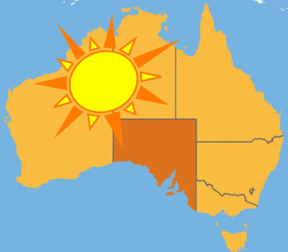
And because the sun is shining in Western Australia after it has gone dark in SA, and its rays hit SA when it is still dark in WA, supply and demand would be evened out.
Professor Andrew Blakers from the Australian National University is working on supergrids and ideas for energy storage in SA. He said there were no financial figures yet, but that SA was in a “pivotal position”.
“An HVDC (high-voltage, direct-current) cable across the desert west to Perth would stabilise the SA system and allow time-shifting … WA is two or three hours behind,” he said. “That would reduce the storage.
“The idea would be you run west. There’s great sun and wind all the way from the head of (Spencer) Gulf to Perth. You’d pick up wind and solar farms along the way.”
The interconnector could then be connected to a new interconnector to the east coast, an option currently under discussion.
Prof Blakers, a professor of engineering, is also talking to the State Government about energy storage through pumped hydro. He says the technology – where water is pumped up to a small reservoir when energy is cheap then released when demand is high – could see SA powered by renewables alone.
Federal opposition energy spokesman Mark Butler has described pumped hydro as one of a number of “exciting” technologies that could transform the market. “There’s a really exciting race on between different technologies that are all being supported at different stages here in Australia and all around the world,” he said.
State Energy Minister Tom Koutsantonis said any extra interconnector would need approval, but that the Government was in favour of the east coast leg.
“The State Government believes a new interconnector to New South Wales would put downward pressure on prices and improve grid security, while at the same time allowing more renewables to be exported to the east coast,” he said……..http://www.adelaidenow.com.au/news/south-australia/sa-in-pivotal-position-to-harness-sun-and-wind-to-stabilise-our-energy-system-says-expert/news-story/4fcf455f7e6f4883eeed3a93f7283319
February 3, 2017
Posted by Christina Macpherson |
energy, South Australia |
Leave a comment
At Woomera, I go to look at the grave monuments in the cemetery on the hill outside the town. There are multiple still births and infant deaths, often in the same family. People don’t like to talk about it, but there are stories of women wailing in the streets, driven by unassuagable grief. A local urban myth held that if a pregnant woman stood on the hill facing Maralinga during a bomb test, the sex of the foetus would be revealed in x-ray silhouette……….
This land is already a nuclear waste dump. The locations and proposals change, but the same apparent “emptiness” that brought rockets, nuclear tests and detention centres now attracts commercial interest in storing nuclear waste from other nations. It’s the end of a cycle that starts with the mining and export of Australian uranium. The redistribution of uranium is a very Anthropocene process, part of the dismantling and reassembling of the planet.
Friday essay: trace fossils – the silence of Ediacara, the shadow of uranium, The Conversation, Alice Gorman, Senior Lecturer in archaeology and space studies, Flinders University , February 3, 2017 As an archaeologist working in the remote areas around Woomera and the Nullarbor Plain, my understanding of South Australia was first informed by rocks and soil. This was a landscape of fossils and trace fossils – the preserved impressions left by the passage of a living body through sediment – jostling for attention. On this land surface, SA presents an arc extending from the “death mask” fossils of early multicellular life to the human leap into the solar system. Sure, you might say, this could be said of other locations on Earth. But here it seems laid bare for any who can read the distinctive pattern of signs.
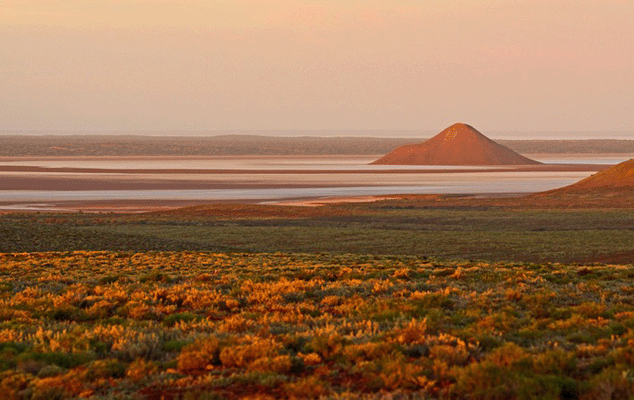
This was once a shoreline in a silent world. ……..
The fossilised fronds and pancake worms of the fauna from the
Ediacaran geological period (635–542 million years ago) are now on display at the South Australian Museum. ……..
Aboriginal people would have noted but passed over the sedimentary rocks that preserved the Ediacara fauna. Instead, they searched for
chalcedony,
chert, and
silcrete. With an understanding of how these stones fracture, you can make a cutting edge sharper and more sterile than a metal surgical blade. Glassy veins of such stone, nacreous in their own way, occur throughout the Nullarbor plain…….
February 3, 2017
Posted by Christina Macpherson |
environment, South Australia |
Leave a comment
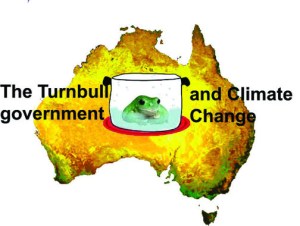 New coal plants wouldn’t be clean, and would cost billions in taxpayer subsidies, The Conversation, Frank Jotzo, Director, Centre for Climate Economics and Policy, Australian National University February 2, 2017 Following a campaign by the coal industry, Prime Minister Malcolm Turnbull has argued for new coal-fired power stations in Australia. But these plants would be more expensive than renewables and carry a huge liability through the carbon emissions they produce.
Major Australian energy companies have ruled out building new coal plants. The Australian Energy Council sees them as “uninvestable”. Banks and investment funds would not touch them with a barge pole. Only government subsidies could do it.
It may seem absurd to spend large amounts of taxpayers’ money on last century’s technology that will be more costly than renewable power and would lock Australia into a high-carbon trajectory.
But the government is raising the possibility of government funding for new coal plants, with statements by Deputy Prime Minister Barnaby Joyce, Treasurer Scott Morrison and Environment and Energy Minister Josh Frydenberg. The suggestion is to use funding from the Clean Energy Finance Corporation. For this to happen, presumably the CEFC’s investment mandate would need to be changed, or the meaning of “low-emissions technologies” interpreted in a radical way.
It should come to nothing, if minimum standards of sensible policy prevailed.
But an ill wind is blowing in Australia’s energy and climate policy debate. The situation in parliament is difficult, and the Trump presidency is giving the right wing in the Coalition a boost.
Definitely not ‘clean’……https://theconversation.com/new-coal-plants-wouldnt-be-clean-and-would-cost-billions-in-taxpayer-subsidies-72362
February 3, 2017
Posted by Christina Macpherson |
AUSTRALIA - NATIONAL, climate change - global warming |
Leave a comment

 Clean coal explained: Why emissions reductions from coal remain a pipe dream http://www.abc.net.au/news/2017-02-02/clean-coal-explained/8235210 ANALYSIS
By Stephen Long “Clean coal” has been the holy grail of the fossil fuel industry for decades: the concept of creating commercially-viable ways of stopping the carbon emissions from coal-fired electricity plants which contribute to global warming.
Advocates use the phrase to describe two different technologies: carbon capture and storage; and highly efficient, lower emissions coal-fired power stations.
Carbon capture and storage is based on the principle of catching the carbon emissions, or CO2, from burning coal before they are released into the atmosphere.
It works by forcing the exhaust from a coal-fired power plant through a liquid solvent that absorbs the carbon dioxide, heating the solvent to liberate the gas, then compressing it and sending it away for storage underground.
Great in principle, but the technology faces big hurdles in practice.
One is the huge cost and logistical challenge of transporting all the captured carbon dioxide and burying it.
It would require a vast network of pipelines and storage sites. As one doubter observed: “Collectively, America’s coal-fired power plants generate 1.5 billion tons per year. Capturing that would mean filling 30 million barrels with liquid CO2 every single day — about one-and-a-half times the volume of crude oil the country consumes.”
The cost of building the required infrastructure would be enormous and the time periods involved may be too long to prevent the risk, identified by the consensus of expert scientists, of potentially catastrophic climate change.
The International Energy Agency (IEA) has found that the world would need to capture and store almost 4 billion tonnes per annum of CO2 in 2040 to keep global warming to 2 degrees Celsius above pre-industrial levels.
Far more would be needed to limit it to 1.5C, the target agreed to by 195 nations at the Paris climate conference in 2015.
Yet current carbon capture capacity for projects in operation or under construction sits at approximately 40 million tonnes per annum.
We also don’t know if all gas would stay buried. While scientists are confident that there are geologically stable areas that could keep the carbon underground for very long periods, there is a risk of carbon seeping into the atmosphere.
To date, the technology is not commercially viable.
‘Cleaner coal’ sometimes mislabelled ‘clean coal’ http://www.abc.net.au/news/2017-02-02/clean-coal-explained/8235210High efficiency, low-emission power stations, also known as ultracritical or supercritical coal-fired power plants, are sometimes also labelled as “clean coal”.
Continue reading →
February 3, 2017
Posted by Christina Macpherson |
AUSTRALIA - NATIONAL, climate change - global warming |
Leave a comment
 How Malcolm Turnbull could ignore the facts and fund the myth of ‘clean’ coal, Guardian, Michael Slezak 2 Feb 17 “….. Turnbull said in his National Press Club speech on Wednesday that “it’s security and cost that matter most, not how you deliver it”.
But new coal technology is not cheaper than renewable energy.
The US Energy Information Agency recently compared the cost of energy from various types of coal power plants and renewable energy plants.
They found that ultra supercritical coal power plants were about twice as expensive to build per unit of energy, compared to wind farms, and almost 40% more expensive than solar farms. Then coal power stations have higher ongoing maintenance costs, as well as significant fuel costs, compared with the wind and solar where the fuel is free.
Dylan McConnell from the Melbourne Energy Institute at the University of Melbourne said if those costs were recovered through energy prices, that would push energy prices up.
Tennant Reed from the Australian Industry Group recently pointed outthat wholesale electricity prices that are currently worrying big energy consumers have been sitting at about $75 per MWh. But recent projections by the CSIRO suggest the ultra supercritical coal generators would produce electricity at a cost of about $80 per MWh.
“To build a coal plant with such costs, investors would need to expect wholesale prices to rise even above looming levels and stay there for decades,” Reed wrote.
Reed also pointed out that the $80 per MWh projection was optimistic, since it was assuming that the power plants were being used at about 80% of their capacity, which was much higher than was generally the case.
Meanwhile, new wind and solar will produce electricity at about $75-85/MWh today and that price will decrease in coming years.
Buckley says: “So renewables are already at grid parity or cheaper than new USC coal-fired power, they can be built more modularly and five times faster, they have 100% emissions reduction relative to the PR spin called ‘clean coal’, they conform to our Paris CO2 commitments and they are likely to get finance – unlike a new coal-fired power plant.” https://www.theguardian.com/environment/2017/feb/02/how-malcolm-turnbull-could-ignore-the-facts-and-fund-the-myth-of-clean-coal
February 3, 2017
Posted by Christina Macpherson |
AUSTRALIA - NATIONAL, climate change - global warming, politics |
Leave a comment
 West Australians embrace solar panels at record rate http://www.abc.net.au/news/2017-01-31/solar-power-embraced-by-west-australians-at-record-rate/8227194 By Kathryn Diss WA households and businesses are installing solar panels at a record rate, with installations up 33 per cent last year, driven by rising power prices and the falling cost of the technology, new research has found.
The data, compiled by solar industry consultancy SunWiz, also revealed ten of the nation’s top 20 solar-adopting suburbs were in WA, with Wanneroo, Mandurah and Armadale leading the way.
Sunwiz managing director Warwick Johnston said two factors were driving the uptake in WA.
“We’re seeing solar prices have come down to levels they’ve never been before — prices in Perth are at their lowest compared to the eastern states — and we’re also seeing the electricity price rises really kicking in in Western Australia”, he said.
“In Perth electricity prices started climbing again and [are] expected to do so for a number of years, so I think that’s in people’s minds, in people’s consciousness when they’re thinking about solar power.
“Those factors are really making solar something people are interested in.”
The huge uptake in solar panels during 2016 provided a boon for solar installers across the state.
Solargain WA sales manager James Baverstock has been selling solar panels since 2008 but 2016 was his best year yet, with unprecedented sales during the last three months of the year.
“Towards the end of 2016 we saw record numbers — we were 80 per cent up compared to the same time during the previous year,” he said.
“The average size of the system has also gone up, we’ve seen that go up a kilowatt to a kilowatt and a half. That’s been a steady increase and [it has] certainly accelerated a little bit more recently.
Leading change
The research came as more than 40 interest groups joined forces in WA to call for action on climate change. Headed by doctors, farmers and church groups, the coalition wants the government to commit to an ambitious renewable energy target of 100 per cent by 2030.
General practitioner Richard Yin spoke on behalf of the coalition and said a shift towards renewable energy was essential. “We understand the target is ambitious but it’s been modelled as being possible and it’s been modelled in such a way we believe it can achieved,” he said.
“Everything has a cost. To not proceed down this line has an effect on our climate, to not proceed has a health impact, the combustion from coal kills many thousands of people in Australia each year and the estimated cost is about $2.6 billion in terms of our health cost.” Former WA doctor and surgeon Kingsley Faulkner is also behind the movement.
He now chairs Doctors for the Environment and said climate change was having a big impact on public health.
“In medicine we have a real responsibility to not only treat individual patients but to be involved with public health matters, and climate change and other environmental challenges are amongst the biggest of those matters,” he said.
Increasing use of solar panels has come at a time when, according to the state’s economic watchdog, households are increasingly struggling to pay their power bills on time.
February 1, 2017
Posted by Christina Macpherson |
solar, Western Australia |
Leave a comment
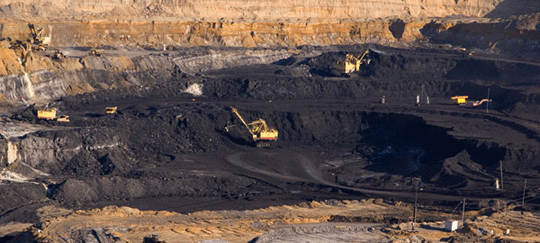 Most Australians oppose government’s $1bn Adani loan for coal railway line https://www.theguardian.com/environment/2017/jan/31/most-australians-oppose-governments-1bn-adani-loan-for-coal-railway-line
More than half of Liberal voters also oppose plan to loan Indian company $1bn to build a rail line between proposed Carmichael coalmine and Abbot Point, Guardian, Michael Slezak, Three-quarters of Australians, including most Liberal voters, oppose the government giving a $1bn loan to Adani to build a rail line between its proposed Carmichael coalmine and the Abbot Point shipping terminal.
The government’s Northern Australia Infrastructure Fund (Naif) granted Adani “conditional approval” for a $1bn loan in December last year.
The rail line, if built, would allow Adani to build the country’s biggest coalmine and open up the Galilee Basin to further mines by linking them to an export terminal.
Coral scientists have argued the coal needs to stay in the ground if the Great Barrier Reef is to be protected from the impacts of climate change.
The government has argued there is no definite link between the coal from the Adani mine being burned and climate change, and the resources minister, Matthew Canavan, has said the mine would “be a good thing for the environment”.
But a ReachTel poll of 2,126 people across Australia conducted on 12 January, commissioned by GetUp, found 74.4% of respondents said “no” when asked whether “lending $1bn to an offshore mining company to build a coal rail line is a good use of public money”.
Just 16.2% of respondents thought it was a good use of public money, with 9.5% saying they didn’t know.
The opposition was strong regardless of voting intention, with 53.7% of those who said they would vote Liberal opposing the loan. Just over 80% of “undecided” voters, 85.5% of Labor voters and 89.9% of Greens voters said the loan was a bad use of public money.
A previous survey of people living in the region that would host the mine found two-thirds opposed public money being used to support the mine. Analysis from Greenpeace has suggested the rail project does not meet the requirements for a loan under the scheme, since it will not be “of public benefit” and it is not clear Adani will be able to repay the loan.
GetUp’s Miriam Lyons said: “A mere 16% of Australians think this is a good way to invest public money. While we see hospitals and schools starved of resources, the government sees fit to hand over a billion bucks to build Adani’s shiny new train.”
Lyons called on Malcolm Turnbull to stop the loan going ahead.
“Prime minister Turnbull’s not even playing for his own team – only 32% of Liberal voters agree with this use of public money,” she said.
February 1, 2017
Posted by Christina Macpherson |
AUSTRALIA - NATIONAL, climate change - global warming, politics, Queensland |
Leave a comment
 Jobs boost as Snowy Hydro and Equis to build $200m solar power plant near Tailem Bend, Daily Telegraph David Nankervis, The Advertiser January 31, 2017 SOUTH AUSTRALIA’s largest solar farm — with capacity for battery storage back up — will be built at a cost of more than $200 million at Tailem Bend this year.
The solar panels will be able generate power for 40,000 homes and help improve the state’s electricity supply while creating up to 200 jobs during construction, according to Snowy Hydro, which is building the farm in conjunction with renewable energy investor Equis.
The solar farm would generate up to 100 megawatts of energy and the almost 400,000 solar panels would cover 200 hectares, Snowy Hydro, which owns the Snowy Mountains Hydro-Electric Scheme, said.
It added that the capacity for battery storage of up to 100 megawatts would also enhance energy security in the state.
The project also includes a diesel fuelled generator producing 28 megawatts to provide backup power during periods of peak demand.
Snowy Hydro said the site would be the “first large-scale battery ready facility we are aware of’’ in the state. “This is an exciting opportunity for Snowy Hydro to source renewable generation in South
Australia to complement our existing capacity,” Snowy Hydro managing director
Paul Broad said.
“We have been keeping the lights on in NSW and Victoria since construction days in the
1950s and are one of the most experienced and diverse companies operating in the
National Electricity Market.’’
Mr Broad explained that the solar plant was designed to maximise the amount of electricity generated in the late afternoon, when demand for power was typically greatest.
“The solar farm represents a significant, strategic investment in South Australia by Snowy………“Importantly, this unique generation facility at Tailem Bend is also ‘battery ready’ with the ability to install up to 100 megawatts of large-scale battery storage on the site.”…….Snowy Hydro said the solar farm would help power an expansion of its retail business here. http://www.dailytelegraph.com.au/news/jobs-boost-as-snowy-hydro-and-equis-to-build-200m-solar-power-plant-near-tailem-bend/news-story/6a2e033bed2416a3bd304b43572f1272
February 1, 2017
Posted by Christina Macpherson |
solar, South Australia |
Leave a comment
 Abbott to PM: scrap RET or face fury SIMON BENSON The Australian January 30, 2017
Tony Abbott has unleashed another critique on Malcolm Turnbull’s leadership, using his Achilles heel — climate change — to accuse the government of treating voters like “mugs” if it did not scrap the renewable energy target.
In his second swipe at the Prime Minister in as many weeks, his predecessor said the Coalition would lose all credibility if it did not move to quickly rein in the push to generate more renewable energy.
In a speech yesterday to a Young Liberals conference in Adelaide, Mr Abbott accused the government of “losing touch” with its traditional supporters. The escalation of rhetoric contained a charge that the government not only lacked leadership in Mr Turnbull but that the Coalition was at risk of electoral collapse. It also reveals Mr Abbott is willing to risk further alienation from his own government….
“……our first big fight this year must be to stop any further mandatory use of renewable power.”
The comments build on remarks Mr Abbott made two weeks ago but indicate that he has no intention of remaining silent as the government struggles to regain momentum after a horror start to the year.
They come as Mr Turnbull is due to deliver a major speech to the National Press Club in Canberra on Wednesday.
The Prime Minister will becoming increasingly frustrated with Mr Abbott’s intervention on the RET, knowing that the government is unlikely to go as far as Mr Abbott is suggesting……
“Australia has almost limitless reserves of clean coal and gas. We should have the world’s lowest power prices. Instead, we’re making it harder and harder to use coal and gas through the renewable energy target — so that power is getting more expensive and less reliable,” he said…..
“Alcoa is in trouble, Arrium is in trouble, Port Pirie is in trouble, even Roxby Downs has a problem.
……….“What used to be called the silent majority, Hillary Clinton’s ‘deplorables’, might often lack a voice but they sure haven’t lost their vote.
“Voters will punish governments and parties that they think have lost the plot — and so they should.
“So that’s our challenge for 2017: to tackle real problems in a meaningful way so that people’s lives get better, not worse — and to do so in ways that make sense to our strongest supporters.” fury http://www.theaustralian.com.au/news/nation/abbott-to-pm-scrap-ret-or-face-fury/news-story/944645cff4bbaff67fb4ee5da6980dde
January 30, 2017
Posted by Christina Macpherson |
AUSTRALIA - NATIONAL, energy, politics |
Leave a comment
 You can’t live in a museum’: the battle for Greenland’s uranium, Guardian, Maurice Walsh, 28 Jan 17 A tiny town in southern Greenland is fighting for its future. Behind it sits one of the world’s largest deposits of uranium. Should a controversial mine get the green light?
………….Since 2009, the island has been an “autonomous administrative division” within Denmark, giving its 56,000 inhabitants control over local resources. The idea of full independence within a generation or two is the dominant theme of local politics – even if the price of breaking free would be an annual Danish subsidy worth some £7,500 a head……
in 2013, the government granted four times the number of exploration licences approved in 2003 – so has the pressure to repeal a 1988 ban on uranium mining: this prevented the extraction of uranium, as well as any minerals that might have uranium as a byproduct. In 2013, after a debate that divided the country,
Greenland’s parliament voted narrowly to repeal the ban.
Kvanefjeld, near Narsaq, is one of many potential mines. Last month, an Australian company was given the green light to begin construction of a zinc and lead mine on the northern coast; there are currently
56 active licences to exploremining for gold, rubies, diamonds, nickel, copper and other minerals elsewhere.
But uranium has made Kvanefjeld the most controversial project, and the focus of a debate about whether this is the economic path that Greenland should pursue. (The most common argument raised against is the danger that radioactive dust will fall on neighbouring settlements and farmland.) An Australian-owned company, Greenland Minerals and Energy (GME), has spent nearly £60m developing a plan for an open pit mine here. It was due to submit an environmental impact assessment by the end of 2016, but the deadline has been extended……….
In a move that sounds counterintuitive, GME is promoting its mine as a contribution to the new global green economy. According to the company, 80% of the commercial deposits in Kvanefjeld are rare earth minerals, commonly used in wind turbines, hybrid cars and lasers; uranium accounts for only 10%. “The market for rare earth minerals is deciding this,” says operations manager Ib Laursen. “Everybody is looking for them. Instead of Greenland being a passive receiver of global warming from the western world, it could contribute to green technology.”
It is a clever pitch. Greenland’s ice sheet has become the benchmark measurement for the march of global warming; research published in September showed that ice loss is accelerating more rapidly than previously feared. Greenland is also the emblematic victim of climate change: Inuit hunters and fishermen are called on in international conferences, to describe how their traditional lifestyles are being destroyed by warming seas.
But what the rest of the world see as creeping ruination, local politicians see as an opportunity. The melting ice sheet will make some minerals more accessible, and reveal others that are so far unknown.
……….Most of the world’s rare earth minerals come from China (six state-owned enterprises control nearly 90% of the planet’s supply), and the scale of environmental degradation there has given open pit mining a bad reputation. Concerned locals in Greenland invoke images of wasted landscapes and pools of toxic and radioactive waste, gleaned from a Google search. Similarly, the history of uranium mining has been one of blithe disregard for the environment……
Laursen.presents his mine as an environmentally friendly alternative to Chinese mines, modelled on international standards of best practice. He says the fears of radioactive dust floating over south Greenland are groundless. The crushed rock discarded once the minerals have been extracted, known as tailings, will be turned into slurry and carried in a pipeline to the bottom of a nearby lake. “It would never surface as dust,” Laursen says: the lake will be sealed in perpetuity by an impermeable dam……..
Frederiksen (sheep farmer) was alert to the dangers of radioactive dust because he had studied sheep farming in Norway in the mid-90s, when animals there were still affected by the fallout from Chernobyl. The scientists said they would remove dust from the mine by sprinkling it with water. “Well, water is usually frozen here in the winter,” Frederiksen tells me now, “so I asked them, ‘How are you going to have water to sprinkle then?’ And they said they would answer that when the environmental impact assessment arrived. When someone asked if it was possible to have no pollution in a mining area, the elderly man told us there had never been mining without pollution.” Frederiksen and Lennert believe most of the sheep farmers oppose the mine, but they avoid too many conversations about it just in case: polarisation risks harmony, and they might need each other in difficult times……….
In the past two elections, the people have decided, by voting for parties that support the uranium mine. Now, Qujaukitsoq says, it is a decision for the government. “Are we hesitant? No. We have no reservations about creating jobs.” For him it is the only way of saving Narsaq from stagnation. Whatever image the rest of the world cherishes, one thing is clear: Greenland will make its own way in the age of climate change.
• Maurice Walsh travelled as part of the Arctic Times Project, an international team exploring the transformation of the Arctic.more https://www.theguardian.com/environment/2017/jan/28/greenland-narsaq-uranium-mine-dividing-town
January 30, 2017
Posted by Christina Macpherson |
AUSTRALIA - NATIONAL, politics international |
Leave a comment
 “The absolute beauty of Tasmania’s situation is that anything you do with solar or wind, we don’t need to worry too much about the intermittent nature of it,” he said.
“We’ve got the hydro which can generate a lot of electricity but it can’t do it all the time.
“Any time of the day that you generate electricity with solar or wind is saving running water out of the dams and then that gives you energy security.”
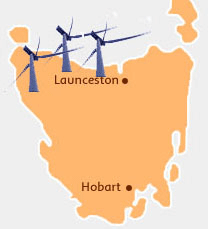
The expansion of renewable energy in Tasmania,  Examiner, 29 Jan 2017 Tasmania has the potential to become the envy of the world when it comes to renewable energy, according to our leaders.
There is no doubt energy was a hot topic in 2016. This time last year, Tasmania had a broken Basslink cable and it would not be fixed for another five months. Hydro Tasmania’s water storage levels were down to 19 per cent, but had dipped lower in previous months.
Not long before the Basslink cable broke, the government had given approval for Hydro Tasmania to decommission and sell the combined cycle gas turbine at the Tamar Valley Power Station, which would later become an essential piece of infrastructure.
As the crisis unfolded, the importance of the power station became clear, it was not sold, and was eventually up and running again.
This crisis led to the establishment of an Energy Security Taskforce which, in its interim report, found the state had a deficit of renewable energy generation and that more on-island hydro-electric and wind generation was needed.
“A more secure setting would be created if this deficit was reduced or eliminated by new entrant renewable energy developments,” the report said.
Already, renewable energy is meeting an average of 80 per cent of Tasmania’s energy demands.
But questions have been raised over whether enough is being done to attract further renewable energy investment into the state. Continue reading →
January 29, 2017
Posted by Christina Macpherson |
energy, Tasmania |
Leave a comment
Neither Canavan nor Frydenberg responded to questions about the costs of building new coal power stations
Australia’s coal power plan twice as costly as renewables route, report finds
Researcher says new coal plants aimed at reducing emissions would cost $62b, while the cost using renewables would be $24-$34bn, Guardian Michael Slezak, 27 Jan 17, A plan for new coal power plants, which government ministers say could reduce emissions from coal-generated electricity by 27%, would cost more than $60bn, a new analysis has found.
 Achieving the same reduction using only renewable energy would cost just half
as much – between $24bn and $34bn – the report found.
The resources minister, Matthew Canavan, and the energy and environment minister, Josh Frydenberg, have been arguing for new coal power plants to be built in Australia. Continue reading →
January 28, 2017
Posted by Christina Macpherson |
AUSTRALIA - NATIONAL, climate change - global warming, energy, politics |
Leave a comment
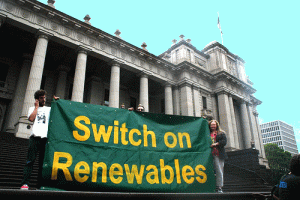 REneweconomy By Jonathan Gifford on 25 January 2017 Peak renewables bodies are looking to mount a campaign to highlight the troubling implications of ERM Energy’s decision to pay shortfall penalties rather than purchase and surrender the certificates for which it is liable under the Renewable Energy Target (RET).
While ERM maintains it is meeting its formal obligations, critics counter that it is acting against the spirit and intent of the legislation and fear that other electricity retailers may follow suit.
ERM’s decision, announced on Tuesday, to pay a $123 million penalty rather than surrender its required number of large scale renewable (LGC) certificates is looming as a major challenge to the Renewable Energy Target and enabling legislation.
ERM predicts that RET compliance levels from electricity retailers may fall from the current and previous levels of 99%, to something like 80% this year, indicating that other retailers are looking to follow suit and pay penalties rather than acquire LGCs.
In short, it is looking increasingly apparent that due to unintended consequences of RET legislation, money meant to go towards renewable energy projects will instead go directly into government coffers, in the form of penalty payments.
“This is a litmus test, it’s a setup,” says the Australian Solar Council’s John Grimes. “I talked in detail at the time of the efforts of the Abbott Government to abolish to the RET that this issue was the ‘Cuckoo egg’ in the nest and the trigger for the government to re-litigate and abolish the RET entirely.”
Grimes says that as a likely shortage of large scale renewable projects and then LGCs – the result of the Abbott government’s “disruption” of the RET and sector – has directly lead to the decision by ERM and others to make penalty payments.
“The [federal] government can then say that this is an expensive scheme, that it costs money but doesn’t deliver renewable energy,” says Grimes.
The ASC says that it plans to “shine a spotlight on the commercial entities looking to skirt their obligations under the RET legislation.”
Grimes notes that as ERM serves commercial customers, it does not have a large residential customer base that could potentially make a switch of retailer on the basis of this week’s decision. The company is the fourth biggest retailer and the second biggest provider of electricity to the business sector.
The ASC has named the ANZ Bank as a major ERM Energy client and is looking to build a larger list of customers on which to put pressure.
The Clean Energy Council also notes that big customers of ERM Power include the New South Wales and Queensland Governments.
“These governments and other customers should be asking why ERM has made a decision not to meet their obligations or support renewable energy projects which will deliver major economic benefits to regional parts of Queensland and New South Wales,” said the CEC’s Kane Thornton, in a statement.
Clean Energy Regulator chairwoman Chloe Munro said it viewed the “intentional failure” to surrender certificates “as a failure to comply with the spirit of the law and an undermining of the objectives of the scheme.” She said the money would be better spent as an investment in a growing industry rather than a financial penalty that has no return.
We believe many customers would be disappointed to know that this money has not been used for the intended purpose,” she said…….http://reneweconomy.com.au/renewable-energy-groups-mobilise-as-erms-ret-shortfall-looms-as-major-test-51422/
January 26, 2017
Posted by Christina Macpherson |
AUSTRALIA - NATIONAL, energy |
Leave a comment
 National Radioactive Waste Management Facility project 20 January 17 Community members are often concerned how a radioactive waste management facility will affect the reputation of their town.
In the week starting February 6 the project team will host a delegation from the Champagne region in France which hosts a low to intermediate-level radioactive waste management facility.
The delegation will include representatives from the French national radioactive waste management agency ANDRA. The international visitors can talk about the interaction of its facility in Champagne with the tourism and agricultural industries in their local areas.
The Australian Nuclear Science and Technology Organisation (ANSTO) and Geoscience Australia (GA) will visit Hawker and Quorn in the week starting February 6.
ENuFF[SA] https://www.facebook.com/sanuclearfree/
January 26, 2017
Posted by Christina Macpherson |
AUSTRALIA - NATIONAL, Federal nuclear waste dump, South Australia |
Leave a comment