 Early skirmishes point to a war over renewable energy lasting well into 2017, The Age, Peter Hannam, 15 Jan 17 “……Trenches are now being dug for what looms as a political battle that will probably last through 2017. On one side lie the Turnbull government, fossil fuel suppliers and right-wing pundits, who say the priority has to be affordable and reliable power.
 On the other, Labor and the Greens and clean-energy backers who argue ageing coal-fired power stations need to prepare for an orderly if not accelerated exit to meet Australia’s commitments agreed in the Paris climate treaty.
Josh Frydenberg, environment and energy minister, ended holidays early on Thursday to rail against states for curbing unconventional gas exploration, which also feeds into higher  electricity prices. That’s especially true in SA where gas provides all the power that’s not from wind or the sun.
He took particular aim at Queensland, where the Labor government under  Annastacia Palaszczuk is aiming for a 50 per cent share of renewable by 2030, up from 4.4 per cent in 2015………
Frydenberg’s Labor counterpart, Mark Butler, though, says the Coalition’s energy policy was “being dictated by the hard right of the party with the likes of Tony Abbott and Cory Bernardi”.
“The culture-war element starts to blind people to pretty clear policy,” he says, noting three-quarters of Australia’s fleet of power stations were operating beyond the end of their design life and needed to be replaced.
“The Turnbull government leaves a policy vacuum at the federal level, the states will fill the void,” he says.
Federal Labor remains committed to a 50 per cent renewable share by 2030, he said, noting the Turnbull government has no target beyond 2020 nor is a target among the terms of reference for its 2017 climate policy review. NSW Labor shares the party’s national goal……
Abbott, as if on cue, weighed into the renewables debate on Saturday……
What is certain is that energy bills are on the rise – although the causes are highly debated…….
Bruce Mountain, an energy economist with CME Australia, says rising energy prices will prompt more people to add solar panels and also batteries as prices continue to tumble – much faster than regulators predict.
Tesla’s new 13.5-kilowatt-hour Powerwall 2, costing about $8800 before installation, already offers a lower battery price than AEMO had predicted for 2040, he says
An average household in Adelaide, where power prices have doubled in the past eight years to be among the highest in Australia, would now be better off with panels and storage.
While panels alone typically slash demand for electricity from the grid by a third, adding a battery will reduce grid purchases by about 95 per cent, he said.
‘Existential threat’
Dylan McConnell, a research fellow at the Melbourne Energy Institute, notes AEMO is predicting 15.5 gigawatts of coal-fired power plants will be shut by 2030. That’s about half of such stations and equivalent to 10 Hazelwoods.
Importantly, AEMO is betting 12GW of new gas-fired power will come on stream “assuming no alternative technologies come to fruition”, Mr McConnell said.
However, the open-cycle gas plants that can provide peaking power to complement variable suppliers such as wind and solar farms “face an existential threat from batteries”, he said……..
Without clear signals, investors won’t have the confidence to invest the billions needed to bring new, more efficient capacity online.
RET challenges
Bloomberg New Energy Finance underscored the scale of the challenge even meeting the 2020 Renewable Energy Target of supplying 33,000 gigawatt-hours from clean energy annually from 2020.
Last year, investment in large scale renewables under the RET bounced back from a meagre $US10 million in 2014 and 2015 after the Abbott government’s review of the sector threw it into a panic. In 2016, it recovered to $US1.1 billion ($1.45 billion).
“However it is still well below the $US2.9 billion per annum now needed to satisfy the notional 20 per cent target by 2020,” Bloomberg said.
Greens energy spokesman Adam Bandt says the Coalition will be tempted to stir up fears of rising electricity prices “in the hope that they can repeat 2013”, when Tony Abbott swept to power in part because of the carbon tax issue.
“They’ll try to beat the electricity bill drums but the prices are going up on their watch,” he says……… http://www.theage.com.au/environment/climate-change/early-skirmishes-point-to-a-war-over-renewable-energy-lasting-well-into-2017-20170111-gtpsd9.html
January 15, 2017
Posted by Christina Macpherson |
AUSTRALIA - NATIONAL, energy, politics, solar, storage |
Leave a comment
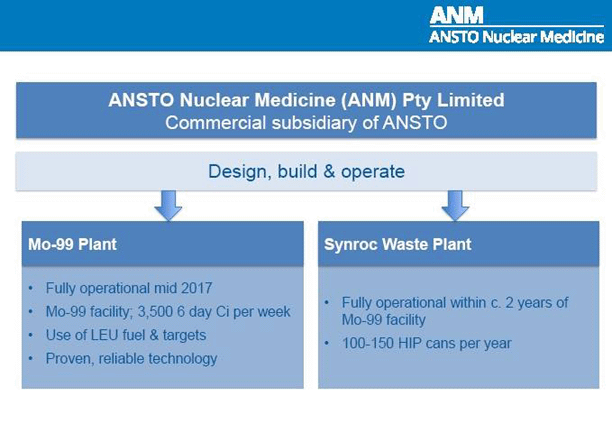
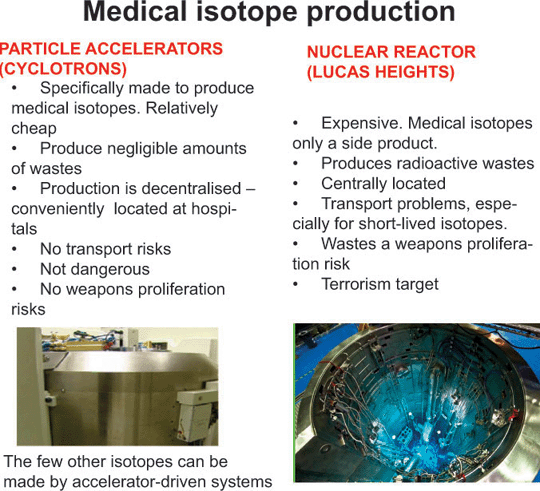
ANSTO’s link http://www.nuclearaustralia.org.au/ansto-nuclear-medicine-project/ This is a slide from the above link. ANSTO Nuclear Medicine (ANM) Pty Ltd is a commercial subsidiary of ANSTO.
So a company is going to cream off the profits while Australian taxpayers subsidise the reactor and the waste disposal – and communities have to deal with the costs of a nuclear waste dump. Another slide says “Full Cost Recovery Model” – the full cost can never be recovered when you are dealing with nuclear waste.
January 14, 2017
Posted by Christina Macpherson |
AUSTRALIA - NATIONAL, politics, secrets and lies |
Leave a comment
Steve Dale Fight To Stop Nuclear Waste Dump In Flinders Ranges SA., 14 Jan 17, Canada is moving towards clean Cyclotrons for Molybdenum-99 production – yet Australia decides it wants to undermine worldwide Cyclotron development by subsidising Mo-99 for the world. Waste taxpayer’s money to produce unnecessary nuclear waste.
“The ANSTO Nuclear Medicine (ANM) Project will enable ANSTO to triple production of Molybdenum-99 (Mo-99). The increased capacity will enable Australia to meet domestic demand, as well as being able to supply up to 25-30% of global demand.”

January 14, 2017
Posted by Christina Macpherson |
AUSTRALIA - NATIONAL, health, politics |
1 Comment
US ‘threatens to involve Australia in war with China’: Paul Keating condemns US secretary of state nominee’s comments, The Age, Fergus Hunter, 14 Jan 17

Former prime minister Paul Keating has rounded on President-elect Donald Trump’s secretary of state nominee, accusing him of threatening to bring on war with China and making “ludicrous” comments on the tense South China Sea dispute.
In a statement released on Friday, Mr Keating warned the Australian government to reject Rex Tillerson’s declaration this week that a “signal” needed to be sent to Beijing that the construction of artificial islands in the contested region must stop and “access to those islands also is not going to be allowed”. The remarks from the former chief of Exxon Mobil, in which he also called for regional allies “to show backup”, have set the stage for sharply increased tensions between the US and China as the Asian superpower builds up its military presence on the islands to defend against competing territorial claims from neighbouring countries.
According to Mr Keating, Mr Tillerson’s testimony to his US Senate confirmation hearing “threatens to involve Australia in war with China”. And he has urged the Australian people to “take note” and recommended the government tell the Trump administration, which will take over on January 20, “that Australia will not be part of such adventurism, just as we should have done in Iraq 15 years ago”. “That means no naval commitment to joint operations in the South China Sea and no enhanced US military facilitation of such operations,” the former Labor prime minister said.
“Tillerson’s claim that China’s control of access to the waters would be a threat to ‘the entire global economy’ is simply ludicrous. No country would be more badly affected than China if it moved to impede navigation. On the other hand, Australia’s prosperity and the security of the world would be devastated by war.”……… http://www.theage.com.au/federal-politics/political-news/us-threatens-to-involve-australia-in-war-with-china-paul-keating-condemns-us-secretary-of-state-nominees-comments-20170113-gtqy0k.html
January 14, 2017
Posted by Christina Macpherson |
AUSTRALIA - NATIONAL, politics, politics international |
Leave a comment
 Adani coalmine activists gear up to fight: ‘This will dwarf the Franklin blockade’
As the protest against the Carmichael project – Australia’s largest proposed coalmine – moves beyond the courts and into the realm of civil disobedience, activists have a clear warning: ‘If you’re in bed with Adani, you’re a target’, Guardian, Joshua Robertson, 14 Jan 17, Across Australia a secretive network of activists are laying the groundwork for what they expect will be the biggest environmental protest movement in the country’s history.
Of course this won’t materialise if Adani and the rest of the miners proposing to open up one of the world’s biggest coalfields walk away from Queensland’s Galilee basin first.
But standing idly by on the assumption that the economics of the massive coal projects won’t stack up – at a time the world is trying to reduce carbon emissionsto limit global warming to under 2C – is not a choice these activists are willing to make.
And so the campaign to take the fight against Australia’s largest proposed coalmine, Adani’s Carmichael project, to another level, beyond the courts and into the realm of civil disobedience, is under way………https://www.theguardian.com/environment/2017/jan/14/adani-coalmine-activists-gear-up-to-fight-this-will-dwarf-the-franklin-blockade
January 14, 2017
Posted by Christina Macpherson |
AUSTRALIA - NATIONAL, climate change - global warming, Queensland |
Leave a comment
What also isn’t included in any of the above articles is that China is also investing 2.5 trillion yuan, the equivalent of $US361 billion in renewable power generation by 2020.
 Environmental spin: An example of media disunity on renewable energy, Independent Australia, Melanie McCartney 14 January 2017, We can’t keep ignoring the ginormous elephant that is renewable energy in our economic policy, writes Melanie McCartney.
LAST SUNDAY, I surfed the ABC news website and clicked onto this headline:
‘China fights pollution: New environmental police squad to battle heavy smog’.
The article seemed a little threadbare. When this occurs I search further and ideally for an article in the country relevant to the article. I like to get more details this way. I decided to try something different this week and scanned the headline blurbs on the first Google page.
I noticed that all of the articles, bar two, started the same:
‘Officials in Beijing create a new environmental police squad in the latest effort to fight China’s persistent…’………
What also isn’t included in any of the above articles is that China is also investing 2.5 trillion yuan, the equivalent of $US361 billion in renewable power generation by 2020.
On 5 January, Fortune reported:
The investment will create over 13 million jobs in the sector, the National Energy Administration (NEA) said in a blueprint document that lays out its plan to develop the nation’s energy sector during the five-year 2016 to 2020 period.
The announcement comes only days after Beijing, the Chinese capital, and other cities in China’s industrial north-east were again engulfed in hazardous smog, caused largely by coal-fired power generation.
The NEA said installed renewable power capacity including wind, hydro, solar and nuclear power will account for about half of new electricity generation by 2020.
Personally, I was aware of China’s five-year-planning but not of the lofty renewable energy target above until I started to write this. The Turnbull Government’s energy policies look dismal when compared to this news. It’s not right that the media has missed this, when so many Australians, especially Indigenous Australians care and value nature and worry about the repercussions of our climate changing. China is the world’s biggest investor not just in energy but in renewable energy. Its citizens need to be able to breathe, just like the developed countries. The rest of the developing countries will follow too.
We can’t keep ignoring the ginormous elephant that is renewable energy in our economic policy. This is harming not just investment hopes within our country and overseas investors but also within our communities. The uncertainty and lack of long-term planning only opens us up to further exploitation by multinational corporations and or foreign countries. China is the world’s biggest producer and investor in solar energy now.
Australia still has a chance, together — not on an elitist path, but closer to an egalitarianism one. One that questions authority. If journalists can’t or won’t do it, we, the people, will have to. It’s the pioneering Aussie way after all.
You can read more from Melanie McCartney on her blog or you can follow her on Twitter@CartwheelPrint. https://independentaustralia.net/environment/environment-display/environmental-spin-an-example-of-media-disunity-on-renewable-energy,9918#.WHlBFksjta4.twitter
January 14, 2017
Posted by Christina Macpherson |
AUSTRALIA - NATIONAL, media |
Leave a comment
Funding boost for renewable sector to prepare ACT for green future http://www.canberratimes.com.au/act-news/funding-boost-for-renewable-sector-to-prepare-act-for-green-future-20170110-gtp8vm.html Clare Sibthorp 11 Jan 17
The ACT government hopes a funding boost to the local renewable sector will take the territory one step closer to a green future.
Two new grant programs launched by Climate Change and Sustainability Minister Shane Rattenbury aim to shape the ACT as an export-oriented hub for renewable energy innovation and investment.
The new Direct Grants Stream will provide grants of more than $30,000 to businesses developing renewable technologies.
The Innovation Connect Renewables Stream will feed extra cash into the ACT government’s existing Innovation Connect grants program, allocating $120,000 to the development of innovative products and services in the renewable sector in 2017.
Mr Rattenbury said the programs would be financed from the $12 million industry-funded Renewable Energy Innovation Fund.
He said the ACT was on track to be fully powered by renewables by 2020. “The grants announced today are designed to grow the renewable energy industry, help organisations take the next step in commercialising their technology and reduce deployment costs of renewable energy and energy storage,” he said.
Jobs growth in the ACT renewable energy sector in the past six years was 12 times faster than the national average, a report into the territory government’s action on climate change revealed.
The Minister’s Report into Climate Change and Greenhouse Gas Reduction also showed the rate of job growth in the ACT’s renewables sector was six times higher than any other state and territory, as the government invested $12 million into a renewable energy industry development strategy.
January 12, 2017
Posted by Christina Macpherson |
ACT, business, energy, politics |
Leave a comment
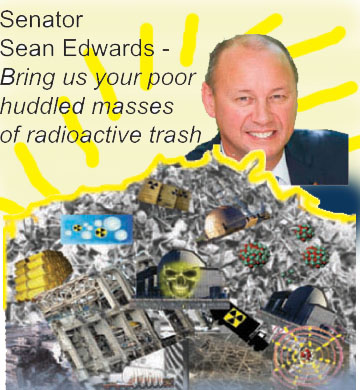
FORMER Liberal Senator Sean Edwards is considering a run for SA Parliament at next year’s election, and has refused to rule out one day standing for party leadership.
The pro-nuclear campaigner today said he was being approached by party members and backers to return to politics, after losing his spot in the Senate at last year’s federal election. Mr Edwards said he was not ruling anything out, and may stand for Liberal preselection in the Port Pirie-based seat of Frome, where independent minister Geoff Brock is currently the MP…….
Mr Edwards has been a vocal supporter of the nuclear industry, and urged the state Liberals to reverse their blanket opposition to further investigation of options, including a dump, for SA. “I never finished my political agenda,” he said……..
To win preselection to stand in Frome, Mr Edwards would need the backing of local branch members.
Liberal MPs canvassed about his chances of becoming leader have ridiculed the concept. http://www.adelaidenow.com.au/news/south-australia/former-liberal-senator-sean-edwards-considers-run-for-state-parliament-refuses-to-rule-out-standing-for-party-leadership/news-story/f088e056d1da90e5a6156282ca38892a
January 12, 2017
Posted by Christina Macpherson |
politics, South Australia |
Leave a comment
 Ex-Lib senator Sean Edwards backed by nuclear dump supporters The Australian, MICHAEL OWEN, 12 Jan 17 A high-powered group of South Australians, angry over the abandonment of bipartisan support to study a nuclear waste repository, are backing a push by former Liberal senator Sean Edwards to enter state parliament.
Mr Edwards, who lost his seat at last year’s election after being bumped down his party’s ticket, is an outspoken advocate of South Australia playing a greater role in the nuclear fuel cycle……
South Australians are due to go to the polls in March next year, with a redistribution putting the Liberals in the box seat.
The Australian understands Mr Edwards is set to nominate for preselection for the seat of Frome, a traditionally Liberal electorate seated in the industrial city of Port Pirie and the agriculture areas of Clare and Gilbert valleys, where the former senator owns a wine business…..
Several of those understood to be backing Mr Edwards were among a group of 21 who last month signed an open letter urging politicians to continue to explore a nuclear waste dump.
Adelaide Crows chairman Rob Chapman, Coopers brewery chief Tim Cooper, former Cricket Australia chairman Creagh O’Connor and industry chief Robert Gerard were among the signatories. Mr Gerard has donated more than $1 million to the Liberals. Dr Cooper donated $22,000 to the party in 2014-15…… http://www.theaustralian.com.au/national-affairs/state-politics/exlib-senator-sean-edwards-backed-by-nuclear-dump-supporters/news-story/7825d323332eb36c6577cee2357c940a
January 12, 2017
Posted by Christina Macpherson |
politics, South Australia |
Leave a comment

East Timor villages lit up by solar from Australian not-for-profit http://www.pv-tech.org/news/east-timor-villages-lit-up-by-australian-not-for-profit By Tom Kenning Jan 12, 2017
An Australia-based not-for-profit, the Alternative Technology Association (ATA), has installed hundreds of household solar lighting systems across 12 villages in East Timor.
The two-year project was completed in partnership with two local partners, CNFP and Natiles, and with funding from the Google Impact Challenge 2014, four East Timor Friendship Groups and public donations.
After pilot projects in 2015, now 607 solar systems have been installed in villages in the districts of Aileau, Viqueque and Baucau, affecting 4,000 people.
In each village, Natiles liaised with the community, providing training to a management committee and helping it set up its own maintenance fund, while CNEFP trained 30 local technicians to install, maintain and repair the systems. Participating villagers pay a US$10 installation fee, followed by a monthly subscription of US$2, which will be held by the management committee to fund ongoing maintenance and repairs.
This monthly payment is less than the cost of candles and kerosene for a month, said the ATA.
Lighting was installed inside and outside the front of each house, and each household also received a USB-rechargeable torch on a wristband. The systems are designed to be easy to fix and tamper-proof.
The solar systems allow villagers to charge mobile phones via the USB port and to work or study in the evenings.
The ATA has worked closely with the East Timor Government and the United Nations Development Program on the future of the country’s renewable energy rollout since 35% of Timorese households still have no access to the grid.
January 12, 2017
Posted by Christina Macpherson |
AUSTRALIA - NATIONAL, solar |
Leave a comment
 Toro Energy’s Wiluna uranium mine in Goldfields gets green light from WA Government, ABC News, By Jarrod Lucas, 9 Jan 17, Western Australia’s first uranium mine is a step closer after the state’s Environment Minister Albert Jacob granted approval for a project at Wiluna in the northern Goldfields.
The owners of the proposed mine, Toro Energy, still need the green light from Federal Environment Minister Josh Frydenberg.
Toro told the stock market on Monday afternoon it hoped federal approval would be granted by March…..
, uranium miners rushing to get approvals in place before March’s state election were thwarted in their bid for a hat-trick when Canadian giant Cameco’s proposed Yeelirrie mine was knocked back on environmental grounds last year……
Drop in Australian uranium production predicted
Uranium prices remain near historic lows, depressed since the 2011 Japanese tsunami sent the Fukushima plant into multiple meltdowns.
The Department of Industry, Innovation and Science today released its Resources and Energy Quarterly which forecast Australian uranium production to decrease by 6.8 per cent this financial year to 7,141 tonnes……http://www.abc.net.au/news/2017-01-09/toro-energy-wiluna-uranium-mine-approved-by-wa-government/8171398
January 11, 2017
Posted by Christina Macpherson |
business, politics, uranium, Western Australia |
1 Comment
New analysis: global sea ice suffered major losses in 2016 http://blogs.discovermagazine.com/imageo/2017/01/07/sea-ice-extent-in-2016-at-both-poles-tracked-well-below-average/#.WHMiWtJ97Gj By Tom Yulsman | January 7, 2017 The extent of sea ice globally took major hits during 2016, according to an analysis released yesterday by the National Snow and Ice Data Center.
At both poles, “a wave of new record lows were set for both daily and monthly extent,” according to the analysis.
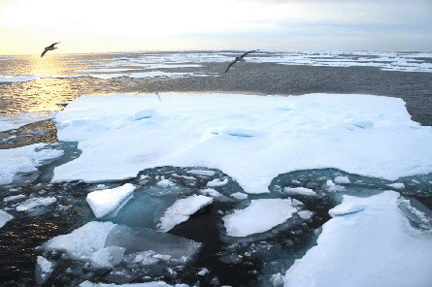
In recent years, Arctic sea ice has been hit particularly hard.
“It has been so crazy up there, not just this autumn and winter, but it’s a repeat of last autumn and winter too,” says Mark Serreze, director of the NSIDC.
In years past, abnormal warmth and record low sea ice extent tended to occur most frequently during the warmer months of the year. But for the past two years, things have gotten really weird in the colder months.
In 2015, Serreze says, “you had this amazing heat wave, and you got to the melting point at the North Pole on New Years Eve. And we’ve had a repeat this autumn and winter — an absurd heat wave, and sea ice at record lows.”
Lately, the Southern Hemisphere has been getting into the act. “Now, Antarctic sea ice is very, very low,” Serreze says.
From the NSIDC analysis:
Record low monthly extents were set in the Arctic in January, February, April, May, June, October, and November; and in the Antarctic in November and December.
Put the Arctic and the Antarctic together, and you get his time series of daily global sea ice extent, meaning the Arctic plus Antarctic:
As the graph [on original] shows, the global extent of sea ice tracked well below the long-term average for all of 2016. The greatest deviation from average occurred in mid-November, when sea ice globally was 1.50 million square miles below average.
For comparison, that’s an area about 40 percent as large as the entire United States.
The low extent of sea ice globally “is a result of largely separate processes in the two hemispheres,” according to the NSIDC analysis.
For the Arctic, how much might humankind’s emissions of greenhouse gases be contributing to the long-term decline of sea ice? The graph above [on original] , based on data from a study published in the journal Science, “links Arctic sea ice loss to cumulative CO2emissions in the atmosphere through a simple linear relationship,” according to an analysis released by the NSIDC last December. Based on observations from the satellite and pre-satellite era since 1953, as well as climate models, the study found a linear relationship of 3 square meters of sea ice lost per metric ton of CO2 added to the atmosphere.
That’s over the long run. But over a shorter period of time, what can be said? Specifically, how much of the extreme warmth and retraction of sea ice that has been observed in autumn and winter of both 2015 and 2016 can be attributed to humankind’s emissions of greenhouse gases?
“We’re working on it,” Serreze says. “Maybe these are just extreme random events. But I have been looking at the Arctic since 1982, and I have never seen anything like this.”
January 9, 2017
Posted by Christina Macpherson |
AUSTRALIA - NATIONAL, climate change - global warming |
Leave a comment
 Sunny Brisbane rooftops well placed to capitalise on solar power, experts say, ABC 6 Jan 17, PM By Katherine Gregory Brisbane has the potential to capitalise on solar power’s more competitive pricing, according to experts.
New research by the not-for-profit solar energy company Australian PV Institute and the University of New South Wales has revealed solar panels in Brisbane’s CBD could generate significant savings.
“We’ve done this stocktake of the solar potential of Brisbane’s CBD and from that we’ve worked out that Brisbane could install 188 megawatts of solar on the rooftops of the CBD and produce enough power to meet 11 per cent of demand of the CBD,” the Institute’s chair Renate Egan said.
“This could be done with upfront investment of about $200 million and would payback in electricity repayments $30 million a year.”
To conduct the stocktake the institute used its new Solar Potential Map, which calculates how much electricity can be generated from any particular roof in Brisbane’s CBD.
Ms Egan said it had found close to 50 per cent of roofs could have solar panels.
“We’ve started with Brisbane CBD because Brisbane and Queensland are really proactive around solar,” she said.
“Queensland has got the largest update of solar in Australia, with 1.6 gigawatts of solar installed in Brisbane [and] in Queensland, and they have a target of getting to three gigawatts by 2020.”
Ms Egan said the institute had also engaged with the Queensland Government about it providing the initial upfront investment to install the panels on government buildings such as Suncorp Stadium and the Queensland Performing Arts Centre (QPAC).
“Anything that helps achieve our renewable energy target of 50 per cent by 2030 is being considered,” a spokesman for Queensland’s Energy Minister Mark Bailey said in a statement.
 ‘Like trying to develop an alpine skiing industry in Queensland’
But the Federal Minister for Northern Australia, Matt Canavan, said Queensland’s renewable energy target was mad.
“It’s like trying to develop an alpine skiing industry in Queensland, it’s about as realistic as that,” he said.
“We don’t have the same renewable resources as say South Australia.
“It would cost an enormous amount of money to build in Queensland and put at risk huge amounts of jobs, particularly in the power sector.
“You’ve got a Labor state government more interested in the philosophy and ideology of power rather than the practicality and reality of it and providing jobs and a decent cost of living for people.”……http://www.abc.net.au/news/2017-01-05/brisbane-well-placed-to-capitalise-on-solar-energy/8164436
January 7, 2017
Posted by Christina Macpherson |
AUSTRALIA - NATIONAL, Queensland, solar |
Leave a comment
The Bureau of Meteorology has just released its annual climate updates and while cooler than normal temperatures in the south stopped WA’s overall annual numbers blowing out, towns up north broke records that make you uncomfortable just reading about them.
Wyndham Aerodrome set a new Australian record for annual average maximum: 37.5 degrees.
Kununurra broke its 1992 record of 36.4 to set a new one: 36.7.
Derby broke its 2015 record of 35.7 with 36.3.
Bureau of Meteorology liaison Glenn Cook said Broome equalled its record average of 33.3 for the first time since 1988.
Other Kimberley towns to break their own daytime records were Warmun Aboriginal community, Troughton Island, Cygnet Bay, Doongan Station and Argyle Aerodrome.
And residents got no relief at night, Mr Cook said, with sites across the Pilbara and Kimberley also breaking their records for highest annual mean minimums.
Troughton Island set a new Australian record of 27 degrees.
Broome, Port Hedland, Karratha and Derby all broke 2010 overnight temperature records with new highs of 23.5, 21.5, 22.0 and 23.5.
Overall for 2016, the region had its hottest average overnight temperatures ever, and its second-hottest average daytime temperatures.
They couldn’t even have the relief of saying “but it’s a dry heat”, as WA also had its wettest year since 2011……Troughton Island set a new Australian record of 27 degrees.
Broome, Port Hedland, Karratha and Derby all broke 2010 overnight temperature records with new highs of 23.5, 21.5, 22.0 and 23.5.
Overall for 2016, the region had its hottest average overnight temperatures ever, and its second-hottest average daytime temperatures.
They couldn’t even have the relief of saying “but it’s a dry heat”, as WA also had its wettest year since 2011.
January 6, 2017
Posted by Christina Macpherson |
climate change - global warming, Western Australia |
1 Comment
Solar targets: ‘We’re already halfway there’ says Energy Minister Mark Bailey, Brisbane Times, Tony Moore , 5 Dec 16 The Queensland Government says it is halfway towards one section of its 2020 target of generating 3000 megawatts of solar power from Queensland rooftops by 2020.
“November’s peak of almost 16MW of solar generation capacity installed represents a 33 per cent increase on the year-to-date monthly average,” Energy Minister Mark Bailey said on December 19.
“The four-month period from August to November included four of the five best months during 2016 for the number rooftop solar installations in Queensland.”
Fairfax Media on Tuesday reported calls by University of New South Wales researchers for Brisbane to make better use of the roofs to collect solar energy.
The researchers will arrive in Brisbane on Friday to demonstrate that by putting solar panels on public buildings such as Suncorp Stadium, QPAC and Roma Street Station enough energy could be collected to power 1200 homes.
Senior researcher Anna Bruce wants to talk to Queensland’s Energy Supply Department and to Brisbane City Council about the potential of using extra roof space to collect solar power.
The research team believes it is possible to “generate 241 gigawatt hours of energy per year,” from photo-voltaic cells which could collect a potential 188 megawatts.
Generating 3000 megawatts from Queensland rooftops is one of the Queensland government’s renewable energy objectives; as well as establishing “a credible pathway for having 50 per cent renewable energy generation by 2030”.
That is contained in its solar energy policy, which can be read here.………http://www.brisbanetimes.com.au/queensland/solar-targets-were-already-halfway-there-says-energy-minister-mark-bailey-20170103-gtlg7a.html
January 6, 2017
Posted by Christina Macpherson |
Queensland, solar |
Leave a comment
 Early skirmishes point to a war over renewable energy lasting well into 2017, The Age, Peter Hannam, 15 Jan 17 “……Trenches are now being dug for what looms as a political battle that will probably last through 2017. On one side lie the Turnbull government, fossil fuel suppliers and right-wing pundits, who say the priority has to be affordable and reliable power.




 State Political Editor Daniel Wills, The Advertiser January 11, 2017