Kimba, South Australia, may rejoin the discussion on hosting a federal nuclear waste dump
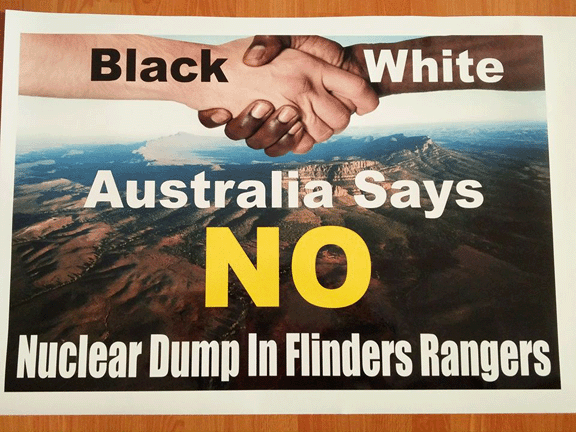 Fight To Stop Nuclear Waste Dump In Flinders Ranges SA, 30 Nov 16 TheNational Radioactive Waste Management Facility project team was invited to Kimba, South Australia, last week by the local group Working for Kimba’s Future.
The team discussed with locals the possibility of Kimba rejoining the process to nominate a site to host the National Radioactive Waste Management Facility.
The team will visit Kimba again on December 6, 7 and 8.
Liberal and Labor quietly pass law to protect uranium industry from legal challenges
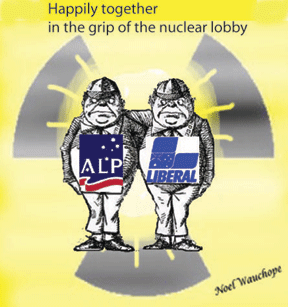 Major parties push a losing uranium sector to India at great risk http://www.smh.com.au/comment/major-parties-push-a-losing-uranium-sector-to-india-at-great-risk-20161128-gszld4.html Dave Sweeney , 29 Nov 16
With little fuss or fanfare, Australia’s two major parties have this week agreed to fly under the radioactive radar and pass an innocuous enough sounding law with some very far reaching implications.
The Indian Civil Nuclear Transfers Act exists to provide “certainty to Australian uranium producers” who want to sell the controversial product to India.
In 2015 a detailed investigation by Parliament’s treaties committee found there were serious and unresolved nuclear safety, security and governance issues with the proposed sales plan. It also found a high level of legal uncertainty. Continue reading
Tiny outback town divided over plan for federal nuclear waste dump
 One misapprehension in this otherwise excellent article.
Residents of Hawker say it has been incredibly confusing that the proposed intermediate-level facility in their community is being discussed at the same time as plans for future high-level nuclear storage elsewhere.
Despite the government saying that many of the jobs and development opportunities near Hawker will benefit the indigenous people at Yappala, McKenzie says they will continue fighting the proposal to the end.
Australian nuclear waste dump divides tiny outback town“This land is our past, present and future and we don’t want a nuclear waste dump on it.”, Aljazeera, by Jarni Blakkarly, 29 Nov 16
While the mountains are named after the British explorer who trekked them in the early 19th century, the indigenous Adnyamathanha people have lived in the region for tens of thousands of years.
This arid and remote part of South Australia has become the unlikely centre of a heated public debate after it was named the preferred site for the country’s first nuclear waste dump. Continue reading
No real action from Federal govt in its new “response plan” on the Barrier Reef
Great Barrier Reef: Australia’s ‘response plan’ draft contains no new action or funding
‘Confidential’ draft acknowledges coral bleaching but does not make any attempt to address climate change, Guardian, Michael Slezak 30 Nov 16 The Australian government’s official “response plan” to the worst ever bleaching event on the Great Barrier Reef commits it to no new action, pledges no new money and does not make any attempt to address climate change, according to a draft seen by the Guardian.
The Northern Great Barrier Reef Response Plan, marked “draft” and “confidential”, begins by describing the bleaching event as “the worst ever coral bleaching” and attributes its cause to climate change.
It says: “In the aftermath of the bleaching event it is more important than ever to building [sic] the resilience of the reef.” But the recommendations appear to contain no new money for action to help build resilience.
It says the plan will be “nested under the Reef 2050 plan”, which is a document the federal and Queensland governments created to convince Unesco not to include the Great Barrier Reef on its “world heritage in danger” list.
On Thursday the government needs to report to the Unesco world heritage committee on the implementation of the Reef 2050 plan, as well as how it has been funded.
But, in June, the Guardian revealed Australia would also need to report on how it is responding to this year’s bleaching event.
At the time, Tim Badman, the director of the IUCN’s world heritage program, which advises the committee on the state of its natural world heritage properties, told the Guardian: “We would expect that that report from Australia is going to cover all the significant things that have happened since June 2015 and whether there are changes in the picture of the management or the response that is needed … The bleaching event is a new issue to be considered.”
It is not known whether this plan is what the government intends to present to Unesco in response to that requirement.
It was revealed this week the bleaching appeared to kill about 67% of coral in the northern third of the reef. Across the entire reef, early estimates suggested about 22% of coral had died but scientists now say that figure is likely to be higher.
But the government’s plan for dealing with the bleaching, at least in its draft from October, appeared unable to point to any significant new action……..https://www.theguardian.com/environment/2016/nov/30/great-barrier-reef-australias-response-plan-draft-contains-no-new-action-or-funding
Australian solar power technology sold to China, by CSIRO
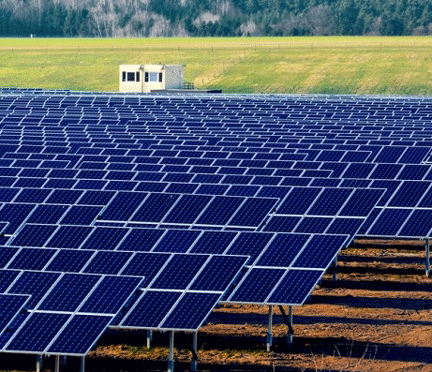 CSIRO sells concentrated solar power technology to China, The Age, Marcus Strom , 28 Nov 16 The CSIRO on Tuesday will sign a technology licensing agreement with a Chinese solar company that could reap millions of dollars in royalties for the national science and industry organisation. The deal with Beijing-based Thermal Focus will allow the company to bid for business in the burgeoning Chinese market for concentrated solar power using Australian-designed technology.
China aims to build infrastructure that produces 1.4 gigawatts of concentrated solar power by 2018, increasing this to 5GW by 2020.
“To put that into perspective, Australia has 50GW capacity in all its power stations,” said Wes Stein, CSIRO’s chief energy research scientist. John Grimes, of the Australian Solar Council, said: “This is a significant commercial opportunity, perhaps worth hundreds of millions.” CSIRO chief executive Larry Marshall said: “This partnership takes our climate mitigation focus to a global stage.”
Minister for Industry, Innovation and Science Greg Hunt said: “Australia is a leader in clean energy technology and this partnership is an important step in realising this advantage.”
The partnership will be signed at the Asia-Pacific Solar Research Conference at the Australian National University. Phil Hearne
Concentrated solar power, or solar thermal, uses mirrors to focus the sun’s energy into a collector. At collected temperatures of 560 degrees, that energy is then stored in molten nitrate salts in large thermal tanks. This can then generate superheated steam to drive turbines for electricity generation for weeks.
CSIRO’s patented technology uses smaller mirrors of about five square metres, known as heliostats, and field-control software to direct the solar energy. The technology was pioneered at the CSIRO’s energy centre in Newcastle. The solar thermal team has grown to more than 30 scientists and engineers.
Mr Stein said: “The big difference with photovoltaic cells is that our technology has storage embedded at a lower cost than batteries.”
A CSIRO spokesman said the licensing agreement covered a technology transfer payment with recurring royalties for the number of heliostats installed……
John Grimes at the Australian Solar Council said: “CSP with storage is the missing link in China’s renewable energy market.” Mr Grimes said what gave this deal credibility was that the Chinese had delivered on their plans in renewables. “Already China has installed 120GW of solar photovoltaic cells,” he said. “It really is a world leader in this field.” Its commitment was partly due to a combination of environmental concerns, cost effectiveness and air-quality pressures in cities, Mr Grimes said.
There are no commercial plants operating concentrated solar thermal technology in Australia. He said this was because government leadership in Australia had been lacking.
However, there are some companies working towards this: Vast Solar, SolarReserve and SolarStor, which is backed by former Liberal leader John Hewson.
SolarStor plans to build a concentrated thermal plant near Port Augusta, South Australia, as does US firm SolarReserve.
The solar deal comes a day after an interim report by a Senate committee recommended all Australian coal mines close by 2030.
The retirement of coal-fired power stations report committee is chaired by Greens senator Larissa Waters. Its final report will be handed down on February 1. http://www.theage.com.au/technology/sci-tech/csiro-sells-concentrated-solar-power-technology-to-china-20161128-gsz8gh.html
Western Australian town to host large renewable energy grid
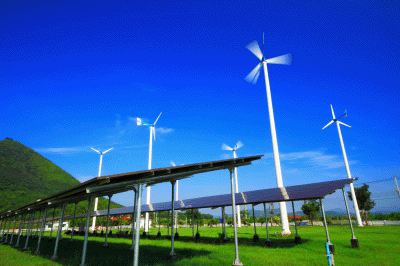 Kalbarri to host what could be Australia’s largest renewable energy grid http://www.watoday.com.au/wa-news/kalbarri-to-host-what-could-be-australias-largest-renewable-energy-grid-20161128-gsz4n5.html A $10 million renewable energy-powered microgrid which has the potential to be the largest in the country will be developed in Western Australia’s Midwest.
The coastal town of Kalbarri is currently supplied by a 140 kilometre long rural feeder line, which experiences outages due to environmental factors.
The microgrid will combine wind and solar power with a large-scale battery and Energy Minister Mike Nahan said the project will be closely looked at to see how the technology could benefit other towns in WA.
“This is a game changer for regional communities who rely on power from a long feeder line, which is subject to environmental factors that can cause outages,” Dr Nahan said.
“The project, which has the potential to be Australia’s biggest renewable microgrid, will consider all generation options and take into account the community’s desire for a renewable solution.””
Western Power will seek expressions of interest from next month with construction expected to begin in 2017.
“Medical” uses do not justify Lucas Heights nuclear reactor, nor a Flinders Ranges nuclear dump
Solid forms of low-level waste include materials that have been contaminated – at Lucas Heights or in hospitals using isotopes, or in industrial firms using isotopes, and so on. Waste of this kind has accumulated at scores of places throughout Australia, but it amounts to only a tenth of all radioactive waste, the rest coming from Lucas Heights
A NEW REACTOR? It’s the worst possible option! Nuclear Study Group Sutherland Shire Environment Centre 1998 By R.D. (Bob) Walshe, OAM
Chairman, Sutherland Shire Environment Centre
- Medical isotopes can be produced by non- reactor technology, such as cyclotrons, which are much cheaper and safer and are powered by electricity.
- Claims that a reactor serves Australia’s ‘national interest’ do not withstand scrutiny……
‘Medical uses’ don’t justify a new Reactor
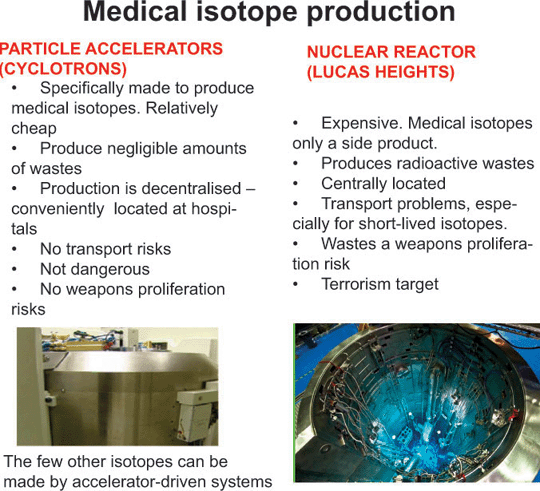
Life-saving? In fact reactor-produced medicine won’t save many lives, if only because over 98% of it is used in diagnosis, not in life-saving therapy.
The Minister should have spoken more moderately. Reactor-based nuclear medicine is only one among many medical technologies used in diagnosis. The Minister didn’t explain why he was favouring it over all other diagnostic technologies by heavily subsidisingit through a new hugely expensive reactor. Nor, indeed, why a new reactor is needed when the bulk of nuclear medicine consists in the supplying of medical isotopes that can be obtained much less expensively from sources other than a Lucas
Heights reactor? Consider…
- Most importantly, cyclotrons increasingly produce isotopes and so render a reactor unnecessary (see cyclotrons, p.13); they are cheaper and safer and produce only small quantities of low-level radioactive waste.
- Nearly all countries in the world import the isotopes they need.
- ANSTO, the Australian Nuclear Science and Technology Organisation, itself imports them when it shuts the reactor for maintenance.
- ANSTO’s isotope operations are indeed heavily subsidised, and thus are not really competing economically with those of large overseas suppliers.
- While ANSTO argues that its most-used isotope technetium-99m can’t be
imported because it has a currency (technically, a ‘half-life’) of only six
hours, ANSTO neglects to say that an equally effective, longer-lived
isotope, molybdenum-99, is widely transported all around the world.
So, by using two cheaper alternatives – importation of some isotopes and production of others in cyclotrons – Australia would save itself the huge expense of this new reactor. It’s as simple as that. And safer too……
ANSTO has been stockpiling such waste for 40 years, and there it sits at Lucas Heights….
Not that ANSTO and the Federal Government haven’t tried to get rid of all this embarrassing waste. They have continually invited any and every state government to set up a dump-site (a ‘repository’) for it. But until 1998, no government would have it.
Only in February of 1998 did one government, that of economically troubled South Australia, hesitantly indicate it might accept it, at a site it considers to be ‘remote’ – but Aboriginal communities have expressed opposition. If established, such a dump would soon become ANSTO’s dump for all levels of its waste.
The long failure of the Federal Government to find a remote dump-site for radioactive waste is conclusive proof – though proof is surely not needed – of the dangerous nature of nuclear waste. So why go on creating such waste? No community wants to be saddled with the burden Sutherland Shire has carried for 40 years.
Three ‘levels’ of waste – and all dangerous
There are three general categories of radioactive waste. First, the high-level kind, chiefly the highly radioactive spent fuel rods; second, intermediate-level waste, such as results from reprocessing of spent fuel rods; third, low-level waste, such as the continual gaseous and liquid discharges from nuclear plants, and contaminated materials like gloves and instruments.
But ANSTO chooses not to follow this high-intermediate-low classification, arguing that high-level waste comes only from nuclear power-generating reactors, and since Australia’s reactor is the ‘research’ kind, its operation results only in intermediate-level and low-level waste. This is a semantic quibble which puts ANSTO at odds with US and Canadian terminology.
More than 1600 of the spent fuel rods, high – level waste, have accumulated at Lucas Heights in the past 40 years. ….. the resulting waste will be returned to Australia as ‘intermediate-level waste’, which will again constitute a problem here. Such shipments are never trouble-free: they involve safety, health and environment risks; they spark anti-nuclear protest along the route, resistance from residents around the destinations, and charges of unethical behaviour for dumping what should be one’s own responsibility onto others…. Continue reading
Why dump nuclear reactor waste in Flinders Ranges? Lucas Heights is the best place.
Regina McKenzie to Fight To Stop Nuclear Waste Dump In Flinders Ranges SA November 26
Cyclotrons for medical isotopes needed in other States, not monopolised by ANSTO in Sydney
Trisha Dee Fight To Stop Nuclear Waste Dump In Flinders Ranges SA, 28 Nov 16 ANSTO want to pick up where Canada has stepped off. Canada used to provide a significant part of the world’s radioactive isotopes. Now Australia wants to get in on this dying industry. They need to make room at Lucas Heights to do so. Hence their push to bury their toxic waste in the outback. There is no strong case for co-location.Cyclotrons for medical uses – a better option than Lucas Heights nuclear reactor
 A NEW REACTOR? It’s the worst possible option! Nuclear Study Group Sutherland Shire Environment Centre 1998 By R.D. (Bob) Walshe, OAM“…..There are attractive alternatives to a new reactor, especially cyclotrons. Why are they being ignored?

Dr Jim Green says, ‘There are several alternatives to a new reactor, including particle accelerators, spallation sources, and synchrotron radiation sources.’
But none of these were independently evaluated prior to the Federal Government’s 3 September 1997 statement of intention to proceed with a new reactor. Yet, says Dr Green, in all cases ‘the alternatives are preferable to a reactor, in relation to radioactive waste and safety’.
There is not room here to report the claims of all these scientific/technical alternatives, but the keenest contender, the cyclotron, suffices to demonstrate what is possible.
‘Particle accelerators’ are machines that charge particles to enormous velocities, whence they can be directed to hit a target and so produce the medical isotopes that ANSTO has led so many people to believe require a nuclear reactor. The cyclotron is at present the most useful of the accelerators.
Australia already has two cyclotrons, one in Sydney and a smaller in Melbourne. Dr Green says they are much cheaper to buy than reactors, cheaper to run, are powered by electricity not nuclear fuel, leave only a small quantity of low-level radioactive waste, and so avoid the intractable waste problem associated with a reactor.
Attractive indeed. How, then, to explain the churlish attitude of ANSTO to cyclotrons? The unavoidable answer is – because the nuclear industry fears it will be undermined by the cheaper, safer, electricity-based cyclotron industry.
Several authoritative voices have called for funds for cyclotron research; for example, the 1995 Senate Select Committee on Radioactive Waste was urged to recommend that $500,000 be spent over three years on cyclotron research – a fraction of the money lavished on the reactor – but none has been forthcoming.
The relatively cheap, safe and simple cyclotron undermines the case for a new, expensive, waste-proliferating reactor. The cyclotron and other attractive alternatives to a reactor promise better results in nuclear medicine. And ANSTO’s last defence of the reactor – that it alone can produce the much-used isotope Technetium-99m which can’t be imported because its effective life is only six hours – neglects to say that its equally effective longer-lived parent , Molybdenum-99m, is being widely transported around the world. (Moreover, American research into cyclotron production of Technetium-99m has shown promising results in recent years, and further research is proceeding actively. ) http://ssec.org.au/our_environment/issues_campaigns/nuclear/a_new_reactor.htm
Australian govt ignores UN request to review its failing uranium industry
The Federal Government …remains resistant to an independent cost-benefit assessment of Australia’s uranium trade, as directly requested by the then UN secretary general Ban Ki Moon in the wake of Fukushima.
instead of the requested industry review there has been a retreat from responsibility and a rush to rip and ship more uranium ore by fast-tracking risky and contested new uranium sales deals, including to India and Ukraine.
Despite Canberra’s irresponsible fire sale approach the Australian uranium sector is facing tough times…..
 On shaky ground: Australian uranium and Fukushima https://independentaustralia.net/politics/politics-display/on-shaky-ground-australian-uranium-and-fukushima,9778 Dave Sweeney 28 November 2016
THE POWERFUL EARTHQUAKE that struck off the coast of Fukushima prefecture in Japan last week, is a stark reminder of the deep and continuing safety concerns following the 2011 nuclear disaster.
The stricken reactor complex remains polluted and porous and every added complication leads to further contamination.
Closer to home the renewed tectonic instability highlights the need for urgent Australian government action on the industry that directly fuelled the continuing nuclear crisis.
In October 2011, Robert Floyd, the director general of the Department of Foregn Affairs and Trade (DFAT) Australian Safeguards and Non-Proliferation Office (ASNO) confirmed to the Federal Parliament that
“Australian obligated nuclear material [uranium] was at the Fukushima Daiichi site and in each of the reactors.”
Traditional Aboriginal owners will fight on against Adani coal mine
 Adani mine leases – Queensland Supreme Court Judicial Review decision 25 November 2016
‘We will not be halted in our fight to protect our land and water, say Traditional Owners’
‘Further appeal being considered, full bench of the Federal Court still to rule’
“Today’s decision in the Supreme Court to dismiss Traditional Owners’ challenge to the issuing of the mining leases to Adani by Mines Minister Anthony Lynham only strengthens our resolve and proves how worthless the State considers our common law native title rights to be, said leading Aboriginal rights advocate, senior Wangan and Jagalingou (W&J) Traditional Owner and W&J Council spokesperson, Adrian Burragubba. …
“Lawyer for the five applicants to the Judicial Review, Mr Colin Hardie says,
“My clients will review the decision and consider their grounds for an appeal, looking especially at the way in which they believe they were denied natural justice before the Minister granted the mining leases”.
““We are concerned with the way in which the Minister has failed to consider the native title rights of our clients, and their obvious and plain rejection of the Adani project. The fully informed and prior consent of traditional owners for mining projects is increasingly being recognised in international law and it should not be any different in Queensland”, Mr Hardie said. …” http://wanganjagalingou.com.au/adani-mine-leases-qld-supreme-ct-judicial-review-decision/
Adani Carmichael coal mine faces many more questions and legal hurdles
 Carmichael mine jumps another legal hurdle, but litigants are making headway, The Conversation, Lecturer in Law, The University of Queensland, 27 Nov 16 The Carmichael coal mine planned for Queensland’s Galilee Basin has cleared another legal hurdle, with the state’s Supreme Court dismissing a legal challenge to the validity of the Queensland government’s decision to approve the project.
The court found in favour of the Queensland Department of Environment and Heritage Protection, ruling that its approval of Indian firm Adani’s proposal was within the rules.
The decision is another setback for environmentalists’ bid to stop the controversial project. But Adani does not yet have a green light to break ground on the project, and legal questions still remain, both about this project and about climate change litigation more generally.
The Supreme Court ruling Continue reading
How radioactive is the nuclear waste we got back from France?
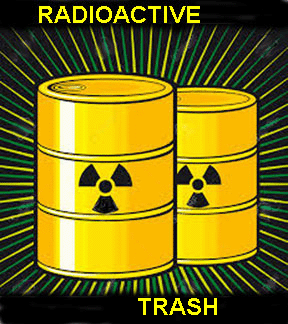 Steve Dale to Fight To Stop Nuclear Waste Dump In Flinders Ranges SA, 26 Nov 16
44,000 times more radioactive than the Uranium Yellowcake we export
13,750,000 times more radioactive than typical Olympic Dam ore
(Yellowcake = 25,000 Bq/g, Olympic Dam ore = 80 Bq/g)
Sources:
Greenpeace report_BBC Shanghai and its nuclear waste cargo report.pdf,
odxEisAppendixSUraniumAndRadiation.pdf,
Guide-to-Safe-Transport-of-UOC.pdf
Federal government bribing Aborigines to accept nuclear waste dump?

The feds are offering Traditional Owners trips to France, Spain and to Sydney ….. hmmm this sounds like another form of bribery to me, another form of trickery and I think a waste of tax payers monies, why???? https://www.facebook.com/groups/344452605899556/

1 This month.

Australians deserve the truth
about
AUKUS – https://aukuspublicinquiry.com/
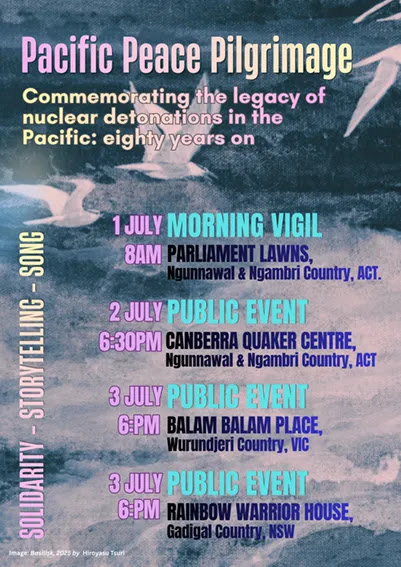


PETITION – To: Prime Minister Anthony Albanese and the Australian Labor Government

of the week – Australians for War Powers Reform (AWPR)
To see nuclear-related stories in greater depth and intensity
 Antinuclear