Traditional landowners running legal challenges against Adani coal project
 Adani faces more legal action as traditional owners vow to halt Carmichael coal mine http://www.abc.net.au/news/2016-12-07/further-legal-action-planned-against-carmichael-coal-mine/8100326, By Kathy McLeish, 7 Dec 16, Traditional owners are set to launch further legal action against Adani’s Carmichael coal mine slated for central Queensland.
The Wangan and Jagalingou people claimed the $22 billion project impinges on their native title rights, and would extinguish their interests over 28 square kilometres of land if it goes ahead.
Spokesman Adrian Burragubba said the group was running four separate legal challenges to the project, and vowed to continue fighting. Continue reading
Australian government’s nuclear waste dump for Barndioota – a sly prelude for importing nuclear waste
It seems there is no way that the federal plan could develop into that grandiose project [the South Australian Nuclear Fuel Chain Royal Commission importing plan].
But the federal nuclear waste project starts the process in some important ways.
Environmentalists had better stop rejoicing and start examining the machinations behind the Federal Government plan.
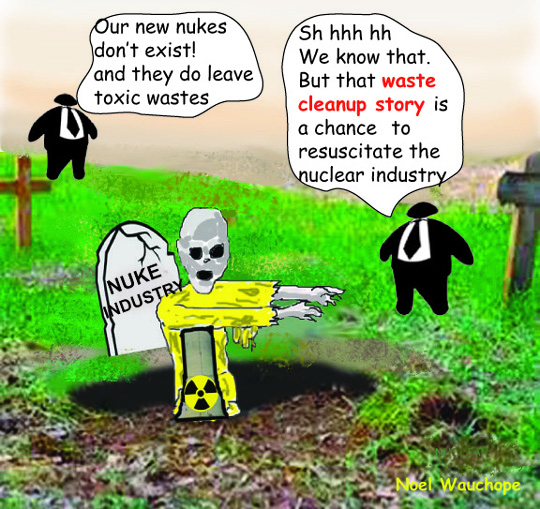 Exhuming South Australia’s nuclear waste import dump plan, Independent Australia, 7 December 2016, The SA nuclear waste dump may be dead in the water but a nuclear waste import plan may now be a Federal affair, writes Noel Wauchope.
POLITICAL SUPPORT for South Australia’s nuclear waste import project has collapsed……..
You would think that, with an election coming up in 2018, Jay Weatherill might ponder on the advantages of making a gracious retreat, respecting the remarkably strong recommendation from his own Citizens’ Jury, that the international nuclear dump was not to go ahead “under any circumstances“.
But Jay Weatherill is persisting with the plan, even though it is a bell tolling his political suicide. We can only suspect that Weatherill has some very poor advisers, or that he is beholden to the nuclear lobby.
Let not the anti-nuclear movement rejoice
The plan for importing nuclear waste to South Australia has been several decades in the making and this recent government push has cost at least $13 million. The nuclear lobby is not giving up so easily. The focus now shifts to the plan for a Federal Government nuclear waste dump in Barndioota.
It would be naive to think that these two plans are not connected.
Australia has a relatively small but enthusiastic pro-nuclear lobby, led by Ben Heard and Barry Brook. Ben Heard – who has just started a pro-nuclear group seeking charity status – made the connection between the two waste dump plans, explaining why South Australia could take not only Australia’s but also the world’s nuclear waste.
It is a simple, and in a way logical, idea to say that once a place is radioactively polluted, well, why not choose that place to dump more radioactive pollution? ……..what if we got a nuclear waste dump in South Australia? One that started out storing “low level medical” nuclear waste but then got “intermediate level” nuclear waste originally derived from Sydney’s Lucas Heights nuclear reactor? Especially as medical nuclear wastes are so short-lived — radioactivity lasting generally for just hours, or a few days, it would be pretty silly to have a great big repository site, with not enough wastes to fill it.
……..if medical wastes are radioactive for only hours, or a few days, why would they need to be transported for thousands of miles across the continent? They are produced in very small quantities and currently stored near the point of use — in hospitals. (There’s actually a strong argument for the use of non-nuclear cyclotrons to produce these isotopes close to the hospitals, rather than at the centralised nuclear reactor at Lucas Heights in Sydney.)
So, an underground nuclear waste facility for medical wastes, at remote Barndioota, in South Australia, doesn’t seem necessary.
But then there’s the processed nuclear waste returning to Lucas Heights, from France and the UK. The Australian Government describes this as intermediate-level waste that isn’t harmful unless mismanaged. The French Nuclear Safety Authority (ASN) has classified it as high-level (long-life) waste according to standards set by ANDRA, the French national radioactive waste management agency. High-level waste is ANDRA’s most severe nuclear waste classification.
Nuclear Shipment Truth Exposed
It is pretty clear that the purpose of the proposed Barndioota nuclear waste dump is the disposal of Australia’s intermediate to high-level waste returning from overseas…….
It seems there is no way that the federal plan could develop into that grandiose project [the South Australian Nuclear Fuel Chain Royal Commission importing plan].
Federal nuclear waste project to start the process
But the federal nuclear waste project starts the process in some important ways.
First, the plan must navigate several legal difficulties. In 2010, former premier Mike Rann brought in laws to prevent a national nuclear waste dump being placed in South Australia — laws which would have to be repealed before the Federal Government could proceed. Federally, the National Radioactive Waste Management Act 2012 did water down prohibitions on nuclear waste dumping but there are still provisions that have to be overcome, particularly in relation to Aboriginal rights.
Secondly, there is that Aboriginal question. I think that the State and Federal governments are justifiably wary of the opposition they might meet from Indigenous communities — and they are working on that problem. The South Australian Government recently imposed Aboriginal Regional Authorities upon the State’s Indigenous communities. These are being used to fast-track and rubber stamp development over much of the land. They would be integral to Jay Weatherill’s strategy of manufacturing consent……
An unspoken part of the process must surely be the development of the Federal Government’s nuclear waste facility in South Australia, which would conveniently overcome some big hurdles and would make that State look like an attractive place for a nuclear hub.
Environmentalists had better stop rejoicing and start examining the machinations behind the Federal Government plan. https://independentaustralia.net/politics/politics-display/exhuming-south-australias-nuclear-waste-import-dump,9814
MP James Purcell calls for nuclear power for Portland, Victoria
 Call to build nuclear power plant in Portland The Age, Benjamin Preiss, 6 Dec 16,
 A nuclear power plant should be built in the western Victorian city of Portland to supply cheap electricity to Alcoa’s troubled aluminium smelter, according to a local-micro party MP.
Vote 1 Local Jobs MP James Purcell has warned that Portland, which has a population of about 10,000, will become a “ghost town” if the smelter closes and cheap power generation is not created. He says the recent power failure that damaged the Alcoa’s aluminium smelter illustrated the need for nuclear energy.
Earlier this month the smelter suffered a major setback when one of its two “pot-lines” was closed due to a disastrous power failure……..
Mr Purcell has called on the Andrews government to consult with the people of Portland to determine whether they would support a nuclear facility.
He said major industries, including wood chipping and wool processing were ideal for Portland. But they relied on substantial amounts of power. Mr Purcell said an energy efficient method of power generation would revitalise Portland and ensure the creation of “many thousands of jobs” into the future. “House prices will be double what they are and you finish up with a thriving town or region,” he said………
Agriculture Minister Jaala Pulford told Parliament that the Labor Party’s national platform did not support the establishment of nuclear power plants.
She said the government was in “regular dialogue” with community leaders in Portland and would continue to work on a solution to the problems at Alcoa.
Greens energy spokeswoman Ellen Sandell urged Mr Purcell to abandon his push for nuclear power and support renewable energy sources.
“The people of Portland need sustainable jobs and clean energy. They don’t want a toxic waste problem and the dangers of a nuclear power plant in their backyard,” she said.
Alcoa is also negotiating a new electricity supply deal with AGL after the expiration of its previous contact that ensured affordable power. http://www.theage.com.au/victoria/call-to-build-nuclear-power-plant-in-portland-20161206-gt4zt8.html
Australian govt promotes coal and nuclear, despite public opinion and Asian Infrastructure Investment Bank policy
the Australian government’s desire to have the AIIB’s investment strategy give more priority to fossil fuel projects runs contrary to Australian public opinion.
According to an online poll from Market Forces, taken between 15 and 19 August by Essential Research, 62% of Australians would prefer multilateral banks like the AIIB and World Bank to use taxpayer dollars to fund renewable energy projects.
The poll, of 1,017 respondents, found just 13% of Australians would prefer money to fund fossil fuel projects (with 26% unsure).
 Australia lobbies infrastructure bank to invest in coal and nuclear power https://www.theguardian.com/business/2016/dec/06/australia-lobbies-infrastructure-bank-to-invest-in-coal-and-nuclear-power Asian Infrastructure Investment Bank releases draft energy strategy prioritising renewable projects, Guardian, Gareth Hutchens, The Australian government is lobbying for the Asian Infrastructure Investment Bank to put more emphasis on coal and nuclear after concerns renewable energy projects were being prioritised.
Draft guidelines were circulated by the bank that suggest it should prioritise investments in renewable energy projects across Asia while the Turnbull government has argued fossil fuels will play a significant role in energy generation in the region for decades to come..
Australia joined the AIIB in June 2015, with then-treasurer Joe Hockey pledging an initial $930m to the bank. The AIIB has been working with the Asian Development Bank, the World Bank, and a range of other banks to satisfy an estimated US$8tn infrastructure shortfall across Asia.
The bank is still in the process of creating its identity, but its founding members, including Australia, have declared the AIIB should be a “green bank.”
The draft guidelines suggest the AIIB should not consider financing nuclear plants at this stage, because the bank would “have to develop the capacity to be involved in such complex and capital-intensive projects”. It says this decision could be revisited if justified.
It also suggests the AIIB should prioritise renewable energy generation over fossil fuel power. Continue reading
The Wangan & Jagalingou Family Council’s fight against the Adani mine
 PART 1
http://www.4zzzfm.org.au/news/audio/2016/12/06/wangan-jagalingou-family-councils-fight-against-adani-mine-part-1
6 December 2016:
“Part 1 “The Adani mine is getting a lot of press after a recent protest in Melbourne rallied for the environment and the damages that the mine will cause.
However, here in QLD the Wangan and Jagalingou Family Council is fighting an extensive legal battle against the mine to protect their country in Central Queensland .
“Brisbane Line Reporter Jack McDonnell spoke with Murrawah Johnson a spokesperson from the Wangan and Jagalingou Family Council about the Adani mine and the councils campaign.
To gain a perspective of how long they have been battling this decision I asked her to tell her story about how she travelled around the world last year lobbying banks so they wouldn’t fund this mine.”
Click the link for part 2:
http://www.4zzzfm.org.au/news/audio/2016/12/06/wangan-jagalingou-family-councils-fight-against-adani-mine-part-2
Australia can get to zero emissions, as rooftop solar booms
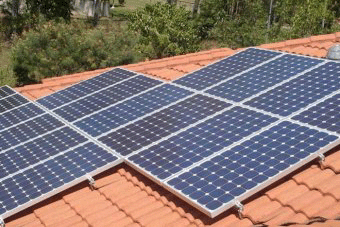 Households to power up to half Australia, zero emissions within reach: CSIRO, The Age, Adam Morton , 6 Dec 16
As the Coalition backs away from a pledge to consider a climate change policy that the energy industry says it needs, a new study is projecting a rapidly growing mass electricity generator for Australia in the decades ahead: the public.
Consumers using rooftop solar panels and batteries will produce between a third and half of Australia’s electricity by mid-century if the right policies are introduced, according to a roadmap from the CSIRO and power and gas transmission body Energy Networks Australia.
The two-year analysis also found an emissions intensity scheme for the electricity sector – a form of carbon trading that was to be considered by a government climate policy review until that plan was abandoned on Tuesday afternoon – would be the cheapest way to cut carbon dioxide emissions.
It suggests it could save customers $200 a year by 2030, while helping create a reliable electricity grid with zero emissions by 2050. Energy Networks chief John Bradley said a low-cost shift to zero emissions would depend on a national climate and energy plan with bipartisan support.
“By contrast, carbon policy which could change dramatically at every election, or differs in every state, is a recipe for a high-cost and less secure electricity service,” Mr Bradley said.
His call for the Coalition and Labor to come together on climate policy echoes that made by bodies representing energy generators and major industrial companies.
The Electricity Network Transformation Roadmap forecasts that up to 10 million households and small businesses would have solar panels, battery storage, smart homes and electric vehicles if pricing and incentives were changed to better reflect demand. This would “transform the grid into a platform more like the internet, where customers can trade and share energy”.
It recommends an emissions intensity scheme for power stations be introduced by 2020, following a similar call by the Climate Change Authority, now dominated by Coalition-appointed board members.
On Tuesday, Environment and Energy Minister Josh Frydenberg backed away from saying the government would consider this sort of scheme as part of a wide-ranging departmental review of climate policy next year. A handful of Coalition backbenchers, including Cory Bernardi and Craig Kelly, had called for any form of carbon pricing to be rejected…….
The report found thermal plants, including coal and gas fossil fuels, would be critical in balancing intermittent renewable energy in the years ahead, but would eventually be replaced by technologies using battery storage and biomass.
Getting there would present significant technical, economic and regulatory challenges. It would transform the system away from its original design – large centralised power stations – to a much more decentralised network.
It said a coordinated plan for 2050 could:
- Make average annual household bills $414 less than they otherwise would have been.
- Cut network costs to consumers by 30 per cent.
- Avoid $16 billion in spending on poles and wires.
- Lead to customers with solar panels, battery storage and electric vehicles earning $2.5 billion a year from network businesses.
The roadmap comes ahead of the Friday release of an interim report into electricity reliability led by chief scientist Alan Finkel, commissioned after South Australia suffered a statewide blackout in September. http://www.theage.com.au/federal-politics/political-news/households-to-power-up-to-half-australia-zero-emissions-within-reach-csiro-20161206-gt4ztf.html
To promote mining (especially uranium) Australian government trashed the reputation of Aboriginal people
Government had made it clear that it wished to re-engage itself more directly in the control of community land through leasing options as well as to open up Aboriginal land for development and mining purposes.
The plan was to empty the homelands, and this has not changed. However, it was recognised that achieving this would be politically fraught – it would need to be accomplished in a manner that would not off-side mainstream Australia. Removing Aboriginal people from their land and taking control over their communities would need to be presented in a way that Australians would believe it to be to Aboriginal advantage, whatever the tactics.
So began the campaign to discredit the people and to publicly stigmatise Aboriginal men of the Northern Territory
And even in 2009 when the CEO of the Australian Crime Commission, John Lawler, reported that his investigation had shown there were no organised paedophile rings operating in the NT, no formal apology was ever made to the Aboriginal men and their families who were brutally shamed by the false claims.
 Sixth Anniversary of the Northern Territory Intervention – Striking the Wrong Note Lateral Love Australia‘concerned Australians’ Michele Harris, 21 June 13 Aboriginal advocate Olga Havnen, in her Lowitja O’Donoghue oration has asked a critical question. She asks what has been the psychological impact of the Intervention on Aboriginal people of the Northern Territory. It is surprising that so little attention has been given to this critical, yet in some ways tenuous, link before now.
Even before the Intervention began in June 2007, government had long planned a new approach to the ‘management’ of Aboriginal people in the Northern Territory. It was no longer part of government thinking that self-determination and Aboriginal control over land could be allowed to continue. These were the Whitlam notions of 1975 and they were no longer acceptable.
Early inklings of change occurred in 2004 with the management of grants being transferred from communities to Government’s newly established Indigenous Co-ordination Centres. More ominous were the Amendments of 2006 to the Aboriginal Land Rights Act and the memoranda of agreements that followed. Government had made it clear that it wished to re-engage itself more directly in the control of community land through leasing options as well as to open up Aboriginal land for development and mining purposes.
The plan was to empty the homelands, and this has not changed. However, it was recognised that achieving this would be politically fraught – it would need to be accomplished in a manner that would not off-side mainstream Australia. Removing Aboriginal people from their land and taking control over their communities would need to be presented in a way that Australians would believe it to be to Aboriginal advantage, whatever the tactics.
So began the campaign to discredit the people and to publicly stigmatise Aboriginal men of the Northern Territory. Continue reading
Finkel review of the National Electricity Market – an opportunity to learn from Germany
The terms of reference for the Finkel review recognise the need to integrate energy and climate policy in Australia.
What can Australia learn from Germany’s remarkable energy transition?, https://theconversation.com/what-can-australia-learn-from-germanys-remarkable-energy-transition-69648 The Conversation, December 5, 2016 The Australian government is reviewing our electricity market to make sure it can provide secure and reliable power in a rapidly changing world. Faced with the rise of renewable energy and limits on carbon pollution, The Conversation has asked experts what kind of future awaits the grid.
The Finkel review of the National Electricity Market is an opportunity to consider how Australia can transition its electricity system to be less carbon-intensive.
Germany’s energy transition is often held up as an incredible success story. Starting from a sector relying predominantly on fossil fuels and nuclear energy in the 1990s, renewable energy now provides about 30% of Germany’s electricity.
Germany is on track to achieve its 80% renewable target by 2050. This transformation has been the result of a range of policy measures.
The depth and breadth of these legal and regulatory reforms can provide valuable lessons for Australia. Continue reading
South Australian Labor govt clings to its nuclear waste dream
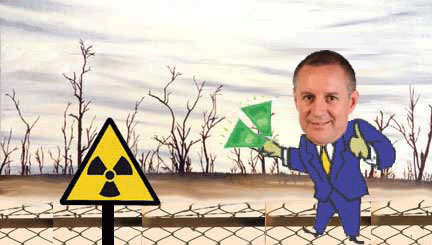 Nuclear roadblock warning but door still open, says Tom Kenyon
 http://www.adelaidenow.com.au/news/south-australia/nuclear-roadblock-warning-but-door-still-open-says-tom-kenyon/news-story/e19a89bfb94a87bbe14d2a18d082da0a Adam Langenberg, Political reporter, The Advertiser November 15, 2016 A SOUTH AUSTRALIAN high level nuclear facility looks further off into the distant future after one of its most strident backers outlined a series of roadblocks before a statewide referendum could be held.
“I think if you go to a population with a vague question, should we have a nuclear waste facility in SA, to be honest I think the result of that referendum would be not much better than what we saw from the Citizens Jury,” Mr Kenyon said.
“If it was ever going to happen firstly it would need bipartisan support to at least continue those investigations and continue discussions.
Then you would need to have quite a lot of information, and I would suspect you would need to know how much you were going to get paid and how much it was going to cost you to store and to know that you almost certainly need to know a site and you would need to have most likely an agreement of a community around a site.”
Asked if the Government could expect support of the Parliament to continue those discussions, Mr Kenyon responded “not at the moment”.
Liberal Treasury spokesman Rob Lucas, the first opposition MP to publicly air concerns about the proposal, told the conference the economic risks were “too great”.
“I always thought it was a naive and ill informed view that you would ever get majority support, whether it be from a Citizens Jury or any other process.
“Frankly if you were going to take on this particular challenge it was going to be an issue of leadership where ultimately the government of the day and the Parliament would have to say, we think it’s in the best interests of South Australia and even though there’s a majority view against it; we’re prepared to support it in terms of the public interest.” http://www.adelaidenow.com.au/news/south-australia/nuclear-roadblock-warning-but-door-still-open-says-tom-kenyon/news-story/e19a89bfb94a87bbe14d2a18d082da0a
Australian uranium mining companies going down the gurgler?
 Writing on the wall for Paladin Energy Ltd, The Motley Fool, Mike King – December 1, 2016 Uranium miner Paladin Energy Ltd (ASX: PDN) faces the prospect of being unable to repay US$212 million due in April 2017 and being forced into liquidation.
The troubled company has seen its share price slump more than 65% this year alone. The planned sale of 24% of its Langer Heinrich Mine (LHM) to CNNC Overseas Uranium Holdings (COUH) for US$175 million appears unlikely to complete before the end of 2016. Now Paladin has been forced to consider other ‘contingencies’ to repay the 2017 convertible bonds.
Not only that but Paladin also needs to raise working capital as it struggles to generate positive cash flow with uranium prices trading under US$20 per pound – the lowest prices in more than 12 years. As Paladin admits, that’s a level that no producer in the world can sustainably break even, and most producers are experiencing negative cash flows.
That’s a long way away from Paladin’s all-in cash expenditure of extracting uranium of US$38.75 per pound (lb). Even the company’s C1 cash costs of US$25.88/lb are well above the spot price of uranium. Paladin is forecasting all-in costs of around US$30/lb for the 2017 financial year, but it’s clear that even at that level, the company is going backwards.
Energy Resources of Australia Limited (ASX: ERA), majority owned by Rio Tinto Limited(ASX: RIO) faces a similar prospect to Paladin and is likely to shut up shop in 2021, once it has finished processing stockpiles at its Ranger uranium mine.
The problem for uranium miners around the world is that since the Fukushima nuclear incident in 2011, uranium prices have steadily fallen from above US$60/lb to its current price under US$20/lb……
Paladin faces the prospect of sinking into administration unless it can find a white knight willing to take a minority stake in its mine – or make an outright bid for the whole company.
That appears highly unlikely. http://www.fool.com.au/2016/12/01/writing-on-the-wall-for-paladin-energy-ltd/
Toro Energy, uranium miner, CEO Vanessa Guthrie chucks away the poisoned uranium chalice
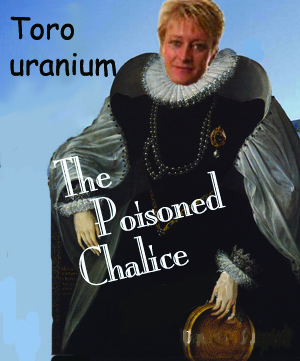 Toro Energy rings in the changes at the top as Dr Vanessa Guthrie departs http://www.proactiveinvestors.com.au/companies/news/169921/toro-energy-rings-in-the-changes-at-the-top-as-dr-vanessa-guthrie-departs-169921.html
Turnbull must reject dirty deal with Adani
Don’t put the interests of big polluters ahead of the interests of the Australian people. PM Malcolm Turnbull appears to be preparing to give multinational mining company Adani $1 billion of Australian taxpayers’ money to fund a coal-carting railway line from the Galilee Basin to the Great Barrier Reef coast.
Media reports today say up to $1 billion of the Northern Australia Infrastructure Facility (NAIF) has been earmarked for the project.
“It seems Prime Minister Turnbull is preparing to put the interests of big polluters ahead of the interests of the Australian people and misuse a billion dollars of public money to support the mega-polluting Carmichael coal project,” said ACF CEO Kelly O’Shanassy.
“This would be a serious misuse of public money, a breach of previous assurances and would turn NAIF into the ‘Dirty Energy Finance Corporation’.
“Adani has a mining licence, but no social licence.
“Any investment in coal in the 21st Century is a dud investment. Australians will lose this money and it will fund the death of the much-loved Great Barrier Reef.
“The Northern Australia Infrastructure Facility (NAIF) is supposed to fund projects that are in the public interest, not coal mines that will create more reef-wrecking climate pollution and jeopardise up to 70,000 jobs that rely on a healthy Great Barrier Reef.
“The NAIF board must release the assessment documents that show how it has determined the environmental and social benefits of this project.
“The government wouldn’t fund SPC Ardmona or the car industry, but it appears willing to fund a billionaire coal company with a dubious environmental record.”
In India, Adani has faced numerous accusations of damaging the environment and failing to comply with regulations and laws.
“If Adani is unable to fund the mine, Australia will be left with a railway to nowhere and an unpaid billion dollar loan,” Ms O’Shanassy said. “Prime Minister Turnbull can choose to entrench Australia’s dependence on a dirty, declining industry or protect the reef and steer us to a brighter, cleaner future.”
Canberra shows off its renewable energy success
 Canberra’s renewable energy facilities host open day, Canberra Times, Stephen Jeffery , 5 Dec 16 Canberra’s renewable energy providers threw their doors open on Saturday to showcase the ways the ACT and southern NSW are helping to reduce carbon emissions.
The Renewable Energy Trail, celebrating 2016 Renewable Energy Day, took Canberrans and tourists to sites across the ACT and surrounding areas of NSW. The day kicked off, under appropriately sunny skies, at the Mount Majura Solar Farm, which began operations this year.
A bus took visitors to Canberra Institute of Technology’s Renewable Energy Skills Centre of Excellence and Renewables Battery Test Centre, before moving on to the “Big Dish” at the Australian National University, a display of electric vehicles in Tuggeranong, and Googong Dam’s mini hydroelectric facility.
A separate bus ventured into NSW, touring the Woodlawn Bioreactor and wind farm.
ACT Environment Minister Mick Gentleman and Climate Change Minister Shane Rattenbury officially opened the event…..The Renewable Energy Trail was held in the same week a report found the ACT well ahead of other Australian states and territories in emission reduction targets.
The ACT also won the Carbon Disclosure Project’s award for “Best Renewable Target” during the week. http://www.canberratimes.com.au/act-news/canberra-life/canberras-renewable-energy-facilities-host-open-day-20161203-gt39xt.html
Northern Territory appoints too many mining representatives to its Mining Advisory Committee
Concerns mining industry over-represented on NT Government-appointed board, ABC News, 4 Dec 16 By Sara Everingham The NT Environmental Defenders Office has raised concerns the mining industry is over-represented on the mining board, which was set up and appointed by the former Country Liberals Government.
A new report revealed that a directive to Glencore’s McArthur River Mine (MRM) by the Department of Primary Industry and Resources — formerly the Northern Territory Mines Department — was overruled by the Government-appointed mining board.
The report by the mine’s independent monitor, the Erias Group, said the NT Mines Department made an order last year after officers on an MRM site visit reported “unapproved works” where waste rock containing metals and salt had been placed in a facility approved for benign material only.
“The use of non-benign material in close proximity to the McArthur River diversion channel and lack of adequate environmental controls represent a risk to the environment,” the department’s officers reported.
The department directed MRM to move the material but MRM appealed against the order to the Mining Board arguing the works were temporary.
The board, now also known as the Mining Advisory Committee, found in MRM’s favour.
The principal lawyer from the NT Environmental Defenders Office, David Morris, said he was concerned the department’s directive had been overruled.
“It’s of concern to me that mining officers who go down and spend a significant amount of time on the site have said ‘we think material has been placed inappropriately, we think that’s putting the environment at risk’ and the Mining Board said ‘well no we’re going to agree with Glencore who’s appealed this decision’,” Mr Morris said………. http://www.abc.net.au/news/2016-12-03/makeup-of-nt-mining-board-questioned/8089756
Public submissions on renewed call for ACT Jupiter wind farm
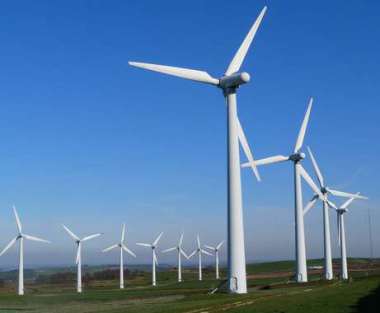 Second time lucky? Jupiter wind farm application lodged again, Canberra Times, 4 Dec 16 Katie Burgess
The company behind the controversial Jupiter wind farm has taken another swing at getting the green light to build 88 wind turbines near Canberra, a year after NSW officials sent them back to the drawing board.
The NSW Department of Planning and Environment struck out EPYC’s application to build the wind farm five kilometres out of the Tarago township last October, after it found the company had not sufficiently addressed environmental and community concerns.
But the joint Australian-Spanish venture has come back to the NSW Department of Environment and Planning with a revised proposal, which has now opened for public consultation.
While the original Jupiter wind farm proposal was to build 100 turbines across 25 rural properties, the new one outlines plans to build 88 turbines across 23 rural properties.
EPYC project manager Ibrahim Eid said the revised environmental impact statement included consultation with community members up to three kilometres away.
But residents of the surrounding regions have vowed to once again fight the proposal, which EPYC has been trying to get off the ground since 2014………
The wind farm will be within 15 kilometres of two operational wind farms, one approved wind farm and a solar farm.
The environmental impact statement acknowledged there could be wind turbines within two kilometres of properties not part of the farm.
It also stated there were 43 threatened fauna species, including the glossy black cockatoo and the spotted-tail quoll, however the turbines, substations and other ancillary buildings would be built on cleared paddocks.
The company will carry out targeted ecological surveys to determine where each wind turbine will sit.
Public submissions on the proposed wind farm close in February. http://www.canberratimes.com.au/act-news/second-time-lucky-jupiter-wind-farm-application-lodged-again-20161130-gt1f9j.html
1 This month


Help Aunty Sue Protect Her Land and Sacred Sites From Destructive Rocket Testing.
.

Australians deserve the truth
about
AUKUS – https://aukuspublicinquiry.com/

PETITION – To: Prime Minister Anthony Albanese and the Australian Labor Government

of the week – Australians for War Powers Reform (AWPR)
To see nuclear-related stories in greater depth and intensity

