Steve Dale Nuclear Fuel Cycle Watch South Australia, 1 Oct 16 In Geraldine Thomas’s recent talk she showed dosimeter data from students in Japan, but she didn’t make it clear that the students were kept out of the “Restricted zone” (funny about that). But if you read the paper, it mentions that a teacher went into the zone for 2 hours (to Okuma) and had readings of 5 microSieverts per hour. Thought I would show how the graph would look with this data included. (Note: Okuma is not the “hottest” area, some areas in the restricted zone are over 20 microSieverts per hour) [relevant graph can be seen on original on Facebook] Facebook https://www.facebook.com/groups/1021186047913052/ Continue reading →
October 3, 2016
Posted by Christina Macpherson |
South Australia, spinbuster |
Leave a comment
 Dr Paterson highlighted the importance of changing the conversation around nuclear issues through both outreach and education to address the knowledge gap and a lack of understanding that exists in society……
“People’s awareness has to be raised about the benefits of nuclear technology for health, the environment and important research,” said Dr Paterson.
Inspiring tomorrow’s scientists: The IAEA presents a new nuclear science and technology educational resource package for secondary schools, International Atomic Energy Agency 30 September 2016 “…… a new educational resource package developed by the IAEA in partnership with education and communication experts from around the world aims to answer. The Compendium of Resources and Activities on Nuclear Science and technology for Secondary School Teachers and Students, presented this week at a side event entitled ‘Introducing Nuclear Science and Technology in Secondary Schools’ on the margins of the 60th IAEA General Conference, aims to make nuclear science more interesting and attractive to students, and to encourage young people to enter the fields of nuclear science and technology……. we need to ensure that the nuclear knowledge is passed on to the next generations. This project is an opportunity for the youth, for developing countries, for women! ” said Ms Najat Mokhtar, Director of the IAEA’s Division for Asia and the Pacific in her opening statement to the side event……
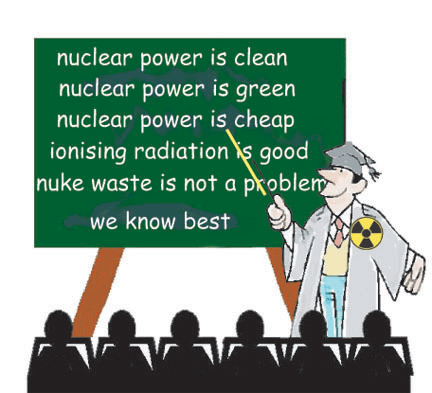
engaging their interest while still in high school is key to ensuring a cohort of students and graduates interested in pursuing careers as scientists, and ready to take on the challenge of developing nuclear knowledge and capacity in their countries……. Continue reading →
October 3, 2016
Posted by Christina Macpherson |
AUSTRALIA - NATIONAL, spinbuster |
Leave a comment
Dennis Matthews , 3rd October 2016
 Electranet now wants the public to pay for new infrastructure. Electranet’s proposed investment will be rewarded with a handsome guaranteed return on the amount invested, which will be funded by all South Australian electricity users in the form of increased tariffs.
Why do we need such a high capacity transmission network? It is to service big electricity users to the north of Port Wakefield, like BHP. Getting everyone to pay for the new infrastructure is a huge publicly funded cross-subsidy to the mining industry. It is a publicly-funded disincentive for more efficient and reliable distributed generation. It is anti-competitive.
The windfall profits reaped by Electranet will then go offshore.
This is a win for Electranet and the big energy guzzling mining companies but, as usual, a huge kick in the guts for small businesses and the average South Australian.
October 3, 2016
Posted by Christina Macpherson |
energy, politics, South Australia |
Leave a comment
NSW push for electricity interconnector with South Australia, SMH, Kirsty Needham , 2 Oct 16 The Baird government will push for a high-voltage interconnector to be built between NSW and South Australia following South Australia’s blackout, convinced the incident has highlighted the need for national energy security.
NSW Minister for Energy Anthony Roberts will attend an emergency meeting of COAG’s Energy Council on Friday, where the South Australian government is expected to seek to speed up a proposal to build the new interconnector between South Australia and the east coast.
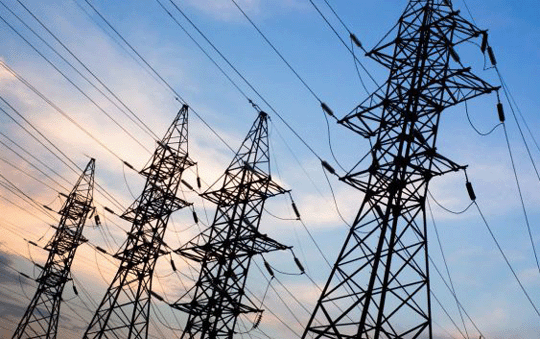
The $500 million proposal would involve South Australia’s ElectraNet and NSW’s Transgrid constructing a 300-kilometre transmission route, potentially between Buronga in NSW and Robertson in South Australia, that could supply surplus electricity from NSW.
NSW can already exchange power with Queensland and Victoria.
The project must first be approved by the Australian Energy Regulator because the construction cost will ultimately be passed on to electricity consumers.
But the Baird government argues the interconnector would not only ensure the lights stay on but also boost the growth of the NSW renewable energy sector, particularly solar farms in regional NSW, which would be able to access South Australian customers…….
The NSW Greens energy spokesman Jeremy Buckingham said: “NSW should adopt a state-based renewable energy target, otherwise all the investment and jobs in the clean energy sector will be attracted to other states that do have state-based targets and NSW will miss out.
“Mike Baird can either dance with the coal-loving dinosaurs or he can embrace the booming clean energy future.”
ElectraNet is expected to lodge an application for approval for the interconnector project by the end of the year. An analysis by PWC for Transgrid has estimated the cost to NSW households at $8 a year. http://www.smh.com.au/nsw/nsw-push-for-electricity-interconnector-with-south-australia-20160930-grspxa.html
October 3, 2016
Posted by Christina Macpherson |
energy, New South Wales, politics |
Leave a comment
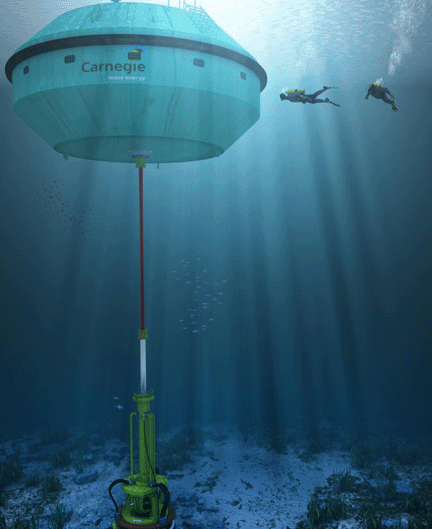
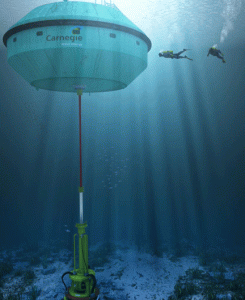 Carnegie Wave Energy up on Sri Lankan agreement https://au.news.yahoo.com/thewest/wa/a/32773367/carnegie-wave-energy-up-on-sri-lankan-agreement/#page1 Stuart McKinnon – The West Australian on September 30, 2016
Carnegie Wave Energy has signed a memorandum of understanding (MOU) with a Sri Lankan company for commercial wave and microgrid projects in the country.
The wave energy firm will work with Lanka Energy Conservation to identify opportunities and development pathways for its technology on the island nation.
Specifically the two companies will examine opportunities to enable CETO wave farms to be integrated into the existing or new power infrastructure to supply clean power and freshwater.
Carnegie’s chief operating officer Greg Allen said the company had made significant progress in its entry into the “small island” market this year.
“The signing of this MOU provides us with another opportunity to provide services to explore the possibility of incorporating CETO, along with microgrid solutions, to enable high penetration of renewable energy, displacing imported diesel,” he said.
Mr Allen said island nations were assessing clean, cost effective, alternative energy solutions to remove their reliance on electricity generated using imported fossil fuels.
“These imported fossil fuels come at a high cost, do not provide energy security and have a significant environmental footprint,” he said.
“Carnegie presents an effective clean energy alternative that can provide a solution for island and fringe of grid communities globally.” Lanka Energy Conservation chairman and managing director Dammica Wickramaratne said Sri Lanka showed good potential for wave, solar and wind energy power.
October 3, 2016
Posted by Christina Macpherson |
business, energy, Western Australia |
Leave a comment
Director of CME Bruce Mountain said while it would take time and preparation to change the nation’s  generation mix, it was “entirely solvable” and had been done in places where renewables had made a large penetration of the energy market, such as Texas, Denmark, Portugal and Norway.
“There is nothing intrinsic to renewable capacity that implies a lower security and certainty of supply than a fossil system,” he said.
“There is nothing intrinsic to it. It is just not the case. There is a different mix of generation, a different operating regime of the existing capacity, a different operating regime of the power system and the transmission system, all of which is entirely within the skill set of engineers, power system operators, planners and so on.”
Nothing stopping Australia from having both energy security and renewable energies say experts, as Federal Government ramps up attacks, Examiner,
2 Oct 2016, There is no reason Australia can’t have energy security and a network increasingly reliant on renewables, energy experts say, as the Federal Government steps up its attacks on Labor state governments’ “aggressive” targets.
Energy Minister Josh Frydenberg said he wanted the Labor state governments, which included Queensland, South Australia and Victoria, to “understand there is a cost and there are implications to these aggressive state-based renewable energy targets”.
But Mr Frydenberg was also forced to admit preliminary inquiries had shown the mass South Australian blackout that sparked the debate was the fault of an unprecedented storm, and not the state’s increasing reliance on renewable energy.
But Mr Frydenberg said the experience should be used as a starting point for a national conversation for what he called “aggressive” renewable energy targets set by Labor state governments and those targets could not take precedence over energy security. …….
“The Australian Energy Market Operator has pointed out as recently as August this year that, if the interconnectors between South Australia and Victoria went down, because of the high reliance on intermittent supply, namely wind and solar, there would be in their words, a high likelihood of a full regional blackout,” he said.
But energy experts said there was no reason the nation could not have energy security while transitioning to a power network more heavily reliant on clean energy. Continue reading →
October 3, 2016
Posted by Christina Macpherson |
AUSTRALIA - NATIONAL, energy |
Leave a comment
 Coalition launches rubbish attack on wind and solar after SA blackout, Independent Australia Giles Parkinson 30 September 2016 Coalition claptrap back on agenda: coal-fired power causes global warming which causes extreme weather. When record storm destroys transmission towers causing a blackout, BLAME RENEWABLES!
THE COALITION GOVERNMENT launched a ferocious attack against wind and solar energy after the major South Australian blackout, even though energy minister Josh Frydenberg and the grid operators admit that the source of energy had nothing to do with catastrophic outage.
Frydenberg, however, lined up with Prime Minister Malcolm Turnbull, Deputy Prime Minister Barnaby Joyce, One Nation’s Malcolm Roberts, Independent Senator Nick Xenophon and a host of conservative commentators, including Andrew Bolt, Alan Moran, the ABC’s Chris Ullmann, and Fairfax’s Brian Robins to exploit the blackout to question the use of renewable energy.
Frydenberg used the blackout to continue his persistent campaign against the renewable energy targets of state Labor governments in South Australia, Victoria and Queensland, saying that the blackout was proof that these targets were “unrealistic.”
He made clear that he wanted the states – South Australia and Queensland which are pushing for 50% renewable energy, and Victoria 40% – to abandon their schemes and conform to the Federal target, which has target of about 23.5% renewables.
The Federal scheme effectively ends in 2020, while the state based schemes provide longer term investment signals by providing a 2025 and 2030 timeframes…….
Electranet – which runs the grid in South Australia – and other grid authorities, have made clear that the blackout – which is unprecedented in Australia and led to its first ever “black start” – would have happened whatever the fuel source at the time.
Power lost after 3 of the 4 transmission lines were brought down by the storm
Bruce Mountain goes into detail about what was happening in this analysis here. But it is now clear that at least 23 high voltage power poles were lost in five different locations, bringing down three of the big four transmission lines that carry electricity to and from the north of the state, sparking a State-wide outage and its isolation from Victoria…….
His views were echoed by the likes of Roberts, Xenophon, the fossil fuel lobby, the South Australian Opposition, and even ABC commentator Chris Uhlmann, who agreed with Joyce that the wind farms were not working because the wind was blowing too hard…..https://independentaustralia.net/politics/politics-display/coalition-launches-rubbish-attack-on-wind-and-solar-after-sa-blackout,9532
October 1, 2016
Posted by Christina Macpherson |
AUSTRALIA - NATIONAL, energy, politics |
Leave a comment
New submarines could ultimately be nuclear, say experts AFR, by Mark Abernethy, 30 Sep 16 As far as government spending goes, it could be the largest capital project ever undertaken in Australia. The Future Submarines Program (FSP) aims to build 12 submarines at a cost of what could be more than $36 billion, taking the Australian Strategic Policy Institute’s estimate of each sub costing up to $3.04 billion (some public estimates have been higher).
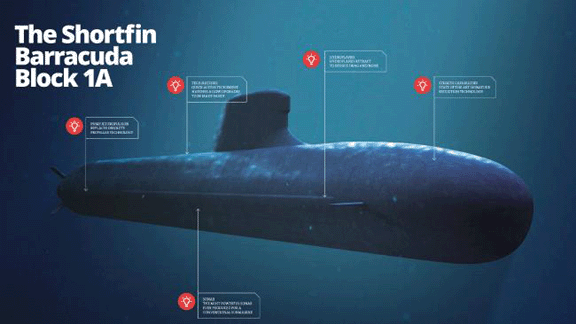
The prime contractor for the 12 submarines – intended to replace the Collins-class subs after 2025 – is French shipbuilder, DCNS, whose winning design is a diesel-electric variant on its Barracuda nuclear sub, now labelled the Shortfin Barracuda for the Australian project.
The requirement of the process was to deliver a regionally superior submarine, meaning the subs should be state-of-the-art, with a modern hull and a combat system from the United States.
However concerns about the new sub’s ability to convert from nuclear to diesel-electric may be ill-founded. In fact, the nuclear-centric design of the Barracuda class may be the point of the exercise, not the problem. “I wouldn’t be surprised if the later builds are nuclear,” says Peter Jennings, executive director of the Australian Strategic Policy Institute (ASPI).
Jennings says the Defence Force’s requirements for the subs, the softening attitudes to nuclear power and the fact that the Barracuda is a nuclear-powered design, point to the opportunity to switch to nuclear power in the Australian subs in the future………
He says the broadening range of Australia’s defence outlook could also be a driver of a switch to the ultra-long range of nuclear submarines. The acceptance of the “Indo-Pacific” as Australia’s strategic theatre increasingly means simultaneous long-range deployments, in different oceans, with different intensities.
“It’s probably a good bet to say that the reason we’ve gone with the Barracuda is that some of the 12 builds can be nuclear, giving the ADF more options in how these submarines are used, ” says Jennings……..
Dr Euan Graham, director of the international security program at the Lowy Institute, says the Japanese submarine in the tender was smaller than the Barracuda, and the Japanese contractor didn’t commit to building in Australia. However, the Japanese bid had the crucial advantage that its submarine is proven operationally…….http://www.afr.com/news/special-reports/defence-and-national-security/new-submarines-could-ultimately-be-nuclear-say-experts-20160926-grohze.
October 1, 2016
Posted by Christina Macpherson |
AUSTRALIA - NATIONAL, weapons and war |
Leave a comment
We have laws, good laws, that are being subverted.
These laws are the embodiment of the will of the people.
I have asked many times why this propaganda exercise is omitting the facts about South Australian law and the prohibition of nuclear waste importation into South Australia.
I have pointed out the deception involved in pretending to be objective while omitting the facts about current law and the penalties per offence of ten years jail and huge fines.
I ask again for an end to this waste of time and money.
I call again for investigation and prosecution of the perpetrators.
(copy of my comment at Your Say Nuclear facebook page run by Dept Premier and Cabinet)
October 1, 2016
Posted by Christina Macpherson |
legal, South Australia |
Leave a comment
 Betting the Farm: Farmers confront climate change http://www.abc.net.au/news/2016-09-30/farmers-confront-extreme-reality-of-climate-change/7887720 Climate change is here, and Australian agriculture is acutely feeling the effects. Three farmers explain how it’s impacting their lives and livelihoods.
By Jo Chandler for Background Briefing Real-world observations of temperature spikes, pasture growth and grape harvests across southern Australia reveal that the landscape is heating up at rates experts did not expect to see until 2030.
In some instances the rates of warming are tracking at 2050 scenarios.
Scientists concerned that climate change is biting harder and faster than models anticipated are campaigning for more research investment to protect Australia’s $58 billion agriculture industry from extreme weather.
Background Briefing has learned that their concerns about the capability of Australian research to address climate change will be validated in an independent review by the prestigious Australian Academy of Science.
The review, due for release in the next few weeks, has identified a substantial shortfall in the nation’s climate research firepower.
It’s understood that the review will recommend that the number of scientists working for CSIRO and its partners on climate science needs to increase by about 90. That is almost double the current number of full time positions.
Meanwhile, the reality is already confronting farmers on the front line, many of them battered by this last year of wild conditions.
Climate change makes farming more of a gamble than it ever was. It should be a complete concern to everyone who eats on this planet, because the whole world is going to be gambling on food production.
George Mills, Tasmania
We are seeing grapes ripening faster and ripening within a much shorter timeframe than they once did.
Brett McClen, Victoria
Climate change is here, there is no doubt about it … The hip pocket is when it makes you decide it is here or not, and it hurt our hip pockets, so we know.
Mark McDougall, Tasmania
Hear Jo Chandler’s full investigation into the impact of climate change on Australian agriculture on ABC RN’s Background Briefing at 8:05am on Sunday, or subscribe to the podcast on iTunes, ABC Radio or your favourite podcasting app.
October 1, 2016
Posted by Christina Macpherson |
Audiovisual, AUSTRALIA - NATIONAL, climate change - global warming |
Leave a comment
 Politicians blame wind power for taking out electrical grid in South Australia, Mashable, BY ANDREW FREEDMAN , 30 Sep 16 In the wake of an unprecedented blackout that cut off an entire Australian state from electricity on Wednesday into Thursday, some politicians are vilifying renewable power sources, particularly wind turbines.
Had the state of South Australia, which includes Adelaide, a city of 1.2 million, not put so much emphasis on cutting greenhouse gas emissions by adding renewable energy facilities, these leaders say, the blackout during a rare, extreme storm would not have occurred.
Considering the rapid rise in renewables around the world, including the U.S., the political fight that has broken out in Australia is not an issue limited to one nation. In fact, it could foreshadow future fights if blackouts occur in the U.S. or Europe, two areas where renewable energy use has increased recently……..
However, ElectraNet, which owns transmission lines in South Australia, said the severe storm — which included powerful winds and tens of thousands of cloud-to-ground lightning strikes, damaged three out of the four transmission lines that connect Adelaide with northern parts of South Australia.
None of the politicians have proposed an explaination for how wind turbines could’ve caused such a widespread outage, a first in Australia’s history, whereas ElectraNet has done so.…….
Prime Minister Malcolm Turnbull told reporters that the state’s aggressive push into renewables may have contributed to the unprecedented statewide blackout.
“The failure of the network was a weather event, pure and simple. Extreme weather knocked out 23 transmission pylons. Storms of this magnitude will knock out the power network no matter what the source of power is,” Bray told the newspaper.
A federal inquiry is likely to be launched into the cause of the more than 24-hour blackout, which may settle some of the debate going on now. Officials in states with a high reliance on wind power, such as Texas, will be closely watching the developments Down Under. http://mashable.com/2016/09/29/south-australia-blackout-wind-power/#KFHs2CKfmiqG
October 1, 2016
Posted by Christina Macpherson |
AUSTRALIA - NATIONAL, energy, politics, South Australia |
Leave a comment
October 1, 2016 RENEWABLE energy sources are rapidly becoming cheaper than new coal and gas-fired electricity, the main difference between different forecasts is the timing.
Bloomberg New Energy Finance says renewables are already cheaper than new fossil fuel plants in Australia. The conservative predictions of the Australian Government’s Bureau of Resources and Energy Economics say they will be within a decade.
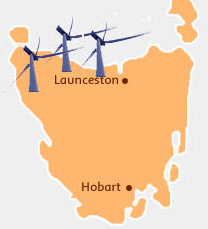
Of particular interest for Tasmania is the relative costs of electricity from wind and solar. Solar is getting cheaper faster than wind. Again, opinions vary on when the crossover will be. Recent statements by major Australian players suggest it will not be long……
Tasmania rightly prides itself on its potential for renewable energy development, but the unfortunate reality is that no large projects have commenced since the opening of the Musselroe Wind Farm in 2014.
Tasmania may only have a limited time to garner its rightful share of the $280 billion being invested globally in renewable energy each year.
Right now windy Tasmania has an advantage, but as the cost of solar drops, investors will look to sunnier locations. Continue reading →
October 1, 2016
Posted by Christina Macpherson |
energy, Tasmania |
Leave a comment
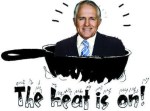 ‘Ignorant rubbish’: PM under fire over renewables lecturing Victorian Premier Daniel Andrews has lashed out at the prime minister, accusing him of peddling “ignorant rubbish” over renewable energy. SBS World News,
Source:
AAP Malcolm Turnbull has taken another swipe at the renewable energy policies of some state governments as he and Victorian Premier Daniel Andrews exchanged angry words over the issue.
Mr Andrews lashed out at the prime minister, accusing him of peddling “ignorant rubbish” over renewable energy after South Australia was blacked out in ferocious storms this week……..
Mr Andrews told ABC radio on Friday Mr Turnbull was “peddling ignorant rubbish, lecturing people about things he knows nothing about and conflating an extreme weather event”.
“It seems like Tony Abbott is back.”
The prime minister had no credibility when he talked about establishing a national renewable energy scheme.
“We are the only jurisdiction in the developed world that had a price on carbon and got rid of it and had a renewable energy target and wound it back,” Mr Andrews said.
The only way Australia could reach the Commonwealth’s renewable energy target of 23.5 per cent by 2020 was through the ambitions of state schemes.
Queensland and South Australia are aiming for 50 per cent and Victoria for 40 per cent, although over longer time frames.
Queensland’s acting energy minister Leeanne Enoch said her state was sticking to its target.
“You never know which Malcolm Turnbull you’re going to get – are we going to get the renewable champion one day and then we’re going to get an almost climate denier the next day,” she said.
“It’s bizarre.”…….http://www.sbs.com.au/news/article/2016/09/30/ignorant-rubbish-pm-under-fire-over-renewables-lecturing
October 1, 2016
Posted by Christina Macpherson |
AUSTRALIA - NATIONAL, energy, politics |
Leave a comment
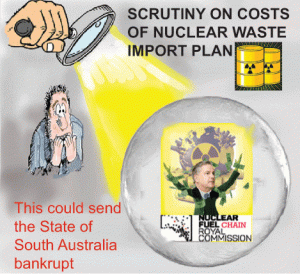 SA nuclear dump dreams just fool’s gold: senior Lib, The Australian, September 29, 2016, byMichael Owen http://www.theaustralian.com.au/national-affairs/state-politics/sa-nuclear-dump-dreams-just-fools-gold-senior-lib/news-story/a595649777c14703159a462c5d9cb34f
A senior Liberal has broken ranks in what had been a bipartisan approach to inquire into the potential for South Australia to host a repository for the world’s high-level nuclear waste, warning that taxpayers risked wasting money “on fool’s gold”.
Rob Lucas, a former state treasurer and the opposition’s Treasury spokesman, told parliament that intense political pressures would make it near impossible for there to be the required bipartisan support at both federal and state level for the necessary legislative changes to allow such a facility.
Mr Lucas, a member of parliament’s joint committee on the findings of the Nuclear Fuel Cycle Royal Commission, also cast doubt on the potential economic benefits, warning it was not possible to verify “some of the financial estimates in terms of what the state might earn from this facility”.
The Scarce royal commission’s final report, delivered in May, found that building a nuclear waste dump in South Australia could bring in an extra $100 billion over 120 years.
South Australian Premier Jay Weatherill — who faces resistance from federal Labor and his own Left faction — has said cabinet would make a decision in November as to whether to progress the proposal, after extensive community consultation. Latest opinion polls show South Australians almost equally divided on the issue.
Last night, Mr Weatherill, who returned this week from touring the world’s first permanent nuclear waste storage facility in Finland, told The Australian he understood the complexities. “I do agree that this issue poses challenges, not the least for my party, but I feel duty bound to act in South Australia’s and the national interest in progressing this debate,” he said.
Mr Lucas said it would be a “courageous Liberal candidate or member in a federal campaign who would be out there campaigning hard to support Premier Weatherill on a nuclear waste dump or facility’’ in his state.
“At an upcoming federal election … (there will be) federal Labor candidates campaigning in South Australia against a nuclear waste facility in South Australia and potentially candidates from the Greens and the Nick Xenophon Team campaigning against a nuclear waste dump or facility (there). If there is not going to be the support of the federal Labor Party, then we, the taxpayers of South Australia, will be spending tens and maybe hundreds of millions of dollars on fool’s gold — fool’s uranium, fool’s nuclear waste dumps.”
September 30, 2016
Posted by Christina Macpherson |
AUSTRALIA - NATIONAL, business, politics, South Australia, wastes |
1 Comment
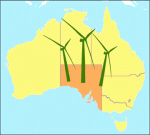 SA weather: No link between blackout and renewable energy, experts say, ABC News, 29 Sep 16 By political reporter Matthew Doran Linking the statewide blackout in South Australia with the state’s heavy reliance on renewable energy is unfounded, energy industry experts say.
Key points:
- South Australia has the highest rate of renewable energy in Australia
- The ‘one in a 50 year’ weather event ‘couldn’t have been prevented or foreseen’
- SA to be an example for other states and territories when planning for significant weather events
A severe storm caused the entire state to go dark yesterday afternoon, following serious damage to more than 20 transmission lines.
That infrastructure failure put extra strain on the interconnector system that links the South Australian electricity grid with the east coast — and tripped safeguards which shut down the power supply to the state………
Mr Frydenberg highlighted the underlying cause of the blackout was the weather.
South Australia has the highest rate of renewable energy in the country, with a fraction over 40 per cent of the state’s power supply generated from sources such as wind and solar farms.
Earlier this week, the Grattan Institute released a report detailing the pressure high uptake in renewables had put on the state’s wholesale power prices, and how it was being viewed as a test case for the rest of the nation. But the report’s author, Tony Wood, said the blackout was as a result of a particularly violent storm and it was usual for a system to shut down to protect itself from further damage. “My understanding, at least at the moment, is there’s no evidence to suggest these two issues are related,” Mr Wood said.
“There’s no evidence to suggest this was caused by too much wind power, or the dependence on wind power, or anything else, or would’ve been any different if any of the power stations that had been shut down earlier this year had still been operating.
“If you’ve got a wind farm or a coal-fired power station at the end of a transmission line, and that system either is taken out by a storm or is forced to shut down to protect itself from a storm, it doesn’t matter what the energy source is.”
There are two interconnector power lines between South Australia and the eastern states, but Mr Wood said there was no indication having more links would have prevented the issue.
“When this event has occurred, it’s created a fault in the system which has caused the generation to trip offline,” the Clean Energy Council’s Tom Butler said.
“It’s separate to the interconnector entirely.
“This is a one-in-a-50 year, almost-unprecedented event for the state that couldn’t have been prevented or foreseen.”
Mr Butler said the Snowtown wind farm, north of Adelaide, was actually helping to prop up the state’s power supply ahead of gas power stations as the network was gradually brought back online.
Labor’s assistant spokesman for climate change, Pat Conroy, told AM it was premature to link the blackout to renewables.
“The South Australian Government has made the point that even if the coal-fired power station that was recently closed down was still operating, it would not have been able to supply power to the state,” he said.“This was a failure of the transmission network, and it didn’t matter what sort of fuel was feeding into the grid, power was not able to flow……..http://www.abc.net.au/news/2016-09-29/sa-weather:-no-link-between-blackout-and-renewables-expert-says/7887052
September 30, 2016
Posted by Christina Macpherson |
climate change - global warming, energy, South Australia, wind |
1 Comment






 JACK GILDING, Mercury