Cutback in solar payments: smart meters might help
 From solar boom to bill shock: Australians face loss of rooftop payments
About 275,000 people across the country will have their solar energy payments reduced by up to 80% over the next six months, Guardian, Michael Slezak 31 July 16 “……. more than 275,000 people across Australia who will see the subsidised payments they receive for their solar energy disappear over the next six months, replaced with rates up to 80% lower.
The solar boom in Australia, which has led to 1.5m households generating their own electricity from the sun, was accelerated by subsidised payments for people who sell solar-generated electricity back to the grid.
In some cases, like Shaw’s, solar customers were able to receive more than twice the money for the electricity they put in the grid, compared with what they paid for electricity they took out of it.
But for a lot of homes and businesses, those schemes are coming to an end over the next six months and, if they’re not prepared, they will be heading towards some serious bill shock.
Customers in New South Wales, who got the most generous rate, will be in for the biggest hit and will need to do the most to adapt to the changes…….
While about 150,000 homes and business will be kicked off these schemes in NSW on 1 January 2017, the party is ending for about 130,000 customers inVictoria and South Australia too.
(Others are on schemes that will continue for years to come. So if people are confused about their own feed-in tariffs, they should ask their retailer what’s happening with them.)…….
Smart meters
The issue of what kind of meter to get is a minefield right now, with different issues affecting consumers depending on where they are, and options are changing rapidly.
One thing that can help anyone make the most of their solar electricity is a smart meter, says Claire O’Rourke, national director of Solar Citizens, a group that lobbies on behalf of solar customers.
A smart meter can be read remotely, and can tell when the most power is being drawn, helping maximise the benefits. They can also open up services such as time-of-use tariffs, providing savings for people who avoid using energy during periods of high demand.
“You’re probably better off with a smart meter but they do have an increased cost,” says O’Rourke.
Some retailers are offering discounts for smart meters in return for fixed-term contracts. “It is really in the interest of consumers to shop around,” she says.
For many people right now a smart meter could be overkill. The smart meter will either be paid upfront, or in the case of free meters offered by retailers, will be paid for through increased tariffs, says Moyse. Whether the meter will allow consumers to recoup that cost is unclear.
For people outside NSW, the lowest-cost option is to keep their current meter, at least until it’s clear a smart meter is worth it. Outside NSW, the current meter will work fine on the new deals.
Unfortunately, for most people on the NSW solar bonus scheme, their meters will need to be replaced……..
the loss of generous feed-in tariffs is driving interest in battery storage, says Chris Cooper, chief executive of Suncrowd, a company using group purchasing power to get cheaper prices for batteries.
“It’s a bit of a trigger point for people to look at new technology,” Cooper says. So far Suncrowd has run its first round in Newcastle, and had about 200 homes join together and buy batteries at discount rates.
He says lots of the customers who have been approaching Suncrowd have been people coming off the NSW solar bonus scheme. Having a battery added to an existing solar system can significantly increase “solar self-sufficiency”, Cooper says, a measure of how much the customer relies on solar rather than electricity from the grid. “With an appropriately sized battery you can boost it from 20% to about 60 or 70% self-sufficiency,” he says. Cooper says Suncrowd is building an online tool to help people calculate their solar self-sufficiency and have been showing it to people at events they’ve been holding. “People are really motivated by seeing the numbers go up,” he says…….https://www.theguardian.com/environment/2016/jul/31/australia-residents-solar-rooftop-lose-payments
Nick Xenophon – only a referendum is adequate to resolve South Australia’s nuclear waste decision
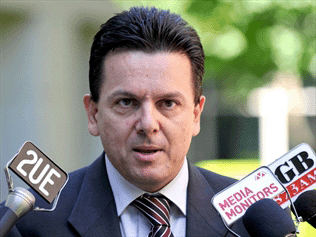 South Australian Premier Jay Weatherill says a final decision on a nuclear waste dump is still years away. SBS World News, AAP 29 JUL 2016
The state government on Friday launched a three-month community consultation program on the recommendations rising from a Royal Commission into the Nuclear Fuel Cycle…….Mr Weatherill says whatever the outcome of that process, a final decision on the dump is still some way off, and will be proceeded by a series of “gated decisions” to move ahead cautiously…….
But South Australian independent Senator Nick Xenophon said only a referendum of all South Australian voters would be adequate for such a momentous decision.
“Because once we have a nuclear dump, that’s it. We will be known as the nuclear dump capital of the world,” he said.
South Australian Greens MP Mark Parnell also criticised the consultation process which he said had ignored the history of failures, cost overruns and risks associated with waste storage.
“The government says it wants South Australians to have the facts, but it has chosen just some of the facts to present,” he said. http://www.sbs.com.au/news/article/2016/07/29/sa-dump-decision-years-away-says-premier
WALKATJURRA WALKABOUT continue the fight to stop uranium mining
 Walkatjurra Walkabout – Walking for Country https://walkingforcountry.com/walkatjurra-walkabout/walkatjurra-walkabout-about-us-2/
will be lead by the
Walkatjurra Rangers https://walkatjurra.com/rangers/
in partnership with
Footprints for Peace https://www.facebook.com/FootPrintsforPeace
Western Australian Nuclear Free Alliance (WANFA) https://nuclearfree.wordpress.com/
the Anti Nuclear Alliance of Western Australia (ANAWA) http://www.anawa.org.au/ and
the Conservation Council of Western Australia (CCWA) http://www.ccwa.org.au/
Wiluna to Leonora from August 7th – September 7th 2016
https://walkingforcountry.com/walkatjurra-walkabout/
 ‘WALKATJURRA WALKABOUT is a celebration of Wangkatja country, a testament to the
strength of the community who have fought to stop uranium mining at Yeelirrie for over forty years, and a chance to come together to continue share our commitment to a sustainable future without nuclear.
It is a chance to reconnect with the land, and to revive the tradition of walking for country.’
‘We invite all people, from all places, to come together to walk with us, to send a clear message
that we want the environment here, and our sacred places left alone.’ Kado Muir, Traditional Owner, Yeelirrie
Three jeers to Today Tonight Adelaide reporter, Hendrik Gout
100% Renewables for SA Three jeers to Today Tonight Adelaide reporter, Hendrik Gout, turning the people he interviewed – fans of solar power in to seeming solar dislikers. Never let the truth get in the way of good fear-mongering story?
Could Mr Gout’s former job have something to do with it?

On Monday, the Adelaide branch of the Seven Network’s daily current affairs program, Today Tonight, ran with a similar anti-renewables slant, as it has done before. And, like much of the Murdoch media’s reporting, its chock full of errors.
The program opened by recalling South Australia’s November 2015 black-outs – a predictable starting point for a renewables witch hunt, considering that was the reaction of the mainstream media back when the outages occurred.
According to Today Tonight Adelaide reporter, Hendrik Gout, “the November night the lights went out” happened because of the “state’s reliance on ‘unreliant’ energy”.
Never mind that this is simply not true. As we reported at the time, “there was only one technology that abandoned its post on Sunday evening, and that was the massive transmission line linking Victoria and South Australia.”
And, as the Australian Energy Market Operator later concluded in a report, the black-out caused by a switch failure lasted much longer than needed because a gas-fired generator failed to follow instructions, causing the system to trip again. The blackout had nothing to do with renewables at all.
That claim should not be a surprise coming from Gout, who was a former senior staffer for South Australia Liberal David Ridgway, the party’s leader in the upper house.
The Coalition in South Australia is notoriously anti-wind, feeding rubbish data to The Australian last week that had to be retracted. Ridgway is also the instigator of an ongoing upper house inquiry into wind energy.
Gout’s program went on to interview two different South Australian business operators: one a farmer/irrigator in the Riverland region who complained – not without reason – that the state’s high power prices had made his business less competitive; and one a micro-brewer on the Murray, who similarly seemed to suggest that power supply difficulties had restricted the growth of the business.
But something didn’t quite gel with these interviews, so we decided to talk to the people ourselves……….
When we asked Beavis why the 30kW PV system wasn’t mentioned in the Today Tonight report, he told us in an emailed statement: “Our solar project was one of the main points I was aiming to get across. But from viewing the piece, it seemed to get lost in the edit.”
Beavis also told us that the solar system offsets 100 per cent of the brewery and houseboats’ power consumption……..http://reneweconomy.com.au/2016/today-tonights-misleading-report-renewables-south-australia-85014
Effect of global warming on Antarctic could be amplifying climate change
 Earth’s ability to absorb CO2 reduced by global warming, Antarctic study finds http://www.abc.net.au/news/2016-07-29/global-warming-reduces-earth-co2-absorption-arctic-study/7673032 By Stephanie Smail Global warming reduces the amount of carbon dioxide the earth can absorb, which could amplify climate change, landmark research in Antarctica has revealed.
CSIRO researchers extracted ice bubbles in pre-industrial polar ice to measure the planet’s sensitivity to changes in temperature.
They found that for every degree Celsius of global temperature rise, the equivalent of 20 parts per million less CO2 is stored by the land biosphere.
CSIRO principle research scientist Dr David Etheridge said the research confirmed the relationship for the first time and revealed how it impacted the cycles of carbon between land, ocean, and the atmosphere.
“That’s useful to know. It’s a bit concerning because it’s going to amplify the climate change, but it’s good news in a way because it can be used in modelling.”
The research team used ice core samples from the Australian Antarctic Program’s unique Law Dome site, together with ice cores from the British Antarctic Survey.
The study focused on CO2 changes preserved in ice before, during, and after a naturally-cool period known as the Little Ice Age (1500 to 1750 AD).
“It gives global planners something to work with, to help estimate what CO2 emissions are allowable to limit global warming to one and a half or two degrees Celsius,” Dr Etheridge said.
The finding is a result of a collaboration between CSIRO, the Seconda Universita di Napoli, University of Melbourne, British Antarctic Survey, University of East Anglia, Australian Antarctic Division, University of Tasmania, and the Australian Nuclear Science and Technology Organisation.
Electricity industry in a panic about renewable energy’s success
Disruptive power, The Age, Richard Denniss , 29 July 16 The Productivity Commission is  criticising the Trans Pacific Partnership, the head of the Australian Competition and Consumer Commission is criticising privatisation, and the electricity industry is worried that competition from renewables might deliver lower prices to consumers. What on earth is happening to the Neo-liberal “agenda”?
We are witnessing a watershed moment in Australia’s economic and political debate. The grand narrative of “market good-government bad” is dead. Killed by the rent seekers and vested interests that couldn’t resist overselling the benefits to the same consumers and taxpayers they were busy gouging.
The mining industry can’t help asking for taxpayers to subsidise their rail lines…….
It’s hard to maintain the argument that government spending is bad for the economy when even the Institute of Public Affairs supports taxpayer funding for dams and coal railway lines in far northern Australia…….
The PC, which now refers to so-called “free trade agreements” as “preferential trade agreements”, recently said that the TPP includes provisions of “questionable benefit” to Australia. It was once heresy to suggest that a document called a ”free trade agreement” could do anything other than facilitate trade, but now the Lefties at the PC are encourage us to scrutinise the detail. Rules matter…….
the banks, the mining companies and the media moguls that shouted the loudest about “free markets” have always spent up big on lobbyists to ensure they got the rules they wanted. But now the cat is out of the bag. …….
As more and more batteries are installed in homes and businesses the peak load on the transmission network will be reduced, meaning that we will be able to save billions of dollars on line upgrades within and between towns and cities. Should that windfall accrue to those with an obligation to maintain the network, to the people who install the batteries, or be shared in some way? Rules matter……..
South Australia has cheaper electricity today than it had in 2007. There were no black outs during the so-called “crisis” and the vast majority of residential and industrial customers who are on long-term contracts didn’t even notice the five-minute surges in the wholesale spot price. When the interconnector upgrade is complete, and if a new interconnector with NSW is built, not only will SA be able to rely on more power from other states when the wind is calm, but SA will be able to export a lot more cheap energy when the wind does what it usually does in SA which is blow hard.
The fear that SA may soon be an even bigger exporter of cheap wind power is what is behind the recent “debate”. Their best chance to protect their profits is to ensure that the “market regulations” restrict the growth prospects for their main competitors. Rules matter. After years of getting the rules they wanted by arguing that they simply wanted “free markets” Australian rent seekers are now forced to win public debates about why we should give them the rules they want. It’s not going well for them.
Richard Denniss is the chief economist for The Australia Institute. http://www.theage.com.au/comment/disruptive-power-20160728-gqgazk.html
Desperate coal industry sponsors attacks on wind farms
 Coal is behind the attacks on wind turbines. It’s fighting for its life, The Age, Peter Martin, 27 July 16
First they were supposed to be destroying birds, then sleep. Now wind turbines are being blamed for destroying the Australian electricity market and pushing prices as high as $14,000 per megawatt hour.
As Victoria gives the green light for a massive $650 million wind farm with up to 104 turbines at Dundonnell, 200 kilometres west of Melbourne, and with talk of more wind farms in NSW a Liberal senator has been calling for a moratorium on new turbines until the Productivity Commission examines what they are doing to prices.
“There should be no further subsidies paid for an intermittent and unreliable power source that can be seen as as proven failure,” Senator Chris Back is quoted as saying, in an apparent attempt to prejudge the inquiry he is calling for.
On the face of it, it’s an odd idea: that adding a new and very cheap source of power should push up prices (wind turbines cost next to nothing to operate). And for the record, it’s not true. South Australia has more wind turbines than any other state. They supply more than one-third of its power. Yet a graph prepared by the Australian National University’s Hugh Saddler shows that South Australia’s average electricity price was much higher when they only provided 10 per cent.
The complaint is about spot prices, those instant short-lived prices the big industrial users have to pay if they haven’t insured against sudden movements, as a lot have not………
With fewer coal-fired plants, and with wind plants scattered throughout the nation, the system has the potential to work surprisingly well. Energy analyst David Leitch points out that in South Australia most of the wind turbines fire up at the same time, but if they were also placed in northern NSW and Tasmania (where the wind blows at very different times) each would fill the other’s gaps.
South Australia and Tasmania overlap only 10 per cent of the time. At other times, the gap would be filled by storage: either batteries or water storage as wind power pumps water up to the top of mountains while the wind’s abundant and lets it drop through hydro plants when it’s not.
Wind needn’t be a problem, regardless of what you’ve been told. But it does leave very little role for coal, which supplies base load power for which a wind-dominated system would have little use.
With fewer coal-fired plants, and with wind plants scattered throughout the nation, the system has the potential to work surprisingly well. Energy analyst David Leitch points out that in South Australia most of the wind turbines fire up at the same time, but if they were also placed in northern NSW and Tasmania (where the wind blows at very different times) each would fill the other’s gaps.
South Australia and Tasmania overlap only 10 per cent of the time. At other times, the gap would be filled by storage: either batteries or water storage as wind power pumps water up to the top of mountains while the wind’s abundant and lets it drop through hydro plants when it’s not.
Wind needn’t be a problem, regardless of what you’ve been told. But it does leave very little role for coal, which supplies base load power for which a wind-dominated system would have little use. http://linkis.com/www.theage.com.au/co/1H46Y
The influence of mining companies on governments, especially Queensland
Greasing The Wheels: Report Lays Bare Extraordinary Govt Access For Queensland Miners, New Matilda By Hannah Aulby on July 29, 2016 There’s something rotten in the state of Queensland, and it smells a lot like gas and mining. Hannah Aulby explains.
There is little doubt that the mining industry enjoys a higher level of access and influence over government in Australia than the average citizen. It’s often difficult to measure exactly how far that influence extends, but at other times it becomes glaringly obvious.
A report released today by The Australia Institute and the Australian Conservation Foundation shows that the influence of the mining industry on government in Queensland is systematic and ongoing.
The report, ‘Greasing the Wheels: the systematic weaknesses that allow undue influence of mining companies on government, a Queensland case study’, provides six case studies of mining companies using political donations, high level political access, gifts and the ‘revolving door’ to influence legislation in their favour.
It shows that Beach Energy, Sibelco, Karreman, New Hope, Adani and Linc Energy have all received favourable treatment from government including retrospective mining project approvals, revocation of environmental protections and reversals of party mining policies.
These case-studies are just the tip of the iceberg. In recent days Linc Energy and QRC have provided fresh insights into a frightening trend…… https://newmatilda.com/2016/07/29/greasing-the-wheels-report-lays-bare-extraordinary-govt-access-for-queensland-miners/
Wakaya Traditional Aboriginal Owners steadfast against fracked gas pipeline
 NT Traditional Owners walk out on fracked gas pipeline deal Lock The Gate Alliance, July 28, 2016 Northern Territory Traditional Owners whose land is being targeted for the proposed new gas pipeline between Tennant Creek and Mt Isa have yesterday afternoon walked out of a joint Central and Northern Land Council meeting, pushing against a planned access route deal for Jemena’s Northern Gas Pipeline, due to concerns about the impacts of fracking gasfields.
A Land Council notice for the meeting asked, ‘are you ready to say yes or no to the pipeline?’ (see here). But the concerns and objections raised by Traditional Owners about the rushed consultation process and the proposed pipeline’s reliance on fracked gas has now meant the decision meeting is postponed until late September……
A final investment decision on the pipeline is due in December 2016 but Wakaya Traditional Owners say they will not back down and allow the project to proceed on their land. Continue reading
Nuclear Weathervane Weatherill wavers on his anti – referendum stance
 SA nuclear waste dump referendum vote still possible, Premier Jay Weatherill says http://www.abc.net.au/news/2016-07-28/referendum-on-sa-nuclear-waste-dump-still-possible/7668412 By political reporter Nick Harmsen The South Australian Government may not be in a position to make a final decision on whether to pursue an international high-level nuclear waste dump this year, Premier Jay Weatherill has said.
The Premier has previously said the Government’s plans to make a decision clear to parliament in November.
But Mr Weatherill today told a budget estimates committee any decision this year was likely to be just the first step. “I’d like to be in a position to make a decision about whether we’re able to pass the first threshold,” he said.
“And there is an important go/no-go threshold that needs to be considered by the parliament.”
The Government has assembled a series of citizens’ juries to help inform its decision.
Mr Weatherill told the committee he would not rule out holding a referendum on the nuclear issue.
But he said a referendum would not provide the level of nuance required. “In particular, some green groups are calling for a referendum,” he said.
“Of course they’re the same green groups that don’t want a referendum on gay marriage. But leaving aside that little internal inconsistency for the moment, I think I [a referendum] tends to close down debate rather than allow it to be developed.”
Philip White reports onNuclear Royal Commission’s presentation to TAFE students
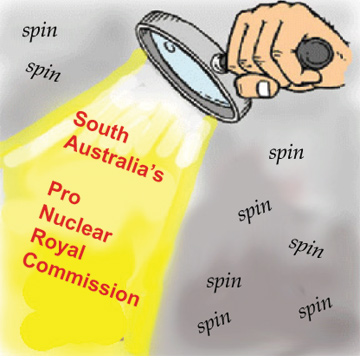 Philip White, 28 July 16 A video consultation session for TAFE staff and students was held on July 28 from 12-1pm. Below is a brief report.
The session started with a 15 minutes Scarce presentation video. I think it was from the press conference for the release of the RC report, but am not sure. One thing that struck me was how Scarce used words like ‘trace’ to imply that the amount of radionuclides after 1,000 years would be negligible.
John Phelan of the Nuclear Fuel Cycle Royal Commission Consultation and Response Agency (CARA) followed up with comments about process.
I was one of only two knowledgeable participants, the other being a nuclear proponent who wanted the dump to go ahead quickly and thought the costs were exaggerated. He thought in a few years we would need nuclear reactors.
A couple of regional TAFE lecturers complained about the lack of notice (meaning they hadn’t read the email sent to all staff and students) and lack of information (meaning they hadn’t been picked up in the RC’s regional propaganda tours). One lecturer confused this with the Commonwealth dump, thinking it would be located near her property in Quorn. John Phelan clarified that this consultation was just about an international dump.
2. Process
I made the following points about process:
(1) These consultations (and also the educational materials they apparently plan to provide to schools) should include presentations both for and against the proposal. Without that the public does not have a basis for thinking critically.
(2) The first Citizens’ Jury was flawed because it was inappropriate for it to be tasked with summarising the RC report.
(3) Referring to the forthcoming second “Citizens Jury”, a 350 person group should not be called a Citizens Jury.
Re (2), Phelan had said in his initial presentation that summarising the RC report was a (the) role of the first Citizens Jury, encouraging people to read this wonderful synopsis.
Members on this email list may recall that I have previously pointed out this flaw of the first citizens jury. I went to the trouble of ringing Iain Walker of NewDemocracy about this. He said the jurors were told to “prioritise” not to “summarise”. I then pointed out that the first sentence of their report says “summarise”. Walker said it was not the organisers’ role to change what the jury wrote, implying that the jury members had misinterpreted their role. But in today’s video conference Phelan was completely clear that they were asked to “summarise”. In my view, asking a Citizens Jury to summarise (or even prioritise) an official document is an abuse of the Citizens Jury method. Citizens Juries are a method of gaining incite into the judgements of informed citizens. They should not be used to help the government (or the Royal Commission) communicate its message.
Re (1), Phelan showed no interest in taking on board my suggestion that all consultations should include presentations from both pro and con perspectives. He responded that they were trying to present facts not opinions, claiming that the RC report was factual. I pointed out that the RC report was not a factual document. It is a selection of facts and perspectives, that there were lots of facts and perspectives that were left out, and that the report reflected the biases in the makeup of the RC.
I suspect that there is some confusion in the government about what it is trying to do with this public consultation process—whether it is trying to stimulate an informed debate, or whether it is just trying to persuade the public to let it build the international nuclear waste dump that it already knows it wants.
It is counter-intuitive for governments and bureaucracies to promote critical thinking among the public, but I suggest we challenge them to give equal time to critics and proponents. When they refuse, then we can call them out. We will have proof that their process was a sham. In the unlikely event that they agree to this demand, we should accept it in the confidence that we can win this argument. Of course, it would be difficult for critics to resource such a project, but we can cross that bridge when we come to it.
3. Waste dump
I pointed out that cost estimates for nuclear projects are generally gross underestimates and that SA would be left with a huge financial and nuclear burden if the costs end up exceeding the revenues. There would be no way of sending the waste back to the countries of origin.
BHP Billiton’s costs for Brazil mine disaster – $3 billion and rising
 BHP Billiton’s Samarco costs top $3 billion, ABC News By business reporter Stephen Letts, 28 July 16, Mining giant BHP Billiton has doubled its provisions for the Samarco mine disaster in Brazil to well in excess of $3 billion.
BHP said it will recognise another provision in the range of $US1.1 to $US1.3 billion ($1.5 to $1.7 billion) on top of $US1.2 billion ($1.6 billion) charge already announced in its half-yearly results in February.
That charge, along with several other asset write-downs, caused BHP to report a record $7.8 billion interim loss.
In a statement to the ASX, BHP said the new provision is approximately equivalent to its 50 per cent share of the current estimate of the Samarco compensation deal struck with Brazilian federal, state and municipal authorities in March.
However, that funding agreement – which was intended to restore and repatriate the community and environment affected by the tailings dam collapse – remains in limbo, having being suspended by Brazil’s Supreme Court last month.
The BHP statement noted the provision reflected the ongoing uncertainty surrounding the nature and timing of a potential restart of the Samarco operations.
The charge will be recognised as an exceptional item in the forthcoming results, together with direct costs of around $US100 million ($133 million)…….http://www.abc.net.au/news/2016-07-28/bhp-billiton-samarco-costs-top-3-billion-dollars/7668832
Josh Frydenberg talks renewable energy – but no action from this government
Coal fan Frydenberg’s figleaf fluttering in the wind
Environment and Energy minister Josh Frydenberg is claiming to be a convert to the cause of renewables but the grim truth is that this government has no interest in meaningful climate action., Crikey, Bernard Keane Alarmed at the criticism of his appointment as combined energy and environment minister, Josh Frydenberg has launched a media campaign to overhaul his image as that of the man who recently insisted there was a “strong moral case” for burning more coal and starting economically unviable new coal mines like Adani’s Carmichael project (not to mention his loathing of environmental groups).,… (subscribers only) https://www.crikey.com.au/2016/07/28/frydenberg-on-renewables-and-coal-but-no-real-action/
Renewables not to blame for South Australia’s electricity papers – says Energy Minister Josh Frydenberg
 Frydenberg says renewables not to blame for South Australia energy “crisis”, REneweconomy By Giles Parkinson on 28 July 2016 Josh Frydenberg, the minister newly elevated to the combined energy and environment portfolio, says that renewable energy was not to blame for the recent energy “crisis” in South Australia, although he did deliver some mixed messages about how the government proposes to move forward.
Frydenberg delivered a series of interviews on Wednesday, the first since he was appointed to the new position in a reshuffle by the re-elected Turnbull government, and this included a “chat” with ABC personality Annabel Crabb at a dinner function at the Clean Energy Summit.
Asked about the recent electricity spikes in South Australia, Frydenberg said it was a “complex picture” that included a reduced capacity on the inter-connector, a cold snap that spiked demand, a big shift in gas prices, and the “intermittency issue about wind and solar.”
But he also noted that in 2008, as RenewEconomy has reported, the price of wholesale electricity in South Australia peaked above $5,000/MWh more than 50 times. That was before wind and solar were in that state, he said, and noted there had only been three such peaks so far this year.
“People have to understand that this volatility is not a new thing. It was back there in 2008 …. so to say that (this price spike) is the fault of renewables is not an accurate assessment,” Frydenberg said, to the applause of the audience of around 400 people.
This, however, was not how The Australian interpreted events, who attributed Frydenberg’s comments about the crises in South Australia and Tasmania as a “wake-up” call about the problems created by wind and solar.
Tasmania, it should be remembered, suffered the highest wholesale prices in Australia last financial year because its electricity supply was restricted by the loss of the Basslink cable and much of its hydro capacity due to drought. Most analysts say it was its lack of investment in wind and solar that forced it to rely heavily on expensive back-up gas and diesel…….
Frydenberg appeared well briefed, non-confrontational, and recognised the growing role of technologies such as wind, solar and battery storage whose costs had fallen quickly and would continue to do so. He also appeared to be listening, people said.
The role of coal, Frydenberg accepted, is declining, and the transition to clean energy is inevitable. But he was reluctant to put any time frames on the inevitable move to zero emissions technology, apart from saying that a shift to 100 per cent renewable energy was not going to happen overnight.
But while his comments were soothing for an industry just regaining its confidence after being battered and bruised by the first term of the Abbott-Turnbull government and the key policy decisions of Frydenberg’s good friend, the previous environment minister Greg Hunt, his next moves will be scrutinised intensely.
There is great concern about a push by the incumbent energy industry, such as the Energy Supply Council to force state governments to abandon their individual state targets, a move that will be strongly resisted by South Australia, Victoria, Queensland and the ACT……..http://reneweconomy.com.au/2016/frydenberg-says-renewables-not-to-blame-for-south-australia-energy-crisis-75546
Wind and solar are NOT responsible for the doubling of wholesale energy prices in South Australia
South Australia’s ‘absurd’ electricity prices: renewables are not to blame, Guardian
Tristan Edis, 28 July 16
Wind and solar are not responsible for the doubling of wholesale energy prices in SA – that’s just part of the spin that says renewables are expensive. Reading many of the newspapers over the past few weeks you’d think South Australia had become a horrible case study in the dangers of too much renewable energy……
Politicians are now responding, with Liberal Senator Chris Back calling for a ban on new wind farms until after a review by the Productivity Commission. Meanwhile Senator Nick Xenophon’s party are backing a Senate inquiry.
Yet everyone has missed the main cause of a doubling in SA power price rises – a doubling in gas prices.
What makes it all especially worrying is the blame attributed to renewable energy appears to have originated from a public relations campaign initiated by the lobby group for the big power generators………
wholesale market data suggests renewable energy has actually been depressing power prices, not increasing them. In the months before and after the Northern Coal Power Station was taken off-line, South Australia’s wind farms, without exception, bid their entire available output into the market for a price less than a single dollar. Meanwhile rooftop solar doesn’t even bid into the market, with its output just reducing the demand for generators that do bid into the wholesale market.
This is not to suggest renewable energy imposes no costs. It is certainly true that wind and solar require a subsidy, but its cost is distributed equally across all electricity consumption around the nation via the federal RenewableEnergy Target scheme. It isn’t allocated to states depending on how many wind farms or solar panels they have installed.
The idea that renewables are to blame for the doubling in South Australian wholesale prices is an idea the Australian Energy Council, which represents big power companies, have been pushing since late last year. This campaign has sought to paint South Australia as an “accidental experiment” in the dangers of too much renewable energy.
If you scratch the surface they actually acknowledge renewable energy is depressing wholesale power prices. But they claim it pushes prices so low that, rather strangely, it is apparently increasing prices……..
It was only with the addition of wind and solar to the existing mix of coal plus the interconnector that gas could be driven down to less than a third of the electricity market. This acted to substantially shield SA from power price rises, not induce them.
So it is LNG plants, not wind and solar, that are responsible for South Australia’s “absurd” electricity prices. https://www.theguardian.com/commentisfree/2016/jul/27/south-australias-absurd-electricity-prices-renewables-are-not-to-blame
1 This month



Help Aunty Sue Protect Her Land and Sacred Sites From Destructive Rocket Testing.
.

Australians deserve the truth
about
AUKUS – https://aukuspublicinquiry.com/

PETITION – To: Prime Minister Anthony Albanese and the Australian Labor Government

of the week – Australians for War Powers Reform (AWPR)
To see nuclear-related stories in greater depth and intensity

