Australia: HRF, Jewish Council and ANIC Demand Arrest or Entry Ban of Israeli President
January 30th 2026, https://www.hindrajabfoundation.org/posts/australia-hrf-jewish-council-and-anic-demand-arrest-or-entry-ban-of-israeli-president
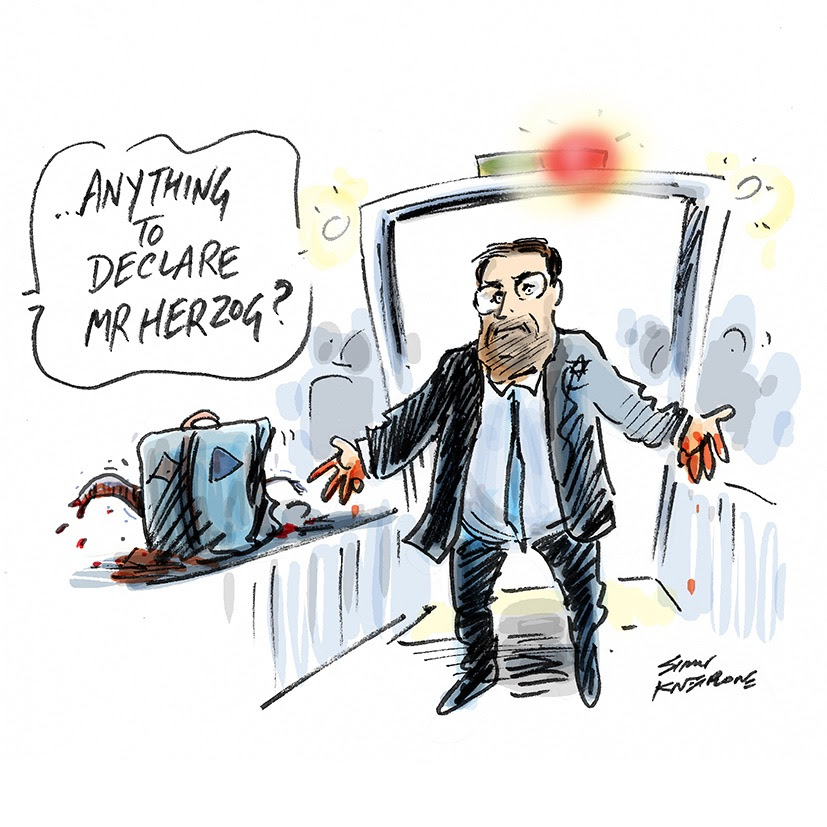
In a historic joint action, the Hind Rajab Foundation (HRF), the Jewish Council of Australia, and the Australian National Imams Council (ANIC), have lodged a formal legal complaint to have Israeli President Isaac Herzog arrested or barred from entering Australia. The groups, represented by renowned barrister Robert Richter KC, allege that Herzog has incited genocide and aided and abetted war crimes, rendering him unfit to enter the country under Australian law.
The 30-page submission, sent yesterday to Attorney-General Michelle Rowland, Home Affairs Minister Tony Burke and the Australian Federal Police (AFP), warns that the President’s visit is “highly inflammatory”.
The groups are calling on the AFP to initiate a criminal investigation of Herzog under the Commonwealth Criminal Code.
The urgent request details a “sustained pattern of incitement and hate speech” by the President, specifically citing:
- The “Entire Nation” Declaration: Herzog’s October 2023 statement that there are no “uninvolved” civilians in Gaza, which the groups argue stripped 2.3 million people of their protected status under international humanitarian law and urged the IDF to treat the entire population as a military target.
- Famine Denial: Herzog’s August 2025 claims that images of starving Gazan children were “staged”—a statement made while famine was setting in and which the brief describes as a “conscious effort to obscure war crimes”.
- Endorsement of Military Operations Involving War Crimes: A December 2023 visit to the Nahal Oz military base where Herzog reportedly “encouraged” troops 48 hours before the “wanton destruction” and “flattening” of the Palestinian town of Khuza’a.
The submission rejects any claim that Herzog has diplomatic immunity, citing the Nuremberg Principles and international law to argue that heads of state have no shield against charges of genocide or war crimes. The groups warn that if the government fails to act, it would signal “acquiescence to genocidal rhetoric”.
“If the Prime Minister of Israel is not permitted to visit Australia, the President should not be allowed to act as his surrogate,” the complaint states, referencing the International Criminal Court’s arrest warrants for Israeli Prime Minister Benjamin Netanyahu.
Dyab Abou Jahjah, Hind Rajab Foundation:
“When a head of state publicly denies civilian protection, dismisses famine, and encourages military operations marked by widespread civilian harm and destruction, those acts carry legal consequences everywhere. No country — including Australia — should become a safe haven for individuals credibly accused of inciting genocide or aiding and abetting war crimes. Australia has a duty to uphold the rule of law and protect its communities from such threats.”
Ohad Kozminsky, Executive Member, Jewish Council of Australia:
“President Herzog represents a state found to be committing genocide in Gaza. His presence in Australia would identify this state with Australian Jews, which risks exacerbating social division and endangering Australian Jewish communities. We stand firmly against all forms of racism, and President Herzog’s statements attributing collective guilt to an entire people are a textbook manifestation of anti-Palestinian racism and Israel’s ongoing campaign of dehumanisation.”
Bilal Rauf, Senior Advisor, Australian National Imams Council (ANIC):
“In recent times, Australia’s social cohesion has been under threat. Now more than ever, it is incumbent upon all of us, particularly our political leaders, to seek to protect our social cohesion as a country and society and ensure that individuals who may inflame the situation by their very presence, are not permitted into our country. The proposed visit by the Israeli President Isaac Herzog, a highly controversial foreign head of state accused of serious international crimes, risks inflaming social tensions, undermining Australia’s hate-speech protections, and placing Australian communities at risk. ANIC calls on the Government, which has hurriedly passed laws in the name of social cohesion, to refuse or cancel any visa held by President Herzog. In pursuing this, among other outcomes, ANIC joins with the Jewish Council of Australia and the Hind Rajab Foundation, in pursuing the complaint.”
As Trump Threatens Weekend Strike on Iran, Albanese Pretends Pine Gap Isn’t Complicit
1 February 2026 David Tyler AIM Extra
Albanese’s Iran Illusion: How Australia Sleepwalks into Someone Else’s War
While our federal government waffles on about rules based order, Iran is rewriting the rules of modern warfare. Trump is threatening regime-change. The Strait of Hormuz has become a kill box where $13 billion aircraft carriers play sitting duck to lethal, glorified speedboats, where cyberattacks double as deterrence, and where Australia, ever the loyal deputy, pretends it’s all someone else’s problem. Labor’s silence isn’t prudence. It’s complicity in a US strategy that’s already unravelling, and we’ve got the scars to prove it.
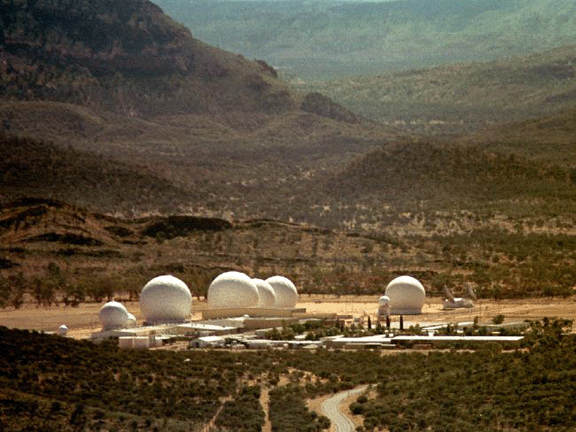
Trump already bombed Iran once. In June 2025, Operation Midnight Hammer saw seven B-2 stealth bombers drop bunker-busters on three nuclear facilities while Pine Gap provided the targeting data. Iran’s face-saving response, a telegraphed missile strike on Al Udeid Air Base in Qatar, fooled no one. But it burned through 25% of America’s total THAAD interceptor stockpiles, missiles the US produces at a rate of roughly one per month. Now Trump’s threatening round two, this time with explicit regime-change goals, and Albanese still won’t acknowledge that Australia’s uncritical alignment has painted a target on our own facilities.
The real damage? Washington’s isolation campaign isn’t weakening Tehran. It’s shoving Iran into Beijing and Moscow’s arms, locking in an anti-Western axis that thrives on American blunders, while teaching every threshold nuclear state that compliance buys nothing but bombs. Why won’t Labor admit the scale of the mess? Because doing so would mean confessing its own role in a policy already fraying at the seams.
Iran’s Budget Warfare: Turning American Strength into Liability
Iran isn’t trying to match the US ship for ship. The Islamic Revolutionary Guard Corps has crafted a playbook that turns American firepower into dead weight: coastal swarms, cyber harassment, proxy deterrence. The goal isn’t winning a war. It’s making escalation so unpredictable, expensive, and politically toxic that the US thinks twice before starting one.
In the cramped waters of the Strait, even Iran’s modest fleet of fast-attack craft becomes a force multiplier. The IRGC doesn’t need a knockout punch, just enough chaos to trap US commanders in a no-win scenario. Push ahead and risk humiliation. Retreat and signal weakness. Dither in the middle while morale drains away. So far, the Pentagon has mostly chosen door number three, proving you can outspend your opponent by billions and still lose the initiative to speedboats and audacity.
The Strait of Hormuz: Where Geography Beats Firepower
The USS Abraham Lincoln isn’t just another, elderly ship in the Strait. It’s a floating monument to American overreach, now redeployed for what Trump calls an “armada larger than Venezuela,” the latest regime-change operation on his scorecard. Iran’s swarm tactics don’t need to sink a nuclear-powered carrier to succeed. They just need to make every transit a gamble, every patrol a potential disaster.
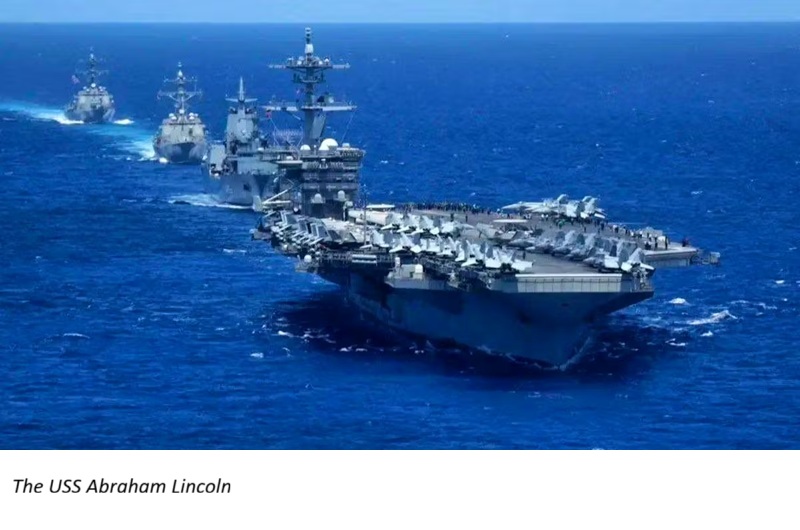
The IRGC’s speedboats may look like dinghies, but in these confined waters where 20% of the world’s oil flows, they’re a constant reminder: geography, not firepower, decides who blinks first. Tehran isn’t trying to win a shootout. It’s turning the Strait into a quagmire where the US loses whether it escalates or backs down, and every crisis burns through irreplaceable defensive systems while China takes notes.
Cyber Jihad: How Iran Turned Hacking into Deterrence
Iran may not match Russia or China’s cyber prowess, but it doesn’t need to. Its campaigns against US, Israeli, and Gulf targets aren’t about knockout blows. They’re about raising costs, sowing doubt, ensuring any strike on Iranian soil comes with a digital counterpunch. From disrupting Saudi oil facilities to probing Israeli water systems, Tehran’s message is simple: hit us, and we hit back, not just with missiles, but with chaos in your backyard.
At home, the regime has weaponised the internet itself, using imported surveillance tech and homegrown censorship to crush dissent. Since January 8, Iran’s internet connectivity has been throttled to 1% of normal levels, a digital blackout designed to hide what appears to be one of the bloodiest crackdowns in modern Iranian history. It’s crude, effective, and one more layer of deterrence the Pentagon now factors into every war plan.
The Massacres Under the Blackout: What Trump’s “Humanitarian” Intervention Ignores
Here’s what Trump won’t mention when he frames the next strike as protecting Iranian protesters: his administration is planning regime change in a country already reeling from mass killings. Since late December, Iran has experienced its largest uprising since 1979, sparked by currency collapse and spreading nationwide. The regime’s response has been catastrophic…………………………………………………………………………………………………………………………………………………………………………………….
The Pine Gap Paradox: Australia’s Uncritical Complicity
Australia isn’t a neutral observer. Through Pine Gap, we provided the intelligence backbone enabling the June 2025 strikes on Iranian nuclear facilities, operations now drawing genocide allegations at the ICJ given the broader context of US-Israeli coordination. That makes us complicit, and Tehran has noticed.
Iranian Brigadier General Mohammad Akraminia was explicit in his warning: if the US strikes again, “the scope of war will certainly extend across the entire region… From the Zionist regime to countries that host American military bases, all will be within range of our missiles and drones.” That’s not bluster. That’s a direct threat to Australian facilities, delivered after we’d already enabled one round of strikes.
The Herzog visit crystallises Labor’s paralysis. Albanese frames it as “solidarity” with Jewish Australians, but the timing, amid ICJ hearings, domestic protests, and credible reports of an “imminent” second US strike aimed at regime change, screams political theatre. Hosting an Israeli president while Pine Gap’s data flows unrestricted into contested operations isn’t tone-deaf. It’s a neon sign for Iranian retaliation: cyberattacks, grey-zone harassment, or worse.
Yet Albanese won’t acknowledge the risks, because doing so would mean admitting our uncritical alignment with Washington has made us a target. So we get silence, deflection, empty platitudes about “shared values,” while senior US military officials tell Middle Eastern allies that Trump may strike Iran “as soon as this weekend.”
Greg Moriarty, our ambassador in Washington, saw this coming. His warnings about blowback from sanctions and military-first strategies should be shaping the debate. Instead, they’ve been sidelined, because realism doesn’t win elections, and admitting the Pine Gap Paradox would require honesty this government doesn’t possess.
The Nuclear Cascade: What Comes After Trump Bombs Iran Again
If Trump follows through, the consequences extend far beyond the Middle East. Every regional power watching this crisis is recalculating. Saudi Arabia has made no secret of its nuclear ambitions, with Crown Prince Mohammed bin Salman publicly declaring the kingdom would pursue weapons if Iran did. Riyadh’s deepening defence cooperation with nuclear-armed Pakistan isn’t coincidence. It’s a hedge against American unreliability and regional instability……………………….
Crossroads: The Choice Albanese Won’t Make
Australia still has options, but the window is closing fast. We can deepen our operational integration with the US, provide targeting for regime-change strikes, and hope Iran decides we’re more trouble than we’re worth. Or we can use our position inside the American security ecosystem to argue for de-escalation, regional guarantees, diplomacy over another roll of the dice with irreplaceable defensive systems and global proliferation architecture.
The second path means telling a distracted superpower our support has limits, that we won’t sign a blank cheque for a strategy multiplying our exposure while delivering only drift. It means acknowledging publicly that Pine Gap’s role in the June strikes has already made Australia complicit, and that a second round aimed at regime change crosses a line we should never have approached.
But if Albanese won’t level with the public about the stakes, we risk sleepwalking into a conflict shaped by other people’s decisions, on other people’s timelines, with Australian facilities providing the targeting data that helps trigger a regional war and global nuclear cascade.
Drop Site News reports the strike could come “as soon as this weekend.” Common Dreams notes 56% of Americans already believe Trump has gone too far with military interventions. Even many Iranian protesters warn the US will exploit their struggle rather than support it. The pieces are in place for a catastrophic escalation, one that makes the June strikes look like a warning shot.
The question isn’t whether Australia can afford to speak plainly about these risks. It’s whether we can afford not to, and whether Albanese has the courage to admit that our “shared values” with Washington don’t extend to enabling regime-change operations that will make us targets while accelerating nuclear proliferation across the Middle East.
The silence from Canberra isn’t prudence. It’s complicity. And if Trump pulls the trigger this weekend, Albanese’s refusal to acknowledge our role will look less like diplomacy and more like dereliction.
This article was originally published on URBAN WRONSKI WRITES, https://theaimn.net/as-trump-threatens-weekend-strike-on-iran-albanese-pretends-pine-gap-isnt-complicit/
The Rules-Based Order: Where America Gets Away with Murder, and Everyone Else Gets the Bombs

When the US bombs Iranian nuclear sites, it’s a “strike”. When Iran defends itself, it’s “aggression”. When the US funds insurrections, arms rebels and sabotages economies, it’s “promoting democracy”.

While Ms Penny Wong chants the “rules based order” mantra, Mr Moriarty, gets the gong: he is off to Washington to ensure Australia remains locked in step with the world’s biggest bully. Meanwhile, as the ICJ rules that Israel’s actions in Gaza constitute plausible genocide, and as the US and Australia continue to arm and fund Israel’s apartheid regime, the hypocrisy would knock you over. The “rules based order” isn’t about justice. It’s about power and who gets to wield it without consequences.
31 January 2026 David Tyler , Australian Independent Media
Australia’s Foreign Minister Penny Wong chants “rules based order” like a sacred hymn.
Order? In reality, it’s a squalid, pseudo-legal jargon for a world where might is right. While the US drops depleted uranium on Iraqi children, arms Israeli apartheid and fuels insurrections in Iran, any nation that dares assert its independence is crushed under a tonne of bricks. In Iran’s case, a hail of “precision strikes” designed to wound, maim and cause lifelong agony. Meanwhile, in Gaza, the International Court of Justice has declared Israel’s actions plausible genocide, ordering an immediate halt to atrocities and unimpeded humanitarian access. The US and its allies, including Australia, have ignored every ruling, proving once again that the “rules based order” is nothing more than a mafia protection racket, and we’re collecting the rent.
Depleted Uranium is often said to drop but it’s part of the super new bullets or “rounds” in use. The A-10 Warthog’s GAU-8 Avenger, for example, fires 30mm DU rounds. Tank rounds (e.g., the US M829 series) use DU in their cores to penetrate enemy armour. So kids get a spray of it, rather than a drop.
When these rounds hit a target, they aerosolise into fine, toxic dust, which can be inhaled or contaminate soil and water, leading to long-term health risks (e.g., cancer, birth defects) and environmental damage.
The Rules Based Order A Licence to Kill
Penny Wong stands in Parliament, her voice trembling with moral certainty. To her, Australia stands with the brave people of Iran as they struggle against an “oppressive regime”. She invokes the rules based order like it’s a force field against tyranny, a beacon of justice in a murky, chaotic and mercenary world. Just one snag. The rules apply to everyone else. Only.
When the US bombs Iranian nuclear sites, it’s a “strike”. When Iran defends itself, it’s “aggression”. When the US funds insurrections, arms rebels and sabotages economies, it’s “promoting democracy”.
When anyone else does it, it’s “terrorism”. And as the US sprays depleted uranium, children become cancer statistics? Birth defects are an inter-generational curse, it’s “collateral damage” a euphemism for war crimes.
This isn’t a rules based order. It’s a licence to kill, and Australia through our defence secretary Greg Moriarty, our intelligence agencies and our slavish alignment with US foreign policy is complicit at every step.
And now, as the International Court of Justice declares Israel’s actions in Gaza a plausible genocide, ordering Israel to halt its military operations and allow humanitarian aid, the US and its allies, including Australia, have done what they always do ignored the ruling and doubled down.
Loaded Language “Regime” vs “Government”, “Strikes” vs “Slaughter”
Let’s talk about the language of empire. The US and its press never refer to the “Iranian government”. It’s always the “Iranian regime” a term that strips legitimacy, implies tyranny and justifies intervention. Meanwhile, Saudi Arabia, a brutal monarchy that beheads dissidents and bombs Yemeni school buses, is a “key ally.”
Israel, an apartheid state with nuclear weapons, is a “vibrant democracy”
When the US bombs a Syrian hospital, it’s a “precision strike”. When Iran fires a missile in self defence, it’s “terrorism”. When the US funds, arms and trains insurgents in Iran such as the Network of Iranian Activists for Democracy (NAD), which distribute Molotov cocktails to protesters and boast about “turning Tehran into a warzone” it’s “supporting democracy”. When Iran arrests those same insurgents, it’s “crushing dissent”.
This isn’t reportage. It’s propaganda, and it’s designed to manufacture consent for the next war.
The Dirty Weapons Engineered to Maim, Designed to Terrorise
The US doesn’t just kill. It maims. It terrorises. It leaves behind a legacy of suffering so grotesque that it defies the term “war crime”. What’s happening is worse than death. Generations suffer. The US has used depleted uranium munitions in every major Middle East conflict since the Gulf War. Why? Because DU is dense enough to pierce armour, but its real legacy is cancer, birth defects and environmental poisoning.
In Fallujah, where the US used DU in 2004, doctors reported a 14 fold increase in birth defects; babies born with two heads, missing limbs and organs outside their bodies. The called the city “the new Hiroshima”. In Syria, the Pentagon confirmed using DU in 2015, despite international condemnation. The result? Radioactive dust that lingers for decades, poisoning soil, water and people. In Iraq, the US ignored its own guidelines, firing DU at unarmoured targets, buildings and even troops turning cities into toxic wastelands.
The US knows DU is a war crime in slow motion. It just doesn’t care.
The US military has set out to maximise suffering. From cluster munitions banned by 100 countries, but still used by the US to white phosphorus, which burns through flesh to the bone, the goal isn’t just to win wars it’s to leave populations traumatised, disabled and dependent.
Cluster bombs scatter hundreds of tiny bomblets, many of which fail to explode until a child picks one up years later. White phosphorus doesn’t just burn. It melts flesh and re-ignites when exposed to air, ensuring victims suffer excruciating, prolonged deaths. Drones don’t just kill targets. They terrorise entire communities, turning the sky into a permanent threat and leaving survivors with PTSD for life.
This isn’t warfare. It’s sadism, dressed up in the language of “national security”.
The Australian Connection Greg Moriarty and the Art of Complicity
Australia isn’t just a bystander to this horror-show. We’re in it up to our necks. Greg Moriarty, our defence secretary and soon to be ambassador to the US, cut his teeth in Iran. As Australia’s ambassador to Tehran from 2005 to 2008, he briefed George W. Bush on Iranian politics at the height of US sabotage operations, assassinations and economic warfare against Iran.
Moriarty’s stellar career is a masterclass in how Australia punches above its weight in the US empire from intelligence sharing to military drill, from sanctions enforcement to diplomatic cover for US aggression.
While Ms Penny Wong chants the “rules based order” mantra, Mr Moriarty, gets the gong: he is off to Washington to ensure Australia remains locked in step with the world’s biggest bully. Meanwhile, as the ICJ rules that Israel’s actions in Gaza constitute plausible genocide, and as the US and Australia continue to arm and fund Israel’s apartheid regime, the hypocrisy would knock you over. The “rules based order” isn’t about justice. It’s about power and who gets to wield it without consequences.
Historical Parallels Chile, Guatemala, Iraq, Syria and Now Iran (and Gaza)
This isn’t new. The US has been skittling independence for decades. In Chile in 1973, the CIA sabotaged the economy, funded strikes and backed a coup against Salvador Allende all to protect US corporate interests. The result? Seventeen years of Pinochet’s torture chambers……………………………………………………………………………………………………………………………………………………………………………………………………………………………….. Call tyranny for what it is. While we are still permitted to express dissent.
This article was originally published on URBAN WRONSKI WRITES https://theaimn.net/the-rules-based-order-where-america-gets-away-with-murder-and-everyone-else-gets-the-bombs/
The Preaching Pentecostal: Scott Morrison in Israel
29 January 2026 Dr Binoy Kampmark, https://theaimn.net/the-preaching-pentecostal-scott-morrison-in-israel/
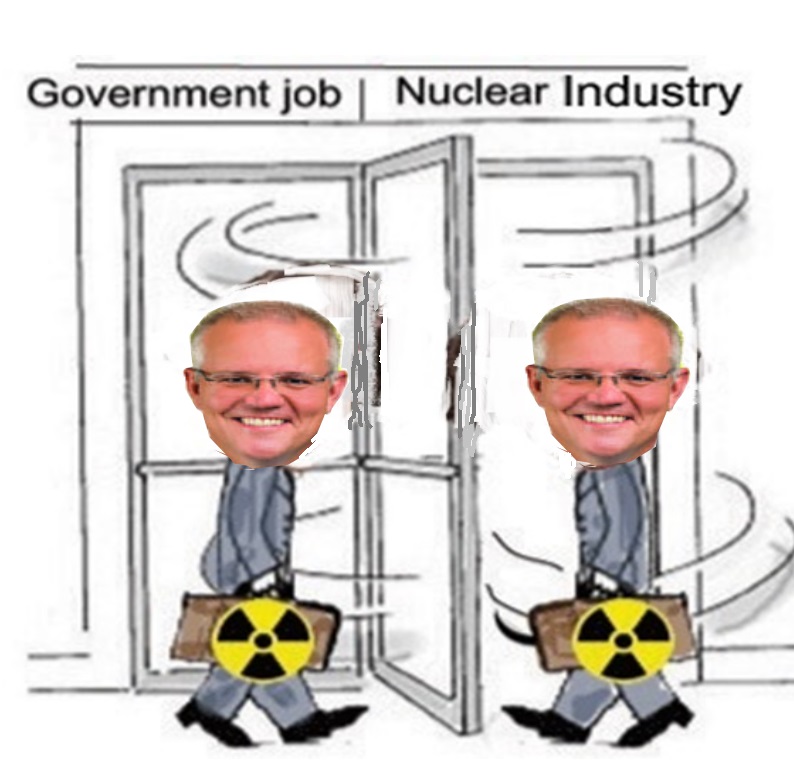
Australia’s former Prime Minister and faithful Pentecostal Scott Morrison never passes up the chance to express an opinion if it will net him a reward. As one of various politicians of the right (and far rightist) hue invited by Israel’s Minister for Diaspora Affairs and Combating Antisemitism, Amichai Chikli, he was in good company. The occasion: the second international conference on combating antisemitism held between January 26 and 27 at Jerusalem’s International Convention Center, ambitiously titled Generation Truth.
The December 14, 2025 attack by two ISIS-inspired gunmen on those attending a Hanukkah event on Sydney’s Bondi Beach had supplied him with a hot script. Australia’s Albanese government had been previously barked at by Israeli Prime Minister Benjamin Netanyahu for going wobbly on Israel and soft on Palestinians. Morrison was in hearty agreement, claiming that the Labor government had “walked away from the Jewish state while antisemitism has taken root in Australia,” feeding the hate through unilateral recognition of Palestinian statehood.
In keeping with various Christian groups of the right, Morrison is of the view that Israeli interests need to be protected, shielded and treasured against other, undesirable members of the Book. Christians and Jews can make a common alliance against their enemies, even if evangelical Christianity has a well-stocked reserve of antisemitic attitudes. As Prime Minister, Morrison recognised West Jerusalem as Israel’s capital, despite its contested status in international law, going so far as to open a Trade and Defence Office there in 2019. In 2021, his government officially adopted the definition of antisemitism proposed by the International Holocaust Remembrance Alliance (IHRA), one that fudges criticism of Israeli policies with antisemitism. Since losing office he has been further courting Israel’s favour by attacking the United Nations for being a forum for antisemitism garbed in the argot of human rights.
The January 27 address recapitulated these points, and more. He pointed to a five-fold rise in antisemitic incidents in Australia following the October 7, 2023 attacks on Israel by Hamas. Context, such as Israel’s historical suppression of Palestinian autonomy and its ruthless campaign of pulverisation in Gaza, was absent. Regular protests in Sydney and Melbourne, including a Sydney Harbour Bridge march numbering 100,000 people, were all cut from the same cloth of antisemitism. Again, Israel’s conduct and policies deserved no mention, while slogans such as “from the river to the sea” and “globalising the intifada” could only be seen as antisemitic declarations.
With political illiteracy typical of the man, Morrison then linked the protests and a softer approach to Palestinian statehood directly to the Bondi attacks, his mind unblemished by any understanding about what ISIS is, and its hostility to Hamas. Shades, here, of the sham groupthink that marked Cold War analysis from Washington to Canberra on monolithic communism. Just as communism of the Chinese, Soviet and Vietnamese character was just communism, so can all forms of Islamism be considered identical.
The usual cod analysis of the “progressive Left,” with its “neo-Marxist identity frameworks” and the “radical Right,” with its “conspiratorial and ethno-nationalist forms,” are offered, both serving as the conduit for “grievance politics.” “When failure is moralised as systemic injustice, liberal norms collapse.” This is the golden apologia for Israel writ large: do not blame institutions and injustice as having any consequences, the spawn of their practices. Abandon grievance; it has no role.
This sets the scene for Morrison’s real concern, and in this, he was keeping to the theme pushed by Chikli from the outset. Whatever the issues on the Left and Right of politics, Islam posed the greatest antisemitic threat, with its “imported European conspiracy theories, recasting Jews as a hidden enemy responsible for global disorder.”
His solution to such malignancy in a Western secular context? More religion, not less. Morrison quotes Lord Rabbi Jonathan Sacks quoting Jonathan Swift: “we have just enough religion to make us hate, but not enough to make us love.” But the faith in question had to be of the “good” sort, an inward individual consideration, rather than the “bad” variety that externalised the grievance and made people rush for placards, street rallies and arms.
That bilious right-wing figures demanding the expulsion of Palestinians from the West Bank and Gaza have more than enough religion to go around (Israel’s National Security Minister Itamar Ben Gvir and Finance Minister Bezalel Smotrich come to mind) suggests this formula to be flawed. But Morrison singles out Islamic leaders and institutions within Australia as alone in lacking accountability. What was needed was “a recognised accreditation framework for imams, a national register for public-facing roles, clear training and conduct requirements, and disciplinary authority for governing councils.” Sermons should also be translated into English, and links to foreign Islamic groups policed and curbed.
In Australia, Liberal Senator Andrew Bragg spoke approvingly of the former PM’s tarnishing method, with Australian Muslims having to “take some responsibility” for terrorist acts. “Unfortunately,” he told ABC radio on January 28, “there has been a mutation of Islam in Australia and other Western countries where they have sought to kill citizens, not just Jewish people, but other citizens.”
The Australian National Imams Council (ANIC), the Australian Federation of Islamic Councils (AFIC) and the Islamic Council of Victoria were suitably unimpressed. Chief executive of the Islamic Council of Victoria, Zakaria Wahid, made the far from startling point that the Australian government did “not hold entire communities accountable for acts of violence committed by individuals, and the same standard must apply to Muslims.”
Morrison has shown that he can be a good Pentecostal when required, demonstrating the sort of charity that never leaves his home or the halls of the Hill Song Church. As a cabinet minister and prime minister in various conservative governments, he showed a glacial contempt for women, welfare recipients, refugees, asylum seekers, those warning about climate change and open government. As prime minister, he gave Australia AUKUS, a criminally exorbitant, foolishly negotiated security pact between Canberra, London and Washington that has turned his country into an American satellite and forward base against China. But his less than secular admiration for Israel has won him friends, a point Chikli has unreservedly acknowledged. No doubt some well remunerated consultancy work is in the bag.
The Afterlife of Failed Prime Ministers
30 January 2026 Roswell , https://theaimn.net/the-afterlife-of-failed-prime-ministers/
There is a curious phenomenon in modern politics whereby leaders rejected by voters at home are reborn as sages abroad. It is a kind of political reincarnation, except instead of coming back as something wiser, they come back with a microphone, an expense account, and a suspiciously friendly audience.
Take Tony Abbott and Scott Morrison. Two of the most out-of-their-depth, ineffectual, policy-light and spectacularly uninspiring Australian prime ministers of the past 50 years. Governments so underwhelming that voters didn’t merely change their minds – they slammed the door, locked it, and put the furniture up against it.
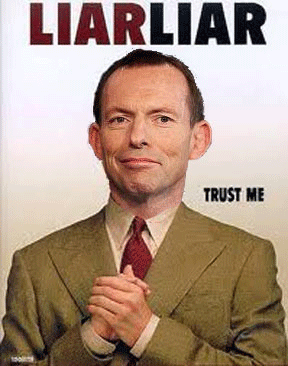
This is surprising, because while neither man excelled at governing Australia, they have since been warmly embraced on the international speaking circuit – mainly by right-wing conferences, “freedom” forums, and governments that find Western accents useful when saying deeply illiberal things.
Tony Abbott, whose prime ministership was defined by instability, internal warfare and three-word slogans that passed for policy, is now invited to explain leadership. Abbott struggled to explain his own government to his own party room, but apparently this has not deterred organisers elsewhere.
Scott Morrison’s record is fresher – and stranger. A prime minister who treated government as a branding exercise, communicated almost exclusively through slogans, and managed crises with photo opportunities rather than competence. A man so committed to secrecy that, in his final months in office, he quietly appointed himself to five ministries without telling the ministers involved.
Ironically, since leaving office, Morrison appears to have lost the ability to keep secrets altogether.
The man who secretly ran half the government now speaks endlessly. Panels, conferences, fireside chats. There is no shortage of words – just an ongoing shortage of insight. Morrison’s speeches are long on grievance, heavy on culture-war talking points, and light on anything resembling reflection or accountability.
One might reasonably ask: who is paying to hear this?
The answer is not “the public.” These are not broad, curious audiences wondering what went wrong. They are curated rooms. Friendly rooms. Rooms where applause is guaranteed and difficult questions are optional. Rooms where electoral defeat is reframed as martyrdom and democratic accountability as persecution.
Failure, it seems, has become a credential.
In a healthy democracy, losing office used to mean something. It was feedback. A verdict. An instruction to step aside. Now it is merely the start of a second career – one in which rejection at home is marketed overseas as proof of courage.
None of this is illegal. None of it is particularly new. But it is revealing.
If Abbott and Morrison had left office respected, effective, and admired, their global speaking careers would make sense. Instead, they left behind governments remembered largely for chaos, secrecy, and exhaustion. And yet, somewhere overseas, there is always a stage, a lectern, and an audience eager not to ask why.
Australia’s New AUKUS Protest Police, and the Quiet Redefinition of Dissent
28 January 2026 AIMN Editorial, By Denis Hay
AUKUS protest police: FOI documents reveal the AFP’s Orcus Command and how protest is being treated as a national security issue in Australia.
Introduction
Public discussion of AUKUS has focused on submarine delivery dates, strategic alignment, and cost blowouts. Far less attention has been given to how the Australian government is preparing for domestic opposition to the agreement.
Freedom of Information documents obtained by transparency advocate Rex Patrick and reported by Michael West Media reveal that the Australian Federal Police has quietly established a new unit, Orcus Command, dedicated to protecting AUKUS-related defence facilities. The documents show this unit is also planning for public order management, including protest and political dissent connected to Australia’s growing role in US and UK military operations.
This matters because protest is a cornerstone of democratic accountability. When dissent is framed primarily as a security risk, the balance between public order and civil liberties shifts in ways that deserve close public scrutiny.
What has received far less attention is how the government is preparing to manage Australians who oppose it.
Internal link: “Australia’s AUKUS agreement”.
Editor’s note:
This analysis is based on Freedom of Information documents obtained by transparency advocate Rex Patrick and reporting by Michael West Media. All claims in this article are drawn from released documents, budget papers, and publicly available statements. Care has been taken to distinguish between documented facts, lawful policing powers, and broader democratic implications.
What Is Orcus Command
Orcus Command is a specialised AFP unit created to provide protective security for the AUKUS nuclear-powered submarine program, particularly at strategically significant defence bases such as HMAS Stirling in Western Australia.
FOI documents show that:
- The unit was created with minimal public disclosure.
- It has a mandate extending beyond physical asset protection.
- It is embedded within the Department of Defence, not a civilian oversight body.
- Its planning includes public order and protest activity.
This institutional placement is significant. By situating Orcus Command within Defence rather than a civilian agency, protest management around AUKUS is treated as a national security issue rather than a matter of routine democratic policing.
Internal link: “Defence influence in Australia”.
Protest and Dissent as a Security Issue
Internal AFP documents explicitly reference the monitoring and response to political opposition and protest activity linked to AUKUS and the expanding US military presence in Australia.
This reflects a broader shift in Australian governance. Over recent years, most states have introduced or strengthened laws restricting protest, increasing police powers, and imposing harsher penalties for disruption.
Rather than being framed as a democratic expression to be facilitated and protected, protest is increasingly framed as a risk to continuity and order.
The Orcus Command documents indicate:
- Planning for escalation scenarios
- Proactive monitoring of protest groups
- Coordination with state police
- Anticipation of increased protest intensity
Internal link: “right to protest in Australia”
Why is Protest Being Framed as a National Security Issue Under AUKUS?
The documents state that Orcus Command has Commonwealth responsibility for protecting the nuclear submarine program under existing legislative powers.
This places protest activity in the same conceptual space as counterterrorism and critical infrastructure protection. While such powers are lawful, their application to political dissent raises difficult questions.
When a protest is absorbed into a national security framework:
- Thresholds for intervention are lowered.
- Decision-making becomes less transparent.
- Oversight mechanisms are weakened.
- Civil liberties are more easily subordinated to strategic objectives.
This does not mean that protest is automatically criminalised. It does mean that the lens through which protest is viewed has changed.
Internal link: “national security frameworks”.
One of the most sensitive revelations in the AFP briefing material is the inclusion of lethal force within Orcus Command’s armed protection planning.
Lethal force authorisations are standard in many armed federal policing and counter-terrorism contexts. Their inclusion alone is not unlawful or unusual. However, the context matters.
These provisions appear within documents that also discuss protest and public order management. This signals that scenarios involving political dissent are being contemplated within a framework that allows for the highest level of force available to federal police.
This does not suggest protesters will routinely face lethal force. It does show that dissent around AUKUS is being planned for within a security paradigm where extreme outcomes are legally contemplated.
That distinction is important, but it should not be dismissed.
Reassuring Allies, Managing Citizens
FOI emails reveal that Australian authorities are keen to show to the United States and the United Kingdom that protest activity will not disrupt or delay AUKUS operations.
This highlights a core tension: Australian policing resources are being used not only to keep domestic order, but also to reassure foreign military partners.
The documents emphasise:
- Proactive responses to identified protest risks.
- The importance of continuity for allied operations
- Minimising disruption to US and UK interests
Internal link: “Foreign policy dependence“.
Budget Allocations Signal Long-Term Expansion
Funding figures reinforce the seriousness of the operation.
- $73.8 million allocated to Orcus Command in late 2025.
- Funding rising to $125.2 million in 2026.
This near doubling suggests the government expects expanded responsibilities and sustained operations, rather than a short-term security task.
Budgets reflect priorities. In this case, substantial public funds are being committed to a policing unit designed to manage both infrastructure security and anticipated dissent.
Internal link: “public money priorities”.
Secrecy, FOI, and Democratic Oversight
AUKUS is one of the most secretive projects in Australia’s modern history. While some confidentiality around defence capabilities is legitimate, secrecy has expanded far beyond technical details.
The government has:
- Refused a comprehensive public inquiry.
- Limited parliamentary scrutiny
- Relied heavily on national security exemptions
- Restricted public access to key information
Without FOI requests and investigative journalism, the existence and scope of Orcus Command would remain unknown.
The Broader Democratic Context
The creation of Orcus Command does not occur in isolation. It sits alongside:
- Tightened protest laws across states
- Expanded police powers.
- Increasing surveillance of activists
- Reduced tolerance for disruption
Taken together, these trends suggest a gradual rebalancing of the state’s relationship with citizens, particularly where dissent intersects with powerful economic or strategic interests.
Why This Matters for Democracy……………………………………………………………………………………. https://theaimn.net/australias-new-aukus-protest-police-and-the-quiet-redefinition-of-dissent/
United Israel Appeal. Charity channels tax free donations direct to IDF soldiers
by Stephanie Tran | Jan 28, 2026 , https://michaelwest.com.au/united-israel-appeal-channels-tax-free-donations-direct-to-idf-soldiers/
Since 2013, more than $400 million in tax-deductible donations have flowed through an Australian charity, including direct to IDF soldiers. Stephanie Tran reports.
United Israel Appeal (UIA) Australia has remitted $376m to Israel since 2013 via its global partner Keren Hayesod, according to ACNC financial disclosures.
In 2024 alone, UIA Australia received $50.9m in tax-deductible donations and sponsorships.
Financial statements from Keren Hayesod, the Israel-based body that receives and distributes UIA funds, show it received AU$323m in global donations in 2024, with 98.5% originating overseas.
On that basis, Australian fundraising accounted for roughly 13% of Keren Hayesod’s worldwide donation base last year.
UIA Australia first received tax deductible status in January 1998. However, ACNC financial disclosures only go back to 2013. The amount of tax deductible donations made to UIA over its lifetime is likely significantly higher than the figure calculated in this article.
In a press release announcing the decision, then-treasurer Peter Costello stated that “in recognition of the valuable humanitarian service undertaken by [United Israel Appeal], the Government has decided to specifically list it as an international affairs recipient. Legislation to give effect to the Government’s decision will be introduced as soon as practicable.”
“Every dollar aligned with Israel’s national priorities”
At the UIA Victoria AGM in November 2025, UIA leadership were explicit about the organisation’s role in Israel. David Slade, president of UIA Victoria, told members:
“We are the only organisation in Australia raising funds for Israel that holds a seat at every table of decision-making authority mandated to rebuild the country from the north to the south.”
“We are proud that every dollar we distribute is aligned with Israel’s national priorities.”
Julian Black, outgoing federal treasurer of UIA, reported that $39.2m had been sent to Israel nationally, including $14.4m from Victoria, in the 2025 campaign period to mid-November.
UIA Australia describes its central mission as supporting aliyah, “ascent”, referring to Jewish immigration to Israel, and strengthening Israeli society. They state that they “raise funds within Australia and transfer them directly to Keren Hayesod-UIA.”
Keren Hayesod, founded in 1920, describes itself as the “preeminent worldwide fundraising arm for the people of Israel,” operating in dozens of countries. UIA Australia functions as its Australian partner, channelling hundreds of millions of dollars in tax-deductible donations to the fund.
At the 2025 AGM, Slade said:
“This is not theory. It’s delivery. It’s national in scale, national in scope. It aligns with Israel’s priorities and is executed by our global partners.”
1×1515
0:10 / 8:09
1×1515
0:10 / 8:09
Since 2013, more than $400 million in tax-deductible donations have flowed through an Australian charity, including direct to IDF soldiers. Stephanie Tran reports.
United Israel Appeal (UIA) Australia has remitted $376m to Israel since 2013 via its global partner Keren Hayesod, according to ACNC financial disclosures.
In 2024 alone, UIA Australia received $50.9m in tax-deductible donations and sponsorships.
Financial statements from Keren Hayesod, the Israel-based body that receives and distributes UIA funds, show it received AU$323m in global donations in 2024, with 98.5% originating overseas.
On that basis, Australian fundraising accounted for roughly 13% of Keren Hayesod’s worldwide donation base last year.
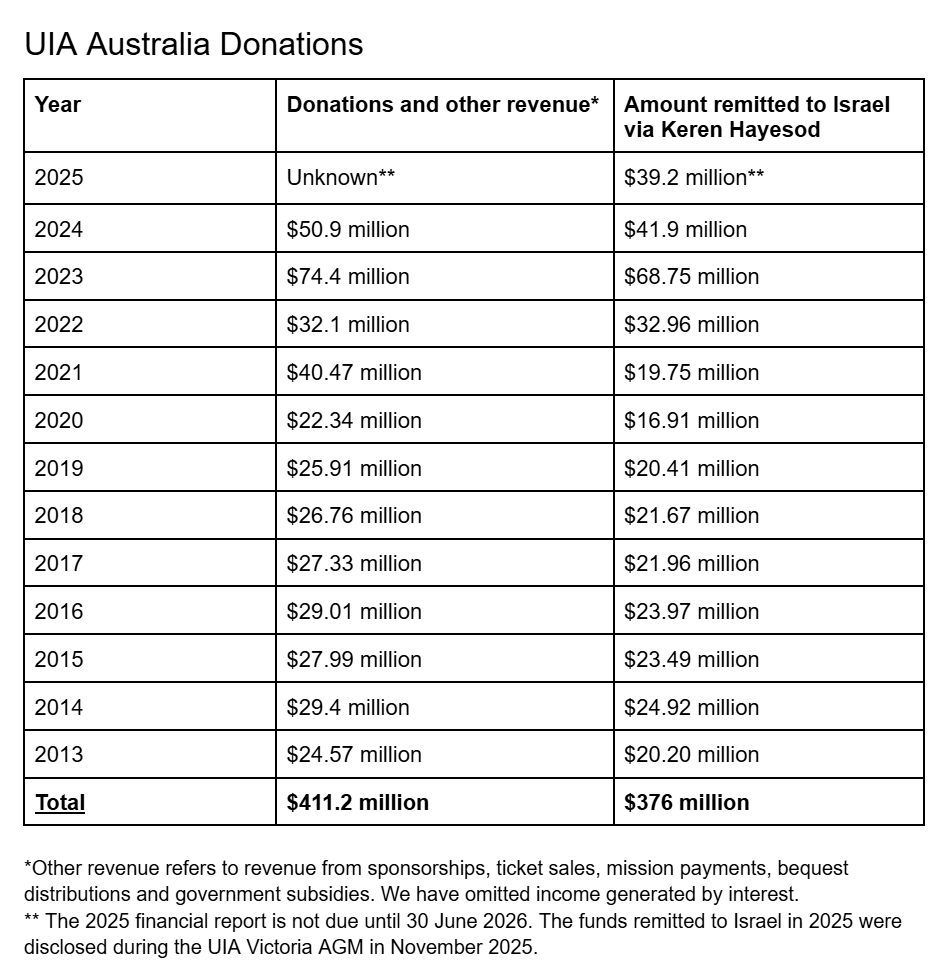
Source: ACNC
UIA Australia first received tax deductible status in January 1998. However, ACNC financial disclosures only go back to 2013. The amount of tax deductible donations made to UIA over its lifetime is likely significantly higher than the figure calculated in this article.
In a press release announcing the decision, then-treasurer Peter Costello stated that “in recognition of the valuable humanitarian service undertaken by [United Israel Appeal], the Government has decided to specifically list it as an international affairs recipient. Legislation to give effect to the Government’s decision will be introduced as soon as practicable.”
“Every dollar aligned with Israel’s national priorities”
At the UIA Victoria AGM in November 2025, UIA leadership were explicit about the organisation’s role in Israel. David Slade, president of UIA Victoria, told members:
“We are the only organisation in Australia raising funds for Israel that holds a seat at every table of decision-making authority mandated to rebuild the country from the north to the south.”
We are proud that every dollar we distribute is aligned with Israel’s national priorities.
Julian Black, outgoing federal treasurer of UIA, reported that $39.2m had been sent to Israel nationally, including $14.4m from Victoria, in the 2025 campaign period to mid-November.
UIA Australia describes its central mission as supporting aliyah, “ascent”, referring to Jewish immigration to Israel, and strengthening Israeli society. They state that they “raise funds within Australia and transfer them directly to Keren Hayesod-UIA.”
Keren Hayesod, founded in 1920, describes itself as the “preeminent worldwide fundraising arm for the people of Israel,” operating in dozens of countries. UIA Australia functions as its Australian partner, channelling hundreds of millions of dollars in tax-deductible donations to the fund.
At the 2025 AGM, Slade said:
“This is not theory. It’s delivery. It’s national in scale, national in scope. It aligns with Israel’s priorities and is executed by our global partners.”
Support for “lone immigrant soldiers”
Among the programs UIA promotes in Australia is assistance for “lone immigrant soldiers”, individuals who migrate to Israel and serve in the Israel Defense Forces (IDF) without immediate family support in the country.
Through the “Wings Program”, UIA partners with the Jewish Agency for Israel to provide grants and assistance to immigrant IDF soldiers. UIA states that they supported 2,200 lone immigrant soldiers in 2024.
According to a report compiled by the Knesset, in August 2024, there were 6,731 lone soldiers serving in the IDF.
Overseas funding networks and settlement links
In 2022, Pastor Larry Huch raised $8 million for Keren Hayesod through his ministry to help “settlements take over produce farms in the West Bank”.
“One of the main Bible prophecies is helping Jews return to the nation of Israel, so we started working with Keren Hayesod with projects such as making aliyah. We help settlements take over produce farms in the West Bank, which is Judea and Samaria,” Hutch said.
According to an analysis by Canadian human rights organisation Just Peace Advocates, public filings by UIA Canada show that funds linked to the broader Keren Hayesod network have supported organisations assisting IDF veterans and institutions located in Israeli settlements in the occupied West Bank.
At the same AGM, Slade disclosed that his own son is currently serving in the IDF as a lone soldier, describing himself as “a lifelong Zionist”.
UIA also funds the Net@ program, which provides technology education for youth. Promotional materials for the program state that graduates are “strong candidates for elite IDF units”.
[excellent charts here on original]
Comparable program-level detail is not disclosed in Australian ACNC filings, which aggregate remittances to Keren Hayesod. UIA Australia did not respond to questions regarding whether they have oversight of which initiatives are supported by the funds they provide to Keren Kayesod and whether they engage in due diligence practices to ensure that these programs comply with ACNC External Conduct Standards and DGR conditions.
A charity operating in a genocide
UIA’s fundraising expansion has occurred during the Gaza genocide and escalating violence across the occupied Palestinian territories.
A January 2026 report by the UN Office of the High Commissioner for Human Rights found that Israeli laws, policies and practices have created “asphyxiating” conditions for Palestinians in the West Bank and East Jerusalem.
The report stated that there has been an “unprecedented deterioration of the human rights situation” since October 2023, as Israeli government “further expanded the use of unlawful force, arbitrary detention and torture, repression of civil society and undue restrictions on media freedoms, severe movement restrictions, settlement expansion and related violations in the occupied West Bank”.
In his National Press Club address, Chris Sidoti, a commissioner on the UN Commission of Inquiry on Palestine and Israel, stated that in light of the Commission’s finding that Israel has committed genocide in Gaza,
“anyone who has served in any arm of the Israeli military in Gaza should be treated as a suspect.“
UIA CEO Yair Miller previously told MWM that “the United Israel Appeal is fully compliant with Australian law”. They did not respond to a follow-up request for comment regarding the matters discussed in this article.
UK to deploy nuclear-powered submarine to Australia
27 January 2026 | By Andrew McLaughlin, https://psnews.com.au/uk-to-deploy-nuclear-powered-submarine-to-australia/172179/
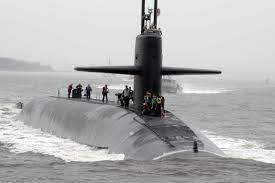
The UK’s Royal Navy will soon deploy a nuclear-powered attack submarine (SSN) to Australia for six months as part of its commitment to the AUKUS construct and to its presence in the wider Indo-Pacific region.
The Astute-class submarine HMS Anson arrived in Gibraltar earlier this month after it departed its home base of Faslane in Scotland on 10 January.
The boat is expected to patrol the Indian and western Pacific oceans during its deployment, and will be the UK’s first commitment to the Submarine Rotational Force–West (SRF-West) that was established under Pillar 1 of AUKUS in 2022.
The respected independent online news site Navy Lookout says, of the five Astute-class SSNs to enter RN service to date, HMS Anson is currently the only boat capable of being deployed. The class has suffered from build delays and poor availability since the lead boat, HMS Astute was commissioned in August 2010, and the remaining four boats are laid up at Faslane undergoing various stages of maintenance.
Two more Astute-class SSN boats are planned, with one currently undergoing sea trials, and the seventh boat scheduled to enter service in late 2028. After this, development of the planned SSN-AUKUS class boats – for which Australia will be a partner – is expected to gain pace.
The UK’s Defence Minister Luke Pollard told the British Parliament in December that an Astute-class boat would join SRF-West as “a core planning assumption for the RN under AUKUS”. Despite very low availability of the Astute-class in recent months, Mr Pollard said the government judges the commitment to be “both realistic and manageable within existing force planning”.
SRF-West is based at HMAS Stirling south of Fremantle in WA, and the Australian Government has committed billions of dollars to upgrade the base and the adjacent Henderson shipyard to support not only UK and US nuclear-powered submarine deployments, but also those of Australia from the mid-2030s, and to boost Australia’s shipbuilding capabilities.
SRF-West has taken its first few tentative steps forward, with a US Navy Virginia class SSN USS Vermont having completed a Submarine Maintenance Period at Stirling in November using a mixed US Navy and Australian maintenance workforce.
Other US Navy SSNs have conducted port visits to Stirling in recent years and these visits are expected to increase as the base and its infrastructure become more capable of supporting these vessels.
‘From day one, an absolute pleasure’: Nuclear science expert receives Australia Day honour

26 January 2026
Sky News host Chris Kenny sits down with former ANSTO CEO Dr Adi Paterson to go over how the Australia Day honours and how he was honoured for his work in nuclear technology. ………………………………………………………………………………. https://www.skynews.com.au/opinion/chris-kenny/from-day-one-an-absolute-pleasure-nuclear-science-expert-receives-australia-day-honour/video/2a31513901d504547fb3d25ee0ad7af9
Falling Upwards: Labor’s Quiet Reward for Failure
25 January 2026 David Tyler, Australian Independent Media
Greg Moriarty’s plum job posting sends a clear message about how Canberra looks after its own.
Washington isn’t a demotion; it’s the prize. Greg Moriarty’s nomination as Australia’s next ambassador to the US isn’t the act of a government cleaning house; it’s the system congratulating itself on resilience. In Canberra, failure rarely disqualifies. It just moves you sideways until the heat cools, or upward, if the optics align.
In a bureaucracy obsessed with process, protection is paramount; the process to protect: protect the insiders first, accountability second; if accountability, (in Canberra, always a slow train coming), arrives at all.
The Canberra reflex
No-one is fussed about Moriarty’s credentials. He is eminently qualified; the boffin’s boffin. He was Australia’s Ambassador to Indonesia (2010–2014) and Ambassador to Iran (2005–2008), giving him “on-the-ground” experience with political Islam, even if Mossad and CIA hit squads mean his speed-dial will need updating.
Moriarty spent his first decade (1986–1995) as a regional analyst in the Defence Intelligence Organisation. DIO. This is the agency responsible for providing intelligence to the Australian Defence Force.
During the first Gulf War, as the 1991 United States’ oil war with Saddam Hussein has become known, Moriarty served as a uniformed Captain in Saudi Arabia, providing intelligence briefings directly to General Norman Schwarzkopf at US Central Command. The “liberation of Kuwait” was a hollow slogan used to mask a war fought to ensure the US remained the sole “policeman” of the world’s energy supply.
Clandestine Diplomacy? Also Greg’s bag. He was Australia’s Ambassador to Iran (2005–2008) at a time when the US had no diplomatic presence there. He was one of the few Westerners with a deep, “inside” view of Tehran, eventually briefing President George W. Bush in the Oval Office, a rare gig, for an Australian diplomat.
Counter-Terrorism Coordinator? If the cap fits. Moriarty was the inaugural “czar” of Australia’s counter-terrorism efforts, whose brief was to bridge the gap between ASIO (domestic spies) and ASIS (foreign spies).
But there’s more. Not only is he a veteran of very complex and challenging foreign postings, but Moriarty served as the International and National Security Adviser and Chief of Staff to Prime Minister Malcolm (Fizza) Turnbull, an all-leather jacket-no-naff-elbow-patches-man. A man of means, Turnbull’s million dollar punt on his own campaign makes him easily the best self-saucing pudding to get into The Lodge.
As a former PM, Turnbull’s become a fearless critic of the Liberal Party, now that he’s free to focus on its internecine wars, its dud policy and its hapless leader, from time to time, as minding his stock portfolio allows. But he’s always put in a good word for Greg. Turnbull often highlights Moriarty’s history with the U.S. (specifically his service with U.S. Central Command). This background helps explain why Prime Minister Anthony Albanese has just appointed Moriarty to succeed Kevin Rudd as Ambassador to the United States.
Turnbull’s trust in Moriarty helped pave the way for Greg to become one of the architects of AUKUS and the primary point of contact for the Trump circus. Scott Morrison may quibble but, success has many fathers.
Above all, Moriarty was the key figure responsible for coordinating Australia’s counter-terrorism arrangements in 2015. He is a primary architect of the controversial strategy that views groups like Hizb ut-Tahrir, as “ideological threats” to national security, even if they fall short of the violence threshold.
So it isn’t about experience or qualifications. It’s about reflex. Canberra’s muscle memory. When faced with scandal or exposure, Canberra’s instinct is to pull the shutters down, shield its own; tidy paperwork later.
Consider Kathryn Campbell. During Senate estimates, Jacqui Lambie pressed Moriarty about his role in placing Campbell; already publicly associated with the Robodebt debacle, in a senior AUKUS‑related Defence post reportedly worth close to $1 million. It wasn’t a technical error; it was a deliberate continuity move.
As Moriarty told estimates, on 14 June 2022 PM&C Secretary Glyn Davis called to see whether there might be a new role for Campbell, who was likely to be moved from DFAT. Moriarty said yes; a spot was waiting in Defence’s nuclear submarine taskforce.
He later argued the appointment pre‑dated the Royal Commission, but that defence misses the point. By mid‑2022, Robodebt’s unlawfulness was already public, and Labor had pledged a Royal Commission in its campaign. To claim no one foresaw reputational risk is bureaucratic fantasy.
When the Commission handed down its findings on 7 July 2023, its condemnation of Campbell was withering. She was suspended without pay three days later and later resigned……………………………………………………………………………..
The politics of timing
And then, there’s the timing.
Moriarty’s appointment, like so many immaculate Canberra announcements, coincides with turbulence elsewhere, this time, the government’s controversial Hate Speech bill. The bill risks criminalising intent: targeting individuals or groups perceived as being about to breach the law, rather than those who actually do.
For activist networks and civil‑liberties advocates, this language turns dissent into pre‑crime; policing inclination rather than action. It marks a profound step away from Labor’s democratic heritage, recasting expression and dissent as potential threats……………………………….
Accountability, inverted
Canberra will insist that promoting Moriarty is pragmatism: the steady hand, the safe pair. But Australians watching from below see something else; a governing circle where the guilty always escape justice.
Accountability in Canberra remains a one‑way mirror: the public gets watched; the powerful get reassigned.
If Labor truly wants to rebuild faith in government, it must break its habit of rewarding failure and punishing conscience. Responsibility must cost something again. Until then, power will keep protecting itself; and the “fair go” will remain a slogan embalmed in Labor’s history, rather than a principle alive in its governance.
Two Canberras
This isn’t just a job swap; it’s a parable of the Two Canberras.
In one Canberra, the “Safe Pair of Hands” is rewarded for a career spent managing the optics of illegal wars, secret submarine deals, and the protection of disgraced colleagues. In this Canberra, accountability is a one-way mirror: the public is watched, but the powerful are merely reassigned.
In the other Canberra, those who actually serve the public interest – the Witness Ks, the David McBrides, and the Bernard Collaerys – are crushed. Their “fidelity” earned them prosecution, not a promotion. Their “integrity” earned them a criminal record, not a diplomatic passport.
Moriarty’s flight to Washington reveals the grim reality of modern Labor governance. By rewarding the managers of wrongdoing while punishing the whistleblowers who expose it, the “Fair Go” has been embalmed and put on display as a museum piece. In today’s Canberra, the stream does not rise higher than its source; and the source is a closed loop where power exists only to protect itself.
Responsibility has no cost for the inner circle; it is a tax paid only by the principled. Moriarity’s pragmatic promotion demotes, depletes and pointedly disregards the notion of Australia as the land of the fair go. https://theaimn.net/falling-upwards-labors-quiet-reward-for-failure/
Australia’s Lack Of Speech Protections Means We Should Be MORE Hostile To Speech Regulation
Caitlin Johnstone, Jan 25, 2026, https://www.caitlinjohnst.one/p/australias-lack-of-speech-protections?utm_source=post-email-title&publication_id=82124&post_id=185687870&utm_campaign=email-post-title&isFreemail=true&r=1ise1&triedRedirect=true&utm_medium=email
A normal, healthy person would look at Australia’s lack of free speech protections and say “Hmm, Australian leaders should be extremely resistant to new laws and policies which restrict speech then, because it would be very easy for those restrictions to become abusive.”
Australian leaders look at our lack of free speech protections and say “See? This means we get to take away your right to protest genocide!”
Nowhere is this more clearly exemplified than the repeated statements from New South Wales premier Chris Minns saying it’s fine to silence Australians because we don’t have free speech rights.
Over and over again Minns has defended his promotion of authoritarian speech crackdowns in his state by claiming it’s okay to stomp out dissident speech of Australians because Australians don’t have the same speech protections as Americans, saying “we don’t have the same free speech rules that they have in the United States and I make no apologies for that” and similar statements in recent weeks.
To be clear, Minns is being repulsively tyrannical when he says this, but factually speaking he isn’t wrong.
As Joe Lauria wrote for Consortium News following the passage of Australia’s frightening new “hate speech” bill:
“Unlike the United States, Australia has no Bill of Rights in its Constitution protecting freedom of speech, assembly and other rights. Much as Israel would want it, a law such as this adopted in Australia would still be difficult to pass in the U.S. on paper, despite the Israel Lobby’s hold over the U.S. Congress.”
If Australians had the same speech protections that they have in the United States, we could appeal tyrannical new laws on First Amendment grounds. Because we have no such protections, it is much harder to oppose authoritarian speech restrictions once they are in place.
As I often remind readers, Australia is the only so-called democracy in the world which has no national charter or bill of rights of any kind. A tremendous amount of faith has been placed in state and federal legislators to simply do the right thing, which has proved foolish and ineffective. Professor George Williams wrote for the Melbourne University Law Review in 2006:
“Australia is now the only democratic nation in the world without a national bill of rights. Some comprehensive form of legal protection for basic rights is otherwise seen as an essential check and balance in democratic governance around the world. Indeed, I can find no example of a democratic nation that has gained a new Constitution or legal system in recent decades that has not included some form of a bill of rights, nor am I aware of any such nation that has done away with a bill of rights once it has been put in place.”
It has been clearly and conclusively established that this system does not work. State and federal governments are working frenetically to shred the right of Australians to oppose the actions of the state of Israel, with their assault on our civil rights disguised as an effort to fight “antisemitism” in our country and help Jewish Australians feel more safe. The fact that this happens to advance the information interests of the western power alliance, we are told, is purely coincidental.
The evidence is in and the case is closed. The Australian system does not work. We need a national bill of rights, and we need free speech to be enshrined in our constitution.
In the meantime, we need to be aggressively opposed to laws and policies which assault our freedom of speech. We need to be more aggressive in our opposition than Americans would be, because we have fewer safeguards against tyrannical abuses.
It’s so disgusting how these freaks are telling us right to our faces “Yeah well you guys don’t have any rights, so I’m going to silence you and oppress you and I make no apologies about that.”
That kind of arrogant, abusive authoritarianism deserves nothing but ferocious defiance.
*&^%$#@! / * Day
The obvious, principled compromise is this – keep 26 January, but stop pretending it should be the main day of national celebration. Turn it into a national day of truth-telling and reckoning, a day that acknowledges what the date is and what it has meant, a day that faces the history rather than trying to drown it in noise.
But if 26 January becomes a day of truth and reckoning, then the country also needs a day of celebration that can plausibly belong to everyone without requiring First Nations people to swallow the insult of being asked to celebrate invasion………… Australia needs a date that can be carried by a civic idea fit for a plural democracy – belonging as commitment, not conquest
The cleanest candidate is already embedded in civic practice – 17 September, Australian Citizenship Day.
25 January 2026 Roger Chao, https://theaimn.net/day/
In late January the country performs a small miracle of selective attention. We turn up the music, we pull a plastic chair into the shade, we talk about how lucky we are; we feel, many of us, an untroubled affection for the ordinary decent life we’ve built here. And then, almost as background noise, we ask a First Nations person to do the impossible – to stand inside that affection, to smile at the same symbols, to treat the same date as a benign birthday, while knowing that the date’s elevation to national holiness is inseparable from a beginning that did not ask permission. It is a demand that some Australians pay for other Australians’ comfort with the currency of their own history.
The most stubborn fault in the Australia Day debate is the insistence that it is a debate about taste – about whether people should be allowed to “celebrate Australia,” about whether “both sides” could calm down, about whether we might add a solemn acknowledgement before the fireworks and call it a balanced approach. But public holidays are instruments of civic formation. A national day is a day on which the state teaches the nation who it is, and what it owes itself. The calendar is one of the quietest and most effective political technologies we possess. It organises memory. It distributes honour. It creates a rhythm in which some facts become normal and others become “controversial.” And because it is repeated, it becomes hard to see. It slides under argument and into atmosphere. That is why it matters.
If we want to see what is really happening, we should begin where the argument always tries not to begin – with time itself, with the scale of this continent’s human story. Aboriginal and Torres Strait Islander peoples have lived here for at least 65,000 years. Say the number out loud and feel its resistance to the way settler culture narrates “Australia.” Sixty-five thousand years is a civilisational fact so enormous that it makes the colonising period look like a thin scratch on a very old surface. Yet the national myth insists, quietly but relentlessly, that the country begins when the British arrive. We are trained to speak as though history starts with documentation, as though law begins with British ink, as though the continent becomes real when it becomes legible to empire. This is an epistemic conquest. It is the first act of taking – taking time from other people, taking their prior sovereignty and turning it into a kind of “before,” a prelude, a cultural mood-board.
Long before 1788, there were laws here. There were ways of holding people accountable, ways of defining responsibility to land and kin, ways of adjudicating disputes, ways of regulating access to water, food, ceremony, marriage, obligation. “Country” in this sense is an ethical and juridical concept; it names a relationship. But colonial narration works by flattening these realities into sentiment – beautiful, spiritual, tragic, but not binding. That flattening is convenient. If First Nations law is treated as culture rather than jurisdiction, then sovereignty can be spoken as though it arrived on ships. The great trick of settler modernity is to recognise Indigenous people as human beings and still deny their political standing. That denial lives, very comfortably, inside our festivals.
Even within the British story, the “beginning” is not as simple as the calendar pretends. In 1770, James Cook claimed the east coast for Britain and named it New South Wales. Whatever one thinks of Cook as a person, the moral structure of the act is plain – a claim made over people who were not consulted, carried out through the imperial confidence that sovereignty is something you can announce into existence. The claim is a template for everything that follows – the conversion of inhabited land into a legal abstraction available for administration, the treatment of existing law as irrelevant noise, the invention of a vacant continent in the imperial imagination. If the later phrase “terra nullius” has become shorthand for a legal fiction, it is worth remembering that the fiction was never confined to courtrooms. It was cultural. It was the moral permission slip for a society that wanted the benefits of possession without the discomfort of acknowledging what possession required.
Then, in January 1788, the First Fleet arrived and the colonial project began in the place we now call Sydney Cove, Warrane, on Gadigal Country. The landing is saturated with symbolism – the ships, the shore, the flag, the impression of a world being “founded.” It has the dramatic clarity that modern nation-states crave. Yet the state did not have to choose that moment as the centre of our civic joy. It chose it. The government of the colony was formally proclaimed on 7 February 1788, when official instruments were read out in the early settlement. If we were simply looking for a date that marked the establishment of colonial governance, 7 February would be the cleaner candidate. But 7 February is not as cinematic. It is administration, not arrival. The landing gives the nation a theatre of beginnings that is all motion and confidence, a beginning scene in which the coloniser’s presence is framed as history itself. The choice of 26 January tells us what kind of story the country wants to tell about itself – not the story of legal formality, but the story of arrival as entitlement.
From that chosen scene, the continent is remade. This is where Australian public memory becomes evasive. We like to say “settlement” because it is gentle. We like to say “pioneers” because it is brave. We like to say “development” because it sounds inevitable. But the record is not gentle, brave, or inevitable. The frontier was not a misunderstanding. It was a contest over land, law, life. Across the continent, there were killings, reprisals, punitive expeditions, and massacres, there is now a substantial body of public historical work documenting colonial frontier violence, including massacre research projects and museum resources that treat these events as constitutive to colonisation rather than as aberrations. Our duty now is to ask contemporary people not to sanctify the initiating moment of a project that required such violence, and not to treat the consequences as mere “complexity” that can be tidily balanced by a respectful acknowledgement.
Violence, however, is only one strand of the colonial apparatus. Another strand is control, exercised under the language of care. The nineteenth-century “protection” regimes are a case study in moral camouflage. In Victoria, the Aboriginal Protection Act 1869 established a Board for the Protection of Aborigines, formalising state authority to intervene in Aboriginal lives. Protection, when enacted by a colonising state, often means the opposite of what it claims. It means the regulation of movement, labour, residence, relationships. It means the conversion of a people into a managed population. It means the state reserving to itself the right to decide what kinds of lives Indigenous people are permitted to live. It is the bureaucratic face of domination – domination that smiles, domination that keeps records, domination that insists it is for your own good.
The forced removal of children, and the long grief gathered under the name “Stolen Generations,” belongs to this history of control. The Bringing Them Home report, tabled in Parliament in 1997, documented the laws and practices that produced removals and made recommendations for acknowledgement and repair. The Apology delivered in 2008 acknowledged the harm of those policies at the highest level of the state. The important thing to notice is not that Australia has apologised. The important thing to notice is that we have learned, at least momentarily, to name some parts of our history as wrong. If we can do that in Parliament, we can do it in the calendar. If we can say, publicly, that certain policies were grievous and unjust, we can also say that it is ethically incoherent to locate the nation’s principal celebration on a date that has become, for many, a yearly reminder of dispossession’s beginning.
The defenders of 26 January often respond with a kind of sentimental absolutism. They speak as if the date were sacred, unchangeable, embedded in the soil. Yet the history of the date as “Australia Day” is itself a history of invention and consolidation. Governor Macquarie marked the 30th anniversary of the landing in 1818, an early official commemoration of the event that later becomes linked to the national day. The day’s meaning and observance shifted across time and place, its modern, national uniformity is not ancient. The public holiday’s standardisation on the actual date across the country is tied to late twentieth-century decisions, including moves in the 1990s to align observance nationally. In other words, the thing presented as immovable tradition is policy, repeated until it feels like destiny.
And even more importantly, the date has never belonged to only one tradition. The country likes to describe protest as a new intrusion into an old party. History says the opposite. On 26 January 1938, Aboriginal activists held a Day of Mourning at Australia Hall in Sydney in response to sesquicentenary celebrations, protesting the treatment of Aboriginal people and demanding political rights. This was a declaration that the date’s public meaning was already morally contested, that celebration on that day required a kind of willed deafness, that the nation’s joy was being built on an instruction to Indigenous people – be quiet, be grateful, be invisible.
In 1972, on 26 January, the Aboriginal Tent Embassy was established opposite Parliament House, making the claim of unceded sovereignty visible in the most direct possible way – by occupying the symbolic space of the state with the presence the state’s story wanted to manage. The Embassy is often spoken of as if it were merely an activist landmark. But it is also an ethical critique in physical form. It says – the nation you celebrate is unfinished, the legitimacy you assume is contested, the land you treat as settled is not settled. That it began on 26 January is not incidental. It is a deliberate counter-ritual. It interrupts the state’s annual performance of innocence.
This brings us to what I take to be the most revealing, and the most indefensible, element of contemporary Australia Day practice – the staging of citizenship ceremonies on 26 January. Citizenship ceremonies are the moment in which the state makes membership visible, in which new citizens make the pledge and are welcomed into the political community. The Australian Citizenship Ceremonies Code states that ceremonies should be held on “days of significance,” explicitly including Australia Day (26 January) and Australian Citizenship Day (17 September). So the state actively encourages this pairing.
What does it mean, ethically, to welcome new Australians into citizenship on a day that many First Nations people rightly experience as invasion? It means we are inducting new citizens into a civic identity whose origin story is still settler-centred. We are asking them, often without their informed consent, to participate in a ritual that treats colonisation’s initiating moment as a suitable setting for national inclusion. We are doing inclusion as theatre while leaving the moral architecture of exclusion untouched. That is why it feels so hollow when public officials describe the day as “for everyone.” Inclusion is not merely a matter of inviting everyone to the party. Inclusion is a matter of whether the party’s theme requires some of the invited guests to pretend their history is not what it is.
The historical irony deepens, because citizenship itself was formally tied to 26 January. On 26 January 1949, the Nationality and Citizenship Act came into effect, creating the legal concept of Australian citizenship where previously Australians were treated as British subjects in law. The state deliberately braided the birth of “citizenship” into the anniversary of colonial beginning. The symbolic message is not subtle – membership is grounded in arrival. The nation becomes itself when the ships come, and citizenship becomes itself on the anniversary of that arrival. It is a neat narrative, neat enough to conceal the moral violence it depends on.
When a society ties its membership ritual to a colonisation anniversary, it is making a claim about legitimacy. It is saying – our belonging flows from this origin. It is saying – our political community begins here. It is saying – the story you join is this story. And if you want to see why the argument about Australia Day will not go away, look at that claim, it is a matter of whose sovereignty counts as foundational.
At this point the conversation often becomes psychologically revealing. Many non-Indigenous Australians respond as though critique of 26 January were critique of themselves. They hear, “you are personally guilty,” when what is actually being said is, “your nation’s ritual life is ethically incoherent.” They hear, “you cannot love your country,” when what is being asked is, “can you love your country truthfully?” They hear, “you must feel ashamed,” when what is being required is a willingness to rearrange public meaning so that the state’s joy is not built on someone else’s humiliation.
This is where the phrase “we can’t change history” appears, as if it were a serious argument. It is not. Changing the date does not change the historical facts. It changes what we honour. It changes what we ask one another to affirm. The defenders of the date want the state to keep awarding the nation’s highest public joy to a settler beginning scene, and they want Indigenous protest to remain a regrettable but manageable interruption. That is why they are so committed to “keeping politics out of it.” What they mean is – keep Indigenous politics out of it. The state’s politics, the politics of choosing 26 January as the nation’s day, must remain invisible, because if it becomes visible it can be judged.
Judged by what standard? By the standard a democracy claims to hold – that its citizens have equal standing, that their histories count, that their grief is not an inconvenience, that their political testimony is not a nuisance. The problem with 26 January is that we have chosen, with determination, to celebrate ourselves on a date whose mixedness is not incidental but constitutive – a date that signifies, in its national elevation, the triumph of a colonising project over Indigenous jurisdiction.
And because the nation is not merely a story but an institution, the harm is not only symbolic. Symbolic harm is real harm in political communities. It is one of the ways unequal standing is maintained. When the state insists that the national day must be 26 January, it is saying, each year, with the force of ritual, that Indigenous pain can be acknowledged but not allowed to reorganise public life. It is saying that truth can be spoken but must not displace celebration. It is saying that the most morally significant fact about the date, that it marks the onset of colonisation, is something we can sideline as “divisive” in order to preserve the mood of unity.
The way out of this is to design public time more honestly. Australia has been trapped in the childish idea that unity requires one day, one mood, one story. It is a strangely thin conception of a nation, especially a nation that tells itself it is mature, multicultural, confident. Adults do not need to force celebration and reckoning into a single afternoon. Adults can hold more than one kind of day.
The obvious, principled compromise is this – keep 26 January, but stop pretending it should be the main day of national celebration. Turn it into a national day of truth-telling and reckoning, a day that acknowledges what the date is and what it has meant, a day that faces the history rather than trying to drown it in noise. It treats truth as a civic obligation rather than a personal hobby. It accepts that the date already carries a counter-tradition of mourning and protest, 1938, 1972, and the many Invasion Day marches since, and it stops treating that tradition as an irritation to be policed. It gives the nation an authorised space to say, publicly, that colonisation was not benign, that its consequences persist, that sovereignty was never ceded, that the modern state exists on contested ground.
A truth-telling day should be the kind of day that makes the nation’s moral accounting concrete – the kind of day on which the country’s institutions do more than perform acknowledgement, they report, they measure, they confront continuing injustice without euphemism. We already have the administrative capacity to do this. We publish budgets. We publish economic statements. We publish national security briefings. The refusal to publish a yearly moral account of colonisation’s ongoing consequences is not a capacity problem. It is a will problem. If the state can choreograph citizenship ceremonies, it can choreograph public truth. If the state can choreograph fireworks, it can choreograph accountability.
But if 26 January becomes a day of truth and reckoning, then the country also needs a day of celebration that can plausibly belong to everyone without requiring First Nations people to swallow the insult of being asked to celebrate invasion. This is where many proposals become either thin or contentious. You can choose Federation and end up celebrating a constitutional arrangement that did not include First Nations people as equal partners. You can choose a court decision and end up collapsing legal recognition into national belonging. You can choose a referendum and end up mythologising it into a substitute for structural change. Australia needs a date that can be carried by a civic idea fit for a plural democracy – belonging as commitment, not belonging as conquest.
The cleanest candidate is already embedded in civic practice – 17 September, Australian Citizenship Day. The government already treats it as a day on which Australians reflect on citizenship and welcome new citizens, and the ceremonies code already names it as a day of significance for ceremonies. In other words, the date already has a civic purpose that aligns with the moral work we want a national day to perform. It is about the present, not the conquest. It is about chosen membership, not imposed sovereignty. It is about a democratic “we” that can be expanded through consent and commitment rather than through arrival and assertion.
Make 17 September the principal national day of celebration, and make citizenship ceremonies the centrepiece of that celebration. Do not treat citizenship as a decorative extra attached to 26 January. Put it where it belongs – at the heart of the day that the nation uses to describe itself. It changes the story the state tells. It says – our pride is not in the landing; our pride is in the ongoing practice of democratic belonging. It says – you can love Australia without needing to sanctify colonisation as the foundation of your joy. It says – new citizens are welcomed into a nation that is honest about its history and serious about its future, not into a nation that asks them to lend their smiling faces to the management of a moral wound.
Some will say changing the national day does not fix material injustice. True. But the defenders of the status quo cannot have it both ways. They cannot say the date is too trivial to change and too sacred to move. They cannot say symbolism does not matter while insisting that the nation’s identity collapses if the party is moved. The truth is that symbolism matters precisely because it shapes what a nation thinks it owes. A country that insists on celebrating itself on 26 January trains itself to experience colonisation as settled history. A country that consecrates 26 January to truth-telling trains itself to experience colonisation as unfinished business. That difference matters for policy, for education, for the public’s tolerance of reform. It matters for whether the country can even imagine treaty and truth as normal rather than as extremist demands. It matters for whether the public treats Indigenous claims as reasonable moral testimony or as an endless complaint.
Others will say that a truth-telling day sounds like self-hatred. This is another psychological confession masquerading as an argument – the idea that the only alternative to self-congratulation is self-loathing. It is a strangely adolescent view of national character. The better alternative is moral adulthood. Adult love is not blind. Adult love can face wrongdoing without collapsing into nihilism. Adult love can say, “this was done in our name, and we will not pretend it was fine.”
The most revealing objection will be the one that says, quietly or loudly, that Indigenous people should simply accept the date because “it happened so long ago.” In this objection, time is treated as absolution. But time absolves nothing when institutions keep renewing the wound. The annual insistence that 26 January is the nation’s birthday is itself an ongoing act. It is an act done now, not then. And it is done against a background of continuing inequity – disproportionate incarceration, health gaps, child removals, the everyday realities of racism, and the deeper constitutional reality that sovereignty remains unresolved. A nation that continues to disadvantage Indigenous people materially while asking them to smile through a celebratory commemoration of is ethically grotesque.
It is also, frankly, politically foolish. The country spends enormous energy every January re-litigating the same question, burning civic trust, splitting communities, forcing local councils into culture-war battles, turning what could be a season of civic generosity into a season of resentment. If the point of a national day is unity, then the current arrangement fails on its own stated terms. But I do not want to make the argument on utilitarian grounds, only justice.
Justice begins, in a settler democracy, with the refusal to make Indigenous people do the emotional work required to preserve settler innocence. It begins with the refusal to treat Indigenous protest as an inconvenience. It begins with the recognition that “acknowledgement” is not reconciliation when the calendar remains untouched. It begins with a willingness to redistribute public honour so that the country’s joy is not performed over someone else’s injury.
The truth-telling day on 26 January would not be an exercise in moral theatre for its own sake. It would be a national commitment to remember properly – to remember the continent’s deep time, to remember the imperial claiming, to remember the arrival at Warrane and the formal establishment of governance, to remember frontier violence and protection regimes, to remember the forced removals and the long struggle for recognition, to remember the Day of Mourning and the Embassy and the continuing refusal to let colonisation be rebranded as benign. It would be, in the best sense, an interruption of the national habit of taking comfort as a civic right. It would say – you do not get to be innocent just because you would like to feel innocent.
The celebratory day on 17 September would then have room to be what a national day should be in a plural democracy – a day on which the state does not ask anyone to deny their history in order to belong. It would allow the country to celebrate what is genuinely worth celebrating, its capacity for inclusion, its ordinary decencies, its democratic aspirations, without building those celebrations on a foundation that many citizens experience as a yearly insult. And it would allow citizenship ceremonies to be what they claim to be – a welcome into an ethical community, not a welcome into a sanitised myth.
There is a particular obscenity in the current practice of using citizenship ceremonies on 26 January as evidence that the day is “inclusive.” It is a kind of moral laundering – proof-by-photo-op. Look, we say, at the new citizens smiling, therefore the date cannot be unjust. But the smile of the welcomed is not a moral permission slip to ignore the dispossessed. It is precisely the opposite. The fact that people from all over the world can become Australians should sharpen our ethical imagination, not narrow it. If we can build a community of shared citizenship across difference, then surely we can build a calendar that does not demand Indigenous people accept a celebratory commemoration of invasion as the price of membership.
The most honest response to this proposal is to ask whether it aligns the nation’s ritual life with its professed values. We claim to value fairness. We claim to value respect. We claim to value democratic equality. We claim to value truth. If we mean those claims, then the current arrangement is untenable. A society that keeps its party on 26 January is a society that has chosen, repeatedly, to privilege settler comfort over Indigenous standing. And a society that welcomes new citizens on that same day is a society that uses inclusion as a mask for unresolved injustice.
The country does not need a perfect date. It needs an honest one. It needs a civic architecture that can hold both truth and celebration without forcing them into a single moral confusion. It needs, above all, to stop asking First Nations people to accommodate the nation’s denial. Keeping 26 January as a day of truth and reckoning and moving the national celebration, with citizenship ceremonies, to 17 September is an act of institutional decency. It is a refusal of the annual humiliation built into the current ritual. It is a step toward a nation that can bear the weight of its own story without flinching.
If Australia wants to be a mature democracy, it must become capable of a simple act – placing joy where it can be shared, and placing truth where it can be faced. It is what adulthood looks like when a nation has the courage to stop confusing comfort with virtue.
“We kill enemies”: Spy firm Palantir secures top Australian security clearance.
by Stephanie Tran | Jan 19, 2026
Cybersecurity company Palantir has received a high-level Australian government security assessment despite concerns about its surveillance and complicity in the Gaza genocide. Stephanie Tran reports.
In November 2025, Palantir Technologies was assessed as meeting the protected level under the Australian Information Security Registered Assessors Program (IRAP). This protection is a key requirement for companies seeking to handle sensitive government information.
The assessment enables a broader range of Australian government agencies and commercial organisations to use Palantir’s Foundry and artificial intelligence platform, AIP.
In a statement, Palantir said the assessment was conducted by an independent third-party assessor in line with requirements set by the Australian Signals Directorate (ASD), and demonstrated its ability to meet “stringent national security and privacy standards”.
The company described Australia as an “important market”, saying the clearance would open “new opportunities” across the public and private sectors.
Mass surveillance without accountability
Palantir has been mired in controversy internationally over how its data analysis and AI tools are deployed by government and military clients, with experts warning that the company’s technology enables mass surveillance and data collection with limited accountability.
An ASD spokesperson stated that IRAP status should “not be interpreted as government approval or endorsement of a company’s broader conduct or use of data.“
“IRAP assessments are third-party commercial arrangements between IRAP assessors (or companies offering ‘IRAP assessment’ services) and assessed entities,” an ASD spokesperson said. “ASD does not sign off or approve IRAP assessments.”
Lobbying push amid political pressure
Palantir’s expanded access to Australian government work comes amid growing political scrutiny. According to reporting by Capital Brief, in July 2025, the company hired lobbying firm CMAX Advisory, after the Greens called for an immediate freeze on government contracts with the company.
“I want to talk to you about Palantir and its expanding footprint in Australia. TLDR: You should be worried. This US surveillance tech company has secured multiple Defence contracts worth over $11 million. We need transparency about what data they’re accessing & why”. — David Shoebridge (@DavidShoebridge) July 7, 2025
CMAX Advisory was founded by Christian Taubenschlag, a former chief of staff to Labor defence minister Joel Fitzgibbon, who is a special counsel at the lobby firm. CMAX Advisory represents a number of major defence contractors, including EOS and Raytheon.
Gaza, ICE and Coles
Palantir has faced sustained criticism globally over how its software is used by government clients.
In April 2025, CEO Alex Karp dismissed accusations that Palantir’s technology had been used to target and kill Palestinians in Gaza, saying those killed were “mostly terrorists”.
The UN Special Rapporteur on the Occupied Palestinian Territories, Francesca Albanese, has said there are “reasonable grounds” to believe Palantir has “provided automatic predictive policing technology, core defence infrastructure for rapid and scaled-up construction and deployment of military software, and its Artificial Intelligence Platform, which allows real-time battlefield data integration for automated decision-making”.
In the United States, Palantir has long worked with Immigration and Customs Enforcement (ICE). An investigation by 404 Media revealed that the company was developing a tool that generates detailed dossiers on potential deportation targets, maps their locations and assigns “confidence scores” to their likely whereabouts.
The company has also attracted attention in Australia for its work with private sector clients, including Coles, where they were hired to cut costs and “optimise” the company’s workforce.
“We kill enemies”
Karp has been blunt about Palantir’s mission. Speaking to shareholders and investors last week, he described the company’s purpose as helping the West “scare enemies” and, “on occasion, kill them”.
Karp also joked about “getting a drone and having light fentanyl-laced urine spraying on analysts that tried to screw us”.
Millions in government contracts
In the United States, Palantir has long worked with Immigration and Customs Enforcement (ICE). An investigation by 404 Media revealed that the company was developing a tool that generates detailed dossiers on potential deportation targets, maps their locations and assigns “confidence scores” to their likely whereabouts.
Despite the controversy, Palantir has quietly built a substantial footprint in Australia. According to Austender data, the company has secured more than $50m in Australian government contracts since 2013, largely across defence and national security-related agencies.
The 2024 financial report of its Australian subsidiary, Palantir Technologies Australia Pty Ltd, show $25.5m in revenue from customer contracts in 2024, though the company’s local financial reports are not audited.
In 2020, Palantir recommended that the Australian government consider “expanding the exemption from public access to disclosure documents”, arguing that filing financial reports with ASIC “is expensive” and “gives competitors access to confidential information”.
Stephanie Tran
Stephanie is a journalist with a background in both law and journalism. She has worked at The Guardian and as a paralegal, where she assisted Crikey’s defence team in the high-profile defamation case brought by Lachlan Murdoch. Her reporting has been recognised nationally, earning her the 2021 Democracy’s Watchdogs Award for Student Investigative Reporting and a nomination for the 2021 Walkley Student Journalist of the Year Award.
Australia’s worst heatwave since black summer made five times more likely by global heating, analysis finds

Human-caused global heating made the intense heatwave that affected much
of Australia in early January five times more likely, new analysis
suggests. The heatwave earlier this month was the most severe since the
2019-20 black summer, with temperatures over 40C in Melbourne and Sydney,
even hotter conditions in regional Victoria and New South Wales and extreme
heat also affecting Western Australia, South Australia and Tasmania. In
Victoria, the heat preceded bushfires that burned through 400,000 hectares
and destroyed almost 900 buildings.
Guardian 22n d Jan 2026,
https://www.theguardian.com/australia-news/2026/jan/23/australias-worst-heatwave-since-black-summer-made-five-times-more-likely-by-global-heating-analysis-finds
Paul Keating’s words ring true

The crazy irony of the whole project (AUKUS) has always been that it commits Australia to spending eye-watering amounts to build a capability supposed to defend us from military threats which are in fact most likely to arise simply because we have that capability and are using it to support the US in some conflict not in our interests to engage,
Australian Independent Media 23 January 2026 John Lord
As I’ve grown older, I’ve seen that in tough times, the United States often puts its own interests before its promises to allies or countries with shared goals. For instance, the Nixon Doctrine of 1971 (also known as the Guam Doctrine) suggested that the U.S. would reduce its military involvement in Asia, leaving allies to fend for themselves more. Similarly, the 2013 Syria “red line” incident highlighted a significant deviation when the U.S. decided against military intervention, despite previously asserting that chemical weapons use would provoke a response. In 2016, former Prime Minister Paul Keating told Lee Sales that after Donald Trump’s election, Australia should “cut the tag” from American foreign policy and focus more on building ties within Asia.
I remember a particular day in my childhood when I sat in my classroom, gazing at a poster of Superman next to a map of the world. Our teacher spoke of the United States as a beacon of hope, a nation that would stand up and help when others were in need, embodying the ideals of justice and freedom. As I grew older, my once clear-cut view was challenged by global events. Reality hit as I realised that America’s priorities shifted with its interests, and my hero, once steadfast in my young eyes, began to seem fallible.
Recently, two former Foreign Ministers, Bob Carr and Gareth Evans, have expressed views similar to those of Paul Keating. Both have distinguished themselves in international affairs. Carr suggested that:
“Our US ally is fiercely unpredictable and dedicated ruthlessly to American national interests, without any pretence of being committed to universal values or a global, rules-based order.”
“This is a big challenge for Australia and its security leaders. Our government needs to make it clear to Trump that Australians do not support his self-focused politics.”
Prime Minister Albanese should make this clear and stand firm.
Trump’s administration now poses a real threat to Australia’s interests and the safety of its people. He could use tariffs to pressure other countries and shows little ethical restraint. For instance, economic analysts suggest that U.S. tariffs could reduce Australia’s GDP, posing significant risks to sectors such as agriculture and manufacturing. This quantifiable threat underscores the need to solidify Australia’s international alliances, rather than relying solely on the U.S.
Trump’s administration once claimed that the United States sought to acquire Greenland, an approach marked by aggressive language and a lack of diplomacy. This startling ambition underscored the need for allies to support each other rather than resort to tactics reminiscent of territorial ambitions.
Greenland has made it clear that it would rather remain part of the Kingdom of Denmark than join the United States. That is their democratic right.
Australia should reconsider its role as the United States’ deputy sheriff. Prime Minister Anthony Albanese could use the nearly four hundred billion dollars set aside for old submarines to build drone defenses, address climate change, and help solve the housing crisis by creating hundreds of thousands of homes. To effectively transition this budget into actionable governance, a dedicated budget reallocation committee should be established to oversee the strategic deployment of funds. Inter-state accords can be formed to ensure cooperation and optimise resource distribution across regions. Such steps would provide a structured approach to transforming these alternative spending ideas into tangible outcomes, thereby enhancing Australia’s national resilience and improving the quality of life for its citizens.
Gareth Evans says America’s recent actions “put beyond doubt that America has zero respect for international law, morality, and the interests of its allies and partners.”
The crazy irony of the whole project (AUKUS) has always been that it commits Australia to spending eye-watering amounts to build a capability supposed to defend us from military threats which are in fact most likely to arise simply because we have that capability and are using it to support the US in some conflict not in our interests to engage, without any guarantee of support in return should we ever need it. In democracies like Australia, this considerable expenditure necessitates rigorous oversight to ensure accountability. Establishing strong parliamentary scrutiny and oversight committees could be an effective way to prevent strategic overreach and ensure that such commitments align with national interests. This level of democratic oversight could safeguard against unnecessary or misguided defense spending, illustrating how systems of accountability can help navigate complex international alliances.
Trump’s recent actions and words show he is now in a very dark and dangerous mindset, where anything could happen, even a third world war. Why aren’t we saying this openly?
He now thinks he can do whatever he wants. Reports have surfaced alleging that he ordered the kidnapping of Venezuela, intending for American companies to take over the country’s substantial oil reserves.
A letter from Trump to the prime minister of Norway, Jonas Gahr Støre, has emerged, to complain that he has not received a Nobel Peace Prize……………………………………………………………………………………………………………………….https://theaimn.net/paul-keatings-words-ring-true/
1 This month

of the week – Australians for War Powers Reform (AWPR)
To see nuclear-related stories in greater depth and intensity
 Antinuclear