Lucas Heights nuclear reactor was always intended as a step towards nuclear weapons, AND IT STILL IS.

 Canberra hoped that aiding Britain might be a step toward its own bomb.
Australia took tentative steps to go it alone. This included the Lucas Heights nuclear plant on Sydney’s southern fringe. Still Australia’s only reactor, it began its life researching, among other things, nuclear weapons
“We have the people, the knowledge, the history, the uranium and we still have Lucas Heights.”
 Australia’s secret plans to have its own nuclear arsenal, AMERICA. Russia. China. Britain. The world’s most powerful countries all have nuclear arsenals — and few people know Australia was almost one of them, Benedict Brook@BenedictBrook, news.com.au, JULY 11, 2017 “…….A military expert has told news.com.au, that top secret plans were so advanced Australia was considered “top of the pile” of countries expected to acquire its own nuclear arsenal
It was 60 years ago that the last nuclear bomb was detonated in Australia, a British weapon at the Maralinga test site in South Australia.
If you look closely, evidence of Australia’s plans for its own nuke remain. A few hours south of Sydney, at picturesque Jervis Bay, a small road leads into the bush. By a boat ramp is a large car park.
However, this was never designed to be a place for tourists’ vehicles. Rather, it is the unfinished foundations of Australia’s first commercial nuclear power station.
The public were told it would revolutionise the country’s energy needs. The truth was it would enrich uranium for Australia’s atomic bombs.
Associate Professor Wayne Reynolds is a defence and foreign policy expert at the University of Newcastle and author of the book Australia’s Bid for the Atomic Bomb….. “We wanted to have a navy; in WWII we wanted access to heavy bombers; and so we wanted nuclear weapons. We wanted to maintain a strategic leading edge.”
Australia didn’t want to go it alone. During WWII, British and Australian experts had worked alongside their American counterparts on the Manhattan Project to build the world’s first atomic bomb.
The expectation was that the US would share the results with its allies.
“In 1946, the Americans changed that calculation by announcing they would not share any of the technology or weapons,” says Prof Reynolds. “Britain and Australia were cut out from the club”……. Many in the government harboured a desire for a joint “Empire” bomb produced between Australia, Britain, Canada and South Africa.
Despite the UK’s ownership of the bombs it detonated at Maralinga, Canberra hoped aiding Britain might be a step toward its own bomb. Certainly, no one underestimated Australia’s atom ambitions. “German, Italy, the Netherlands — all wanted nuclear weapons but Australia was top of the list because of our uranium resources, our scientists and our enrichment program,” Prof Reynolds says.
Australia took tentative steps to go it alone. This included the Lucas Heights nuclear plant on Sydney’s southern fringe. Still Australia’s only reactor, it began its life researching, among other things, nuclear weapons…..
In the early 1960s, the Menzies Government was discussing with the US the top secret “SEATO plan 4” which could have seen American bombs on Australian soil.
“This were absolutely not known by the public and plan 4 was only declassified thirty years later,” says Prof Reynolds.
…..In 1968, ex-RAAF pilot Gorton became Prime Minister. The nuclear non-proliferation treaty (NPT) was already in the works. However, a big supporter of a homegrown nuclear deterrent, Gorton wanted to Australia to be on the “brink of manufacture” of a weapon, says Prof Reynolds…….
Gough Whitlam formally ended Australia’s atom ambitions by signing onto the NPT and tying the country’s security to the US…….
Prof Reynolds says it is unlikely Australia would seek to host nuclear bombs — its own or others. But history warns you to never say never.
“Historically, we’ve gone with the major powers. But if this unravels we might need a capability down here,” he says.” “We have the people, the knowledge, the history, the uranium and we still have Lucas Heights.” benedict.brook@news.com.au http://www.news.com.au/technology/science/australias-secret-plans-to-have-its-own-nuclear-arsenal/news-story/2bcac85b0f2cbe3f7e377217d6ef999b?platform=hootsuite
Pat Conroy,Australia’s Minister for Defence Industry in denial about U.S. military bases (?targets) in Australia

Colin Mitchell, 31 July 26
On the 7.30 Report (Wed night) Pat Conroy would only talk about the current 5 year agreement for Rotational Force West due to end in 2032. Presumably the agreement could be renewed or another agreement made in 2032 for another 5 years or longer. He would not explicitly say that US subs would not come to HMAS Stirling after 2032 when asked directly by Sarah Ferguson on that. Instead he simply repeated that the current agreement ends in 2032.
“There are no foreign military bases in Australia” he said. What a whopper! (Pine Gap and NWCape are “joint” US – Australian bases).
He insisted that US Subs will not be “based” here, simply rotated through, because they will not be at Stirling for more than a year!
He wouldn’t give any shorter time limit than a year.
As for the Treaty of Rarotonga that Treaty does not prevent nuclear weapons entering Australia as he implied. It merely says that they can’t be “stationed” here. What length of time “stationing” would be is not defined in the Treaty. That leaves a gaping loophole in the Treaty. The shortest time Pat Conroy would specify for Stirling is one year! The Treaty of Rarotonga is no barrier to nuclear weapons transiting or “rotating” through Australia, with the length of time constituting a “transit” or “rotation” not specified. Pat Conroy’s idea would be anything less than a year.
A sub could go to sea and then come back again for another year! Likewise a plane could fly out on an exercise and come back again.
Yes the US will respect the Treaty of Rarotonga because the Treaty does not prevent nuclear weapons from being in Australia for extended periods of time.
When genocide is silenced in the name of “unity”
30 July 2026 Dr Andrew Klein, https://theaimn.net/when-genocide-is-silenced-in-the-name-of-unity/
When genocide is silenced in the name of “unity”: Labor’s festering wound
Dedicated to the young Senator, the young Muslim – who dared to speak when others stayed silent.
I. Introduction: A Funeral for Unity
In July 2026, over 400 delegates gathered in Adelaide for the Australian Labor Party’s National Conference. They were there to shape the party’s platform – to decide what Labor would stand for over the next three years. Yet, during that conference, a debate about the genocide in Gaza was killed before it could begin.
Labor MP Ed Husic moved an amendment acknowledging the UN inquiry’s finding that Israeli authorities had “deliberately targeted Palestinian children, resulting in genocide, crimes against humanity and war crimes in the Gaza Strip.” His motion was initially seconded by the Maritime Union of Australia (MUA).
But on the morning of the debate, the union withdrew its support. Without a seconder, the motion could not proceed. The debate was over before it started. Husic said:
“I’m astonished by the extraordinary amount of energy that’s been put into preventing this being discussed rather than discussing it, rather than having a conversation, rather than thrashing it out better.”
He did not back down. He said: “If they put me in the freezer, I don’t give a shit.” But another voice emerged. Mike Kelly, a former Labor minister and a former Australian Army officer – made extraordinary comments.
II. Kelly’s Accusations: The Weaponisation of Conspiracy Theory
Mike Kelly’s comments were not merely offensive – they were pathological.
Kelly claimed that “hard core, violent revolutionary communists in league with Islamist extremists are subverting the union movement, branches and the Labor Party.” This was not a policy disagreement. This was a conspiracy theory dressed up as political analysis.
One observer described his remarks as “bizarre dangerous claptrap.” They are.
What is the truth?
Kelly is using the spectre of the Cold War to delegitimise anyone who criticises Israel. He is trying to reframe opposition to genocide as a product of extremism. He is trying to silence those who dare to speak.
His own colleague, South Australian Premier Peter Malinauskas, questioned Husic’s motives, suggesting he might be “pursuing a barrow” for attention. This is a classic smear tactic: when you cannot rebut the argument, you attack the character.
III. The Pattern of Suppression
The incident is not isolated. It is a pattern:
- A crisis occurs. The evidence of genocide is overwhelming.
- The government tries to control the narrative. Dissent is silenced. Critics are marginalised.
- The “unity” narrative is weaponised. Anyone who speaks out is framed as a threat to party cohesion.
- The dissenters are isolated. Payman is attacked. Husic is put in “the freezer.” The seconder disappears.
At the conference, Husic said Labor had become unwilling to engage in open disagreement. He argued that the “trauma” of the Rudd-Gillard years had created a situation where anything that looked like debate was seen as “disunity” that could bring down the government.
But as one participant noted: “Unity must be based on democratic consent, not bureaucratic diktat.”
IV. The Lancet and the Numbers
The Lancet published a study estimating that the death toll in Gaza could exceed 186,000 people. The study accounted for both direct violence and indirect causes – starvation, disease, the collapse of the healthcare system.
Mike Kelly’s response to these numbers? He did not rebut them. He supported the killers and cheered them on.
That is not leadership. That is moral abdication.
V. The Deputy Prime Minister’s Admission
Deputy Prime Minister Richard Marles made a rare admission (paywalled): while Labor’s platform on Israel-Palestine was flawed, compromise was necessary for unity.
In other words: truth matters. Morality matters. Justice matters. But unity matters more.
It is a calculation we have seen elsewhere – the calculation of those who place power over principle, cohesion over conscience.
VI. Conclusion: The Festering Wound
The festering wound inside the Labor Party will not be healed by performances of “unity.” It will not be healed by those sitting in air-conditioned rooms, saying it is “complex,” and hoping the problem goes away.
The young Senator Fatima Payman dared to cross the floor. Ed Husic dared to speak. They were isolated. Attacked. Put in “the freezer.”
But they were not defeated.
They are a reminder that we have real consciences – and not just servile obedience to party loyalty.
AUKUS Inquiry exposes nuclear weapon-sized crater
by Rex Patrick | Jul 25, 2026, https://michaelwest.com.au/aukus-inquiry-exposes-nuclear-weapon-sized-crater/
The AUKUS Public Inquiry has reminded Australians of a nuclear weapon proliferation problem that the Government is yet to solve and one that could change the program from full-steam-ahead to a dead stop.
AUKUS Public Inquiry
It’s the inquiry the Labor government and Coalition opposition didn’t want. It’s the “AUKUS Inquiry unauthorised!”
The inquiry will likely have little direct effect on Prime Minister Albanese and his Cabinet National Security Committee.
They’re completely blinded by the gold epaulets on the shoulders of the admirals that are briefing them (the same admirals who spent $3B not buying French submarines, buying the most expensive frigates known to man and procuring patrol boats that were found not fit for purpose).
But the Inquiry will inform the public.
Nuclear weapon material
One very useful submission to the Inquiry was from Tilman Ruff, a Nobel laureate. He laid out some facts about the nuclear fuel inside a Virginia Class submarine’s reactor.
At the start of their life every Virginia class submarine has about 650 kg of highly enriched uranium that will power the vessel’s reactor. That’s a 93% enrichment – 610 kg of fissionable uranium-235. At the end of each submarine’s life the fuel elements in the reactor still be 83% enriched – 375 kg of uranium 235. The Hiroshima bomb was 80% U-235.
Waste responsibility
Australia must deal with the waste from our AUKUS submarines. By binding treaty agreement with the United States and the United Kingdom, AUKUS provides that “Australia shall be responsible for the management, disposition, storage, and disposal of any spent nuclear fuel and radioactive waste resulting from the operation of Naval Nuclear Propulsion Plants …”
The Australian Government is doing everything it can to not talk about how it will deal with nuclear waste. It recently lodged an appeal in the Federal Court to try to overturn a Freedom of Information win on the topi
Whatever they ultimately do on the waste front, it’s going to be expensive.
Tilman told the AUKUS Public Inquiry that AUKUS nuclear waste needs a really high level of security because “in 10,000 years, someone could still go and dig that stuff up and build nuclear weapons with it”.
Non-proliferation risk
And therein lies one of the problems with AUKUS that the Government has been unable to solve.
Australia is a signatory to the Nuclear Non-Proliferation Treaty, a treaty to limit the spread of nuclear weapons and associated materials and technology.
Under the Treaty, non-nuclear-weapon states (including Australia) are obligated to not manufacture or otherwise acquire nuclear weapons.
Correspondingly, nuclear-weapon states (including the US and the UK) are obligated not to transfer nuclear weapons to any recipient, and not in any way to assist, encourage or induce any non-nuclear-weapon state to manufacture or otherwise acquire nuclear weapons.
IAEA decision the key
Associated with the Treaty are legally binding Comprehensive Safeguard Agreements between a signatory country and the International Atomic Energy Agency (IAEA) to allow the IAEA to verify that a country’s nuclear material is being used only for peaceful purposes and not diverted to nuclear weapons or other nuclear explosive devices.
Article 14 of the treaty allows Australia to pursue naval nuclear propulsion, but it requires that we renegotiate our Comprehensive Safeguard Agreement, originally agreed in 1974 with no contemplation of operating weapon grade naval reactors.
If we do not reach agreement with the IAEA, the US and UK will not transfer submarines to Australia
Follow the money
Australia commenced negotiations on a new Comprehensive Safeguard Agreement in May 2023. The Department of Foreign Affairs and Trade has taken the lead on the negotiations.
There has been considerable secrecy from the Government in relation to progress on the Agreement, which is opposed by several countries including Indonesia, Malaysia and China. Opposing countries argue that
“AUKUS could weaken the non-proliferation regime.“
Information on progress has been limited. So MWM has followed the money.
In the 2023-24 Budget, DFAT was allocated $35M for financial year 23/24 and $40M for 24/25 to provide legal, policy and diplomatic support for AUKUS non-proliferation related negotiations. No money was allocated for financial years 25/26 or 26/27.
In the 2024-25 budget optimism was still alive with $40M remaining allocated for that financial year and, again, nothing allocated in 25/26 or 26/27.
In the 2025-26 budget optimism had faded and another $39M was thrown in to the pot to cover ongoing negotiations. Nothing was allocated for the following years.
This year’s Budget papers are telling. It allocated $43M for this financial year and includes $44M for 27/28.
“The negotiations have gone from a two year $75M task to a four year $200M task (at least).“
Like happens so often with Defence projects, the whole thing has been a complete under-estimation.
Nuclear explosion-sized crater
When MWM made the first ever FOI request for an Australian Submarine Agency’s Budget Estimate’s Brief (October 2023) there were seven pages dedicated to nuclear non-proliferation. In the latest Budget Estimate’s Brief (June 2026) there was nothing.
If the IAEA does not reach agreement with Australia, whether for political or technical reasons, AUKUS is dead. The price of then proceeding without IAEA agreement would be to risk a catastrophic breakdown of the already shaky nuclear non-proliferation regime.
“That would be something the AUKUS powers could not afford. “
The US and UK can walk away, thankful for the billions in taxpayer’s dollars that we’ve gifted to their industry. And even more will have been wasted here in Australia.
We’ll be left with a nuclear explosion sized crater in our Defence budget with nothing to show for it. The money will be gone, and our national security will have been compromised.
Are Australian military exports fuelling massacres in Sudan?
by Andrew Bartlett | Jul 28, 2026 |, https://michaelwest.com.au/are-australian-military-exports-fuelling-massacres-in-sudan/
While the heat is on Defence for arms sales to Israel, the government is mute on its role enabling the atrocities in Sudan. President of Australians for War Powers Reform Andrew Bartlett reports.
A great deal has been said about Australian military exports to Israel during the genocide in Gaza and despite a series of denials from the Albanese government, there is clear evidence that some exports are continuing.
But there is now credible evidence that Australia may be contributing to serious atrocities in another conflict zone – Sudan – where appalling civilian massacres have been documented over the past two years.
As an example of how grave the situation is in Sudan, in February the BBC reported that 6000 civilians were killed in one city in just three days.
In November last year, multiple media outlets published satellite images of the city of El Fasher in which piles of dead bodies could be seen from space.
A brutal militia group called the Rapid Support Forces (RSF) is actively engaged in a massive civil war against the Sudanese Armed Forces (SAF).
According to the UN, both sides have committed severe atrocities, war crimes, and human rights violations since the war began.
Why is Australia involved?
But how on earth is Australia involved?
The United Arab Emirates (UAE) is accused of providing weapons and resources to the Rapid Support Forces (RSF) in Sudan.
Despite this, Australia continues to export military equipment to the UAE – in fact, almost $300 million worth in the last five years.
If there is even a slight chance that our exports are being used to slaughter large numbers of unarmed civilians, you’d think the government would at the very least properly investigate this possibility.
But there are no signs that the government has taken any action, and getting straight answers from them about our arms trade with the UAE is like pulling teeth.
Human rights groups and civil society groups have both warned the government about this possibility and asked questions about the trade, but the result has been PR doublespeak.
Defence plays a deadbat
In December, Greens Senator David Shoebridge grilled senior defence officials in Senate estimates about exports to either Sudan or the UAE, but he got no answers.
For half an hour the officials simply recited policy documents but did not provide any meaningful answers about the transfer of sensitive goods to this bloody conflict.
One official said he didn’t know if there were any existing exports permits for Sudan and that he would have to go back and check the records.
They were asked, given the civilian bloodshed, whether any permits were under review. No answer was forthcoming.
Under the Arms Trade Treaty, which Australia has signed, states are prohibited from transferring military equipment if they are likely to be used in attacks directed against civilians.
Our organisation, Australians for War Powers Reform, has also sought answers on these matters and has faced blatant stonewalling.
Wong and Marles duck
We wrote to Foreign Minister Penny Wong in November and received a response from the Defence Department which did not address any of the questions raised.
We have also contacted Defence Minister Richard Marles on two occasions and have not received a response.
In August last year, 64 civil society organisations, including the ACTU, Amnesty International, The National Council of Churches and The Human Rights Law Centre, called for a parliamentary review of Australia’s growing arms export sector, to ensure compliance with the Arms Trade Treaty.
“This call too has fallen on deaf ears”.
The level of secrecy and the complete lack of accountability is unacceptable.
The Australian community does not want weapons or other military equipment being used in a brutal civil war, where civilians are targeted en masse.
At present there is no reliable way to establish if our exports are making their way to Sudan and that’s for one reason only – the government won’t tell us.
ICC weighs in
This week the International Criminal Court reported a breakthrough in its investigation of atrocities in Sudan.
The court says it now has concrete evidence linking the RSF militia to war crimes and that charges were likely to follow.
The ICC system is notoriously slow, and charges will not stop war crimes in the near future.
The Albanese government should act immediately to thoroughly investigate our involvement and cancel or pause any suspect export permits.
Coalition MPs push for nuclear-powered data centres
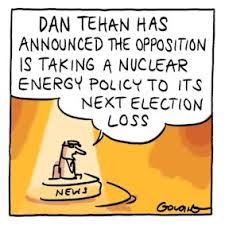
“……………………………………..Shadow Energy and Emissions Reduction Minister Dan Tehan has argued the government’s proposed standards for data centres are too restrictive.
Ahead of releasing the Coalition’s revitalised energy policy, Mr Tehan has said that all options should be on the table to power future data centres, including nuclear energy.
“When [companies] look to invest in Australia, they are deterred by our moratorium preventing them from powering their centres through nuclear,” Mr Tehan said in a statement.
Mr Tehan said that US companies such as Google and Amazon were investing in “their own zero emissions nuclear power to power data centres”.
According to the International Energy Agency [IEA], nuclear energy plays a supporting part in powering the world’s biggest data centre markets: the United States and China.
The autonomous intergovernmental organisation expects nuclear power’s role to grow from 2030, when it is expected that more small modular reactors [SMRs] come online.
Google, for example, signed a landmark deal in 2024 with Kairos Power to buy energy from several SMRs to help support the tech giant’s AI infrastructure.
The first of the reactors is expected to come online by 2030.
Nationals Deputy Leader Darren Chester, whose electorate of Gippsland in Victoria is experiencing significant data centre investment, said he believed that it was “inevitable” that Australian-based facilities would be powered by nuclear energy to some degree in the future.
Mr Chester said “large-scale” nuclear reactors were “proven technology”, but he would be open to other options in the years to come, such as SMRs.
“Removing the moratorium on nuclear [energy] is a sensible thing to do,” Mr Chester said.
Shadow Infrastructure and Sovereign Capability Minister, Andrew Hastie, said it was not feasible for AI data centres to be powered solely off renewables.
“There needs to be a mix of base load power, and nuclear should be part of that mix,” Mr Hastie said in a statement.
The Coalition’s nuclear energy aspirations for Australia suffered a significant blow in its election drubbing in 2025.
An internal review found the opposition’s election campaign was perceived as “incoherent,” and acknowledged the Coalition’s plan for nuclear was among policies widely criticised as “politically mistimed or alienating”.
At the core of the policy was a plan to build seven nuclear power sites, but the party did not specify whether large-scale reactors, small modular reactors [SMRs], or a combination of both, would be used.
National science agency CSIRO and the Australian Energy Market Operator [AEMO]’s latest GenCost report showed introducing nuclear power to Australia would attract significant up-front costs.
“New large-scale nuclear costs are significantly lower than nuclear SMR, but both represent moderate-to high-cost sources of electricity generation,” the report stated.
Nuclear power generation has been banned in Australia under federal laws since the late 1990s.
States and territories also have legislation prohibiting nuclear energy production, with some jurisdictions also restricting certain nuclear-energy-related activities, such as uranium mining.
Labor is emphatically opposed to lifting the moratorium on nuclear energy in Australia.
Energy Minister Chris Bowen recently told Sky: “Nuclear is not an answer for Australia any time.”
Instead, the government is focusing on transitioning to renewable energy, specifically solar and wind energy backed up by hydro storage and gas, with a goal of having 82 per cent of electricity generated by renewables by 2030.
Experts weigh in on how to power Australia’s data centres
Tony Irwin, a nuclear energy advocate and ANU honorary associate professor who spent three years building nuclear reactors in the UK, believes nuclear energy should be used to help power data centres.
“Solar and wind obviously can play a part in it. But nuclear should also be playing a part because, as I say, it’s reliable, it’s low emissions,” he said.
Mr Irwin believes large-scale reactors could be used, but SMRs and what are known as “micro-reactors” could be less costly.
Operational SMRs are only found in Russia and China, according to Energy Strategy Reviews. Micro-reactors are still in development.
The prime minister said in his speech that both Australia’s land and sunshine were among reasons the world was “queuing up to invest” in the nation.
“Think about what we have … the space to build. The sunlight to power affordable, renewable, reliable energy,” he said.
Tony Wood, a senior fellow at Grattan Institute’s Energy and Climate Change Program, welcomed the government’s new rules but questioned how data centre operators would be forced to supply their own renewable energy.
“We are going to get on top of this. That’s what this is about, and I fully support that,” he said.
“I’ve not seen anything that really expands on how such a requirement would be implemented.”
Mr Wood said the opposition’s push for nuclear power for data centres was a “political sideshow”……….
He described the government’s plan for Australia’s energy transition as “plan A”.
“I think we’ve got a very strong plan A and we should stick with it in Australia,” he said.
“And just because someone else does it [nuclear energy] doesn’t mean we should fire.”……..https://www.abc.net.au/news/2026-07-29/data-center-boom-powers-up-political-energy-debate/106929726
NACC handed naval contracts corruption case back to Defence
Not the first time NACC has asked Defence to investigate itsel
Former senior naval officer to face general court martial in Canberra in September
Michelle Fahy, Jul 29, 2026, https://undueinfluence.substack.com/p/nothing-to-see-here-says-australia
Last week, reports from The Nightly and the ABC revealed details of a case involving a recently retired senior naval officer facing a court martial on eight separate charges relating to naval sustainment contracts at the Henderson shipyard near Perth.
Further details emerged over the weekend that the defence department had initially referred the matter to the National Anti-Corruption Commission but the watchdog handed the case back to Defence. (See non-paywall version.)
A NACC spokesperson said:
As it is now in the public domain, we confirm that the Department of Defence did refer this matter to the Commission in compliance with their mandatory reporting obligations under the National Anti-Corruption Commission Act 2022.
Beyond this, it is not appropriate for us to comment further as this matter is subject to suppression orders.
The NACC would not say whether it was continuing its own separate investigation into the matter.
Defence minister Richard Marles told the ABC he thought the court martial process was “appropriate”, but refused to comment further
Court martial proceedings set for September
The ADF’s chief judge advocate, Major General Michael Cowen KC, has issued a non-publication order suppressing the accused person’s name, saying the person should be referred to only by the pseudonym, “star ranked officer in the Royal Australian Navy, Officer Brown”. ‘Star ranked’ refers to the top ranks of the navy and includes admirals, vice-admirals, rear-admirals and commodores.
A five-day pre-trial hearing was held at HMAS Stirling naval base in Western Australia in June. Another pre-trial hearing is scheduled to start on September 1 at a military facility in Canberra. The court martial is set to commence at the same facility on September 14, running for up to six weeks.
Figures familiar with the allegations told The Nightly last week that due to the seniority of the accused it was initially difficult to find senior officers to take part in the court martial who were not conflicted. Those figures also said the case will examine interactions between the government’s former weapons-buying group – Capability and Sustainment Group (CASG) – and several large companies who completed sustainment projects at Henderson shipyard.
It is unclear exactly when the alleged wrongdoing took place. The Nightly reported that the activity under investigation occurred during the previous Coalition government, before the Albanese government took power in 2022.
Not the first time NACC has asked Defence to investigate itself
In late 2024, Undue Influence reported on another known defence-related corruption matter where, having received a referral from Defence, the NACC sent the matter back to Defence for investigation. That matter related to a billion-dollar munitions factory contract between Defence and the Australian subsidiary of French multinational arms-maker Thales. Defence said it was “unable to substantiate the allegation”. The NACC has made no further statements on the Thales matter and it is unclear whether it remains under investigation.
‘Nothing to see here’ says Australia as third Thales corruption case starts globally https://undueinfluence.substack.com/p/nothing-to-see-here-says-australia
The Quiet Surrender of our Nation’s Sovereignty
28 July 2026 Dr Andrew Klein, https://theaimn.net/the-quiet-surrender-of-our-nations-sovereignty/
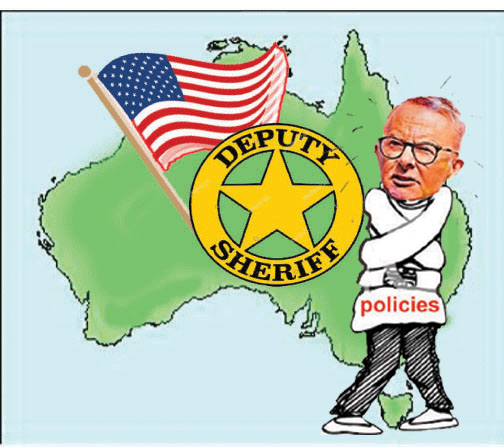
It is our melancholy duty to inform Australians of the quiet surrender of our nation’s sovereignty
I. Introduction: The Mask and the Man
What they see is a Prime Minister. What I see is a party animal – trapped in a role he was never prepared to play. He knows how to win power. He doesn’t know how to wield it. And when he fails, he blames everyone but himself.
The Albanese government has presided over a quiet but systematic surrender of Australian sovereignty. Through AUKUS, through the integration of Australian forces into American military structures, through secret arms deals, and through a failure to interrogate the strategic consequences of our alliance commitments, Australia is being transformed from an independent nation into a junior partner – a vassal state without voting rights.
This is not a deepening of alliance. This is a strategic surrender.
II. AUKUS: The $368 Billion Abdication
The AUKUS nuclear submarine deal is the clearest example of this failure. Australia will commit $368 billion to acquire nuclear-powered submarines – equivalent to more than $30 million per day across three decades.
But the deal is plagued by problems:
- Deliverability: The United States shipyards cannot meet production targets, averaging only 1.1 to 1.2 Virginia-class submarines per year, far below the required 2.33.
- Cost blowouts: Australia will commit nearly $10 billion to subsidise US and UK naval shipyards.
- Strategic uncertainty: Former foreign minister Gareth Evans has warned that AUKUS will place Australia’s sovereignty at “serious risk,” with submarines effectively becoming “an extension of U.S. military power.”
- A “junior partner” trap: Former Defence Department analyst Dr Andrew Gaczol told a public inquiry that Australia will become a “junior” partner to the United States and lose its strategic independence. According to Dr Gaczol, “The Australian political class and defence policy community still think it’s our melancholy duty to support the military commitments of our great and powerful friends, even if they conflict with Australian interests.”
III. The US-Israel Military Merger: Australia’s Involuntary Integration
In July 2026, the US House of Representatives passed a $1.15 trillion National Defense Authorization Act (NDAA) by a vote of 216 to 212.
Section 219 of the Act establishes a “United States-Israel Defense Technology Cooperation Initiative,” requiring the Pentagon to appoint an executive agent to “expand and accelerate bilateral defense technology research.” The provision “would all but fuse the two countries’ armed forces together” across multiple domains, including biotechnology, autonomous systems, artificial intelligence, and cyberwarfare.
Representative Jennifer McClellan condemned the provision as one that “undermines our sovereignty and lacks any form of oversight.”
Why does this matter to Australia?
The Australian Defence Force has long achieved interoperability with the US military. Israel has achieved interoperability with the US since 1981. If the US and Israel move from interoperability to integration, the two degrees of separation between the ADF and the IDF are reduced to one.
Australia is being integrated into Israel’s military system through the American link. We are being drawn into a conflict not of our choosing, through a chain of obligations we never consciously accepted.
IV. Australia’s De Facto Participation in the Iran War
The evidence of Australia’s entanglement is already clear.
A. Intelligence Sharing
In March 2026, Australia deployed an E-7A Wedgetail surveillance aircraft and 85 ADF personnel to the UAE. The aircraft provides “long-range reconnaissance capability” to “secure the airspace above the Gulf.” Defence officials have confirmed that reconnaissance information obtained by the Wedgetail is also provided to US allies including Jordan, Saudi Arabia, Bahrain, and Qatar.
While the government insists the role is “defensive,” the intelligence is fed into the Joint Air Operations Center (CAOC), which is under the command of US Central Command – and the US is waging an offensive war against Iran.
B. Embedded Troops
As of June 2026, 729 ADF personnel are embedded with US and UK armed forces. Some Australian personnel were aboard a US submarine that sank an Iranian frigate in the Indian Ocean. The Defence Chief defended this involvement as “in our national interest to have our people on board US Virginia Class submarines training, learning and understanding.”
C. Arms Supplies
Australia has been supplying Advanced Medium Range Air-to-Air Missiles (AMRAAMs) to the UAE. The government has also issued 322 defence export permits to Israel since 1 January 2017. As Greens Senator David Shoebridge noted, Australia has “one of the most secretive and unaccountable weapons export systems in the world.”
V. The Logic of Sovereignty Concession
The chain of sovereignty loss is clear:
- US-Israel Integration (NDAA Section 219) →
- Australia-US Integration (AUKUS, interoperability agreements) →
- Australia’s de facto military integration with Israel through the US →
- Australia’s strategic autonomy is diluted, and military decision-making is influenced by external forces.
Each link in this chain was forged without parliamentary debate. As the AUKUS inquiry has noted, the Federal Parliament “never held a thorough debate on the agreement,” exposing “a clear democratic deficit” in Australia’s largest strategic commitment.
VI. The Political Class: Incompetence or Complicity?
The Albanese government’s approach to national security is defined by caution, message control, and risk aversion – not by strategic vision.
- On AUKUS: The government has refused to interrogate the $368 billion deal, despite “substantial reservations” that have “not abated.”
- On the Iran war: The government insists Australia is not involved in “offensive operations,” but our assets are providing intelligence that enables offensive operations.
- On arms exports: The government has fought to keep arms exports to Israel secret, only being forced to disclose information by Federal Court order.
- On the NDAA: The government has remained silent on Section 219 – a provision that directly compromises Australian strategic autonomy.
Incompetent people, once in power, are more dangerous than bad people because:
- Bad people can be brought down.
- An incompetent person will remain there, constantly causing destruction, yet appearing “unblamed” after each failure.
- VII. Conclusion: The Cost of Silence
- Australia’s political class and defence policy community still believe it is their “melancholy duty to support the military commitments of our great and powerful friends, even if they conflict with Australian interests.”
But a new world order is coming. Australia has a choice: position itself for that new order, or desperately cling to a slipping world order.
Through AUKUS, through Section 219, through secret arms deals and uncritical alliance commitments, we are choosing the latter.
The chain of sovereignty concession is tightening. And the Australian people are being told nothing.
The question is not whether Australia will be dragged into a war not of its choosing. The question is: when that war comes, will we have any say in whether we fight?
Dedicated to my beloved wife and confidante – who taught me to see the person behind the mask, and to trust what I see.
A global threat for millennia: experts warn Australia’s nuclear submarine legacy will be weapons-usable uranium cache

Ben Doherty,25 June 26, https://www.theguardian.com/world/2026/jul/25/aukus-nuclear-submarines-danger-weapons-grade-uranium
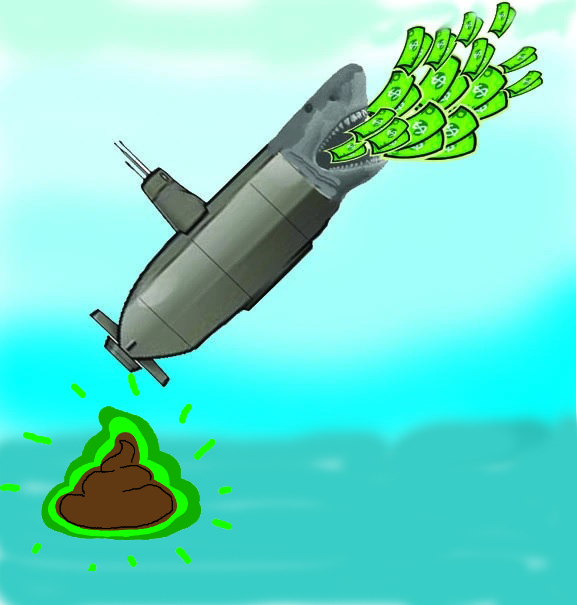
Uranium waste from Aukus submarines will be enriched to an estimated 80%: the same level as the bomb dropped on Hiroshima.
Australia’s proposed nuclear submarine fleet will leave behind tonnes of weapons-usable uranium-235: radioactive for hundreds of millions of years, and capable of being processed into scores of warheads, nuclear experts have told a public inquiry into Aukus.
And a former White House national security adviser has told the Guardian that Australia’s Aukus deal – involving the transfer of highly enriched uranium to a non-nuclear weapons nation – sets a dangerous proliferation precedent that other countries such as Iran could try to exploit, weakening global control of the spread of weapons-usable nuclear material.
Associate Prof Tilman Ruff, founding chair of the Nobel prize-winning International Campaign to Abolish Nuclear Weapons, told the Aukus public inquiry that the legacy of Australia’s nuclear submarine fleet – of which each vessel will have a service life of about three decades – will be hundreds of kilograms of high-level radioactive waste. Even as waste, the submarines’ spent reactor fuel will be highly enriched uranium (HEU), usable to build nuclear weapons.
“No nation has resolved the huge problem of how to manage this material and there’s no guarantee – given the timeframes involved and the hazards of the material over geological time – that any arrangement that we come up with could reliably isolate that material for hundreds of thousands, or millions of years.
“The additional complication here is that it needs a really high level of security because, in 10,000 years, somebody could still go and dig that stuff up and build nuclear weapons with it.”
The uranium left behind by Australia’s nuclear submarines at the end of their working lives will likely still be enriched to about 80%: the same level as the atomic bomb dropped on Hiroshima.
The Australian government has repeatedly said the precise amount of high-level nuclear waste that will be left behind by its submarine fleet is classified.
But documents released under freedom of information laws show Australia will be responsible for each submarine’s nuclear reactor compartment, “roughly the size of a four-wheel drive”, and spent nuclear fuel “roughly the size of a small hatchback”.
Leading global experts on non-proliferation have now estimated each nuclear submarine decommissioned by Australia – beginning in the 2050s – will contain about 400kg of HEU, enriched to about 80%, containing about 320kg of uranium-235 (U-235).
The International Atomic Energy Agency states a “significant quantity” of highly enriched uranium – enough to make a weapon – is 25kg of contained U-235.
U-235 has a half-life of 700m years: it will be a weapons proliferation risk for millennia. And the radioactive materials generated by its fission process will be toxic to humanity and the environment for millions of years.
The HEU left behind by each one of Australia’s three second-hand Virginia-class submarines bought from the US would be sufficient for more than a dozen weapons.
Australia’s domestically built Aukus-class submarines – Australia is proposing to build five – will be powered by Rolls-Royce’s in-development PWR3+ reactor. The quantity of HEU required to power that reactor is classified but they are expected to be larger than the Virginia-class reactors, Ruff said.
The Aukus agreement mandates that Australia is responsible for the disposal and storage of all of the nuclear waste left behind by its nuclear-powered submarines in perpetuity
By the end of the century, when all eight of Australia’s planned nuclear powered submarines have been retired, Australia will be responsible for the management of “at least 3 tonnes” of U-235 in the highly enriched uranium spent fuel waste, Ruff told the Guardian.
“That’s enough for 120 nuclear weapons using the International Atomic Energy Agency standard.”
Australia has spent decades reducing its HEU stocks. There is presently less than 3kg of HEU in the entire country, held for research purposes.
Ruff told the public inquiry into Aukus, established by the Australian Peace and Security Forum, that his primary concern over Aukus was that it exacerbated regional tensions and made Australia “a higher priority target, including for nuclear attack”.
Ruff cited the work of Dr Frank von Hippel, senior research physicist and professor of public and international affairs emeritus at Princeton University, who estimated that the reactor of a Virginia-class submarine – such as those Australia is set to buy from the US – would be decommissioned at the end of its working life still containing about 400kg of HEU, enriched to about 80%.
Von Hippel, who served as an assistant director for national security in the Clinton White House, told the Guardian “by the IAEA’s metric, 0.4 tons of 80% enriched uranium would be sufficient for 13 implosion bombs”.skip past newsletter promotion
Billions of dollars are failing to lift production of AUKUS submarines.
Michael Koziol, SMH, July 24, 2026
Washington: Billions of dollars of additional funding for the US defence industrial base have not improved the production rate of Virginia-class submarines, a top Pentagon official says, casting further doubt on whether Australia will receive its AUKUS subs on schedule.
Austin Dahmer, a senior policy official at the US Department of Defence, told a hearing on Capitol Hill that while undersea forces were the decisive instrument in denying Chinese domination of the Pacific, they were also the forces the US was the least able to produce.
“Virginia-class boats have been delivering at roughly 1.1 to 1.2 a year since 2022, against a requirement of two to 2.33, counting AUKUS pillar one,” he said.
“Two per year is not now expected until roughly 2032 … The strategy is sound. Production capacity is the point of failure.”
The US Congress has approved billions in additional funding to build submarines, while Australia has tipped in at least $US2 billion ($2.84 billion) with another $US1 billion to come. But Dahmer said the extra money had not helped.
“I would underline that Congress has already appropriated [funds] substantially, and the rate has not moved,” he said. “Any recommendations that consist of more money without a mechanism to materially compress those timelines will not change the outlook.”
Dahmer is a deputy to Elbridge Colby, the undersecretary of defence for policy who has in the past expressed scepticism about AUKUS. He made the comments to the National Commission on the Future of the Navy on Wednesday (US time) during a hearing on ways to improve US sea power.
Afterwards, he told this masthead the navy was working hard to improve delivery of the Virginia-class submarines so that a future administration would be in the best possible position when it decides whether to transfer a vessel to Australia………………..
The comments underscore the practical hurdles facing AUKUS despite the political commitment from all three countries, and come as Australian Labor Party members prepare for a possibly fiery debate about the pact at their national conference in Adelaide.
Under the $368 billion-plus agreement, Australia is due to receive at least three nuclear-powered submarines from the US starting in 2032, before building a new class of the vessel, the SSN-AUKUS, with the UK.
The US has now clarified all three of the submarines it proposes to sell to Australia will already be in service, rather than new. But the president of the day must approve the transfer and be satisfied it does not degrade US war-fighting capability.
Arthur “Trip” Barber, a retired 40-year veteran of the US Navy and the Pentagon, who now sits on the National Commission on the Future of the Navy, said the fundamental problem was shipyard wages, and their inability to retain workers.
“We need to pay shipyard workers a compelling amount of money so they stay on the job,” he told this masthead……………….
A staunch AUKUS supporter who is now a defence lobbyist, Christopher Pyne told the inquiry he did not believe the project would be delivered on time nor on budget, but “they’ll give it a good go”.
Deputy Prime Minister and Defence Minister Richard Marles was contacted for comment. His office referred inquiries to the government’s Australian Submarine Agency………… https://www.smh.com.au/world/north-america/billions-of-dollars-are-failing-to-lift-production-of-aukus-submarines-20260723-p60hq7.html
“Intolerable pressure”. Inside the Israel lobby campaign to coerce regulators on antisemitism
by Wendy Bacon and Stephanie Tran | Jul 17, 2026 , https://michaelwest.com.au/intolerable-pressure-inside-the-israel-lobby-campaign-to-coerce-regulators-on-antisemitism/
The health regulator AHPRA was “forced into a massive capitulation” to adopt the hardcore IHRA definition of antisemitism. Wendy Bacon and Stephanie Tran investigate.
A Zionist doctor has claimed that AHPRA CEO Justin Untersteiner “was forced into a massive capitulation with IHRA”.
The Australian Health Practitioner Regulation Authority (AHPRA) recently introduced the controversial International Holocaust Remembrance Alliance (IHRA) definition of antisemitism which puts healthcare workers at risk for criticising Israel.
The Zionist doctor, Doron Samuell, alleges that he was part of a campaign that “exerted intolerable political pressure” on AHPRA to adopt the IHRA definition of antisemitism.
IHRA resisted for two years
AHPRA, which regulates the conduct of 900,000 Australian healthcare workers, had resisted pressure to adopt the IHRA definition for two years.
However, on June 17, the health regulator shifted its position unexpectedly and without consultation when CEO Justin Untersteiner issued a joint statement with the Special Envoy to Combat Antisemitism, Jillian Segal announcing the adoption of the definition and that Segal’s guidance handbook would be used as a tool in handling complaints.
Thousands of health care workers, and many organisations including the Australian Nurses and Midwifery Federation, NSW Civil Liberties Council and Medical Association for Prevention of War have called for AHPRA to reverse its decision and continue to rely on its existing framework in dealing with complaints of racism including antisemitism.
In response, Israel’s Foreign Ministry pressured the Australian government to “confront antisemitism in healthcare” in a post on X on Sunday.
AHPRA subjected to “intolerable pressure” from Israel lobby
The ‘intolerable pressure’ claims were made by “Aba Shesh”, a social media pseudonym linked to the Facebook account used by Dr Doron Samuell, a member of the Australian Zionist Healthcare Alliance (AZHA).
Dr Samuell’s comments were made in response to a post on ‘Jews of Melbourne’ (JOM) Facebook page drawing members’ attention to a Civil Liberties Defence Centre (CLDC) webinar presented by its chairperson, lawyer Nick Hanna. The webinar was an educational briefing for healthcare workers on the implications of AHPRA’s adoption of the IHRA definition .
A member of the Jews Of Melbourne group predicted there would be
“lots of “antisemitism” at the webinar which members could monitor and report to AHPRA.”
In response, “Aba Shesh” described Untersteiner as an “unthinking bureaucrat” who “repeatedly minimised the problem until his hand was forced”.
Samuell lamented that Untersteiner “said the right things and even visited a shule but AHPRA sat on their hands, receiving vexatious complaints for two years until we exerted intolerable political pressure on them to act.”
Samuell stated that Untersteiner “was forced into a massive capitulation with IHRA”.
Last year, Samuell claimed he was responsible for the cancellation of a staff forum on Children and War at the Royal Children’s Hospital.
MWM sent detailed questions to Untersteiner and provided him with an opportunity to respond to the comments. Instead of specific answers, AHPRA provided us with a general statement. AHPRA’s full response is below.
MWM also contacted Samuell for comment, he did not provide a response.
Several healthcare professionals who opposed the change said they met with senior AHPRA officials, including Untersteiner, earlier this year to argue against adopting the IHRA definition.
One doctor, who requested anonymity because of concerns of professional repercussions, said senior leadership were presented with medical evidence of the genocide and concerns that the IHRA definition would be used to silence doctors.
“As well as presenting the overwhelming amount of medical evidence of genocide and the silencing of healthcare workers as an apparatus of genocide, we also focused on the concern of the IHRA definition being used to silence doctors who openly support human rights,” they said.
Jerusalem definition preferred
The doctor said they proposed the Jerusalem Declaration on Antisemitism as an alternate definition.
“We provided an alternative definition on antisemitism, the Jerusalem definition, should it be necessary to single out one group for a separate definition on discrimination.”
The doctor said Untersteiner told them he had publicly rejected the IHRA definition and discussed pressure the regulator was facing from Israel lobby groups.
“Untersteiner said he has publicly rejected the IHRA definition but when pressed to provide this in writing later, AHPRA did not,” the doctor said.
“[Untersteiner] also expressed some of the personal stress he was under due to the Zionist groups and in particular from doctors like Doron Samuell. It appeared to be genuine and heartfelt.”
MWM put those claims to Untersteiner, who declined to comment.
The doctor expressed concern that AHPRA’s decision to adopt IHRA will encourage vexatious complaints against practitioners, an anxiety shared by thousands of other healthcare workers.
“AHPRA’s statement on the IHRA definition will embolden the Zionists to ramp up their vexatious complaint campaign,” they said.
Path to capitulation
Samuell told the Facebook group that “with my pressure, the Minister issued a directive for Justin to remedy the situation and gave him 6 months to do it” yet, “when he reported back 7+ months later, he was still refusing to define antisemitism”.
In September 2025, health ministers directed APHRA to provide a six monthly report on “Improving the health practitioner response to racism and discrimination, including antisemitism”. AHPRA established a Racism and Discrimination Committee to provide an action plan.
Minister for Health, Mark Butler did not respond to questions on the matter.
In February 2026, Untersteiner was pressured by Senator Andrew Bragg in Senate Estimates to adopt the IHRA definition.
“I’m wondering why you haven’t decided to adopt a clear definition of antisemitism. We’ve just had a religious massacre in Australia where antisemitism was a key driver. So I’m wondering why you haven’t adopted one,” Bragg asked.
In response, Untersteiner said the issue was a “live discussion” however, “the vast majority of practitioners do the right thing and they comply with our codes of conduct” and “in the very few cases where they don’t, we do believe that we’ve got the tools to be able to deal with that effectively.”
The Segal meetings
When pressed further to explain why he had not adopted the IHRA definition, Untersteiner said he had been meeting with Jillian Segal “on a regular basis”.
“I’ve been meeting with the special envoy on a regular basis. I think we’ve been able to work quite well together,” Untersteiner told the Committee.
On 13 April 2026, AHPRA’s Race and Discrimination Committee submitted its report responding to the Ministerial directive. In his posts, Samuell objected to the composition of the committee because it
“included a Jewish person who had been critical of Israel.”
The report stated that “the National Code of Conduct sets out clear expectations that registered health practitioners will deliver care that is culturally safe and free from discriminatory behaviours.” There was an action plan for strengthening AHPRA’s anti-racism approach but no mention of the IHRA definition.
On April 24, Special Envoy Segal released the Understanding Antisemitism in Australia handbook.On May 1, the Health Ministers accepted AHPRA’s report and it was published on AHPRA’s website.
APHRA’s usual practice is to publish communiques on its Board meetings shortly after they occur. Communiques have not been published for the May and June meetings.
Call for Untersteiner sacking
AHPRA declined to supply us with copies of those communiques so it is unclear whether the Board approved the use of the IHRA definition in these meetings.
On May 6, Samuell expressed his frustration with AHPRA in a podcast episode published by “The Israel Connexion”.
During the interview, Samuell said that AZHA had called for Untersteiner’s sacking in its submission to the Royal Commission into Antisemitism and Social Cohesion.
“AHPRA has dropped the ball. Now we’re making a submission to the Royal Commission, calling on the Health Minister to sack Justin Untersteiner for the role that he has played in this,” he said.
“Antagonistic to Israel”
“We’ve outlined in our submission a large number of failures. For example, there are governance problems in AHPRA. There are board members in AHPRA who are on the public record as being antagonistic to Israel.” Samuell said.
“I know from their own staff, many of whom have been in private communications with me, that they are not taking this matter seriously at all. They’ve breached their social contract with us. [Untersteiner] is not the person that can fix this situation.”
Samuell told Israel Connexion that AZHA has encouraged “practitioners and patients in the health sector to make submissions to the Royal Commission into Antisemitism through [AZHA] website” and is “synthesising the submissions into a discussion paper for the Royal Commission” by applying the IHRA definition.
The result is a “whole of sector submission” developed by applying “social theories about what is going on and what should happen to remedy it.”
MWM is not asserting that any of the public allegations against AHPRA are true. In the absence of responses from AHRPA or Samuell on these matters, we are reporting them in the interests of transparency.
Zionist Healthcare Alliance attacks on AHPRA
Samuell is one of several Zionist health workers who represent the Australian Zionist Healthcare Alliance (AZHA).
The AZHA was launched in October last year. It describes itself as “Australia’s first dedicated Zionist healthcare advocacy organisation”
AZHA’s most vocal member is public affairs officer Sharon Stoliar who helped found AZHA last year.
Ten days after the IHRA definition announcement, on June 27, Stoliar was featured in a major report by The Australian titled “How did hospitals become the front line in the antisemitic onslaught?”.
The report accused AHPRA of ignoring an “unprecedented explosion of antisemitism” and said Australian health care workers were amplifying anti-Jewish hate speech” and deliberating neglecting or harming Jewish patients.
Royal Commission hearsay
Stoliar told The Australian that she hoped to give evidence at the Royal Commission.
Stoliar is quoted describing an incident in which a woman in a Sydney hospital was “left to lie in a pool of blood with no pain relief” while her baby screamed in its cot alongside hers.
She has also claimed that an antisemitic health care workers caused a Jewish person to have a ‘forced abortion’.
No evidence is provided to support these hearsay claims which Stoliar has repeated in an interview with Israel’s Channel 12.
The Australian article has taken on a life of its own being regurgitated in various forms in Australian and Israeli media. The Channel 12 broadcast was reposted on Facebook and Instagram by the Zionist Federation of Australia. Collectively these posts have triggered a large amount of hate against Australia health workers and precipitated the Israeli Ministry for Foreign Affairs tweet this week.
AHPRA’s response
Rather than responding to our questions, AHPRA supplied MWM with a statement similar to one it has sent to thousands of healthcare workers who signed letters expressing opposition to its adoption of the IHRA definition.
AHPRA appears keen to allay the concerns of its registered health care workers. It emphasises that ”there is no place for racism or discrimination in healthcare”, and that it will deal with complaints on an individual basis. An AHPRA spokesperson provided the following explanation for the sudden change:
Ahpra had initially not adopted the IHRA definition, as we felt there was insufficient clarity between legitimate commentary and debate regarding the policies and actions of the state of Israel and its elected leaders, and antisemitism. However, the Special Envoy on Antisemitism’s handbook is designed to support use of the definition by distinguishing ‘between antisemitism and legitimate political debate, including on the topic of Israel’.
It is on that basis that Ahpra will use the IHRA definition as a reference tool where relevant, supported by the ASECA handbook, when considering regulatory responses. As a reference tool, the definition is not legally binding. There are no changes to the National Codes or the guidance that supports them.
AHPRA’s explanation is surprising. The handbook itself exacerbates concerns with the IHRA definition. For example, Segal’s examples suggest that it is antisemitic to say that Israel is a ‘racist project’ or that Israel is ‘committing genocide’, views that are widely held by numerous international law experts and humanitarian organisations.
The Genocide continues
Daily, the genocide continues. Israel has murdered thousands of healthcare workers in Gaza and devastated its healthcare system.
Last week the UN Commission of Inquiry on Occupied Palestinian Territory and Israel demanded that Israel release Gaza paediatrician Dr. Hussam Abu Safiya who has been imprisoned without charge and tortured by Israel for over 18 months.
Australian health care workers are mobilising and have formed a new national coalition. Yesterday, the Australian Healthcare Alliance 4 Palestine, encompassing hundreds of thousands of registered doctors, nurses and dentists, wrote a letter to AHPRA asking it to “provide full transparency regarding the governance, consultation and decision-making processes” that led to the decision to adopt the IHRA definition.
The Alliance said that health practitioners have “an ethical responsibility to advocate for our patients, our colleagues and the healthcare system” and called on AHPRA to rescind its decision.
Wendy Bacon
Wendy Bacon is an investigative journalist who was the Professor of Journalism at UTS. She worked for Fairfax, Channel Nine and SBS and has published in The Guardian, New Matilda, City Hub and Overland. She has a long history in promoting independent and alternative journalism.
She is a long-term supporter of a peaceful BDS and the Greens.
Stephanie Tran
Stephanie is a journalist with a background in both law and journalism. She has worked at The Guardian and as a paralegal, where she assisted Crikey’s defence team in the high-profile defamation case brought by Lachlan Murdoch. Her reporting has been recognised nationally, earning her the 2021 Democracy’s Watchdogs Award for Student Investigative Reporting and a nomination for the 2021 Walkley Student Journalist of the Year Award.
Close that Facility: The 2026 Pine Gap Protests
Dr Binoy Kampmark, 21 July 2026, https://theaimn.net/close-that-facility-the-2026-pine-gap-protests/
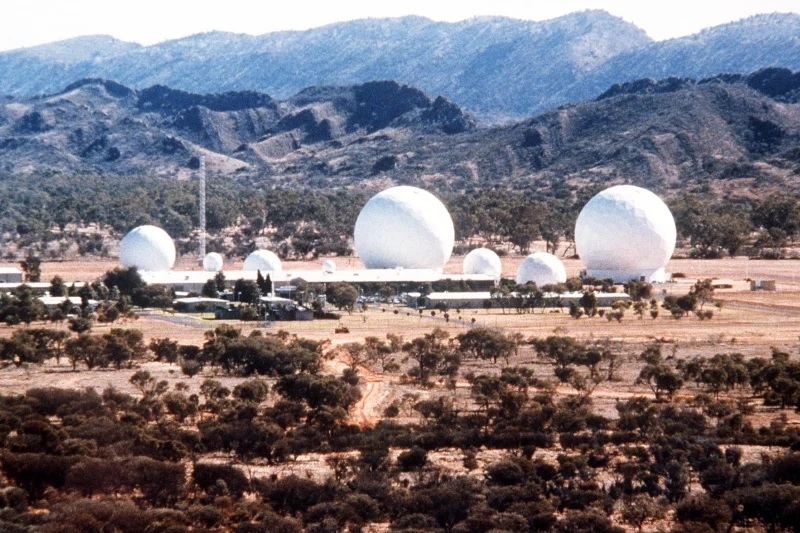
It remains a prickly reminder that Australia remains an embarrassed vassal of power, annexed to the security interests of another state basking in imperial and fast diminishing splendour. Pine Gap, known more technically as the Joint Defence Facility Pine Gap (JDFPG), is a largely US-operated effort in Alice Springs, Central Australia. As the late scholar of strategic studies Desmond Ball pithily remarked in 1988, it is “an espionage operation.
Euphemisms should not be allowed to obscure this essential point.” It grew out of a desire on the part of the US Central Intelligence Agency (CIA) in 1965 to establish a remote Australian-sited ground control station intended for signals intelligence satellites. Land belonging to the Central Arrernte people was accordingly excised the following year for the site. The decision, in typically rough fashion, was made without consultation and discussion with local residents or elders, a secret place that became what Trevor Paglen would describe as a “blank space on the map … erased from the public record.”
The facility staffs some 800 personnel from the US National Security Agency (NSA), CIA, the US National Reconnaissance Office (NRO) and such Australian agencies as the Australian Signals Directorate and Australian Federal Police. Over the years, the base has become increasingly corporatised with a heavy American accent: Raytheon, Northrop Grumman and General Dynamics, IBM and Hewlett Packard. A mere 10% of the constituted personnel are said to be Australian government employees.
The base periodically attracts its keen and principled protesters, aghast at the base’s role in furnishing targeting data for US and allied drone and missile strikes across the Middle East and Africa. This year, the Close Pine Gap-Sacred Land Back convergence featured three days (July 18-20) of activities, with hundreds of participants gathered in Alice Springs to demand the closure of the facility through a series of workshops, panels and woven “threads of anti-militarism and decolonial movements.”
On July 20, a rally of 300 individuals gathered close to the front of the spy base, the largest since 1987, sporting signs and flags and chanting the stock phrases: “shut it down”, “close Pine Gap”, and “always was, always will be Aboriginal land.” New South Wales Greens Senator David Shoebridge was present, expressing his concern about a “foreign military base set up for the interests of a foreign military” in the service of “right wing politics” and disrespectful of international law. The base was also a potential target for any adversaries the US might be willing to antagonise, thereby bringing “danger into the heart of our country.”
Arrernte Apmereke-artweye traditional custodians Felicity, Wyonna and Jacquita Hayes offer sound if disturbing logic, as reported by the Australian Associated Press: Pine Gap sits on a sacred site that not only profanes tradition but acts as vehicle for the waging of foreign wars and the conduct of genocide. “We don’t want to be feeling guilty all the time when bad things are happening overseas to little ones. We’re not the ones controlling that facility, but we feel guilty that it’s coming to our land.”
The custodians wished for the facility to be closed “so the generation coming can be safe. We want to be compensated so we can get houses at Whitegate community.” It is also with some astonishment that the residents of Whitegate, to this day, are deprived of rudimentary services, including decent housing and running water. The water has to be brought in by truck. There is no sewerage.
Richard Tanter of the Nautilus Institute, one of Pine Gap’s most astute and flawlessly detailed critics, proved ever reliable in remarking that, “Unless the Australian direct and indirect military relationship to Israeli activities in the Gaza Strip are closely reviewed … it is not possible for the Australian government to assure parliament and the Australian public that Australia is no complicit in acts of genocide.” The good professor has been able to shed much light on the facility’s broader purposes and is dismissive of critics who fault claims that the site is being used to feed such military efforts as those of Israel. (He can point to at least three satellites having the Gaza Strip within their reach.) In October 1973, for instance, satellite intelligence from Pine Gap was passed on to Israel during the Yom Kippur War, a contribution that aided Israel’s breakthrough of the Egyptian lines.
This is of little concern to the clubland militarists in Canberra and such think tanks as the Australian Strategic Policy Institute. Former intelligence officer Patrick White, writing for ASPI’s The Strategist, laments the diminished secrecy and security of the site, worrying that trends in signals technology have no longer made the base “irreplaceable”. The advent of extensive encryption means that satellite download feeds can be protected “almost anywhere. The remoteness that once hid the site from view no longer hides much at all.” He is sentimental about the ties with Washington. “We have shared in intelligence and expertise far beyond anything our own resources could produce. We have no satellites of this kind.” Precisely why Canberra is blood-crusted in its complicity, less an authoritative host than a butler eager to please.
Pine Gap acts, then, as a symbol of highly distilled, triple strength colonisation: a garrison outpost dominated by the US imperium and its personnel (a poke in the eye of Australian sovereignty), located on native land it defiles (a poke in the eye of the First Nations peoples), and also responsible for aiding the predations of Washington’s allies – more recently the Israeli Defense Forces in its cleansing conflict against the Palestinians. “I understand the genocide in Gaza against my people is made possible by intelligence flowing from the heart of this colony in Alice Springs directly to the Israeli occupation forces,” stated Palestinian activist Remah Naji of Justice for Palestine Magan-djin with potency. Shoebridge agreed: “We’re letting them use our land, this key real estate, I think [to] commit some of the worst atrocities we’ve seen.”
As the AUKUS Public Inquiry continues its various hearings on that ghastly, doomed security pact between Australia, the United Kingdom and the United States, the Close Pine Gap campaign should be commended as a linked, worthy extension. The former’s proceedings have been mostly savaging the wisdom of a pact that has shown Australia to be embarrassingly disadvantaged, its politicians largely deluded, and its strategic establishment impressionable and bankrupt. (That establishment seeks to bankrupt the Australian treasury to the princely sum of AU$368 billion over promised nuclear-powered submarines that may never arrive.) The Close Pine Gap protests, while receiving less in the way of coverage, is no less pertinent and urgent in its aims.
Albanese government pledges extra $4.6billion for AUKUS shipyard – but critics warn it will make Australia a nuclear target

‘Drone technology – particularly undersea drones – is advancing at such a rapid rate that the submarines will be out of date next year.“
By ALASDAIR BELLING and AUSTRALIAN ASSOCIATED PRESS, 24 July 2026 https://www.dailymail.com/news/article-16001457/aukus-submarines-funding-osborne-adelaide-labor-china-beeson.html
The Albanese government has promised an extra $4.6 billion for its AUKUS deal, but experts have raised concerns the funding is a waste of resources and could make Australia a nuclear target.
The package, announced on Friday, will go towards nuclear submarine construction at Osborne, 21km northwest of Adelaide‘s CBD.
The construction yard will be used to build the nuclear-powered vessels as part of the $368billion AUKUS security agreement with the US and UK.
The additional funding will bring total spending on the Osborne site to $8.5billion, supporting construction and development activities.
But Mark Beeson, an AUKUS critic and adjunct professor at the University of Technology Sydney‘s Australia-China Relations Institute, criticised the additional funding.
‘Defence has got an appalling record of acquisitions,’ he told the Daily Mail.
‘They’re always late, they’re always over budget and they never perform as they’re supposed to, and this is going to be no different, but on a larger scale.
‘Drone technology – particularly undersea drones – is advancing at such a rapid rate that the submarines will be out of date next year.’
Deputy Prime Minister Richard Marles and Prime Minister Anthony Albanese attend the Labor National Conference after announcing an extra $4.6billion in AUKUS-related spending
The funds will help construct a shipyard outside Adelaide to build nuclear-powered vessels
‘They’ll be easier to find and destroy, and the drones that destroy them will cost a fraction of the price of these submarines.’
Professor Beeson added that, more broadly, the pact may be intended to keep Australia safe but has the opposite effect when it comes to relations with China.
‘Something that’s meant to keep us safe is actually making us a nuclear target and making us less safe than ever,’ he said.
‘The prospect of nuclear-armed submarines being based in Perth and now Adelaide is a concern [for China].
‘That’s what makes them nuclear targets, as well as other American facilities in Australia, such as Pine Gap and North West Cape. They’d get nuked as well.
‘I think AUKUS is the most ill-conceived, misguided, strategically illiterate initiative you could possibly think of.’
According to current estimates, the second-hand submarines due under the AUKUS deal will arrive in Australia during the 2030s. The promised new vessels are not expected to be ready until the early 2040s.
SA Premier Peter Malinauskas was positive about the funding on Friday, telling reporters in Adelaide the shipyard – where there are currently about 1,100 workers employed – was a huge opportunity.
‘It is difficult to comprehend the scale of the billions of dollars of investment at Osborne to enable us to build the most complex machines on the planet,’ he said.
‘We are pleased to work in close partnership with the Albanese Government to deliver the crucial infrastructure needed and look forward to seeing young South Australians learning high value nuclear skills at Osborne within the next two years.’
But rank and file members of Labor have said they want to drop AUKUS from the party platform, with the funding announcement coinciding with the ALP’s national conference this week.
Marcus Strom from Labor Against War said the submarine deal needed to be axed to free up funds for reform measures.
‘If the Labor Party is serious about defeating the hot-air challenge from One Nation over lack of investment in infrastructure, it should be putting that sort of money into meaningful jobs, not jobs in the war industry,’ he told AAP on Friday.
This is a chimera of opportunity for jobs. The much better jobs, longer-term jobs [are] in renewables, advanced manufacturing, and the health industry.’
Under the AUKUS pact, Australia will buy used nuclear submarines from the US, before locally built vessels are brought online.
Prime Minister Anthony Albanese discussed AUKUS with newly elected UK counterpart Andy Burnham during a call on Thursday to congratulate him on his appointment and invite him to visit Australia.
AUKUS is expected to be debated on the floor of Labor’s national conference on the final day, Saturday.
While delegates agreed on AUKUS at the party’s previous conference in 2023, members are optimistic about a change in stance.
Defence Minister Richard Marles said there was ‘definitely an opportunity’ for AUKUS to be publicly debated at the national conference, but pointed to the positive vote three years ago.
‘Seventy-five per cent of the floor supported AUKUS, so this was not close, and that’s the position of the party right now,’ he told ABC Radio.
‘I understand that this is a huge public expenditure, and so people are entitled to raise questions and have debates, and I stand ready to do those debates.
‘But at the same time, we are putting this in place.’
Dozens of anti-AUKUS protesters were out the front of the Adelaide Convention Centre in hazmat suits and blaring sirens, urging Labor to drop support for the pact.
Gambling reform measures will also be brought to the conference floor, with rank and file members urging the government to go further on the issue.
Amendments have called for a national regulator to better protect vulnerable people from gambling harms.
UN refutes Jillian Segal’s Gaza death toll claim before Royal Commission
by Aleta Moriarty | Jul 17, 2026 https://michaelwest.com.au/un-refutes-jillian-segals-gaza-death-toll-claim-before-royal-commission/
Responding to Special Envoy Jillian Segal’s claim of a “grossly inflated” death toll in Gaza, UN spokesperson for Secretary-General António Guterres backed the Gaza Ministry of Health. Aleta Moriarty reports.
The integrity of Australia’s Royal Commission into Antisemitism and Social Cohesion depends on an accurate factual record. Public confidence in its findings relies on evidence being tested and claims being verified.
Too much is at stake. Hate is on the rise, and the safety of the Jewish community is rightly being examined in the wake of the Bondi Terror Attack. With distrust and polarisation at near-record levels, the process deserves to be respected.
Special Envoy to Combat Antisemitism, Jillian Segal, told the Royal Commission on July 9 that Gaza death toll figures from the Gaza Health Ministry reported by SBS and the ABC were “grossly inflated,” and that this was “well known and even accepted by the United Nations”.
I’ve spent most of my career working for the UN and its agencies. I’m not an official UN employee right now, but I remain a firm believer in the institution and its integrity, which is why I sought clarification regarding the UN’s position on the Gaza death toll directly from the office of the Secretary-General.
The UN responds
Responding on behalf of Secretary-General António Guterres, UN spokesperson Stéphane Dujarric said:
“For us the Ministry of Health in Gaza is a source we, and many others, often cite. Independent validation of subsets of the data has found no significant discrepancies in their numbers.”
The Department of Home Affairs was asked if it would issue a clarification. A spokesperson provided the following response:
“The Special Envoy has been appointed as non-statutory Ministerial appointment. The Department does not comment on statements made by individuals.”
Misinformation broadcast nationally and left unchallenged doesn’t just cast aspersions on the UN. It cheapens the seriousness of the allegations Israel is facing, and it’s an insult to the scale of civilian life already lost. It also undermines the commission’s noble cause of promoting greater social cohesion.
Envoy Segal’s testimony before the Royal Commission was also rejected by the ABC Alumni whose Jonathan Holmes referred to as “propagating serious inaccuracies, and some outright untruths, in her sworn testimony to a Royal Commission”.
On the Gazan Health Ministry numbers referred to by Ms Segal as “grossly inaccurate”, Holmes wrote:
This is simply untrue. The UN has said repeatedly that the Gazan Ministry of Health estimate of 70,000 deaths in Gaza since October 2023 is probably too low because so many bodies are still buried under the rubble. And even the IDF admitted in January this year that those statistics were “broadly accurate”.
Senior naval officer facing court martial over naval contracts – breaking news from WA
Defence accused of trying to bury details of a high-level investigation into handling of lucrative naval defence contracts by a former senior naval figure
Michelle Fahy, Jul 21, 2026, https://undueinfluence.substack.com/p/senior-naval-officer-facing-court?utm_source=post-email-title&publication_id=297295&post_id=207838287&utm_campaign=email-post-title&isFreemail=true&r=1ise1&triedRedirect=true&utm_medium=email
A secretive court martial process is under way in Western Australia involving a recently retired officer, The Nightly’s Andrew Greene has reported.
The Nightly said it understands the accused had left the Australian Defence Force in the past few years and will soon be subjected to a court martial on eight separate but unspecified charges.
Former senior Defence official Michael Shoebridge said he believes the entire process should be handled by a regular civil court, rather than kept inside the military justice system.
“The alleged offences are probably also offences under civilian law, so the better approach is a standard — open and public — prosecution in a civil court,” Shoebridge told The Nightly. “Instead, this just looks like the Defence leadership and ministers trying to keep this away from the public.”
Another defence industry figure familiar with details of the case backed the assessment, telling The Nightly they believed the military establishment was trying to “bury” the case from public view.
Figures familiar with the allegations have told The Nightly that due to the seniority of the accused ADF member it was initially difficult to find senior officers to take part in the court martial who were not conflicted.
Those figures told The Nightly the complex case will also examine interactions between the government weapons-buying group – Capability and Sustainment Group (CASG) – and several large companies who completed sustainment projects at Henderson shipyard.
The Nightly said it understands the activity under investigation occurred during the previous Coalition government and before the Albanese government took power in 2022.
It is unclear why the matter is being handled by a military disciplinary process rather than a civilian court.
Read The Nightly’s full story here.
1 This month
.

Australians deserve the truth
about
AUKUS – https://aukuspublicinquiry.com/

PETITION – To: Prime Minister Anthony Albanese and the Australian Labor Government

of the week – Australians for War Powers Reform (AWPR)
To see nuclear-related stories in greater depth and intensity

