PM sharpens attack on nuclear in election-style tour
Maitland Mercury, By Kat Wong and Tess Ikonomou, January 7 2025 –
Anthony Albanese is testing new lines of attack as he hurtles through key battlegrounds ahead of an official election campaign.
The prime minister has embarked a whirlwind tour of Queensland, the Northern Territory and Western Australia just months before voters are expected to go to the polls.
A federal election must be held by late May and, while Mr Albanese is yet to pull the trigger, the trip might be seen as a soft campaign launch………………………………………………….
Labor has renewed its offensive against the opposition’s $330 billion bid to set up seven nuclear reactors.
It initially aimed its criticism at safety and environment concerns, leaning on the nuclear fears of older generations.
But its latest attack highlights cost, viability and time, with a particular focus on economic consequences for the Sunshine State.
Fresh analysis released by Labor shows the coalition’s plan assumes it will cost Queensland more than $872 billion in lost output by 2050 and treasurer Jim Chalmers said Mr Dutton’s “economic madness” would leave Queensland households worse off.
“As a Queenslander, I won’t sit back and watch Peter Dutton push energy prices up and growth down right across the state,” he said…………………………………………………………… more https://www.maitlandmercury.com.au/story/8860529/pm-sharpens-attack-on-nuclear-in-election-style-tour/
The continual cover up – Jenny Hocking on the strange disappearance of Gough Whitlam’s ASIO file
January 5, 2025 , Australian Independent Media, By Jenny Hocking
And it is not just Gough Whitlam’s ASIO file that has been “culled” by the National Archives of Australia. The relevant Government House Guest Books at the time of the Dismissal have disappeared and the entire archive of Kerr’s prominent supporters, including Lord Mountbatten, was accidentally burnt in the Yarralumla incinerator.
I was made sharply aware of the conceptual and physical fragility of archives as historical representation 20 years ago through a chance encounter, or more precisely a lost encounter, with Gough Whitlam’s Australian Security Intelligence Organisation (ASIO) file. I had stumbled onto Whitlam’s security file quite unexpectedly through a reference to it in another, unrelated, file. Clearly, any file maintained by the domestic security service on Gough Whitlam would be a critically important historical record in itself, and even more so given the Whitlam government’s fractious relationship with the security services and the well-known surveillance excesses of ASIO and the state Special Branches at that time.
To find evidence of the existence of an ASIO file on Whitlam that I had never expected was a rare moment of archival anticipation. That anticipation was dashed four months later when the Archives informed me that, having maintained this security file for nearly 40 years, it had been destroyed in a routine culling, just weeks before I requested it. Although Archives assured me that, according to ASIO’s records, the now destroyed file “contained material of a vetting nature only”, this is now impossible to verify. A request for access to the ASIO documents referred to in this response and on which this claim about the nature of the file was based, went unanswered.
As a former Prime Minister, Whitlam was a recognised “Commonwealth Person”, for the purposes of the Archives management systems. These are “individuals who have had a close association with the Commonwealth” and whose records are therefore expressly collected and preserved for history. Notwithstanding that acknowledged significance, the Archives had issued an authorisation for ASIO to destroy Whitlam’s security file within weeks of my request to view it. It brings to mind Blouin’s arch observation that “a historian working in state archives, particularly on topics related to the recent past, is constantly engaged in some way in a struggle with the politics of state-protected knowledge”.
The misplaced destruction of Whitlam’s security file compounds the unsettled history of the dismissal by allowing the circulation of competing speculations over its coincident erasure: was this a vetting file as ASIO stated, did the file identify agents or surveillance methods, would its release have led to files on other members of the Whitlam government? This latter is no idle speculation. ASIO was already monitoring deputy Prime Minister Dr Jim Cairns, whose ASIO “dossier” was sensationally leaked to The Bulletin in 1974, causing immense damage to the Whitlam government and to Cairns personally. The possibility of security files on other ministers and even on Whitlam himself is only stirred by the deliberate destruction of ASIO’s vetting file. In the absence of the file itself an already clouded history becomes further compromised.
It was this episode that introduced me to the force of what Elkins terms “archival scepticism” in archive-based research. Whatever the reason for its apparent destruction, the Archives had successfully removed Whitlam’s ASIO file from public view and therefore from the consideration of history. In doing so it had played an important role in the construction of the dismissal in history, in which a security file on Gough Whitlam does not and cannot now feature. This underscores precisely, if there were any doubt about this, that archives are not neutral replicators of documented history, but politicised re-creators of it.
The Lost Archive: Government House Guest Books
In 2010, I first requested access to the Government House guest books held by the Archives, which provide the details of visits and visitors to “their Excellencies” at Yarralumla………………………….. The guest books appear regularly from July 1961 until July 1974, before stopping altogether until December 1982.
…………………………………………. The guest books for 1975 are now officially lost.
These missing guest books add fuel to the longstanding speculation that security and defence officials, notably the Chief Defence Scientist Dr John Farrands as the recognised authority on Pine Gap and the Joint Facilities, had briefed Kerr in the week before the dismissal about mounting security and defence concerns over Whitlam’s exposure of CIA agents working at Pine Gap, and his planned Prime Ministerial statement on this in the House of Representatives on the afternoon of 11 November 1975. ……………………………………….
The Burnt Archive: Sir John Kerr’s Prominent Supporters
In 1978, soon after Kerr left office, a cache of letters “of outstanding value” to Kerr was accidentally reduced to ashes in the Yarralumla incinerator………………………………
Kerr had sought these congratulatory letters for use in his forthcoming autobiography Matters for Judgement. Among his correspondents was the Queen’s second cousin, Lord Louis Mountbatten, Prince Philip’s uncle and King Charles III’s great mentor; the former Governor-General and distant royal relation, Viscount De L’Isle; and other prominent individuals supporting Kerr’s dismissal of Whitlam. These names alone indicate that these burnt letters were as important to history as they were to Kerr. Were it not for this secondary file of correspondence between Smith and Kerr detailing the saga of the “burnt letters”, the existence and apparent inflammatory end of Kerr’s correspondence with his minor aristocratic supporters would never have come to light. The letters themselves now never will.
Philip Ziegler’s authorised biography of Mountbatten, however, gives just a glimpse of this story. Ziegler recounts that Mountbatten wrote to Kerr days after the dismissal, congratulating him on his “courageous and correct action” in dismissing Whitlam. It was a remarkably partisan royal intercession, and Mountbatten was not alone among Kerr’s royal supporters. We now know, thanks to letters released in 2020 following the High Court’s decision in my legal action, that King Charles also fully supported Kerr’s actions. Charles’s letter to Kerr, written in starkly similar terms to Mountbatten’s weeks after the dismissal, leaves no doubt of Charles’s support for Kerr; “What you did […] was right and the courageous thing to do.”
As Kerr later wrote to the South Australian lieutenant-governor, Sir Walter Crocker, “I never had any doubt as to what the Palace’s attitude was on this important point.”
*************************
These are extracts from Professor Jenny Hocking’s essay ‘Critical Archival Encounters and the Evolving Historiography of the Dismissal of the Whitlam Government’, Australian Journal of Politics and History, 11 April 2024.
Open access publishing facilitated by Monash University, as part of the Wiley – Monash University agreement via the Council of Australian University Librarians. This article was originally published on Pearls and Irritations and has been republished with permission. https://theaimn.net/the-continual-cover-up-jenny-hocking-on-the-strange-disappearance-of-gough-whitlams-asio-file/
The polar playground for a suicidal species?
https://theaimn.net/the-polar-playground-for-a-suicidal-species/ 7 January 25
Where to begin on this mind-boggling story about epic changes on a very small planet?
Well, let’s begin on the fun part. The Australian Antarctic Program encourages some pretty innocuous recreational activities, plus of course, encouragement for tourists to come, and to learn about the polar world. So that’s OK, I suppose. But lately, in the news, there is growing concern that tourists, Australians in particular, are taking such a playful attitude to Antarctica, that they are risking their personal safety.
Interesting that the video above puts the blame on TikTok for encouraging the fun and danger. But tourism itself is good for increasing education about Antarctica. As long as individuals personally behave safely, that’s fine, isn’t it?
But what about planetary safety?
What Australians, and most of the world, learn about Antarctica, is that it’s pretty, and has penguins, Oh, and the ice is melting a bit, too. And that’s about it. The media does not trouble our complacent little minds with information about the thermohaline ocean circulation, the atmospheric circulation patterns, the carbon-sequestration of krill, the polar vortex…. Much too hard for us, in this cricket-tennis season.
Right now, Northern Europe and parts of the USA are experiencing extreme cold weather. No doubt some people would say that this disproves global heating, climate change. Alas, these extremes, emanating from the Arctic, by the polar vortex, are exacerbated by global heating. The polar vortex is a complex system, difficult to grasp, for the average news reader, so it is part of the whole poorly known, global climate system.
Antarctica is at the other end of the world – not connected to all this? Well, not if you ignore the global thermohaline circulation, among other things like sea level rise.
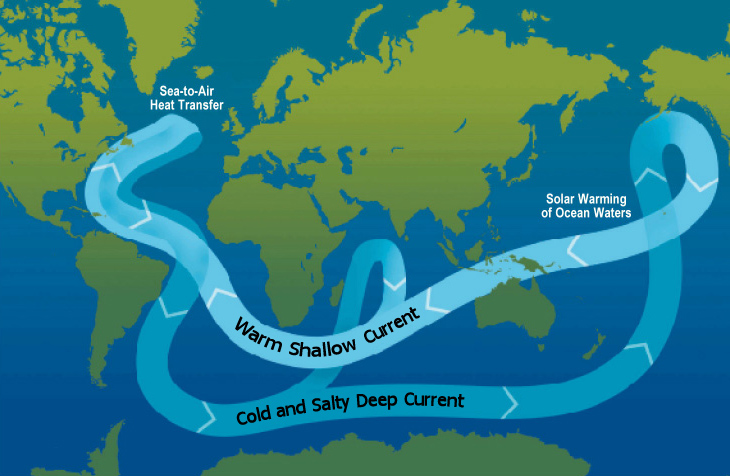
Global thermohaline circulation
Professor Elisabeth Leane, Professor of Antarctic Studies at the University of Tasmania says – What happens in Antarctica doesn’t stay in Antarctica. Its future will shape the future of the planet
Which brings me to the question of safety in relation to Antarctica – planetary, not just personal.
And here’s what the University of Tasmania says about it – Antarctica’s tipping points threaten global climate stability.
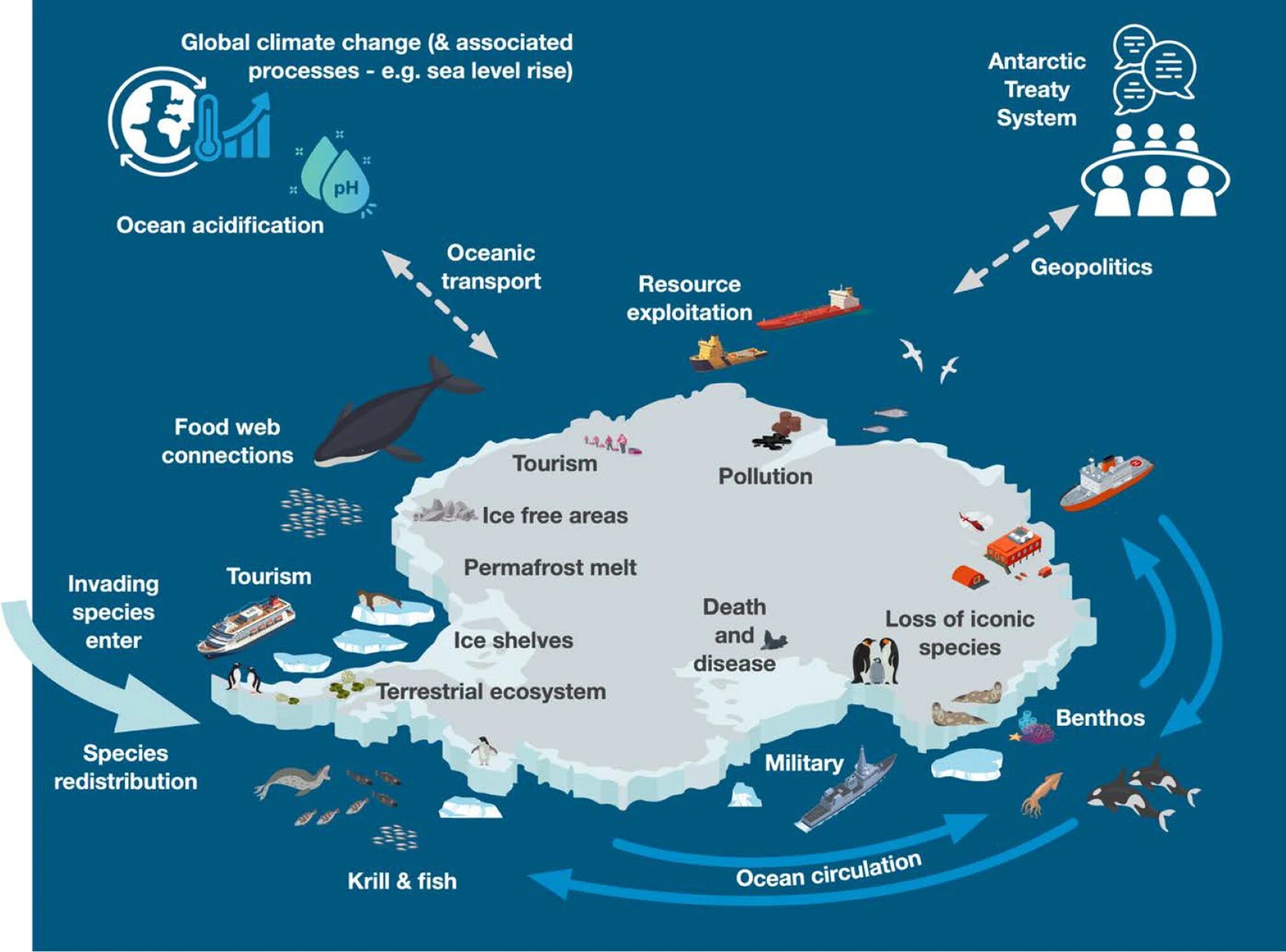
The map above is from the University of Tasmania’s report by international climate scientists . It identifies the various cascading tipping points and their interactions and pressures on the ecosystem.
For those who care about the climate change issue, and about Australia and the Antarctic, I would urge them to watch, and persist with, this brilliant report by climate researcher Paul Beckwith – https://www.youtube.com/watch?v=6WccDhnM8R8
Beckwith explains the potential tipping points identified by the study and their interrelationships , and adds the issue of sea ice loss. Critical issues are ice sheets, ocean acidification, ocean circulation, species redistribution, invasive species, permafrost melting, local pollution, chemical impacts, social impacts, local pollution and the Antarctic Treaty System. He goes on to explain with excellent graphics, the global thermohaline circulation, and then, in-depth, the records on sea ice, and then on to his detailed study on the tiny krill or light shrimp, and their global importance. Finally, Beckwith outlines the politics, the various national claims in the Antarctic Treaty System. The scientists’ conclusion – the urgent need for action on climate. Heavy stuff. Fascinating stuff. He finishes with a reminder of the unique role of that amazing critter the krill.
If you want a more concise discussion of the University of Tasmania’s December remarkable workshop of international marine scientists – go to Radio Ecoshock – World-changing Tipping Points – In Antarctica !
The “mainstream media” rarely covers climate change in any depth. For decades, the public has been informed very superficially on this life and death matter for our survival. The dedicated scientists produce their research results, but the media seem to find these too difficult, or too “political” to bother to report on them properly. The December 2024 “emergency summit” of international polar scientists in Tasmania barely got a mention in the Australian or international press.
You have to go to alternative media, to get any real insight into what is happening to the climate of our planet home. For decades now, Paul Beckwith has being producing his highly informative and wonderfully illustrated videos, on Youtube. Meanwhile Alex Smith has been doing the same sort of thing on radio and podcast, and print, – on Radio Ecoshock, which is heard in Australia on Community Radio 3CR.
In 2025, it is ever more urgent for people to wade through the morass of “social” media, and corporate media, and “alternative” media, to find the facts on climate change. Paul Beckwith and Radio Ecoshock are two examples of a rare and endangered human species – journalists who do their homework on climate change.
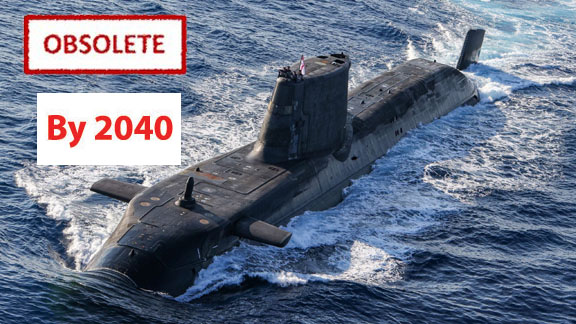
Could AI soon make dozens of billion-dollar nuclear stealth attack submarines more expensive and obsolete?
By Wayne Williams, 5 Jan 25, https://www.techradar.com/pro/could-ai-soon-make-dozens-of-billion-dollar-nuclear-stealth-attack-submarines-more-expensive-and-obsolete
Artificial intelligence can detect undersea movement better than humans.
AI can process far more data from a far more sensors than human operators can ever achieve
But the game of cat-and-mouse means that countermeasures do exist to confuse AI
Increase in compute performance and ubiquity of always-on passive sensors need also be accounted for.
The rise of AI is set to reduce the effectiveness of nuclear stealth attack submarines.
These advanced billion-dollar subs, designed to operate undetected in hostile waters, have long been at the forefront of naval defense. However, AI-driven advancements in sensor technology and data analysis are threatening their covert capabilities, potentially rendering them less effective.
An article by Foreign Policy and IEEE Spectrum now claims AI systems can process vast amounts of data from distributed sensor networks, far surpassing the capabilities of human operators. Quantum sensors, underwater surveillance arrays, and satellite-based imaging now collect detailed environmental data, while AI algorithms can identify even subtle anomalies, such as disturbances caused by submarines. Unlike human analysts, who might overlook minor patterns, AI excels at spotting these tiny shifts, increasing the effectiveness of detection systems.
Game of cat-and-mouse
AI’s increasing role could challenge the stealth of submarines like those in the Virginia-class, which rely on sophisticated engineering to minimize their detectable signatures.
Noise-dampening tiles, vibration-reducing materials, and pump-jet propulsors are designed to evade detection, but AI-enabled networks are increasingly adept at overcoming these methods. The ubiquity of passive sensors and continuous improvements in computational performance are increasing the reach and resolution of these detection systems, creating an environment of heightened transparency in the oceans.
Despite these advances, the game of cat-and-mouse persists, as countermeasures are, inevitably, being developed to outwit AI detection.
These tactics, as explored in the Foreign Policy and IEEE Spectrum piece, include noise-camouflaging techniques that mimic natural marine sounds, deploying uncrewed underwater vehicles (UUVs) to create diversions, and even cyberattacks aimed at corrupting the integrity of AI algorithms. Such methods seek to confuse and overwhelm AI systems, maintaining an edge in undersea warfare.
As AI technology evolves, nations will need to weigh up the escalating costs of nuclear stealth submarines against the potential for their obsolescence. Countermeasures may provide temporary degree of relief, but the increasing prevalence of passive sensors and AI-driven analysis suggests that traditional submarine stealth is likely to face diminishing returns in the long term.
Can true nuclear independence be achieved without ending the US Alliance?
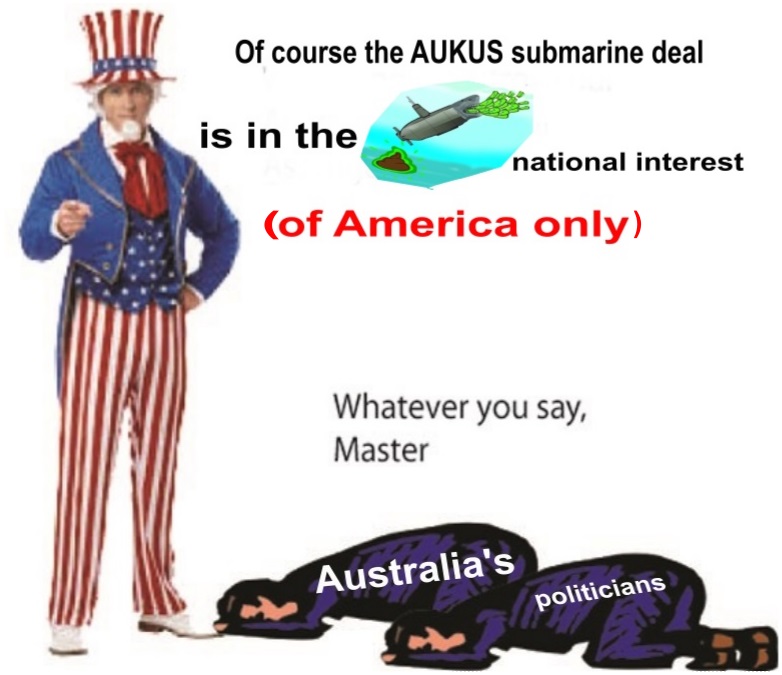
By Donald Wilson, Jan 4, 2025, https://johnmenadue.com/can-true-nuclear-independence-be-achieved-without-ending-the-us-alliance/
Australia’s historical commitment to nuclear disarmament is facing new challenges, as critics say the nation’s alliance with the United States is leading to a conflicted stance on nuclear non-proliferation.
While Australia has actively participated in global nuclear arms control initiatives, such as the Nuclear Non-Proliferation Treaty (NPT) and the Comprehensive Nuclear-Test-Ban Treaty (CTBT), it simultaneously relies on the so-called “US nuclear umbrella” for security. This duality has led to ongoing debate about whether Australia’s security policies align with its disarmament principles.
Australia’s approach to nuclear non-proliferation has shifted over recent years. In 2016, Australia voted against a United Nations General Assembly resolution aimed at creating a legally binding instrument to prohibit nuclear weapons. The following year, it refused to join negotiations that led to the Treaty on the Prohibition of Nuclear Weapons (TPNW). As a result, Australia remains one of the few regional countries not signed onto this treaty, despite a 2018 resolution by the Australian Labor Party to consider joining under a future government.
Critics argue that if Australia were to adopt the TPNW, it would be compelled to prohibit any support for other countries’ nuclear weapons programs—potentially forcing the closure of Pine Gap, a key joint defence facility with the US. Yet government supporters claim that distancing from the US would leave Australia vulnerable, especially amid regional tensions with China.
However, questions have arisen about the reliability of this “nuclear umbrella.” Currently, US military systems, including missile defence, offer limited protection against intercontinental ballistic missiles (ICBMs). After investing over $400 billion in missile defence research and development, no system has yet achieved dependable protection against ICBMs. Critics argue this leaves Australia exposed rather than safeguarded, despite assurances from the US.
In addition, Australia’s recent defence agreements, particularly the AUKUS pact and the US-Australia Force Posture Agreement (FPA), have raised concerns over sovereignty. Signed in 2014, the FPA allows the US to store and control defence equipment on Australian soil. According to Article VII of the agreement, the US retains “exclusive control” over its prepositioned military supplies in Australia, with full ownership rights, effectively restricting Australian authority over the use of these materials.
Article XII of the FPA states that US government vehicles, aircraft, and vessels are exempt from inspection by Australian authorities without US consent. This clause has fuelled arguments that the FPA has compromised Australia’s independence by allowing the US to make defence decisions within Australian borders. For instance, US B2 bombers have launched from Australian bases in operations overseas, reportedly without consulting the Australian public.
As Australia contemplates its nuclear policy, the debate over whether it can maintain both its alliance with the United States and a commitment to nuclear non-proliferation will likely intensify. This complex question has implications not only for Australia’s defence but also for its sovereignty and international standing in the movement toward nuclear disarmament.
The $80 billion question buried in Dutton’s nuclear power plan.

“Companies can go bust, but the nuclear waste is still going to be there. It has to be owned by the government.”
Two elements of the opposition’s nuclear plan are not included in the costings – waste management and public liability for disasters.
Mike Foley, January 3, 2025 , https://www.theage.com.au/politics/federal/the-80-billion-question-buried-in-dutton-s-nuclear-power-plan-20241218-p5kzg9.html
Decommissioning any plants built under the Coalition’s nuclear energy plan could cost more than $80 billion, and taxpayers would have to foot the bill.
Opposition Leader Peter Dutton’s planned seven nuclear plants, with a likely 14 large-scale reactors, would be publicly owned, so taxpayers would be liable for clean-up costs from the radioactive sites and any accidents during operation.
Last month, Britain’s National Audit Office found that the bill to clean up its old nuclear sites, which date back to the 1940s, would be $260 billion.
About $200 billion of this is to decommission Britain’s original Sellafield site for weapons and energy generation, with contaminated buildings and radioactive waste.
Another $48 billion is to decommission eight other nuclear sites, which now range from 36 to 48 years old, at a cost of $6 billion each. They are set to be handed back by a private operator to the government for decommissioning from 2028.
University of NSW energy researcher Mark Diesendorf said international experience showed the cost of decommissioning a nuclear reactor could be roughly in line with its construction cost, which the Coalition has said would be about $9 billion a reactor in Australia.
“For a rough approximation, you’re looking at probably the equivalent of the construction cost,” Diesendorf said.
If the Coalition’s plan to build 14 nuclear reactors by the mid-2040s is realised, the decommissioning bill would be roughly $82 billion to $125 billion in today’s dollars.
Private firm Frontier Economics produced costings of the opposition’s plan that included decommissioning in an overall $331 billion bill to build 14 gigawatts of nuclear generation. However, it is unclear what price was attached to clean-up and whether it is plausible, given Frontier has declined to release the assumptions it used.
Frontier said the government’s policy to boost renewables to nearly 100 per cent of electricity generation by 2050 would cost $595 billion – a figure the federal government has rejected. Labor says nuclear is the most expensive form of new energy generation.
Opposition energy spokesman Ted O’Brien said the Coalition’s plan was cheaper than the government’s renewable energy goals.
“Unlike the Coalition, Labor refuses to calculate the full cost of its plan, such as the decommissioning costs of massive offshore wind projects in the six zones it has identified off the Australian coast,” O’Brien said.
Griffith University Emeritus Professor Ian Lowe said Diesendorf’s assumption that decommissioning a large-scale reactor would cost the same as building it was “sensible”.
“The World Nuclear Association has information about the 25 reactors that have been decommissioned, and the figures vary enormously,” Lowe said.
“The figure of about $6 billion per reactor sounds about the average figure, assuming that there are no complications.”
The opposition has said its nuclear reactors would operate for 80 years, and University of NSW Associate Professor Edward Obbard, a nuclear materials engineer, said it made “perfect sense” for a country to hold the liability for nuclear decommissioning, given the cost and timescale required.
“I don’t think there’s any alternative to the state being responsible for decommissioning a nuclear power program,” Obbard said.
“Companies can go bust, but the nuclear waste is still going to be there. It has to be owned by the government.”
The government could choose to isolate an old nuclear reactor once it reaches its end of life, and leave it alone for several decades until the radioactivity had reduced, he said.
Two elements of the opposition’s nuclear plan are not included in the costings – waste management and public liability for disasters.
Diesendorf and Lowe said public liability in the unlikely event of a nuclear accident could run into the hundreds of billions of dollars, given the $290 billion clean-up bill from Japan’s 2011 Fukushima nuclear disaster.
Where is the ‘mature debate’ about the health impacts of nuclear power?

By Margaret Beavis, January 2 2025, Canberra times 2/1/25 https://www.canberratimes.com.au/story/8857513/margaret-beavis-health-risks-near-nuclear-plants-exposed/
When it comes to nuclear radiation, there is a clear disconnect between the medical evidence and the views of the Coalition. Since the 1950s we have known there is a link between X-rays in pregnant women and leukemia and other cancers in their children. It is not for nothing there are signs in every radiology department asking if you are pregnant.
The current shrill denunciations of potential health risks associated with nuclear power plants as a “scare campaign” may yet prove to be an own goal, as it has drawn attention to the issue. Communities considering hosting a nuclear reactor should be aware of the evidence regarding real-world health impacts. Informed consent matters, in politics as well as medicine.
Extra cases of leukaemia occurring in children living near nuclear power plants have caused concern and controversy over decades. In the 1980s excess cases of leukaemia and lymphoma were noticed around the Sellafield nuclear plant in England.
A UK government investigation unexpectedly found that the risks for leukaemia and lymphoma were higher than in the surrounding population. In 2007, the US Department of Energy examined all the reliable data available worldwide, confirming a significant increase in leukaemia for children living near nuclear power plants..
The clearest findings on this subject come from a large national German study from 2008, which examined leukaemia among children living near any of Germany’s 16 operating nuclear plants over a 25-year period.
It showed that the risk of leukaemia more than doubled for children living within 5 km of a nuclear plant. Nuclear proponents quote a UN study with an 80 km radius showing no harm, but the much larger distance dilutes any problems for those living much closer.
Just last June, a very large (over seven million people) meta-analysis of reliable data from a range of studies found residents of any age living 20-30 km from nuclear power stations had an average 5% increased cancer risk, and again children under five were the worst impacted. Thyroid cancer increased by 17 per cent and leukemia by 9 per cent.
For workers in the nuclear industries, there is also clear evidence of increased risk of death from cancer. Indeed, recent findings show even some non-cancer diseases are increased, such as heart attack and stroke.
The best evidence for this comes from INWORKS, a multi-country study of over 300,000 radiation industry workers observed for more than 30 years. Their radiation exposures and health outcomes were carefully monitored and compared with the general population.
The cancers caused by radiation blend in with other cancers – they are not like the characteristic mesothelioma caused by asbestos. The heart attacks and strokes have the same problem. As a result, it takes large population studies and careful long-term monitoring to know what the risks are.
The Coalition has also made claims linking radiology, radiotherapy and nuclear medicine to nuclear power that are patently false and deliberately misleading.
A letter sent by Coalition MPs to their constituents earlier this year claimed that: “Nuclear energy already plays a major role in medicine and healthcare, diagnosing and treating thousands of Australians every day”.
We do not have, and have never had, nuclear power in Australia, and the nuclear power proposal has no connection to our world class nuclear medicine, radiology or radiotherapy services.
Doctors are increasingly concerned about the radiation exposures from medical imaging, particularly in children. CT scans and nuclear medicine scans are done only when essential, and the benefit outweighs the risks. We worry about cumulative lifetime exposures, especially in children.
But perhaps the biggest health issue of all with the Coalition’s proposal is the increased use of coal and gas, for decades to come. Climate change has started, and we have to take action as soon as possible.
From a health perspective, recklessly worsening future heat waves, fires, storms, floods and droughts by delaying the transition from coal for political gain is unconscionable.
Finally, the Coalition’s response to my public submission and testimony to a government inquiry has been to attack me as a past Greens candidate. They neglect to report my qualifications to speak on this.
In playing the man and failing to address the evidence, they fail their own request for an adult conversation on nuclear energy.
The Coalition’s coal-keeper plan
The widespread concern among energy experts is that the introduction of nuclear into the power system would result in renewables, including rooftop solar, being switched off for extended periods, lest the grid be overwhelmed with power, and to assure the financial viability of nuclear generators.
According to analysis by the peak body for the renewables industry, the Smart Energy Council, “up to five million rooftop solar systems will be switched off, and the average power price bill will more than double” as a result.
The Coalition’s nuclear proposal offers no outlook for lower household bills, and the political debate obscures the fact that the plan is undeliverable.
By Mike Seccombe, 21 Dec 24, https://www.thesaturdaypaper.com.au/news/environment/2024/12/21/the-coalitions-coal-keeper-plan
There are really only two possibilities. Either Peter Dutton and Angus Taylor do not understand the basics of the Coalition’s signature nuclear power policy or they are deliberately, repeatedly broadcasting a falsehood.
At December 13’s Brisbane press conference where the opposition leader and shadow treasurer released the long-awaited costings of the Coalition’s nuclear plan, contained in modelling by Frontier Economics, both men said it showed their policy would cut electricity bills by 44 per cent.
In fairness it should be noted the council has a big vested interest, but the fact remains that Price’s published modelling appears to ignore the impact of nuclear on renewables. As Hamilton noted, in Price’s modelling “these capacity factors [that is, the amount of time renewables are generating power] do not change with the introduction of nuclear producing 38 per cent of generation nearly 24/7.”
In response to the Hamilton critique, Price argued it was already the case that renewables were sometimes turned down or off because there is too much generation. He said this problem would increase as the share of renewables increased.
“This is because you have to build vast amounts of renewables to produce enough electricity to meet demand, and since you never know whether they will produce at the same time or at different times, inevitably you end up at times with too much electricity.”
He did not, however, address the cost issue. And he conceded that under his model, less renewables infrastructure would be built.
The broader point, however, is that this was not apparent in his published work.
Normal protocol in the modelling world is to provide detail of the data on which a model is built, says Professor Warwick McKibbin of the ANU Crawford Centre.
“You should be transparent. That’s just standard good practice. If you can’t see that data that underpins the work, then how do you know what’s been assumed? How do you assess the value of it?” he says.
It doesn’t take an internationally renowned economic modeller to tell us that – every primary-school maths teacher instructs their students to show their work. But when the Smart Energy Council contacted Price, seeking the data underpinning his assumptions, the reply was a single word: “No.”
Dutton did it again on Tuesday at a press conference in Adelaide, called to promote the candidacy of Nicolle Flint, a member of his hard-right faction, for the seat of Boothby at the coming election.
“The work of Frontier says that over time electricity prices will be 44 per cent cheaper under our policy than Labor’s,” he said.
On Wednesday, Taylor repeated the claim. The opposition plan, he said, “will bring down electricity bills by 44 per cent. There’s no doubt about that.”
It’s not true. In fact, the Frontier report specifically says, on page 18: “We do not, at this stage, present any results for the prices, as this will depend on how the cost of new capacity will be treated in the future.”
What the Frontier modelling actually concludes is something quite different: that the total cost of upgrading and running the national electricity market out to 2050 – when we are committed to reaching net zero greenhouse emissions – would be 44 per cent less under one scenario including nuclear power than under another not including nuclear.
That claim, too, is misleading, according to many economists and energy experts, because it compares “apples and oranges” – that is, two dissimilar scenarios labelled “step change” and “progressive”.
The first scenario, step change, is premised on Australia electrifying its economy in a big way between now and 2050, largely using renewable energy to power vehicles, homes, existing industries and energy-hungry new ones, such as data centres and AI services, in a robustly growing economy. The other is premised on a future in which that transition away from coal, gas and oil is slower and growth is significantly smaller.
“This is unequivocally about politics, not policy. The Coalition’s $331 billion nuclear fantasy is a coal- and gas-keeper energy transition plan for Australia, funded by taxpayers.”
According to the modelling produced pro bono for the Coalition by Danny Price, managing director of Frontier, the step change scenario without nuclear would cost $594 billion. The progressive scenario with nuclear would cost $331 billion, a difference of $263 billion, or 44 per cent.
But that does not equate to a similar reduction in prices for consumers. Not if the economy ends up being smaller, with less demand for electric power.
Simon Holmes à Court, businessman, energy analyst and director of pro-renewables body The Superpower Institute, summarises the opposition’s case as “we’re going to pay $263 billion less for electricity, but it’s for a lot less electricity”.
“And meantime, we have to pay an extra $500 billion for fossil fuels.”
His calculation factors in the long lead times involved in building nuclear capacity. The Price model would see 13 gigawatts of nuclear commissioned across Queensland, New South Wales and Victoria by 2050. The first unit would not come online until 2036 – and even this is a highly optimistic forecast. According to the CSIRO, a more realistic timeline is 15 years, not 11, to get the first one up and running. Other experts suggest even longer.
The Price model would see only a small amount of nuclear power before 2039 and the whole 23 gigawatts not operational until 2049.
In the meantime, his report says, Australia would have to extend the life of its fleet of coal-fired power plants.
“Already,” says Nicki Hutley, economist, former banker and now a councillor to the Climate Council, “at any one time, about 25 per cent of coal is down because it is ageing and is either under planned or unplanned repairs. What does that do to power prices when you don’t have enough supply to meet demand?”
In his report, Price suggested the problems with coal-fired plants could be ameliorated by introducing much more gas into the grid, but the cost of that, he wrote, “has not been modelled”.
Nor would the extra costs incurred by a delayed transition to renewables only be financial. More fossil fuels would be burnt, so more planet-warming gases would be emitted.
According to Price’s own modelling, the emissions intensity – the amount of greenhouse gas produced per unit of power generated – remains vastly higher under his plan than the government’s, all the way out to 2046.
The fact that emissions under the Price–Dutton nuclear plan eventually come down to the same level as the government’s renewables-heavy plan is beside the point, says Dylan McConnell, an energy systems analyst at UNSW Sydney.
“The pathway there is more important than the destination, in some respects, because it’s the cumulative emissions that matter,” he says.
By his calculations, as well as those of Hutley and the Climate Council, Steven Hamilton of the George Washington University, and the Tax and Transfer Policy Institute at the Australian National University, the extra cumulative emissions under the Coalition policy would be enormous.
The Price–Coalition plan would produce about 2.5 times the emissions of the government’s preferred step change model – 1.65 billion tonnes, compared with 0.6 billion, according to Hamilton’s analysis, which was published in The Australian Financial Review this week.
And that is in the electricity sector alone, Hamilton wrote.
Add in the costs outside the generation sector, arising from things such as greater consumption of petrol and diesel resulting from the slower take-up of electric vehicles under the Coalition plan, and the cumulative emissions rise even more. To a total of more than 1.7 billion tonnes, according to Holmes à Court.
Those extra emissions “would blow our carbon budget”, says Hutley. “No wonder the opposition wants to abandon the 43 per cent emissions reduction target,” she says, “because you can’t possibly get anywhere near it under this policy.”
Scrapping that 2030 reduction target set by the current government would breach the Paris climate agreement and make Australia an international “pariah”, she says.
Hutley stresses that she has no objection to nuclear power, per se.
“It’s not ideology. It is purely and simply about the numbers. And I just can’t make them add up. You can’t just say we’re going to produce a grid with a whole lot less energy and that’ll cost us less.”
A large part of the problem in trying to make sense of the Price modelling, Hutley and others say, lies in the assumptions that underpin it. Some, like the capital cost per kilowatt of installed capacity, are generally seen as implausibly low.
Price factors in a cost of $10,000 a kilowatt, although the actual delivered costs of nuclear plants in comparable Western countries are about double that.
Others are simply mystifying, such as his assumed “capacity factors” for nuclear generation compared with wind and solar. Skipping the technical details, the essence of the issue is that nuclear runs more or less continuously, producing a constant amount of relatively expensive electricity. Renewables, by contrast, are intermittent, depending on the sun and wind, but produce cheap electricity.
The widespread concern among energy experts is that the introduction of nuclear into the power system would result in renewables, including rooftop solar, being switched off for extended periods, lest the grid be overwhelmed with power, and to assure the financial viability of nuclear generators.
According to analysis by the peak body for the renewables industry, the Smart Energy Council, “up to five million rooftop solar systems will be switched off, and the average power price bill will more than double” as a result.
An approach to the shadow minister for climate change and energy, Ted O’Brien, seeking the data got no response at all.
Experts interviewed by The Saturday Paper noted other worrying or peculiar aspects of the opposition’s policy, including the party of business’s vision of a nuclear industry wholly funded by government.
They say the reason is that the private sector would not risk investing.
But perhaps the biggest mystery, says Holmes à Court, is why Dutton and co chose to bring on this fight.
Opinion polling shows nuclear is not a popular option with the public, in contrast with wind and particularly solar. More pertinently, it is a policy that almost certainly can’t be implemented any time soon.
The Dutton Coalition would have to win both houses of federal parliament in order to overturn a ban on nuclear legislated under the Howard government in 1998 as part of a deal with the Greens. The odds of that happening are very long.
On top of that, Queensland, Victoria and NSW also have bans on nuclear power and show no inclination to reverse them, even though the Liberal National Party of Queensland now holds government.
“A little-known fact,” says Holmes à Court, “is that Queensland made it a requirement that there be a plebiscite to un-ban nuclear. That’s a lovely little poison pill that they left in the legislation.”
That being the case, why pursue it?
Because it is a means of exploiting voter concerns about the cost of living, even if it relies on the untrue promise of a 44 per cent reduction in electricity prices.
And because it avoids another round of the climate wars that have riven the conservative parties for decades. Those wars played a major part in the demise of several Coalition leaders, including Malcolm Turnbull, twice – the second time as a consequence of the plotting of Peter Dutton.
What the nuclear policy actually does is kick the energy-policy can down the road. It promises to get to net zero by 2050, but in the meantime to keep the electricity system running on fossil fuels for another decade or more.
Indeed, says Stephanie Bashir, of the energy consultancy Nexa Advisory, it is a mistake to consider it a serious policy at all.
“This is unequivocally about politics, not policy,” she says.
“The Coalition’s $331 billion nuclear fantasy is a coal- and gas-keeper energy transition plan for Australia, funded by taxpayers,” she says.
And that about sums it up.
This talk of nuclear is a waste of time: Wind, solar and firming can clearly do the job

RENEW ECONOMY, David Leitch, Dec 30, 2024
Australia’s economic future will be at risk if we stop the wind and solar construction to build nuclear. Big energy-intensive manufacturing industries such as aluminium smelters would likely be forced to close, and the risk of blackouts from forcing coal generators to stay on line would be huge.
Wind, solar and firming can clearly do the job. Every hurdle from reliability to inertia has been overcome. There is no need and no reason to change course. Certainly economics is not a reason.
• Makes blackouts more likely by forcing coal stations, already expensive to maintain, that require government support and are increasingly unreliable to go for much longer. The idea of replacing the coal plants with gas while we wait is likely not very realistic, largely because gas plants themselves are expensive and hard to permit and because if asked to run in shoulder mode they are not very efficient and require lots of gas. And right now we are already looking at importing LNG.
If the nuclear plants are 5, 10 or 15 years late, as is entirely possible, it would require heroic assumptions to see the coal fleet managing the gap.
More to the point it’s a completely avoidable and unnecessary risk. Australia is well set on its transition path.
There are some inevitable cost up and downs but no show stoppers have been identified. Every hurdle from reliability to inertia has been overcome. There is no need and no reason to change course. Certainly economics is not a reason.
• Increases emission costs by between A$57 and A$72 bn (NPV @ 7%) even in the very unlikely event the plants are built on time as compared to the present ISP.
• The nuclear plants stand a good chance of being well over budget and late. That’s because:
° Globally that is often but not always the case. By and large the nuclear industry is one of the most likely global industries to be late and over budget.
There is no real nuclear expertise in Australia;
° It will have to be more or less forced on an industry set on a different course;
° It will likely be government owned and developed and the record on that in Australia is poor;
° In general for most capital intensive industries there is an Australia cost premium relative to global averages. This in the end will disadvantage us compared to other countries in terms of the cost of energy.
• Likely will destroy the value of CER (consumer energy resources – rooftop solar, home batteries and EVs) in Australia.
• Will result in the temporary halt in the transition to a firmed VRE system which is already 20 years down the track with a penetration rate of say 50% within 18 months.
• Equally the LNP and by comparison Frontier don’t appear to have done the work or to understand the demand forecasts. The LNP bleat on about EVs, but the real differences are hydrogen, large industrial loads and business demand. One suspects that the aluminium industry in Australia will die if it has to wait for nuclear.
• Finally the old concept of baseload is changing, but in my opinion firming costs are cheaper the bigger the portfolio. This implies firming should sit at least with a large gentailer or possibly with a State or even Federal Govt.
The existing wind and solar build out is working, and it’s far too risky to rely on old coal plants
The biggest, by far, reason for the electricity industry to push back against the ideological LNP Nuclear plan is its far, far too risky.
Australia has a plan to decarbonise. It’s not a perfect plan, no plan survives first contact, but it’s capable of and is in fact being achieved. We are roughly already at 40% VRE. We have at least 20 years experience at developing and integrating wind, solar, behind the meter assets and batteries.
We know the issues around transmission and social license and cost and reliability. There are well developed plans for each issue and a wealth of industry finance and expertise.
The assets to take us from 40% VRE to 50% are already under construction, some are just starting to enter service.
The insurance finance to add another 12 GW of VRE and 4 GW of firming assets (essentially batteries) is already either awarded or in tender through the CIS.
The LNP wants to bring this to a crashing halt, keep our few, increasingly ageing and unreliable coal stations going for another 20 years while it starts up an industry in which Australia has zero comparative advantage and zero experience.
Only in politics could conmen say things with such a straight face. The risk of the coal stations failing is very high. Other stations like Eraring have full ash dams. Yallourn is already on Government support, Vales Point and particularly Mt Piper have coal supply issues………………………………………………………………………..
The errors and sleights of hand in Frontier’s nuclear v ISP analysis………………………………………………………………………………………………………………..
Govt funded and managed likely increases risks very significantly
As far as I know the electricity industry in Australia has expressed zero interest in nuclear and obviously some parts of the industry that are busy building wind and solar will be actively opposed. Clearly this in itself is likely to raise costs. That is, the nuclear plants will have to be forced on the industry to a greater or lesser extent.
Again although the plans are very vague the understanding is that they will Goverment funded and owned. Leaving aside all questions of ideology, in my opinion having the Goverment manage the program rather than industry means that there will be less expertise at almost every stage.
I could rant on about this, the mind truly does boggle a bit at the possible negative outcomes, but perhaps it is sufficient to say that having the Goverment step into this area where it has no expertise raises the odds of cost and delay outcome substantially…………………………………………………………………………………………………………………….. more https://reneweconomy.com.au/this-talk-of-nuclear-is-a-waste-of-time-wind-solar-and-firming-can-clearly-do-the-job/
Scientists should break the ice
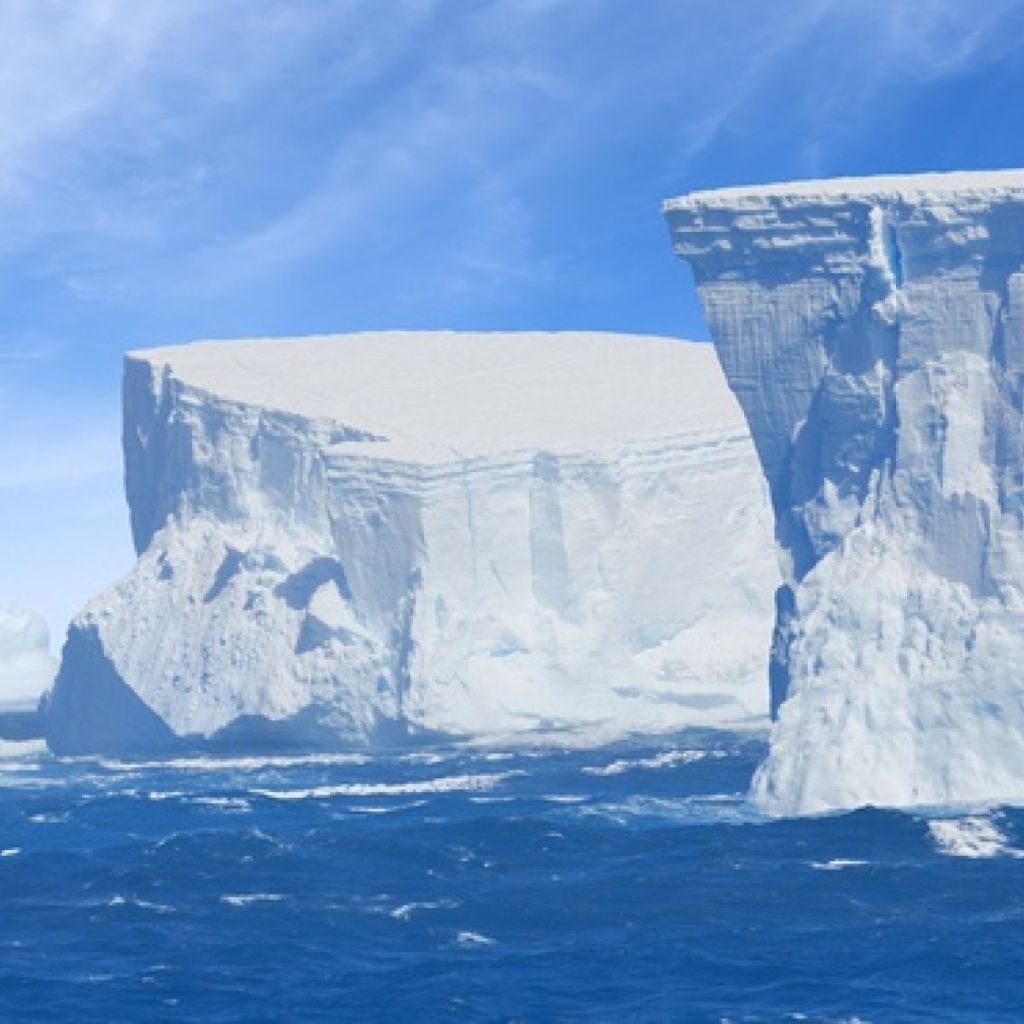
once the ice sheet slides into the ocean, there is no putting it back, even if all carbon emissions ended that day. The ice-sheet holds enough water to raise sea levels by 58 metres. Even if only half of it breaks off, it will be just a waiting game over just a few years for the ice to melt and for us to watch every coastal city on earth to be inundated. In our lifetime.
once the ice sheet slides into the ocean, there is no putting it back, even if all carbon emissions ended that day. The ice-sheet holds enough water to raise sea levels by 58 metres. Even if only half of it breaks off, it will be just a waiting game over just a few years for the ice to melt and for us to watch every coastal city on earth to be inundated. In our lifetime.
Crispin Hull, December 29, 2024
The 2024 award for the biggest disjoin between the importance of a story and the coverage it got must surely go to the science briefing on Antarctica and Sea-Level Rise published by the Australian Antarctic Program Partnership and the ARC Australian Centre for Excellence in Antarctic Science.
It came out in September. The ABC had some coverage, but it seemed to miss some essential points.
Here is what the new science tells us and how it is different from the older science.
The older science tells us that the amount of sea ice in Antarctica is shrinking, but not as badly as in the Arctic. Sea ice expands and contracts quite quickly according to air and sea temperature. So, a gradual reduction in sea ice will mean a gradual and comparatively small rise in sea levels.
This science should be moderately alarming, but the misinformationists in the fossil fuel industry can bat away public fears by saying not much is happening here and it will not happen in your lifetime, so carry on as usual.
This is standard stuff from fossil misinformationists: climate change is not happening, but if it is happening it is part of natural geologic forces and has nothing to do with human-generated carbon, and even if it is caused by human-generated carbon we can develop technologies to capture the carbon and safely store it away.
In short, they base their facts on their desired conclusion that they can continue to make profits from the emission of carbon until ecosystems and economies collapse. When it is too late.
Coming back to Antarctica, earlier science suggested that sea-ice contraction could be reversed if temperatures came down a bit. As it happens sea-ice is an important reflector of solar rays (and heat). Without the sea-ice you have dark ocean which absorbs the rays and increases the heat of the ocean. Nonetheless, it is still a probably reversible process.
Enter the new research. This is about the eastern Antarctic icesheet. Hitherto, this has given climate scientists much less cause for concern. This is because the eastern ice sheet has built up over land. It is anchored.
Unlike sea-ice it is not vulnerable to warmer water melting it.
Picture the land mass and a big thick ice sheet over it. The sea nibbles at the edge and even if the sea is a bit warmer it does not melt much ice. This is not like sea-ice where the warmer water is all around it melting it quickly. So, hitherto scientists have taken some climate solace in the fact that so much ice is safely tied up in the eastern Antarctic ice-sheet (more than 60 per cent of the world’s fresh water) and so will give us more time to slow and reverse the warming of the planet.
Enter the new research. Remove the image of a lump of land mass. Rather picture that the land mass has been forced down by the weight of the ice – heavier at the middle of the land mass and lighter at the edge.
The new science tells us that much of the eastern Antarctic ice-sheet is grounded below sea level. So, one the warmer sea waters get under it, the whole sheet becomes unstable and can slide into the ocean. And even if temperatures are made to fall, the tipping point would have been reached – the warmer sea would have run under the massive ice-sheet, undermining it and making its slide into the ocean inevitable.
And once the ice sheet slides into the ocean, there is no putting it back, even if all carbon emissions ended that day. The ice-sheet holds enough water to raise sea levels by 58 metres. Even if only half of it breaks off, it will be just a waiting game over just a few years for the ice to melt and for us to watch every coastal city on earth to be inundated. In our lifetime.
Once the ice sheet hits the ocean, it is the end of civilisation as we know it.
The ice cannot be put back.
The greater the potential damage the more you should do about it, even if you think the risk is small. This is why people go to a lot of effort to make their houses less exposed to bushfires and cyclones.
It may be that some billionaires might imagine they could set up doomsday retreats to avoid death, injury, and discomfort. They are dreaming. In those circumstances money means nothing and the profit-driven selfishness that drives unnecessarily extending the use of fossil fuel will be brushed aside by the maniac selfishness of those on a desperate if doomed survival mission.
Scientists must change stop their subdued, cautious approach to reporting climate change. It is understandable because scientists do not want to cause panic or unnecessary alarm. But the approach has just given the fossil industry endless free kicks. It is time for alarm and measured panic.
Scientists should stop being scared of publishing scary material in a scary way. It is time to tell people the reality of the biggest security, economic, and existential threat to humans on earth………………………. more http://www.crispinhull.com.au/2024/12/29/scientists-should-break-the-ice/?utm_source=mailpoet&utm_medium=email&utm_campaign=crispin-hull-column
Labor argues ‘economic madness’ of Coalition’s nuclear plan would cost NSW $1.4tn.
Jim Chalmers says ‘Peter Dutton is the biggest risk to household budgets’ as Coalition defends cheaper costings modelled on a smaller power grid.
Dan Jervis-Bardy, https://www.theguardian.com/australia-news/2024/dec/28/labor-argues-economic-madness-of-coalitions-nuclear-plan-would-cost-nsw-14tn
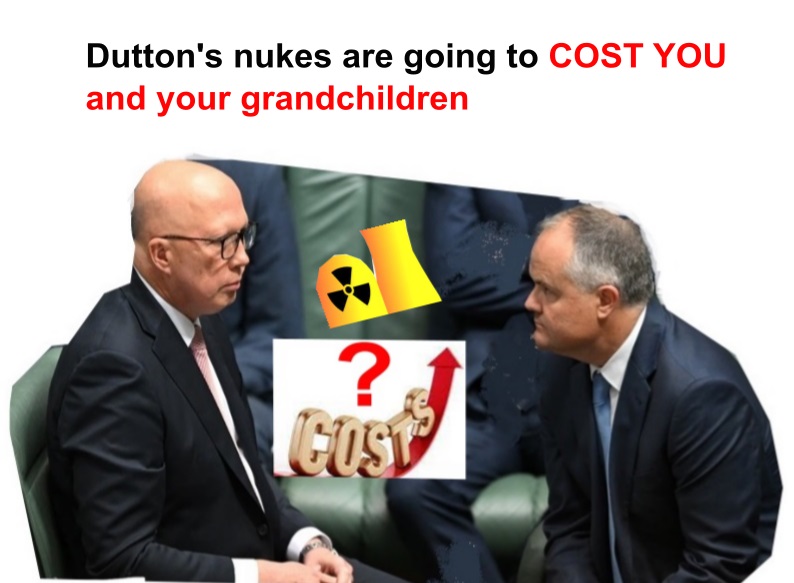
The Coalition’s nuclear policy will cause a $1.4tn hit to New South Wales over the next 25 years, according to analysis Labor will use to attack the “economic madness” of Peter Dutton’s signature energy scheme.
The federal treasurer, Jim Chalmers, will on Saturday put a dollar figure on the impact on the NSW economy of the Coalition’s plan to build nuclear reactors at seven sites across Australia.
The Albanese government’s analysis is based on the assumption underpinning the Coalition’s costings that less electricity will be needed under its nuclear vision.
Chalmers has argued the Coalition’s plan for a smaller energy grid would result in an economy that is $294bn smaller, with $4tn in lost output, by 2051.
The analysis, to be released on Saturday, suggests that NSW alone would suffer a $1.4tn blow to the state’s economic output over that period, including $114bn in the year 2051.
“Peter Dutton’s nuclear scheme is economic madness,” Chalmers said. “He will push energy prices up and growth down and the people of NSW will be worse off.
“We now know for sure that Peter Dutton is the biggest risk to household budgets and Australia’s economy.”
The new analysis is likely to be quickly dismissed by the Coalition, which brushed off Chalmers’ claims of a $4tn hit to the national economy as “absolute and utter nonsense”.
Asked earlier this month if the Coalition’s plan would shrink the nation’s economy, the opposition’s treasury spokesperson, Angus Taylor, said Labor was already doing that.
The economics of nuclear energy has been thrust to the centre of the political debate after the Coalition released the long-awaited costings for its plan earlier this month.
Frontier Economics modelling suggested the nuclear plan would cost $331bn over 25 years, roughly $263bn cheaper than the estimated bill for Labor’s renewables-focused push to net zero by 2050.
However, the Coalition’s costs are modelled on a scenario – which the Australian Energy Market Operator calls “progressive change” – in which the electricity grid is far smaller than what is envisaged under the “step change” route preferred by Labor.
The rollout of electric vehicles, rooftop solar and the electrification of households and businesses is all expected to be slower under the “progressive change” pathway.
The scenario assumes GDP growth of 1.89% a year through to 2050, compared with 2.21% a year under the “step change” alternative.
The new federal analysis assumes heavy industry, such as aluminium smelters, would have to shut their doors after 2030 because there will not be enough energy to keep operating. That would spell danger for the aluminium smelters in the Hunter Valley in NSW and Portland in Victoria.
The NSW premier, Chris Minns, has repeatedly ruled out lifting the state’s nuclear power ban.
“The bottom line here is that nuclear power costs a lot of money and it takes a lot of time,” Minns said earlier this year.
“And we don’t really have a moment to spare when it comes to renewing our energy grid and thinking about new sources of electricity generation.”
Dutton must face coal, hard facts. Nuclear will not work
December 27, 2024, https://www.theage.com.au/national/nsw/dutton-must-face-coal-hard-facts-nuclear-will-not-work-20241227-p5l0tj.html
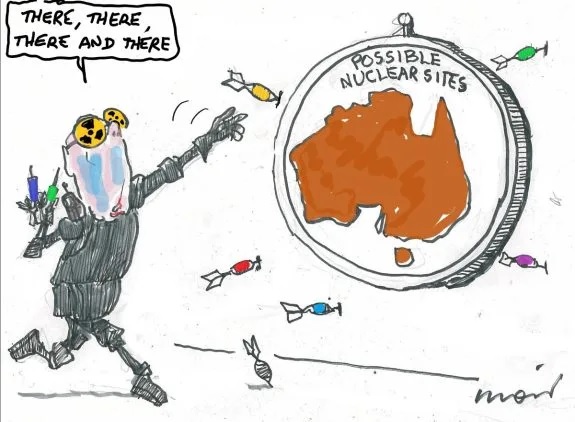
The owners of our coal-fired power plants have pointed to the biggest single flaw in Peter Dutton’s nuclear plan: those plants will all be gone before the first reactor can make an appearance, and long before the last is up and running (“Coal chiefs query Dutton’s nuclear bet”, December 27). Even if the owners wanted to keep them operating, it’s doubtful they could – not without spending inordinate amounts of money. That money, inevitably, would be courtesy of the taxpayer. All so we can enjoy energy at double the cost of renewables. Why can’t the opposition see what all the rest of us can? Or is it just a ploy to delay action on climate change for 20 more years? Ken Enderby, Concord
In March this year, it was reported that AGL, Australia’s largest power supplier, had ruled out taking part in Dutton’s nuclear push. It is instead pressing ahead with long-term plans to transform its legacy coal sites into low-carbon industrial energy hubs, including renewable energy, grid-scale batteries and manufacturing operations for green technologies. The Hunter Energy Hub is to occupy the old coal station Liddell and AGL’s Bayswater coal-fired generator, which is due to retire no later than 2033. Coal stations are ageing and in constant need of repair. Dutton will not include the consequent necessary budget support for coal in his costings, but taxpayers should. Fiona Colin, Malvern East (Vic)
Dutton’s plans depend upon his assumption that the existing coal-fired power plants will keep going until 2050 when nuclear plants replace them. In the Herald article, the Australian Energy Council said Dutton’s assumption was “brave”. “Brave” was a word reserved for impending disaster, that uber-bureaucrat Sir Humphrey Appleby would use to his prime minister Jim Hacker when the latter was contemplating doing something ridiculous. Life imitates art. Joe Weller, Mittagong
We don’t need to replace the soon-to-be redundant 19th century baseload power from ageing coal plants with poisonously expensive and slow-to-build nuclear plants that won’t be ready in time.
We are now well through the transition to a modern, computer-controlled grid that can handle the variable power coming from thousands of sources during the night and millions of sources during the day when rooftop solar is also available. I type this letter on a battery-powered device that was charged yesterday from the grid. An off-the-grid house with solar, wind, batteries and a small generator has no baseload power; one which is on all the time whether needed or not, just clever computer controls managing the balance between the available power and the load. Larger examples are every aeroplane in flight, and every ship away from port. The long-term safety of nuclear and its waste management is another issue. Peter Kamenyitzky, Castle Hill
When is the leader of the opposition going to wake up to the fact that his nuclear option is simply a bad idea? The facts are in. Nuclear will be considerably more expensive and not operational in time. It has no plan for waste disposal and our coal-fired power stations will have closed. This is a classic example of stubborn ideology overwhelming common sense. Bill Young, Killcare Heights
Is Dutton’s persistently promoted nuclear power proposal really a smoke screen over a plan to continue the use of coal, then gas, indefinitely? And to hell with the global heating consequences. Douglas Mackenzie, Deakin (ACT)
We’ve heard from experts, state and local governments, community leaders and now from the fossil fuel operators themselves: not only is it not a technically feasible plan, Dutton’s idea for nuclear power plants is unworkable, from a purely practical perspective. After all the studies and debate demonstrating how Dutton’s plan is economically, technically and practically dead in the water, why do we devote more money and energy giving this oxygen-thieving waste of space the time of day? Frederick Jansohn, Rose Bay
The Coalition has conveniently excluded many of the costs associated with its nuclear plan. The owners of the existing coal-fired plants are well aware of the incredible expense of maintaining them beyond their use-by dates. Eraring is a good example and that extension was only for a couple of years. Additionally, the expenditure involved in the disposal of nuclear waste and the inevitable extraordinary liabilities associated with the future decommissioning of nuclear plants was ignored in Dutton’s costings. If in doubt, check Britain out. Roger Epps, Armidale
Dangerous Tribunal decision paves way for Dutton to keep nuclear blow-outs secret

by Rex Patrick | Dec 27, 2024, https://michaelwest.com.au/art-tribunal-secret-snowy-decision-dangerous-for-dutton-nuclear/
The new Administrative Review Tribunal (ART) just ruled the $2B, no $6B, no $12B Snowy 2.0 project immune from public scrutiny. The decision paves the way for secrecy over Peter Dutton’s nuclear ambitions. Rex Patrick reports.
In April 2023, I made a Freedom of Information (FOI) application for access to Snowy Hydro Limited project reports about Snowy 2.0 pumped storage power scheme to the Minister of Climate Change and Energy, Chris Bowen. I also asked for the briefs on Snowy 2.0 prepared by the Department of Climate Change, Energy, the Environment and Water (DCCEEW) for the Minister.
Suspecting things were off the rails, I wanted to see what Snowy Hydro was saying to the DCCEEW in relation to Snowy 2.0’s progress, or lack thereof, and what DCCEEW was then saying to Minister Chris Bowen.
In August 2023 the Government announced a Snowy 2.0 ‘reset’; a marketing label for a massive cost blowout and schedule delay. That caused me to made a further request for the Snowy Hydro Corporate Plan update sent to Bowen and Finance Minister Katy Gallagher to convince them to back the project cost doubling from $6B to $12B.
Access to the project reports and ministerial briefs was flatly refused and so I appealed the matter to the Administrative Appeals Tribunal, now repackaged by Attorney-General Mark Dreyfus as the Administrative Review Tribunal (ART).
Tribunal rejects transparency
In a decision made by Deputy President Peter Britton-Jones, the Tribunal has affirmed the access refusal decisions, effectively shutting down any FOI scrutiny of Snowy 2.0. This mega-project, which has blown out by $10B, is now shrouded in secrecy, blocking the gaze of members of the public, who are paying for the project.
The ART decision has blown a huge hole in government transparency and accountability because it creates a model that could, and almost certainly will, be used to exempt Opposition Leader Peter Dutton’s $331B nuclear power program from any future public scrutiny. It’s a secrecy barn door that’s big enough to drive a nuclear reactor through.
Protecting business information
How did this happen?
The FOI Act has some reasonable protections in it to ensure sensitive business information is protected from release.
Section 47 of the FOI Act protects trade secrets or commercially valuable information from being disclosed; a company’s ‘11 secret herbs and spices’ stays just that, secret. No other consideration; it’s a full stop exemption from the requirement to disclose.
Section 47G of the FOI Act protects more general business information which, if released, could adversely affect the business in some way. But this particular disclosure exemption clause is conditional on whether the disclosure would be contrary the public interest.
And that’s fair enough – when a company starts taking money from the public for public purposes, if there’s public interest in disclosing the information (like project cost and schedule blowouts), that just sits as a cost of doing business with the Government.
These are important provisions in our FOI law. Last year eighty-three thousand businesses provided their services or products in exchange for $99.6B of public money.
Removing the public interest
There’s another FOI exemption, Section 45, inserted into Act to prevent a “breach of confidence”; that is a promise to keep information confidential – like Aboriginal tribal secrets provided to government in native title matters; artistic assessments by experts of works of art under consideration for purchase – things that need confidentiality but are not business information.
That’s how the Section 45 exemption was presented to the Parliament way back in 1982 when our FOI law was first debated and legislated. In past decisions of the Tribunal Deputy President Britten-Jones has decided not to give that presentation any weight. Instead, Section 45 is interpreted as an unbreakable secrecy clause whenever government and a business agree that it should apply to information that the business has provided to government.
The end result is that now, despite the Parliament determining that business information should be disclosed if that disclosure is not contrary to the public interest, that legislated provision should not be honoured.
Section 45 is, as a result of past Tribunal decisions, the ‘go to’ exemption from departments trying to protect their projects from any scrutiny.
Quacking like a duck
The only reason I actually challenged DCCEEW and the Minister’s FOI decision in this instance is because there’s a carve out in the FOI Act that says Section 45 does not apply if the disclosure of the document would constitute a ‘breach of confidence’ owed to the Commonwealth.
So, one question before the Tribunal was, is Snowy Hydro ‘the Commonwealth’?
To me, the answer was clear.
While Snowy Hydro is a distinct legal entity, it is an 100% government-owned corporation, and is largely funded by the public (the Snowy 2.0 ‘basket case’ project is funded by the taxpayer to the tune of $7B and the rest of the money comes from electricity customers – you).
project is funded by the taxpayer to the tune of $7B and the rest of the money comes from electricity customers – you).
Snowy Hydro has its board appointed by shareholder ministers and remunerated in accordance with a determination of the Commonwealth’s Remuneration Tribunal.
Snowy Hydro is subject to control by the Commonwealth, is obliged to surrender information (unfettered by any confidentiality obligations) requested by a shareholder minister or the Auditor-General or the Senate.
I summarised this legal situation in my submissions to the Tribunal, stating, “If it walks like a duck, looks like a duck and quacks like a duck – it’s a duck!”
The lawyers arguing the government’s case insisted none of that mattered. It might look like a duck, it might even be a government duck but it somehow wasn’t a Commonwealth duck.
Britton-Jones decided it was an elusive night owl, declaring that Snowy Hydro Limited is not the Commonwealth.
Dutton’s Nuclear Power Limited
If the ART decision stands, Snowy Hydro will be effectively excluded from FOI scrutiny. That means an impenetrable wall of secrecy, barring investigation of this government owned and controlled company’s mismanagement of the Snowy 2.0 project and its huge cost to taxpayers.
But that may well be only the beginning of things.
The pieces are all in place for the Coalition’s nuclear power plans to be shrouded in secrecy – thanks in large measure to arguments presented by the Albanese government’s lawyers.
Here’s how Dutton will do it. He just has to follow the Snowy Hydro model and he can ensure than no project reports will ever make it into the hands of the public. The steps are as follows:
- Legislate to set up ‘Nuclear Power Limited’ by way of statute – the ‘Nuclear Power Limited’ Act – with two Ministers to be shareholders in behalf of government.
2. Include the following words in the Act – “‘Nuclear Power Limited’ is not, and does not represent, the Crown”.
3. Subject ‘Nuclear Power limited’ to a policy requirement to report project status to the shareholder ministers (so they at least know what’s going on).
4. Enter into an agreement between Nuclear Power Limited and the government that states “each party agrees to keep the confidential Information confidential and not to disclose it to anyone without the consent of the other party” provided the information is marked as “confidential” (the actual confidentiality of the information does not matter – the key is that the pages are marked “confidential”
Boom! Secrecy heaven
Financial meltdowns can be secret
Nuclear Power Limited will be Snowy Hydro Limited on radioactive steroids. If the similar magnitude $2B to $12 billion blowout to Snowy 2.0 were to occur with Dutton’s (already understated) $331B Nuclear Power Program, the blowout could amount to trillions of public money burned up building reactors that may never be economically viable.
In that regard, ART Deputy President Britten-Jones may have made the most dangerous decision ever made by an administrative review body (even without reference to Dutton’s plans, it casts a secrecy blanket over $100B of annual government procurement).
As such, I’ve put my hand into my pocket and spent $6K initiating a Federal Court Appeal. This secrecy decision can’t be allowed to stand.
And in the meanwhile, we can all just wonder how many more billions Snowy 2.0 will cost us.
Rex Patrick
Rex Patrick is a former Senator for South Australia and earlier a submariner in the armed forces. Best known as an anti-corruption and transparency crusader, Rex is running for the Senate on the Lambie Network ticket next year – www.transparencywarrior.com.au.
The Australian election as a game of cricket: cost of living is the issue, but does Nature bat last?

December 26, 2024 , By Noel Wauchope, https://theaimn.net/the-australian-election-as-a-game-of-cricket-cost-of-living-is-the-issue-but-does-nature-bat-last/
It is not nice to talk about politics at this happy festive time. But you can talk about cricket. Indeed, in Melbourne, it is your patriotic duty. So, I will – sort of.
A prestigious political analyst, Paul Bongiorno, writes in The Saturday Paper about the focus of campaigning for the 2025 Australian federal election. He sees both political parties emphasising the economy, and the “cost of living”. But Bongiorno warns that climate change could suddenly become once more the big factor in the political game, if summer does bring bushfires and floods.
Bongiorno argues that Dutton and the Liberal Coalition are out to stop renewable energy development:
“If the Dutton-led Coalition manages to take the treasury benches, the brakes will be dramatically applied to climate action. The energy transition would be stalled and billions of dollars of new-energy investment put in jeopardy.A key Labor strategist says… it would take only another summer of catastrophic bushfires or floods to significantly jolt public opinion.”
Bongiorno goes on to argue that “The portents here are not favourable for Dutton.” And he cites powerful arguments about “deep flaws” in Dutton’s energy plan’s economic modelling. Bongiorno draws the conclusion that if climate change extremes hit Australia, voters will recognise the value of renewable energy, and vote for the present Labor government’s policies on climate action.
If only that would be the effect of weather disasters – Australian voters embracing action on climate change – the development of renewable energy and energy conservation!
Paul Bongiorno is a much-admired and well-informed analyst. And I am presumptuous to doubt his opinion. But I do doubt it. Look what happened in 2023, with the Australian public first supporting the concept of an Aboriginal Voice to Parliament, but finally voting a resounding “No” to that plan.
How did it happen?
We are in a different era of media and opinion. We are in extraordinary times. When it comes to national elections, people still do vote according to what they see as “their best interest”. It’s just that now, due largely to the power and influence of “social” media, information about “one’s best interest” has become very confusing.
We thought that the Internet would give everyone a voice. And it did. But very soon the new information platforms found money and power could be bought by corporate interests, and indeed, that they themselves could become ultra-lucrative corporations. The media has become a smorgasbord of conflicting information, with so much of it not fact- checked. The “old” media still checks its facts (though I’m not sure about Sky News), but the old media has always been beholden to corporate influence. Even the ABC is circumspect in what it covers, and what it omits – and still makes sure to provide “balance”, even when one side is plainly unreasonable.
Anyway, for the old media to compete – the news has to be preferably exciting, dramatic, even violent. Except for sport and feel-good stuff.
In the new zeitgeist of 24 hour information barrage from so many different outlets, political news can be, and indeed is, swamped by cleverly designed brief messages, from forces like the Atlas Network, from the dominant global fossil fuel corporations. That swamping propelled many Australians to vote against the Aboriginal Voice.
In political news, media emphasis has shifted dramatically away from facts to personalities. In the USA, Donald Trump was seen as a strong, confident, interesting man, as against weak, indecisive, (and female) Kamala Harris. In Australia, there’s an obvious contrast between careful, measured, Anthony Albanese, and strong, outspoken Peter Dutton. In the USA, it didn’t matter that Trump offered few positive policies, so in Australia, the Liberal Coalition does the same.
In the USA, with a population of 334.9 million, approximately 161.42 million people were registered to vote. But only about 64% of these actually did vote in the 2024 general election. So, the majority of Americans don’t vote anyway. Trump was elected by a minority. The rest either didn’t care, or weren’t able to vote.
The Australian election system is so different. With compulsory voting, preferential voting, and the nationwide and highly reliable Australian Electoral Commission (AEC), most Australians do vote. You’d think that with factual news being provided by mainstream media, climate change information would become so important to voters, in the event of summer weather disasters. Paul Bongiorno thinks so.
I think so, too, But the advantage for Peter Dutton in the current national mood might be twofold.
First, Dutton is still that “tough, decisive person” with a tough plan, too – nuclear power instead of renewables. Secondly, the Dutton plan can so easily be marketed as the only real solution to global heating – nuclear power portrayed as “emissions free”, and “cheaper” than solar and wind power.
Never mind that there are substantial greenhouse gas emissions from the total nuclear fuel cycle. Never mind the astronomic cost. Never mind problems of radioactive wastes, safety, and weapons proliferation. The very telling point is that nuclear reactors cannot be up and running in time to have the needed effect on cutting greenhouse emissions. The time for effective action is now, not decades later.
Action on climate change is critical for Australia – and now!
But for the global nuclear lobby, getting Australia as the new poster boy for nuclear power – is critical – now!
Nuclear power should be a dying industry. There is ample evidence of this: reactors shutting down much faster than new ones are built, and of the mind-boggling cost of decommissioning and waste disposal. However, “peaceful” nuclear power is essential to the nuclear weapons industry – with the arms industry burgeoning in tandem with the increasing risk of nuclear war. It seems that the world cannot afford to weaken this war economy.
And the cost and trouble of shutting down the nuclear industry with its tentacles in so many inter-connected industries, and in the media, and in politics, is unimaginable.
The old poster boy, France, has blotted its nuclear copybook recently with its state energy company EDF deep in debt, and things rather crook with its latest nuclear station. But hey! What about Australia, a whole continent, with a national government perhaps ready to institute nuclear power as its prime energy source, and all funded by the tax-payer!
The long-promised nuclear renaissance might really come about – led by Australia, the energetic new nation, with its AUKUS nuclear submarines, with brand-new nuclear waste facilities, and kicking off this exciting new enterprise – nuclear power. This is the opportunity for a global nuclear spin machine to gear up for an onslaught on Australia. They really need the Liberal-National Coalition to win this election.
Dutton will be fed with the right phrases to regurgitate. It’ll be all about a “balanced” economy – nuclear in partnership with renewables and so on, if people have any worries about that. All the same, there are those problems of pesky independent politicians like Monique Ryan and David Pocock, and there’s still the ABC, Channel 9 TV and its print publications.
First, I’m hoping that Australia does avoid bushfires and floods this summer. And second, I’m hoping that in the event of climate disasters, Australians will choose the Labor Party with its real plan for action against climate change, and reject the Coalition with its nuclear power dream. There is a good chance of this result.
I’m hoping that Paul Bongiorno is right, if climate change does bat last in the election game, and that I am wrong about the power of personality politics + slick lies.
Look at the networks, not nuclear, to reduce energy bills
RENEW ECONOMY, Tristan Edis, Dec 19, 2024
The next election is shaping up to become a competition between politicians about which type of big power stations – nuclear or renewables – will help lower or drive-up power bills.
The fact that paying for big power stations makes up only a third of the power bill will probably be completely missed by both sides of politics. If politicians really want to help households lower their energy bills, there’s better places to go looking than the next big power station.
One of the places they seem to always glance past are the energy network monopolies. I suppose politicians can’t quite fathom how they might be able to turn this into a vote winner. But if you genuinely want to help lower energy bills you can’t afford to look past them.
As I explained in a prior article, the monopoly businesses operating our electricity networks have over 2014 to 2022 managed to manipulate the regulations and the regulator to generate profits 70% greater than the regulator had originally thought they’d capture.
This came on the back of a huge blow-out in expenditure and incredible shareholder returns for many of these networks over the 2008 to 2013 period.
Critically, electricity networks have not delivered these increased profits through better efficiency, with total factor productivity of networks today being worse now than it was back in 2006 when the Australian Energy Regulator began measuring productivity.
In terms of gas networks the story is worse, with the Regulator signing off on prices that gave these businesses profits 90% greater than the Regulated had anticipated.
What’s absolutely staggering is the energy network monopolies are mounting a lobbying campaign to extend their monopoly reach beyond poles and wires and into distributed batteries, electric vehicle charging and the management of household electrical devices.
Yet these technologies can be provided to consumers at lower cost via competitive markets and simply don’t need to be delivered or controlled by network monopolies.
The reality is that we can’t rely on the Australian Energy Regulator to keep these monopolies in check. Instead our best hope to address networks’ excessive charges is likely to be competition.
By shifting away from gas appliances to electric alternatives we can minimise our reliance on gas pipelines.
That, of course, still leaves us reliant on electricity networks. In this case though there is also the potential for competition through use of a combination of solar, batteries and energy efficient appliances and homes.
Also, if electric vehicles are charged during the daytime and outside evening demand peaks they can vastly improve utilisation efficiency of network capacity.
Even better, the technology is available for these vehicles to discharge power during peak demand periods to compete against networks augmenting capacity and large peaking power plants.
Energy networks’ lobbying campaign seeks to suggest they just want to help us make effective use of these technologies to address climate change. Yet effective use of these technologies entails less demand for network capacity.
Why would they want to undermine their own revenue base? And why should we turn to a monopoly to roll out technologies which could be procured competitively from businesses that are vastly more experienced in providing these technologies to consumers than the networks?
Where this is most insidious is the concept of so called “community batteries.” Networks are keen to market “community batteries” – which in reality are network monopoly-owned batteries – as a more efficient and fairer option than households adopting their own battery. This is based on the claim that by building bigger batteries, networks will be able to capture economies of scale to deliver batteries more cheaply.
But as I’ve explained previously, and now corroborated in data gathered by the ARENA, it’s just not true. Network-provided batteries are significantly more expensive than household batteries.
Yet this is not their only area of poor performance in supporting the use of distributed energy solutions…………………………………………………………………………… more https://reneweconomy.com.au/look-at-the-networks-not-nuclear-to-reduce-energy-bills/?fbclid=IwY2xjawHYFmJleHRuA2FlbQIxMQABHRWjory7UuJpQrd_U1wReQbbc2h5lgpmbHM
1 This month
.

Australians deserve the truth
about
AUKUS – https://aukuspublicinquiry.com/

PETITION – To: Prime Minister Anthony Albanese and the Australian Labor Government

of the week – Australians for War Powers Reform (AWPR)
To see nuclear-related stories in greater depth and intensity

