Australian govt lies about medicine and nuclear waste
Government information on nuclear waste is misleading and omits important facts. Failure of informed consent? Medical Association for Prevention of War – health professionals promoting peace 22 February 2016 – MELBOURNE:
 Nuclear medicine has been highlighted as a key reason to have a nuclear waste repository. MAPW President, Dr Margaret Beavis observes that ‘The Commonwealth government fact sheet: Information for communities- Key questions answered’ is a gross misrepresentation and reads more like a puff-piece for the nuclear industry. The recently released brochure states “One in two Australians – everyone who has ever had a broken bone, heart scan or cancer diagnosis – will need nuclear medicine at some point in their lifetime.”
“This is very clearly misleading in all three areas” said Dr Beavis . “X Rays for a broken bone rarely require nuclear medicine, the vast majority of heart scans are done by ultrasound, and most cancers are treated by surgery, chemotherapy or radiotherapy, none of which use radioisotopes. Even the assertion the half the population needs nuclear medicine is not credible.”
In addition ANSTO continues to insist that using reactors to produce radioisotopes is the only option. In January 2015 Canada – the world leader in radioisotope commerce – had a successful pilot project for commercial cyclotron production. Current regulatory testing and expansion will likely make Canada self-sufficient through cyclotron generation in 3-5 years. “Cyclotrons are a more reliable, safer and cheaper source of radioisotopes than nuclear reactors, and produce no long term waste, but ANSTO has not mentioned this” said Dr Beavis
Nor is mention made of ANSTO’s plans to increase reactor production (from previously 1%) to supply 25-30% of world markets, vastly increasing Australia’s waste from the generation of medical radioisotopes for international sales. “We already have more waste than we know what to do with” said Dr Beavis “We need community debate before massively increasing radioactive waste production.”
Earlier this month it was reported that ANSTO would stop making radioisotopes next year if a waste repository site was not found. Subsequently in Senate Estimates hearings it emerged this was sourced from a previous document and was not the case. These alarming claims have yet to be widely rebuffed by ANSTO, despite requests to do so.
Finally, the telephone information hotline for communities has been very poor. “Comments such as suggesting televisions and microwaves are radioactive when used are clearly wrong.” said Dr Beavis.
If the government is sincere about informed consent it needs to do much better than this.
South Australia”destined to be locked in to nuclear industry” – Adelaide Advertiser
The Adelaide Advertiser – mouthpiece of the nuclear lobby advises that we should all just give up – “see the light’ and let South Australia just roll over like a tame dog, and let the nuclear juggernaut roll over it.

we hosted the British nuclear bomb tests at Maralinga in the 1950s, and we have the world’s largest uranium mine at Olympic Dam.
So we are destined to be locked in to the nuclear fuel industry for decades to come. – Chris Kenny, The Advertiser 21 Feb 16
National Radioactive Waste Management Act overrides any local opposition to nuclear waste dump
 Overriding opposition, Jim Green 21 Feb 16 Bruce Wilson said it would be unlikely that the federal government would override state/territory government opposition to a repository. But that’s exactly what the federal government did the first time round (1998– 2004). And that’s exactly what the federal government did in the NT (2005– 2014). As Wilson acknowledged, the government retains the power to override state/territory governments in order to impose a radioactive waste repository/store. The government should amend the legislation so it no longer has that power.
Wilson said the National Radioactive Waste Management Act is consent-driven ‘world’s best practice’ legislation. In fact, it gives the federal government extraordinary powers to override state/territory governments, councils, communities, Traditional Owners and anyone else.
A government rep said the government gave up on the Muckaty / NT site when it realised that community support was lacking. That’s false. The government knew that a majority of Traditional Owners opposed the proposed repository/store in 2006/07 but only gave up in 2014.
Kimba residents are all too aware of the distress and division that the radioactive waste issue has created in the past six months. Muckaty Traditional Owners endured the same problems for the best part of a decade. “We’ll probably have one of the first good sleeps we’ve had in eight years,” Marlene Bennett said when the government finally stopped its thuggish attempt to impose a radioactive waste repository on an unwilling community.
Julie Bishop, Christopher Pyne, Bill Shorten do their bit for the pro nuclear dance

Opposition Leader Bill Shorten has indicated he is open to the idea as long as there is community support, an economic benefit, and reassurance of environmental protection….
Overall Ms Bishop is optimistic that public opinion is in favour of more engagement with the nuclear fuel cycle………http://www.adelaidenow.com.au/news/south-australia/australia-the-ideal-location-for-nuclear-waste-dump-says-julie-bishop/news-story/c2655249dd4f655d05bf809d6d1795c8
Australia breaches Paris climate agreement, damages economy, by cutting CSIRO climate modelling
 CSIRO climate cuts will breach Paris agreement and cost economy – report
Cuts to climate modelling and measuring research contradict Australia’s pledge to strengthen commitments to climate science, the Climate Council says, Guardian Michael Slezak 21 Feb 16 Cuts to the CSIRO’s climate modelling and measuring research will breach Australia’s obligations under the recent Paris agreement and will result in huge costs to the economy, a report by Australia’s Climate Council has found.
The report adds to a chorus of eminent bodies and individuals criticising the move, which the CSIRO made after almost no consultation with its own scientists or other research institutions.
Earlier in the month it was revealed CSIRO would be cutting up to 350 staff from climate research programs over two years. Over the following weeks, the organisation’s chief executive Larry Marshallexplained that would result in a loss of about 50% of the staff working in climate modelling and measuring.
In a report titled “Flying Blind: Navigating Climate Change without the CSIRO,” the Climate Council said governments and businesses relied on the CSIRO’s climate modelling and measuring work to make billion-dollar decisions and if the cuts went ahead, would be relying on “guesswork”.
The report notes Australia and the rest of the world agreed to strengthen commitments to climate science at COP21 in Paris in December. “The recently announced cuts to climate science mean that Australia has already reneged on one of its obligations under the Paris commitments,” it concludes.
It cites a number of examples of decisions and industries that have relied on the modelling and measuring performed by the CSIRO:………
An open letter signed by more than 2800 scientists raised similar concerns. In response to the chorus of criticisms, Marshall initially said the response was more like religion than science, and compared climate scientists to oil lobbyists in the 1970s…….
It was revealed in Senate estimates that CSIRO executives did not consult with organisations like the Bureau of Meteorology who depend on CSIRO modelling until 24 hours before the cuts were made public.
Even Ken Lee, the director of the division that would take the brunt of the cuts was only told about the cuts four days before they were announced.
The Climate Council, which produced the new report, is a crowd-funded body that seeks to provide authoritative information on climate change to the community. It was created after the Abbott government cut the Climate Commission when it took government in 2013, and seeks to perform the same job. http://www.theguardian.com/environment/2016/feb/22/csiro-climate-cuts-will-breach-paris-agreement-and-cost-economy-report
Michele Madigan points out the National dangers of transporting nuclear wastes
 Nuclear waste danger knows no state borders, Eureka Street Michele
 Madigan | 09 February 2016 “……..It would be a mistake for anyone living outside of South Australia to think that the premier’s plan is just a South Australian problem. Transport and containment risks are hugely significant. State boundaries are no guarantees of safety.
Professor John Veevers of Macquarie University notes the ‘tonnes of enormously dangerous radioactive waste in the northern hemisphere, 20,000km from its destined dump in Australia … must remain intact for at least 10,000 years.
‘These magnitudes — of tonnage, lethality, distance of transport and time — entail great inherent risk.’
In 1998 when the federal government identified the central northern area of South Australia to be site for a proposed national radioactive waste dump, it was not only South Australians who were concerned.
In 2003 the mayors of Sutherland, Bathurst, Blue Mountains, Broken Hill, Dubbo, Griffith, Lithgow, Orange, Wagga Wagga, Auburn, Bankstown, Blacktown, Fairfield, Holroyd, Liverpool, Parramatta and Penrith — communities along potential transport routes — opposed ‘any increase in nuclear waste production until a satisfactory resolution occurs to the waste repository question’.
The NSW parliamentary inquiry into radioactive waste found ‘there is no doubt that the transportation of radioactive waste increases the risk of accident or incident — including some form of terrorist intervention’. Continue reading
ARPANSA: a not so independent radiation regulator
 Jim Green 21 Feb 16 Bruce Wilson (from the federal government’s Department of Industry, Innovation and Science) and other governments reps were keen to talk up the role of the ‘independent’ regulator, the Australian Radiation Protection and Nuclear Safety Agency (ARPANSA). But ARPANSA has a troubled history. Its troubles began immediately: the government allowed ANSTO a direct role in selecting the founding CEO of ARPANSA, so ARPANSA’s independence was undermined from the start.
Here’s a more recent example of problems with ARPANSA, summarised in a 2011 ABC article:
“A review of Australia’s nuclear industry regulator, ARPANSA, has found an improper relationship with the main agency it monitors [ANSTO]. The Health Department’s audit and fraud control branch has been investigating how ARPANSA handled allegations of safety breaches and bullying at the nation’s only nuclear reactor in Sydney. Whistleblowers had alleged ARPANSA was too close to the Australian Nuclear Science and Technology Organisation (ANSTO), which runs the Lucas Heights research facility.”
ABC, 8 July 2011, Nuclear regulator ‘too close’ to ANSTO, www.abc.net.au/news/stories/2011/07/07/3264086.htm
An independent regulator could provide some confidence. But a not-so-independent regulator with a poor track record …
More information about ARPANSA:
- www.foe.org.au/anti-nuclear/issues/oz/arpansa
- ANSTO / ARPANSA whistleblower saga: www.foe.org.au/ansto-whistleblower-saga-2007-ongoing
Nuclear waste dump plan for Kimba – govt ignores relevant standards and codes
 Jim Green 21 Feb 16 Some comments on the 18 Feb 2016 government ‘information session’ in Kimba regarding plans for a radioactive waste repository and above-ground ‘interim’ store for long-lived intermediate-level waste.
 1. The government ignores and breaches relevant standards and codes when it suits.
As a Kimba resident noted at the meeting, the National Health and Medical Research Council’s (NH&MRC) ‘Code of Practice for Near-Surface Disposal of Radioactive Waste in Australia (1992)’ states that “the site for the facility should be located in a region which has no known significant natural resources, including potentially valuable mineral deposits, and which has little or no potential for agriculture or outdoor recreational use”.
So the government has breached the NH&MRC Code of Practice by short-listing the Kimba sites.
Following the so-called clean-up of the Maralinga nuclear test site in the late 1990s, nuclear engineer Alan Parkinson wrote: “The Department has claimed that burial is a safe disposal method consistent with “the [NH&MRC] Code.” This was the first time that the Code had been mentioned in relation to the Maralinga project. When three of the five authors said that it was not applicable (the other two were Commonwealth public servants and would not comment), the Department claimed that it did not have to follow the Code but had chosen to do so. It made this statement despite the fact that not a single requirement of that Code was satisfied.”
(Alan Parkinson, “The Maralinga Rehabilitation Project: Final Report”,
http://www.ippnw.org/pdf/mgs/7-2-parkinson.pdf)
So the government ignores relevant standards and codes when it suits, and the government breaches relevant standards and codes when it suits. Why would anyone trust the government to safely operate a radioactive waste facility in the Kimba region in those circumstances?
Alan Parkinson summarises the problem (keep in mind that he is pro-nuclear and a nuclear engineer): “The disposal of radioactive waste in Australia is ill-considered and irresponsible. Whether it is short-lived waste from Commonwealth facilities, long-lived plutonium waste from an atomic bomb test site on Aboriginal land, or reactor waste from Lucas Heights. The government applies double standards to suit its own agenda; there is no consistency, and little evidence of logic.”
(Alan Parkinson, 2002, ‘Double standards with radioactive waste’, Australasian Science, www.foe.org.au/anti-nuclear/issues/oz/britbombs/clean-up)
Nuclear Semioticians (sign experts): how to warn future generations of the wastes danger
they established the field of nuclear semiotics……. an “atomic priesthood”
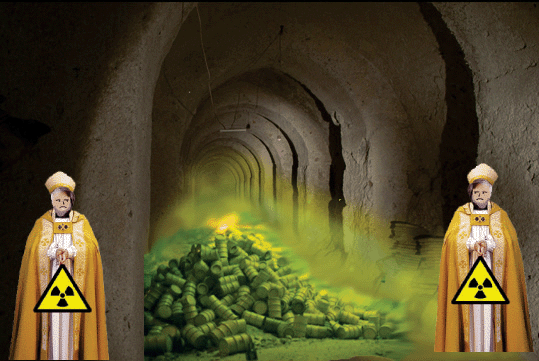
The message walls would have the faces as well as simple messages
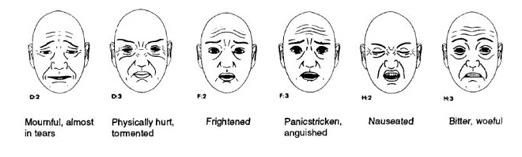
Temple of Doom: How do we warn the future about nuclear waste?, Triple J Hack, by James Purtill, 19 Feb 16 This week the South Australian Royal Commission released “tentative findings” recommending the state take more than 100 tonnes of high-level radioactive waste and store it in the desert for hundreds of thousands of years.
……..If the facility goes ahead, the designers may consider a problem that has baffled linguists and semioticians (sign experts): how to tell the distant future don’t dig up the dump?
Atomic priesthoods and ‘ray cats’
In 1991, the Department of Environment hired linguists, scientists and anthropologists at a cost of about $1 million to answer what is basically a conundrum of labelling. How do you warn far-off civilisations or scattered bands of post-apocalyptic survivors that invisible beams of energy emanating from the earth could kill them, and this was not a trick, there’s no buried treasure?
The report runs to 351 pages and has the (rather dry) title: Expert Judgement on Markers to Deter Inadvertent Human Intrusion into the Wasteland Isolation Pilot Plant.
Here’s some of the problems they identified:
- Languages evolve too fast to communicate with the future: Few English speakers understand Old English, which was spoken about 1000 years ago.
- The meanings of symbols is too ambiguous: For example, the physicist Carl Sagan was invited to join the researchers, couldn’t make it, and wrote to suggest they simply use the skull-and-crossbones symbol to signify danger. But this symbol has only been current for a few hundred years, has meant ‘poison’ for the last 100, and is no longer very threatening. It’s on ‘pirate theme’ drink bottles.
- Even if they understand the warnings, future trespassers might not believe them. Curses associated with the burial sites of the Egyptian Pharaohs did not deter grave robbers.
Australian govt’s wrong decision to dump CSIRO climate modelling – Dr John Church
 Renowned CSIRO scientist Dr John Church speaks out against decision to dump climate modelling, ABC News 19 Feb 16 By Angela Ross One of the CSIRO’s most respected scientists, Dr John Church, has spoken out against the body’s decision to scrap its climate modelling program.
A petition signed by 2,800 international scientists from more than 60 countries expressed outrage about the decision to cut two research programs under the oceans and atmosphere business unit.
“The decision to decimate a vibrant and world-leading research program shows a lack of insight and a misunderstanding of the importance of the depth and significance of Australia’s contributions to global and regional climate research,” it read……..
Dr Church argued there was no point collecting data if scientists were not there to analyse the results.
“If Australia pulls out of key activities in the southern hemisphere then that will leave significant gaps, we will be losing partnerships with key agencies all around the world,” he said……..
The union representing Dr Church and his colleagues, the CSIRO Staff Association, has lodged a dispute with the Fair Work Commission but no date has been set. http://www.abc.net.au/news/2016-02-19/award-winning-scientist-condemns-csiro-job-cuts/7184410
Melbourne Girls’ College’s original approach to becoming carbon neutral
 Melbourne Girls’ College pedals toward carbon neutral status with outdoor cinema, solar installations, ABC News, 19 Feb 16 774 ABC Melbourne By Clare Rawlinson An all-girls Melbourne high school is on its way to becoming the first Victorian school to go carbon neutral.
Melbourne Girls’ College is working towards carbon neutral status through the installation of solar arrays and energy reduction projects, spearheaded by the school’s Sustainability Collective.
The passionate young environmentalists are hosting an outdoor cinema powered by bicycles and ergo machines on Friday, to share their quest with the public and draw attention to the true cost of energy.
The students will pedal all day to charge the cinema batteries for the screening of movie Oddball, as well as the power for coffee carts and popcorn machines.
“The idea behind it is to show people what a watt hour is and how much electricity goes into these events,” former student Ruby Wynn Williams said.
Sustainability coordinator Andrew Vance said the first step towards the school’s goal of carbon neutrality was awareness. “It’s really easy to burn some coal to watch a movie but it’s completely out of sight and out of mind,” he said. “When you get on the bike and pedal two watts, it’s like an epiphany.”
Reputation for environmental sustainability
The school’s reputation for environmental sustainability has already earned it acclaim through a major international competition, the Zayed Future Energy Prize. In 2015 it was selected as one of five schools globally to receive the competition’s $US100,000 funding grant for sustainability projects.
The majority of the prize money has been spent on converting the school’s permanent power source to solar, with the installation of a 33kW solar array on one side of the gymnasium roof.
It plans to cover the other side of the roof with community-funded solar arrays.
“[Each person] who buys a panel will get their name on it … so they can go and look at how much carbon they’ve offset and the equivalent in trees,” Mr Vance said.
“That will get us close to our carbon neutral goal.”…….http://www.abc.net.au/news/2016-02-19/melbourne-girls-college-pedals-toward-carbon-neutrality/7180684
Western Australian govt to press on with its changes to Aboriginal heritage legislation
WA government to proceed with controversial changes to Aboriginal heritage legislation, ABC News 19 Feb 16 By Jacob Kagi The West Australian Government intends to proceed with controversial changes to Aboriginal heritage legislation, despite progress on the bill stalling for so long that it dropped off the list Parliament was due to consider.
The Government first introduced legislation to Parliament to amend the Aboriginal Heritage Act in 2014, but there has been no substantial progress on the bill since then.
Because it had been so long since the bill had been debated, it dropped off the Legislative Assembly’s “notice paper”, which is the list of legislation and motions which Parliament is due to consider.
However, that was rectified on Thursday, with the Government passing a motion to restore the bill to the notice paper.
The proposed changes have proven controversial, with concerns that much of the decision-making power would rest of the head of the Department of Aboriginal Affairs, and fears the legislation did not give enough of a role to Indigenous people…….http://www.abc.net.au/news/2016-02-19/wa-government-to-proceed-with-controversial-changes-to-aborigin/7182280
World’s most expensive and toxic “stranded asset” – Nuclear Waste Dump For South Australia
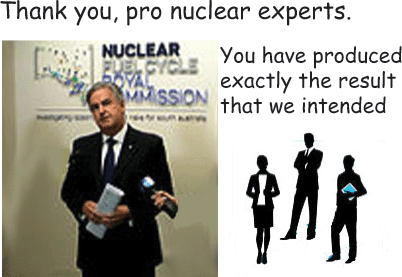 Nuclear Royal Commission: What’s Scarce in Kevin’s Report, Independent Australia
17 February 2016,The Scarce Report recommends South Australia being storing the world’s nuclear waste, opening the door for nuclear power generation in Australia in the future, writes Noel Wauchope.
Kevin Scarce’s Report on the “tentative findings” of the South Australian Nuclear Fuel Chain (I mean Cycle) Royal Commission runs to 42 pages. Still, he manages to leave a few questions unanswered and, indeed, a few questions not even asked, as well as leaving a few grey areas to be brushed over in a suitably vague manner.
MONEY
The major recommendation of the Report is for South Australia to make billions by importing, managing, storing and disposing of nuclear waste.
Who pays up first?
An interesting question – and grey area – is exactly who would be responsible for paying for the building of the nuclear waste facilities; for the construction of the dedicated port facility, airport and rail freight line; and the maintenance of all the infrastructure?
Well, that question is not answered clearly at all by the Report. However, as it states that ‘the facilities would need to be controlled and owned by government’, we can assume that the tax-payer will be responsible for the costs, now unto eternity, as eternity is about how long that high level radioactive wastes have to be contained and kept secure .
The Commission’s financial advice from Jacobs MCM makes this clear:
‘Capital and operating costs are assumed to be met from revenue. In the first few years of the model costs are assumed to be incurred before revenue is received.’
The payments for taking in spent fuel (high level wastes) from other countries would start only ‘at the moment of transfer from ship to shore in South Australia’, which would happen 15 years after the waste storage facility was built
Now how could they sell that idea to the public? Well, there’s the possibility of other countries paying for some of it, sort of:
‘…the potential to negotiate advance reservation fees with some prospective client countries to offset at least a portion of this cost.’
How much will it all cost?
Scarce reports the underground disposal facility as costing $33 billion. The Jacob report does not make all of the costs clear. It does not reveal the costs of the surface storage facilities and of maintaining high level wastes for many decades in dry storage casks.
The Jacobs MCM financial advisory report to the Commission has a tone of optimism and yet its 214 pages contain many “ifs” and “buts”.
Some of these include:
- Disposal of spent fuel (SF) will account for 93% of the costs. No country except UK has actually priced this cost, and estimates for these costs vary wildly from country to country.
- Countries with established nuclear experience – USA, UK, France, Sweden, Finland, Russia, China and India – will not be exporting nuclear waste to Australia, which leaves potential markets to a number of nuclear-inexperienced countries in Asia and Middle East — some with unstable regimes. Japan is committed to reprocessing its nuclear wastes, with no plan to export them……….
How come Australia is the only country to jump at this opportunity? Continue reading
Barry Brook, Pinchy Lobster and Clive Palmer: Three ‘Outstanding Scientists/Intellectuals’
 Jim Green, 19 Feb 16 Tas Uni academic Barry Brook’s university webpage says that in 2005 he was listed as one of the “2000 Outstanding Scientists of the 21st Century” by the International Biographical Centre (IBC). But the IBC is a zero-credibility money making operation.
The WA Government’s Dept of Commerce ‘ScamNet’ website states: “The material promoting the International Biographical Centre creates a false impression about the credentials of the organisation. It also wrongly implies that the receiver of the letter has been picked through a special research process considering their work and qualifications.”
If there was any doubt about the IBC’s illegitimacy, one of Brook’s academic colleagues nominated a squeaky toy lobster and Prof. Lobster was accepted for inclusion as one of the ‘2000 Outstanding Scientists of the 21st Century’. And the IBC has accepted a nomination for Clive Palmer to be listed as one of the ‘2000 Outstanding Intellectuals of the 21st Century’. A ‘Medal of Intellect’ will be sent to Palmer on payment of a $240 fee.
Feel free to test the IBC’s credibility yourself … you’ll have no trouble getting the Wiggles or the Bananas in Pyjamas or Thomas the Tank Engine accepted as Outstanding Scientists or Outstanding Intellectuals.
Given that the illegitimacy of the IBC is beyond doubt, why does the IBC accolade remain on Brook’s university webpage?
Sources:
- Brook’s Tas Uni website (see the Career tab, under “Awards and Prizes”): https://secure.utas.edu.au/profiles/staff/plant-science/barry-brook
- IBC: www.internationalbiographicalcentre.com/2000_outstanding_scientists_of_the_21st_c.php
- WA Government ‘scamnet’ website: http://www.scamnet.wa.gov.au/scamnet/Scam_Types-Directory_Listings_and_registry_schemes-International_Biographical_Centre.htm
- Wikipedia IBC entry: https://en.wikipedia.org/wiki/International_Biographical_Centre
- Critique of Brook’s nuclear propaganda: www.foe.org.au/anti-nuclear/issues/oz/barry-brook-bravenewclimate
Barry Brook, Pinchy Lobster and Clive Palmer: Three ‘Outstanding Scientists/Intellectuals
Jim Green, 19 Feb 16 Tas Uni academic Barry Brook’s university webpage says that in 2005 he was listed as one of the “2000 Outstanding Scientists of the 21st Century” by the International Biographical Centre (IBC). But the IBC is a zero-credibility money making operation.
The WA Government’s Dept of Commerce ‘ScamNet’ website states: “The material promoting the International Biographical Centre creates a false impression about the credentials of the organisation. It also wrongly implies that the receiver of the letter has been picked through a special research process considering their work and qualifications.”
If there was any doubt about the IBC’s illegitimacy, one of Brook’s academic colleagues nominated a squeaky toy lobster and Prof. Lobster was accepted for inclusion as one of the ‘2000 Outstanding Scientists of the 21st Century’. And the IBC has accepted a nomination for Clive Palmer to be listed as one of the ‘2000 Outstanding Intellectuals of the 21st Century’. A ‘Medal of Intellect’ will be sent to Palmer on payment of a $240 fee.
Feel free to test the IBC’s credibility yourself … you’ll have no trouble getting the Wiggles or the Bananas in Pyjamas or Thomas the Tank Engine accepted as Outstanding Scientists or Outstanding Intellectuals.
Given that the illegitimacy of the IBC is beyond doubt, why does the IBC accolade remain on Brook’s university webpage?
Sources:
- Brook’s Tas Uni website (see the Career tab, under “Awards and Prizes”): https://secure.utas.edu.au/profiles/staff/plant-science/barry-brook
- IBC: www.internationalbiographicalcentre.com/2000_outstanding_scientists_of_the_21st_c.php
- WA Government ‘scamnet’ website: http://www.scamnet.wa.gov.au/scamnet/Scam_Types-Directory_Listings_and_registry_schemes-International_Biographical_Centre.htm
- Wikipedia IBC entry: https://en.wikipedia.org/wiki/International_Biographical_Centre
- Critique of Brook’s nuclear propaganda: www.foe.org.au/anti-nuclear/issues/oz/barry-brook-bravenewclimate
1 This month
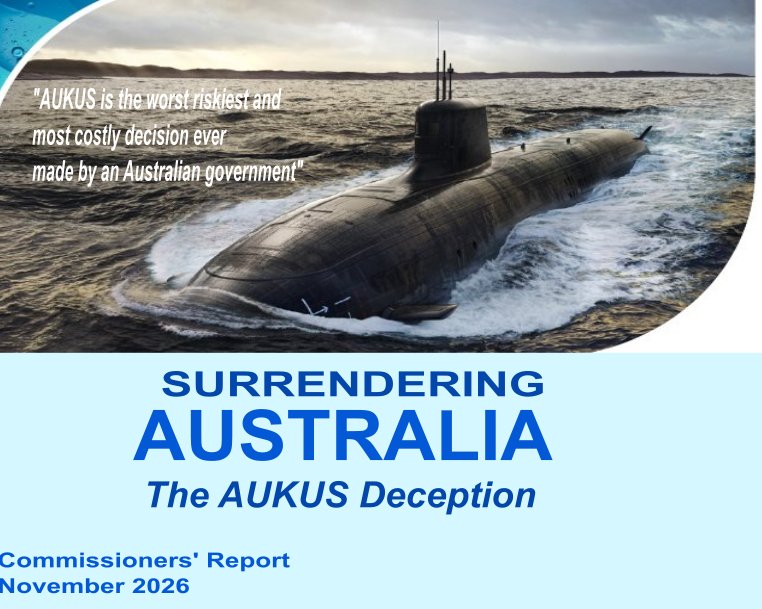
Read the Public Inquiry Report, the Commissioners’ report, Surrendering Australia: The AUKUS Deception is available to download for free at aukuspublicinquiry.com. Or just watch the replay of the National Press Club Luncheon.
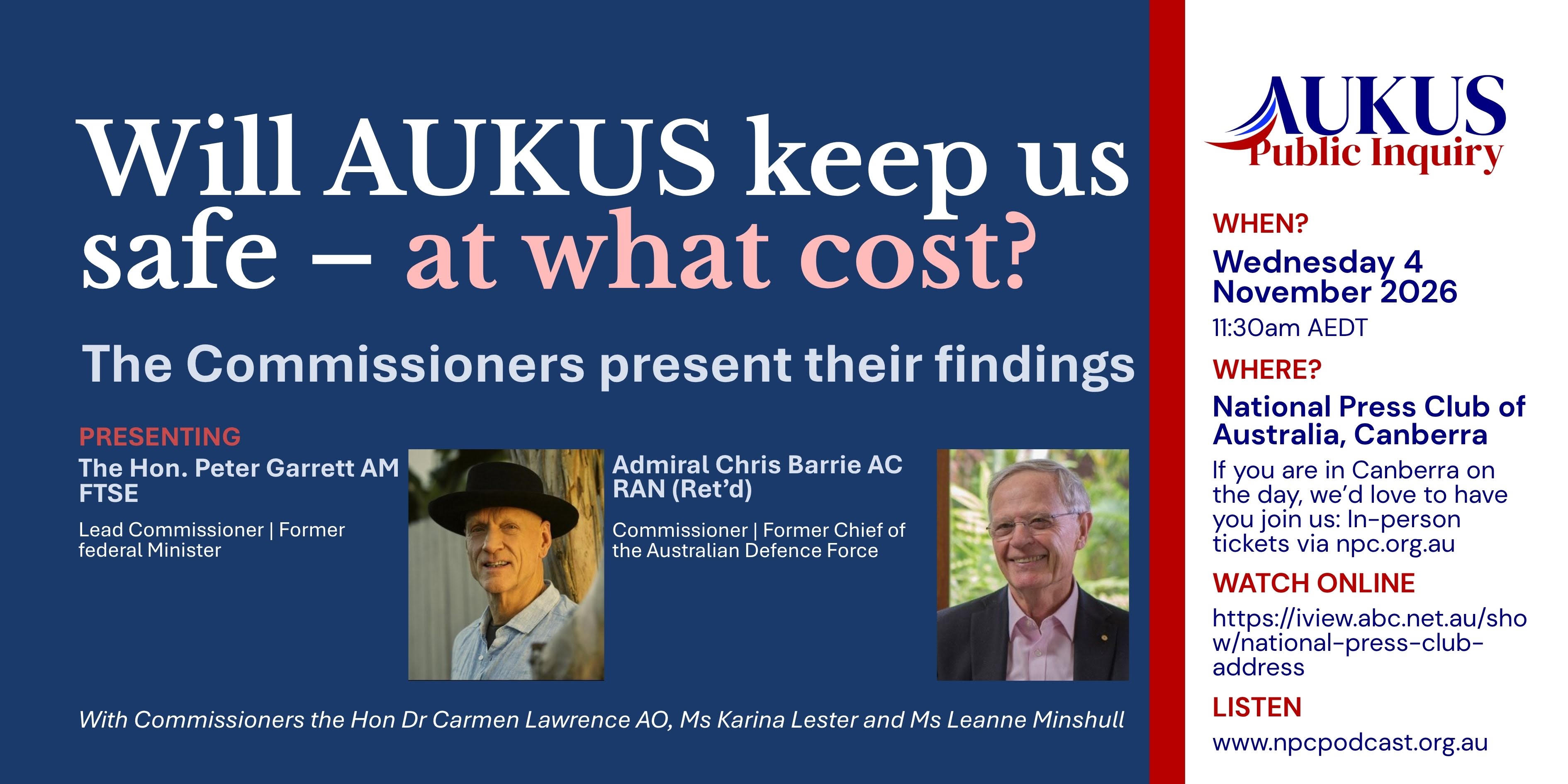
4 November – Will AUKUS keep us safe – at what cost?
the Commissioners of the AUKUS Public Inquiry present their findings at the National Press Club of Australia in Canberra. iview.abc.net.au/show/national-press-club-address
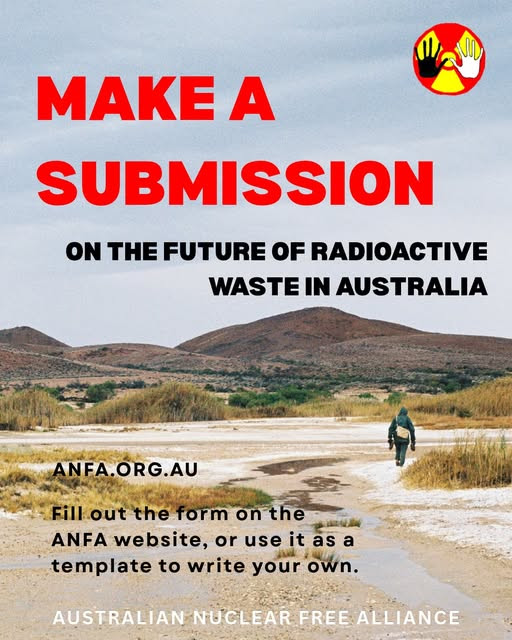
Submissions to the federal government’s new draft framework close on the 13th November 2026.
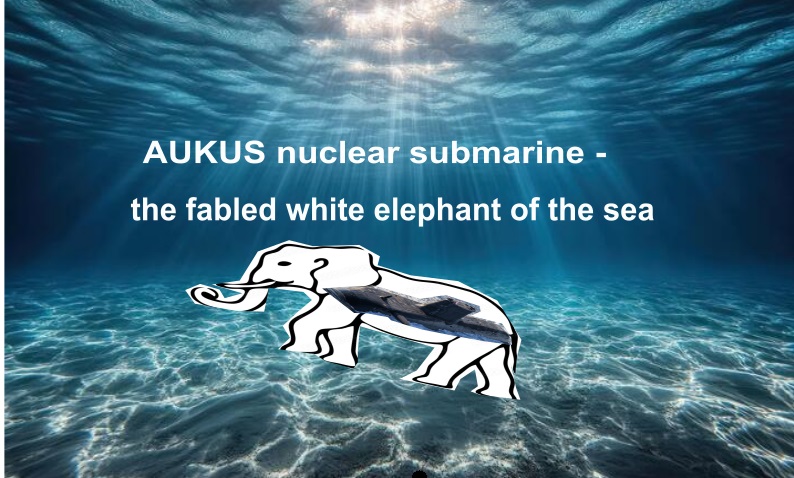
Australians deserve the truth
about
AUKUS – https://aukuspublicinquiry.com/

PETITION – To: Prime Minister Anthony Albanese and the Australian Labor Government

of the week – Australians for War Powers Reform (AWPR)
To see nuclear-related stories in greater depth and intensity

