India pushing to hurry up uranium purchases from Australia
 India pushes for early implementation of nuclear deal with Australia, Economic Times By PTI | 1 Sep, 2015 NEW DELHI: India today conveyed to Australia its eagerness to conclude negotiations for early implementation of the bilateral nuclear deal besides pushing for joint production of defence equipment.
Both Swaraj and Andrews also discussed first ever naval joint exercise to be held later this month at the Bay of Bengal. …….http://economictimes.indiatimes.com/articleshow/48764027.cms?utm_source=contentofinterest&utm_medium=text&utm_campaign=cppst.
Australia, India hold naval exercise, ramping up tensions in Indian Ocean
Australia, India to Hold First Ever Naval Exercise Amid China Concerns ( Source- The Diplomat / Author- Prashanth Parameswaran) September 1, 2015, Manoj Ambat, Prashanth Parameswaran
September 1st, Wattle Day, should be our new Australia Day
Wattle Day, [September 1st]on the other hand, acknowledges the natural beauty of this land, which, like Aboriginal and Torres Strait Islander people, is ancient. This would be more sensitive to indigenous peoples, and it would bring unity, in celebrating the natural beauty of our lands and waters.
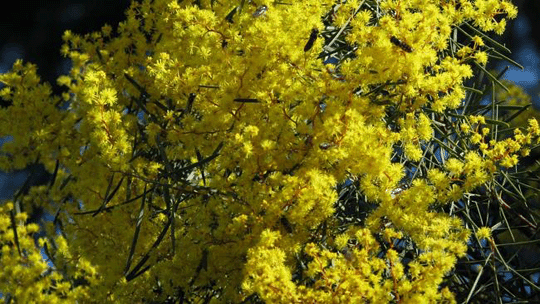
Why today should be Australia Day, news.com.au SEPTEMBER 01, 2015 Is there any more Australian sign of spring than wattle trees blossoming across the country, our nation al flower’s bright yellow blooms against the green of its leaves, the inspiration for our Australian colours of green and gold?
Acacia pycnantha, otherwise known as Golden Wattle, has earned its status as our national floral emblem: it symbolises May Gibbs’ Little Ragged Blossom; the green and gold garb of our cricket team; it signifies the golden sands of our beaches and the green of our gum trees.
This and many other reasons, is why Australia Day, our national celebration of who we are as a nation, should move from January 26 to September 1 — Wattle Day. The first of September is the first day of Spring, marking a time of birth, fresh beginnings….
Instead, we officially celebrate Australia Day on January 26. For our First Peoples, this is hardly a day to celebrate. It marks the day in 1788 that Captain Arthur Phillip invaded the Eora Nation, landing in Sydney Harbour and claiming the lands of indigenous peoples in the name of the British Empire. It marks the start of 227 years of suffering and loss, massacres of hundreds of thousands of people, and of the removal of tens of thousands of children from their mothers’ arms.
It is the height of insensitivity and hypocrisy to celebrate Australia’s nationhood on such a date, and Aboriginal and Torres Strait Islander peoples have voiced their protest to it since the 1880s………
Wattle Day, on the other hand, acknowledges the natural beauty of this land, which, like Aboriginal and Torres Strait Islander people, is ancient. This would be more sensitive to indigenous peoples, and it would bring unity, in celebrating the natural beauty of our lands and waters.
Changing the date of Australia Day is possible. We only have to look to the USA for inspiration, where the similarly insensitive ‘Columbus Day’ is no longer observed in Hawaii, South Dakota, Alaska and Oregon. South Dakota has actually changed the day to ‘Native American Day’ and the city of Berkeley in California, followed by a number of other cities, renamed it ‘indigenous Peoples’ Day’.
The last time changing the date was discussed on a political level was in 2009 when Mick Dodson was named Australian of the Year. He used the opportunity to urge national debate on changing the date of Australia Day, saying that the use of January 26 as Australia Day alienates Aboriginal and Torres Strait Islander people…….
>National symbols matter, and it is time for us to celebrate as a nation in a way that unites rather than divides us, under the green and golden branches of the wattle tree.
Tammy Solonec is indigenous Peoples’ Rights Manager for Amnesty International Australia. http://www.news.com.au/lifestyle/real-life/why-today-should-be-australia-day/story-fnixwvgh-1227507268253
Australia’s electricity retailers not investing in renewable eneregy projects
 Renewable investment drought to continue as utilities extend buyers’ strike, REneweconomy, By Giles Parkinson on 31 August 2015 The investment drought that has plagued the Australian large-scale renewable energy industry for the last two years could extend for another six to 18 months, with big and small electricity retailers showing no interest in contracting new wind or solar projects.
Infigen Energy said on Monday that the deal to cut the large-scale renewable energy target from 41,000GWh to 33,000GWh has yet to have any impact on the market, or to send a signal to retailers to contract new construction.
Infigen CEO Miles George says it could be six to 18 months before retailers will start to act. “The big three are in no hurry to contract now,” he told a conference call on Monday for the release of its annual results.
This confirms the indications from Origin Energy, AGL Energy and EnergyAustralia in recent weeks that they were not interested in writing long-term pricing contracts, either because of perceptions about the policy environment in Australia or because they had enough renewable energy certificates on their books.
Renewable energy investment in Australia plunged nearly 90 per cent since the election of the Abbott government, and even after the slashing of the RET the only projects going ahead now are those supported by the ACT government’s own renewable energy scheme (Ararat, Coonooer Bridge and Hornsdale).
Some big turbine manufacturers may enter the market on a “merchant basis” – taking the price risk – because they have the balance sheet to do so. This includes Suzlon’s Ceres project in South Australia and Goldwind’s project in NSW, and Infigen says it recently sold stakes in two wind projects with an unnamed wind turbine supplier with a mind to do the same thing.
The only other activity in the market has come from Queensland, where Ergon Energy has called for a tender for 150MW of renewable energy and the Queensland government has foreshadowed a tender for 40MW; and in Victoria, which has announced an initiative that may get a small number of wind turbines built.
In the meantime, the renewable energy developers are virtually hamstrung. Infigen Energy, despite the sale of its US wind and solar assets, remains loaded down with relatively high debt levels, so can’t develop projects on its own.
Pacific Hydro, the other major Australian developer, is up for sale and not in the construction market. Meridian Energy, the $5 billion New Zealand renewable energy giant, says it is not interested in investing in new wind farms in Australia as long as it is run by a government which does not like renewable energy…….
The federal government has commissioned the Clean Energy Regulator to do a regular update on the state of the market. The first one is due in April.
The industry is hopeful that this could be used as an incentive to push the industry along. But some fear – given the rhetoric from the Abbott government about renewable energy – that it could be used as an excuse to further weaken the target, despite the government’s promise not to do so before 2020.
Infigen reported a net loss of $304 million as it took a major hit from the write down of its US wind assets, which it sold to reduce its debt burden. It said wind conditions had been particularly poor in the last financial year, but were expected to improve. http://reneweconomy.com.au/2015/renewable-investment-drought-to-continue-as-utilities-extend-buyers-strike-28325
New South Wales way behind on renewable energy
 NSW ‘at bottom of pack’ for renewable energy; Government says it’s committed to clean projects, ABC News By state political reporter Brigid Glanville. 30 Aug 15, It may be known as the premier state, but New South Wales is a clear under-achiever when it comes to renewable energy.
NSW has the highest level of greenhouse gas emissions in the country and does not have a renewable energy target.
In 2014 the renewable industry body, Clean Energy Council, listed New South Wales at the bottom of the states for renewable energy production. Only 6 per cent of its electricity is from wind, solar and water — compared with Tasmania, which uses 95 per cent renewables. “New South Wales is at the bottom of the pack of the Australian states when it comes to renewable energy,” Climate Council CEO Amanda McKenzie said.
“It’s behind the pack in terms of generating renewable energy and the amount of rooftop solar on people’s roofs.”
New South Wales and the two territories remain the only jurisdictions where Solar PV panel penetration is under 10 per cent.
In South Australia, take up is almost 25 per cent.
Clean energy penetration by state
- Tasmania 95%
- South Australia 40%
- Western Australia 13%
- Victoria 10%
- Queensland 7%
- NSW 6%
Source: Clean Energy Council, Clean Energy Australia Report 2014
Enova Energy New South Wales community organisation starts new renewable energy provider

The directors said in the prospective that the “nimble and collaborative locally based social enterprise model” used by Enova could be replicated and scaled across like-minded communities in Australia.
The share offer closes on September 25.
Northern Rivers community seeks $4m in energy IPO http://www.theage.com.au/business/energy/northern-rivers-community-seeks-4m-in-energy-ipo-20150828-gja99q.html#ixzz3kLbExZM1 August 30, 2015 Angela Macdonald-Smith A community-owned organisation in north-eastern NSW is set to take on the big guns in electricity supply through a $4 million initial public offering to fund a renewable energy retailing and solar company it hopes will stimulate local renewable energy projects across the country.
Enova Energy, chaired by consultant and former NSW state librarian Alison Crook, is aiming to capture customers in the Northern Rivers region, where retailing major Origin Energy dominates the market.
Ms Crook said Enova was not aspiring to be a major competitor of Origin but sought mainly to provide a customer for small wind farms, hydropower and bio-energy projects that were not large enough to be of any interest to major retailers as a green power provider.
“We see this as a game-changer to get community renewable energy really going in Australia,” Continue reading
French ACT co-operation on renewable energy for Canberra and South Australia
French diplomacy delivers renewable energy to Canberra and $250m to South Australia, ABC, SA Country Hour By James Jooste, 26 Aug 15 A joint venture between French company Neoen and the Australian Capital Territory Government will inject $250 million into the South Australian economy and deliver clean energy to the capital. Continue reading
Solar energy to power Perth
 Solar to fuel new power generation https://au.news.yahoo.com/thewest/wa/a/29358326/solar-to-fuel-new-power-generation/ Daniel Mercer August 27, 2015,
Fuelled by falling solar panel prices and rising electricity tariffs, demand for solar cells has been running at 20-30 per cent in Perth for the past six years.
About 170,000 households in the South West grid covering Perth now have a system.
Dr Nahan said installed solar capacity across the city was about 500MW — or the equivalent of a major base-load power station — and this was expected to more than double within years.
“We expect that the bulk of generating capacity during sunlight hours in the metro area in about 10 years time will be provided by rooftop solar,” Dr Nahan said.
“That’s the reality. So it is going to provide the bulk of additional capacity going forward.
“It will also displace a lot of the existing capacity. It’s low-priced, it’s democratically determined and it’s something we’re committed to facilitating.”
The comments came as Dr Nahan provided an update of the Government’s plans to shake up the electricity sector.
He said moves to end Synergy’s monopoly over the household power market and throw it open to competition by 2018 were on track.
Before the Government could do that, however, he said the subsidy to the State-owned utility would need to be erased and excess capacity from the system stripped by reducing some Synergy capacity.
He said it was too early to say which plants would be closed
Twisting the public’s perception about ionising radiation
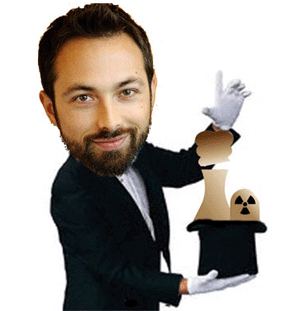
In Muller’s previous presentations on his YouTube show Veritasium, he has consistently confused the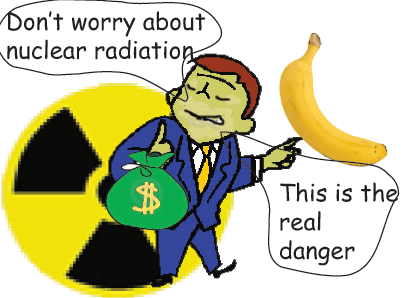
naturally occurring radioactive potassium K, with the nuclear fission produced radioactive isotopes…..Muller seems to have no understanding of the way in which bananas are used in the body
What Muller and Thomas are doing is following the script from the tobacco and asbestos industries.
This documentary “Uranium – twisting the Dragon’s Tail” is just Series One. I would love to know who helped to fund Gene Pool Productions for PBS and SBS to produce this. I’m betting that Series Two will follow before long, with a glossy and positive story about Generation IV nuclear reactors.
The half lie of the Dragon’s Tail. Online opinion, By Noel Wauchope Thursday, 27 August 2015 The documentary “Uranium – Twisting the Dragon’s Tail” is the latest glossy and highly sophisticated soft sell for the nuclear industry. It’s also, if you look at it closely, rather confusing.
I will start from the end, because that’s where the main message of this film comes out clearly “Just imagine a world where reactors can produce immense amounts of clean, safe, energy. There is no such thing as a future without uranium.” These final words are said against a background of soaring celestial choirs.
This seems to be the formula now, in nuclear promotion. The 2013 propaganda film “Pandora’s Promise” carried the same positive message – an ever rocketing energy demand to be met by ever increasing, indeed limitless, electrical energy provided by new nuclear reactors.
But, like ‘Pandora’s Promise’, this new documentary devotes the first two thirds of its series to discussing the negative aspects of the nuclear industry. Episode One covers its history, ill effects of radiation, the atomic bomb and its use. Episode Two continues this, with a sympathetic attitude to Australian Aboriginal concerns.
Unlike “Pandora’s Promise” this film does not denigrate anti-nuclear activists, and there is no attempt to ridicule Dr Helen Caldicott, as “Pandora’s Promise” did.
Indeed, the first two episodes are beautifully clear and accurate, as well as entertaining. Really, I couldn’t criticise them.
With the final episode – that’s when the message kicks in, and also when it gets confusing…….
Muller consistently mixes up “natural” radiation with ionising radiation from nuclear fission. He talks about background radiation as “natural”. There’s no mention of the increased ionising radiation in the biosphere as a result of the atomic bomb testing in the 1950s and 60s.
In Muller’s previous presentations on his YouTube show Veritasium, he has consistently confused the naturally occurring radioactive potassium K, with the nuclear fission produced radioactive isotopes, such as caesium 137 and strontium 90. As part of this confusion he constantly uses bananas as a comparison .comparison https://www.youtube.com/watch?v=TRL7o2kPqw0
Cesium-137 is 12 million times more radioactive than potassium-40. Another highly-radioactive fission product, strontium-90, releases almost 20 million times more radiation per unit mass than does potassium-40. Muller seems to have no understanding of the way in which bananas are used in the body. The human species has had thousands of years of experience with bananas and other foods containing potassium 40 (K40). We have a natural trace level of K40 in our bodies. When we eat bananas, our bodies excrete the extra cesium, so by the natural process of homeostasis, our K40 level remains the same. This is not the case with the very recently created radioactive isotopes from nuclear fission; they remain….., there is absolutely no mention of the effects of internal emitters of radiation – that is, the radioactive isotopes breathed in or ingested, that can sit in a body’s organs for years, decades, emitting high dose gamma radiation..
Moving on to the Fukushima nuclear accident, we are told that the psychological effects are the serious ones. What a great piece of spin this is! Of course the psychological effects are extremely serious. Wouldn’t you be worried, if you were a pregnant woman, or if you feared that your child might later get leukaemia, because you decided to return to a radioactive environment? It is the reality of increased risk of fatal illness that accentuates the other disastrous consequences of that accident.
Prof Thomas assures us “The most important studies will be those on the mental effects”. In the context of this documentary, that just makes me envisage more documentaries like this one – with more spin about how we mustn’t worry about ionising radiation…….
The documentary appeared in Australia at a very convenient time for the South Australian Royal Commission. Dr Muller often covers his back with remarks about nuclear weapons “the most savage thing that man has ever built” and like his “feeling that renewables are going so fast – perhaps we can use alternatives”. But ultimately, his is a message of confidence in nuclear power. He says “Every year uranium saves more lives than it has ever destroyed” Really? Where are the facts to back up these kinds of statements? And all is spoken with guru like solemnity, and the backing of soaring holy choral music……..
What Muller and Thomas are doing is following the script from the tobacco and asbestos industries. They know full well that the toll of cancers, heart conditions, birth defects, from persistent exposure to ionising radiation will not become apparent for decades. They would have us believe that it will be impossible to establish ionising radiation as the cause of this toll of suffering and death…….
We are living in a strange time, where science is valued if it brings a benefit to corporations. Dr Derek Muller and Professor Geraldine Thomas are comfortably ensconced in that world. But there must be some scientists out there who are like Sir Richard Doll, and whose work is motivated by the public good.
And we desperately need those scientists.
This documentary “Uranium – twisting the Dragon’s Tail” is just Series One. I would love to know who helped to fund Gene Pool Productions for PBS and SBS to produce this. I’m betting that Series Two will follow before long, with a glossy and positive story about Generation IV nuclear reactors. http://www.onlineopinion.com.au/view.asp?article=17624
Climate system changing more rapidly than expected: new report

 A STUNNING new Climate Council report that reveals the climate system is changing more rapidly than expected and with larger and more damaging impacts paints a stark picture of the urgent need for action, Professor Tim Flannery said today.
Climate Change 2015: Growing Risks, Critical Choices provides the most up-to-date, comprehensive synthesis of climate science in Australia and exposes the extent of the dramatic changes in the climate system worldwide.
“In short, the more we know about climate change, the riskier it looks,” Prof Flannery said.
“Heatwaves, sea level rise and ice loss are all increasing as the air, the ocean and the land continues to warm strongly. Extreme weather events like dangerous bushfire weather are becoming more severe and frequent.
“But this is a future we don’t have to have. Tackling climate change and moving to clean, renewable energy is the right thing to do. It’s the right thing to do to protect our health and wellbeing. The right thing to do to protect us from economic shocks from worsening extreme weather and opening new opportunities for jobs and investment in new industries. Unfortunately the barriers to action are political.”
The report found:
Australia:
- SEA LEVEL RISE: Australian sea levels are projected to continue to rise through the 21stcentury at a rate faster than that over the past four decades or over the 20th century as a whole. More than $226 billion of buildings and infrastructure are vulnerable to 1.1m of sea-level rise.
- EXTREME HEAT: Hot days have doubled in the last 50 years and heatwaves have become hotter, longer and happen more often. The number of deaths in summer in Australia has steadily increased over the last 40 years. In the future extreme heat increases are very likely with more frequent and hotter hot days and longer and more severe heatwaves.
- BUSHFIRE: Extreme bushfire weather has increased in the south east of Australia in the last 30 years and a “Catastrophic” category was added following Black Saturday bushfires. Longer and hotter fire seasons in eastern and southern Australia are likely in the future.
SOUTH AUSTRALIA:
- HEATWAVES: In Adelaide, the number of heatwave days has nearly doubled since 1950 and the average intensity of the peak heatwave day has increased by 4.3°C. In 1995, Adelaide experienced 20 days above 35°C. By 2090 it could experience up to 47 per year. Deaths from heatwaves in Australian cities are projected to double over the next 40 years.
- BUSHFIRES: Climate change is already increasing the risk of bushfires in southern South Australia; extreme fire weather has increased over the last 30 years in South Australia. The fire season in South Australia is starting earlier and lasting longer. In 2014 the bushfire season started earlier in seven of 15 districts in South Australia. By about mid-century, the total economic costs of South Australian bushfires are projected to almost double, potentially reaching $79 million.
- COASTAL FLOODING: In Adelaide, today’s 1-in-100–year flooding event would occur every year or so by 2100 under a high emissions scenario. A sea level rise of 1.1 m exposes a significant amount of infrastructure to the impacts of flooding and erosion in South Australia, including between $5 billion-$8 billion worth of residential buildings
Globally:
- Arctic sea ice retreat over the past three decades was unprecedented in at least the last 1,450 years.
- The 1980s, 1990s and 2000s were all hotter than any other decade in recorded history.
- Sea level rise is accelerating – the average rate of sea-level rise between 1901 and 2010 was 1.7 mm per year, increasing to 3.2 mm per year between 1993 and 2010.
The report underscored that Australia’s post 2020 emissions reduction targets were too weak to protect Australians from worsening climate change impacts, Professor Will Steffen said.
“As the escalating risks of climate change have become clearer and more disturbing, other countries have started to heed the warnings, putting in place tangible and ambitious policies,” he said.
“But Australia’s response to meeting the challenge of Paris is disappointingly weak; it is out of step with the science and out of step with most of the developed world.”
Professor Lesley Hughes said Australia had critical choices to make as country.
“We can embrace the range of solutions to climate change, which are more feasible and less costly than ever before, and build a healthier and more economically viable future or we can continue to pay the many costs that come from delaying action on climate change,” she said.
The Climate Council is an independent, crowd-funded organization providing quality information to climate change to the Australian public. For media enquiries, please contact Senior Media Advisor Jessica Craven on  0400 424 559.
Lucas Heights (terrorism target) gets security upgrades
Security upgrades at Lucas Heights nuclear reactor not influenced by trespasser scare, SMH, August 25, 2015 Henry Belot Canberra Times Reporter
Security upgrades at Australia’s oldest nuclear reactor were not triggered by the arrest of five men caught loitering outside the site last year, according to officials.
The men were arrested and questioned in September after parking their vehicles within 100 metres of the security gates to the Lucas Heights reactor in southern Sydney.
The group were eventually released without charge but their actions led police to question why they had strayed onto restricted Commonwealth land.
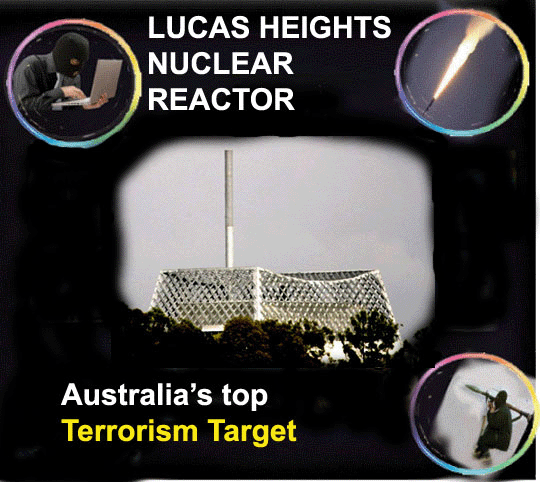
In response to a question on notice, Australian Nuclear Science and Technology Organisation chief executive Dr Adrian Paterson said security upgrades in October were not prompted by the scare.
“Control room operations were outsourced to one of Australia’s largest security firms with significant expertise and experience in control room monitoring,” an ANSTO spokesman said.”ANSTO’s first responder safety function was also outsourced to a private company.”
The spokesman said both changes were made after a detailed review of security arrangements and after consultation with the Australian Federal Police. “The changes have been successfully implemented and are delivering improved operational outcomes as well as cost savings,” he said.
“The AFP continues to be responsible for the 24-hour-a-day physical protection of the ANSTO site as well as armed first response.”
Dr Paterson said ANSTO received regular briefings from the intelligence community and their security posture could be strengthened quickly in response to specific threats……..
In 2001, Greenpeace activists gained entry to the Lucas Heights complex and unveiled banners claiming nuclear power was “never safe”…….
. The Lucas Heights site will also receive a shipment of radioactive waste returned to Sydney from France this year, after being sent to Europe for processing in the 1990s.
According to legal requirements, the waste must be returned from France by December with more waste set to be returned from Britain in 2017……….
ANSTO marketing material states the returning waste is equivalent to one third of a shipping container.
The cost of transferring waste from Britain is expected to cost nearly $27 million over four years, while the return of waste from France has been funded in budgets since 2010…….. http://www.smh.com.au/national/security-upgrades-at-lucas-heights-nuclear-reactor-not-influenced-by-trespasser-scare-20150825-gj71pv.html#ixzz3jrTJrpgg
Australia’s bushfire and flood danger, as climate change accelerates
 Climate system changing faster than expected: Climate Council, ABC Radio Angela Lavoipierre reported this story on Tuesday, August 25, 2015
MICHAEL BRISSENDEN: The Climate Council says the case for the link between climate change and severe weather events has become much stronger. In a new report the Council states that the world’s climate system is changing more rapidly than expected.
ANGELA LAVOIPIERRE: The Climate Council’s report gives a snapshot of the changes so far to Australia’s climate, as well as changes it expects over the coming century.
The Council’s professor Will Steffen paints a grim picture.
WILL STEFFEN: One of the things that we can say is that we’re already seeing some impacts. Heat waves are lasting longer and starting earlier.
We’re seeing in the south-east of the country high bushfire danger weather has increased significantly over the last 30 years. We’ve seen that sea level has risen about the global average around Australia. That’s led to a threefold increase in coastal flooding.
ANGELA LAVOIPIERRE: And then, there’s what’s to come.
WILL STEFFEN: If we keep, if the globe keeps emitting fossil fuel emissions like we are now, we could see up to a metre of sea level rise around Australia. That could for example make a one in a hundred year flooding event in Sydney a daily event……..http://www.abc.net.au/am/content/2015/s4299445.htm
Canning voters are urged to reject Liberals’ war on solar energy

The solar council is planning a nationwide marginal seats campaign at the next election.
The government has directed the CEFC – which it unsuccessfully tried to abolish – to stop investments in rooftop solar, but changes to the investment mandate remain under legal uncertainty.
Canning byelection: solar industry urges voters to reject Liberals ‘war on solar’, Guardian, Lenore Taylor, 25 Aug 15
Solar Council letterboxes all electors in Western Australia’s seat of Canning encouraging them to vote for Labor, the Greens or the Palmer United party The solar  industry is letterboxing all electors in the crucial West Australian Canning byelection urging them to vote against the Liberal party on 19 September in response to the Abbott government’s “war on solar”.
The Solar Council leaflet states: “Installing solar helps Western Australians cut a typical power bill by up to 65%. The federal government is targeting solar by slashing the renewable energy target. We will support any political party with a good solar policy.”
The council has invited all party leaders and candidates to a public forum on 13 September

– a week before the byelection that could affect Tony Abbott’s hold on the Liberal leadership – to explain their solar policies. Continue reading
Citigroup analysis finds that renewable energy IS cheaper than fossil fuel energy
Giles Parkinson: Why wind and solar are already better value than fossil fuels.When radio shock jock Alan Jones got the cost of wind energy so horribly wrong in front of a million or so viewers on ABC TV last month, he did more than misplace a decimal point. He repeated an often-made misunderstanding about the costs of energy, and why renewables are already better value than fossil fuels. …
Jones admitted his error, but he remained unbowed on his view of wind energy and renewables in general. Like the Coalition government, its advisors, and other opponents of renewable energy, including elements of the Murdo ch media, Jones is convinced that renewable energy will cause overall consumer costs to soar. But he is wrong about that too.
Citigroup has published a detailed analysis of the costs of various energy sources, and it concludes that if all the costs of generation are included then renewables turn out to be cheaper than fossil fuels and a “benefit rather than a cost to society.”
http://reneweconomy.com.au/2015/why-wind-and-solar-are-already-better-value-than-fossil-fuels-16022 &http://www.dailyclimate.org/t/-71650010666671461
BHP wants to remove Federal and State laws on uranium mining
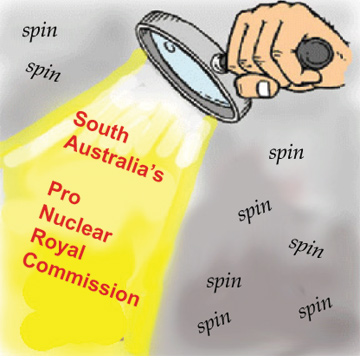 BHP cool on hot uranium demand, The Weekend Australian p.2 REBECCA PUDDY, 22 Aug 2015 BHP Billiton has warned that the future doubling of global demand for uranium will not necessarily lead to increased investment at its Olympic Dam mine.
The mining company said the commercial return from the Olympic Dam deposit in the north of South Australia was driven primarily by copper production, together with a combination of commodity prices and other market factors.
“Therefore increased demand for uranium may not in and of itself lead to increased investment in the Olympic Dam deposit,” the company said in its submission to South Australia’s Nuclear Fuel Cycle Royal Commission.
BHP Billiton’s warning comes after it announced this month that 380 workers would be sacked as part of an operational review to cut costs.
An expansion plan for Olympic Dam was put on hold three years ago, although South Australian Premier Jay Weatherill hinted this month that a modified plan to expand the mine remains on the cards, with trials of an alternative heap-leaching technology progressing more rapidly and successfully than expected. This comes as demand for uranium is tipped to increase.
The International Energy Agency world energy outlook states that there are currently 437 operating nuclear power reactors in the world with 378 gigawatt capacity.
With a further 68 reactors being built, the agency forecasts nuclear capacity will increase to 624GW by 2040. “In the long run, additional supply of primary uranium will be required to meet the expected demand,” it says.
“With steady demand increases, the market deficit is expected to be filled by a range of potential projects.”
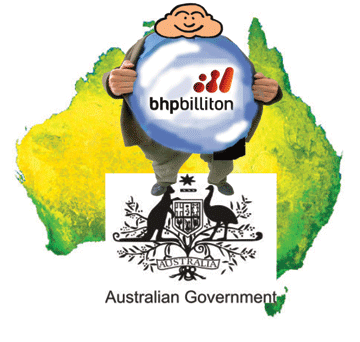
BHP Billiton’s submission to the royal commission focuses its attentions on the regulatory burdens placed on it by state and federal governments. It recommends the removal of uranium mining from the list of Matters of Environmental Significance in the federal Environment Protection and Biodiversity Act.
The commission is due to report early next year.
1 This month


Help Aunty Sue Protect Her Land and Sacred Sites From Destructive Rocket Testing.
.

Australians deserve the truth
about
AUKUS – https://aukuspublicinquiry.com/

PETITION – To: Prime Minister Anthony Albanese and the Australian Labor Government

of the week – Australians for War Powers Reform (AWPR)
To see nuclear-related stories in greater depth and intensity

