Nuclear lobby’s latest schtick – “Acceptable Risk”
 I studied the nuclear lobby’s schtick and came up with 3 main lies that they are pushing in the leadup to the December Paris conference:
- “new Generation IV will solve the nuclear waste problem”
- “low dose ionising rdaiation is OK – even good for you”
- “nuclear power will solve climate change”
BUT – I missed an important one. They’ve got a new gee-whiz idea – called “ACCEPTABLE RISK”. 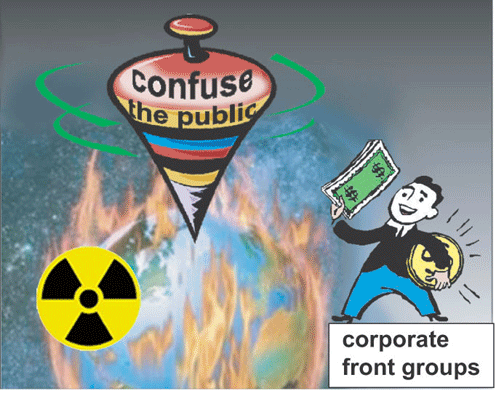 Australian nuclear propagandist Geoff Russell used this one in his submission to the South Australia Nuclear Fuel Chain Royal Commission – as he argued that people falling off roofs with solar panels is a bigger health danger than Fukushima radiation.
They have another great way of confusing us (that’s the aim – confuse the world and delay action against a truly dangerous industry) – they call it ‘residual risk”:
it is not meaningful to say that an activity or facility is safe or unsafe. The proper way to say it is that the residual risk is tolerable or acceptable given the benefits that are derived from this activity or facility. The NRRC is helping Japanese utilities to accurately quantify the residual risk from nuclear power plants so that measures can be taken to reduce it to as small a number as possible. – (George Apostolakis, Japan News, 30/8/15)
Where now for Australia’s Climate Change Authority?
 Ignored by the government, shrunk by resignations – where now for Australia’s Climate Change Authority?, https://theconversation.com/ignored-by-the-government-shrunk-by-resignations-where-now-for-australias-climate-change-authority-47366 The Conversation, Clive Hamilton
Professor of Public Ethics, Centre For Applied Philosophy & Public Ethics (CAPPE) at Charles Sturt University September 11, 2015 Bernie Fraser’s resignation as chairman of Australia’s Climate Change Authority has left many wondering what is left of it and what its future might be.
Established three years ago as part of the climate change package negotiated by the previous parliament’s Multi-Party Climate Change Committee, the Authority was formed to serve as the principal source of climate policy advice to the federal government, particularly on the issue of emissions targets. Championed by the then Greens deputy leader Christine Milne, it was modelled closely on Britain’s Committee on Climate Change.
The Authority is legislated to have nine part-time members, including the Chief Scientist ex officio. When the Abbott government was elected two years ago it expressed its intention to abolish the Authority along with the rest of the Labor government’s climate policy architecture. Continue reading
Tony Abbott has ‘a very good story to tell’ Pacific Islanders, about climate change
 ‘I’ve got a very good story to tell’: Tony Abbott confident of placating island leaders on climate change September 10, 2015 Michael Gordon Political editor, The Age Tony Abbott has entered a retreat with leaders from Pacific island nations confident he can reassure those who say their survival is threatened without a stronger commitment to reduce carbon emissions.
“I think I have got a very good story to tell on climate change to tell the Pacific Islands Forum,” the Prime Minister said before entering a day-long meeting with 15 Pacific island leaders.
Led by the president of Kiribati, Anote Tong, several of the leaders have warned that anything short of a commitment to limit the average global temperature rise to 1.5 per cent would represent a betrayal of their people.
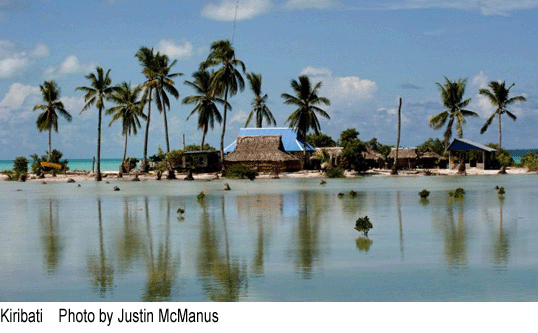
…..Both Mr Abbott and New Zealand Prime Minister John Key will resist the push led by the smaller island states to go beyond a commitment to the goal of limiting the global rise to 2 degrees.
Fairfax Media has seen successive drafts of the leader’s declaration where a reference to a 1.5 degree commitment is removed. The final draft will be released after the leaders’ retreat. http://www.theage.com.au/federal-politics/political-news/ive-got-a-very-good-story-to-tell-tony-abbott-confident-of-placating-island-leaders-on-climate-change-20150910-gjj93v.html#ixzz3lOo0rT8H
Abbott’s attempt to stop legal action by green activists is likely to fail in the Senate
BUT with Labor and the Greens adamantly opposed, Environment Minister Greg Hunt faces a tough lobbying job to get it through the Senate.
The measure follows a Federal Court order, sought by a local environmental group, setting aside Mr Hunt’s approval of the proposed Carmichael coal mine in Queensland’s Galilee Basin.Mr Hunt on Thursday told parliament the change would prevent people with no connection to a project except a political agenda from using the courts to disrupt and delay.However the rights of farmers and other impacted landowners to go to court would not be affected………http://www.heraldsun.com.au/news/breaking-news/greens-court-options-being-limited/story-fni0xqi4-1227521109153
Will Tony Abbott ignore the cautionary message of committee on uranium sales to India?
 India uranium red-light a test for Tony Abbott, SBS News, 8 Sept 15, While Prime Minister Abbott and Foreign Minister Bishop have been strong supporters of selling Australian uranium to India, many others, including key Australian diplomats and insiders, remain far more circumspect. By Dave Sweeney
 The JSCOT report followed a detailed examination and expert testimony and states that while the federal government can ratify the deal it must not advance uranium sales or supply to India before key checks and balances are put into practice and proven to work.
In short, the committee charged with advising the government on Indian uranium sales has reached the unambiguous conclusion that the government can sign but not sell.
The question now is whether the Abbott government will follow due parliamentary process and act in the public interest or will it ignore these concerns and JSCOT’s advice and seek to fast-track the agenda of the under-performing uranium sector?
When Prime Minister Tony Abbott signed a uranium deal with Indian Prime Minister Narendra Modi in New Delhi in September 2014, he praised India’s “absolutely impeccable non-proliferation record”. Yet India’s record on nuclear proliferation tells another story. India acquired its nuclear arsenal by breaking a promise not to use a Canadian reactor for military purposes. It remains outside the globe’s key non-proliferation frameworks and the region remains on nuclear high alert amid tensions with nuclear rival Pakistan.
Instead of addressing real questions about India’s nuclear weapons program and inadequate nuclear safety standards Mr Abbott resorted to cricketing clichés, declaring that Australia and India trust each other on issues like uranium safeguards because of “the fundamentally ethical principle that every cricketer is supposed to assimilate – play by the rules and accept the umpire’s decision”.
The JSCOT process received strongly critical submissions from a who’s who of nuclear arms control diplomats and experts including John Carlson (former long serving Director-General of the Australian Safeguards and Non-Proliferation Office from 1989 to 2010), Ron Walker (former Chair of the International Atomic Energy Agency, Prof. Lawrence Scheinman (former Assistant Director of the US Arms Control and Disarmament Agency). These are veteran players in global nuclear diplomatic and regulatory regimes, not anti-nuclear activists.
Nuclear arms control expert Crispin Rovere noted that “this treaty appears less like the deepening of a bilateral partnership and more like one of a client state being dictated to in an expanded Indian empire. It is a major display of weakness on the part of the Australian Government, and a failure to stand up for Australia’s national interests in this area”.
One thing we can all agree on is that Australia has a key role to play in supporting India’s legitimate energy aspirations, but this cannot be advanced by a retreat from responsibility on nuclear safeguards and security. The government must read and heed the JSCOT report and Australia’s uranium must remain away from India’s nuclear reactors and weapons – to do otherwise would be profoundly irresponsible.
JSCOT has just clean bowled this dangerous and deeply deficient sales plan. Mr Abbott must now heed his own words, “accept the umpire’s decision” and start the long walk back to pavilion for a serious re-think. http://www.sbs.com.au/news/article/2015/09/08/comment-india-uranium-red-light-test-tony-abbott
Joint Standing Committee on Treaties (JSCOT) not happy with plan to sell uranium to India
Caution urged on uranium sales to India, Herald Sun September 8, 2015 THE government needs to consider greater safeguards and stronger diplomatic efforts before Australia sells uranium to India, a new report says. THE treaties committee report, tabled in parliament on Tuesday, said India should be encouraged to become a party to the comprehensive test ban treaty and separate its civil and military nuclear facilities.Uranium should not be sold to India until it puts in place an independent nuclear regulator and best practice safety inspections of nuclear facilities, the report said.Committee chairman, Liberal MP Wyatt Roy, said in the report there were some “significant risks” to selling uranium to India.India was outside the “nuclear non-proliferation mainstream” and Australia should use all diplomatic steps to ensure it signed the Nuclear Non-Proliferation Treaty.There were weaknesses in the way India’s nuclear facilities are regulated “that jeopardise nuclear safety and security”.
“The committee has made a recommendation that the sale of uranium to India only commence when these weaknesses have been addressed,” Mr Roy said……..Two Labor members of the committee said the full separation of India’s civil and military nuclear facilities and the setting up of a new independent watchdog should be done before the treaty is ratified.The majority committee view was that these two matters should be addressed after ratification.”We consider it essential that any nuclear agreement with India should be at least as rigorous as all the agreements Australia has concluded with other countries,” Labor’s Melissa Parke and Sue Lines wrote.Greens senator Scott Ludlam said the deal should not go ahead.”It puts the interest of a small and marginal industry ahead of global security,” he said……..http://www.heraldsun.com.au/news/breaking-news/australias-india-uranium-deal-report-due/story-fni0xqi4-1227517124640
Big Solar Power: Australian Renewable Energy Agency and the Clean Energy Finance Corporation
 Large scale solar plants get $350m push, The Age, September 9, 2015 –Mathew Dunckley BusinessDay Editor Australia will get up to 10 new large solar power stations as part of an unprecedented $350 million tie-up between two major government renewable energy agencies.
As part of a new funding round the Australian Renewable Energy Agency and the Clean Energy Finance Corporation will collaborate to offer, respectively, grants and loans to get major solar projects off the ground to feed into the energy grid.
It is understood some state governments have also signalled they will financially support bids for projects in their jurisdictions potentially through long term offtake agreements. Continue reading
Pacific Island Forum will be dominated by Australia’s Inaction on Climate Change
Australia’s inaction on climate change set to dominate Pacific Island talks, Guardian, 6 Sept 15 Australia and New Zealand are expected to face strong criticism from Pacific Island leaders disappointed the nations are not doing more to combat climate change.
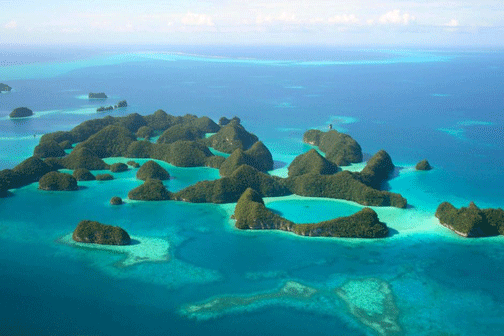
The issue will likely dominate this week’s Pacific Islands Forum leaders summit in Port Moresby, ahead of the United Nations climate change conference in Paris later in the year.
Pacific leaders want the world to work on restricting the global warming temperature rise to 1.5C, fearing a 2C target will risk the survival of many tiny islands.
Natural disaster recovery will be fresh on their minds. The summit starts on Monday, six months after Cyclone Pam, which flattened much of Vanuatu and caused heavy flooding on Tuvalu, Kiribati and the Marshall Islands.
Host nation Papua New Guinea is grappling with the opposite problem – what could be its worst drought in 20 years and a potential food crisis.
The prime minister, Peter O’Neill, has said El Niño conditions have been exacerbated by the effects of climate change.
The Solomon Islands and Vanuatu are also experiencing a dry spell………
The Pacific Island Forum runs from 7-11 September. http://www.theguardian.com/world/2015/sep/06/australias-inaction-on-climate-change-set-to-dominate-pacific-island-talks
Importing #nuclear waste is illegal. The Lucas Heights returning waste is an exception
I hope that The Age and other media will make clear the fact that this radioactive trash returning from UK and France, emanates from radioactive trash that originated at Lucas Heights. Australia is legally obliged to take it back. A completely different proposition from the hare-brained idea of importing foreign nuclear wastes.
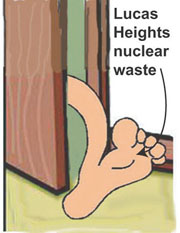 Under Commonwealth and State laws, no nuclear waste repository can be set up in Australia, with just this one exception.
The nuclear lobby, and the South Australian government will use this exception to confuse the public – so that this exception could become a foot in the door for the ill advised plan by some greedy Australian individuals, and by the desperate overseas nuclear companies, for South Australia to become the world’s nuclear toilet.
Increasing danger of #nuclear submarines in Indo Pacific oceans
 ‘the more submarines you put in the same body of water, the higher the probability they might collide’.
Indo-Pacific nuclear sub threat to rival Cold War AFR, by John Kerin, 3 Sept 15 The Indian and Pacific Oceans are becoming increasingly crowded with nuclear armed and conventional submarines increasing the risk of collision and nuclear conflict.
The warning is contained in a new Lowy Institute of International Affairs paper to be released on Friday which argues the region faces the greatest threat of a miscalculation involving nuclear armed submarines since the Cold War era.
“The regional contests for influence between the United States and China and China and India do not yet have the existential or ideological ‘life or death character’ of the Cold War,” the paper by Professor Rory Medcalf of the ANU based National Security College and Brendan-Thomas Noone from the Lowy International Security Program says.
“But quite literally below the surface a new and dangerous competition is emerging as China and India in particular start deploying nuclear weapons at sea………. Continue reading
Abbott govt soon to give shortlist of sites for Lucas Heights nuclear waste dump
 Nuclear waste dumps: Abbott government close to releasing shortlist of possible sites, SMH, September 3, 2015 James Massola Political correspondent The Abbott government is close to releasing a shortlist of possible sites to host a nuclear waste dump, but has missed a self-imposed August deadline. At least four locations — two in South Australia’s Kimba shire, one in Leonora in Western Australia and one in Yalgoo, WA — are among those in the running to be on the shortlist of sites that will host the “national radioactive waste management facility”, though a final decision on the location is not due until 2017.
The delay in the release of the list has prompted suggestions from Labor of a link with the Canning byelection on September 19. Continue reading
Video: Walkajurra Walkabout protest Toro uranium mining project
 Walkajurra Walkabout begins fifth protest of Toro uranium mining project Anti-nuclear protesters have come together for the fifth consecutive Walkajurra Walkabout to oppose energy company’s Toro Energy uranium mining project.
By Craig Quartermaine Yellarie Source: NITV News 31 AUG 2015
TRANSCRIPT Malarndirri McCarthy: The Walkajurra Walkabout has international anti-nuclear protesters and traditional owners gathered together on some of the richest uranium deposits in the country.
Craig Quartermaine: I’m here at Yellerie Station for the Walkajurra Walkabout that will continue for the next two weeks it’s a dynamic mix of people who make their way through country
After protesters set up camp, they had a breakdown of the meeting with Toro Energy before turning in for the night……
Kado Muir is the Tjurrura man who has lead the event for the last five years .
Kado Muir, Walkajurra Walkabout organiser: So if they ever got the approval to mine it, it would dig up a 50 kilometre area, taking uranium out of the ground, turning it over, extracting the ore, leaving radioactive materials behind, all this beautiful land will end up being a radioactive wasteland……..Basically all these people share this common goal with us the Aboriginal people of this land of keeping uranium in the ground and shutting down the nuclear industry.
Western Australian Labor holds firm to nuclear-free policies
 URANIUM AND THORIUM (nb: from Environment chapter)
- WA Labor believes that:
- Enriching uranium poses significant risks to human health, the natural environment and is not a solution to climate change; and
- Thorium also poses significant risks to human health and the environment.
- In Government, WA Labor will:
- Oppose the mining and export of uranium;
- Oppose nuclear enrichment, nuclear power and otherwise the production of dangerous radioactive waste;
- Oppose the storage of nuclear energy waste in Western Australia;
- Oppose the testing or use of nuclear weapons in Western Australia or near our coastline;
- Encourage local governments to declare themselves ‘Nuclear Free Zones’; and
- Ensure that the mining of thorium in Western Australia only occurs under the most stringent environmental conditions and oppose thorium exports to countries that do not observe the Nuclear Non-Proliferation Treaty.
URANIUM MINING & NUCLEAR ENERGY (nb: from Industry and Regional Development chapter)
- Recognising the problems, hazards and dangers of nuclear power, especially relating to:
- The safety of the nuclear fuel cycle;
- The unsolved problems pertaining to the reprocessing and storage of radioactive wastes and spent plant;
- The growing concern about the biomedical effects of even low radiation;
- The coupling of nuclear energy and nuclear weapon development;
- The added danger of a future plutonium economy and the threats to civil liberties involved in a nuclear economy; and
- The fact that Labor policy contained herein on fossil fuels, energy conservation and renewable resources will ensure Western Australian energy self-sufficiency.
- WA Labor will:
- Reject nuclear power as an option for electricity generation in Western Australia;
- Oppose the establishment of a nuclear enrichment facility in the State;
- Reject the establishment of nuclear processing plants or the storage of nuclear wastes in the State;
- Allow no uranium mining or development in Western Australia; and
- Place thorium under the restrictions and conditions applicable to the mining, processing, sale and transportation of uranium currently mined in Australia as outlined in the Resources and Energy section of the National Platform, so far as they relate to nuclear non-proliferation.
- The platform recognises WA Labor’s long and continuous opposition to Uranium Mining. The commencement and continuation of any uranium project is inconsistent with WA Labor Policy. WA Labor will accept no obligation to complete approval processes or honour contractual arrangements entered into by a previous government where such approvals or contracts are directed towards an outcome inconsistent with WA Labor’s platform.
International Relations:
Support measures that prevent the use of Australian uranium exports in the proliferation of nuclear weapons or environmental degradation
Rosatom now selling uneconomic Honeymoon uranium project in South Australia
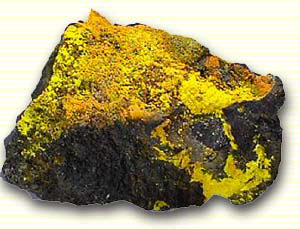
 Rosatom sells Honeymoon uranium mine in South Australia, SMH September 1, 2015 Simon Evans Russia’s state-owned nuclear energy company Rosatom has finally lost patience with the Honeymoon uranium project in northern South Australia and is selling it off to an ASX-listed minnow called Boss Resources.
Honeymoon is one of the five Australian uranium mines in Australia, four of which are located in South Australia, but it has been in mothballs for the past two years because of the plunge in uranium prices which made it uneconomic to continue mining from the site.
The Honeymoon mine is located about 75 kilometres north west of the town of Broken Hill and has been through a series of changes in ownership, the last being a buyout of the Canadian firm Uranium One by the Russian state-owned nuclear company Rosatom. This gave Rosatom ownership of Honeymoon.
Boss Resources chairman Evan Cranston told Fairfax Media on Tuesday that one of the big attractions was the 2600 square kilometre tenement package which came with the project…….
The complex buyout by Boss involves several components including a $2.4 million cash payment, a $200,000 “site access” fee and several milestone payments into the future if the mine does go into production again. http://www.smh.com.au/business/rosatom-sells-honeymoon-uranium-mine-in-south-australia-20150901-gjci9k.html#ixzz3kWS1eIJQ
Australian uranium company Paladin mothballing uneconomic project in Labrador, Canada
Aurora Energy suspending uranium exploration in Labrador, CBC News Company cites low prices for decision to mothball Labrador operation Sep 01, 2015 Aurora Energy has announced it is suspending uranium exploration in Labrador and is blaming lower commodity prices for the decision.
Ches Andersen, Aurora’s vice-president of Labrador affairs, said since there’s no mining underway, the parent company will mothball the Labrador operation…..
Aurora is a member of the Paladin Energy Ltd. Group of Companies, based in Australia.
Lifting of moratorium
The issue of uranium mining in Labrador has been a divisive one.
The Nunatsiavut government narrowly passed a controversial bill to put a moratorium on exploration in place in April 2008. The decision to lift the moratorium was made unanimously late in 2011….http://www.cbc.ca/news/canada/newfoundland-labrador/aurora-energy-suspending-uranium-exploration-in-labrador-1.3209939
1 This month


Help Aunty Sue Protect Her Land and Sacred Sites From Destructive Rocket Testing.
.

Australians deserve the truth
about
AUKUS – https://aukuspublicinquiry.com/

PETITION – To: Prime Minister Anthony Albanese and the Australian Labor Government

of the week – Australians for War Powers Reform (AWPR)
To see nuclear-related stories in greater depth and intensity

