Behind the plans for Australia to become a nuclear dumping ground and leverage synergies with the US military alliance and civilian nuclear

THE FIFTH ESTATE, MURRAY HOGARTH, 22 JULY 2024
The Nuclear Files: The pro-nuke lobby that surrounds the Liberal-National coalition wants Australia to become a fully-fledged nuclear nation – and a permanent dumping ground for the world’s high-level radioactive reactor waste.
“They want it all,” warns long-time anti-nuclear campaigner Dave Sweeney, from the Australian Conservation Foundation (ACF), which is leading the environment movement’s counterattack on the coalition’s nuclear insurgency: “They want Australia to adopt the full nuclear cycle, from cradle to grave.”
The far-reaching ambitions of the pro-nuclear campaign were revealed at their Navigating Nuclear event in Sydney earlier this year, formally opened by the Opposition’s nuclear torchbearer Ted O’Brien MP, and attended by The Fifth Estate.
O’Brien’s enthusiasm for the “big brains” and “calibre of people” in the room at the event, the “big idea” of nuclear energy for Australia, and his job to “listen and learn” is all on show in the video of his opening address.
These nuclear influencers, who have helped to shape the Peter Dutton led coalition’s still-emerging nuclear policy over the past two years, are looking well beyond overturning Australia’s ban on nuclear energy, which would clear the path to build reactors.
Navigating Nuclear, which was promoted as being all about “the facts”, but rapidly descended into a propaganda exercise, heard from one an MIT professor, name about extraordinary ambitions for an all in nuclear Australia:
- Most controversially, becoming the world’s repository for high-level nuclear reactor waste, with America’s output alone worth $US1 billion a year
- Leveraging the AUKUS nuclear submarine military pact with the US and the UK to drive a civilian nuclear industry
- Challenging for the title of global number one uranium producer, which has long been an ambition for the powerful Minerals Council of Australia (MCA) and
- Even building reactors in our arid lands to make the deserts bloom with agriculture fed by nuclear-powered water desalination plants.
However unlikely, crazy or dangerous these plans to go beyond nuclear energy may sound, they are being openly proposed within the pro-nuke lobby.
As the ACF’s Sweeney makes clear, this is because pro-nuclear advocates, both here and internationally, want Australia to take a seat at the table with Big Nuke’. This means participating in multiple aspects of the nuclear fuel cycle, from mining more and more uranium through to high level radioactive waste disposal as a global service.
The only thing off the table, at least for now, seems to be Australia joining ranks of nations that are nuclear weapons capable. But even that deep redline has been flirted with in recent months, with Jim Seth, a WA Liberal state executive extolling the benefits of nuclear weapons
His sentiments were echoed in a recent discussion paper from the Australian Strategic Policy Institute suggesting that uncertainty with the AUKUS deal necessitates that “discrete thinking must start now to address these potentially program-killing issues. A Plan B that raises alternatives must be developed. These must include, if China is indeed perceived as a possibly existential threat, the option of Australian nuclear weapons”.
While Sweeney and other critics of Dutton’s domestic nuclear plan do not see nuclear weapons as the inevitable next step they do loudly warn of the voracious appetite of the ideological drivers of the nuclear push and the dangers of nuclear normalisation and mission creep.
“Australians would be wise to be very cautious”, says Sweeney. “Some of the current crop of nuclear promoters absolutely want an Atomic Australia. Their vision is one of unfettered uranium mining and enrichment, fuel processing, domestic nuclear power, national and international radioactive waste storage and Australia to have or host nuclear weapons and war fighting capacity. If they are successful, we will all be far poorer – forever”.
The sheer scale of nuclear ambition was made clear at the all-day Navigating Nuclear workshop, which as well as being opened by O’Brien, the shadow minister for climate change and energy, was attended by his senior adviser, James Fleay, and another outspokenly pro-nuclear coalition MP, the National Party’s David Gillespie.
This is in spite of the event originally promoted as “politicsfree”.
One of the keynote international speakers, Professor Jacopo Buongiorno, based at the Massachusetts Institute of Technology in Boston a top US outlined the economic opportunity for Australia to take the world’s radioactive waste.
Buongiorno estimated that American reactors alone produce $US1 billion worth of high level waste each year.
Currently this waste in the US has been stored for decade above ground at reactor sites, even after decommissioning, Buongiorno said.
This is the same methodology O’Brien is proposing for the seven preferred sites for reactors that it has identified in Australia, which he has said could have operating lives of 60, 80 or even 100 years.
High-level radioactive waste is a hot button issue for the public. Australia has decades of deeply contested history to find a site to accommodate permanent disposal of low and intermediate level radioactive waste from the Australian Nuclear Science and Technology Organisation’s Lucas Heights facility and other sources such as medical.
Commercial reactor waste is hot dangerous and extremely long lived
Sweeney warns that: “Commercial reactor waste is a whole different ball game – hot, dangerous and extremely long lived, the current international best practice for its long term disposal requires very expensive confinement in purpose built facilities, located deep underground in highly geologically stable areas.”
Ultimately, the waste held indefinitely in so-called “dry casks” spread around America is meant to end up in such facilities, but so far, the Americans have never gotten around to actually doing it, in part at least because it costs a bomb!
It’s difficult to imagine a more controversial proposal for Australia’s future than becoming a nuclear dumping ground for the world’s reactor waste, at least part of which will remain dangerously radioactive for many tens of thousands of years.
Sweeney says: “Previous attempts to advance high level global radioactive waste disposal in WA in the 1990s and more recently in South Australia last decade foundered on the jagged rocks of hostile politics, community concern and deep First Nation opposition. But neither the nuclear industry’s waste, nor its need to be seen to have a pathway for disposing of this, has gone away.”
Overseas observers see Australia offers “a convenient postcode to store a permanent poison,” Sweeney says.
They have followers closer to home, including former Foreign Minister Alexander Downer. In a June 2024 column in Adelaide’s The Advertiser, Downer argued that hospitals, schools and roads could all be paid for by a nuclear waste storage facility servicing Australia and other parts of the world, which could reap tens of billions of dollars in revenue, which he based on a state Labor-commissioned 2016 royal commission report.”
Even the World Nuclear Association, the industry’s own PR front, says:
The radioactivity of nuclear waste naturally decays and has a finite radiotoxic lifetime. Within a period of 1000 to10,000 years, the radioactivity of HLW (high-level waste) decays to that of the originally mined ore. Its hazard then depends on how concentrated it is … Most nuclear waste produced is hazardous, due to its radioactivity, for only a few tens of years and is routinely disposed of in near-surface disposal facilities. Only a small volume of nuclear waste (~3 per cent of the total) is long-lived and highly radioactive and requires isolation from the environment for many thousands of years.
Sweeney has been close to multiple community fights around plans to site global and national radioactive waste facilities throughout remote and regional Australia.
His experience over decades has seen many promises and scant progress. “Radioactive waste is a serious and unresolved management issue here and overseas. It needs to be isolated and secured from people and the wider environment for staggering periods of time – up to 100,000 years. It lasts longer than any politician’s promise and needs serious attention and management. It should always be approached through the lens of responsibility and human and environmental health, not shouted and touted as a revenue stream.”
O’Brien and his senior adviser Fleay were in the Navigating Nuclear audience when Buongiorno, outlined a series of major nuclear related options for Australia, including the world’s waste dump “opportunity”………………………………………………………………………………………..
What about the security risk and the synergy between military alliance and a civilian nuclear industry?…………………………………………………………..
Such security and proliferation concerns were not high on Buongiorno’s radar as he also cited leveraging AUKUS as another key opportunity for Australia, seeing clear synergies between the military alliance and a civilian nuclear industry.
This is despite then Prime Minister Scott Morrison being very clear of a distinction between AUKUS and any domestic nuclear industry when he stated, “Australia is not seeking to acquire nuclear weapons or establish a civil nuclear capability.
Sweeney warns: “But that was then. Now the coalition has landed on nuclear as a key plank in the lead up to the next election, AUKUS is now being promoted as a driver and enabler and a convenient political wedge to attempt to blunt Labor’s sustained criticism.” …….
more https://thefifthestate.com.au/columns/columns-columns/the-nuclear-files/behind-the-plans-for-australia-to-become-a-nuclear-dumping-ground-and-leverage-synergies-with-the-us-military-alliance-and-civilian-nuclear/
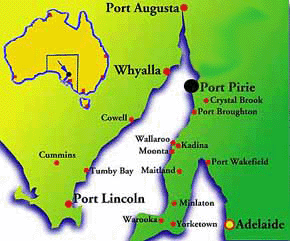
Indigenous group considers legal battle over proposed Port Augusta nuclear power plant
ABC Stateline / By Arj Ganesan and James Wakelin 21 July 24
In short:
Earmarking Port Augusta for the opposition’s nuclear plan has proved wildly unpopular with Indigenous leaders, who say mining and dumping nuclear material is akin to “killing your mother”.
Others say they believe Australia is lagging behind and needs to embrace nuclear energy.
What’s next?
Questions remain, with voters saying they are still in the dark about how much the plan will cost and how the privately owned land would be acquired.
Earmarking Port Augusta for Peter Dutton’s nuclear plan has proved wildly unpopular with an Indigenous leader, who says he feels so strongly about the issue that he is willing to go to court to fight the proposal.
Nukunu elder Lindsay Thomas said his community was against mining fissionable elements, such as uranium as a whole.
“Our people don’t believe in this, we don’t believe it should have even been dug out of the ground anywhere in Australia,” he said.
“We believe it’s poison.”
Mr Thomas said First Nations people had a spiritual connection to the land and he was proud of the work the Barngarla people had done in stopping the federal government’s attempt to dump nuclear medical waste in Kimba.
“You put that stuff in the ground, that kills that earth forever, we can’t do that, we cannot do that,” he said.
“That’s like killing your mother.”
Some locals concerned nuclear is too risky
Citizen scientist and master diver Jeff Bowey is also opposed to Port Augusta as a location for nuclear energy.
Mr Bowey said it was too risky as the water around the Upper Spencer Gulf took “three to five years” to move through.
“You get a spill or some impact into the Gulf itself, you literally destroy what we’ve got,” he said.
“The Gulf is on a knife’s edge, all we need is like one little bit more impact and we’ll probably lose the Gulf and all of the positives that it has.
“We have species here — animals, fish life, plant life, marine life — that’s found nowhere else on earth…………………………………………………………………………………..
Many questions regarding the proposed plant remain.
Voters are still in the dark about how much the plan will cost or how the government will acquire the privately owned land…………………….. https://www.abc.net.au/news/2024-07-21/port-augusta-nuclear-power-plant-legal-battle/104105048
AUKUS – Australia-United Kingdom-United States nuclear pact endangers us all

Agreement is proliferation nightmare
By Jemila Rushton https://beyondnuclearinternational.org/2024/07/21/agreement-is-proliferation-nightmare/—
Australia arms up with UK and US help
The following is a statement to be delivered on July 23 at the 2024 Nuclear Non-Proliferation Treaty Preparatory Committee event in Geneva by Jemila Rushton, Acting Director, International Campaign to Abolish Nuclear Weapons, Australia. It was endorsed by a number of groups, including Beyond Nuclear. It has been adapted slightly for style as a written piece rather than oral delivery.
We gather in uncertain and dangerous times. All nine nuclear armed states are investing in modernizing their arsenals, none are winding back policies for their use. The number of available deployed nuclear weapons is increasing. We do not have the luxuries of time or inaction.
Against this background where the proliferation of nuclear weapons is an ongoing concern, Australia, the United Kingdom and the United States of America continue to further develop AUKUS, an expanded trilateral security partnership between these three governments.
AUKUS has two pillars. Pillar One was first announced in September 2021 and relates to information, training and technologies being shared by the US and UK to Australia to deliver eight nuclear powered submarines to Australia. Vessels which, if they eventuate, will utilize significant quantities of highly enriched uranium (HEU). It also allows Australia to purchase existing US nuclear submarines. Currently, Australia is committing billions of dollars to both US and UK submarine industry facilities as part of the AUKUS agreement, potentially enabling the further development of nuclear armed capability in these programs.
Two years ago, during the 2022 NPT Review Conference, many governments expressed concern that the AUKUS nuclear submarine deal would undermine the NPT, increase regional tensions, lead to proliferation, and threaten nuclear accidents in the ocean. There remains an urgent need to critique the nuclear proliferation risks posed by AUKUS.
The Australian decision to enter into agreements around nuclear powered submarines was made on the assumption that it would be permitted to divert nuclear material for a non-prescribed military purpose, by utilizing Paragraph 14 of the International Atomic Agency’s (IAEA) Comprehensive Safeguards Agreement (CSA). The ‘loophole’ of Paragraph 14 potentially allows non-nuclear armed states to acquire nuclear material, which would be removed from IAEA safeguards.
Australia’s proposed acquisition of large quantities of HEU outside of usual IAEA safeguards and scrutiny jeopardizes nonproliferation efforts and fissile material security. This conference has the mandate to prepare recommendations for the upcoming Review Conference to strengthen rather than weaken the global nonproliferation regime by moving to close the Paragraph 14 loophole. States represented here should negotiate the closure of the Paragraph 14 loophole in the NPT, as it permits Australia and other non-nuclear armed states to obtain nuclear-powered submarines and potentially weapons-grade HEU.
To eliminate the risk of non nuclear weapons states acquiring nuclear weapons grade HEU, all states, including AUKUS members, should refrain from sharing the technology and materials that will be transferred if Australia and others acquire nuclear-powered submarines. The paragraph 14 loophole undermines the NPT and needs to be closed.
Pillar Two of AUKUS plans to enhance the joint capabilities and interoperability between the partners, and may draw in other countries to AUKUS. This move is vastly out of step with a strong sense of Pacific regionalism and the long-standing commitment to a Nuclear Free Pacific. The South Pacific Nuclear Free Zone Treaty (Treaty of Rarotonga) is being put under strain in this agreement. It is of grave concern that currently Japan, Canada and Aotearoa/New Zealand are actively considering their engagement with AUKUS Pillar 2.
We are concerned that the AUKUS trilateral partnership, and any further expansions will exacerbate regional tensions, fuel an arms race and increase risks of war in the Asia-Pacific region, particularly involving China and the United States, and will increase the danger of nuclear escalation in any such conflict.
Within Australia, First Nations communities have expressed deep concern about the imposition of new military and radioactive waste facilities on their lands. First Nations and broader communities across Australia and throughout the Pacific have noted that AUKUS is part of a rapid militarization of the region, and raises the ever-present threat of nuclear conflict. Recognizing the disproportionate impacts of previous nuclear activities on First Nations or Indigenous Peoples, and the on-going legacies of nuclear weapons testing and activities in the region, there is deep concern for what AUKUS will mean for sovereignty of Small Island States and its impacts on Indigenous lands and Peoples.
The fuel for HEU naval propulsion reactors is weapons-grade, and the spent fuel is weapons-usable. HEU is the most suitable material for ready and rapid conversion into a nuclear bomb. While removing HEU from a submarine would not be an easy process, the possibility of diverting such material for weapons purposes cannot be ruled out. Meaningful safeguards are extremely limited when the material is on a stealth platform that can disappear for six months at a time.
With the entry into force of the UN Treaty on the Prohibition of Nuclear Weapons (TPNW), there is a mandate to strengthen existing non-proliferation mechanisms. By joining the TPNW, governments can legally confirm that they will not acquire or host nuclear weapons, nor assist with their use or threat of use. We affirm that AUKUS members should make firm their commitments to nuclear non-proliferation and disarmament by joining the TPNW as a matter of urgency.
Jemila Rushton is the Acting Director, International Campaign to Abolish Nuclear Weapons, Australia
Australia: Opposition’s nuclear power plans open the door for nuclear weapons
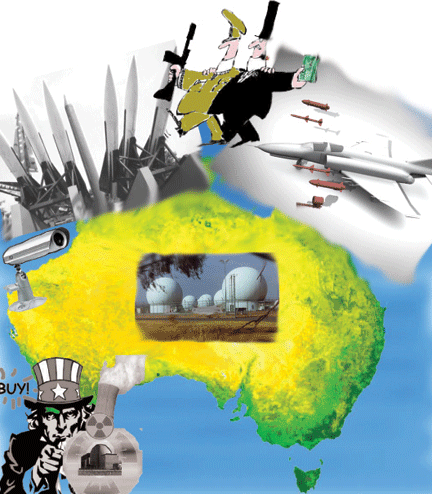
Barely mentioned is the potential of a nuclear power industry to provide a pathway for the development of nuclear weapons: first, by providing a large pool of nuclear scientists, engineers and technicians and, second, by creating the means to manufacture the fissionable material needed for a bomb. The latter would require further heavy investment in either a uranium enrichment plant or a plutonium reprocessing plant, or both.
Such a discussion has been underway largely behind closed doors in strategic and military circles for decades.
WSWS, Peter Symonds, 19 July 24
Federal opposition leader Peter Dutton’s announcement last month that the Liberal-National Coalition would build seven nuclear power plants seeks to overturn longstanding official opposition to nuclear energy, entrenched in state and federal law. Currently, Australia has just one nuclear reactor, operated by the Australian Nuclear Science and Technology Organisation (ANSTO) for research and the production of medical isotopes.
Dutton slammed Prime Minister Anthony Albanese’s Labor government for its reliance on renewables, claiming that nuclear power would provide cheap, reliable, environmentally-friendly energy for households and businesses. He dismissed problematic issues of nuclear waste and safety by pointing out that the Albanese government had already ditched Labor’s nuclear-free policy by embracing the acquisition of nuclear-powered attack submarines under the AUKUS pact with the UK and US.
In the ensuing wave of commentary on the nuclear power proposal, critics derided Dutton’s lack of detail, including costings, and pointed out that nuclear reactors would not be operational for at least a decade. Advocates of the profitable renewable industries touted solar and wind power as the cheap, clean, safe alternatives to nuclear power.
Barely mentioned is the potential of a nuclear power industry to provide a pathway for the development of nuclear weapons: first, by providing a large pool of nuclear scientists, engineers and technicians and, second, by creating the means to manufacture the fissionable material needed for a bomb. The latter would require further heavy investment in either a uranium enrichment plant or a plutonium reprocessing plant, or both.
Such a discussion has been underway largely behind closed doors in strategic and military circles for decades. Plans for an Australian atomic bomb were seriously considered in the 1950s and 1960s, with the 1968‒71 Coalition government of Prime Minister John Gorton taking the first steps in building a nuclear power reactor that provided a route to manufacturing a nuclear weapon.
In the midst of the Cold War, however, Washington was determined to maintain the effective monopoly of its massive nuclear arsenal and thus its use as a menacing threat or in war itself against the Soviet Union or any other potential rival. Under the guise of disarmament, the Nuclear Non-Proliferation Treaty (NPT) banned the manufacture of nuclear weapons except for the five countries with a known nuclear arsenal—the US, the Soviet Union, Britain, France and China—and effectively stymied the Australian project as well as most similar plans by other countries. Australia signed the NPT in 1971 and ratified it in 1973.
The global geopolitical landscape, however, has dramatically changed since the dissolution of the Soviet Union in 1991 and the end of the Cold War. Far from bringing global peace and prosperity, US imperialism has been waging war for the past three decades in a desperate attempt to maintain its global hegemony. Conflicts in the Middle East and Central Asia are now rapidly metastasizing into great power conflicts and world war involving nuclear-armed powers. The US and its NATO allies are already waging war against Russia in Ukraine and, in league with its Asian allies, including Australia, preparing for war against China.
In this context, as the danger of nuclear war looms larger, debate has reemerged in military circles over the building of an Australian atomic bomb. In his book How to Defend Australia, published in 2019, prominent strategic analyst Hugh White devoted an entire chapter to the question: “Does Australia need its own nuclear weapons to preserve its strategic independence in the decades ahead?”
The way White posed the question points to the central argument of the book as a whole—the necessity of Australian imperialism forging a foreign and military policy that does not rely on America’s waning power.
………………………………. In the Indo-Pacific, the US has been preparing for war with China, which Washington regards as the chief threat to its global domination. Far from leaving Australia isolated, the US is integrating the Australian military directly into its war plans against China—the AUKUS pact being the most obvious expression. This places the Australian population on the front lines of such a war.
White speaks for a minority in the ruling class that doubts the wisdom of being drawn into a catastrophic military conflict with Australia’s biggest trade partner. He and others argue for Australian imperialism to adopt a stance of heavily-armed neutrality. While not explicitly calling for an Australian nuclear weapon, White’s book certainly implied its necessity. Grossly inflating the threat posed by China, he argued that without the protection of the US, the only realistic means of countering such a threat is for Australia to have its own nuclear armaments.
……………………………………………………………………………………………………………………US imperialism is already, in reality, engaged in a war with nuclear-armed Russia in Ukraine and making advanced preparations for conflict with nuclear-armed China. The Australian military, including its bases, forms a vital component of the Pentagon’s strategy for fighting a nuclear war and, thus, a potential nuclear target. American nuclear submarines and nuclear-capable strategic bombers are being stationed in western and northern Australia. US spy and communications bases in Australia are indispensable to the US military’s global war plans. In other words, if US imperialism launches nuclear war, Australian imperialism is automatically involved……………………………………………………………………………………..more https://www.wsws.org/en/articles/2024/07/20/qxon-j20.html—
Nuclear power plan puts thousands of farms in “radiation alert zone”
ReNewEconomy, Stephanie Gardiner, Jul 18, 2024
Nuclear energy threatens Australia’s food production with more than 11,000 farms near the opposition’s proposed reactor sites, the government says.
The farms are located within an 80km radius of the seven earmarked sites, according to a data analysis released by the federal government on Thursday morning.
Under international standards that radius is classified as an “ingestion exposure pathway” in which people may be exposed to radiation through contaminated food, milk and water after a nuclear leak.
US farmers in those zones must take on preventative measures in an emergency, such as providing livestock with separate feed and water, holding shipments and decontaminating produce.
“Based on international practice, farmers would need to take expensive steps during a nuclear leak and would need to inform their customers that they operate within the fallout zone,” Agriculture Minister Murray Watt said in a statement.
“It’s bizarre that the Nationals and Liberals are putting at risk our prime agricultural land like this, especially without the decency to explain it to farmers and consumers how they’d mitigate all the potential impacts.”
Senator Watt also told the Australian Global Food Forum on Wednesday that nuclear power needs more water than coal-fired energy and renewables.
“One issue not yet considered in the nuclear debate is the fact that nuclear energy production is a thirsty endeavour,” he told the industry crowd in Brisbane.
………………………………………..There would be more than 1000 affected farms close to each of the sites at Callide, Collie, Liddell and Mount Piper, 2400 near Tarong and 260 near Port Augusta, according to the government’s analysis.
Victoria’s La Trobe region would be the hardest hit with more than 4100 farms within the 80km radius.
Nuclear power will be on the agenda as the nation’s agriculture ministers meet in Queensland on Thursday…. https://reneweconomy.com.au/nuclear-power-plan-puts-thousands-of-farms-in-radiation-alert-zone/
HMAS Stirling nuclear waste management facility approval has Rockingham residents worried
By Daryna Zadvirna and David Weber, 19 July 24 https://www.abc.net.au/news/2024-07-19/nuclear-waste-facility-at-hmas-stirling-rockingham/104114228
In short:
Australia’s nuclear safety watchdog has approved a plan to prepare for a radioactive waste facility at HMAS Stirling naval base in Perth’s south, for waste from nuclear submarines.
But local residents are worried about the potential for nuclear accidents and the impact on the environment.
What’s next?
Approval to begin construction will now be sought, followed by licences for control and operation of the facility, which is expected to open in 2027.
Rockingham residents have expressed alarm at the prospect of a radioactive waste facility at HMAS Stirling naval base on Garden Island, following a decision by the nuclear safety watchdog to approve one.
The Australian Radiation Protection and Nuclear Safety Agency (ARPANSA) has given the green light to prepare a site for the facility, which will be a workshop for servicing and repairing the vessels, and will store waste from nuclear powered submarines.
The facility will also need separate approvals for construction and operation.
The facility, about five kilometres off the coast of Rockingham, which is 50 kilometres south of Perth’s CBD, would provide low-level waste management and maintenance support.
Can the Voices model help communities fight off nuclear reactors?
By Bianca Hall and Mike Foley, July 20, 2024
Coal communities across the country – facing the loss of industry, jobs and the social fabric that binds them together – are poised to transition from the fossil fuel that built their histories.
But what the future will look like in towns like Lithgow in NSW and Traralgon in Victoria’s Latrobe Valley is far less certain. Will they pivot to privately owned renewables, or have government-owned and funded nuclear reactor sites imposed on them by a future Coalition government?
Community groups in every site nominated by Peter Dutton as a potential future nuclear site have joined forces to offer their answer to his proposal: no.
Wendy Farmer is president of Voices of the Valley, a community group that formed in the Latrobe Valley after the Hazelwood coal mine fire in 2014, which burned for 45 days and caused health concerns for those living there amid the smoke.
Farmer united community groups from each area nominated for a nuclear plant to campaign together against the plans. Together, they’ve formed an alliance representing seven communities to fight against the proposal, reminiscent of the independent Voices movement that sent Cathy McGowan to federal parliament in 2013 and has since been replicated across the country.
Already, two people are preparing to nominate as independent candidates to take the fight to the next election.
“I’m really hoping that it will show communities that united, we can really make a change,” she says. “We can actually demand what we want as community. To me, it’s really important that we just aren’t dumped on and told ‘this is what’s good for you, and this is what’s going to happen’.”
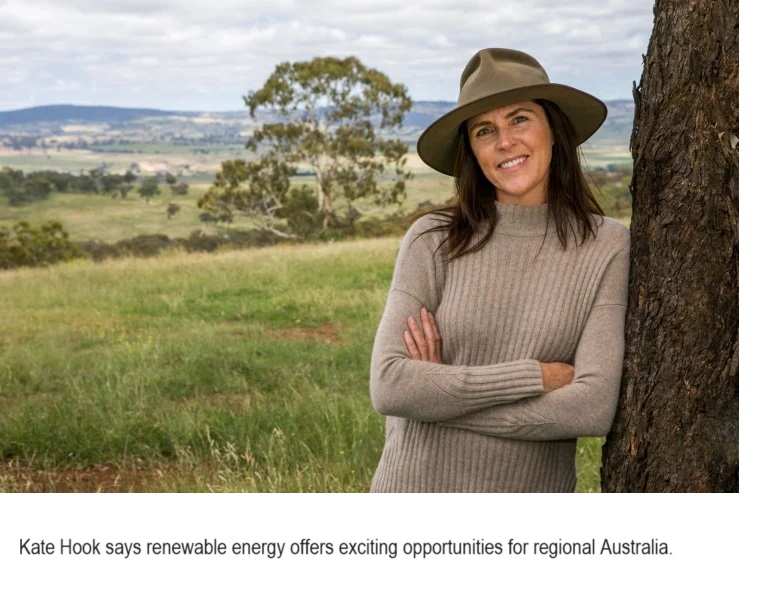
Kate Hook, who ran as an independent candidate in Calare in central western NSW in 2022, says she’s considering putting her hand up again at the next election against Nationals MP-turned-independent Andrew Gee.
Key to her candidacy, which she would run as a Voices-style campaign, is renewable energy and nuclear. “Is it a bunch of politicians who have just got together and said, ‘Here’s a talking point that will distract from renewable energy’?” she says.
“Because there is already something under way [the switch to renewables], which is an amazing opportunity for this region that we haven’t had in decades, and there’s a risk that that is squandered.”
AGL has announced its ambition to transform the sites of its coal-fired power stations in Victoria and NSW – the last of which is due to close in 2035 – into low-carbon energy “hubs” spanning renewable energy generation, big batteries and green tech manufacturing.
Meanwhile, Dutton in June nominated seven regional communities that he said would be home to nuclear reactors under a future Coalition government, at the sites of current or closing coal power plants.
They would be hosted at Lithgow and the Hunter Valley in NSW, Loy Yang in Victoria’s Latrobe Valley, Tarong and Callide in Queensland, Collie in Western Australia and Port Augusta in South Australia.
The announcement was made without consultation with the owners of the privately owned coal stations they would replace, according to several well-placed sources.
Unease about Dutton’s nuclear ambition isn’t limited to communities: local MPs are also wary of Dutton’s bid to build reactors on the sites of former coal-fired power plants.
Bathurst MP Paul Toole, who represents Lithgow in the NSW parliament for the Nationals, has criticised the lack of consultation by the federal opposition over the proposed takeover of the Mount Piper plant, about 20 kilometres north-west of Lithgow.
Rather than commit to the party line, he said he would back the community’s position. “I think the community feels as though they’ve been left in the dark,” Toole said last month. “The announcement lacks detail and raises more questions than answers. I’ll be backing the views of my community 100 per cent.”
Calare MP Andrew Gee, an independent who represents Lithgow in federal parliament, is also a sceptic of the opposition’s nuclear plans who has criticised lack of community consultation……………………………………………………………………………………..more https://www.theage.com.au/politics/federal/can-the-voices-model-help-communities-fight-off-nuclear-reactors-20240716-p5ju4o.html
Renewables caught in misinformation crossfire from Australia’s nuclear cheerleaders

Graham Readfearn, 18 July 24, https://www.theguardian.com/environment/article/2024/jul/18/renewables-caught-in-misinformation-crossfire-from-australias-nuclear-cheerleaders
Those pushing the nuclear option are making some questionable claims about the capacity of renewable energy.
Advocacy for the Coalition’s hopes to build nuclear power plants is increasingly coming with large side-orders of misinformation, not just on the speed or costs of nuclear but on renewables.
Dr Adi Paterson, the chair of the Nuclear for Australia advocacy group, has taken to attacking the credentials of CSIRO experts while going hyperbolic with his rhetoric.
When Paterson told Sky News he thought the agency’s report on the costs of different electricity generation technologies was “a form of fascism” there was not a whisper of disapproval from the surrounding studio panel. Mussolini would be turning in his grave.
The definitely-not-fascist GenCost report has found electricity from nuclear would be far more expensive than solar and wind, taking into account the cost of extra transmission lines and technologies to connect, store and rerelease renewable power.
Paterson claimed on the Sky news show Outsiders that the GenCost report “looks at one reactor in Finland”. In fact, the report had based the cost of large-scale reactors in Australia on South Korea’s long-running nuclear program – one of the most successful in the world.
Entrepreneur Dick Smith, a patron of Nuclear for Australia, has also tried to claim CSIRO used a “worst-case scenario” for nuclear costs. One leading energy analyst has previously told Temperature Check the opposite was more likely the case.
Paterson, a former boss of the Australian Nuclear Science and Technology Organisation, said in any case, he wanted to see Australia consider 5MW micro-reactors (less than the size of a large wind turbine, suggesting Paterson would like to see Australia scattered with tiny nuclear reactors).
He then pointed to Bill Gates’ Terrapower company and its project in Wyoming (which has a much higher proposed generation capacity of 345 MW), saying it was currently licensed and “being built now”.
In fact, as Terrapower’s chief executive told CNBC a couple of months ago, the company has only just submitted its construction permit application to the US Nuclear Regulatory Commission and hopes to get approval in 2026. They are doing some construction at the site, but none of it relates to the nuclear aspects of the plant.
Two days out of five?
Paterson has claimed wind turbines only generate electricity “two days out of five” or “37% of the time”.
Dr Dylan McConnell, an energy systems analyst at UNSW, said this was a “misleading” characterisation of windfarm performance.
McConnell said the 37% figure referred to something called the capacity factor – that is, how much electricity is generated over a given period relative to a windfarm’s maximum capacity.
“It is equivalent to implying that windfarms run at 100% of capacity two days out of five, and zero capacity three days out of five. This is of course not at all how windfarms or renewable energy generation works,” he said.
“They infrequently run at 100% of capacity. The converse of this is that they are often running just at levels below their full rated output – which is even more true across the whole fleet.”
McConnell points to data showing over the past year windfarms contributed about 12% of the total generation across the national electricity market (everywhere except WA and the NT) and while he said there was “a lot of variability”, there were no days when windfarms failed to generate.
He said: “Saying they work ‘two days out of every five’ is misunderstanding or a misrepresentation of the contribution of wind to the power system.”
Free pass for renewables?
Conservative economist and contributor to the Australian and the Spectator, Judith Sloan, has penned several pieces in recent weeks favouring nuclear power while making questionable claims about renewables.
In the Spectator, Sloan wrote that state governments “have allowed renewable energy companies to avoid the normal approval processes, including environmental assessments”.
Firstly, renewables projects are subject to both state and federal environmental assessments.
The federal environment minister, Tanya Plibersek, has assessed and approved more than 50 renewables projects – often with conditions attached – under current environmental laws, and rejected one windfarm in north Queensland in May because of potential impacts on nature. (The previous environment minister, Sussan Ley, also rejected a windfarm in 2020.)
Marilyne Crestias, interim chief executive at the Clean Energy Investor Group, said it was “inaccurate” to say that projects avoided environmental assessments at state level.
“Each state and territory has its own set of laws governing environmental assessments for renewable energy projects.
For example, in New South Wales, large-scale renewable energy projects must undergo an environmental impact assessment (EIA) under the Environmental Planning and Assessment Act 1979. Similarly in Victoria, projects are assessed under the Planning and Environment Act 1987 for their environmental, social and economic impacts. And in Queensland, the Environmental Protection Act 1994 requires environmental impact statements (EIS) for significant projects, including renewable energy developments. These assessments ensure that renewable energy projects are developed responsibly and sustainably.”
Talking to Sky, Sloan has said: “One of the worst aspects of [the renewables rollout] is that these renewable investors have never entered into an undertaking that they will remediate the land.”
Crestias said this was a “misconception”, saying developers typically did have agreements that included remediating the land.
“These agreements often cover the entire lifecycle of the project, from development through decommissioning,” she said.
“For instance, planning permits for windfarms in Victoria require developers to submit a decommissioning and rehabilitation plan before construction begins.”
BARNGARLA COURT WIN OVER NUCLEAR DUMP.

Jim Green, 18 July 23
Today, in a history making moment, The Federal Court of Australia through Her Honour Justice Charlesworth, handed down a decision which was favourable to the applicant the Barngarla Determination Aboriginal Corporation. This has resulted in the quashing of the decision to place the waste dump site at Napandee near Kimba.
“I am so happy for the women’s sites and dreaming on our country that are not in the firing line of a waste dump. I fought for all this time for my grandparents and for my future generations as well.” – Aunty Dawn Taylor, Barngarla Elder.
“This result today is about truth telling. The Barngarla fought for 21 years for Native Title rights over our lands, including Kimba and we weren’t going to stop fighting for this. We have always opposed a nuclear waste dump on our country and today is a big win for our community and elders.” – Jason Bilney, Chairperson Barngarla Determination Aboriginal Corporation.
“Every Australian, whether First Australians or more recent Australians have the right to independent scrutiny of Government. Today the Federal Court has set aside the declaration for the nuclear waste facility reinforcing how important these rights of independent review are. It has been a significant dispute which has created much pressure on Barngarla and their legal team they should be proud of their efforts to hold the government to account.” – Nick Llewellyn-Jones lawyer for Barngarla.
“The Barngarla have opposed the radioactive waste dump at Kimba since it was first suggested. We have fought for 7 years, to be heard, to be seen and to be respected. We welcome this decision and expect that this will be the end of this threat to our country, heritage and culture. We, the Barngarla have always stood strong and believe that this decision is reflective of staying steadfast; it shows that if you have a voice and want it to be heard, never give up. Continue to be loud. Continue to use your voice. Don’t rely on others to speak for you. Speak up for what’s right. Truth telling is what led us today. We are proud.” – The Barngarla People.
DUTTON’S RISKY NUCLEAR REACTOR PLAN THREATENS 12,000 FARMS
FOOD PRODUCTION ACROSS THE COUNTRY ON HIGH ALERT FROM DUTTON’S RISKY REACTOR PLAN
Agriculture Minister Murray Watt, 18 July 24
The fallout from Peter Dutton’s expensive and risky nuclear reactor announcement continues with new revelations that nearly 12,000 farms across Australia could be impacted.
The LNP’s announcement that nuclear reactors would be built at seven sites across the country could have serious implications for the agricultural sector.
The regions selected by Mr Dutton are major contributors to Australia’s food supply with significant cattle, milk, lamb, grain and vegetable production nearby.
Various states in the United States of America, including Illinois, California, Indiana, Maryland, Missouri and Florida set out detailed guidelines to be followed by farmers, processors and distributors within an 80-kilometere radius of nuclear reactors (known as the “ingestion zone”) to protect their food supply, in the event of a nuclear accident.
Analysis of ABS and local government data by the Parliamentary Library has found approximately 11,955 farms are located within an 80-kilometre radius of the Coalition’s selected sites.
Mr Dutton must urgently explain whether Australian farmers, processors and distributors within a similar ingestion zone will be forced to replicate the expensive actions recommended by American counterparts.
On top of this, leaks have occurred in recent years at nuclear reactors in the United States, Japan, India and Europe, in some cases contaminating agricultural land, crops and water sources.
Eating contaminated foods and drinking contaminated milk and water could have a harmful, long-term effect on the health of the wider community.
Mr Dutton needs to explain his plan to prevent such leaks, how he will manage them if they occur and how he would compensate affected farmers.
Agriculture Minister Murray Watt: –
“Peter Dutton’s risky nuclear plan is not only expensive, slow and unreliable, it also poses a threat to the agricultural industry.
“Based on international practice, farmers would need to take expensive steps during a nuclear leak and would need to inform their customers that they operate within the fallout zone.
“It’s bizarre that the Nationals and Liberals are putting at risk our prime agricultural land like this, especially without the decency to explain it to farmers and consumers how they’d mitigate all the potential impacts.”
BACKGROUND:
Parliamentary library analysis of farm businesses within the 80km ingestion zone of each proposed reactor.
- Collie (WA): Approximately 1,150 agricultural establishments. Major agricultural products include beef cattle, milk, lamb, barley, and carrots.
- Callide (Qld): Approximately 1,040 agricultural establishments. Major agricultural products include beef cattle, cotton, vegetables, wheat, and herbs.
- Hunter (NSW): Approximately 1,650 agricultural establishments. Major agricultural products include beef cattle, milk, chicken (meat), eggs, and hay.
- Latrobe Valley (VIC): Approximately 4,175 agricultural establishments. Major agricultural products include milk, beef cattle, vegetables, applies, and strawberries.
- Mt Piper (NSW): Approximately 1,280 agricultural establishments. Major agricultural products include beef cattle, cultivated turf, lamb, mushrooms, and other vegetables.
- Port Augusta (SA): Approximately 260 agricultural establishments. Major agricultural products include wheat, barley, lamb, wool, hay, and eggs.
- South Burnett/Darling Downs (Qld): Approximately 2,400 agricultural establishments. Major agricultural products include beef cattle, pork, sorghum, cotton, and milk
Government moves quietly on towards radiation facility for nuclear submarine programme
ARPANSA approves siting licence for ASA Controlled Industrial Facility
17 July 2024
ARPANSA has issued a licence to the Australian Submarine Agency to prepare a site for the prescribed radiation facility known as the ‘Controlled Industrial Facility’. The proposed Controlled Industrial Facility will provide low-level waste management and maintenance services to support the Submarine Rotational Force – West program, which is being planned at the existing HMAS Stirling Navy Base, Garden Island, Rockingham, Western Australia.
ARPANSA is responsible for licensing Commonwealth entities that use or produce radiation and applies a
strict review and assessment process once a licence application is received………………………..
The siting licence approval is the first stage of a stringent licencing process that requires separate applications for siting, construction, operation and decommissioning.
Parliament is considering legislation to establish a dedicated naval nuclear power safety regulator, the Australian Naval Nuclear Power Safety Regulator (ANNPSR). Until the new regulator is established, ARPANSA will regulate nuclear and radiological safety for ASA.
Future applications for the Controlled Industrial Facility are likely to be made while ARPANSA remains the regulatory authority for nuclear and radiological safety for ASA. The CEO has committed to continuing to invite public comment on all future ASA facility licences considered by ARPANSA……,,, https://www.arpansa.gov.au/arpansa-approves-siting-licence-asa-controlled-industrial-facility?fbclid=IwZXh0bgNhZW0CMTEAAR1xXw4CRdQCPOLg3sp1MqQAl-RCQHby8KJjOf_X_BXL3OxmKyMmq2nH9Xw_aem_gN1-iDIpedU70PUZyyEqJQ&sfnsn=mo
Nuclear too slow to replace coal, and baseload “simply can’t compete” with wind and solar, AEMO boss says
Giles Parkinson, Jul 16, 2024, https://reneweconomy.com.au/nuclear-too-slow-to-replace-coal-and-baseload-simply-cant-compete-with-wind-and-solar-aemo-boss-says/
The head of the Australian Energy Market Operator, Daniel Westerman, has rejected nuclear power as an option to replace Australia’s ageing coal fleet, saying it is too slow and expensive, and that baseload power sources in any case won’t be able to compete in a grid dominated by wind and solar.
The comments by Westerman at the Clean Energy Summit in Sydney on Tuesday, come as the federal Coalition intensifies its push for nuclear power, outlining plans to build nuclear facilities at seven current and former coal generation sites across the country.
Westerman says the updated roadmap released by AEMO last month, known as the 2024 Integrated System Plan, does not consider nuclear because it remains outlawed in Australia and is not part of any government policy package. But he said it was clear from AEMO’s work with CSIRO in the GenCost report that nuclear was expensive, and too slow.
“To be clear, AEMO does not form the view that one form of energy is ‘good’ and another ‘bad’,” Westerman said.
“Our engineers and economists are focused on finding the least-cost path to reliable and affordable energy for Australian consumers.
“Even on the most optimistic outlook, nuclear power won’t be ready in time for the exit of Australia’s coal-fired power stations. And the imperative to replace that retiring coal generation is with us now.
“In fact, the old notion of “baseload” generation which runs constantly, then supplemented with “peaking generation” for the daily peaks in demand, simply does not reflect the way our power system works today, or into the future.
“When the sun is shining and wind is blowing, renewable generation produces energy at zero marginal cost, and “baseload” energy simply can’t compete. It is either pushed out of the market entirely, or has to sell its energy at a loss if it can’t flex up and down to absorb the peaks and troughs of variable renewable supply.
Westerman’s comments were echoed by Damien Nicks, the CEO of AGL Energy which is the country’s biggest producer of coal power, all of which will close by 2035.
“We haven’t got time to wait,” Nicks said. We need to build 12 GW of both firming and renewables over that period of time and we have to get on with it. Nuclear is not part of our strategy.”
Rob Wheals, the former head of gas company APA who now heads iron ore billionaire Andrew Forrest’s renewable investor Squadron Energy, agreed. “Nuclear does not actually solve the problem(of impending coal closures) …. we’ve got to get on with the job of building and rebuilding Australia’s energy system.”
The AEMO ISP outlines plans to deal with the expected retirement of all of Australia’s coal fleet over the next 10 to 15 years, and the costs involved to build new wind, solar and storage, as well as transmission lines – which AEMO puts at $122 billion.
That figure – along with the conclusions from the GenCost report – have been repeatedly attacked by the federal Coalition, right wing “think tanks” and mainstream media outlets. They claim that the ISP ignores costs such as networks, and consumer energy resources, which will be one of the major components of the transition.
Westerman rejected this. “It does not include the cost of distribution networks whose plans are made at a local level…and it does not include the cost of consumer devices like rooftop solar systems, because those investment decisions are made by consumers themselves,” he said.
The ISP maps out a dramatic transition in Australia’s main electricity grid, from around 60 gigawatts (GW) now, including 20 GW of rooftop solar, to more than 300 GW and more than 86 GW of rooftop solar, with demand doubling as a result of economic growth and electrification in homes, industry and transport.
This will require 60 GW of large scale wind (up from 12 GW now), 58 GW of large scale solar (up from 10 GW), and 44 GW of battery storage capacity.
It will also need 15 GW of gas capacity, up from 11.5 GW now, but that meant that around 13 GW of new capacity would be needed as much of existing capacity is ageing and will need to be replaced.
He said gas will not be used much – maybe just 5 per cent of the time – but it will be important to meet demand peaks, and also to fill gaps in so-called “dunkelflaute” the German word for extended wind and solar droughts which may be apparent in states like Victoria, particularly in winter.
One of the biggest challenges remains the management of consumer energy resources, particularly rooftop solar, which are largely uncontrolled. This meant that protocols had to be introduced to protect “minimum load” levels which would enable AEMO to remain control of the grid and keep the lights on.
Westerman said the overall pace of investment needs to increase, and the connections process – cited by investors as one of the biggest causes of project delays – also needs to be streamlined.
He said the capacity of new generation and storage projects in various stages of the connection process in the National Electricity Market had grown to close to 43 GW from 30 GW a year ago.
AEMO is also working on the engineering requirements to accommodate periods of 100 per cent renewables on the main grid. Already new milestones had been reached, including renewables reaching more than 70 per cent of NEM demand, rooftop solar alone providing 50 per cent of the NEM, and more than 100 per cent in South Australia.
He noted that South Australia, which leads the country and the world with a 70 per cent renewable share – wind and solar – over the past year, had also met more than 90 per cent of its supply with wind and solar, mostly rooftop PV, even when the state grid was electrically separated from the rest of the NEM as a result of a storm last year.
“Australia is leading the world in proving how to reliably source the majority of electricity for a developed economy from the wind and the sun.
China is installing the wind and solar equivalent of five large nuclear power stations per week

Instead of nuclear, solar is now intended to be the foundation of China’s new electricity generation system.
Who is going to be the economic winner in that global economic transition? It’s going to be China.”
energy experts are frustrated with the progress of Australia’s transition, including the discussion of nuclear power and the “weaponisation of dissent” from community groups over new wind farms and transmission lines.
ABC Science / By technology reporter James Purtill, 16 July 24, https://www.abc.net.au/news/science/2024-07-16/chinas-renewable-energy-boom-breaks-records/104086640
In short:
China is installing record amounts of solar and wind, while scaling back once-ambitious plans for nuclear.
While Australia is falling behind its renewables installation targets, China may meet its end-of-2030 target by the end of this month, according to a report.
What’s next?
Energy experts are looking to China, the world’s largest emitter and once a climate villain, for lessons on how to rapidly decarbonise.
While Australia debates the merits of going nuclear and frustration grows over the slower-than-needed rollout of solar and wind power, China is going all in on renewables.
New figures show the pace of its clean energy transition is roughly the equivalent of installing five large-scale nuclear power plants worth of renewables every week.
A report by Sydney-based think tank Climate Energy Finance (CEF) said China was installing renewables so rapidly it would meet its end-of-2030 target by the end of this month — or 6.5 years early.
It’s installing at least 10 gigawatts of wind and solar generation capacity every fortnight.
By comparison, experts have said the Coalition’s plan to build seven nuclear power plants would add fewer than 10GW of generation capacity to the grid some time after 2035.
Energy experts are looking to China, the world’s largest emitter, once seen as a climate villain, for lessons on how to go green, fast.
“We’ve seen America under President Biden throw a trillion dollars on the table [for clean energy],” CEF director Tim Buckley said.
“China’s response to that has been to double down and go twice as fast.”
Smart Energy Council CEO John Grimes, who recently returned from a Shanghai energy conference, said China has decarbonised its grid almost as quickly as Australia, despite having a much harder task due to the scale of its energy demand.
“They have clear targets and every part of their government is harnessed to deliver the plan,” he said.
China accounts for about a third of the world’s greenhouse gas emissions. A recent drop in emissions (the first since relaxing COVID-19 restrictions), combined with the decarbonisation of the power grid, may mean the country’s emissions have peaked.
“With the power sector going green, emissions are set to plateau and then progressively fall towards 2030 and beyond,” CEF China energy policy analyst Xuyang Dong said.
So how is China building and connecting panels so fast, and what’s the role of nuclear in its transition?
Like building solar farms near Perth to power Sydney
Because its large cities of the eastern seaboard are dominated by apartment buildings, China hasn’t seen an uptake of rooftop solar like in Australia.
To find space for all the solar panels and wind turbines required for the nation’s energy needs, the planners of China’s energy transition have looked west, to areas like the Gobi Desert.
The world’s largest solar and wind farms are being built on the western edge of the country and connected to the east via the world’s longest high-voltage transmission lines.
These lines are so long they could span the length of our continent.
In Australian terms, it’s the equivalent of using solar panels near Perth to power homes in Sydney.
Mr Buckley said China’s approach was similar to the Australian one of developing regional “renewable energy zones” for large-scale electricity generation.
“They’re doing what Australia is doing with renewable energy zones but they’re doing it on steroids,” he said.
What about ‘firming’ the grid?
One of the issues with switching a grid to intermittent renewables is ensuring a steady supply of power.
In technical terms, this is the difference between generation capacity (measured in gigawatts) and actual energy output (measured in gigawatt-hours, or generation over time).
Renewables have a “capacity factor” (the ratio of actual output to maximum potential generation) of about 25 per cent, whereas nuclear’s is as high as 90 per cent.
So although China is installing solar and wind generation equivalent to five large nuclear power plants per week, their output is closer to one nuclear plant per week.
Renewables account for more than half of installed capacity in China, but only amount to about one-fifth of actual energy output over a year, the CEF’s Tim Buckley said.
To “firm” or stabilise the supply of power from its renewable energy zones, China is using a mix of pumped hydro and battery storage, similar to Australia.
“They’re installing 1GW per month of pumped hydro storage,” Mr Buckley said.
“We’re struggling to build the 2GW Snowy 2.0 in 10 years.”
There are some major differences between Australia and China’s approaches, though. Somewhat counterintuitively, China has built dozens of coal-fired power stations alongside its renewable energy zones, to maintain the pace of its clean energy transition.
China was responsible for 95 per cent of the world’s new coal power construction activity last year.
The new plants are partly needed to meet demand for electricity, which has gone up as more energy-hungry sectors of the economy, like transport, are electrified.
The coal-fired plants are also being used, like the batteries and pumped hydro, to provide a stable supply of power down the transmission lines from renewable energy zones, balancing out the intermittent solar and wind.
Despite these new coal plants, coal’s share of total electricity generation in the country is falling.
The China Energy Council estimated renewables generation would overtake coal by the end of this year.
The CEF’s Xuyang Dong said despite the country’s reliance on coal, “having China go green at this speed and scale provides the world with a textbook to do the same”.
“China is installing every week the equivalent of what we’re doing every year.”
Despite this speed, China wasn’t installing renewables fast enough to meet its 2060 carbon neutrality target, she added.
“According to our analysis, [the current rate of installation] is not ambitious enough for China.”
What about nuclear?
China is building new nuclear plants, although nowhere near as fast as it once intended.
In 2011, Chinese authorities announced fission reactors would become the foundation of the country’s electricity generation system in the next “10 to 20 years”.
But Japan’s 2011 Fukushima disaster prompted a moratorium on inland nuclear plants, which have to use river water for cooling and are more vulnerable to frequent flooding.
Meanwhile, over the following decade, solar became the cheapest electricity in the world.
From 2010 to 2020, the installed cost of utility-scale solar PV declined by 81 per cent on a global average basis.
As well as cheap, it was safe, which made solar farms quicker to build than nuclear reactors.
Instead of nuclear, solar is now intended to be the foundation of China’s new electricity generation system.
Authorities have steadily downgraded plans for nuclear to dominate China’s energy generation. At present, the goal is 18 per cent of generation by 2060.
China installed 1GW of nuclear last year, compared to 300GW of solar and wind, Mr Buckley said.
“That says they’re all in on renewables.
“They had grand plans for nuclear to be massive but they’re behind on nuclear by a decade and five years ahead of schedule on solar and wind.”
How is China transitioning so fast?
In June of this year, on the eve of the Coalition’s nuclear policy announcement, former Queensland Premier Annastacia Palaszczuk, who’s now a Smart Energy Council “international ambassador”, led a delegation of Australians to the world’s largest clean energy conference in Shanghai.
The annual Smart Energy Conference hosts more than 600,000 delegates across three days.
Its scale underlines China’s increasing dominance of the global clean energy economy and, for some attendees, prompted unenviable comparisons with Australia’s progress.
Mr Buckley, who was part of the delegation, said he was “blown away”.
“China is winning this race.”
John Grimes, the Smart Energy Council CEO who also attended, said Australia could learn from the Chinese government’s ability to execute a long-term, difficult and costly transition plan, rather than relying on market forces to find a solution.
“Australia’s transition is going too slow, there was a lost decade of action,” he said.
“The world today spends about $7 trillion a year on coal, gas and oil and that money is going to find a new home.
Who is going to be the economic winner in that global economic transition? It’s going to be China.”
He and other energy experts are frustrated with the progress of Australia’s transition, including the discussion of nuclear power and the “weaponisation of dissent” from community groups over new wind farms and transmission lines.
Stephanie Bashir, CEO of the Nexa energy advisory, said Australia’s transition was tangled in red tape.
“The key hold-up for a lot of projects is the slow planning approvals,” Ms Bashir, who also attended the conference, said.
“In China they decide they’re going to do something and then they go and do it.”
The Australian Energy Market Operator’s (AEMO) plan to decarbonise the grid and ensure the lights stay on when the coal-fired power stations close requires thousands of kilometres of new transmission lines and large-scale solar and wind farms.
Australia is installing about half the amount of renewables per year required under the plan.
Due to this shortfall, many experts say its unlikely to meet its 2030 target of 82 per cent renewables in the grid and 43 per cent emissions reduction.
“We need to build 6GW each year from now until each power station closes, and so far we’re only bringing online 3GW,” Ms Bashir said.
“If we identify some projects are nation-building … and we need them for transition, we just have to get on with it.”
Mr Buckley predicted China would accelerate its deployment of renewables.
“My forecast is it will lift 20 per cent per annum on current levels.”
“Battering ram of bad faith actors:” Clean Energy Council says nuclear push causing confusion, delays and higher costs

Giles Parkinson, Jul 16, 2024, https://reneweconomy.com.au/battering-ram-of-bad-faith-actors-cec-says-nuclear-push-causing-confusion-delays-and-higher-costs/
The head of the Clean Energy Council, Kane Thornton, has launched a forceful attack on the pro-nuclear lobby, describing it as littered with bad faith actors, disinformation, and praying on a weakened mainstream media.
Thornton said Australia is poised to finally take advantage of its unique competitive advantage to produce low-cost, zero-emissions power that will transform the Australian economy, but the country’s ability to deliver reform and generational change is fragile and being undermined by vested interests.
“Bad faith actors are using a weakened media, praying on communities increasingly anxious about the uncertainty and tensions in the world around us to tear things down,” Thorntold said in an opening address to the Clean Energy Summit in Sydney on Tuesday.
“Vested interests are stepping up to tell their story and peppering it with mistruths and outright disinformation. They are undermining the very things that would build our nation’s future and resilience in an unstable world, to further their own short term political agenda.”
”The battering ram of bad faith actors today is nuclear power. We all know it’s several times more expensive than renewables and storage and is two decades away at best.”
Thornton noted that heavily promoted nuclear technologies such as small nuclear reactors still do not exist in commercial form, and coal power in Australia would be long gone before they could be delivered, if ever they could.”
Despite this reality, we are having a national debate about nuclear power. The Australian public are being confused and misled,” Thornton said.
”Investors know nuclear is not a commercially viable option for Australia and will never be realised here. But this debate is nevertheless deeply unhelpful for Australia’s international reputation as a safe place to invest, giving a perception that Australia’s energy policy remains deeply fractious and at risk of radical U-turns from one election to another.
”If we can’t have a sensible discussion about energy policy, then our problems as a nation go far beyond balancing our energy mix. We have suffered for over 15 years through the climate wars.
”These distractions and the inaction are why power prices are higher today and the energy transition is all the harder. It’s why we are playing catchup to reform our energy markets, fix and build out the grid, train the workforce, developing the standards and practices we should expect.”
Thornton said the rooftop solar market remained strong, and the battery storage market was also robust. “It’s the energy we need to charge these batteries that needs to happen much quicker,” he said.
Thornton said he hoped that the federal government’s Capacity Investment Scheme, which seeks 32 GW of new wind, solar and storage, will be one of the last “missing pieces” of the energy transition puzzle and help accelerate the rollout.
‘It needs to move quickly and deliver the investment confidence the market is seeking. If it works, we can expect a wave of large-scale renewable energy projects come forward,” he said.
But Thornton said that, given the disinformation around nuclear, the industry needed to work together to give confidence in the future of renewables.
“We need to recognise that change doesn’t always come easy. For some people it can create anxiety and uncertainty,” he said.
”They look for clarity, to people they trust. They want to understand lived experience and how new technology or projects in their community will impact their lives.”
Sealed away in steel and concrete is Australia’s nuclear waste legacy at Lucas Heights in Sydney’s south
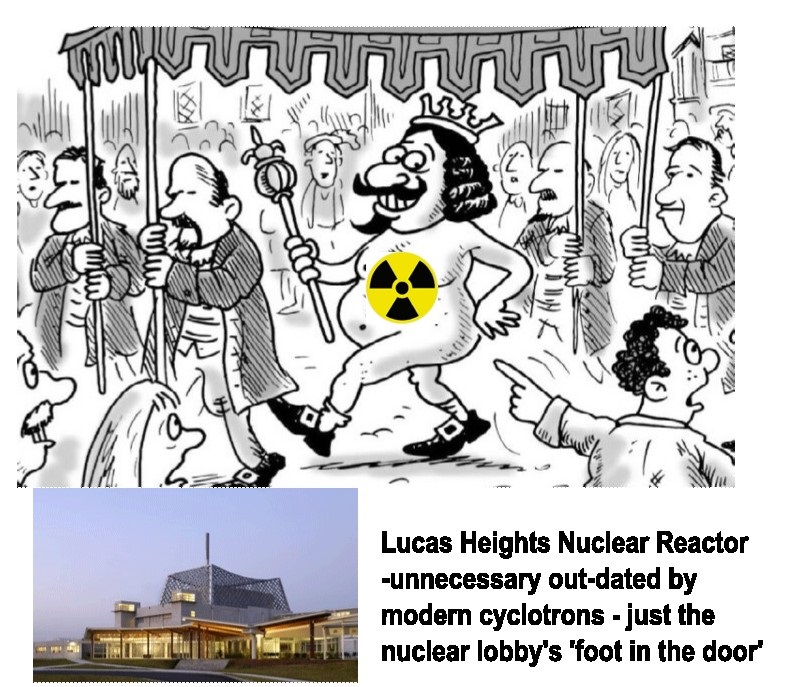
ABC News, By political reporter Matthew Doran, 15 July 24
Whenever there is a debate about nuclear power in Australia, one question regularly pops up: What do we do with the waste?
It can’t just be taken to the local dump along with garbage or rubble, and it has to be handled with immense care and stored in particular ways while it remains dangerous — sometimes for decades, and in the case of high level waste up to thousands of years.
Despite nuclear power generation still being a subject of political debate rather than reality, and nuclear-propelled submarines being decades away from being tied up at local docks, many Australians don’t know we are already producing, processing, and storing nuclear waste.
One of the largest repositories is Australia’s Nuclear Science and Technology Organisation (ANSTO) at the Lucas Heights nuclear facility, in Sydney’s south.
The ABC was invited inside……………………………………………………………………………………………………
The type of contaminated waste coming into the vast warehouse for assessment and processing is what’s classified as “low-level”.
Much of it includes items like rubber gloves, gowns, glassware, and old laboratory equipment from ANSTO’s nuclear medicine facility
It’s still contaminated and needs to be meticulously picked through, categorised, and stored away until it’s no longer dangerous, sealed away in the steel drums lining the shelves of multiple warehouses dotted across the Lucas Heights site.
Decades of legacy
Bags and bags of contaminated material sit in bins at the edge of the warehouse we’re standing in.
All the waste comes from ANSTO itself. While the organisation doesn’t store waste for others, it does assist with the material they produce………………. It’s brought into the warehouse, and scanned with high-tech machinery before ANSTO figures out the best way to store it – and for how long.
…. “A lot of the waste that we bring in is really very quickly able to be sent out to the normal tip, because working with nuclear medicine, which generates most of our waste, we have a lot of short-lived isotopes,” Paula Berghofer, head of waste management , says.
…………………………………………………………………………………………………………………… ANSTO’s Lucas Heights site is home to the only nuclear reactor in the country.
It’s a facility used to create radioactive isotopes for use in areas such as nuclear medicine. ……..
Lucas Heights’ OPAL reactor is currently undergoing maintenance.
It’s not used for power generation and doesn’t create waste anywhere near the level of radioactive material that would come from such a reactor.
However, that’s not to say there isn’t decades-old nuclear waste stored at the site.
Some drums and blocks of radioactive material, encased in concrete and steel tombs weighing many tons, have been here for decades.
Among them, are remnants of the original nuclear reactor at Lucas Heights – known as MOATA – which operated between 1961 and 1995, and was decommissioned 15 years ago.
“It will remain here, safely monitored and stored, until Australia has a disposal operation available for us to send it to,” Ms Berghofer says……………………………………………………………………………………………………………………
Offshore processing

There’s another warehouse, which looks a little different, on the Lucas Heights campus.
It’s newer. It’s taller. It’s wrapped in extra layers of security.
When you walk inside, it’s striking how empty it is. Apart from two huge cylinders, standing on their ends, at one side of the building
“While Australia has a very important role in the nuclear space, we are comparatively small, and we certainly don’t have the infrastructure or really the need or desire to install what is a very large price reprocessing facility here,” Ms Berghofer says.
“So it makes sense for us to have those international agreements, so that we can send this overseas to the experts, where they can reprocess it and send us back an equivalent.”
Again, these canisters are also intended for a national nuclear waste dump, once it is established. https://www.abc.net.au/news/2024-07-16/australias-nuclear-waste-legacy-lucas-heights-ansto/104091600
1 This month

of the week – Australians for War Powers Reform (AWPR)
To see nuclear-related stories in greater depth and intensity
 Antinuclear