South Australian government warned on using public money to encourage nuclear industry
“…..Greens MLC Mark Parnell has questioned why the Attorney-General’s Department is in charge of three tenders seeking on behalf of the Royal Commission business cases for the establishment of a nuclear power plant, a dump and an enrichment facility.
 “The Government must tread a very fine line between engaging in genuine open inquiry and actively promoting an expansion of the nuclear industry,’’ he said.
“It is illegal to spend any public money to “encourage” a nuclear waste facility in this State. The tender contract is in the name of the Attorney-General’s Department, so they will need to be very careful about any instructions they provide to tenderers about what to say or what not to say.” – Adelaide Now, August 14, 2015
Judge defending the NSW Land and Environment Court
 ‘If you have a degraded environment, you’re impoverished’: Justice Brian Preston, Peter Hannam ENVIRONMENT EDITOR, THE SYDNEY MORNING HERALD August 14, 2015 – Brian Preston, chief judge of NSW Land and Environment Court, joins Peter Hannam for a chat over lunch……. The Land and Environment Court was the first so-named court in the world when it was established in 1979, according to Ben Boer, Emeritus Professor at Sydney Law School and Preston’s first lecturer on environmental law, and a long-time friend and collaborator. There are now about 700 such courts globally.
But long before he got the top job at the court, he helped found another key organ of environmental law: the Environmental Defender’s Office of NSW.
It was the EDO that last week won a ruling in the Federal Court that found Environment Minister Greg Hunt had not properly considered advice on two threatened species, the Yakka skink and the ornamental snake, when approving Adani’s huge $16 billion Carmichael coal mine in Queensland.
The verdict prompted Prime Minister Tony Abbott to declare that courts were being used to “sabotage” mining projects, adding that Australia “must, in principle, favour projects like this”. The NSW Bar rejected the comments..
While our lunch preceded Mr Abbott’s outburst, Preston defended the importance of judicial independence, and later remarked that miners too often view environment checks as merely red tape.
Preston makes time for our lunch between his court duties, ongoing research for a book on environmentally sustainable development, and his work for a global effort to find ways the law can be used to curb climate change. He also teaches biodiversity law at Sydney University, and has helped develop environmental law in China and Thailand – two nations particularly in need of regulatory control –……..
He says that having a specialist court with judges well-read in environmental issues does not imply – as some miners argue – that developers won’t get a fair hearing.
“You should be environmentally literate,” he said. “All courts strive to make the right decision and you’re more likely to make that if you’ve got more knowledge.”……..http://www.smh.com.au/environment/lunch-with-justice-brian-preston-20150812-gixcdb.html
Guidelines for growing renewable energy in Victoria
 Four easy ways to grow renewable energy in Victoria, REneweconomy, By Leigh Ewbank on 12 August 2015 With the Abbott government sabotaging Australia’s clean energy future, states such as Victoria must step up and lead on renewable energy.
The uncertainty unleashed by the Abbott government has cost Australia’s renewable energy sector dearly. On the Prime Minister’s watch, investment has collapsed by 90 per cent and over 2,500 people working in the sector have lost their job.
Not content with its savage 20% cut to the national Renewable Energy Target, the Abbott government has dictated to the Clean Energy Finance Corporation that it can no longer invest in wind farms and rooftop solar power.
This is the context in which the Daniel Andrews government is developing its Renewable Energy Action Plan to grow the sector and jobs in Victoria.
The Andrews government has been sending all the right signals when it comes to renewable energy. It was elected with a commitment to repeal the Baillieu-era restrictions on wind farms. And it delivered on the commitment just months after taking office.
To date, the Andrews government has provided financial support for the Newstead community in it pursuit to be 100 per cent renewable by 2017, as well as a 30-KW community solar project in Woodend. It has also established a $20 million New Energy Fund to encourage investment in renewable energy and cleantech projects.
The Andrews government’s Renewable Energy Action Plan is due for release later in 2015 and will build on these positive first steps.
“We will do whatever we need to do to increase the total percentage of energy generated from clean sources but also do whatever we can to create more jobs,” Premier Andrews said while visiting the Ararat wind farm.
There are some straightforward ways the Victorian government can increase renewables before it announces its comprehensive plan. Continue reading
Strategy for developing Australia’s renewable energy
 In Australia, survey evidence has shown clearly that renewable energy is wildly popular (research and development on renewable and other low-emissions technologies also enjoys wide popularity across all climate-relevant segments of society), whereas fossil fuels, nuclear power, carbon taxes and increases in electricity bills are very unpopular. One conclusion from this evidence is clear: Labor’s renewable energy frame is likely to be appealing, and the Abbott Government’s fetishisation of coal is likely to be unappealing.
The first post in this three-part series compared the energy plans of Australia’s major political parties with the rest of the world. The second post considered the economics of Australia transitioning to a renewables-based energy system. When it comes to the politics of climate change and renewable energy, it is relevant to consider both strategy and tactics.
Climate change is not going to be solved with a single giant global treaty and a perfect emissions trading scheme. Climate action is not, internationally or domestically, a ‘one shot game’. As such, agents of climate action, including policymakers, must take seriously the idea that decarbonising global and national economic sectors will require a strategic approach. Continue reading
Australia will have to improve on its inadequate greenhouse gas emission pledge
 UN climate expert warns Australia’s emissions target should not be final offer, The Age, August 13, 2015 Nicole Hasham Environment and immigration correspondent Australia should not attend global talks in Paris refusing to budge on its greenhouse gas emission pledge, the UN’s scientific body on climate change has said, ahead of expected international pressure on the Abbott government to do better……….
In Canberra on Wednesday, Professor Jean-Pascal van Ypersele, vice-chairman of the UN Intergovernmental Panel on Climate Change, said the December talks in Paris were negotiations.
“No country can go to negotiations knowing or thinking, really, that the [emissions target] numbers cannot be touched,” he said. Professor van Ypersele said targets from each nation would be collated and assessed, adding the collective efforts may not be enough to keep warming below 2 degrees. That would lead to “a discussion on how to increase the level of ambition and who needs to increase it first”, he said.
While pledges from nations may not be formally negotiated at Paris, leaders will probably be urged to increase their ambitions, either during the conference or afterwards……….
On Wednesday Labor leader Bill Shorten said he would attend the Paris talks.
The Marshall Islands, a Pacific nation highly vulnerable to the effects of climate change, has decried Australia’s pledge as a “weak target” that erodes our international reputation.
Mr Abbott said the Minerals Council of Australia, which represents the mining industry, called the target is “ambitious”.
The target has been interpreted as an effort to placate climate sceptics in the community and the government, while doing the minimum needed to meet Australia’s international obligations.
Climate Institute deputy chief executive Erwin Jackson said Australia’s target was “not the end of the story”. “Countries in Paris will be under pressure to lift their ambitions,” he said.
“Both diplomatic and economic pressure is [also] going to build through time after Paris for countries to get in line with where the world needs to go, which is towards net zero emissions.” http://www.theage.com.au/federal-politics/political-news/un-climate-expert-warns-australias-emissions-target-should-not-be-final-offer-20150812-gixa98.html#ixzz3ijcqRmdX
Philip Adams – Late Night Live – gone over to the nuclear lobby?
 I was astounded to hear ABC Radio National’s Late Night Live programme last night. Philip Adams’ guests were two spruikers for the nuclear industry. Ben Heard, (occupational therapy graduate,now doing his PHd all about nuclear power – tutored by Australia’s top nuclear propagandist Barry Brook), and Hayden Manning Associate Professor with the School of Social and Policy Studies at Flinders University. Not a surprise that he’s from Flinders Uni – that seem sto bde abit of a hotbed for nuke spruiking, and with Prof Pam Sykes funded by DOE to find out how ionising radiation is good for mice.
SBS uranium documentary – mixed messages and a soft sell for nuclear lobby?
 A Critical Look at ‘Uranium: Twisting the Dragon’s Tail’, truthdig, Aug 9, 2015 By Stanley Heller A week or so before the 70th anniversary of the atomic bombing of Hiroshima, I watched a curious documentary on PBS. It was called “Uranium: Twisting the Dragon’s Tail.” You can see it here. The presenter was a physicist named Derek Muller. What’s odd is that Muller concludes that nuclear power is not the way to go, but the way the film was edited, the message is the opposite: that nuclear power is relatively safe and that its technical problems are at the point of being solved. Continue reading
Research finds gender divide on opinions on nuclear power versus solar
 More men back nuclear, women like solar: climate change gender divide found, The Age, August 10, 2015 Nicole Hasham Environment and immigration correspondent If the climate change debate wasn’t polarised enough, another divide has opened up: the attitudes of men versus those of women.
Climate Institute research published on Monday confirms Australian men are more likely than women to believe climate change is not happening, and to prefer nuclear and coal as energy sources. Women, meanwhile, are more inclined than men to support wind and solar power, and take the view backed by the vast majority of the world’s scientists – that climate change is real.
Ian Dunlop, a former international oil, gas and coal industry executive who is now a director of not-for-profit think tank Australia21, said gender differences were a “fundamental issue” holding back climate action.
“The male incumbency in the business and political world have not been prepared to engage with that discussion,” he said, deriding a dominant culture of “macho short-termism”. “I think women on the other hand are actually more conscious of the … world we are heading into and [that] we need to start doing something about it.”………
The United Nations has previously said women in poor nations bear the disproportionate burden of climate change, but are largely overlooked in the debate about how to address effects such as rising seas, droughts and extreme weather.
The founder of 1 million women, Natalie Isaacs, whose organisation encourages women to act on climate change through the way they live, said protecting future generations “is a hot button issue for women”. She said women made 85 per cent of consumer decisions that affect a household’s carbon footprint.
Mr Dunlop, former chairman of the Australian Coal Association and former chief executive of the Australian Institute of Company Directors, said women were more likely than men to see climate change as an “existential issue”. “The male approach to this thing is [often] saying it is all nonsense, it’s all just alarmism,” he said.
It has been argued that advocates for climate action should frame their message around defending the status quo, to encourage more men to confront the problem. http://www.theage.com.au/federal-politics/political-news/men-back-nuclear-women-like-solar-climate-change-gender-divide-found-20150809-giv5vk.html#ixzz3iZgnCE00
Abbott snubs UN climate talks in December
 Abbott won’t attend UN climate change talk http://www.heraldsun.com.au/news/breaking-news/abbott-wont-attend-un-climate-change-talk/story-fni0xqi4-1227478782154 PRIME Minister Tony Abbott won’t attend the United Nations climate change summit at the end of the year.
INSTEAD, he will send Foreign Minister Julie Bishop to Paris for the talks to nut out a post-2020 global approach to dealing with climate change.
Labor says if world leaders like US President Barack Obama can find time to attend there is no excuse Mr Abbott can’t as well.
South Australian Premier critical of BHP as the company cuts even more jobs
“Our strategy has always been about the diversification of the South Australian economy and I think that we’ve been working on many fronts. Whether it’s education, health industries, tourism, defence … this is an economy of many moving parts,” Mr Weatherill said.
SA Premier Jay Weatherill refuses to explain BHP Billiton’s ‘bad news’ after jobs cut announcement 891 ABC Adelaide , 11 Aug 15,
Mr Weatherill said the company needed to “front the media” after its announcement this week that jobs would go at the mine, including those of technicians, scientists, engineers and supervisors.
It follows on from the loss of 230 positions in South Australia earlier this year.
Mr Weatherill defended the Government’s record on embracing the mining industry and BHP’s expansion plans for the mine. Continue reading
Australian govt’s emissions target is flimsy, but Abbott has no intention of meeting even that
Never mind the target – can the government actually deliver? No.
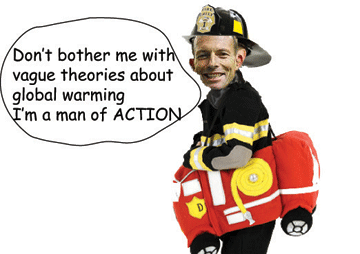 The government plans to meet the 2030 target essentially on a wing and a prayer. There were graphs galore at today’s media conference, but the crucial one from Greg Hunt committed the government to extending Direct Action all the way out to 2030……..That’s the sort of obfuscation we’ve come to expect from the Abbott government when it comes to climate. This is a government viscerally opposed to meaningful action on climate change on any level beyond the symbolic.
To see why, judge the government not by its words, but by its actions.
Tony Abbott Has No Intention Of Reaching His Flimsy Emissions Target, New Matilda, Ben Eltham, 11 Aug 15 The combination of policies being deployed by the government will not help them achieve even the weak target announced today, writes Ben Eltham.
The news that the Abbott government has settled on an emissions reduction target for Australia out to 2030 heralds a new turn in climate politics in this country. The target, announced by Prime Minister Tony Abbott today, is a 26 per cent reduction on 2030 levels compared to 2005. It would put Australia at the back of the international pack – offering less than Canada, the United States or Europe. Only Japan is offering a smaller target.
On the one hand, of course, this target is manifestly inadequate. Continue reading
Winda-Mara – Aboriginal success stories that we just don’t hear about
Stories like Winda-Mara’s need to be told—they show how Aboriginal communities are more than capable of creating their own forms of livelihood, if given space to do so. Winda-Mara’s diversity has been key to its success—rather than being just a “health” or “employment” program, it approaches issues holistically, asserting that cultural heritage protection and community health are fundamentally linked. Now that my eyes are open to it, I’ve realised that other Aboriginal communities across the country have similar stories. Let’s find and share these stories, and support these communities in articulating their own visions for their futures.
The Indigenous Australia We Don’t Talk About http://honisoit.com/2015/08/the-indigenous-australia-we-dont-talk-about/
By Andy Mason on August 8, 2015 It’s not very often that most of us hear success stories from Aboriginal communities. The overwhelming majority of the mainstream media treatment of Indigenous issues focuses on the (very real) problems which affect Aboriginal people, problems which can seem so complex and entrenched that imagining solutions usually seems impossible. In a society still dominated by a collective denial of our violent past and oppressive present, a society which hides behind empty sloganeering about ‘progress’ as it continues to punish Aboriginal people whenever they articulate their desire for control over their own lives, any coverage at all can seem like a blessing. But I wonder if only ever hearing the negative stories helps to reinforce an understanding of the situation as intractable and hopeless—if it perhaps leads us away from imagining and articulating alternatives.
A couple of weeks ago, my partner and I were privileged to be able to visit Winda-Mara, an Aboriginal co-operative run by local Gunditjmara people in Heywood, south-western Victoria. Winda-Mara was established in 1991 as an Aboriginal health organisation with the aim of providing culturally appropriate healthcare to the community. Since then, the organisation has expanded to also include housing, education, employment, and environmental and cultural heritage management. Continue reading
Solar power is top choice for Australians, nuclear is last
Solar Power Still The Preferred Energy Choice Of Australians http://www.energymatters.com.au/renewable-news/climate-institute-solar-em4980/ August 10, 2015
The Climate Institute has released Climate of the Nation 2015, its annual review of public attitudes on climate change and its solutions.Even in the face of stinging attacks from the Coalition, renewable energy has become even more popular with the Australian public – and fossil fuels less so.
Among all energy sources, solar power leads in popularity at 84 per cent, up 2 points on last year. Women turned out to be the strongest supporters of solar energy; with 86% ranking it their most preferred choice, compared to 81% of men.
Solar power is followed by wind at 69% (up 5 points on last year).
The popularity of both gas and nuclear crashed 7 points to 21 and 13 per cent respectively; making nuclear and coal tied as least preferred energy sources. Continue reading
Australian electricity companies offer solar, battery technology for lease
Solar power for rent: Electricity companies offer solar, battery technology for lease http://www.abc.net.au/news/2015-08-07/solar-power-for-rent-batteries-electricity/6679494 AM By Eric Tlozek Electricity companies have offered solar and battery systems for lease in a bid to keep customers and lower their own costs. Continue reading
Role of senator Sean Edwards in the South Australia Nuclear Toilet plan
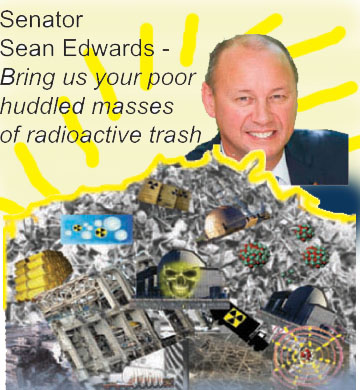 South Australia’s future role in the nuclear industry, The Saturday Paper, 8 Aug 15 PHILIP DORLING“……..Perhaps the most interesting twist in these proceedings, however, has been the role of South Australian Liberal senator Sean Edwards, who in April outlined a radical plan for an integrated nuclear industry embracing nuclear waste storage and recycling, fuel fabrication and power production.
Edwards has demonstrated a sustained interest in nuclear issues since he entered federal parliament in 2011.
He argues that East Asian countries could pay up to $1 million a tonne to send used fuel rods to South Australia for storage. By using a new form of reactor, an integral fast reactor (specifically the power reactor innovative small module – PRISM – design proposed by GE Hitachi Nuclear Energy), 95 per cent of the energy could be extracted from the rods, with electricity generation as a byproduct.
“We could end up with zero or low-cost power,’’ Edwards told The Sydney Institute in April. “It could revitalise the industrial sector in South Australia. The more you reprocess, the more electricity you have to get rid of.”
After consultation with a group of pro-nuclear advocates and technical experts, Edwards has submitted an as-yet-unpublished 213-page submission to the royal commission, arguing that South Australia can take advantage of the “under-serviced market for the management of used nuclear fuel. Several nations are holding quarantined budgets in the tens of billions of dollars with no satisfactory pathway to discharge responsibility for this material”.
Edwards’ submission proposes the establishment of a multinational spent fuel storage installation, an industrial pilot-scale fuel recycling and fabrication facility, a new “fourth generation” fast-breeder reactor, and deep borehole disposal of short-lived waste products.
Substantially funded by foreign investment, Edwards estimates the project could deliver $28 billion to South Australia, including very low-cost, even free, electricity for the state.
During the past 18 months, Edwards has also engaged in discussions with the nuclear industries in several Asian countries, which he says have expressed “considerable interest”. He is currently not prepared to identify the countries involved, but The Saturday Paper has established they include South Korea and Japan.

Edwards has also briefed Abbott, Industry Minister Ian Macfarlane and Trade Minister Andrew Robb.
It remains to be seen whether Edwards’ scheme stands critical scrutiny from the royal commission and wider debate. There are already plenty of critics. The Australian Greens have expressed strong opposition to the entire royal commission process, so too has veteran anti-nuclear campaigner Helen Caldicott. Nuclear researcher Richard Leaver, formerly of Flinders University, points out that no so-called fourth-generation reactors have been built and they are not expected to be available for commercial construction before 2030-40. ……..https://www.thesaturdaypaper.com.au/news/politics/2015/08/08/south-australias-future-role-the-nuclear-industry/14389560002222
1 This month


Help Aunty Sue Protect Her Land and Sacred Sites From Destructive Rocket Testing.
.

Australians deserve the truth
about
AUKUS – https://aukuspublicinquiry.com/

PETITION – To: Prime Minister Anthony Albanese and the Australian Labor Government

of the week – Australians for War Powers Reform (AWPR)
To see nuclear-related stories in greater depth and intensity

