Climate Change: What Australia Knew – and Buried
Taylor’s book shows how Australia could have acted on climate change a quarter of a century ago, but how corporate interests and economic ideologies not only stopped the clock on action, but wound it back
Australia was ready to act on climate 25 years ago, so what happened next?, Guardian, Graham Readfearn, 7 Aug 15 New book investigates how corporate interests and ideologues worked to make Australia doubt what it knew about climate change and its risks.
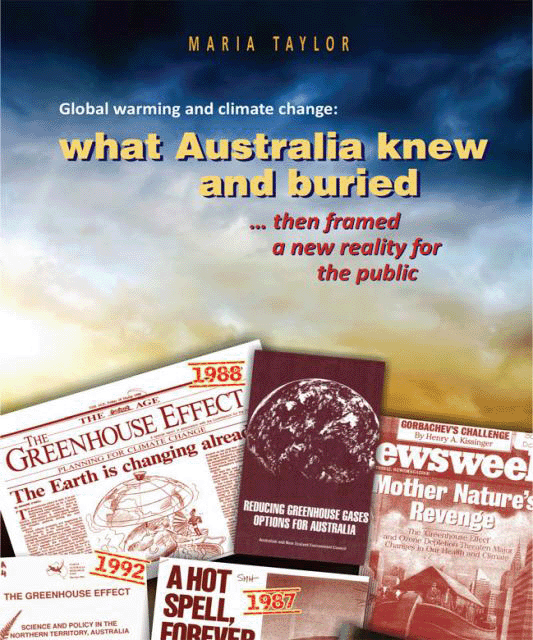
There’s something about climate change that almost everyone in Australia has either forgotten or never knew in the first place.
In 1990 Bob Hawke announced his government wanted the country to cut greenhouse gas emissions by 20% by the year 2005.
For a fleeting moment, it seemed the Australian public, politicians and the media were in agreement with the science.
But a new book investigates how the industries that stood to lose the most worked to undermine the science and entirely reshape the story being told to the public.
“We have been propagandised,” says the author, Maria Taylor. Continue reading
South Australia’s flirtation with nuclear energy – a ticking time bomb for Labor?
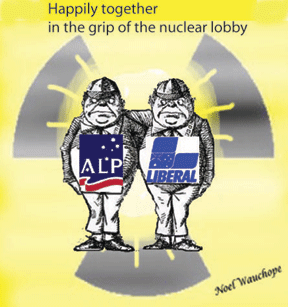 South Australia’s future role in the nuclear industry, The Saturday Paper, 8 Aug 15 PHILIP DORLING The South Australian government’s flirtation with nuclear energy threatens to turn its relationship with federal Labor into a ticking time bomb. South Australia was in the news this week thanks to Prime Minister Tony Abbott’s announcement of a new naval construction plan that, if implemented, will see Adelaide confirmed as Australia’s naval shipbuilding hub.
Mirrar people mourn Hiroshima, and regret impacts of uranium sourced from their land
Mirarr recognise 70 years since nuclear bombs destroyed Hiroshima and Nagasaki 06 Aug 2015 The Mirarr traditional owners of lands in Australia’s Northern Territory, including parts of Kakadu National Park and the Ranger and Jabiluka uranium deposits, acknowledge with sadness the seventy year anniversary of the world’s first nuclear bomb attacks.
Gundjeihmi Aboriginal Corporation, which represents the Mirarr, is supporting commemoration events around the country in recognition of the strong links between Mirarr country and Japan and the great damage that the nuclear industry has inflicted on people and country over these 70 years.
Gundjeihmi Aboriginal Corporation CEO Justin O’Brien said: “There is a strong history between Mirarr country and Japan. Mining began at Ranger- against the wishes of the Mirarr – in large part because of agreements between the Australian and Japanese governments.”
In 1978 before Ranger mine opened, then Senior Traditional Owner Taby Gangale was worried the uranium from his land might be used in nuclear weapons stating: “What if they make an atom bomb or something? Same as they did in Japan. Very dangerous.”
The Mirarr feel great responsibility for the impacts of uranium sourced from their land. Soon after the 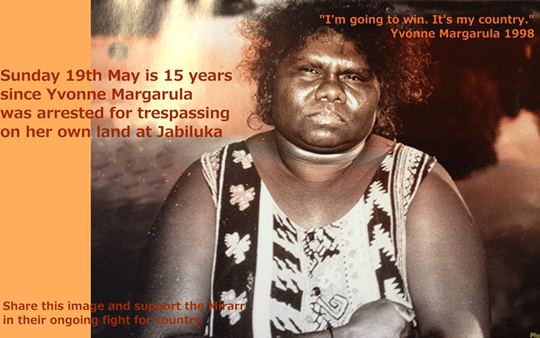 nuclear emergency started at Fukushima, Mirarr senior traditional owner Yvonne Margarula wrote a letter to UN Secretary General Ban Ki Moon expressing her concern and sadness at the devastation that uranium from her lands was causing in Japan: “This is an industry we never supported in the past and want no part of in the future. We are all diminished by the events unfolding at Fukushima” Ms Margarula wrote at the time.
“In 2014 the Mirarr hosted a visit from Naoto Kan, who was Prime Minister of Japan at the time of the Fukushima nuclear emergency. Mr Kan’s visit marked a new chapter in the longstanding partnership between our two countries. We discussed the ways in which uranium has damaged both Mirarr country and Japan and the importance of working together towards peaceful energy sources and better outcomes for all people.” Mr O’Brien concluded
For details of commemoration events visit the website of the International Campaign to Abolish Nuclear Weapons www.icanw.org.au For further information including photographs of the Mirarr, Naoto Kan and Ranger mine contact Kirsten Blair:  0412 853 641
Professor Tilman Ruff on .The bombing of Hiroshima and Nagasaki
there are grounds to be hopeful about decisive progress on a circuit-breaker. The first ever intergovernmental conferences on the humanitarian impacts of nuclear weapons have been held – three in the past two years. These have led to 113 nations signing a humanitarian pledge committing them to work to fill the legal gap for the prohibition and elimination of nuclear weapons.
In a welcome development, the recent ALP national conference adopted a policy that recognises that eliminating nuclear weapons is a humanitarian imperative. The policy commits Labor to support negotiation of a global treaty banning nuclear weapons
 Ban the bomb: 70 years on, the nuclear threat looms as large as ever, The Conversation, Tilman Ruff Associate Professor, International Education and Learning Unit, Nossal Institute for Global Health, School of Population and Global Health at University of Melbourne August 6, 2015 “……..The bombing of Hiroshima and Nagasaki
Rumours had been circulating in Hiroshima that the city was being saved for something special. It was. The burst of ionising radiation, blast, heat and subsequent firestorm that engulfed the city on August 6 killed 140,000 people by the end of 1945. Many were incinerated or dismembered instantly; others succumbed over hours, days, weeks and months from cruel combinations of traumatic injury, burns and radiation sickness.
Three days later, another B-29 carrying a bomb equivalent to 21,000 tons of TNT headed for Kokura. Because of clouds blocking visibility, its cargo was dropped over Nagasaki instead, raining similar radioactive ruin and killing 90,000 people by the end of 1945.
In both cities, ground temperatures reached about 7000° Celsius. Radioactive black rain poured down after the explosions.
In both weapons, less than one kilogram of material was fissioned. The physics of the Hiroshima bomb were so simple and predictable that the bomb was not tested prior to use. The Nagasaki plutonium bomb required a more sophisticated design. A prototype was exploded at Alamogordo in New Mexico on July 16, 1945, detonated by Australian nuclear physicist Ernest Titterton.
The survivors of the two bombings bore the legacy of terrible injuries and scars on top of the cataclysmic trauma of what they witnessed. They also faced discrimination and ostracism, reduced opportunities for employment and marriage, and increased risks of cancer and chronic disease, which stalk them, even 70 years later, for the rest of their days. Continue reading
South Australia’s new wind farm creating 250 construction jobs
 Work on Hornsdale Wind Farm near Jamestown to create 250 construction jobs http://www.adelaidenow.com.au/news/south-australia/work-on-hornsdale-wind-farm-near-jamestown-to-create-250-construction-jobs/story-fni6uo1m-1227471864726 BELINDA WILLIS THE ADVERTISER AUGUST 06, 2015
WORK on a new 100-turbine wind farm in the state’s mid-north is expected to start within months, creating up to 250 jobs during construction.
Canberra-headquartered Neoen Australia’s $250 million investment in the Hornsdale Wind Farm near Jamestown was signed off by state Planning Minister John Rau on Friday, with its first stage of 100 megawatts production planned to be in operation in 2017.
Two South Australian firms, Catcon for civil construction and CPP for electrical works, have been confirmed as contractors by Neoen Australia managing director Franck Woitiez.
It is believed to be the state’s first new wind farm construction since the Federal Government’s political compromise in May on reducing the nation’s Renewable Energy Target to 33,000 gigawatt hours by 2020, down from 41,000 gigawatt hours. Continue reading
Uranium mining experts have faith, despite the gloomy situation for the nuclear industry
One of the major risks for the uranium industry is the rapid advancement of the renewable power sector, particularly in battery technology.
“We have been waiting for the Japanese nuclear power fleet to be turned back on. We had an expectation for the past two summers that it would be turned back on and that hasn’t come to pass, and that remains the biggest question for uranium prices..”
Australia is well placed to cash in on uranium boom, say mining experts The Age, August 6, 2015 Peter Ker If uranium demand were to ever boom like iron ore, Australia would make a packet. But renewables and community attitudes threaten that. If uranium demand were ever to boom in the way iron ore has over the past decade, Australia would be well placed to cash in.
With the world’s largest known uranium resource and enough mining to be the world’s third biggest producer of the nuclear fuel, Australia is already a significant player in the global uranium industry.
But that industry remains relatively small compared with the likes of gold, copper and coal, and it has endured a severe downturn over the past four years………..
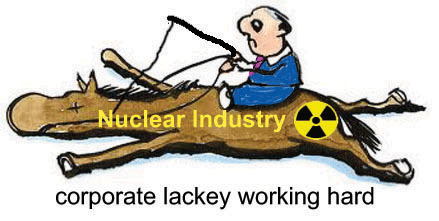
dramatically reduced demand for uranium and prices have been badly depressed ever since. The benchmark price has spent the past couple of years between $US25 a pound and $US40 a pound, and uranium was fetching $US35 a pound last week.
The weak prices have forced many marginal mines around the world to close which, combined with older mines reaching the end of their working lives, has reduced the number of operating uranium mines in Australian in recent years.
Uranium is now being produced at just three Australian sites: BHP Billiton’s Olympic Dam mine in South Australia, the Rio Tinto-dominated Ranger lease in the Northern Territory, and the Four Mile mine in South Australia, run by Quasar and Alliance Resources.
Mining at Ranger has stopped and the company is gradually working through the remaining stockpiles, while Olympic Dam is focused on copper and treats uranium as a byproduct.
Two others in South Australia (Russian miner Uranium One’s Honeymoon mine and US company General Atomics’ Beverley mine) closed down during 2013 and 2014 because weak uranium prices made them unviable.
But weak prices do not only hurt the mines that are already in production; they also deter companies from pushing ahead with the next generation of uranium mines, as at Ranger last month when plans for a underground expansion were abandoned.
Other Australian uranium deposits, such as the ones Toro Energy is developing in Western Australia, seem unlikely to be mined unless uranium prices significantly recover. Continue reading
Australian Renewable Energy Agency helps kick off Queensland’s ‘Virtual solar plant’
 ‘Virtual solar plant’ in home trial in Queensland http://www.theage.com.au/business/energy/sunverge-energy-links-with-ergon-energy-for-qld-home-power-storage-program-20150805-gisdx5 August 6, 2015 Angela Macdonald-Smith Californian electricity storage developer Sunverge Energy has forged an alliance with Ergon Energy for a limited commercial rollout of its power systems in Queensland homes, with at least two similar deals with other Australian partners expected to follow later this year.
The partnership with the Queensland utility, which also involves US-listed solar panel provider SunPower, will tap into keen interest in battery storage among households in Australia, partly thanks to the huge popularity of rooftop solar.
The deal announced on Thursday involves installing SunPower solar panels and Sunverge energy storage systems in 33 homes in Toowoomba, Townsville and Cannonvale in a program that will receive $400,000 of funding by the Australian Renewable Energy Agency.
The Sunverge systems include back-up power, a six-kilowatt inverter with 11.6 kilowatt-hours of energy and a sophisticated communications and control capability that allows the utility to control and collectively manage them to increase the efficiency of power supply on its grid. Continue reading
Wind inquiry: Australia’s pro-nuclear Senate trio downgrades nation’s peak medical research body
The Committee also cast doubt on the reliability of National Health and Medical Research Council investigations of the issue, after the nation’s peak research body reported a lack of evidence to support claims of the harmful effects of wind turbines.
It proposed the IESC take the lead on conducting research on the issue, dismissing the NHMRC’s efforts in the area as “manifestly inadequate”.
But in a dissenting report, Labor Senator Anne Urquhart shredded the credibility of Sarah Laurie, who the majority senators relied heavily upon for evidence of the adverse health effects of wind farms, as an authority on the issue.
 Senators want federal health body sidelined on wind turbine investigations, REneweconomy, By Adrian Rollins on 4 August 2015 Australian Medicine The Federal Government has been urged to sideline the nation’s peak medical research body and set up a stand-alone scientific committee to investigate the health effects of wind farm noise.
The Senate Select Committee on Wind Turbines, chaired by Democratic Labor Party Senator John Madigan, has recommended the establishment of an Independent Expert Scientific Committee (IESC) on Industrial Sound to research the health effects of wind turbines “and any other industrial projects which emit sound and vibration energy” and develop a national noise standard for wind farms.
The IESC, which along with a National Wind Farm Ombudsman, would be paid for through a levy on wind farm operators, would provide advice to State governments on the health effects of any proposed or existing wind farm, and the Senate committee called for states that did not accept expert advice or adopt the national noise standard to be overruled by the Commonwealth.
The recommendations are in keeping with Government hostility to the wind power industry. Continue reading
Batteries about to change everything – off-grid or on grid electricity
With the world’s highest uptake of residential solar per capita, Australian demand for batteries that allow households to better match up the power generated from their rooftop panels with when they want to use it is primed to take off……..
Morgan Stanley estimates that 2.4 million east coast homes will have batteries installed within the next few years.
Instead of having to draw on peak-tariff electricity from the grid in the evenings, a household can then use stored energy, saving money and helping prevent the grid from overloading. Batteries also provide back-up power for computers, lighting and life-support systems that have to stay on during power cuts.
How battery-powered homes are unplugging Australia, SMH, August 1, 2015 Angela Macdonald-Smith Energy Reporter “……….While the much-hyped Powerwall home battery system from Californian electric car pioneer Tesla Motors won’t be available locally until 2016, lithium-ion batteries have been on offer to Australian homes and businesses for the last year or so.
High-tech, adaptable and controllable and typically the size of a small fridge, these systems have left clumsy and ugly lead acid batteries far behind.
Less than a week after the soft launch of the sleek Powerwall and larger Powerpack batteries in late April, Tesla was said to have sold out until mid-2016 after about $US800 million of orders for some 55,000 Powerwalls and 25,000 commercial units.
In Australia, the 1.4 million homes with rooftop solar panels are the battleground for battery providers and retailers.
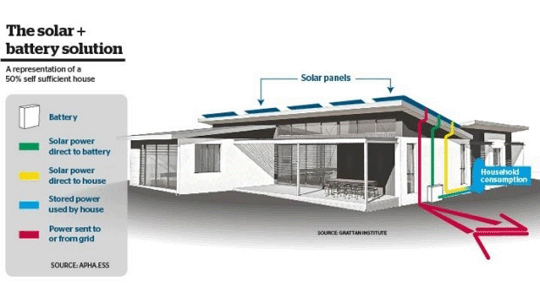
Others, like Whiltsher, are starting from scratch, having batteries and rooftop solar fitted at the same time. Even for homes without solar PV panels, batteries could make economic sense down the track, many say. Continue reading
Energy storage revolutionising electricity – especially in off-grid solar
The next biggest potential market in Australia for energy storage – as a value proposition – would be the off-grid market, the report finds.
“Off-grid electricity is Australia’s most expensive electricity due to the underlying high gas and diesel prices in remote areas,” it notes.
“As such, the business case for renewables as a means to offset fuel use is strong. Similarly, in order to enable higher penetrations of renewables, energy storage can be utilised to manage the intermittent nature of wind or solar generation.”
Energy storage ‘megashift’ ahead, battery costs set to fall 60% by 2020, REneweconomy By Sophie Vorrath on 3 August 2015 [excellent graphs and tables] The key role energy storage will play in the electricity grids of the future – and the vital importance of investing in and testing the various emerging battery storage technologies – has been highlighted in a major report published by the Australian Renewable Energy Agency on Monday, which predicts a 40-60 per cent price plunge for certain battery technologies by 2020. Continue reading
Largest coal mining union backs Labor’s Renewable Energy Target
Why has Australia’s largest coal mining union backed Labor’s Renewable Energy Target? Australian Broadcasting Corporation, ABC TV 7.30 Report Broadcast: 28/07/2015 Reporter: Matt Peacock
Australian’s largest coal mining and energy union was the surprise backer of Labor’s 50 per cent Renewable Energy Target at the party’s national conference, so what moved them to support it when Prime Minister Tony Abbott claims there will be a massive cost for consumers?
Transcript Continue reading
Tom Kenyon MP – the man who sold the radioactive trash idea to South Australia
 Mr Kenyon, now a backbench MP, refused to comment on the report.
The Sunday Mail understands it was not presented to Cabinet but became instrumental in prompting the current Royal Commission into the potential for the nuclear fuel cycle to revive the SA economy.
The report found there needed to be a good public relations campaign to convince people of the safety of the plan, and that money raised should be spent on infrastructure like the SA leg of a high speed rail to Melbourne.
It also proposed a model in which SA generate more money by leasing yellowcake mined here and taking it back as waste, and as a trade off people be guaranteed there will be no nuclear power plants in SA.
 Nuclear waste dump should be first cab off the rank, report finds by: MILES KEMP From: Sunday Mail (SA) Originally published as Nuclear dump could be key to our riches August 01, 2015 Available on The Australian website http://www.theaustralian.com.au/news/nuclear-waste-dump-should-be-first-cab-off-the-rank-report-finds/story-e6frg6n6-1227466384020
A BRIEFING paper delivered to the State Government recommended the state accept Taiwan’s nuclear waste, access that nation’s $10 billion disposal fund and establish an Outback nuclear waste dump to revive the economy.
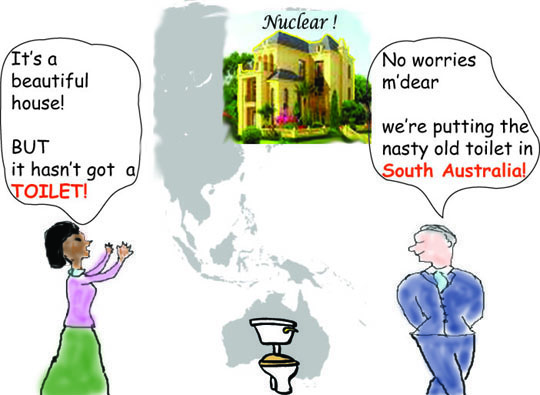
As the Nuclear Fuel Cycle Royal Commission explores the option to help solve SA’s jobs crisis, the Sunday Mail has obtained a copy of a report prepared for former Employment and Science Minister Tom Kenyon which argues the case for a waste dump near Woomera. Continue reading
Short term greed overtakes long term prospects in South Australia’s push for nuclear waste importing
 SA Nuclear royal commission: Waste dump best economic option for state, Business SA says ABC News 3 Aug 15 Establishing an outback nuclear waste dump would be the best economic move for South Australia if the State Government decides to expand its role in the nuclear industry, Business SA says.
It has been revealed Premier Jay Weatherill last year received a report commissioned by former Employment and Science Minister Tom Kenyon, which found setting up a waste dump near Woomera could reap billions for the local economy.
A royal commission headed by Kevin Scarce is in the process of examining the potential for an expansion of the state’s role in the nuclear industry, including whether a nuclear power station or nuclear waste  dump should be built.
Business SA’s chief executive Nigel McBride (above, at left) said countries such as Japan and South Korea would pay handsomely to dump their nuclear waste in the state’s outback.
We know that there are huge potential financial benefits from being able to provide that service, and it’s logical that they’ve identified somewhere in the Woomera region as a potential site because of course it’s very remote,” Mr McBride said.
“There is a huge market out of countries like South Korea who has got a lot of nuclear waste they need to deal with, Japan and other Asian countries and of course countries around the world.”………..
Mr McBride said South Australia was the ideal location for a waste dump, and could store the nuclear fuel safely.
He said the biggest concern would be transportation options……
More than a decade ago, South Australia’s Labor Government fought and won a vigorous battle against the Howard government to stop a low-level nuclear waste dump being located in far north South Australia.
The royal commission is expected to hand down its findings by May 2016. http://www.abc.net.au/news/2015-08-02/nuclear-waste-dump-best-economic-option-business-sa-says/6666212
Nuclear facilities in South Australia would be at grave danger from bushfires
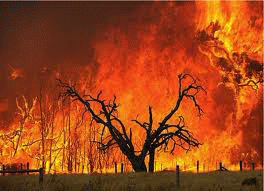 Dangers of Bushfires-Wildfires & Nuclear Business miningawareness, 3 August 15 “………
According to the South Australia Country Fire Service, nearly 1/2 of people living in bushfire prone areas don’t understand the threat. This is apparently true of those proposing adding nuclear
 anything in Australia.
circumstances.
What’s Australia’s water security under future climate?
 The role of water in Australia’s uncertain future, The Conversation Amgad Elmahdi Manager Water Resources Assessment Section at Australian Bureau of Meteorology Matthew Hardy Manager, Urban Water at Australian Bureau of Meteorology August 3, 2015 “…….Water security is threatened by a number of factors. These include climate change, rainfall variability, population growth, economic development, and drought.
For instance, across southern Australia climate change is projected to decrease winter and spring rainfall by up to 15% by 2030 regardless of whether greenhouse gas emissions are reduced.
Rainfall declines are amplified in reduced streamflow and in turn the water in storages. Southwestern Australia has seen streamflow declines of 50% since 1970, while streamflow during the Millennium Drought (1996-2010) in southeastern Australia was half of the long-term average………
Australia also has naturally highly variable rainfall influenced by events such as El Niño and La Niña. An El Niño was declared in May 2015.
The El Niño’s likely impact will be drier and warmer conditions across inland eastern Australia. Importantly the strength of an El Niño does not always indicate how severely Australia may be affected.
 These dryer conditions, should they arise, will place increased pressure on the water supply of effected regions. In particular, increased water demands and reduced stream flows will see declining surface water storage volumes. This could mean we need to develop and use more climate resilient sources………https://theconversation.com/the-role-of-water-in-australias-uncertain-future-45366
1 This month


Help Aunty Sue Protect Her Land and Sacred Sites From Destructive Rocket Testing.
.

Australians deserve the truth
about
AUKUS – https://aukuspublicinquiry.com/

PETITION – To: Prime Minister Anthony Albanese and the Australian Labor Government

of the week – Australians for War Powers Reform (AWPR)
To see nuclear-related stories in greater depth and intensity

