CHRISTIANA FIGUERES answers Maurice Newman’s attack on United Nations
CHRISTIANA FIGUERES:...” he is certainly not in the majority, not only the majority of scientists, but the majority of citizens around the world, the majority of leaders around the world, are quite clear about the effects that we are actually playing with here and the risks that we have to manage ahead of us.”
UN climate chief responds to tirade from PM’s adviser Australian Broadcasting Corporation, Lateline Broadcast: 08/05/2015 Reporter: Emma Alberici
UN climate negotiator Christiana Figueres says she is willing to meet business leader Maurice Newman in the wake of his extraordinary attack against on UN climate policy – and warns that it would be dangerous for Australia not to act on climate change.
Transcript……………
Christiana Figueres joins us now from our studio in Canberra……………
Climate change defines Christine Milne’s fine legacy in Parliament
 Given our climate politics, who can blame Christine Milne for retiring?, Guardian 7 May 15 Tim Hollo
After 25 years of campaigning, Milne’s retirement from parliament is an indictment of how little progress Australia has made on climate change. egardless of the surprise of the press gallery, anyone paying attention realised Christine Milne would have been thinking deeply about her future. With her first grandchild on the way, the planet’s future would also have been brought into a stark new light.
Milne can be confident that she steered the Greens through a hugely difficult period, bringing a new strategic focus to campaigning and beautifully mentoring a new crop of advocates. But it is climate change which keeps her awake at night, and she has had to consider where she could most effectively focus her efforts in the critical years ahead.
Who can blame her for concluding that Australian parliamentary politics is a poor place right now from which to work for radical climate change action?
Milne’s deep knowledge of (and passion for) climate science and policy is legendary in and around parliament. Less well known is her record on climate change over the last quarter century.
In 1990, while a member of the Tasmanian Parliament, she was appointed alongside Joan Kirner and Rupert Hamer to Australia’s first Greenhouse Council. She moved to the international arena in 1998 and was elected to the Global Council of the International Union for the Conservation of Nature in 2000. She was elected its vice president in 2004, the same year she was elected to the Senate.
From all of these positions, Milne worked to build awareness and acknowledgement of climate change. More deeply, she challenged us to grapple with its deep ramifications for our economies, our politics and our lives.
From all of these positions, Milne worked to build awareness and acknowledgement of climate change. More deeply, she challenged us to grapple with its deep ramifications for our economies, our politics and our lives……………..
Milne’s role in bringing depth to the climate change debate through that period was vital to the tremendous election result for the Greens in 2010. She capitalised on that by proposing the Multi Party Climate Change Committee as a condition of supporting the Gillard government, insisting on experts sitting on the committee, and shepherding through it the best possible result that could have been achieved. She also used the process to increase the understanding of climate change in the community.
While we have, of course, lost the carbon price, the Climate Change Authority and the Clean Energy Finance Corporation remain – and both are Milne’s hard-won achievements. More importantly, the idea that we cannot be serious about climate change without phasing out coal remains and is growing ever stronger. No future government will be able to get away with what Tony Abbott has done, and that is in no small part thanks to Milne’s efforts…….http://www.theguardian.com/commentisfree/2015/may/07/given-our-climate-politics-who-can-blame-christine-milne-for-retiring
Australia’s disarmament double-speak at the nuclear Non-Proliferation Treaty Review Conference 2015
Australia’s claimed reliance on the US’ nuclear arsenal hijacks any meaningful contribution to disarmament. Most endorsers of the Australian-led humanitarian statement are similarly thwarted by their commitment to the nuclear weapons of their allies. Meanwhile, many other countries are refusing to accept and enable indefinite inaction.
While Australia remains tolerant of nuclear weapons, thankfully Austria and the majority of states are seeking new methods and action, now. This process is bound to go ahead with or without the nuclear weapons states.
The Australian Government should respond to the 84% of the Australian public who want their government to support a nuclear weapons ban (2014 Nielsen poll) and stop encouraging the reckless behaviour of the nuclear minority.
 Gem Romuld, 6 May 15 Despite being close in name, the gap between Australia and Austria on the issue of nuclear disarmament is stark. Austria is at the forefront of a global push to stigmatize, ban and eliminate nuclear weapons, whereas Australia is leading efforts to undermine this push.
During the first week of the nuclear Non-Proliferation Treaty Review Conference, currently underway in New York, the Australian Ambassador to the United Nations, Ms Gillian Bird, delivered a statement expressing concern that 45 years since the NPT entered into force, “some 16,000 nuclear warheads still exist”. But she dismissed the “call for a treaty banning nuclear weapons”, and stated Australia’s support for “practical, realistic measures to achieve actual nuclear disarmament”. Elaboration on these unambitious measures was saved for the 26-nation Statement on the Humanitarian Consequences of Nuclear Weapons, not to be confused with the much stronger Austrian-led 159-nation Joint Statement on the Humanitarian Consequences ofNuclear Weapons.
Both ‘humanitarian statements’ acknowledged the renewed focus on the humanitarian impacts of nuclear weapons, catalysed by the three conferences that have been held on the subject since February 2013 by the Norwegian, Mexican and Austrian Governments. The Austrian-led statement said that the “humanitarian focus is now well established on the global agenda” and affirmed that “the only way to guarantee that nuclear weapons will never be used again is through their total elimination”. The Australian-led statement claims there are “no short cuts”, implying that the slow, and thus far ineffective, steps to disarmament are the only way to reach a world without nuclear weapons. Continue reading
Prosperity for Victorian farmers hosting wind farms
There are jobs and prosperity blowin’ in the wind http://www.weeklytimesnow.com.au/news/opinion/there-are-jobs-and-prosperity-blowin-in-the-wind/story-fnkerdb0-1227337252668 MAY 06, 2015
“THE single biggest investment in rural Victoria.” That’s how Municipal Association of Victoria president Bill McArthur described the $5 billion worth of new wind farms waiting to be built in Victoria.
This recognition of the sheer scale of the opportunity the wind farms present to regional Victoria is a welcome turn in the debate. In much of the discussion around wind farms, the interests of regional Victoria are too often overlooked. How to keep farming businesses viable. How to keep tenants in the shops along the main street. How to provide the jobs that will draw the next generation of families back to small towns and farms.
These are questions country Australia has constantly had to address.
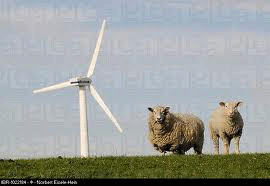 Wind farms fit with farming. Wind towers use only a fraction of a farmer’s land and add valuable access tracks, improving farm viability.
Wind farm lease payments bring a 25-year income stream on to farms and that money returns to the local economy through things such as farm upgrades, the hire of local labour and purchases from local businesses.
A full-time work force can make a huge difference to a small town and guaranteed rates income has already become vital for shires like Moyne, Pyrenees and Southern Grampians.
Crucially, wind farms don’t use a drop of water. As southeast Australia becomes drier, a large-scale energy source that makes no call on our precious water supplies will become all the more important.
But there’s no such thing as a free lunch. As The Weekly Times editorial recognised last month, more wind farms will bring a “long-term change to our beloved landscape”. Visually, wind farms are a big deal, but whether people like the look of them or not can’t be the main driver.
An end to the Federal Government’s attack on the renewable energy target will bring a once-in-a-generation investment boom to regional Victoria. Our choice is to embrace this and make it work, or just hope that another opportunity like it might one day turn up.
Andrew Bray is Australian Wind Alliance national co-ordinator
South Australia gets world class floating solar system – by an Australian company
 Australian company creates world-first floating solar system NEWS.COM.AU MAY 02, 2015 AN AUSTRALIAN company is leading the way for renewable energy after creating a world-first floating solar system.
Infratech Industries selected the Northern Areas Council Waste Water Treatment Plant in South Australia as the first location to implement the new system.
Director Felicia Whiting said it is expected the innovative technology will generate an estimated 57 per cent more power than fixed land-based systems.
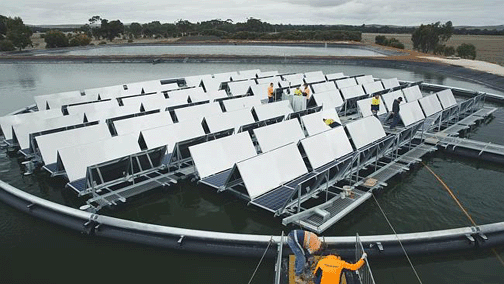
“The proprietary tracking, cooling and concentrating technology uses water to counteract the gradual loss of output caused by overheating solar panels to create a better performing and more efficient system,” she said.
“The Northern Areas Council will reap additional economic benefits with a cost saving of approximately 15 per cent on their current energy expenditure, plus an additional one per cent margin on the excess energy provided to the local community.”
- Ms Whiting said the biggest challenge in implementing the technology was changing the mindset of government officials and bureaucrats who questioned the need for renewable energy.
“Just how strong Australia’s post-2020 emissions reduction targets remain unknown, however we do know solar innovation is a milestone towards Australian councils, communities and businesses making a difference,” she said.
“As Australians evangelise this type of technology, it is our hope that renewable energy becomes the mainstream rather than niche solution.
“Change is not beyond us and this is definitely a strong step forward.”………http://www.news.com.au/technology/innovation/australian-company-creates-world-first-floating-solar-system/story-fnjwucti-1227331868879
Climate change making Australia’s hot spells even more costly
 Severe heat costs the Australian economy US$6.2 billion a year, New Scientist, May 2015 by Michael Slezak Heat stress costs the Australian economy a whopping US$6.2 billion a year – a finding that shows what other countries might be facing in areas where global warming will make extremely hot days more common. Continue reading
Next Australian stock exchange winner could be renewable energy
 Could Renewable Energy be the Next Big ASX Winner? Money Morning 5 May 15 On Wednesday, Infratech Industries announced their intention to list on the ASX. It’s a bold move for the fledgling renewables company, which was established in April 2012.
The company is behind the $17.5 million floating solar panels project currently being expanded in South Australia. They say their tracking and cooling technology produces 57% more power than land-based solar panels. It’s a big deal for the entire solar industry.
Chief executive Raj Nellore says that soon, more capital will be required to keep up with demand. Of listing on the ASX, he said ‘once we get to a certain size, [it] makes sense’.
Infratech has partnered up with the Centre for NanoScale Science and Technology at Flinders University (CNST) for research. CNST has backing from the South Australian state government. So their funding — and the partnership with Infratech — is subject to budget changes.
There are other forces that might pressure Infratech to go public sooner rather than later. For example, they may need to raise money to expand their US operations too. Their US entity was opened in June 2014. They signed their first US customer — the City of Holtville, California — in November. That’s pretty much all they’ve done there.
Whenever they do float, they won’t be alone. A small group of renewable energy companies are already listed on the ASX.
Which renewable energy companies are currently on the ASX?
Wave power Carnegie Wave Energy [ASX:CWE] ………
Solar Dyesol [ASX:DYE] ……Enviromission [ASX:EVM]……..
Geothermal The Raya Group [ASX:RYG]……http://www.moneymorning.com.au/20150505/could-renewable-energy-be-the-next-big-asx-winner-cw.html
Greens leader Christine Milne steps down
 Christine Milne resigns as Greens leader, will not contest 2016 election, SMH May 6, 2015 – Lisa Cox National political reporter The Greens will elect a new leader on Wednesday morning after Christine Milne revealed she would not contest the 2016 election and resigned as party leader……………
May 5 closing date for Nominations from landowners to host nuclear waste
South Australia, Western Australia, Victoria and the Northern Territory have legislation in place prohibiting the storage of radioactive waste from outside the state or territory. This means that the legality of nominations coming from these states or territories is compromised. The Federal Government, however, calls onto all Australian landowners fulfilling the criteria to submit applications, as the National Radioactive Waste Management Act 2012 allows the Minister to override state legislation if conflict arises. The question is just how voluntary the siting would be in that case, given that it undermines democratically made decisions?event of an accident) or indirectly affected
 Let’s hope the opportunity to deal with radioactive waste won’t be wasted, SBS, Over the coming weeks and months we will find out whether the Federal Government’s new approach to finding a radioactive waste storage and disposal site will be more successful than past efforts. By Anica Niepraschk 1 MAY 2015 -Australia does not produce any high-level radioactive waste. It does however produce moderate amounts of low-level waste that could be disposed of in a shallow repository to be monitored for several hundred years, and long-lived intermediate-level waste that will need to be carefully managed for some thousands of years.
After more than 20 years of flawed and failed attempts to impose a dump on communities in South Australia and the Northern Territory, the Government has finally realised that a matter of such importance and extraordinary risks can’t be imposed on communities but has to be the result of a voluntary process.
In March, Industry Minister Ian McFarlane called on landowners across Australia to nominate their land to host a radioactive waste management facility. The two-month nomination period ends this Tuesday, May 5, which could give a first indication on where the Government is heading with its new approach.
It is worth having a look at how the process is set out and if it is really as voluntary as the Government claims. Continue reading
Environment Minister Greg Hunt’s hype about “Direct Action” doesn’t ring true
 Greg Hunt hasn’t a lot to show for $660m spent on reducing greenhouse emissions, Guardian, Lenore Taylor, 1 May 15
While the environment minister is proclaiming a ‘stunning’ result, the money mostly went on projects begun under the previous government
Last week the government spent $660m to reduce Australia’s expected greenhouse emissions by 47m tonnes – a result the environment minister, Greg Hunt, described as “stunning” and one starry-eyed commentator suggested was so completely amazing it may have won the next election for the coalition.
So what stunning things did we get for our money? Did we start to transform our economy so we use less fossil fuel in the future? Did we buy lasting change? Not a lot. Mostly we spent it on making sure that projects begun under the former government kept going…….http://www.theguardian.com/environment/2015/may/01/greg-hunt-660m-spent-reducing-greenhouse-emissions
Recycling of rare earths – an industry already under way
Recycling gives old electronics new life JAMIE DUNCAN AAP MAY 01, 2015 Herald Sun
IMAGINE a world in which billions of dollars of gold, silver, platinum and other precious metals are thrown into a pit like rubbish.
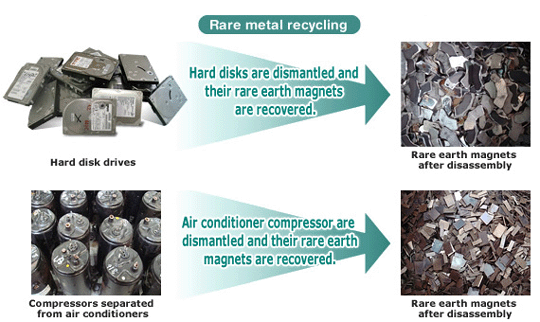
IT seems unlikely, but it’s happening now at landfills around the globe.
- A recent United Nations University report found consumers threw out 41.8 million tonnes of unwanted electronics, or e-waste, in 2014 but recycled only 6.5 million tonnes.That discarded e-waste included an estimated $US52 billion ($A65.78 billion) of precious and other metals.Rose Read, recycling manager with MobileMuster (MobileMuster), says recycling components from e-waste is good for the economy and the environment.”The benefits are massive, and not just in terms of dollar value, but also the environmental benefits of slowing the rate of mining,” Ms Read told AAP.”The amount of energy it takes to recover product materials from a mobile phone is a tenth of digging them up.”MobileMuster is a federal government-accredited product stewardship scheme funded voluntarily by a range of mobile phone manufacturers and retailers that collects unwanted mobiles to recycle components.A similar scheme operates for end-of-life televisions.Consumer thirst for the latest technology is forcing the need to recycle e-waste, Ms Read said…….
- Recycling e-waste entails significant costs, hence the need for industry-funded stewardship schemes, but Ms Read says Australia could build a new, self-sustaining e-waste industry.
- Already, a lead smelter in South Australia is considering expanding to recycle circuit boards locally rather than send them overseas, she said.”There is a whole range of opportunities to create a new industry and employment,” she said.”A lot of new jobs could come out of this. There is some innovative new technology that we can use.”
A warning about paid trolls on social media
 Already, trolls on Twitter have been running a scurrilous campaign against Dr Helen Caldicott. I believe that these Twitter trolls are Australia, and not connected with NASA or similar organisations. Their abusive tweets are so sill and insulting that I doubt that a serious agency would use them.
 Internet Trolls May be Trained Government Agents According to Leaked Document Health Impact News Editor, 3 May 15 Glenn Greenwald, a journalist, constitutional lawyer, commentator, and author of three New York Times best-selling books on politics and law, has been working with NBC News in publishing a series of articles on how covert government agents infiltrate the Internet to “manipulate, deceive, and destroy reputations.”
The information is based on documents leaked by National Security Agency (NSA) whistleblower Edward Snowden. Greenwald’s article, How Covert Agents Infiltrate the Internet to Manipulate, Deceive, and Destroy Reputations, is based on four classified documents produced by the British spy agency GCHQ, and presented to the NSA and three other English speaking agencies reportedly part of “The Five Eyes Alliance.”
In this shocking piece, Greenwald publishes a copy of a spy training manual used entitled: “The Art of Deception: Training for Online Covert Operations.” Greenwald writes that agencies like the NSA are “attempting to control, infiltrate, manipulate, and warp online discourse, and in doing so, are compromising the integrity of the internet itself.” Greenwald writes: Continue reading
Australian Labor Party to roll over on nuclear policy and become indistinguishable from Liberal
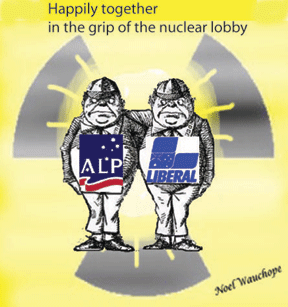 AUDIO Labor set to debate expanding Australia’s role in the global nuclear fuel cycle http://www.abc.net.au/radionational/programs/breakfast/labor-set-to-debate-expanding-australias-role/6436276 1 May 2015 More uranium mining, more Australian involvement in the global nuclear fuel cycle, and the potential for taking back spent Australian nuclear fuel.
With the prospect of bi-partisan support, these options are all on the table with moves to free up the Labor Party’s nuclear policy at the ALP National Conference in Melbourne in July.
Labor in South Australia is already considering its nuclear options, with a Royal Commission set up earlier this year.
The nuclear re-think here in Australia comes as national nuclear societies meet in France over coming days to sign a Nuclear for Climate declaration.
Thousands rally across Australia against closure of Indigenous communities
 Melbourne city centre blocked by protests over closure of Indigenous communities – as it happened, Guardian, Helen Davidson @heldavidson 1 May 15 [excellent report and pictures]
Thousands of people joined rallies in towns and cities around Australia and overseas to protest against threatened withdrawal of funding from remote communities Tens of thousands have attended reportedly peaceful rallies across Australia and New Zealand, protesting against the threat of closure of remote communities in Western Australia.
The largest rallies in Melbourne and Sydney began at 4pm, severely disrupting Friday peak hour traffic. The Melbourne rally blocked a major intersection and Flinders st Station. Protesters intend to move to Kings Domain where they will set up a makeshift camp for two nights.
Some protesters in Sydney have moved on to the Redfern Aboriginal tent embassy after thousands walked down Sydney’s George St, delaying some public transport.
Between 500 and 1000 attended a Perth rally, as well as thousands more across Sydney, Canberra, Darwin, Adelaide, Alice Springs, and 1,000 in four New Zealand cities. …..http://www.theguardian.com/australia-news/live/2015/may/01/protests-at-proposed-closure-of-remote-indigenous-communities-live
Liberal MP Dan Tehan dares question Abbott strategy on Renewable Energy Target
 Renewable energy target: Liberal MP Dan Tehan pushes for higher RET to end political stalemate, save jobs ABC TV 7.30 By Sabra Lane and Lucy Barbour A Liberal
 MP is urging the Government to settle on a higher renewable energy target (RET) to prevent further job losses across the sector.
Companies from the trade-exposed energy intensive industry and the clean energy sector have told 7.30 they want the major parties to settle on a final target of 33,000 gigawatt hours (GWh).
The Member for Wannon, Dan Tehan, agrees and believes the Government should resolve the impasse swiftly. “[My constituents] have been saying that politics is put in front of jobs and what I have been reassuring them is that, as far as I’m concerned, what I want to see is jobs put before politics,” Mr Tehan told 7.30.
The RET mandates that 20 per cent of all Australia’s energy come from renewable sources by 2020.
The current target is legislated at 41,000 GWh, but electricity demand has dropped dramatically in recent years, meaning the amount generated will far exceed 20 per cent.
It is why the Coalition and Labor have been at loggerheads for months over what the target should be.
The Coalition will not budge from 32,000 GWh, while Labor is fixed on 33,500 GWh.
Businesses in ‘state of limbo’ as result of impasse
The community of Portland, in south-west Victoria, is fed up with the political stone-throwing and the latest push for agreement has been pushed by two of the region’s key businesses, Keppel Prince Engineering and Portland Aluminium.
Both companies rely on the RET debate being resolved to prevent further job losses.
The general manager of Keppel Prince, Steve Garner, said his company — which builds wind turbine towers — is in a “state of limbo”………….http://www.abc.net.au/news/2015-04-30/liberal-mp-pushes-for-higher-ret-target-to-end-political-impasse/6435712
1 This month


Help Aunty Sue Protect Her Land and Sacred Sites From Destructive Rocket Testing.
.

Australians deserve the truth
about
AUKUS – https://aukuspublicinquiry.com/

PETITION – To: Prime Minister Anthony Albanese and the Australian Labor Government

of the week – Australians for War Powers Reform (AWPR)
To see nuclear-related stories in greater depth and intensity

