According to Alexander Downer Australia must get small nuclear reactors, to power data centres? Really?
Letter to The Advertiser, 20 Aug 26
Alexander Downer and his fans have jumped on the data centre band wagon as the latest reason why Australia should build nuclear reactors. They claim nuclear reactors will provide cheap, reliable electricity to power these data centres.
Presumably the data centres they have in mind are the ones that will be built around 2050, because they won’t be getting electricity from nuclear reactors any time soon. It’s worth remembering that currently no commercial ‘micro’ or ‘small modular’ reactors actually exist.
And ‘reliable’ power (let’s not say ‘cheap’) might just be in winter. Nuclear reactors in Europe are getting shut down left right and centre in summer because their cooling systems can’t handle the heat. Of course, the world will be much hotter by 2050. By then, I expect the nuclear illusion will have vanished like a mirage on the horizon.
Far-Right secretive political group Advance appears at election inquiry

By Belinda Jones | 22 August 2026, https://independentaustralia.net/politics/politics-display/far-right-secretive-political-group-advance-appears-at-election-inquiry,21462
Despite Advance’s appearance at the 2025 election inquiry, Australians are none the wiser about what Advance really does, who’s funding them, who the people involved are, what their agenda is and what link binds them, writes Belinda Jones.
THE FAR-RIGHT POLITICAL advocacy group Advance Aus Limited appeared before the Australian Joint Standing Committee on Electoral Matters inquiry into the 2025 federal election late yesterday afternoon. Chair Vicki Dunne and Company Secretary Mark Spencer represented Advance. Executive Director Matthew Sheahan did not appear.
For background, Dunne served in the A.C.T. Parliament for the Liberal Party for 19 years, the latter years under then-Leader of the Opposition, Zed Seselja. Zed went on to serve as a Liberal Senator from 2013 until he was defeated by Senator David Pocock in 2022.
Advance unsuccessfully campaigned against Pocock in 2022.
At yesterday’s public hearing, Greens Senator Steph Hodgins-May asked Spencer why he failed to provide his biography to the inquiry’s committee; he claimed he hadn’t been asked to provide one. He didn’t volunteer to the committee that he was the former Director of Public Policy at Christian Schools Australia.
For those not familiar with Advance, since its inception in 2017, it has gained a reputation as a somewhat clandestine outfit with many wealthy backers, including One Nation-backer Gina Rinehart. Dunne told the committee that Advance now has 662,973 “supporters”; she later admitted these were “email subscribers” to the Advance website.
Dunne also told the committee that Advance has 45,645 “grassroots” donors averaging around $200 per donation, including “partners” who contribute “regular, recurring donations” that Dunne likened to Catholic “planned giving”. Interestingly, both Dunne and Seselja are devout Catholics.
Hodgins-May pressed Dunne and Spencer on whether Advance has a physical office and how many staff they have. Dunne was evasive and could only estimate that Advance had about “30 staff” of contractors and consultants, which fluctuated all the time. It was established that Advance does not have an actual office, just a virtual one – the Advance team all work from home.
Both Dunne and Spencer mentioned during the hearing that if Advance appears in public or has an office, it faces aggressive or anti-social behaviour.
On the one hand, Dunne argued that Advance is enormously popular and has over half a million supporters while simultaneously being scared to appear in public because of public backlash. Perhaps they are not as popular as they think.
A check of their popularity on social media revealed very modest numbers too: Advance’s Facebook has 211K followers, Instagram 96K followers and X (formerly Twitter) just 20K.
Advance’s own array of culture war petitions on their website attracts a fraction of their so-called 662K “supporters”; most petitions manage five per cent of that number or less and fail to meet their signature targets. Another sign they’re not as popular as they think.
Like a dentist extracting a mouthful of teeth, Hodgins-May painstakingly continued, reading out a list of names of people associated with both the Liberal Party and Advance; she asked about the Liberal Party Associated Entity The Cormack Foundation and what sort of consultancy work Whitestone Strategic had done for Advance.
Dunne reiterated to the Senator that Advance had complied with Australian Electoral Commission (AEC) law on all donations and suggested Whitestone had done some marketing and comms for Advance.
After much to-and-froing, Hodgins-May calmly asked Dunne why Advance shouldn’t be considered an AEC Associated Entity, given the fact that Advance is “stacked” with Liberal Party operatives and received $500K from a Liberal Party associated entity. Dunne objected, through the Chair, to the word “stacked” but could not explain the amazing coincidence of Liberal Party connections nor the half-million-dollar Cormack Foundation donation.
Dunne didn’t say a word when Hodgins-May read out the name Stephen Doyle, nor did she elaborate on his connection to Whitestone.
Doyle, Zed Seselja’s former Chief of Staff and brother-in-law, founded Whitestone with former Australian Christian Lobby director of communications David Hutt in 2017, who is no longer with the company.
Whitestone has also provided their services to several sitting Liberal parliamentarians, including Andrew Hastie, Alex Antic, Jacinta Nampijinpa Price and Claire Chandler. Doyle is also listed as Advance’s Campaign Manager for the 2025 election. Dunne and Spencer didn’t mention that either.
It has been previously reported by the Guardian that former Australian Christian Lobby (ACL) head Lyle Shelton’s ‘personal website is registered to Whitestone’. Whitestone’s ASIC address is also shared with a number of anti-trans advocacy groups.
So, despite Advance’s appearance at the hearing, Dunne’s long-winded Opening Statement and the committee’s clear, fair questions, Australians are none the wiser about what Advance really does, who’s funding them, who the people involved are, what their agenda is and what link binds them.
Dunne told the committee that thousands of “grassroots” people lined Advance’s coffers with small donations, not just billionaire backers. Therefore, the link can’t be money if rich and poor alike are “patriots” and “supporters”.
The link can’t be a social media uprising because Advance’s social media following is also a fraction of their so-called “supporters” after eight years of political advocacy.
The link can’t be a groundswell of popular support for Advance’s imported culture war policies; otherwise, those Advance petitions would have met or exceeded their signature goals.
Dunne says the fact that they’re all connected to the Liberal Party is pure coincidence, so it can’t be that.
Perhaps the link is religion, since so many are or have been affiliated with religious organisations or have openly professed their faith.
Religion would also explain the imported culture wars from the U.S. Bible Belt. It would explain why, despite Advance’s bulging war chest, their message isn’t cutting through in Australia’s largely secular society.
Since Advance started in 2018, the Liberal vote has steadily declined nationwide. The Conservative vote is now split between the Coalition and One Nation, with polls predicting neither would garner enough votes to hold power outright.
Advance appears to be driving that decline, or maybe that’s just a coincidence too.
Maybe we’ll learn more in a few weeks when we get the answers to all those questions Dunne and Spencer took on notice.
Or maybe Advance will remain the secretive third-party political organisation pushing a secretive political agenda by secretive political people with lots and lots of money from secretive billionaire backers.
Why are we militarising Space?

Falling in behind the US, Australia signed the Trump Administration’s 2020 Artemis Accords which were designed to nullify the Moon Treaty and give the green light to US-led colonisation of the Moon for the purpose of commercial mining of its surface.
The US aims to dominate space militarily, and Australia is its willing accomplice.
20 August 2026 AIMN Editorial, https://theaimn.net/why-are-we-militarising-space/
By Michael Williss
The Australian Defence Force (ADF) released its 2026 Defence Strategy earlier this year, and an accompanying fact sheet said that “The ADF must be integrated across all five domains – maritime, land, air, space and cyber – as well as with international partners.”[1]
The reference to the “five domains” is important. Prior to 2020, there was only reference to the traditional warfare domains of the land, seas and air. As of January 2022, however, a new command force operating across the three traditional domains was created, now known as Space Command.[2]
The official embrace of Space as a war-fighting domain runs counter to the spirit, if not the letter, of two international Treaties signed by Australia: the UN Outer Space Treaty (OST) and the Moon Treaty.
The OST was a response by the world community to US and Soviet nuclear weapons tests in Space from 1958 to 1962. The largest US test occurred 400kms above and 1450kms south-west of Hawaii. It was 90 times the size of the blast at Hiroshima. It caused significant electrical damage in Hawaii, but also resulted, in the months that followed, in killing eight of the 24 satellites that were then in orbit around the Earth including the UK’s Telstar.[3]
This led to the ratification by UN member states of the OST in 1967. Amongst the provisions of the Treaty were:
outer space shall be free for exploration and use by all States;- outer space is not subject to national appropriation by claim of sovereignty, by means of use or occupation, or by any other means;
- States shall not place nuclear weapons or other weapons of mass destruction in orbit or on celestial bodies or station them in outer space in any other manner.
However, there is a very large loophole between a nuclear weapon and a WMD through which any manner of weapons based on new technologies could be fired.
The 1979 Moon Treaty reiterated the points above and strengthened several of them. Australia signed it in 1986, but to date on 17 countries have done so. Opposition to it has been led by the US which refused to accept its restriction on “any military use of celestial bodies.”[4]
Falling in behind the US, Australia signed the Trump Administration’s 2020 Artemis Accords which were designed to nullify the Moon Treaty and give the green light to US-led colonisation of the Moon for the purpose of commercial mining of its surface.
Anywhere that the US dollar treads, the men with guns are there to protect it. As on Earth, so in Space. In 1985, under Ronald Reagan, the US created its Space Command. It lapsed after a while but was recreated under Trump in 2019 with a reemphasized focus on space as a warfighting domain. It established its own fighting force for Space, known as Guardians.
Col. Kyle Pumroy (Ret.) writing in the Mitchell Institute for Aerospace Studies’ paper “Military Human Spaceflight: A Key Component to US Space Superiority,” said “now is the time to begin placing Guardians in space to develop the skills, tools, and concepts to build a future capacity to defend core US interests…”[5]
The US aims to dominate space militarily, and Australia is its willing accomplice.
The latest comments came on August 12 2026 at the US Army Space and Missile Defense Symposium in Alabama.[6]
US Space Command (SPACECOM) head Gen. Stephen Whiting, told attendees that SPACECOM’s top two priorities for fiscal 2029 through to 2033 are “integrated space fires” and capabilities to counter large constellations of satellites in low Earth orbit (LEO) in order to establish space superiority.
“We’re a combatant command and we fight to win wars. To win, we need credible, acknowledged, kinetic and non-kinetic fires. They are a key component of how we establish space superiority and restore credible deterrence,” he said.
Kinetic refers to the movement of a physical body such as a missile for the purpose of the destruction of an adversary’s material assets; non-kinetic refers to such movement as use of radio waves for jamming an adversary’s communications systems.
Whiting’s deputy, Lt. Gen. Rick Zellmann, on Tuesday told the symposium that the US military now has “policy” approval for three basic types of space fires: ground-to-space fires that “we’ve been doing for years” with “communications jamming systems;” space-to-space attacks known as “orbital warfare;” and, given that the Trump administration plans to build space-based interceptors for the US Golden Dome missile shield, space-to-ground.
Responsibility for ground to space fires is shared with the Army, the Air Force and Marines, but orbital warfare and space to ground fires are the preserve of SPACECOM.
Australian company EOS claimed that Australia is one of just two countries with the capabilities to neutralise large numbers of satellites passing over its territory.[7] EOS spokesperson Dr Ben Greene said Australian Space Domain Awareness (SDA) covered around one sixth of the sky, delivered by, among others, EOS with its laser tracking facility in Canberra, the RAAF’s space telescope in WA and the new US-owned LeoLabs Australia space radar, also in WA. “We could intercept and interdict the satellite operations of any country on earth, if we chose to. That’s a really powerful platform for us,” he said. “It’s quite feasible now to talk about taking out hundreds of satellites a day if that was necessary.”
An ASPI (aka Australian Serving Predatory Imperialism) spokesperson supported EOS’s vision for the military use of Space, saying: “We need a much more ambitious approach to how we think about defence and space. It can’t just be for communications provision. It’s got to be about space control. It’s got to be how we respond to a contested space domain when China is rapidly developing counter-space capabilities and fully intends to use them in the next war. Space will quickly become a warfighting environment, not because of our own actions but because of decisions in Beijing.”
No doubt Russia and China are developing military space technologies similar to those of the US. But we are not their appendages in the same way as we are in relation to the US.
We must do what we can to stop the militarisation of Space, including support for or participation in US space war plans.
Australia must call for the strengthening of the OST to include all weapons in Space, and for the banning of Earth to Space, Space to Space, and Space to Earth military activity.
Australia must join those nations that have pledged to a no first use (NFU) policy on placing weapons in Space and call on the US, Russia and China to do the same.
Australia must ensure any developments in Space are done for purposes other than “colonization” by any state or nation on earth. The exploration and use of Space for peaceful cooperation among nations should be our goal.
That is the only way we can contribute to humanity and not be a burden on it.
[1] 2026 National Defence Strategy Factsheet
[2] Space Command (Australia) – Wikipedia
[3] The Space Review: Remembering Starfish Prime
[5] Guardians_in_Space_Policy_Paper_65-Final.pdf
[6] Joint force needs kinetic and non-kinetic weapons for space war: Whiting – Breaking Defense
Robodebt on Steroids. Palantir eyes NDIS

Palantir has been lobbying the Government to control the National Disability Insurance Scheme”s (NDIS) data, potentially exposing Australia’s most vulnerable. Claudia Weisenberger reports.
If the NDIS Amendment Bill passes this week — and it will — a computer program will have the authority to cut a disabled person’s funding. If the program gets it wrong, section 59E(3) of the Bill provides that the decision stands anyway.
by Claudia Weisenberger | Aug 18, 2026 |
“There is no appeal.”
What the documents show
In 2023, Samuel Porter, then Deputy CEO and Chief Operating Officer of the NDIA, took a personal meeting with the Australian President of Palantir. The NDIA’s own security architect flagged that Palantir did not hold the required government security clearance. The engagement continued anyway.
Freedom of Information documents, obtained by disability advocate Sam Connor, show it ran from April 2023 to February 2024 — spanning a Proof of Concept, Palantir’s Foundry Cloud Architecture Diagram and Security Whitepaper, multiple documents titled ‘Palantir Technologies — Failed Payments NDIA,’ follow-up sessions on SAP integration, and a Palantir Terms of Service.
In November 2025, Palantir received its Protected-level security clearance — the level at which NDIS participant files sit.
“The NDIA declined to release all 22 documents,“
citing business information exemptions — protecting Palantir’s commercial interests rather than the public’s right to know.
Whether the engagement proceeded to a contract remains unknown. The NDIA is exempt from Commonwealth Procurement Rules and does not publish its contracts on AusTender — making independent verification impossible.
In response to questions from Michael West Media, a NDIA spokesperson said: “The NDIA has not used Palantir technology and has no plans to do so.”
The statement did not address the Freedom of Information documents showing extended engagement between the NDIA and Palantir from April 2023 to February 2024, including a Proof of Concept, a pitch on failed NDIS payments processing, and a Palantir Terms of Service document. It did not address why 22 documents relating to that engagement were refused in full.
What can be confirmed: AusTender records show AUSTRAC — one of 24 agencies sharing participant data with the NDIA through the Fraud Fusion Taskforce — holds an active Palantir contract for ‘Data Analytics capability’ worth $8.83 million, running to June 2027.
Participant data shared with AUSTRAC is therefore already being processed on Palantir infrastructure.
The government has committed $442 million to rebuild the NDIS’s digital infrastructure. The new PACE payment platform is already live. The $358.5 million digital enrolment and payment system will introduce automated real-time
“checking of every claim for 800,000 participants.“
Nobody asked those 800,000 people whether they consented to their data being processed this way. No privacy impact assessment has been published. No consultation with disabled people has taken place.
When automated systems get it wrong — and at this scale, they will — a participant loses funding they depend on to live. To eat. To get out of bed. To breathe. There is no human on the other end of the phone. There is no appeal. There is a computer program and a decision that stands.
What the Bill does
For the first time in Australian law, the Bill expressly permits a computer program to make decisions involving ‘discretion’ and ‘evaluative judgment’ — decisions previously reserved for humans. Section 59E(3) goes further: an automated decision stands even if the required safeguards were not followed.
Schedule 1 removes review rights. New section 34A makes a ministerial funding cut non-reviewable.
Here is what that means. A participant in a wheelchair receives an automated notice — her funding for home modifications has been cut. The computer got it wrong. Her occupational therapist’s report was filed under the wrong support category. Under section 59E(3), the decision stands anyway.
Under section 34A, she cannot challenge it. She has a wheelchair and a house she can no longer live in safely. And nowhere to go.
The Robodebt Royal Commission described exactly this architecture — automated decisions, delegated authority, reduced oversight — as the precondition for unlawful harm at scale. The NDIS is five times the size of Centrelink’s debt-raising program. The people affected are among the most vulnerable in the country.
Parliament is handing a Commonwealth agency the power to automate decisions, conduct coercive investigations and share data across 24 agencies — without telling the people affected who is building the system, or what will happen when it gets it wrong.
The questions that need answers this week
First: FOI documents show the NDIA engaged with Palantir for nearly a year, including a Proof of Concept and Terms of Service discussions. Did that engagement proceed to a contract — and if not, who did?
Second: 800,000 disabled Australians have not been told what data is being collected about them, who holds it, or what it will be used for. When will they be?
Third: section 59E(3) provides that an automated decision stands even when the required safeguards were not followed. In plain English — the system can break the rules and the decision still counts. Who approved that, and why?
In the shadows of Robodebt
The last time a Commonwealth agency built this kind of automated decision architecture — with delegated authority, reduced oversight and no meaningful right of appeal — a Royal Commission found it unlawful.
People lost their homes. People took their own lives. Nobody was prosecuted. The architects faced no legal consequences whatsoever.
The NDIS is five times the size. The people affected are among the most vulnerable in the country. When this goes wrong — and people are harmed — will the architects of this system face criminal prosecution? Or will history simply repeat itself?
According to disability advocate Sam Connor, the embedding of Palantir into the NDIS is the result of Labor associates lobbying the government.
“The President of Palantir is a former Labor Defence politician, Mike Kelly AM – one of their chief lobbyists is another, former autoelectrician turned Defence Minister, Joel Fitzgibbon. More than 14 of Palantir’s 42 staff appear to have come from Labor political or public service backgrounds.”
The NDIA was contacted for comment at 11am AEST on 17 August 2026. An NDIA spokesperson responded prior to the 5pm AEST deadline; their statement is incorporated in the article above
Claudia WeisenbergerClaudia Weisenberger is a management consultant with deep experience in pharmaceuticals, hospital transformations, and strategic due diligence across four continents. She combines sharp analysis with hands-on execution.
Today In Dystopia: Burning Books For Israel, Burning Books For AI
Caitlin Johnstone, Aug 20, 2026
I’ve been putting out more and more of these “today in dystopia” write-ups because our society is plunging into iron-fisted authoritarianism and AI-induced idiocracy so rapidly that it’s hard to keep up with how it’s unfolding day by day without shoveling multiple stories into a single essay.
Today in dystopia they’re really going after books. A library in Sydney has removed the book “How to Sell a Genocide” by Adam Johnson from its shelves after Zionists complained about its criticisms of Israeli mass atrocities in Gaza.
The Guardian reports:
“A Sydney library has removed a book critical of Israel called How to Sell a Genocide, following a complaint reportedly from a survivor of the Bondi beach terror attack.
“Waverley library at Bondi Junction is in the same council area as Bondi beach.
“A Waverley council spokesperson said: “The book has been removed from library shelves for review, and council will further consider processes to ensure closer oversight of book selection.”
“They seem to be objecting largely based on the title using the word ‘genocide’,” Johnson commented. “But ‘genocide’ is not my word, or my finding. The fact of genocide in Gaza is the overwhelming consensus of the human rights world, and it is a wholly mainstream opinion among those tasked with studying and determining such matters.”
So in Australia they’re now banning books for Israel. I guess it was only a matter of time.
Also today in dystopia, Amazon is buying and destroying rare books in a secret facility to train AI.
404 Media has been doing some great reporting on how companies like Google and Anthropic have been buying up rare and out-of-print books to train their LLM models before destroying them, and now 404 has a new article out describing how its reporters placed a tracking device on a shipment of books and followed it to an Amazon warehouse where the books are being scanned and shredded.
Here’s an excerpt:
“That final destination was an Amazon warehouse in Las Vegas, Nevada. Amazon employees who work at this location say all they do is receive massive shipments of printed books which they then cut the bindings off in order to scan the books more quickly. The printed book is destroyed in the process. The logo of the Amazon team that works at this warehouse, called VGT3, is a dinosaur, brandishing its teeth and with a book in its hands.”
That’s right: the logo for Amazon’s book-destroying location is an angry tyrannosaurus preparing to rip apart a book…………………………………
Today in dystopia, the Israeli government is working harder and harder to manipulate the information AI chatbots feed their users about Israel and its myriad military projects in the middle east.
Politico reports:
“Israel has launched a new campaign to influence how large-language models like ChatGPT are answering questions about Gaza and the Israel Defense Forces amid declining public support for the country across the U.S. political spectrum.
“French PR firm Havas Media, which runs the lion’s share of Israel’s FARA-registered foreign influence work in the U.S., appears to have stood up an ‘institute’ aimed at feeding LLMs positive information about Israel via one of its subcontractors, boutique ad agency Piro, Inc.”
This builds on previous reporting from Drop Site News about FARA revelations showing that former Trump campaign manager Brad Parscale secured a lucrative deal with Israel to set up dummy pro-Israel websites designed to be read not by humans, but by the web crawlers that LLMs get their information from. Drop Site found that Microsoft Copilot, Google Gemini, and Perplexity were the AI companies most vulnerable to Parscale’s manipulations.
Today in dystopia it’s becoming more and more common for online commenters to accuse me of using AI to write my essays, which I have never done and will never do.
I hate that this is a thing now. I’ve been writing essays every day for a decade, and nobody who’s been reading me for a long time believes I use AI. But now that so many people are using these creepy chatbots to do everything for them, people believe it’s impossible for a human brain to produce a few paragraphs of text.
I don’t mind the accusations, I just hate what it says about where we’re heading as a species. These things have only existed for a few years, but some people are already forgetting what it was like to be able to use your own mind to complete simple cognitive tasks. I find it deeply disturbing.https://www.caitlinjohnst.one/p/today-in-dystopia-burning-books-for?utm_source=post-email-title&publication_id=82124&post_id=211937785&utm_campaign=email-post-title&isFreemail=true&r=1ise1&triedRedirect=true&utm_medium=email
Renewables, nuclear, gas? Data centre boom energises political debate

ABC, By political reporter Lexie Jeuniewic, 29 Jul 2026
New AI data centres in Australia will be required to deliver “at least as much energy” into the grid as they take out under mandatory rules under the government’s blueprint for AI regulation.
And as the race to attract the power-hungry warehouses accelerates, political debate about how to generate the energy to feed them is intensifying.
There are about 160 operational data centres across the nation, but that number is expected to balloon to accommodate the rise of AI.
During a major speech on AI earlier this month, Prime Minister Anthony Albanese said the government wanted the next generation of data centres to build “new renewable generation and firming” to strengthen the nation’s energy resilience.
The government is pursuing batteries, pumped hydro, and gas as firming energy technology, which is used to stabilise the grid when renewables such as solar and wind are unavailable.
But the Coalition says a moratorium on nuclear power is deterring investment in Australia.
Under the government’s proposed mandatory standards, new data centres will be required to underwrite new power supply, minimise water use, and maximise energy efficiency.
It is understood the government will use a yet-to-be-determined energy threshold to decide which future data centres are captured by the mandatory standards.
The plan has already hit a snag, with Queensland and the Northern Territory signalling yesterday they will not back national standards requiring facilities pursue renewable power.
Not all data centres are created equal’
Data centres that support AI technology typically have greater energy and space requirements than traditional data centres used to store and process information, and according to recent analysis from McKinsey and Company, will account for 70 per cent of data centre demand from 2025–2030.
The prospect of large-scale facilities cropping up in Australia’s cities and regional areas has sparked community concern, especially around higher power prices and potentially harmful impacts on the environment.
But the government says an influx of data centre applications means Australia can be selective.
Assistant Minister for Technology Andrew Charlton said the government was receiving more applications than Australia could build, creating an opportunity to prioritise projects.
“Not all data centres are created equal,” Mr Charlton told the ABC.
“Better data centres are the ones that bring their own clean energy, that use water responsibly, that contribute positively to their community.
“Worse data centres are the ones that plug into our grid, drink our water and push up bills.”
The proposed rules for large data centres will build on a set of non-binding “expectations” released by the government earlier this year.
The expectations state that facilities should “not place upward pressure on energy prices”, make a “positive contribution” to the nation’s energy transition, and work in coordination with energy regulators and suppliers.
The CEO of Data Centres Australia, Belinda Dennett, said operational data centres in Australia were already offsetting 70 per cent of their energy use with renewable energy projects, but there was still a reliance on diesel for back-up power.
“Data centre operators and their customers currently underwrite new, renewable energy generation and firming, and pay their way on energy and water infrastructure,” Ms Dennett said……………………………………………………………………………….
Coalition MPs push for nuclear-powered data centres
Shadow Energy and Emissions Reduction Minister Dan Tehan has argued the government’s proposed standards for data centres are too restrictive.
“The problem is that the government has said that pretty much it’s wind and solar as the only two forms of renewable energy that data centres can use,” Mr Tehan told the ABC.
Ahead of releasing the Coalition’s revitalised energy policy, Mr Tehan has said that all options should be on the table to power future data centres, including nuclear energy.
“When [companies] look to invest in Australia, they are deterred by our moratorium preventing them from powering their centres through nuclear,” Mr Tehan said in a statement.
Mr Tehan said that US companies such as Google and Amazon were investing in “their own zero emissions nuclear power to power data centres”.
According to the International Energy Agency [IEA], nuclear energy plays a supporting part in powering the world’s biggest data centre markets: the United States and China.
The autonomous intergovernmental organisation expects nuclear power’s role to grow from 2030, when it is expected that more small modular reactors [SMRs] come online.
Google, for example, signed a landmark deal in 2024 with Kairos Power to buy energy from several SMRs to help support the tech giant’s AI infrastructure.
The first of the reactors is expected to come online by 2030.
Nationals Deputy Leader Darren Chester, whose electorate of Gippsland in Victoria is experiencing significant data centre investment, said he believed that it was “inevitable” that Australian-based facilities would be powered by nuclear energy to some degree in the future.
Mr Chester said “large-scale” nuclear reactors were “proven technology”, but he would be open to other options in the years to come, such as SMRs.
“Removing the moratorium on nuclear [energy] is a sensible thing to do,” Mr Chester said.
Shadow Infrastructure and Sovereign Capability Minister, Andrew Hastie, said it was not feasible for AI data centres to be powered solely off renewables.
“There needs to be a mix of base load power, and nuclear should be part of that mix,” Mr Hastie said in a statement.
The Coalition’s nuclear energy aspirations for Australia suffered a significant blow in its election drubbing in 2025.
An internal review found the opposition’s election campaign was perceived as “incoherent,” and acknowledged the Coalition’s plan for nuclear was among policies widely criticised as “politically mistimed or alienating”.
At the core of the policy was a plan to build seven nuclear power sites, but the party did not specify whether large-scale reactors, small modular reactors [SMRs], or a combination of both, would be used.
National science agency CSIRO and the Australian Energy Market Operator [AEMO]’s latest GenCost report showed introducing nuclear power to Australia would attract significant up-front costs.
“New large-scale nuclear costs are significantly lower than nuclear SMR, but both represent moderate-to high-cost sources of electricity generation,” the report stated.
Nuclear power generation has been banned in Australia under federal laws since the late 1990s.
States and territories also have legislation prohibiting nuclear energy production, with some jurisdictions also restricting certain nuclear-energy-related activities, such as uranium mining.
Labor is emphatically opposed to lifting the moratorium on nuclear energy in Australia.
Energy Minister Chris Bowen recently told Sky: “Nuclear is not an answer for Australia any time.”
Instead, the government is focusing on transitioning to renewable energy, specifically solar and wind energy backed up by hydro storage and gas, with a goal of having 82 per cent of electricity generated by renewables by 2030…………………………………………………………………………………………………………………………………………………………
Greens urge pause as AI race accelerates
Beyond the obvious, at least initial, financial benefits, the Labor government also sees attracting AI data centres as a key to building sovereign capability.
“Not just adopting or accommodating AI. Designing it, making it, building the capability right here … building our sovereignty — and our economic resilience as a result,” Mr Albanese said.
As the prime minister urged haste on AI, the Greens have called for a moratorium on data centre approvals until mandatory standards are implemented, saying the government must take its time to get the right policy settings in place.
“With more than 90 data centres already in the pipeline, we cannot allow a free-for-all in the meantime,” Greens senator Sarah Hanson-Young said in a statement.
The federal government says it will legislate the new mandatory regulations early next year. https://www.abc.net.au/news/2026-07-29/data-center-boom-powers-up-political-energy-debate/106929726
Australian Political Futures: AUKUS and National Sovereignty
17 August 2026 Denis Bright, https://theaimn.net/australian-political-futures-aukus-and-national-sovereignty/
As the fifth anniversary of the AUKUS commitment by the Morrison Government approaches, investigative media reports must not overlook the murky background, confusing present and unknown strategic projections of being so entangled with the US Global Alliance. Australia’s social and essential service spending options are totally compromised by the direct financial burdens of AUKUS and its effects on security protocols for future investment in the domestic economy with China as Australia’s key trading partner.
In an article for The AIMN last year I expressed concerns about the new imperial role that had been assigned to Australia within the US Global Alliance by the AUKUS deal announced by the Morrison Government in 2021.
Foreign affairs journalist Ben Packham of The Australian continues to chip away with more revelations of these secret AUKUS protocols. A vastly different and morcontracts. A fleet of twelve conventional submarines would now be operational at a fraction of the cost of AUKUS to offer Australians a higher level of national sovereignty in operational commitments with a focus on regional operations over extended manoeuvres in troubled waters to distant parts of Asia and Micronesia.
The long-term costs of AUKUS extends into our domestic economy. More controls on Chinese investment are being maintained in the new AI era while the Trump administration cultivates new commercial ties with China as covered in dozens of YouTube videos.e open strategic future could have prevailed through a continuation of the French submarine Here is but one example: [on original]
As the AUKUS delivery mechanisms move on, the AUKUS Inquiry under the direction of its Commissioners has new relevance:
The online AUKUS Inquiry site has been developed to facilitate submissions.
In my own submission to the AUKUS Inquiry, I emphasized that the outrageous spending on AUKUS added to regional security problems in the Indo Pacific Basin as a commitment to Forward Defiance priorities on behalf of the US Global Alliance including sabre-rattling over the status of Taiwan.
Ironically, Australia is more committed to closer strategic and economic ties with the prevailing US administration than the absolute loyalty offered by the post -1945 governments of other Middle Powers like Italy. Some remnants of these Cold War commitments remain.
Ben Packham’s recent news article in The Australian (7 August 2026) mentioned the NSA Navy Base in Naples (From the US Navy):
Naples 18 June 2026: U.S. Naval Support Activity Naples, Italy is a host to more than 50 separate commands and approximately 8,500 personnel. NSA Naples is located approximately 60 miles (96 kilometers) south from the city of Gaeta and 145 miles (235 kilometers) from Rome.
The U.S. Naval Support Activity (NSA) Naples Morale, Welfare and Recreation (MWR) program hosted a garden party onboard Carney Park, June 11 to showcase extensive park renovations, cabin upgrades, and quality-of-life improvements.
This US social outreach to Italians is commonplace at other military bases in Italy with patriotic themes and displays of conventional weaponry. The Gioia del Colle Base near Bari once hosted Jupiter Nuclear Armed Missiles which were withdrawn by agreement with the Soviet Union in negotiations to end the Cuban Missile Crisis of 1962.
At the Joint US-Italian Base near Livorno and Pisa, military and civilian leaders met to celebrate the U.S. Army’s 251st anniversary celebration at Camp Darby, Italy, on 10 June 2026. Such joint operations extend beyond social events and nostalgic ceremonies.
Italy continues to welcome the presence of US bases and submarine visits to locations shown on the strategic map [on original]. However, more controls are being imposed by Italian governments over the use of these bases for offensive operations .
The strength of the industrial Labor Movement across Australia during the Cold War era kept US bases away from Australia as a commitment from both sides of politics until the 1960s. However, agreement was reached by the LNP on the establishment of the NW Cape Communication Station in 1963 and Pine Gap Joint defiance Facility followed in 1966 as ties with the US Global Alliance intensified during the Vietnam war era.
In opposition and government after 1975, the Labor Party moved in more pragmatic policy directions in relation Australia’s national sovereignty within the US Global Alliance.
The ANZUS Agreement which was given bipartisan support in 1951-52. The text of this agreement is readily available online. Commitments to the use of the Security Council to avoid armed conflicts were a key priority of the ANZUS text. Joint military operations as currently favoured by the Trump administrations were always a last resort. Threats of tariffs, purchases of territory from prospective rivals and military occupations had no place in the agendas of representative governments in traditional ANZUS protocols.
Such strategic alliances with budgets in the trillions annually do not give the US President a right to harass the leaders of Middle Power States within the US Global Alliances (Riccardo Alcaro of The Guardian 1 July 2026):
If Giorgia Meloni thought that she could put her April spat with Donald Trump over the pope’s criticism of the US war on Iran behind her, she had not banked on the US president’s capacity to bear a grudge.
Trump reignited tensions by telling an Italian TV journalist that the Italian PM had “begged” him for a picture at the recent G7 meeting in France. The Spanish newspaper El País suggested that Trump’s feathers had been ruffled by a video at the same meeting, showing Meloni appearing to scold him. In any case he doubled down on his tale in a Truth Social post, adding that Meloni wanted the photo to boost her flagging approval ratings, which he blamed on her failure to support the US in the Iran war.
Trump’s line of attack is hardly surprising, but Meloni’s forceful response is. In a social media video, she said Trump’s claim about the picture was “made up”. She expressed puzzlement at the US president apparently treating his allies worse than his adversaries. Fusing personal and national pride in a single retort, she concluded: “I do not beg, nor does Italy.”
What a top secret navy officer case says about the The National Anti-Corruption Commission (NACC) and Defence’s ‘cosy’ relationship
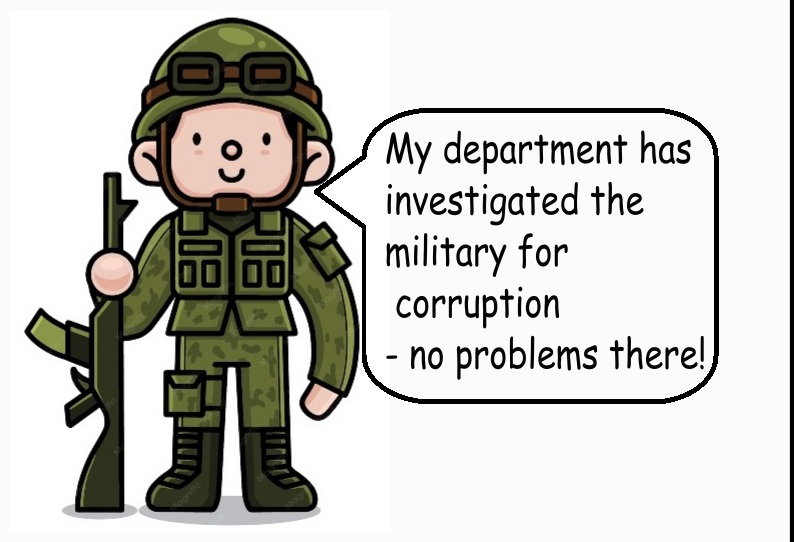
Defence initially referred to the National Anti-Corruption Commission (NACC) a case involving a former ‘star-ranked’ navy officer. The NACC chose to send it back to Defence to investigate itself instead — and not for the first time.
Michelle Fahy, Aug 16, 2026, https://undueinfluence.substack.com/p/what-a-top-secret-navy-officer-case?utm_source=post-email-title&publication_id=297295&post_id=211342821&utm_campaign=email-post-title&isFreemail=true&r=1ise1&triedRedirect=true&utm_medium=email
A former “star-ranked” officer of the Royal Australian Navy is facing a court-martial in September on eight charges relating to reported “lucrative defence contracts” for sustainment work at the Henderson shipyard near Perth, which the government has invested $12 billion in to prepare for AUKUS purposes.
The ADF’s chief judge advocate, Major General Michael Cowen KC, is hearing the case and has suppressed all details thus far, including the identity of the accused former officer.
Several elements of the case have drawn attention from defence commentators, who have argued that it appears as if Defence leadership and ministers are trying to “bury” the case from public view, and that the case should take place in an open civil court.
But a key point of interest is the fact that the National Anti-Corruption Commission, after initially being referred the matter by Defence, as required by law, chose to hand the case back.
This means Defence is overseeing its own investigation into the matter.
It’s not the first time this has happened
The NACC has a history of handling certain cases like this.
In mid-2024, the national audit office found that a Defence official had given French weapons maker Thales confidential information during a protracted negotiation process. The official subsequently took a position with Thales, just before the company was awarded a 10-year, $1.2 billion contract to manage two Commonwealth-owned munitions facilities.
When Defence referred that matter to the NACC, the watchdog sent the case back to the department to investigate. Minister for Defence Industry Pat Conroy later claimed the department had “thoroughly investigated” the Thales matter and found “no evidence to substantiate the allegation”.
But as former Australian Federal Police investigator Chris Douglas said at the time, Conroy was wrong to make this claim.
Douglas, who worked for the AFP for 31 years in intelligence and operational units before going on to advise domestic and foreign governments on the design and implementation of anti-corruption programs, said Defence cannot effectively investigate allegations that could involve corruption.
A “thorough” investigation can only be undertaken by a law enforcement agency, particularly the NACC, “using a full suite of investigation powers including electronic evidence gathering.”
“There might be evidence at the person’s home, Defence isn’t going to find that, or in premises occupied by Thales, Defence won’t find that either. That is why we have a NACC.”
The NACC also did not appear to have placed sufficient weight on the seriousness of the matter, particularly as Thales is linked to several international corruption matters, operates in one of the most corrupt industries in the world, and currently manages Australian government contracts worth billions of dollars.
Douglas added that if Thales were an individual, “based on its past behaviour it would not be given a security clearance and therefore no employment”.
‘They should have been investigated’
Talking with Crikey, Douglas said the NACC’s decision to send the naval contracts case back to Defence for investigation provides further indication that “it lacks an understanding of how to approach serious corruption matters”.
While there are valid reasons for a department to be asked to conduct preliminary investigations into minor matters, Douglas said the case involving the former Navy officer is not minor.
“They should have been investigated thoroughly by the NACC. Defence does not have the power to tap telephones, install listening devices or compel witnesses to speak.”
Senator David Shoebridge, Greens spokesperson on Defence and Justice, agrees.
“It is now a pattern of behaviour where the NACC, which is meant to be the independent watchdog that takes on corruption, has handballed its responsibility back to the institution at fault,” he told Crikey.
Douglas also criticised the court-martial process, noting that police officers do not sit on judicial panels overlooking other police. “You wouldn’t have a corrupt cop who’s been taking money from outside being adjudicated by police only; those matters go to a civil criminal court.”
In contrast to the secrecy being imposed by Defence, the former AFP investigator supplied several examples in which the names of senior law enforcement officers have been made public regarding serious offences. These included former assistant WA police commissioner Gailene Hamilton, who was stood down from the WA police force in July last year. Her trial started in May.
Further bolstering the argument that the former navy officer’s case should be heard in a civil court is news that entities external to Defence also appear to be involved in the matter, with interactions to be examined between Defence’s former arms buying group — the Capability Acquisition and Sustainment Group — and several large companies that completed sustainment at Henderson shipyard.
‘Cosy’ relationship between NACC and Defence
The NACC’s freedom of information disclosure log contains documents related to the abovementioned Thales matter of 2024. The six documents reveal emailed interactions between relevant personnel at the NACC and Defence, and show what Douglas has described as an apparently “cosy relationship” between the two.
Notably, the NACC notified Defence, from the outset, of the expected length of its investigation: four to six weeks.
Senior Elder petitions to halt rocket and military testing at Koonibba Test Range
Giovanni Torre, August 7, 2026, https://nit.com.au/06-08-2026/25800/senior-elder-petitions-to-halt-rocket-and-military-testing-at-koonibba-test-range
More than 1,300 people have thrown their support behind a Senior Elder’s petition urging federal Minister of Environment and Water, Murray Watt, to halt rocket and military testing by Southern Launch in South Australia.
Aunty Sue Coleman-Haseldine, the Senior Googatha Elder who started the petition, expressed grave concerns over the potential environmental and heritage impacts on the area.
“Southern Launch have been using my Country and Sacred sites as a test range for dangerous experimental launches without my consent, putting the delicate ecosystem and endangered animals at risk,” she said.
“I am worried for the animals with the fire hazard that these rockets cause and I am worried that my sacred sites will be destroyed by the falling debris.”
Southern Launch operates from Koonibba Test Range which covers 41,000 km squared of Yellabinna Regional Reserve and Yumbarra Conservation Park.
Both the reserve and the park are home to many endangered and threatened species such as the Golden Mole, Pink Cockatoo, Mallee Emu-Wren and Sand Hill Dunnart. It is also home to the only stunted mallee habitat in the world.
The petition calls for an immediate cessation of the company’s activities to protect the Yellabinna Regional Reserve and Yumbarra Conservation Park.
Aunty Sue said the company’ activities in the area are also putting her and her family at risk as they regularly make trips into the area to fulfil their cultural duties “caring for the land and many sacred sites that are out there”.
“They have launched multiple rockets now while I have been in the rocket range with full knowledge my safety was at risk,” she said.
Her petition states that Southern Launch rocket tests are “experimental and as result extremely dangerous especially in such a fire vulnerable environment”, noting that “earlier this year the park and reserve experienced the largest fire in decades devastating thousands of acres of land which will take over a century to recover”.
“The park and reserve will completely collapse if another fire happens,” the petition warns.
A federal government spokesperson told National Indigenous Times said any concerns about the site can be raised through formal avenues.
“Businesses have a responsibility to look after the land they operate on, and respect the history of that site,” they said.
“We take reports of cultural or environmental risk to sites and species seriously, and would encourage anyone with evidence of behaviour that breaches those regulations to submit it to the relevant authority.”
National Indigenous Times understands no formal applications have been received under the Environment Protection and Biodiversity Conservation Act or the Aboriginal and Torres Strait Islander Heritage Protection Act in relation to the Koonibba Test Range.
The primary responsibility for the protection of Aboriginal and Torres Strait Islander cultural heritage in South Australia rests with the State Government.
The Segal State: the office Australia never voted for
by Andrew Brown | Aug 9, 2026 , https://michaelwest.com.au/the-segal-state-the-office-australia-never-voted-for/
Jillian Segal holds power over what Australians may say, teach, report and believe. No election gave it to her. No Parliament ratified it. Nothing like her office has existed in the federation. Labor built it. The Coalition wants it bigger. Nobody asked you. Andrew Brown – The Segal State, Part One.
Remember the referendum in which Australians voted to create a Voice to Parliament for Israel?
You don’t. It never happened. We got one anyway.
In 2023, 60.06 per cent of Australians rejected a constitutionally recognised Voice for Aboriginal and Torres Strait Islander people. A body that could only make representations, only on matters concerning the people whose ancestors have been here sixty thousand years.
Too much, the No campaign shrieked. Division. Privilege. Special treatment.
Nine months later, Anthony Albanese handed Jillian Segal what the Voice never dreamed of asking for. Not a right to be heard. Power. No election. No parliamentary vote. No hearing. A three year commission reporting personally to the Prime Minister, with a mandate reaching into every campus, newsroom, classroom, gallery, charity, arts contract and visa file in the Commonwealth.
“Australia has never seen an office like this. Not once in 125 years.”
We have been here before and we said no. In 1951, Robert Menzies asked Australians for power to outlaw communism and police political belief. Even Menzies put it to a referendum, because a democracy does not seize control of ideas by fiat. A frightened people refused him.
That refusal became a founding settlement of this country. The state does not decide what citizens may think.
A captain’s call
Albanese tore up that settlement with a press release. No referendum. No bill. No debate. One man appointed one advocate, and the checkpoint went up.
An open society grants authority over its citizens three ways. Election. Appointment ratified by Parliament. Or a court, ruling in public, subject to appeal. Segal’s power arrived by none of them. The word for that is illegitimate. Not unlawful. Worse. Lawful, and
“authorised by nobody but one man”.
Do not look to the opposition for rescue. The Coalition demanded a national antisemitism crackdown before Labor delivered one, and its only complaint since is that the checkpoint is too small and the universities let off too lightly.
Resistance has come from the cross-bench alone. When both major parties agree on machinery this size, the voters have been deleted from the equation. Neither will ask whether Segal’s authority is legitimate, because both intend to use it. That is imposition.
“That is Australia in 2026.“
Say it plainly. Antisemitism is real. It is sometimes murderous. Jewish Australians deserve safety, delivered without mercy by police, courts and criminal law against anyone who menaces a synagogue or a schoolchild.
Safety does not require a private advocate enthroned above the speech of 27 million people. That is not protection. That is capture.
The wrong person, chosen on purpose
Segal ran the Executive Council of Australian Jewry. She chaired the Australia Israel Chamber of Commerce. Israel lobby groups.Advocacy for Israel is her right as a private citizen. It is also the precise reason no honest government would put her near an office ruling on the boundary between antisemitism and criticism of Israel. Albanese did not blunder into the conflict. He shopped for it.
Her selection sits buried under Freedom of Information redactions. Up to $16.9 million was approved for the Envoy offices. You were not asked. You were not told. You are paying her a reported $1,070 a day, and Home Affairs refuses to tell you her salary.
The machinery of a small authoritarian state
Jillian Segal produced a 20 page plan. Thirteen recommendations. Forty nine actions. And behind them, nothing. No published evidence base. No consultation paper. No regulatory impact statement.
Not one piece of credible research showing any of it would prevent a single antisemitic incident. For all the rigour on display, the plan might as well have been drafted at her Point Piper kitchen table. In December 2025 the Government swallowed it whole anyway, named it a program of work led by Segal, and pledged action on every recommendation, unquestioned.
Read the list and ask which country you are living in. Media monitoring. A university report card. Withholding university funding. Terminating academic grants. Stripping charities of their status. Screening visa applicants for their opinions. Ideological training for the public service. Cancellation clauses so arts grants can be ripped back from artists who say the wrong thing about the wrong state.The fig leaf is that Segal cannot personally cancel anything. Her office helps define the offence, grades the accused and recommends the sentence.
Ministers supply the muscle and the deniability. Prosecutor, judge and probation service in one unelected body, answerable only to the man who created it. Build this for any other subject and Australians would name it instantly.
A censorship ministry.
A rigged definition, wired into everything
At the centre sits the contested IHRA definition, whose own lead drafter has protested its use as an enforcement weapon. The ABC, SBS, Amnesty International and hundreds of scholars warn its Israel related examples can melt criticism of a state into hatred of a people. Segal bolts it into government regardless.From January 2027, universities must define antisemitism under an enforceable national standard. Then Segal’s report card marks whether the definition is appropriate, while her plan demands IHRA everywhere. Choice, the way a loan shark offers choice.
No vice chancellor will need to be ordered to censor.
“They will censor themselves in advance.“
That is only the architecture. Then Segal took an oath and showed what it is for.
And hold one question in your head overnight, the one polite Australia refuses to ask. Why does one form of racism summon a ministry, a report card and $130 million, while First Nations families waited thirty years and 590 deaths in custody for recommendations nobody implemented?
Why machinery for one hatred and a media release for the rest? You are not supposed to ask. Ask anyway.
Tomorrow, Part 2: the mask off under oath. The plan for your children. The $50,000 nobody will investigate. And the question answered.
Britain can’t provide us with nuclear submarines, says Malcolm Turnbull.
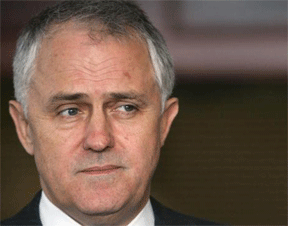
Speaking at an inquiry into the viability of the Aukus deal, the former
Australian prime minister said the agreement was ‘a colossal mistake’.
The former Australian prime minister Malcolm Turnbull has called British
shipbuilding an “industry in disarray” and predicted it will produce
few, if any, of the nuclear-powered submarines promised under the Aukus
agreement in the foreseeable future.
Speaking at an independent inquiry
into the implications and viability of the tri-nation submarine deal, which
will cost Australia the equivalent of nearly £200 billion, the former
Liberal Party leader described the pact as “a colossal mistake”.
Times 10th Aug 2026, https://www.thetimes.com/world/australasia/article/australia-submarines-aukus-deal-malcolm-turnbull-jqc2x66hq
Why Renewables Win

Australia has one of the world’s fastest-moving electricity systems. It
leads the world in rooftop solar, has deployed grid-scale batteries at
extraordinary speed, and is now starting to replace its ageing coal fleet
with cleaner sources of energy. But as renewable costs rise and electricity
demand grows, can the transition remain affordable while maintaining a
reliable power system? This week on Cleaning Up, Michael Liebreich is
joined by Paul Simshauser, CEO of Iberdrola Australia, and one of
Australia’s leading energy economists. Drawing on decades of experience
across electricity markets, networks and policy, Paul explains what makes
Australia’s power system unique, and what the rest of the world can learn
from it.
Cleaning Up 10th Aug 2026 https://cleaninguppod.substack.com/p/why-renewables-win
Royal Commission into Antisemitism a “$131 Million Whinge”
by Andrew Brown | Aug 5, 2026, https://michaelwest.com.au/royal-commission-into-antisemitism-a-131-million-whinge/
“Australians are not being investigated for hating Jews. They are being investigated for objecting to a genocide.” Andrew Brown on the Royal Commission into Antisemitism.
Apparently antisemitism simply fell from the sky. Fully formed. Immaculately conceived. Entirely unrelated to anything happening in Gaza. That is the finding Australia has pre-purchased for $131.1 million, confirmed at Senate Estimates in February, with $91 million alone for staffing, property, lawyers and security.
“Every single dollar buys theatre.“
Measure the obscenity. The banking royal commission, which gutted an entire industry’s misconduct, cost $75 million. Aboriginal Deaths in Custody cost $50.2 million.
This inquiry outspends both combined. Meanwhile there is no royal commission into the domestic violence killing a woman most weeks, none into Islamophobia, now soaring. Australia found $131 million for the one inquiry designed never to ask an obvious question.
Blame where it belongs. Anthony Albanese wrote the answer into the question. His Letters Patent instruct the Commission to find the drivers of antisemitism in extremism and radicalisation, the war deleted from the terms of reference before Virginia Bell was even sworn in.
The Albanese government wrote the verdict into the terms of reference, then spent more than the banking royal commission to have a judge read it back. Here is what the money is buying.
Commissioning an alibi
Albanese promised the inquiry would deliver, in his own words, the right outcome. A Prime Minister announcing the right outcome in advance is commissioning an alibi.
This is the government that will gesture at recognising Palestine while refusing to utter the word genocide, that ships F35 components into the supply chain of the slaughter, that sanctions two Israeli ministers and calls it courage. It needed a grand national explanation for collapsing social cohesion that never once mentions its own complicity.
“For $131 million, it has bought one.“
The process delivered. In the first three days of hearings, 23 of 36 witnesses characterised criticism of Israel, opposition to Zionism or Palestine advocacy as antisemitic. Jewish organisations opposed to Zionism were refused leave to appear. Palestinian voices were excluded for lacking a direct and substantial interest.
The accused were barred from the courtroom so the prosecution could run unopposed at public expense.
The grievance parade
And the substance? A grievance parade.
The ABC and SBS hauled in to answer for Jillian Segal’s strong perception, her phrase, that their Gaza coverage lacks balance, then interrogated for declining the contested IHRA definition Bell waved through as uncontroversial.
Keffiyehs, flags, watermelon art, chants of Free Palestine, student encampments and fundraisers for maimed children tendered as exhibits of hate. Protest. Tents. Journalism. Every place an ordinary Australian expressed solidarity with a people being exterminated, recast at public expense as a crime scene. Australians are not being investigated for hating Jews.
“They are being investigated for objecting to a genocide.“
The complainants were welcomed like royalty. Alex Ryvchin of the ECAJ, who called the anti-Israel movement indistinguishable from neo-Nazism, testified at length while his silk objected to opposing counsel merely uttering the word genocide, a finding the International Court of Justice considered plausible back in January 2024.
Robert Gregory of the self-appointed Australian Jewish Association, which the ECAJ itself calls unrepresentative, told the Commission the government egged on antisemitism, fresh from blaming Bondi on visas for Palestinians fleeing the bombs.
Sky’s the limit
Sky News completes the circuit, wheeling Gregory out to demonise protesters, then feeding its own segments back into the panic as evidence.
The outcomes are as predetermined as the terms.
Come 14 December, expect IHRA stamped across the public service and pushed onto civil society, work Segal has begun. Expect ABC oversight its own ombudsman rejected. Expect protest reframed as policing, and regulators monitoring speech the way AHPRA already does, having admitted under oath it watches nurses and doctors for criticism of Israel after Segal’s pressure.
“Expect everything blamed but the war.“
And expect antisemitism not to fall, because you cannot cure what you refuse to diagnose. Every recommendation will manufacture the resentment it claims to fight, and Labor will call the wreckage cohesion.
For almost three years the world has watched a genocide live-streamed by a state claiming to act in the name of the Jewish people, while its Australian cheer squad defended, excused or denied every atrocity.
Now they ask why anger grows.
None of this excuses antisemitism. Not one word of it. The Bondi gunmen murdered Jews for being Jews, and the law should fall hard on every bigot who follows them. Fifteen dead Australians deserved a fearless inquiry. They got a pantomime, their graves deployed as a shield for a foreign state and the government that armed it.
The elephant is blocking the doorway and eating $131 million of paperwork, yet everyone keeps peering around it, declaring there is nothing to see.This Commission will not defeat antisemitism. It will deliver the most expensive whinge in Australian history, commissioned by a government purchasing its own absolution with public money.
The Advertiser (Adelaide) tries to be fair about AUKUS nuclear waste, but can’t quite make it.

Waste Storage Issue
Robyn Wood, 3 August 26
The Advertiser published my letter on AUKUS today, though they edited it to remove the cost of “tens of billions of dollars” and removed my sentence asking just what the government was trying to hide from us.
To answer David Harris’ suggestion on the eventual storage of high level waste at the end of AUKUS nuclear submarine life – (Stiring the waste – letters 30/7/26), Australia is definitely responsible for it, even nuclear waste generated by the U.S. in the second-hand subs we will supposedly get from them.
Eventually a deep geological nuclear waste facility would have to be built in Australia at a vast cost which has not been budgeted for.
The government is keeping its plans secret.
Former Senator Rex Patrick recently won a legal case to bring about release of government documents detailing potential AUKUS nuclear waste storage and disposal sites, which the government is currently appealing, in their wish to keep the plans from public view.
Royal Commission: lawyers spar over Gaza genocide, health regulator admits Segal pressure
by Stephanie Tran and Wendy Bacon | Jul 30, 2026 , https://michaelwest.com.au/royal-commission-lawyers-spar-over-gaza-genocide-health-regulator-admits-segal-pressure/
A heated exchange erupted at the Royal Commission on Antisemitism and Social Cohesion on Wednesday after counsel for the Jewish Council of Australia, Kirsten Edwards SC, questioned Australian Health Practitioner Regulation Agency (AHPRA) chief executive Justin Untersteiner about whether healthcare workers could face complaints for describing Israel’s conduct in Gaza as genocide.
The exchange prompted strong objections from counsel for the Executive Council of Australian Jewry, Michael Borsky KC, who argued the commission should not become
“a platform” for “false claims” about Israel.”
Edwards’ questioning centred on an example contained in the Special Envoy to Combat Antisemitism’s handbook, which AHPRA adopted alongside the International Holocaust Remembrance Alliance (IHRA) definition in June.
One reading of the analysis provided of this example is that describing or using the words genocide, apartheid, or ethnic cleansing in connection with Israel’s actions in Palestine is antisemitic,” Edwards said.
She noted that international bodies, including the International Court of Justice, had used the term genocide in relation to Israel’s conduct in Gaza and asked how practitioners expressing similar views would be treated under AHPRA’s new approach.
“Prior to the publication of this handbook in January 2024, the International Court of Justice ruled that it was
plausible that Israel’s acts in Gaza could amount to genocide,” Edwards said.
“Genocide claims antisemitic, claims Israel lobby lawyer“
Borsky immediately objected and said the “false claims” would “fuel antisemitism”.
“I object. We respectfully submit that this Commission ought not be used as a platform for referring to such allegations. My friend is wrong. That’s not what was found, and the suggestion is, in any event, irrelevant to the Commission’s terms of reference, it could only be relevant to the subject of the Commission’s terms of reference in fuelling anti-Semitism and eroding social cohesion for these false claims to be advanced through this forum,” he said.
Commissioner Virginia Bell rejected the submission that the questioning was irrelevant.
“As I understand where Ms Edwards is going,” Bell said, “it is to contend that in some contexts, use of the word genocide … might nonetheless not be evidence of hostility towards Jews, but might reasonably be taken as a political statement about the conduct of the State of Israel.”
“I think that’s very much at the heart of aspects of the work of this Commission.”
Genocide denied
Borsky doubled down.
“Commissioner, with the greatest of respect, we understand and accept that. But accuracy matters and what my friend put was inaccurate. It was false. She put that the International Court of Justice has ruled that it was plausible that Israel’s acts in Gaza could amount to genocide.
“That is false, and its airing in public is liable to exacerbate the problem of anti-Semitism in his country,” he said.
Commissioner Bell disagreed.
“Mr Borsky, calling it false might be going one step beyond a neutral way of framing it,” she said.
Bell observed that the ICJ had not determined whether genocide had occurred but had accepted there was a prima facie case warranting provisional measures while proceedings continue.
Counsel assisting the Royal Commission, Richard Lancaster SC also interjected Edwards’ line questioning twice.
On the first occasion, Lancaster objected to Edwards’ characterisation of the example in the Special Envoy’s handbook, telling the Commission:
“I object to that because it refers to Zionism. It doesn’t refer to Israel.”
On his second interjection, he once again emphasised that the example of antisemitism in the handbook referred to the term “Zionist”.
“The launching pad for Ms Edwards’ questions was an example given in the ASECA handbook.The example does not involve expressions using the word Israel or the government of Israel. It uses the terms Zionist, and so the launching pad for the question does not sit well with Miss Edwards’ explanation of it,” Lancaster said.
The analysis of the example on page 76 of Segal’s handbook argues that “trying to separate ‘antisemitism’ from ‘antizionism’ ignores the history of misinformation, disinformation and antisemitic propaganda that has shaped narratives about Israel and Zionism … Antisemitism and antizionism are both expressions of hatred towards Jews.”
Untersteiner was unable to answer whether the handbook example would be found to be antisemitic. He said that it would depend on “context” in each case and that he was not a decision maker of complaints.
Segal handbook was “tipping point”
Earlier in his evidence, AHPRA CEO Justin Untersteiner confirmed AHPRA had resisted adopting the IHRA definition because of concerns it could inhibit legitimate political speech.
We resisted it for a period of time,” he said, because AHPRA had heard concerns about “the risk of the IHRA definition stifling free speech … within the healthcare system.”He said publication of the Special Envoy’s handbook earlier this year altered the regulator’s assessment.
“The handbook really provided greater granularity and detail about the definition, about what it does mean and what it doesn’t mean,” Untersteiner said.
“It was on the basis of that handbook, as well as all the feedback that we’d had over a period of time, that we felt it was the right decision then to adopt it.”
When Edwards suggested the handbook had been the “tipping point” in AHPRA’s decision, Untersteiner agreed.
Handbook to inform disciplinary action
Untersteiner also confirmed the handbook would not simply assist staff in triaging complaints but could
“inform disciplinary decisions made by professional boards.“
Asked whether the IHRA definition would be referenced if AHPRA alleged a practitioner had breached professional standards through antisemitic conduct, Untersteiner replied that it would.
“The recommendation and the report … would very much reference IHRA,” he said.
“The appropriate board would be referencing IHRA in making that final decision.”
He further agreed that AHPRA was embedding not only the IHRA definition but also the Special Envoy’s handbook into its regulatory framework.
When asked whether both documents could inform assessments of whether conduct was antisemitic and whether complaints were vexatious, Untersteiner answered: “Correct.”
AHPRA begins social media monitoring
The hearing also revealed AHPRA has begun using social media monitoring tools to monitor practitioners’ social media activity.
“We, like most regulators, use a range of different regulatory tools,” Untersteiner said.
“That includes the use of social media monitoring tools … to help us identify where there might be activity of concern to us related to, for instance, racism or discrimination.”
“We’ve engaged a service provider that undertakes general social media monitoring, and they will use a range of different methods to identify. And by the way, this isn’t just about discrimination, which relates to other issues that might play out in the health system,” he said.
Pressed on whether the monitoring involved searching for particular terms, such as “genocide”, Untersteiner said he was not sufficiently familiar with the technical operation of the system to answer.
Untersteiner said that 85% of complaints related to Islamophobia and anti-Semitism were related to social media activity compared to 40 to 45% of overall complaints regarding racism and discrimination.
Chilling effect acknowledged
Edwards also questioned Untersteiner about complaints made against doctors who had spoken publicly about Gaza.
She referred to correspondence from the Royal Australian College of General Practitioners raising concerns that complaints relating to political speech, even when ultimately dismissed, were taking months to resolve and causing considerable stress to practitioners.
Untersteiner acknowledged that even
“unsubstantiated complaints could have a “chilling effect”.
He said AHPRA was considering whether practitioners should sometimes not be notified about complaints unlikely to result in regulatory action in order to reduce unnecessary anxiety.
Abuse after adopting IHRA
Questioned later by Borsky, Untersteiner said he had received abuse following AHPRA’s adoption of the IHRA definition, including allegations that he supported genocide or had been influenced by the Israel lobby.
Borsky also referred to abuse directed at Special Envoy Jillian Segal, who will reappear at the Commission on Thursday.
The hearing did not examine claims that AHPRA had also come under sustained lobbying from pro-Israel organisations before adopting the IHRA definition.
MWM previously revealed that AHPRA’s decision followed months of lobbying by the Australian Zionist Health Alliance and other advocacy groups, including calls for Untersteiner’s removal and repeated engagement with senior government officials.
1 This month
17 October, Free Public Talk on Nuclear Issues in South Australia
David Noonan will speak on public interest concerns over the new Roxby Downs Indenture Act 2026 on BHP copper-uranium mining and ore processing in SA, and on how AUKUS may face SA with a High-Level nuclear waste agenda.
Dr Jim Green will discuss international developments in the field of nuclear power including ‘small modular reactors’ and Generation 4 ‘advanced’ nuclear reactor concepts.


Help Aunty Sue Protect Her Land and Sacred Sites From Destructive Rocket Testing.
.

Australians deserve the truth
about
AUKUS – https://aukuspublicinquiry.com/

PETITION – To: Prime Minister Anthony Albanese and the Australian Labor Government

of the week – Australians for War Powers Reform (AWPR)
To see nuclear-related stories in greater depth and intensity

