Peter Dutton is about to talk nuclear at CEDA. Will he be fact checked by Chris Uhlmann?

Dutton and his team have not come close to explaining how it will dance around rooftop solar, or how rooftop solar will be forced to dance around nuclear. Will Dutton tell solar households that their PV will be switched off in the middle of the day to accommodate his energy ideology?
Giles Parkinson, Sep 19, 2024
Federal energy minister Chris Bowen calls it the great distraction. Virtually everyone in the electricity market calls it a nonsense, but Opposition leader Peter Dutton’s efforts to put the nuclear debate on centre stage appears to be gaining traction.
On Monday, Dutton takes his nuclear campaign, complete with obvious untruths and exaggerations, to the august environment of the Committee For Economic Development of Australia. The event, on Monday, is titled “A nuclear powered Australia – could it work?
CEDA was established in 1960 to “better understand and interrogate public policy” and says it remains independent and not restricted by vested interests or political persuasion. It should, in that case, be the perfect place for Dutton’s nuclear claims to be fact-checked.
Dutton has so far revealed little about his nuclear policy, apart from a vague plan to build reactors, both large-scale and the yet-to-be-commercialised small modular reactors (SMRs) at seven sites across the country where coal fired power stations have or still do operate.
The premise, according to the Coalition, is simple. Just build them and plug them in where there is an existing grid connection, and Australians will be protected from the lights going out and the economy being sent back to the dark ages, something it insists will be the result of Labor’s renewable energy roadmap.
It’s not clear how much more Dutton will tell CEDA about the details of the nuclear plan. He has insisted that the first reactors could be up and running and producing power by 2035 – a fanciful idea according to the regulators and other experts who point out that the late 2040s might be closer to the mark.
Dutton insists that nuclear is essential for the net zero target. It might be for other countries, particularly those with inferior solar resources and a well-established nuclear industry, but for Australia that claim is a nonsense.
The clear intention of the Coalition to slow, even stop, the rollout of new wind, solar and battery storage projects, extend the life of ageing coal generators and invest heavily in new gas – all of which will blow Australia’s emissions budget over the coming decades. It is difficult to think of a worse idea if climate change is the motivation.
Dutton has been regularly fact-checked on a number of other claims both here, and on the Guardian – less so, if not at all, in the rest of mainstream media and on radio and TV, where the claims are often broadcast. It hasn’t deterred him.
It includes the claim that Labor is looking to build 28,000 km of transmission lines to support its green energy transition. Not true. it has only targeted little more than 5,000kms.
The 28,000 km is a target under the most optimistic green energy scenario – it was developed by the Australian Energy Market Operator in its modelling under the previous Coalition government, and has changed little since then.
Dutton claims that nuclear is cheaper than wind, solar and storage. Again, not true and not by a long shot, according to recognised and respected Australian and international experts – all of whom have come under fierce attack by the Coalition and its attack dogs on social media.
It includes the claim that nuclear leads to lower power bills for consumers. But that only happens when the nuclear power is heavily subsidised, as it is in France, and when consumers are protected from market forces.
Ontario is often cited by the Coalition as having cheaper electricity prices than Australia, but they forget to tell you Ontario’s electricity prices are significantly higher than other Canadian provinces, thanks to nuclear.
Australia’s bills are weighed down by the cost of networks, servicing a population nearly twice the size of Ontario in a land are more than seven times bigger.
Dutton’s claim that nuclear can be plugged in to existing power grids without the need for upgrades is also nonsense. Most of those sites already have replacement capacity – Port Augusta and Collie in particular, and the site owners at Liddell, Mt Piper and Loy Yang have their own plans that definitely do not include nuclear.
The Coalition and their choristers also insist that nuclear somehow requires no additional back-up. That would be a miracle. All forms of generation require back up to ensure the lights stay on in case of an unexpected outage, or planned and long term maintenance.
Nuclear is no exception – it was the cause of massive amounts of pumped hydro being built around the world, in France, the Americas and China – and the size of its units at large scale mean additional measures are needed should the units go offline, even if the cause is as mundane as a tree falling across power lines.
Dutton insists that nuclear is attractive because it is “baseload” and “always on.” But modern grids demand flexibility, and none more so than Australia where – because of its excellent solar resources, the falling cost of PV and the high retail prices – more rooftop solar has been installed per capita than anywhere else in the world.
That rooftop PV is already causing problems for the existing “baseload” generators – coal and gas: It destroys their business models, and is technically challenging. The economics of nuclear relies more than any other on being “always on”.
Dutton and his team have not come close to explaining how it will dance around rooftop solar, or how rooftop solar will be forced to dance around nuclear. Will Dutton tell solar households that their PV will be switched off in the middle of the day to accommodate his energy ideology?
Dutton’s event will be compered by Chris Uhlmann, the former ABC political editor who became an instant “expert” in grids and renewables when he seized on the South Australia state-blackout and blamed it all on wind energy, even though multiple reports from regulators and energy experts have shown that not to be the case.
Will Uhlmann fact-check Dutton in the way that CEDA might expect? Uhlmann has spent much of his time since joining Sky News and The Australian earlier this year attacking the same targets as the Coalition – the IPCC, climate science itself, emissions targets, and the transition away from fossil fuels.
One of his more egregious pieces was an attack last month on a research report “Fossil Fuels are a Health Hazard” that was put together by the Doctors for the Environment Australia. Uhlmann’s piece in the Weekend Australian was titled “Fossil fuel bans are hazardous to our health”.
It included claims by Uhlmann that products such as panadol and soap depend on fossil fuels. Nonsense, the doctors wrote in response: These products might source fossil fuels now, but they don’t need to. No, we can’t stop using fossil fuels overnight, but we can phase them out very quickly.
The promotion of nuclear and fossil fuels, and attacks and the downplaying of climate science often go hand in hand. Will that be the case at CEDA next week?
As Nicholas Talley and Kate Wylie wrote in the excellent Croakey:
“Journalists have an opportunity to raise public awareness of climate change, using their power to encourage transformative action on what is termed the defining story of our time. They have a responsibility to ensure their coverage is evidence based and reports on the very real scientific and health warnings.”
Monday’s event should be very interesting.
The UK’s nuclear waste problem

“more nuclear power means more nuclear waste”
By Chas Newkey-Burden, The Week UK, 16 Sept 24 https://theweek.com/environment/the-uks-nuclear-waste-problem
Safety concerns as ‘highly radioactive’ material could be buried in the English countryside
“Not in my backyard” is a term normally used in conversations about proposed new housing or rail lines, but a version of it could soon be heard about one of the most dangerous materials on the planet.
Nuclear power stations are filling up with radioactive waste, so “swathes” of the highly dangerous material are set to be “buried in the English countryside”, said The Telegraph. For local communities, it isn’t so much “not in my backyard” as “not under my backyard”, said the Financial Times.
‘100,000 years of hazard’
Sellafield, in Cumbria, is the “temporary home to the vast majority of the UK’s radioactive nuclear waste”, said the BBC, “as well as the world’s largest stockpile of plutonium”. It’s stuck there because no long-term, high-level waste facilities have been created to deal with it.
The “highly radioactive material” releases energy that can infiltrate and damage the cells in our bodies, Claire Corkhill, professor of radioactive waste management at the University of Bristol, told the broadcaster, and “it remains hazardous for 100,000 years”.
The permanent plan to handle the waste currently at Sellafield is to first build a designated 650ft-deep pit to store it. Although the contentious matter of its location has yet to be agreed, the facility will hold some of the 5 million tonnes of waste generated by nuclear power stations over the past seven decades. Then, in the second half of the century, a much deeper geological disposal site will be dug, which will hold the UK’s “most dangerous waste”, such as plutonium, said The Telegraph.
The problem is only going to get bigger because nuclear power is a central part of the government’s mission for “clean power by 2030” and “more nuclear power means more nuclear waste”, said the BBC.
With at least three new nuclear power stations planned, said The Telegraph, the country will quickly be “at odds with” the 1976 review of nuclear waste policy by the Royal Commission on Environmental Pollution, which warned the UK was amassing nuclear waste so fast that it should stop building reactors until it had a solution.
‘Poison portal’
Some believe part of that solution will be found overseas. Earlier this year, there were warnings that Australia could become a “poison portal” for the UK and US as a result of a new three-nation defence pact called Aukus. The original wording of the agreement would allow for facilities to be created to dispose of waste from “Aukus submarines”, which could have included UK and US vessels.
Dave Sweeney, the Australian Conservation Foundation’s nuclear free campaigner, warned at the time that Aukus partners could see Australia as “a little bit of a radioactive terra nullius”.
After pushback, the Australian government added a loophole to the legislation to “ensure Australia will not become a dumping ground for nuclear waste”, said The Guardian.
But the Australian Greens’ defence spokesperson, David Shoebridge, said the changes did not go far enough. The amendment only addresses high-level radioactive waste, he said, and “still allows the US and UK to dump intermediate-level waste, and Australian high-level waste, anywhere in Australia”.
Hidden costs? Cheaper energy? ‘Farcical’ locations? Debunking the hype around nuclear
29 June 2024 , By Charis Chang, SBS News

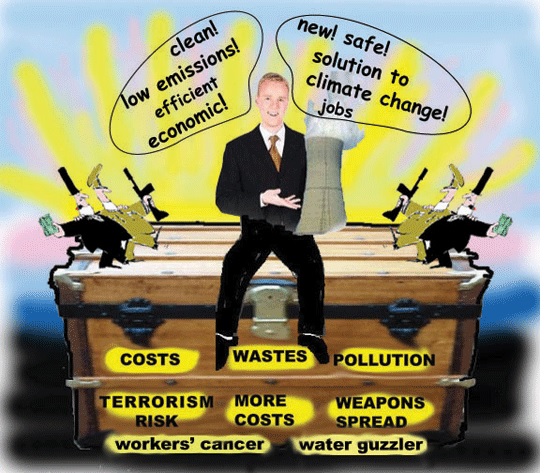
Seven nuclear power plants could be built in Australia if the Coalition wins the next election, but will they live up to the hype?
Australians are being promised a brighter future with nuclear as the answer to rising energy costs.
As concerns grow over the cost of living and rollout of renewables, the Coalition has announced an alternative vision, promising to build seven nuclear power plants across the country if elected.
Last week, it confirmed it would push for nuclear power plants to be built at Tarong and Callide in Queensland, Liddell and Mount Piper in NSW, Port Augusta in South Australia, Loy Yang in Victoria and Muja in Western Australia.
“We have a vision for our country: to deliver cleaner electricity, cheaper electricity and consistent electricity,” Opposition leader Peter Dutton said on 19 June.
But can nuclear in Australia live up to the hype?
Can nuclear bring down electricity prices?
One of the biggest claims the Coalition makes is that
nuclear energy could bring down the price of electricity
in Australia.
Dutton told the Today show on 21 June: “In Ontario, for example — they have 60 per cent nuclear in the mix there, their electricity prices are a quarter of what it is here in Australia”.
But Tim Buckley, director of think tank Climate Energy Finance, questioned how a form of energy that would produce “zero” electricity for the next 15 to 20 years, could bring down power prices.
In the meantime, the Coalition’s plan would undermine investor confidence so Australia didn’t get as much electricity supply from other sources, Buckley said.
“Less supply means higher prices — that’s economics 101.”
He believes the Coalition’s nuclear strategy could increase electricity prices by 20-50 per cent over the next decade because of the need for more government intervention and funding to extend the life of coal plants.
Buckley said the GenCost report — produced by Australia’s national science agency, the CSIRO — found power from nuclear could also be double the price of firmed renewables.
“Therefore power prices go up, not down,” he said.
GenCost looked at the levelised cost of electricity, which is the estimated price that would need to be charged so the generator could cover its costs including a return on investment.
It found electricity generated by large-scale nuclear would be $155/MWh (per megawatt hour) to $252/MWh.
Integrating renewables such as solar photovoltaic (PV) and wind into the grid, including the cost of storage and transmission lines, was estimated to be much cheaper, costing between $90/MWh and $100/MWh.
The GenCost report noted overseas electricity costs may not reflect the prices that could be charged in Australia because of differences in installation, maintenance and fuel costs.
Other countries may also be benefiting from older projects where the costs to build the power plant had already been recovered by investors or governments.
“Such prices are not available to countries that do not have existing nuclear generation such as Australia,” the report said.
Batteries will need to be ‘ripped down’ for nuclear
The Coalition plans to locate its nuclear power plants in the locations of old and retiring coal-fired power plants to “avoid much of the new spending needed for Labor’s ‘renewables-only’ system”.
An electricity grid with a large proportion of intermittent renewables requires many new transmission poles and wires, “all of which will be passed on in the form of higher bills”, Opposition energy spokesperson Ted O’Brien has said.
But Buckley points out that most retired coal-fired power sites are already being used for new battery plants. This includes a 500-megawatt battery plant announced last year on the site of the old Liddell plant in NSW’s Hunter Valley.
Ted O’Brien and Peter Dutton are proposing nationalisation of private assets, and then they’re going to have to rip down the batteries that have just been built at billions of dollars in cost … in order to then wait for 20 years while they build their nuclear power plants,” he said.
“It’s a little bit farcical to me.”
An ambitious 13-year timeline
In a press release announcing its policy, O’Brien said large-scale nuclear would be built by 2037, in 13 years.
But the CSIRO has estimated a nuclear power plant in Australia would take at least 15 years to build.
Australia’s federal nuclear ban would have to be overturned and the government may also have to override several state-level bans
Site selection and acquisition, design, impact studies and environmental permits would then need to be completed before construction could even begin.
Buckley said getting the relevant planning approvals was a time-consuming hurdle for any energy project, let alone one that had never been done in Australia before.
Nuclear ‘will need to be refurbished after 30 years’
Dutton has said nuclear is “an investment for 80 years” and this longevity makes the technology superior to renewable sources of power such as wind energy.
“These nuclear plants can produce and provide 24/7 power for 80 to 100 years … wind turbines last 19 years, so you’ve got to cycle them in and out three or four times,” he told the Today show on 21 June.
Buckley said Coalition statements underestimated the life of renewable projects, noting that nuclear power plants needed to be refurbished after around 30 years.
Warranties on new solar modules now covered them for more than 20 years, he said. And those on batteries had doubled from 10 to 20 years.
“Most solar projects have a design life of 25 years, wind projects have a design life of 30,” he said.
Buckley said the price of refurbishment should also be included in the capital costs for nuclear, and so should decommissioning expenses, which can cost about $10 billion once the plant reaches the end of its life.
‘Who’s going to pay for other costs?’
Eventually, funding will also have to be found to store the nuclear waste generated, which has to be securely stored for tens of thousands of years.
“Who’s going to pay for 10,000 years of nuclear waste disposal?” Buckley said.
Even based purely on the initial construction cost, nuclear does not come out ahead.
Who’s going to pay for 10,000 years of nuclear waste disposal? Tim Buckley, Climate Energy Finance director
The GenCost report estimated the cost of a large-scale nuclear plant in Australia would be $8.6 billion for a 1,000kW plant built in 2023, although the first one would likely be much more expensive.
A small modular reactor (SMR) was estimated to be even more expensive, at $28.6 billion.
In comparison, onshore wind is estimated to cost $3 billion for 1000kW of generation, while large-scale solar PV is even cheaper, at $1.5 billion.
Costs for offshore wind rise to between $5.5 billion and $7.7 billion.
The capital cost for firming technologies such as batteries is separate, but — as mentioned above — the levelised cost of renewables is estimated to be $90-$100/MWh, even including the cost of storage and transmission lines.
Meanwhile, the levelised cost of nuclear is between $155-$252/MWh.
The Coalition hasn’t yet released costings for its nuclear plan, only saying they would come “very soon”.
Analysis from the Smart Energy Council suggests it could cost between $116-$600 billion to build seven nuclear reactors, and they would only supply 3.7 per cent of Australia’s energy mix in 2050.
Michael Preuss, director of research infrastructure at Monash University’s faculty of engineering, has previously told SBS News that while the initial investment in nuclear is expensive, those upfront costs could be recovered.
“There’s a huge upfront investment and once they’re built and they start operating, they’re relatively inexpensive to operate and then you recoup the investment. But it takes a long time,” he said.
There will also be ongoing costs to buy the fuel required to run the nuclear power plant, something renewables can source for free.
Australian communities facing an un-insurable risk?
The Coalition has dismissed concerns about government funding of the plants, saying local communities would welcome the investment.
“You can imagine what this means to local communities, to mums and dads and their kids as they look to the future,” O’Brien told reporters on 19 June.
But Buckley said government funding was required because nuclear power plants were not commercially viable without taxpayer subsidies. He said no private company could afford the insurance risk of a nuclear catastrophe………………………..
Is the world embracing nuclear?
Dutton told Today on 21 June: “I think if you look at the top 20 economies of the world, Australia is the only one that hasn’t embraced or hasn’t signed up to nuclear.”
But Buckley believes this statement is misleading.
“America has closed more nuclear units in the last two decades than they’ve opened so how is that embracing nuclear?”……………………………………………………….
He said other countries that had embraced nuclear did not have the wind and solar resources that Australia did.
“Why would Australia go and choose the most expensive source of electricity with massive water consumption issues, with massive site rehabilitation and massive waste disposal risks, when we don’t need to?
“When there’s a lower cost, commercially proven technology today?” https://www.sbs.com.au/news/article/hidden-costs-cheaper-energy-farcical-locations-debunking-the-hype-around-nuclear/7rd5ewmbr
David Noonan confronts Australia’s politicians with critical unanswered questions on the AUKUS agreement – will they pretend not to hear this?
Federal Labor has failed to inform the SA community of the Health risks they face in imposed N-Subs at Port Adelaide and failed to carry out required nuclear accident Health Impact Studies.
AUKUS aims Australia buy existing US military nuclear reactors in second-hand N-Subs that are to be up to 10-12 years old, loaded with intractable US origin High-Level nuclear wastes that are also weapons usage fissile materials – and remain as Bomb Fuel long after decommissioning.
AUKUS will aim to compulsorily acquire and declare a High-Level nuclear waste dump site, with override of State laws through this Bill, long before the 2032 first purchase of a second-hand US N-Sub.
This Inquiry should respect and investigate the ‘Right to Know’ of affected Communities and Indigenous People facing federal imposed nuclear risks in an AUKUS Agreement requiring HighLevel nuclear waste & nuclear weapons usable fissile material storage and disposal facilities:
It is not credible for the JSCT to over rely on an AUKUS proponent in Defence Minister Marles.
Submission no. 154
Submission to Joint Standing Committee on Treaties Inquiry into the AUKUS 2.0 Agreement:
‘Agreement among the Government of Australia, the Government of the United Kingdom of Great Britain and Northern Ireland, and the Government of the United States of America for Cooperation Related to Naval Nuclear Propulsion’.
Public Input by Mr David J. Noonan B.Sc., M.Env.St.
Independent Environment Campaigner 1 September 2024 https://www.aph.gov.au/Parliamentary_Business/Committees/Joint/Treaties/NuclearPropulsion/Submissions
RE: National Interest, Public Safety and Indigenous Consent are compromised as the Agreement imposes N-Subs risks and untenable AUKUS military High-Level nuclear waste & nuclear weapons usable fissile material on all future generations of Australians
Dear Secretary
This Inquiry into ‘the Agreement’ (Washington, dated 4 August) goes to fundamental matters of public interest through the powers, imprimatur and pathway this AUKUS Agreement provides to an unfolding Federal Labor agenda to impose nuclear powered submarine (N-Subs) risks and nuclear reactor wastes (N-wastes), with serious consequences for Civil Society and Indigenous People in Australia.
Please consider this Public Submission, the Recommendations provided (see p.10-12) and Discussion (p.13).
I also request an opportunity to give Evidence as a Witness in a Hearing (see my Relevant Background, p.14).
This public input focuses on serious N-Sub reactor accident risks and N-waste impacts due to this AUKUS Agreement:
First: N-Subs inherent nuclear reactor accident risks & impacts are imposed on Australian Port communities without their informed consent, while the US is granted Indemnity.
Port communities face Evacuation and persons may require ‘decontamination’ and medical treatment, while children require Stable Iodine Tablets to lessen the risk of Thyroid cancer.
Second: untenable AUKUS military High-Level nuclear waste & nuclear weapons usable fissile materials are recklessly imposed as an uncosted liability on all future generations.
Continue readingThe Public Interest and Indigenous Rights in South Australia must not be compromised by an untenable Defence imposition of AUKUS military High-Level nuclear waste & nuclear weapons usable fissile material on the Woomera Area

David Noonan’s Submission to the Review of the Woomera Prohibited Area Coexistence Framework
30 August 2024
Contents:
Introduction
The public has a ‘Right to Know’ who is targeted for imposed storage of AUKUS N- wastes.
AUKUS N-wastes are a threat to the Rights of the People of SA to decide their own Future.
3 There is an onus on this Woomera Area Review to see it doesn’t add to a sad history of nuclear disrespect for Indigenous Human Rights and Interests in our State.………………….
4 Civil Society faces imposition of an AUKUS military High-Level nuclear waste dump …………………..
5 Defence is already targeting the Woomera Area as a potential region to site an imposed
AUKUS military High-Level nuclear waste dump ……………………………….
6 Indigenous People have a UN recognised Human Right to Say No to AUKUS N-wastes …………………….
7 Is US origin military High-Level nuclear waste from US N-Subs to be dumped at Woomera? ……………………………
8 Multi-billion $ N-waste Costs are ignored while the US gets Indemnity over nuclear risks ……………….
9 Recommendations
10 Discussion
The Review must be transparent on Defence roles for Woomera in AUKUS and in war
11 As to my Relevant Background
The public has a ‘Right to Know’ who is targeted for imposed storage of AUKUS N- wastes.
Minister Marles MP has still not made a promised ‘announcement’, said to be by early 2024, on
a process to manage High-Level nuclear waste and to site a waste disposal facility, he saying
“obviously that facility will be remote from populations” (ABC News 15 March 2023).
The national press (11 August 2023) reports the Woomera rocket range is understood to be the
‘favoured location’ for storage and disposal of submarine nuclear waste (“Woomera looms as
national nuclear waste dump site including for AUKUS submarine high-level waste afr.com).
Political leaders in WA, Qld and Vic have already rejected a High-Level nuclear waste disposal
site. SA’s Premier has so far only said it should go to a ‘remote’ location in the national interest.
This Review must respect the SA public and Traditional Owners rights to full disclosure of
potential nuclear risks and impacts in advance of any decisions, legislation and process to
impose AUKUS N-waste onto community in the Woomera Area or anywhere else in SA.
Defence can-not claim to have a ‘social license’ to operate in the Woomera Area while failing to
inform affected community of the AUKUS nuclear risks, the cultural and environmental impacts,
and socio-economic impacts they may face through siting for AUKUS nuclear waste storage.
Defence has so far denied South Australians their ‘Right to Know’ the nuclear risks they face.
AUKUS N-wastes are a threat to the Rights of the People of SA to decide their own Future.
The Woomera Area Review must understand that South Australians will not accept federal
Labor and Defence undemocratic imposition of AUKUS nuclear wastes in our State.
If federal Labor go ahead with storage of AUKUS nuclear wastes in SA, it will have to over-ride
State Law to impose the dump. AUKUS N-wastes are a threat to the Safety of the People of SA.
Storage and disposal of nuclear wastes compromises the Safety and Welfare of the people of
South Australia, that is why it is prohibited by the Nuclear Waste Storage (Prohibition) Act 2000.
The Reforming Defence Legislation Review also proposes to take on Defence Act powers to
override State legislation to ‘provide certainty’ to Defence roles, operations and facilities. My
input and Recommendations to the Defence Review called for transparency on these issues:
Defence should become transparent over proposed Navy High-Level nuclear waste
disposal, policy, siting process, rights and legal issues. Defence must declare whether
the SA Nuclear Waste Storage (Prohibition) Act 2000 will be respected OR is intended to
be over-ridden to impose a Navy High-Level nuclear waste storage or disposal site on
‘remote’ lands and unwilling community in South Australia. (April 2023, p.7 & Rec 6-7)
I refer the Review’s consideration to “The Politics of Nuclear Waste Disposal: Lessons from
Australia”, a Report by Dr Jim Green and Dimity Hawkins AM, Published by the Asia-Pacific
Leadership Network (January 2024). The Defence AUKUS agenda needs to learn these lessons…………………………………………………………………………………………………….
Recommendations
These Recommendations No.1-5 comprise public interest disclosures that must be required
from Defence to facilitate an informed public Review of the future of the Woomera Area:
Civil Society faces imposition of an AUKUS military High-Level nuclear waste dump
This Review must respect affected Communities and Indigenous People’s ‘Right to Know’ the
Defence imposed nuclear risks they face in intended High-Level nuclear waste & nuclear
weapons usable fissile material storage and disposal facilities.
1.1 The Review must call on Defence to publicly disclose which Australian regions and
Indigenous Peoples are currently under threat of imposed siting and compulsory land
acquisition for an AUKUS High-Level nuclear waste dump, and which – if any – existing Defence
lands are included in the regional short list that is currently being prepared.
1.2 The Review must make Defence become accountable over the future and fate of the
Woomera Area, understood in national media to be a ‘favoured location’ for storage and
disposal of submarine nuclear waste (“Woomera looms as national nuclear waste dump site
including for AUKUS submarine high-level waste afr.com AFR 11 August 2023). Noting the
Woomera Area is currently subject to a Defence ‘Review’: “to ensure it remains fit for purpose
and meets Australia’s national security requirements” – read AUKUS requirements.
1.3 Defence must become publicly accountable and declare its intension to over-ride the SA
Nuclear Waste Storage (Prohibition) Act 2000 through powers in an AUKUS Bill now before
Parliament (Sec.135 “Operation of State and Territory laws”): to impose an AUKUS nuclear
waste dump on outback lands and unwilling community in SA, by decree in federal Regulations.
This Defence agenda to impose nuclear waste storage in SA also involves Defence over-ride of
the SA Environment Protection Act 1993 and over-ride of the SA Aboriginal Heritage Act 1988.
2 Indigenous People have a UN recognised Human Right to Say No to AUKUS N-wastes
The Woomera Area Review must respect the clear views of Indigenous Labor Senator Patrick
Dodson and act in accordance with the Recommendations of a Federal Inquiry Report (Nov
2023) into the UN Declaration on the Rights of Indigenous Peoples, stating:
“the Commonwealth Government ensure its approach to developing legislation and
policy on matters relating to Aboriginal and Torres Strait Islander people be consistent
with the Articles outlined in the UNDRIP”.
2.1 This Review must seek an explanation from the federal Labor Gov as to whether they will
commit to respect and comply with the United Nations Declaration on the Rights of Indigenous
Peoples Article 29 provision of Indigenous Peoples Rights to “Free, Prior and Informed
Consent”, as a Right to Say No, over storage or disposal of hazardous materials on their lands;
OR if Federal Labor intends to claim a sanction to over-ride UNDRIP and to impose a hazardous AUKUS nuclear waste dump against the potential express wishes of Traditional Owners.
3 US origin military High-Level nuclear waste from US N-Subs to be dumped at Woomera?
The Woomera Area Review must recognise the AUKUS Agreement’s proposed importation of US
origin military High-Level nuclear wastes sourced in 10–12-year-old US Navy nuclear reactors in
second hand US Virginia Class N-Subs that will require perpetual storage in Australia:
This Review must seek a full explanation of how Defence Minister Marles claims to be able
to manage a globally unprecedented task in siting and perpetual storage & disposal of
intractable US origin High-Level nuclear wastes from second-hand US Virginia N-Subs.
It is not credible for the Review to overly rely on claims by AUKUS proponent Minister Marles.
3.1 The Review should call on Minister Marles to explain the incompatibility between the AUKUS
Agreement’s transfer of US origin Virginia Class N-Sub nuclear wastes to Australia, effective
importation of nuclear wastes sourced from the US, and the pre AUKUS Federal Labor Policy
commitment in the ALP National Platform (2021, Uranium p.96-98) to oppose overseas waste:
Labor will: 8. d. Remain strongly opposed to the importation and storage of nuclear
waste that is sourced from overseas in Australia.
4 Multi-billion $ N-waste Costs are ignored while the US gets Indemnity over nuclear risks.
There is an onus on this Review to require public $ Costings and an evidentiary basis on:
- the liability $ Cost consequent in required capability and facilities for in perpetuity High-
Level nuclear waste storage and geological waste disposal at the Woomera Area; - whether the $ Cost of High-Level nuclear waste storage and claimed geological disposal
is included in – OR is additional to – the public Cost of AUKUS at approx. A$368 billion.
These unstated, kept secret, liability $ Costs must be in the order of at least A$10’s of billions.
4.1 In the public interest the Review must require a full exposition on the array of nuclear waste
risks the AUKUS Agreement exposes the Woomera Area to and grants the US Indemnity over.
“Indemnity 22. The Agreement requires Australia to indemnify the UK and the US
against any liability, loss, costs, damage, or injury (including third party claims) arising
out of, related to, or resulting from nuclear risks (risks attributable to the radioactive,
toxic, explosive or other hazardous properties of materials) … transferred pursuant to the
Agreement (Article IV(E)).” (In the National Interest Analysis [2024] ATNIA 14)
5. The Review must be transparent on Defence’s roles for Woomera in AUKUS and in war.
Our survival is at stake, ex-Ambassador to China, Ross Garnaut has stated (20 August 2024):
“America would be damaged by war with China over the status of Taiwan, but, short of a
major nuclear exchange debilitating both great powers, its sovereignty would not be at
risk. Australia’s would be. Indeed, I doubt that Australia could survive as a sovereign
entity the isolation from most of Asia that would be likely to follow anything other than a
decisive and quick US victory in a war in which our military was engaged.”
Discussion:
Defence imposed AUKUS military High-Level nuclear waste & nuclear weapons usable fissile
material on all future generations of Australians is untenable and will be opposed at Woomera.
This Review must at least be able to facilitate informed public consideration of the future of the
Woomera Area through required full disclosures from Defence to the set of pre-requisite public
interest Recommendations No.1-5 presented in this public input.
Australian regional communities and Indigenous groups have a ‘Right to Know’ who is being
currently targeted for siting and assessment of an AUKUS nuclear waste storage / dump.
The Review must realise an answer from federal Labor over whether the UNDRIP championed
by Senator Patrick Dodson will be complied with OR over-ridden to impose AUKUS N-wastes.
Three years into AUKUS the failure to respect affected communities ‘Right to Know’ is evidence
Defence is on a seriously wrong track and is undermining trust in governance in Australia.
There is an onus is on this Review to investigate the array of serious nuclear waste risks to be
imposed on Woomera through AUKUS and subject to an Indemnity to favour US interests.
The Review must be transparent on Defence roles for Woomera in AUKUS and in war.
It is arguable that AUKUS and N-Subs bring Australia closer to a devastating war between the
US and China, including likely strikes on Australia with a real risk of nuclear weapons strikes.
For instance, the Review should consider “AUKUS: The worst defence and foreign policy
decision our country has made” by ex-Foreign Affairs Minister Gareth Evans (17 August 2024):
“… Four, the price now being demanded by the US for giving us access to its nuclear
propulsion technology is, it is now becoming ever more clear, extraordinarily high. Not
only the now open-ended expansion of Tindal as a US B52 base; not only the conversion
of Stirling into a major base for a US Indian Ocean fleet, making Perth now join Pine Gap
and the North West Cape – and increasingly likely, Tindal – as a nuclear target …
Australia’s no-holds-barred embrace of AUKUS is more likely than not to prove one
of the worst defence and foreign policy decisions our country has made, not only
putting at profound risk our sovereign independence, but generating more risk than
reward for the very national security it promises to protect.”…………………………………………………………..
FBI Sued For Withholding Files On Assange And WikiLeaks

Kevin Gosztola, Sep 12, 2024, https://thedissenter.org/fbi-sued-for-withholding-files-on-assange-and-wikileaks/
“With the legal persecution of Julian Assange finally over, the FBI must come clean to the American people,” Chip Gibbons, policy director for Defending Rights & Dissent.
The civil liberties organization Defending Rights and Dissent sued the FBI and United States Justice Department for withholding records on WikiLeaks and its founder Julian Assange.
“For nearly a decade and a half, we’ve been trying to get at the truth about the U.S. government’s war on WikiLeaks,” declared Chip Gibbons, the policy director for Defending Rights and Dissent.
Gibbons added, “With the legal persecution of Julian Assange finally over, the FBI must come clean to the American people.”
On June 25, 2024, U.S. government attorneys submitted a plea agreement [PDF] in the U.S. District Court for the Northern Mariana Islands after Assange agreed to plead guilty to one conspiracy charge under the U.S. Espionage Act.
Assange was released on bail from London’s Belmarsh prison, where he had been jailed for over five years while fighting a U.S. extradition request. He flew on a charter flight to the Northern Mariana Islands, a U.S. territory where a plea hearing was held.
The plea agreement marked the end of a U.S. campaign to target and suppress Assange and WikiLeaks that spanned 14 years and first intensified after WikiLeaks published documents from U.S. Army whistleblower Chelsea Manning that exposed crimes committed in U.S. wars in Iraq and Afghanistan as well as U.S. complicity in human rights abuses in dozens of countries around the world.
“As soon as we began publishing newsworthy stories about US war crimes in 2010, we know the US government responded to what was one of most consequential journalistic revelations of the 21st century by spying on and trying to criminalize First Amendment-protected journalism,” stated WikiLeaks editor-in-chief Kristinn Hrafnsson.
Hrafnsson continued, “While WikiLeaks has fought for transparency, the U.S. government has cloaked its war on journalism in secrecy. That’s why Defending Rights & Dissent’s lawsuit is so important, as it will help unmask the FBI’s efforts to criminalize journalism.”
On June 27, Defending Rights and Dissent requested [PDF] “all records created, maintained, or in the custody of the FBI that mention or reference: WikiLeaks; Julian Assange.”
The FBI separated the request into two requests—one for files mentioning “WikiLeaks,” one for files mentioning Julian Assange. And by August 19, the organization was informed by the FBI that it would take around five and a half years (2,010 days) to “complete action.”
Previously, on June 22, 2021, Defending Rights and Dissent submitted a nearly identical request. It took the FBI two years to respond and notify the organization that the documents could not be provided because there was a “law enforcement” proceeding that was pending against Assange.
The FBI became involved in pursuing an investigation against Assange and WikiLeaks in December 2010.
In 2011, FBI agents and prosecutors flew to Iceland to investigate what they claimed was a cyber attack against Iceland’s government systems. But as Iceland Interior Minister Ögmundur Jónasson told the Associated Press in 2013, it became clear that the FBI agents and prosecutors came to Iceland to “frame” Assange and WikiLeaks.
The FBI was interested in interviewing Sigurdur Thordarson, a serial liar and sociopath who embezzled funds from the WikiLeaks store and sexually preyed on underage boys. As I recount in my book “Guilty of Journalism: The Political Case Against Julian Assange,” Thordarson subsequently became an FBI informant or cooperating witness.
“When I learned about it, I demanded that Icelandic police cease all cooperation and made it clear that people interviewed or interrogated in Iceland should be interrogated by Icelandic police,” Jónasson added.
A little more than a year before the U.S. government’s prosecution against Assange collapsed, the FBI approached three journalists who had worked with Assange but had a falling-out with him. Each refused to help U.S. prosecutors further their attack on journalism.
“The decision to respond to reporting on U.S. war crimes with foreign counterintelligence investigations, criminal prosecutions, and dirty tricks continues to cast a dark shadow over our First Amendment right to press freedom,” Gibbons said.
Gibbons concluded, “We will work tirelessly to see that all files documenting how the FBI criminalized and investigated journalism are made available to the public.”
Albanese has a second chance with AUKUS
Australia is to spend mind-boggling money to weaken its own security. Marles has released a National Defence Strategy which centres on what he calls “projection”. That is, Australian forces threatening China from China’s surrounding waters.
it is America which now sets our defence policy,
By Mike Gilligan, Sep 14, 2024 https://johnmenadue.com/albanese-has-a-second-chance-with-aukus
Australia is to spend mind-boggling money to weaken its own security. Minister RIchard Marles has released a National Defence Strategy which centres on what he calls “projection”. That is, Australian forces threatening China from China’s surrounding waters. The Albanese Government’s defence policy manufactures grievous risk for Australia. That risk must be understood by the government.
The weekend Sydney Morning Herald (7 September) front page said: “Australia key to new US security scheme” by Peter Hartcher in Washington.
Hartcher is known as part of the Herald’s China-threat scare in March 2023, telling Australians that we face war with China within three years. Today that leaves just 18 months at the outside before war breaks out. Clearly ill-founded, it was a sensationalist attempt to panic Australians into embracing America’s planning for conflict with China.
The Americans are still at it, of course. And Hartcher is their messenger – boasting that his access in Washington is special because his interview at the White House is the only one which President Joe Biden’s National Security Adviser, Jake Sullivan, has given to Australian media in his 3-1/2 years in the role. Hartcher followed up with another report a few days later explaining that the Americans are looking for another big technology project to foist on Australia. In a hurry, because progress against China has been too slow.
Sullivan wants the new scheme stitched up before Biden leaves office. And by the way, Australia must spend more on defence for its role against China.
America is accustomed to dealing with its allies in that way. Europe’s NATO forces always have been shaped by US close oversight. Its member states are regularly hectored to spend more on defence against a common enemy. Sullivan is treating Australia just as he would another NATO ally. Without a second thought. And Australia’s leaders have fallen into line obsequiously.
Again it has to be said – Australia is not like the NATO countries. NATO was set up in response to an agreed security threat, the USSR.
We have no security threat. No Australian Government has declared, much less demonstrated, that China is a security threat. We had decades of understanding with the United States that our defence spending should be directed to Australia’s own defence with our own forces. Without relying on America. In situations where Australia supported the US militarily overseas, it would be with forces which we held for our own priorities. Nothing special would be done for America. America agreed. That was Australia’s independence in action.
It worked for 35 years until President Barack Obama visited in 2010 effectively requiring Australia to do an about-face. Signalling that henceforth Australia’s defence would be done America’s way.
The Albanese Government’s defence policy manufactures grievous risk for Australia. That risk must be understood by the government.
It is Australia’s experience with the US itself which defines the risk. No need to look elsewhere for examples. Ever since the ANZUS treaty was signed in 1953, America has told Australia not to rely on it if attacked. Again in contrast to NATO, ANZUS deliberately avoids American commitment to assisting Australia if attacked. It was the proof of that American reluctance (over Indonesia) and the Vietnam tragedy which led to Australia facing reality – bipartisanly adopting a self- reliant defence policy in 1976. The risk of not embracing self- reliance was deemed intolerable. To not pursue self-reliance feckless. And that initiative came with America’s enthusiastic endorsement, for 35 years.
Today it suits America to use Australia’s forces for its own ends against China. Yet it won’t commit to our security by dignifying us with a genuine treaty. The obvious risk is that America’s interest in Asia will decline, for many reasons. Then Australia will be left with defences of little use for our own need. What good is an island-hopping army dependent on US Marines, who have gone home? It’s been said before. But the profound risk hasn’t sunk in.
At the business end, the Albanese Government is spending heavily to dump Australia ever deeper into the risk predicament. Marles flaunts the financial cost. Noting that the Defence budget was $48 billion in 2022-23, the Albanese Government will raise it to $55.7 billion in 2024-25:
“These increases will see annual Defence spending almost double over the next ten years to $100 billion in the financial year 2033-34. Taken over a 10-year period, it will be the largest sustained growth in the Defence budget since the Second World War.”
This is the spending which Sullivan says should be increased. Australia’s defence budget of $58 billion is the same as Japan’s, also accelerating because of US pressure.
Australia is to spend mind-boggling money to weaken its own security. Marles has released a National Defence Strategy which centres on what he calls “projection”. That is, Australian forces threatening China from China’s surrounding waters. Sam Roggeveen in his elegant essay “The Jakarta Option” describes the influences which render Marles’ strategy foolhardy. He presents evidence of a structural shift in warfare which renders maritime attack on an opponent’s territory increasingly hazardous. The exchange ratio of maritime forces to land-based weapons has swung heavily to the defender ie China in this case. Marles strategy of “projection” is squarely on the wrong side of this asymmetry.
So, what to do about this latest American “initiative”? Albanese tells the tale of having just one day to consider AUKUS when in opposition. He now has the full resources of Cabinet and can set his own timetable. He can require Marles to talk to the risks and costs to Australia of his National Strategy of power projection. And this latest directive from Washington. Ministers, especially the treasurer, should work through the risks, costs and consequences so that they genuinely know what Australia is being led into at vast cost.
Back to Hartcher. He unwittingly does us a service, demonstrating yet again that Australians have to rely on the candour of American leaders to see through the murky verbiage of Defence Ministers, confirming that it is America which now sets our defence policy, down to project detail. Hartcher will have something to brag about when he has the level of access in Beijing which he claims in Washington.
Labor claims Aukus nuclear waste dumping issue just a Greens scare campaign
the amendment did not specifically mention “high-level radioactive waste” and it “still allows the US and UK to dump intermediate-level waste, and Australian high-level waste, anywhere in Australia”.
Matt Thistlethwaite, an assistant minister, said Australia would “not manage, store or dispose of spent nuclear fuel from the US or the UK submarines”.
Legislation before Australian parliament covers the way the country’s nuclear-powered submarine program will be regulated
Guardian, Daniel Hurst Foreign affairs and defence correspondent, 13 Sept 24
The Albanese government has bowed to pressure to close an Aukus loophole, insisting that the newly revealed changes will ensure Australia will not become a dumping ground for nuclear waste from US and UK submarines.
The Greens argued the government’s latest amendments did not go far enough and it was becoming increasingly clear the Aukus security pact was “sinking”.
But Labor MPs later told the parliament Australia would not become “a dumping ground for nuclear waste for other countries” and argued such claims were part of “a scare campaign”.
The legislation before the Australian parliament covers the way the country’s nuclear-powered submarine program will be regulated. It includes the creation of a new statutory agency, the Australian Naval Nuclear Power Safety Regulator.
The bill – in its original form – talked about “managing, storing or disposing of radioactive waste from an Aukus submarine”, which it defined broadly as Australian, UK or US submarines.
This prompted concerns from critics that the bill could pave the way for Australia to eventually store nuclear waste from other countries, regardless of a political commitment from the incumbent government not to do so.
In May, a Labor-chaired inquiry called for a legislative safeguard to specifically rule out accepting high-level nuclear waste from the US and the UK.
New amendments circulated by the government on Wednesday include a “prohibition on storage and disposal of spent nuclear fuel that is not from an Australian submarine”.
The wording says the regulator “must not issue a licence” for the storage or disposal in Australia “of spent nuclear fuel that is not from an Australian submarine”.
The government is also amending the bill to prevent appearances of conflicts of interest at the new naval nuclear safety regulator.
The legislation will ensure anyone who has worked in the Australian defence force or the Department of Defence in the previous 12 months cannot be appointed to be the director general or deputy of the new regulator.
The defence minister, Richard Marles, said the amendments would “reaffirm the government’s already-established commitment that Australia will not be responsible for the storage or disposal of high-level radioactive waste from the US, UK or other countries”.
He said the government would “continue to build the foundations to safely and securely build, maintain and operate conventionally armed, nuclear-powered submarines”.
Greens say changes ‘far from clear’
But the Greens defence spokesperson, David Shoebridge, said the amendments were “far from clear”.
“The Albanese Labor government tried to sneak through a loophole that would allow the UK and US to dump their nuclear waste in Australia,” Shoebridge said.
“We called the government out and people around Australia pushed back, now Albanese is quickly putting through a half-measure to shut everyone up.”
Shoebridge said the amendment did not specifically mention “high-level radioactive waste” and it “still allows the US and UK to dump intermediate-level waste, and Australian high-level waste, anywhere in Australia”.
“Everyone can see Aukus is sinking,” he said.
Matt Thistlethwaite, an assistant minister, said Australia would “not manage, store or dispose of spent nuclear fuel from the US or the UK submarines”.
He told the parliament’s federation chamber that the government’s new amendments were intended to “put the matter beyond doubt”.
A fellow Labor MP, Rob Mitchell, said: “We will not be, as some have suggested, a dumping ground for nuclear waste for other countries. And it’s important that we put that scare campaign to bed very quickly and very clearly.”……………. https://www.theguardian.com/world/article/2024/sep/11/labor-aukus-nuclear-waste-loophole-greens
Record weeks for renewables blow up Dutton’s nuclear con

The record high of low-cost wind and solar in the grid comes as we are still waiting for the costing on the Coalition’s plan to nationalise the eye-watering cost of seven nuclear plants.
Tim Buckley and Annemarie Jonson, 12 Sept 24, https://www.afr.com/policy/energy-and-climate/record-weeks-for-renewables-blow-up-dutton-s-nuclear-con-20240910-p5k9e4
It’s been a red-letter few weeks for renewables in Australia. In the last week of August, coal dropped below 50 per cent of electricity generation for the first time, as renewables’ share rose to a record high 48.7 per cent, boosted by windy conditions and low grid demand.
In August last year, coal contributed 57 per cent and renewable energy held a 37 per cent share
As in the US and Britain, where zero-emissions supply is burgeoning as fossil fuels’ contribution to generation falls, this threshold moment in Australia symbolises that the inevitable shift to clean energy is well under way and accelerating here and globally. China is deploying 23 gigawatts of renewables every month, four times what Australia does in a year.
The record-high renewable energy penetration in our national electricity market was accompanied by near record-low wholesale prices, averaging $57 per megawatt hour in the last week of August, versus $91 in August last year. This shows that more renewables equals cheaper power.
South Australia is the standard-bearer for Australia’s renewable energy future. In the past seven days, more than 75 per cent of its power use was generated by renewables, at average wholesale prices of just $37 per megawatt hour, way below the $123 average over the past year.
South Australian Energy Minister Tom Koutsantonis has revised the state’s renewables target to 100 per cent by 2027, off the back of the continued rollout of clean energy infrastructure.
This includes three big batteries announced last week under Federal Energy Minister Chris Bowen’s flagship Capacity Investment Scheme – a key driver of investment momentum underpinning the renewables build-out nationally – and major grid developments, with concomitant projected residential and business energy bill savings.
The federal government and its state counterparts are getting on with the job of accelerating our national energy transition, working to deliver the federal 82 per cent renewables by 2030 target and the resulting energy bill relief. The lower house passed the Future Made in Australia Act this week, key to the government’s vision for a renewables-powered economy.
Still no nuclear costings
Meanwhile, the federal Coalition continues to perpetuate its nuclear con, designed to blow up progress on the transformation of our energy system to low-cost, reliable firmed renewables and entrench decades more of volatile, expensive fossil fuel-based power while we wait … and wait.
Next week marks three months since Opposition Leader Peter Dutton and chief nuclear spruiker Ted O’Brien released their fact- and costings-free, one-page nuclear memo, effectively a note proposing to nationalise the eye-watering cost of construction of seven nuclear plants nationwide – in a country with zero history and expertise in nuclear power generation, on a timeframe that, by all expert accounts, will not result in any material delivery before the mid-2040s. We’re still waiting for their budget projections on this excuse for a policy.
Only this week, Dutton was reported as dismissing questions about budget impacts because he didn’t want to overload Australians with too much information, as the government released an ad citing calculation by industry body the Smart Energy Council that the nuclear energy build would cost up to $600 billion and add $1000 annually to household electricity bills.
Our estimate is that the public cost would be a minimum of $100 billion, and this would inevitably be taxpayer-funded because, unlike firmed renewables, into which private capital is increasingly flowing, there is zero investor interest in nuclear in Australia without massive government subsidies, risk transfer and guarantees.
The Coalition plan involves a fiscally negligent impost on consumers already struggling with cost-of-living pressures. The global history of huge cost blowouts and bailouts in every Western economy building nuclear exacerbates this, and should discourage even the most credulous believer.
This alone makes nuclear unviable here. But the clincher is ongoing generation costs feeding into retail prices. The 2024 GenCost report by the CSIRO and the Australian Energy Market Operator prices large-scale nuclear energy at $155 to $252 a megawatt hour. That is double their estimate of the cost of fully firmed renewable energy of $90 to $100, even after factoring in grid transmission, curtailment and battery firming costs.
The renewables surge is the way of the future. We cannot afford to entertain the Coalition’s damaging nuclear distraction.
Any government proposing nuclear here would be robbing Australians three times: once via a $100 billion public capital subsidy for nuclear reactors; again by locking in long-term hyperinflated energy prices; and third to compensate owners of the former coal power sites the Coalition has slated for nuclear, which have already built new clean energy assets, such as batteries onsite.
Progress is building on transforming our grid with superabundant wind and solar energy, distributed across rooftops and utility-scale, backed up by battery storage and modernised transmission. This now needs further acceleration, particularly given looming closures of breakdown-prone, expensive end-of-life coal power clunkers.
The evidence that firmed renewables win on cost is irrefutable, and double-digit annual deflation of battery and solar costs widens this advantage every year. The energy market operator last month confirmed it sees no energy supply reliability gaps to 2030 in the national electricity market, assuming planned renewables projects proceed on time and at the targeted scale.
The renewables surge we have experienced is the way of the future. We cannot afford to entertain the Coalition’s damaging nuclear distraction. For the sake of Australia, let’s hope that as the renewables reality rises, the Coalition’s domestic nuclear pipe dream is consigned to oblivion, where it belongs.
Any government proposing nuclear here would be robbing Australians three times: once via a $100 billion public capital subsidy for nuclear reactors; again by locking in long-term hyperinflated energy prices; and third to compensate owners of the former coal power sites the Coalition has slated for nuclear, which have already built new clean energy assets, such as batteries onsite.
Progress is building on transforming our grid with superabundant wind and solar energy, distributed across rooftops and utility-scale, backed up by battery storage and modernised transmission. This now needs further acceleration, particularly given looming closures of breakdown-prone, expensive end-of-life coal power clunkers.
The evidence that firmed renewables win on cost is irrefutable, and double-digit annual deflation of battery and solar costs widens this advantage every year. The energy market operator last month confirmed it sees no energy supply reliability gaps to 2030 in the national electricity market, assuming planned renewables projects proceed on time and at the targeted scale.
The renewables surge we have experienced is the way of the future. We cannot afford to entertain the Coalition’s damaging nuclear distraction. For the sake of Australia, let’s hope that as the renewables reality rises, the Coalition’s domestic nuclear pipe dream is consigned to oblivion, where it belongs.
Barnaby Joyce — nuclear energy not as cheap as he thinks it is
Independent Australia, By Belinda Jones | 14 September 2024,
Barnaby Joyce jumps on the nuclear energy bandwagon but gets his facts wrong, writes Belinda Jones.
THE COALITION’S NUCLEAR PLANS suffered another setback this week when it revealed that the Member for New England, Barnaby Joyce, got key nuclear facts wrong in a recent debate.
As part of the annual Bush Summit, presented by Gina Rinehart’s Hancock Prospecting and News Corp, Joyce took part in a debate with Chair of the Climate Change Authority, Matt Kean.
The Bush Summit has been an annual event on the bush calendar since 2019, which meets in rural and remote locations around the country and brings together leaders in politics, mining, agriculture and many other fields……………………………………..
Joyce had jumped on the nuclear energy bandwagon a few years earlier and has been there ever since. Joyce’s position was supported in 2019 with a push for an inquiry into the feasibility of nuclear energy by fellow National Keith Pitt and L-NP Senator James McGrath.
In 2022, Coalition donor Rinehart invested $60 million in Arafura Rare Earths. Arafura’s Nolans Project outputs involve exploration and processing of rare earths, including uranium ‘as a minor product’. A minor product that could be very lucrative if Australia had nuclear energy.
According to the Minerals Council of Australia ‘Australia’s uranium reserves are the world’s largest, with around one-third of global resources’, which might explain mining billionaire Rinehart’s embrace of nuclear energy as the transition away from coal continues…………..
Joyce’s passion for nuclear energy does beg the question — why didn’t the Coalition seize the opportunity to begin a transition to nuclear energy while they were in government from 2013 to 2022? One government minister said at the time it was because ‘financially it doesn’t stack up’.
In 2021, Morrison rejected nuclear energy because of a lack of bi-partisan support. Joyce revealed at the recent Bush Summit debate with Matt Kean that the real reason Morrison had rejected nuclear energy was because internal polling said nuclear energy was unpopular, as it still does, not because of a lack of bipartisan support.
During the recent Bush Summit debate, Joyce claimed that France and Finland’s energy is cheaper than Australia’s because they use nuclear energy.
This claim has since been fact-checked by AAP as wrong:
‘The National Party MP was responding to a suggestion that Russia’s invasion of Ukraine in 2022 had driven up power prices globally.
When asked to provide evidence for the claim, Mr Joyce’s office sent AAP FactCheck an article from the Australian Energy Council comparing household electricity prices internationally.
The analysis is from February 3, 2022, which predates the beginning of Russia’s invasion of Ukraine by three weeks.’
Currently, the Coalition has released scant details about their nuclear energy ambitions. In the absence of a clear, comprehensive, costed nuclear energy plan from which Coalition politicians can work, misinformation or disinformation is more likely to spread on the nuclear issue…………………………….
Joyce has become the self-appointed poster boy for groups opposing renewables, particularly the New England, Illawarra and Hunter regions. He will be a panelist on ABC’s Q and A next Monday. Advertised shuttle buses will likely be ferrying anti-renewables activist audience members from Muswellbrook and Port Stephens to the Newcastle studio. Joyce will be at his theatrical best, knowing he has an audience full of supporters………………………… more https://independentaustralia.net/politics/politics-display/barnaby-joyce–nuclear-energy-not-as-cheap-as-he-thinks-it-is,18977
Award-winning Australian film-maker David Bradbury detained in India (he exposed India’s repression of its peaceful anti-nuclear activists).
The police used riot tactics and baton charges, mace and teargas to bludgeon the good people of Indinthakarai into submission. Which is the situation today. They are too scared to come out of their homes in mass protest. The Government of India, of Prime Minister Modi has become a terrorising state of its own people.

David Bradbury 14 September 24
I flew from Bangkok to Chennai Tuesday night with my two children – Nakeita Bradbury (21) and Omar Bradbury (14).
We all have visas issued by the Indian Govt in Australia before we left Sydney, last Saturday, Sept 7th.
After three days in Bangkok we flew to Chennai to begin what was to be a family holiday to remember: five major tourist destinations in two weeks.
Accommodation and internal flights (non refundable…) booked in advance in several locations.
(In Bangkok I showed my latest doco – a tribute to Neil Davis who was tragically killed in a 24 hour coup in Bangkok 39 years ago. Death is a Lady was shown at the Foreign Correspondents Club and we raised $Aust407 for the children of Gaza).
Arriving at Immigration counter at Chennai airport, my two children got their passports stamped and were able to go through no problem. When it came my turn, the perplexed official had to call for help as he laboured over his computer terminal.
Putting in my details had obviously triggered alarm bells. He called for his Supervisor who similarly winced as he looked over his shoulder. It was
2am in the morning. My kids waited patiently on the ot her side of the glass barrier between us.
Eventually I was told it would not be possible for me to enter India. I asked why not? I had a legitimate visa I told them.
And my kids were on the other side of the barrier separating us.
We were here on a family holiday we’d planned and saved for many months. With the usual Indian courtesy of avoiding the question:
‘Why not? What is wrong with my visa..?’
My kids were on one side of the border…and I was on this side. I could not join them. As they waved sadly, reluctantly Goodbye to me, I was led off down a corridor to a small room with high ceilings. Pretty disgusting room with papers and rubbish on the floor under a bed which had a filthy mattress on it, no sheets. A metal grill window that looked out to a blank corridor wall.
Occasionally a guard would come and stare through it at me.
During the course of the rest of the day and into the night various Immigration
Plainclothes police would come and interrogate me. What was I doing in India? What did I do here before in previous visit in 2012? Who did I know here in India and who have you been talking to before I came to India this time. Can you open up your phone and give it to us, please? Can we have their phone number?
I was cold and asked for my long trousers and socks which were in my suitcase and some medication I was taking for an enlarged prostrate. They never got them for me, only an hour before they forced me back onto the flight to Bangkok. My bag still hasn’t arrived here in Bangkok.
I asked if I could make a phone call to the Australian embassy in Delhi but that request was ignored.
As the plane took off from Chennai yesterday morning for Bangkok at 1.30am, it hurt my world weary heart to accept being separated from my kids and our plans to have a grand tour of the Indian subcontinent which included going to Varanasi to show my Omar how Hindus deal with death and farewelling their loved ones into the next life.(Omar lost his mum, my wife to breast cancer five months ago. We both feel strongly attached to each other).
What had caused the cancellation of my Indian Visa? Over the course of the afternoon and being interrogated by Indian Immigration plainclothes, I quickly concluded the Indian Govt had not forgiven me for writing an article for my local newspaper back in Australia and daring to enter a ‘No-go’ zone for both Indian national press and foreign media like myself in 2012.
Back then after I’d done my duties on the jury of the Mumbai International film festival, with wife Treena (Lenthall) and son Omar, then aged 3, we went and stayed in a small fishing village on the southern most tip of India. At a village called Indinthakarai where thousands of locals led by Dr Udayakamur, Catholic priests and nuns. Since the 1980’s the good fisherfolk of Indinthakarai had maintained a David and Goliath struggle against the pro-nuclear designs of the central Govt in far away New Delhi.
These people embraced Treena, Omar and I because we felt for them in their struggle against the central Government 3,000kms away in New Delhi who had run roughshod over their rights and their community. We lived in the village for the next two weeks and filmed their everyday lifestyle, their fishing in the ocean which their livelihood depended upon. I interviewed their leaders on why they were so upset with the Government. One of them, a wonderful man called Dr Udayakamur stood out. He told me why they were determined to keep on with their struggle.
It was because their Government had signed a very dodgy deal with the Russians to build six nuclear powers plants on top of a major earthquake fault line. That faultline right where a cabal of corrupt senior Indian politicians and senior bureaucrats had signed the contract with the Russians had seen 1,000 villagers swept to their deaths when the 2004 Boxing Day tsunami hit.
He told me on camera how the humble fisherfolk of Idinthakarai
whose ancestors had ploughed the ocean for millennia;
How the Delhi Govt refused to have any community consultation and refused repeated requests by the people of Indinthakarai to be given access to environmental assessment reports.
Dr Udayakamur is an earnest practitioner of Gandhi’s non violent protest actions to effect Change.
The locals under Dr Uday staged sit-down protests where they buried their bodies in the sand up to their necks on the foreshore where the nuclear plants were being built. Thousands of people marched into the sea out front of the power plants defying police orders.
In the end their actions were in vain. The police used riot tactics and baton charges, mace and teargas to bludgeon the good people of Indinthakarai into submission. Which is the situation today. They are too scared to come out of their homes in mass protest. The Government of India, of Prime Minister Modi has become a terrorising state of its own people.
Dr Uday faces 58 criminal charges which includes ’Sedition’. He faces many years in gaol and long years before that in drawn out court proceedings. It has taken its toll on his health and his family.
All this happening out of sight of reporter’s notebooks and cameras in the world’s largest ‘Democracy’.
The lucrative charity, yes CHARITY, running the Land Forces weapons expo

by Michael West | Sep 14, 2024, https://michaelwest.com.au/the-lucrative-charity-yes-charity-running-the-land-forces-weapons-fair/
The promoters behind the Land Forces weapons expo are registered as a charity. This charity, AMDA, pays no tax but does pay high salaries and just tripled its income to $35m. Michael West
It was rubber bullets and tear gas for peace protestors but special police mollycoddling and a Victorian Government sponsorship for the merchants of death.
What do we know about the promoters of the Land Forces weapons fair which the Victorian government so avidly protected from anti-war protestors this week with a $15m police presence, stun grenades, pepper spray and batons?
We know from regulatory filings the promoter behind Land Forces is a charity called AMDA Foundation. We know from AMDA’s financial disclosures that this charity is highly profitable. Its income shot up from $13m in 2022 to $34.6m last year
That was for the year to June; at which point it was sitting on a financial investment portfolio of $43m in cash, stocks and bonds. AMDA even gets government grants – grant revenue is booked at $6.6m over the past 2 years. The principal sponsor for Land Forces expo this year was none other than the Victorian Government, which went to extraordinary lengths to protect and promote its investment.
The mainstream media was bizarrely strident in its anti-protest coverage, running the story (not disavowed by the government and Victoria Police) that protestors sprayed police with acid. That was later downgraded to ‘irritants’ and ‘low-level acid’ bringing speculation it might have been orange juice (citric acid) or maybe the chemicals in the bubble liquid from the bubble machine with which the outnumbered protestors entertained the police blockade at one point.
It’s all a rort on the public, on the very taxpayers and citizens the Victorian government had its police assaulting this week, because weapons companies – the likes of AMDA’s exhibitors BAE, Lockheed Martin, Thales and Boeing – are funded by governments globally.
In Australia, the Defence budget is soaring amid rising weapons sales; so it is a fair bet that the income of AMDA will be higher in 2024.
AMDA’s $30m in expenses last year included $8m in pay for its 31 employees (FTE equivalent), which averages out at almost $260k per employee. The 5 KMP – the crew at the top of the charity – shared $1.5m or almost $300k apiece in ‘charity pay’.
The fake charity AMDA Foundation is exposed by Michael West Media’s Michelle Fahy.
Landforces’ brothers in arms: how a weapons peddler qualified for charitable status . https://www.michaelwest.com.au/landforces-brothers-in-arms-how-a-weapons-peddler-qualified-for-charitable-status/
by Michelle Fahy | Jun 4, 2021 The Coalition is cracking down on charitable organisations. However, the Australian charity promoting arms deals on behalf of weapons makers that profit from humanitarian catastrophes is unlikely to be in the government’s sights. With the weapons expo LandForces wrapping up in Brisbane this week, Michelle Fahy delves into the charity behind LandForces.
The Morrison government has charitable organisations in its sights. It proposes to amend the legislation covering charities so that minor legal misdemeanours by staff or supporters of a charity could be used as a prompt by the regulator for a review of a charity’s privileged status.
St Vincent de Paul told The Saturday Paper that if an activist wearing a Vinnies T-shirt refused to move along when asked by police, Vinnies could risk having its charitable status removed.
Hands Off Our Charities, an alliance of Australian charities, said in a submission to government: “The proposal is a major overreach and the need for further regulation has not been (and in our view cannot be) properly explained.”
Yet consider the activities of a not-for-profit organisation that many Australians will be astounded to discover has gained privileged charitable status – AMDA Foundation Limited (AMDA).
AMDA is the organiser of Land Forces, a biennial military and weapons exhibition running in Brisbane this week showcasing organisations “operating across the full spectrum of land warfare”.
The 600 exhibitors at Land Forces include local and multinational weapons manufacturers and other suppliers to military forces. Event sponsors include global arms corporations such as Boeing, BAE Systems, Lockheed Martin, Rheinmetall, General Dynamics, Saab and Hanwha, along with local companies Electro Optic Systems (EOS), CEA, and NIOA. Representatives from foreign governments and militaries are among the attendees.
Several of AMDA’s arms-maker sponsors have supplied their weaponry to the two countries leading the coalition fighting the war in Yemen – Saudi Arabia and the United Arab Emirates. The UN has been pleading for years for countries to cease supplying weaponry to these countries.
In late 2018, the New York Times published distressing photographs of emaciated children in Yemen dying as a result of aid blockades during the war. The mass starvation continues. UNICEF has said more than 400,000 Yemeni children under five could die preventable deaths this year.
Promoting arms deals on behalf of corporations that have profited from this unspeakable humanitarian catastrophe is the antithesis of what an Australian registered charity should be doing.
But the political posturing evident in the government’s proposed changes is unlikely to result in any repercussions for the AMDA Foundation. Instead, it is ‘activist’ environmental charities that are being targeted by the changes. Which is precisely the problem with such sweeping broad powers. They can be implemented selectively to silence voices the government does not want heard.
“It is the principle that underpins the change that is wrong, regardless of who it is used to target,” said Matt Rose, Economy & Democracy Program Manager at the Australian Conservation Foundation.
Arms trade promotion a “charitable activity”?
AMDA runs numerous major military and weapons-related trade exhibitions around Australia. Its roster of events includes Avalon, a biennial aerospace military and weapons expo in Victoria, next slated for early December 2021. The Indo Pacific Expo, a maritime warfare exhibition, is scheduled for May 2022 in Sydney.
These and other industry trade shows bring together sellers and buyers of weaponry and other military and security-related equipment. “Doing business is easy at Land Forces,” says its website, noting that Land Forces serves as a “powerful promotional and industry engagement forum”.
AMDA says it exists to help the “general community in Australia”. But the general community is not permitted to attend Land Forces nor AMDA’s other arms exhibitions. (The public can attend the Avalon Air Show, a separate public event run at the same time as the Avalon arms expo.)
AMDA is part of a group of companies registered with ACNC which operates around the country. It had 24 full-time-equivalent employees and a gross income in 2020 of $11.7 million – 32% of which came from government grants and 61% from operating revenue. Its income in 2019 was $26.2 million, mostly from operating revenue.
Revolving doors and conflicted interests
The AMDA board is an all-male affair. Its chair is former chief of the Royal Australian Navy, Christopher Ritchie, who joined the board in May 2017 while concurrently sitting on the boards of Lockheed Martin Australia (until 2020) and German naval shipbuilder Luerssen Australia, both multibillion dollar contractors to the Defence Department.
Former chief of army Kenneth Gillespie sits on the AMDA board while also sitting on the board of Naval Group, the French multinational building Australia’s controversial new submarines. Gillespie is also chair of the Australian Strategic Policy Institute (ASPI) Council, the highly influential and supposedly “independent” think tank tasked with providing strategic advice to the government.
ASPI is sponsored by Naval Group as well as other global arms manufacturers including Lockheed Martin, Thales, Saab and Northrop Grumman. ASPI has been vocal in its anti-China ‘war drums’ rhetoric, stoking regional tensions, along with the Asia Pacific arms race.
Why Aged Care Funding Scrutinised, but Military Spending Not
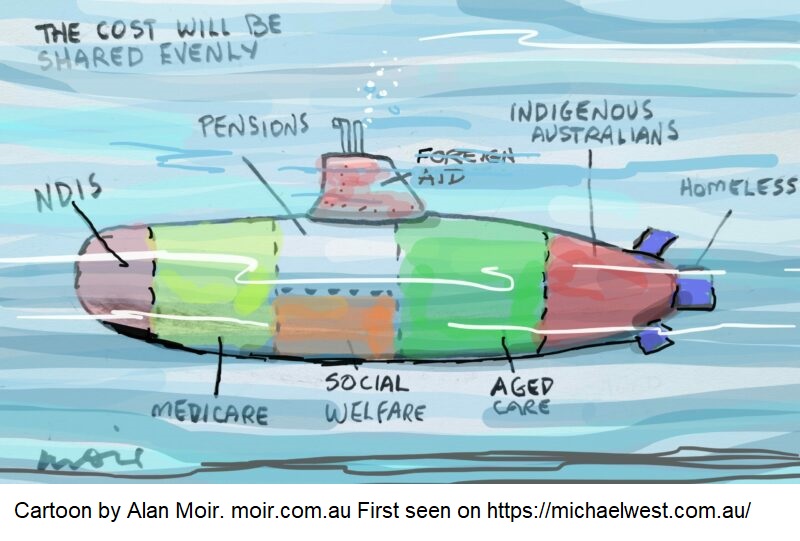
Double Standards in Public Discourse
The double standard in how we view social versus military spending is stark. While aged care is framed as a financial burden that requires higher contributions from individuals, military spending is accepted without the same level of scrutiny. Why is it that investments in the well-being of citizens are questioned while investments in military equipment go ahead without question?
Australia’s government has the financial ability to distribute more resources toward aged care without compromising national defence. By reallocating just, a fraction of the $368 billion earmarked for submarines, the aged care system could receive the necessary funding to address worker shortages, improve infrastructure, and ensure that no senior is left without quality care.
September 13, 2024 by By Denis Hay, The AIM Network
Introduction
Australia is grappling with rising demands for aged care services as its population grows older, leading to a $5.6 billion reform package to improve the sector. Yet, every dollar given to aged care is met with scrutiny, with questions about sustainability and affordability. In stark contrast, military spending – including the $368 billion given for the AUKUS submarine deal – goes ahead with far less financial scrutiny.
Why do we ask, “At what cost?” for aged care, yet overlook the same question for military projects? This article explores these double standards and how Australia’s currency sovereignty means the government has the financial capacity to fund both without compromising one for the other.
Disparities in Spending Scrutiny
I. Aged Care Reforms: Why “At What Cost” is Constantly Asked
A. Key Changes in Aged Care
The Australian government’s $5.6 billion aged care reform package aims to improve services for more than 1.4 million older Australians, helping them stay at home longer before entering institutional care. However, the reforms include higher means-tested contributions from seniors, raising concerns about affordability for lower-income individuals.
B. Challenges in Aged Care Funding
Australia’s aged care sector is facing significant challenges, even with the new reforms:
1. Workforce shortages – More than 300,000 workers are needed to meet the demand for aged care services, but underfunding is making recruitment and retention difficult.
2. Underfunding – The sector is still underfunded despite the reforms, with many care facilities still struggling to provide adequate services.
3. Increased demand – With Australia’s aging population expected to double by 2050, more funds will be needed to provide quality care.
Despite these growing challenges, aged care funding is constantly questioned. The $5.6 billion reform package was seen as necessary, but it came with a public narrative focused on budget concerns and intergenerational equity, suggesting the government is walking a financial tightrope when funding such social services.
C. Public and Political Scrutiny
Aged care spending is consistently subjected to public and political debate, with media coverage often emphasising the “cost to the taxpayer“ and generational fairness. Yet this intense scrutiny stands in stark contrast to how military spending is viewed, where multibillion-dollar defence projects move forward with little financial questioning.
II. Military Spending: An Unquestioned Cost
A. Overview of Military Expenditures
In 2023, Australia committed $368 billion over the next 30 years to the AUKUS submarine program, making it one of the largest military spending commitments in the country’s history. The overall defence budget for 2023-2024 alone reached $50 billion, marking a significant increase compared to previous years.
B. Justifications for Military Spending
Proponents of military spending often argue that defence investments are critical for national security, particularly with the growing military presence of China in the Indo-Pacific region. The AUKUS deal, which promises to deliver nuclear-powered submarines to Australia, has been framed as necessary for safeguarding Australia’s interests in the future.
However, this narrative ignores the question of cost. While $368 billion has been committed for submarines over the next three decades, far less attention is given to the financial opportunity costs – what else could be funded with such vast sums?
C. Limited Scrutiny on Defence Budgets
In contrast to aged care, military expenditures are rarely subject to serious financial scrutiny. Public debate around defence spending typically focuses on national security threats rather than the financial burden of these projects. Even when media coverage addresses military budgets, it rarely compares them to the costs of social services, leaving aged care and defence spending to occupy entirely different public conversations.
Australia’s Currency Sovereignty and the Real Limits…………………………………………………………………………..
Double Standards in Public Discourse
The double standard in how we view social versus military spending is stark. While aged care is framed as a financial burden that requires higher contributions from individuals, military spending is accepted without the same level of scrutiny. Why is it that investments in the well-being of citizens are questioned while investments in military equipment go ahead without question?
…………………………………………………………… Rebalancing Australia’s Budget Priorities
…………………..Australia’s government has the financial ability to distribute more resources toward aged care without compromising national defence. By reallocating just, a fraction of the $368 billion earmarked for submarines, the aged care system could receive the necessary funding to address worker shortages, improve infrastructure, and ensure that no senior is left without quality care. ……………..more https://theaimn.com/why-aged-care-funding-scrutinised-but-military-spending-not/
The tangled nuclear web of lies and half-truths – can we believe that Australia will refuse to take USA toxic wastes?
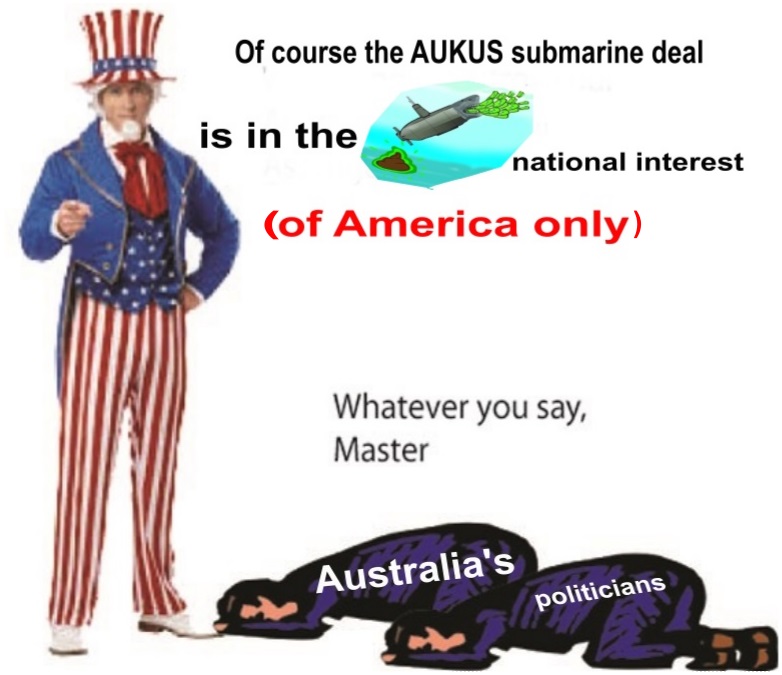
How is the Australian government going to twist their way around THIS ONE!
I’d really like to believe Prime Minister Anthony Albanese, who once was a noble opponent of the military-industrial-nuclear complex.
But – now – I fear that he is as gutless as most Australian politicians when it comes to sucking up to the USA.
https://theaimn.com/can-we-believe-that-the-australian-government-will-really-refuse-to-take-usa-uk-nuclear-submarine-waste/ 12 Sept 24, Today comes one of those amazing bits of news that a national government, in this case, it seems, Australia, has actually listened and responded to the many voices of peace and environment activists who are shocked at the proposed Naval Nuclear Propulsion Treaty which benefits the USA, but not Australia, and which makes Australia responsible for high level nuclear wastes from U.S/UK nuclear submarines.
If we can believe the Labor government – they are going to stand up to the USA and the UK, and refuse to accept high level toxic radioactive trash from USA – ‘Relief’ Australia won’t take high-level nuclear waste under AUKUS.
The latest information on Australia getting nuclear submarines is that as early as 2027, the United States will begin rotational presence in the Western Australia facility. Ultimately, there will be up to four U.S. Virginia-class submarines and one United Kingdom Astute-class submarine at HMAS Stirling. https://www.defenseone.com/business/2024/01/race-prepare-australia-nuclear-subs/393601/
So these nuclear submarines will be stationed in Australia , but owned by the USA and UK, not by Australia.
Well- here are a couple of clauses from this jargon-filled proposed Treaty:
ARTICLE IV – D
Australia shall be responsible for the management, disposition, storage, and disposal of any
spent nuclear fuel and radioactive waste resulting from the operation of Naval Nuclear
Propulsion Plants transferred pursuant to this Article, including radioactive waste generated
through submarine operations, maintenance, decommissioning, and disposal.
ANNEX B: SECTION I – SPECIAL NUCLEAR MATERIAL
Such Power Units shall contain highly enriched uranium and, only with respect to irradiated fuel, may contain plutonium.
Friends of the Earth are among the many who have sounded the warning:
Minister for Defence Richard Marles has stated that Australia would not accept radioactive waste from overseas, but this has not been explicitly ruled out in the Australian Naval Nuclear Power Safety Bill 2023 currently before Parliament. The words of an under-pressure defence minister in 2024 are unlikely to count for much decades hence if Australian legislation and the Agreement between Australia, the UK and
the US do not prohibit the acceptance of foreign spent nuclear fuel.
It is important to acknowledge Australia’s poor history regarding radioactive waste disposal
facilities.
How is the Australian government going to twist their way around THIS ONE!
I’d really like to believe Prime Minister Anthony Albanese, who once was a noble opponent of the military-industrial-nuclear complex.
PM Albanese has been adroit at making himself a “small target” for both the Opposition nuclear enthusiasts, and for his own Labor Party members who deplore the AUKUS nuclear deal. No doubt he will rely on the mealy-mouthed USA-sycophant defence Minister Richard Marles to spin the story on this.
1 This month.
20 September –National Day of Action in Melbourne on the International Day of Peace


Help Aunty Sue Protect Her Land and Sacred Sites From Destructive Rocket Testing.
.

Australians deserve the truth
about
AUKUS – https://aukuspublicinquiry.com/


PETITION – To: Prime Minister Anthony Albanese and the Australian Labor Government

of the week – Australians for War Powers Reform (AWPR)
To see nuclear-related stories in greater depth and intensity
 Antinuclear