Australia becoming internationally isolated as a climate denialist
 ‘We are burning our trust’: Abbott’s climate denials winning Australia no friends CRIKEY, PADDY MANNING | SEP 17, 2014 WE ARE WELL PAST THE POINT WHERE MORE EVIDENCE WILL PERSUADE CLIMATE SCEPTICS OR THOSE VESTED INTERESTS OPPOSING CLIMATE ACTION TO CHANGE THEIR TUNE.
Particularly in Australia. Abbott just doesn’t want to talk about climate change at all. He wants climate off the G20 agenda. He won’t be going to the climate talks starting in New York next Tuesday, which will be attended by over 100 heads of state, including US President Barack Obama and Indonesian President Susilo Bambang Yudhoyono, as momentum builds for agreement on a new post-Kyoto climate deal in Paris next year. Continue reading
Tasmania has vital need to keep Renewable Energy Target – Bill Shorten
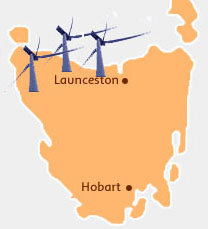 Bill Shorten says Renewable Energy Target vital to Tasmania’s north-west Yahoo News September 17, 2014 Federal Opposition Leader Bill Shorten has called on the Federal Government to support the Renewable Energy Target (RET) during a trip to Tasmania’s west coast……Mr Shorten said the Government needs to retain the RET to ensure the proposed wind farm at Granville Harbour goes ahead.
“It beggars belief that you have got up to 200 jobs just waiting to roll: 33 wind turbines, one of the windiest areas in Australia,” he said.
“The community want them, they don’t share Joe Hockey’s view that somehow wind farms are sick-making.
“They want the jobs, they want the wind farms but what they need is a government in Canberra who understands that renewable energy is not some green plot but part of the sustainable mix going forward.”
Liberal Senator David Bushby gave assurances the Federal Government had not yet decided what to do about the RET……….
projects such as the Granville Harbour wind farms remain in doubt.
In her meeting with Mr Shorten this morning, West Coast Mayor Robyn Gerrity stressed the importance of the RET to the region.
She told 91.7 ABC Northern Tasmania that while there was not much Mr Shorten could do for the region she wanted him to support the retention of the RET to ensure the Granville wind farm went ahead.
“They could employ within weeks about 30-odd men to start doing the roadworks for it,” she said.
“The problem being, for them to source and get the final tick-off regarding financing, they’re relying on the Renewable Energy Target.”…….https://au.news.yahoo.com/a/25005137/bill-shorten-says-renewable-energy-target-vital-to-tasmanias-north-west/
Labor committed to keeping Renewable Energy Target unchanged: Palmer also
Labor rules out making changes to scale down Renewable Energy Target 7 News, BY ENVIRONMENT AND SCIENCE REPORTER JAKE STURMER September 18, 2014 Labor has ruled out negotiating with the Federal Government to scale back the Renewable Energy Target (RET).
The Government is believed to be searching for a bipartisan compromise to scale back the green scheme, which was put in place by the Howard Government.
It was tweaked in 2010 to ensure that 20 per cent of Australia’s power would be generated by renewable resources by 2020.
It effectively gives industry support to renewables at the expense of established fossil fuel electricity generators.
A Government-commissioned review last month recommended closing the large scheme to new entrants and shutting it by 2030, or that it be ditched with the renewable sector limited to a 50 per cent share of new growth in electricity demand.
The Government is yet to reveal its position on the review but it is understood to be looking for a middle ground…………
The most recent meeting was held in the Liberal held seat of Barton in southern Sydney, which is held by just 489 votes.
Labor leader Bill Shorten used the opportunity to hose down talk that he would accept any negative change to the RET.
He was asked by one of the 200 audience members to promise that he would not negotiate down from what the current position is.
“We’re not about to abandon all the principles and the details of what you just said,” Mr Shorten said………Mr Shorten’s office later told the ABC that there would be no negotiation that would result in the scaling back of the RET.
The Palmer United Party also reiterated its position that it did not support any change to the scheme………https://au.news.yahoo.com/a/25037753/labor-rules-out-making-changes-to-scale-down-renewable-energy-target/
Risks of uranium mining outweigh any benefits
 Anti-uranium activists criticise NSW exploration program, Australian Mining 15 September, 2014 Vicky Validakis Anti-nuclear campaigners have criticised the NSW government for opening up the state to uranium exploration.
Last week the state government invited six companies to apply for exploration licences.
The move comes two years after NSW overturned a uranium exploration ban. Mining uranium is still restricted.
Three locations around NSW – near Broken Hill, near Cobar and south of Dubbo – have been earmarked for drilling activity.
Natalie Wasley, spokeswomen for the Beyond Nuclear Initiative, said the decision was disappointing, ABC reported.
“Uranium has very unique and dangerous properties and risks,” Wasley said. “It’s linked to the production of the world’s most toxic and long-lasting industrial waste, as well as proliferation of the world’s most destructive weapons, so it poses a risk to workers, to communities and the environment.”
Wasley said the sector will only create a small number of jobs, and claims the risks associated with uranium outweigh any economic benefits. “We know that in rural and regional areas there’s a much better opportunity for long-lasting sustainable jobs in the renewable sector.”
“We’d really encourage those local governments and the state governments to be putting money and resources into developing more creative, long-term and sustainable jobs for people.”……..
The six companies invited to apply for licenses are Australian Zirconia, Callabonna Resources, EJ Resources, Hartz Rare Earths, Iluka Resources and Marmota Energy. http://www.miningaustralia.com.au/news/anti-uranium-activists-criticise-nsw-exploration-p
Uranium mining still prohibited in New South Wales, and not considered economically viable
Uranium exploration in western NSW – but mining is still prohibited NSW Country Hour Sally Bryant and Julie Clift 15 Sept 14, The New South Wales Government has invited six mining companies to put in expressions of interest to explore for uranium, but mining will remain prohibited, until deposits prove economically viable.
However not all of the mining companies who are involved in this process are actually interested in mining for uranium.
One of six companies invited to tender for an exploration licence, Alkane Resources, is developing a rare earth project near Dubbo, in the state’s central west.

Alkane say they’re not interested in uranium, that they are merely protecting their rare earth project from other resource companies applying for an exploration licence over the top of them
Managing Director Ian Chalmers says this is an insurance policy for his company……..http://www.abc.net.au/news/2014-09-15/uranium-exploration-in-western-nsw/5743584
Victoria’s Planning Tribunal gives go ahead for wind farm
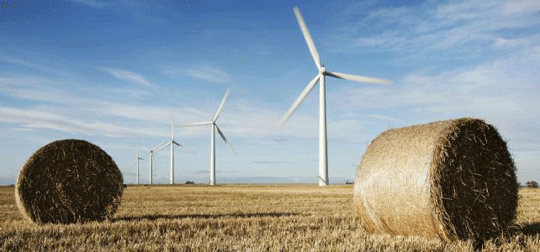 VCAT approves Berrimal Wind Farm changes http://www.abc.net.au/news/2014-09-15/vcat-approves-berrimal-wind-farm-changes/5743290 15 Sep 2014,
Victoria’s planning tribunal has given the green light to changes to a renewable energy company’s plans for a 24-turbine wind farm in the Buloke Shire.
Acciona’s Berrimal Wind Farm had the support of the Buloke Shire but needed approval from the Victorian Civil and Administrative Tribunal (VCAT) to make the amendments to its original planning permit.
The project is located between Wedderburn and St Arnaud and is expected to generate 72 megawatts of electricity.
Buloke Shire’s chief executive officer, John Hicks, says the $150 million project will benefit the municipality in a number of ways.
“That will provide six ongoing jobs for maintenance and looking after the turbines, plus the economic development that’s available to other people in the shire because of the added business,” he said.
“There’s also the benefits of rates coming into the shire which relieves the burden on other ratepayers.”
However, Acciona says all its projects, including the Berrimal Wind Farm, are on hold because of the uncertainty caused by the Federal Government’s review of the Renewable Energy Target.
Double benefit in farming both cattle and wind, in Western Australia
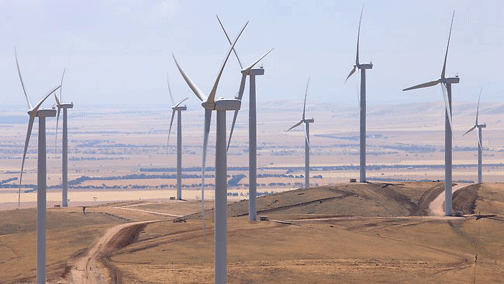 WA farmer living amongst wind turbines backs keeping Renewable Energy Target 7 NEWS BY CLAIRE MOODIESeptember 14, 2014 Living amongst 15 massive wind turbines might not be everyone’s idea of paradise, but West Australian Mid West farmer Bruce Garratt believes he is investing in the future.
Eight years ago, he agreed to accommodate the turbines as part of WA’s first privately-built wind farm, south of Geraldton, and is still enjoying the serenity.
“People tell me how noisy they are, people tell me how they affect your health,” he said. “I’ve had lots of people tell me different things that honestly, unless they have lived on a wind farm, they don’t really know what they are talking about.”
Mr Garratt, who manages cattle and crops on his 2,000 acre property, said the turbines — part of the Alinta Walkaway Wind Farm — provided an additional passive income, as well as a sense of purpose.
“No-one in their right mind could put up an argument and say that wind turbines aren’t of benefit,” he said. “They’re not producing C02.”
Mr Garratt is critical of the recent Warburton review that recommended either closing the Renewable Energy Target (RET) to new entrants or scaling it back…….
Coal-fired generators the winners: wind farm owner
Uranium oversupply bodes ill for the future of the industry
 Rally in Uranium Prices Is Unlikely to Last, WSJ, 14 Sep 14 Gains Fueled by Ukraine Crisis, Mine Unrest Don’t Offset Oversupply SYDNEY—A multiweek rally in uranium prices fanned by the Ukraine conflict and labor unrest at a large mine in Canada looks unlikely to continue for long as the reality of oversupply and lackluster demand sinks in among buyers of the nuclear fuel.
Industry analysts and some uranium producers believe that even as supplies fall, a substantial increase in demand is needed to drive prices up to levels that would make new investments worthwhile, when many operations are running at a loss……..
Demand for the fuel hasn’t recovered since the disaster at Japan’s Fukushima Daiichi nuclear-power plant in 2011, which sparked nuclear-plant closures across the country and tarnished uranium’s image globally…….
state governments in resource-rich Australia have been encouraging the growth of the nation’s uranium industry. A decadeslong ban on uranium production in Queensland was lifted in July, opening the door to new applications to build mines in the state. The government of New South Wales this month said it would invite six companies to apply for exploration licenses.
Still, there is expected to be little investment in new projects until the market stages a more substantial comeback. Cameco said it would need to see much higher uranium prices before it started construction of its proposed Kintyre uranium mine in Western Australia.
“The nuclear industry is still in the midst of upheaval,” said Jonathan Hinze, senior vice president at nuclear-research firm Ux Consulting Co. …http://online.wsj.com/articles/rally-in-uranium-prices-is-unlikely-to-last-1410726782
Fighting climate change on the investment frontier
 Climate activism’s new frontier is targeting fossil fuel investors, The Age September 15, 2014 Michael Green In mid-July, the peak body of the Uniting Church in Australia voted to sell its investments in fossil fuels. The decision was available online for anyone who cared to peruse the church’s minutes, but it didn’t issue a media release until a month and a half later, on the last Friday afternoon in August.
“We didn’t think it was the most earth-shattering news, because it’s a pretty mainstream issue in the Uniting Church now,” explains the church’s president, Reverend Professor Andrew Dutney. Yet its resolution included a moral claim that may be confronting for most Australians, who, by way of their superannuation funds – at the very least – own a stake in coal, oil or gas projects.
“Further investment in the extraction of fossil fuels contributes to, and makes it more difficult to address climate change,” the church states. Given the harm climate change will cause, “further investment and extraction is unethical”. “A number of people have found that to be a strong statement,” Dutney says. “But it’s very hard to argue against.”……
There are dozens of campaigns targeting universities, churches, councils, superannuation funds and banks.
In Australia, there are campaigns at 19 universities, including Melbourne, Monash, Latrobe and RMIT, calling for the institutions to sell whatever investments they have in fossil fuel companies……..
In July, the World Council of Churches, an umbrella group representing over half a billion Christians, announced its plans to fully divest from fossil fuels. The same month, the Anglican Church of Australia passed a motion encouraging its diocese to divest. A global campaign for the Vatican to divest has just been launched…….
Nearly 30 city councils have pledged to divest, including San Francisco and Portland in the US and Dunedin in New Zealand, as well as 13 US universities and colleges. In May, Stanford University, in California, committed to divest from companies that mine coal for energy generation. Its endowment fund is worth about $US19 billion ($21 billion).
A fortnight ago, the University of Sydney announced it would suspend further investment in coal companies while it reviews its ethical investment policy. It is also assessing what to do with its existing $900,000 holding in Whitehaven Coal Limited, owner of the controversial Maules Creek mine in NSW. …..
One of the key divestment advocates is Market Forces, which is affiliated with Friends of the Earth. Its founder, Julien Vincent, argues that as well as an environmental imperative, there’s also a financial case for divestment, especially for long-term investors such as banks and superannuation funds……
Market Forces has just launched a website called Super Switch, which helps people compare various funds’ investments in fossil fuels………
Reverend Professor Dutney says the church’s decision was strongly influenced by the worries of its sister churches in the Pacific. “We’re already seeing the results of climate change across the globe and it affects the poorest people disproportionately badly,” he says.
“For us, the idea was simply to do the right thing, regardless of what anybody thought about it.” http://www.smh.com.au/national/climate-activisms-new-frontier-is-targeting-fossil-fuel-investors-20140912-10fxoc.html#ixzz3DRXmzQls
CSIRO prints solar panels!
 The Power Of The Press: CSIRO Installs Solar Panel Printer https://newmatilda.com/2014/09/11/power-press-csiro-installs-solar-panel-printer By Amy McQuire Solar technology In Australia took a step forward recently, with the installation of a machine that can print solar panels. Amy McQuire reports.
Printable solar panels could power our laptops and rooftops – even our skyscrapers – sooner than we think after a new solar-cell printer, the nation’s largest, was recently installed at the CSIRO.
The printer, worth $200,000 and funded by the Victorian Organic Solar Cell Consortium (VOSCC), is able to print organic solar cells ten times the size of what was previously possible, and straight onto paper-thin plastic or steel.
It’s a faster and more cost-effective method than solar panels using traditional silicon cells (used to power objects like our calculators) because it uses organic polymers (a bonding of different materials) that absorb sunlight , generate charges and produce electricity.
Because these organic solar panels are more related to materials like cling wrap they are thin, flexible and printable.
The cells produce 10-50 watts of power per square metre (50 watts is enough to power a small laptop computer) and they can be printed fast, at speeds of up to ten metres per minute.
But the printer is not entirely new technology, the CSIRO says. It’s similar to what you would use to screen-print T-shirts. CSIRO materials scientist Dr Scott Watkins said the aim was to make the technology as accessible as possible.
“We’re developing the technologies to work with existing printing processes, so the printers that we’ve got are the same sort of printers that you could use for paper, or even things like t-shirts, and we’re developing our processes to be able to use these existing printing technologies so that the barrier to entry for manufacturing these new printed solar cells is as low as possible,” Dr Watkins said.
The printer represents a significant step forward for the VOSCC team, which is made up of a consortium of the CSIRO and the Melbourne and Monash Universities, who have been working on printing solar cells since 2007.
The size of the solar cells were increased to an A3 size sheet of paper from the size of a coin in only three years.
The CSIRO says the possibilities are growing and there are companies interested in taking the technology commercial.
“Eventually we see these being laminated to windows that line skyscrapers,” VICOSC project coordinator Dr David Jones said.
“By printing directly to materials like steel, we’ll also be able to embed cells onto roofing materials.”
Western Australia to lose 1000s of jobs if RET is scrapped – Senator Ludlam
 Ludlam warns of job losses in wake of Renewable Energy Target review http://www.watoday.com.au/wa-news/ludlam-warns-of-job-losses-in-wake-of-renewable-energy-target-review-20140914-10gu11.html Liam Ducey WA Greens Senator Scott Ludlam has warned $800 million will be slashed from the WA renewable energy sector if the Abbott Government dumps the Renewable Energy Target.
The Warbuton Review into the RET, commissioned by the federal government in February, has recommended scrapping the target, which Senator Ludlam says will see up to $10.7 billion in renewable energy investment head overseas, threatening 21,000 jobs.
In WA, 16 per cent of households are solar-powered, and Mr Ludlam said the RET had benefited Perth’s poorer suburbs.
“A study by the Greens shows that WA’s poorer suburbs have the highest uptake in solar, which has collectively saved $87million a year or $560 per household,” he said. “WA is in a unique position to be the best investors in clean energy with our plentiful sunshine and independent energy market.
“WA now boasts 414 accredited solar installers and scrapping the RET would result in a loss of thousands of local jobs. The Greens has shown that if more investment into clean energy was supported, another 27,000 jobs could be created.”
A spokeswoman for State Environment minister Albert Jacob said the potential scrapping was federal government issue.
Comment is being sought from Federal Environment Minister Greg Hunt.
Canberra protestors worried about wind farms disturbing their rural setting
 Residents fighting Jupiter wind farm plan Canberra protest, Canberra Times September 15, 2014 Land owners in communities along the Goulburn-Braidwood Road are continuing their self-described “David and Goliath battle” to stop a $400 million wind farm development proposed for 12,000 hectares in the area.
The Residents Against Jupiter Wind Turbines group last week said progress was being made in the fight, after another community meeting at Tarago and contact with Goulburn MP and planning Minister Pru Goward.
Planning is underway for a demonstration outside the ACT Legislative Assembly on Tuesday as group members want territory residents to know the local impact of some renewable energy sources.
An Australian-Spanish joint venture is developing the 110 turbine wind farm on the properties of 25 landholders. The individual turbines are set to be more than 110 metres high, with three 63-metre rotor blades, near small towns at Lake Bathurst, Tarago, Mayfield, Boro, Mount Fairy and Manar.
Group spokesman Michael Crawford said many of the residents were current and former Commonwealth and state public servants who had migrated to the area, east of Goulburn, and were desperate to preserve their rural setting……..
The group believes the state’s wind farm development guidelines are inadequate, and fail to take full account of impacts including noise, visual changes, sleep and health effects and property values…..
The company has several proposed wind farm projects in New South Wales and Victoria.
Is Australia ready for the financial impacts of this warming world?
Can Australia prosper in a 2°C finance world? REneweconmy, By Giles Parkinson on 11 September 2014 “……HSBC: The path to a low-carbon economy means increasing energy efficiency, scaling up low-carbon energy provision and embedding resilience to the consequences of warmer temperatures. The idea is to lower the chances of the most catastrophic climate system effects (through reducing emissions) as well as prepare for some of the impacts.
RE: Australia lags the world on energy efficiency measures, particularly in relation to vehicles and transport. Coalition governments have dismantled basic housing requirements, and the federal government is yet to act on the national energy efficiency plan. Despite all this, consumption per household has fallen more than 10 per cent in the last few years, mostly because people have installed rooftop solar and have bought more efficient appliances.
HSBC: In a 2°C world, the development of energy would take into consideration both the benefits of energy access (e.g. education, economy, time saved and spent doing other things etc.) as well as the associated costs with certain types of energy (e.g. health, climate change, pollution).
RE: Australia is not doing too well on that. It has deliberately ignored climate change and health impacts in its consideration of the renewable energy target, and sought to dismantle the Climate Change Authority (which thinks about these things) and has already abolished the Climate Commission and cut funding to the CSIRO, the leading scientific body. The only criteria for the RET Review was the cost to coal generators.
HSBC: The concept of co-benefits has gained momentum in recent years. For example, tackling the sources of pollution in China helps tackle climate change at the same time. Alternatively, tackling climate change through policy and innovation could bring other co-benefits such as reduced health costs (since the sources of pollution and climate change are similar).
A recent study by MIT, published in Nature Climate Change, finds that the “co-benefits…. May offset some or all of the near-term costs of GHG mitigation.” For instance, the study finds that a cap-and-trade system might cost $US14 billion, but the associated air pollution health benefits from implementing this system could be of the order of $US139 billion. For reference, $US6.5 trillion was spent globally on health in 2010 (WHO).
RE: Co-benefits have not entered the vocabulary of the Coalition government, with climate change deniers advising it in four key industry areas – banking and finance, renewable energy, business, and budget measures.
HSBC: The three main reasons why capital has not been channeled in the right direction for a low-carbon economy, historically, are: unfavourable economics for low-carbon, weak policy signals and the uncertain timing of high CO22 impacts.
RE: Australia exemplifies this. Having attracted billions of dollars in low-carbon investments in recent years, thanks to the short-lived carbon price and the renewables target, that capital is now drying up, with major international companies leaving, or warning they will direct capital elsewhere. Only households, keen to offset rising electricity bills, are keeping up momentum, although this is largely confined to rooftop solar and LED lighting. http://reneweconomy.com.au/2014/can-australia-prosper-2c-finance-world-35343
Abbott self-publicises on Aboriginal land: he cuts funding to Aboriginal Child and Family Centres
Aboriginal family and children’s centres in limbo SMH, September 14, 2014 Julie Power The future of some of the most disadvantaged children across Australia is now in limbo, following the federal government’s withdrawal of funding from 38 Aboriginal Child and Family Centres.
“We are in no man’s land. No one wants to take ownership,” said Catherine Edwards-Bott, the executive director of the indigenous-run Brewarrina Business Co-operative. The co-op manages two Aboriginal Child and Family Centres in the poorest local government areas in NSW.
These centres were previously funded under the $300 million “closing the gap” partnership between the states and the federal government to provide early childhood services and health programs to Aboriginal children and their families……..
26 have no long-term guarantee of funding. Some had barely opened before funding was axed. Some had not moved into custom-built premises. Two out of the 38 have received nothing since the National Partnership Agreement, introduced three years ago, was cut in June 2014. Another 11 centres have been given some limited funding that will last between six months and two years.
“To say it is a mess is an understatement. To say that Aboriginal people feel betrayed is an understatement,” said Frank Hytten, the chief executive of the Secretariat for National Aboriginal and Islander Child Care (SNAICC). “This is yet another betrayal by white fellas of Aboriginal people. Promises made and promises broken.”
Many people were overlooking the centres’ role as community-managed hubs……
A Victorian centre, Bubup Wilam at Thomastown, has attracted 58 children since it opened, with many going on to the local primary school that did not even know these children lived in the area. Half of its 26 staff members are Aboriginal. Like many of the centres, Bubup Wilam runs an early learning program, health checks, nutrition and family support services.
In Fitzroy Crossing, the Baya Gawiy early childcare centre – with similar services to Bubup Wilam – will close in late December if no other funding is found.
Its manager, Sarah Cleaves, said the centre played a huge role in getting Aboriginal children ready for school. “Many of our children have early life trauma, some have foetal alcohol spectrum disorder, or they are developmentally delayed. So the integrated service provision is designed to get them to start school on par with other Australian children.”
In addition to providing the children with 80 per cent of their nutritional needs, the centre’s program was designed to create an early love of learning and teach children about structure, show them how to sit down and listen to a teacher.
“If they haven’t been to a centre like ours, they hit school and they see it as alien,” Ms Cleaves said.
The centre’s closure will also mean many Aboriginal and non-Aboriginal professionals whose children attend the childcare centre may have to leave the remote town because there are no other childcare services in the Kimberleys.
“We have a manager of Centrelink [child], the [children of the] only permanent GP in town, health services … and other services who run BP roadhouse, their children all come to us,” she said. http://www.smh.com.au/nsw/aboriginal-family-and-childrens-centres-in-limbo-20140912-10fvqb.html#ixzz3DPzDPmkr
While Abbott struts about in Arnhem Land, Aboriginal legal aid funds are cut
Abbott’s Top End trip: Indigenous legal aid agency seeks meeting with PM to discuss funding cuts, ABC News, 12 Sept 14 By political reporter Anna Henderson Tony Abbott will face fresh questions about the federal budget and spending on Indigenous affairs when he touches down in north-east Arnhem Land on Sunday at the start of a week-long trip to the Top End.
Some organisations are already taking action to find savings even before knowing the scope of their potential budget cuts.
For decades the North Australian Aboriginal Justice Agency (NAAJA) has been providing legal aid in the remote town of Nhulunbuy, on the northern tip of Arnhem Land, as well as in the nearby community of Yirrkala and surrounding outstations.
But the agency is set to close its doors in Nhulunbuy at the end of the year, in anticipation of severe budget cuts, and is seeking a meeting with the Prime Minister during his visit…….
Eighty per cent of inmates in Territory jails are Aboriginal. In the juvenile justice system, it is 95 per cent.
The closure of the NAAJA office means those needing to see a lawyer face-to-face will have to fly or make the massive drive to Darwin, or wait for a fly-in fly-out lawyer to come to them.
The agency’s principal lawyer, Jonathon Hunyor, said the other option was a phone consultation with someone in Darwin.
“Often the issues that our clients bring to us are very complicated, they can be very sensitive and they can be very personal,” he said.
“So issues like child protection or issues like a medical complication where bad service was provided by the hospital, or a family law issue where someone is the victim of abuse.
“They are very difficult things to talk about and they don’t want to have to talk about them over the phone.”
He said ultimately Indigenous clients would not get the representation they deserved, “which means that Aboriginal people get second-rate justice”. ………
Ms Yunupingu fears those seeking legal advice may travel to Darwin on their own, without family support……….
May’s federal budget included plans to strip half a billion dollars from Indigenous programs administered by the Prime Minister and Cabinet and Health portfolios. http://www.abc.net.au/news/2014-09-12/pm-to-face-questions-over-legal-aid-funding-during-top-end-trip/5738500
1 This month


Help Aunty Sue Protect Her Land and Sacred Sites From Destructive Rocket Testing.
.

Australians deserve the truth
about
AUKUS – https://aukuspublicinquiry.com/

PETITION – To: Prime Minister Anthony Albanese and the Australian Labor Government

of the week – Australians for War Powers Reform (AWPR)
To see nuclear-related stories in greater depth and intensity

