Australia’s Aboriginal Central Land Council suspicious of the government’s nuclear waste dump plans
CLC seeks more Red Centre nuclear waste dump answers http://www.abc.net.au/news/2014-09-12/clc-seeks-more-nuclear-waste-dump-answers/5740226 By Robert Herrick Fri 12 Sep 2014,
The Federal Government is seeking a new location for the facility, after a nominated site at Muckaty Station, near Tennant Creek, was abandoned.
The Government has given the Northern and Central land councils until the end of the month to put forward an uncontested site for a nuclear waste dump, before considering proposals from all landowners.
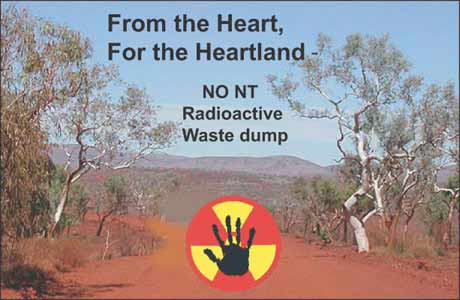
Traditional owners in the Tanami Desert are offering a site 540 kilometres west of Alice Springs.
However, the Central Land Council (CLC) said Commonwealth officials could not answer all the questions put to them at a meeting this week at the Tanami Mine, including how waste would be transported.
The CLC says it has a responsibility to ensure traditional owners are fully informed of the potential impacts of a nuclear waste dump before it can back any nomination.
Forget the hype – Australia’s uranium trade with India is of little economic benefit
 The future is renewable, not radioactive http://www.hindustantimes.com/comment/analysis/the-future-is-renewable-not-radioactive/article1-1263460.aspx?utm_medium=twitter&utm_source=twitterfeed Jim Green 12 Sept 14 India and Australia have signed a nuclear cooperation agreement that may open the door for uranium sales. However, obstacles remain and claims of an economic bonanza for both countries ignore facts.
If Australia supplies 20% of that demand, uranium export revenue will increase by 3% — two orders of magnitude short of the figure in the Fairfax press.
Indian demand would have to grow ten-fold just to sustain one small uranium mine in Australia. Projections of exponential growth leading to hundreds of gigawatts (GW) of nuclear capacity in India should be disregarded. Continue reading
1984 Royal Commission concluded that Australian servicemen were nuclear guinea pigs
 TODAY IN HISTORY – Bendigo Advertiser 12 Sept 14
1984 – Australian Royal Commission starts an investigation into whether servicemen were deliberately exposed to radiation in British nuclear tests at Maralinga in 1956-57. It will conclude that they were. http://www.bendigoadvertiser.com.au/story/1880269/good-morning-bendigo-12092014/?cs=80
Check on how the electricity utilities charge you big-time for solar hot water
 I think you could fix this excessive cost problem by switching to Powershiop
Dennis Matthews, 13 Sept 14 Matching supply and demand has always been a problem and is not unique to renewables.
An interesting thing about wind power in SA is that the % installed capacity (MW) is the same as the % delivered electricity (MWhr). In other words, wind power is no worse than non-renewables in terms of the amount of time that it is generating.
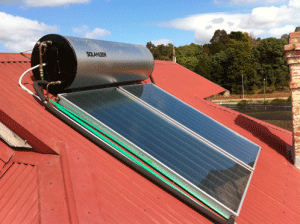 Concerning off-peak electricity. This is very wasteful, you end up heating and reheating the same water because of heat losses, especially over night. In addition in some areas off-peak electricity is controlled centrally through a square wave distortion (SWD) system. This means that off-peak is no longer just overnight. It can be any time of the day that suits the electricity utilities. This has the effect of undercutting solar hot water systems. After sunrise, when solar starts to heat a solar hot water system, the electricity utility can, and does in my area, switch on the off-peak heater. In order to prevent this I have to physically switch off the off-peak hot water system at the meter box and turn it on again late in the day when solar is no longer effective.
I suspect this is happening to a lot of people in SA with solar hot water and they are wondering why their bills are still high. Look for the SWD box (grey in my case) in the meter box. If you have one then you may have to do the same as me.
Shadow Environment Minister Jackie Trad exposes foolish decision of Queensland govt on uranium mining
 LNP under fire as companies target Qld uranium http://www.sunshinecoastdaily.com.au/news/lnp-uranium-green-light/2384465/ Bill Hoffman | 12th Sep 2014 THE ALP has slammed the Newman government decision to grant mineral development leases to two companies planning to mine uranium in Queensland.
Shadow Environment Minister Jackie Trad accused the LNP of lying before the last election when it gave what she described as a clear commitment not to endorse uranium mining.
“The Premier gave a clear election commitment but the granting of six exploration licences shows once again the value of an LNP promise,” she said.
“In breaking the promise, the Newman Government is ignoring the widespread objections of Queenslanders, ignoring the substantial environmental risks associated with uranium mining, ignoring the risks associated with the transportation ofradioactive material and ignoring the risks to public health and safety.
“It is a massive betrayal of trust.
“We are just a few steps away from having trucks and trains filled with uranium making their way through communities to ports and waterways.”
Ms Trad accused the Newman Government of arrogantly ignoring the wishes of the majority so it could pander to the demands of powerful vested interest groups.
She said there had been no uranium extraction in Queensland since 1982. Any future State Labor government would move swiftly to reinstate the ban. “It remains our view that the risks and hazards inherent in uranium mining far outweigh the economic benefits,” Ms Trad said.
“Even if all known deposits of uranium were mined the expected royalties would only be around 1% of the state’s current royalty revenue.”Uranium mining simply doesn’t stack up on either economic or environmental grounds.”
Ms Trad will be on the Sunshine Coast as special guest at her party’s Sunshine Coast Hinterland branch forum on the environment and the Newman Government’s track record on green policy.
It will be held at Maleny Neighbourhood Centre on Saturday, September 27 at 2pm.
Australian solar investment – over 1500 businesses have gone solar!
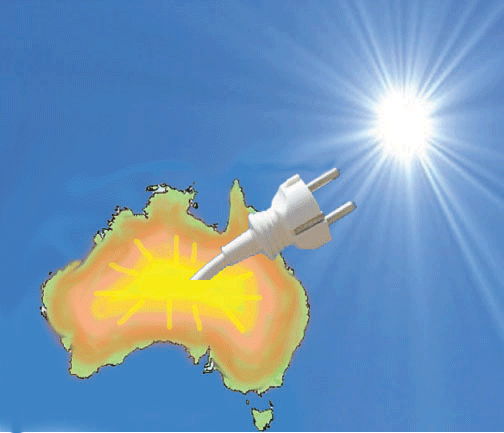 15,000+ Australian Businesses Have Gone Solar More than 15,000 Australian businesses have installed solar panels says the Clean Energy Council.http://www.energymatters.com.au/index.php?main_page=news_article&article_id=4490
“Businesses have now invested almost $460 million in solar power systems across the country, helping them to collectively save about $64 million on their bills every year,” said Clean Energy Council Acting Chief Executive Kane Thornton.
Mr. Thornton says the businesses operate in a broad range of sectors – from dairy and chicken farmers through to wineries, offices, supermarkets and retail outlets.
“There is an increasing recognition that the current modest support provided by the RET means the business case for solar power makes sense, helping businesses become more competitive in tough economic conditions.”
However, he warns slashing the Renewable Energy Target could see the opportunity lost or make it so paperwork-heavy some businesses simply wouldn’t bother.
“The rest of the world is going full-speed ahead on solar and there is a huge opportunity here for Australian businesses if we leave the RET alone,” he said.
Mr. Thornton states slashing the RET would also see the loss of up to 5800 jobs in this part of the nation’s solar power sector.
For now, the segment is humming along. National commercial solar providerEnergy Matters reports it has installed 4 megawatts capacity of commercial scale systems (10kW+) and currently has 2MW of projects in the pipeline.
Among the high profile projects in Energy Matters’ portfolio are Western Australia’s largest privately-owned rooftop solar power system (Bidvest Foodservices) and Australia’s largest privately funded array (NEXTDC’s M1 Data Centre in Melbourne).
In August, Energy Matters stated that just among its monitored systems, 1 million kilowatt hours of solar electricity had been generated and it expects cumulative generation for those systems to reach 3 million kilowatt hours by end of this year.
According to the August Sunwiz Insights, of the 48 x 100kW commercial solar power systems installed in Australia in the previous 3 months; Energy Matters led the rankings with 5 x 100kW systems.
A portfolio featuring a selection of Energy Matters’ commercial solar projects can be viewed here. Businesses interested in learning more about how solar can benefit their bottom line can contact Energy Matters’ commercial team on 1300 553 213 or by emailing commercial@energymatters.com.au.
Launch of Australian Energy Storage Council
Australian Energy Storage Council launched to bring together industry and promote standardisation PV Tech, By Andy Colthorpe Sep 12, 2014 The Australian Energy Storage Council, a new industry representative body has been launched for energy storage in Australia, backed and co-founded by the Australian Solar Council.
The Australian Energy Storage Council was formally launched this morning. The Australian Solar Council will back the new organisation with resources initially, with solar council chief executive John Grimes also acting as its head.
“It is important that energy utilities engage with the energy storage sector sooner rather than later,” said Grimes. “Too often the energy sector ignores emerging technology trends and is blindsided when they are deployed widely. That’s why one of the first things the Energy Storage Council will do is to focus on developing standards and protocols for embedding energy storage into the energy network.”

The call for standardisation across the energy storage industry has been voiced by a wide cross section of parties, including academics and battery manufacturers.
The storage council will be a non-profit organisation, paid for by memberships, training activities and from hosting industry events. According to the council, it will seek to connect local members with global industry partners.
The new group joins other regional and international energy storage industry associations in the growing space, including the International Battery and Energy Storage Alliance (IBESA) and one of the earliest-formed organisations of its kind, the California Energy Storage Alliance, which according to CESA’s deputy head Chris Edgette, was influential in helping the California Public Utilities Commission (CPUC) in drafting the recently issued mandate for utilities to install 1.3GW of storage by 2020………http://storage.pv-tech.org/news/australian-energy-storage-council-launched-to-bring-together-industry-and-p
Large solar company First Solar not impressed with Abbott govt’s proposed compromise on Renewable Energy Target
US’s First Solar says Australian govt’s renewable energy ‘compromise’ likely to be rejected KERRIE SINCLAIR THE COURIER-MAIL SEPTEMBER 12, 2014 A COMPROMISE position on Australian renewable energy market reform being touted by federal ministers won’t be palatable to the industry as it would still mean certain death, a leading solar company said Thursday.
Jack Curtis, regional vice president for Asia Pacific at First Solar, the US’s largest solar panel company, said a reform proposal now being floated, as well as the proposals of a federal government-commissioned review released last month, were all potentially fatal to Australia’s renewable energy industry.
First Solar has a $500 million active project pipeline in Western Australia, Queensland and New South Wales, a potential future pipeline of $250 million and has a venture with Rio Tinto to build an up to 6.7 megawatt, $23.4 million solar power plant at the Weipa bauxite mine on the west coast of Cape York Peninsula……..
GE, one of Australia’s largest foreign investors, has rejected the Warburton review proposals, saying either option would risk pushing up household power bills and raise sovereign risk issues for the Australian economy.
First Solar on Thursday said the option that appeared to be emerging as the federal government’s possible compromise position would not be acceptable to the industry.
“I think you’ve already started to see this idea of a ‘real 20 per cent’ target being thrown about as the government’s potential compromise position,” Mr Curtis said.
“But any one of those three (the first two of the Warburton report or that compromise position) wouldn’t be palatable at all to the industry.
“Because it’s gradations of death for the industry. It’s a question of, ‘Do you want to die from one bullet in the head or two or three bullets in the head?’ It’s irrelevant because you’re still lying on the ground dead.”
Mr Curtis said it wasn’t clear if the federal LNP had decided its position on large-scale RET reform…….
“In some of the large projects we’re involved with, say in western NSW, more than 50 per cent of the project procurement comes from local companies that for example used to make parts for auto companies and have retooled to provide parts for solar projects.”
Mr Curtis also questioned Rio Tinto’s call this week for governments, industry and communities to support development of ‘clean coal’ technology which aims to capture and bury underground forever the planet-warming emissions of coal-fired power stations…….
“I’ve seen clean coal promoted as the solution to the world’s dirty coal problems for a long time and I’m yet to see anything that’s a commercially viable solution,” Mr Curtis said…….http://www.couriermail.com.au/business/uss-first-solar-says-australian-govts-renewable-energy-compromise-likely-to-be-rejected/story-fnihsps3-1227056769087
Queensland State Labor pledges to block hazardous uranium mining
Q, North West Star Sept. 10, 2014, “..[Queensland’s OPPOSITION environment spokeswoman] Jackie Trad was adamant there was little benefit from uranium mining.
“Even if all known deposits of uranium were mined the expected royalties would only be around 1% of the State’s current royalty revenue,” she said.
“We are just a few steps away from having trucks and trains filled with uranium making their way through communities to ports and waterways.”
Ms Trad said there had been no uranium extraction in Queensland since 1982 and confirmed that a future State Labor Government would move swiftly to reinstate the ban” .
Flexible home solar energy storage system available in Australia
SMA Flexible Energy Storage System Available In Australia http://www.energymatters.com.au/index.php?main_page=news_article&article_id=4486 11 Sept 14, For Australian solar households looking to distance themselves from the mains grid, the competitively-priced Sunny Home Manager Flexible Storage System is worth considering.
Whether the ultimate goal is to completely ditch the grid or still maintain a mains connection; this clever system from SMA is up to the task.
The system has been developed to enable households to store surplus electricity generated by their solar panel array for use when the sun isn’t shining or in blackout conditions. It consists of a Sunny Island battery inverter, a Speedwire Data Module, SMA Energy Meter and Sunny Home Manager.
Available from national solar provider Energy Matters; it’s an open concept that works with most battery technologies (including lithium-ion) and any existing grid connect inverter. This degree of flexibility allows Energy Matters to package an entire energy storage solution, including batteries, according to a customer’s needs and circumstances.
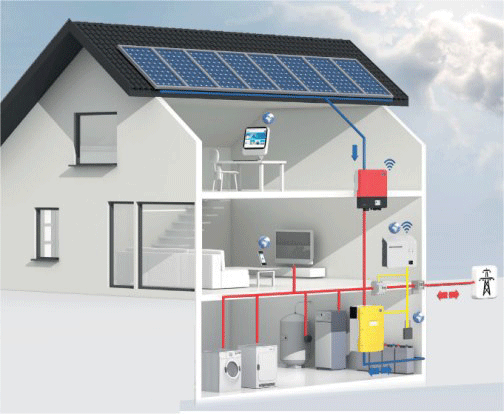
In the image above, the solar inverter converts the DC current produced by the solar panels to AC power for household use.
Any power not being used by household appliances is transmitted to the Sunny Island. The Sunny Island charges the batteries and also offers an uninterruptible, grid-quality power supply.
Power not being utilised by either the household or Sunny Island is exported to the mains grid.
At night, or when called upon, the Sunny Island converts the DC energy stored in the batteries back into AC power for use by the household.
The SMA Energy Meter communicates solar generation and consumption data via Speedwire to the Sunny Home Manager.
The Sunny Home Manager provides live data on electricity use to aid in smart energy management. Reports and visualisations of all the relevant electricity flows are displayed via a user-friendly interface, providing comprehensive and concise data.
Reports and data generated by the Sunny Home manager can be accessed on a PC or smartphone.
Unlike some grid-connected energy storage solutions, if a mains-grid blackout is experienced; the system doesn’t shut down – it will automatically switch to using the energy stored in the battery bank.
The SMA flexible storage solution is also “future-proof” – it will be compatible with future smart grid technologies.
Developing methods for renewable energy to the grid
 The biggest factor is the roll out of electric vehicles
How to get renewable energy into the grid — without losing power The Conversation, Anthony Vassallo Delta Electricity Chair in Sustainable Energy Development at University of Sydney, 11 September 2014
The recent review of the Australian Renewable Energy Target has once again raised the issue of the “unreliability” of some renewable power sources such as wind and solar power. Their variability, which arises from the weather or daily and seasonal cycles, leads some to conclude that they will only ever be able to supply a minority fraction of Australia’s electricity.
But for the most part we have the technology available to ensure a steady supply of power, and where we don’t, technology is rapidly advancing.
South Australia is at the forefront of integrating renewables into the existing grid. With more installed wind than any other state (almost 1,500 megawatts), wind now provides on average 25% of its annual electricity production. On recent occasions it provided 100% of the state’s needs and even exported 487 megawatts of power in June this year………
….Our national electricity grid (mostly on the eastern and southern states) is the result of decades of growth, largely built on legacy operation — large, remote, baseload coal power plants that need to operate continuously.
This resulted in the three tier generation comprising baseload, intermediate and peaking.
Baseload is the term used to describe the large coal-fired power plants that were designed to provide cheap, continuous power. In fact because of their size and design it was not feasible to greatly reduce their output overnight, so it was necessary to provide an incentive to consumers to use power at night to keep them running efficiently.
This was the “off-peak” hot water and other time independent loads that were encouraged through very low tariffs……….
Improving forecasts
There are a number of alternatives to managing this variability, such as more accurate renewable generation forecasting and demand response (i.e. specific actions to reduce customer loads, such as payments for reducing consumption).
Wind power generation can now be forecast with useful accuracy. In Australia, wind forecasting is now better than 10% error for 40 hours ahead, and better than 4% error for 1 hour forecast……. Continue reading
Australian government will “let” residents offer their land as radioactive waste dump!
 PUT IT IN THE BACKYARD: Government Considers Letting Australians Nominate Their Land As A Radioactive Waste Dump http://www.businessinsider.com.au/put-it-in-the-backyard-government-considers-letting-australians-nominate-their-land-as-a-radioactive-waste-dump-2014-9
The government has flagged it intends to open a nationwide volunteer process, similar to what is currently open to Aboriginal Land Councils in the Northern Territory, under the National Radioactive Waste Management Act.
If nominations are opened, land owners in all states and territories would be able to volunteer their properties for technical consideration.
“A site will only be selected if it can fulfil strict environmental requirements,” minister for industry, Ian Macfarlane said in a statement.
Those interested in having a radioactive facility built out the back have until November 10 to submit a proposal.
Macfarlane said all submissions will be considered before a decision is made to widen to selection criteria.
Australian government actively setting up bribes to Aboriginal communities to host nuclear waste dump
 Government ‘not short of choice’ for nuke dump site ABC Online Indigenous By Gail Liston and staff writers September 08, 2014 Federal Industry Minister Ian Macfarlane is “confident” nuclear waste being stored under buildings in Sydney and Melbourne could still be headed for the NT.
The ABC understands traditional owners from central Australia are in talks to nominate a site in the Tanami Desert, 540 kilometres west of Alice Springs for a facility to house nuclear waste, in the wake of a site near Tennant Creek being withdrawn in the middle of a federal court challenge.
Earlier this year the Minister offered NT Aboriginal land councils an opportunity to nominate a site, which he said would be “worth millions and millions of dollars to whoever is successful”, after the Federal Government withdrew its nomination of Muckaty Station north of Tennant Creek.
Mr Macfarlane said he would only consider nominations that were uncontested, after theMuckaty nomination process which he later described as a disaster.
Asked if he was aware of a group from the Tanami offering land to build the site, Mr Macfarlane refused to answer directly.
“I am not going to talk about potential applications while the existing process is in operation. The Central and Northern Land Councils still have the best part of 20 days to supply me with a site,” he said.
“I can say I won’t be short of choice if this process goes beyond the current process with the Central and Northern Land Councils.”
I am receiving offers from potential sites from right across Australia,” Mr Macfarlane said.
“I am confident that if we don’t succeed in the current process we’ll succeed in the subsequent process to identify a site and build a repository so that nuclear waste that is currently being stored in shipping containers and car parks underneath CBD buildings in Sydney and Melbourne will have a proper place to be stored.”
The ABC has been told a delegation from the Central Land Council will start consultations with the traditional owners later this week.
The Tanami Road is the only way to access the site, but a 254 kilometre stretch remains unsealed.
Sealing the road is one of the key recommendations in the Federal Government’s plans for developing Northern Australia but could cost hundreds of millions of dollars.
Nat Wasley from the Beyond Nuclear Initiative says the Minister is trying to bribe desperate people into accepting nuclear waste. “He gave till the end of September, so it is not surprising that people are looking to have meetings and find out more information before that deadline,” he said.
“We are also seeing the situation where the Minister is dangling a carrot yet again in front of communities who desperately do need funding for outstations, roads and housing.
“I’m not sure of the exact location of the site that is being looked but it would be a concern if the Government is considering taking nuclear waste along unsealed roads for the very reason that it can’t find other ways to manage nuclear waste.”
Government keen to avoid another Muckaty……….
Mr Macfarlane later said the process to nominate Muckaty Station was “a disaster” but there was interest from Aboriginal land owners elsewhere.
He said if there were no takers for a dump in the NT by September he would open the bidding to the rest of the country, but warned any potential site would need to be undisputed.
“I’ll throw it open to anyone in Australia who can provide me with a block of land free of dispute and challenge that is environmentally suitable and that will be keenly sought after by a whole range of people – individuals, private property owners.” http://www.abc.net.au/news/2014-09-08/new-push-for-nt-nuke-dump-site/5727496/?site=indigenous&topic=latest
The 3 demands at the top of the IPA’s 75-strong wish list for a “better Australia” were the repeal of the carbon price, the abolition of the Department of Climate Change and clean energy funds.

 Tony Abbott’s Year of Leading Dangerously, REneweconomy By Giles Parkinson on 8 September 2014 Just over a year ago, after it became clear that Tony Abbott’s Coalition would sweep to a federal election victory, the predominant thought among many in the clean energy and climate policy space was: Well, he won’t be that bad, will he?
Yes, he will, and he has been. As we noted in our pre-election summary on September 6 last year, there was every reason to believe that anAbbott government could be worse than people feared. And not it should be noted, by doing anything Abbott hadn’t already flagged, but by doing exactly what he said he would do.
Several months earlier, RenewEconomy flagged Five ways Abbott could kill renewables in Australia. They were: Kill the carbon price, the Clean Energy Finance Corp and the Australian Renewable Energy Agency, make the renewable energy target unworkable, and disband the Climate Change Authority.
He has acted on all five. Here’s how he has progressed.
Can the carbon price. Tick.
Can or dilute the Renewable Energy Target, and make it unworkable. Tick. The Abbott government now has the recommendation it needs, from the controversial Warburton Review, now it just a matter of implementing them. The uncertainty in the industry has brought all large-scale investment to a halt.
Axe the Climate Change Authority. This was one of the government’s first acts. It hasn’t yet succeeded, but the CCA has been gutted by the departure of many key personal. It has been sidelined from the RET Review, and its key findings on climate policies and emissions targets are ignored by the government, and ipso facto by mainstream media.
Can the Australian Renewable Energy Agency. It’s still trying, with a vote to be presented to the Senate later this month. Funding has already been cut, but Abbott wants to cut all future funds and absorb the running of the committed projects back within a government department.
Can the Clean Energy Finance Corporation. It tried, but once again the Senate has stymied its attempts. Still, the CEFC can be directed where to direct its funds, and it is increasingly likely it will be given modified mandates to help out with the discredited Emissions Reduction Fund, the key plank of Direct Action policy.
A lot of what Abbott has sought to achieve in his first year was mandated by the Institute of Public Affairs, the conservative think tank that has become a voice for extreme right views and vested interests. Continue reading
Non profit ASSET OWNERS DISCLOSURE PROJECT scrutinises funds investments and climate change
 ASSET OWNERS DISCLOSURE PROJECT
The Asset Owners Disclosure Project is an independent global not-for-profit organisation whose objective is to protect members’ retirement savings from the risks posed by climate change. We aim to do this by helping funds to redress the huge imbalance in their investments between high-carbon assets (50-60% of a portfolio) and low-carbon assets (typically less than 2%) and realigning the investment chain to adopt long-term investment practices. Key elements of the initiative are:
- Conducting an annual survey and assessment of the world’s 1000 largest asset owners pertaining to their management of climate change risks and opportunities.
- Publishing rankings of the world’s 1000 largest asset owners to allow members, stakeholders and industry to see which funds are better than others at managing climate risk.
- Providing and promoting climate change best practice to drive and improve climate change management and capability of asset owners.
- Developing consumer-facing programs to educate asset owner’s members or stakeholders of the financial risks associated with climate change.
- Researching trends in climate risk, member behaviour and institutional investment.
- Creating frameworks to encourage active ownership………..http://aodproject.net/about/about-us.html
1 This month


Help Aunty Sue Protect Her Land and Sacred Sites From Destructive Rocket Testing.
.

Australians deserve the truth
about
AUKUS – https://aukuspublicinquiry.com/

PETITION – To: Prime Minister Anthony Albanese and the Australian Labor Government

of the week – Australians for War Powers Reform (AWPR)
To see nuclear-related stories in greater depth and intensity

