Conservative British Lord Deben attacks Tony Abbott’s ‘reckless’ climate policies
 Carbon tax repeal: UK politician Lord Deben attacks Tony Abbott’s ‘reckless’ plan to scrap carbon tax, ABC Lateline 9 July 14 One of the UK’s leading Tory politicians has attacked Tony Abbott’s plan to scrap the carbon tax, accusing the Prime Minister of “recklessly endangering” the future of the world…….the unlikely voice of Lord Deben, who remains Britain’s longest serving environment minister. Lord Deben, a former head of the Conservative Party who served under Margaret Thatcher and John Major, is now the head of the UK Committee on Climate Change.
He has issued a statement saying the Abbott Government “appears to be more concerned with advancing its own short-term political interests” than dealing with global warming……..Australia is changing Britain’s climate as we are changing yours. It is not just a national matter. We are all in this together and Mr Abbott is recklessly endangering our future, as he is Australia’s,” the statement said.
Lord Deben, formerly John Selwyn Gummer, has told Lateline the Abbott Government is sending Australia backwards.
We all know [Tony Abbott] and his Government do not take this seriously, where the rest of the world, 80 per cent plus of emitters, are taking it so seriously that we find it very upsetting that Australia should be slapping us in the face and saying we don’t care about the climate.
“In Britain we have an independent body which is apart from party politics which sets the targets, sets the budget, and independently assesses how well the government has done,” he said.
“Mr Abbott has got rid of his independent group, he won’t have independent assessment, nobody outside his party thinks that his policy is going to deliver and he will not listen to the rest of the world……….
Australia ‘slapping us in the face’ on climate change
The Government says its $2.5 billion Direct Action plan will reduce emissions and allow Australia to reach its target of a 5 per cent reduction in emissions by 2020.
But Lord Deben – whose government has a binding target to cut emissions by 80 per cent by 2050 – says that is a “miserable” target.
“A 5 per cent target by 2020 is out of kilter even if you choose the most favourable base that you like with the rest of the world,” he said……
we all know he and his Government do not take this seriously, where the rest of the world, 80 per cent plus of emitters, are taking it so seriously that we find it very upsetting that Australia should be slapping us in the face and saying we don’t care about the climate, you can get on with it, we are not doing our part.”…….http://www.abc.net.au/news/2014-07-08/abbott-endangering-future-on-climate-lord-deben/5582902
Sydney gets world’s first solar integrated house
 World’s first building-integrated solar system built in Australia http://ecomento.com/2014/07/08/worlds-first-building-integrated-solar-system-built-in-australia/ July 8, 2014 – NextPremium.co Many people looking to go (at least partially) off the grid install rooftop solar panels, but a house purpose-built for solar power is another matter entirely.
The first building-integrated solar energy system was recently installed in a house in suburban Sydney, Australia, CleanTechnica reports.
The house’s rooftop array thin-film photovoltaic panels with a solar-thermal duct system that warms and cools the air. While the top layer produces electricity like any other solar panel, heat trapped between the layers is also used by the house.
Australian steel manufacturer Bluescope produced the $5 million system with government assistance in the form of a $3.2 million loan grant from the Australian Renewable Energy Agency (ARENA). Government money is often an important factor in getting projects like this off the ground (no pun intended).
Whether integrated solar catches on remains to be seen, but at least the public will now get a chance to see what this technology can do. This post appeared first on NextPremium.com
Cheap effective storage for renewable energy – ” pumped hydro”
 How pushing water uphill can solve our renewable energy issues The Conversation, Andrew Blakers Director of the Centre for Sustainable Energy Systems (CSES) at Australian National University 9 July 2014
More and more renewable energy sources are being plugged into Australia’s electricity grids. South Australia, for example, will get 40% of its electricity from wind and solar once the Snowtown wind farm is completed later this year.
But if renewable energy is ultimately to dominate the market, we will need ways to store the energy so we can use it round the clock. The good news is that it is easy to store energy. All you need is two small reservoirs – one high, one low – and a way to pump water between them.
This technique, called “off-river pumped hydro energy storage”, can potentially provide the energy storage that Australia needs to embrace renewables fully. It’s cheap, too.
How pumped hydro works
When there is excess electricity, water is pumped through a pipe or tunnel, to the upper reservoir. The energy is later recovered by letting the water flow back down again, through a turbine that converts it back into electricity. Efficiencies of 90% in each direction are possible.
Pumped hydro is by far the most widely used form of energy storage, representing 99% of the total. Worldwide, pumped hydro storage can deliver about 150 gigawatts, mostly integrated with hydroelectric power stations on rivers………..
There is little opportunity for Australia to develop on-river hydroelectric power, because of environmental and other constraints. But, there are vast opportunities for short-term off-river energy storage. A typical site would comprise a pair of small reservoirs connected by a pipe through which water would be cycled daily, together with a pump and turbine, powerhouse and power lines.
Australia has thousands of excellent potential sites in hilly areas outside conservation reserves, with typical elevation differences of 750 m. They don’t need to be near a wind or solar farm.
Off-river electricity storage has several advantages over typical on-river facilities:
- There are vastly more potential sites
- Sites can be selected that do not clash with environmental and other values
- The upper reservoir can be placed on top of a hill rather than in a valley, allowing the elevation difference to be maximised
- No provision needs to be made for floods (typically a major cost).
A system comprising twin 10-hectare reservoirs, each 30 m deep, with a 750 m elevation difference, can deliver about 1,000 megawatts for five hours.
Between 20 and 40 of these systems would be enough to stabilise a 100% renewable Australian electricity system……..http://theconversation.com/how-pushing-water-uphill-can-solve-our-renewable-energy-issues-28196
Proposal for Nuclear Waste Dump on Aboriginal Land in Western Australia
 Nuclear dump plan for desert MICHAEL DULANEY The West Australian July 6, 2014, A traditional owner in the northern Goldfields wants to house a proposed nuclear waste dump on land in the Gibson Desert to help develop the region’s economy.
Kanpa community chairman Preston Thomas has seized on the Commonwealth dumping Muckaty Station as the site for a Federal nuclear waste repository.
It is part of his vision to provide biofuel to the Ngaanyatjarra Lands and develop agriculture around the remote Kanpa Aboriginal community, about 900 km north-east of Kalgoorlie-Boulder.
The Northern Territory station was withdrawn last month after a Federal Court case and division between Aboriginal groups in the region who claim they were not consulted properly.
The Federal Government is looking for an alternative site for Australia’s first radioactive waste dump.
Kanpa’s representative body the Pira Kata Aboriginal Corporation, chaired by Mr Thomas, has applied for a native title sublease of about 500sqkm between Kanpa and the Great Central Road.
Mr Thomas wants this area to be considered for the facility, which requires an area of about 3sqkm – about the size of two football fields……..Mr Thomas has been in discussions for the project with AgGrow Energy Resources since 2010, after the company’s involvement in a similar pilot project in the Pilbara………Industry Minister Ian Macfarlane said the Northern Land Council, which represented traditional owner interests at Muckaty Station, had been given three months to find an alternative site.
If the process was not concluded by September, a nationwide tender would be conducted, with “preliminary discussions” already under way.https://au.news.yahoo.com/thewest/business/wa/a/24395664/nuclear-dump-plan-for-desert/
Aboriginal Australia needs a genuine representative, not Abbott’s token Warren Mundine
It is not acceptable for political parties to appoint a token representative to address the issue, misrepresent to the community they are going to be acting in the best interests of the community and then fail to consult the community upon which they are imposing laws and policies.
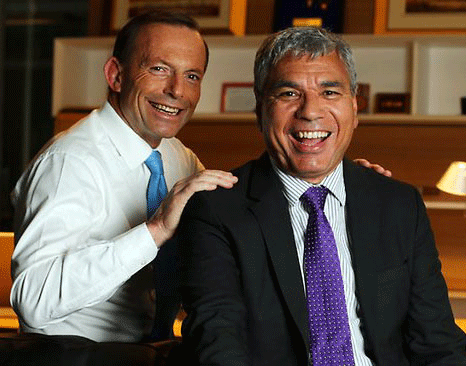 Tony Abbott, terra nullius and Warren Mundine, Independent Australia Natalie Cromb 4 July 2014, Prime Minister – and supposed Indigenous Affairs Minister – Tony Abbott has insulted First Australians, saying Australia was “unsettled” before British colonisation, while his Indigenous advisor Warren Mundine laughed off the calumny. First Australian Natalie Cromb comments.
PRIME MINISTER TONU ABBOTT delivered the keynote address at a Melbourne Instituteconference last night and, whilst advocating for foreign investment, he shed some light on his particular take on history, crediting Australia’s existence on British “foreign investment” in
“… the then unsettled or, um, scarcely settlement, Great South Land.”
This, of course, is the same Tony Abbott who, in the lead up to last year’s election, told a large group at Arnhem land that he would spend his first week as Prime Minister with the Yolngu People.
When it was pointed out by David Donovan in late September that he had not, actually, done that, PM Abbott was backed to the hilt by his hand-picked Indigenous advisor, Warren Mundine, who excoriated IA‘s managing editor for foolishly taking Tony at his word.
Again, today, Mundine has downplayed Abbott’s latest insensitive comments as “silly”, saying Tony Abbott’s
So, who is this Mundine? And why has he thrown his support behind a prime minister whose attitude towards Indigenous Australia is ambivalent at best and downright duplicitous at worst?
As a proud member of Australia’s First Peoples, I would like to talk about Warren Mundine and his relationship and connection to Indigenous Australia, as well as lay out what a person in his position should aim to achieve.
Warren Mundine is an accomplished man with a large family and extensive political history with the Australian Labor Party — however, those closest to Mundine do consider his political aspirations self-serving rather than for the greater good of the Aboriginal people.
Lending weight to this critique is the fact that he has jumped ship from Labor, citing he was “sick at heart” following the appointment of Bob Carr to the position that he was courting and now he is Prime Minister Abbott’s key advisor on Aboriginal Affairs.
I am sure that Warren Mundine’s ‘leadership’ status and ‘advisor’ capacity has nothing to do with the fact that he shares the same religious philosophy as the Prime Minister, is an economic conservative that supports Abbott’s policies of individual economic participation as being of more importance than the empowerment of communities and he appears to tow the party line.
Warren Mundine’s views are widely criticised and rightly so.
He has supported a political party and policies that have set Indigenous people back, and makes outlandish comments of this nature, which not only deny the history of this nation, but belittle it for an economic cause.
An example is the recent announcement of $42m funding being cut from the National Aboriginal and Torres Strait Islander Legal Service (ATSILS).
The ATSILS is the one organisation that attempts to counterbalance the obvious discrimination that occurs in the criminal justice system. It is accepted as fact, and there is a tremendous amount of data to support, the contention that Indigenous Australians are racially profiled and are more likely to receive custodial sentences than their non-Indigenous counterparts for the same crime. Nevertheless, ATSILS is staring down the barrel of a crippling funding cut.
Mundine did little to oppose this cut and, in fact, said Indigenous programmes should be looking for further “efficiencies”.
In my opinion, Mundine and Abbott can expel rhetoric about efficiencies until the cows come home but a cut is a cut and cuts of this magnitude, targeted in such a manner, illustrate a complete disconnect between Abbott, his adviser and the Aboriginal populace at large. Continue reading
Australia’s solar energy revolution is underway
Australia’s solar boom has only just begun Echo Net Daily Giles Parkinson, RenewEconomy 6 July 14 Australia is expected to spend some $55 billion on new electricity generation over the next decade and a half, but two thirds of this will be in the form of solar technology, and nearly half in rooftop solar PV.
These forecasts are included in Bloomberg New Energy Finance’s Market 2030 outlook, which includes detailed forecasts for Australia and Asia, both of which have major implications for the coal industry – exporters and local generators.
The most striking prediction is that for solar PV, which BNEF says will dominate capacity and investment over the next decade and a half. It expects 15.8GW of rooftop solar to be built in Australia out to 2030 – mostly on the basis of fundamental economics.
It suggests the payback for rooftop solar will halve to just three years by 2030. That is based on no subsidies and no carbon price, but it argues that it is still a compelling proposition to households.
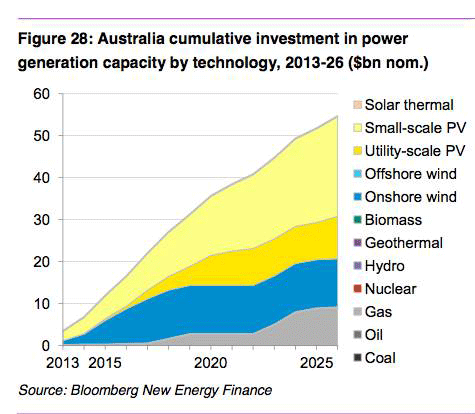
“Australia, like Japan, has high retail electricity prices which, combined with continuously reducing technology costs, are the main reasons for the small-scale PV adoption rate,” it writes.
“The favourable economics of the small-scale PV technology – ie, the reduction in payback period – will drive the sixfold increase in small-scale PV capacity and the technology’s contribution to total capacity additions between 2013 and 2030.”
BNEF expects households and businesses will invest another $24 billion on rooftop solar.
While the speed and breadth of the rooftop solar deployment will be influenced slightly by policy changes, the deployment of large-scale renewables is almost entirely dependent on the state of policies such as the renewable energy target…….http://www.echo.net.au/2014/07/australias-solar-boom-just-begun/
Anglican Church urges Abbott to change his climate policies
 Respect climate science: Anglicans urge Tony Abbott to change tack on climate change policies, The Age, 4 July 14, Tom Arup Environment editor, The Anglican Church has told the Abbott government to change its approach to climate change, urging it to respect and base its policy on scientific evidence.
At a meeting in Adelaide, the church’s Australian general synod passed a unanimous motion calling on the government to “respect and act upon relevant independent evidence-based scientific advice’’ on climate change.
The 23 dioceses of the church said they were gravely concerned that Australia’s target to cut carbon dioxide emissions – five per cent below 2000 levels by 2020 – was well short of what was needed.
They said they deeply regretted that it was “future generations and other forms of life” that would “bear the real cost of our heavy dependence on carbon-based energy”.
Perth Bishop Tom Wilmot, a church leader on environmental issues, told Fairfax Media that the environment was such an important issue it should not be left just to politicians and economists to discuss it.
‘‘My concern is the Abbott government seems to be deconstructing almost everything that was put in place over the last decade or so to protect the environment,’’ he said.
‘‘It seems to be neutering any scientific voice and, in fact, any voice that seeks to speak on environmental matters.’
He said the appointment of businessman and self-described climate sceptic Dick Warburton to head a review of the renewable energy target was a cynical way of pre-determining its outcome.
And he accused Environment Minister Greg Hunt of being dishonest about the effectiveness of the carbon price, which is expected to be repealed next week with support of new crossbench senators.
Bishop Wilmot said he was concerned about the government’s attitude to environmental policy generally, including handing approval powers for big developments to state governments.
Warren Mundine ‘raises his eyebrows’, but Nova Peris speaks out, on Tony Abbott racist gaffe
 Nova Peris attacks Tony Abbott over ‘unsettled’ land THE AUSTRALIAN JULY 05, 2014 Patricia Karvelas LABOR senator Nova Peris has condemned Tony Abbott for suggesting Australia was unsettled before British occupation.
And Mr Abbott’s chief indigenous adviser [Warren Mundine] admits he “raised his eyebrows” when the Prime Minister said we had all benefited from Britain’s original foreign investment because Australia was “unsettled” before the British arrived.
After delivering the keynote address at the Economic and Social Outlook conference on Thursday night, Mr Abbott was asked about foreign investment, but his answer suggesting people were not in Australia in 1788 sparked a backlash.
Senator Peris said the comments were highly offensive, dismissive of indigenous peoples and simply incorrect.
“British settlement was not foreign investment. It was occupation,’’ she said. “The comments from the Prime Minister have not just offended Aboriginal Australians but many people around the country.” Senator Peris said Mr Abbott’s comments had setback bipartisan efforts to recognise Aboriginal and Torres Strait Islander people in the Constitution……http://www.theaustralian.com.au/national-affairs/policy/nova-peris-attacks-tony-abbott-over-unsettled-land/story-fn9hm1pm-1226978303770
Renewable energy certificate prices to rise, regardless of what Tony Abbott says
 Ignore Abbott, renewable energy certificate prices should rise, Business Spectator TRISTAN EDIS 2 JUL The key barometer of the health of the renewable energy sector, particularly wind power, is the price of large-scale renewable energy certificates or LGCs. These certificates are the currency through which the electricity retailers comply with the large-scale Renewable Energy Target and make up more than half the revenue a wind farm earns (the other component is the underlying price for wholesale electricity).
On the day prior to Clive Palmer’s press conference with Al Gore, LGCs plumbed a low of $21 on the spot market. The market had only ever gone this low once before, in early 2007 when the final RET target was just 9500 gigawatt-hours.
The day after the Palmer-Gore press conference they surged to as high of $32, but then subsided and just yesterday changed hands at $28.70.
This is way too low and does not reflect the economics of renewable energy projects nor the political situation surrounding the Renewable Energy Target. Instead it reflects how the market is punch drunk from one bad piece of news after another enveloping the scheme in a cloud of uncertainty. ………
Complete repeal of the scheme with existing holders and producers of LGCs left stranded appears highly unlikely. Even as Joe Hockey was decrying wind farms as “utterly offensive”, he also told Alan Jones that they couldn’t leave those holding contracts high and dry. After all, the people on the hook are power retailers and banks – hardly the enemies of the Coalition. Also, in response to questioning from Climate Spectator, Environment Minister Greg Hunt told an audience of several hundred in May that no matter what comes out of the RET review, the scheme will continue…………https://www.businessspectator.com.au/article/2014/7/2/renewable-energy/ignore-abbott-renewable-energy-certificate-prices-should-rise
Troubled rare earths miner Lynas to move from Sydney to malaysia
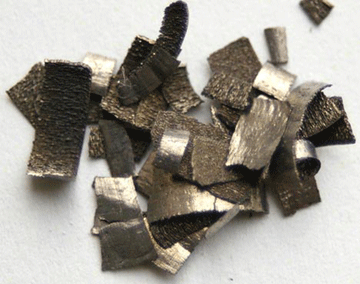 Nervous investors ditch Lynas ahead of move to Malaysia July 3, 2014 The Age, Brian Robins Troubled rare-earth miner Lynas Corp is to shift its head office abroad as part of a renewed cost-cutting regime as the company seeks to stop haemorrhaging cash.
It also comes amid production difficulties at its recently commissioned Malaysian processing unit that have yet to be resolved, and as negotiations continue to refinance a key funding package.
Lynas said it would move its head office to Kuala Lumpur, from Sydney, which will result in an unspecified number of job losses, with further jobs to go at its Perth office…….Investors were unnerved by the latest news, pushing Lynas shares down 7 per cent to close at 13¢.
Lynas is not the only rare earths producer encountering ongoing problems in lifting output, with US group Molycorp also struggling to bed down a capacity expansion.
Equally important to Lynas Corp’s near-term progress is resolving negotiations to refinance a $US325 million loan, via Nomura.
There has been ”no material development” with this refinancing, a Lynas spokesman said.
To help shore up its balance sheet, Lynas recently raised $40 million from shareholders as well as replacing its chief executive. http://www.smh.com.au/business/nervous-investors-ditch-lynas-ahead-of-move-to-malaysia-20140702-3b8so.html#ixzz36Xf4ozEk
Australia’s wind energy brought down wholesale wind prices, (but not passed on to consumers)
 Big savings from renewable energy target but consumers miss out, SMH July 2, 2014 Peter Hannam Environment Editor, The Sydney Morning Herald While Prime Minister Tony Abbott says renewable energy significantly increase electricity bills, a new study finds wind energy actually forced down wholesale power prices by more than $3.2 billion over six years – but that little of the savings flowed through to consumers. Mr Abbott on Tuesday said the renewable energy target, which has largely driven investment in wind farms, was ”very significantly driving up power prices”.
”It’s precisely the opposite,” John Foster, one of the authors of the study that has been submitted to a review of the target, said. “The [target] – and the stimulation of wind – has increased supply and flattened out the expensive peaks.”
For instance, modelling of 30 minutes of heavy demand for electricity in Victoria on January 31, 2011 showed the wholesale price of $1.4 million would have ballooned to $45.6 million had only coal and gas-fired power plants had been able to respond.
Mr Abbott’s statement has been interpreted as signalling his government may weaken or scrap the target requiring at least 20 per cent of power from renewable sources once a review into the scheme is complete………
Once other costs including the purchase of renewable energy certificates were taken out, the target delivered a net benefit of $870 million from 2007 to 2012, the study found.
Little of that benefit reached consumers, though, with a lack of transparency masking just how much retailers snagged of the gains, Ms Molyneaux said. “We don’t see evidence of consumer prices going down.”
Debate over the target is expected to intensify with coal baron Clive Palmer saying last week his party will use its balance of power in the new Senate to preserve the existing target – now set at 41,000 gigawatt-hours of renewable energy by 2020 – until at least 2016, whatever the recommendations of the government’s hand-picked review panel………
Among the states, Victoria was the biggest beneficiary, snaring $2.37 billion of the $3.2 billion in wholesale savings. It hosts the second-largest wind turbine capacity of the states and can tap the largest – in South Australia – because of good transmission connections, the researchers said.
NSW lagged with only $136 million in wholesale savings because of its modest wind farm presence, while wind farm-free Queensland had barely any savings at all.
By 2012, wind farms were also responsible for reducing carbon emissions at the rate of 4 million tonnes a year, the study said.
Separately, the latest Cedex report by energy consultants Pitt & Sherry found carbon emissions from the National Electricity Market fell 10.4 per cent, or 18 million tonnes, in the two years of the carbon tax.
A fall in electricity demand contributed part of the drop, as did a switch to more wind and hydro electricity. Coal supplied 73 per cent of the power to the National Electricity Market – which serves eastern Australia – a year to the end of June, almost certainly a record low, according to Hugh Saddler, principal consultant with Pitt & Sherry. Gas supplied 12.7 per cent, hydro 9.6 per cent and wind 4.7 per cent.
Windy conditions over the past week saw wind farms supply 14.5 per cent of the generation in NSW, South Australia, Tasmania and Victoria from Monday to Saturday.
At 4.25am on Friday, South Australia’s wind generation exceeded demand in the state for the first time, according to Infigen Energy, a wind farm operator.
”The greatest significance of these figures is probably the demonstration that the [market] is sufficiently robust to be able to accommodate such large shares of wind generation, with no effect on the supply of electricity to consumers,” the report said. http://www.smh.com.au/federal-politics/political-news/big-savings-from-renewable-energy-target-but-consumers-miss-out-20140702-zstn1.html#ixzz36XYUb9LS
The real cost to Queensland of uranium mining may be very high
Queensland lifts its uranium ban, but is the price worth the cost? The Conversation Maxine Newlands Lecturer in Journalism, Researcher in Environmental Politics at James Cook University Liz Tynan Senior Lecturer and Co-ordinator Research Student Academic Support at James Cook University 1 July 14,
As of today, Queensland has lifted a 32-year ban on uranium mining. That decision was taken within months of the 2012 state election, despite Premier Campbell Newman’s pre-election promise not to restart mining the radioactive mineral.
Miners are being invited to apply to restart the industry under the Queensland’s government’s uranium action plan, which will mean Canadian company Mega Uranium can reopen the Ben Lomond and other mines in north Queensland.
Queensland’s resumption of uranium mining comes only days after Australia’s newest uranium mine, Four Mile in South Australia, officially opened on 25 June.
 Yet the price of uranium has fallen from a high in 2007 of US$70 a pound to $US28, due to factors including oversupplyand what the Wall Street Journal has described as a “post-Fukushima funk”.
Given the prices are so low that The Australian has reportedthat Four Mile is already losing money, while the Beverley mine has been mothballed since January, why are Australian states looking to open more mines?………….
Battles ahead over Queensland exports
The highest concentration of Queensland’s uranium mines sit in the northern tropics, an area prone to Category 5 cyclones.
A 2013 Swiss study found uranium was far more mobile than originally thought. Uranium once extracted, becomes soluble in water, increasing the chances of contamination or radioactive dust carried in high winds and heavy rainfall.
If Ben Lomond is reopened, the quickest way to export its uranium would be through the city of Townsville, home to 190,000 people, which is only 50km from the mine.
The Port of Townsville has said it has the capability to “facilitate the transportation and export of yellowcake”. The Queensland’s government’s uranium action plan recommends that:
Queensland’s efforts should be [put] on facilitating the use of existing ports and shipping lanes by industry for the export of uranium.
However, the Port of Townsville sits within the Great Barrier Reef World Heritage Area and close to sensitive environments including the Great Barrier Reef Marine Park, dugong protected areas, seagrass beds, fringing coral reefs and mangrove forests.
Last year, Great Barrier Reef Marine Park Authority chairman Russell Reichelt told the ABC that:
I think shipping of any toxic cargo would be of concern. But really we would have to see a proposal and we would have to consider that.
So this is set to be a contentious issue: while economic development of the north has bipartisan support at a federal, state and local government level, a number of locals and environmental groups have said they will challenge any plans to reopen uranium mines and exports from Queensland.
The big question for Queensland residents to consider now is whether the return of uranium mining to the state will be worth the wait for the uranium price to recover, given the risks attached to transporting the mineral through populated and environmentally-sensitive areas.http://theconversation.com/queensland-lifts-its-uranium-ban-but-is-the-price-worth-the-cost-28105
Rare Earths: background to arrest and release of Australian activist Natalie Lowrey
Crikey Clarifier: what’s all the fuss about rare earths? http://www.crikey.com.au/2014/07/01/crikey-clarifier-whats-all-the-fuss-about-rare-earths/ by Crikey Intern Bondi resident Natalie Lowrey was suddenly released without charge on Friday night after five days’ detention in a Malaysian prison. Lowrey, who was born in New Zealand, was arrested last week in Kuantan, Malaysia, for protesting against the processing of rare earths by Australian minerals giant Lynas Corp. We delve into some of the issues surrounding the case.
What are rare earths?
Rare earths are chemical elements found in the earth’s crust that are vital to many modern technologies, including electronics such as speakers, computers, hybrid cars and wind turbines. Rare earths have unique magnetic, luminescent, and electrochemical properties that help technologies perform more efficiently. They are particularly valuable for use in smartphones, and are in high demand.
What is Lynas Corp, and what is it doing in Malaysia?
Lynas Corporation Ltd is an ASX 100 listed company based in Sydney, Australia. It is currently constructing the Lynas Advanced Materials Plant (LAMP), a rare earth processing plant at Gebeng, near Kuantan, Malaysia.
Lynas’ rare earth project has sparked protests in Australia and Malaysia over fears about possible negative health, environmental and economic impacts once the plant begins its operation, as it will produce radioactive material as a waste product. Although the rare earths are extracted in Western Australia, the potentially hazardous processing will take place in Malaysia.
Is there any evidence processing rare earths is dangerous?
Mitsubishi Chemicals Asian Rare Earths, a plant in Bukit Merah, Malaysia, was shut down in the 1992 after at least eight cases of leukaemia and a sudden surge in birth defects and miscarriages in the area. The plant was finally closed after an eight-year battle and is currently undergoing the largest clean-up in the rare earth industry at a cost of US$100 million. Cleaning up requires digging up the entire area of contamination and entombing it inside a mountain.
A spokesperson from Lynas told Crikey: “The Asian Rare Earth plant used the waste from tin mining as its raw material. Lynas raw material contains naturally low levels of thorium, which are 30-40 times lower than rare earth concentrates from tin mine tailings. By all international standards, the Lynas raw material is classified as safe, non-toxic and non-hazardous.”
But Dr David KL Quek, former president of the Malaysia Medical Association, has said:
“Thorium is an acknowledged waste product from the planned Lynas refinery of rare earth ores. Due to the various refining processes thorium will be enriched and concentrated to levels which could reach quantities that are difficult to contain or be safely sequestrated.
“Based on the preliminary Environmental Impact Agency report, thorium residues would lead to a sizeable radioactivity dose of some 62 Becquerel per gram. For 106 tonnes this would be an enormous quantity of radioactive residual thorium.”
Wastes from production will include radioactive thorium and uranium and their radioactive decay products such as radium and radon. Australian authorities have explicitly refused to allow the wastes to be shipped back to Australia for safe disposal.
Why Malaysia?
The Malaysian government has been more open to rare earths processing than the Australian government.
Phua Kai Lit, an associate professor of the Jeffery Cheah School of Medicine and Health Sciences at Monash University in Malaysia, told Crikey: “The Prime Minister, as well as the Chief Minister of the state of Pahang, are both strong supporters of the project. Similarly, political appointees such as the various ministers from ministries involved with the project echo the government’s line. The head of the main regulatory body, the Atomic Energy Licensing Board, also echoes the government’s line.
A spokesperson told Crikey Lynas plans to recycle the waste from the LAMP refining process into co-products such as plaster boards and cement. Two out of three of these products have been certified as non-radioactive by the Malaysian Atomic Energy Licensing Board.
The AELB is in charge of approving and monitoring radioactive industries and received an undisclosed sum by Lynas Corp in 2011. However the AELB denied the sum was a requirement.
Palmer and Gore have saved Australia’s important renewable energy projects
Australia Institute director says Gore-Palmer ploy reset climate debate http://www.theguardian.com/environment/2014/jul/01/australia-institute-director-says-gore-palmer-ploy-reset-climate-debateFormer Greens staffer Ben Oquist, one of those who brought the two men together, said the move was a step forward The Australia Institute has defended its role in negotiating the Clive Palmer-Al Gore climate announcement because the concessions made by the Palmer United party had “avoided a big step backwards” and reset the climate debate in Australia.
In an email to supporters, the thinktank’s strategic director and former Greens staffer, Ben Oquist, one of a number of people involved in bringing Gore and Palmer together, defended the move as a step forward, despite PUP’s unchanged resolve to repeal Australia’s carbon pricing scheme after the Senate resumes next week.
PUP will now use its balance of power votes in the Senate to retain the Clean Energy Finance Corporation, the Climate Change Authority and the renewable energy target.
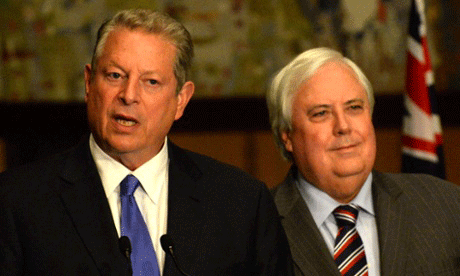
“Six months ago it seemed certain that the Abbott government would succeed in its plan to scrap the RET, the CEFC and the CCA,” Oquist wrote.
“[The institute’s] research has long shown that the RET has been the key mechanism driving investment in clean energy production … It has had more impact than the carbon price at zero cost to the government. Billions of dollars in investment was being put at risk by the Abbott government’s determination to unwind the scheme.
“The Palmer-Gore announcement has reset climate policy and politics. Keeping the CCA, the RET and the CEFC is much more than most expected from PUP. We have avoided a big step backwards … [it] also reframed the debate about carbon pricing – it’s hard to suggest carbon pricing is some form of left-wing, economy-wrecking conspiracy when a billionaire mining magnate supports it.”
Oquist says it “would have been preferable for PUP to have delayed a vote on the carbon price repeal by sending it to a committee. It would have been preferable for them to amend the existing carbon price to move straight to the floating price [due to start next July]. The fact is that the PUP senators and Clive Palmer think that their voters expect them to vote it down, and that’s what they intend to do.”
Government backbenchers have been pushing for the RET to be watered down (it currently requires 41,000 gigawatt hours of power to be sourced from renewables by 2020) on the grounds that it pushes up power prices. Before the PUP announcement senior government sources were suggesting the scheme could be closed to new entrants after the government’s own review of the scheme, chaired by the businessman and self-professed climate sceptic Dick Warburton. More recently backbenchers have been pushing for a less drastic scaling back.
ACIL Allen modelling done for the government’s review shows the current target will increase the average household bill by an average of $54 a year between now and 2020, but will reduce bills by a similar annual amount over the following decade compared with what they would be if the RET were repealed.
The modelling used assumptions highly unfavourable to renewable energy, including that coal and gas prices would remain almost unchanged until 2040.
Separate modelling for the Clean Energy Council by Roam Consulting – with different assumptions about gas prices – found that bills would be $50 higher by 2020 if the RET were repealed, compared with it being retained.
And polling has revealed that Australians overwhelmingly want the renewable energy target to be retained or even increased.
The polling, done for the Climate Institute, shows 72% of Australians want to keep or expand the RET.
The Coalition went to the election promising to keep the RET, which underpins investment in energy sources such as wind and solar, but said it would review the fact that the policy was exceeding its original goal of delivering 20% renewable energy by 2020 because of falling electricity demand.
Warburton, a veteran industrialist and the chairman of the Westfield Retail Trust, described his views on climate science in a 2011 interview on ABC.
“Well, I am a sceptic,” he said. “I’ve never moved away from that. I’ve always believed sceptical. But a sceptic is a different person than a denier. I say the science is not settled. I’m not saying it’s wrong. I’ve never said it’s wrong, but I don’t believe it’s settled.”
Solar storage project to be funded by Australian Renewable Energy Agency
 Australian Renewable Energy Agency to fund solar storage solution http://www.abc.net.au/news/2014-07-01/arena-funds-solar-storage-technology/5552394 1 Jul 2014,
AUDIO: ARENA funds breakthrough solar storage technology (ABC Rural)
“Sunverge Energy plans to work with energy retailers to offer solar packages that include its innovative storage solutions. “This approach has the potential for fast, widespread adoption of the technology, increasing the supply of renewable energy in Australia.”
The investment comes at an interesting time for ARENA which was put in place by the previous Labor Government to promote and implement renewable energy solutions but faces a cut in funds under the Coalition.
Politics aside, ARENA is still endeavouring to meet its charter with $1 billion worth of committed funding for projects to be rolled out over the coming years.
“Now the other the other thing I should emphasis is we have over a billion dollars of existing commitments and the Federal Government is very much behind keeping those.
“Out of that billion odd dollar less than a third of it has actually been spent. “So there is an awful lot to do and an awful lot of benefits to yet come out of the ARENA project.”
1 This month


Help Aunty Sue Protect Her Land and Sacred Sites From Destructive Rocket Testing.
.

Australians deserve the truth
about
AUKUS – https://aukuspublicinquiry.com/

PETITION – To: Prime Minister Anthony Albanese and the Australian Labor Government

of the week – Australians for War Powers Reform (AWPR)
To see nuclear-related stories in greater depth and intensity

