Australians waking up to the opportunity to control electricity bills through solar energy
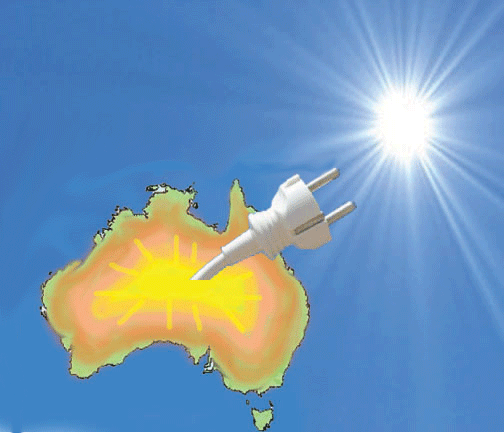 Solar PV’s potential just starting to dawn, SunPower chief says http://www.smh.com.au/environment/energy-smart/solar-pvs-potential-just-starting-to-dawn-sunpower-chief-says-20140501-zr2my.html May 1, 2014 Peter Hannam Environment Editor, The Sydney Morning Herald Solar photovoltaic systems will continue to spread across Australian rooftops because of rising electricity costs, “great irradiation” and cheaper finance, the head of the second largest PV producer in the US has said.
SunPower Corporation has picked Australia as one of two sites globally for a pilot storage program combining solar PV and batteries that the company hopes will one day make it economic to leave the power grid.
“The tariff structure in Australia will provide a strong foundation to homeowners with the incentive to consider distributed generation and storage,” SunPower chief executive Tom Werner said.
“Consumers will go from being essentially passive to having total control of your energy bill within five to 10 years,” he said.
The Abbott government is conducting another review of the Renewable Energy Target. The goal now calls for electricity supply from clean energy sources to reach 41,000 gigawatt-hours by 2020, although many commentators expect the review to recommend a reduction or delay of the target in part because of slumping demand.
Any dilution would be “a step in the wrong direction,” Mr Werner said. “In most countries, we see them pulling in their targets and increasing them.”
SunPower has installed about 7.5 gigawatts of solar PV – or more than double Australia’s total – and boasts of industry-leading efficiency levels above 20 per cent.
The company has also attracted some big partners, including US billionaire Warren Buffett and French energy group Total. Last month, Google and SunPower invested $US250 million ($269 million) to lease solar PV systems to US residents at a cost typically less than their regular power bill. Mr Werner said the Google tie-up would bring PV to 18,000 households and was “very scalable”. While the company is yet to discuss extending the program to Australia, the potential exists.
“We find all over the world people pay their energy bills. It’s pretty intuitive that it should work well here,” Mr Werner said.
He predicted that financing would play an increasing role in spurring the take-up of PV as governments rolled back incentives, such as feed-in tariffs, and the precipitous drop in panel prices in the past few years levelled off.
In California, SunPower’s home state, the ratio of cash to finance has gone from a 70-30 split to the reverse in just three years.
“I’d be willing to say that it’s likely we’ll see something similar here,” Mr Werner said, adding that SunPower’s partnership with Community First Credit Union offered loans for solar PV at a 7.1 per cent annual rate.
The company also has a stake in a Victorian electricity retailer, owning 42 per cent of Diamond Energy. SunPower would use such a foothold to refocus more on storage and energy management for customers should the Abbott government cut support for the industry, Mr Werner said. http://www.smh.com.au/environment/energy-smart/solar-pvs-potential-just-starting-to-dawn-sunpower-chief-says-20140501-zr2my.html#ixzz30bFchsP8
A new model of small scale solar power production to be piloted in Australia
Australia to pilot new power plan GREGG BORSCHMANN, ABC Environment1 MAY 2014 Householders have the potential to disconnect from the grid under a new system proposed by Sunpower
One of the largest solar companies in the world has chosen Australia as the proving ground for a new model of power production that promises to give householders more control – and cut bills. ‘WHAT DO YOU DO when the sun doesn’t shine?’
It’s been one of the criticisms levelled at the solar panels that are now so common on residential and commercial roofs across Australia.
Australia has the world’s greatest penetration of solar photovoltaic panels (PV). By the end of 2013, more than 3,000 megawatts of small-scale solar was installed across 1.1 million households, with the average system now 3.9 kilowatts in size.
Now Sunpower Corporation – which builds solar panels but also large-scale solar plants – has flagged that it will be using Australia as a global testing ground for a new model for providing electricity.
An announcement on a pilot project in Victoria, focused on the economics of storing domestically produced solar power, is expected in the next two months.
For years, it’s been keenly understood that the next big thing – the Holy Grail if you like for solar – would be the ability to store energy generated from solar panels for later use at a reasonable cost. At the moment, domestic solar PV generators can be supplying power into the grid but only getting paid 8 cents kw/hour during daylight hours, and then be charged as much as 30 cents kw/hour if they use electricity in the early evening peak. Solar storage gets around this problem.
For consumers it could mean being able to manipulate power use – and cut bills by avoiding expensive peak electricity times.
While Sunpower operates in 10 countries across the globe, president Tom Werner has told the ABC that his company has chosen Australia as the country to prove up the economics of power generation from many small-scale sources.
“Australia has a great solar resource,” says Werner. “We see penetration rates in Australia that are higher than other parts of the world, it has frankly expensive power and therefore solar can compete, [and] it has largely de-regulated the electricity markets, so it opens the market up to innovative structures”.
Perhaps the most important of those ‘innovative structures’ is what’s called distributed power generation. “What’s cool is that the consumer will be their own generator and then they’ll use things like storage and energy management to control load. When you combine the control of load – or when you use electricity and how much you use – with generation and being able to use storage … the combination of those two become really, really powerful…
“We see Australia as a market where we can do that early on, learn from that and do that in other parts of the world”.
It seems at first blush impossible to believe. Solar PV installations have slowed since the winding back of generous tariffs for homeowners supplying power to the grid. And then there’s all the uncertainty associated with yet another government review of the 2020 Renewable Energy Target (RET).
But Werner believes Sunpower’s model could be a game changer.
“Think of transitions like wired phones to cell phones to smart phones – it’s going to take a while, but in the next 10 years the way we get electricity will be considerably different.
“To say that the landscape will look a lot different in the next five to ten years is virtually certain, I think the disruptive nature of cost effective renewable has already happened, and it’s very hard to put that genie back in the bottle, so to speak”.
He also believes that distributed solar energy generation can provide cheaper power for consumers.
“We can build distributed generation and have economic energy and that’s what consumers want, they want renewable energy, and they want it to be economic… so the more solar there is, the more economic energy is going to be in Australia. If you combine that with economic storage and energy management and then you add creative financing schemes like we have in the US, you could have an offering where the consumer has way, way more control over their energy bill than they do today”.
Disconnecting
Some retailers are already offering finance packages and loans for home solar systems. Chris O’Brien, General Manager, Sunpower Corporation Australia, says consumers can install solar PV systems with no upfront cost. The loan repayments are covered with the savings on their energy bill, and they can be ahead from year one.
If careful energy use and cheap, sustainable storage is added to this offering, it has major implications for the future of the grid – the network of poles and wires in Australia. http://www.abc.net.au/environment/articles/2014/05/01/3995957.htm
Renewable Energy Target 2013 Administrative Report from Australia’s Clean Energy Regulator
The report provides information about how the Renewable Energy Target is performing against its legislated objectives and details information about who and what is producing renewable energy and benefiting from the scheme.
Some highlights from 2013 report, include:
- 26 renewable energy power stations were accredited in 2013, bringing the total number accredited renewable energy power stations to 394.
- 238,769 small-scale renewable energy system installations were validated by the Clean Energy Regulator in 2013. This saw the total number of small-scale systems installed under the Renewable Energy Target exceed two million.
- 90 liable entities in 2013, who achieved 99.97% small-scale technology certificate compliance and 99.98% large-scale generation certificate compliance.
- more than 20.4 million (20,457,324) small-scale technology certificates and more than 14.6 million (14,649,036) large-scale generation certificates were validly created in 2013.
Australia’s Anti Environment Minister either doesn’t understand renewable energy modelling, or is working for the coal industry
 Hunt disputes CEC modeling on renewable energy target http://reneweconomy.com.au/2014/hunt-disputes-cec-modeling-renewable-target-82441 By Giles Parkinson on 1 May 2014 Every day there is a new reason for the renewable energy industry in Australia to become increasingly despondent about its future.
 On Thursday, it was environment minister Greg Hunt, who ostensibly has some influence over renewables policy, taking issue with modelling released by the Clean Energy Council which showed thatconsumer bills would fall, not rise, if the RET was retained, or even increased. Hunt said he had read the report, and agreed with some of it, and disagreed with other bits. On the latter, it appeared to be the idea of a “negative cost” of the RET policy that “did not make sense” to the minister for the environment. Hunt said that if that was the case, then renewable energy projects would not need a subsidy. “Some say that it is a negative cost, but that doesn’t make any sense because you wouldn’t need subsidy if that was the case. It is effectively a cross subsidy from one form of electricity to another, ” he told the Municipal Association of Victoria Environment Conference in Melbourne, in response to a question from Surf Coast Shire Councillor Eve Fisher.
The CEC modelling said that the cost of the RET, in the form of certificates bought by retailers and the cost passed on to consumers, would be around 3-4 per cent of electricity bills – a figure agreed on by Hunt. But the CEC modelling also noted that this impact would be offset by the reductions in the wholesale price, caused by the presence of more renewable energy, which has a minimal short-run cost and forces wholesale electricity prices down. These are conclusions arrived at elsewhere in the world, including by the International Energy Agency, and for what it’s worth is the very argument presented by the fossil fuel industry, as it seeks to have the RET reduced or dismantled entirely. They fear that their profits will be eroded by the expected fall in wholesale prices. They argue that the wholesale cost reductions should not be passed on to consumers. The reason why a RET is warranted – apart from its obvious environmental benefits – is that it requires retailers to write contracts for new wind or solar farms. Without this mechanism, they wouldn’t be built, because of an oversupply of coal and gas fired generators. The incumbents simply want to keep operating these as long as they can. The fact that Hunt doesn’t understand how this works suggests one of two things. The first is that he is possibly confusing the concept of negative cost abatement with his emissions reduction fund, which will allocate money to the cheapest bid in an auction. (Hardly likely that any of those bids would be negative, otherwise it would be the private sector giving a grant to the government.) The Abbott government is already struggling with the concept of negative abatement, given its refusal to allow the Clean Energy Finance Corporation to continue despite its promise that it could do the same by unlocking vast sums of private money. It also suggests that Hunt’s instinct is to side with the fossil fuel industry rather than consumers, which is why the Abbott government insisted on the RET review in the first place, and insisted it be led by the likes of Warburton, rather than the Climate Change Authority, which made the very point that the Clean Energy Council was making this week.
Australia to be hit by $40 billion costs due to Tony Abbott’s climate ppolicies
 Tony Abbott’s climate policies a $40 billion budget slug, says Climate Institute – Peter Hannam
Environment Editor, The Sydney Morning Herald 1 May 14, The Abbott government’s changes to existing climate change policies would cost the budget as much as $40 billion by 2020, according to the Climate Institute, and the cost will blow out even further if it weakens the renewable energy target.
The estimated costs stem in part from payments to polluters to curb greenhouse gas emissions under the government’s Direct Action emissions reduction plan. This tally includes the $2.55 billion for the first four years of the Emissions 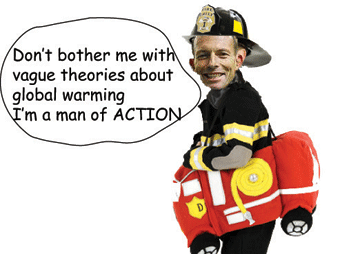 Reduction Fund and an estimated $1.2 billion annually after that.
“This is a friendless piece of policy and not many people are standing up to defend it,” said John Connor, chief executive of the Climate Institute.
A bigger blow to the budget, though, will come from the loss of the carbon tax revenues if, as expected, the new Senate votes to repeal it after July 1. Current laws indicate the price – now a tax but due to convert to a floating price by mid-2016 at the latest – will bring in more than $18 billion.
That combined tally, at about $24 billion, swells to more than $40 billion by 2020 if the Abbott government sticks with its plan to block the purchase of cheaper international emission reductions to meet domestic commitments, the institute said……..
The costs of the Direct Action will balloon further if the government undermines other policies limiting carbon emissions, such as the Renewable Energy Target. The target, now set at supplying 41,000 gigawatt-hours of renewable energy by 2020, is currently being reviewed by businessman and climate change sceptic, Dick Warburton.
The current climate policies of the government are “a growing slug on taxpayers, and barely tenable now”, Mr Connor said. “If they start to weaken other measures, they’ll have to buy more” carbon abatement, he said.: http://www.smh.com.au/federal-politics/political-news/tony-abbotts-climate-policies-a-40-billion-budget-slug-says-climate-institute-20140430-zr1yh.html#ixzz30V7Nazbj
Warren Mundine helping uranium mining companies to get Aborigines off their land?
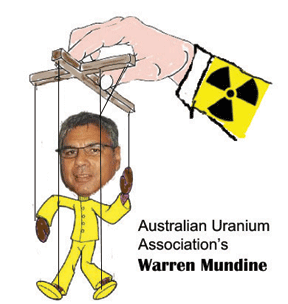 Cut land councils, says Warren Mundine PATRICIA KARVELAS THE AUSTRALIAN MAY 01, 2014 TONY Abbott’s top adviser on indigenous affairs has called for the reform of land rights and the slashing of the number of land councils with gatekeeper powers over development.
Prime Minister’s Indigenous Advisory Council chairman Warren Mundine also called for an end to the requirement to establish a continuous connection with land to establish native title, arguing it “discourages indigenous people from moving away”.
In an address to the West Australian Chamber of Minerals and Energy, Mr Mundine attacked green groups for holding up indigenous development.
“I’m not aware of one new development project in mining, energy or infrastructure that has been supported by green groups,’’ he said yesterday…….http://www.theaustralian.com.au/national-affairs/policy/cut-land-councils-says-warren-mundine/story-fn9hm1pm-1226901405997#
Clive Palmer’s poor record on Aboriginal relations –
Clive Palmer firm Mineralogy’s ‘poor’ indigenous relations HEDLEY THOMAS AND PAIGE TAYLOR THE 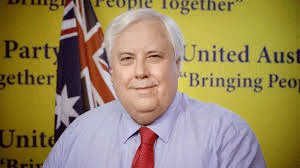 AUSTRALIAN MAY 01, 2014 CLIVE Palmer’s flagship company Mineralogy has a “particularly poor” record of working with Aborigines, who say their rights and culture have been trampled in his pursuit of mineral wealth on sacred sites.
Mr Palmer’s new political merger with three indigenous Northern Territory politicians comes amid his expressions of grave concern about the health and poverty of Aborigines.
But an examination by The Australian of findings by magistrates in mining court and native title cases show his main company has failed to act in good faith, flouted rules, operated combatively, had little regard for indigenous landowners and may even have destroyed ancient burial sites.
A key witness and senior member of the native title claim group whose evidence was accepted by the mining court, Mathew Sampi, said yesterday he had no confidence in Mr Palmer as the tycoon had broken past pledges to spend money on indigenous health.
“We don’t believe anything he says now,’’ said Mr Sampi, who represents the Kuruma Marthudunera people and grew up fishing and hunting in the Cape Preston area in the Pilbara, near an iron ore project built by Chinese companyCITIC Pacific.Findings by magistrates include that Mr Palmer’s company and staff exhibited “a sense of absolute entitlement in relation to mining endeavours” and “adopted an unduly confrontational approach” with indigenous owners. One of Mr Palmer’s top executives was found to have been an unreliable witness and the architect of “misleading” sworn documents.
Trumpeting the defection of the three indigenous MPs to his Palmer United Party this week, Mr Palmer appealed to indigenous voters to trust his commitment to reduce child deaths above other parties.
“He can suck a lot of Aboriginal people in and some of them really don’t know what they have been talked into. He seemed real good in the beginning, saying he was going to help the Aboriginal people in the area. They destroyed a lot of things, they disturbed special places where there used to be ancient tools.”……
In an earlier Native Title Tribunal case, Mineralogy was found to have given a “take it or leave it” ultimatum to indigenous owners of the land the company wanted to mine. Tribunal deputy president John Sosso found that Mineralogy had not acted prudently, reasonably or responsibly in its dealings with Aborigines. In a case involving the Kuruma Marthudundera group, elders Neil Ricky Finlay and Mr Sampi told the court of bad experiences with the company in the Pilbara region, which includes sacred burial grounds near the Cane River and the town of Karratha.
The Mining Court’s magistrate, Elaine Campione, described the two elders as “respected, senior and knowledgeable men” and she accepted their evidence………http://www.theaustralian.com.au/news/investigations/clive-palmer-firm-mineralogys-poor-indigenous-relations/story-fnk76wj3-1226901468114#
A treaty with Australia’s Aboriginal people
 TREATIES ARE AGREEMENTS BETWEEN EQUALS IC Magazine, by Callum Clayton-Dixon on April 28, 2014 All of a sudden [Australia’s] conservative coalition government is welcoming discussion about something we have demanded for decades, something Prime Minister Bob Hawke promised to deliver by 1990, and a proposal the current Labor opposition has labelled “stupid”.
While Herald Sun columnist Andrew Bolt claims treaties will cause “racial division”, Indigenous Affairs Minister Nigel Scullion says they are “agreements between equals” and considers this to be one of the issues Abbott’s Indigenous Advisory Council (IAC) should be looking at.
However, many would dispute whether a handpicked government advisory body has the mandate to control such a debate. The nature of any treaty process must be owned by Aboriginal people on the ground.
WHAT IS OUR STATUS?
Before going any deeper, it’s probably a good idea to take a step back and have a look at what exactly is our status as First Nations peoples. Continue reading
Bernie Fraser on ABC radio “sick and disappointed” about Abbott’s attack on renewable energy

The price of power http://www.abc.net.au/radionational/programs/backgroundbriefing/
Abbott’s renewables attack makes Fraser “sick and disappointed” http://reneweconomy.com.au/2014/abbotts-renewables-attack-makes-fraser-sick-and-disappointed-19255 By Giles Parkinson on 28 April 2014
Fraser says investment in large-scale renewables was being cut back and delayed, and it was quite likely that the current 41,000GWh target would not be reached because of the uncertainty caused by Abbott’s new RET review. The CCA in late 2012 rejected attempts by the incumbent coal-fired industry and network operators to wind back the RET, saying it had clear benefits and little cost to consumers.
However, one of its chief recommendations, to replace the two-yearly review with a four-yearly review to provide the market with certainty, was not adopted by the then Labor government, clearing the way for Abbott to commission another review. This review, being led by a panel led by climate change denier and pro-nuclear advocate Dick Warburton, rather than the CCA, has effectively stalled investment.
“Investment is actually being cut back and delayed, and I think because of that I think it is apparent that the 41,000GWh for large-scale renewable energy power plans it not going to happen,” Fraser told the ABC Radio National’s Background Briefing program.
“ I think that is what the opponents and the critics of renewable energy want to see.” Asked about the political rhetoric around renewables in Australia, Fraser said:
“It makes me feel sick and disappointed. Policy makers need to look beyond short-term economic considerations and the interests of some of the big companies, and to longer term community interests. That’s what governments are supposed to do. Unfortunately, it’s not happening at the present time.
“It’s very disappointing that we are we falling behind, and we are falling behind what many other countries are doing.”
Fraser’s comments about the stalling in projects is supported by data that shows no new large-scale renewable energy projects have been committed since the start of 2013. The only four projects that are going ahead are those supported by either the ACT government’s auction scheme, the now defunct solar flagships proposal, and the Clean Energy Finance Corporation, which the government wants to close.
The appointment of Warburton, the narrow terms of reference that ignores many of the benefits of renewables, and the hiring of a consultancy firm whose highly contested modeling formed the basis of the coal industry’s attack on the RET in 2012, has left the renewables industry despondent about its future.
The Australian Solar Council predicts that the entire government rebate for small-scale rooftop systems could be removed. Larger project developers believe that the 41,000GWh will be severely diluted.
“We know that the government is going side with big business,” ASC’s chief executive John Grimes told the program.
“They want to protect the big utilities. And the way they will do that is to eliminate all support for rooftop solar. And we think that that’s outrageous.”
Matthew Warren, the head of the Energy Supply Association of Australia, which represents major suppliers, says the RET is “broken” and needs to be wound back.
The ABC said that neither Industry minister Ian Macfarlane, whose portfolio covers energy, nor environment minister Greg Hunt would agree to be interviewed for the program.
(We recommend the program as an excellent backgrounder on the economics and the politics of renewables. RenewEconomy even makes some cameo appearances!)
Abbott’s Direct Action plan will cost tax-payers, not the polluting industries
Direct Action transfers emission cutting costs from polluters to taxpayers, SMH, April 26, 2014
“…..the Abbott government’s official position is that greenhouse emissions created by humans are contributing to the dangerous warming of the planet, and that it must do something about it. Precisely what this government proposes to do is a matter of great public interest.
So it was unhelpful that Hunt chose to release those details – as scant as they were – shortly before the close of business on the eve of the Anzac Day long weekend.
Taxpayers have every reason to be sceptical about his motives. They, after all, will be the ones paying for the government’s so-called Direct Action climate change strategy. Its centrepiece is an ‘‘emissions reduction fund’’, a pool of $2.55 billion of taxpayers’ money in the first four years, from which some of the nation’s biggest polluters will be paid incentives to cut their greenhouse gases.
To be clear, creating this fund will transfer the cost of cutting emissions from the polluter to the taxpayer, should the government succeed in pushing its bill through the Senate.
The fund would displace both the carbon tax and the emissions trading scheme that had been advocated not only by Labor but by the Howard government in 2007. ‘‘To reduce domestic emissions at least economic cost, we will establish a world-class domestic emissions trading scheme,’’ the Howard policy had promised.
The Liberals now in power may still believe in market forces, but not yet for carbon abatement. Instead of making the biggest emitters pay, they are asking taxpayers to reward them for reducing their pollution. This would be done by means of a ‘‘reverse auction’’. The firms proffering the lowest bids – the least expensive way to reduce emissions – would get government subsidies…….
government is asking taxpayers to relieve industry of the cost of carbon abatement at the same time that it tells Australians they must make many other sacrifices. …….
The case for shifting the carbon burden from polluters to taxpayers, however, is yet to be made. The government still needs to convince Australians and a hostile Senate.
It could have done much better than calling a news conference at 3pm on the eve of Anzac Day to produce a flimsy policy in the hope that nobody would notice. ……. http://www.smh.com.au/comment/smh-editorial/direct-action-transfers-emission-cutting-costs-from-polluters-to-taxpayers-20140427-zr04d.html#ixzz30DsXmZG3
Aboriginal climate ambassadors assess impact of climate change
 Indigenous ambassadors assess climate impact on native land SBS World News, Two young Indigenous climate ambassadors have been touring Australia to document the impact of the changing natural environment on traditional communities. By Gary Cox Source NITV News, 27 April 14 Narelle Long and Malcolm Lynch were the first young Indigenous people to set foot in Antarctica back in 2012.
Australian right-wing politicians surprisingly may vote against Abbott’s “Direct Action” climate policy
 Direct action could fail even without Palmer United Party April 26, 2014 Lisa Cox , 26 April 14 National political reporterTony Abbott’s “direct action” climate change policy is almost certain not to pass the Senate in its present form – even if the Palmer United Party were to change its position and vote for the plan.
Independent senator Nick Xenophon said on Friday that he would not vote for the Coalition’s policy unless there were substantial changes, including measures to ensure companies comply with the scheme.
Fellow crossbench senator John Madigan, of the Democratic Labour Party, said he doubted whether the government was committed to the policy.
Environment Minister Greg Hunt on Thursday unveiled key details of the centrepiece of direct action, an emissions reduction fund, and declared the government would ”easily” reach an emissions reduction target of a 5 per cent cut below 2000 levels by 2020.
Senator Xenophon said he was not convinced by the white paper, which proposes a $2.55 billion fund to pay polluters to cut their emissions. Companies would bid for funding through a reverse auction process run by the Clean Energy Regulator……..
Tony Abbott has a Creation Science believer as his top adviser!
Maurice Newman Rejects Climate Change, Because God. In Other Words, by Tom Cummings, 24 April 14 “…….Newman rejects the findings of thousands of scientists from hundreds of organisations scattered across 195 countries, because of the analysis of one man: Roy Spencer.

Remembering that other war: the war against Australian Aborigines
Lest we forget, wars undeclared Canberra Times April 25, 2014 Although war was never declared, armed conflict between Australia’s indigenous people and Europeans was widespread. The consequences echo still. In an extract from his book Forgotten War, Henry Reynolds examines the evidence. Anyone acquainted with conditions on the Australian frontier knew that bloody work had been done. Writing in 1880 the pioneer ethnographers Lorimer Fison and Alfred Howitt declared:
”It may be stated broadly that the advance of settlement has, upon the frontier at least, been marked by a line of blood. The actual conflict of the two races has varied in intensity and in duration . . . But the tide of settlement has advanced along an ever-widening line, breaking the native tribes with its first waves and overwhelming their wrecks with its flood.”
We will never know how many Aborigines died directly or indirectly as a result of the conflict, how wide or how deep was the line of blood. Contemporaries often estimated the death rate in particular districts and a few observers attempted to calculate a more general figure. But then as now problems abound with making such estimations.
We are uncertain of the size of the indigenous population when settlement began. We have no idea how many people died in the smallpox epidemic that swept across south-eastern Australia in advance of settlement. We are unsure what the population was in particular regions when the tide of settlement arrived. We are even unsure of the number of indigenous people alive after localised conflict came to an end. There appears to have been no official estimate of those killed in conflict anywhere in Australia.
Even if a government had sought out such information the task would have been immensely difficult. Much of the killing happened on the edge of settlement in regions remote from the reach of authority. Because there was no official recognition of a state of war any killing was technically murder. Frontier communities were notorious for keeping secret their exploits in the war. Killing was referred to using a lexicon of known euphemisms. Punitive parties may often not have known how effective their attacks were, particularly when they operated in the dark or if they shot at groups some distance away. When the bodies of victims were encountered they were almost universally burnt to destroy the evidence. The long career of the Queensland Native Police was cloaked in official secrecy and most of the records were destroyed. If it is difficult to determine how many people died in direct conflict with the settlers. It is even harder to estimate how many more must have subsequently died of wounds or from the fierce rigours of prolonged and uneven warfare.
There was considerable interest in the question in the late 19th century but as the Aborigines themselves disappeared from the historiography of the first half of the 20th century, no one seems to have thought it an important matter for speculation. With the new interest in Aboriginal history that arose in the 1970s and 1980s attempts were made to assess how many people, both white and black, died in the frontier wars.
Historian and author Henry Reynolds: “Much of the killing happened on the edge of settlement in regions remote from the reach of authority. Because there was no official recognition of a state of war, any killing was technically murder.” Photo: Justin McManus
In my book The Other Side of the Frontier (1981), I argued that it was ”reasonable to suppose that at least 20,000 Aborigines were killed as a direct result of conflict with the settlers”…………
A compilation of regional studies does not allow us to assess the overall death rate in Australia’s frontier wars. But some things are clear. Aborigines were killed by settlers every year somewhere in Australia from 1788 to the early years of the 20th century, and died in disproportionate numbers. The research of the last decade has led most engaged scholars to conclude that the controversial 1981 estimate of 20,000 Aboriginal dead needs to be revised not downwards but steeply upwards to 30,000 and beyond, perhaps well beyond. And the dead do matter. They intimidate us. They force us to reassess many other aspects of Australian history. That is the least that can be done.
This is an edited extract from Forgotten War. It is published by NewSouth and won the 2014 Victorian Premier’s award for non-fiction. Henry Reynolds is a Tasmanian historian. http://www.canberratimes.com.au/national/lest-we-forget-wars-undeclared-20140424-376r3.html#ixzz2zvtw4pCi
The farce that is the Australian government’s Renewable Energy Review
“Farcical” start to Tony Abbott’s renewable energy review, REneweconomy, By Giles Parkinson on 24 April 2014 Tony Abbott’s controversial review of Australia’s renewable energy target (RET) made a “farcical” start to its public deliberations on Wednesday, attracting new accusations of bias and of having a pre-determined outcome.
Clean energy representatives were shocked by the panel’s appointment as chief advisor and modeller of ACIL Allen, a consultancy seen as close to the fossil fuel industry, and whose highly contested research formed the basis of the coal industry’s attempts to dismantle the RET in 2012.
Not only will ACIL Allen do the modelling for the RET Review panel, some of the assumptions that will form the basis of that modelling have also stunned the clean energy industry, and been branded as a farce.
This includes an apparent refusal to measure the benefits of renewable energy – including the health benefits, job benefits, and the network benefits – which the panel has dismissed as “too hard to model” and little more than a “transfer of wealth”, presumably away from the coal generators and network providers. There is concern about how it will model the reduction in wholesale prices – the main complaint from the existing fossil fuel industry.
Around 50 people who attended the RET Review panel’s modelling forum at the Mercure hotel near Sydney’s international airport were also told that the modelling will assume that there will be no carbon price out to 2030, and will not factor in any abatement targets. In other words, it is assuming there will be no carbon restrictions on the sector for another two decades.
John Grimes, the CEO of the Australian Solar Council, echoed the thoughts of many who attended the meeting and were interviewed by RenewEconomy when he said it appeared clear that the RET Review will serve only to protect the vested interests in the current electricity market.
“I’ve got to say – this is much worse than we had anticipated,” Grimes said. “This entire review process needs to be revealed for the sham that it is … we can only conclude that the RET Review process is heading to a biased and predetermined outcome.
“Instead of making customer benefits the key measure of a successful energy market, this review is set to side with big business, giving little or no weight to the benefits of solar for householders, business and the community.
“Clearly any model that fails to consider a carbon price (in any form) up to 2030, in the face of international action on climate change, is negligent and lacks any credibility. “ The RET review was already controversial because of the Abbott government’s decision to by-pass the Climate Change Authority (which dismissed the ACIL Allen modelling and the coal industry’s protestations in its 2012 review), and appoint a panel led by climate change denierand pro-nuclear advocate Dick Warburton.
He will be supported by fossil fuel lobbyist and former ABARE chief Brian Fisher, and Shirley In’t Veld, the former head of WA’s biggest coal generator, Verve Energy. The secretariat will be housed in Abbott’s own department.
Clean energy attendees said they were shocked by some of the statements – including Warburton’s apparent ignorance that the Abbott government went to the election with a “million solar rooftops” commitment, as well as assumptions by the panel that the current 41,000GWh could not physically be met.
The panel reportedly claimed that no large renewable energy projects would be able to be built for another 18 months, and no more than 1,000MW to 1,200MW of wind capacity would be possible in a single year, making it impossible to reach the current target. Both these claims were reportedly vigorously contested by the representative of the Clean Energy Council.
However, it was ACIL Allen’s appointment that confirmed the worst fears of the renewable energy industry……….
Even the Murdoch-owned Business Spectator made a spectacular demolition of ACIL Allen’s research, pointing to its previous reports that claimed that carbon pricing would eradicate the LNG industry, would force the closure of all brown coal generators by 2020, its predictions that geothermal would account for 30 per cent of the Renewable Energy Target, and how on two occasions it grossly miscalculated the uptake of rooftop solar……..
the problem that the renewable energy industry faces – incumbents and ageing engineers and business people who reject the science, simply do not understand or accept that renewable energy sources can be effective and cost competitive, and cannot imagine an energy system any different to the centralised model that has dominated for the past 100 years, and/or who are merely seeking to protect their vested interests.
The problem is that not only do they now have the ear of the current government, they have their hand on the wheels – and their foot on the brakes. http://reneweconomy.com.au/2014/farcical-start-to-tony-abbotts-renewable-energy-review-14978
1 This month


Help Aunty Sue Protect Her Land and Sacred Sites From Destructive Rocket Testing.
.

Australians deserve the truth
about
AUKUS – https://aukuspublicinquiry.com/

PETITION – To: Prime Minister Anthony Albanese and the Australian Labor Government

of the week – Australians for War Powers Reform (AWPR)
To see nuclear-related stories in greater depth and intensity

