South Australian scheme to install solar panels at no cost
Tindo Solar will install solar panels free for 5000 businesses and households http://www.adelaidenow.com.au/business/tindo-solar-will-install-solar-panels-free-for-5000-businesses-and-households/story-fni6uma6-1226893885057 RICHARD EVANS THE ADVERTISER APRIL 23, 2014 A NEW solar scheme could get thousands of SA households equipped with free panels and paying cheaper bills for life.
Mawson Lakes solar panel manufacturer Tindo Solar will install solar panels free for an estimated 5000 businesses and households around the state in the next year.
However, if the scheme proves popular the company says there will be no cap on the number of people able to sign up.
Customers will pay for electricity for an agreed time frame of up to 15 years before owning the panels outright.Tindo business and people manager Richard Inwood said the scheme would be a “game changer” and revolutionise the electricity market in Australia.
“Instead of us selling the system, we’re selling the electricity that that system is generating – that electricity is going to pay off that system,” he said.“We have now become a retailer of 100 per cent green energy that is cheaper than what can be purchased from the grid.”

“SA Power Networks made more than $300 million profit last financial year – that shows how much fat is in there.”
Tindo Solar secured a $30 million loan, under the Federal Government-funded Clean Energy Finance Corporation, last week to install the systems with more money available if demand exceeds expectations, Mr Inwood said.
He said the scheme would provide customers with daytime electricity prices that were 20 to 30 per cent cheaper than most other providers. “Energy has increased around 70 per cent in the last seven years,” he said. “If you look at the average electricity cost per kilowatt it’s 35 to 42 cents per kilowatt – we will provide you with a price of around 25c a kilowatt.”
“Price rises will be no more than one per cent per annum and we want to take the worry around energy price increases away from the public generally and give them certainty. It’s the long term certainty over your energy bills that is exciting.”
Mr Inwood said the company guaranteed its flagship panels had a 240V AC output, with testing at Tindo of other imported panels installed in South Australia revealing the actual output often does not always match the higher voltage promise and brings associated safety compromises.
He said an anticipated upsurge in business for the Mawson Lakes business could mean more jobs for the company.
“Recruiting and on-boarding of factory staff could take as little as four weeks,” he said.
“We currently have 24 staff and would see this at least treble if we are to get the $30 million spent in two years which is what is required.”
Mr Inwood said the State Government also supported the scheme with a tender for 200 public housing homes in the pipeline.
FACTS:
Upfront cost – $0.
Repayment time frame – up to 15 years – longer in some cases. Customer will own the system at the end of the agreement.
Price per kilowatt – 20-30 per cent cheaper than traditional energy providers.
Annual price rises – up to 1 per cent a year.
Expected uptake – 5000 businesses and households in the next year.
READ MORE: Tindo Solar welcomes ACCC probe into solar advertising
Tony Abbott’s review of Renewable Energy Target – a complete scam!
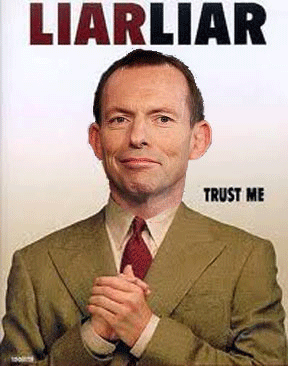 Coalition’s renewable energy review an ‘unprecedented scam’, industry says, The Guardian, Lenore Taylor,
Review assumes fossil fuel investors won’t need to factor in any risk due to climate policies for decades theguardian.com, Thursday 24 April 2014 The renewable energy industry has labelled a controversial Abbott government review an “unprecedented scam” and a “stitch-up” after learning that it was conducting electricity industry modelling on the assumption there would be no risk or cost to investments in coal-fired power stations in the next few decades.
The review of the renewable energy target – headed by veteran businessman and self-professed climate sceptic Dick Warburton – and its modellers from ACIL Allen consulting held a workshop with industry participants on Wednesday at which they revealed the modelling would assume investors in fossil fuel generation would not need to factor in any risk due to climate policies for decades – neither a carbon price, nor a requirement to invest in emission-reducing technologies, nor any cost from any other government policy or regulation.
Many of the 50 participants said this assumption was entirely unrealistic………
n setting up its own RET review, the government bypassed the Climate Change Authority – which it wants to abolish – but which is required by legislation to undertake regular reviews of the RET. http://www.theguardian.com/environment/2014/apr/24/coalitions-renewable-energy-review-unprecedented-scam
AUIDIO: Australia falling behind in the electricity energy revolution
AUDIO: The price of power ABC Radio Background Briefng 27 Apr 14 With Australian electricity prices amongst the highest in the world, more and more households are going solar. The big power companies say the Renewable Energy Target is undermining their businesses and they want it wound back. The federal government agrees, so who is to blame for the high price of power? Jess Hill investigates……….Mr Abbott’s claim that the renewable energy target is expensive is not supported by the data. The Australian Energy Markets Commission says the renewable energy target adds four per cent to the average electricity bill. For an average household, that’s about a dollar a week.
‘For all of the attention that carbon price has got, from the increasing attention the renewable energy target’s got, the main reason that electricity has been getting dearer is the overinvestment in poles and wires, and the fundamental inefficiency in the way that the national electricity market’s working,’ says Richard Denniss, executive director of the Australia Institute.
Federal Treasury estimates that 51 per cent of an average household bill is spent on network costs. Most of that is going towards paying off the $45 billion network companies have spent on updating our poles and wires over the last five years………Solar rooftops are wreaking havoc on the traditional power industry, says Mr Denniss, because they produce the most amount of energy at the time of day when the power industry makes the most money.
‘Solar panels have got this great trick, they make lots of electricity when the sun is shining; that’s when we like to turn our air conditioners on,’ he says. ‘When everybody turns their electricity on at four o’clock on a hot Thursday afternoon, we have enormous demand for electricity for these short periods of peak demand. And that’s when solar panels are at their best.’
‘Solar panels are actually pumping quite a large amount of energy in during these periods of peak demand, and that’s pushing down the peak price. Now that’s great for everybody, except the so-called baseload power stations. Because the baseload power stations used to be able to sell their electricity for a much higher price at four o’clock on that hot Thursday afternoon. From the coal-fired power station point of view, you couldn’t have a worse competitor, because solar is at its best when the market is at its most profitable.’
What that means is that the big coal-fired power plants are earning less for the energy they produce. That’s because Australia has more electricity than it can use………The chair of the Climate Change Authority is Bernie Fraser, a former Reserve Bank governor. He says that just by holding another review, the government has ensured that the 41,000 gigawatt-target won’t be met. ‘Investment is actually being cut back and delayed, and I think because of that, I think it’s apparent now that the 41,000 gigawatts for large renewable energy power plants, is not going to happen. It’s going to be a lesser figure and I think that’s what the opponents, the critics of renewable energy want to see.’
‘Policymakers need to look beyond short-term economic considerations in the interests of some of the big companies to longer-term community interests. And that’s what governments are supposed to do, but unfortunately it’s not happening at the present time,’ he says.
So it’s a bit… well, it’s more than a bit, it’s very disappointing that we’re falling behind, and we are falling behind what many other countries are doing.’ http://www.abc.net.au/radionational/programs/backgroundbriefing/2014-04-27/5406022
Australian government, and Renewable Energy Panel chief Dick Warburton are fans of nuclear power
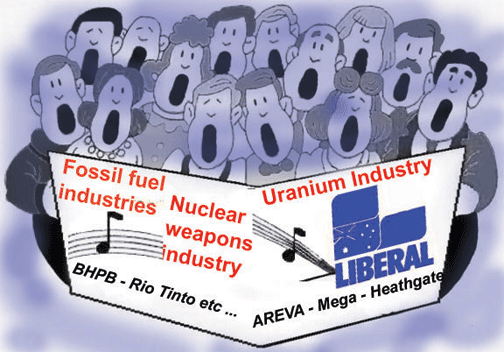 Wind and solar generation half the cost of nuclear REneweconomy, By Sophie Vorrath on 23 April 2014 “………in Australia, the government looks to be eyeing nuclear power as a clean energy option for the country’s future, alongside its dreams of abundant “clean coal.”Last year, an issues paper released ahead of the Abbott government’s energy white paper noted that slow development in carbon capture and storage, and difficulties with hydro, meant nuclear technologies continued “to present an option for future reliable energy that can be readily dispatched into the market.”
And Dick Warburton, Abbott’s hand-picked head of the federal government’s RET review panel, hasrevealed himself as a big fan of nuclear energy, describing it once as the only alternative to fossil fuel generation.
In an article published in Australia’s Quadrant magazine in 2011, Warburton and his c0-author wrote that “except for nuclear power, there are no straightforward strategies for reducing dependence on fossil fuels without large economic costs.” http://reneweconomy.com.au/2014/wind-and-solar-generation-half-the-cost-of-nuclear-95493
Sydney shows the way – communities can switch to clean renewable energy

The City of Sydney has recognised the potential of community energy in its roadmap to move the city towards 100 per cent renewable energy by 2030. Sydney’s Lord Mayor Clover Moore said the IPCC’s most recent report has again underlined the extreme urgency of action on climate change. “Addressing climate change will require action at all levels. Empowering communities to develop their own local, renewable energy projects will help deliver more clean energy,” Cr Moore said.
Communities can drive urgent switch to clean energy http://phys.org/news/2014-04-urgent-energy.html Apr 22, 2014 Australia will continue to lag behind countries like the United States and Germany in heeding the UN’s latest call to urgently switch to clean sources of energy unless the burgeoning community energy sector is allowed to thrive, according to a UTS researcher. Community-owned renewable energy generation in towns and cities around the country can stimulate regional development, provide more resilient and inexpensive energy security and significantly contribute to Australia’s climate mitigation targets, UTS Institute for Sustainable Futures researcher Nicola Ison said.
“A growing number of communities, including local councils, are recognising this, however there are significant regulatory and institutional barriers that need to be overcome,” Ms Ison said.
“Across the world renewable energy is changing the way citizens and organisations think about and use energy. In the United States, more than 1,500 wind farms are owned by communities across 27 states and in Germany, customers own two thirds of all renewable energy generated.
“Councils, as large energy users in local communities and facilitators of local action in their own right, can play an increasingly important role in this transition.”
The City of Sydney has recognised the potential of community energy in its roadmap to move the city towards 100 per cent renewable energy by 2030. Sydney’s Lord Mayor Clover Moore said the IPCC’s most recent report has again underlined the extreme urgency of action on climate change. Community-owned renewable energy generation in towns and cities around the country can stimulate regional development, provide more resilient and inexpensive energy security and significantly contribute to Australia’s climate mitigation targets, UTS Institute for Sustainable Futures researcher Nicola Ison said.
“A growing number of communities, including local councils, are recognising this, however there are significant regulatory and institutional barriers that need to be overcome,” Ms Ison said.
“Across the world renewable energy is changing the way citizens and organisations think about and use energy. In the United States, more than 1,500 wind farms are owned by communities across 27 states and in Germany, customers own two thirds of all renewable energy generated.
“Councils, as large energy users in local communities and facilitators of local action in their own right, can play an increasingly important role in this transition.” Continue reading
Labor and Liberal keen on uranium mining, and on promoting geothermal energy
 Dennis Matthews, 24 April 14 The hot rocks geothermal energy industry has been generously supported by both Labor and Liberal governments. The first grant was $1million from the Federal government to the University of NSW in September 1999. Since then grants totaling about $300million have been made in support of the industry.
Focusing on one particular grant (The Advertiser, 24/4/14) obscures the real problem of why so much effort has gone into supporting this industry.
Funding has often been accompanied by considerable media hype. Claims of cheap, low greenhouse gas emission, renewable, electricity have not been realised and issues of water use and radioactivity have not been adequately addressed.
Although wishful thinking seems to have been a major factor, bi-partisan political support for the mining industry, particularly uranium mining, seems to have played a major role.
Australia deliberately prevented a nuclear-free Pacific treaty, to obey USA’s interests
Declassified documents from the National Archives of Australia, including the 1985 Cabinet minute about the SPNFZ Treaty, show clearly that Australia designed the treaty to protect US interests in the Pacific, including the deployment of nuclear-armed warships and the testing of nuclear missiles.
 International legal experts, including Don Rothwell, professor of international law at the Australian National University, have raised concerns that uranium sales to India would breach Australia’s obligations under the treaty. Rothwell has prepared a legal opinion stating that the SPNFZ Treaty prohibits members from selling uranium to countries that do not accept full-scope nuclear safeguards under the Nuclear Non-Proliferation Treaty.
This is consistent with past Australian government policy.
Delaying The Nuclear-Free Zone In The Pacific http://concernedyapcitizens.wordpress.com/2014/04/23/pacific-islands-report-delaying-the-nuclear-free-zone-in-the-pacific/ By Nic Maclellan At the height of the nuclear arms race between the United States and Soviet Union, a treaty to create a South Pacific Nuclear Free Zone, or SPNFZ, was opened for signature on Hiroshima Day, 6 August 1985, at the Pacific Islands Forum meeting in Rarotonga.
Twenty-eight years after it was signed on that day by Australia, New Zealand and island nations, the United States still hasn’t ratified its protocols, in spite of a request from president Barack Obama to the US Senate more than two years ago.
Next week, as Forum leaders gather in the Marshall Islands – site of sixty-seven US nuclear tests at Bikini and Enewetak Atolls – the US government will be eager to keep nuclear issues off the agenda, as it has been since the Treaty was first mooted. Declassified documents from the National Archives of Australia, and US diplomatic cables published by WikiLeaks, highlight longstanding opposition in Canberra and Washington to a comprehensive nuclear-free zone that might hamper US nuclear deployments in the Pacific.
The Forum meeting, and the US Senate’s continued stalling, coincide with on-going concerns that Australia’s decision to sell uranium to India threatens to breach Australian treaty obligations. As Conservative Australian governments in the 1960s debated the acquisition of nuclear weapons and purchased aircraft capable of delivering nuclear strikes in Southeast Asia, the labour movement across the region proposed a nuclear free zone designed to ban the bomb in this part of the world. The SPNFZ Treaty was finally negotiated in the 1980s after decades of campaigning by unions, Pacific churches and the Nuclear Free and Independent Pacific movement. Continue reading
ABORIGINAL AUSTRALIANS AND THE WAR OF INVASION ,
ACKNOWLEDGEMENT SOUGHT: KEVIN GILBERT, ABORIGINAL AUSTRALIANS AND THE WAR OF INVASION , Philippa Scarlett 24 April 2014 by Indigenous Histories In early September 1991 Kevin Gilbert was photographed by Richard Briggs against the background of the Australian War Memorial. He carries a cross in almost Christ like manner as he walks towards Anzac Parade. However it is unlikely that this symbolism was Christian. Gilbert’s creation spirit was Baiame. Rather the cross was generally symbolic of the sacrifice of the Aboriginal inhabitants of Australia during more than 200 years of undeclared war against invasion and of the ongoing suffering of his people. Gilbert himself said at the time
I represent Aboriginal people who have fought with honour and given their lives for justice and for the land – as none have done for so long as my people. This is a memorial to those who have fought and died and continue to die in the continuing massacre against us. Interview with Amanda Uhlmann, Canberra Times 3 September 1991.
In seeking recognition of Australia’s first and unfinished war, and commemoration of the sacrifice of its participants he brought his plea and protest to the hub of remembrance of the war service of Australians and linked it with the phrase used to encapsulate the act of remembering war: LEST WE FORGET. The wayside memorial he constructed in a then vacant space on Anzac parade – already lined with officially sanctioned memorials – bears the sign THIS SITE IS A MEMORIAL TO ALL ABORIGINAL PEOPLE WHO HAVE DIED IN DEFENSE OF OUR LAND LEST WE FORGET…… http://indigenoushistories.com/2014/04/23/acknowledgement-sought-kevin-gilbert-aboriginal-australians-and-the-war-of-invasion/
Australia’s commission of audit not allowed to cost Abbott’s “Direct Action” climate policy
 Audit not privy to multibillion-dollar direct action plan to reduce emissions http://www.smh.com.au/federal-politics/political-news/audit-not-privy-to-multibilliondollar-direct-action-plan-to-reduce-emissions-20140424-zqya6.html#ixzz2zro4nYhK April 24, 2014 Lisa Cox National political reporter The Abbott government’s multibillion-dollar “direct action” carbon reduction plan was not considered by the commission of audit, and key details of the scheme remain unknown.
The head of the audit of government spending, Tony Shepherd, told Fairfax Media that the commission had not considered the controversial $3.2 billion policy because it was not provided with any details.
The comments come ahead of the imminent release of the government’s “direct action” white paper – expected as early as Thursday – elements of which have been closely guarded by the office of Environment Minister Greg Hunt. The paper is expected to clarify key pieces of information, including how “direct action” will work and the mechanisms behind the key component of the policy, the $1.55 billion emissions reduction fund.
Mr Shepherd said on Wednesday the commission had been unable to assess “direct action” because there was no information available on the policy during the three months it was conducting its review.
“The Commission of Audit couldn’t really look at it because we didn’t have a policy to look at,” he said.
“If they had a policy and it was out there we would have had a look at it, but in the absence of any detail we couldn’t.”
Mr Shepherd said that as a result, the commission’s report contained no information on “direct action”, although he did not necessarily view that as a problem, despite the scheme carrying a price tag of up to $3.2 billion.
“There’s a number of other government policies and things that are evolving at the moment,” he said.
“You’ve got to draw the line somewhere.”
The government is facing a tough battle to win over MPs with its plan to replace Labor’s carbon tax.
Labor and the Greens do not support “direct action” and Fairfax MP Clive Palmer declared this week that his Palmer United Party also would not back the “hopeless” policy.
Mr Palmer has threatened to reconsider his position on the carbon and mining taxes if the government does not bring direct action legislation to the Senate for debate.
Australian government’s unseemly haste in selling uranium to volatile Middle East region
 Robb Fast-Tracks UAE Uranium Deal https://newmatilda.com/2014/04/23/robb-fast-tracks-uae-uranium-dea By Dave Sweeney, 23 April 14 The Federal Government has signed another uranium export deal with a dubious overseas partner – and without inspecting the country’s facilities. We need an independent inquiry, writes Dave Sweeney
In a move that marks the first time Australia uranium would be sold to the Middle East, Trade Minister Andrew Robb is fast-tracking a nuclear cooperation agreement with the United Arab Emirates (UAE). Last week hesigned a new treaty in Dubai worth 800 tonnes of Uranium a year from 2020. But in doing so, the Minister is treating our Parliament as little more than a radioactive rubber stamp.
The foundation for these sales was laid by former foreign minister and airline food critic Bob Carr, who signed the initial agreement with the UAE — a country with a secretive, unelected government situated in one of the world’s most insecure regions.
Consequently, the Joint Standing Committee on Treaties recently recommended that prior to any ratification of the sales plan, the International Atomic Energy Agency undertake physical inspections of UAE facilities.
But the Federal Government’s failure to take this or any other prudent step, in favour of providing “certainty” to the ailing uranium sector shows it has confused the commercial interest of Australia’s small, high-risk low-return uranium sector with our national interest. Uranium is a small contributor to Australian export revenue and employment, but when it comes to global impact and risk Australian uranium is playing in the major league. The Australian Conservation Foundation has used industry data to examine the sustained gap between the sector’s promise and performance.
The report, Yellowcake Fever: Exposing the Uranium Industry’s Economic Myths, highlights the urgent need for an independent cost-benefit analysis and a comprehensive and transparent assessment of Australia’s uranium trade. The sector’s employment contribution is tiny: the World Nuclear Association estimates there are less than 1800 jobs in Australia’s entire uranium industry, representing just 0.015 per cent of Australian jobs. From 2002 to 2011, uranium sales averaged $627 million annually and accounted for only 0.29 per cent of all national export revenue: small beer, but with a big hangover.
Why sell to the UAE? The seven emirates, including Abu Dhabi and Dubai, have one of the least participatory political systems in the world. In 2012, more than 50 human rights activists in the UAE were rounded up and detained without charge following calls for political reform. The Human Rights Watch 2013 world Report describes a worsening human rights situation in the country, with labour rights a particular issue.
The planned uranium sale treaty doesn’t take into account local human rights issues, political changes or broader social upheavals in one of the world’s most volatile regions. It states that the agreement “shall remain in force for an initial period of thirty years and upon expiry of this initial period shall be renewed automatically for successive thirty year periods”. If this is advanced Australia would be locked in. As Greens Senator Scott Ludlam said, the Federal Government should “take a deep breath” and ask “do they really want to be selling uranium into the Middle East at the moment?”
Despite the Federal Government’s repeated insistence that the uranium must and will only be used for peaceful purposes, there is clear evidence that international nuclear safeguards are stressed, under-resourced and effectively impossible to police. To simply state that Australian uranium will not be misused is dangerously naïve.
In the shadow of Fukushima — a continuing nuclear crisis directly fuelled by Australian uranium — we need policy based on evidence. Instead of fast-tracking irresponsible uranium sales to the UAE and India — or continuing to provide nuclear fuel to nuclear weapon states — we urgently need an independent assessment of the full impacts of Australia’s radioactive and risky uranium trade.
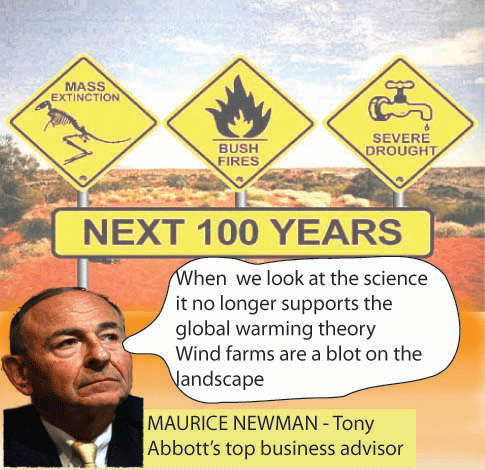
Maurice Newman, Abbott’s top adviser, informs us that climate change is not real!
 No evidence that man has caused warming Australian Broadcasting Corporation, Lateline Broadcast: 22/04/2014 Reporter: Emma Alberici
Maurice Newman, the chairman of the Prime Minister’s Business Advisory Council discusses climate change and says that there is little correlation between carbon dioxide and the warming of the planet.
Transcript
EMMA ALBERICI, PRESENTER: One of Tony Abbott’s first acts in Government was to appoint Maurice Newman as the head of his Business Advisory Council. Mr Newman is the former Chairman of both the Stock Exchange and the ABC. He’s our guest this evening and he joined me earlier in the studio for this exclusive interview. ……..
EMMA ALBERICI: It’s no secret that you don’t agree that man-made CO2 is causing global warming. Given there is now consensus among 97 per cent or so of climate scientists across the world that the view – around the view that human activity is responsible for climate change, what would it take to convince you?………
MAURICE NEWMAN: I just look at the evidence. There is no evidence. If people can show there is a correlation between increasing CO2 and global temperature, well then of course that’s something which we would pay attention to. But when you look at the last 17.5 years where we’ve had a multitude of climate models, and this was the basis on which this whole so-called science rests, it’s on models, computer models. And those models have been shown to be 98 per cent inaccurate.
EMMA ALBERICI: By?
MAURICE NEWMAN: By Roy Spencer, who’s carried out a thorough review of all of the models and the empirical data which against both land-based and satellite-based measuring. And they were found to be wrong………
EMMA ALBERICI: He is. He was at NASA. His colleagues at NASA disagree with him…………
Australian uranium miner Paladin continues its revenue fall
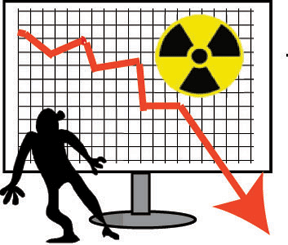 Paladin’s revenue continues to slide Revenue for uranium miner Paladin Energy fell in the three months to the end of March.
The company’s sales revenue of $US88.56 million in the three months to March 31 was down from $US106 million in the same period a year earlier.
Its average sales price in the March quarter was $US36.82 per pound, down from $US38.40 in the first six months of the 2013/14 financial year, and $US55.22 in same quarter a year earlier…….http://www.sbs.com.au/news/article/2014/04/22/paladins-revenue-continues-slide
Australian uranium miner Paladin’s production declines
During the quarter under review, Paladin reported a combined production of just over two-million pounds from its Kayelekera and Langer Heinrich mines. This compared with the 2.2-million pounds of uranium oxide (U3O8) in the previous quarter.
The Kayelekera operation produced 696 710 lb during the quarter, compared with the 777 015 lb produced in the previous three months.
Paladin suspended operations at Kayelekera in February this year, citing the depressed price of U3O8, and the unsustainable cash demand to maintain the loss-making operation.
Production at the Langer Heinrich operation, in Namibia, declined to 1.39-million pounds during the three months to March, compared with the 1.43-million pounds produced over the three months to December……..http://www.miningweekly.com/article/paladin-production-declines-on-kayelekera-close-2014-04-22
Clive Palmer says that Abbott’s “Direct Action” climate policy useless and a waste of money
 Direct Action is a waste of money: Palmer Herald Sun, 21 April 14 FEDERAL MP Clive Palmer has strongly indicated his party won’t support the Abbott government’s climate change direct action plan, labelling it a “token gesture” and a waste of money.
The Palmer United Party leader and mining magnate said the money allocated for the policy should be used for pensions, which could be under review in the May budget.
Mr Palmer said the rights of pensioners were more important and had greater priority than “a token gesture to addressing carbon issues”…….http://www.heraldsun.com.au/news/breaking-news/direct-action-is-a-waste-of-money-palmer/story-fni0xqi4-1226891204355
British-Australian mining giant Rio Tinto and uranium deaths in Africa
 Uranium kills in Namibia http://www.news24.com/Columnists/AndreasSpath/Uranium-kills-in-Namibia-20140422 2014-04-22 Andreas Wilson-Späth
That uranium is a radioactive and toxic substance with potentially lethal impacts on the people who dig it out of the ground is generally glossed over by those among us who argue for nuclear power as a clean, green, safe and sustainable source of electricity.
Along with other intractable problems faced by the atomic energy industry – like its propensity to lay to waste entire landscapes if and when things go wrong and the fact that we still don’t have a long-term solution for storing its noxious waste products – this is not in dispute. It’s merely a matter of unintended side-effects. Collateral damage.
For uranium miners in Namibia, however, their occupation in proximity to the metal has much more first-hand and personal consequences. A report soon to be released by Earthlife Namibia and the Labour Resource and Research Institute argues that long-time workers at the Rössing uranium mine are routinely exposed to unhealthy working conditions, radiation and dust.
The survey of current and former Rössing employees suggests that an anomalous number of them are dying of cancer and other mysteriously unexplained illnesses caused by their working conditions.
Rössing, which is located in central Namibia and employs over 1500 people, is majority owned (69%) by British-Australian mining giant Rio Tinto. The next biggest shareholders of the mine are the government of Iran (10%) and our own Industrial Development Corporation (10%).
Rio Tinto officials have consistently denied that they’re to blame for any harm, insisting that their operations at Rössing and elsewhere, including their copper, gold, coal, bauxite, iron ore and diamond mines around the world, are well monitored and run ethically, for the benefit of local communities, respecting human rights and protecting the environment.
But a closer look at the multinational’s global operations reveals that Rio Tinto isn’t quite as squeaky clean as they would like us to believe:
• At the end of last year, radioactive and acidic slurry spilled from a uranium processing tank at Rössing. Two weeks later the damaged rubber lining of a similar tank at the company’s Ranger mine in Australia’s Northern Territory leaked more than a million litres of the stuff.
• In 2013, 33 miners perished when a tunnel collapsed at Rio Tinto’s Grasberg gold and copper mine in Indonesia – the largest portion of the total of 41 deaths at their global operations during that year which international trade union IndustriAll claims the company should have done more to prevent.
• Locals have blamed the Grasberg mine for pollution affecting the environment and population.
• In Madagascar, activists have accused Rio Tinto of “land grabbing and environmental devastation”.
• A lawsuit has been filed against Rio Tinto’s Bingham Canyon mine in the US state of Utah for five-year breaches in air pollution regulations. The organisations that brought the case claim, that on some days the dust from the mine has a similar “effect on people who are consistently outdoors” as “smoking a pack of cigarettes a day”
• In Mongolia, indigenous nomadic herders have raised concerns that an expansion of Rio Tinto’s Oyu Tolgoi copper and gold mine in the Gobi desert would threaten the integrity of the local ecosystem along with their access to fresh water.
Of course Rio Tinto also made over $1 billion in profits last year. I guess in the minds of the company’s executives that justifies the occasional mishap.
– Andreas is a freelance writer with a PhD in geochemistry. Follow him on Twitter:@Andreas_Spath
1 This month


Help Aunty Sue Protect Her Land and Sacred Sites From Destructive Rocket Testing.
.

Australians deserve the truth
about
AUKUS – https://aukuspublicinquiry.com/

PETITION – To: Prime Minister Anthony Albanese and the Australian Labor Government

of the week – Australians for War Powers Reform (AWPR)
To see nuclear-related stories in greater depth and intensity

