In lead up to Rio Tinto’s Australian AGM (May 8) signs that Rio will not pay up for fixing up Ranger uranium mine
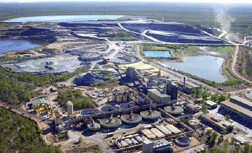 Rio chief tight-lipped on Ranger mine, SMH April 16, 2014 – Peter Ker Rio Tinto chief executive Sam Walsh has refused to guarantee that his company will cover the cost of rehabilitating the Ranger uranium mine near Kakadu, building on uncertainty that was created last month by the Rio subsidiary in charge of the mine.
Energy Resources of Australia – which is 68 per cent owned by Rio – raised eyebrows when it revealed it may need to find new sources of money to meet its rehabilitation commitments for Ranger, which is entirely surrounded by Kakadu National Park.
Under the Ranger permit, ERA must have rehabilitated the site by 2026, and a review of the rehabilitation strategy in 2013 found the cost would be $603 million on a net present cost basis. ERA has $357 million on hand and has ceased mining at Ranger, with the company now exploring for more uranium underground in a bid to find future revenue streams.
In an unusual move, ERA appeared to link the success of that exploration project – known as Ranger 3 Deeps – to its ability to pay for the rehabilitation of the site. “If the Ranger 3 Deeps mine is not developed, in the absence of any other successful development, ERA may require an additional source of funding to fully fund the rehabilitation of the Ranger Project Area,” the company said in its annual report.Such an outcome would be unusual, as miners are typically compelled to pay for the rehabilitation at the end of a mine’s life through provisions that are made each year.
In ERA’s case, some rehabilitation is already underway and it maintains a trust with the Australian Government which was holding $63.9 million at December 31.
When asked at Tuesday night’s annual meeting of Rio shareholders in London, Mr Walsh indicated he was in no mood to pick up the tab for ERA, particularly after Rio took part in a $500 million equity raising for the company in 2011. “There was a rights issue at ERA to fund the rehabilitation work and those funds are still sitting within that business,” said Mr Walsh.
”(ERA) is a public Australian company and clearly that is an issue for them.
“We are clearly shareholders, but it’s a matter for all shareholders and a matter for the ERA board.”
Environmental sensitivities of another kind were also raised at the AGM, with Rio executives forced to defend the company’s continued involvement in coal mining.
Mr Walsh said Rio did accept that “man made emissions” were responsible for changes in the climate, but the company believed the challenge could be resolved through technological developments rather than by ceasing coal production………
Rio’s Australian AGM will take place on May 8. http://www.smh.com.au/business/mining-and-resources/rio-chief-tightlipped-on-ranger-mine-20140416-36qfi.htmlSMH
No real recovery in sight for dismal uranium prices
 FN Arena reports (15 April 14) “……The recovery will not, however, be long lasting under CIMB’s modelling. Despite recent voluntary cuts to supply, including Paladin Energy’s Kayelekeera mine in Malawi being placed into care & maintenance, and despite the end of the Russian HEU supply agreement, CIMB sees the global uranium market drifting back in to surplus by 2016. …
In the meantime, UBS is the most recent of brokers to mark uranium prices to market for the purpose of producer valuations. The broker has cut its 2014 average price forecast to US$39/lb from US$43/lb previously. …”
Under the Abbott government, Australia is an active Climate Change Denier
 Australia Remains Silent Amid Global Warming And Calls For Renewable Energy Use http://au.ibtimes.com/articles/548241/20140415/australia-global-warning-climate-change-tony-abbott.htm By Reissa Su | April 15, 2014
Australia’s Great Barrier Reef is known as a World Heritage site and the worsening effects of climate change have sparked fears that it would soon be destroyed and die. Recent scientific studies have shown a significant loss of coral cover in the past 27 years. The damage to corals is caused by climate change, storms and the increasing population of crown of thorns starfish. Reducing the number of the starfish species is the key factor to restore coral cover based on research studies.
Despite the mounting fears, climate scientists observed Australia may not be fully committed to battle out climate change. According to reports, Australia is one of the biggest and most active “climate change deniers” in the world. While the United Nations‘ Intergovernmental Panel on Climate Change (IPCC) is encouraging countries to do their part in reducing greenhouse gas emissions, Australia is focusing on coal which is considered the biggest contributor to the ozone’s destruction.
The IPCC has found global carbon emissions have increased faster between 2000 and 2010 compared to the past 30 years. The IPCC said attempts to reduce greenhouse gas emissions continue to fail.
According to Dr. Frank Jotzo from the Australian National University, Australia has to quadruple low carbon energy use in 2050 or risk the consequences of climate change to agriculture, coastal areas and tourism.
The rise in global temperature would mean the potential widespread and permanent damage to Australia’s coral reef systems, specifically the Great Barrier Reef and Ningaloo in Western Australia.
Some species native to Australia may disappear. The continued rise in global temperature could increase the frequency of flooding which will cause damage to infrastructure. Some low-lying areas may be swallowed by rising sea levels. Extreme weather conditions may affect the quality of Australia’s drinking water.
Worsening dry spells, fiercer heat waves and frequent bushfire seasons should be worrying for Prime Minister Tony Abbott and the Coalition government after CSIRO and the Bureau of Meteorology released the State of the Climate report.
The two-year study has prompted calls for curbing carbon emissions from human activities. Greenhouse emissions are already at record levels. Climate scientists predict that the world will be 5 degrees hotter by 2070.
But the Abbott government has not accepted the Climate Change Authority (CCA)’s recommendation for Australia to triple its carbon emissions reduction target. The climate agency said Australia should be aiming for at least 15 percent by 2020. The target rate will increase to 19 percent once the carryover credits that have been previously set in the Kyoto Protocol are included. To contact the editor, e-mail: editor@ibtimes.com
Crikey names and shames Australia’s top 10 Climate Denialists
 The Dirty Dozen: Australia’s biggest climate foes, part 1 CRIKEY, CLIVE HAMILTON | APR 15, 2014 Who are the 12 people doing the most to block action on climate change in Australia? With a new government in place, and Australia’s emissions stubbornly high, we name and shame a fresh Dirty Dozen …
Who has been most responsible in recent times for preventing progress in the reduction of Australia’s greenhouse gas emissions? The Dirty Dozen — which I originally named in 2006 and updated in 2009 — are the people who have most effectively denied the science of climate change, lied about its implications, lobbied to water down laws, or provided cover for weak policy.
They are doing most to help turn Australia from a reluctant leader into a proud laggard in responding to the most dire threat to the world’s future. Some are well-known — even if their links and tactics are not — while others do their dirty work behind the scenes. Here is my Dirty Dozen for 2014, in no particular order …
Chris Mitchell
Where to start with The Australian’s editor-in-chief? How about here, here,here, here, here, here, here, here, here, here, here, here, here, here, here,here, here or, if you can’t be bothered clicking on all of those, look here or here………
Tony Abbott
What to say that everyone does not already know? ……
Ian McNamara
For too long the presenter of ABC Radio’s Sunday morning program Australia All Over has flown under the radar. When not chatting about the weather in Nuriootpa, Macca’s huge cohort of two million listeners (enough to make other shock jocks weep) is prone to debunking climate science and ridiculing renewable energy. He draws in his salt-of-the-earth listeners with a kind of folksy bush wisdom that has little time for eggheads with PhDs in atmospheric physics. Periodically, listeners complain to the ABC about McNamara’s “pot shots“ at global warming and his penchant for inviting on his right-wing mates……..
….The influence of Bolt on the landscape of climate denial has been exhausted.
Gina Rinehart…….Rinehart is a major funder of the Institute of Public Affairs, the primary conduit of denier talking points in Australia. The IPA’s 70th birthday partylast year was a love-in for the nation’s most powerful climate deniers; Murdoch, Pell, Bolt, Rinehart, Abbott, all co-ordinated by IPA executive director (and former Rio Tinto employee) John Roskam.
Innes Willox……The Australian Industry Group ……Willox has made himself into the enforcer of the greenhouse mafia, pushing the hardest line against measures to limit emissions…….
Ian Plimer
Plimer is the chief ideologist of climate denial in Australia. ….
*Clive Hamilton is professor of public ethics at Charles Sturt University in Canberra and author of Requiem for a Species: Why we resist the truth about climate change. For the second instalment of the Dirty Dozen, read Crikeytomorrow … http://www.crikey.com.au/2014/04/15/the-dirty-dozen-australias-biggest-climate-foes-part-1/
Small scale solar thermal energy initiative unveiled today in New South Wales
 Solar plant to be unveiled at Wallsend swimming pool http://www.abc.net.au/news/2014-04-15/solar-plant-to-be-unveiled-at-wallsend-swimming-pool/5390322 A revolutionary solar thermal project invented by researchers at the University of Newcastle will be unveiled today at Wallsend swimming pool. The demonstration plant will collect heat from the sun in curved mirrored troughs, producing electricity and heat for on-site use, using the new heat engine technology.
The GRANEX project has been funded by the Australian Renewable Energy Agency (ARENA). Researcher Professor Behdad Moghtaderi says the technology will have significant benefits for remote mining and industrial sites in rural communities.
“It can be used in remote communities, aboriginal communities, because all we need is a set of solar arrays,” he said. “You really don’t need diesel fuel, or anything like that.
“The problem is not really the infrastructure as such. “It’s more of a cost and logistical problems associated with transporting diesel fuel.”
The Wallsend swimming centre could save hundreds of dollars on its its annual power bills because of the project.
Professor Moghtaderi says the technology means electricity can be produced with zero carbon emissions from a range of different sources.”Any type of low-grade heat source and also renewable energy sources, in the example that you have for a swimming pool today, essentially we are using solar energy as heat input,” he said. “But, with the same token, you can use geothermal energy, biomass energy or waste heat going out of the stack of power plants and things like that.” ARENA CEO Ivor Frischknecht today joined Parliamentary Secretary for Industry and Paterson MP Bob Baldwin at the official launch.
“The $1.7 million project integrates solar thermal and GRANEX heat engine technology and is supported by $812,000 funding from ARENA,” he said.”The 200 kilowatt solar field, located at the Wallsend swimming complex, will generate 30 kilowatts of electrical output and 150 kilowatts of heat for the swimming pool.
Mr Frischknecht says the demonstration project is the first of its kind and will produce thousands of hours of valuable operating data.”It demonstrates the potential of small-scale solar thermal systems in providing cost effective energy options, particularly for off-grid areas,” he said.
“ARENA recognises the importance of supporting renewable energy projects that are innovative, economically geared and increasingly market-driven – such as those that could deliver low cost power to remote mining communities.
“It is vital that Australia continues to deliver world-leading and cost-effective renewable technology solutions that keep up with economic growth.”
Austtralia’s hypocrisy. Government knows full well that Israel has nuclear weapons
 Australia still denies Israel’s open secret of a nuclear arsenal, SMH, April 15, 2014 Phillip Dorling
Secret government files reveal that Australian governments, diplomats and spies have known for more than 30 years that Israel has an arsenal of nuclear weapons, while continuing to deny any knowledge of its existence to the point of misleading Parliament.
Previously secret diplomatic files declassified by the National Archives reveal a longstanding policy to turn a blind eye to Israel’s nuclear arsenal. Last week the Department of Foreign Affairs and Trade again declined to comment on whether the Australian government thinks Israel is an undeclared nuclear weapons state.
Foreign Affairs Department briefing papers prepared for former Labor foreign minister Bill Hayden in 1987 state that ”intelligence assessments are that Israel has a small arsenal of nuclear weapons (possibly about 20). Israel’s technological capabilities would enable it confidently to deploy such weapons without recourse to a nuclear test.”
Mr Hayden and Dr Blix were talking against the backdrop of the treason trial of Mordechai Vanunu, the Israeli nuclear technician who in 1986 disclosed detailed evidence of Israel’s nuclear weapons production. The Foreign Affairs Department advised Mr Hayden to publicly deny knowledge of Israel’s nuclear weapons capabilities. Mr Hayden told Parliament on September 17, 1987: ”We have no information to corroborate these allegations.”
However, Foreign Affairs’ files, declassified in response to applications by Fairfax Media, reveal that Australia had been monitoring Israel’s nuclear program from its beginnings in the 1950s………
Australian policy remains unchanged, with the Abbott government deciding last October not to support a UN General Assembly resolution on nuclear proliferation in the Middle East – 169 countries voted for the resolution. Only five – the US, Israel, Canada, Palau and the Federated States of Micronesia – voted against. Australia abstained……..http://www.smh.com.au/federal-politics/political-news/australia-still-denies-israels-open-secret-of-a-nuclear-arsenal-20140414-36nr4.html
Uranium mining plans by Toro Energy – expensive, polluting, and under investigation
Toro uranium expansion plan: premature and polluting http://www.ecovoice.com.au/toro-uranium-expansion-plan-premature-and-polluting/
Western Australia’s peak environmental group has condemned a move by uranium mining hopeful Toro Energy to expand their unrealised Wiluna mine plan into a much larger uranium mining precinct spanning 100km and two ecologically sensitive lake systems in the East Murchison region.
The state EPA has released details of the expansion plan while the company is under investigation by the Australian Securities Exchange for a second time over claims they have released misleading information to shareholders and the market. (See background below).
“Toro have never successfully mined anything before and have a long way to go to get their original single-mine project approved – let alone any new expansion,” said CCWA Nuclear Free campaigner, Mia Pepper.
“Contrary to their statements to shareholders, the company needs to complete additional environmental management , mine closure, tailings management and transport plans for assessment before any mining can commence at the Wiluna site.”
The company has struggled to find investors and currently needs $300 million in start-up costs and a further $300 million in upfront bonds.
“This new plan to attract investors is likely to draw further scrutiny from both regulators and the wider community who will be looking at the cumulative impacts of a regional uranium precinct covering 100km and two arid zone Lake Systems.”
“Toro plans to double its water consumption and store radioactive mine waste from several mine sites in a Lake bed. This idea lacks credibility and the company lacks capacity, experience and financial backing.”
Toro’s new plan involves four deposits over one hundred kilometres – Lake Way, Centipede, Millipede and Lake Maitland, with the company’s long term plans including mining an additional three deposits Nowthanna, Dawson Hinkler and Firestrike – covering a hundred kilometres in the other direction.
Also in the region is WA’s largest uranium deposit – Yeelirrie, which is now owned by Cameco. Traditional Owners have consistently opposed this project for forty years.
CCWA is partnering with a range of public health, union and faith groups to call for a public inquiry into the Toro mine plan.
ASX investigation
The Mineral Policy Institute and the Conservation Council of WA received formal notification that the Australian Securities Exchange is investigating Toro Energy for the second time over the release of potentially misleading information. Continue reading
Australia to work with United Arab Emirates in developing nuclear technology
| UAE declares launch of nuclear energy cooperation deal with Australia | |||
|
|||
|
ABU DHABI, April 14 (KUNA) — The United Arab Emirates said on Monday that an agreement on the use of nuclear energy for peaceful means signed with Australia in 2012 has come into force.
The announcement was made in an official statement published on state news agency, WAM, which mentioned that the decision for the move was made during a meeting between Foreign Minister Sheikh Abdullah bin Zayed Al-Nahyan and Australia’s visiting Minister of Trade and Investment Andrew Robb. The Emirati foreign minister said that enacting the agreement will “provide broader opportunities for cooperation between state institutions and businesses operating in the nuclear energy field.”…….. According to the report, the discussions also touched upon enhancing existing economic and trade ties, and encouraging joint investments.
Sheikh Abdullah went on to stress the importance of exchanged visits in supporting bilateral cooperation and assessing the levels development and growth in each of the two countries…… The Australian minister, for his part, commended the level of cooperation between the two sides, emphasising the need to further these ties.
He also noted to the high reputation the UAE has managed to make for itself on the international scene, through providing a lucrative location for international businesses. (end) asa.sd http://www.kuna.net.kw/ArticleDetails.aspx?id=2372272&language=en |
Australia is part of USA’s increased market for exporting weapons to this region

The Obama administration has pushed through a streamlining of the licensing process in order to facilitate an increase in military exports – in part to compensate U.S. arms manufacturers for a decline in orders from the Pentagon…..
The more advanced weaponry U.S. allies purchase, the more they are locked into future acquisitions. The United States emphasises “interoperability” among its allies. Not only are purchasers dependent on the United States for spare parts and upgrades, but they must consider the overall system of command and control (which is now C5I — Command, Control, Communications, Computers, Combat systems and Intelligence).
World Cuts Back Military Spending, But Not Asia, Inter Press Service Analysis by John Feffer WASHINGTON, Apr 14 2014 (IPS) – For the second year in a row, the world is spending a little less on the military. Asia, however, has failed to get the memo. The region is spending more at a time when many others are spending less. Continue reading
How long can Tony Abbott and his media lackeys keep up his pretense about Climate Change?
 IPCC puts more heat on Abbott’s anti-science climate policies, Crikey, GILES PARKINSON | APR 14, 2014 The IPCC says action on climate change is urgent but affordable. The Abbott government says it will “wait and see”, all the while dismantling the mechanisms that could achieve higher targets. It is probably not what he is doing right now, but Australian Prime Minister Tony Abbott should be wondering exactly how long it is that he can continue with his climate change policy charade.
On Sunday, the United Nations climate body the Intergovernmental Panel on Climate Change delivered the third of its landmark updates on the climate science, impacts and mitigation options. The chief message of Working Group III, the mitigation of climate change, was one of hope: the world still had time to avoid the worst impacts of climate change, and although this would require a dramatic and urgent decarbonisation of the world’s energy and transport systems, it needn’t actually cost that much.
Indeed, as the IPCC graph indicates, the combined impact of all the measures that would be needed to encourage renewable energy in particular, and a suite of other technologies, might subtract just 0.06% from annual global growth: (see good graphs in original of this article).
And that is without calculating the obvious benefits or reduced air pollution and enhanced energy security, and without the obvious devastating impacts on the economy if climate change is allowed to continue unchecked.
 In Australia, the IPCC reports have gone largely unremarked or cherry picked by much of the mainstream media. After the report from Working Group II last month, The Australian reprinted an article from The Wall Street Journalhighlighting how global warming might mean fewer deaths from cold. This morning its headline screamed that action to mitigate climate change would cost 10% of GDP. The Australian Financial Review and The Daily Telegraphcompletely ignored it in their print editions. Apparently, their editors believe it is neither a business issue nor one that would trouble the general public.
This media approach has created an insular and distorted view in Australia of what is happening around the world. But any chance that world governments might sweep this under the carpet, as the Abbott government has been allowed to do by the mainstream media, were swiftly torched by the United States. Within minutes of the formal release of the report, Secretary of State John Kerry issued a statement saying the report was a “wake-up call” about the global economic opportunity that the world could seize. Kerry said abatement technologies can cut carbon pollution while growing economic opportunity at the same time: Continue reading
Climate change action is essential for business: no more ‘business as usual’
 Cyclone Ita: lessons after the media deluge, WA Today April 14, 2014 Crispin Hull “…………The response to extreme weather events by climate-change sceptics and business-as-usual climate-change deniers is now down pat: ”Well, you cannot assert that the climate is changing on the basis of an isolated event (insert event: cyclone. storm, bushfire, flood, drought). We have had these things before, you know.” And scientists will generally agree.
But this mantra has to stop.
For a start, with cyclones you can confidently say that they will now be more severe because of global warming. The oceans have warmed in the past 50 years. Cyclones get their energy from the heat of the ocean.
A lot of these things have exponential effect. A little extra heat means cyclones will be a lot more powerful. A little extra wind velocity means a lot more destruction. The power of wind is a cube function of its speed. Doubling the speed results in eight times the force. Trebling the speed equals 27 times the force.
So the difference between a category three and category five cyclone 500 kilometres off the Australian coastline is enormous. Once a category five is tracked, as was the case with Ita, very costly preventive measures get set in train, as they must.
My guess is that most people in Port Douglas blew between two and four days of their lives on cyclone preparation and returning to normal. Most businesses blew at least a day’s trade.
So there can be no more business as usual. Climate change has to be a major concern of business, particularly small business. Big business has the power and resources to adapt. Small businesses suffer badly at best or go broke at worse……..
Climate change must be a matter of concern for small business. Yes, we know that Australia on its own cannot affect the global climate, but we can and should influence world opinion, as we did with the bans on fluorocarbons. Those bans stopped the depletion of the ozone layer and prevented much cancer-causing radiation hitting the Earth.
The world co-operated then and we should co-operate now. The voice of small business should rally on this. Much of big business likes a high carbon economy and it does not care about the consequences……..http://www.watoday.com.au/comment/cyclone-ita-lessons-after-the-media-deluge-20140414-zquiy.html
French analysts surprised to find that Renewable Energy Target REDUCES Australia’s energy costs
Schneider study finds boosting renewables will cut energy costs (Excellent graphs) REneweconomy, By Giles Parkinson on 14 April 2014 Analysts at French based energy components company Schneider Electric have concluded that extending or expanding Australia’s renewable energy target would lead to lower electricity prices, lower carbon emissions and increased competition.
Reducing, or removing the renewable energy target – as many incumbent generators, industry lobby groups, state governments and some of its own members are urging the Abbott conservative government to do – will have the opposite impact, pushing prices higher and creating a greater reliance on expensive gas-fired generation.
The conclusions in the white paper have apparently surprised even the four-man team from Schneider that conducted the analysis, and the unnamed large energy users who commissioned it. Large energy users have normally been against the renewable energy target, and this study – along with others that have reached similar conclusions – is causing a rethink.
The Schneider Electric analysis says Australia will benefit from maintaining, extending or expanding its large scale renewable energy target (LRET) because renewable generation has lower emissions and lower marginal costs than do fossil fuels- fired generation.
“As a result of the influence of the LRET on the generation mix, electricity generation emissions in Australia are forecast to be lower under the LRET than would be otherwise,” it says.
“Again, the LRET becomes a hedge against rising carbon prices, and may help to keep carbon prices lower as a result of the lower emissions.
“Finally, and most strikingly, is the impact of the LRET on long-term energy prices. The LRET is forecast to result in a generation mix with lower marginal cost, lower carbon emissions, and increased competition in the electricity market, all which serve to reduce prices.
“Even after taking into account the cost of Large-scale Generation Certificates, the LRET in its current form is forecast to result in prices lower in the long run than those under decreased targets or outright removal of the Large-scale Renewable Energy Target.”
The analysis is important in the light of claims made by incumbent generators about the cost of the renewable energy target on consumers, and some even wilder claims in conservative commentators that renewables could add 50 per cent to consumer bills by 2020.
Pacific Hydro general manager Lane Crockett said the analysis by Schneider and others clearly demonstrated that zero fuel cost renewable energy can act as a hedge against future price rises in coal and gas.
“This report by Schneider is one of a number of recent reports that clearly demonstrate that deployment of renewable energy technologies via the renewable energy target has played a major role in keeping wholesale electricity prices down and is likely to continue to do so provided it is largely left alone,” he said.
“This report is no real surprise and clearly shows that that promise of a cleaner, cheaper energy market is now closer than ever to becoming a reality.” …..http://reneweconomy.com.au/2014/schneider-89361

IPCC report shows that Australia must do more to develop renewable energy
 IPCC report points to ‘renewables solution’ http://www.theaustralian.com.au/business/latest/ipcc-report-points-to-renewables-solution/story-e6frg90f-1226883956621 STAFF REPORTER APRIL 14, 2014
The Climate Council says a new international report released yesterday and signed off by governments from around the world, including Australia, has found a need to lift investment in renewable energy to combat climate change.
“Renewable energy is critical to tackling climate change,” says Amanda McKenzie, Climate Council CEO.
“Australians have already taken steps to increase renewable energy and this report shows we need to do more.”
The Intergovernmental Panel on Climate Change (IPCC) report focuses on mitigation strategies for climate change and indicates that globally the world needs to at least triple the use of zero and low carbon energy sources by 2050.The think-tank says key players, like the United States and China, are quickly moving ahead. For example, the United States doubled renewable capacity between 2008 and 2012, and China increased its capacity in wind energy by 36% in 2012.
Australia currently has a national renewable energy target to generate 20% of the power mix from renewables by 2020. Over 130 other countries have similar targets to bolster renewable energy.
“It’s clear that the renewables race has begun,” says McKenzie.
“Shifting away from fossil fuels to renewable energy is a key part of tackling climate change and has other benefits, for instance growing new jobs, industries and investment,” says McKenzie.
“Australians know that solar power is just common sense here, so there is a lot of community support for greater investment in renewables.
“On the other side of the ledger, Australia is also home to some very inefficient and aging coal fired power plants. That means our current electricity supply is one of the most emissions intensive and least efficient in the world.”
Australia will have to come clean on nuclear weapons policy
Australian policy on nuclear weapons hopelessly conflicted http://www.smh.com.au/comment/australian-policy-on-nuclear-weapons-hopelessly-conflicted-20140410-zqt9l.html April 10, 2014 At a meeting in Hiroshima of the Non-Proliferation and Disarmament Initiative (NPDI), a group of 12 countries led by Australia and Japan, Foreign Minister Julie Bishop made much of Australia’s supposed commitment to ridding the world of nuclear weapons.
- But Australian policy on nuclear weapons is hopelessly conflicted. With one hand, it promotes nuclear disarmament, yet with the other, it clings anxiously to US nuclear weapons for national security. Australia wants to get rid of nuclear weapons and keep them too.
- There is no secret about this: Bishop wrote in February that Australia “has long and actively supported nuclear disarmament … and worked tirelessly toward the goal of a world free of nuclear weapons” and also that Australia “will continue to rely on nuclear deterrence” for its security as long as nuclear weapons exist. She is the latest custodian of a bipartisan policy that has been passed down through consecutive governments for decades.
- As long as nothing much was happening with nuclear disarmament, Australia could safely advocate it. But the emergence of a global movement to examine the humanitarian consequences of nuclear weapons, and a related push for a treaty banning them, has put Australia on the spot.
International conferences held in Oslo last year and in Nayarit, Mexico, in February concluded that any nuclear detonation would completely overwhelm humanitarian and disaster response capabilities, and cause unacceptable long-term harm worldwide.
Australia cautiously participated in these meetings, but clearly with misgiving. And at the United Nations last October, when 125 countries, including Japan and five other NPDI members, made a joint statement on the humanitarian consequences of nuclear weapons, Australia baulked – and weaselled out.
Pressed to explain why Australia could not join the statement, officials said the sentence, “It is in the interest of the very survival of humanity that nuclear weapons are never used again, under any circumstances,” was incompatible with Australia’s reliance on nuclear deterrence.
Calls for a new treaty to ban nuclear weapons have further exposed the contradictions in Australia’s policy. There is no legal reason Australia could not join such a treaty tomorrow: Australia has no nuclear weapons. As a member of the Nuclear Non-proliferation Treaty (NPT) it has sworn off them.
The official response, however, has been to oppose such a ban because it would not “guarantee” nuclear disarmament. This is a ludicrous excuse, given that none of the approaches Australia and the NPDI advocate will “guarantee” disarmament either (in fact most of them are hopelessly bogged down).
That a polished performer like Bishop would field such a flimsy rationalisation only shows how bare the intellectual cupboard at the Foreign Ministry is. They can’t find a better argument, because there isn’t one.
Despite the increasing visibility of its inherently contradictory policy, the government blithely continues to seek a high profile on nuclear disarmament.
- The people of Hiroshima will surely welcome Bishop’s earnest undertakings to address the humanitarian impact of nuclear weapons and pursue nuclear disarmament. They will be less impressed by her extraordinary statement that “the horrendous humanitarian consequences of nuclear weapons are precisely why deterrence has worked” – in other words, that Australia depends for its security on the very humanitarian consequences it claims to be working to avoid.The contradictions emerge even within the NPDI. The purpose of the NPDI is to support implementation of the 64-point “action plan” on non-proliferation and disarmament agreed by the 189 members of the NPT. Australia is a prominent proponent of the plan. But the very first of these 64 actions requires Australia to “pursue policies that are fully compatible with the treaty and the objective of achieving a world without nuclear weapons”. How is relying on nuclear weapons compatible with the objective of achieving a world without nuclear weapons?
- The circle simply cannot be squared. Follow the tortuous reasoning to its conclusion and it reduces to “Australia supports nuclear disarmament, just as soon as it has happened”.
- As the humanitarian initiative gathers momentum, and as a ban treaty looms closer, Australia’s policy will become increasingly untenable. It will soon have to choose: nuclear weapons – yes or no. If the answer is yes, the only honest course is to drop the pretence of working towards a world free of nuclear weapons and leave the NPT. If the answer is no, then there are policy challenges ahead – but overcoming them would put Australia on the right side of history.
- Richard Lennane is a former United Nations disarmament official and Australian diplomat.
Uranium supply will outlast the uneconomic nuclear industry
reality appears to be relegating nuclear power to the uneconomic category of history
 Enough Uranium, but Nuclear Power Is Still Shrinking http://www.truthdig.com/report/item/enough_uranium_but_nuclear_power_is_still_shrinking_20140412 By Paul Brown, Climate News Network This piece first appeared at Climate News Network.
LONDON—There is enough uranium available on the planet to keep the world’s nuclear industry going for as long as it is needed. But it will grow steadily more expensive to extract, because the quality of the ore is getting poorer, according to new research.
Years of work in compiling information from around the world has led Gavin M. Mudd from Monash University in Clayton, Australia to believe that it is economic and political restraints that will kill off nuclear power and not any shortage of uranium, as some have claimed.
Writing in the journal Environmental Science & Technology that renewables do not have the disadvantages of nuclear power, which needs large uranium mines that are hard to rehabilitate and which generates waste that remains dangerous for more than 100,000 years.
In addition, research shows that renewable technologies are expanding very fast and could produce all the energy needs of advanced economies, phasing out both fossil fuels and nuclear.
Mudd, who is a lecturer in the department of civil engineering at Monash, has compiled decades of data on the availability and quality of uranium ore. He concludes that, while uranium is plentiful, mining the ore is very damaging to the environment and the landscape. Continue reading
1 This month


Help Aunty Sue Protect Her Land and Sacred Sites From Destructive Rocket Testing.
.

Australians deserve the truth
about
AUKUS – https://aukuspublicinquiry.com/

PETITION – To: Prime Minister Anthony Albanese and the Australian Labor Government

of the week – Australians for War Powers Reform (AWPR)
To see nuclear-related stories in greater depth and intensity

