Greens want Victoria to have a Clean Energy fund to help businesses and homes
 Greens call for state clean energy fund, http://www.theage.com.au/victoria/greens-call-for-state-clean-energy-fund-20140413-36ldj.html 13 April 14, The Greens want the Victorian government to establish a state-based clean energy fund to make solar panels more affordable.
Australian Greens Leader Christine Milne call for the creation of a Victorian Solar Fund to help homes and businesses deal with the upfront costs of solar panels.
Senator Milne said the fund would make money for the state and reduce power bills. “Australia is a leader in solar science but is underinvested in solar power, depriving us of jobs that the community is calling out for,” she said on Sunday.
“We can create the financial incentives to put solar panels on roofs, for no money down, delivering immediate savings on electricity bills.”
Julie Bishop is out of step with Australian opinion on nuclear weapons
 Julie Bishop says banning nuclear weapons impractical ABC Radio National, Tanya Nolan reported this story on Friday, April 11, 2014 TANYA NOLAN: Foreign Minister Julie Bishop is representing Australia at a 12 nation summit in Hiroshima today discussing global efforts to eliminate nuclear weapons. Disarmament activists in Hiroshima are lobbying hard for agreement to be reached on a global ban on nuclear weapons.
But Australia is one of a group of countries that is unlikely to support any such push: Ms Bishop says banning weapons won’t get rid of them and any global treaty would be impractical without the support of the world’s nuclear armed states – something unlikely to be achieved.
The International Campaign to Abolish Nuclear Weapons say Australia’s position is out of step with the views of most Australians. 
It’s released a survey of 1,500 Australians who were asked whether they think the Government should support a global ban on nuclear weapons. I spoke to Dr Tillman Ruff, co-chairman of the campaign who is in Hiroshima for the Non-Proliferation Disarmament Initiative.
So the International Campaign to Abolish Nuclear Weapons, ICAN has released its poll showing 84 per cent of Australians think the Government should support a global treaty banning nuclear weapons. Don’t you think it would have been more accurate to pose the question would a global ban on nuclear weapons be effective without the support of those countries that have nuclear weapons?
TANYA NOLAN: But Foreign Minister Julie Bishop has a point doesn’t she, that any global ban on nuclear weapons won’t be effective if you can’t get the nuclear armed states on board?
TILLMAN RUFF: Well, of course the elimination of nuclear weapons is going to require the states that have them to do that. I mean I think that’s obvious, but what we’ve seen essentially over the last 70 years is a failure of the nuclear armed states to live up to their legally binding obligation under the non-proliferation treaty to disarm.
There are currently no negotiations underway and arguably our, the danger of nuclear weapons being used, many experts are suggesting is actually increasing. Proliferation is certainly not under control so it’s hard to claim that business as usual is getting us very far, very fast.
So, you know, the states that have the weapons have so far shown really no serious intent to get rid of their nuclear weapons. ……….
Aboriginal community in the North to develop a strategy for the long term
For our power now lies outside of Labor or Liberal. The big parties have lost the true path. The north cannot be developed without our advancement, too. What is required now for remote Aboriginal people is a strategy beyond the election cycle. There are numerous complexities in coaxing participation out of welfare-dependent communities or productivity out of government-funded community programs. Part of the solution is developing an environment where private businesses can grow, in order to foster private wealth. That requires a strategic and efficient program of infrastructure development, including the local Aboriginal workforce.
Instead of driving remote economic development, the Labor and Liberal parties continue to treat remote Aboriginal people as a uniquely unresolvable problem. Australia’s Northern Territory has become a new colony — a moral crisis zone. By now it should be obvious there will be no change in remote Aboriginal communities unless the residents are willing. The arrogance of the major political parties will never inspire willingness.
The only path to advancement is via the bush bloc http://www.theaustralian.com.au/national-affairs/opinion/the-only-path-to-advancement-is-via-the-bush-bloc/story-e6frgd0x-1226881272887# 12 April 14, Alison Anderson MLA for Namatjira.
POWERFUL factions in the major political parties have failed Aboriginal people in the Northern Territory. That failure can be attributed almost wholly to a poor understanding of the aspirations of remote Aboriginal people. It’s simple — the people in power do not want to take the time to sit in the dirt and communicate with the most disadvantaged people, even if those same people gave them their power at the ballot box. Rather, they treat us as useful idiots. Continue reading
Electromagnetic radiation from mobile phones IS a danger
New Studies Show Health Risks from Wireless Tech: Warnings from the BioInitiative Working Group http://www.businesswire.com/news/home/20140411005708/en/Studies-Show-Health-Risks-Wireless-Tech-Warnings April 11, 2014 RENSSELAER, N.Y.–(BUSINESS WIRE)--The BioInitiative Working Group says evidence for health risk from wireless tech is growing stronger and warrants immediate action. The Group released a mid-year update covering new science studies from 2012 to 2014.
New studies intensify medical concerns about malignant brain tumors from cell phone use. “There is a consistent pattern of increased risk for glioma (a malignant brain tumor) and acoustic neuroma with use of mobile and cordless phones,” says Lennart Hardell, MD, PhD at Orebro University, Sweden, according to studies released in 2012 and 2013. “Epidemiological evidence shows that radiofrequency should be classified as a known human carcinogen. The existing FCC/IEEE and ICNIRP public safety limits are not adequate to protect public health.”
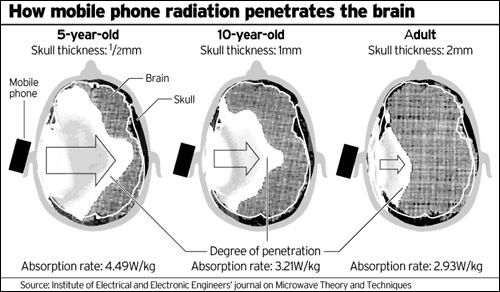
The BioInitiative reports nervous system effects in 68% of studies on radiofrequency radiation (144 of 211 studies) in 2014. This has increased from 63% in 2012 (93 of 150 studies) in 2012. Studies of extremely-low frequency radiation are reported to cause nervous system effects in 90% of the 105 studies available in 2014. Genetic effects (damage to DNA) from radiofrequency radiation is reported in 65% (74 of 114 studies); and 83% (49 of 59 studies) of extremely-low frequency studies.
Mobile wireless devices like phones and tablets are big sources of unnecessary biological stress to the mind and body that can chip away at resilience over time. The Report warns against wireless in schools. Schools should provide internet access without Wi-FI.
“It is essentially an unregulated experiment on childrens’ health and learning. Microwave from wireless tech disrupts thinking – what could be worse for learning? Technology can be used more safely with wired devices that do not produce these biologically-disruptive levels of microwave radiation,” said Cindy Sage, Co-Editor of the BioInitiative Report.
Federal programs like ConnectED and E-Rate are calling for wireless classrooms while ignoring the health evidence. Hyperactivity, concentration problems, anxiety, irritability, disorientation, distracted behavior, sleep disorders, and headaches are reported in clinical studies.
Government reviews on health impacts of wireless radiofrequency radiation from the European Union and Australia continue to be inconclusive largely because they require certainty before issuing warnings. The FCC review of health impacts from wireless technologies is still underway, but has not affected the federal push for wireless classrooms.
Contacts
BioInitiative Working Group
David O. Carpenter, MD
(518) 525-2660
dcarpenter@albany.edu
info@bioinitiative.org
www.bioinitiative.org
Evidence to be taken in Tennant Creek, on the legal case against Muckaty nuclear waste dump
 Muckaty trial to be held in Tennant Creek http://www.theaustralian.com.au/news/latest-news/muckaty-trial-to-be-held-in-tennant-creek/story-fn3dxiwe-1226880701026 NEDA VANOVAC AAP APRIL 11, 2014
THE federal government is exploiting the Northern Territory’s constitutional weakness by planning to build a nuclear waste facility there  against traditional owners’ wishes, Senator Nova Peris says.
This week it was decided that a Federal Court trial would sit in Tennant Creek and Darwin in June to take evidence on the proposed dump, which is fiercely opposed by four of the five traditional owner groups at Muckaty, about 120 kilometres north of Tennant Creek.
Legal proceedings have been running against the federal government and the Northern Land Council (NLC) since June 2010, with those opposed accusing the NLC of breaching its duties by failing to properly identify the traditional Aboriginal owners of the nominated land, not consulting adequately and not getting proper consent before recommending the site. “The Northern Territory is not our nation’s dumping ground,” Senator Peris told a Muckaty dinner in Darwin on Thursday.
“The only reason the dump was proposed to be built here is because we are a Territory and not a state. Exploiting our constitutional weakness is not acceptable.”
Ms Peris called for a scientific and rational approach to determining how Australia would deal with its nuclear waste.
Lawyer Elizabeth O’Shea said it was a victory for traditional owners to have part of the trial sit in Tennant Creek.
“We’re very concerned about the health and age of a number of our witnesses,” she said.
“It’s hugely important that the court has taken this step and we’re very pleased, and it’s caused great comfort for our clients.”
The Muckaty decision affects all of Tennant Creek, traditional owner Penny Phillips says, so it’s important for the community to be able to observe the legal process.
“All the people there, the old people and the young ones too, they can step up and start talking up,” she said.
“Our people fought for country for years and years – you get back country and you have to look after it.
“If you put the dump there, who’s going to look after the next generation?”
The trial will begin in Melbourne on June 2.
1000 US marines arrive in Darwin. What a target!
 Why are there U.S. marines in Darwin? Independent Australia Nick Deane 10 April 2014, The recent arrival of over a thousand marines in Darwin provides a risk for Australia, yet absolutely no reward, writes Nick Deane.
IF ONE COUNTRY INVITES the armed forces of another onto its territory, one would expect the government of the host country to have seen strategic benefits in the arrangement.
Furthermore, one would also expect, in a democracy, that this government would be happy to explain these benefits to its people. That should be simple enough.
In the case of Australia playing host to a garrison of more than 1,000 United States marines in Darwin for the next six months, the public has been offered no explanation about the strategic benefits. All we have been told (via a letter to IPAN-NSW from the Minister for Defence on 7 December 2012) is that the marines’ presence is an extension of our existing, long-standing alliance with the U.S. — as though the passage of time alone is sufficient justification for us to willingly accept foreign forces on our territory.
What is missing is any discussion of the strategic advantages to Australia that come from the presence of the U.S. garrison.
It is probably taken for granted that the advantage lies in the supposed ‘protection’ that it brings us. But are the marines really here for our protection?
And who actually benefits, in strategic terms, from this arrangement?
Certainly, the strategic benefits to the U.S. are large.
The marines occupy a ‘forward position’, thousands of kilometres beyond US territory. And, in the words of a report from CSBA (the Centre for Strategic and Budgetary Assessment):
‘Australia’s strong ties with America provide it with the means to preserve U.S. influence and military reach across the Indo-Pacific.’
Note: that’s the United States’ influence and military reach……..
where is the benefit to Australia?
What we get out of it is the certainty that we are now directly involved, if hostilities break out between America and China. That would make parts of Australia potential targets for attack…..http://www.independentaustralia.net/article-display/why-are-there-us-marines-in-darwin,6370
Dick Warburton, nuclear power enthusiast, is heading Renewable Energy Review Panel
 Tony Abbott’s renewable czar: Nuclear only alternative to coal REneweconomy, By Giles Parkinson on
  9 April 2014 Tony Abbott’s handpicked head of the panel reviewing Australia’s renewable energy target, the self-avowed climate “sceptic” Dick Warburton, is no fan of renewable energy. In an article co-authored for Quadrant in 2011, Warburton insisted that nuclear energy was the only alternative to fossil fuel generation.
The two-part series for the conservative magazine – co-authored by Warburton along with poet and accountant Geoffrey Lehmann and Resmed founder Peter Farrell – is an eye-opening compendium of the major arguments that climate science deniers and fossil fuel lobbyists have ever thrown at climate science, against carbon pricing and against renewable energy.
The title of the two-part series was “An intelligent voter’s guide to global warming” (you can find Part 1 here and Part II here), and the authors pretended to “provide basic information often missing from the debate.” In fact, it is a collection of scientific howlers normally only found in right-wing blogs.
This, though, is the paragraph that might interest those likely to feel the impact of the decisions made by the RET review panel that Warburton now heads:
“Except for nuclear power, there are no straightforward strategies for reducing dependence on fossil fuels without large economic costs. Wind and solar generators often cannot function when needed. Wind machines operate at only about 25 per cent capacity in the UK. Even when the wind is blowing, “back-up capacity, usually gas-fired … had to be kept running, using fuel, generating steam, emitting CO2, ready to ramp up its turbines the moment sufficient supply from the wind machines stopped coming”. Two main obstacles with renewables are the difficulty of establishing transmission lines from sunny or windy places to where the power is needed and the absence of utility-scale storage technology for intermittent renewable energies. A US comparison estimated the following electricity generation costs per kilowatt hour: hydroelectric $0.03; nuclear and coal $0.04; wind power $0.08; natural gas $0.10 (other estimates for gas suggest about $0.04); solar power (construction costs only, ignoring production costs for which reliable data were unavailable) $0.22.”
And, a little later….
“The only current viable alternative to burning fossil fuels is to go nuclear. Although current known reserves of uranium are limited, it is likely that by developing new nuclear technologies and with new sources of uranium, humanity’s electricity needs could be satisfied by nuclear power for many hundreds of years or more.”
Fantastic. In the true sense of the word. One hopes that Warburton has caught up a little on the various technology costs. In the US, where his electricity generation costs are cited, nuclear is four times the price that he quotes. In fact, you would have to go back many, many years to find a time when it was just 4c/kWh.
Ditto with solar. Solar PV, including production costs (for which there is plenty of reliable data), costs around half that quoted by Warburton in the US. Some recent solar PV power purchase contracts, aided by a tax credit, have been at one-quarter of the price he quoted. Wind, according to General Electric, the largest provider of power equipment, is also around half of that quoted by Warburton, and new coal – according to investment bank Citigroup – is also four times the price quoted by Warburton. Even fracked gas is being priced out of the market by utility-scale solar. As Citigroup noted, quite bluntly: Nuclear and coal are not competitive with renewables on cost.
One also assumes that Warburton is aware that the cost of energy storage is falling, and likely to follow the pathway of solar, as Morgan Stanley has pointed out. This is one reason why grid operators in WA and Queensland are looking to reduce their poles and wires delivering centralised fossil fuels, because they cannot compete economically with solar and storage any more.
Warburton can catch up with Australian technology cost estimates at the Bureau of Resource and Energy Economics, which recently doubled its estimated costs of nuclear and dramatically reduced its estimates on the cost of solar.
One also hopes that Warburton is disabused of his idea that “fossil fuel” generation is left running, and polluting, waiting for the sun to stop shining and the wind to stop blowing. Such nonsense is only propagated by the most infamous of blogs haunted by climate science deniers, nuclear boosters and the anti-wind brigade. (Who are often the very same people).
A report by the US Department of Energy’s National Renewable Energy Laboratory puts this myth to rest. Those grids that have high renewables are actually using less fast-response peaking power than those relying almost exclusively on inflexible coal or nuclear generators………
The question that the renewables industry will be asking is this: Given that Warburton says he has investigated the climate science and declares that climate scientists do not know what they are talking about, what are the chances that he will accept the evidence from the renewable energy industry? Ideology, as we have seen with the media and the government since the September poll, is a mighty powerful editor. http://reneweconomy.com.au/2014/tony-abbotts-renewable-czar-nuclear-only-alternative-to-coal-65816
Abbott planning $40 billion defence submarine project, despite known dangers
 Submarines on collision course in busy sea, BRENDAN NICHOLSON, THE AUSTRALIAN, APRIL 10, 2014
AS submarines increasingly become the clandestine weapon of choice in the Asia-Pacific, an admiral from the US Pacific Fleet says regional nations must tell each other where their boats are operating or risk a deadly underwater collision.
The head of the US Pacific Command’s submarine force, Rear Admiral Phillip G. Sawyer, told a conference in Canberra yesterday the rapidly increasing number of submarines had created a greater chance of an underwater crash………
A US submarine had already collided with a supertanker in the Strait of Hormuz. It also emerged yesterday that the Abbott government is about to start negotiating with industry in Australia and with allied nations on how to structure the consortium which is to take on Australia’s biggest ever defence project — the building of new submarines for an estimated $40 billion.

The Australian was told the government will soon issue an “intent to consult” notice to major companies keen to join the submarine project.
A 130-strong expert team is being built up in Adelaide to integrate the best technology available in Australia and internationally into the new submarine.Defence Minister David Johnston and navy Chief Vice Admiral Ray Griggs told the conference they were talking to Japan about the possibility of using some of its technology.
That sparked claims from the opposition that the government was backing away from an election commitment to build 12 submarines in Adelaide.
Premier Jay Weatherill, who will join Tony Abbott in China this week, said yesterday that Senator Johnston appeared to be backing away from a commitment to build the next fleet of submarines in the state.
“Of course when you hear language like this from the federal government it is a cause of concern,” he said. “I think that there is only one solution — to build submarines here in South Australia. Not in South Australia and the nation’s interests in terms of manufacturing, but in terms of our defence needs.”
But Steve Ludlam, chief executive of the Adelaide shipbuilder ASC, said he would not be concerned if the government shifted its focus to a submarine design from overseas.
Additional reporting: Sarah Martin http://www.theaustralian.com.au/national-affairs/policy/submarines-on-collision-course-in-busy-sea/story-e6frg8yo-1226879396585#
ERA desperately trying to restore confidence in uranium investors for Ranger mine
ERA digs deep in search of a future BARRY FITZGERALD THE AUSTRALIAN APRIL 10, 2014
“…..Chief executive Andrea Sutton told ERA’s annual meeting in Darwin yesterday that the environmental impact statement would be submitted in the second half of this year. The company is targeting first production late next year and has a $120 million exploration decline and a $57m prefeasibility study into the development running concurrently. Uranium production at Ranger from stockpiled ore is suspended following the collapse of a leach tank in the processing plant in December.
The collapse released a slurry of ore and acid which was captured by the site’s containment system, with ERA saying that no material escaped into Kakadu.
The AGM was told that ERA’s board had approved a work plan to bring the processing plant to readiness for a restart. But a final clearance is required from the NT and federal governments.
Ms Sutton was not able to put a timeline on when that might happen, raising the prospect that ERA will have to secure uranium from other sources. The meeting was told that the quantities involved would depend on the timing of operations being restarted.
The company said it understood the “importance of restoring confidence in the safety and environmental performance of the Ranger mine”. http://www.theaustralian.com.au/business/era-digs-deep-in-search-of-a-future/story-e6frg8zx-1226879305475#
Community solar energy project underway in Illawarra, New South Wales
 Residents back renewable energy plan http://www.illawarramercury.com.au/story/2208044/residents-back-renewable-energy-plan/?cs=320 April 9, 2014, WOLLONGONG ADVERTISER A group of Illawarra residents aims to set up a small-scale renewable energy project, such as solar panels on a community building roof.
The plan came out of a community energy forum held at the Illawarra Aboriginal Centre, in Wollongong, on March 27.
Reading about climate change in 2006, Mr Nott said he felt this was one of the greatest challenges we faced. He organised a ‘‘Clean energy for eternity’’ human sign on Tathra Beach, which attracted 3000 people.
With the help of others, Mr Nott ran a fund-raising campaign to place solar panels on community buildings – so far they have provided solar panels to six surf clubs, 12 Rural Fire Service sheds, five churches, 15 community halls and four preschools.
The group’s most ambitious project is to build Australia’s largest community solar farm, providing half the power needs of Tathra Sewage Treatment Plant.
Graeme Jessop and John Davis from not-for-profit Clear Sky Solutions presented their investment model of renewable energy development. Last year they installed solar panels onto a Boggabri pub using investor funds.
Community Power Agency’s Nicky Ison spoke about community projects overseas. Forum participants agreed to work on a small-scale Illawarra renewable energy project, such as solar panels on a community building.
Organiser Rowan Huxtable said the network was very pleased at the community’s response and urged anyone wanting to help the project to contact them.Information: 0408 372 792 or email thuxtable55@optusnet.com.au
Broken Hill’s solar farm, part funded by ARENA will keep going
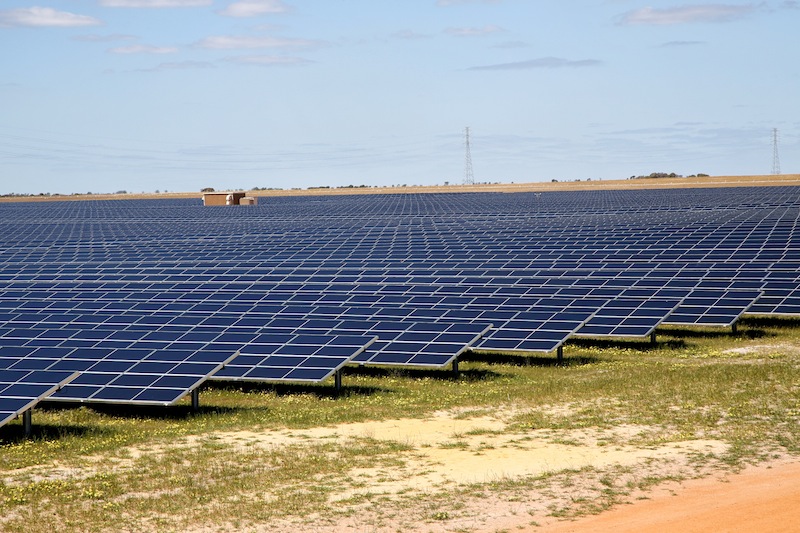 ‘Business as usual’ for Government agency part-funding Broken Hill and Nyngan Solar Farms, ABC News 10 April 14 Gavin Coote A solar farm at Broken Hill in far-western New South Wales will still go ahead, despite the contractor’s uncertainty about future renewable energy investment in Australia.
First Solar is building the Nyngan and Broken Hill Solar Farms, but is reconsidering its future investments because of uncertainty surrounding the Federal Government’s Renewable Energy Target.
The Australian Renewable Energy Agency, or ARENA, is an independent government agency and is helping fund the solar farm, along with the NSW Government.
The Agency says it won’t comment on any future projects in western New South Wales until they are signed off financially, but says it’s business as usual for the ARENA’s current programs, including those at Nygnan and Broken Hill…… “It is business as usual for ARENA, we are continuing to manage our existing projects and to assess and progress proposals we receive in accordance with our procedures and decision making processes.”….http://www.abc.net.au/news/2014-04-09/broken-hill-solar-farm-still-on-track-despite-investor-uncertai/5376866
First operating wave energy array scheme in the world, in Western Australia
 Western Australia wave energy project on the brink of commercialisation Oliver Milman theguardian.com, Wednesday 9 April 2014 A major sustainable energy plan has come closer to fruition with the launch of three giant buoys in Perth Australia could be set for a breakthrough in energy derived from waves, following the launch a major new project in Western Australia.
Carnegie Wave Energy unveiled three large buoys in Perth on Wednesday as part of a new $70 million technology which will feed energy into the Australian grid later this year.
The enormous buoys, called buoyant actuators, will be towed out into the ocean near Garden Island, off the coast of Perth.
The buoys will then be submerged and attached to underwater pumps. The movement of the ocean’s waves will cause the buoys to shoot high-pressure water through pipes which, in turn, will drive turbines and generators onshore, creating electricity.
The high-pressure water will also be fed into an onshore desalination plant, creating fresh water without the need for pumps.
Electricity and water provided by the project will be used by the department of defence for HMAS Stirling, Australia’s largest naval base, which is on Garden Island. The government, which has provided $13.1 million in funding through the Australian Renewable Energy Agency (ARENA), said the project will be the first operating wave energy array scheme in the world……
Ivor Frischknecht, chief executive of ARENA, said Carnegie should be congratulated for helping push forward the viability of wave energy in Australia.“Australia’s wave energy resources along our south and south-west coasts are among the best in the world and, importantly, can be reliably predicted days ahead,” he said.
“There is great long-term potential for wave energy in Australia, with a range of competitive Australian technologies being developed towards commercialisation.” http://www.theguardian.com/environment/2014/apr/09/western-australia-wave-energy-project-on-the-brink-of-commercialisation
Plan for underground mine at Ranger is high risk and low return
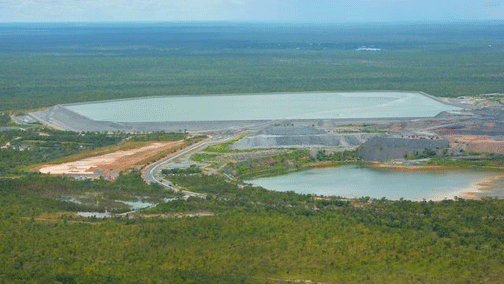 ERA told: Clean up Ranger uranium mine site and clear out rather than shifting underground, 9 April 14
http://www.abc.net.au/news/2014-04-09/era-urged-to-clean-up-ranger-uranium-mine-site-and-clear-out/5377698?section=ntPublic health experts have joined traditional owners and environmentalists in calling for Energy Resources of Australia (ERA) to focus on land rehabilitation rather than expansion of its Ranger uranium mine in the Northern Territory.
The company’s latest report shows that despite operations being suspended at the site since a toxic leak last year, plans to mine uranium underground continue.
ERA is holding its annual general meeting in Darwin today.
NT branch secretary of the Public Health Association of Australia, Dr Michael Fonda, says underground uranium mining poses serious health risks. One of the main things that is concerning us is that they [miners] are going to be exposed to dangerous levels of radon gas,” he said. Dr Fonda says ERA has a troubling safety record and it cannot be trusted to ensure safe work practices for the underground uranium mining.
“What is being planned for the R3 Deep’s expansion is for very large extraction fans to take much of that radon [gas] out of the mine,” he said.”I am concerned, and the Public Health Association is concerned, that will not be enough.”
Australian Conservation Foundation (ACF) national nuclear campaigner Dave Sweeney says ERA should focus on land rehabilitation in the final years of its mining lease. “Realise this is high risk and low return,” he said.
“Instead of accepting the inevitable and cleaning up and exiting, and having a staged and a costed and managed rehabilitation of the Ranger site, ERA is increasingly desperate and is chasing the illusion of dollars by going underground with the Ranger 3-Deep project.”Mr Sweeney says ERA and its parent company Rio Tinto should realise the planned underground mine is high risk and low return.
Indigenous traditional owners have expressed concerns that ERA will not have enough money to follow through on rehabilitation plans for the mine, which is near Jabiru and inside the boundaries of Kakadu National Park.
Australia-Japan joint military exercises (China won’t like that)
Abe, Abbott agree on joint research on submarine technology, Kyodo News International April 7, 2014 Global Post Prime Minister Shinzo Abe and Australian Prime Minister Tony Abbott agreed Monday to conduct joint research on submarine-related technology as part of efforts to bolster bilateral security ties under Japan’s new policy on defense equipment.
The agreement reached during a summit between the leaders in Tokyo came nearly a week after Japan relaxed its arms export ban by adopting new principles and guidelines for the first time in nearly 50 years.
Abe and Abbott picked marine hydrodynamics used for submarines as the first area of bilateral cooperation. The Japanese and Australian defense and foreign ministers will meet in Tokyo in June and work out details. “We confirmed that we will expand practical cooperation to include joint exercises,” Abe told reporters after the summit. …….http://www.globalpost.com/dispatch/news/kyodo-news-international/140407/abe-abbott-agree-joint-research-submarine-technology
The end of an era for Energy Resources of Australia’s uranium mining in Kakadu
 The ERA of uranium mining is over http://www.onlineopinion.com.au/view.asp?article=16200, Dave Sweeney 9 April 14, In the early hours of Saturday December 7th 2013 the evacuation order was given in the processing area of Energy Resources of Australia’s troubled Ranger uranium mine in Kakadu.
Minutes later came the unforgiving sound of peeling metal followed by a surge of over one million litres of highly acidic uranium slurry from the buckled and broken number one leach tank. The toxic tide swept over the concrete bunds meant to contain any spills and moved uncontrolled through the night and the site.
Four months later and ERA remains under pressure, under performing and under scrutiny. Mineral processing remains suspended at Ranger pending the findings of a federal government review of the tank collapse and this week the ERA board and management will face sceptical shareholders and no doubt plenty of critical questions at the company’s annual meeting in Darwin. Continue reading
1 This month


Help Aunty Sue Protect Her Land and Sacred Sites From Destructive Rocket Testing.
.

Australians deserve the truth
about
AUKUS – https://aukuspublicinquiry.com/

PETITION – To: Prime Minister Anthony Albanese and the Australian Labor Government

of the week – Australians for War Powers Reform (AWPR)
To see nuclear-related stories in greater depth and intensity

