Western Australia rules out uranium mining policy change amid nuclear energy push from Peter Dutton

ABC Goldfields / By Jarrod Lucas, 8 Aug 24
In short:
WA Mines Minister David Michael has ruled out any change to the Cook government’s long-standing policy on uranium mining.
There is an effective ban on mining the mineral in WA, where only one uranium mine is permitted to operate.
Peter Dutton says the ban is “ideologically based” and should be overturned.
Western Australia’s mines minister has rejected calls from federal Liberal leader Peter Dutton to overturn the state’s long-standing ban on uranium mining and insisted that future energy needs will be met by renewable sources.
The state has had an effective ban on mining the nuclear fuel since Labor was swept to power in 2017, while Mr Dutton has made nuclear power development the centrepiece of the Coalition’s energy policy.
Speaking on the sidelines of this week’s Diggers and Dealers Mining Forum in Kalgoorlie-Boulder, Mr Dutton said the WA policy should be scrapped.
But WA Mines Minister David Michael, who attended the final day of the forum, poured cold water on the idea and said the state government’s stance on uranium would not be changing anytime soon.
“WA Labor, for two elections, has committed to not approving any uranium mines and there is no intention to change that policy,” Mr Michael said……………………………………………………………………………………..
Mr Michael said he spoke with officials from Deep Yellow at Diggers and Dealers and believed renewables such as wind, solar and battery storage were a safer bet than uranium.
“I think it’s more important to focus on critical minerals in terms of the renewable future,” he said.
“We know that renewable energy is what the world moves to sooner or later.
“We know that’s what we need to tool up for in WA, and we’re doing it.”…………………………………………………………. more https://www.abc.net.au/news/2024-08-08/wa-uranium-mining-policy-to-stay-despite-nuclear-energy-push/104196130
For Australia, AUKUS and the planned nuclear submarines create more problems than solutions
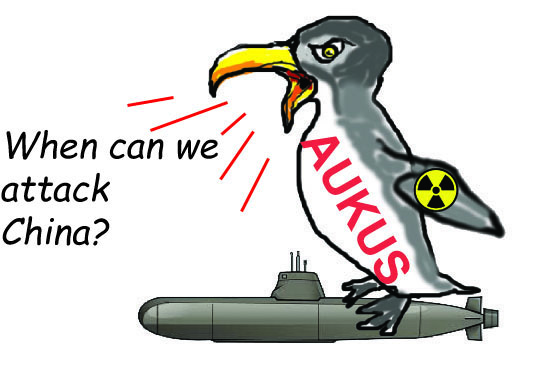
Preposterous’: AUKUS creates more problems than solutions THE AUSTRALIAN,
The timelines for Australia’s transition from ageing Collins-class to its first nuclear-powered sub just don’t add up. There is hardly a single strategist in the country who believes it will happen. By CAMERON STEWART 10 Dec 21

Now that Australia has finally weathered the diplomatic fallout caused by the creation of the three-nation AUKUS pact, it is time to work out exactly what it means for the nation’s security.
The Morrison government faces a series of critical multi-billion dollar decisions in the coming year that will set the course of Australia’s maritime defence for the next half a century.
These will require Canberra to test the limits of its alliance with both the US and the UK to ensure they make good on their AUKUS promise to share their sensitive nuclear know-how to help Australia acquire a nuclear-powered submarine fleet.
………….But the not-so-good news is that AUKUS has delivered as many conundrums for Australia as it has solutions.
………. the AUKUS announcement and the related scrapping of the French submarine project offers far more problems than solutions.
The timelines for Australia’s transition from its ageing Collins-class submarines to its first nuclear-powered submarine just don’t add up. Put simply, unless something changes, Australia risks having either no submarine fleet or a grossly antiquated one in the late 2030s and early 2040s……..
The government has given itself up to 18 months from the AUKUS announcement in September to study its options, although it says it hopes to decide on a plan of action earlier.
………………… The trouble is that the government’s initial projection for the completion of the first of eight nuclear-powered submarines, which it claims will be built in Adelaide, is not until 2038, meaning it would not be brought into naval service for another two years after that, in 2040, with one new nuclear boat every three years after that. This timetable is hugely ambitious and there is hardly a single strategist in the country who believes this will happen. The lessons of naval shipbuilding in Australia is that a first-of-class boat is never completed on time, much less the building of a nuclear submarine – easily the most complex construction of its kind in the country’s history.
……….
The solutions that have been floated, in no particular order, are to shorten the process by building at least some of the nuclear submarines overseas rather than in Australia; lease nuclear submarines from the US or UK; build a new conventional submarine in Australia as an interim measure; or extend the life of the Collins for a second refit cycle, meaning they would be sailing into the 2050s.
Every one of these proposals is problematic.
………………….. if the government chooses not to build a new conventional submarine and it deems that the Collins can be extended only for a decade, rather than two decades, then the only option is to acquire nuclear submarines more quickly than the current 2040 guideline.
This is the option that Dutton is pursuing but it requires delicate diplomacy with Australia’s AUKUS partners. First, Dutton must decide whether to ditch the government’s intention to build the eight nuclear submarines in Adelaide. While building all boats here will maximise Australian defence industry content, it will almost certainly slow the project down compared to a decision which would allow at least the first few boats to be constructed in US or UK shipyards.
Second, Dutton must choose between acquiring the US Virginia-class or the UK’s Astute-class submarines. Neither the UK nor the US production lines have room to include Australian boats in the foreseeable future. Dutton would need to lean heavily on London or Washington to make room for Australian boats to be constructed in their own shipyards. In the US, it would probably require Australia to partly fund a third shipyard to build the Virginia-class boats because the current two shipyards are struggling to keep up with the orders of the US Navy.
Hellyer believes the choice between the two countries is simple. “With nuclear submarines, we are not just picking a boat we are picking a strategic partner and that can only be the US,” he says…….
However, ditching the British submarine option would require delicate diplomacy from Canberra given that Britain’s prime minister Boris Johnson promised that the AUKUS deal would create “hundreds” of highly skilled jobs across the UK and would reinforce Britain’s place “at the leading edge of science and technology”.
The Morrison government appears to have gone cold on the option of leasing nuclear submarines to get them into the navy earlier. On closer inspection, neither the UK or the US have submarines available to lease. And in any case, Australia does not have the crews or the skills to sail them.
It will take at least a decade and probably longer for Australia to be able to train enough crew to the high levels required to man a nuclear-powered boat. A vast amount of that training will need to be done in the US or UK while Australia builds up the nuclear infrastructure and knowledge that will be needed to crew, maintain and manage a nuclear fleet.
All of these options amount to multi-billion dollar decisions by the government. If the wrong option is chosen, it will not only hit taxpayers, but it could severely compromise the country’s defence for decades.
The stakes could not be higher as the government moves to turn AUKUS from rhetoric to reality. www.theaustralian.com.au/inquirer/aukus-gives-us-more-problems-than-solutions-and-our-safety-is-at-stake/news-story/fff5b011740957f5cc246eb641408894
Hidden in mainstream Olympic Games news – an incisive comment on nuclear costs!

This naughty journalist understood that the news, at the present dragging-on time must be dominated by the Olympic Games, and nothing else matters.
So he wrote in a half page article -a quarter of a page virtuously all about the Olympic Games. Then – shock horror! He aberrated!
Taxpayers will come dead last at the Brisbane Games
Shane Wright, The Age, Business Section, 6 August 24
“……………………….There are myriad reasons why these costs blow out. Governments have a political incentive to under-estimate so they can win taxpayers over to the idea. Requirements for sports change. Organisers ignore inflation risks. And they have strict deadlines, which means paying whatever it takes to get everything ready on time………………….
Last year, Flyvberg and Dan Gardner published a book, How Big Things Get Done — a text that should be mandatory reading for every politician and engineer.
Based on a global database covering 16,000 major projects (including Olympic Games) from around the world and their cost to taxpayers, and stripped of the usual political spin used by every government and political party to sell their projects, it shows the single largest cost overruns for major projects are for nuclear storage projects. In third place is nuclear power itself. Taking out the silver medal for cost overruns is hosting the Olympic Games.
Of note to Dutton should be that the average cost blowout for nuclear storage is 238 per cent, with just under half of all projects suffering an overrun of at least 50 per cent.
Then, there’s nuclear power itself, where the average cost overrun is 120 per cent (the research covers almost 200 separate power plants). In terms of dollars, that means those who think – and will potentially promise voters – the nuclear dream will cost $10 billion will actually wind up billing taxpayers about $22 billion.
Also worthy of note is that in 55 per cent of all nuclear power cases, the overrun is at least 50 per cent. Of that subset, the average blowout is 204 per cent. Again, in terms of dollars, that would mean the $10 billion nuclear program would actually cost a little over $30 billion.
The project with the lowest risk and lowest overall cost of overrun?
Solar power.
Ultimately, the choice is to believe the reality of 16,000 projects from around the world, or politicians who have every reason not to be upfront about the true cost of their various promises.
There’s just one winner in that race, and unlike the Olympics, nuclear blowouts can’t be fixed with a cardboard bed. https://www.theage.com.au/politics/federal/taxpayers-will-come-dead-last-at-the-brisbane-games-20240805-p5jzio.html
A revised AUKUS agreement. Dunno what it means yet
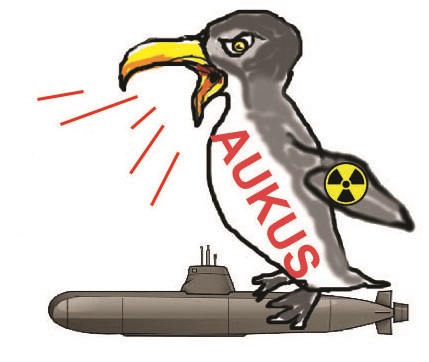
#Breaking. The White House has just revealed #AUKUS Govts have settled a new agreement to supersede the original AUKUS treaty. Significantly there is also an “understanding” including “additional related political commitments”. No details yet. 1/2
Letter to the Speaker of the House and President of the Senate on the Agreement Among the Government of the United States of America, the Government of Australia, and the Government of the United Kingdom of Great Britain and Northern Ireland for Cooperation Related to Naval Nuclear Propulsion
“………………………………………………….The Agreement, which would supersede the ENNPIA, would permit the continued communication and exchange of NNPI, including certain RD, and would also expand on the cooperation between the governments by enabling the transfer of naval nuclear propulsion plants of conventionally armed, nuclear-powered submarines, including component parts and spare parts thereof, and other related equipment. The Agreement also enables the sale of special nuclear material contained in complete, welded power units, and other material as needed for such naval nuclear propulsion plants. Equipment transferred in accordance with the Agreement could include equipment needed for the research, development, or design of naval nuclear propulsion plants, including their manufacture, operation, maintenance, regulation, and disposal, and could also include training, services, and program support associated with such equipment.
…………………………….The trilateral partners also concluded a non-legally binding Understanding Among the Government of the United States of America, the Government of Australia, and the Government of the United Kingdom of Great Britain and Northern Ireland (Understanding), which reflects the governments’ intended approach to certain articles of the Agreement and provides additional related political commitments. The Understanding would become operative on the date on which the Agreement enters into force
…………………………………Accordingly, I have approved the Agreement, authorized its execution, and urge that the Congress give it favorable consideration.
Sincerely,
Now is not the time for nuclear energy
Ian Thistlethwayte, Wyong, August 5, 2024, https://coastcommunitynews.com.au/central-coast/news/2024/08/now-is-not-the-time-for-nuclear-energy/
I agree with Gaye Clark (CCN 449) that “technology has advanced significantly” in the field of nuclear energy and have no doubt that it could, and maybe should, be in the energy mix in the future.
I contend, however, that now is not the time for this.
Many of us are unwittingly lending weight to the imbroglio which is “post truth politics”.
Hopefully, the advice of experts with backgrounds in science, engineering and thermo-nuclear energy production is of far greater value than what we are told by some politicians, the mainstream media and social media.
This advice includes observations that if Australia was to plan for nuclear power in 2025, we’d be unlikely to see any production from its source before 2040.
Further, what is being proposed so far will meet no better than seven per cent of the nation’s energy needs in 2040.
It has been widely agreed that an average 1.5-degree-Celsius rise in global temperatures since the beginning of the Industrial Revolution is the upper limit of what can be quite realistically managed.
The current trajectory of warming could lead to runaway climate change.
It’s likely the 1.5-degree rise has either been reached, or will be very soon.
While greenhouse emissions continue almost unabated, we now have renewables.
They work, are working, and are already helping.
Investment diverted from renewables towards nuclear power now and into the near future will result in greater rates of environmental destruction.
We still don’t know whether nuclear power will be affordable.
In Germany, nuclear has effectively been abandoned and renewables now produce more electricity than all forms of fossil fuel combined – 57 per cent at the beginning of 2024, up from 45 per cent in 2019.
The UK is not far behind this trajectory.
We’re at 35 per cent renewables, aiming for 82 per cent by the end of 2030.
In 2030, there won’t be a single nuclear power reactor on Australia’s horizon even if we start planning for one today.
The USA is at 22 per cent renewables, while each year, to pay for secure storage of radioactive waste, its citizens are taxed a total of $6B US and rising.
Clean? Yeah… nah! Eventually, yes?
Technology keeps advancing, but for governments worldwide to provide for the future safety and wellbeing of their citizens, the phrase “time is of the essence” seems most apt.
My final thoughts about Australia’s immediate future with nuclear: unclear.
Furphies being advanced by some people seeking to hamper the adoption of renewable energy.
Ultimately, they would undermine (pun intended) Australia’s clean energy sovereignty and exacerbate damage to our environment.
Nuclear energy as dead as dinosaurs

Dave Horsfall, North Gosford, August 6, 2024, https://coastcommunitynews.com.au/central-coast/news/2024/08/nuclear-energy-as-dead-as-dinosaurs/
Those in the anti-renewables lobby don’t give up, do they?
One could be excused for thinking that they have shares in the fossil-energy industry (and for the record, I do not have shares in the renewables industry, nor indeed any shares at all, as I do not believe in gambling upon the fortunes of a nation).
The latest offering is presented in CCN 449 (Time to rethink nuclear power), where not only is the since-discredited myth that wind turbines affect whales promulgated – which they do not, but I guess that alleged dangers to whales always make for a good story.
Apparently we are expected to believe that said turbines can suddenly uproot themselves and go cruising around of their own accord; either that, or ships’ captains are stupid or something.
Of course, no mention is made of how to safely dispose of the highly dangerous waste, nor indeed the reactor vessel itself once it’s reached its commercial end of life; then again, I guess these are just inconvenient truths.
Do these individuals really believe that they are more qualified than Australia’s peak scientific body – viz the CSIRO – which found that nuclear energy is the most expensive of all sources, and renewables the cheapest?
Nuclear energy is as dead as the dinosaurs; get used to it.
Australian Conservation Foundation’s X account suspended after apparent ‘report bombing’

‘I do believe we are being targeted and they are trying to silence us out of this space,’ ACF spokesperson says
Graham Readfearn, Mon 5 Aug 2024 https://www.theguardian.com/australia-news/article/2024/aug/05/australian-conservation-foundation-acf-x-account-suspended-report-bombing
The X account of the Australian Conservation Foundation was suspended for more than 24 hours with the charity saying it believes it is being “report bombed by pro-nuclear groups” seeking to remove negative commentary.
The environment charity’s X account @AusConservation was suspended on Sunday morning, sparking outrage among supporters. The account was reinstated late on Monday, but without the charity’s 32,000 followers.
An explanatory note on its account had said that “after careful review” the account had been suspended for breaking “X Rules”.
The founder of one Australian pro-nuclear group, Nuclear for Australia, celebrated the suspension on X – the social media company owned by free speech advocate and US billionaire Elon Musk.
Major companies last year suspended their advertising on the platform, formerly known as Twitter, after Musk said he agreed with an antisemitic tweet on the platform.
Musk later apologised and called the post his “dumbest”
The ACF’s director of engagement, Jane Gardner, said the organisation had been posting more nuclear content since the Coalition revealed it wanted to lift the country’s ban on nuclear reactors and build seven nuclear plants.
She said: “We have noticed on our posts [about nuclear] there’s plenty of people disagreeing with us, with people threatening to report our content. I do believe we are being targeted and they are trying to silence us out of this space.”
ACF has received another suspension on X for no reason. I believe we’re being report bombed by pro-nuclear groups.
This is not isolated: factual nuclear info from @renew_economy & @climatecouncil has also been removed from Facebook and TikTok recently.On X, Gardner wrote: “As Australia’s largest and oldest environment advocacy group, our content is always evidence based and never in breach of any platform’s rules.
“It’s no coincidence that pro-nuclear proponents are today publicly boasting about these repeated attempts to silence us.”
Conservation charity Friends of the Earth said on X the suspension was “ridiculous” and that “no environmental group is safe from censorship here”.
An economist at The Australia Institute, Greg Jericho, said the suspension was “an absolute disgrace”.
Gardner said after the account was reinstated: “I hope our followers will be re-instated, but we are still to hear from X about why our account was withdrawn, We’ve had no explanation.
“We are worried this could happen again and, if it does, we will have to make some decisions about whether we want to be on the platform.”
ACF’s X account was also suspended briefly last month, again after posting nuclear content. The account was reinstated, without explanation, within a day of that suspension.
Guardian Australia asked X in an email why ACF’s account was suspended and if the suspension related to complaints about particular content. An automated reply said: “Busy now, please check back later.”
Last month the not-for-profit Climate Council had a video critical of nuclear energy temporarily removed from the social media platform TikTok.
The renewable energy media outlet RenewEconomy last month had an opinion article written by the University of Queensland economics professor John Quiggin on the costs of nuclear removed from Facebook.
“Disgraceful:” Bowen demands answers as social media giants remove EV and nuclear articles

Giles Parkinson, Aug 5, 2024, https://reneweconomy.com.au/disgraceful-bowen-demands-answers-as-social-media-giants-remove-ev-and-nuclear-articles/
Federal energy and climate minister Chris Bowen has demanded answers from social media giants, and Facebook owner Meta in particular, after a series of articles supportive of electric vehicles and critical of the federal Coalition’s nuclear policy were removed from their platforms.
Last month, Renew Economy published an analysis on the soaring cost of nuclear power by leading economist John Quiggin. We attempted to post it in our feed on social media but Facebook removed it without explanation.
Other posts critical of the Coalition’s nuclear claims have also been removed, and readers report that their attempts to post the articles on their Facebook feeds had also failed.
On Friday, the Australian Conservation Foundation – which has also been critical of the Coalition’s nuclear policies, also had its page on X, formerly twitter, frozen, much to the delight of the pro-nuclear zealots, including the schoolboy funded by the deep-pocketed renewable critic Dick Smith.
“ACF has received another suspension on X for no reason,” the ACF’s head of engagement Jane Gardiner wrote on her account, which has not been suspended.
“I believe we’re being report bombed by pro-nuclear groups. This is not isolated: factual nuclear info from @renew_economy & @climatecouncil has also been removed from Facebook and TikTok recently. We are under attack.”
Last week, Renew Economy’s EV-focused sister site The Driven also had a post removed from Facebook by Meta. This time it was about the start of a new price war on electric cars, this time driven by MG. Facebook said it was because the article breached community standards.
Bowen said he was not impressed.
“This is disgraceful,” he wrote on X. “A news outlet publishes a straight and factual article about EV prices coming down and @Meta bans it.
“Social media has the responsibility to police disinformation and facilitate factual updates. Social media is of course full of climate disinformation. There is no excuse for Meta blocking this factual article. I look forward to Meta justifying this decision.”
Researchers have pointed to a network of so-called think tanks and fossil fuel ginger groups who have been ramping up their presence on social media, attacking renewable and EV technologies, and promoting coal and nuclear. Yet it appears these posts, often laughably wrong, are not taken down.
The fossil fuel industry is largely behind these actions because nuclear serves two purposes for coal and gas – it delays action on climate and emissions reduction by several decades, and causes coal fired power generators to stay open for longer and for new gas generation to be built. The social media giants appear to have taken sides.
Giles Parkinson is founder and editor of Renew Economy, and is also the founder of One Step Off The Grid and founder/editor of the EV-focused The Driven. He is the co-host of the weekly Energy Insiders Podcast. Giles has been a journalist for more than 40 years and is a former business and deputy editor of the Australian Financial Review. You can find him on LinkedIn and on Twitter.
About Peter Dutton’s claim that nuclear is cheaper than renewables.
Philip White – (letter to The Advertiser) 5 Aug 24
Nuclear proponents go to great lengths in an attempt to show that nuclear energy is cheaper than renewables. For example, in Monday’s Advertiser former Australian Nuclear Science and Technology Organisation boss Ali Paterson is quoted comparing France’s electricity rates with Australia’s.
That is like comparing apples with pears. There is a huge difference in the impact on electricity prices of existing reactors that have already been paid for, and new reactors that won’t generate electricity for another 15 plus years.
I would put much greater faith in an estimate by Monash University’s Roger Dargaville that power bills could rise by $1,000 a year under the Coalition’s nuclear plan.
And by the way, the only French nuclear reactor to be built this century is 12 years behind scheduled and more than 4 times over budget and it still hasn’t started operating.
America’s war machine: Unless Australia acquires nuclear weapons, why acquire AUKUS subs?
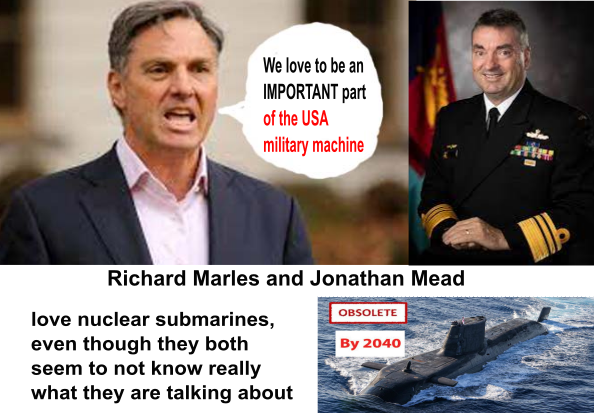
By Percy Allan, 3 Aug 24, https://johnmenadue.com/americas-war-machine-unless-australia-acquires-nuclear-weapons-why-acquire-aukus-subs/
Nuclear-powered Virginia Class and AUKUS submarines are a useful deterrent only if they carry cruise missiles with nuclear warheads that can be launched from their unique vertical firing shaft.
Then if a distant enemy nuked Australia, we could launch an instant nuclear retaliation from such submarines lurking off their coast for months without needing refuelling.
That’s called MAD – mutually assured destruction – both sides know that neither side could nuke the other without risking oblivion.
Australia does not have nuclear weapons, nor does it plan to acquire them.
Australia’s quest to become part of America’s armed forces
Australia is fusing its navy, air force and army with America’s military forces. It’s called shifting from “interoperability” to “interchangeability”. One senior Australian defence officer has explained it as follows:
“…interoperability is two organisations able to work together, share information through technology and systems, and operate effectively as a joint or combined team. The higher standard of interchangeability includes all that plus the ability to seamlessly exchange individual people, equipment, doctrine, and/or systems between trusted nation groups.”
In essence under “interoperability” there are two separate national chains of command working jointly, whereas under “interchangeability” there is single chain of command. Under the latter it is doubtful the junior partner could break the chain of command and insist it call its own shots if the senior partner got into a skirmish not of Australia’s doing.
Without nuclear arms Australia should not be a party to confronting China
As such the Australian mainland could be the first casualty in an American war with China because we would be the weak link in America’s war machine without our own nuclear weapons.
Australian owned Virginia Class and AUKUS submarines carrying cruise missiles with conventional war heads would not provide a meaningful MAD deterrence.
And we have no guarantee from America that if a foreign power nuked Australia, America would nuke it in turn since that could cause a nuclear attack on America itself.
Worse still, unlike America we do not have an air defence system to intercept missile and drone attacks on our capital cities nor will we have such a protective shield in the foreseeable future.
Australia’s choice – get nuclear armed or stay conventionally armed?
In February 1970, Australia signed the Treaty on the Non-Proliferation of Nuclear Weapons (NPT), which commits us not to acquire nuclear weapons and to champion non-proliferation gobally. Since then, we have been one of the treaty’s strongest supporters.
Given that very long-range submarines like Virginia Class and AUKUS are best suited for nuclear armed powers (US, UK France, Russia, China, India, Pakistan, Israel, and North Korea), Australia needs to make a choice:
- Break the NPT and the join the club of nine nuclear armed nations and risk provoking our biggest neighbour Indonesia to do likewise, or
- Scrap nuclear-powered submarines for conventional ones better suited for defending our coastline than patrolling China’s foreshores
Canada recently decided to buy 12 modern electric-diesel powered submarines for an estimated US$44 billion (versus US$ 268-$368 billion for Australia’s 8 Virginia Class and AUKUS nuclear-powered submarines) since its focus is on patrolling its own vast coastline not that of distant nations.
Marles’ rationale for nuclear-powered subs does not stack up
Australia’s official rationale for obtaining submarines that can stay under water almost indefinitely is that they will defend our world shipping lanes and undersea communication cables. But that’s not credible.
Each year there are 26,000 ship port calls involving over 3,000 different ships at 70 Australian ports according to Shipping Australia.
China is Australia’s largest two-way trading partner in goods and services, accounting for one third of our trade with the world. It is not in China’s interests to disrupt it.
Marles should explain how three nuclear submarines by 2039 or eight by 2055 can defend each of these ships doing 26,000 round trips from being sunk by enemy submarines, destroyers, or bombers. Note that only one sub in three will be at sea at any time with the other two in port for maintenance or training purposes.
Marles probably thinks that our subs would be assisted by America’s 67 nuclear submarines (China has only 12 but is planning to have 21 by the early 2030s). But what assurance does he have that America would prioritise Australia’s trade routes and shipping movements over its own?
As for the nearly one million miles of telecommunication cables lying on the ocean floor, submarines can’t protect them. To safeguard these optical fibres, they are covered in silicone gel and wrapped in multiple layers of plastic, steel wires, copper sheathing, polyethylene insulator, and nylon yarn. In the deep sea, ocean inaccessibility largely protects cables, requiring only a thin polyethylene sheath. Hence the navy won’t have a role in patrolling their security.
Israel lobby ramps up scare campaigns in fear of truth
By Bilal Cleland | 1 August 2024, https://independentaustralia.net/politics/politics-display/israel-lobby-ramps-up-scare-campaigns-in-fear-of-truth,18826
Israel lobby groups have increased efforts to silence those accusing the nation of genocide in Gaza, writes Bilal Cleland.
SHAIMA FARWANEH, 16, in the coastal displacement camp in al-Mawasi, west of Khan Younis, was preparing to make breakfast for her family on 13 July when the Israeli bombs fell.
Ninety people, mainly women and children, were killed and over 300 injured.
Shaima told Mondoweiss:
There is no country in all the world that does this to children, women, and civilians. This isn’t how wars are.
A leg hit me and I saw dismembered bodies a few metres away. I saw a young child screaming. He lost his lower limbs and was crawling on his hands and screaming. The bombs didn’t stop and suddenly the boy disappeared. I saw how he vanished before me while we ran and lowered our eyes to the ground, unable to do anything but run.
Israel in trouble
Following 7 October, by the end of 2023, from over 4,000 immigrants a month only about 1,000 a month were arriving in Israel. A 70 per cent decline.
In that same couple of months, about 470,000 Israelis fled.
As reported in Anadolu Ajansi:
‘Therefore, there is a negative migration of about half a million people, and this does not include thousands of foreign workers, refugees and diplomats who left the country.’
Despite the support given to Israeli Prime Minister Benjamin Netanyahu by the ruling parties across North America, much of Europe and Australia, one in four Israeli Jews and four in ten Arab Israelis would like to leave Israel according to a new survey. This reflects ‘a steady distrust with Israel’s political and military leadership’.
International institutions closing in
Haaretz published the stunning International Court of Justice (ICJ) findings on the Israeli occupation of Palestinian territory:
- Israel must end its presence in the occupied territories as soon as possible.
- Israel should immediately cease settlement expansion and evacuate all settlers from the occupied areas.
- Israel is required to make reparations for the damage caused to the local and lawful population in the Palestinian territories.
- The international community and organisations have a duty not to recognise the Israeli presence in the territories as legal and to avoid supporting its maintenance.
- The UN should consider what actions are necessary to end the Israeli presence in the territories as soon as possible.
The International Criminal Court (ICC) in The Hague is expected to issue arrest warrants for Netanyahu and Defence Minister Yoav Gallant within a fortnight.
Conflating opposition to genocide with anti-Semitism
The United States makes much of the role of the Iranian Council of Guardians selecting acceptable candidates for political office but ignores the role of its own Council of Guardians, AIPAC, which decides on suitable candidates for office.
U.S. Congressman Jamaal Bowman, once a recipient of lobby largesse, after seeing reality in Palestine on a J Street-funded excursion, called Gaza a genocide and said boycotts were legitimate.
Israeli lobby groups spent $9.9 million in a Democrat primary to get rid of him in favour of a supporter of Israel.
The scare campaign around rising anti-Semitism, which conflates criticism of Israel’s mass atrocities with prejudice against Jews, is a feature of most of the old colonial countries.
Mary Kostakidis, one of Australia’s most respected journalists, who speaks truth to power, has written regarding the Israeli genocide in Gaza:
‘In an effort to silence me, the Zionist Federation have filed a complaint with the [Australian Human Rights Commission] for racial vilification, aided by a reporter who can’t do his own research.’
The lobby levelled another case of harassment and suspicious accusations against a Palestinian Australian engaged in anti-genocide activity.
Hash Tayeh, who had to present himself to the police over alleged anti-Semitic comments, was not charged and his matter has been referred to the Office of Public Prosecutions.
His Caulfield Burgertory outlet was set on fire, allegedly by two men, on 10 November, an attack he claimed was linked to his involvement in a pro-Palestine rally and thus a hate crime.
Then we witnessed the arrest of a Palestinian activist in the Prime Minister’s electoral office.
Sarah Shaweesh, who was asking about the delay in visas for her family in Gaza, was arrested.
The office refused to help her.
She is a key organiser of the 24/7 Gaza sit-in protest in front of the PM’s office.
Complicity in genocide
In early March, Sydney law firm Birchgrove Legal lodged a communiqué to the ICC prosecutor claiming that the Australian PM and a number of other high-level local politicians are complicit in the Gaza genocide.
On Tuesday this week, it announced that the Office of the Prosecutor of the ICC had added the document:
‘“…to the evidence gathered as part of the ICC’s investigation into the Situation in the State of Palestine,” as well as having been transmitted “to relevant staff members for further review”.’
Meanwhile, Muslim Votes Matter is mobilising the anti-genocide vote in preparation for the next federal election.
Ted O’Brien sets out long-term plan for uranium-enrichment industry
Joe Kelly, THE AUSTRALIAN, 31 July 24
Opposition energy spokesman Ted O’Brien will call for Australia to develop a sovereign capability at the front end of the nuclear fuel cycle – including the enrichment, conversion and fabrication of uranium – as new survey results show a dip in support for nuclear power.
In an address in Adelaide on Thursday night, Mr O’Brien will sketch out a long-term national endeavour to strengthen Australia’s energy security, building on the Coalition’s plans to replace retiring coal-fired power stations with up to seven nuclear power plants.
Mr O’Brien’s long-term nuclear plan for Australia now includes three key planks: the unlocking of the nation’s uranium reserves; the building of nuclear power plants; and a longer-term plan to develop expertise across the front end of the nuclear fuel cycle that would involve the development of a uranium-enrichment industry.
The three-pronged plan is aimed at ensuring Australia can eventually be self-sufficient, and not have to rely on global supply chains for the nuclear fuel rods that will be needed to power a future fleet of nuclear power plants…………………….
“Advancing Australia in this direction would set Australia up for the future, not just economically, but also strategically.”
Mr O’Brien will speak about his longer-term vision at an energy event on Thursday night being hosted by the Institute of Public Affairs, where he will also make a case for Australia to develop the capability to export nuclear fuel…………………….
The speech follows SEC Newgate’s release of its latest Mood of the Nation report on Thursday, which reveals only moderate support for nuclear power and a clear preference for renewables and new transmission infrastructure.
The latest tracking survey of 2021 Australians over the age of 18, taken between July 17 and 23, shows support for nuclear is slightly lower than in April at 37 per cent, while 39 per cent of respondents say they are against nuclear, and 23 per cent are neutral.
The results show a clear preference for building large-scale wind and solar farms with new transmission lines (50 per cent of respondents prefer this option), rather than nuclear power plants that use existing transmission infrastructure (26 per cent of people prefer this option).
Support for the Coalition’s policy to build seven new nuclear power plants is 39 per cent, while 35 per cent of respondents say it makes them less likely to vote with the Coalition, and 26 per cent say it makes them more likely to vote for the Opposition at the next election.
Of those who oppose the Coalition plan, most objections relate to safety concerns (41 per cent say it is too dangerous). However, 19 per cent of opponents to the Coalition plan believe renewables are superior.
AUKUS servility just one facet of poor governance
By Paul KeatingJul 31, 2024, https://johnmenadue.com/aukus-servility-just-one-facet-of-poor-governance/
Richard Marles has the Navy out in force firing torpedoes at AUKUS critics.
On Friday last, Vice Admiral Jonathan Mead claimed the critics need to produce evidence of any challenges to AUKUS being realised, then on Saturday, Vice Admiral Hammond, Chief of Navy, raised his periscope claiming the AUKUS debate was being ‘hijacked’ by people with ‘specific agendas’ without indicating what these agendas might be or who was likely making them.
The fact is, what clearly is being ‘hijacked’ is national accountability – accountability for the most wayward strategic and financial decision any government has taken since Federation.
Despite AUKUS’s half trillion of budgetary cost and its dangerous strategic implications there has not been one Ministerial Statement explaining its rationale, its strategic policy objective or defending its hugely distorting impact on government expenditures.
Not a coherent or persuasive word has come from the Minister for Defence or for that matter, the Prime Minister, let alone from a parliamentary debate on what is significantly a seminal turn in the country’s strategic and defence policy settings.
Vice Admiral Hammond, ignoring Australia’s geography – its residence among populous and prosperous Asian states, fell back on the old Anglo glee-club adage ‘three developed nations who have over 100 years of shared history, heritage, values and sense of purpose.’

The likelihood is that Australia will not come into possession of nuclear submarines of its own making, but what it will certainly become is landlord and host to American nuclear submarines as the United States appropriates Australian real estate in its attempts, against all odds, to maintain strategic primacy in Asia. Odds that carry the likelihood of Australia being dragged into military skirmishes with China, or indeed, worse.
So irresponsible, secretive and smug has the government been in making its decision, that no amount of ‘hijacking’ by anyone else is likely to disrupt Australia from its current path of effectively falling into American hands, or at least, being abjectly at America’s beck and call.
Republished from Australian Financial Review, July 30, 2024
Prime Minister Albanese’s hypocrisy on matters nuclear
Reverse nuclear secrecy. Albo or Dutton? What’s the scam?
Michael West Media, by Rex Patrick | Jul 28, 2024
“……………………………………………………………………..At the same time, the Prime Minister has launched a full-scale attack on Dutton’s half-baked scheme to build seven nuclear power reactors. Albanese’s problem is that much of Labor’s critique of Dutton’s contentious plans applies to AUKUS too.
It’s hard to criticise power reactors when you’re the man who stamped approval on the $368B AUKUS program as you swung by the political Kabuki show in San Diego last year.
Which leaves the Prime Minister exposed as a hypocrite on an issue he would like to put at the centre of his election campaign. https://michaelwest.com.au/reverse-nuclear-secrecy-albo-or-dutton-whats-the-scam/
Jabiluka uranium mine lease not renewed in decision heralded as ‘huge win’

NT government opts not to grant 10-year lease after considering wishes of Indigenous people and federal government advice
Australian Associated Press, Fri 26 Jul 2024, https://www.theguardian.com/australia-news/article/2024/jul/26/jabiluka-uranium-mine-lease-not-renewed-in-decision-heralded-as-huge-win?CMP
The lease on the Northern Territory’s Jabiluka uranium mine will not be renewed, months after its remote surrounding area was granted new protections.
Energy Resources Australia (ERA) had applied for a 10-year lease renewal on the Jabiluka uranium mine, but was knocked back on Friday.
The NT mining minister, Mark Monaghan, said the decision to not renew was based partially on advice from the federal government.
“We have gone through a thorough process to ensure that all stakeholder views have been considered in this decision,” he said.
“The federal government advice, along with the wishes of the Mirarr people, were critical to this process and outcome.”
The Northern Territory government declared special reserve status over the Jabiluka area, which is in the surrounds of Kakadu national park, in May.
This prevents any future applications for the grant of a mineral title over the Jabiluka area once the current lease ceases on 11 August.
The Australian Conservation Foundation welcomed the decision, calling it a “huge win” for traditional owners.
“This decision allows a line to be drawn under the divisive era of uranium mining in Kakadu,” a statement read.
“This is a responsible decision that ends the threat that has hovered over this very special place for four decades.”
Mirarr people have long opposed any mining in the area, holding protests in the late 1990s and early 2000s when more than 5,000 people travelled to Kakadu to prevent uranium mining at Jabiluka.
Energy Resources of Australia, a subsidiary of the Rio Tinto Group, has been contacted for comment
1 This month.
20 September –National Day of Action in Melbourne on the International Day of Peace


Help Aunty Sue Protect Her Land and Sacred Sites From Destructive Rocket Testing.
.

Australians deserve the truth
about
AUKUS – https://aukuspublicinquiry.com/


PETITION – To: Prime Minister Anthony Albanese and the Australian Labor Government

of the week – Australians for War Powers Reform (AWPR)
To see nuclear-related stories in greater depth and intensity
 Antinuclear