History repeated, as again a Liberal government sees our country as the world’s radioactive waste dump
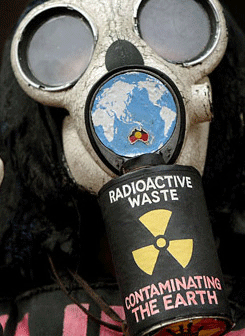 Australia isn’t the world’s dumphttp://conspiracyoz.com/2014/03/27/australia-isnt-the-worlds-dump/ Some bad ideas don’t die, and making Australia the world’s nuclear waste dump is one of them. A new report should remind us that even the waste we store now is unsafe, writes Dave Sweeney
If you sit in the one place long enough the whole world passes by. So goes one Buddhist saying. The same could apply to the news, especially stories with a long shelf life. And few things on earth have a shelf life like nuclear waste. The notion of Australia hosting the world’s growing stockpile of radioactive waste has been revisited, this time in a report by Deloitte Access Economics.
It’s an idea that has had many promoters over the years. Bob Hawke, Alexander Downer, Warren Mundine and the secretive Dr John White, a former energy adviser to John Howard, have all made the case for Australia making a dump for nuclear waste.
The idea has also been actively advanced in desktop and field studies with a consortium called Pangea Resources, largely funded by the US, UK and Swiss nuclear industries, targeting two areas in regional WA in the 1990’s as possible sites for a global dump. Pangea’s plan was derailed when a leaked copy of their slick promotional video was obtained by Friends of the Earth and made available to politicians and journalists ahead of the company’s timeline.
The resulting publicity saw much ducking, dodging and denial and subsequent legislation banning international waste dumping in Australia.
Unfortunately, it’s impossible to legislate nuclear waste out of existence. Its management remains the nuclear industry’s Achilles heel. The Deloitte report acknowledges as much, stating “many proposals to make greater use of nuclear power ultimately flounder on the issue of how to deal with the resultant waste. That’s eminently understandable”.
All nuclear processes create radioactive wastes that pose a direct hazard and need to be isolated from people and the environment for extremely long periods of time. We are now in the seventh decade of the nuclear age and, despite industry assurances, political promises and spending multiple billions in research and development, not one country on Earth has a final disposal facility for high level radioactive waste.
Radioactive waste management remains a complex, costly and unresolved issue and one that Australia, as a major global provider of nuclear fuel, has a responsibility to consider and address. Australia is home to around 35 per cent of the world’s uranium and our exports out of Darwin and Adelaide are the start of an increasingly contaminating industrial process.
After use in a reactor, Australian uranium becomes high-level radioactive waste. That’s on a good day. On a bad day it becomes radioactive fallout; let’s never forget that Australian uranium was fuelling the failed Fukushima nuclear complex when it melted down.
Closer to home Australia’s approach to radioactive waste management has been a case study in how not to approach complex policy development. For seven years now a community at Muckaty, north of Tennant Creek in Central Australia, has been in the government’s sights as the nation’s radioactive waste dump site.
 The majority of Traditional Aboriginal owners and custodians have never been asked, let alone given consent and the dump plan is in direct conflict with international industry best practice and Australia’s obligations under the UN’s Declaration on the Rights of Indigenous Peoples.
The dump plan remains secretive and hidden by “commercial in confidence” provisions. It’s far removed from Deloitte’s call for “a mature debate that weighs safety, cost, environmental impact, community sentiment and other dimensions of the issue”.
In June, the Federal Court will hear a case bought by Traditional Owners opposed to the dump plan who seek to get the Muckaty site nomination ruled invalid. That they would have to go to the courts is evidence of profound policy failure on the part of government. It is a failure that bodes poorly for any future moves or backroom agreements that seek to take Australia further down the nuclear road.
If we cannot get our own nuclear house in order it hardly inspires confidence in Australia as a solution to a global problem — a point again noted in Deloitte’s report, which acknowledges that domestic resistance and concern would make the idea unlikely to proceed.
Hopefully the Deloitte report might give a long overdue initiative some attention. Australia needs an independent, public and credible review of how best to manage our existing domestic radioactive waste — such as a national commission into responsible radioactive waste management.
We need to move away from short term political fixes based on legislative overrides and carrot and stick politics with disadvantaged communities and instead embrace and enact an approach based on transparency, credible community engagement, proper process and sound science.
Radioactive waste lasts longer than any economic advisor, community campaigner or federal politician. We have a shared responsibility to manage it maturely and securely.
Nuclear industry interests helped along by South Australian government

Dennis Matthews 27 March 14 Today’s (Adelaide) Advertiser contains an article about a new uranium mine in SA. Apparently the SA Government has given $50,000 of taxpayers money to the Ian Wark Institute at the University of SA for them to study a way of recovering the uranium from this proposed in-situ-leach uranium mine.
ANSTO is also involved. The Ian Wark Institute was set up by someone with a long history of involvement in the nuclear industry. I think he was involved in the early days of the Synroc project, another ANSTO project which seems to have fizzled out after spending umpteen million of taxpayer’s money.
Renewable Energy Target of great value to farmers
Farms rely on renewable energy target http://www.standard.net.au/story/2177788/farms-rely-on-renewable-energy-target/?cs=383 By SEAN McCOMISH March 27, 2014 WIND farm campaigners will launch a petition in the south-west next week calling on the federal government to preserve the country’s renewable energy target.

At least four major wind farm projects in Moyne Shire have been shelved until the government completes a review of the renewable energy target (RET) which sets a 20 per cent green energy goal by 2020.
Victorian Wind Alliance (VicWind) a coalition of manufacturers, energy groups and landholders will launch a petition next Tuesday in Yambuk and Portland. VicWind south-west organiser Angela McFeeters told The Standard the RET not only guaranteed income on farms but also supported jobs at Portland tower manufacturer Keppel Prince.
“In places like Yambuk people need to know if they’re going to have a future on the farm with the certainty of the guaranteed income,” Mr McFeeters said.
Campaigners will hand copies of the petition to politicians, including Wannon MP Dan Tehan who has previously expressed support for the green target.
Under the RET, turbines are subsidised thousands of dollars. A number of MPs, including Angus Taylor and Senator John Madigan, want to see the RET scrapped. In January Senator Madigan said the RET “means we are relying more on energy sources that are unreliable”.
According to Moyne Shire documents, construction has been suspended at the Hawkesdale, Ryans Corner, Woolsthorpe and Mortlake south wind farms until the government review is completed by September.
s.mccomih@fairfaxmedia.com.a
Court judgment on Andrew Bolt and Racial Discrimination

 Brandis Backs Down on Bigotry, ProBono Australia, March 27, 2014 Federal Attorney General George Brandis has watered down his controversial changes to the racial discrimination laws, however community organisations remain steadfast that no changes should be made to the current law.
Previously the Coalition Government’s proposed changes, as part of an election commitment, were to Section 18C of the Racial Discrimination Act (RDA) , which prohibit public conduct that is reasonably likely to “offend, insult, humiliate or intimidate” a person or groups because of their skin colour or national or ethnic origin.
However, the Government has announced that while continuing to repealing some sections of the Act a new section will be inserted which Senator Brandis claims will preserve the existing protection against intimidation and create a new protection from racial vilification……….
Co-Chairs of Reconciliation Australia, Dr Tom Calma and Melinda Cilento released a joint statement saying they are opposed to any changes to the RDA which weaken the protections against racial discrimination.
“The Racial Discrimination Act 1975 (RDA) currently ensures all Australians are protected from discrimination on the grounds of race, colour, descent or ethnic origin,” Dr Calma and Cilento said.
“Any changes to the RDA that weaken protections from racial vilification would pave the way to a less reconciled, just and equitable Australia. We therefore strongly oppose the current proposed changes to the RDA which repeal Section 18C.”
The Reconciliation Australia Co-Chairs said the use of defamation laws by politicians from both sides of politics was well known and exemplifies the balance between free speech and the need for citizens to be protected from scurrilous and false verbal attacks.
“We note that Section 18D of the current Racial Discrimination Act contains exemptions for ‘anything said or done reasonably and in good faith’ and, in the case of publishing, anything that constitutes ‘a fair and accurate report of any event or matter of public interest’.
“We note that in the key case against which the alleged free speech restrictions of the RDA are being measured – the Andrew Bolt case – the judge, J Bromberg, found that Mr Bolt contravened section 18C because the articles were not written in good faith and contained factual errors, and therefore not made exempt by Section 18D of the RDA.
“In his judgment J Bromberg found the Section 18D exemptions did not apply because of ‘….the manner in which the articles were written, including that they contained errors of fact, distortions of the truth and inflammatory and provocative language’.
“Section 18D does provide free speech protection for comments that may be considered offensive to many Australians as long as these comments are delivered in a reasonable and honest way.”
New South Wales Aboriginal Land Council has also condemned the moves to amend the Commonwealth Racial Discrimination Act………http://www.probonoaustralia.com.au/news/2014/03/brandis-backs-down-bigotry#
Queensland’s Premier Newman breaks promise to keep ban on uranium mining
 No apology for dumping Uranium mining ban on 2nd anniversary of election of the Newman Government Mark Bailey Keep Queensland Nuclear Free 24 March 2014 http://www.mysunshinecoast.com.au/articles/article-display/no-apology-for-dumping-uranium-mining-ban-on-2nd-anniversary-of-election-of-the-newman-government,33604?utm_source=rss&utm_medium=rss&utm_campaign=MSC_Feed#.UzNVFahdV9U With the second anniversary of the Newman government this week, it is timely to note there has been no apology from Premier Newman for dumping his promise to Queenslanders before the last election to keep the ban on uranium mining in Queensland.
Premier Newman was explicit when he said;
“We have no plans and that’s as clear as I can be. The parliamentary team are very, very clear that we have no plans to develop any sort of uranium mines in Queensland.” ABC 16 Nov 2011
Yet, two years on there is less than 100 days left until dirty and dangerous uranium mines are made legal by the Newman government with approval power likely to be handed to them by the Abbott Federal Government.The safety record of uranium mining in Australia has been appalling with over 200 recorded safety incidents at Ranger mine, which is still shut down after a toxic spill last year of a million litres of radioactive slurry.
Not a single closed uranium mine in Australia has been successfully rehabilitated to this day with the last mine at Mary Kathleen a toxic mess to this day.
Queenslanders do not want the risk of radioactive contamination of their waterways, from truck accidents near their homes and schools and they certainly don’t want uranium being exported across the Great Barrier Reef.The Newman state government should suspend their dumping of the twenty-three year ban on uranium mining forthwith and conduct an independent enquiry into all implications of allowing uranium mining in our state so that communities, schools and existing industries can have their say in this far reaching decision.
Tony Abbott’s ‘Direct Action’ ineffective as a curb on carbon emissions
 Direct Action subsidies: wrong way, Abbott, go back
Crikey, FRANK JOTZO AND PAUL BURKE | MAR 25, 2014 Nothing has happened since the election to challenge the view that the Coalition’s Direct Action plan for carbon reduction is vastly inferior to carbon pricing, write economists Frank Jotzoand Paul Burk at INSIDE STORY. Direct Action is often perceived as an exercise in keeping up appearances: a fig-leaf policy from a government that has expressed little enthusiasm for serious action on climate change. But with the possible neutering of the Renewable Energy Target, Direct Action subsidies are set to be the main pillar of Australia’s climate change mitigation effort as well as a new drain on our scarce fiscal resources.
The cornerstone of Direct Action is a system of subsidies for emissions-reducing projects, channelled through an Emissions Reduction Fund. In a nutshell, government will pay companies to implement specific projects that are thought to reduce emissions. It will “buy up the cost curve”, purchasing the lowest-cost emissions reductions first.
Not much more detail is available about the policy than was sketched before the election. The government’s December 2013 green paper leaves many of the most crucial questions open, including how baselines would be set, whether there would be a penalty for companies that exceed their baselines, and whether projects in all parts of the economy would compete directly or there would be separate pots of money for sectors such as agriculture, forestry and industrial energy efficiency.
The consultation process is under way and will no doubt reveal the competing interests of different groups. It is also no foregone conclusion that the Senate will vote in favour of the scheme.
When examined under a bright light — as we have done so inour submissions to the recent Senate inquiry on Direct Action — Direct Action doesn’t hold up at all well. Yes, it’s an attractive political phrase, the combination of two very positive-sounding words. Yes, the Coalition’s negative strategy surrounding carbon pricing has been politically successful. But as a piece of public policy for use in achieving either short- or long-term emissions reduction goals, Direct Action is fundamentally flawed.
From an economic point of view, the first weakness of Direct Action is that, unlike carbon pricing, it doesn’t offer the potential to pick all of the “lowest hanging” emissions reduction opportunities….. http://www.crikey.com.au/2014/03/25/direct-action-subsidies-wrong-way-abbott-go-back/
Australia’s regressive politics – rejected in South Australia?
De nnis Matthews, 26 March 14, Is it possible that South Australians are smarter than the average voter? The results of the state election would seem to support this proposition.
Just when it seemed that there would be a change of government many voters decided that they would rather stay with the devil they know. Signals from Canberra that the former liberal party, which in recent decades has become the conservative party, was now becoming the regressive party did not go unnoticed.
It appears that regressive politics is being foisted on everyday life with the new political correctness being intolerance, rudeness, and downright bigotry. This may work in political circles but is it the way a civilized society should behave?
Should politicians take their lead from decent citizens or should we follow the example of those in the houses of parliament?
The answer to this question may well shape Australia’s future.
INDIGENOUS Land Corporation drafts Bill to protect its funding
Leaders issue $2bn challenge for Abbott PATRICIA KARVELAS
THE AUSTRALIAN MARCH 25, 2014 INDIGENOUS Land Corporation chairwoman Dawn Casey has enlisted the support of the most powerful Aboriginal leaders to seek an emergency meeting with Tony Abbott to protect the $2 billion indigenous “land account”.
In an escalation of tensions between the government and ILC, the taxpayer-funded body has taken the unprecedented step of drafting its own bill that if passed into law would protect its funding from political tampering………
The land account and corporation were established after the High Court’s recognition of native title.
“More than 20 years on from the High Court’s Mabo decision and the passage of the Native Title Act, we want to remind Australians — particularly young people — that the land account was established as part of a national settlement that provided land-title certainty for all Australians,” Dr Casey said.
“The issues at stake are not just administrative arrangements, to be changed at the whim of a minister regardless of what political party.
“They go to the heart of the sort of nation we wish to be.” http://www.theaustralian.com.au/national-affairs/policy/leaders-issue-2bn-challenge-for-abbott/story-fn9hm1pm-1226863684812#
Australia’s Dr Helen Caldicott in Japan threatened with death for speaking out about nuclear power
 KPFA: Dr. Helen Caldicott threatened with death while in Japan for speaking about nuclear power — Students being charged with disturbing the peace for handing out flyers (AUDIO) http://enenews.com/kpfa-dr-helen-caldicott-threatened-death-japan-speaking-about-nuclear-power-students-charged-disturbing-peace-handing-flyers-audio?utm_source=feedburner&utm_medium=email&utm_campaign=Feed%3A+ENENews+%28Energy+News%29
KPFA Flashpoints, Mar. 10, 2014
Steve Zeltzer, reporting from Japan: We went to Osaka […] we were told there’s continuing repression. Activists here are being threatened, including Professor Shimoji who was arrested for handing out leaflets. The government is trying to suppress opposition to nuclear power by passing the secrecy law which just passed the parliament and also by intimidating antinuclear activists and saying they have to keep quiet. […] We also learned from Dr. Helen Caldicott that she was threatened. She spoke at a meeting in Kyoto on the 8th and it was reported at the meeting that she had been threatened by right-wingers with death for speaking out about the dangers of nuclear power. (correction – Dr Caldicott referred to previous incidents in USA, not Japan)
Full Flashpoints broadcasts available here
Renewable energy and carbon price are financial winners for Tasmania
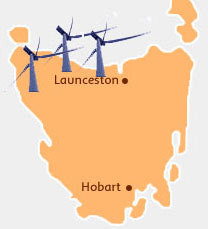 Tasmania wins from pollution price http://christine-milne.greensmps.org.au/campaigns/tasmania-wins-pollution-price 21 March 14, Since the government made big businesses pay for their greenhouse pollution, Tasmanians have come out ahead because the money raised is used to help low-income earners, and invest in clean energy.
Tasmanians who earned $80,000 or less got a permanent tax cut, and the amount you earn before you pay tax was increased from $6,900 to $18,200.
More than 295,000 Tasmanians had permanent rises in their Age Pension, Disability Pension, Carer Allowance, Newstart Allowance, Youth Allowance, Austudy and Abstudy payments, special benefits and Family Tax Benefit A and B.
Tasmanian businesses received $13 million in grants to help their energy efficiency, and $14.9 million went to farmers and landcare groups to protect our soil, wildlife and bush from the effects of climate change.
Part of the funding raised by the price on pollution is also being used to fund investment in more clean renewable energy and energy efficiency, including projects in Tasmania. Tasmania produces more renewable energy than any other Australian state. Selling our renewable energy to other states earns about $70 million for Tasmania every year.
This money is used to pay for our hospitals, schools and other important services. Producing renewable energy fits with Tasmania’s clean, green and creative brand which so many businesses rely on.
The appalling hidden history of what British settlement did to Tasmania’s Aborigines
 Invasion, Theft, Rape, Murder: The Aboriginal Holocaust in Tasmania Atlanta Black Star, March 19, 2014 by Runoko Rashid DEDICATED TO TRUGANINI “……..The first people of Tasmania, known as Palawa, were marked by tightly curled hair, with skin complexions ranging from black to reddish-brown. They had broad noses, wide mouths, and deep-set brown eyes. They were relatively short in stature with little body fat. They were the indigenous people of Tasmania and their arrival there began at least 35,000 years ago. With the passage of time, the gradual rising of the sea level submerged the Australian-Tasmanian land bridge and the Black aborigines of Tasmania experienced more than 10,000 years of solitude and physical isolation from the rest of the world……..
As early as 1804 the British began to slaughter, kidnap and enslave the Black people of Tasmania. Continue reading
Australian Senate votes against repealing the carbon tax
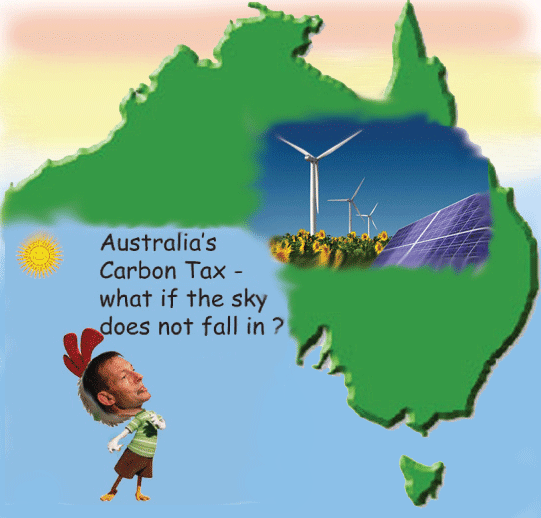 Senate votes to block carbon tax repeal legislation ABC News By political correspondent Emma Griffiths 20 March 14, The Senate has voted down legislation to axe the carbon tax – a core election promise of Prime Minister Tony Abbott.
After months of debate Labor and the Greens combined to vote against the repeal laws 33 votes to 29 today.Labor, which introduced the carbon pricing scheme in 2012, says the Coalition’s alternative policy to tackle climate change, called Direct Action, will be ineffective and too expensive.
“Without a credible alternative, Labor cannot support the abolition of the existing clean energy policies,” Opposition climate change spokesman Mark Butler said.Greens leader Christine Milne has issued a statement saying the current law, maintaining a price on carbon, must stand.”The Senate has rejected Tony Abbott’s do-nothing approach on global warming and voted to maintain the price on pollution,” she said.
The carbon pricing scheme was brought in by the Gillard Labor government, after extensive negotiations with the Greens, and currently charges polluters about $25 per tonne of carbon emissions……..
Earlier today, the Government had already reintroduced carbon tax-related legislation that could set the stage for a double dissolution election on the issue.The Coalition wants to axe the multi-billion-dollar Clean Energy Finance Corporation (CEFC) but the Senate rejected the legislation in December…….
The laws were brought back before Parliament this morning, and if voted down again would give the Government a trigger to call an election of both houses of Parliament……….http://www.abc.net.au/news/2014-03-20/senate-votes-to-block-carbon-tax-repeal-legislation/5334020
Australian Medical Association says wind farms do no cause adverse health effects
 AMA statement on wind power should reassure Australians says CEC http://www.renewableenergymagazine.com/article/ama-statement-on-wind-power-should-reassure-20140319 Robin WhitlockTuesday, 18 March 2014 The Australian Clean Energy Council (CEC) has welcomed a public statement by the Australian Medical Association dismissing claims of adverse health effects from wind turbinesThe CEC said that the AMA statement should provide additional peace of mind for communities living in the vicinity of existing or proposed wind power projects. CEC Policy Director Russell Marsh added that the AMA statement followed similar recommendations by health and acoustic bodies across Australia, to the effect that there is no evidence to link wind farms and adverse health effects.
“Other groups that have made positive statements on wind farm noise and health recently include the New South Wales and Victorian health departments, the South Australian Environmental Protection Agency and the Association of Australian Acoustical Consultants” said Mr Marsh. “The National Health and Medical Research Council, the national peak body for health research, also released a draft position statement several weeks ago that stated there was ‘no reliable or consistent evidence that proximity to wind farms or wind farm noise is directly associated with health effects’.”
Mr Marsh went on to report that no credible Australian health or acoustic organisations are opposing wind farms and that people should therefore feel reassured by that.
There has been a steady misinformation campaign in Australia over several years waged by those opposed to wind farms. This makes it even more important that developers of wind power projects should maintain good relations with the communities living in the vicinity of existing or proposed wind farms.
The CEC has now developed community engagement guidelines for wind farms in addition to a community expectations guide.
For additional information: Clean Energy Council (CEC) Community Engagement Guidelines
Palmer United Party to the rescue of Australia’s Renewable Energy Target?
 Renewable Energy Target – Even Clive Palmer Gets It http://www.energymatters.com.au/index.php?main_page=news_article&article_id=4227 Australia’s renewable energy sector has perhaps found an unexpected ally in Clive Palmer and the Palmer United Party (PUP). After PUP’s WA candidate, Zhenya ‘Dio’ Wang, expressed support for the Renewable Energy Target to be left as is and labelled the controversial RET review a ”waste of taxpayers’ money”, Mr. Palmer backed Mr. Wang’s views and told Fairfax Media he was a supporter of renewable energy.
Grassroots solar advocacy groups Solar Citizens applauded Mr. Wang’s public statement of support for the RET.
“Mr Wang’s media release of earlier today, which acknowledged the importance of the renewable energy target (RET) and the jobs it creates, is great news for all solar loving West Australians” said Lindsay Soutar, National Director of Solar Citizens.
“WA Senate candidates need to understand that West Australians want more renewable energy, and that’s why all parties should reveal their position on solar and the RET before Western Australians go to the polls.”
The Australian Solar Council also congratulated Palmer United Party (PUP) for pledging their support for the Renewable Energy Target to stay exactly as it is. “Politicians know Australians love solar because it cuts household power bills. They know that supporting the Renewable Energy Target at the Senate election will deliver them votes,” said Australian Solar Council Chief Executive John Grimes.
“Not supporting the Renewable Energy Target will cost them votes.”
The Council says it will be publishing a preliminary solar scorecard in The West Australian on March 22 to show where the various players stand on the issue of solar. It will also be engaging a substantial TV advertising campaign in the lead up to the WA Senate election.
“More than 12,000 Australians (1,200 West Australians) would lose their jobs if the Renewable Energy Target was axed”, said Mr Grimes.
Close to 150,000 households in Western Australia have installed solar panelsand many more have expressed and interest in doing so. Under the Renewable Energy Target, support is provided for the purchase of systems.
Call for electric highway in Western Australia
 Electric car devotees push for electric highway in Western Australia ABC News, By Claire Moodie 18 Mar 2014, Australia’s first ‘electric highway’ will be rolled out in Western Australia if Perth devotees of the cars have their way.The push is on for a network of charging stations in up to 35 towns in Western Australia’s south west, including the tourist getaway of Margaret River.
It would be a game changer for electric vehicle (EV) owners, many of whom currently think twice about leaving the city.”You can’t just drop into a petrol station,” said Patti McBain, whose converted Ford Focus has a range of about 125 kilometres.”You have to plug in somewhere.”…….
Kirsten Rose of the Sustainable Energy Association says Australia is lagging behind due to the lack of public policy on electric cars.”There is little or no support for getting these cars on the road at the moment,” she said. Ms Rose says Australia needs to follow the lead of the US and Europe and introduce financial incentives, such as rebates, if it is to get up to speed with the benefits of EVs.
The rest of the world is well ahead of us in this game. Motor Trade Association chief executive Stephen Moir “In our cities, air quality and air pollution is an increasing issue and EVs have no emissions so there is a very significant public health benefit that needs to be quantified,” she said.
The Motor Trade Association agrees incentives need to be introduced if electric cars are to move from a niche market into the mainstream. Chief executive Stephen Moir says although prices are falling, the average electric vehicle on the Australian market is about twice the price of its petrol equivalent.
The Electric Vehicle Association says while the upfront costs are high, the running costs are minimal. “Once you’ve bought the electric car or motorcycle, you’re looking at less than three cents per kilometre to drive whereas a petrol-powered car might be something like 12,” Mr Jones said.
“The fact that you can generate your own electricity on your roof for free and charge your car and drive around for free, is a winner.”And they need virtually no maintenance.”http://www.abc.net.au/news/2014-03-18/push-for-an-electric-highway-in-wa/5329442
1 This month


Help Aunty Sue Protect Her Land and Sacred Sites From Destructive Rocket Testing.
.

Australians deserve the truth
about
AUKUS – https://aukuspublicinquiry.com/

PETITION – To: Prime Minister Anthony Albanese and the Australian Labor Government

of the week – Australians for War Powers Reform (AWPR)
To see nuclear-related stories in greater depth and intensity

