Help BHP by making South Australia the world’s radioactive trash dump!
John Read: By storing more radioactive waste at Olympic Dam, the  struggling mine may remain profitable Adelaide Now,11 Feb 14….
For the last quarter of a century, WMC then BHP have picked the eyes out of the deposit, mining the richest, most accessible areas through expensive underground mining. Both companies have left staff, investors and governments in no doubt that underground mining is becoming increasingly unprofitable.
However, following an exhaustive study spanning over half a decade, BHP came to the conclusion that the mighty proposed open-cut expansion, deemed essential to guarantee the longevity of the mine and the best use of the resource, was uneconomical .
Every month that the mine continues to exhaust the feasible underground resource without initiating the open cut is a month closer to a Ravensthorpe-type decision when BHP will pack up its bat and ball and leave town.
When BHP singled out the poor performance of Olympic Dam at its recent AGM, hot on the heels of the announcement of imminent closures of Ford and now Holden , the Prime Minister and SA Premier have been left considering the unimaginable: closure of one of their prime assets……
If we want Olympic Dam to survive we need to rationalise our collective views on the nuclear industry and our management of radioactive waste……….
Olympic Dam, producing 70 million tonnes of radioactive tailings each year.
We need to acknowledge that the 40 cubic metres of radioactive waste generated by hospitals, research labs and the manufacturing industry each year and held in over 100 inappropriate storages around the country, is a minute fraction of what is produced and managed every year at Olympic Dam.
We should accept that the Olympic Dam region of northern SA was identified by a comprehensive nationwide search as the optimal region for an Australian radioactive waste repository……
By storing the national radioactive waste within or next to the Olympic Dam tailings dams, the struggling mine may generate sufficient revenue to remain profitable. http://www.adelaidenow.com.au/news/opinion/john-read-by-storing-more-radioactive-waste-at-olympic-dam-the-struggling-mine-may-remain-profitable/story-fni6unxq-1226822858616

Senate Inquiry found big faults in Australia’s uranium industry
Dave Sweeney: Nuclear pain outweighs economic gain for South Australia THE ADVERTISER FEBRUARY 10, 2014 “…….Since the Fukushima accident began in March 2011 there have been repeated and wide-ranging calls for an independent review of the costs and consequences of the Australian uranium sector, here and abroad. Predictably – and sadly – these have been ignored by uranium companies, the industry’s lobby association and successive Australian governments.
The most recent independent assessment of the Australian uranium industry – a Senate Inquiry in October 2003 – found the sector was characterised by underperformance and non-compliance, an absence of reliable data to measure contamination or its impact on the environment, and an operational culture focused on short-term considerations.
The small economic gain from uranium can mean big pain. There is a compelling case that Australia’s uranium trade is a major source of domestic and international risks and that an independent inquiry is needed into its effects on the environment, health, safety and security.
SA is blessed with renewable energy resources and is well placed to become a national and indeed global leader in renewable energy production. Renewables are the fastest-growing energy sector in the world and already provide more global electricity every day than the contested, costly and contaminating nuclear sector.
Radioactive waste, legacy mine sites and risky reactors all last far longer than the shelf-life of any politician or the tenure of any industry group. Uranium mining and the wider nuclear industry are high-risk, low-return sectors that pose unique, unresolved and long-lived threats.http://www.adelaidenow.com.au/news/opinion/dave-sweeney-nuclear-pain-outweighs-economic-gain-for-south-australia/story-fni6unxq-1226822892221
Cameco to decrease activities in Australia. Paladin shuts African mine
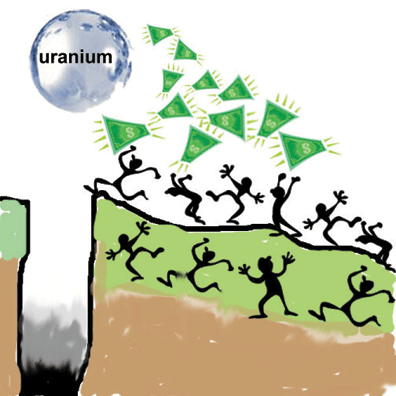 Weak uranium prices force closure of Paladin mine, Financial Review PETER KER AND ANGELA MACDONALD-SMITH 10 FEB 2014 Uranium miners are starting to cut back production amid a growing belief that the sector will not recover in the near term.
ASX listed Paladin Energy has confirmed one of its two mines will cease production until the uranium price recovers, while one of the world’s biggest uranium miners, Cameco, has cut its growth schedule and warned the ‘‘stagnant, over supplied’’ market was not going to improve any time soon.Cameco had previously promised to increase uranium production by 50 per cent over the next four years, but on Saturday the company said such long-term production forecasts were no longer appropriate in the current market conditions.
‘‘Market challenges have persisted since early 2011 and we expect they will continue for the near to medium term,’’ the Canadian company said in a statement.
Uranium prices have been on a downward trend since the Fukushima nuclear crisis damaged confidence in the industry in 2011……
Cameco deferred its Kintyre uranium project in Western Australia in 2012, and on Saturday it vowed to ‘‘decrease activities in Australia’’ even further.,,,,,,http://www.afr.com/p/business/companies/weak_uranium_prices_forces_closure_6Jq1zMnOONO3LAxC4jQkTM
Adelaide Citizens Demand Business South Australia Cease Nuclear Promotion Fraud
 8 Feb 14 A group of concerned citizens today issued a firm rejection of industry lobby group Business SA’s recent “demands (for) a nuclear industry in South Australia”.
The group’s spokes-person, mathematician Brett Stokes, has personally demanded that Business SA and AdelaideNow cease Nuclear Advocacy Fraud.
Stokes says “the economics are bogus – the ludicrous totally false claim of abundant cheap energy deserves condemnation as a malevolent fraud”.
Stokes cites the huge costs of construction and operational failures such as Chernobyl and Fukushima.
Stokes also notes that nuclear power reactors require huge amounts of cooling water and only operate 90% of the time at best.
Who’s behind Business South Australia’s push for nuclear waste dump
 The Editor
The Advertiser
Now that neither of the major political parties supports Business SA’s demand for a nuclear fuel and waste industry for SA (The Advertiser, 6/2/14) – one party calls it a “dangerous distraction”, the other “a long way off” (The Advertiser, 7/2/14) – then Business SA should put its money where its mouth is and publish the names of the companies it claims support its demand.
That way SA consumers can vote with their feet and perhaps Business SA might then be a little less outrageous in its political demands.
Dennis Matthews
At last! Notorious (Australian) Paladin uranium mine in Malawi shuts down
 Paladin uranium mine shuts, PAUL GARVEY, THE AUSTRALIAN FEBRUARY 08, 2014 PALADIN Energy has bowed to persistently low uranium prices and moved to stop production at its Kayelekera mine in the southern African nation of Malawi.
The mine, which has been in production since 2009, has been bleeding money in recent years……
- Last month Paladin sold a 25 per cent stake in its flagship Langer Heinrich mine in Namibia to China National Nuclear Corporation for $US190m, as well as debt refinancing.
Abbott’s Australia – the land of cover-ups and secrecy?

The ABC is uniquely placed.. because it is not beholden to commercial interests. Rather than leading the day’s news with a story about Justin Bieber, because that will generate the largest audience, Aunty tells people what they need to know.
Cover up and secrecy in Abbott’s Australia, Aljazeera, PM pans ‘unpatriotic’ national broadcaster for holding govt accountable to its electorate Fiona Broom, 7 Feb 14, Australian Prime Minister Tony Abbott has something in common with Egypt’s military government – he expects the government-funded Australian Broadcasting Corporation to be a cheerleader for the country and decries the reporting of stories which portray Australia negatively.
But while the Egyptian government has jailed Al Jazeera journalists for making Egypt look bad, Abbott has to find other methods of curtailing criticism. Continue reading
New Nuclear technology not really an option for Australia
The Australian government is under pressure from the USA nuclear lobby, and a bunch of entrepreneurial Australian types, to buy the (as yet only on paper) Small Modular Nuclear Reactors, based on Thorium as fuel.
Sure, let’s debate nuclear power – just don’t call it “low-emission” , The Conversation , Mark Diesendorf, Associate Professor and Deputy Director, Institute of Environmental Studies, UNSW at University of New South Wales 6 Feb 14,
“……..The technology trap Could new types of nuclear power station solve the problem?“Fast breeder reactors” produce more nuclear fuel than they use and so would theoretically have much lower life-cycle CO2emissions than existing “burner” reactors. But in practice breeders are even more complex, dangerous and expensive than burners. As a result they have been stuck at the demonstration stage for decades and even some nuclear proponents admit that breeders are unlikely to be commercialized for at least another two decades, if ever.
The government’s issues paper mentions the possibility of nuclear reactors based on the thorium fuel cycle, but these are also more complex than uranium-based nuclear energy and there are no commercial systems operating as yet.

Advocates of another possible option, nuclear fusion on Earth, recognize that it unlikely to become a commercial reality for at least three decades, if ever.
To sum up, based on existing commercial technology, nuclear energy is not a solution to the global climate crisis, because it will soon become too emissions-intensive. It is also not a short-term solution, because it is a very slow technology to plan and construct. It is dangerous and very expensive.
So why bother? There is already a better alternative to fossil fuels: the efficient use of renewable energy.http://theconversation.com/sure-lets-debate-nuclear-power-just-dont-call-it-low-emission-21566
Political bias at Australia’s ABC
 Status Update By Don’t blame me I didn’t vote for Tony Abbott POST BY PAGE MEMBER RICHARD O’BRIEN:
Howard government appointments:
Donald McDonald – Liberal Party member and long-time friend of the Howard Family.
Michael Kroger – Liberal party powerbroker and former president of the Victorian Liberal party. Member of the right-wing think tank the Institute of Public Affairs (“Ding!”)
Judith Sloan – Right-wing labour market economist, News Ltd Columnist and outspoken critic of the ABC. Associated with right-wing think tanks the Centre for Independent Studies, the HR Nichols Society and the IPA (“Ding, Ding!”)
Ross McLean – Former Liberal party MP for Perth.
Leith Boully – Member of the Murray-Darling CAC with close ties to the Liberal party. Former member of the NT Young Country Liberal Party.
Maurice Newman – Close friend and confidant of John Howard and founder of the Centre for Independent Studies, a right-wing think tank identical to the IPA (“Ding, Ding, Ding!”)
Janet Albrechtson – Right-wing columnist for News Ltd. Associated with the CIS and IPA (“Ding, Ding, Ding, Ding!”)
Ron Brunton – Former right-wing columnist for News Ltd. Climate change skeptic, critic of the stolen generations report and Director of Indigenous Affairs at the IPA (“Ding, Ding, Ding, Ding, Ding!”)
Steven Skala – Former director of the CIS (“Ding, Ding, Ding, Ding, Ding, Ding!”)
Keith Windschuttle – Right-wing historian. Outspoken critic of the ABC and regular keynote speaker for the CIS and IPA (“Ding, Ding, Ding, Ding, Ding, Ding, Ding!”)
Peter Hurley – President of the SA Hotels Association and major donor to the Liberal party and right-wing think tanks…oh bugger it (“Ding, Ding, Ding, Ding, Ding, Ding, Ding, Ding!”)
Jonathan Shier – Right-wing opponent of all public broadcasting. Was appointed with a mandate to attack the ABC but resigned after 19 months. Guess who called for this guy’s appointment. (“Ding, Ding, Ding, Ding, Ding, Ding, Ding, Ding, Ding!”)
Mark Scott – Former staffer to NSW Liberal minister Terry Metherell.
Rudd/Gillard appointments
James Spigelman – No known political affiliation.
Julianne Schultz – No known political affiliation.
Cheryl Bart – No known political affiliation.
Fiona Stanley – No known political affiliation.
Jane Bennett – No known political affiliation.
Five ABC board appointments fall vacant in the current government’s term.
GOVERNMENT IGNORES UN RECOMMENDATION THAT WE ASSESS FULL COSTS OF URANIUM MINING
“…..…Recommendation For Assessment Of Environmental And Societal Costs Of Uranium Mining Hansard Page: 13 Question Date: 18 November 2013 Senator Ludlam asked:
 Senator LUDLAM: It probably makes more sense to have your answer in front of me, rather than this back-and-forth across the table. What steps have been taken by the Commonwealth, or any agencies, or indeed your agency, to address the UN Secretary-General’s September 2011 recommendation that Australia conduct an in-depth assessment of the net cost impact of mining fissionable materials—that is, uranium—on local communities and ecosystems? It was an SG recommendation of 2011—…..
Mr McAllister: I can look into it, yes.
Mark Diesendorf points out that nuclear power is just NOT “low emission”
Sure, let’s debate nuclear power – just don’t call it “low-emission” , The Conversation , Mark Diesendorf, Associate Professor and Deputy Director, Institute of Environmental Studies, UNSW at University of New South Wales 6 Feb 14,
With environmental considerations constraining the further development of hydro-electric sources, nuclear technologies continue to present an option for future reliable energy that can be readily dispatched into the market.
This sentence appears in a passage dealing with the “move to low-emissions energy”, and although nuclear is not explicitly described as a low-emission option, it certainly looks as if the government is prepared to consider embracing nuclear power as part of an alleged move away from fossil fuel
Is nuclear energy really low-emission?

Unfortunately, the notion that nuclear energy is a low-emission technology doesn’t really stack up when the whole nuclear fuel life cycle is considered. Continue reading
Australia’s solar energy up against attack from Tony Abbott
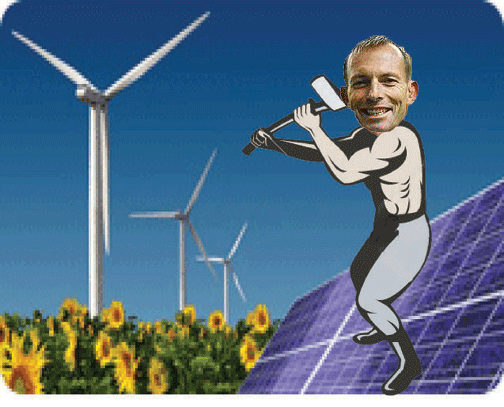 Australia’s solar industry prepares for battle, pvmagazine 06. FEBRUARY 2014 | BY: EDGAR MEZA The government of Prime Minister Tony Abbott looks set to gut the country’s Renewable Energy Target program. Critics accuse Abbott of having misrepresented his stance on renewables. Australia’s renewable energy sector is feeling increasingly threatened by the government of Prime Minister Tony Abbott.
In a report on Thursday in U.K. newspaper The Guardian, opposition Labor Party environment spokesman Mark Butler took Abbott to task. Butler accused the prime minister of having pretended to support the renewables industry before the election but said he was now “launching a full-frontal attack” on the sector…….
The Labor environment spokesman said Abbott had taken control of a scheduled review of the country’s Renewable Energy Target (RET), adding that the current ruling coalition may reassess the program due to increases in power prices.
Butler said Labor would continue to oppose the repeal of the country’s carbon tax when parliament resumes this month and added that the party was also preparing “to ramp up a community campaign in support of renewable energy.” The renewable energy sector has become increasingly alarmed at the possibility of the government drastically reducing or even abolishing the RET.
The Australian solar council has already launched a “save solar” campaign out of fear the government review will immobilize the industry by eliminating the target, which requires 45,000 gigawatt hours of power to be sourced from renewables by 2020 and provides a subsidy to people who install solar systems. http://www.pv-magazine.com/news/details/beitrag/australias-solar-industry-prepares-for-battle_100014143/#ixzz2se7wYtKC
Time for Australia’s Future Fund to stop investing in nuclear weapons
In 2011 the Future Fund barred all investments in companies that manufacture anti-personnel landmines and cluster munitions, but a loophole remains in the policy allowing the Fund to continue investing in nuclear weapon companies.
 Congratulations, Costello – now it’s time to give up the nukes Gem Romuld Outreach Coordinator International Campaign to Abolish Nuclear Weapons- Australia 5 February 2014Following yesterday’s announcement that former federal treasurer Peter Costello has been appointed Chair of the government-owned Future Fund, the International Campaign to Abolish Nuclear Weapons (ICAN) calls for a review the Fund’s investments in nuclear weapons companies.
Campaigners from ICAN visited the Fund’s Melbourne headquarters today to deliver a congratulatory card to the new Chair. “We’ve visited Peter Costello on the first day of his new job, to call on him to use his new Chairmanship as an opportunity to steer the Fund out of the nuclear weapons industry”, said ICAN spokesperson Gem Romuld. Continue reading
Brisbane Aboriginal activists to push for land rights and sovereignty
 Aboriginal News Aboriginal Way – National Indigenous Radio Service (NIRS) Lateral Love NIRS NEWS STORIES 05 FEBRUARY 2014 A number of Brisbane activists have formed a group to push for and further discussions on treaties, land rights and sovereignty.
Nganyaywana man Callum Clayton-Dixon is a co-founder of the collective and says treaties must be a grass-roots movement and not be administered by government bodies.
Mr. Clayton-Dixon says he welcomes Nigel Scullion and Warren Mundine’s recent interest in treaty talks and wants to bring the discussion into communities.
The hidden benefit of Australia’s carbon tax
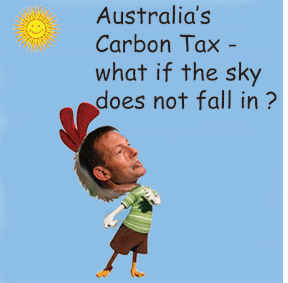 Big fall in electricity sector emissions since carbon tax Peter Hannam, 5 Feb 14 ENVIRONMENT EDITOR, THE SYDNEY MORNING HERALD “……..The premise of the debate about changes in emissions from last year is wrong, said Frank Jotzo, an associate professor at Australian National University’s Crawford School of Public Policy and deputy director, ANU Climate Change Institute.
“What matters is not the comparison with last years’ emissions levels, but with what emissions would be if it was not for the carbon price,” Professor Jotzo said. “Australia’s emissions have been on an increasing trajectory, projections without carbon pricing were for strong increases.”
“Now we’re seeing only very slight increases which is progress,” he said.
While the electricity sector is seeing the largest impact of the carbon prices, the impact is not as big as it would be if businesses believed that the carbon price was here to stay, Professor Jotzo said.
“To stop increasing emissions in transport and extractive industries like LNG would require a carbon price much, much higher than what is currently in place,” he said…….http://www.smh.com.au/environment/climate-change/big-fall-in-electricity-sector-emissions-since-carbon-tax-20140205-320a6.html
1 This month
17 October, Free Public Talk on Nuclear Issues in South Australia
David Noonan will speak on public interest concerns over the new Roxby Downs Indenture Act 2026 on BHP copper-uranium mining and ore processing in SA, and on how AUKUS may face SA with a High-Level nuclear waste agenda.
Dr Jim Green will discuss international developments in the field of nuclear power including ‘small modular reactors’ and Generation 4 ‘advanced’ nuclear reactor concepts.


Help Aunty Sue Protect Her Land and Sacred Sites From Destructive Rocket Testing.
.

Australians deserve the truth
about
AUKUS – https://aukuspublicinquiry.com/

PETITION – To: Prime Minister Anthony Albanese and the Australian Labor Government

of the week – Australians for War Powers Reform (AWPR)
To see nuclear-related stories in greater depth and intensity

