Abbott’e review panel is stacked against renewable energy !
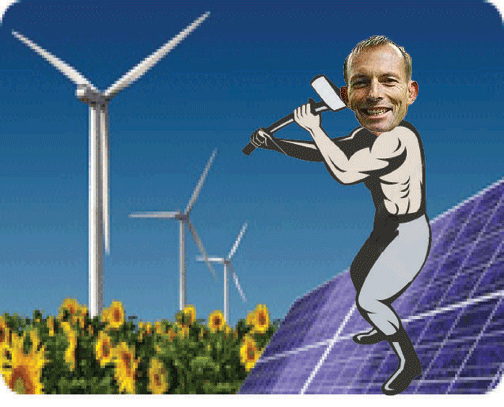 Renewable Energy Target Review Panel – Further Doubts http://www.energymatters.com.au/index.php?main_page=news_article&article_id=4191 25 Feb 14, The Federal Government promised an open and transparent RET review – but to some it’s appearing as a rigged game from the get-go.
The Sydney Morning Herald reports former Caltex chairman and climate change sceptic Dick Warburton, who is leading the panel, has declined to comment on whether he or his family hold any interests in fossil-fuel companies that might benefit from a reduction in the Renewable Energy Target.
It’s also been revealed that while Environment Minister Greg Hunt said all panel members had completed private interests declarations, “as is required to identify potential conflicts of interest,” Shirley In’t Veld, said she had not been asked to make such a disclosure.
Professor Ross Garnaut, economist and former advisor to the Labor Government, believes the Climate Change Authority should be carrying out the Review. According to RenewEconomy, Professor Garnaut believes the current panel is “comprised of people who have neither the independent status, nor the professional capacity of the executive in the CCA”.
Greens Leader Senator Christine Milne has labelled the Review a “hatchet job” and an “anti-renewable energy review”. Others have expressed similar sentiments.
The Small-scale Renewable Energy Scheme (SRES), a component of the RET, will have zero net cost impact on household power bills. Even so, the continuation of the program after the Review is anything but assured given the circumstances under which the Review is occurring; including recurring negative signals from Prime Minister Abbott.
The Review is already having somewhat of a dampening effect on Australia’s renewable energy industry, with some large scale projects being put on hold until the results are in and actions decided.
If the RET is abolished, up to 6,750 solar PV jobs could be lost and foregone nationally in under 5 years says the Australian Solar Council. If the RET remains unchanged, approximately 30,000 more jobs in the renewables sector will be created and another $18.7 billion in investment will occur.
South Australia gets wave energy unit to power 1,000 homes
 $7m wave energy unit heads to Port MacDonnell http://www.abc.net.au/news/2014-02-24/7m-wave-energy-unit-heads-to-port-macdonnell/5279420 24 Feb 2014, A 20 square metre wave energy unit will be towed from Adelaide to its position off South Australia’s south-east coast today.
The $7 million unit, developed by wave energy company Oceanlinx, will be tugged to Port MacDonnell. CEO Ali Baghaei says the unit will produce enough electricity to power 1,000 homes. He says the unit was meant to be connected to the grid last year but it was delayed.
“It’s been delayed because of weather and obviously it’s very important that we ensure that the unit commences its journey of four to five days during the best weather window period, as much as we can predict of course, hence why we have to assess the weather report and see what the tide master’s opinion is of the journey and so forth,” he said.He says it is a unique opportunity for South Australia.
“I believe that certainly this is the first of its kind, it’s the largest of its kind in the world, it’s one megawatt power and hopefully we will be able to demonstrate that successfully within coming months,” he said.
Conflict of interest in Abbott’s panel to review Renewable Energy Target ?
 Mr Warburton declined to say whether he or his family held any interest in fossil-fuel companies that might benefit from a reduction in the renewable energy target.
The Abbott government’s handling of the RET review may come under Senate Estimates scrutiny on Monday
‘ ‘I have zero confidence in the independence or rigour of this anti-renewable energy review,” Greens leader Senator Christine Milne said. ”It is no more than a hatchet job on the RET by a team of people notorious for their opposition to strong action on global warming or the roll-out of renewables.”
Disclosure doubts cloud renewable energy target panellists, February 24, 2014 – Peter Hannam Environment Editor, The Sydney Morning Herald Doubts have arisen over potential conflicts of interests of a controversial panel appointed by the Abbott government to review the Renewable Energy Target after contradictory statements about the process used to select its members.
The appointment last week of former Caltex chairman and prominent climate change sceptic Dick Warburton to head the panel had already ignited fears in the renewable energy sector that the government intends to slash the target of sourcing at least 20 per cent of electricity from clean energy sources by 2020. Continue reading
Draconian changes to South Australia’s Electoral Act
To The Editor The Advertiser, by Dennis Mathews, 21 Feb 14
 The Duopoly Election Bullies stand to gain from their draconian changes to the Electoral Act not only by excluding competition (The Advertiser,21/2/14) but whoever gets into government will get the revenue from candidates who lost their $3000 deposit.
If this system had been in place for the 2010 election the increased revenue would have been $268,000.
The changes to the Electoral Act were supposedly to prevent voters from having to fill out a very large voting paper for the Legislative Council and to prevent “gaming” through organized and complicated preference deals. The latter meant that voters had no idea where their preferences were going.
In actual fact the changes have affected both the Legislative Council and the House of Representatives, gaming will still occur in the 2014 election, and we may still get a very long voting paper for the Legislative Council.
Ironically we may end up with electing to the Legislative Council a candidate who lost their $3000 deposit because they didn’t get 4% of the primary vote.
Climate change hitting Adelaide earlier than predicted
 Hot weather in Adelaide already at levels not expected until 2030, says Climate Council report ,The Advertiser ELLEN WHINNETT HERALD SUN FEBRUARY 17, 2014
THE frequency of hot-weather days in Adelaide has already reached levels previously not expected until 2030, according to a report by the controversial Climate Council.
The council — the publicly funded version of the official national climate authority cut off by the Abbott Government — will release its latest environmental report on Tuesday. It says heatwaves will become more common and severe in Australia and that Adelaide, Melbourne and Canberra are already experiencing more extreme-heat events.
Adelaide has sweltered through a summer of record-breaking heat, enduring two severe heatwaves and more days above 40C than in any summer on record.
The council report says Adelaide’s heatwaves are an average 2.5C hotter than they were half a century ago, and peak heat days are 4.5C hotter…….http://www.adelaidenow.com.au/news/south-australia/hot-weather-in-adelaide-already-at-levels-not-expected-until-2030-says-climate-council-report/story-fni6uo1m-1226829833961
Another radioactive spill at an Australian owned uranium mine
 Paladin Energy spills radioactive material at African mine, The Age, Peter Ker 17 Feb Another Australian uranium miner has been forced to clean up a spill of radioactive material.
ASX-listed Paladin Energy has reported a spill near one of its African mines, saying a truck carrying a container of uranium oxide from its Kayelekera mine in Malawi overturned while negotiating a curve in the road…….
The incident comes less than three months after ASX-listed Energy Resources of Australia (ERA) suffered a spill at its Ranger precinct in the Northern Territory. That spill is still under federal investigation and processing at the site has not resumed since.
ERA is majority owned by Rio Tinto, and the incident at Ranger occurred in the same week as a similar spill at a Rio Tinto mine in Nambia…..
The incident occurred just three days after Paladin announced it would cease mining at the loss-making Kayelekera until uranium prices improved significantly…..
Australian Conservation Foundation spokesman Dave Sweeney said the Paladin incident highlighted the risks that were inherent in mining uranium.
“We have seen costs rising and corners being cut right across Africa,” he said.
“Paladin have announced they are closing Kayelekera and this is a toxic and tragic way to say goodbye.”http://www.smh.com.au/business/mining-and-resources/paladin-energy-spills-radioactive-material-at-african-mine-20140217-32v7v.html#ixzz2td54yjQ1
Abbott govt to weaken safety regulations on uranium sales to India
There are indications that the Abbott government might be willing to dilute some of Australia’s monitoring safeguards
Australia seeks to draw India into tighter embrace with nuclear deal TNN | Feb 17, 2014, CANBERRA: Australia, which in the past has expressed serious reservations about New Delhi’s nuclear programme, appears extremely keen to close a deal to supply uranium to India. “We see it as a priority and want to move as quickly as possible. The political will certainly exists within this government,” Australia’s foreign minister Julie Bishop told reporters here even as the two countries were in the middle of their fourth round of talks for a civil nuclear cooperation agreement. …..
While she would not elaborate, the South Pacific Nuclear Free Zone Treaty, of which Australia is a member, is said to be one of them. (There’s also a narrower self-interest in finding a new market for Australia’s uranium producers.) …………..
Our National Parks are no place for uranium mines
By Dave Sweeney and Mia Pepper, 17 Feb 14 When we think of National Parks in Australia we generally think of places of renewal and natural beauty where we can take the whole family to recharge and reconnect with nature – places that draw international visitors to our shores looking for a taste of the wild places that have made our state famous.
Yet Western Australia’s largest National Park is current in the cross hairs of a Canadian company for a large scale uranium mining project. Right now the Canadian mining company Cameco is proposing to mine uranium in the Pilbara at Kintyre, in an area that has been excised from WA’s biggest National Park – Karlamilyi (Rudall River).
The area that contains the Kintyre uranium deposit is one of the most unique and diverse ecosystems in the country, including the fate 28 endangered, vulnerable and priority species. The proposed mine site is nestled between two branches of the Yandagoodge creek, which feeds springs and lake systems throughout Karlamilyi National Park and provides water for the communities of Punmu and Parnngurr.
On top of the question of the appropriateness of placing a uranium mine in an area well recognised for its unique and fragile environmental assets, the equation becomes even more fraught when the track record of the proponent – Cameco Resources – is given closer inspection.
Cameco’s track record overseas raises disturbing questions about the risks and potential impacts on this fragile desert ecosystem and the adequacy of the state systems that are meant to protect the people and the place. Cameco’s operating uranium mines in Canada have been dogged by leaks, floods, contamination and unsafe work environments.
Cameco has been through court over license breaches in the US, has been investigated for tax avoidance in Switzerland and has had Chinese companies turn back their leaking uranium shipments. Community division, lowering house values,community court actions and secret deals with the US military are all things that feature in reports about Cameco.
The company is also currently embroiled in a court action with the Canada Revenue Agency, which is seeking millions in unpaid tax between 2007 and 2013. Which all begs the question – is this the kind of corporate track record to which we should be willing to open up our National Parks?
Karlamilyi National Park should not be the testing ground to see if this company can operate safely or treat communities with respect without creating division.
Despite industry assurances and government promises the Australian uranium sector has a sorry track record of failed uranium mines, with leaks, spills and license breaches from exploration projects at Wiluna and Yeelirrie in WA to operating mines at Ranger in the NT and Olympic Dam in SA.
In fact there has never been single uranium mine rehabilitated successfully in Australia – Rum Jungle, Nabarlek, Mary Kathleen and more are all names associated with unresolved radioactive or acid mine drainage legacies.
Giving a blank cheque to a foreign company to operate a dirty mine in one of WA’s most special places is not smart politics or policy. It is a short term trade that would see a long term loss and an uncapped liability on the State and its tax-payers.
We all know from past experience both here and overseas that mining uranium is a risky business. Between the processing acids, heavy metals, radon gas, dust and radioactive mine waste there is a lot that can go wrong. This is sector facing strong opposition internationally with nuclear shut downs in Germany and Japan after the Fukushima disaster – a catastrophic natural and nuclear disaster fuelled by Australian uranium.
When you put this contaminated cocktail next to a National Park that is home to a network of ephemeral rivers and numerous endangered, vulnerable and priorityspecies then the stakes get even higher. WA can – and must – do better than this.
Dave Sweeney is the Nuclear Free Campaigner at the Australian Conservation Foundation. Mia Pepper is the Nuclear Free Campaigner at the Conservation Council of WA.
Australia’s Minerals Council out to stop climate change action, and start nuclear power
 Use G20 for power push: miners ANNABEL HEPWORTH THE AUSTRALIAN FEBRUARY 17, 2014 MINING giants will urge the government to use the presidency of the G20 to secure a renewed commitment to end global “energy poverty”, recognise coal as a cheap and plentiful fuel, and call for a national debate on nuclear power.
The powerful Minerals Council of Australia will today call on the Abbott government to urgently seek to reverse a move by the World Bank to restrict funding for coal-fired power generators in poor nations to “rare circumstances”.
And in a move sure to inflame tensions with environmental groups, the miners will ramp up calls for the repeal of the carbon tax and the phasing out of the renewable energy target, saying Australia now has some of the highest electricity prices in the developedworld largely because of “ill-judged policy interventions”…….. Continue reading
Energy Efficiency Target (VEET) Scheme saved Victoria from power blackouts
 Mixed Greens: Climate youth want 100% renewables in 10 years, REneweconomy, By Sophie Vorrath on 10 February 2014″……Power outages, sparked by the periods of extreme heat that have characterised Victoria’s 2013-14 summer, would have been much more common but for the contributions of energy efficiency, a new report has found. The report, released today by the Energy Efficiency Certificate Creators Association (EECCA), found that the Victorian Energy Efficiency Target (VEET) Scheme helped reduce peak demand by 187MM over the January heat wave. “Without the contribution from the VEET, the demand at 4pm on 16th January would have been 10,427 MW exceeding the previous electricity peak of 10,415 MW on 29 January 2009 in the lead up to the Black Saturday bushfires,” the report says. As well as saving over $500 million in the reduction of Victorian household and business energy bills, the report says the energy efficiency scheme reduced stress on infrastructure during the hot spell and likely reduced the prevalence of system black outs. Continue reading
South Australia – the hub of Australia’s pro nuclear propaganda
 They’ve resuscitated the plan for South Australia as the world’s nuclear waste dump, Online opinion, Noel Wauchope, 11Feb 14 , On February 9, with exquisite timing, Terry Krieg of the Australian Nuclear Forum delivered his fourth nuclear industry advertorial, on ABC Radio’s Ochkams Razor. Exquisite timing, because the South Australian election is on March 15, and Krieg’s talk on this prestigious science program is the latest effort of that State’s nuclear lobby to get their cause up as an election issue……. Labor and Liberal contenders are being very low-key about nuclear and uranium issue. The Herald Sun reports
Jay Weatherill : No (chance that SA will have a nuclear industry). I think it’s a dangerous distraction.
Marshall:, the Opposition doesn’t have a nuclear energy division, it’s a potential for the future but I think it would be a long way off.
South Australia’s nuclear push is undeterred.
Krieg presented a “timeline for how South Australia should embrace nuclear energy in the next three decades” . The plan includes Officer Basin as the world’s nuclear waste dump.This would be the first step to the full nuclear fuel cycle. BHP should help the State government to set up an infrastructure development program, and a nuclear education program in schools.and universities. ….
In 2013-2014 a new distinctly South Australian push has taken up the torch. Terry Krieg, from Port Lincoln, is just one of many……the heartland of Australia’s nuclear fuel cycle promotion is Adelaide……
Nathan Paine Chief Commercial Officer at the Property Council of Australia said: “The development of a domestic nuclear power sector could turn us into the “Dubai of Asia”. You’d almost be able to give every South Australian … when they turn 18, a cheque for $50,000 and a house”
Chris Burns, Rundle Mall Management Authority chairman said “What we’ve got unique resources for in this state are for nuclear energy… Never sell it, only lease it and bring it back here to bury it. I think that’s the industry for the state.”
I don’t know why this diverse group of people is so passionately in favour of the full nuclear power cycle and radioactive waste dumping for South Australia. I can only suppose that they see South Australia as an economically depressed State, and therefore envisage the nuclear developments as some kind of financial bonanza for the State.
I ponder that some academics might get a kind of glorious fame, in being Australia’s only climate “experts” who advocate nuclear power.
It distresses me that only one of people mentioned has any expertise in health and ionising radiation, nor in ecology. That person is Professor Pamela Sykes,who has been co-opted by the USA Department of Energy to try to prove how healthy low dose radiation is. http://www.onlineopinion.com.au/view.asp?article=16012&page=1
Nuclear waste dump plan for South Australia -uneconomic and uinrealistic
This reality is not linked to any red or green tape, but rather to the clear absence of economic returns. While the sector’s risks are significant, its economic contribution is not: in total it provides only around 650 jobs and $700 million in earnings – nationwide.
 Dave Sweeney: Nuclear pain outweighs economic gain for South Australia THE ADVERTISER FEBRUARY 10, 2014 IF South Australia moved further down the nuclear road by processing enriched uranium or storing nuclear waste, it would threaten the natural environment and put the state in direct conflict with federal policy, global markets and community expectations.
The call by Business SA to process enriched uranium and store nuclear waste stems from misplaced enthusiasm rather than measured assessment.
Any such call can only be made by ignoring the reality that the nuclear industry is, here and internationally, under intense political, regulatory and community pressure since the Fukushima meltdown in Japan.
A market analysis by economic forecaster Morgan Stanley shows the price of uranium has slumped by nearly 50 per cent since the Fukushima nuclear crisis, where Australian uranium became and remains global radioactive fallout. Continue reading
The facts on Abbott’s war on the environment and climate change action
War on the environment a distraction from climate change policy, The Conversation, David Holmes, 11Feb14 ,A fter almost six months in office, it seems that the Abbott government’s reputation for action on climate change and the environment in general is in tatters.
Overseas, condemnation has been directed at a government now labelled as the ‘most hostile to its nation’s environment in history’. And that assessment is made with scant attention to what the Coalition government is doing on climate change, where it has pulled out all the stops to bring climate change policy to heel before the interests of big coal and big mining.On the environment, the Abbott government has departed from the Howard years of striking a balance with conservation values and listening to the concerns constituents have for the environment.
Balancing economic growth with sustainability had been at the forefront of legislative and regulatory protection, including the Howard government’s Environment Protection and Bio-diversity Conservation Act (1999). But the scrapping of the Environment Defenders Office (EDO) is symbolic of the distinctive shift we are seeing with this government.he EDO has played a crucial role in providing free legal advice to communities that wish to question and challenge decisions, such as coal seam gas drilling or dredging of the Great Barrier Reef. But in the context of a government that is driven to extract‘every molecule’ of gas and every last seam of coal from the driest country on earth, it has deemed that opposition to mining is not to be tolerated.
The really bad news for climate change mitigation policy is that the Abbott government’s open season on the environment will distract Australian’s from climate policy settings, which is the one area to which all environmental issues will one day be subordinated…….
Australia is the only nation currently demolishing a working carbon price, which has, in its very short life so far, already mitigated 40 megatonnes of C02.
The administrative and advisory infrastructure put in place to tackle climate change has been all but eradicated. To rehearse the measures:
- Abolishing the Climate Commission
- Axing of COAG’s Environment Ministers Forum after 41 years.
- Scrapping the Biodiversity Fund, Clean Energy Finance Corporation and Environmental Defenders Offices
- Foreshadowing the abolition of the climate change Authority in July
- Cutting funding to the: Caring for our Country Program, Low Carbon Communities Program, and the Australian Renewable Energy Agency.Perhaps the decision invoking the most contempt relates to the Clean Energy Fund. Originally, the Abbott government had claimed that abolishing Clean Energy Finance Corporation will cost the budget A$439 million. However, it now transpires that investing in renewable energies is highly profitable, and the taxpayer is actually going to gain $760 million instead.
The contradictions here don’t stand up to even rudimentary analysis. On the one hand the Abbott government dogmatically claims that these cuts are economically driven, but this is patently false when it comes to the CEFC. ……http://theconversation.com/war-on-the-environment-a-distraction-from-climate-change-policy-22983.
Renewable Energy Target – a small cost for a big gain
this time, the renewable industry has grown and is planning to fight back with a marginal seats campaign and a public appeal to save the current Renewable Energy Target.
 Is $15 a year really too much to pay for renewable energy? The Conversation, AUTHOR Dylan McConnell Research Fellow, Melbourne Energy Institute at University of Melbourne,11 Feb 14 Australia’s Renewable Energy Target looks likely to be weakened or even axed, with the Prime Minister saying the scheme needs to be reviewed because it is causing “pretty significant price pressure”.
But does $15 a year sound like a “pretty significant” cost to you? Continue reading
Institute of Public Affairs dictates environment policy to Tony Abbott
 War on the environment a distraction from climate change policy, The Conversation, David Holmes, 11Feb14 “……The radical conservatism of the Coalition seems to be drawn from the same platform as the Institute for Public Affairs (IPA), which has entreated Abbott to ‘Be Like Gough’.
In a document posted on its website, the IPA declares open season on just about every publicly interested authority and organisation in Australia for which climate change ranks at the very top. Of 75 recommendations, climate change figures in four of the first six. These include:
- Repeal the carbon tax, and don’t replace it.
- Abolish the Department of Climate Change
- Abolish the Clean Energy Fund
- Repeal the renewable energy target
With recent talk that Abbott is about to appoint IPA ‘anti-renewable zealot’ Alan Moran to a new independent panel to review the Renewable Energy Target, it looks likely that all four of these recommendations will be ticked off nicely.
Nowhere on the planet is there a region that is going to feel the effects of climate change on its population than Australia, with heat-stressed soils, heatwaves, firestorms, flooding and cyclones. And yet, we have a government doing its level best to maximise measures that will only exacerbate global warming.http://theconversation.com/war-on-the-environment-a-distraction-from-climate-change-policy-22983
1 This month
17 October, Free Public Talk on Nuclear Issues in South Australia
David Noonan will speak on public interest concerns over the new Roxby Downs Indenture Act 2026 on BHP copper-uranium mining and ore processing in SA, and on how AUKUS may face SA with a High-Level nuclear waste agenda.
Dr Jim Green will discuss international developments in the field of nuclear power including ‘small modular reactors’ and Generation 4 ‘advanced’ nuclear reactor concepts.


Help Aunty Sue Protect Her Land and Sacred Sites From Destructive Rocket Testing.
.

Australians deserve the truth
about
AUKUS – https://aukuspublicinquiry.com/

PETITION – To: Prime Minister Anthony Albanese and the Australian Labor Government

of the week – Australians for War Powers Reform (AWPR)
To see nuclear-related stories in greater depth and intensity

