Toro’s Vanessa Guthrie optimistic in the face of uranium’s financial disaster
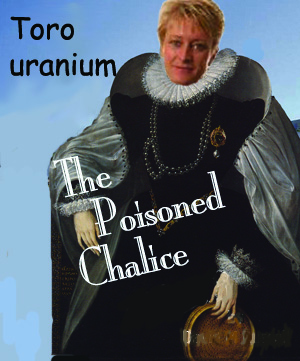 INTERVIEW -Uranium miners face new hurdles as Fukushima disaster worsens Reuters, Aug 21, 2013 By James Regan
* Uranium miners face uncertainty as new Fukushima nuclear disaster unfolds
* Australia’s Toro says need for new uranium mines still stands
SYDNEY, Aug 21 (Reuters) – Revelations of more toxic leaks from Japan’s Fukushima Daiichi nuclear power plant will raise second-thoughts about Japan’s nuclear future, but won’t halt the long-term global expansion of the industry, the head of a uranium mining company said.
“It reinvigorates the heightened state of nervousness, it surely will make the Japanese government and nuclear regulatory authorities more cautious and conservative in the decisions about the restart,” said Vanessa Guthrie, managing director of Australia’s Toro Energy Ltd, which expects to start mining uranium in Australia in 2016.
Japan is set to raise the severity rating of the leak to level 3, or “serious incident”, on an international scale for radiological releases, underlining a deepening sense of crisis at the site.
The price of uranium, used mainly as fuel for nuclear reactors, plunged after the March 2011 meltdown at the Fukushima plant 240 km (150 miles) from Tokyo and has struggled to recover ever since. August uranium futures stood at $35.15 per pound on Wednesday compared with $68 per pound before the earthquake and tsunami that triggered the disaster.
However, Guthrie said contract prices between uranium miners and buyers standing at around $58-$59 a pound more accurately reflect the supply and demand balance than the spot price.
Operating costs in the industry range between $22-$25 per pound up to the high $40s, Guthrie said……
Uranium spin from David Paterson – “emotion” is good, when it’s pro nuclear
 I have often been accused by nuclear lobbyists of beong – that awful thing “emotional”. An anti-nuclear person speaking out is “emotional” (obviously not sensible). Indeed, an anti nuclear woman is “hysterical”.
So I find it almost hysterical that Australia’s uranium propagandists are now being advised to be emotional – C.M .
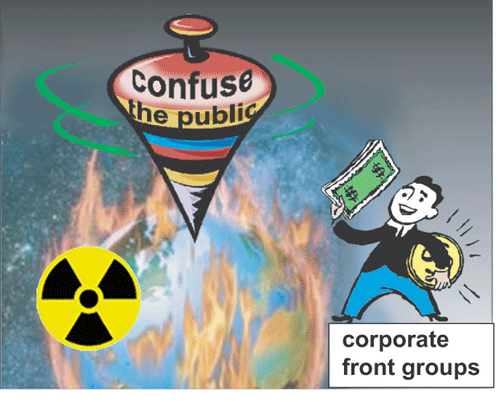 Coal seam gas industry has to work harder to win over critics August 21, 2013 Business Day David Paterson
- “……..Australia’s CSG industry could learn a few lessons from the way the uranium industry worked on its image during the past three to four decades…….
in 2006, the uranium sector sought to bring a more sophisticated approach to its advocacy on public policy and in the following years there were some substantial successes…… the Australian uranium industry made a number of fundamental changes to the way it approached policy debates that helped improve its public reputation.
For today’s CSG industry, there are five important lessons that could be learned from the uranium sector’s experience.
Firstly, hearts and minds will not be won by facts alone. Good advocacy requires reliable factual information, but emotions will play a surprisingly important role in even the most technical debate. Understanding this is the first step to developing a communications strategy that will resonate with audiences.
Secondly, the CSG industry must learn that the battle is all about trust. Building trust takes many things, from showing technical ability to emotional intelligence, and company representatives will need to have both. Continue reading
When you vote – how to manage the preferences maze
 Below The Line http://www.belowtheline.org.au/ Your vote. Your preference. Your deal.
There are over 50 small parties running in this election — does one of them suit your vision for Australia better than Labor, Liberal, the Nationals, or even Family First or the Greens?
In Australia, you cannot throw away your vote.
Well, you can vote informally but simply putting a non-major party as your first preference won’t mean your vote is wasted. If your first preference candidate isn’t elected your vote goes to another candidate instead.
If my vote isn’t thrown away, where does it go?……. Vote below the line! Yes, it’s a lot more boxes to fill in but that’s where we can help. We’ve decoded the parties’ preferences to show you exactly what that means for your vote. If you like what they’re doing, you can vote above the line and know your preference is doing what you want. But if it doesn’t we provide you with the tools to make your vote do what you want without the problems of having to work out who all those people are once you’re in the polling booth.
If you’re ready to give it a go, let’s get started!
Victorian Liberal Sarah Henderson supports the anti wind farm campaign

 Pollie Watch: Coalition candidate for Corangamite backs Baillieu’s anti-wind farm laws http://yes2renewables.org/2013/08/21/pollie-watch-coalition-candidate-for-corangamite-backs-baillieus-anti-wind-farm-laws/August 21, 2013 by Leigh Ewbank The Coalition candidate for Corangamite Sarah Henderson‘s support for renewable energy is in question as it was revealed she endorses Ted Baillieu’s controversial anti-wind farm laws. The revelation emerged in a community forum in Torquay on 13 August, in which Sarah Henderson expressed her support for the restrictive laws, saying that wind farms were “dividing communities.”
Of course, the only thing dividing communities are anti-wind campaigners and the restrictive laws preventing farmers from a drought-proof income stream. Ms Henderson’s claim wind farms divide communities ignores all of the available public polling which shows that three quarters of the community support more wind farms. Wind farms are even highly popular among Coalition voters.
The anti-wind farm laws Ms Henderson thinks is “good” policy has already affected one local proposal. Ted Baillieu’s anti-wind farm laws killed off the Surf Coast Energy Group‘s proposal for a community-owned wind farm, denying farmers a chance for a steady income as well as costing jobs in manufacturing, construction and maintenance.
Victoria’s restrictive wind farm laws also have implications for the Surf Coast Air Action group, who will release a detailed report on how Anglesea’s coal mine and power plant could be replaced by renewable energy sources, including wind energy.
Henderson’s endorsement of Victoria’s anti-wind farm laws may lead some to speculate whether her stance is influenced by her partner, state MP Simon Ramsay.
Mr Ramsay is associated with anti-wind farm campaigns. In 2012, Victoria’s shadow planning minister Brian Tee accused Mr Ramsay of misusing his parliamentary position to campaign against a wind farm near his property near Colac.
Poll after poll shows strong public support for wind farms. Yes 2 Renewables encourage Ms Henderson to reexamine her stance and adopt a position that aligns with mainstream views. It’s time for political leadership on wind energy, not more pandering to a noisy band of anti-wind farm campaigners.
Take Action
Greens maintain their stand for renewable energy, and mining tax
 Greens reiterate commitment to mining tax and renewable energy in election lead-up http://www.abc.net.au/news/2013-08-20/greens-reiterate-commitment-to-mining-tax/4900456 The Greens have launched their WA federal election campaign, naming the mining tax and renewable energy as focus points in the lead up to September 7.
The Greens say a 40 per cent tax rate for all big miners would not cripple the industry.
The party has already announced its plan to increase and broaden the mining tax as one of its key initiatives.
In Perth for the launch, leader Christine Milne says the industry can afford to pay.
“The political power of the big miners have frightened the old parties and instead they would rather take the money out of the pockets of single parents, take it out of universities, than take it out of the pockets of the big miners,” she said.
Last week, Labor’s national executive ordered the party to preference the Greens ahead of all others in every state except Queensland.
It boosts WA senator Scott Ludlam’s chances of returning to Canberra.
His seat is critically important if the party has any hope of maintaining the balance of power.
Senator Ludlam says he is focused on gaining primary votes rather than preference deals and he is not resting on his laurels.
“I think we’re in really good shape here but we’re on a knife edge and there are only a handful of seats between Tony Abbott and complete control of the parliament, and one of those is here in Western Australia,” he said.
“I feel nothing like a shoo-in, there is no such thing as a safe seat in politics and senate races are extraordinarily difficult to predict.”
Australia’s major parties ignore climate change and renewable energy

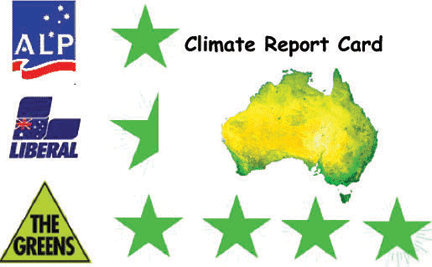 Despite efforts by some media to bring climate change to the forefront – as witnessed by the SMH editorial today – such pleas are likely to fall on deaf ears in the current campaign.
Neither Treasurer Chris Bowen nor Opposition spokesman Joe Hockey mentioned climate change or a clean energy transition in their hour-long debate on Monday, focusing instead on an absurd argument about revenue and budget forecasts in forward estimates – a complete irrelevance to everyday Australians and the major issues confronting the country.
 Renewables future no more costly than fossil fuels REneweconomy, By Giles Parkinson on 21 August 2013“……..The consideration of future costs is a crucial point in the current federal political debate, where policies such as high emission reduction targets and high renewables scenarios – as proposed by The Greens – are seen as reckless, dangerous, marginal or fringe policies.
The frustration is that while such targets form part of the mainstream policy discussion in most other countries, each of the big parties in Australia are as keen as the other to put as much distance between themselves and the Greens. So while most other countries debate how quickly they should be moving to decarbonise the economy, the overall theme in Australia is how slowly it should be done.
The common reason for this is cited as cost to the consumer, but the reality is that the cost to consumer is no greater in these ambitious scenarios than it is under the more modest transitions modeled by Treasury. And if other environmental costs are included, such as the health impacts of fossil fuels, then the numbers change again. Continue reading
Wind energy facts – including 47% of South Australia’s energy last week
 Wind supplied 47% of South Australia’s energy last week http://reneweconomy.com.au/2013/wind-supplied-47-of-south-australias-energy-last-week-67550 By Ketan Joshi on 20 August 2013 VERY GOOD GRAPHS in this article
Science Week was from August 10-18, inclusive. The Australian Energy Market Operator (AEMO) makes 5-minute generation data available through a gargantuan database. I’ve chosen to focus on South Australia and Victoria, states which lead the way in installed wind generation – there are 22 wind farms I’ve obtained generation data for, summarised in the table below.
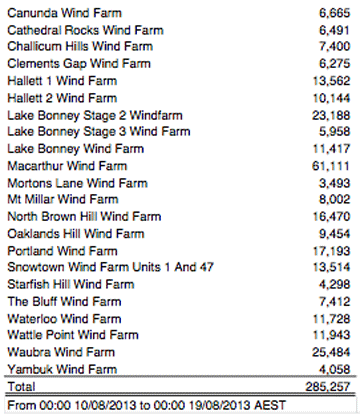
The total generation of those 22 wind farms was 285,257 megawatt hours. But what does that deliver to the energy market? The average Sydney household consumes 11.6 KWh per day, or 0.104 MWh over 9 days. So, the generation of wind farms throughout science week could power ~2.7 million homes – enough for all of Greater Sydney, and all of Greater Adelaide. That statistic alone is a firm reminder that wind power is a formidable player in the supply of energy. Continue reading
Fact checking the clams about “wind turbine syndrome”
DO WIND TURBINES CAUSE HEALTH PROBLEMS? > CHECK THE FACTS HTTP://WWW.FACTSFIGHTBACK.ORG.AU/DO-WIND-TURBINES-CAUSE-HEALTH-PROBLEMS-CHECK-THE-FACTS/ Facts Fight Back, August 20, 2013 ·
Who: “[Health concerns are] justified on the scientific evidence. We know from evidence from field studies… that low frequency noise actually causes health problems, physiological damage to people.” Senator Nick Xenophon
The claim: There is scientific evidence that wind turbines cause health problems.
The facts: In July 2010, the National Health and Medical Research Council reviewed the literature and found that there is currently no published scientific evidence to positively link wind turbines with adverse health effects.
In January 2012, an Independent Expert Panel in the US released a Wind Turbine Health Impact Study Report for the Massachusetts Department of Environmental Protection and the Department of Public Health. The reportfound that literature on human response to wind turbines related to self-reporting of “annoyance”.
The finding: Negative health outcomes appear to be caused by people being stressed by incorrect information about wind turbines not from the actual wind turbines. There is no evidence to show that wind turbines cause health problems.
Discussion of evidence: Reviews of the scientific literature have found that wind turbines cause no ill health effects. Health effects that are reported are consistent with stress and further studies have shown that there is a correlation between these adverse impacts and exposure to negative health information about wind turbines. Senator Xenophon is incorrect to say there is scientific evidence that point to wind turbines causing adverse health effects in humans.
It turns out that renewable energy is no more costly than fossil fuels
So it seems that Canberra bureaucrats, if not the politicians, are conceding that there is little difference in costs between the relatively modest climate and clean energy goals proposed by the current government, and the more ambitious targets proposed by The Greens, and environmental groups.
Renewables future no more costly than fossil fuels REneweconomy, By Giles Parkinson on 21 August 2013 The Australian government appears to have made a remarkable concession following the release of the 100% renewables report by the country’s energy market operator – a renewables future will be no more costly than the largely fossil fuel alternative.
As we reported earlier this month, after the release of the Australian Energy Market Operator’s 100% renewables scenario, the estimated wholesale cost of electricity from a system based largely around wind, solar, geothermal and biomass would cost around $110/MWh and $130/MWh between 2030 and 2050 – depending on the speed of that transition.
A “community summary” posted on the Department of Climate Change website, highlights the fact that the various scenarios painted by Treasury, the CSIRO, the UNSW, and now the AEMO modeling suggests that wholesale prices – whatever the scenario – will fall in a generally narrow range of around $100/MWh to $130/MWh in 2030, and $110/MWh to $150/MWh in 2050.
Here is the relevant piece from the document: Continue reading
Shabby history of destruction of Aboriginal culture and land ownership
Rudd and Abbott charge the north Eureka Street Dean Ashenden | 19 August 2013 “……..Credit for getting this history under way goes to the pastoral grandees of the colony of South Australia. In the 1860s they funded an obsessive-compulsive alcoholic Scotsman to find out what lay between their northern border and the far coast, and how it could be got. John McDouall Stuart’s six expeditions found little to encourage them, but lust trumped reason, and South Australia set itself to be the first colony in history to found a colony. The two would fuse, in time, to become the Great Central State.
Dreams of imperial glory and speculative fortunes turned almost immediately into a long-running mixture of farce and nightmare. Eventually South Australia got lucky. In 1911 it managed to palm off its colony onto the newly-constituted Commonwealth of Australia. Astonishingly, the Commonwealth even agreed to pay serious money for it, nearly four million pounds, plus another 2.2 million for a railway line that had not even reached South Australia’s northern border, let alone made any money.
Believing, as had the South Australians before them, that there must be a way to turn space into land, the Commonwealth did what South Australia had done, with the same result. An official inquiry report in 1937 was scathing. It found that in the 25 years since the takeover the federal government had spent more than 15 million pounds and was heading further into the red. The previous year’s production had brought in 100 000 pounds less than the Government’s outlay for the year of 600,000 pounds.
But the inquirers nonetheless found that it can be done, if it’s done right. It prescribed the familiar medicine: ports, roads, bridges, railways, ports, industry development boards, the lot.
Much of what the inquiry wanted soon came to pass, but not in result of its proposals. In 1939, war saw tens of thousands of troops stream north to build roads, airfields, a port and other infrastructure. For the first time the white population exceeded the black.
Soon motor vehicles, aircraft, air conditioning and buckets of public money transformed the look and feel of the Territory, but ‘development’ remained elusive. In the Territory, and more particularly in neighbouring tropical Queensland and Western Australia, mining was the only big earner, not necessarily to the advantage of government revenues.
The kind of on-the-ground industries apparently envisaged by Rudd and Abbott — horticulture and agriculture particularly — were confined to coastal enclaves or to the margins of viability. Much of the north proved too hot, too wet, too dry, too far from markets, too barren or too pestilential, with the happy consequence that the frontier failed to do its grim work.
Instead of a near-obliteration of Aboriginal populations of the kind seen on the eastern and southern seaboards, northern Australia witnessed a slow-motion saga of sporadic violence and accommodation, of advance and retreat. Neither side ever looked liked winning, and neither ever looked like giving up.
In the aftermath of the Coniston massacres of 1928 both sides abandoned violence for other means, and since then both have used the law, politics, money and public opinion in hundreds of struggles over land and ‘culture’, some famous or notorious, most not, one side straining to gain ground, the other to resist and to recover.
That 160-year struggle now seems to be reaching a new stage. We like to think that the devastation of one population and culture by another is all in the past, but the apparent failure of Rudd and Abbott to notice that northern Australia is shared country suggests that there might be more to come.http://www.eurekastreet.com.au/article.aspx?aeid=37087#.UhP0g9Jwo6I
Tony Abbott keen to sell uranium to India, but Kevin Rudd is not
 Australia and the great Indian uranium sale debate By Geoff Hiscock, CNN August 20, 2013 “…….Both the Labor and Liberal parties have a policy that they will sell Australian uranium to energy-starved India. So on paper, it looks like a bipartisan position.
But Rudd is a reluctant helmsman for his party’s policy, believing India must accept stringent conditions before it gets Australian uranium for its power plants. In his first stint as prime minister in 2007-2010, he was adamant that because India was not a signatory to the nuclear non-proliferation treaty, uranium sales to it were precluded.
He said this was not a policy directed against India, but one that applied globally.
When Julia Gillard, the deputy prime minister who overthrew Rudd for the leadership in June 2010 (before herself being ousted in June this year by Rudd), decided to push through a Labor Party policy change on the uranium issue in late 2011, Rudd was not consulted.
Rudd has said that India does not need to source uranium from Australia. It gets most of its supply now from Russia, France and Kazakhstan.
Abbott’s Indian ambitions
In contrast, Abbott is happy to see Australian uranium shipped to Indian nuclear power plants. At the India Australia Friendship Fair in Sydney last year, he said: “Yes, we will sell uranium to India because we know that India is one of the world’s great democracies.”……
If Abbott wins office on September 7, expect Australia to give even more priority to India. If Rudd retains office, it will be a case of “steady as she goes.”
Ahead of his last visit to India in 2009, Rudd noted that like most of Australia’s relationships, the one with India “has some bumps in the road” occasionally. “But we can work our way through them,” he said. Uranium likely will continue to be one of those bumps. http://edition.cnn.com/2013/08/19/business/australia-election-india-uranium/
Under Abbott’s “Direct Action” climate policy, the tax-payer pays the polluters
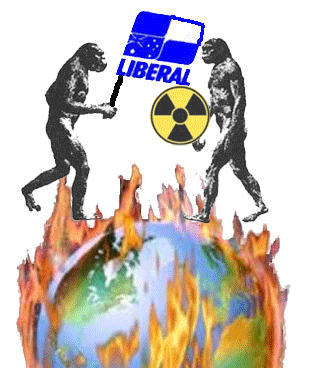 The Coalition’s climate change policy: it’s the public, not polluters, who pay The shortcomings of the Direct Action Plan are striking. If the Coalition is serious about tackling climate change, then it must offer voters a credible alternative to the carbon price The Guardian, Lisa Caripis 19 Aug 13
You don’t have to be a policy expert to realise that if the Coalition is serious about climate change, it will have to take its Direct Action Planback to the drawing board.
Having spent time analysing the parties’ climate change policies for the University of Melbourne’s Election Watch, I’m disappointed that yet another speech by Greg Hunt, the shadow minister for climate action, failed to answer key questions about the Coalition’s climate policy. As it stands, the Direct Action Plan falls short as a policy model for climate action: it’s questionable whether it will enable us to control and reduce our emissions at all, let alone to do so in a way that’s cost effective and fair.
The Coalition has said it accepts the climate science and is committed to Australia’s internationally binding target to cut emissions by 5-25% by 2020. The climate science makes it clear that without good policy intervention, the concentration of greenhouse gases in the atmosphere will continue to rise far above safe levels.
The first move of a Coalition government would be to repeal the laws establishing the current carbon price policy and replace them – by the middle of next year at the earliest – with a policy called Direct Action……..
The Coalition’s policies also jeopardise investment in renewable energy. It has promised to scrap the Clean Energy Finance Corporation, the $10bn body set up to stimulate private investment in renewable and clean energy technologies, and to review the Renewable Energy Target (RET) in 2014. According to the chair of the peak body for the clean energy sector, the uncertainty created by the prospect of a second review of the RET in two years is deterring investment in renewable energy. Coupled with abolition of the carbon price, this uncertainty will make it more expensive to meet the RET.
Some have pointed out that at best Direct Action is a short-term model that is not viable in the long run. Yet the shortcomings of the Direct Action Plan as it stands are striking. If the Coalition is serious about tackling climate change, then it must offer voters a credible alternative to the carbon price. The various iterations of Direct Action the Coalition has presented to us so far simply don’t cut it. http://www.theguardian.com/commentisfree/2013/aug/20/coalition-climate-change-direct-action
Australia’s unbalanced election debate – the environment is left out
One of the Australian economy’s strongest comparative advantages has been the wealth of the nation’s natural environment. Weak laws allow state governments and industry to further undermine this increasingly vulnerable natural resource base. Northern Australia is being targeted for a new era of dam building and agricultural industrialisation. But state water management regimes across the north are a shambles.
Australia’s environment and economy are bound together. Good economic management will protect and replenish our natural wealth. Bad economic management will destroy it.
When the federal election zoo closes down on September 7 the environment and economy will still be bound together. Question is, will the next federal government have noticed?
Environment lost in election zoo http://www.smh.com.au/comment/environment-lost-in-election-zoo-20130819-2s6du.html August 19, 2013 Paul Sinclair Australia’s environment is being held captive in a viewing cage in the federal election zoo.
The environment policy enclosure is located in a dilapidated, hard-to-find part of the zoo.
 (At left, false economic thinking – environment is last consideration )The “economy” is the zoo’s premiere exhibit. The economy spends all day pacing a little square of synthetic grass in a deep, concrete-lined enclosure.
The poor thing is disconnected from every other living thing that has shaped what it is and could be. (At right – true economic thinking, with environment as the resource base)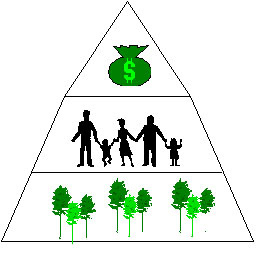
By putting the economy and environment in separate cages Australia fails to properly manage either. Continue reading
What an Abbott government would do to Renewable Energy
 Election could leave Australia with AUS$4 billion clean energy funding gap http://www.pv-tech.org/news/election_could_leave_australia_with_aus4_billion_clean_energy_funding_gap 20 Aug 13 Liberal Leader Tony Abbott’s climate approach could cut funding and policy incentives for renewable energy. Image: Flickr/TonyAbbott
If the Coalition defeats the current Labor government in Australia’s general election on 7 September, it could create an AUS$4 billion (US$3.7 billion) gap in funding for the renewable energy sector and other carbon cutting measures, research claims.
The centre-right Coalition, which currently leads opinion polls, would repeal the AUS$10 billion (US$9.2 billion) Clean Energy Finance Corporation, a state-backed financing vehicle, but supports the AUS$3 billion (US$2.7 billion) research focussed Australian Renewable Energy Agency, according to a report by the Climate Institute think-tank. Continue reading
Coalition election win would mean $4 billion in private funding sucked away from Australia’s renewable energy industry
Climate of uncertainty August 19, 2013 SMH, Ben Cubby, Tom Arup About $4 billion in private funding would be sucked away from Australia’s solar power and renewable energy industries over the next three years if the Coalition wins government, confidential data obtained from banks and financial analysts shows. Continue reading
1 This month
17 October, Free Public Talk on Nuclear Issues in South Australia
David Noonan will speak on public interest concerns over the new Roxby Downs Indenture Act 2026 on BHP copper-uranium mining and ore processing in SA, and on how AUKUS may face SA with a High-Level nuclear waste agenda.
Dr Jim Green will discuss international developments in the field of nuclear power including ‘small modular reactors’ and Generation 4 ‘advanced’ nuclear reactor concepts.


Help Aunty Sue Protect Her Land and Sacred Sites From Destructive Rocket Testing.
.

Australians deserve the truth
about
AUKUS – https://aukuspublicinquiry.com/

PETITION – To: Prime Minister Anthony Albanese and the Australian Labor Government

of the week – Australians for War Powers Reform (AWPR)
To see nuclear-related stories in greater depth and intensity

