International win for University of Wollongong’s fibro solar energy cottage
University of Wollongong’s fibro cottage wins international renewable energy competition http://www.abc.net.au/news/2013-08-12/fibro-cottage-wins-international-eco-prize/4880032 By Nick McLaren A team from the University of Wollongong has won a worldwide competition to design a zero-emissions solar house by refitting a humble Australian fibro cottage.
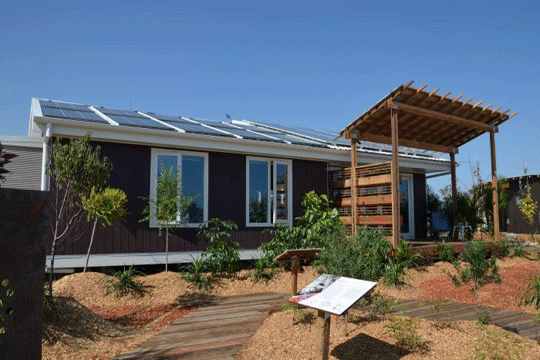
It is the first time an Australian team has entered the Solar Decathlon, which has been held in Datong, China since 2002.
The 51-strong team built the Flame House – a retrofitted fibro cottage designed to appeal to older clients nearing retirement.
The Australians beat 20 other finalists to place first in the engineering, solar and architecture categories, with a team from China second and Sweden third.
Project Manager Lloyd Niccol says the competition is about producing a home that is comfortable and generates more energy than it consumes. “We’re trying to find some way to make an immediately and positive impact on our environment,” he said.”There are eight million homes existing in Australia, and quite a few hundred thousand fibro homes.
“Only 2 per cent of those are replaced every year, so if we do want to make a real impact…we thought the best way to do that is to retrofit our homes. “So it’s showing how you can bring the typical home built in the 1950s into the current modern age so its comfortable, its got all the amenities you require, and it produces more energy than it consumes.”
Mr Niccol says the team used a range of technologies to modernise the cottage………… “In terms of the rest of the world…there are a lot of Chinese people that have actually asked whether we can just build them in Australia, so rather than actually retrofitting, just building the timber frame from scratch, essentially, and building this home.
“So there’s a market and a desire out there.” Mr Niccol says the competition home would cost approximately $300,000 to build in Australia.The prize-winning pad is set to be pulled apart before being shipped back to the University of Wollongong to be used for education and research.
Electricity prices will rise if carbon tax is scrapped

 http://www.abc.net.au/radionational/programs/breakfast/axing-carbon-price-will-hit-power-prices/4882394 AUDIO: Scrapping the carbon tax will lead to electricity price rises: report 13 August 2013 A new report out today says that the Coalition’s promise to ending carbon pricing in Australia would lead to higher wholesale energy prices. The report’s author told RN Breakfast that the policy would be a blow to renewable energy and household power bills, asJames Bourne reports.
An independent report released today has found that ditching the carbon price in Australia will hit investment in the renewable energy sector—and almost certainly lead to an increase in electricity prices.
Bret Harper, the Director of Research at advisory firm RepuTex which was commissioned by the World Wildlife Fund to write the report, says that without proper investment in renewable energy—made possible by a carbon price—wholesale electricity prices could rise by between five to ten percent by 2020.
And while the findings of today’s Renewable Energy and the Carbon Price report appear to be counter intuitive, Mr Harper says the potential price hikes are already common knowledge among government and business.
‘Renewable energy, when it’s put onto the system, tends to cut household electricity bills, not push them up,’ he told RN Breakfast.
‘It represents a very low-cost form of energy that displaces other fossil fuel generators which have very high fuel costs.’………..
Renewable energy revolution having an impact on energy prices
EnergyAustralia hurt by falling prices August 12, 2013 – SMH, Brian Robins EnergyAustralia, one of the country’s largest energy groups, has fallen into the red, hit by the downturn in wholesale electricity prices with little prospect of a quick revival in its fortunes……
The Australia energy market is facing unprecedented structural changes,” the Hong Kong-based parent said.
“The past two years have seen a pronounced decline in residential electricity demand in response to rising prices, and the deployment of rooftop solar photovoltaic systems and energy efficiency savings have more than offset any increase in demand from population growth……. Commercial and industrial demand has also been impacted … by a difficult manufacturing environment, in part due to rising energy costs, a highly valued Australian dollar and a slowing global economy.”
Wholesale electricity prices are also being pressured by a high level of output from renewable energy sources, it said, which is “likely to continue”. http://www.smh.com.au/business/earnings-season/energyaustralia-hurt-by-falling-prices-20130812-2rry3.html#ixzz2bt6ZK8vH
Australia’s supposed nuclear non proliferation policy: it’s hypocrisy
 Australia’s retreat on nuclear non-proliferation http://www.independentaustralia.net/2013/environment/australias-retreat-on-nuclear-non-proliferation/?utm_source=rss&utm_medium=rss&utm_campaign=australias-retreat-on-nuclear-non-proliferation 11 Aug 13, This week marked the anniversaries of the bombing of Hiroshima and Nagasaki, and Australia’s signing of the South Pacific Nuclear Weapons Free Zone Treaty. Dave Sweeney comments.SIXTY-EIGHT YEARS AGO this week our world changed forever – and tens of thousands of lives instantly ended – when the atomic bomb was unveiled.
The destruction of the Japanese cities of Hiroshima (6 August) and Nagasaki (9 August) in 1945 heralded the end of the Second World War and the beginning of the nuclear age.
It is a long way from Hiroshima in 1945 to election mode Canberra in 2013, but lessons learned and actions taken to stop the chance of further nuclear threats are being forgotten in the rush to advance risky Australian uranium sales.
In December 2011, the Labor Party narrowly voted to overturn a long standing ban on the sale of uranium to countries that had not signed the Nuclear Non-Proliferation Treaty (NPT) — the world’s main check and balance on the spread of the world’s worst weapons.
Labor’s backflip was designed to allow uranium sales to India, a nuclear weapon state that has consistently refused to sign the NPT.
The move was condemned by the Australian Greens but enthusiastically welcomed by the Coalition, which paved the way with its August 2007 decision to support uranium sales to India and is an active supporter of an expanded uranium sector.
But the controversial sales plan is in clear conflict with Australia’s obligations under the South Pacific Nuclear Weapons Free Zone Treaty – also known as the Treaty of Rarotonga – and is putting Australia on a collision course with our Pacific neighbours.
Professor of International Law at ANU, Professor Donald Rothwell, has examined the treaty and the planned sale deal and concluded ‘Australia is obligated under the Treaty of Rarotonga to not provide India with nuclear materials until such time as India has concluded a full-scope safeguards agreement.’
The Treaty, signed twenty eight years ago this week in the Cook Islands, bans the use, testing and possession of nuclear weapons within the South Pacific region and places constraints on non-military nuclear activities, including the export of uranium. Continue reading
Toro Energy and Mega Uranium making a big mistake in acquiring Lake Maitland

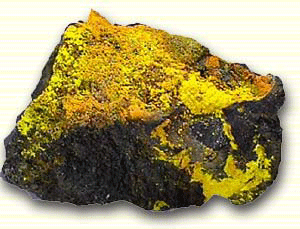 Toro’s mega mistake Mia Pepper – Conservation Council of WA 12 August 2013 WA uranium hopeful Toro Energy’s acquisition of Lake Maitland, another small calcrete uranium deposit in a sensitive Lake system, is based more on optimism and need rather than any measured assessment of the deeply depressed uranium price and nuclear sector said the CCWA today.
The acquisition between Toro and Mega Uranium does little to change the fundamental constraints facing each company and may well be Toro’s mega mistake.
It is a further sign of the difficulties facing junior uranium companies in a time of falling commodity prices and rising costs. Toro and Mega may share big dreams but they do not have big capacity, experience or dollars.
Toro cannot begin construction at Wiluna and do not have final and formal approval to mine at Wiluna. Instead the company has a conditional Federal approval that involving 35 conditions and requires further assessment from the Federal Minister.
The conditional nature of the approval prohibits Toro Energy from clearing vegetation or using heavy machinery for breaking ground for mining or infrastructure. Toro must also complete a mine closure plan for both State and Federal level assessment.
A recent independent economic analysis of the Wiluna project (attached) found that:
The Wiluna project’s lack of scale and high sensitivity to changes in operating or capital costs means our estimate of its position on the mine production cost curve is perilously high. The project would be highly vulnerable under our model, in the event of sustained lower long-term contract prices in the next decade. On both a cash and total economic cost basis our model suggests Wiluna is a high cost project that will struggle to compete against either existing mines or most greenfield and brownfield projects. For the full report: http://www.ecolarge.com/work/osos-sobre
Australian Greens call for health care justice for nuclear test veterans
 GREENS CALL FOR MEDICAL CARE FOR AUSTRALIA’S NUCLEAR VETERANS HTTP://WWW.GREENS.ORG.AU/GREENS-CALL-MEDICAL-CARE-
 AUSTRALIA%E2%80%99S-NUCLEAR-VETERANS The Australian Greens have called for hundreds of Australian soldiers who were exposed to radiation from British nuclear bomb testing in the 1950s and ‘60s to automatically receive Veterans’ Gold Card health care.
“Between 1952 and 1963, more than 16,000 Australian civilians and serviceman were exposed to nuclear fallout when British nuclear weapons were tested at the Montebello Islands in Western Australia, Maralinga and Emu fields in South Australia, and over the Christmas and Malden Islands,” spokesperson Assisting on Defence, Senator Scott Ludlam said.
“Some servicemen were clad only in shorts and t-shirts when they were sent into contaminated areas while British scientists in charge looked on wearing full body protective suits.
“In the decades following, many of these men, their wives and families have reported a range of radiation-related disorders ranging from multiple miscarriages to leukaemia, cancers, and respiratory conditions.
“While many radioactive illnesses take decades to manifest after the initial exposure it is widely acknowledged that these men were dangerously exposed. Continue reading
Independent Australia exposes Abbott’s fraudulent Climate Change “Direct Action”
 Tony Abbott’s “direct action” dud, Independent Australia 9 August, 2013 Doug Evans examines the Coalition’s climate change policies …… In the Liberal Party’s election pamphlet Real Solutions for Australians the Party commits to taking:
‘…direct action to reduce carbon emissions inside Australia, not overseas — and also establish a 15,000-strong green army to clean-up the environment.’
One of the main tasks intended for the green army is proposed to be plantation tree planting for purposes of carbon storage.
Widely known as the Direct Action Policy (DAP) this ‘policy’ comprises:
-
An “Emissions Reduction Fund” of $3 billion to fund projects that would reduce carbon emissions, based on a tender process.
-
Support for projects such as “soil carbon technologies and abatement”.
-
A commitment to reducing carbon emissions by 5 percent by 2020.
In my assessment of Labor Party climate policy, I showed the inadequacy of the bipartisan 5% emissions reduction target. This time, I will address the likelihood that the measures nominated in the DAP could achieve even this modest emissions reduction. Continue reading
Election danger to Liberals in Western Australian backlash over attack on solar energy
Could Barnett’s Solar Attack Impact The Federal Election? http://www.energymatters.com.au/index.php?main_page=news_article&article_id=3884 12 Aug 13, The knee-jerk reaction by Western Australia’s government to its failure to rein in increasing power prices by targeting solar households could cost it – and the Coalition – dearly.
As mentioned on Friday, the Western Australian Government has said it will retrospectively slash the solar feed-in tariff rate for approximately 75,000 households that installed systems between mid 2010 and mid 2011.
A similar move was attempted by the New South Wales Government in 2011; which resulted in that government on the receiving end of a black eye – and the same fate may be in store for Premier Barnett, amplified by its timing.
The decision could have dramatic impacts on the Federal Election in key seats says Dr. Geoff Evans of Solar Citizens. Continue reading
Western Australia: Liberals rebel against govt reneging on solar energy deal
Liberal rebellion on solar heats up, The West, Gareth Parker and Daniel Mercer, The West Australian August 12, 2013, 2 Colin Barnett is facing a backbench revolt over the State Government’s decision to halve its rooftop solar panel subsidy, with a pair of Liberal MPs accusing the Government of lacking integrity.
The growing rebellion came as a letter from Synergy sent in 2011 emerged as a key piece of evidence in any potential legal fight over
the changes. The letter – sent soon after the Government cut the tariff in a previous revision to the scheme – says that customers entitled to the
40 cent payment would get it “for the full term of your 10-year contract”.
Government MPs have been flooded with complaints from irate voters about the decision to cut to the so-called solar feed-in tariff from
40 cents to 20 cents, with the issue spilling over to the Federal election campaign as a vote turn-er against Liberal candidates.
Maverick Hillarys MLA Rob Johnson threatened to cross the floor for the first time in his 20-year career to vote against the measure,
while Southern River MLA Peter Abetz said the Government had acted unethically.
Mr Johnson said the Government was acting with a “lack of integrity” by reneging on a deal with 75,000 solar panel owners in a bid to save
$51.2 million over the next four years. Continue reading
Eye cancer danger to children from UV radiation
Parents told to make kids wear sunglasses to protect them from eye cancer JANE HANSEN THE SUNDAY TELEGRAPH AUGUST 10, 2013 CHILDREN should wear sunglasses because sun exposure in the first 20 years of life increases the risk of eye cancer and other eye problems later in life, Cancer Council NSW research has revealed. The research shows exposure to solar radiation is a cause of eye cancer but while parents may Slip, Slop, Slap, they often overlook sunglasses for their children.
Cancer Council NSW’s Vanessa Rock said it was just as important to protect your eyes as your skin. There is an average of 98 cases of eye cancer per year in Australia.”Unprotected exposure to UV radiation over long periods can cause serious damage to your eyes, including cataracts, and cancer in and around the eye,” Ms Rock said.
Optometrist Association of Australia (OAA) Andrew McKinnon said irreplaceable eyesight is at risk in high glare, high UV settings such as the beach, by the water or the snow. “At the beach, it drives me mad, I want to put sunglasses on all the kids, all the adults have glasses on but a child’s eyes are more vulnerable.” Continue reading
Western Australian government’s solar rate cuts will be fought by Labor
WA Labor promise fight over solar rate cut http://www.heraldsun.com.au/news/breaking-news/wa-labor-promise-fight-over-solar-rate-cut/story-fni0xqi4-1226695095998 AAP AUGUST 11, 2013 WEST Australian opposition leader Mark McGowan has promised to “take on” Premier Colin Barnett after the state government reneged on a 10-year undertaking for households that feed in solar power to the grid.
Mr McGowan tweeted on Sunday: “Anyone unhappy with Mr Barnett ripping up their families solar contract should come to parliament at 2.45pm Tuesday where we will take him on.” It follows Thursday’s state budget in which Treasurer Troy Buswell announced that the government would halve the residential solar feed-in tariff rate to save $51 million.
The state government believes it is safe from legal action over the decision, despite many householders expressing their outrage on talkback radio.The program, introduced in 2009, was such a success that the Liberal government had to admit in 2011 the take-up cap had been breached, costing about $46 million more than planned.
The Sustainable Energy Association says more than 75,000 WA households will be affected. Mr McGowan described the solar backflip as another “broken promise” from the Barnett government.
New obstacles to Tasmania’s solar industry
New Building Codes Threaten Tasmania’s Solar Industry http://www.energymatters.com.au/index.php?main_page=news_article&article_id=3883 12 Aug 13 Additional and pointless red tape threatens the solar industry in Tasmania say the Greens. The Tasmanian Greens have called for the Minister for Workplace Standards to review proposed new building codes for solar installations that it says would increase the cost of installing solar – and ultimately lead to job losses in the industry.
Greens Energy Spokesperson Kim Booth MP says the proposed new regulations will see Councils requiring planning fees and an accredited builder to install a solar panel system – even though solar installations are already required to be engineered, installed and inspected according to Australian Standards.
The additional costs could add 25% – 100% on to the contracted value of solar installation.
Mr. Booth says the industry is concerned only accredited builders will be legally permitted to perform installs, while suitably accredited solar installation experts are “driven off the site.”
“Ultimately, pointless red tape drives the price up for consumers and potentially drives companies out of business, something that the Property Council and the HIA should reflect on given their role in wrapping the building industry up in worthless over regulation.” The solar industry in Tasmania is facing a number challenges; including an uncertain future for the state’s feed in tariff. However, for households that install solar power systems before January 1, 2014, Tasmania’s government has proposed to keep the state’s 1:1 feed in tariff in place until 2017 – making the best time to go solar in Tasmania likely right now.
According to solar solutions provider Energy Matters, a good quality 3kW solar panel system installed in the Apple Isle can return a financial benefit of approximately $890 a year.
More than 12,500 households in Tasmania have already installed solar PV systems. In doing so, these households have not only slashed their own power bills, but have also generated employment, diversified electricity generation and allowed increased export of the state’s hydropower to mainland states; providing additional revenue for Tasmania.
Warren Mundine , nuclear lobby’s Aboriginal spin doctor, enters election campaign
Christina Macpheson, 10 August 13, Australia’s uranium-nuclear lobby must be ecstatic. After all that Aboriginal opposition to their mines, and their nuclear waste dump plans, now their very own Aboriginal stooge has stepped in. Warren Mundine, former National President of the Labor Party, has well and truly jumped political party ship, to head a new Liberal party indigenous advisory council .
Warren Mundine has an impressive pro nuclear record. He has been promoting the nuclear industry , praising nuclear energy,saying that it is necessary for nuclear medicine. Most alarming of all, Mundine advocates the “full nuclear cycle”. That means Australia not only having nuclear power, but taking in nuclear waste from overseas countries.
Mundine’s nuclear lobbying activities have been documented on this website several times. He was appointed by Queensland Premier Newman to the uranium implementation committee. He is co-convener of the Australian Uranium Association’s Indigenous Dialogue Group,

There’ll be a few Aboriginal people who will,not be happy with Mundine’s latest effort. He’s been slammed in the past by Noongar anti-nuclear activist, Marianne McKay of the West Australian Nuclear Free Alliance.
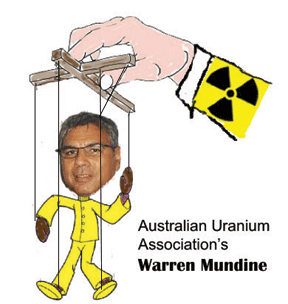
Warren Mundine is a Director of the Australian Uranium Association
Nuclear Lobby’s Warren Mundine and Tony Abbott are kindred spirits
 Indigenous affairs: Tony Abbott says he and Warren Mundine are ‘kindred spirits’ Coalition
 leader wants to work in close partnership with Mundine, who would head a new indigenous advisory council under an Abbott government Paul Owen in Sydney and agencies theguardian.com, Saturday 10 August 2013
The Coalition leader said there was a need to convert all the good thinking from indigenous leaders such as Mundine, Noel Pearson and Alison Anderson into practical action on the ground.
“Warren and I are kindred spirits and I’m really excited at the changes that have taken place in thinking about these issues over the last decade or so,” he told ABC radio on Saturday morning.
Abbott said he wanted to work in close partnership with Mundine, who would head a new indigenous advisory council under a Coalition government, and said the arrangement could make the difference needed to improve indigenous lives…… Mundine, the executive chairman of the Australian Indigenous Chamber of Commerce, is to spell out his vision at the Garma Festival in the Northern Territory on Saturday night. That will reportedly involve abolishing a range of indigenous governance bodies and excising townships from community-owned land to allow for private ownership of homes and businesses….. http://www.theguardian.com/world/2013/aug/10/indigenous-affairs-tony-abbott-warren-mundine-kindred-spirits
Australia’s Silex laser uranium technology – a Faustian bargain
 The global implications are profound according to the American physicists’ society and non-proliferation groups who fear the
Silex technology will promote the spread of nuclear weapons.
DAVID BRADBURY, FRONTLINE FILMS: The long-term repercussions of it is that we’re going to have more uranium being enriched around the
planet, it’s going to lead to a mountain of nuclear waste for which we have not created any solution to be able to store it safely and so in
so doing it’s going to create a nightmare for present and future generations to deal with.
Nuclear Enrichment Revolution Meets Weapon Fears James M. Acton ABC TV/RADIO BROADCAST AUGUST 1, 2013 An Australian
nuclear physicist has developed a new enrichment process and been granted approval by US regulators to develop it commercially, despite fears it could promote the proliferation of nuclear weapons. Carnegie’s James Acton talks to Australia’s ABC News.
LEIGH SALES: Two years after the disastrous meltdown of the Fukushima power plant, the Japanese people are still dealing with the fall-out
and the debate over nuclear energy is as polarised as ever. In Australia, proponents of nuclear power are stepping up their efforts
to win support. One Australian physicist has developed a revolutionary new enrichment process which has been given the go-ahead by regulators in the United States to the alarm of anti-nuclear activists. Greg Hoy reports.
GREG HOY, REPORTER: Inside Australia’s top-secret nuclear facility, Lucas Heights, in Sydney, a ground-breaking development is under way.
Australian nuclear physicist Dr Michael Goldsworthy and his company Silex are refining top-secret laser technology. While filming the real
lasers is prohibited, this technology will revolutionise enrichment of uranium for the world’s nuclear power plants, slashing costs and the
scale of production……..
TV REPORTER: Earlier this week the GE Hitachi facility in Castlemaine received federal approval to enrich uranium using laser technology,
but what exactly does that mean and what are the implications to our community? Continue reading
1 This month
17 October, Free Public Talk on Nuclear Issues in South Australia
David Noonan will speak on public interest concerns over the new Roxby Downs Indenture Act 2026 on BHP copper-uranium mining and ore processing in SA, and on how AUKUS may face SA with a High-Level nuclear waste agenda.
Dr Jim Green will discuss international developments in the field of nuclear power including ‘small modular reactors’ and Generation 4 ‘advanced’ nuclear reactor concepts.


Help Aunty Sue Protect Her Land and Sacred Sites From Destructive Rocket Testing.
.

Australians deserve the truth
about
AUKUS – https://aukuspublicinquiry.com/

PETITION – To: Prime Minister Anthony Albanese and the Australian Labor Government

of the week – Australians for War Powers Reform (AWPR)
To see nuclear-related stories in greater depth and intensity

