Senator Ludlam asks awkward questions on Wiluna uranium mine project
 WILUNA URANIUM PROJECT – MINE CLOSURE PLAN http://www.greens.org.au/wiluna-uranium-project-mine-closure-plan Senate Standing Committee on Environment and Communications
Legislation Committee Answers to questions on notice Sustainability, Environment, Water, Population and Communities portfolio
Budget Estimates, May 2013
Topic: Wiluna uranium project – mine closure plan
Senator Ludlam asked: But how much work around mine closure had been assessed by the minister? Presumably, something must have been done or he would not have had the confidence to give this thing the tick, even a conditional tick?
Ms Jones: Through the assessment process there were assessment documentation in draft and final form. Supplementary information was sought by the minister from the proponent on issues that cut across this matter. To give a succinct response, I would probably have to take that on notice and come back to you, Senator.
Senator LUDLAM: Maybe if you could, yes. I am interested in the degree to which the approval conditions side is open-ended. Does it have any lapse date at all, or is this an approval in eternity? If the company comes back in 20 years, will it be live, or does it have a lapse date?
Answer:
The proposed action was assessed by the Western Australian Environment Protection Authority under the bilateral agreement between the Commonwealth and Western Australian Government. The State assessment report addressed the issue of mine closure, including assessment of an Environmental Management Strategy for Mine Closure and Rehabilitation provided by the proponent. The Minister considered the State assessment report. The Minister also sought further information from the proponent in relation to the long-term integrity of the tailings storage facility, which was reviewed by the Supervising Scientist Division, Geoscience Australia and the Australian Radiation Protection and Nuclear Safety Agency.
The approval is valid until 31 March 2043. Condition 2 of the approval states that if, at any time after five years from the date of this approval, the person taking the action has not commenced the action, then the person taking the action must not commence the action without the written agreement of the Minister.
Aboriginal Cultural Landscape Rangers for Tasmania
Federal funds secure Tasmanian Aboriginal rangers to care for land http://www.abc.net.au/news/2013-08-09/federal-funds-secure-tasmanian-aboriginal-rangers/4875112?section=tas Aug 9, 2013 The Federal Government has allocated almost one million dollars funding for Tasmanian indigenous rangers.
The $980,000 would be provided over three years to the Environment Department to help traditional custodians care for their land.
The money comes from an existing program. The Federal Environment Minister, Mark Butler, says the new Aboriginal Cultural Landscape Rangers would hit the ground next year.
“To ensure that there are indigenous employment opportunities connected to those values but also that there is the maximum opportunity possible to have those values explained to the broader Australian opportunity,” he said.
Cutting Renewable Energy target would make customers pay more
 Cut to renewable target would cost power consumers http://www.businessspectator.com.au/news/2013/8/9/renewable-energy/cut-renewable-target-would-cost-power-consumers By a staff reporter 9 Aug, Bloomberg New Energy Finance has released a study finding that cutting the Large-scale Renewable Energy Target to levels recommended by some energy retailers would increase costs to consumers by $1.3 billion.
The study analyses the effects of reducing the target from the current legislation of 41,000GWh down to 27,000GWh, which Origin Energy and Energy Australia have advocated would be consistent with 20% of Australia’s like electricity demand in 2020.
It finds that while there would be savings from retailers having to buy less renewable energy certificates, this is outweighed by an increase across all electricity sold in the wholesale market of $5 per megawatt-hour. This is because extra renewable energy supply tends to depress the overall electricity market price because of its low operating costs.
In addition Bloomberg believe that if the government were to cut the target this would heighten financiers perceptions of investment risk leading to a finance premium of 0.75%. This would increase the cost of the remaining renewable energy projects required to meet the reduced the target.
Solar energy in Australia heading for big commercial applications?
 Solar PV projects can be rolled out within months, not years. The experience from the Australian residential solar sector illustrates that solar PV can scaled-up very quickly. While grid connection is a more involved process for commercial rooftop solar than residential, each system involves tens of kilowatts instead of just two or three. So it seems reasonable to expect that if the market conditions are conducive, there would be no physical constraints to commercial solar rolling out a few hundred megawatts in 2014, and a gigawatt in 2015.
There would still be a need for new wind farm development under such scenario, but it would buy time for wind farm projects to scale-up, and ensure enough supply to meet the Renewable Energy Target.
Market could blindside Origin and Energy Australia Climate Spectator Tristan Edis 9 Aug, “……So far Origin Energy and Energy Australia have been holding out on signing onto long-term power purchase agreements for wind farms, because they’re hoping the Coalition will water down the level of the Renewable Energy Target. AGL has also put a halt to further development concerned that it might come true.
This can create a self-fulfilling phenomenon, because waiting to develop projects makes the target more difficult to achieve. This then encourages government to intervene to water down the target.
However there’s some interesting wrinkles that could mean solar becomes a bigger player in the large-scale renewable energy target, producing substantial numbers of large-scale renewable energy certificates known as LGCs.
1) Non-traditional buyers for renewable energy certificates may emerge and the price will rise……..
2) Commercial rooftop solar developers will begin producing LGCs……..
3) Finance products are emerging to support commercial solar………… Continue reading
New solar energy company opens in Sydney
 China’s quiet achiever makes mark on energy’s new frontier SMH, August 10, 2013 Peter Hannam Carbon economy editor “…….Yingli Green Energy, has knocked Suntech off its rank as the world’s biggest producer of solar photovoltaic panels and its breakneck growth – along with an array of other Chinese firms – has driven PV prices down by about three-quarters in four years.
“He’s China’s Richard Branson,” said Daman Cole, commercial director of Yingli Solar, speaking of his boss at the opening of the company’s Australian office this week in Sydney……..
The opening of the Sydney office is also part of Yingli’s search for new markets. The company aims to grab 10 per cent of the Australian market within a couple of years, with a focus on commercial customers. Orders secured include a 1.25-megawatt deal to supply the panels for 30 buildings for the City of Sydney worth $3.4 million, while it has also signed a distribution pact with L&H Group, a major electrical wholesaler in Australia and New Zealand.
Solar-powered smartphone batteries and broader “energy solutions” with customers are expected to feature in the future…… http://www.smh.com.au/business/chinas-quiet-achiever-makes-mark-on-energys-new-frontier-20130809-2rn5n.html
For Western Australia’s Toro Energy uranium project, the outlook may be terminal
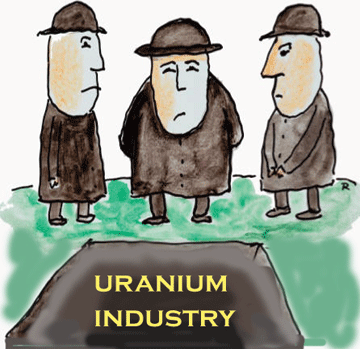 Nuclear not worth digging or dealing http://ccwa.org.au/blogs/nuclear-not-worth-digging-or-dealing#.UgWPQ9Jwo6I August 9th 2013 by Mia.Pepper Article published in the Kalgoorlie Miner 9th August 2013
At this week’s Diggers and Dealers, low commodity price and high production costs have been a focus of attention for the entire minerals sector. While, overall, Australia’s mining sector shows signs of resilience, there is one mineral whose outlook may be terminal.
There are five significant recent events that have occurred recently that send a clear message about the future of the uranium sector and the wider nuclear industry. The uranium price dropped to US$34.50lb. Energy Resources of Australia, the operator of the Ranger uranium mine in Kakadu, announced a $54 million loss. Perth –based uranium miner Paladin Energy failed to sell a stake in its Langer Heinrich mine in Namibia. French nuclear giant EDF announced its exit from nuclear power in the US and Duke Energy cancelled two proposed reactors in Florida.
These incidents are neither isolated nor unrelated – they are significant indicators about the health of nuclear industry. Continue reading
King Island shows the way towards 100% renewable energy

“The way these technologies are being used and integrated is world-leading and another example of the clever solutions to real-world problems that have been developed in Tasmania and can be exported globally.”
100% renewables: The King Island example, Business Spectator Laurie Guevara-Stone 9 Aug 13, Halfway between Tasmania and mainland Australia, in the heart of the Bass Strait, is rugged, windswept King Island. With a population of just under 2,000 and an area of just over 400 square miles, tiny King Island is becoming a big leader in electricity generation, demonstrating that a high-renewables future is possible.
King Island, and especially greater Tasmania, face many challenges due to climate change including water availability, flooding of coastal settlements, a rise of bushfires, and decreased agriculture and aquaculture industries. Although Australia’s contribution to global greenhouse gas emissions is small – and Tasmania’s even smaller, largely due to singificant amounts of hydro – the island has a goal of reducing carbon emissions by 60 per cent from 1990 levels by 2050.
Tasmania is on track to meet that target, thanks in part to lessons learned and the success at King Island. King Island is providing a significant demonstration of the potential opportunities for Tasmania through its King Island Renewable Energy Integration Project (KIREIP). Initiated by the government-owned electricity provider,Hydro Tasmania, KIREIP’s goal is to not only reduce dependence on fossil fuels, but also to help constrain power prices on the island. Continue reading
Australia’s world-leading initiatives on climate policy

Australia is part of a growing number of key regions and countries acting to reduce their GHG emissions—including the EU, United States, and China. As Australia gears up for its federal election later this year, the country has the opportunity to set a powerful example for other nations by moving forward with ambitious mitigation strategies and making efforts to strengthen them. As Australia has learned from other countries’ experiences in setting up market mechanisms for carbon reduction, the international community should continue to keep an eye on the Australian experience, track its performance, and build on its successes.
3 Key Initiatives From Australia’s Climate Change Policy Http://Insights.Wri.Org/News/2013/08/3-Key-Initiatives-Australia%E2%80%99s-Climate-Change-Policy#Sthash.ORj7bvdO.Dpuf by Olivia Kember and Thomas Damassa on August 8, 2013 This piece was co-written with Jenna Blumenthal, an intern with WRI’s Climate and Energy Program. Australia is a major nation to watch when it comes to curbing climate change. The country made an international commitment to reduce its GHG emissions by 5 to 25 percent from 2000 levels by 2020. How Australia achieves these reductions can provide lessons on how other countries around the world can pursue their own climate change mitigation plans. WRI’s Open Climate Network and Australia’s The Climate Institute (TCI) recently analyzed Australia’s climate change plan, which includes a mix of policies to reduce emissions (check out the working paper here). We found that three initiatives stand out in terms of their potential to significantly reduce GHG emissions: a carbon pricing mechanism, a Renewable Energy Target (RET), and the Carbon Farming Initiative (CFI).
1) The Carbon Pricing Mechanism
The carbon pricing mechanism is the primary instrument for meeting Australia’s emissions reduction goals. Established by the federal Clean Energy Act 2011, the carbon price is applied to roughly 60 percent of the country’s emissions. Set as a fixed fee per metric ton for the first few years of operation (around $A 23-25), the mechanism will shortly transform into a cap-and-trade system linked to the European Union emissions trading scheme (ETS) and, to a lesser extent, the Kyoto Clean Development Mechanism. The government recently advanced the date of this transition from 2015 to 2014;experts do not expect this to have a material impact on Australia’s ability to achieve its target. Government revenue from selling carbon permits will be invested in clean energy and low-carbon technologies. Revenue from the carbon pricing mechanism will also be provided as compensation to households for possible increases in the cost of goods and services as a result of the carbon price.
It is widely expected that the price on carbon permits in Australia will be influenced by permit prices in the larger European market, and hence, by policy developments in the EU rather than in Australia. This is likely to affect the degree to which emissions reductions are achieved in Australia. For example, low prices in the EU trading scheme could encourage polluters in Australia to purchase EU permits instead of reducing their emissions domestically. On the other hand, if the Australian government were to aim higher than the minimum 5 percent target, it can do this without affecting the permit price. Given that international permit prices are projected to remain fairly low for the rest of the decade, Australia could achieve the top of its current target range for very little extra cost.
2) The Renewable Energy Target
The federally mandated Renewable Energy Target is the principal driver of investment in renewable energy in Australia. The Large-Scale Renewable Energy Target (LRET) requires utilties to generate 41,000 gigawatt hours (GWh) from renewable sources by 2020. The Small-Scale Renewable Energy Scheme (SRES) targets households and is expected to account for at least 4,000 GWh by 2020. The RET has mobilized $A 18 billion in renewable energy investments since 2001. It contributed to an additional 3.5 percent of renewable electricity generation in 2011, and projections show that the RET could help renewables gain more than 20 percent of the market share. Government estimates indicate that the RET is likely to reduce annual emissions by nearly 30 Mt CO₂e, which would be equivalent to 6 percent of net emissions in 2020 under the 5 percent target and 7 percent under the 25 percent target. Continue reading
Australian political parties’ policies on nuclear power and uranium mining
Well – you’d be hard put to find out about this. I scoured the web to get anything up to date about this. But no ! – in spite of all the media rubbish going on lately about how great nuclear power would be for Australia – no political party has a word to say about nuclear issues.
It seems that they think (even the Greens) that nuclear power is just irrelevant to the coming Australian election.
As for uranium mining – well despite its disastrous financial and environmental state, Australia’s mainstream media regards uranium mining as a great investment, terrific, we all love it

Indeed, the mainstream media does not cover nuclear/uranium issues as relevant. Even the current radiation crisis at Fukushima is not relevant news. (The ABC is an exception) Hiroshima Day came and went, as far as I could see, it was ignored by the mainstream media.
If it weren’t for Gem Romuld Outreach Coordinator International Campaign to Abolish Nuclear Weapons- Australia www.icanw.org.au we just wouldn’t know about our election parties’ nuclear policies.
So, thanks, Gem, for taking the trouble to let us know about party policies on nuclear power

Australian political parties’ policies on climate change and environment
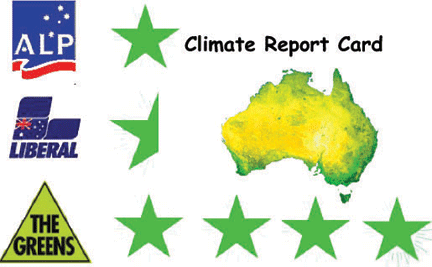 Environment policy: where the parties stand ABC, By Sarah Clarke and Andrew Greene Aug 5, 2013 After slipping from the national agenda, the environment and climate change are now back to prominence. When the ALP was elected in 2007, prime minister Kevin Rudd made climate change centre-stage at the UN climate meeting in Bali, where he declared that Australia would ratify the Kyoto Protocol.
Mr Rudd first proposed an emissions trading scheme but postponed the idea. When she became prime minister, Julia Gillard revived a carbon price, in the form of a carbon tax, as a condition for getting the independents and Greens on side to form minority government.Following her departure, Mr Rudd has declared the carbon tax “terminated” as Labor promises to move to an emissions trading scheme by July 2014, one year earlier than planned.
The Coalition plans to scale back staff in the newly created Climate Change department, and merge it with the Environment Department. Under its “Direct Action” policy a number of initiatives and agencies set up by Labor will go.
On an international scale, Australia is one of the largest per capita emitters in the developed world. Australia’s carbon pollution represents 1.5 per cent of global emissions of greenhouse gases and our emissions are projected to continue growing by almost 2 per cent a year.
What aspects do the major parties agree/disagree on?
Greenhouse gas emission reduction targets
Both ALP and the Coalition agree on the science of climate change, and have formally backed Australia’s emissions reduction target of 5 per cent by 2020. But there are some differences:
- ALP: Committed to 5-25pc reduction on 2000 levels by 2020, based on the ambition of global agreement and 80pc reduction by 2050 which is in line with the UK and Germany. Signatory to second commitment period of Kyoto Protocol for 2020 reduction and intention to ratify.
- Coalition: Committed to the 5-25pc reduction on 2000 levels based on ambition of global agreement. Review in 2015 to consider longer term target in light of international agreement. Coalition has stated “in principle” support for second commitment period of Kyoto Protocol but no position on ratifications announced.
- Greens: Committed to 25-40pc reductions on 1990 levels by 2020, net zero emissions by 2050 and the second period of the Kyoto Protocol.
Carbon price
- ALP: Carbon pricing legislated in 2011 along with independent Climate Change Authority, Clean Energy Regulator, and Australian Renewable Energy Agency. Climate Commission established administratively in February 2011 to explain the science of climate change. Announced in July 2013 bringing forward emissions trading scheme to 1 July 2014 and cutting back Energy Security Fund from $4.3 billion to $2.5 billion.
- Coalition: Committed to abolish carbon price. Abolish the Climate Change Authority, Climate Commission, and the Energy security fund. Retain the Clean Energy Regulator and the National Greenhouse and Energy Reporting Scheme (NGERS) as part of the administration of the Emissions Reduction Fund. Committed to introducing a carbon buyback via an Emissions Reduction Fund.
- Greens: Made carbon pricing a condition of supporting the Gillard Government after the 2010 election, including the creation of Multi Party Climate Change Committee. Do not support bringing forward emissions trading to 1 July 2014.
Clean Energy Finance Corp
- ALP: CEFC legislated in 2012 with funding of $10 billion over 5 years to leverage private investment to deploy and commercialise large scale renewable energy and energy efficiency projects with funding from July 1, 2013. Investment functions of Low Carbon Australia now merged into CEFC.
- Coalition: The CEFC to be axed and contracts already issued will not be acted on.
- Greens: Will oppose any attempt to repeal the CEFC.
International climate deal
- ALP: Labor supports a global deal through the United Nations negotiations and along with all member countries has agreed to set up a legally binding international deal for all major emitters by 2015 in Paris, to be up and running by 2019. Supports G20 and Major Economies Forum to shape global solution and climate deal.
- Coalition :The Coalition supports the role of the UN and will be engaged in the international negotiations. In addition, the coalition believes that as Chair of the G20 there’s an opportunity for Australia to further negotiations between the US, China, India and the EU to secure an international deal.
- Greens: Greens support a legally binding global deal through the UN negotiations by 2015.
Renewable Energy Target (RET)
- ALP: Committed to the RET of at least 20pc by 2020 which maintains target of 41,000 GWh large scale renewable energy generation by 2020. Commitment not to review RET until 2016.
- Coalition: Committed to the RET of 20pc by 2020 but will review it in 2014.
- Greens: Committed to the RET of at least 20pc by 2020 which maintains target of 41,000 GWh large scale renewable energy generation by 2020; 2030 RET target is 90pc.
Australian Renewable Energy Agency (ARENA)
- ALP: Established ARENA but cut its budget in 2013. Approx $3 billion of support maintained and receives dividends from the CEFC.
- Coalition: Maintain ARENA and accepts Labor’s budget cuts. Would not receive dividends from CEFC if it was abolished.
- Greens: Opposed Labor’s cuts to ARENA in the 2013 Budget.
Carbon farming
- ALP: Set it up and committed $290 million to Carbon Farming Futures and Skills program. $44 million for complementary improvements in Natural Resource Management planning. Adopted new international rules which allow virtually all Carbon Farming Initiative credits to be sold to all polluters in the carbon pricing mechanism.
- Coalition: Committed to keeping it, and vowed to expand to include a wider range of emissions reduction methodologies to be available for purchase via the Emissions Reduction Fund.
- Greens: Supported the establishment of the CFI and negotiated amendments under the auspices of the Multi Party Climate Change Committee adding a ‘negative list’ which bans a range of project types……. http://www.abc.net.au/news/federal-election-2013/policy/climate-change/
Hypocrisy of Foreign Minister Carr: Australia DOES have the power to help Julian Assange

Australia could seek an assurance from Sweden that following the completion of all Swedish legal proceedings that Assange would be deported to Australia. This would be an entirely appropriate outcome for an Australian citizen who has been subject to extradition to a foreign country.
If the Gillard government was able to obtain these diplomatic assurances, which are consistent with international law, then Assange would face his accusers in Sweden and not face the prospect of onward extradition to the United States.
How Australia can end the Assange stalemate The Drum Australia can help Julian Assange negotiate his legal problems while remaining consistent with the norms of international law and with the level of assistance that would be offered to other Australians, writes Donald Rothwell. …….. the UK has indicated that it does not recognise Ecuador’s granting of asylum and if Assange were to leave the Embassy he is liable to arrest and extradition to Sweden.
Ecuador revealed in mid-August – as the Assange matter reached a pivotal point- that Britain had threatened to rely on its Diplomatic and Consular Premises Act and revoke the Ecuadorian Embassy’s diplomatic protection so as to enter and seize Assange.
This threat was extraordinary and without modern precedence and it was unsurprising that the Ecuadorian Government responded with such fury. British Foreign Secretary William Hague has now downplayed any suggestion that the Ecuadorian Embassy will be raided, and emphasised Britain will act consistently with international law.
Nevertheless, Hague and the British government have made it clear that they have a legal obligation to Sweden to extradite Assange and that they will continue to seek his arrest for breach of his bail conditions……..
Australia has been remarkably silent on some of these recent developments. Throughout the year Assange has been highly critical of what he claims has been a lack of support from the Australian government, but Foreign Minister Bob Carr insists that Assange has received more consular assistance than any other Australian in similar circumstances.
The reality is that Australia can still play a proactive, and perhaps even pivotal role, in seeking to bring about a resolution to the current stalemate. Continue reading
Australian buildings can go gas free, AND halve their energy use
Aust buildings could halve energy use in decade – gas free http://reneweconomy.com.au/2013/aust-buildings-could-halve-energy-use-in-decade-gas-free-81837 By Sophie Vorrath on 6 August 2013 A nationwide plan to transform Australia’s existing building stock into models of energy efficiency and renewable power generation has found that residential and commercial energy use could be cut in half, and could reach zero emissions from their operations, within 10 years.
Launched on Tuesday, the The Zero Carbon Australia Buildings Plan – a joint effort from climate think-tank Beyond Zero Emissions and The University of Melbourne Energy Institute – sets out a strategy to retrofit Australia’s buildings, to reduce energy bills, generate renewable energy, increase comfort levels, and make workplaces more productive.
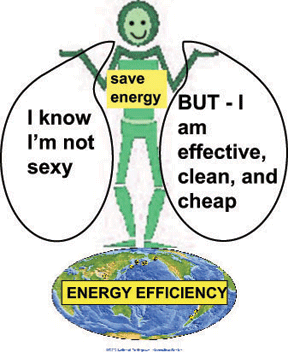
The plan finds the residential building sector would be able to achieve a 53 per cent energy use reduction overall, with some typical home categories seeing over 70 per cent reduction. Commercial buildings are estimated to be able to reduce energy use by 44 per cent overall.
A key element of the plan involves buildings going gas-free, with gas appliances deemed “too inefficient and polluting” compared to modern electric appliances which can replace them – namely heat pumps, or split-system airconditioners, as they are more commonly known. Continue reading
Tony Abbott aims to shut down clean energy initiatives
 Renewables fear the worst as Tony Abbott targets clean energy REneweconomy, By Giles Parkinson on 6 August
  2013 Australia’s clean energy industry leaders have been invited to a special meeting next week to discuss the future of renewable energy policy in the country and to contemplate the unpalatable, as Coalition leader Tony Abbott began his campaign with an early lead and a call to the Clean Energy Finance Corporation to cease its operations immediately.
A meeting of the CEOs of Australia’s largest companies involved in the renewable energy industry is believed to have been called by AGL Energy managing director Michael Fraser, who doubles as chair of the Clean Energy Council, to discuss strategies to protect the renewable energy target (RET). Or indeed to assess whether they have the political capital or influence to maintain the target as is under a Coalition government.
The crisis meeting comes as the Coalition takes an early lead in the first days of the election campaign, and with increasing uncertainty about the likely make-up of the Senate. The renewables industry fears that with a Coalition win, the lobbying from incumbent utilities and generators, including the Business Council of Australia, to have the RET diluted or removed will intensify, and there may be little political protection for the current target.
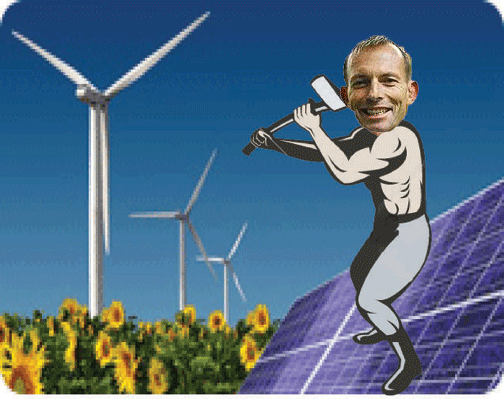
The renewable energy industry is probably the industry sector most directly affected by the outcome of this election. While Labor has vowed to push the next RET review out to 2016, the Coalition wants to have yet another review of the RET in 2014, and has expressed sympathy with pleas to dilute the fixed 41,000GWh target because of falling demand.
The uncertainty that this has created has already brought most large-scale developments to a halt. Continue reading
Australia’s solar energy revolution in outer suburbs
Solar revolution led by outer suburbs, SBS World News, 5 AUG 2013, Households across the country are putting solar panels on their roofs at a rate that has exceeded all expectations, By Tim Flannery
 Households across the country are putting solar panels on their roofs at a rate that has exceeded all expectations. This year we hit 1 million rooftops with photovoltaic (PV) solar panels, up from just 8,000 in 2007. This means that a staggering 2.6 million Australians, 11% of the population, are now using the sun to power their homes.
The solar energy revolution is being led in suburbs and towns like Dubbo and Campbelltown in NSW, Bundaberg in Queensland, Hoppers Crossing in Melbourne, and Mandurah in Western Australia. This increase is being driven by ordinary Australians. It is the modest outer metropolitan suburbs across the country, with high concentrations of mortgages, which show the greatest uptake.
The cost of installing a PV panel today is less than a quarter of what it was in 2002. The decision to install solar panels is no longer just about global responsibility – it makes financial sense. As global momentum for solar continues to grow, the technology is advancing and manufacturing is being up-scaled in countries like China. Together these factors are rapidly driving down costs, making solar increasingly competitive even without subsidies. Businesses are watching the drop in technology costs keenly as payback periods become increasingly cost competitive.
Smart investors are realising that this trend is here to stay and that the future of energy is renewable. …. http://www.sbs.com.au/news/article/1796353/Comment-Solar-revolution-led-by-outer-suburbs
Outrage – the favoured tactic of the anti wind energy crowd

In concert with pseudoscientific assertions, outrage and emotion seem to be integral in driving the skewed perception that wind farms are a risk to health.
A focus on rousing anger has been at the heart of the anti-wind movement for some time. New York anti-wind activist Calvin Luther Martin wrote in 2009 that wind farm opponents should “screw concerned and start getting angry and defiant.”
The same philosophy has been deployed by the anonymously run blog ‘Stop These Things’. Replete with direct vilification of individuals in the wind industry (including myself), death threats, threats of violence and comparisons to genocidal regimes, the anonymous author/s attempt to inspire anger and aggression.
Facts out, wind outrage in Climate Spectator Ketan Joshi 6 Aug 13, Recently, I relayed the tale of a man angrily questioning the health effects of wind farms, and proceeding to smoke a cigarette: two risks that he seemed to react to with odd disparity. In that piece, I explored some of the reasons why it can be quite natural for us to adopt pseudoscience, when it’s predicated on fear and uncertainty.
But that’s only part of the chain of events that has led to ‘Wind Turbine Syndrome’ consuming much of the oxygen of public discourse around wind energy. Community, control and risk perception also play a big role in the genesis of authentic health fears, based on fabricated science.
Technologies designed to meet our ravenous demand for electricity have historically spurred an undercurrent of nervousness in those that live near them………….
In late May, ABC’s ‘Background Briefing’ ran a story on the purported health impacts of wind energy, and a 200-turbine development proposed for the small community of King Island, off the coast of Tasmania. Simon Chapman, Professor in Public Health at Sydney University, states during the story that 17 evidence reviews (recently updated to 19) all reach a similar conclusion: the likelihood that wind farms have direct health impacts on human physiology, through inaudible low-frequency noise emissions, is close to nil.
Despite a conspicuous lack of supporting scientific evidence, opposition to wind farms is regularly predicated on the belief that the health risks are high. Anecdotal reports of health impacts are collated and dispersed by anti-wind groups such as the Waubra Foundation. When the CEO of the Waubra Foundation, Sarah Laurie, visited the King Island community, she informed residents that “Yes, wind turbines do cause adverse health effects” and linked wind energy to autistic behaviour.
Labelling an illusory causal link as established medical truth is not the only technique utilised by anti-wind groups to inspire opposition to wind farms. Continue reading
1 This month
17 October, Free Public Talk on Nuclear Issues in South Australia
David Noonan will speak on public interest concerns over the new Roxby Downs Indenture Act 2026 on BHP copper-uranium mining and ore processing in SA, and on how AUKUS may face SA with a High-Level nuclear waste agenda.
Dr Jim Green will discuss international developments in the field of nuclear power including ‘small modular reactors’ and Generation 4 ‘advanced’ nuclear reactor concepts.


Help Aunty Sue Protect Her Land and Sacred Sites From Destructive Rocket Testing.
.

Australians deserve the truth
about
AUKUS – https://aukuspublicinquiry.com/

PETITION – To: Prime Minister Anthony Albanese and the Australian Labor Government

of the week – Australians for War Powers Reform (AWPR)
To see nuclear-related stories in greater depth and intensity

