Maurice Newman and fossil fuel front group stop New South Wales wind farm
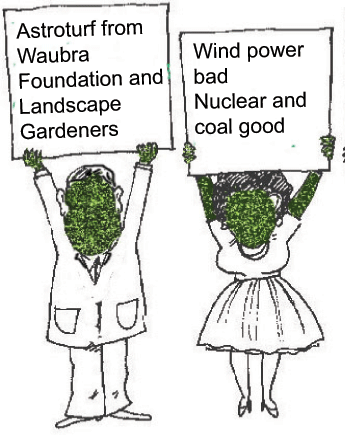 Protests stop wind farm plan BY:HARRY EDWARDS The Australian July 08, 2013 A LARGE wind farm proposed for near Goulburn in NSW has been shelved after protests from local landholders including Maurice Newman, the former head of the Australian Securities Exchange who has been anointed to chair a new business advisory council if the Coalition wins this year’s federal election.
The planning application for the 100-turbine Golspie wind farm, lodged by renewable energy developer Wind Prospect CWP, lapsed last week, with the company citing “wind resource, land security and grid connection issues”.
Mr Newman, who opposes wind farms and has pledged to lobby against subsidies for them, argues that fluctuations in output from renewable energy sources have increased power costs for consumers by requiring the construction of expensive backup generators.
Mr Newman belongs to Landscape Guardians, a community lobby group that actively campaigns against all wind farms in the Upper Lachlan shire, where he owns land. In January Tony Abbott announced that Mr Newman — appointed by the Howard government to chair the ABC — was his choice to head a new business advisory council for a Coalition government……
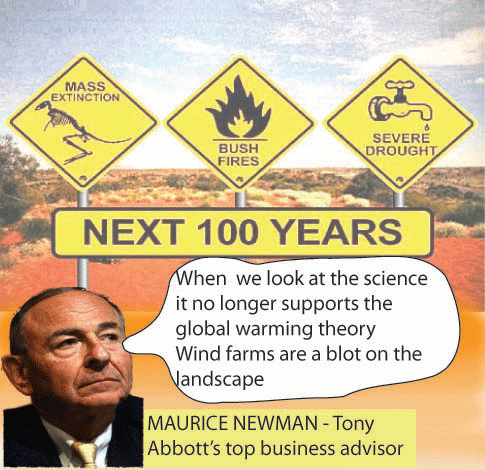
Labor’s Renewable Energy Target aims to have 20 per cent of electricity generated from renewable sources by 2020. The Coalition intends to review the RET next year if it wins the election, and could rely on Mr Newman’s advice to scrap the target.
Climate Change Minister Mark Butler said the system was working. “Labor stands by our unprecedented investment in clean, renewable energy which is driving a transformation of the Australian economy with a 30 per cent increase in renewable energy generation in the last 12 months and a 7 per cent drop in carbon pollution in the national electricity market,” he said……. http://www.theaustralian.com.au/national-affairs/climate/protests-stop-wind-farm-plan/story-e6frg6xf-1226675644019
Tasmanian government acting on UV radiation danger of solariums
Tasmania to outlaw use of solariums Examiner By Alex Druce July 7, 2013, WIDELY publicised cancer risks and strict operating laws have seen tanning beds almost phased out of Tasmania. And in 18 months, they will be outlawed completely.
Health Minister Michelle O’Byrne said Tasmania would join New South Wales, Victoria and South Australia in banning solariums from commercial use by December 2014.The move comes four years after the government slapped heavy restrictions on solarium owners, including bans for customers aged under 18, bans for people with very fair skin, and mandatory training for all operators. Continue reading
Uranium miner Paladin among many suspected Australian tax cheats
Advocacy group ActionAid claims poor countries are losing more than $130 billion in tax revenues a year by giving generous tax breaks to big companies, including Australian miners. There are about 240 Australian mining companies with operations in Africa.
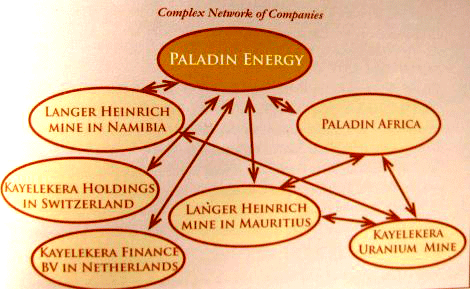
Perth-based uranium miner Paladin Energy, came under scrutiny for its tax arrangements in Malawi where it runs a mine in Karonga. A report by the group Norwegian Church Aid alleges there are discrepancies between Paladin’s reported tax and its tax paid. It also alleges other payments by Paladin in Malawi are lower than the company reports.
Paladin has subsidiaries registered in Mauritius and the British Virgin Islands, both tax havens. Last year’s annual report showed the company accumulated losses that mean it will need to make profits totalling $208 million in Australia before paying any tax.
Tax man takes scalpel to energy and resources firms http://www.theage.com.au/national/tax-man-takes-scalpel-to-energy-and-resources-firms-20130705-2phat.html July 6, 2013 Georgia Wilkins The Tax Office will open 60 cases of suspected tax dodging by Australian and international companies amid global pressure to crack down on profit shifting.
The investigations will add to the 26 cases of offshore restructuring already under review by the government body.
Under scrutiny are companies that deliberately restructure their business to route profits through low-tax jurisdictions or tax havens to avoid paying higher taxes in Australia, often through the use of post box companies or marketing hubs that have little real substance. Continue reading
Like King Canute, Wyong Council behaves as if the sea level will not rise
 Actually – that headline is not really fair to King Canute. The Canute story is that his courtiers believed that King Canute had god-like powers, and could stop the tide coming in. Canute, in order to educate them, went down to the beach, and ordered the tide not to come in. However, as he expected, the tide did come in, and he got wet.
And the Wyong mayor and councillors might get we one day.
Sea level rise recommendation rejected http://www.abc.net.au/news/2013-07-05/sea-level-rise-recommendation-rejected/4802480, 6 July 13
A sea-level rise recommendation for building heights in Wyong has been rejected by the Tuggerah Lakes Estuary and Flood Plain Management Committee.
Wyong Council staff had recommended that an increase to floor level building heights of 400 millimetres was needed to allow for any future
sea level rises. Wyong Mayor Doug Eaton says the recommendation was rejected five votes to one.
“That recommendation of the committee now has to go to council to be either endorsed or changed by it my view it will almost certainly be
endorsed,” he said.
Uranium company cuts back its NT and Queensland operations as uranium price plummets
 Deep Yellow slashes jobs, cuts pay, Minng.com, 5 July, 2013 Vicky Validakis Uranium exploration company Deep Yellow has cut jobs and reduced salaries by five per cent as it ramps up steps to reduce overhead costs, blaming the move on the weakness in the uranium sector.
The company announced board fees and executive salaries would be reduced by five per cent for at least six months, with salary scales to remain fixed at 2013 rates.
The company also said its Perth office had reduced staff to just three, comprising the managing director, financial controller and office manager.
Deep Yellow is said it is also planning to move to a smaller office by the end of the year.
The latest pay cuts follow a ten per cent reduction in base salary and fees and group-wide salary freezes in July 2012…… Deep Yellow’s chairman Mervyn Greene said the steps to reduce overheads costs was due to ongoing volatility in financial markets and a weakness in the uranium market…… In Australia the company owns the Napperby Uranium project in the Northern Territory as well as exploration tenements in Queensland. http://www.miningaustralia.com.au/news/deep-yellow-slashes-jobs-cuts-pay
Victorian city of Ballarat could be powered by 100% renewable energy – Greens candidate
 Greens’ renewable energy plan outlined http://www.thecourier.com.au/story/1619753/greens-renewable-energy-plan-outlined/?cs=62 By PATRICK BYRNE July 5, 2013, THE Australian Greens candidate for Ballarat believes the city can one day be powered by 100 per cent renewable energy. Stephanie Hodgins-May yesterday announced a long-term plan to have Ballarat and the surrounding region invest more heavily in renewable energy.
She also slammed the federal opposition leader and Liberal members of parliament for denying the existence of climate change.
Ms Hodgins-May said the possibility of the region relying only on renewable energy was completely achievable.“When you look at a town like Daylesford, that whole town can be powered by only two wind turbines at the Hepburn wind farm,” she said.
“There is no reason why a city like Ballarat cannot one day rely solely on renewable energy.”
She said that both the Labor and Liberal parties needed to commit to a renewable future, instead of avoiding the issue and, in some instances, flatly denying the existence of climate change.“The Labor and Liberal parties are creating uncertainty with possible changes to the price on pollution and clean energy investment,” Ms Hodgins-May said.
Ms Hodgins-May announced plans for a “clean energy roadmap” that would help to one day power the city.The roadmap includes plans to increase the current renewable energy target, aiming to achieve 90 per cent renewable energy by 2030.The current government energy target is for at least 20 per cent of Australia’s electricity to come from renewable energy by 2020.
A warning to Tanzania, (where an Australian company is to start mining uranium)
 Health hazards posed by uranium mining IPP MEDIA 5th July 2013“…….. the developing countries in the process of starting mining uranium, must learn a lesson from the USA, the most powerful rich and technically advanced nation in the world, who for the sake of protecting its environmental pollution from the known post uranium mining hazardous health effects, to its citizen of today, tomorrow and future generation, admitted that enough was enough, and shut down most of uranium mining in their country.
The big lesson here for Tanzania with its Uranium deposit soon to be exploited is that; until now there is no proper way of destroying completely remains of uranium mining, and therefore it is difficult to control the effects of the mineral that will end thousands of years. Above all the cost of cleaning up the environment and avoidance of effects caused by remains of big uranium mines and management of radioactive waste will put a big strain on the already ailing country’s economy. Continue reading
Australia is big on nuclear disarmament talk, but bad on nuclear disarmament action
Australia is good at talking the talk. Yet when it comes to taking action, Australia’s governments have fallen far short of their heroic rhetoric.
The 2009 Lowy Institute poll report stated that seventy-five per cent of Australians “somewhat” or “strongly” agree that “global nuclear disarmament should be a top priority for the Australian government”.
On Australia Day in 2012, nearly eight hundred Order of Australia recipients – including former prime ministers, governors-general, foreign affairs and defence ministers, premiers, governors, High Court justices and chiefs of the armed forces – called on the government to adopt a nuclear weapon-free defence posture and work towards a nuclear weapons convention.
If we want to play a proactive role on disarmament, Australia should end its hypocritical reliance on US nuclear armaments by renouncing extended nuclear deterrence.
 AUSTRALIA’S NUCLEAR DISARMAMENT HYPOCRISY , Right Now, BY DAVID DONALDSON 4 July 13 On the face of it, Australia is a great advocate for global peace and disarmament efforts. It played a proactive role on banning chemical weapons, giving its name to the Australia Group of countries aimed at preventing the spread of chemical weapons. The Keating government created the Canberra Commission on the Elimination of Nuclear Weapons, which illustrated the necessity – and possibility – of complete nuclear disarmament.
In the same vein, the Rudd government initiated the widely cited joint Australian-Japanese International Commission on Nuclear Non-Proliferation and Disarmament (ICNND), whose report argued that nuclear weapons are “the most inhumane weapons ever conceived, inherently indiscriminate in those they kill and maim, and with an impact deadly for decades.”
In 2008 Kevin Rudd declared that “we must be committed to the ultimate objective of a nuclear weapons free world.” At diplomatic meetings, Australia says it wants a reduced role for nuclear weapons in military doctrines, and that it believes that nuclear weapons states “need to do more to reduce and ultimately eliminate all types of nuclear weapons.” Continue reading
More trouble hits Australian uranium company Paladin’s African empire
Some of the issues pertain to female worker’s miscarriages; [CEO] Duvenhage’s apparent failure to engage with the union; the company’s reluctance to give workers a “single cent” for an annual increment; unfair performance bonuses; nepotism and corruption.
Australian-based Paladin Energy Ltd. (TSE:PDN) owns 100% interest in the mine.
Protests hit second largest uranium mine in Namibia http://www.mining.com/protests-hit-second-largest-uranium-mine-in-namibia-85919/ Vladimir Basov | July 2, 2013 About 300 workers, including mine staff and contractor employees, picketed at Langer Heinrich Uranium (LHU) mine last Thursday over pay and working conditions, The Namibian reported.
Workers and media were barred from the minesite where the demonstration was supposed to take place although the protesters had organized the peaceful demonstration at the beginning of last week and had announced it to the mine’s management.
As a result, all day shift buses were forced to stop inside the concession area where workers then had to disembark – about five kilometres away from the actual site. To their dismay, the protesters were forced to picket at the concession area. The Mineworkers Union of Namibia (MUN) branch executives felt that the mine’s management snubbed what it termed a legal and democratic action. Continue reading
World Meteorological Organisation’s critical report on Climate Change


The WMO says droughts affect more people than any other kind of natural disaster because of their large scale and long duration. The decade saw droughts across the world, with some of the longest and most severe in Australia (2002 and other years),
Clear upward trend’ in global temperatures: WMO ABC News, ALEX KIRBY, 5 July 13, In the first decade of this century extreme weather, global temperatures and sea level all continued a trend in a “clearly upward direction”, says a new report from the World Meteorological Organisation.
If you think the world is warming and the weather getting nastier, you’re right, according to the United Nations agency committed to understanding weather and climate.
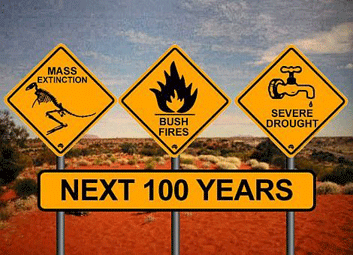
The World Meteorological Organisation says the planet “experienced unprecedented high-impact climate extremes” in the ten years from 2001 to 2010, the warmest decade since the start of modern measurements in 1850.
Those ten years also continued an extended period of accelerating global warming, with more national temperature records reported broken than in any previous decade. Sea levels rose about twice as fast as the trend in the last century.
A WMO report, The Global Climate 2001-2010: A Decade of Climate Extremes, analyses global and regional temperatures and precipitation, and extreme weather such as the heat waves in Europe and Russia, Hurricane Katrina in the US, tropical cyclone Nargis in Myanmar, droughts in the Amazon basin, Australia and East Africa, and floods in Pakistan. Continue reading
A public health challenge to Australia’s use of medical ionising radiation
We’ve known about the risks of radiation for some time, but these three studies quantify the risks. Essentially, they show that relatively low doses of ionising radiation, previously considered ‘safe’ can translate into excess cancer cases.
We believe that these findings call for a change in imaging practice. First, ionising radiation should be a consideration for the referring doctor when deciding whether a patient needs a scan (and if so, what type). Second, imaging techniques and machines that reduce ionising radiation doses should always be used. Finally, government funding models must be reviewed to ensure there are no inappropriate incentives towards a radiating scan.
For example, in Australia, if a young patient presents to a GP with low back pain and the GP orders a scan, Medicare would fund a CT scan but not a magnetic resonance imaging (MRI), even though this may be a safer alternative in terms of radiation.
The body of evidence is growing. We need to start translating evidence into practice
 The risks of ionising radiation: three new studies and their impact on imaging in sports medicine http://www.clinicalsportsmedicine.com/the-risks-of-ionising-radiation-three-new-studies-and-their-impact-on-imaging-in-sports-medicine-jessica-orchard-and-john-orchard~ Jessica Orchard and John Orchard 2 July 13, In 2012, two major studies were published about the risks of ionising radiation from imaging. Pearce and colleagues’ study in The Lancet examined the excess risk of leukaemia and brain tumours for children and adolescents exposed to computed tomography (CT) scans. They found that children exposed to cumulative doses of 50mGy (3-5 CTs) may have triple the risk of leukaemia, and doses of 60mGy may have almost triple the risk of brain tumours.[1] In addition, the Pijpe and colleagues’ GEN-RAD-RISK paper in theBMJ[2] study showed that women such as Angelina Joliewho carry a specific mutation associated with breast cancer (BRCA1/2), and who were exposed to diagnostic radiation before the age of thirty, had almost twice the risk of breast cancer (with a dose-response pattern). This study involved lower doses, which we have previously considered fairly ‘safe’ (e.g. 4mGy from a single mammogram or shoulder X-ray).
On the basis of these studies, we wrote a blog post and started writing an editorial for theBritish Journal of Sports Medicine. While we were in the final stages of preparing the editorial,[3] a third study was published. The Matthews et al Australian data linkage study,[4] with an enormous cohort (11 million) showed that the adjusted overall cancer incidence for young people exposed to a CT scan was twenty-four percent greater than for those who were not exposed.
That is, one in every 1800 scans resulted in an excess cancer case. As the mean follow up time was only 9.5 years (relatively short in relation to the time taken to develop cancer), this suggests the true lifetime risk may be much higher. We await with interest the relative risk in older people to see whether the risks for the young also apply to those in middle age. Continue reading
The reality of Australia’s sorry history on nuclear disarmament policy
 AUSTRALIA’S NUCLEAR DISARMAMENT HYPOCRISY , Right Now, BY DAVID DONALDSON 4 July 13 “……..The Australian government’s submission also noted that extended deterrence has “removed the need for Australia to consider more significant and expensive defence options” – defence-speak for Australia developing its own nukes. Linking Australia’s decision not to develop nuclear weapons – a position to which it is bound by international law – to extended nuclear deterrence amounts to little more than an absurd threat to the Americans not to remove a guarantee that has never been publicly acknowledged.
Such statements demonstrate the lack of real commitment by the Federal Government to disarmament, and have no doubt made Obama’s stated desire to reduce the number of nuclear weapons in the world that little bit harder. Faced with an inevitably sceptical Pentagon and obstructive allies like Australia, the soaring anti-nuclear rhetoric of Obama’s 2009 Prague Speech has brought few results.
More recently, Australia refused to sign on to an 80-nation statement on the humanitarian impact of nuclear weapons at the 2013 Nuclear Non-Proliferation Treaty Preparatory Committee. The statement sought to address the fact that, in spite of the widely acknowledged catastrophic effects of any use of nuclear weapons, such concerns have “not been at the core of nuclear disarmament and nuclear non-proliferation deliberations for many years.”
While more than 150 countries have expressed support for a treaty banning nuclear weapons under international law – based on similar conventions on landmines and cluster munitions – the Australian government is not among them.
Moreover, the Future Fund continues to invest in nuclear weapons companies, despite having agreed to divest from tobacco, cluster munitions and landmines companies……. HTTP://RIGHTNOW.ORG.AU/WRITING-CAT/ARTICLE/AUSTRALIAS-NUCLEAR-DISARMAMENT-HYPOCRISY/
Western Australians stand to benefit with employment from tourism, rather than mining
 Tourism is a much more important job provider than is mining. And – it must be noted – mining is transient – and usually leaves a nasty looking degraded environment, and a dying town, when it ends. Tourism goes on, can go hand in hand with environmental conservation, and provide ongoing employment.
Tourism a jobs winner http://au.news.yahoo.com/thewest/a/-/wa/17874412/tourism-a-jobs-winner/ Yolanda Zaw, 5 July 13, Tourism will overtake mining and construction as one of the biggest employers in WA, according to statistics to be released today. Tourism accounts for 7 per cent of all jobs in the State, just behind mining with 8 per cent, construction 10 per cent and health care and social assistance, the top employer with 11 per cent.
Tourism Council chief executive Evan Hall said tourism would become more important to the WA economy as the resources boom slowed.
“The trend is for tourism jobs to grow as mining jobs decline,” he said. “With the lower Australian dollar, cheaper hotel rates and more flights to Perth, WA can win back the leisure tourists we lost over the last few years.”
Mr Hall said in all other States tourism employed more people than mining. Continue reading
Hypocrisy ! Australian Pipeline Industry Association wants GAS to be treated as RENEWABLE ENERGY
Gas sector wants access to renewable energy support Climate Spectator, By a staff reporter 5 July 13 The Australian Pipeline Industry Association has called for gas suppliers to be able to access government support currently available to renewable energy.
In a policy document released today they suggest government establish a technology-neutral energy investment program, allowing renewables, clean coal, gas and any low-emission technologies to compete for investment funds……http://www.businessspectator.com.au/news/2013/7/5/renewable-energy/gas-sector-wants-access-renewable-energy-support
Bonanza for John Borshoff. boss of Australian uranium mining company
 Paladin boss earnings increase while Kayelekera cut jobs http://www.nyasatimes.com/2013/02/14/paladin-boss-gets-massive-pay-hike-after-malawi-job-cuts/ By Nyasa Times Reporter February 14, 2013 Despite uranium miner, Paladin Energy limited claiming that its Malawi operations in the northern district of Karonga at Kayelekera are operating on massive losses and that world uranium prices are low, the company’s managing director John Borshoff elected to cash in his leave entitlementment, Nyasa Times has established.
Paladin’s annual report reveals that despite Borshoff honouring a promise to cut his salary by 25% between November 2011 and November 2012 – a promise he extended to June 2013, the CEO was able to boost his remuneration after a review of annual leave entitlements thereby pocketing a 52% rise in earnings. The review focused on annual and long-service leave in a bid to cut Paladin’s liabilities, and Borshoff responded by cashing out 220 days of leave.The transaction approaved by the remuneration Committee and the board netted Borshoff $1,717,000 and helped increase his remuneration to $3,464,000, from $2.26 million in 2012.
The uranium miner recently retrenched 110 staff from its Kayelekera mine in Malawi in an austerity drive which others commentators fault Boshoff for excercising his right to cash in the leave entitlement when local staff just had their calls for a 66 per cent pay rise rejected.
”Its total mockery to the Malawian workers at Kayelekera who were retrenched but have not had their benefits yet. These people are suffering. That’s a wake-up call to Malawi Government that Paladin is making profits despite plunge in prices” Karonga Business Community Chairperson Wavisanga Silungwe said in a statement made available to Nyasa Times.
“While production has gone up, the uranium price has not; hence Kayelekera continues to operate at a loss. We had warned government that this situation was unsustainable and would lead to job losses unless the uranium price improved, which it has not,” said Paladin’s (African) Ltd General Manager, international affairs, Greg Walker.
Walker said the staff reduction is in “response to economic pressures on the company caused by the continuing depressed uranium price” Borshoff’s contract with Paladin has one year left, and provides him with three months’ long-service leave for every five years of service. He is entitled to two years of double base salary when he retires or has his employment terminated.
|
|
1 This month
17 October, Free Public Talk on Nuclear Issues in South Australia
David Noonan will speak on public interest concerns over the new Roxby Downs Indenture Act 2026 on BHP copper-uranium mining and ore processing in SA, and on how AUKUS may face SA with a High-Level nuclear waste agenda.
Dr Jim Green will discuss international developments in the field of nuclear power including ‘small modular reactors’ and Generation 4 ‘advanced’ nuclear reactor concepts.


Help Aunty Sue Protect Her Land and Sacred Sites From Destructive Rocket Testing.
.

Australians deserve the truth
about
AUKUS – https://aukuspublicinquiry.com/

PETITION – To: Prime Minister Anthony Albanese and the Australian Labor Government

of the week – Australians for War Powers Reform (AWPR)
To see nuclear-related stories in greater depth and intensity

