Solar energy storage being developed in a big way in Nevada
 Solar towers and storage – about to change the energy game? http://reneweconomy.com.au/2013/solar-towers-and-storage-about-to-change-the-energy-game-91721, By Giles Parkinson on 4 July 2013
The $1 billion Crescent Dunes project near Tonopah in the Central Nevada Desert, some 300kms north of Las Vegas, was developed by the Santa Monica-based SolarReserve and features the company’s market leading molten salt power tower technology with fully integrated energy storage.
What makes it unique and a potential game changer in the electricity industry is the flexibility and dispatchability of its power, meaning that it can deliver electricity whenever it is needed by customers; and its cost, which already beats diesel, is competitive with new build coal and gas generation.
The Crescent Dunes facility will have 10 hours of molten salt storage, which on average will allow it to deliver 110MW of baseload capacity to Las Vegas between the hours of 12 noon and midnight each day, when the city needs it most to power the lights and air conditioning of its casinos and entertainment palaces. It has signed a 25-year power contract with NV Energy, Nevada’s largest utility, to do that.
Tom Georgis, SolarReserve’s senior vice president of development, says the unique capabilities of the technology means that the plant could have been configured in any number of ways. With a 180MW turbine, for instance, it could have produced power for 10 hours each day, which was the original intention. With a smaller turbine, and more than 20 hours storage, it could have delivered 50MW of base-load power 24/7.
In the end, Nevada pitched for midday to midnight to suit its needs. In effect, the plant is providing baseload power for a fixed period each day – delivering the benefits of coal-fired power without the downsides, which is of course heavy pollution and an ability to be switched off at will or at regular intervals.
‘You can’t do that with a coal fired facility,” Georgis says of the Nevada contract. But the technology also allows it to compete with gas-fired generation, both in the ability to provide baseload and as a peaking plant.
Next year, SolarReserve begins construction of the 150MW Rice Solar Energy Plant in Southern California, which will act more like a peaking power station to suit that state’s needs. Proposals the company will take to Chile, Australia and the Middle East will likely be for baseload power. (We will explain more about those plans in the next two days).
“This should be the winning technology. It has all the attributes you looking for to displace conventional generation,” Georgis says. “It’s not just fulfilling renewable energy targets, you are displacing any new build fossil plants – from nuclear, gas and coal. This is going to change the discussion in energy markets, certainly around the idea that renewables are variable.”
Georgis says there is a lot of confusion about storage and what it means. He says the way to think about it is in the amount of electricity produced by a solar tower plant over a year……….

The Crescent Dunes plant will not be the first of its type, but it will be the biggest to date, and the first built to what Georgis describes as “utility scale”. The 18MW Gemasolar plant (pictured) has been operating in Spain for the last 18 months, and the 10MW Solar Two demonstration facility near Barstow in California’s Mojave Desert was operated by the Department of Energy in the 1990s.
Australian Government helps Tonga change from costly diesel to cheaper solar energy
ADB And Australian Government Helping Tonga Go Solar, http://www.energymatters.com.au/index.php?main_page=news_article&article_id=3823 4 July 13 The Asian Development Bank (ADB) and the Australia Government are kicking in to fund the construction and installation of solar power systems on nine of Tonga’s outer islands.
Tonga is comprised of 176 islands scattered over 700,000 square kilometres of the southern Pacific Ocean and is home to 103,000 people. Tonga currently depends on expensive and polluting imported diesel for 90% of its electricity generation. In some areas, the cost of electricity can be as high as 74 cents per kilowatt hour.
The Outer Islands Renewable Energy Project will help to change that by funding solar power systems on Eua, Vava’u and Ha’apai, along with four outer islands in the Ha’apai group as well as on Niuatoputapu and Niuafo’ou. The solar arrays will be connected to state and community owned power distribution networks on most of the target islands.
ADB will provide a $2 million (currency unknown at the time of publishing) grant from its concessional Asian Development Fund, while the Australian Agency for International Development (AUSAid) will provide a $4.5 million grant, to be administered by ADB.
The Government of Tonga will contribute $300,000 equivalent; for a total investment cost of $6.8 million.
The total installation will be reasonably small; around 1.25 megawatts capacity, but it will reduce diesel imports by an estimated 0.48 million litres a year. A litre of diesel generates approximately 2.6 kilograms of carbon emissions; so the project will offset around 1,248 tonnes of CO2 a year.
The Outer Islands Renewable Energy Project will be executed by Tonga’s Ministry of Finance and National Planning and will be implemented over 6 years with an estimated completion date of December 2019. Consultants will provide training on the operation and maintenance of the facilities along with management services that will extend for at least 5 years after completion of the training.
Tonga’s interest in solar goes beyond cheap electricity – the multiple effects of climate change pose a significant threat to the nation
Australia’s hidden atomic health and death toll
 A powerful manuscript entitled “The Black Mist and its Aftermath — Oral Histories by Lallie Lennon” (2010) was submitted to the South Australian and federal governments as well as to the International Atomic Energy Agency
Now aged in her 80s, Lallie has never had her health issues properly investigated, much less received any compensation. She continues to suffer from the beta burn-related skin condition to this day.
Professor Sir Ernest Titterton, the duplicitous architect of nuclear testing in Australia, typified the official contempt for survivors when he dismissed the Black Mist event as a “scare campaign”.
More recently, the ultra-right wing Herald Sun columnist Andrew Bolt has repeated this line.
Australian atomic massacre still ignored http://www.greenleft.org.au/node/54394, June 29, 2013 By David T. Rowlands Nearly 60 years have passed since Totem 1, a British nuclear test in the Australian desert, was recklessly conducted in unfavourable meteorological conditions.
Nuclear testing of any sort, even in the most “controlled” of circumstances, is inherently abusive, a crime against the environment and humanity for countless generations to come. Yet the effects of Totem 1 were particularly bad, even by the warped standards of the era.
The mushroom cloud did not behave in the way it was supposed to. Instead of rising uniformly, part of it spread laterally, causing fallout to roll menacingly at ground level over a remote yet still populated corner of South Australia, sowing injury, illness and death in its wake.
The number of casualties is unknown because the secretive and unaccountable nuclear establishment has always declined to investigate the full impact of its own criminal negligence. But it has been suggested by investigators that perhaps 50 short-term Aboriginal fatalities resulted.
In addition to those who died, many others were exposed to harmful levels of radiation. The long-term health effects on these individuals have never been charted — but anecdotal reports of high cancer rates and horrendous birth defects in isolated “downwinder” communities have circulated.
At the time of the tests, it was well known by authorities that communities of Aboriginal people were close by. Yet the official attitude was that the concerns of a “handful of natives” could not be allowed to interfere with the “interests” of the British Commonwealth. Continue reading
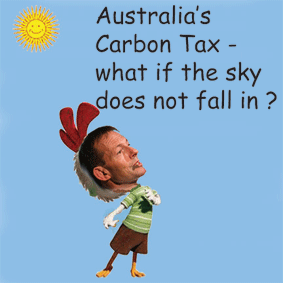
Tony Abbott to remove carbon tax, but keep the compensation. Strange politics?
 Tony Abbott’s vow to abolish the carbon tax but keep the compensation smacks of populist politics at its finest PAUL SYVRET THE COURIER-MAIL JULY 02, 2013 “…………On the carbon front, emissions from the electricity sector have been reduced by 7 per cent, although other factors, such as demand, contribute to this, while renewable energy use is up 30 per cent. Most of the new-generation energy being planned is renewable or gas fired, indicating the carbon price is doing what it is designed to do in terms of shaping long-term investment.
Not a bad effort, Australia. Take a bow.
Still Abbott perseveres (straight-faced) with his claim the looming election will be a referendum on carbon, despite polls indicating only one in three voters support the removal of the tax and its replacement by the Coalition’s nebulous “Direct Action” scheme.
In short, a price on carbon, which was Abbott’s preferred policy option until he saw a chance to use it as a wedge in his plot to topple former Liberal leader Malcolm Turnbull, is seen by all but a handful of economists as the most efficient way of reducing emissions.
It is a “Pigovian tax”, designed to change behaviour by penalising companies that generate what are called negative externalities, in this case, spewing greenhouse gases into an already warming globe.
As Harvard Professor of Economics Greg Mankiw put it in a 2009 paper: “The economics here is straightforward: emitting carbon into the atmosphere entails a negative externality. In absence of any policy, people will emit too much. The Pigovian policy response is to impose a tax on carbon emission. This will induce households and firms to internalise the carbon externality when deciding, for example, how much to drive, what kind of car to buy, how much electricity to use, what kind of electric power plant to build and so on.”
But no, the Abbott response is to declare again on national television over the weekend that not only would he axe the tax, but Australians would keep the compensation, the sort of addle-headed populism that must have more financially literate members of his team screaming in silent anguish……
This is at the same time the rest of the world is moving to price carbon, with some markets, such as Europe, already well established. Just last week US President Barack Obama took America a big step down the road with a decision to cap emissions for US power plants. California, with a larger economy than Australia, already has a cap-and-trade scheme.
What about here? We may well be left with a “policy” that is based on little more than blood oath obduracy and dog-whistling for the deniers. http://www.couriermail.com.au/news/opinion/tony-abbott8217s-vow-to-abolish-the-carbon-tax-but-keep-the-compensation-smacks-of-populist-politics-at-its-finest/story-fnihsr9v-1226672519966
Another wind farm for New South Wales’ Upper Lachlan
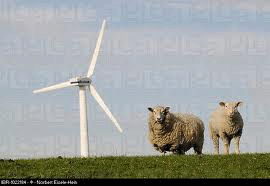 Plans for Upper Lachlan windfarm http://www.abc.net.au/news/2013-07-01/plans-for-upper-lachlan-windfarm/4790626 Natalie Whiting Jul 1, 2013 There are plans to set up another wind farm in the Upper Lachlan Shire Council area. Newtricity is proposing to build up to 40 turbines at the proposed Biala Wind Farm, outside Crookwell.
The 30 million dollar project would be spread over two adjacent sites. Two options have been identified to connect the windfarm to an existing electricity terminal.Newtricity says it could connect to the existing Goulburn to Yass transmission line or to the line being used by the near by Gullen Range wind farm, which is being constructed.
The development would also involve building a substation and control buildings on site.The company’s submitted its proposal and its preliminary environmental assessment to the Department of Planning.
Solar energy in Victoria continues to soar
 Victoria’s Solar Electricity Production Soars http://www.energymatters.com.au/index.php?main_page=news_article&article_id=3819, 2 July 13 Solar energy supplied 550 gigawatt-hours to Victoria in 2012 – 14 per cent of all renewable electricity – says the Clean Energy Council.
The CEC recently released its Renewable Energy in Victoria 2012 report; which provides an overview of Victoria’s electricity generation from renewable energy sources last year.
According to the report, the 550 gigawatt-hours figure was more than double solar’s contribution in 2011; which was 225 gigawatt-hours. In 2009, output was just 18 gigawatt-hours.
Installed solar panel capacity in 2012 in Victoria jumped from 270 megawatts to 418 megawatts. This was due to the uptake of home solar power, which accounted for all but 1 megawatt of installed capacity.
Uptake was spurred on by rapidly ballooning domestic power bills – and with more electricity price rises on the way; solar will likely continue to see solid gains.
While commercial solar installations were still a bit player last year, the CEC says low solar panel prices may see further uptake by the commercial sector during 2013.
The other renewable energy technology that saw significant increases in capacity and production last year was wind power. In 2012, Victoria’s wind farms generated 1674 gigawatt-hours, of clean electricity; up from 1280 gigawatt-hours in 2011.
The state’s 11 commercial wind farms over 1 MW in capacity generated enough electricity last year to provide the power needs of over 230,000 average Australian homes. Wind energy accounted for more than 27 per cent of Victoria’s renewable electricity generation capacity last year.
The report states Victoria’s installed renewable energy capacity has almost tripled since 2000, increasing from 668 megawatts to more than 1860 megawatts by the end of last year.
Victoria’s total renewable energy electricity generation was 3825 gigawatt-hours, in 2012; an increase of 874 gigawatt-hours, or nearly 30 per cent more than in 2011. The Renewable Energy in Victoria 2012 report was created with assistance from Sustainability Victoria. The full report can be downloaded here (PDF).
Productivity Commission agrees: solar energy not the cause of high electricity prices
 Productivity Commission Says ‘Go West’ For Solar http://www.energymatters.com.au/index.php?main_page=news_article&article_id=3818 2 July 13, The Productivity Commission’s Electricity Network Regulatory Frameworks final inquiry report laments that not enough small scale solar power systems have been installed facing west.
The report states average electricity prices across Australia have risen by 70 per cent in real terms from June 2007 to December 2012 – but doesn’t point the finger at solar. It acknowledges what has been known for years; network costs in most states are the main culprit and offers a series of recommendations for addressing the issues. Continue reading
Victorian Electricity Distributors quietly move to sabotage new home solar installations
 Electricity Distributors Cast Shadow over Solar 1 July 13, Victorian Electricity Distributors have quietly introduced new hurdles to the installation of grid connected solar systems. CitiPower and Powercor have both introduced a pre-approval process and criteria which are likely to result in many customers’ applications to install grid connected solar systems being rejected.
NECA Victoria Executive Director, Philip Green said “these criteria are likely to result in many rural customers being unable to connect to the grid while in urban areas customers will have their applications knocked back on the basis that there are too many existing solar systems in their area.”
“Your neighbours may all have grid connected solar, however the electricity distributors can knock you back – it seems to be a matter of first in, best dressed” said Mr Green. “In addition, these policies appear designed to hamper the spread of solar into the commercial and industrial sectors.”
The distributors justify their policies on the basis that grid connected solar has effects on power quality and network integrity issues.
“The community has suffered massive increases in electricity prices over recent years with much of this increase going to upgrade (some would say gold plate) the network” said Mr Green. “Unsurprisingly many consumers are looking to mitigate the high cost of electricity by installing solar and yet they’re being told that can’t connect to the network that they’ve helped pay to upgrade.”
“Distributors should not be at liberty to proceed and introduce restrictive policies that
will impede the community’s best efforts to help reduce its impact upon the environment,” said Mr Green.
The policies have not been widely communicated to either the community or sellers and installers of solar systems meaning that some customers who enter into sales contracts may never be able to conn ect to the grid. NECA also understand that other electricity distributors are likely to introduce similar policies.
Only last year, the Victorian Competition and Efficiency Commission released its Inquiry into Feed-in Tariffs & Barriers to Distributed Generation Final Report Power from the People. Neither this report nor the Victorian Government’s response to it canvassed or proposed policies like these. “We call upon the Victorian Government to intervene” said Mr Green.
–
Australia’s “Northern Territory Intervention” trashed the reputation of Aboriginals on behalf of mining industries
 Government had made it clear that it wished to re-engage itself more directly in the control of community land through leasing options as well as to open up Aboriginal land for development and mining purposes.
The plan was to empty the homelands, and this has not changed. However, it was recognised that achieving this would be politically fraught – it would need to be accomplished in a manner that would not off-side mainstream Australia. Removing Aboriginal people from their land and taking control over their communities would need to be presented in a way that Australians would believe it to be to Aboriginal advantage, whatever the tactics.
So began the campaign to discredit the people and to publicly stigmatise Aboriginal men of the Northern Territory
And even in 2009 when the CEO of the Australian Crime Commission, John Lawler, reported that his investigation had shown there were no organised paedophile rings operating in the NT, no formal apology was ever made to the Aboriginal men and their families who were brutally shamed by the false claims.
Sixth Anniversary of the Northern Territory Intervention – Striking the Wrong Note Lateral Love Australia‘concerned Australians’ Michele Harris, 21 June 13 Aboriginal advocate Olga Havnen, in her Lowitja O’Donoghue oration has asked a critical question. She asks what has been the psychological impact of the Intervention on Aboriginal people of the Northern Territory. It is surprising that so little attention has been given to this critical, yet in some ways tenuous, link before now.
Even before the Intervention began in June 2007, government had long planned a new approach to the ‘management’ of Aboriginal people in the Northern Territory. It was no longer part of government thinking that self-determination and Aboriginal control over land could be allowed to continue. These were the Whitlam notions of 1975 and they were no longer acceptable.
Early inklings of change occurred in 2004 with the management of grants being transferred from communities to Government’s newly established Indigenous Co-ordination Centres. More ominous were the Amendments of 2006 to the Aboriginal Land Rights Act and the memoranda of agreements that followed. Government had made it clear that it wished to re-engage itself more directly in the control of community land through leasing options as well as to open up Aboriginal land for development and mining purposes. Continue reading
Tony Abbott keen to rush coal development, stifle renewable energy
Abbott to fast-track coal mines, in competition for ideas REneweconomy By Giles Parkinson on 1 July 2013 Tony Abbott has given his clearest indication yet that he intends to fast-track approval for large thermal coal mining projects, saying his new “one stop” shop for environmental approvals will ensure quick decisions on project approvals.
Abbott’s move, along with his party’s policy platform that has effectively suspended most investment in large scale renewables, comes as newly restored Prime Minister Kevin Rudd seeks to take the wind out of Abbott’s sails by proposing a more rapid transition to a (low) market price for carbon, as first foreshadowed on this website last Thursday morning, and the Greens push for even more ambition – proposing a 90 per cent renewables target by 2030.
Solar energy storage could be revolutionised by Australian invention
 Australian Invention Could Revolutionise Solar Energy Storage http://www.energymatters.com.au/index.php?main_page=news_article&article_id=3816 1 July 13, ANU researchers have developed a material that can store large amounts of power rapidly – and with very little energy loss. Based on the mineral rutile, it is a ‘dielectric’ material; which are used in the construction of capacitors.
The researchers say their material is superior to current capacitors in energy absorption, is cheaper to manufacture and can function effectively in a massive temperature range: -190°C to 180°C.
“With further development, the material could be used in ‘supercapacitors’ which store enormous amounts of energy, removing current energy storage limitations and throwing the door wide open for innovation in the areas of renewable energy, electric cars, even space and defence technologies,” says Associate Professor Liu of the ANU Research School of Chemistry. Continue reading
Australia’s electricity demand falls, as more direct solar systems established
Demand forecasts slashed again as consumers turn to solar REneweconomy, By Giles Parkinson on 28 June 2013 The Australian Energy Market Operator has again slashed its demand forecasts for the coming year and over the coming decade, as households and business turn increasingly to rooftop solar PV, and as energy efficiency efforts also take bite.
The latest AEMO National Electricity Forecasting Report – released on Friday – cited rooftop solar and energy efficiency regulations in buildings as the main reasons cutting its forecast demand across the National Electricity Market (which includes all states except WA and Northern Territory) for 2013/14 by 2.4 per cent. Lower than expected industrial demand also played a role.
This comes a year after AEMO slashed its forecasts for 2012/13 by nearly 10 per cent. As it is, demand for 2012/13 looks to have come in 1.1 per cent below event that forecast…….
One of the reasons for the revised estimates is that AEMO has introduced new modeling techniques, including those that better recognize the impact of solar and energy efficiency. Up to two years ago, it relied heavily on forecasts given to it by state-owned network operators, who had a self-interest to give bullish demand forecasts because it would justify greater infrastructure investment and bigger profits for the networks.
Consumers are now paying heavily for those forecasts, and for network assets that may not have been required. But those same network operators, along with other incumbent generators and retailers, are now likely to use the pared down forecasts for their own benefit, this time by resuming their campaign to have the renewable energy target diluted, or even removed…..
ncreased use of solar PV, where consumers generate some, or even a large part of their own energy needs, and increased energy efficiency (which also reduces demand), are two of the central planks of policy measures taken by the US and China to reduce their emissions. It is also part of the central policy recommendations of the International Energy Agency. http://reneweconomy.com.au/2013/demand-forecasts-slashed-again-as-consumers-turn-to-solar-78062
Confusion about New South Wales Government’s attitude to nuclear power and uranium mining
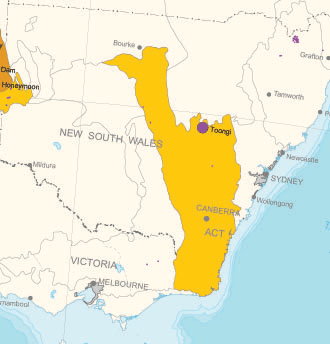 In May, the minister’s office said evaluation of the expressions of interest were due to begin, with an announcement of the successful applicants due “mid-year”.
It’s far from clear, but presumably the announcement – which must be imminent – will not only tell us which companies have applied to explore uranium, but also where they want to do so. (at left, areas recommended for uranium exploration)
[NSW Premier -] “The Uranium Mining and Nuclear Facilities (Prohibitions) Act 1986 continues to prohibit the construction of nuclear generation facilities in this state,” a spokesman told Fairfax Media when approached about the response.
“There has been and will be no change in the NSW government’s position on that.”
Nuclear act is still a minefield http://www.brisbanetimes.com.au/comment/nuclear-act-is-still-a-minefield-20130628-2p2cm.html#ixzz2XfneLben June 29, 2013 Sean Nicholls Sydney Morning Herald State Political Editor More than a year after the heat generated by last year’s announcement that the NSW government would overturn a 25-year ban on uranium exploration, things have gone a little quiet – publicly at least.
Premier Barry O’Farrell declared the move would help boost the state economy, particularly in light of the federal government decision to allow export of uranium to India. As expected, it was met with furious opposition from environment groups. Greenpeace labelled it “obscene”.
But while O’Farrell talked up the decision as a potential economic boost, he insisted his government was “not about to rush into mining uranium until we have carried out the necessary environmental and exploration checks and have had a mature and sensible discussion about utilising this resource”. Continue reading
This could be the 2013 climate change election
Australia got its price on carbon under the prime ministership of Julia Gillard. Gillard, whatever you think of her, was remarkable in her ability to forge consensus in a hung parliament. The Greens party and independent MPs supported the Clean Energy Future Act, which in most ways was similar to Rudd’s carbon reduction scheme, albeit with more investment in renewable energy.
During this time, as I’ve written about earlier, the conservative opposition leader, Tony Abbott, ran an unrelenting fear campaign against the carbon price. Support for the carbon price from 2010 to 2012 fell sharply, until July last year when it came into effect. Since then, public support in Australia has increased for the carbon price.
Kevin Rudd’s return could herald a second Australian climate election http://www.guardian.co.uk/environment/southern-crossroads/2013/jun/28/kevin-rudd-australian-climate-election The Labor leader’s return to the Australian prime ministership could see a repeat of 2007’s ‘climate change election’ Rudd was elected in 2007 saying that climate change was the “the greatest moral, economic and environmental challenge of our generation”. In many ways, 2007 was the climate change election.

The first act Rudd took as prime minister was to ratify Kyoto, a symbolic break from the lead-footed conservative government under John Howard. A price on carbon was the major policy that the new Labor government saw to reduce carbon emissions, called the carbon pollution reduction scheme.
The scheme was defeated in the Senate in 2009 after the Greens party refused to support it, and voted with the Liberal and National parties to oppose it. Then the dismal efforts of Copenhagen further dampened efforts for climate action. Rudd’s final climate act as prime minister in 2010 was to announce that the carbon pollution reduction scheme would be shelved. Continue reading
Australia’s Clean Energy Finance Corporation launches investment, but Coalition opposes it
 The Coalition has vowed to axe the CEFC, along with the carbon price.
It has also written to the corporation saying any contracts it signs will not be honoured by the Coalition if it forms government.
Clean Energy $100m deal gets Coalition cold shoulder http://www.theage.com.au/environment/clean-energy-100m-deal-gets-coalition-cold-shoulder-20130628-2p2q9.html#ixzz2XgCLAQWO June 29, 2013 Tom Arup Environment editor, The Age Australia’s Clean Energy Finance Corporation has launched its first investment, committing to a joint $100 million energy efficiency loan program with the Commonwealth Bank.
The deal sets up a stand-off with the Coalition which has vowed not to honour any contracts signed by the $10 billion corporation if it wins office later in the year.
The corporation’s chief executive, Oliver Yates, said on Friday it would co-finance loans for medium-sized businesses for energy efficiency projects such as energy saving lighting, solar panels, and cogeneration and trigeneration plants.
The CEFC and the Commonwealth Bank will each chip in $50 million to the program, which will hand out loans between $500,000 to $5 million. It builds on an existing scheme put in place by another government agency, Low Carbon Australia – now folded into the CEFC – which has so far delivered $10.2 million to projects in manufacturing firms.
The CEFC is also working on a number of other larger deals, and it is understood some could be introduced as early as next week. It is reportedly negotiating to help New Zealand company Meridian Energy increase its debt in the massive Victorian Macarthur wind farm with a $100 million-plus loan, before it sells its share in the project. Continue reading
1 This month
17 October, Free Public Talk on Nuclear Issues in South Australia
David Noonan will speak on public interest concerns over the new Roxby Downs Indenture Act 2026 on BHP copper-uranium mining and ore processing in SA, and on how AUKUS may face SA with a High-Level nuclear waste agenda.
Dr Jim Green will discuss international developments in the field of nuclear power including ‘small modular reactors’ and Generation 4 ‘advanced’ nuclear reactor concepts.


Help Aunty Sue Protect Her Land and Sacred Sites From Destructive Rocket Testing.
.

Australians deserve the truth
about
AUKUS – https://aukuspublicinquiry.com/

PETITION – To: Prime Minister Anthony Albanese and the Australian Labor Government

of the week – Australians for War Powers Reform (AWPR)
To see nuclear-related stories in greater depth and intensity

