The Coalition is hoodwinking Australia about nuclear energy

Opposition Leader Peter Dutton is expected to make rescinding the nuclear power prohibition a 2025 election policy. One expert wonders whether he can do basic sums.
EMMA ELSWORTHY, JAN 12, 2024 https://www.crikey.com.au/2024/01/12/nuclear-energy-coalition-policy-dutton-2025-election/
It’s now more expensive than renewables, Australia has a decades-long ban on it, and its key international example touted by the Coalition was scrapped, but that hasn’t stopped growing cries from conservatives about nuclear power entering the energy mix on the nation’s path to net zero by 2050.
Opposition Leader Peter Dutton is reportedly preparing to make nuclear a key part of his energy policy for the next federal election, telling the Institute of Public Affairs: “The only feasible and proven technology, which can firm up renewables and help us achieve the goals of clean, cost effective and consistent power is next generation nuclear technologies.”
Dutton has tasked the opposition’s climate change and energy spokesperson Ted O’Brien with an internal investigation into a domestic nuclear energy industry in Australia. An enthused O’Brien has since returned from a tour of the US and Canada’s nuclear reactors last year, including the site of the BWRX-300 build in Ontario and Pittsburgh’s Generation IV nuclear battery, called the eVinci.
O’Brien is interested in small nuclear reactors, or SMRs — structures that would be manufactured in a factory, shipped out and assembled on-site in a dreamlike bid to drive down the cost and time delays of larger reactors.
“Environmental advocates, industry, private equity, centre-left and centre-right think-tanks, members of Congress — all told us that near 100% renewables was neither practical nor affordable, and that we needed nuclear in our energy mix,” O’Brien wrote in The Australian last year.
Several conservative figures have called for nuclear power to enter the energy conversation, including former Liberal treasurer Peter Costello, Nationals senator Matt Canavan, Nationals leader David Littleproud, and Liberal Democratic MP David Limbrick. Meanwhile, Climate and Energy Minister Chris Bowen has flat-out called the idea “dumb”.
In November, however, conservative SMR dreams were dashed here and abroad when a US developer binned a project widely touted as kicking off the new nuclear era. NuScale Power said it had failed to attract enough utility customers for the controversial power source to proceed — but it had also nearly doubled in cost (from US$8 billion to US$14 billion), suffered a five-year time delay, and revealed its power generation capacity had been slashed by a third.
Even so, Australian National University Honorary Associate Professor Tony Irwin told Crikey there was “still time” for nuclear to contribute to Australia’s pursuit of net zero, requiring “politicians with a long-term vision” to recognise what some COP28 nations called “the key role of nuclear energy in limiting temperature rise”.
Griffith University Emeritus Professor of Science, Technology and Society Ian Lowe called this bullshit.
“Nobody who can read joined-up writing and do take-away sums thinks nuclear power has any role in slowing Australia’s release of greenhouse gases,” the environmental scientist told Crikey.
A CSIRO report released last month found likewise, concluding nuclear power did not offer an “economically competitive solution”, and that SMRs would be “too late to make a significant contribution to achieving net zero emissions” because of both legal and commercial viability hurdles.
Lowe also noted the 2006 Uranium Mining, Processing and Nuclear Energy Review (UMPNER) report had found nuclear energy would need very generous public subsidies to compete with renewables, which have backslid in price enormously in the 18 years since the review’s release.
The UMPNER was chaired by then head of the Australian Nuclear Science and Technology Organisation (ANTSO) Dr Ziggy Switkowski — a spokesperson for the government organisation told Crikey it’s following the nuclear debate though officially “agnostic” on nuclear energy.
Lowe also noted that the Coalition’s bleating about the nation rescinding the nuclear ban and embracing the controversial power source from the opposition has interesting timing considering the nine years it spent in government.
“Of course, they did nothing to promote that technology in their decade in office and are now predictably evasive about where a nuclear power station would be located and how it would be funded,” Lowe said.
Labor MP Josh Wilson went harder, telling Crikey that Dutton’s growing support for nuclear energy in the face of cheaper and cleaner renewables showed the opposition leader is unfit to lead the country.
“By giving in to the climate deniers and nuclear cheerleaders in his own show, Dutton shows his preparedness to consign the Australian community to an expensive, disaster-prone, and dangerous future for the sake of protecting his own position,” Wilson said.
Defence Minister Marles announces Australia has joined in U.S. attacks on Yemen
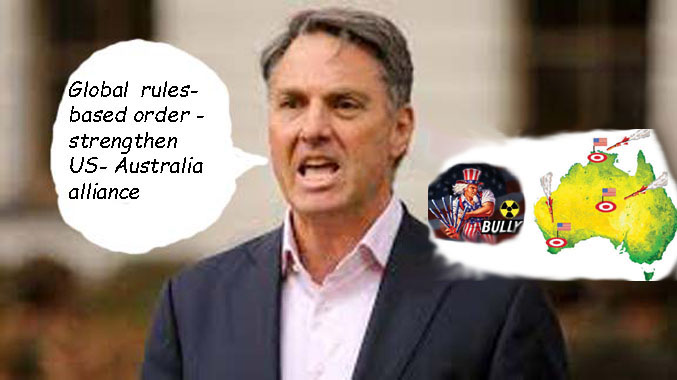
Comment. As Marles yet again spouts the “global rules-based order”, we wonder where is Prime Minister Anthony Albanese, and why was Parliament not consulted?
Deputy Prime Minister Richard Marles confirms Australian personnel contributed to strikes in Yemen.
ABC News, 12 Jan 24
Defence Minister and Deputy Prime Minister Richard Marles says Australian personnel had been present in “operational headquarters” but said he could not elaborate further on the precise nature of their participation.
Key points:
- A US official said strikes against the Iran-backed group were carried out by aircraft, ships and a submarine
- It comes as the United Nations Security Council demands an immediate halt to the shipping disruptions
- The US Central Command said Houthi rebels have launched their 27th attack since November 19
Mr Marles said Australia’s participation was “completely consistent” with the national interest. “Australia must stand up for freedom of navigation,” Mr Marles said, accusing the Houthis of “disruption of the rules-based order.”
The US and Britain have started launching strikes against Houthi targets in Yemen.
Houthi official Abdul Qader al-Mortada said raids were conducted in several Yemeni cities, including the capital Sana’a, in the early hours of Friday.
Two Hodieda residents told Associated Press they heard five strong explosions.
Hodieda lies on the Red Sea and is the largest port city controlled by the Houthis.
Yemen’s Houthi rebels said they will continue targeting Israel-linked ships in the Red Sea despite overnight air strikes by the US and Britain, their spokesman said on Friday.
“We affirm that there is absolutely no justification for this aggression against Yemen, as there was no threat to international navigation in the Red and Arabian Seas, and the targeting was and will continue to affect Israeli ships or those heading to the ports of occupied Palestine,” Yemen’s Houthis spokesperson Mohammed Abdulsalam posted on X, formerly known as Twitter.
On Friday, Iran said it condemns the US-Britain attack on Houthis in Yemen warning that it will fuel “insecurity and instability” in the region, Iranian state media reported.
“We strongly condemn the military attacks carried out this morning by the United States and the United Kingdom on several cities in Yemen,” said Nasser Kannani, spokesperson at Iran’s foreign ministry.
“These attacks are a clear violation of Yemen’s sovereignty and territorial integrity, and a breach of international laws,” he added…………………………………………
US President Joe Biden said Australia, Canada, Bahrain and the Netherlands provided support for the operation………………………………………..
The strikes would mark the first counterattack launched against the Iran-backed group, since it began Red Sea attacks in November last year.
It comes as the United Nations Security Council demanded an immediate halt to the disruption in global commerce on Thursday.
A joint statement by Australia, Bahrain, Canada, Denmark, Germany, Netherlands, New Zealand, Republic of Korea, United Kingdom and the US said the UN resolution, in addition to Houthi ignoring calls to end the shipping attacks, had led to these “precision strikes”……………………………..
Scotland’s first minister Humza Yousaf, whose parents-in-law escaped Gaza in early November, warned the UK “does not have a good record of military intervention in the Middle East”, demanding MPs have a briefing. ………………………………………………………………………………….
The Iran-backed group says it is conducting attacks in support of Palestinian militant group Hamas in its fight against Israel………………………………………………………….
Before the resolution on Thursday, United States deputy ambassador Robert Wood said “freedom of commercial activity on the seas is critically important to commerce and to national security of a number of states”.
Wider fallout on the horizon
Nearly 10 per cent of global oil trade and an estimated $US1 trillion ($1.5 trillion) in goods pass through the Red Sea route annually.
Houthi attacks have forced many shipping companies to use the much longer and more-expensive route around Africa’s Cape of Good Hope………………………………………………………………. more https://www.abc.net.au/news/2024-01-12/britain-joins-strikes-against-houthi-rebels/103312432?fbclid=IwAR0IWBxVsFVdHyF534j_12Il1ojMC-TMJ2zflrOI_J5Xnt9KWqBRBmUCAy8
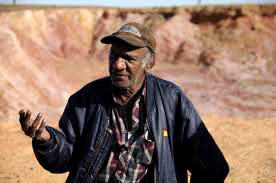
Vale Uncle Kevin Buzzacott, fierce advocate for his people and a nuclear free Australia
Green Left , Jim Green, January 8, 2024 Issue 1397
Arabunna Elder Uncle Kevin Buzzacott passed away in Alice Springs on November 29, 2023. A fierce advocate for his people and for a nuclear-free Australia, Kevin will be sorely missed.
Kevin was born in 1946 at Finniss Springs, on Arabunna country in South Australia. As a youngster, he learnt culture, language, how to live off the land and he learnt to work with cattle and horses.
Over the years, Kevin and his family lived in many places including Alice Springs, Tarcoola and Gawler. He worked on the railways for many years.
In 1984, Kevin moved to Port Augusta, where he worked as alcohol and drug worker. In 1985 he moved to Alice Springs where he worked on the successful campaign to stop the Todd River from being dammed. He helped establish the Arrernte Council in Alice Springs and served as an Aboriginal and Torres Strait Islander Commission regional councillor.
Kevin returned to South Australia in the mid-1990s to protect Arabunna country.
One of his major campaigns was to try to stop the rapacious water take from the Great Artesian Basin by mining company WMC (and later BHP) to supply the Olympic Dam copper/uranium mine at Roxby Downs.
The extraction of around 40 million litres of water has adversely affected the precious Mound Springs on Arabunna country — desert oases supported by the underlying Great Artesian Basin.
Kevin’s campaign might eventually succeed: there are plans to build a desalination plant on Spencer Gulf which could lead to a reduction and possible cessation of the water take from the Great Artesian Basin.
Kevin explained: “I’ve been at this game of calling for justice and peace for 30, maybe 40 years, but what really got me going was when Western Mining Corporation (WMC) set up the Olympic Dam mine. They started doing deals with the government on pastoral leases. So they did deals with S. Kidman & Co. and took up one of their cattle stations, Stuart’s Creek Station, which is on Arabunna land. Because of our native title and ongoing land rights campaigning, we’ve been fighting for these places for a long time. Stuart’s Creek is a very special, sacred place for us, and we’ve been trying to get it back for a long time.
“I thought that just before they bought that place I’d go and protest and camp on it. Also, it is on that station, on the shores of the Lake Eyre, where WMC started taking the sacred water out of the Lake Eyre Basin. That was where they started sucking the life blood out of us. That is where they put their big bore down, right on the shores of the lake. That was a real kick in the guts for me and really got me going.”
……………………………………………………………………….. Protest camp
Kevin set up a protest camp on Arabunna country in March 1999. WMC was among the most viciously racist mining companies in Australia and, true to form, the company tried to have Arabunna Elder Kevin Buzzacott evicted. The protest camp lasted until it was busted up by WMC goons and local police in December 1999.
Kevin initiated court actions against WMC and the federal government. These actions weren’t successful in the courts, but helped draw attention to the issues Kevin was fighting for.
“I did a court action against Hugh Morgan, who was the head of WMC. I charged Hugh Morgan with genocide, trying to flush him out and some of the shareholders. Hugh Morgan is based in Victoria. People in Melbourne deserve to live in a good place, they don’t need to live with these criminals and warmongers. Another court action I did was one I brought against Alexander Downer and Senator Robert Hill for stopping Lake Eyre from becoming a World Heritage site.”
After the protest camp on Arabunna country was busted up, Kevin set up a protest camp at Genocide Corner, outside the SA Governor’s residence in the centre of Kaurna Yerta/Adelaide.
“I had to go to Adelaide for the court case against Hugh Morgan, and when I was there the charges against Hugh Morgan were dismissed. The judge was a pastor in the Lutheran Church, and I asked him to stand down because I believed he had a conflict of interest as his church was a shareholder in the WMC. When he refused to do so I told him to get stuffed, walked out and went straight down to Government House to start a protest. I took banners, and whatever things I had,” Kevin said
“While I was talking to the media I was confronted by the cops. I looked over the road and saw a patch of grass and thought, ‘Bugger it, I’ll make camp and a fire here’. I ended up calling it ‘genocide Corner’, and renamed Adelaide the ‘City of Genocide’. It was on the intersection of King William Street and North Terrace [one of the main intersections in the city] so loads of people were passing by.
“Four ceremonial fires for peace were lit and, after 21 days, the Adelaide City Council and 50 police came down and arrested me for failing to cease to loiter. It was one of those laws they hadn’t used in a long time, but they used it to clear away all my stuff and my supporters.
“One of the court conditions was that I was not able to walk within the vicinity of Genocide Corner. I was of a mind just to walk straight back there, but I had the Peace Walk from Lake Eyre to Sydney coming up so I had to let that one go.”
The Peace Walk was timed to reach Sydney for the Olympics in September 2000.
“We walked for months, for 3000 kilometres, and all sorts of people from all walks of life joined us. We were carrying the fire for peace and justice. I made sure that we went through lots of different Aboriginal communities. I got a lot of support, but the government also pressured a lot of people not to support me by threatening their jobs and funding. Each place we went to, people took us through their land and we respected each mob.
There were all types of pressure put on people along the way. The cops were nasty and threatened some of the walkers with guns and everything. I visited all the jails along the way from Broken Hill to Dubbo and Bathurst. It was sad to see so many young brothers confined and locked up.
“We went to Canberra and met up with the Tent Embassy mob. A couple of politicians came to meet us and then we all went to Government House to present the Governor-General with a document of peace and justice.
“When we arrived in Sydney for the Olympic Games the Tent Embassy mob had already set up a camp [in Victoria Park], so we joined up with them. We did all sorts of things. We did a re-enactment at the beach where Captain Cook came in. We re-enacted the bad way in which he came with guns and all that and then the next day we did how they should have come.”
Reclaiming totems
In 2002, Kevin reclaimed the Emu and Kangaroo totems from the Australian Coat of Arms hanging outside Parliament House, Canberra………………………………………………………..
In 2004, Kevin participated in the Peace Pilgrimage from the Olympic Dam uranium mine to Hiroshima, Japan.
“During the first walk and then in Sydney we met people from all over and that got everything going. Aboriginal nations from Queensland were saying there should be a walk up the coast to show the world the things they were suffering. Then some people made contact with people in Hiroshima to have a walk from the uranium mine in Roxby to where the bomb was dropped in order to show how all these things are linked. Aboriginal people, Japanese monks, all sorts of people were involved. It started at Roxby and then went to Canberra and then an aeroplane took us to Japan where we walked all over the country. We visited Nagasaki and Hiroshima and met a lot of people who were kids when the bombs were falling. We did talks and took part in a huge ceremony on the anniversary of the bomb being dropped. There were people everywhere and lanterns lit and people crying, it was full on.”
In 2006, Kevin went to Melbourne for the Stolenwealth Games…………………………………………..
And Kevin was back in Melbourne in 2008 for BHP’s Annual General Meeting.
‘Born to be peacemakers’
“BHP have taken over WMC. They now own Olympic Dam and want to make it bigger. Myself and others who want to stop the mine got to be proxies for shareholders, they gave us tickets and we got to go inside on their behalf. I got to speak and I told the people there about the damage they are doing and that they need to stop it immediately.
“Aboriginal people have lived here for more than 40,000 years and cared for this country, but now it’s being turned into a sick and evil place. Myself, and others around this country, were born to be peacemakers.
“We mustn’t be frightened to educate others and fight, but not in a warlike way, to protect the earth and let everything run free. I don’t want to shoot or bomb the people from BHP and the others who are destroying this country because two wrongs don’t make a right. I think if I can help them to wake up to what they are doing then that will be punishment enough.”
Kevin was at the first meeting of the Alliance Against Uranium (later renamed the Australian Nuclear Free Alliance) in 1997 and, for many years, he served as the Alliance’s President.
He actively supported countless campaigns against uranium mining and plans to dump nuclear waste on Aboriginal land. He was at the Beverley uranium mine supporting Adnyamathanha Traditional Owners in May 2000 when SA Police viciously and illegally attacked protesters, children and journalists.
Kevin was at the Lizard’s Revenge protest at Olympic Dam in 2012.
Kevin was awarded Nuclear-Free Future Resistance Award in 2001 by the Nuclear-Free Future Foundation and travelled to Ireland to accept the award. Kevin was awarded the SA Conservation Council’s Jill Hudson Award in 2006.
Kevin was awarded the Australian Conservation Foundation’s Peter Rawlinson Award in 2007 for two decades of work highlighting the impacts of uranium mining and promoting a nuclear free Australia.
ACF Executive Director Don Henry said: “Kevin is a cultural practitioner, an activist, an advocate and an educator. He has travelled tirelessly, talking to groups large and small about the impacts of uranium mining and the threats posed by the nuclear industry. Kevin has had a profound impact on the lives of many people – especially young people – with his many tours and ‘on-country’ events. For many young activists ‘Uncle Kev’ is truly an unsung hero and, against the current pro-nuclear tide, his is a very important struggle and story.”
Kevin participated in many of the Radioactive Exposure Tours run by Friends of the Earth. We camped at the ‘Old Lake’ (Lake Eyre) and generations of young activists learnt first-hand about the impacts of the Olympic Dam mine on country and culture.
Kevin’s partner Margret Gilchrist passed on Kevin’s final message when he returned to Alice Springs with his health failing: “Keep that old fire burning; don’t stop til we’ve won; Lake Eyre for World Heritage.”
[Kevin’s funeral service can be viewed online and many videos featuring Kevin can be found at Cinemata and YouTube. Jim Green is the national nuclear campaigner with Friends of the Earth.]
Uranium ship sneaks into ‘nuclear free’ Fremantle port, sparking concern by wharfies over safety
The West Australian, Sat, 6 January 2024
A container ship carrying uranium ore was allowed to dock at Fremantle on Thursday, but was forced to wait for several hours whilst officials checked it was safe for it to berth.
The Maritime Union of Australia said wharfies expressed safety concerns when they became aware of the radioactive cargo.
”They’ve never had that cargo on board that anyone can remember so there was some push back from the workforce, to make sure all the safety requirements were in place,” union organiser Daniel Piccoli told The Sunday Times.
The vessel APL Mexico City was eventually allowed in on Thursday morning and the ship was due to sail on Sunday night.
The uranium stayed in 18 containers on the ship, which had left Adelaide on December 30.
Fremantle Port Authority said that while the cargo was prohibited from being handled, it was permitted for transit through the Port…………………………
Fremantle was a nuclear free zone under a long-time City of Fremantle policy.
According to the policy, “Council would object to uranium, nuclear waste or other material connected with the nuclear power industry being stored or transported in or through the municipality.“
Fremantle Greens MLC and former mayor Brad Pettitt said the transit was unusual, but it raised questions about whether the port workers were adequately informed about the dangerous cargo and were all the safety protocols adhered to.
He said protocols should be transparent as well as strong………. https://thewest.com.au/news/wa/uranium-ship-sneaks-into-nuclear-free-fremantle-port-sparking-concern-by-wharfies-over-safety-c-13132756
Nuke policy quietly nuked: Australia to fund US nuclear weapon delivery program

Greens Defence Spokesperson Senator David Shoebridge said, “When will the Albanese government start telling the whole truth about AUKUS and how Australians will be paying to help build the next class of US ballistic missile submarines?”
by Rex Patrick and Philip Dorling | Jan 2, 2024, https://michaelwest.com.au/australia-to-fund-nuclear-missiles-aukus/
A newly released Congressional Research Service report confirms that Australian funds will be used to support the United States Navy’s nuclear ballistic missile submarine program. The Government has sunk Labor’s nuclear disarmament and non-proliferation pledges. Rex Patrick and Philip Dorling explain.
The Columbia class submarines will carry 16 thirteen metre long Trident II D5 missiles. Each of those missiles can carry up to eight (they can carry 12 but, by treaty, the number has been limited to eight) multiple independently targeted re-entry vehicles. Each re-entry vehicle can deliver a thermonuclear warhead to an individual target.
Fully loaded, each submarine will be able deliver thermonuclear weapons to 128 cities or hardened military targets.
When on patrol, the submarines are virtually undetectable, and there are no known, near-term credible threats to the survivability of the SSBN force. The ballistic missile submarines are the most survivable leg of the triad.
The US Navy for more than a decade consistently identified the Columbia Class program as its top priority program.
Enter AUKUS
There has been a lot of focus on how the US will meet its own production requirements for the conventionally armed Virginia class nuclear attack submarines with the AUKUS agreements providing for two existing submarines to be transferred to Australia and at least another new vessel acquired off the production line.
No-one in Australia has paid much attention to the Columbia Program. That’s been an oversight.
The Columbia class ballistic missile submarines will be built at General Dynamics’ Electric Boat in Groton, Connecticut, and Huntington Ingalls Industries’ Newport News Shipbuilding (HII/NNS), in Newport News, Virginia. That’s exactly the same shipyards the Virginia class attack submarines will be built.
And this will all be happening at the same time. The first Columbia submarine is to be delivered in October 2027, the second in April 2030, the third in August 2032, the fourth in September 2032, and the fifth in August 2033. At the same time those same shipyards will be pumping out Virginia Class submarine for the US Navy, and Australia. As the fifth Columbia is being delivered, Australia will get its first second hand Virginia Class submarine.
Both shipyards are currently collectively punching out 1.4 Virginia class boats per annum. By 2028 it is expected that the yards will be collectively be producing 2 per annum. That will meet US Navy requirements, but AUKUS takes the required production rate to 2.33 per annum. When the Columbia submarines are added to the mix, the US submarine industrial base needs to be producing 1+2.33 submarines per annum.
AUKUS funding to be used
In the meantime, Australia has agreed to contribute US$3B (AUD$4.7B) to “the US industrial base to support increased production and maintenance capacity to ensure there is no capability gap for Australia in acquiring Nuclear Powered Submarines.”
The latest Congressional Research Service report on the Columbia class program makes to clear that the Australian commitment is to generic US submarine industrial base funding; covering construction for both the Virginia and Columbia submarine programs.
“Building up the industrial base’s capacity to a 1+2.33 capacity will require investing several billion dollars for capital plant expansion and improvements and workforce development at both the two submarine-construction shipyards and submarine supplier firms.
Some of this funding has been provided in FY2023 and prior years, some of it is requested for FY2024, some of it would be requested in FY2025 and subsequent years, and some of it would be provided, under the AUKUS proposed Pillar 1 pathway, by Australia.”
Parliament in the dark on nuclear funding
To be perfectly clear, Australian AUKUS funding will support construction of a key delivery component of the US nuclear strike force, keeping that program on track while overall submarine production accelerates.
This fact has not been shared with the Australian public or Parliament.
Greens Defence Spokesperson Senator David Shoebridge said, “When will the Albanese government start telling the whole truth about AUKUS and how Australians will be paying to help build the next class of US ballistic missile submarines?”
Of course, the Government hasn’t exactly been upfront about a number of things in the AUKUS program, with Michael West Media being left to reveal (in contrast to statements made by Defence Minister Richard Marles) that Australia will be taking nuclear waste from the US and UK under the program.
Nuclear dreams rudely awoken by blast of CSIRO reality
National Party Leader David Littleproud has publicly stated that the National’s goal is to stop renewables and wait for nuclear, and it’s a similar story with the Liberals
by Rosco Jones | Dec 27, 2023 , https://michaelwest.com.au/nuclear-energy-too-expensive-csiro-gencost/?utm_source=newsletter&utm_medium=email&utm_term=2023-12-28&utm_campaign=Michael+West+Media+Weekly+Update
CSIRO, Australia’s top science agency, has relegated nuclear reactors and hydrogen to the energy bench. They simply cost too much to be viable sources for our energy future.
on the latest GenCost report.
It was revealed in the shadows of Christmas, and its impact has so far been muted as there were more pressing matters to attend to, such as last-minute shopping and holidays. Yet the importance of the latest big-ticket analysis of energy costs cannot be understated. Indeed it will shape decision-making in politics and the energy markets this year and Australia’s energy future.
The CSIRO’s annual GenCost report has confirmed the view of new energy experts that small nuclear reactors and hydrogen – lauded as ‘wonder-technologies’ by pro-fossil-fuel political figures in their ideological campaign against renewable energy are fast losing allure as price projections skyrocket.
The 2023-24 GenCost report by CSIRO and AEMO is Australia’s most comprehensive electricity generation cost projection report. It uses the best available information each cycle to provide a benchmark on cost projections and updates forecasts to guide decision-making, as electricity costs change significantly each year.
This year’s analysis has cast ever more doubt on the Coalition’s nuclear fantasy, with a raft of issues plaguing nascent Small Modular Reactor (SMR) technology, accompanied by investor disinterest in large-scale nuclear power plants. Additionally, renewables are still by far the cheapest option for Australia’s grid despite this year’s inclusion of infrastructure costs. Unsurprisingly these results have left a wave of frustration rippling across the political right. They also come as a slap to Opposition Leader Peter Dutton’s campaigning against the Albanese government.
Although sidetracked by fossil industry distractions such as carbon capture and storage (CCS) technology, the government has pressed ahead with wind, solar and hydro as its focus for Australia’s energy future. The Coalition, in the absence of constructive policy ideas, has been pushing nuclear power through its usual media channels. However, the GenCost report estimates that SMR cost of production has risen 70% and also suggests demand for hydrogen is massively overinflated given the cost outlook.
…………. Utah venture dashes hopes

The much-hyped UAMPS project in Utah has proven commercially unviable and was cancelled with inflationary pressures on construction costs contributing to its demise.
This failure of the argument for nuclear in the face of cheaper, proven renewable technologies has inflamed Australia’s conservative pro-nuclear lobby, which has resorted to attacking the CSIRO’s credibility and analysis.
Critics have taken issue with the usage of a single project’s failure as a broad indicator of SMR’s capital costings. However, as noted in GenCost, UAMPS is an industry leader in the SMR field and represents one of the only sources of data available to derive non-theoretical cost estimates.
“GenCost requires first-of-a-kind cost estimates given the first commercial project is yet to be completed”.
UAMPS was set to be the first completed commercial SMR. With the added context of Chinese ventures into SMRs having similarly rising costs even prior to 2023. It seems likely that theoretical estimates, most of which have been performed by organisations heavily influenced by the nuclear industry, were likely of poor quality rather than UAMPS being an improper proxy.
This explanation, included within the report, did not prevent scathing commentary by the likes of lobbyist turned LNP minister Ted O’Brien:
“They’re not looking at companies like Westinghouse, GE or Hitachi, and they’ve chosen that one design from a start-up for one customer that has run into problems and based the entire analysis of nuclear on that.”
UAMPS is the only SMR that has actually received design approval.
In addition to the cost hikes, the delivery timeframe for the implementation of SMRs was larger than expected. A common criticism of Nuclear Power is, of course, its lengthy set up times, which range from 6-8 years for conventional power stations. SMRs were intended to address this, with construction as short as 3-5 years, however this seems to no longer be an advantage in an Australian context:
“If a decision to pursue a nuclear SMR project in Australia were taken today, with political support for the required legislative changes, then the first full operation would be in 2038.”
Waiting until 2038 to begin using nuclear power guarantees another 15 years of dependence upon fossil fuels for energy production. Party Leader David Littleproud has publicly stated that the National’s goal is to stop renewables and wait for nuclear, continuing their tradition of unwavering support for petrochemical extraction and use, and it’s a similar story with the Liberals, who have publicly stated that no nuclear means no net zero.
Judge Rules Assange Visitors May Sue CIA For Allegedly Violating Privacy

Kevin Gosztola, Dec 19, 2023, The Dissenter
A federal judge ruled that four American attorneys and journalists, who visited WikiLeaks founder Julian Assange while he was in the Ecuador embassy in London, may sue the Central Intelligence Agency (CIA) for their role in the alleged copying of the contents of their electronic devices.
The Americans sufficiently alleged that the CIA and CIA Director Mike Pompeo—through the Spanish security company UC Global and its director David Morales—“violated their reasonable expectation of privacy” under the Fourth Amendment of the United States Constitution.
Richard Roth, attorney for the four Americans, reacted, “We are thrilled that the court rejected the CIA’s efforts to silence the plaintiffs, who merely seek to expose the CIA’s attempt to carry out Pompeo’s vendetta against WikiLeaks.”………………………………………………………………………………………………………………………………………
The U.S. government on behalf of the CIA will likely appeal the decision. Nevertheless, it is a remarkable development because there is a distinct possibility that there may be a civil trial, where CIA spying on Americans is challenged. And all while the U.S. government pushes forward with the unprecedented act of putting a publisher on trial for engaging in journalism. https://thedissenter.org/judge-assange-visitors-may-sue-cia-for-spying/?ref=the-dissenter-newsletter&fbclid=IwAR1S-KR9qxfueGXiIYf0quxldvaXEus_rLZsBUQbwIbPaTmZ_VjSft9KBzI
Ted O’Brien’s fact-free nuclear cheerleading is cover for the same old climate vandalism
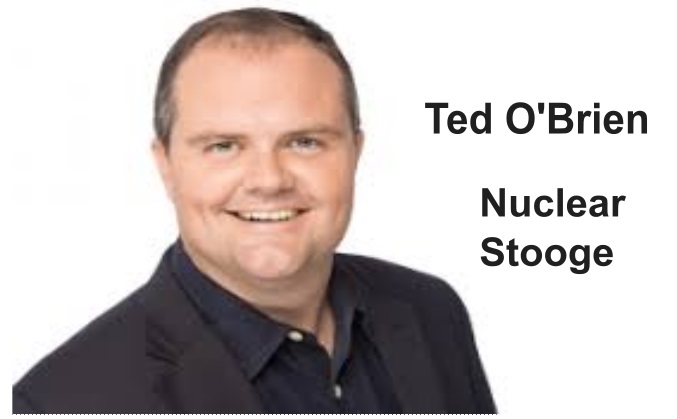
For O’Brien’s foray to be something other than time-wasting, oxygen-thieving nonsense, the shadow minister needs to be explicit about how much nuclear costs compared with other technologies.
For O’Brien’s foray to be something other than time-wasting, oxygen-thieving nonsense, the shadow minister needs to be explicit about how much nuclear costs compared with other technologies.
Katharine Murphy Guardian, 22 Dec 23
In huffing and puffing over renewables while denying the measurable costs of nuclear generation, the Coalition is digging in with the politics of relentless opportunism.
The great modernist poet TS Eliot once observed that humankind cannot bear very much reality. He might have been talking about Ted O’Brien, the shadow minister for climate and energy.
O’Brien is a fan of nuclear energy. That’s not a thought crime. I wouldn’t describe myself as a nuclear fan – but I know we might need every available technology, including nuclear, to reduce emissions in a manner consistent with the goal of limiting global heating to 1.5C. There are lots of things in life that we don’t love, but might need – nuclear energy is one of those things. I’m yet to be persuaded that Australia needs it given the other abundant resources we have, but I’m open…………………………………………………………………………………………
If I were the federal minister for climate change, I’d remove the legislative ban on nuclear energy and instead regulate the well-documented safety risks through other legislative means. Chris Bowen has a different view. Nuclear lacks a social licence in Australia. It is also prohibitively expensive. Given these two facts, why would you chew up valuable policy bandwidth (a finite commodity when you are trying to correct 10 years of obstruction and regression) looking at the nuclear ban, when you can accelerate actual, achievable risk mitigation right now? When it comes to the energy grid, Australia can execute the necessary transition much more rapidly using firmed renewables – a significantly cheaper technology that the community actually supports.
Bowen’s position is entirely logical.
………………………This week, a new analysis from the CSIRO, in collaboration with the organisation that runs the power grid, the Australian Energy Market Operator, found that electricity generated by solar and onshore wind is the cheapest in Australia. This remans the case even when you factor in the expenses associated with bolting renewables into the power grid. This same analysis found smaller nuclear reactors was the most expensive form of technology considered in the exercise.
O’Brien wasn’t happy. Big feelings ensured. Huffing and puffing. Renewables might be the cheapest form of energy for investors, “but not for consumers.” O’Brien felt the “big investors that come into Australia to make money from utility scale wind and solar projects can look after themselves, but it’s Australian households that I care about – even if Chris Bowen doesn’t.”
Dude. Come on. Can we be grownups?
Nuclear power is expensive. This is not a bolt from the blue, nor a conspiracy promulgated by the wild wokeists of the world. It’s a well-established fact. These things can be measured.
When John Howard asked businessman and nuclear physicist Ziggy Switkowski to scope out nuclear power in the mid-2000s, Switkowski concluded the government would need to legislate a carbon price to make the technology economical. Obviously energy verities have evolved over a couple of decades, but Switkowski maintained his point about the significant expense of conventional nuclear reactors in 2019, when he contributed a submission to a parliamentary committee chaired by (wait for it) O’Brien. Switkowski’s view in 2019 was that there might be commercial opportunity for small modular reactors in some parts of Australia, but “we won’t know until SMRs are deployed in quantity during the late 2020s.”
While we are on facts, here’s another one. The only company to have a small modular nuclear power plant approved in the United States has recently cancelled its first project due to rising costs.
Rounding out the picture, a centre-right thinktank recently acknowledged there was no prospect of nuclear energy playing a role in Australia before 2040. As my colleague Adam Morton has pointed out, Aemo says renewable energy could be providing 96% of Australia’s electricity by that time.
So, let’s inhabit reality. Please. It really doesn’t seem that much to ask.
Persisting with reality, if the Coalition wants to propose an Australian nuclear option seriously (as opposed to pretending to explore something while weaponising large scale renewable developments that can reduce emissions now) then lots of things need to happen.
For O’Brien’s foray to be something other than time-wasting, oxygen-thieving nonsense, the shadow minister needs to be explicit about how much nuclear costs compared with other technologies.
If he’s concerned about the high energy costs Australian households are facing, O’Brien needs a plan to pay for his preferred nuclear generation. If the government is paying, then consumers are actually paying through their taxes. Also: where do the reactors go? Where is waste stored? How is the industry regulated?
In the absence of substance and transparency, the Coalition is continuing to have a lend of the Australian people. You’d think a couple of decades having a lend of Australians on an existential issue would be enough, but apparently it isn’t.
In the Abbott era, things were simpler. It was acceptable to wonder out loud whether climate change was crap. Now, the Coalition has to say it supports net zero. It has to suggest nuclear could be the magic bullet to get us there. (Sort of) committing to nuclear, then, provides a measure of cover for the same old vandalism – thwarting the renewable technology the Coalition has spent two decades thwarting.
This isn’t a contention. Like the costs of nuclear, political behaviour can be measured. The Coalition is now leading the charge, with One Nation, against offshore wind developments in the Hunter Valley. …………………………………………………………………………………… https://www.theguardian.com/australia-news/2023/dec/23/ted-obrien-nuclear-cheerleading-renewables-climate-vandalism
Day X Marks the Calendar: Julian Assange’s ‘Final’ Appeal

December 22, 2023, by: Dr Binoy Kampmark https://theaimn.com/day-x-marks-the-calendar-julian-assanges-final-appeal/—
Julian Assange’s wife, Stella, is rarely one to be cryptic. “Day X is here,” she posted on the platform formerly known as Twitter. For those who have followed her remarks, her speeches, and her activism, it was sharply clear what this meant. “It may be the final chance for the UK to stop Julian’s extradition. Gather outside the court at 8.30am on both days. It’s now or never.”
Between February 20 and 21 next year, the High Court will hear what WikiLeaks claims may be “the final chance for Julian Assange to prevent his extradition to the United States.” (This is qualified by the prospect of an appeal to the European Court of Human Rights.) Were that to take place, the organisation’s founder faces 18 charges, 17 of which are stealthily cobbled from the aged and oppressive US Espionage Act of 1917. Estimates of any subsequent sentence vary, the worst being 175 years
The WikiLeaks founder remains jailed at His Majesty’s pleasure at Belmarsh prison, only reserved for the most hardened of criminals. It’s a true statement of both British and US justice that Assange has yet to face trial, incarcerated, without bail, for four-and-a-half years. That trial, were it to ever be allowed to take place, would employ a scandalous legal theory that will spell doom to all those who dive and dabble in the world of publishing national security information.
Fundamentally, and irrefutably, the case against Assange remains political in its muscularity, with a gangster’s legality papered over it. As Stella herself makes clear, “With the myriad of evidence that has come to light since the original hearing in 2018, such as the violation of legal privilege and reports that senior US officials are involved in formulating assassination plots against my husband, there is no denying that a fair trial, let alone Julian’s safety on US soil, is an impossibility were he to be extradited.”
In mid-2022, Assange’s legal team attempted a two-pronged attempt to overturn the decision of Home Office Secretary Priti Patel to approve Assange’s extradition while also broadening the appeal against grounds made in the original January 4, 2021 reasons of District Judge Vanessa Baraitser.
The former, among other matters, took issue with the acceptance by the Home Office that the extradition was not for a political offence and therefore prohibited by Article 4 of the UK-US Extradition Treaty. The defence team stressed the importance of due process, enshrined in British law since the Magna Carta of 2015, and also took issue with Patel’s acceptance of “special arrangements” with the US government regarding the introduction of charges for the facts alleged which might carry the death penalty, criminal contempt proceedings, and such specialty arrangements that might protect Assange “against being dealt with for conduct outside the extradition request.” History shows that such “special arrangements” can be easily, and arbitrarily abrogated.
On June 30, 2022 came the appeal against Baraitser’s original reasons. While Baraitser blocked the extradition to the US, she only did so on grounds of oppression occasioned by mental health grounds and the risk posed to Assange were he to find himself in the US prison system. The US government got around this impediment by making breezy promises to the effect that Assange would not be subject to oppressive, suicide-inducing conditions, or face the death penalty. A feeble, meaningless undertaking was also made suggesting that he might serve the balance of his term in Australia – subject to approval, naturally.
What this left Assange’s legal team was a decision otherwise hostile to publishing, free speech and the activities that had been undertaken by WikiLeaks. The appeal accordingly sought to address this, claiming, among other things, that Baraitser had erred in assuming that the extradition was not “unjust and oppressive by reason of the lapse of time”; that it would not be in breach of Article 3 of the European Convention on Human Rights (inhuman and degrading treatment)”; that it did not breach Article 10 of ECHR, namely the right to freedom of expression; and that it did not breach Article 7 of the ECHR (novel and unforeseeable extension of the law).
-ADVERTISEMENT-
Other glaring defects in Baraitser’s judgment are also worth noting, namely her failure to acknowledge the misrepresentation of facts advanced by the US government and the “ulterior political motives” streaking the prosecution. The onerous and much thicker second superseding indictment was also thrown at Assange at short notice before the extradition hearing of September 2020, suggesting that those grounds be excised “for reasons of procedural fairness.”
An agonising wait of some twelve months followed, only to yield an outrageously brief decision on June 6 from High Court justice Jonathan Swift (satirists, reach for your pens and laptops). Swift, much favoured by the Defence and Home Secretaries when a practising barrister, told Counsel Magazine in a 2018 interview that his “favourite clients were the security and intelligence agencies.” Why? “They take preparation and evidence-gathering seriously: a real commitment to getting things right.” Good grief.
In such a cosmically unattached world, Swift only took three pages to reject the appeal’s arguments in a fit of premature adjudication. “An appeal under the Extradition Act 2003,” he wrote with icy finality, “is not an opportunity for general rehearsal of all matters canvassed at an extradition hearing.” The appeal’s length – some 100 pages – was “extraordinary” and came “to no more than an attempt to re-run the extensive arguments made and rejected by the District Judge.”
Thankfully, Swift’s finality proved stillborn. Some doubts existed whether the High Court appellate bench would even grant the hearing. They did, though requesting that Assange’s defence team trim the appeal to 20 pages.
How much of this is procedural theatre and circus judge antics remains to be seen. Anglo-American justice has done wonders in soiling itself in its treatment of Britain’s most notable political prisoner. Keeping Assange in the UK in hideous conditions of confinement without bail serves the goals of Washington, albeit vicariously. For Assange, time is the enemy, and each legal brief, appeal and hearing simply weighs the ledger further against his ailing existence.
More serious governance failures in Defence contracting
The pattern of poor governance by Defence has been further exposed following disturbing revelations in yet another contract.
MICHELLE FAHY, DEC 23, 2023 https://undueinfluence.substack.com/p/more-serious-governance-failures?utm_source=post-email-title&publication_id=297295&post_id=140001297&utm_campaign=email-post-title&isFreemail=true&r=1ise1&utm_medium=email
It was revealed this week that Defence Department officials congratulated themselves for not recording minutes of a critical meeting in which the work of consultants it had hired was being checked against the contract.
Incredibly, the failure to record minutes was noted as a positive in a post-implementation review of the project, with the only negative point listed being that the donuts arrived too early in the meeting.
This serious accountability failure is a breach of Defence’s contracting rules and the Commonwealth Procurement Rules, adherence to which is fundamental to good governance.
The failure to keep minutes of the key meeting means there’s no official record of who attended the meeting, in what capacity, and what contribution they made.
It was just one of a raft of irregularities found in a $100 million contract between the Defence Department and KPMG, which is part of the One Defence Data program, following a damning review by external consultants, Anchoram Consulting.
Some of the irregularities described in the review bear striking similarities to those found in Defence’s controversial Hunter Class frigate procurement from BAE Systems, Australia’s largest ever surface warship acquisition, which has been referred to the National Anti-Corruption Commission following a scathing report by the auditor general.
One of the grounds for the corruption referral was the absence of a number of important accountability documents, including minutes of key decision making meetings, related to the Hunter Class frigate procurement process. (Read full story on the $46 billion frigate procurement here and here.)
The Australian National Audit Office report on the frigates noted that the Defence Department was a serial offender when it came to deficient record-keeping. The auditors footnoted a comment from the Commissioner for Law Enforcement Integrity that a “lack of record keeping can create corruption vulnerabilities within an Agency”.
A lack of record keeping can create corruption vulnerabilities
Another revelation in the Anchoram review was that Defence had made “a six-figure payment” to KPMG “for work the government knew had not been delivered”.
Similarly, as the audit office revealed in May, during the frigate procurement process the Defence Department made milestone payments to BAE Systems even though BAE had missed the milestones.
Anchoram revealed that the KPMG project was plagued by a “lack of accountability” and “real and perceived conflicts of interest”. Core governance documents were not signed off and key requirements of KPMG’s contract were diluted from “mandatory” to “desirable”, sometimes in consultation with KPMG itself, despite Defence requirements stating explicitly that mandatory items cannot be changed.
Furthermore, Anchoram concluded that “the Commonwealth has a significant risk that it absolved [KPMG] from its commercial obligations and consequently transferred delivery risk from [KPMG] to the Commonwealth.”
The review said the Commonwealth’s ability to govern the One Defence Data program’s financials and ensure value for money had been “significantly compromised”.
Similarly, with the frigate procurement process, Defence sidelined the central procurement rule of achieving value for money. Numerous conflicts of interest and revolving door appointments, including the secretive involvement in the frigate tender evaluation process of people formerly employed by BAE Systems (as I reported exclusively in July) prefigure the serious governance issues exposed by Anchoram in Defence’s cosy arrangement with KPMG.
The Anchoram Consulting report, dated April 2022, has been released publicly this week following an order from independent senator David Pocock to the Defence Department.
Meanwhile, the Parliamentary Joint Committee of Public Accounts and Audit is conducting an inquiry into Defence’s frigate procurement process.
Labor MP Julian Hill, the chair of the committee, has stated: ‘It does feel like someone has back-engineered a decision and gone, “we want to go with BAE”…’.
The Anchoram Consulting report on the One Defence Data program can be downloaded here.
Assange Appeal Hearing Set for February

Julian Assange’s wife Stella Assange confirmed that the hearing will take place at the Royal Courts of Justice in the middle of February.
By Joe Lauria / Consortium News, https://scheerpost.com/2023/12/19/assange-appeal-hearing-set-for-february/
Imprisoned publisher Julian Assange will face two High Court judges over two days on Feb. 20-21, 2024 in London in what will likely be his last appeal against being extradited to the United States to face charges of violating the Espionage Act.
Assange’s wife Stella Assange confirmed that the hearing will take place at the Royal Courts of Justice. Assange had had an earlier request to appeal rejected by High Court Judge Jonathan Swift on June 6.
Assange then filed an application to appeal that decision and the dates have now been set. Assange is seeking to challenge both the home secretary’s decision to extradite him as well as to cross appeal the decision by the lower court judge, Vanessa Baraitser.
Baraitser had ruled in January 2021 to release Assange from Belmarsh Prison and deny the U.S. request for extradition based on Assange’s mental health, his propensity to commit suicide and conditions of U.S. prisons. On every point of law, however, Baraitser sided with the United States.
The U.S. appealed her decision, issuing “diplomatic assurances” that Assange would not be mistreated in prison. The High Court, after a two-day hearing in March 2022, accepted those “assurances” and rejected Assange’s appeal.
His application to the U.K. Supreme Court to hear the case was then denied. Assange then applied for a new appeal of Baraitser’s legal decisions and the home secretary’s extradition order.
Swift rejected Assange’s 150-page argument in a three-page rejection. The appeal of that decision will now take place two months from now.
If convicted under the World War I-era Espionage Act, the WikiLeaks publisher and journalist is facing up to 175 years in a U.S. dungeon for publishing classified material revealing crimes by the U.S. state, including war crimes.
Assange was also charged with conspiracy to commit computer intrusion, though the indictment agains him does not accuse him of stealing U.S. documents or even of helping his source, Army intelligence analyst Chelsea Manning, to do so.
A Merry AUKUS Surprise, Western Australia!
December 20, 2023, by: Dr Binoy Kampmark, https://theaimn.com/a-merry-aukus-surprise-western-australia/
The secretive Australian government just cannot help itself. Clamouring and hectoring of other countries and their secret arrangements (who can forget the criticism of the Solomon Islands over its security pact with China for that reason?) the Albanese government is a bit too keen on keeping a lid on things regarding the withering away of Australian independence before a powerful and spoiling friend.
A degree of this may be put down to basic lack of sensibility or competence. But there may also be an inadvertent confession in the works here: Australians may not be too keen on such arrangements once the proof gets out of the dense, floury pudding.
It took, as usual, those terrier-like efforts from Rex Patrick, Australia’s foremost transparency knight, forever tilting at the windmill of government secrecy, to discover that Western Australians are in for a real treat. The US imperium, it transpires from material produced by the Australian Department of Defence, will be deploying some 700 personnel, with their families, to the state. And to make matters more interesting, Western Australia will also host a site for low-level radioactive waste produced by US and UK submarines doing their rotational rounds under the AUKUS arrangements.
The briefing notes from the recently created Australian Submarine Agency reveal that the Submarine Rotational Force-West (SRF-West) will host as many as four US nuclear submarines of the US Navy Virginia-class at HMAS Stirling and one UK nuclear-powered boat from 2027. As part of what is designated the first phase of AUKUS, an Australian workforce of some 500-700 maintenance and support personnel is projected to grow in response to the program before Australia owns and operates its own US-made nuclear-powered boats. Once established and blooded by experience, “This workforce will then move to support our enduring nuclear-powered submarine program and will be a key enabler for SRF-West.”
The ASA documents go on to project that “over 700 United States Personnel could be living and working in Western Australia to support SRF-West, with some also bringing families.” The UK will not be getting the same treatment, largely because the contingent from the Royal Navy will be moving through on shorter rotations.
The stationing of the personnel in question finally puts to rest those contemptible apologetics that Australia is not a garrison for the US armed forces. At long last Australians can be reassured, if rather grimly, that these are not fleeting visits from great defenders, but the constant, and lingering presence of an imperial power jealously guarding its interests.
The issue of storing waste will have piqued some interest, given Australia’s current and reliably consistent failure to establish any long-term storage facility for any sort of nuclear waste, be it low, medium or high grade. But never fear, the doltish poseurs of the Defence Department are always willing to please and, as the department documents show, learn in their servile role.
As Patrick reveals, the documents released under FOI tell us that “operational waste” arising from the Submarine Rotational Force operation at HMAS Stirling will include the storage of low to intermediate level radioactive waste on Australian defence sites. One document notes that, “The rotational presence of United Kingdom and United States SSNs in Western Australia as part of the Submarine Rotational Force – West (SRF-West) will provide an opportunity to learn how these vessels operate, including the management of low-level radioactive waste from routine sustainment.”
The ASA also confirms with bold foolhardiness that, “All low and intermediate radioactive waste will be safely stored at Defence sites in Australia.” The storage facility in question is “being planned as part of the infrastructure works proposed for HMAS Stirling to support SRF-West.”
The Australian Defence Minister Richard Marles has retained a consultant, Steve Grzeskowiak, to the remunerative value of AU$396,000 from February to December this year to identify a suitable site on land owned by the Commonwealth. Absurdly, the same consultant, when Deputy Secretary of Defence Estates, conducted an analysis of over 200 Defence sites in terms of suitability for low-level waste management, finding none to pass muster.
In a troubling development, Patrick also notes that the Australian Naval Nuclear Power Safety Bill 2023, in its current form, would permit the managing, storing or disposing of radioactive waste from an AUKUS submarine, which would include UK or US submarines. Importantly, that waste could well be of a high-level nature. “While the Albanese Government has made a commitment that it will not do so, the Bill leaves the legal door open for possible future agreement from the Australian Government to store high-level nuclear waste generated from US or UK nuclear-powered submarines.”
To round matters off, Australia’s citizenry was enlightened to the fact that they will be adding some $US3 billion (AU$4.45 billion) to the US submarine industrial base. In the words of the ASA, “Australia’s commitment to invest in the US submarine industrial base recognises the lift the United States is making to supporting Australia’s acquisition of nuclear-powered submarines.” This will entail the pre-purchase of “submarine components and materials, so they are on hand at the start of the maintenance period” thereby “saving time” and “outsourcing less complex sustainment and expanding planning efforts for private sector overhauls, to reduce backlog.”
Decoding such naval, middle-management gibberish is a painful task, but nothing as painful as the implications for a country that has not only surrendered itself wholly and without qualification to Washington but is all too happy to subsidise it.
CSIRO says wind and solar much cheaper than nuclear, even with added integration costs
The big mover – and one that is significant in the context of the Australian debate on the energy transition, and the federal Coalition’s insistence that nuclear is the answer to most questions – is the cost of nuclear and small modular reactors.

Giles Parkinson 21 December 2023 ReNewEconomy
The CSIRO has published the latest edition of its important GenCost report, and responded to critics by dialling in near term integration costs for wind, solar and storage. But the result is just the same – renewables are clearly Australia’s cheapest energy option, and the story for nuclear just got a whole ot worse.
The annual GenCost report, prepared in collaboration with the Australian Energy Market Operator since 2018, is an important guide to where Australia’s energy transition is at and where it should be heading, but over the past has become the target of attack from conservative naysayers and the pro-nuclear lobby.
CSIRO has defended its methodology, but to satisfy the critics has added in pre-2030 integration costs – including the new transmission lines being built to connect new generation – and finds that the story is much the same.
“While this change leads to higher cost estimates, variable renewables (wind and solar) were still found to have the lowest cost range of any new-build technology,” the CSIRO says, noting that this includes all integration costs up to and including 90 per cent renewables.
In the past year, cost of solar and offshore wind has fallen, the cost of battery storage has remained steady, but the cost of other technologies such as onshore wind and pumped hydro has increased.
The big mover – and one that is significant in the context of the Australian debate on the energy transition, and the federal Coalition’s insistence that nuclear is the answer to most questions – is the cost of nuclear and small modular reactors.
The CSIRO has been attacked by the pro-nuclear lobby, including conservative media and right wing think tanks, for what the lobby claims are inflated cost estimates, but the CSIRO says recent events have backed its numbers. In fact, they make clear that nuclear SMR costs are worse than thought.
CSIRO economist Paul Graham points to the collapse of a major deal this year involving the most advanced SMR projects in the US, the NucScale projects in Utah, which were withdrawn because of soaring costs.
Graham says it is significant because, as NuScale was listed and had to abide by strict regulatory disclosure rules, it had to be “honest” about the anticipated costs of SMRs.
And these were nearly double what was previously thought. In fact they ended up at the equivalent of $A31,000/MW, according to NuScale filings, and much higher than the $A19,000/MW estimated by the CSIRO in its previous report, and for which it was accused of inflating.
“The UAMPS (Utah utility) estimate implies nuclear SMR has been hit by a 70 per cent cost increase which is much larger than the average 20% observed in other technologies,” the CSIRO writes.
“The cancellation of this project is significant because it was the only SMR project in the US that had received design certification from the Nuclear Regulatory Commission which is an essential step before construction can commence.” Graham says that all other claims on nuclear SMR costs are just marketing and sales talk.
The reality, however, is that talk of nuclear SMRs as a solution for Australia’s energy transition and near term emissions targets are a distraction, given that the SMR technology is simply not available, and unlikely to be so for two decades.
The CSIRO report says some interesting things about the costs of wind and solar, technologies which are available and which do work. It says the costs of these technologies will continue to fall in coming years after the various price shocks that have affected the technologies over the last couple of years.
By including the costs of transmission and storage that is underway now and committed out to 2030 adds 40 to 60 per cent to the 2023 cost of deploying high shares of wind and solar, although that also ignores the technologies cost falls that will occur over time……………………………………………………………………………………….more https://reneweconomy.com.au/csiro-says-wind-and-solar-much-cheaper-than-nuclear-even-with-added-integration-costs/
Opposition need to explain whether they’ll will stick with their ‘nuclear fantasy’
Climate Change and Energy Minister Chris Bowen says the Opposition has some explaining to do about whether they’ll stick with their “nuclear fantasy”.
“So, of course, projects will encounter some challenges – Snowy 2.0 has encountered delays and cost increases,” he said during a media conference on Thursday.
“That’s just one example.
“Nevertheless, it remains a very important project.
“Renewable energy, in all the evidence independently examined by the CSIRO and AEMO, is the cheapest form of energy.”
1 This month

of the week – Australians for War Powers Reform (AWPR)
To see nuclear-related stories in greater depth and intensity
 Antinuclear