Dutton’s nuclear plan wouldn’t even meet net zero by 2050 target, report finds
“The proposal by the federal Coalition would not significantly reduce emissions until the late 2040s, by which time catastrophic impacts would be almost certain.”
Giles Parkinson, Jun 11, 2024, https://reneweconomy.com.au/duttons-nuclear-plan-wouldnt-even-meet-net-zero-by-2050-target-report-finds/
The federal Coalition’s nuclear energy proposal would not just result in the tearing up of Australia’s commitment to the Paris climate treaty, it wouldn’t even be able to deliver net zero emissions on Australia’s main electricity grid by 2050, according to a new report.
Opposition leader Peter Dutton’s admission on the weekend that the Coalition’s energy plan – to stop the roll out of renewables, keep coal fired power stations online, and build more gas while waiting for nuclear – would render Australia’s interim emissions target for 2030 impossible to meet.
Dutton suggested that the Coalition would be willing to tear up that agreement, but would still seek to honour the later 2050 net zero target once nuclear power generators could be rolled out in the country in the 2040s.
A report prepared by Solutions for Climate Australia, led by Barry Traill, says Dutton’s proposal would result in some 2.3 billion tonnes of additional carbon emissions over the Australian Energy Market Operator’s step change scenario.
That is bad enough, because it would mean Australia walking away from its international commitments – the Paris treaty that Australia signed up to requires no backtracking because of the urgency of emissions reduction – and becoming a pariah once again on the international stage.
Worse than that, SCA says that even rolling out nuclear as early as 2040/41 – which it does not believe is feasible, but is using that date for the sake of modelling – and rolling it out as quickly as France (also questionable), would still leave Australia well short of reaching net zero by 2050.
The Coalition energy plan remains vague, but to fill the gap created by the lack of renewables and the shutting down of ageing coal fired power stations would require a 10-fold increase in gas generation, which with its newly understood methane leaks and ambitions is barely cleaner than coal.
“The calculations in this paper use a series of assumptions based on what the federal Coalition has said their nuclear reactors plan would achieve,” the report says.
“Many of these assumptions are not considered feasible by energy experts: it is near impossible that nuclear reactors could come online in 2040, nor that Australia could build nuclear reactors at one of the fastest rates in
history.
“The build rate used in this analysis generously matches the relatively fast rate achieved by France from 1978, which had a population of 53 million, and had already been building nuclear power reactors for 23 years.
“It is extremely unlikely that Australia could match this build rate, but this has been used as a proxy for the purposes of the analysis. Even with this scenario’s very ambitious build rate of nuclear reactors, the National Electricity Market would
not reach net zero by 2050.”
“Drastically reducing carbon emissions this decade is essential to avoiding more extreme fires, heatwaves, floods and droughts as the impacts of climate intensify.
“The proposal by the federal Coalition would not significantly reduce emissions until the late 2040s, by which time catastrophic impacts would be almost certain.
“The proposal would break Australia’s existing international commitments to both the current 2030 target and its obligations under the Paris Agreements.
“Any proposal to introduce nuclear reactors to Australia is therefore not a climate policy, but rather a policy to increase emissions, acting to distract from urgent climate action over the coming decades.”
The network of conservative think-tanks out to kill the switch to renewables
Michael Mazengarb, Feb 28, 2024 https://reneweconomy.com.au/the-network-of-conservative-think-tanks-out-to-kill-the-switch-to-renewables/
Australia’s renewable energy and emissions reduction plans are being targeted by coordinated campaigns from conservative “think tanks”, as the Coalition embraces nuclear and its MPs rail against all forms of large scale renewables and transmission lines being built as part of the clean energy transition.
Having successfully defeated the Voice to Parliament referendum by feeding the distribution of disinformation, conservative groups like the Institute of Public Affairs (IPA), the Centre for Independent Studies (CIS), the Liberal-party aligned Menzies Research Group and the ‘campaign group’ Advance Australia are all ramping up their pro-nuclear, anti-renewables campaigns.
Anyone familiar with Australian climate and clean energy policy over the last couple of decades will be familiar with the Institute of Public Affairs. The well-funded think tank – thanks to generous donors that include mining billionaire Gina Rinehart – has long railed against any efforts to tackle climate change, calling for the abolition of the carbon price and virtually any policy that supports renewable energy.
The IPA has published a flurry of reports that have sought to stoke fears renewables causing the loss agricultural land in Victoria, and high costs of renewables in Western Australia – two claims that rely on gross exaggeration.
Like the IPA, the Centre for Independent Studies has strong links with the Coalition parties – promoting the works of Coalition MPs, and several of the group’s ‘alumni’ going on to serve as Liberal Party MPs or candidates.
The group recently launched a new campaign to promote nuclear energy and to actively attack the efforts of energy market regulators and institutions, including the Australian Energy Market Operator and the CSIRO, to plan the transition to renewables.
The Menzies Research Centre has the clearest, explicit, ties to conservative politics – having been named for former prime minister Robert Menzies – and pumps out opinion pieces critical of renewables and advocating for fossil fuels that are often published by News Corp outlets.
For example, a recently authored piece by Menzies Research Centre’s senior fellow, Nick Cater, blamed renewables for the Victorian blackout (which was caused by storms and an outage at the Loy Yang A coal power station).
All of these campaigns are having an impact, being embraced and fuelled by the Federal Coalition, with opposition leader Peter Dutton set to reignite the ‘climate wars’ by pushing for an Australian nuclear power industry – despite the astronomical costs, and the huge wait times for the industry.
Coalition MPs dominated the speakers list of a recent anti-renewable energy rally, that descended on Canberra earlier this month.
The group that is likely to be running the pro-nuclear ground campaign ahead of the next election, Advance Australia, previously led substantial efforts to oppose the recent First Nations Voice to Parliament referendum. The group is already running campaigns that denigrate renewable energy technologies, campaign against net zero targets, question climate change and promote nuclear energy.
While attempting to portray itself as a ‘grassroots’ roots movement, a conservative counter to GetUp! that claims to be taking on ‘woke elites’ – Advance Australia has amassed significant funds from some of Australia’s wealthiest individuals.
Donors to Advance Australia include former Vales Point power station owner Trevor St Baker, Bakers Delight founder Roger Gillespie, owner of Kennards Self Storage Sam Kennard, the former Blackmores CEO Marcus Blackmore, former fund manager Simon Fenwick, and former Shark Tank investor Steve Baxter.
Recent political donation disclosures show Advance Australia receiving a massive, $1.025 million donation from Perth-based car salesman Brian Anderson, and $1.1 million over the last three years from Fenwick.
Sam Kennard – who is worth an estimated $2.6 billion and who also sits on the board of the Centre for Independent Studies – regularly attacks renewables and promotes climate change denial on social media, and donated $165,000 to Advance over the last three years.
The depth of the interconnections between these think tanks is difficult to assess, but there is growing evidence that points to a coordinated international campaign to undermine renewables and promote the interests of fossil fuels and the pro-nuclear lobby.
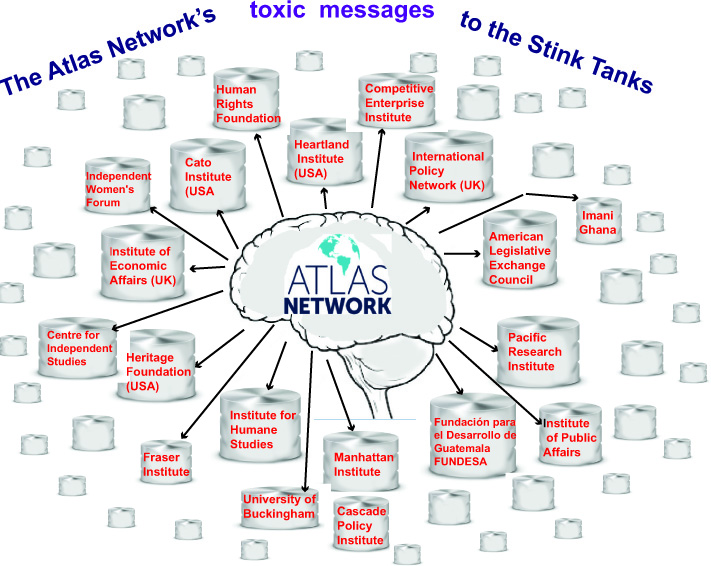
The efforts of researchers like University of Technology Sydney professor Jeremy Walker have drawn links between the campaigns of Australia’s conservative lobby groups and other members of a global ‘Atlas Network’ of conservative think tanks. The US-based Atlas Network disperses grant funding and runs training on campaigning and fundraising for its international network, including to Australian think tanks.
Australian members of the Altas Network include the IPA, the CIP, and the Australian Institute for Progress – which has also adopted anti-renewable energy and anti-electric vehicle positions.
A recently published submission by Walker draws the parallels between these ‘think tanks’ and the anti-wind farm campaigns that have targeted the Illawarra Renewable Energy Zone, and culminated in a bizarre anti-renewables rally outside Parliament House in Canberra – and similar campaigns that opposed wind farm developments in the United States.
Anti-off-shore wind farm campaigns in the states of New Jersey and Rhode Island have used similar, disproven, claims about impacts on whale populations. These campaigns, as reported by the New York Times, were being funded and coordinated on the other side of the United States, by fossil-fuel industry linked the Texas Public Policy Foundation – itself a member of the Atlas Network.
International members of the Atlas Network include high-profile propagators of climate denial and pro-fossil fuel propaganda, including the US-based Heartland Institute, and the London-based Global Warming Policy Foundation – which now features former Australian prime minister Tony Abbott on its board of trustees.
The complexity and opaqueness of the network is noteworthy, and has made the drawing of distinct relationships between groups and individuals difficult to track and analyse. But the shear number of linkages is clear, as are the relationships between the groups and Australia’s conservative political parties.
Several current and former members of the Australian-based think tanks have done stints with the Atlas Network and its members, with some members openly acknowledging the coordination between groups on training and funding.
This includes ex-IPA executive Alan Moran – who formally spearheaded the IPA’s climate denial efforts, former Abbott-government adviser and climate sceptic Maurice Newman – who have both held roles across several members of the Atlas Network
What is clear is that efforts to undermine the phase-out of fossil fuels remain strong, remain well funded and efforts are being coordinated globally.
The Voice to Parliament referendum was a stark example of how misinformation and disinformation can be deployed to influence the public and public policy, and Australia’s renewables sector will need to be ready to counteract these efforts when facing a similar campaign in the lead up to the next federal election.
Dutton to ditch Paris Agreement: analysis reveals nuclear impact on emissions

SMH By Mike Foley. June 9, 2024
The opposition’s nuclear energy plans would force Australia to fall massively short of the nation’s emissions target and generate more than 2 billion tonnes of extra greenhouse gas by 2050, breaking Australia’s commitment to the Paris Agreement. New analysis revealed the emissions blowout following Opposition Leader Peter Dutton’s declaration he would ditch Australia’s legally binding climate target to cut emissions 43 per cent from 2005 levels by 2030.Dutton told The Australian on Saturday that the government’s renewable goal was unattainable and “there’s no sense in signing up to targets you don’t have any prospect of achieving”, and pledged only to meet a goal of net zero emissions by 2050.
Solutions for Climate Australia calculated the extra emissions that would be generated by coal and gas plants while waiting for the first nuclear plants to be built, which CSIRO reported last month could not be achieved until 2040 at the earliest.
Dutton has said the Coalition would boost the role of gas power to fill gaps in the energy grid until his reactors are built, and would ensure coal plants are not shut before their energy supply is replaced.
This increased reliance on fossil fuels would generate 2.3 billion tonnes more greenhouse emissions compared to the Albanese government’s climate policy. That’s more than five years’ worth of Australia’s annual emissions, which were 433 million tonnes in 2023.
Dutton’s declaration will reignite the climate wars and ensure the next federal election, due by May, is a referendum on climate policy after Prime Minister Anthony Albanese last week vowed his government will campaign on this issue every day.
The opposition’s plan would break from the terms of the Paris Agreement, which demands its members increase their emissions goal every five years, with the Albanese government committed to set a 2035 target by February.
It is also at odds with findings of the Intergovernmental Panel on Climate Change – the United Nations’ expert science body – that fossil fuels must be rapidly phased out to meet the Paris Agreement, which the Abbott government signed Australia up to in 2015.
The Paris Agreement commits nations to contributing to action that limits global warming to under 2 degrees – and as close to 1.5 degrees as possible – to avoid the worst damage.
Climate scientists say reaching net zero emissions by 2050 is not enough to achieve this goal, and countries must start reducing emissions rapidly now to have any hope of limiting warming to below 2 degrees, rather than waiting until later decades to deliver deep reductions in greenhouse gases.
Currently, 194 nations are signatories to this deal, including all developed nations and Australia’s major trade and security partners – the US, UK, Japan, Korea, China and India.
Dutton’s rejection of Australia’s 2030 goal will place Australia outside the bounds of the Paris Agreement.
“They’re walking away from the Paris Agreement … saying that Australia will join Libya, Yemen and Iran outside the Paris Accord,” said Climate Change and Energy Minister Chris Bowen.
The Investor Group on Climate Change, representing institutional investors with total funds under management of more than $30 trillion, said Dutton’s policy threatened to derail the clean energy transition.
“Back-flipping on these commitments and withdrawing from the Paris Agreement would corrode investor confidence at a time when Australia is competing for funding for new technologies and clean industries, local jobs and training opportunities,” said the group’s policy director Erwin Jackson………………………………..
“Our analysis shows the federal Coalition’s plan for nuclear reactors would see Australia throw its commitment to limit global heating to 1.5 degrees out the window,” said Solutions for Climate Australia campaigner Elly Baxter……………………………..
The modelling assumes, based on comments from senior figures including Nationals Leader David Littleproud, that a Coalition government would halt construction of large-scale wind and solar farms and continue to roll out rooftop solar panels for homes.
When asked if the opposition still wanted to pause the rollout of renewables, O’Brien said details of the policy would be released in due course. https://www.smh.com.au/politics/federal/dutton-to-ditch-paris-agreement-analysis-reveals-nuclear-impact-on-emissions-20240604-p5jj8s.html
Peter Dutton proposes decades of delay on climate: Federal Liberals still with no climate plan
June 8, 2024: The AIM Network, https://theaimn.com/peter-dutton-proposes-decades-of-delay-on-climate-federal-liberals-still-with-no-climate-plan/
National climate group Solutions for Climate Australia expressed extreme disappointment and concern at the Opposition Leader Peter Dutton proposing further decades of delay in tackling climate change, despite increasing climate disasters.
This follows a statement by Peter Dutton today, in an interview with The Australian, that the Federal Liberal Party wants to reject current targets and plans to reduce Australia’s climate pollution this decade.
“It is a tragedy that the Federal Liberal Party has no plan to stop the increasing climate disasters which are directly killing Australians, and damaging communities, agriculture and businesses across the country, and globally,” said Dr Barry Traill, Director of Solutions for Climate Australia.
“We need decisive action on climate pollution this decade to protect farmers, our food supply, businesses and trade. From uninsurable houses, to declining crop yields, to direct threats to life and property, we are all now being hurt by climate disasters.
“Australians voted decisively for action on climate in the 2022 election. Mr Dutton’s weak, do-nothing approach on climate is out of step with the electorate. The community showed it expects all political parties to adopt strong, science-based targets to reduce pollution.”
“The federal Coalition has not heeded the message of the nation on climate. They must do better.”
Dutton’s nuclear policy a disaster for Australia
Climate Council Media Release, 8 June 24 https://theaimn.com/duttons-nuclear-policy-a-disaster-for-australia/
Responding to reports today that Opposition Leader Peter Dutton would rip up Australia’s 2030 climate targets if elected, Climate Council CEO Amanda McKenzie said:
“Dutton’s climate policy is a disaster, and the consequence for Australians would be more extreme heat, fires and floods. Instead of ripping up Australia’s 2030 climate targets, Peter Dutton must listen to the communities already ravaged by worsening climate disasters.
“There are 195 countries signed up to the Paris Agreement. Opting out would make Australia a global laughing stock.
“The Liberals haven’t learned the lesson Australians gave them at the last election: this is more of the same from the party who already gave us a decade of denial and delay on climate.”
Head of Policy and Advocacy Dr Jennifer Rayner said: “Peter Dutton is now promising Australians more climate pollution and a more dangerous future for our kids.
“This is the make-or-break decade to slash climate pollution by accelerating Australia’s move to clean energy. This is what it takes to keep our kids safe from escalating climate change and set Australia up for our next era of prosperity.
“Australia is already making great progress, with 40 percent of the power in our main national grid coming from clean energy, and one in three households having solar on their roof. Doing a massive u-turn on this momentum makes no sense when we can accelerate it instead.”
Opposition’s nuclear-energy policy would increase defence risk.
7 Jun 2024, Chris Douglas https://www.aspistrategist.org.au/australian-oppositions-nuclear-energy-policy-would-increase-defence-risk/
The Australian Liberal-National opposition’s proposal to build nuclear power stations on the sites of old coal-fired plants is misguided. The policy would perpetuate Australia’s concentration of electricity generation and worsen our vulnerability to air and missile attack.
Renewable-energy installations, by contrast, are numerous, dispersed and therefore much less profitable for an enemy to destroy. They’re also far easier and quicker to fix. And energy storage capacity, another source of resilience, necessarily grows as they’re built.
The current concentration of large slabs of generation capacity in coal-fired stations is already a vulnerability. They’re attractive targets. A single attack by a few strike missiles might knock out a plant and its large chunk of power supply.
Chinese bombers, submarines and carrier-launched aircraft could attack them using guided bunker-busting bombs, regular air-to-ground missiles or hypersonic ones with tungsten penetrators. Russia is indeed targeting power stations in its war against Ukraine, typically hitting them with missiles and drones.
If a big power station’s energy comes from nuclear reactors instead of boilers burning fossil fuel, a strike could cause an environmentally devastating release of radioactive material. If we had nuclear power stations, they would in fact be things that an enemy could use against us.
The Chernobyl nuclear disaster resulted in radioactive contamination of about 150,000 square kilometres reaching as far as 500km from the plant. It released more radiation than the atomic bombs dropped on Hiroshima and Nagasaki combined. In 2007 the Royal United Services Institute for Defence and Security Studies reported: ‘a nuclear power plant contains more than 1000 times the radiation that is released in an atomic bomb blast’. The Chernobyl experience suggests that destruction of a large nuclear station on the site of the Eraring coal-fired plant in New South Wales might render the port of Newcastle inoperative and perhaps force the evacuation of 800,000 people in the city and Central Coast.
Most of Australia’s coal-fired power stations are in NSW, Victoria and Queensland. Replacing at least some with nuclear plants, as the opposition suggests, would therefore expose much of the population to frightening wartime risk. Attacks could result in long-term crippling of the economy by rendering cities uninhabitable. They would raise the cost to Australia for continuing any war.
Fixing a coal-fired power station that had suffered war damage would be hard enough and would take many months, at least. Fixing a nuclear one would be a lot harder and take much longer. For all that time, the economy would be deprived of the plant’s generating capacity.
Wide distribution of electricity generation to hundreds of wind and solar farms avoids such risks. Collateral damage from strikes on them would be small, not least because they are usually in remote places.
Because renewable generation capacity is economically divided among many installations each with modest capacity, they raise an enemy’s cost of knocking down supply. Eraring’s capacity is 2880 megawatts, concentrated in a 400-metre-long line of four generating units, each of which might be disabled by a single hit.
The Macintyre wind farm in Queensland, to be completed this year, will have 180 wind turbines, a site area of 36,000 hectares and a rated capacity of 1026 megawatts. Average output of a typical Australian windfarm, allowing for variation in wind strength, is only about 35 percent of rated capacity. But destroying such an installation would require a great many munitions.
Similarly, the solar farm at Coleambally, NSW, has more than 565,000 solar panels spread over 513 hectares and a rated capacity of 150 megawatts. At the time of completion, its output was expected to average 45 megawatts.
Moreover, generating farms are complemented by homes and businesses that are partly or entirely independent of grid supply thanks to their own solar generation and battery storage.
In World War II, Japan had a dispersed electricity-generating system, which was one reason why the United States did not try to knock out supply. The system consisted of too many targets and would have been too hard to debilitate.
Repairability enhances the inherent robustness of renewable generation. Critical parts that are not made domestically would need to be stockpiled, something that Japan did in preparation for World War II. The federal government’s Future Made in Australia strategy will help. If Australia builds wind turbines, solar panels, batteries and distribution gear, it will have plenty of skills and fabrication machinery for fixing them. Recovery times would be far shorter than for a damaged or destroyed nuclear plant.
The opposition’s nuclear power proposal would lead us into far greater vulnerability in a war with a major adversary. It’s much better to stay on our current course. Every time a new piece of the renewable energy system is switched on, we become a little less vulnerable.
AUTHOR. Chris Douglas served with the Australian Army in infantry and intelligence and later with the Australian Federal Police.
Resources Minister Madeleine King challenges Peter Dutton to name Western Australia nuclear power station sites
Joe Spagnolo, The West Australian, Sat, 8 June 2024
WA Federal Labor Minister Madeleine King has challenged Peter Dutton to come clean on where nuclear power stations would be located in WA — as the Federal Liberal leader spruiks nuclear energy for Australia.
Addressing the media in Kwinana on Saturday morning, the Resources Minister said WA communities like Collie, Kwinana and Fremantle could all be targets for a nuclear power station under a Dutton-led Federal Government…………………. (Subscribers only) https://thewest.com.au/politics/state-politics/resources-minister-madeleine-king-challenges-peter-dutton-to-name-wa-nuclear-power-station-sites-c-14953838
Will Port Adelaide, Fremantle or Port Kembla be the Australian Chernobyl?
By Douglas McCartyJul 21, 2023 https://johnmenadue.com/aukus-will-adelaide-fremantle-or-port-kembla-be-the-australian-chernobyl/
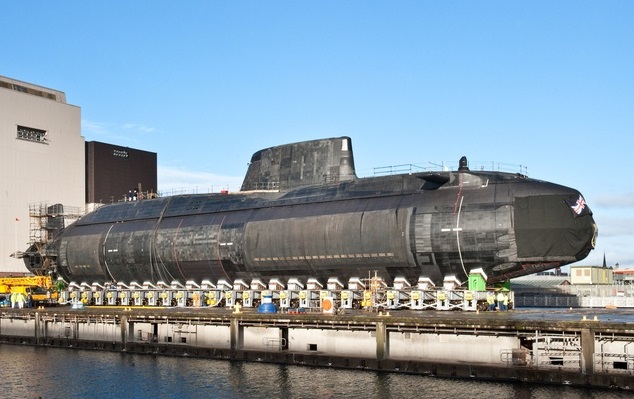
While most discussion of the AUKUS Agreement has focussed on the geopolitical implications for Australia’s standing in the world, the escalation of the risk of war and the crippling cost of the nuclear submarine purchases when less expensive and more sensible non-nuclear options are available, little has been said of the risk to the civilian population posed by these nuclear-powered submarines (or other nuclear-powered naval vessels) in Australia’s home ports.
Perhaps we citizens only enter the calculations as ‘collateral damage’. Any such necessarily technical discussion is hampered by military secrecy. Some information has been released officially, but most is from generalised inference, or conjecture, and so subject to uncertainty. However, in this important matter, it is worth attempting to join the dots….
News from the war in Ukraine includes, almost every other night, a report on the situation around the Zaporizhzhia Nuclear Power Plant, the largest in Europe. Though no longer continuing to generate power for Ukraine, it is always at risk of being shelled or bombed by one side or the other, and regularly just avoiding reactor cooling water pump failure from damaged power transmission lines or lack of diesel fuel for their backup generators for the pumps. How long this situation will continue remains to be seen. And now, after the breaching of the Kakhovka Dam, it is estimated just three months of water for cooling remains.
The consequences of the catastrophic failure of a nuclear reactor are well known to both the Ukrainians and the Russians. To the Northwest of Zaporizhzhia, and just 100 kilometres North of Kyiv, lies the Chernobyl Reactor No. 4, which, on 26 April 1986, underwent meltdown after a coolant and moderator failure, exploded, and caught fire. Radioactive material and fission products were ejected into the air, spreading across the immediate countryside and into Northern Europe. Radioactive rain was reported on the mountains of Wales and Scotland, in the Alps, and contamination in reindeer herds in Northern Sweden. The principal radiological contaminant of concern across this vast area was Caesium-137, one of many fission products and representing some 6% of fission reactor spent fuel. Just 27 kg of Caesium-137, it is calculated, caused this contamination. Some 150,000 square kilometres of Ukraine, Belarus and Russia were initially contaminated. Of course, at the time of the accident, all this was part of the Soviet Union. To this day, 2600 square kilometres around the plant are considered unsafe for human habitation, or agriculture, and will remain so for between 300 and 3000 years! The Reactor used 2% enriched Uranium fuel.
Although the loss of life at Chernobyl was a small fraction of the 100,000 deaths from one of the only two uses of nuclear weapons in war, on Hiroshima in 1945, Chernobyl created 400 times more radioactive pollution. The Hiroshima bomb, “Little Boy”, contained 64 kg of enriched Uranium, though less than 2% actually underwent nuclear fission. The bomb was detonated 500 metres above ground (‘airburst’), and the fatalities were the result of blast, heat, and irradiation, in a city centre. Chernobyl occurred at ground level and so ejected debris upwards initially, followed by smoke columns from subsequent fires. . The 31 deaths at Chernobyl were plant operators and, of course, firemen. The G7, the AUKUS Partners and the Quad just met at ‘ground zero’ in a rebuilt Hiroshima City, 78 years after the bombing.
The US Navy nuclear powered warships, including the ‘Virginia’ Class submarines that Australia would buy under the AUKUS Agreement, principally use Highly Enriched Uranium (HEU) reactors. The Uranium is enriched to above 93% fissionable Uranium-235. It is weapons grade material and has in part been sourced from decommissioned nuclear weapons. The submarine reactors are intended to last for the ‘Life of Ship’ (LOS), up to 33 years, without needing refuelling. Low Enriched Uranium reactors need fuel replacement every 5 to 10 years, when, importantly, the containment pressure vessel around the reactor is physically inspected for flaws and deterioration. This is not done for the HEU, LOS reactors.
The US Navy nuclear powered warships, including the ‘Virginia’ Class submarines that Australia would buy under the AUKUS Agreement, principally use Highly Enriched Uranium (HEU) reactors. The Uranium is enriched to above 93% fissionable Uranium-235. It is weapons grade material and has in part been sourced from decommissioned nuclear weapons. The submarine reactors are intended to last for the ‘Life of Ship’ (LOS), up to 33 years, without needing refuelling. Low Enriched Uranium reactors need fuel replacement every 5 to 10 years, when, importantly, the containment pressure vessel around the reactor is physically inspected for flaws and deterioration. This is not done for the HEU, LOS reactors. In one year, at full power, (210 x 365 ÷ 940 =) 81.5 kg of U-235 would be required. Along with other decay products from the U-235 (Strontium-90, Iodine-131, Xenon-133 etc.), as noted earlier some 6% (or 4.9 kg) would be Caesium-137. The ‘neutron poisons’ also created are balanced out by ‘burnable’ neutron poisons incorporated into the core when new, to maintain reactor function over the years. So far, simple nuclear physics and thermodynamics.
Operationally, one surmises, the submarine reactor will infrequently run at full power. Actual annual production of Caesium-137 may lie between, say, 0.8 kg for 1/6th capacity operation on average for the whole year, and 2.45 kg at half capacity for the year. As the reactor is designed to not need refuelling for the ‘Life of the Ship’, the Cs-137 would continuously accumulate inside the reactor fuel elements. At the lower bound of 1/6th operation, there would be approaching 27 kg of Cs-137 in the core after 33 years, allowing for the decay of some of the Caesiun-137, given its half-life of 30.05 years. At the upper bound, it would take about 13 years for 27 kg of Caesium-137 to accumulate.
Visiting nuclear-powered submarines, from the US or UK, would be similar. Visiting US nuclear-powered aircraft carriers, each with two A1B reactors each of 700MWt, may have 27 kg of Cs-137 in their reactor cores after just two years of operation.
Visiting ships may stay in Australian ports for days or even weeks. Australian submarines will be in port not only between deployments, but also for maintenance, for months and years. The US Navy appears to have about 40 Virginia Class Subs, with some 18 undergoing long-stay maintenance, or about half. We might expect the same. So, at any one time, the AUKUS plan would see naval nuclear reactors, US, or UK, or Australian, or all, in Adelaide, and/or Fremantle, and/or Port Kembla. While peacetime only presents the risk of a nuclear accident, wartime would see these important military assets easily detectable – and targetable – while in port. In the event of a nuclear war, this may be just one of our worries.
In a conventional, non-nuclear conflict, the story may be very different. The situation of the Zaporizhzhia civilian reactors in Ukraine is most instructive. However, as legitimate military targets, would such restraint be shown towards the reactors in the submarines? What would be the impact of a conventional cruise or hypersonic or ballistic missile warhead on the pressure hull and reactor containment vessel (and plumbing) of a nuclear-powered submarine?
Should just 27 kg of the Caesium-137 in the naval reactor cores be released into the air through an explosion (as at Chernobyl) in an accident or deliberate attack, what would be the outcome? In Fremantle, especially if the ‘Fremantle Doctor’ was blowing, would sections of Fremantle and Perth become unsafe for human habitation? In Port Kembla, especially if a ‘Southery Buster’ came through, the Illawarra and, depending on the particular weather conditions, would parts of the South of Sydney become unsuitable for human habitation? For Port Adelaide, especially if a NW change came through, would the Adelaide coastal strip from Gawler to Aldinga become unsuitable for human habitation?
Imagine the number of “single mums doing it tough” who would have to be relocated to emergency accommodation – somewhere! Imagine all that social housing rendered uninhabitable! Even if we ‘won’ the war.
This is a real possibility if we have nuclear reactors in surface ships or submarines in our ports, or in our ship building and maintenance facilities.
Submarine boss refuses to answer questions over multi-billion-dollar AUKUS payments
By defence correspondent Andrew Greene, https://www.abc.net.au/news/2024-06-07/submarine-bossmulti-billion-aukus-payments/103952528
The head of the AUKUS submarine program has refused to say whether an almost $5 billion government payment to the United States will be refunded if no nuclear-powered boats are delivered to Australia.
Under the tri-nation agreement, Australia is providing multi-billion-dollar contributions to the United States and United Kingdom to help expand their submarine industrial bases, but for months officials have declined to discuss details of the transfers.
During a Senate estimates hearing, Greens senator David Shoebridge attempted to extract details of the impending $4.7 billion payment to the US from the head of the Australian Submarine Agency, Vice Admiral Jonathan Mead.
Under questioning late on Thursday, the ASA boss repeatedly refused to say if a refund clause was included with Australia’s payment in case the United States fails to transfer Virginia class submarines in the 2030s.
“I just go back to the original statement — the US has committed to providing two US submarines from its submarine industrial base in the early 2030s and a third one on procurement,” the vice admiral told the committee.
What if the United States determines not to give us a nuclear submarine? Is there a clawback provision in the agreement?” Senator Shoebridge then demanded to know.
“That’s a hypothetical and I’m not going to entertain … The US has committed to transferring two nuclear-powered submarines to Australia,” the ASA boss asserted.
“It may be embarrassing that you have entered into an agreement that sees Australian taxpayers shelling out $4.7 billion — which we don’t get back if we don’t get our nuclear submarines,” Senator Shoebridge responded.
Under the final stage of AUKUS the United Kingdom will help develop a new class of nuclear-powered submarine to be known as SSN-AUKUS, with Australia’s boats to be built locally in Adelaide.
Ahead of the ambitious venture, Australia will hand almost $5 billion to British industry over the next decade for design work and to expand production of nuclear reactors that will eventually be installed on AUKUS submarines
Navy apologises to traditional land owners over nuclear expansion
Defence has apologised to traditional land owners in Western Australia who live around the Garden Island naval base for not consulting them about upgrades being made to accommodate visiting nuclear-powered submarines.
During Senate estimates, Greens senator Dorinda Cox, who is a Yamatji-Noongar woman, expressed concerns on behalf of her community about the AUKUS work that will soon occur at HMAS Stirling.
Chief of Navy Vice Admiral Mark Hammond told the Senator he wanted to discuss the matter on his next visit, an offer she accepted.
“I’m just surprised that this has been such an oversight for an extended period of time, I do apologise, I’m in Western Australia in a couple of weeks’ time and again in July. I’d like to formally engage with your concurrence.”
Experts unite to condemn Coalition nuclear policy meltdown.
Climate Media Centre
Energy and health experts as well as affected regional and global communities have condemned reports today of the Coalition’s energy policy which includes large nuclear reactors to be sited on mothballed coal-fired power stations across regional Australia, as well as a plan to rip up Australia’s commitments to the Paris Agreement.
The CSIRO’s recent GenCost report showed that renewable energy remains the fastest, safest and lowest-cost energy option is what we’re already building. Clean energy like solar and wind already makes up 40% of our national electricity grid, and one in three households have installed solar panels. Staying this course is the most responsible path toward slashing emissions this decade to avoid the worst impacts of climate change.
Andrew Bray, National Director, RE-Alliance – “The Federal Coalition’s energy policy is a false solution to Australia’s emission reduction commitments – the shift to a clean energy supply is already under way, with the latest data showing almost 40% of Australia’s electricity generation came from renewable energy sources in 2023.
“Policies relying on non-existent small modular reactor (SMR) nuclear technologies and large-scale nuclear plants that take decades to build would commit Australia to a polluting and unreliable fossil fuel powered system for the next 20 years. Our current trajectory will see these ageing plants close progressively over the next ten years.
“Renewable energy is here right now. Australians are increasingly using a cleaner and cheaper electricity supply, which we need to minimise the increasing impacts of climate change. Regional communities can greatly benefit from the rollout of renewable energy infrastructure – provided governments and industry are committed to sustained and significant investment in community engagement.
“We need to stick to the plan but shift our focus to ensure regional communities get the benefits they deserve from the roll-out.”
IEEFA Australia CEO, Amandine Denis Ryan, said: “The research by IEEFA’s nuclear experts calls into question whether nuclear makes financial sense for Australia, for a multitude of reasons – timing, cost, compatibility with renewables and liability issues to cite just a few.”
“Our research shows that nuclear reactors – both small modular reactors (SMRs) and gigawatt-scale reactors – in comparable countries have consistently taken longer and have been more expensive to build than expected. With over 50 years experience in this space, our analysts have researched nuclear projects around the world. For a country like Australia, starting from scratch, we expect that nuclear power reactors would not reach commercial operation before the 2040s, would come at a high cost, and require substantial government support.
“Nuclear plants in Australia cannot be built in time to replace Australia’s fleet of coal power stations, more than 90% of which are expected to retire in the next 10 years. Our research aligns with CSIRO and the regulators’ assessment that it would take at least 15 years to first production. The few existing SMRs in operation took over 12 years to build, despite original construction schedules of three to four years. Large reactors have a history of long delays, with most recent projects taking nine years or more from the first concrete pour, which in turn can only take place after years of planning, contracting and pre-construction works. This is in addition to the time required to develop the regulatory regime.
 Experts unite to condemn Coalition nuclear policy meltdownClimate Media CentreEnergy and health experts as well as affected regional and global communities have condemned reports today of the Coalition’s energy policy which includes large nuclear reactors to be sited on mothballed coal-fired power stations across regional Australia, as well as a plan to rip up Australia’s commitments to the Paris Agreement. Experts unite to condemn Coalition nuclear policy meltdownClimate Media CentreEnergy and health experts as well as affected regional and global communities have condemned reports today of the Coalition’s energy policy which includes large nuclear reactors to be sited on mothballed coal-fired power stations across regional Australia, as well as a plan to rip up Australia’s commitments to the Paris Agreement.The CSIRO’s recent GenCost report showed that renewable energy remains the fastest, safest and lowest-cost energy option is what we’re already building. Clean energy like solar and wind already makes up 40% of our national electricity grid, and one in three households have installed solar panels. Staying this course is the most responsible path toward slashing emissions this decade to avoid the worst impacts of climate change. To arrange interviews, please contact:Danielle Veldre +61 408972997 dan.veldre@climatemediacentre.org.auEmily Watkins +61 420622408 emily.watkins@climatemediacentre.org.au Andrew Bray, National Director, RE-AllianceAndrew has been working with regional communities hosting large scale renewable and transmission infrastructure for more than a decade. He can discuss the policy solutions that are needed to support regional communities to harness the benefits available in the shift to renewable energy.Location: Bungendore, NSW (near Canberra) “The Federal Coalition’s energy policy is a false solution to Australia’s emission reduction commitments – the shift to a clean energy supply is already under way, with the latest data showing almost 40% of Australia’s electricity generation came from renewable energy sources in 2023. “Policies relying on non-existent small modular reactor (SMR) nuclear technologies and large-scale nuclear plants that take decades to build would commit Australia to a polluting and unreliable fossil fuel powered system for the next 20 years. Our current trajectory will see these ageing plants close progressively over the next ten years. “Renewable energy is here right now. Australians are increasingly using a cleaner and cheaper electricity supply, which we need to minimise the increasing impacts of climate change. Regional communities can greatly benefit from the rollout of renewable energy infrastructure – provided governments and industry are committed to sustained and significant investment in community engagement. “We need to stick to the plan but shift our focus to ensure regional communities get the benefits they deserve from the roll-out.” IEEFA Australia CEO, Amandine Denis Ryan, said: “The research by IEEFA’s nuclear experts calls into question whether nuclear makes financial sense for Australia, for a multitude of reasons – timing, cost, compatibility with renewables and liability issues to cite just a few.” “Our research shows that nuclear reactors – both small modular reactors (SMRs) and gigawatt-scale reactors – in comparable countries have consistently taken longer and have been more expensive to build than expected. With over 50 years experience in this space, our analysts have researched nuclear projects around the world. For a country like Australia, starting from scratch, we expect that nuclear power reactors would not reach commercial operation before the 2040s, would come at a high cost, and require substantial government support. “Nuclear plants in Australia cannot be built in time to replace Australia’s fleet of coal power stations, more than 90% of which are expected to retire in the next 10 years. Our research aligns with CSIRO and the regulators’ assessment that it would take at least 15 years to first production. The few existing SMRs in operation took over 12 years to build, despite original construction schedules of three to four years. Large reactors have a history of long delays, with most recent projects taking nine years or more from the first concrete pour, which in turn can only take place after years of planning, contracting and pre-construction works. This is in addition to the time required to develop the regulatory regime. “Nuclear plants are notorious for cost overruns. Our analysts found that SMRs in operation or under construction cost three to seven times more than originally planned. Proposed SMRs in the US have also already seen cost estimates blow out by between two and four times in recent years. Large-scale reactors often face cost overruns as well. The Flamanville EPR in France is an extreme example of this, with costs having more than quadrupled despite France’s deep expertise on nuclear. |
“Nuclear plants are not a good complement for renewable generation. They can be flexible within a range, however the economics rely upon being operated in ‘baseload’ mode. In the 2040s, when the first nuclear plants could begin operating, the Australian Energy Market Operator expects that over 90% of generation will be supplied by variable renewables (wind and solar), and that the average annual utilisation factor of gas generation assets will be between 3% and 15% to complement them. Our analysts estimate that at a utilisation factor below 25%, the cost for electricity supplied by an American SMR would increase to more than AUD 600/MWh, if it was even possible to achieve such a low utilisation operationally.
| Experts unite to condemn Coalition nuclear policy meltdownClimate Media CentreEnergy and health experts as well as affected regional and global communities have condemned reports today of the Coalition’s energy policy which includes large nuclear reactors to be sited on mothballed coal-fired power stations across regional Australia, as well as a plan to rip up Australia’s commitments to the Paris Agreement. The CSIRO’s recent GenCost report showed that renewable energy remains the fastest, safest and lowest-cost energy option is what we’re already building. Clean energy like solar and wind already makes up 40% of our national electricity grid, and one in three households have installed solar panels. Staying this course is the most responsible path toward slashing emissions this decade to avoid the worst impacts of climate change. To arrange interviews, please contact:Danielle Veldre +61 408972997 dan.veldre@climatemediacentre.org.auEmily Watkins +61 420622408 emily.watkins@climatemediacentre.org.au Andrew Bray, National Director, RE-AllianceAndrew has been working with regional communities hosting large scale renewable and transmission infrastructure for more than a decade. He can discuss the policy solutions that are needed to support regional communities to harness the benefits available in the shift to renewable energy.Location: Bungendore, NSW (near Canberra) “The Federal Coalition’s energy policy is a false solution to Australia’s emission reduction commitments – the shift to a clean energy supply is already under way, with the latest data showing almost 40% of Australia’s electricity generation came from renewable energy sources in 2023. “Policies relying on non-existent small modular reactor (SMR) nuclear technologies and large-scale nuclear plants that take decades to build would commit Australia to a polluting and unreliable fossil fuel powered system for the next 20 years. Our current trajectory will see these ageing plants close progressively over the next ten years. “Renewable energy is here right now. Australians are increasingly using a cleaner and cheaper electricity supply, which we need to minimise the increasing impacts of climate change. Regional communities can greatly benefit from the rollout of renewable energy infrastructure – provided governments and industry are committed to sustained and significant investment in community engagement. “We need to stick to the plan but shift our focus to ensure regional communities get the benefits they deserve from the roll-out.” IEEFA Australia CEO, Amandine Denis Ryan, said: “The research by IEEFA’s nuclear experts calls into question whether nuclear makes financial sense for Australia, for a multitude of reasons – timing, cost, compatibility with renewables and liability issues to cite just a few.” “Our research shows that nuclear reactors – both small modular reactors (SMRs) and gigawatt-scale reactors – in comparable countries have consistently taken longer and have been more expensive to build than expected. With over 50 years experience in this space, our analysts have researched nuclear projects around the world. For a country like Australia, starting from scratch, we expect that nuclear power reactors would not reach commercial operation before the 2040s, would come at a high cost, and require substantial government support. “Nuclear plants in Australia cannot be built in time to replace Australia’s fleet of coal power stations, more than 90% of which are expected to retire in the next 10 years. Our research aligns with CSIRO and the regulators’ assessment that it would take at least 15 years to first production. The few existing SMRs in operation took over 12 years to build, despite original construction schedules of three to four years. Large reactors have a history of long delays, with most recent projects taking nine years or more from the first concrete pour, which in turn can only take place after years of planning, contracting and pre-construction works. This is in addition to the time required to develop the regulatory regime. “Nuclear plants are notorious for cost overruns. Our analysts found that SMRs in operation or under construction cost three to seven times more than originally planned. Proposed SMRs in the US have also already seen cost estimates blow out by between two and four times in recent years. Large-scale reactors often face cost overruns as well. The Flamanville EPR in France is an extreme example of this, with costs having more than quadrupled despite France’s deep expertise on nuclear. “Nuclear plants are not a good complement for renewable generation. They can be flexible within a range, however the economics rely upon being operated in ‘baseload’ mode. In the 2040s, when the first nuclear plants could begin operating, the Australian Energy Market Operator expects that over 90% of generation will be supplied by variable renewables (wind and solar), and that the average annual utilisation factor of gas generation assets will be between 3% and 15% to complement them. Our analysts estimate that at a utilisation factor below 25%, the cost for electricity supplied by an American SMR would increase to more than AUD 600/MWh, if it was even possible to achieve such a low utilisation operationally. “One of the major risks for investors in nuclear assets is the size and allocation of liability in case of an accident, with international conventions stating that operators of nuclear installations are liable should an incident occur. Such liabilities are very challenging for a company to carry by itself. In the United States, this issue was addressed with the Price–Anderson Nuclear Industries Indemnity Act (1957) by creating a shared insurance pool, now totalling AUD 22.5 billion across the almost 100 reactors covered. The US Government is exposed to costs beyond the insurance pool. Full costs associated with the 2011 Fukushima disaster could be as high as AUD 770 billion. It is unclear how Australia would be able to manage these liabilities without very material government underwriting of risk.” |
Mia Pepper, Campaign Director at the Conservation Council of WA said: “The Coalition’s nuclear power plans reported today are a clear plan to distract and delay from real action on climate change.
“Nuclear power is expensive, slow and dangerous and simply cannot deliver the energy needed in the time frame we have to decarbonise.
“WA is currently exiting coal and well advanced on the transition to cheaper, safer, cleaner alternatives like renewables. It makes no economic, environmental or energy sense to change direction now.
“The WA Liberals have already ruled out nuclear power for WA, saying it is too expensive and doesn’t make sense for WAs grid. Peter Dutton’s irresponsible reactor plan has failed to convince his own party – and it certainly hasn’t and won’t convince the wider WA community. The Liberal party energy policy is nothing more than a dangerous distraction and delay from the much needed transition out of fossil fuels.”
“Nuclear is thirsty, requiring huge volumes of water for cooling, in an uncertain climate future nuclear also becomes one of the most dangerous and unreliable forms of energy we have seen these issues emerge in nuclear powered countries like France.
There remain significant and unresolved issues with the management of High-Level nuclear waste, insurmountable issues with security, and deep connections to the production of weapons grade materials. The risks of things going wrong are catastrophic.”
Masayoshi Iyoda – 350.org Japan Campaigner, said: “You cannot call nuclear clean energy, and completely ignore the voices of the victims of nuclear disasters and the burden on future generations. Nuclear is simply too costly, too risky, too undemocratic, and too time-consuming. We already have cheaper, safer, democratic, and faster solutions to the climate crisis, and they are renewable energy and energy efficiency.”
Joseph Sikulu – 350.org Pacific Managing Director said: “The legacy of nuclear power in the Asia Pacific region is a harmful one, as is the legacy of climate-destroying fossil fuels. The possibility of Australia venturing into nuclear is dangerous and concerning, and a distraction from what we should really be focused on – the just transition to renewable energy.”
Was ABC’s firing of Antoinette Lattouf influenced by a pro-Israel group? | Real Talk – Online.
23 Jan 2024 Real Talk
Australian-Lebanese presenter Antoinette Lattouf was fired by Australia’s ABC just three days after she started. It has now surfaced that her firing may have been orchestrated by a pro-Israeli WhatsApp group. Now she’s fighting back, and she joins us to speak about it on Real Talk online. (Note: After this interview was recorded, ABC issued a statement saying that Lattouf was not fired. Lattouf responded on Twitter, saying: “If I wasn’t sacked, what was it?”) #RealTalk is a Middle East Eye interview show hosted by Mohamed Hashem that delves into the stories and experiences of a diverse range of guests.
Lockheed Martin deletes Australian F-35 ties
The world’s biggest weapons manufacturer, Lockheed Martin, has deleted from its website details about Australia’s key role in building F-35 fighter jets, which Israel is using to bomb Gaza.
MICHELLE FAHY, JUN 05, 2024 https://theklaxon.com.au/lockheed-martin-australian-government-joined-at-the-hip/
Among the details quietly scrubbed from Lockheed Martin’s website are that Australian businesses are supplying components ‘for the entire F-35 fleet’ and that, ‘Every F-35 built contains some Australian parts and components’.
The material was included in the section ‘Industrial Partnerships’, which was deleted entirely between March 15 and April 7 this year.
Around that time, Lockheed Martin and the Albanese Government were under heavy scrutiny following a February Senate hearing in which the supply of ‘weapons’ to Israel was hotly contested, specifically F-35 parts and components.
The deleted ‘Industrial Partnerships’ section of the Lockheed Martin site states: ‘As a programme partner, Australian businesses are supplying components for the entire F-35 fleet, not just Australian aircraft.’
It continues: ‘In total, more than 70 Australian companies have been awarded export contracts valued at AU$4.13 billion.’
Web archive Wayback Machine, which sporadically screenshots webpages, shows the ‘Industrial Partnerships’ section was on Lockheed Martin’s site until March 15, but had been deleted by April 7, the next time it screenshot the page.
Also deleted from the site is a profile of Melbourne F-35 parts manufacturer Marand Precision Engineering, which supplies the F-35 ‘global fleet’ with an ‘engine removal and installation mobility trailer’ comprised of ‘around 12,000 individual parts’.
The Marand article was on the Lockheed site when the Wayback Machine took a screenshot of the page on March 28, but it had been deleted by the time of the next screenshot taken on May 9.
Lockheed Martin’s Australian F-35 page now contains only information relating to the Australian Defence Force’s F-35 program.
On March 25, Greens Senator David Shoebridge tried (and failed) to move a motion in the Senate that accused the Federal Government of being ‘content to send weapons and weapons parts to Israel to literally fuel the genocide’.
On February 14, participating in a Senate committee, Shoebridge asked Hugh Jeffrey, a Department of Defence deputy secretary: ‘Do you consider parts of an F-35 fighter jet, such as the parts manufactured in Australia and used on Israeli Defence Force fighter jets to open the bomb bay doors, to be weapons?’
Jeffrey responded: ‘A pencil is used for writing. It’s not designed in and of itself to be a weapon, but it can be, if you want to use it as a weapon.’
Shoebridge said: ‘Bomb bay doors are generally used to release bombs.’
Jeffrey said that under the UN definition, ‘weapons are defined as whole systems’, such as ‘armoured vehicles’, ‘tanks’ and ‘combat helicopters’.
The Albanese government has repeatedly said that no ‘weapons’ have been sent to Israel for at least the past five years.
Focusing on the word ‘weapons’ enables the government to ignore exports of ‘ammunition/munitions’ and ‘parts and components’, all of which are covered by the 2014 Arms Trade Treaty, which Australia championed at the United Nations and ratified in 2014.
The Albanese government is coming under increasing pressure, with concerns mounting that Australia will be found to be complicit in genocide because it has not ceased military exports to Israel.
More than 800 public servants last week released a signed open letter calling on the government to immediately stop all military exports to Israel.
The Department of Defence has admitted it approved two new export permits to Israel after the October 7 attack.
In a Senate estimates hearing on February 14, the Defence Department‘s Hugh Jeffrey said: ‘Two export permits have been granted since the time of the last estimates’, the date of which was 25 October 2023. The permits were approved between October 25 and October 31. Mr Jeffrey refused to say what items the new permits covered.
The Defence Department and DFAT have also refused to answer questions about whether approved military export permits that were in place before the Hamas attacks have been suspended.
Australia’s key role in the F-35 fighter jet program
More than 70 Australian companies supply parts and components into the global supply chain of the F-35.
Several of the companies are the sole source of the parts they produce. Without them, new F-35 jets cannot be built, nor can parts be replaced.
In December last year a US Congressional hearing revealed that the F-35 joint program office had been moving ‘at a breakneck speed to support … Israel … by increasing spare part supply rates’. (Emphasis added.)
On October 30, the Defence Department issued a media release trumpeting the important role played by Australian industry in the production and maintenance of the global F-35 fleet. The release announced that Melbourne company Rosebank Engineering had established an important repair depot under the F-35 global support solution for aircraft operating in or deployed to the Indo-Pacific region. Rosebank Engineering and the Defence Department had partnered with the US F-35 joint program office and Lockheed Martin to establish the new facility.
Rosebank has been part of the F-35 supply chain since 2004 and now manufactures more than 150 components for the landing gear and weapons bay systems on the F-35, including the components that enable the bombs to be dropped on Gaza. Rosebank (formerly RUAG Australia) is the sole source global supplier of the F-35’s ‘uplock actuators’ that open and close the F-35’s weapons bay doors.
Sydney-based Quickstep Holdings is another long-term supplier to the F-35 program. In December 2020, it announced it had produced its 10,000th component – just 20% of its commitment to the program. Quickstep manufactures more than 50 components and assemblies, worth about $440,000 in each F-35, it says.
Lockheed Martin also acknowledged Queensland’s Ferra Engineering in providing products for the F-35 since 2004 and said it remained a vital partner.
Rosebank Engineering, Quickstep Holdings and Ferra Engineering have all supplied parts and components into the F-35’s supply chain during the past five years.
No nuke waste down under: Nuclear Free Local Authorities spokesperson receives assurance MOD still committed to decommissioning British nuclear subs at home
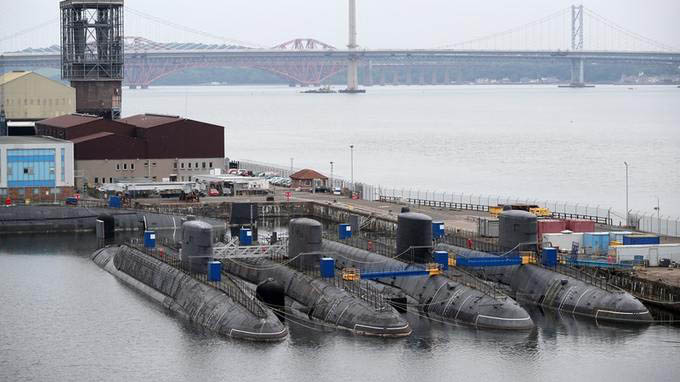
Nuclear Free Local Authorities, 4 June 24
Defence chiefs have written to the NFLA Spokesperson on Nuclear Submarine Decommissioning reassuring him that ‘the Ministry of Defence remains committed to disposing its decommissioned submarines, including the waste they produce, within the UK’.
Councillor Brian Goodall, who represents the Rosyth Ward in Scotland where decommissioning is currently taking place, wrote to the outgoing Defence and Foreign Secretaries on 17 May seeking their assurance that redundant British nuclear submarines will not be sent to Australia for disposal.
In Australia, in relation to the AUKUS defence pact, legislators have proposed a new Naval Nuclear Power Safety Bill 2024, which appears to provide under Clauses 7 and 12 of the Bill for the disposal of high level radioactive waste from British and American submarines on Australian soil, and also for the storage of such materials in Australia from ‘a submarine that is not complete (for example, because it is being constructed or disposed of)’.
Councillor Goodall is concerned that this could theoretically mean the British Government ‘permitting towing redundant UK boats from Rosyth and Devonport down under for disposal’. Councillor Goodall fears that, were this to become practice and not just theory, local expertise and the jobs of his constituents could be lost.
In their response, defence officials say they continue to work on completing the decommissioning of the submarine Swiftsure at Rosyth by 2026 ‘by adopting a unique approach that will maximise the amount of the submarine that can be recycled and minimise the amount of waste that needs to be disposed of’. Radioactive waste will be taken to Capenhurst, Cheshire for interim storage until a Geological Disposal Facility is completed for its eventual disposal. This includes the reactor from each dismantled submarine.
Knowledge acquired as a result of the submarine decommissioning work will be shared by the MOD with Australia.
The letter sent to Lord Cameron and Grant Shapps on 17 May read:……………………………………………………… more https://www.nuclearpolicy.info/news/no-nuke-waste-down-under-nflas-spokesperson-receives-assurance-mod-still-committed-to-decommissioning-british-nuclear-subs-at-home/
A Detectable Subservience – Australia’s ill-fated nuclear submarine deal?

All of this leaves one wondering about just what due diligence was done before Morrison, and the 24-hour copycat decision-maker Albanese, committed us to the folly of paying $A368 billion to purchase a subservient position embedded within the US war machine by means of a soon-to-be fully detectable and therefore likely to be destroyed fleet of nuclear-powered submarines.
June 6, 2024 by: The AIM Network, By Michael Willis, https://theaimn.com/a-detectable-subservience/
The first operational outcome of the Pillar 2 AUKUS arrangement between the US, UK and Australia has just been announced.
The three countries will share data from their submarine-hunting PA-8 Poseidon aircraft, manufactured by the troubled Boeing Corporation.
This was announced on May 29 in an “exclusive interview” given to US online website Breaking Defense by Michael Horowitz, whose office serves as the Pentagon’s day-to-day lead on AUKUS issues.
(In a deliciously ironic slip, the website referred to the United Kingdom as the “Untied Kingdom”, true of the political cohesion of both the UK and the US at this time.)
All three AUKUS nations:
“… operate the Boeing-made maritime surveillance aircraft; the US operates 120, Australia 12, and the United Kingdom nine. A key part of the P-8 is its collection of sonobuoys, which are dropped into the water to hunt down submarines. (“Sonobuoys” is the preferred US-spelling of the English language “sonar buoys”.)
According to Horowitz, the Pentagon’s Deputy Assistant Secretary of Defense for Force Development and Emerging Capabilities, a new “trilateral algorithm” will allow them to share information from P-8 sonar buoys between each other.
According to Breaking Defense, the trilateral algorithm requires a high level of trust between the three countries.
“Even among Five Eyes partners,” it says, “sonobuoy information is highly sensitive, as sharing that data not only makes clear what each country has the ability to gather and where those buoys are deployed, but because it clearly reveals what and where each country is tracking.”
Pillar 2 arrangements build on those of Pillar 1 which are solely concerned with Australia’s acquisition of the hugely expensive nuclear-powered submarines.
At a cost averaged out at $A33 million a day over 35 years, we are promised a fleet of 8 submarines with the apparent advantages of extended range and endurance, higher speed, increased payload capacity, and reduced refuelling needs.
But given our own use of sonar buoys and knowing that our own all-but-at-war with “enemy”, China, has the same or superior detection technologies, it is the claim that SSNs (nuclear-powered submarines) have greater stealth and reduced detectability that is the major sales pitch justifying our $368 billion spend.
SSNs are claimed to have reduced noise and to be able to operate at greater depths, thus making them harder to detect.
Reduced noise will affect passive sonar buoys which listen for sounds generated by submarines. These sounds can include engine noise, propeller cavitation, or other mechanical noises.
Greater depth will affect active sonar buoys, those that send out a sound wave which then bounces off the submarine, allowing the buoy to detect the “ping” that travels back to the buoy. That ping is weaker the greater distance it has to travel.
Former Senator and submariner Rex Patrick was critical of the AUKUS decision for Australia to begin its SSN acquisition with the purchase of three second-hand Virginia Class SSNs from the US.
“The first highly noticeable issue with the Virginia class is a problem that has surfaced with the submarine’s acoustic coating that’s designed to reduce the ‘target strength’ of the submarine (how much sound energy from an enemy active sonar bounces off the submarine, back to the enemy),” he said.
“The coating is prone to peeling off at high-speed leaving loose cladding that slaps against the hull, making dangerous noise, and causes turbulent water flow, which also causes dangerous hull resonance (where the hull sings at its resonant frequency, like a tuning fork) and extra propulsion noise. I know a bit about this as a former underwater acoustics specialist.”
Magnetic Anomaly Detection (MAD) is another method of detection. MAD detects disturbances in the Earth’s magnetic field caused by the metal hull of a submarine. MAD sensors are typically deployed on aircraft and can detect submarines at relatively close ranges. The signals weaken with distance.
However, the Chinese are developing the ability to detect extremely low frequency (ELF) electromagnetic signal produced by speeding subs.
Researchers from the Chinese Academy of Sciences’ Fujian Institute of Research on the Structure of Matter found an ultra-sensitive magnetic detector could pick up traces of the most advanced submarine from long distances away.
The researchers calculated that the extremely low frequency (ELF) signal produced by a submarine’s bubbles could be stronger than the sensitivities of advanced magnetic anomaly detectors by three to six orders of magnitude.
The bubbles are an inevitable consequence of the submarine’s cruising speed, which causes the water flowing around the hull to move faster as its kinetic energy increases and its potential energy – expressed as pressure – decreases. When the pressure decreases sufficiently, small bubbles form on the surface of the hull as some of the water vaporises. This process causes turbulence and can produce an electromagnetic signature, in a phenomenon known as the magnetohydrodynamic (MHD) effect.
Though faint, ELF signals can travel great distances, thanks to their ability to penetrate the water and reach the ionosphere, where they are reflected back to the Earth’s surface.
Detection by ELF turns the advantage of an SSNs higher speed into its opposite, namely the disadvantage of higher detectability.
This ability of science to increase the detection of SSNs led even the pro-US Australian Strategic Policy Institute (ASPI) to publish a warning that “the oceans of tomorrow may become ‘transparent’. The submarine era could follow the battleship era and fade into history.”
It titled its article on a study of submarine detection by Australian scientists and academics “Advances in detection technology could render AUKUS submarines useless by 2050.”
According to the authors:
“The results should ring alarm bells for the AUKUS program to equip Australia with nuclear-powered submarines. Our assessment suggests that there will only be a brief window of time between the deployment of the first SSN AUKUS boats and the onset of transparent oceans.”
However, it is the expanding frontier of quantum computing that may be the ultimate nail in the AUKUS submarines coffin.
Quantum computing is the sexy new kid on the block – witness the Australian government’s investment of almost a billion dollars in a bid to build the world’s first commercially useful quantum computer in Brisbane. It’s bound to make the shareholders of US company PsiQuantum very happy, including notorious corporate investors such as Black Rock.
In July 2016, the Australia government awarded a contract to local company Q-CTRL to develop a quantum navigation system can use the motions of a single atom to precisely determine the course and position of a submarine and maintain accuracy to a remarkable degree. This overcomes two disadvantages of navigation by GPS: GPS is vulnerable to jamming by an adversary, and its signals cannot penetrate sea water to any appreciable depth.
That’s the good news story.
The bad news is that China has already funded its multi-billion-dollar National Quantum Laboratories to develop quantum-based technology applications for “immediate use to the Chinese armed forces”, possibly including targeting stealthy submarines.
According to Zhu Jin in The Conversation:
“New quantum sensing systems offer more sensitive detection and measurement of the physical environment. Existing stealth systems, including the latest generation of warplanes and ultra-quiet nuclear submarines, may no longer be so hard to spot.”
Using devices that measure and analyse the gravitational pull exercised by the mass of a submarine on the movement of sub-atomic particles in a sensor would overcome the disadvantages of sonar buoys and magnetometers, rendering any otherwise undetectable object with mass detectable.
The other area in which China is more advanced than its competitors is the use of quantum computing for encryption and decryption of communications.
In a 2022 paper on Quantum Computing and Cryptography, the authors that:
“China has set the pace for creating secure quantum communications that cannot be intercepted or manipulated. Further advances in Chinese quantum communication networks, especially networks designed for military use, will put the Navy at increased risk when deployed to the Indo-Pacific. If Chinese communications are virtually unbreakable and U.S. Navy communications can be exploited by Chinese quantum code-breaking technology, it will quickly lose its ability to safely operate among PLAN forces.”
All of this leaves one wondering about just what due diligence was done before Morrison, and the 24-hour copycat decision-maker Albanese, committed us to the folly of paying $A368 billion to purchase a subservient position embedded within the US war machine by means of a soon-to-be fully detectable and therefore likely to be destroyed fleet of nuclear-powered submarines.
Michael Williss is a member of the Australian Anti-AUKUS Coalition (AAAC) and the Independent and Peaceful Australia Network (IPAN).
Eraring deal signals death of baseload power in Australia, and Dutton’s nuclear fantasy
Giles Parkinson, Jun 4, 2024, https://reneweconomy.com.au/eraring-deal-signals-death-of-baseload-power-in-australia-and-duttons-nuclear-fantasy/
Australia’s biggest coal generator will operate with the same capacity factor as the average solar farm as a result of the deal to delay the Eraring closure. It confirms baseload power has no future in Australia, so what does Peter Dutton think he is going to do with a big nuclear plant?
The one thing that you can say about the federal Coalition energy policy over the last two decades is that it has been consistent, at least in so far as the technology that they don’t want to support: Let’s call it “Anything but renewables.”
Two decades ago John Howard scrapped the then mandatory renewable energy target after being convinced by the fossil fuel lobby of the potential horrors of doubling wind and solar output from just one per cent to two per cent.
Nearly a decade later Tony Abbott scrapped the carbon price, and then tried to do the same with the current renewable energy target, and the institutions that supported it. He was thwarted by an unlikely combination of Al Gore and Clive Palmer, but succeeded all the same in creating a two year investment drought.
Now the Peter Dutton led Coalition is having another crack, albeit from Opposition, demanding that the rollout of large scale renewables – wind, solar and storage – be brought to a crashing halt, and promising to rip up contracts with the commonwealth if they are returned to power.
So absolute is their hatred and fear of renewables that it is just a little surprising that they haven’t yet figured out the alternative for the country’s ageing fleet of increasingly unreliable and highly polluting coal fired power stations.
The Coalition started with a fixation on new coal fired power stations – remember HELE – laughingly called high efficiency, low emissions, but in reality exactly the opposite?
That didn’t last long because they realised that no one would actually want to build one, although if you search into the bowels of X, you might just find a cosplay former Coalition minister still singing the fossil fuel’s tunes.
Then it was the turn of nuclear small modular reactors (SMRs), before it dawned on them that the sort of machines the travelling salespeople had been talking to them about with such enthusiasm don’t actually exist – and probably won’t for a while and will likely be terribly costly when they do.
Clean Energy Council boss Kane Thornton on Tuesday described the push for nuclear – six times more costly than renewables and storage and two decades until it could possibly be produced for the first time in Australia – as a “mad-hatters’ tea party”. That is the almost unanimous view in the energy industry, but the FUD – fear uncertainty and doubt being spread by the Coalition and right wing media creates a different picture in the public arena.
The nuclear boosters thought they had a victory last month when they assumed the delay in closing the country’s biggest coal generator Eraring was vindication of their insistence that wind and solar won’t work, and that the only way to replace centralised fossil fuel generation is with another centralised baseload fuel source.
But the extraordinary – and many say unnecessary – deal struck by the NSW government and the Eraring owner is anything but.
Yes, the 2.88 GW official closure is pushed back by two years – not because wind, solar and storage can’t do the job, but because it hasn’t been built quickly enough, and that’s the fault of both Eraring owner Origin and the state government.
The delay is not due to reliability concerns because there is no obligation on Eraring to be producing power at the time that the market operator says it will need it most – the “tail risk” events that might occur in the middle of summer, for instance, when an intense heatwave creates a surge of demand and renders other generation useless.
The extension is really just about the risk and fear of high prices – exacerbated by the delays in new projects – and the fact that these might occur in the lead up to the next election in early 2027.
One thing that the government can observe is that the energy industry exercises no self control about bidding practices, which is why an automatic price cap had to be imposed last month when a bunch of coal generators were out of action. There is no doubt that, given the same opportunity, they will repeat the dose.
But here’s what the Eraring deal really tells us, and it’s a big problem for Opposition leader Peter Dutton’s nuclear fantasies: It’s a signal – indeed confirmation – that the concept of “baseload” power – interpreted by most as “always one” generation and the fundamental back drop to energy markets for half a century – is now dead in the water.
The deal with the government only requires Origin to operate Eraring at just one quarter of its rated capacity, about the same capacity factor as your average solar farm, and less than most wind farms.
The deal requires it to provide little more than one third of its recent average annual output – just 6 terawatt hours. Last year it produced 16 TWh. That’s partly because the plants are getting old – but it’s also because there is simply no room in the grid for an ‘always on’ big baseload generator any more.
This has been admitted by the owners of Eraring, Origin Energy, for some time. It was clear more than a decade ago that this was going to happen, and Origin admitted as much in 2018. “The idea of base-load power stations is well and truly gone,” said Greg Jarvis, the head of markets said then.
It is expected that Origin will cycle two or three of its Eraring units over summer, and perhaps just one over winter. One thing that is for sure, it won’t be running at baseload, and so won’t likely be in the market for so-called “baseload” swaps. Which means, according to some analysts, it might just pick the moments when prices are higher.
Running a big baseload plant at low capacity factors, is clearly not economic, at least at face value. So if Origin can’t pick high priced moments for Eraring, it has at least the security of having the NSW taxpayer on the hook to underwrite its looses – up to a hefty $225 million a year – and pay for any major equipment upgrades.
The other private operators of coal generators in Australia agree that baseload is dead as a concept. AGL says there is simply not the demand to operate coal fired power stations as “baseload,” and EnergyAustralia is pushing for contracts that will allow its last remaining coal generator, Mt Piper, to switch off completely in certain seasons.
There is speculation that its Yallourn generator in Victoria will end up doing the same thing, notwithstanding the current but hidden contract to keep it open until 2028.
The CSIRO, of course, took this into account when estimating its generously low costs for large-scale nuclear in the recently released final version of the GenCost report.
The Coalition and its supporters howled their disapproval. Energy spokesman Ted O’Brien wants the CSIRO to calculate capacity factors of 92 per cent, without ever explaining how this can possibly fit into a grid where rooftop solar in many states already accounts for all, or nearly all, daytime demand.
It’s not the only problem with large scale, of course. There are questions about the need for more standby capacity for such large machines (1.4 GW) and there is the question about critical system services which in many other countries nuclear is given a grid pass on because it requires them to produce less power, which they don’t like doing.
The nuclear lobby has also been absolutely insistent that the CSIRO include integration and transmission costs for wind and solar, which the CSIRO has done. Curiously, they haven’t said a peep about the considerable integration, storage and transmission costs for nuclear, which are not included in the CSIRO report.
There was a big range of reactions to the Eraring decision – from frustration and anger from those who think it is not needed and not justified, to quiet resignation and a roll of the eyes from many in the energy market, and as some sort of validation for the renewable naysers and nuclear junketeers.
One of the most inventive responses came from the Centre for Independent Studies, which decided that fossil fuel subsidies, like the $450 million offered to Eraring to keep less than half its output going for another two years, are really subsidies to the renewable energy industry, because – they argue – it is in response to its failures.
Full marks for creativity, but none for reality. The nuclear boosters have decided, like Donald Trump, that the best way to disguise a dud deal is to make ever more outrageous claims.
It underpins the carefully choreographed claims that nuclear is cheap (it’s not), that everyone is doing it (they are not), that nuclear can be built in Australia faster than anywhere else in the world (it can’t), and that is the only technology that can keep the lights on (clearly not true)..
Denial has morphed from climate change to technology. But it doesn’t stack up. If the lowest cost “baseload” can’t find room in the market, then there’s not much hope for the most expensive “baseload.” And climate science tells us there is no time to wait.
1 This month
25 October – Film –Britain’s Nuclear Bomb Scandal: Our Story – part of the Adelaide Film Festival,
Screening and Conversation
A screening of Britain’s Nuclear Bomb Scandal: Our Story (2024) followed by a talk with 2026 Bettison and James Awardee and Tradtional Owner Karina Lester in conversation with Simone Tur.
When: Sun 25 Oct, 12:00pm-Screening, 1:15pm-Talk
Where: The Mercury
Free admission, register below by clicking on BUY TICKETS and select free event tickets, at end of web page:
https://www.adelaidefilmfestival.org/program/2026/britains-nuclear-bomb-scandal-our-story
.

Australians deserve the truth
about
AUKUS – https://aukuspublicinquiry.com/

PETITION – To: Prime Minister Anthony Albanese and the Australian Labor Government

of the week – Australians for War Powers Reform (AWPR)
To see nuclear-related stories in greater depth and intensity

