Every day between now and the election’: Albanese ignites nuclear fight with Dutton
SMH, By James Massola, June 2, 2024
…………………….. the prime minister highlighted recent CSIRO research that found nuclear power is up to eight times more expensive than large-scale wind or solar power.
“They also found building a single nuclear power plant would cost at least $8.5 billion and take 15 years. At the next election, we will offer voters a choice between renewable energy and nuclear power,” he said.
“We will raise this every day between now and the election. [Dutton] needs to stop hiding his plans and release the locations of these planned nuclear reactors. We will join communities in campaigning against them.”………………………………..
The prime minister said Dutton had promised to look communities that could host nuclear power plants in the eye and engage with them but “he hasn’t been anywhere near [them]”.
“He has not been within 40 kilometres of a coal-fired power station. And he’s saying they’ll have six or more sites. He’s been nowhere near any of them in Gippsland, the Hunter, Flynn, Maranoa, O’Connor, seats like this,” Albanese said.
Back in 2007, when he was infrastructure spokesman in the Kevin Rudd-led opposition, Albanese helped lead Labor’s attack against John Howard’s plans to build nuclear power plants across the country – and he has not forgotten those lessons.
…………………Dutton had initially flagged the nuclear policy would be outlined before last month’s federal budget, but that timeline has since slipped.
This masthead then revealed the Coalition planned to unveil either six or seven sites had been selected to host nuclear power plants in the current parliamentary sitting fortnight but following that report, the opposition pressed pause on the announcement once more.
The Coalition’s policy announcement has now been pencilled in for the week after next, once parliament has risen at the end of next week, and is expected to take place outside of Canberra.
Possible sites for nuclear reactors include the Latrobe Valley in Victoria, the Hunter Valley in NSW, Collie in Western Australia, Port Augusta in South Australia, and even potentially a plant in Nationals leader David Littleproud’s electorate of Maranoa in south-west Queensland. All of these locations are on the site of, or near, current or former coal-fired power plants.
Coalition sources, who asked not to be named so they could detail internal discussions about the policy, said the six or seven MPs who would potentially host nuclear power plants in their seats had been notified.
…………………. Labor strategists believe that once the potential sites are named – all of which are expected to be in Coalition seats – that will sharpen the political debate and force voters to consider the implications of having a power plant in their own seat.
A Dutton-led government, if elected, would face a fight with state Labor premiers including Victoria’s Jacinta Allan, NSW’s Chris Minns and Western Australia’s Roger Cook, who have all hosed down suggestions their states could host nuclear power plants.
Queensland Opposition Leader David Crisafulli, who is widely expected to lead the LNP to victory in a state election in October, has indicated he would not back nuclear power unless it had bipartisan support at a federal level.
Albanese said the Labor government opposed the construction of nuclear power plants in Australia for four main reasons.
“Nuclear reactors are simply wrong for Australia, the International Energy Agency said that this week, they support nuclear reactors but for Australia, given the comparative costs and time frames, it makes no sense given that we have access to the best renewables on Earth, along with hydro, batteries and gas to firm them,” he said.
“Second is nuclear is too slow [to build] to keep the lights on, the CSIRO speak about 15 years at least for it to happen. So you’re talking about 2040 just small modular nuclear reactors and years later, if they want to go down the large-scale route and Australia doesn’t have that time.”
“Third, relates to cost, nuclear will push up power bills – independent analysis from CSIRO, AEMO [the Australian Energy Market Operator], says nuclear is the most expensive form of energy to build. And the fourth is communities don’t want nuclear. That includes state LNP leaders that have said that, local councils, state and indeed even [federal] coalition MPs like Darren Chester and Dan Tehan.”
Back in March, 12 Coalition MPs told this masthead they backed lifting the moratorium on nuclear power in Australia but would not commit to hosting a nuclear power plant in their own electorate.
And Nationals MP Darren Chester, who holds the Victorian seat of Gippsland, which is widely considered a probable pick for a nuclear site, said he would not accept a site unless his community was handed a significant economic package.
https://www.smh.com.au/politics/federal/every-day-between-now-and-the-election-albanese-ignites-nuclear-fight-with-dutton-20240601-p5jigh.html
If regional communities don’t want a windfarm, why would they accept a nuclear power station?
Guardian, Gabrielle Chan, 4 June 24
The Coalition’s energy policy is leveraged on regional discontent about renewables. But many farmers don’t want nuclear in their back yard either.
Here’s the thing about the Coalition’s latest nuclear policy. It tries to use one of the most contentious issues in rural areas, which is the rollout of renewables and the electricity transmission lines to carry energy around the country, to push an even more controversial energy transition.
Because nuclear power stations would also be built in the regions. And if you’re worried about renewables, hands up who wants a nuclear reactor next door?
My generation grew up with the US-Russian cold war and the Doomsday Clock.
While the conversation and the technology of nuclear energy has moved on, the cost, complexity and construction time has not, as the CSIRO found in a report released last month………………………
If there is one thing that I have learned from calling a country town home, it is that people are very attached to their place and how it is identified.
Not everyone opposes renewables but there is a significant portion of people who don’t want them in their own back yard. Others are quietly making their fortunes, having struck the formula for drought-proofing their businesses for decades to come. If the Big Dry strikes, you will probably find them on a beach somewhere.
That is because annual payments to host turbines start from $40,000 each though I know of agreements that are much higher, especially when communities collectively bargain. The New South Wales government pays landowners $200,000 to host transmission lines in annual instalments over 20 years, with Victoria paying the same over 25 years.
Those payments have crept up because of ongoing regional protests. That action has been amplified by poor community consultation from some energy companies highlighted in the Australian Energy Infrastructure Commissioner Andrew Dyer’s report. He found the rollout had created “material distrust” of developers in some communities.
Discontent is also being amplified for political purposes, including by David Littleproud, Barnaby Joyce and Matt Canavan, who spoke at a rally against renewables at parliament house.
The politics is clear. For starters, the long lead time kicks the nuclear energy can down the road to 2040. The Liberals cannot walk naked into the next election without at least a fig leaf for a net zero policy. The Nationals, on the other hand, don’t give a toss about net zero. They just want to extract the funding from the Liberals in compensation for hosting any technology that delivers on the net zero promise. Nuclear can be that fig leaf.
It is also true the Nats and the country Liberals will have to wear any pushback on where nuclear facilities are placed. They won’t be able to campaign against their own policy like some do on renewables.
Peter Dutton has not, as yet, specifically named any potential sites for a nuclear power station but he has pointed to current coal production facilities that are due to close. His announcement is imminent, perhaps even after the party room meeting on Tuesday.
Possible sites include the Hunter Valley in NSW; Anglesea and Latrobe Valley in Victoria; Port Augusta in South Australia; Collie in Western Australia; and perhaps Tarong in central Queensland – within Littleproud’s Maranoa electorate.
Since then the game has begun to get Coalition MPs to commit to host or rule out a reactor in their own back yard.
This is a bit silly really, because apart from the ACT, which renewable-supporting metropolitan MPs could commit to hosting a wind turbine or a solar farm in their city seats?
Littleproud and Joyce have both indicated their approval to host a reactor. But a dozen others would not commit when asked by Nine newspapers.
Keith Pitt told Nine he supported lifting the moratorium on nuclear power but, alas, there were technical restrictions, including earthquakes in his electorate. But if Pitt is worried about his area, other MPs might be scurrying to the Geoscience Australia map of faultlines for their own get-out-of-jail-free card.
Pitt’s seat of Hinkler looks like a shoo-in compared to the faultlines under Darren Chester’s Gippsland electorate, which covers the Latrobe Valley in Victoria, or the Liberal MP Rick Wilson’s seat of O’Connor, which covers Collie in WA…………………………………………..
Once you combine the feelings of the existing populations with younger populations, does that add up to support for nuclear over renewables in these changing back yards? I wouldn’t bet on it. https://www.theguardian.com/australia-news/article/2024/jun/04/liberal-coalition-nuclear-power-plant-policy-renewable-energy
Nuclear Shaping Up To Be The Big Issue Next Election
https://10play.com.au/theproject/articles/nuclear-shaping-up-to-be-the-big-issue-next-election/tpa240602vcgxm 2 June 24 We’ve just passed the two-year anniversary of Anthony Albanese being elected as the Prime Minister of Australia, and now rumours are swirling around when the PM will call the next election.
And there’s one issue that shapes up to be a cornerstone election issue when we go to the polls.
The battle lines have been drawn and nuclear power plants are at the centre of them.
The Prime Minister has set the agenda for the remainder of his term, saying the government will campaign on the issue until the day Australia heads to the polls.
It’s been almost two years since the opposition leader first flagged his nuclear policy proposal, but the devil is in the details, and that’s precisely what the PM says is missing.
It comes as rumours swirl around whether Anthony Albanese will call an early election when he still has more than a year left to do so.
And while the PM has repeatedly said he intends to serve a full term… There are a few reasons he may decide not to.
The impact of foreign forces could also play a role in his decision.
So will Albo stick to his guns and hold out until next year, and will the next campaign go totally nuclear.
“We haven’t been consulted:” Coal town on transition to renewables is not interested in nuclear
ReNewEconomy, Aaron Bunch, Jun 2, 2024
A Western Australian coal town lined up as a potential site for a nuclear power station by the federal Coalition says the plan is a distraction as it works to ditch fossil fuels and transition to renewables and storage.
The federal coalition has floated plans to add nuclear energy to the power grid should it win government by building reactors at sites currently home to either coal or gas-fired power stations.
The sites have not yet been announced but the list is widely reported to include Collie, 200km south of Perth and home to about 7500 people, where a state government-supported pivot away from the coal industry is underway. It is the site for two of the country’s biggest battery storage projects.
Shire President Ian Miffling said the state $662 million Just Transition plan had created a “buzz” in the town and the federal coalition’s nuclear power plan hadn’t received much attention.
“Collie hasn’t been consulted at all and we don’t know any of the details of the policy and what they propose, so we’ve not given it too much credence at this stage,” he told AAP…………………
Mr Miffling said locals were focused on bolstering their skills for jobs in new industries, like the recently approved green steel mill and Synergy’s $1.6 billion battery to store renewable energy once coal is retired as an energy supply in 2030.
“The potential for nuclear, which would be a long way down the track, is a bit of a distraction and it really doesn’t need us to spend too much time talking about it at this point,” he said………………..
Local state Labor MP Jodie Hanns said federal opposition leader Peter Dutton and the coalition were out of touch with what was happening on the ground in Collie and floating plans for a reactor in the town was “arrogant and disrespectful”……………………….
“No one I’ve spoken to is in support of a nuclear reactor being put in Collie … my house will be up for sale if this becomes a reality.”
AMWU state secretary Steve McCartney said Collie workers had been discussing for years what they wanted for the town after coal mining ended, “and I can guarantee you one of the things wasn’t a nuclear power station”…………… https://reneweconomy.com.au/we-havent-been-consulted-coal-town-on-transition-to-renewables-is-not-interested-in-nuclear
Scott Morrison on the revolving door- government nuclear AUKUS deal, to Dyne, company advising on AUKUS
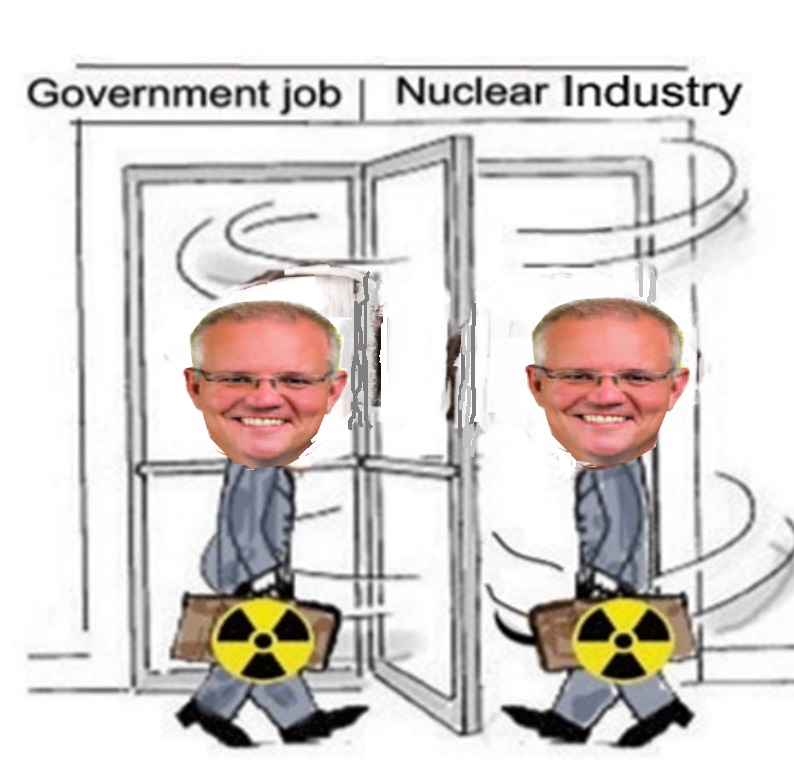
As a strategic advisor to DYNE, Morrison hopes to advance investment in dual-use technologies — inventions that have military and civilian applications. That innovation is being helped by the second pillar of AUKUS, the one that has to do with tearing down military-industrial trade barriers between the US, UK and Australia.
Facing post-Parliament poverty, multitasking Morrison looks to seafloor for riches
What to do when your taxpayer-funded salary drops from $549k, to $225k, to nothing? Multitask, of course.
Crikey, ANTON NILSSON, MAY 30, 2024
Scott Morrison has yet another new job — and like some of his other post-Parliament gigs, it’s tangentially linked to the AUKUS submarine pact he helped set up as prime minister.
The Age reports Morrison is listed as a strategic advisor at a newly created venture called the Seafloor Minerals Fund, alongside ex-US secretary of state Mike Pompeo. Both men are also behind venture capital firm DYNE, set up to support the strategic goals of AUKUS, and which also has interests in deep sea mining, according to the story.
Crikey figured it was time to have another look at Morrison’s post-politics career.
In need of cash …………………………………………..
Multitasking
So what has Morrison done to set himself up for success? His LinkedIn lists three jobs: author, non-executive vice chairman of American Global Strategies, and board member at “various companies”. The voters who brought you Scott Morrison want stronger anti-corruption protectionsRead More
As an author, he’s already published his first work: the religious memoir Plans For Your Good. The book was aimed at the $1.175 billion US Christian book market, but in Australia, it’s reportedly sold very few copies so far.
At American Global Strategies, Morrison is working with two former Donald Trump staffers to “help clients navigate a highly dynamic geopolitical landscape that presents risks and opportunities”, in the ex-PM’s own words.
As a strategic advisor to DYNE, Morrison hopes to advance investment in dual-use technologies — inventions that have military and civilian applications. That innovation is being helped by the second pillar of AUKUS, the one that has to do with tearing down military-industrial trade barriers between the US, UK and Australia. The new gig, with the Seafloor Minerals Fund, will set Morrison and Pompeo up for taking advantage of the estimated trillions of dollars in rare metals estimated to be on the seafloor. According to The Age, Australians can expect a fierce future debate about the merits and risks of mining the seabed for minerals, as China seeks to do the same. https://www.crikey.com.au/2024/05/30/scott-morrison-seafloor-minerals-fund/?utm_medium=Social&utm_source=Twitter#Echobox=1717042244
Do young people support nuclear power?

Jim Green 31 May 24
Earlier this year the Murdoch-Coalition echo-chamber was excited about younger poll respondents in a February Newspoll survey ‒ 65 percent support and 32 percent opposition among 18 to 34-year-olds to this survey question: ‘There is a proposal to build several small modular nuclear reactors around Australia to produce zero-emissions energy on the sites of existing coal-fired power stations once they are retired. Do you approve or disapprove of this proposal?’
However the Newspoll survey was a crude example of push-polling as discussed by polling experts Kevin Bonham and Murray Goot and by economist Professor John Quiggin. The question was loaded, the response options were mischievous (excluding a “neither approve nor disapprove” option, without which majority support (across all age groups) almost certainly would not have been achieved), and the Murdoch/Sky reporting on the poll was biased and dishonest.
Moreover, as Murray Goot notes, other polls reach different conclusions:
“But eighteen- to thirty-four-year-olds as the age group most favourably disposed to nuclear power is not what Essential shows, not what Savanta shows, and not what RedBridge shows.
“In October’s Essential poll, no more than 46 per cent of respondents aged eighteen to thirty-four supported “nuclear power plants” — the same proportion as those aged thirty-six to fifty-four but a smaller proportion than those aged fifty-five-plus (56 per cent); the proportion of “strong” supporters was actually lower among those aged eighteen to thirty-four than in either of the other age-groups.
“In the Savanta survey, those aged eighteen to thirty-four were the least likely to favour nuclear energy; only about 36 per cent were in favour, strongly or otherwise, not much more than half the number that Newspoll reported.
“And according to a report of the polling conducted in February by RedBridge, sourced to Tony Barry, a partner and former deputy state director of the Victorian Liberal Party, “[w]here there is support” for nuclear power “it is among only those who already vote Liberal or who are older than 65”.”
“Truly the stuff of nightmares”: unprecedented low in Antarctic sea ice recorded

By Jeremy Smith, May 31, 2024, https://johnmenadue.com/truly-the-stuff-of-nightmares-unprecedented-low-in-antarctic-sea-ice-recorded/?fbclid=IwZXh0bgNhZW0CMTEAAR0LBw8Xpve2S05Os1FH_y7RYvvv8tqj0qhXrhsM-Z3e49hH1Uu2E44lQr4_aem_AbLMAUeHwooBl6H86wLEqHTtPllDKldX5fzB5e2_5LYTTkXQuf4y_brUHNORL5PsxpdKGuD227S1VVLTWCOjJj7N
Each winter the surface of the sea freezes around Antarctica, over a vast area, mostly to a depth of about one metre. But this is starting to change. Last year, the sea ice reached an unprecedentedly low maximum extent of only 17 million square kilometres.
Why aren’t we talking about sea ice? Perhaps it’s because most people haven’t even heard of it, which is a shame because it’s important.
Each winter the surface of the sea freezes around Antarctica, over a vast area, mostly to a depth of about one metre. The continent effectively doubles in size, with 18-20 million square kilometres being covered by floating ice. That’s an area 2.5 times that of Australia; 4% of Earth’s surface.
But this is starting to change. Last year, the sea ice reached an unprecedentedly low maximum extent of only 17 million square kilometres. Although this year looks like being a little less extreme, a clear and concerning trend appears to be under way. This is emphasised in the ice minimum values in late summer. By February each year the sea ice extent shrinks typically to about three million square kilometres (mostly in two large embayments, the Weddell Sea and the Ross Sea), but through most of the present decade it has dwindled to below two million.
Why does this matter? Well for a start, it is the underside of this huge area of sea ice where algae live and multiply, which feed the shrimp-like krill that in turn sustains an entire ecosystem: fish, seals, penguins, whales, the lot. The upper surface of sea ice is also crucially important. Its albedo, or reflectivity, means that 80-90% of the incoming summer sunshine is bounced back into space. Replace the ice with dark ocean and only about 9% is reflected, the rest going to warm the water. So the loss of sea ice is not only a symptom of climate change, it also contributes to it, in a feedback loop that might accelerate.
There’s more. When sea water freezes, the developing ice crystals comprise nearly pure water. Most of the salt is extruded as a heavy brine, and this cold, dense water sinks, becoming the Antarctic Bottom Current. This circulates around the Southern Ocean before spinning off into the other major ocean basins. As this deep cold flow moves north it displaces warmer water which then up-wells and forms the main surface currents. Without the annual ‘push’ of the Antarctic Bottom Current, these warmer currents might slow and cease.
The global ocean is so vast that it changes very slowly. We are only now beginning to see the results of the ocean’s absorbance of a century of industrial environmental heating, in the form of anomalously warm seas particularly this year. Any pronounced weakening of the ocean circulation due to sea ice loss will be slow – but inexorable.
The results, which are probably not going to happen in our own lifetimes but could well become part of our legacy to future generations, are likely to be dire. It could eventually mean goodbye to the Gulf Stream and the other currents which maintain benign climates on the European Atlantic coast, around Japan, and elsewhere in the northern hemisphere.
The possible consequences of such climate change for human societies are truly the stuff of nightmares.
Inside the nuclear influence machine

Documents unearthed by The Fifth Estate lay bare how funding for the strategy, now in motion, is coordinated by a coal mining leader from Queensland, working with possibly Australia’s most influential conservative think tank, and also a key member of Australia’s unofficial nuclear club.
Is the push for nuclear power in Australia more stalking horse for coal than a genuine alternative for a clean energy future? Here’s how the nuclear cabal is working its pitch
THE FIFTH ESTATE, MURRAY HOGARTH, 29 May 24
There’s a sophisticated, well funded strategy underway to prolong coal and gas and eventually take Australia down the nuclear road.
Documents unearthed by The Fifth Estate lay bare how funding for the strategy, now in motion, is coordinated by a coal mining leader from Queensland, working with possibly Australia’s most influential conservative think tank, and also a key member of Australia’s unofficial nuclear club.
For this to work, the Liberal-National coalition needs to win back political power at the next federal election due by May next year.
- A key conservative think tank aims to keep coal until nuclear power arrives
- Its energy security argument is echoed by Peter Dutton as coalition policy
- A Queensland coal baron mustered donors to fund this influence machine
As things stand, nuclear power is currently prohibited in Australia, and the Labor government is committed to fast-tracking a renewables-led energy transition and says it has no plans to lift the ban.
Canberra retreat
The documents we’ve obtained and refer to in this article are the script and slides from a revealing energy security project update to a private strategy retreat held in Canberra last year on 12 May 2023 by the Institute of Public Affairs (IPA).
Behind the current campaign to bring nuclear energy to Australia is a deliberate agenda to prolong coal generation and disrupt the renewables rollout
The Fifth Estate contacted the speaker and two other key IPA-connected figures identified in this story for comment on Monday 27 May, inviting on-the-record interviews and providing questions. On Tuesday evening 28 May, the IPA chief executive officer Scott Hargreaves responded by email but declined to be interviewed. Full details of that response and related information are included at the end of this article.
The Melbourne based IPA is known as Australia’s leading conservative think tank, a key influencer of Coalition policies, and breeding ground for conservative politicians.

It habitually loads speaking point bullets for coalition politicians to fire. And it looked like Opposition Leader Peter Dutton did just that when he delivered his headland nuclear policy speech at an IPA public event, just two months after the Canberra retreat on 7 July last year.
In 2023, the IPA threw an arm around one of the favourite sons of the nuclear club, University of Queensland Adjunct Professor Stephen Wilson, making him a Visiting Fellow, as part of a big new donor-funded influence project, running over three years.
A key and recurring focus of this project and subsequent related policy talking points is energy security.
The internal IPA documents, authored by Wilson, lay out what many people suspect and have alleged: that behind the current campaign to bring nuclear energy to Australia is a deliberate agenda to prolong coal generation and disrupt the renewables rollout.
The final commentary and slide in Wilson’s presentation show an IPA-orchestrated master plan for Australia to defend and preserve coal and gas in the 2020s; then build “mini and small modular reactor (SMR)” nuclear plants in the 2030s under the mantle of reaping energy security, environmental and low-cost rewards in the 2040s.
It’s a parallel universe to the view a vast number of people have of Australia’s energy future. And it’s totally at odds with the clean energy transition agenda and the federal government’s targets of 43 per cent greenhouse gas emissions reductions below 2005 levels and 82 per cent renewables by 2030.
Threat to climate targets
It’s also likely to breach Australia’s staged progress, with five yearly sub targets (for example 43 per cent by 2030, with 2035 targets due to be announced early next year, with a range of 65-75 per cent being evaluated by the Climate Change Authority), towards its bipartisan commitment to 100 per cent net zero by 2050, which was made by the former Morrison coalition government ahead of the UN Climate Summit in Glasgow in the UK in 2021.
The IPA, however, is no fan of UN processes, and as Wilson made clear in his project update notes for the IPA insiders, the aim of its strategy was definitely not to prolong a Labor government……………………………..
The coal connection
Wilson also identified in the presentation who was pulling together the funding for his IPA project, with a bit of ideological explanation to set the scene:…………………………………………………………………….
Bring on Peter Dutton
The private IPA retreat in Canberra on 12 May last year was followed less than two months later by Dutton’s major speech to launch the coalition’s new energy security themed nuclear policy. This was delivered at a public IPA event in Sydney on 7 July.
Dutton’s speech mirrors the theme
Dutton’s headland nuclear speech substantially mirrored the energy security theme and language from the IPA retreat. And it also picked up on themes from earlier “nuclear club”events and activities, a number of them involving Stephen Wilson. If Australia’s nuclear club has anyone it would like to make its intellectual rock star, it’s Wilson.
Dutton’s IPA speech directly referenced Wilson, most significantly:
Professor Wilson says that we must stop procrastinating and prepare real options to deploy nuclear energy in case we need them. Countries are queuing up to put in their orders. Australia could have SMRs [small modular reactors] installed within a decade.
Wilson also confirmed his presentation to the IPA retreat in the video of another IPA event earlier this year, its 2024 Generation Liberty IPA Academy aimed at young conservatives, and relayed how Dutton had quoted him on a couple of occasions, expressing some surprise, saying, “I didn’t know he was going to do that.” (Dutton’s 7 July speech also quoted three other nuclear club regulars, as well as Wilson.)
Since then, SMRs have been a disappointment. Very inconveniently for Dutton and Wilson, the US showcase for new and thus far commercially-unproven SMR-design nuclear power stations, the NuScale project in Idaho, was cancelled in November last year due to cost overruns and lack of electricity buyer interest.
NuScale’s chief executive officer was reported as saying: “Once you’re on a dead horse, you dismount quickly. That’s where we are here.”
On message for energy security
However insecure the NuScale experience sounds, it’s worth remembering that the core theme of Wilson’s earlier 12 May IPA presentation, based on the notes and slides, was energy security. That was also a central theme of Dutton’s 7 July IPA speech:………………………………………………………………
The future of the nation and Western civilisation as we know it
On a geo-political note, national security was weighing heavily on Wilson’s mind on 12 May, as it did for Dutton on 7 July. According to Wilson’s speaking notes, at stake was nothing less than the future of the nation and Western civilisation as we know it:…………………………………………………………………..
Nuclear club bona fides
To be clear, this is the same Stephen Wilson who joined Queensland Liberal MP Ted O’Brien, Dutton’s Shadow Minister for Climate Change and Energy, and other nuclear club players, on a so-called “due diligence” study tour to the US and Canada in January-February 2023.
As Wilson’s slide deck for the IPA Canberra Retreat showed, the study tour group visited major nuclear industry companies, government representatives, lobbyists and campaign organisations. (Ted and friends’ excellent nuclear adventure in North America will feature in other upcoming articles in The Nuclear Files.)
By his own account, judging by a number of publicly available videos, Wilson imbibed deeply in the North American nuclear sector Kool-Aid, riffing off a theme he picked up on the US study tour, to proclaim that: energy security IS national security.
That became the inspiration for a key paper he published with the IPA on 1 November 2023, titled Energy security is national security. Its 1 November 2023 launch, in London on the perimeters of a global gathering of about 1500 ultra-conservatives, is another story coming soon from The Nuclear Files.
The Fifth Estate’s questions to key players in this story
The Fifth Estate provided these questions to IPA CEO Scott Hargreaves early on Monday afternoon:………………………………………………………………………………
The nuclear story, then and now, in brief
Nuclear power has been considered for Australia numerous times over the past nearly 70 years, from the 1950s, but has never happened, mainly for economic reasons. Historically because of the low cost and wide availability of coal, and now it is the low cost of renewables. This month the 2024 CSIRO GenCost report found that traditionally designed large scale nuclear power stations would cost at least 50 per cent more than solar and wind backed by batteries, and take at least 15+ years to develop, and more technically-advanced Small Modular Reactors (SMRs) could be four to six times more expensive than renewables.
On ABC Radio Sydney on Wednesday morning, 29 May, Opposition nuclear frontman Ted O’Brien was pressed on the timing for release of the coalition’s highly anticipated nuclear policy, and insisted it would be revealed “in due course”. He confirmed that the coalition wanted to replace coal-fired power stations, as they exit the electricity grid, with nuclear ones, and that gas generation would fill any gap (which could be one to two decades) between coal shutting down and nuclear starting up. https://thefifthestate.com.au/columns/columns-columns/the-nuclear-files/inside-the-nuclear-influence-machine/
CSIRO stands by nuclear power costings that contradict Coalition claims

The Coalition has attacked the GenCost report that found nuclear power plants would be at least 50% more expensive than solar and wind
Graham Readfearn, 29 May 24, https://www.theguardian.com/australia-news/article/2024/may/29/csiro-nuclear-power-plant-australia-cost-peter-dutton-liberal-coalition
The CSIRO says it stands by its analysis on the costs of future nuclear power plants in Australia after the Coalition attacked the work, which contradicted its claims reactors would provide cheap electricity and be available within a decade.
The opposition’s energy spokesperson, Ted O’Brien, claimed on Tuesday in the Australian newspaper that the CSIRO should re-run its modelling to account for longer life-spans and running times of nuclear generators in other countries with nuclear programs.
Last week the CSIRO released its GenCost report on the costs of different generation technologies, saying nuclear would be at least 50% more expensive than solar and wind and would not be available any sooner than 2040.
The Coalition has yet to reveal any detail on its nuclear plan, including what type of reactors it would build, how large they would be and where they would put them.
A CSIRO spokesperson told Guardian Australia: “CSIRO provides impartial and independent advice and does not undertake modelling for specific policy directions.
“While we stand by the data provided, any alternative scenarios assessed by others would not carry CSIRO’s endorsement.”
O’Brien pointed to an assumption used in the GenCost report that nuclear plants would have a “capacity factor” – how often they are generating electricity relative to their maximum capacity – of between 53% and 89%.
O’Brien wanted the CSIRO to use a higher figure of 92.7% for nuclear based on the performance of plants in the US.
But the GenCost report discusses the reasons for setting capacity factors, saying new baseload generators such as nuclear “are expected to struggle to present the lowest cost bids to the dispatch market” and would, therefore, likely be generating less often.
O’Brien also wanted the CSIRO to model the full lifespan of nuclear plants – which could be as long as 80 years – and to add a start date of 2035 to its modelling.
The report provides cost estimates for power from different generation technologies, including both large and small reactors, for the years 2023, 2030 and 2040.
The CSIRO spokesperson said: “Specific issues in regard to economic life of generation assets and capacity utilisation, including large scale nuclear, have been assessed by the GenCost team as part of the consultation process for the 2023-24 report.”
Australia has never built a nuclear reactor for electricity and the technology has been banned since 1998.
The CSIRO report said if a decision was made in 2025 to adopt nuclear power, it would be at least 15 years until a reactor was producing power.
The report said: “Nuclear technologies need to undergo more extensive safety and security permitting, nuclear prohibitions need to be removed at the state and commonwealth level and the safety authorities need to be established.”
The report estimated if Australia could establish a nuclear industry, then a 1,000MW plant would cost $8.6bn, but the first reactors could cost double that amount – more than $17bn.
The report said: “Given the lack of a development pipeline and the additional legal and safety and security steps required, the first nuclear plant in Australia will be significantly delayed. Subsequent nuclear plant could be built more quickly as part of a pipeline of plants.”
Among opposition leaders, Peter Dutton is a miracle survival story. But is he about to nuke himself with women voters?
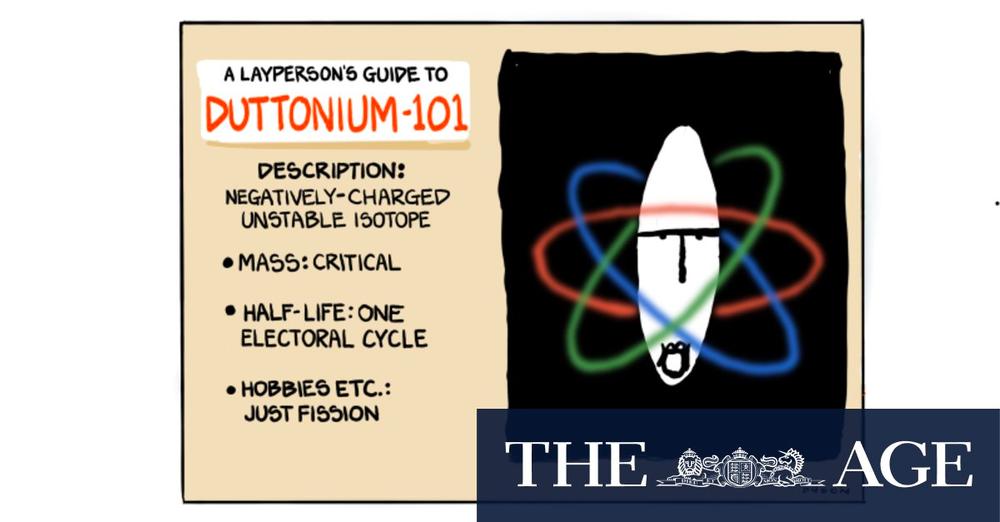
ABC, By Annabel Crabb 29 May 24
Peter Dutton is a freak of nature. Politically, that is…………………………………
Two years in, Dutton is not only still in office, but nobody inside his own party — or even in the National Party — is trying to blow him out of it. It is a truly extraordinary achievement.
His public popularity remains firmly in negative territory, according to Newspoll. So why isn’t this translating into the customary seasonal orgy of backstabbing?
Two reasons.
The first is that there really isn’t, ahem, any alternative……………………………………………………………………………….
Dutton much a much more dangerous opponent for Anthony Albanese than is commonly assumed.
But there is one risk associated with this unseasonably warm bath of internal approbation……………………..his decision to pursue nuclear energy as a principal policy decision is a high-risk call, as a new piece of research — supplied to the ABC — makes clear……………………
When it comes to nuclear, public opinion divides along gender lines
Over recent weeks, the RedBridge Group conducted a survey of around 2,000 Australian voters, seeking their views on various issues including nuclear energy. Respondents were asked whether they would support or oppose an Australian government lifting the ban on nuclear power so private investors could build nuclear power plants here.
The responses, across all voters, were kind of evenly divided. Strong supporters constituted 17 per cent, another 17 said they were supportive, 19 per cent were “neither”, 15 per cent were opposed, 20 per cent strongly opposed, and 12 per cent were unsure. This shakes out to an extremely slender net negative of-1
But the truly fascinating detail in the survey comes when you dig down into who especially loves the idea of nuclear, and who hates it.
And the biggest difference of opinion on nuclear, it turns out, breaks along gender lines……………….
Women disapproved of nuclear power strongly – just 7 per cent strongly agreed a ban should be lifted, compared with 24 per cent of male respondents. That’s a net negative of -29 for women, and net positive of 26 for men.
The only demographics showing real enthusiasm for nuclear power were Coalition voters, those aged over 65, those who earn more than $3,000 a week, and those who own their own home. In each of these instances, every other group was majority opposed.
In other words, every other party’s voters apart from the Coalition’s registered a net negative, as well as every other age bracket apart from the most elderly, and all other income brackets apart from the top one.
Renters and mortgage holders alike disapproved on the whole. Among those who described themselves as under “a great deal of financial stress”, the feeling on nuclear ran at negative 15. Among those under “no stress at all”, however, the reception was much warmer – positive 19…………………………………………………………………………….
And in the two years that have elapsed since female voters demonstrated their annoyance at being ignored and talked down to, the Liberal Party has failed to do anything about its structural under-representation of women in parliament, …………………………………………………………..
There always seems to be an abundance of reasons to get rid of women; almost as many reasons as traditionally abound for holding on to and even promoting male duds. Women do notice this stuff.
And “Never mind ladies, have a nuclear power plant” may not be a very compelling change of subject. https://www.abc.net.au/news/2024-05-29/peter-dutton-nuclear-power-policy-may-risk-alienating-women/103870338
Nuclear will cost Queensland jobs

JOINT STATEMENT Premier The Honourable Steven Miles, Minister for Energy and Clean Economy Jobs, The Honourable Mick de Brenni, 13 May, 2024 https://statements.qld.gov.au/statements/100305
- The LNP backed “Nuclear for Climate Australia” has identified multiple sites in North Queensland for nuclear reactors.
- This would see nuclear reactors in Townsville, the Sunshine Coast, Rockhampton, Brisbane Valley, Toowoomba, the Darling Downs and more.
- LNP going nuclear risks Copperstring jobs, critical minerals boom for Townsville to Mount Isa
- Labor backs clean and renewable energy not nuclear.
- The Miles Government is already delivering jobs and clean energy through the Queensland Energy and Jobs Plan and development of the SuperGrid.
- Those jobs would be at risk with the LNP’s nuclear plans.
The Miles Government is focussing on clean energy jobs and has a working plan for a safe and responsible transition to renewable energy, that will protect existing jobs and create new ones.
Queenslanders from Townsville to Mt Isa are at the heart of Labor’s leading plan for a clean economy future.
Our plan to build CopperString will provide more than 800 jobs during construction and will unlock the $500 billion North West Minerals Province, by linking it with Hughenden and up to 6,000 MW of renewable energy.
This is the nation’s largest expansion to the power grid and it is paid for by progressive coal royalties.
By putting their fossil fuel friends before Queensland’s transition, the LNP is risking thousands of jobs and return to high unemployment.
The LNP’s nuclear option is an LNP recipe for a cost-of-living meltdown. Nuclear is the most expensive option. It is 5 times the price of renewables.
International examples show it will take around 19 years to build a nuclear power station.
This is decades too late for Townsville employers who need clean, affordable energy now to remain competitive.
Nuclear is neither clean nor renewable. And it’s illegal in both Queensland and Australia.
The LNP backed proposal targets nuclear power stations in Townsville, Gladstone, Sunshine Coast, Toowoomba, Brisbane Valley, Ipswich, Darling Downs, the Western Downs, Rockhampton, and Callide.
Quotes attributable to Premier Steven Miles:
“The LNP are proposing nuclear reactors right across this state. Up to three near Townsville, while they have earmarked locations on the Sunshine Coast, Toowoomba, Brisbane Valley and Ipswich.
“What we know about those nuclear reactors is that they will be much more expensive. As much as five times more expensive for your household power bills.
“We also know that as a result of those reactors, future generations of Queenslanders will have to manage nuclear waste forever.
“That’s the LNP’s plan. Higher prices and nuclear waste; putting our waterways, our environment and our beautiful state at risk.”
Quotes attributable to Energy Minister Mick de Brenni:
“Everyone from Townsville Enterprise to the Queensland Resources Council backs Labor’s plan on renewable energy, because Copperstring means jobs and long-term prosperity for the region.
“The only exception is the LNP, who voted in Parliament to oppose the Energy and Jobs Plan, because they are opposed to renewables and public ownership.
“It seems that everybody in Townsville wants local manufacturing and jobs here, except David Crisafulli, who will not stand up to Peter Dutton and Ted O’Brien and actually back Townsville jobs.
“We know how risky and expensive nuclear is and we know David Crisafulli deserted North Queensland for the glitter strip on the Gold Coast, and now he’s setting Townsville up for an unemployment and cost of living meltdown.
“North Queensland already has the world’s best plan to protect local jobs through the transition, so why would the LNP turn its back on the Queensland Energy and Jobs Plan and Copperstring, just so they can cosy up to their big donors?
“Labor is backing renewable energy because it protects jobs in North Queensland, from Townsville to Mt Isa and beyond, and Labor is not prepared to risk those jobs.”
Quotes attributable To Thuringowa MP Aaron Harper:
“I do not want to see a nuclear reactor in Townsville and anywhere near the banks of the much loved and well used Ross River.
“Nobody in Thuringowa and the Upper Ross will accept nuclear waste travelling down Riverway Drive.
“We know the LNP back nuclear energy and are against renewable energy.
“We know that David Crisafulli and the state LNP are too weak to stand up to Peter Dutton’s nuclear agenda.
“There are serious questions to answer from the LNP about their connections to Nuclear for Climate’s plan for nuclear power in Townsville.
“Peter Dutton and David Crisafulli’s nuclear agenda pose an unacceptable risk to Townsville.”
Background information:
- Nuclear for Climate Australia, which has the backing of the Coalition, has identified multiple sites in Queensland as ideal spots to host nuclear reactors.
- Nuclear power is currently illegal in Queensland.
- Miles Government is delivering cheaper, cleaner, reliable power to develop the North West Minerals Province.
- Nation’s largest expansion to the power grid – SuperGrid, not a MiniGrid.
- CopperString will connect nation’s largest renewable energy zone at Hughenden and power a critical minerals industry that will supply world’s transition
- CopperString will be 100% publicly owned
Fast Facts
- Nuclear power production is prohibited under two pieces of legislation:
- Australian Radiation Protection and Nuclear Safety Act 1998
- Environment Protection and Biodiversity Conservation Act 1999
- CSIRO estimate the capital cost of small modular reactors in 2030 to be $15,959/kW, compared to wind at $2105/kW and solar at $1134/kW.
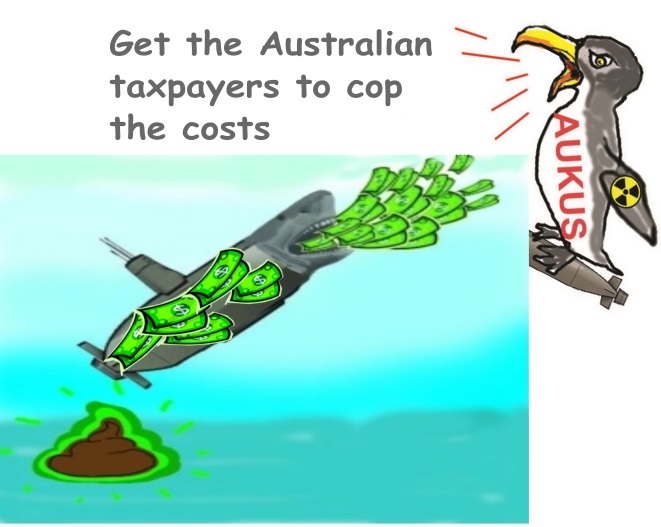
Nuclear subs’ $13bn cost tip of the iceberg
By Kym Bergmann, THE AUSTRALIAN, May 28, 2024
The Defence budget papers for the 2023-24 Financial Year show for the first time that the approved four-year spend on nuclear-powered attack submarines is $13.6bn. This is just the tip of the iceberg because it does not include the submarines themselves, just some of the preparatory costs.
The Defence department is notoriously vague about many details of project funding, and it is only by deduction that this figure involves a gift that will eventually reach a total of $4.6bn to the US submarine industrial base. It also seems to include a smaller, undefined payment to the UK industry for some long lead time nuclear reactor components – but over time that will also reach an identical $4.6bn figure. No one outside a handful of officials knows how these huge numbers were calculated……………………………………..
Also in the US, additional funds are now being committed to submarine construction to boost output. After something of a shaky start, supplemental funding of $3bn has finally been approved by Congress. This is in addition to two lots of $4.7bn in successive financial years which means that funding should no longer be an issue.
It is unknown whether these amounts include the Australian contributions or whether they are treated separately. What is at stake for Australia is a requirement for the USN to have sufficient excess Virginia-class submarines so some can be sold to Australia. The magic number is the construction of 2.33 SSNs per year, an increase in the long-term annual average of 1.4…………………………………….
Another development is that in the complex web of funding negotiations, Congress is now seeking to put the construction of two new Virginia boats back into the budget for the 2025 financial year, which in the US starts on October 1.
Somewhat surprisingly the Presidential Budget Request for next year included just a single Virginia – a move criticised by supporters of the AUKUS deal as slowing down production at a time when it needs to be ramped up.
The summary is that the US is definitely increasing submarine production, with new Colombia-class nuclear missile-firing SSBNs the top priority.
What remains unclear is the date when production will reach the 2.33 level and what happens to the Australian sale if the target slips by a few years. The overall SSN schedule is about three years late and there is a huge maintenance backlog for older boats.
In the next few years, the USN’s fleet of attack submarines declines as older Los Angeles boats face retirement faster than Virginias can be built. There are some work-arounds such as slowing down the retirement process, but numbers will remain tight for a while.
For the sale to Australia to go ahead, a future US president will need to legally certify that the transfer of SSNs will not negatively impact USN capabilities, which is another hurdle that will need to be overcome. In Australia, preparations are under way for the expansion of HMAS Stirling in Western Australia to handle the rotational deployment of nuclear-powered submarines from the US and the UK beginning in 2027.
Defence Industry Minister Pat Conroy has frequently said this involves a $7bn investment – though that number could not be found anywhere in the budget documents either.
Australia, Israel and the ICC. One rule for Ukraine, another for Palestine

by Ian McGarrity | May 28, 2024 https://michaelwest.com.au/australia-israel-and-icc-one-rule-for-ukraine-another-for-palestine/
Already on trial for genocide, Israel has defied the International Court of Justice and amped up its slaughter of Palestinians. Ian McGarrity looks at the ‘global rules based order’, Australia and the predicament for world justice.
ICJ orders and ICC’s Netanyahu arrest warrant
How many times have you heard Australian political leaders and senior bureaucrats intone our country’s belief in, and strategic reliance on the international community conforming to the ‘rules-based international order’?
But how consistent is a country like Australia likely to be when faced with supporting orders and obligations flowing from last week’s actions of rules-based entities like the International Criminal Court (ICC) and International Court of Justice (ICJ) when it doesn’t suit us or our own domestic values environment? Let alone those espoused by our ally, the United States?
The ICC is like a standing war crimes entity that deals with individuals accused of committing certain prescribed international crimes who are not likely to be dealt with by their own nation’s judicial system. The ICJ is a UN instrumentality dealing with disputes between countries.
Anthony Albanese and our urbane Foreign Minister, Penny Wong, are currently trying to navigate the complex thicket the ICC and ICJ have presented them. And the PM is seemingly not making a great fist of mastering the nuanced political, and arcane legal language used by the ICJ and the ICC in their respective orders and actions concerning the Gaza war last week.
ICJ orders and ICC’s Netanyahu arrest warrant
The ICJ made orders on May 17, which, on their face, appear to require Israel to cease military operations in the Gaza city of Rafah. The language of these orders is so tortured from seeking compromise and agreement from 13 of the 15 relevant judges, that international legal experts and the two dissenting judges are not really sure of their exact legal meaning.
Yet international political commentators seem to have no such difficulty interpreting the majority of the ICJ’s Rafah orders. They often take a small amount of knowledge and understanding and organically grow that into awesome conclusions that may not be factually sound.
The Chief Prosecutor of the ICC, on the other hand, put very clear meat on his bones regarding the action he wants: for a three-judge panel of the ICC to approve the issuing of arrest warrants against three Hamas leaders and the Prime Minister and Defence Minister of Israel. And if those arrest warrants are issued, for the 124 signed-on member countries of the ICC, including Australia, to arrest any of those five should they land in Australia.
One senior Australian Government Minister, Chris Bowen, has supported what he believes (really can he be sure he knows) the ICJ has ordered Israel to do by saying: “Australia believes international law should be complied with”.
Australia believes the binding rulings (of the ICJ) should be complied with, and we believe Rafah should not be invaded by Israel.
I wonder whether he’ll be as certain of his position if the Benin, Romanian and Mexican ICC judge panel of three decides Australia should arrest the Israeli Prime and Defence Ministers in accordance with the arrest warrant the ICC’s Chief Prosecutor seeks.
Or will he say the 124 members of the ICC are obligated to arrest the three Hamas leaders should their arrest warrants be approved, but remain silent on any applying to Benjamin Netanyahu and Yoav Gallant?
Australia’s response
Our PM, of course, and Foreign Minister Wong back in January had already opined that they did not agree with the basic premise of the genocide case South Africa brought before the ICJ.
Presumably, that means they must have some doubts about the ICJ orders last Friday (even if Bowen does not) concerning Israel and Rafah, which, also presumably, to some extent support the contention before the ICJ that genocide is happening or about to happen in Gaza.
So much for our PM’s reluctance last week to comment mid-stream on the ICC’s arrest warrant process when he and Wong clearly did just that back in January concerning the ICJ process.
The fact is, the ‘rules-based international order’ is really a minefield inhabited by a range of countries seeking different outcomes, usually ‘according to each’s national interest’.
The ICJ and, in particular, the ICC are fundamentally political as well as judicial entities. They are not just finding that the facts comprise ‘2’ and ‘3’ and hence the sum of those facts is ‘5’. They are dealing, like Justice Lee, in the Higgins Lehmann case, much more in ‘the balance of probabilities’.
Palestine and the ICC
The matter actually begins with the ICC admitting the State of Palestine as a member of the ICC on 1 April 2015. That was nine years ago.
As a member, on 22 May 2018, Palestine raised an issue for the ICC to adjudicate regarding relevant crimes alleged to be committed by Israelis in the territory of Palestine since 13 June 2014, with no end date.
On 5 February 2021, a previous ICC panel of three judges determined (by a 2-1 majority) that the ICC had jurisdiction to examine the alleged relevant crimes covered in the Palestine referral. The previous ICC Chief Prosecutor had referred this jurisdiction matter to the panel on 22 January 2020.
Australia provided its views to the three-judge panel on 14 February 2020 and opposed the ICC having jurisdiction concerning the relevant crimes set out in the Palestine referral of 22 May 2018. The investigation by the office of the Prosecutor, which led to last week’s application to the ICC three judge panel for arrest warrants to be issued, commenced on 3 March 2021.
Note that all this action over the 6 years since Palestine became a member of the ICC, and
occurred at least 19 months before the Hamas attack on Israel on 7 October last year and the Israeli response.
The ICC genocide case – what’s next?
On 17 November 2023, the current Chief Prosecutor, Karim Khan, received referrals from five ICC members, South Africa, Bangladesh, Bolivia, Comoros, and Djibouti, requesting an investigation into possible relevant crimes in the West Bank, East Jerusalem and Gaza (the ‘territory’ of a member’s ‘state’ – Palestine). Chile and Mexico were added to the list of referral members on 18 January 2024.
Under the Rome Statute, where a signatory has referred a matter to the Office of the Prosecutor and it determines that a reasonable basis exists to commence an investigation, the Office is obliged to act. This is thre process that led to last week’s referral.
In my view, the political and legal options open to the three judges from Benin, Romania and Mexico now considering Khan’s request for 5 arrest warrants to be issued are:
- Neither Hamas nor Israeli leaders (notwithstanding the Prosecutor’s request and the referrals from the eight members)
- Issue arrest warrants for leaders of either Hamas or Israeli leaders alone; or
- c. Issue arrest warrants for leaders of both Hamas and Israel
I can only imagine that many, if not all, at the top of the ICC tree probably think it would be best for its panel to find any substantial reason to delay any decision on the arrest warrant application because all of the options above are almost certain to do great damage to the ICC.
For theICC’s sake I hope in view of the majority only (2-1) decision regarding jurisdiction of February 2021 – and the cleft stick on which the ICC rules and processes have hoisted the Chief Prosecutor and the ICC judges – the panel can refer the decision on jurisdiction for further review.
This would place the Prosecutor’s application for arrest warrants into Chelmsford like deep sleep.
Albanese and Wong must also be hoping that deep sleep envelops Karim Khan’s latest application for arrest warrants to be issued against Netanyahu and Gallant.
What about Putin and Ukraine?
However this was not their view when Khan requested the ICC issue arrest warrants for Vladimir Putin, and his Commissioner for Children’s Rights Maria Lvova-Belova, on 22 February 2023 and such warrants were approved by the Court just 23 days later.
Australia had joined 42 other countries in referring the Ukraine invasion matter to Khan at the ICC and indicated it would act on the warrants if ever that was relevant.
Can one pick and choose which international rules-based order decisions one supports or rejects?
Could Australia say it would not support arrest warrants for Netanyahu and Gallant and remain an ICC member?
Coalition’s brave nuke world a much harder sell after new CSIRO report
Graham Readfearn, https://www.theguardian.com/australia-news/article/2024/may/26/coalitions-brave-nuke-world-a-much-harder-sell-after-new-csiro-report?CMP=soc_568
The agency’s GenCost analysis says a first nuclear plant for Australia would deliver power ‘no sooner than 2040’ and could cost more than $17bn
The Coalition’s pitch on nuclear energy for Australia has had two recurring themes: the electricity will be cheap and it could be deployed within a decade.
CSIRO’s latest GenCost report – a document that analyses the costs of a range of electricity generation technologies – contradicts both of these points. It makes the Coalition’s job of selling nuclear power plants to Australians ever more challenging.
For the first time, the national science agency has calculated the potential costs of large-scale nuclear electricity in a country that banned the generation technology more than a quarter of a century ago.
Even using a set of generous assumptions, the CSIRO says a first nuclear plant would deliver power “no sooner than 2040” and could cost more than $17bn.
It is likely to spark an attack on the credibility of the report from nuclear advocates and those opposed to the rollout of renewable energy. Opposition leader, Peter Dutton, has already attacked the report.
In the meantime, Australia waits for the Coalition to say what kind of reactors it would deploy, where it would put them and how much it thinks they would cost.
Now that CSIRO has released its report, here’s what we know about the viability of a nuclear industry in Australia.
What’s new on nuclear costs?
CSIRO’s GenCost report says a 1,000 megawatt nuclear plant would cost about $8.6bn to build, but that comes with some large caveats. The main one is that this was the theoretical cost of a reactor in an Australia that already had an established and continuous program of building reactors.
The $8.6bn is based on costs in South Korea, which does have a continuous reactor building program and is one country the least beset by cost blowouts.
To make the cost more relevant, CSIRO compared the Australian and South Korean costs of building modern coal plants. Costs were more than double in Australia.
But CSIRO warns the first nuclear plants in Australia would be subject to a “first of a kind” premium that could easily double the $8.6bn build cost.
In the UK, a country that has been building reactors intermittently, costs for its under-construction Hinkley C reactor (more than three times the size of a theoretical 1,000MW reactor in Australia) started at $34bn and could now be as high as $89bn.
In the United States, the country’s largest nuclear plant has just turned on its final unit seven years behind schedule and at double the initial cost. There are no more nuclear plants under construction in the country.
What about the cost of the electricity?
CSIRO also offers cost estimates for the electricity produced by large-scale reactors, but those too assume a continuous nuclear building program in Australia.
Electricity from large-scale reactors would cost between $141 per megawatt hour and $233/MWh if they were running in 2030, according to GenCost.
Combining solar and wind would provide power at between $73 and $128/MWh – figures that include the costs of integrating renewables, such as building transmission lines and energy storage.
What about those small modular reactors?
The Coalition has also advocated for so-called “small modular reactors” which are not commercially available and, CSIRO says, are unlikely to be available to build in Australia until 2040.
One United States SMR project lauded by the Coalition collapsed in late 2023 because the cost of the power was too high.
That project, CSIRO says, was significant because its design had nuclear commission approval and was “the only recent estimate from a real project that was preparing to raise finance for the construction stage. As such, its costs are considered more reliable than theoretical projects.”
GenCost reports that power from a theoretical SMR in 2030 would cost between $230 and $382/MWh – much higher than solar and wind or large-scale nuclear.
How quickly could Australia build a nuclear plant?
Nuclear advocates tend to point to low nuclear power costs in countries that have long-established nuclear industries.
Australia has no expertise in building nuclear power, no infrastructure, no regulatory agency, no nuclear workforce and a public that is yet to have a serious proposition put in front of it.
Australia’s electricity grid is fast evolving from one dominated by large coal-fired power plants to one engineered for and dominated by solar, wind, batteries and pumped hydro with gas-fired power working as a rarely used backup.
This creates a major problem for the Coalition, because CSIRO estimates “if a decision to pursue nuclear in Australia were made in 2025, with political support for the required legislative changes, then the first full operation would be no sooner than 2040.”
Tony Wood, head of the Grattan Institute’s energy program, says: “By 2040, the coal-fired power stations will be in their graves. What do you do in the meantime?”
“You could keep the coal running, but that would become very expensive,” he says, pointing to the ageing coal fleet that is increasingly beset by outages.
Wood says the GenCost report is only a part of the story when it comes to understanding nuclear.
The Coalition, he says, would need to explain how much it would cost to build an electricity system to accommodate nuclear.
Could you just drop nuclear into the grid?
The biggest piece of generation kit on Australia’s electricity grid is a single 750 megawatt coal-fired unit at Kogan Creek in Queensland. Other power stations are larger but they are made up of a series of smaller units.
But the smallest of the “large-scale” nuclear reactors are about 1,000MW and most are 1,400MW.
Electricity system engineers have to build-in contingency plans if large units either trip or have to be pulled offline for maintenance. That contingency costs money.
In Australia’s current electricity system, the GenCost report says larger nuclear plants would probably “require the deployment of more generation units in reserve than the existing system consisting of units of 750MW or less.”
But by the time a theoretical nuclear plant could be deployed, most if not all the larger coal-fired units will be gone.
Who might build Australian nukes?
Some energy experts have questioned whether any company would be willing to take up a contract to build a reactor in Australia when there are existing nuclear nations looking to expand their fleets.
Right now, nuclear reactors are banned federally and in several states.
The GenCost report also points to another potential cost-raiser for nuclear – a lack of political bipartisanship.
The report says: “Without bipartisan support, given the historical context of nuclear power in Australia, investors may have to consider the risk that development expenses become stranded by future governments.”
WA Liberals reject Peter Dutton’s nuclear plan
New Daily, AAP, May 26, 2024,
The Western Australia Liberal Party has poured cold water on the federal Coalition’s plan for nuclear power in the state, while backing coal to keep the lights on.
Energy spokesman Steve Thomas says federal Opposition Leader Peter Dutton’s plan for nuclear power won’t work in WA.
“To get approvals and construction happening on a nuclear power plant, whatever the size is, is probably a 15-to-20-year timeframe,” he told reporters on Sunday.
“In the meantime, we have to keep the lights on we have to keep the air conditioners running and we have to do it at a cost that the community can afford.”
WA’s power system was small and a large cost-effective nuclear power plant wouldn’t work, Mr Thomas said.
“The size of the unit would matter significantly because as CSIRO has said, the small ones which will fit into our marketplace are more than two-to-three times as expensive per unit of electricity as the large ones,” he said.
“There might one day be room for a small one when the time is right and the business case steps up and the community accepts it.”
A CSIRO report released last week found building a large-scale nuclear power plant in Australia would take 15 years, cost at least $8.5 billion and produce electricity about twice the cost of renewables.
Any nuclear plant in WA would need significant federal government investment and Mr Thomas said he was happy to look at Mr Dutton’s business case and continue talks.
“This is a long, ongoing discussion and we the state Liberals are not afraid of nuclear energy … but it has to stack up and it has to have support,” he said………………………………… https://www.thenewdaily.com.au/news/2024/05/26/wa-liberals-reject-dutton-nuclear-plan
1 This month
25 October – Film –Britain’s Nuclear Bomb Scandal: Our Story – part of the Adelaide Film Festival,
Screening and Conversation
A screening of Britain’s Nuclear Bomb Scandal: Our Story (2024) followed by a talk with 2026 Bettison and James Awardee and Tradtional Owner Karina Lester in conversation with Simone Tur.
When: Sun 25 Oct, 12:00pm-Screening, 1:15pm-Talk
Where: The Mercury
Free admission, register below by clicking on BUY TICKETS and select free event tickets, at end of web page:
https://www.adelaidefilmfestival.org/program/2026/britains-nuclear-bomb-scandal-our-story
.

Australians deserve the truth
about
AUKUS – https://aukuspublicinquiry.com/

PETITION – To: Prime Minister Anthony Albanese and the Australian Labor Government

of the week – Australians for War Powers Reform (AWPR)
To see nuclear-related stories in greater depth and intensity

