Uranium clean-up way over budget, running late… sounds like true nuclear power
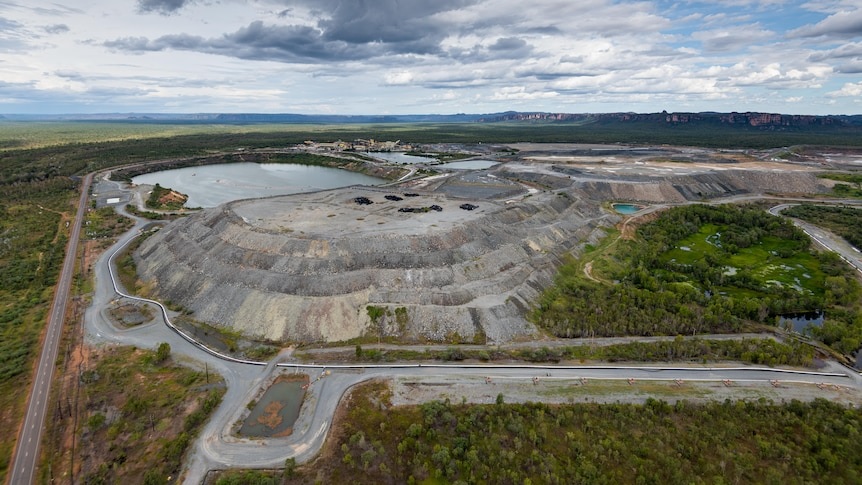
The company cleaning up the Ranger uranium mine in Kakadu says the project is running badly over budget and already late.
Crikey GLENN DYER AND BERNARD KEANE, SEP 28, 2023
Peter Dutton and the radioactive gang of nuclear spruikers in the media seem to think that if only they call for a “mature debate” long enough, small nuclear reactors (SMRs) will just pop into being.
But like any energy source, nuclear power comes with a host of practical challenges that don’t seem to feature in the op-eds and speeches about how SMRs are just around the corner.
Take, for example, the plight of Energy Resources of Australia (ERA) — the almost wholly owned subsidiary of Rio Tinto that operated the Ranger uranium mine in Kakadu in the Northern Territory from 1980 until 2021, when it was closed and rehabilitation work started………………………..(Subscribers only) more https://www.crikey.com.au/2023/09/28/uranium-mine-clean-up-over-budget-running/
Nuclear power on Surf Coast “incomprehensible”, says Greens MP
Surf Coast Times, September 28, 2023 BY James Taylor
GREENS MP and former City of Greater Geelong councillor Sarah Mansfield has pushed back against Opposition Leader Peter Dutton’s support for nuclear power at old mine sites, saying it would be “incomprehensible” to build a reactor at the former Anglesea mine.
During a visit to Ocean Grove last week, Mr Dutton said he wanted a “mature discussion” about nuclear energy in Australia, and touted the benefits of small modular reactor (SMR) technology as a viable solution to decarbonising the economy.
Alcoa’s Anglesea coal mine and power station supplied power to the former Point Henry smelter and closed in August 2015.
Asked if a nuclear reactor would be a hard sell for people in Geelong, the Bellarine and the Surf Coast, Mr Dutton replied: “Well, is there a coal mine that’s operating here at the moment that’s coming to end of life?”…………………………………………………………………………………….
Ms Mansfield, who became a Member for Western Victoria at the 2022 state election, said in a letter to this newspaper that she was “deeply concerned” by Mr Dutton’s comments.
“His arguments promote dangerous misinformation about nuclear technology.
“Moreover, the suggestion that these reactors could be placed at old mine sites (such as the Anglesea Alcoa site) is incomprehensible.”
She said nuclear power was not safe, clean, or renewable.
“The health risks associated with uranium mining and nuclear reactors are well established. Imagine the devastation to our beautiful coast and communities if there was a nuclear accident? Then the waste – where will it go? Australia already struggles to deal with medical industry nuclear waste.
“And to claim it is zero emissions is simply wrong. No energy source is completely emissions-free when you consider whole of life emissions (e.g. transport, materials, construction) – and nuclear produces greater emissions than renewables like solar and wind.
“It’s hard to believe the Coalition is serious about this proposal. They know that coal and gas are on the way out, but they’re blocking renewables and have come up with a nuclear fantasy that no reasonable economist or energy expert is willing to back.”
Labor has rubbished the Coalition’s proposal, with Energy and Climate Change Minister Chris Bowen saying modelling from his department found replacing Australia’s coal-fired power stations with SMRs would cost $387 billion. https://timesnewsgroup.com.au/surfcoasttimes/news/nuclear-power-on-surf-coast-incomprehensible-says-greens-mp/
Mission to Free Assange: Australian Parliamentarians in Washington
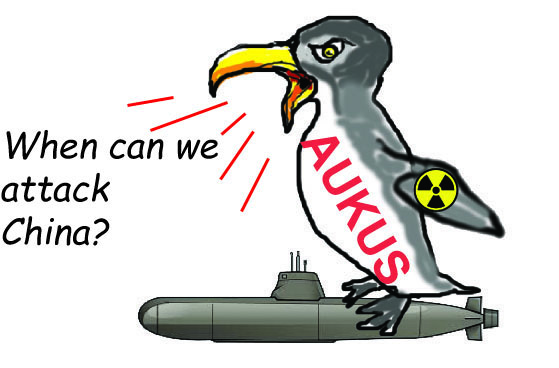
Australia remains the prized forward base of US ambitions in the Indo-Pacific, the spear pointed against China and any other rival who dares challenge its stubborn hegemony. The AUKUS pact, featuring the futile, decorative nuclear submarines …………also makes that point all too clear.
September 24, 2023, Dr Binoy Kampmark, https://theaimn.com/mission-to-free-assange-australian-parliamentarians-in-washington/
It was a short stint, involving a six-member delegation of Australian parliamentarians lobbying members of the US Congress and various relevant officials on one issue: the release of Julian Assange. If extradited to the US from the United Kingdom to face 18 charges, 17 framed with reference to the oppressive, extinguishing Espionage Act of 1917, the Australian founder of WikiLeaks risks a 175-year prison term.
Nationals MP Barnaby Joyce, Labor MP Tony Zappia, Greens Senators David Shoebridge and Peter Whish-Wilson, Liberal Senator Alex Antic and the independent member for Kooyong, Dr. Monique Ryan, are to be viewed with respect, their pluckiness admired. They came cresting on the wave of a letter published on page 9 of the Washington Post, expressing the views of over 60 Australian parliamentarians. “As Australian Parliamentarians, we are resolutely of the view that the prosecution and incarceration of the Australian citizen Julian Assange must end.”
This is a good if presumptuous start. Australia remains the prized forward base of US ambitions in the Indo-Pacific, the spear pointed against China and any other rival who dares challenge its stubborn hegemony. The AUKUS pact, featuring the futile, decorative nuclear submarines that will be rich scrapping for the Royal Australian Navy whenever they arrive, also makes that point all too clear. For the US strategist, Australia is fiefdom, property, real estate, terrain, its citizenry best treated as docile subjects represented by even more docile governments. Assange, and his publishing agenda, act as savage critiques of such assumptions.
The following views in Washington DC have been expressed by the delegates in what might be described as a mission to educate. From Senator Shoebridge, the continued detention of Assange proved to be “an ongoing irritant in the bilateral relationship” between Canberra and Washington. “If this matter is not resolved and Julian is not brought home, it will be damaging to the bilateral relationship.”
Senator Whish-Wilson focused on the activities of Assange himself. “The extradition of Julian Assange as a foreign journalist conducting activities on foreign soil is unprecedented.” To create such a “dangerous precedent” laid “a very slippery slope for any democracy to go down.”
Liberal Senator Alex Antic emphasised the spike in concern in the Australian population about wishing for Assange’s return to Australia (some nine out of 10 wishing for such an outcome). “We’ve seen 67 members of the Australian parliament share that message in a joint letter, which we’ve delivered across the spectrum.” An impressed Antic remarked that this had “never happened before. I think we’re seeing an incredible groundswell, and we want to see Julian at home as soon as possible.”
On September 20, in front of the Department of Justice, Zappia told reporters that, “we’ve had several meetings and we’re not going to go into details of those meetings. But I can say that they’ve all been useful meetings.” Not much to go on, though the Labor MP went on to state that the delegation, as representatives of the Australian people had “put our case very clearly about the fact that Julian Assange pursuit and detention and charges should be dropped and should come to an end.”
A point where the delegates feel that a rich quarry can be mined and trundled away for political consumption is the value of the US-Australian alliance. As Ryan reasoned, “This side of the AUKUS partnership feels really strongly about this and so what we expect the prime minister [Anthony Albanese] to do is that he will carry the same message to President Biden when he comes to Washington.”
The publisher’s brother, Gabriel Shipton, also suggests that the indictment is “a wedge in the Australia-US relationship, which is a very important relationship at the moment, particularly with everything that’s going on with the US and China and the sort of strategic pivot that is happening.” Assange, for his part, is bound to find this excruciatingly ironic, given his lengthy battles against the US imperium and the numbing servility of its client states.
Various members of Congress have granted an audience to the six parliamentarians. Enthusiasm was in abundance from two Kentucky Congressmen: Republican Senator Rand Paul and Republican House Representative Thomas Massie. After meeting the Australian delegation, Massie declared that it was his “strong belief [Assange] should be free to return home.”
Georgian Republican House member Marjorie Taylor Greene expressed her sense of honour at having met the delegates “to discuss the inhumane detention” of Assange “for the crime of committing journalism,” insisting that the charges be dropped and a pardon granted. “America should be a beacon of free speech and shouldn’t be following in an authoritarian regime’s footsteps.” Greene has shown herself to be a conspiracy devotee of the most pungent type, but there was little to fault her regarding these sentiments.
Minnesota Democrat Congresswoman Ilhan Omar also met the parliamentarians, discussing, according to a press release from her office, “the Assange prosecution and its significance as an issue in the bilateral relationship between the United States and Australia, as well as the implications for freedom of the press both at home and abroad.” She also reiterated her view, one expressed in an April 2023 letter to the Department of Justice co-signed with six other members of Congress, that the charges against Assange be dropped.
These opinions, consistent and venerably solid, have rarely swayed the mad hatters at the Justice Department who continue to operate within the same church consensus regarding Assange as an aberration and threat to US security. And they can rely, ultimately, on the calculus of attrition that assumes allies of Washington will eventually belt up, even if they grumble. There will always be those who pretend to question, such as the passive, meek Australian Foreign Minister, Penny Wong. “We have raised this many times,” Wong responded to a query while in New York to attend the United Nations General Assembly. “Secretary [of State Antony] Blinken and I both spoke about the fact that we had a discussion about the views that the United States has and the views that Australia has.”
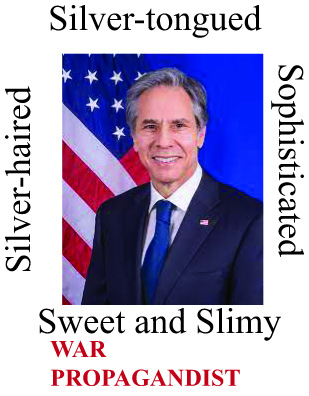
Not that this mattered a jot. In July, Blinken stomped on Wong’s views in a disingenuous, libellous assessment about Assange, reminding his counterpart that the publisher had been “charged with very serious criminal conduct in the United States in connection with his alleged role in one of the largest compromises of classified information in the history of our country.” The libel duly followed, with the claim that Assange “risked very serious harm to our national security, to the benefit of our adversaries, and put named sources at grave risk – grave risk – of physical harm, and grave risk of detention.” That gross falsification of history went unaddressed by Wong.
Thus far, Blinken has waived away the concerns of the Albanese government on Assange’s fate as passing irritants at a spring garden party. However small their purchase, six Australian parliamentarians have chosen to press the issue further. At the very least, they have gone to the centre of the imperium to add a bit of ballast to the effort.
Let’s Label #USPropaganda – Call it out. Our crews at Boeing and disrupting General Mick Ryan/
Age Peace 21 Sept 23
Wage Peace friends have been out disrupting the US propaganda machine.
Last week our friends interrupted this public lecture. General Mick Ryan is there at the lectern. He’s an ex-ADF General – now a #USPropagandist – and he’s about to tell people about why we must prepare for war by buying more US weapons.
ALP stalwart Paul Lucas moves in. But even 30 minutes later we were still there telling an alternative story about what is going on!
| –Last week our friends interrupted this public lecture. General Mick Ryan is there at the lectern. He’s an ex-ADF General – now a #USPropagandist – and he’s about to tell people about why we must prepare for war by buying more US weapons. ALP stalwart Paul Lucas moves in. But even 30 minutes later we were still there telling an alternative story about what is going on!Watch on YouTube as we disrupt his latest propaganda engagement. #BewareBoeingsWars Boeing is a weapons companyOur friends also attended Boeing slowly walking up to their suburban location in Brisbane. We prevented the weapons dealers arriving for work. Beware Boeing’s wars we warned. Boeing is a weapons company. With BAE, Thales, and General Dynamics, Boeing is pushing for war while taking the big bucks from Australians. #EarthCareNotWarfare |
The push for nuclear energy in Australia is driven by delay and denial, not evidence.
Adam Morton 21 Sept 23 https://www.theguardian.com/commentisfree/2023/sep/21/nuclear-energy-australia-smokescreen-climate-denialism-coalition
Unsubstantiated claims of nuclear energy’s worth distracts from the urgency to act now on climate crisis
he vague, ideological push for nuclear energy backed by the Coalition and News Corp and given legitimacy this week on the ABC’s Q+A should be treated as what it is: the latest step in a decades-long campaign of delay and denial on the climate crisis.
Nuclear energy likely has a role to play in the global shift to zero-emissions energy in places that already use it or that have few other options. As with other technology, its role may grow or recede over time as the world moves. This stuff is going to change.
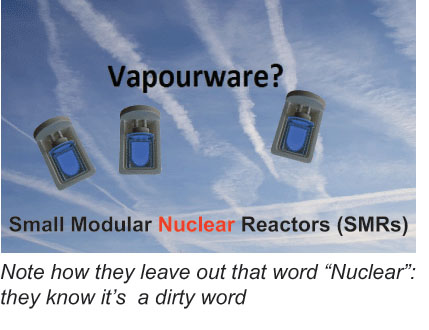
But no case has been made to support claims it has a place in the rapid transition under way in Australia. The reason for this is pretty straightforward: the technology that is being spruiked – small modular reactors (SMRs) – doesn’t exist. Not meaningfully.
That alone tells you that, with few exceptions, the current wave of nuclear boosterism is at its heart an anti-renewable energy campaign.
It is based on an arrogant and – despite the reams of column inches given over to it – unsubstantiated rejection of the detailed evidence from the Australian Energy Market Operator (and plenty of others) that solar, wind, hydro, batteries and other “firming” support can provide a reliable, affordable, low-emissions electricity supply.
Coincidentally or otherwise, many prominent members of the pro-nuclear and anti-renewable energy campaign dismiss climate science. Some do it directly. Others do it indirectly by arguing there is no urgency to act.
The primary sources of this climate rejection are the federal Coalition, the Australian newspaper and the misinformation sewer of Sky News After Dark. The Australian is happy to run unquestioning news stories claiming multibillion-dollar “black holes” in renewable energy plans based on flawed analyses by former mining executives, but then devote pages to tut-tutting over an estimate by Chris Bowen’s energy department that says nuclear energy would be – shock horror – really expensive.
This is, of course, a newspaper that gives more space to contrarian campaigns by individual scientists who claim that the Great Barrier Reef is not under threat and the Bureau of Meteorology’s temperature records cannot be trusted than it does to the overwhelming weight of thousands of peer-reviewed science papers. Considered and balanced scepticism is healthy. The Australian’s coverage of these issues has the rigour of an old bloke shouting in the corner of a pub as last drinks are served.
The Coalition’s position on nuclear energy is a little more slippery. In its limited defence, we’re only 16 months on from the last election and it’s reasonable that it doesn’t yet have a developed energy policy. But the language it uses is not that of a party gently exploring an idea. Peter Dutton has asserted that Australia could build nuclear plants, which are banned here, on existing coal-fired plants.
The Coalition considered, and rejected, abolishing the nuclear ban while it was in power for nearly nine years. Then, the party stuck with its status quo on climate, including hyping a subsidised “gas-fired recovery” that never happened. Now, Dutton and Ted O’Brien, the energy and climate spokesperson, speak of nuclear as the obvious solution and mock those who back the rollout of renewable energy and transmission lines.
Bowen’s back-of-envelope claim is that it could cost $387bn to replace every Australian coal plant with nuclear SMRs – a step that, at this stage, the Coalition has not proposed. O’Brien’s response was to cite the nuclear-heavy Canadian province of Ontario as an example of a power grid that is much cleaner and cheaper than here.
This was a red herring. The Ontario system runs on old, large-scale nuclear technology that nobody is proposing for Australia. It has a different cost profile, has been heavily subsidised and a new plant has not been completed for 30 years.
A true comparison would involve looking at the cost of SMRs today and considering what it would cost to start an industry in Australia.
The CSIRO, which has looked at the evidence, concluded this is near impossible due to a lack of robust data. It says there are only two known SMRs in operation – one in Russia (on a barge) and one in China. Both suffered the cost blowouts and delays that have become common with nuclear projects.
According to the International Atomic Energy Agency, there are more than 80 other SMR designs in development, only some of which would be used for electricity generation if successful. But it says their economic competitiveness is “still to be proven in practice”.
The CSIRO, which has looked at the evidence, concluded this is near impossible due to a lack of robust data. It says there are only two known SMRs in operation – one in Russia (on a barge) and one in China. Both suffered the cost blowouts and delays that have become common with nuclear projects.
According to the International Atomic Energy Agency, there are more than 80 other SMR designs in development, only some of which would be used for electricity generation if successful. But it says their economic competitiveness is “still to be proven in practice”.
But the idea Australia should wait for an unproven technology to possibly arrive when it already has extraordinary clean energy resources at its disposal defies all logic.
There is a genuine opportunity cost here. Time focused on the nuclear sideshow is playing into the delay game. I’m giving it succour just by writing this column.
Meanwhile, the world is in the grip of the hottest year on record. The fire season is under way in mid-September. Antarctic sea ice is at a record low level. Credible bodies such as the Australian Academy of Technological Sciences and Engineering now argue the country should be aiming to be net zero by 2035 – a date by which, if things go really well, just a small handful of SMRs may be in operation.
The transition away from fossil fuels is genuinely challenging. There are huge policy and social licence issues that need to be navigated so the rollout of renewable energy can accelerate. Emissions from transport, major industry and agriculture are not coming down. We barely talk about what adapting to the changes under way will mean.
But solutions are available. Imagine what might be possible if the political energy dedicated to the nuclear energy furphy went into developing those.
Modelling shows estimated cost of Peter Dutton’s nuclear energy plan
Each reactor’s estimated capital cost is $18,167/kW in 2030 compared with large-scale solar at $1058/kW and onshore wind at $1989/kW. When broken down, the modelling suggests each individual taxpayer would be burdened with a “whopping $25,000 cost impost” for such a transition
.Australian taxpayers would be slugged with a $387bn bill if Peter Dutton’s current plan to transition to nuclear was actioned.
Ellen Ransley, news.com.au, 18 Sept 23
Replacing Australia’s retiring coal-fired power stations with the Coalition’s suggested nuclear energy model would cost taxpayers up to $387bn, new modelling suggests.
Opposition Leader Peter Dutton, backed particularly by junior Coalition partners the Nationals, has previously suggested that Australia could “convert or repurpose coal-fired plants and use the transmission connections which already exist on those sites”.
Mr Dutton has also said nuclear is the “lowest cost form” of low carbon electricity, but has not explicitly outlined how much such a transition would cost.
New analysis done by the energy department shows the projected cost, which assumes replacing all of the output from closing coal-fired plants with small modular reactors, would be costly.
Energy and Climate Change Minister Chris Bowen said Mr Dutton and the opposition “need to explain why” Australians would be slugged with a $387bn burden for their nuclear energy plan that “flies in the face of economics and reason”.
But the Greens have called on the government to stop the distraction and explain to Australians why they are forging ahead with new coal and gas projects when the country is in the grips of a “climate crisis”.
“Australia is forecast to have its worst summer since the Black Summer, and yet Labor is approving more coal and gas. Peter Dutton’s nuclear push is a distraction from Labor’s continual approval of new coal and gas projects,” party leader Adam Bandt said.
“We should not allow ourselves to be distracted by Peter Dutton’s push for nuclear when Labor keeps opening new coal and gas projects in the middle of a climate crisis.”
A minimum of 71 small modular reactors – providing 300MW each – would be needed if the policy were to fully replace the 21.3GW output of the country’s retiring coal fleet.
Each reactor’s estimated capital cost is $18,167/kW in 2030 compared with large-scale solar at $1058/kW and onshore wind at $1989/kW. When broken down, the modelling suggests each individual taxpayer would be burdened with a “whopping $25,000 cost impost” for such a transition.
The opposition want to trump the benefits of non-commercial SMR technology, without owning up to the cost and how they intend to pay for it,” Mr Bowen said.
“After nine years of energy policy chaos, rather than finally embracing a clean, cheap, safe and secure renewable future, all the Coalition can promise is a multi-billion dollar nuclear flavoured energy policy.”
In total, the $387bn plan costs about 20 times what the Albanese government’s Rewiring the Nation fund is projected to cost.
The government says that fund will help achieve 82 per cent renewable energy by 2030, by unlocking over 26GW of new renewable generation capacity, and over 30GW of transmission capacity.
When Mr Dutton made his pitch for a nuclear transition in July, he suggested the Liddell Power Station could be a possible site for a small nuclear reactor…………………………………..more https://www.news.com.au/finance/business/mining/modelling-shows-estimated-cost-of-peter-duttons-nuclear-energy-plan/news-story/39f543faf65d77c53f33ec8d10175d02
Bowen demolishes case expensive for nuclear power

AuManufacturing 19 September 2023
Minister for Climate Change and Energy Chris Bowen has rubbished opposition calls for Australia to embrace nuclear poower in the form of small modular reactors.
Opposition leader Peter Dutton has injected his idea of a nuclear renaissance into the energy debate, suggesting he might change the Coalition’s official opposition to nuclear power, saying Labor was putting ‘party interests ahead of the national interest’.
According to the former head of the Australian Nuclear Scientific and Technology Organisation Dr Ziggy Switkowski who chaired a federal review of nuclear powe that ‘on paper, they (SMRs) look terrific’, but that we won’t know their costs ‘until the SMRs are deployed in quantity’.
Bowen told a Canberra press conference: “Since the last election, the party which spent ten years telling us we didn’t need to worry about climate change says they’ve found a solution for climate change and it’s nuclear.
“They didn’t bother for their ten years in office to promote a nuclear agenda, but as they desperately search around for an alibi for their hatred of renewable energy, they settled on this since the last election.”
Dutton made a nuclear plan the centrepiece of his Budget reply, but Bowen said there was actually no policy and nothing costed.
“Peter Dutton said at a speech earlier this year that it’s easy, you just plug and play nuclear in to replace coal. Well if it’s so easy, Mr Dutton, where is your plan?”
Bowen released cost estimates of $387 billion to replace Australia’s 21.3 gigawatts of coal-fired power with nuclear.
This would involve the construction of 71 nuclear reactors spread across Australia.
Given the public pushback on even low level waste disposal sites, any plan to build 71 nuclear power plants would likely be political suicide for any government……………………………………………more https://www.aumanufacturing.com.au/bowen-demolishes-case-expensive-for-nuclear-power
Nuclear too costly, too slow, too risky for Australia

The federal government’s preliminary cost estimates for small modular reactors highlight one of the many reasons why this nuclear technology – which isn’t being commercially deployed anywhere in the world – is not a viable option for Australia.
Australian Conservation Foundation nuclear policy analyst Dave Sweeney said the nuclear option would dramatically increase household electricity bills, slow the transition to clean energy, introduce the possibility of catastrophic accidents and create multi-generational risks associated with the management of high-level nuclear waste.
“The government’s initial cost estimates show the unacceptably high financial costs of technology that does not even exist on a commercial scale,” Dave Sweeney said.
“Aside from financial costs, Australians don’t need or want to take on the massive risks that accompany nuclear energy – catastrophic meltdowns like Chernobyl and Fukushima, plus the intergenerational danger of storing high-level radioactive waste for centuries.
“We cannot afford to squander more time in moving our economy away from its reliance on climate-damaging coal and gas. Nuclear is a dangerous distraction to effective climate action.
“Australia is blessed with amazing clean energy resources. Our energy future is renewable, not radioactive.” For interviews contact: Dave Sweeney 0408 317 812, or Josh Meadows 0439 342 992
Chris Hedges: Craig Murray on the ‘Slow Motion Execution’ of Assange
And I saw, 100% for certain, that the judge came into court with her ruling already typed out before she heard the arguments, and she sat there almost pretending to listen to what the defense was saying for now and what the prosecution was saying for now. Then she simply read out the ruling.
Chris Hedges: She’s like the Queen of Hearts in Alice in Wonderland giving the verdict before she hears the sentence.
SCHEERPOST, September 17, 2023
Julian Assange continues to fight extradition to the United States to face prosecution under the Espionage Act, a growing chorus of voices is rising to demand an end to his persecution. Hounded by US law enforcement and its allies for more than a decade, Assange has been stripped of all personal and civil liberties for the crime of exposing the extent of US atrocities during the War on Terror. In the intervening years, it’s become nakedly apparent that the intent of the US government is not only to silence Assange in particular, but to send a message to whistleblowers and journalists everywhere on the consequences of speaking truth to power. Former British ambassador to Uzbekistan, Craig Murray, who was fired for exposing the CIA’s use of torture in the country, joins The Chris Hedges Report to discuss what Julian Assange’s fight means for all of us.
TRANSCRIPT
Chris Hedges: Craig Murray, the former British ambassador to Uzbekistan, was removed from his post after he made public the widespread use of torture by the Uzbek government and the CIA. He has since become one of Britain’s most important human rights campaigners and a fierce advocate for Julian Assange as well as a supporter of Scottish independence. His coverage of the trial of former Scottish first minister Alex Salman, who was acquitted of sexual assault charges, saw him charged with contempt of court and sentenced to eight months in prison. The very dubious sentence, half of which Craig served, upended most legal norms. He was sentenced, supporters argued, to prevent him from testifying as a witness in the Spanish criminal case against UC global director, David Morales, being prosecuted for installing a surveillance system in the Ecuador embassy when Julian Assange found refuge that was used to record the privileged communications between Julian and his lawyers.
Morales is alleged to have carried out this surveillance on behalf of the CIA. Murray has published some of the most prescient and eloquent reports from Julian’s extradition hearings and was one of a half dozen guests, including myself, invited to Julian and Stella’s wedding in Belmarsh Prison in March 2022. Prison authorities denied entry to Craig, based on what the UK Ministry of Justice said were security concerns, as well as myself from attending the ceremony.
Joining me to discuss what is happening to Julian Assange and the rapid erosion of our most basic democratic rights is Craig Murray.
And to begin, Craig, I read all of your reports from the trial which are at once eloquent and brilliant. It’s the best coverage that we’ve had of the hearings. But I want you to bring us up to date with where we are with the case at this moment.
Craig Murray: Yeah. The legal procedures have been extraordinarily convoluted after the first hearings for the magistrate ruled that Julian couldn’t be extradited, on essentially, health grounds. Due to the conditions in American prisons, the US then appealed against that verdict. The high court accepted the US appeal on extraordinarily dubious grounds based on a diplomatic note giving certain assurances which were conditional and based on Julian’s future behavior. And of course, the US government has a record of breaking such assurances, and also, those assurances could have been given at the time of the initial hearing and weren’t.
Chris Hedges: I don’t think those assurances have any… It was a diplomatic note. It has no legal validity.
Craig Murray: It has no legal validity. It’s not binding in any sense. And as I say, it is in itself conditional. It states that they may change this in the future. It actually says that –
Chris Hedges: Well, based on his behavior.
Craig Murray: – Based on his behavior, which they will be the sole judges of.
Chris Hedges: Of course.
Craig Murray: And which won’t involve any further legal process. They will decide he’s going into a supermax because they don’t like the way he looks at guards or something. It’s utterly meaningless. And so the US, having won that appeal so Julian could be extradited, it was then Julian’s turn to appeal on all the points he had lost at the original extradition. Those include the First Amendment, they include freedom of speech, obviously, and they include the fact that the very extradition treaty under which he’s being extradited states that there shall be no political extradition and this is plainly a very political case and several other important grounds. That appeal was lodged. Nothing then happened for a year. And that appeal is an extraordinary document. You can actually find it on my website, CraigMurray.org.uk.
I’ve published the entire appeal document and it is an amazing document. It’s an incredible piece of legal argument. And some of the things it sets out like the fact that the US key witness for the charges was an Icelandic guy who they paid for his evidence. They paid him for his evidence and he is a convicted pedophile and convicted fraudster. And since he has said he lied in his evidence and he just did it for the money. That’s one example of the things you find. The documentation is not dry legal documentation at all. It’s well worth going and looking through Julian’s appeal. That appeal ran to 150 pages plus supporting documents.
For a year, nothing happened. Then two or three months ago it was dismissed in three pages of double-spaced A4, in which the judge, Judge Swift, said that there were no legal arguments, no coherent legal arguments in this 150 pages and it followed no known form of pleading and it was dismissed completely. And the thing is that the appeal was written by some of the greatest lawyers in the world. It’s supervised and written by Gareth Pierce, who I would say is the greatest living human rights lawyer. Those people have seen the film In the Name of the Father, starring Daniel Day-Lewis…………………………………….
She’s won numerous high-profile cases. She has enormous respect all around the world and this judge, who is nobody, is saying that there’s no validity to her pleadings which follow no known form of pleading. This is quite extraordinary.
Chris Hedges: Am I correct in that he was a barrister, essentially, for the defense ministry? He was served the interests of the UK government and that’s essentially got him his position. Is that correct?
Craig Murray: Exactly. He was the lead barrister for the security services. Well, he was a banister who specialized in working for the security services.
……………………………………………………And I saw, 100% for certain, that the judge came into court with her ruling already typed out before she heard the arguments, and she sat there almost pretending to listen to what the defense was saying for now and what the prosecution was saying for now. Then she simply read out the ruling.
Chris Hedges: She’s like the Queen of Hearts in Alice in Wonderland giving the verdict before she hears the sentence.
……………………………..On the most basic level, the evisceration of attorney-client privilege because UC Global recorded the meetings between Julian and his lawyers, that in a UK court, as in a US court alone, should get the trial invalidated
Craig Murray: In any democracy in the world, if your intelligence services have been recording the client’s attorney consultations, that would get the case thrown out. ………………………….
……………………………………………………………………………………………………………….at times it seemed as though they were deliberately doing things as slowly as possible.
Chris Hedges: Well, this is what Neils Melzer, the special repertoire on torture for the UN, said that he called it, a slow motion execution, were his words.
………………………………..Craig Murray: It was because of my advocacy for and friendship with Julian. That’s why they put me in jail. I was in the cell, my cell was 12 feet by eight feet which is slightly larger than Julian’s cell, and I was kept in solitary confinement for 23 hours a day, sometimes 23.5 hours a day for four months. And that’s extremely difficult. It’s extremely difficult. But I knew when I was leaving, I had an end date. To be in those conditions as Julian has been for years and years and no idea if it will ever stop, no idea if you’ll ever be let out alive, let alone not having an end date, I can’t imagine how psychologically crushing that would be……………………………………………………………………………….
Craig Murray: The immediate thing that will happen is that Julian’s lawyers will try to go to the European Court in Strasbourg –
Chris Hedges: To the European Court of Human Rights.
Craig Murray: – The European Court of Human Rights to submit an appeal and get the extradition stopped, pending an appeal. The worry is that Julian would instantly be extradited and that the government wouldn’t wait to hear from a European Court.
Chris Hedges: Explain to Americans what it is and what jurisdiction it has in the UK, the European Court.
Craig Murray: Yeah, the European Court of Human Rights is not a European Union body. It’s a body of the Council of Europe. It has jurisdiction over the European Convention on Human Rights which guarantees basic human rights and therefore it has legally binding jurisdiction over human rights violations in any member state of the treaty. So it does have a legally binding jurisdiction and is acknowledged as such, normally, by the UK government. They’re very powerful voices within the current conservative government in the UK which wants to exit the convention on human rights. But at present, that’s not the case. The UK is still part of this system. And so the European Court of Human Rights has legally binding authority over the government of the United Kingdom purely on matters that contravene human rights.
Chris Hedges: And if they do extradite him, they’ve essentially nullified that process, the fear is that, of course, the security services would know about the ruling in advance. He’d be on the tarmac and shuttled in, sedated, and put in a diaper and hooded or something and put on a CIA flight to Washington. I want to talk about if that happens. It’s certainly very possible. What we need to do here, and I know part of the reason you’re in the US, is to prepare for that should it take place. You will try and cover the hearings and trial here as you did in the UK but let’s talk about where we go if that event occurs.
Craig Murray: Yeah. The first thing to say is that if that happens, on the day it happens, it will be the biggest news story in the world; It would be a massive news story. So we have to be prepared. We have to know who, from the Assange movement or who from his defense team, who’s going to be the spokesman, who are going to be the spokespeople, who are going to be offered up to all the major news agencies? We have to affect the story on day one. Because if you get behind the story – And we know what their line will be. They’ll put out all these lies about people being killed because of WikiLeaks, about the American insecurity being endangered, we know all the propaganda that they will try to flood the airwaves with – So we need to be ready and ahead of the game to know who our people are, who are going to be offered up to interview, who are going to proactively get onto the media, and not just the alternative media like this media, but onto the so-called mainstream as well, and get out the story…………………………………………………………………………………………………………………………………………………………………
Chris Hedges. ………………….my reading of it is that they don’t care how they look. And part of it is to send a message. It doesn’t matter what nationality you are, it doesn’t matter where you are. WikiLeaks is not a US-based publication, it doesn’t matter where you are. If you expose the information that Julian and WikiLeaks exposed, we’re going to come for you. Isn’t that the message?
Craig Murray: That’s absolutely right. And this, again, it’s amazing they don’t see the dangers in this claim of universal jurisdiction. …………………….
This claim of universal jurisdiction is extraordinary. And what’s even more extraordinary is they’re claiming universal jurisdiction but Julian is under their jurisdiction because he published American Secrets even though he’s not an American and he wasn’t in America. And at the same time, while they claim jurisdiction over him, they’re claiming he has no First Amendment rights because he’s an Australian.
The combination of we have jurisdiction over you, you have all the liabilities that come with that but you have none of the rights that come with that because you’re not one of our citizens, that’s pernicious. It’s so illogical and so vicious. …………………………………………
Chris Hedges: I want to close because there’s been noise out of Australia. The ambassador, Carolyn Kennedy, said that they might consider a plea deal. I have put no credence in it. It’s all smoke but I wondered what you thought.
Craig Murray: Yeah. It’s an attempt to placate Australian public opinion. Public opinion in Australia is extremely strong. Over 80% of Australians want Julian released and allowed to go home to Australia. Blinken came there and made some very hostile and un-diplomatic remarks at a time when Australia was allowing the US to base nuclear weapons on its side. Caroline Kennedy came out… It’s a lie, frankly. There has been no approach from a justice department or from the State Department to doing any plea deal. It’s purely smoke and mirrors to try to distract the Australian public. Caroline Kennedy was lying to the Australian public. That’s pure and simple.…………..
Build renewables, not nuclear’: energy execs reject reactors.

Australia must focus on developing a huge pipeline of renewable energy as it can’t afford to wait for small modular nuclear reactors to become cost-competitive.
THE AUSTRALIAN Colin Packham Energy reporter
Australia must concentrate on developing a massive pipeline of renewable energy as it can’t afford to wait for small modular nuclear reactors to mature and become cost-competitive, energy executives have urged.
“The economics are clear: we need to act now to build wind, solar and batteries, not wait for a more expensive solution that won’t be available for more than a decade, at the earliest,” said Jason Willoughby, the chief executive of Andrew Forrest-owned renewables developer Squadron Energy.
“Renewables are the cheapest form of new-build electricity, including with the investment required in transmission infrastructure.
“The consequences and costs are too great not to act.
“Australia simply can’t afford to wait.”
Australia is struggling to meet its ambitious plans to replace its ageing coal power stations with renewable energy, and the federal opposition has proposed converting coal-fired power sites into small modular nuclear reactors to ease the transition.
Federal Energy Minister Chris Bowen recently released modelling showing that 71 small modular reactors would cost $387bn.
He said each megawatt of nuclear-generated electricity would have a capital cost of $18.1m – about $5.4bn per reactor – much higher than $1m for large-scale solar and $2m for onshore wind.
Energy experts said estimates for developing nuclear in Australia matched recent modelling internationally, although some expect costs to fall.
Robin Batterham, chair of the Net Zero Australia Steering Committee and emeritus professor at the University of Melbourne, said that if costs fell nuclear power could become a viable and cost-effective alternative………………………………………………………… ‘Build renewables, not nuclear’: energy execs reject reactors
Replacing Australia’s retiring coal power stations with small nuclear reactors could cost $387bn, analysis suggests
The figure adds fuel to the growing political dispute over the pace and form of Australia’s energy transition
Daniel Hurst https://www.theguardian.com/australia-news/2023/sep/18/replacing-australias-retiring-coal-power-stations-with-small-nuclear-reactors-could-cost-387bn-analysis-suggests
The federal government says it would cost as much as $387bn to replace Australia’s retiring coal-fired power stations with the form of nuclear power proposed by the Coalition.
The figure, produced by the energy department, is the projected cost of replacing all of the output from closing coal-fired plants with small modular reactors.
The opposition leader, Peter Dutton, has previously suggested that Australia “could convert or repurpose coal-fired plants and use the transmission connections which already exist on those sites”.
However, he has not been explicit about how much of the coal-fired electricity output would be replaced with nuclear-sourced energy – an uncertainty that makes projecting the cost difficult.
The figure adds fuel to the growing political dispute over the pace and form of Australia’s energy transition.
The government said the new analysis showed a minimum of 71 small modular reactors – providing 300MW each – would be needed if the policy were to fully replace the 21.3GW output of Australia’s retiring coal fleet.
“According to the 2022-23 GenCost report modelling under the current policies scenario, this could cost $387bn,” a government summary said.
“This is due to the estimated capital cost of $18,167/kW for [small modular reactors] in 2030, compared to large scale solar at just $1,058/kW, and onshore wind at $1,989/kW.”
The government said this would represent “a whopping $25,000 cost impost on each Australian taxpayer”.
The minister for climate change and energy, Chris Bowen, said the opposition wanted to promote the benefits of “non-commercial” small modular reactor technology “without owning up to the cost and how they intend to pay for it”.
“Peter Dutton and the opposition need to explain why Australians will be slugged with a $387bn cost burden for a nuclear energy plan that flies in the face of economics and reason,” Bowen said.
“After nine years of energy policy chaos, rather than finally embracing a clean, cheap, safe and secure renewable future, all the Coalition can promise is a multi-bullion-dollar nuclear-flavoured energy policy.”
Dutton identified Liddell as a possible site for a small modular reactor when he gave a pro-nuclear speech in July.
At the time, Dutton said he saw nuclear “not as a competitor to renewables but as a companion” and he wanted “an Australia where we can decarbonise and, at the same time, deliver cheaper, more reliable and lower emission electricity”.
He called on the government to consider removing legislative prohibitions on new nuclear technologies – a step the former Coalition government didn’t attempt during its nine years in power – “so we do not position Australia as a nuclear energy pariah”.
Dutton further accused Bowen of burrowing “so deeply down the renewable rabbit hole that he refuses to consider these new nuclear technologies”.
“The new nuclear technology train is pulling out of the station. It’s a train Australia needs to jump aboard.”
The estimates released by the government on Monday are partly based on the costs for small modular reactors outlined in the CSIRO’s GenCost report.
That report notes that global commercial deployment of small modular reactors is “limited to a small number of projects and the Australian industry does not expect any deployment here before 2030”.
The report notes some uncertainty around the projections.
“Nuclear SMR current costs are not reported since there is no prospect of a plant being deployed in Australia before 2030,” said the CSIRO report, released in July.
“However, some improved data on nuclear SMR may be available in future reports and projected capital costs for SMR have been included from 2030 onward.”
The federal government has set a goal of 82% of electricity coming from renewable energy by 2030, up from about 35% today.
To achieve this, the federal government has committed $20bn in low-cost finance for “rewiring the nation” – updating transmission lines – but is facing pushbacks from rural communities.
Protesters call on Labor to protest Fukushima nuclear waste dumping
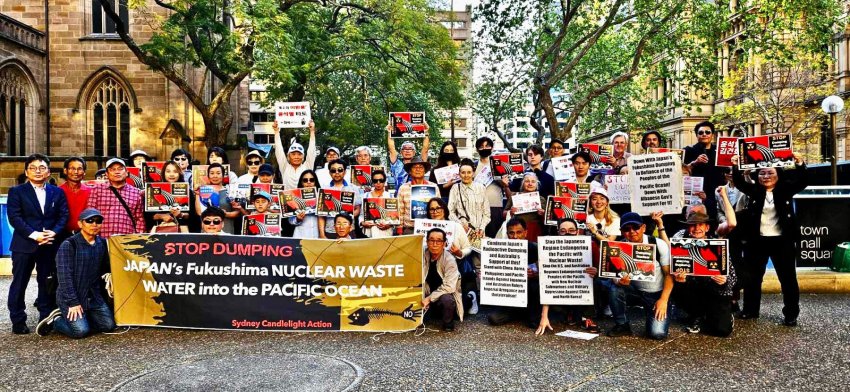
Jim McIlroy, Gadi/Sydney, September 18, 2023 https://www.greenleft.org.au/content/protesters-call-labor-protest-fukushima-nuclear-waste-dumping
Protesters took a stand against the dumping of Fukushima’s nuclear waste into the Pacific Ocean on September 16. The action was organised by the Sydney Candlelight Action (SCA), based in the Korean community, and was part of a global day of action.
Speakers from the Korean community and other groups condemned the Japanese government and called for international pressure to stop further dangerous radioactive contamination.
Vivian Pak from the Candleight Alliance called on the Prime Minister and environment minister to oppose Japan’s decision.
She also condemned the South Korean government for “not only assisting Japan over the dumping of the nuclear contaminated water but also actively encouraging the ultra right-wing government of Japan to increase its military presence in the region”.
Peter Boyle from Socialist Alliance condemned Labor for endorsing the dumping of the Fukushima nuclear waste as “safe”.
The Australian Embassy in Tokyo even staged a “Fukushima fish and chips” dinner as a public relations stunt in support of the nuclear wastewater release.
Boyle said the Australian government was a “bad Pacific neighbour” because it is undermining a nuclear-free Pacific by supporting the dumping of nuclear waste, dumping nuclear waste on Aboriginal land and entering the AUKUS nuclear submarine deal.
Katti Jisuk Seo, a Korean-German who now lives here, said while enjoying her first scuba dive on the Great Barrier Reef the news about the toxic waste came through.
“Japan is sending its radioactive waste on a trip around the world,” she said.
“Japan plans to release 1.3 million tons of radioactive contaminated wastewater into the ocean over the next decades: that’s enough to fill at least 500 Olympic-sized swimming pools.
“From the Pacific it will reach beaches and seas globally, entering fish, marine plants, other sea creatures and mammals throughout the marine food chain. Via evaporation, through rainfall, it will find its way back onto the lands across our planet.”
David Rho, the rally MC, called on the Japanese government to “accept an independent assessment of the Fukushima wastewater, and to release the true test result”. He said AUKUS represented further nuclear escalation in the region and must be opposed.
Risk assessment and the nuclear cultists
Damian Meagher From Facebook page Nuclear Fuel Cycle Watch 17 Sept 23
Risk assessment is a complex subject, but nuclear cultist would have you believe it is a simple straightforward matter. There are at least two aspects of risk that they always ignore.
The first is the issue of risk consent.
Some risks in life are ones that consenting adults decide to take. For example, they might go rock climbing or skydiving, or some other adventure sport. Or they might smoke, drink to excess or have an unhealthy diet.
These are examples of risks that they have decided to take.
There is another type of risk though. Risks that are imposed on a person.
Your neighbour might bring home an ill trained guard dog and allow it to roam the streets without supervision. A food manufacturer may include dangerous ingredients in their product and not disclose this fact. A person might drink and drive and cause an injury to another person.
These are examples of risks that exist, but that are imposed on a person who has NOT consented to that risk.
All risks can be analysed both as to the probability of the risk as well as what consequences the risk poses. The risk of being involved in a minor car accident at some point in your life is rather high, but the likely consequences are minimal.
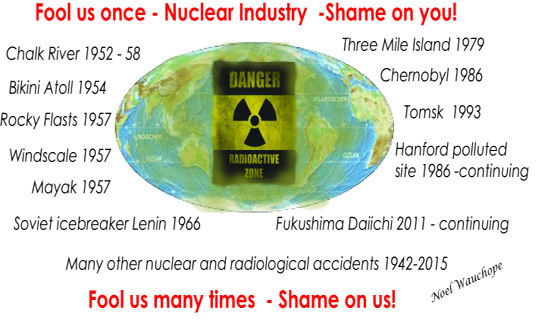
Proper risk management assesses BOTH the likelihood of a risk AND the potential consequences.Poor nuclear cultists don’t use this method, as it immediately highlights a significant problem that nuclear faces.While the likelihood of an accident is low, the consequences can be catastrophic. The victims of such an accident did not consent to this risk. It is imposed on them.
Chernobyl (an accident that cultists like Goronwy Price prefer to ignore) had impacts both health and economic, right across the northern hemisphere. The victims had the risk imposed upon them. This is fundamentally unjust. N-Cultists are happy to put other people at risk regardless.
Antarctic sea-ice at ‘mind-blowing’ low alarms experts

2
The sea-ice surrounding Antarctica is well below any previous recorded
winter level, satellite data shows, a worrying new benchmark for a region
that once seemed resistant to global warming. “It’s so far outside anything
we’ve seen, it’s almost mind-blowing,” says Walter Meier, who monitors
sea-ice with the National Snow and Ice Data Center. An unstable Antarctica
could have far-reaching consequences, polar experts warn. Antarctica’s huge
ice expanse regulates the planet’s temperature, as the white surface
reflects the Sun’s energy back into the atmosphere and also cools the water
beneath and near it. Without its ice cooling the planet, Antarctica could
transform from Earth’s refrigerator to a radiator, experts say.
BBC 17th Sept 2023
Peter Dutton wants Australia to jump on the VERY UNECONOMIC “nuclear train”

| NUMBERS NUKE PETER’S PIPE DREAM – Crikey Worm 18 Sept 23 |
Opposition Leader Peter Dutton’s push to switch coalmine sites out for small nuclear reactors (SMRs) would cost us $387 billion, the Department of Climate Change and Energy found, because we’d need at least 71 to match the coal power. Guardian Australia reports that’s about $25,000 a taxpayer — far more per megawatt hour than cheap power from the sun or wind, per the latest Net Zero Australia report.
Not that it’s stopped Dutton from droning on about Australia needing to jump on the “nuclear train”. Do we? China has 50 gigawatts of nuclear power capacity and 95-120 gigawatts of solar expected this year alone, The Conversation adds. Multibillion-dollar SMRs in the US, France, Finland and the UK have either blown way over budget, way over time, or been abandoned altogether. This comes as the South Australian Chamber of Mines & Energy — whose biggest member, the AFR ($) notes, is uranium miner BHP — told the state government nuclear is the “logical solution”./************************************************************************************************************************************************************************************************************************************************************/**************************************************************************************************************************************************************************************************************************************************************//////////////////////////////////////////////////////////////////////////////////////////////////////////.lOpposition Leader Peter Dutton’s push to switch coalmine sites out for small nuclear reactors (SMRs) would cost us $387 billion, the Department of Climate Change and Energy found, because we’d need at least 71 to match the coal power. Guardian Australia reports that’s about $25,000 a taxpayer — far more per megawatt hour than cheap power from the sun or wind, per the latest Net Zero Australia report. Not that it’s stopped Dutton from droning on about Australia needing to jump on the “nuclear train”. Do we? China has 50 gigawatts of nuclear power capacity and 95-120 gigawatts of solar expected this year alone, The Conversation adds. Multibillion-dollar SMRs in the US, France, Finland and the UK have either blown way over budget, way over time, or been abandoned altogether. This comes as the South Australian Chamber of Mines & Energy — whose biggest member, the AFR ($) notes, is uranium miner BHP — told the state government nuclear is the “logical solution”.
1 This month

of the week – Australians for War Powers Reform (AWPR)
To see nuclear-related stories in greater depth and intensity
 Antinuclear