CSIRO chief warns against ‘disparaging science’ after Peter Dutton criticises nuclear energy costings

Douglas Hilton says he will ‘staunchly defend’ scientists as opposition leader repeats incorrect claim that CSIRO report does not accurately represent cost of renewables
Guardian, Paul Karp and Graham Readfearn,15 Mar 24
Australia’s science agency, CSIRO, has rejected Peter Dutton’s claim its estimates of the cost of renewables are unreliable.
CSIRO chief executive, Douglas Hilton, has warned that maintaining trust “requires our political leaders to resist the temptation to disparage science”, rejecting Dutton’s comments about its GenCost report.
But the opposition leader has doubled down, repeating his incorrect claim on Friday that the report does not properly cost renewables and transmission required to integrate them into the grid.
On Tuesday, Dutton claimed the annual CSIRO report that had included estimates of costs for small modular reactors – which are not yet available commercially – was “discredited” because it “doesn’t take into account some of the transmission costs, the costs around subsidies for the renewables”.
Despite Dutton’s claim, the most recent GenCost report does include the cost of integrating renewables such as solar and wind into the electricity grid. That is, it includes the cost of building new transmission lines and energy storage such as batteries.
On Friday Hilton said that he would “staunchly defend our scientists and our organisation against unfounded criticism”.
“The GenCost report is updated each year and provides the very best estimates for the cost of future new-build electricity generation in Australia,” he said in a statement………………………………
Hilton insisted that “CSIRO’s scientists and engineers can be relied on by the community to work creatively, assiduously and with integrity”.
On Friday Dutton doubled down on the comments, despite the rebuke, telling Channel Nine his point was “we need to compare apples with apples”.
“And at the moment that report … doesn’t take into consideration all of the costs around renewables,” he claimed, repeating his original error…………………………………………
The climate change and energy minister, Chris Bowen, has repeatedly rebuffed Dutton’s nuclear push, citing cost – including an estimate from the energy department that replacing fossil fuels with nuclear could cost $387bn.
Bowen has accused the Coalition of using “the rightwing playbook of 2023 – populism, polarisation and post-truth politics” in making false claims about the potential for nuclear power in Australia. https://www.theguardian.com/australia-news/2024/mar/15/csiro-peter-dutton-gencost-report-nuclear-energy-renewables-cost
ABC interview- Sarah Ferguson and Tom O’Brien – a case study in exposing Trumpian-style deceptive spin
Greg Phillips 13 Mar 24
We need a proper transcript of this – Ferguson made a great point (11m25s) that Bill Gates said we should take advantage of our bountiful wind and solar potential. (Plus there are so many things that O’Brien said that I want to add to my “wacky nuclear predictions” file.) – Ferguson: I asked Bill Gates on this program whether Australia should get involved with nuclear energy – this was his answer – “Australia doesn’t need to get engaged on this, Australia should aggressively take advantage of Australia’s natural endowment to do solar and wind, that’s clear cut and beneficial to Australia”
Greg Phillips In the interview, Ted O’Brien employs logical fallacies to support the Coalition’s position on nuclear energy:
O’Brien appeals to the authority of experts and government agencies, such as ANSTO [Australian Nuclear Science and Technology Organisation], to support his argument for nuclear energy.
O’Brien presents a false dichotomy by framing the energy debate as a choice between nuclear energy and renewables, suggesting that nuclear is necessary due to the perceived failure of renewable energy targets.
O’Brien engages in ad hominem attacks by criticising the Labor Party’s energy policies and accusing them of lacking transparency and effectiveness, rather than directly addressing the interviewer’s concerns about nuclear energy.
O’Brien misrepresents the interviewer’s arguments by suggesting that they are arguing against the attractiveness of nuclear energy to investors, rather than questioning its feasibility and cost-effectiveness in the Australian context.
O’Brien selectively then cites examples of successful nuclear energy projects in other countries, such as Canada and the United States, while ignoring instances of cost overruns and delays in countries like the United Kingdom and France.
These logical fallacies detract from the soundness of O’Brien’s arguments and undermine the credibility of the Federal Coalition’s stance on nuclear energy.
AUKUS anniversary brings a sinking feeling.

The Age, By Matthew Knott, March 13, 2024 —
As anniversaries go, this one has turned out to be quite a downer.
A year since Anthony Albanese, Joe Biden and Rishi Sunak stood at a naval base in San Diego to unveil Australia’s plan to acquire a fleet of nuclear-powered submarines, critics of the AUKUS pact are cock-a-hoop and its backers are on the defensive.
It’s a turnaround from December, when AUKUS’s champions were celebrating the fact that the notoriously dysfunctional and divided United States Congress had passed legislation authorising the sale of three Virginia-class submarines to Australia.
“This is a very significant accomplishment for all the parties involved,” declared US Congressman Joe Courtney, co-chair of the Congressional Friends of Australia Caucus.
“A lot of people have been holding their breath to see whether Congress takes this seriously.”
Yet in the lead-up to the one-year milestone, prominent commentators have been promoting a sense of gloom around the submarine plan.
“Dead in the water: the AUKUS delusion,” screams the bright yellow cover of the current edition of the Australian Foreign Affairs journal.
In the lead essay, defence expert and longtime AUKUS sceptic Hugh White argues the submarine plan will “almost certainly fail”, effectively reading AUKUS’s last rites before the pact has even reached teething age.
After laying out multiple ways in which the submarine plan could fall apart, White predicts the crunch is “perhaps most likely to come in Washington, where a number of hurdles could prove fatal to America’s willingness to sell us Virginia-class subs”.
Esteemed Financial Times foreign affairs columnist Gideon Rachman ventilated these anxieties to an international audience in February in a piece titled, “The squawkus about AUKUS is getting louder”.
Then came the Tuesday release of the Biden administration’s 2025 defence budget request, revealing it was only seeking funding for one Virginia-class submarine to built in the coming year. That is down from the two previously expected and well below the production rate of 2.33 subs a year the US says is necessary to sell any submarines to Australia.
As it tries to compete with China for supremacy in the Indo-Pacific, the US Navy is currently 17 attack submarines below its target of 66 – raising obvious questions about whether it will agree to hand over three boats to Australia beginning in 2032.
The legislation passed by Congress last year requires the president of the day to certify that the transfer of the submarines “will not degrade the United States undersea capabilities” and would be contingent on the US “making sufficient submarine production and maintenance investments” to meet its own needs.
The US navy is struggling to cope with supply chain blockages and worker shortages, so much so that the defence sector bought prime-time advertisements during the Oscars telecast to convince welders, forklift drivers, plumbers and marine biologists to help make AUKUS a reality.
Far from elated, AUKUS’s biggest champion in the US Congress is now furious. Describing the budget request as a “hard rudder turn”, Courtney said the decision to produce just one Virginia-class boat in a year “makes little or no sense” and would have a profound impact on both the US and Australian navies.
Former prime minister Malcolm Turnbull, who has long argued Australia would be better off under the deal he struck with France to acquire conventional diesel submarines, leapt onto ABC radio to say he told us so.
“This is really a case of us being mugged by reality,” Turnbull said.
“We are bobbing along as a cork in the maelstrom of American politics…Unless the Americans are able to dramatically change the pace at which they’re producing submarines, and there’s no reason to believe they will be able to do so, we will not ever get the submarines that were promised.”
The Australian and US governments have tried to push back on the doubters, with Defence Minister Richard Marles insisting the three nations “remain steadfast in our commitment to the pathway announced last March”.
The US Navy argues it is pouring $11 billion into the US industrial base over five years, with a plan to produce two Virginia-class submarines by 2028 and the 2.33 required to meet its AUKUS commitments soon after that.
……………………………………………………….. depends on how optimistic you feel about the American political system and the strength of the US-Australia alliance. Meanwhile, we have to contend with the possibility of Donald Trump’s return to the White House and no one knows what he would do about AUKUS…………………………….
From the moment it was announced a year ago, it has been clear the submarine plan was courageous in the Yes, Minister sense of the word: a hugely ambitious and risky endeavour that could come unstuck in several ways. While it is vastly premature to declare AUKUS dead, immense challenges remain.
Ultimately, only the delivery of the promised submarines will silence the doubters – not soothing words from Washington and Canberra. https://www.theage.com.au/politics/federal/aukus-anniversary-brings-a-sinking-feeling-20240313-p5fc0y.html
Pentagon sparks fresh AUKUS doubts on anniversary of Australia’s nuclear-powered submarine plans
ABC, By defence correspondent Andrew Greene, 13 Mar24
- In short: Defence Minister Richard Marles says AUKUS partners are working to help Australia acquire nuclear-powered submarines despite changes to procurement plans in the US.
- The US Navy says it will order just one fast-attack nuclear submarine in 2025, rather than two.
- What’s next? As part of the AUKUS deal, Australia will provide more than $4.5 billion to bolster America’s submarine industrial base
………………………………………Already the US is struggling to ramp up its submarine production rate to an annual target of 2.33 so it can replace retiring boats in its own fleet and begin transfers of second-hand stock to Australia in the early 2030s.
At present, the US is only achieving around 1.2 to 1.3 boats each year due to labour shortages and supply chain delays following the COVID-19 pandemic, with the Navy not expected to consistently hit a two-per-year target until 2029.
Former prime minister Malcolm Turnbull told the ABC Australia’s future defence had become completely dependent on the United States.
…………………………………….. This week marks one year since Prime Minister Anthony Albanese joined British counterpart Rishi Sunak and US president Joe Biden at a San Diego Naval Base to outline the AUKUS “optimal pathway” for Australia to acquire nuclear-powered submarines.
Greens senator David Shoebridge described the latest US defence budget request as a failure for the AUKUS partnership that was “almost too big to wrap your head around” and predicted Australia would end up with “nothing”.
“When the US passed the law to set up AUKUS they put in kill switches, one of which allowed the US to not transfer the submarines if doing so would ‘degrade the US undersea capabilities’. Budgeting for one submarine all but guarantees this,” he warned
………………………….Budget changes under new proposal
As part of the AUKUS deal, Australia will provide more than $4.5 billion to bolster America’s submarine industrial base, while the US aims to contribute a similar amount contingent on congressional negotiations over defence spending that are complicated by the Ukrainian war.
However, this week’s Pentagon budget proposal requests Congress to appropriate a further $US4 billion for the US submarine industrial base in 2025, and $US11.1 billion over five years, for a “historic” investment to expand production.https://www.abc.net.au/news/2024-03-13/us-defence-announcement-raises-questions-on-aukus-anniversary/103578408
Opposition eyeing off six sites for nuclear reactors
New Daily, Poppy Johnston, Mar 12, 2024
Households and businesses close to the six nuclear power reactors the opposition hopes to see built could have their energy bills subsidised.
Teasing the coalition’s yet-to-be-unveiled energy policy at the Australian Financial Review Business Summit in Sydney on Tuesday, opposition leader Peter Dutton said the plan would likely include six nuclear plant sites.
Tasmania has been ruled out as a potential host state.
Dutton said the coalition would seek a social licence by incentivising close-by communities with subsided energy, a model he said was used in the United States.
“It provides incentive for industry to establish jobs,” he told the audience.
The opposition is expected to release its energy policy ahead of the federal budget in May, with the plan likely to include overturning the moratorium on nuclear technology and possible sites for reactors on old coal station locations to take advantage of existing transmission infrastructure…………….
The Albanese government has dismissed nuclear as an unsuitable technology for Australia that has a high price tag and will take too long to roll out.
Energy experts also say it’s difficult to estimate the cost of transitioning to nuclear given the technology is not currently commercially available.
Dutton addressed a number of what he described as “straw man arguments” against nuclear, including cost.
He used other regions with nuclear in the energy mix – South Korea and the Ontario region of Canada – to make his case for the system-wide cost of the energy source and its influence on power bills.
Reactors also produce a “small amount of waste” and Dutton said the government had already signed up to deal with nuclear waste via the AUKUS agreement……………………………. https://www.thenewdaily.com.au/news/politics/australian-politics/2024/03/12/dutton-six-sites-nuclear-reactors
Issues Changing the Nation: Never Ending AUKUS Submarine Policy Sagas

March 14, 2024 : The AIM Network, By Denis Bright
The issue of AUKUS has resurfaced from the murky depths of undersea politics. ABC News graphics remind readers of the latest additional payment to fast track the AUKUS deal with its proposed cost of at least $US368 billion.
Public policy interest in the AUKUS submarine saga is now being propelled by doubts about US construction deadlines for the high technology nuclear-powered submarines. The US Navy confirmed that it will halve the number of nuclear-powered submarines on offer in its 2025 budget. Second-hand LA Class submarines will not be available for sharing with Australia as they will be needed in the USA. Even the construction schedule for AUKUS-class submarines in Adelaide is now in doubt (ABC News 13 March 2024).
For readers who are new to this issue, I might restate some background to the AUKUS deals. The commercial military industrial complexes do not advertise their hidden details. Making a request to Gemini-Google Bard provided this summary for verification by readers:
- US Virginia-class submarines: Australia will acquire at least three (and potentially up to five) Virginia-class nuclear-powered attack submarines from the US. The first of these might be in early 2030s. The leading corporations from the US military industrial complexes are General Dynamics and Huntington Ingalls Industries (Newport News Shipbuilding). Numerous supportive technology companies engage in preparations for these developments including involvement from Boeing.
- AUKUS-class submarines: Provided through US and British commercial providers of a new class of nuclear-powered attack submarines during the 2040s. The British firms particularly embedded in the AUKUS Programme are:
: BAE Systems will play a critical role in the construction of the AUKUS submarines.
: Babcock International will be involved in construction and maintenance.
: Rolls-Royce will be involved in design and delivery of the nuclear reactors.
- Temporary Rotational Deployment UK Astute-class and US Virginia-class submarines are planned on a rotational basis to HMAS Stirling in Western Australia.
The US Studies Centre in Sydney (9 February 2024) offered commentary by its Director Professor Peter Dean and research associate Alice Nason:
AUKUS has become a case study in generational politics. Public opinion polling reveals only 33 per cent of Gen Z and millennial voters believe it’s a good idea for Australia to have nuclear-powered submarines, compared with 66 per cent of voters aged sixty-five and over.
Still, on some things, all generations agree: a plurality of Australian voters feel nuclear-powered submarines are not worth the cost to Australian taxpayers. Only 21 per cent of voters believe the submarines warrant their $368bn price tag.
These apprehensions, especially among young people, should alarm our policymakers. The people who are expected to staff Australia’s new submarine enterprise as of now don’t support it. This is only the tip of the iceberg for Australia’s workforce challenge.
Australia will build up a sizeable military industrial complex over the next half-century if the AUKUS deals proceed as planned. Lobbying in support of AUKUS has attracted retired political leaders from both sides of politics who are committed to the goal of a more militarized Australia (Anton Nilsson Crikey.com 23 January 2024).
From the far-off United States, Anna Massoglia and Dan Auble from the Open Secrets site were able provide details of lobbying by major corporations in during 2023 just in support of AUKUS. Boeing, Lockheed Martin and General Dynamics topped the lobbying spending with a combined expenditure of over $US80 million.
David Hardaker of Crikey.com exposed the roles of conservative lobbyists in support of the efforts of the military corporates (31 May 2023). This is an exercise in investigative journalism at its best:
A Crikey investigation into the power of conservative political lobbyists CT Group has revealed that two US companies represented by CT are set to be among the biggest winners of the “forever” AUKUS defence deal hatched by former prime minister Scott Morrison.
One of the companies, General Dynamics, is the lead contractor for constructing the US navy’s fleet of nuclear-powered submarines. The other company, Centrus Energy, is the leading provider of nuclear fuel for US national security purposes and for naval reactors.
CT’s US entity, CTF Global LLC, has acted as a lobbyist for General Dynamics and Centrus Energy since it set up shop in Washington in 2018, taking on the client list of long-term lobbyist Larry Grossman who was seeking to extend the global reach of his firm.
The evolution of the CIT Group as defence lobbyists came as it reached the peak of its political influence in Australia at the end of 2018 with its then-Australian CEO Yaron Finkelstein joining Morrison’s staff as principal private secretary.
In parallel with Australia, the CT Group also enjoyed the closest of relationships with then-UK prime minister Boris Johnson. David Canzini, a former CT executive, was part of Johnson’s team as a deputy chief of staff.
Readers can follow the investigative trails offered through Crikey.com:
Explore the Series
In this era of cost-of-living politics, no one on either side of politics seems to worry about the irregular additional costs of the AUKUS deals. There was an unexpected allocation of $A835 million to France was imposed on the Labor Government for breach of contract from the cancellation of Malcolm Turnbull’s submarine deal.
- Crosby Textor: the pollsters that took over the Liberal Party and became a global power.
- Mere coincidence? Crosby Textor is the common link in Morrison’s AUKUS deal.
- Scott Morrison issues blanket denial on nuclear submarine questions.
- Spooks and spies: Crosby Textor moves into shadowy territory.
- Crosby Textor group’s influence on the Liberals has been pervasive. Is it time to cut the link?
- Crosby Textor’s influence on prime ministers helped it dominate the Anglosphere.
The Register of Lobbyists and the Foreign Influence Transparency Scheme (the Scheme) from the Attorney-General’s Department do not provide easy access to the specific roles played by lobbyists for firms associated with military industrial complexes. Just knowing which lobbyists have an association with a company like the CT Group is of little practical purpose in investigative journalism. This is a sample register extract for the CT Group which was mentioned in the Crikey.com articles.The LinkedIn site offers more clues by showing which ex-politicians or former military personnel and policy advisers with links to Australian and global military industrial companies through both lobbying activities or the convening of forum events or other corporate links. There is nothing sinister about the openness of the opportunities offered through LinkedIn which opens a new world of connections for further investigation by journalists.
Here are just three examples. Arthur Sinodinos, Joel Fitzgibbon, Lynton Crosby
…….. Critical discussion might be painful to political elites. Armed conflicts in a nuclear age are even worse. Let’s pause for some reflection before more jingoism gets Australia into real trouble through over-commitment to global corporate military industrial complexes and the expansion of a stronger home-grown variant in Australia. https://theaimn.com/issues-changing-the-nation-never-ending-aukus-submarine-policy-sagas/
Refuting Peter Dutton’s recycled nuclear contamination
By Michelle Pini | 14 March 2024, https://independentaustralia.net/politics/politics-display/peter-duttons-recycled-nuclear-contamination,1841
Nuclear power is one hell of a way to boil water.
~ Albert Einstein
MANY AUSTRALIANS are accustomed to the Coalition’s deliberate lies and obfuscation on most issues, which is why they are no longer in power, at least for now.
The lengths to which the “friendly” media’s ongoing Right-wing public relations campaign is prepared to go in support of such obvious nonsensical blathering is, however, alarming.
In recent days, Opposition Leader Peter Dutton has been running free all over the countryside spruiking nuclear energy. Who cares? We hear you say. Well, apparently, every mainstream media platform, since they are not only publicising his outright lies, but in many cases, promoting them as credible policy.
Despite the current political state of play in Australia, in which the Labor Party has been elected federally and in every mainland state and territory, plus his “popularity” continuing to dwindle towards complete extinction, Peter Dutton appears mired to the outdated policies of generations past.
After yet another election loss, this time in the Dunkley by-election, Dutton has sprung up on every media platform, keeping the climate denial fires burning and rambling about nuclear as if it were a new idea, rather than the stale, worn-out dance with annihilation that it actually is.
According to Pete, nuclear is:
“…The only credible pathway we have to our international commitments to net zero by 2050.”
And proving yet again that facts never stood in the way of a good PR campaign, the Fourth Estate say: Facts be damned! We already had to (mostly) give up on climate denial so let’s give nuclear a good old-fashioned, vested-interests-funded, radioactive show of support!
This week, the usual suspects flooded our screens, radio waves and Google searches with headlines such as:
‘Nuclear will help Australia reduce emissions by 2050’ ~ Sky News
‘Shadow Energy Minister Ted O’Brien floats 10-year timeframe to get nuclear up and running in Australia’ ~ The West Australian
And the winner of the Most Creative Bullshit Headline award, once again, goes to that much-awarded Murdoch rag…
‘There’s no rational reason for maintaining the nuclear ban’ ~ The Australian
We may currently have a Labor Government, which has canned nuclear energy, but the media barons’ collective power to keep greenhouse gases spewing, corporate donors’ pockets overflowing and public minds contaminated should not be underestimated.
And so in answer to the Coalition and its nuclear-friendly media disciples, here are a few, by no means exhaustive, rational reasons to maintain Australia’s nuclear ban, keep nuclear energy firmly out of the energy mix and out of everyone’s backyard.
LIE #1: IT’S CHEAP
Even in the U.S., which boasts the biggest nuclear energy sector in the world, nuclear power costs have escalated. As recently as mid-2021, despite huge government subsidies, the target price for nuclear power increased by 53 per cent, to almost twice the price of utility-scale solar PV systems with battery storage.
Climate Change and Energy Minister Chris Bowen has estimated that the Coalition’s nuclear plan will carry a price tag of $387 billion – 20 times more than Labor’s current renewables investment fund – and would not be delivered before 2040. Nuclear energy, then, does not appear to be cost-effective.
LIE #2: IT’S QUICK
We (thankfully) don’t have nuclear reactors in Australia and thus there is no established nuclear reactor industry in place.
Nonetheless, back in 2023, Dutton first claimed:
“New nuclear technologies can be plugged into existing grids and work immediately.”
In their more recent ramblings, Dutton, his current Shadow Energy Minister Ted O’Brien and the unnamed “experts” to whom they refer claim Australia can have large nuclear reactors – magically – ready to go within ten years.
In the U.S., which boasts the largest nuclear industry in the world, it currently takes 19 years to achieve this.
According to Ted, the UAE produced a nuclear reactor from go to whoa in “ten years”. In reality, however, even with the UAE being an autocracy with a command economy, where communities are not permitted to object to reactors in their backyards, it actually took 13 years.
But what’s three extra years and a few more glow-in-the-dark communities between climate-denying friends?
Nuclear energy does not appear to be fast, either.
LIE #3: IT’S CLEAN AND GREEN
Even before we get to the radioactive leaks part of why nuclear power isn’t “clean”, there is the small matter of the Coalition’s stated need to maintain coal-fired power stations until all these nuclear reactors magically emerge, which even in Dutton’s plan, requires at least ten more years, but which based on the U.S. experience, we know will take more like 20.
This is, of course, at the heart of the Coalition’s nuclear push. This is the reason the Coalition gets energetic (pardon the pun) about most things. Nuclear energy generation takes a long time to develop at great cost, which would prohibit further investment in renewables and necessitate the extension of coal-fired power stations, currently set to be phased out by 2040.
According to its own Nuclear Regulatory Commission, in 2017, out of 61 operating – and self-regulating – nuclear power plant sites in the United States, 43 have had leaks or spills involving groundwater contamination above the EPA’s safe drinking water threshold.
So, nuclear energy does not appear to be “clean” or “green” or, as we indicate below, safe.
LIE #4: IT’S SAFE
There is still no answer to nuclear waste disposal or the toxic bi-products of nuclear storage. There is no safe way of “recycling” it.
There is still no answer to the “management” of radioactive leaks.
Nuclear waste, depending on its elemental composition, takes between 290 to a few hundred billion years to decompose. High-level nuclear waste consisting of spent fuel from nuclear reactors – of the type Peter Dutton and co would like to build – accounts for most radioactive waste and needs to be safely stored for up to a million years.
And then there are unplanned natural disasters, such as Fukushima.
As Dave Sweeney recently explained on IA, despite its established technical sophistication and even after 13 years, the best Japan can do with Fukushima’s ongoing radioactive waste is ‘pump and dump’ it into our oceans.
LIE #5: THE LIGHTS WILL GO OUT
According to self-styled nuclear energy mastermind Ted O’Brien, if we “prematurely” shut down coal-fired energy generators and implement nuclear reactors right now, “the lights will go out”.
Unsurprisingly, there is no factual basis for this claim. However, the lights may well go out if we do as his party is suggesting since natural disasters affecting nuclear reactors on a scale like Fukushima cannot be anticipated or prevented. Then there’s the “slight” problem of global warming, which, if we continue to accelerate by burning fossil fuels, will, indeed, result in all the lights going out.
To sum up – rationally – we repeat, nuclear power isn’t safe, it’s not cost-effective and it certainly ain’t green, unless you count glowing in the dark.
Dutton’s blast of radioactive rhetoric on nuclear power leaves facts in the dust
Graham Readfearn, Guardian, 14 Mar 24
Coalition’s claim of cheap power and quickly built reactors is at odds with real world experience of other countries.
We may not yet be entering a nuclear age in Australia, but we would all be best advised to handle the rhetoric around the issue as carefully as we would radioactive waste.
This week opposition leader Peter Dutton said an annual CSIRO report that had included estimates of costs for small modular reactors – which are not yet available commercially – was “discredited” because it “doesn’t take into account some of the transmission costs, the costs around subsidies for the renewables”.
Dutton is referring to a report known as GenCost, which calculates the cost of generating electricity from different technologies when fuel, labour and capital are included. This metric is known as the levelised cost of electricity.
Despite Dutton’s claim, the most recent GenCost report does include the cost of integrating renewables such as solar and wind into the electricity grid. That is, it includes the cost of building new transmission lines and energy storage such as batteries.
The most recent GenCost report estimates a theoretical small modular reactor built in 2030 would cost $382 to $636 per megawatt hour. It says this is much more expensive than solar and wind, which it puts at between $91 and $130 per MWh even once integration costs are included.
The calculations in GenCost don’t include subsidies for any generating technologies – including renewables or future SMRs.
The cost estimates for SMRs are challenging because no commercial plant has been built. But the closest a project has got to existing – the Carbon-Free Power Project in Utah – was cancelled late last year primarily because the cost of the power would have been too high. And that project was given more than $2bn from the US Department of Energy.
Mycle Schneider is an independent nuclear expert and coordinator of the annual World Nuclear Industry Status report that tracks nuclear power development around the globe. He points to research from US financial group Lazard that says in the US, the costs of unsubsidised solar and wind including firming costs, such as batteries, range from US$45 to $141 per MWh compared to new-build nuclear at US$180 per MWh.
Ramping up the nuclear rhetoric
On Tuesday, Dutton said he would soon reveal six potential sites for nuclear reactors around Australia – likely to be close to, current or retiring coal-fired power stations.
Shadow energy minister Ted O’Brien claimed this week Australia could have nuclear power “up and running” within a decade.
“Nuclear ‘up and running within a decade’ does not fit with the experience we have seen elsewhere,” said Prof MV Ramana, a nuclear expert at the University of British Columbia and a contributor to the nuclear industry status reports.
Ramana points to Finland that has operated reactors since the 1970s, where parliament voted in 2002 to add a fifth reactor to the country’s fleet. Work started in 2005 but the reactor didn’t connect until 2022 “almost exactly 20 years after the parliamentary vote,” he said.
“We can see similar long periods of time between decisions to build reactors and when they start operating, again in countries that already have nuclear plants, in countries like the United States and the United Kingdom.”
Dutton and O’Brien have both said there are 30 economies around the world using nuclear and “50 more” that want to.
But Schneider says there are actually 32 countries with nuclear reactors, “but the top five generators produced 72% of the nuclear electricity in the world.”
“Over the past 30 years, only four countries started nuclear programs (Romania, Iran, Belarus, UAE) and three phased out their programs (Kazakhstan, Lithuania, Germany). There are reactors under construction in three more newcomer countries (Bangladesh, Egypt, Turkiye). Most other ‘plans’ are vague.”
The UAE – a model case study?
On Sky News, O’Brien pointed to the United Arab Emirates as a country that had commissioned South Korea’s Kepco to build four reactors of the size that could be considered for Australia in less than a decade.
In fact, each of the 1.4GW UAE plants was expected to be delivered in five years, but took eight, according to the industry status report. And it took 12 years from the announcement of the plan in 2008, to the first unit coming online in 2020.
The problem with using the UAE as a case study is that it is not a democracy, but an autocracy.
“The UAE is not a good model for Australia,” Ramana said………………………………………..
Reactor reactions
Experts have told the Guardian that even if Australia were to remove its federal and state bans on nuclear energy, it would be unlikely to see reactors generating power until the 2040s – at which point most, if not all, of Australia’s coal-fired power will have been turned off years earlier. One nuclear advocate questioned whether Australia could actually find a company to build reactors.
This week one political journalist said on Sky that “Canada is about to put in small modular reactors” and had selected a site in Ontario.
While Ontario Public Generation does plan to build a fleet of four small modular reactors, the company doesn’t yet have a licence to construct them.
If it does go ahead, OPG has said it doesn’t expect the first-of-its-kind unit – each about one-tenth the size of Australia’s biggest coal-fired power plant – to be working commercially until the end of 2029.
Expertise needed to make giant leap
O’Brien and Dutton have rejected the notion that Australia would be “starting from scratch” on nuclear, citing the existence of the tiny reactor at Lucas Heights near Sydney, the country’s existing reserves of uranium and the agreement to buy nuclear-powered submarines in the future.
Glenne Drover, the secretary of the Victorian branch of the Australian Institute of Energy and a broad supporter of nuclear power, said it was “quite a step up” from the 20MW Lucas Heights research reactor “to 1,000MW+ and to build, own and operate a pressure reactor”………………………more https://www.theguardian.com/environment/2024/mar/14/peter-dutton-nuclear-power-comments-csiro-small-modular-reactors
Dead in the Water- The AUKUS Delusion

Australian Foreign Affairs – February 2024
The latest issue of Australian Foreign Affairs examines Australia’s momentous decision to form a security pact with the United States and the United Kingdom that includes an ambitious, expensive and risky plan to acquire nuclear-power submarines – a move that will have far-reaching military and strategic consequences.
Dead in the Water looks at whether the AUKUS deal will enhance or undermine Australia’s security as tensions between China and the US rise, at the impact on Australia’s ties with its regional neighbours, and at whether the submarines plan is likely to ever be achieved….. more https://www.australianforeignaffairs.com/
Australia’s biggest smelter to launch massive wind and solar tender, says nuclear too costly

Giles Parkinson, Renew Economy, Mar 13, 2024
A massive tender for wind and solar projects is to be launched next week to help repower Australia’s biggest aluminium smelter Tomago, near Newcastle, with its majority owner saying nuclear is out of the question because it is too slow and too expensive.
The tender will be a landmark event for the Australian renewable energy transition, because the Tomalgo smelter – with annual demand of more than 8 terawatt hours, is the biggest single energy consumer in the country.
Majority owner Rio Tinto this year has already announced two record-breaking contracts for wind and solar farms in Australia to provide power for its Boyne Island smelter in Gladstone, Queensland, and its two alumina refineries in the same port city.
Those contracts included one for the first gigawatt scale solar project in Australia, the 1.1 GW Upper Calliope solar project in central Queensland, and the 1.4 GW Bungapan wind project to be developed by iron ore billionaire Andrew Forrest’s majority owned Windlab.
In an interview on Renew Economy’s popular and weekly Energy Insiders podcast this week, the head of Pacific Repowering in Rio Tinto’s energy and climate division, Vik Selvaraja, says the first steps towards a new tender will be launched next week.
“Next week, we’re launching an RFP (request for proposals) for Tomago,” Selvaraja told the podcast.
“And we are very, very keen to go down a very similar process of assessing what projects exist in New South Wales that we can partner with to bring to the market.”………………………………..
The switch from fossil fuels to renewables for the country’s biggest consumers of energy makes a nonsense of the claims that such facilities can only prosper on so-called “base-load” power, a claim the federal Coalition uses to justify its plans to extend the life of coal fired generators and replace them with nuclear.

Opposition energy spokesman Ted O’Brien has been claiming that while nuclear is expensive to build, it is somehow cheap to consume. But that too is a nonsense claim, and only made possible in some countries by government ownership and massive subsidies.
Asked about the nuclear option, Selvaraja said: “As far as we can see … all validated and independent data that exists on costs say that it (nuclear) is a very expensive source of energy. And I think in Australia, certainly, we’ve got low cost wind and solar, and we were going to run with that.”
Rio Tinto, it should be noted, was once one of the major producers of uranium, but no more following the closure of the Ranger mine in the NT, owned by Energy Resources of Australia.
You can listen to the full interview with Selvaraja here, along with our weekly commentary of all things energy. You can find past episodes of the Energy Insiders and other RenewEconomy podcasts here. https://reneweconomy.com.au/australias-biggest-smelter-to-launch-massive-wind-and-solar-tender-says-nuclear-too-costly/
Cold turkeys: The demise of nuclear power
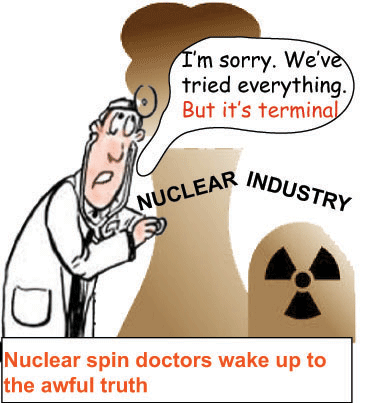
Jim Green, Mar 12, 2024, https://reneweconomy.com.au/cold-turkeys-the-demise-of-nuclear-power-in-australias-aukus-partner-countries/
When announcing the AUKUS agreement in 2021, then Prime Minister (and secret energy minister) Scott Morrison said: “Let me be clear: Australia is not seeking to establish … a civil nuclear capability.” He also said that “a civil nuclear energy industry is not a requirement for us to go through the submarine program.”
However, Coalition Senators argued in a report last year that Australia’s “national security” would be put at risk by retaining federal legislation banning nuclear power and that the “decision to purchase nuclear submarines makes it imperative for Australia to drop its ban on nuclear energy.”
So, let’s see how nuclear power is faring in our AUKUS partners, the UK and the US.
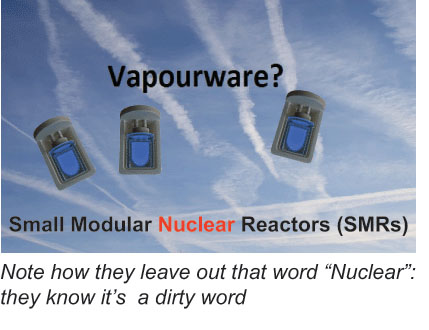
This is a story about conventional, large reactors. All that needs to be said about ‘small modular reactors’ in the UK and the US is that none exist and none are under construction.
This is a story about conventional, large reactors. All that needs to be said about ‘small modular reactors’ in the UK and the US is that none exist and none are under construction.
The UK
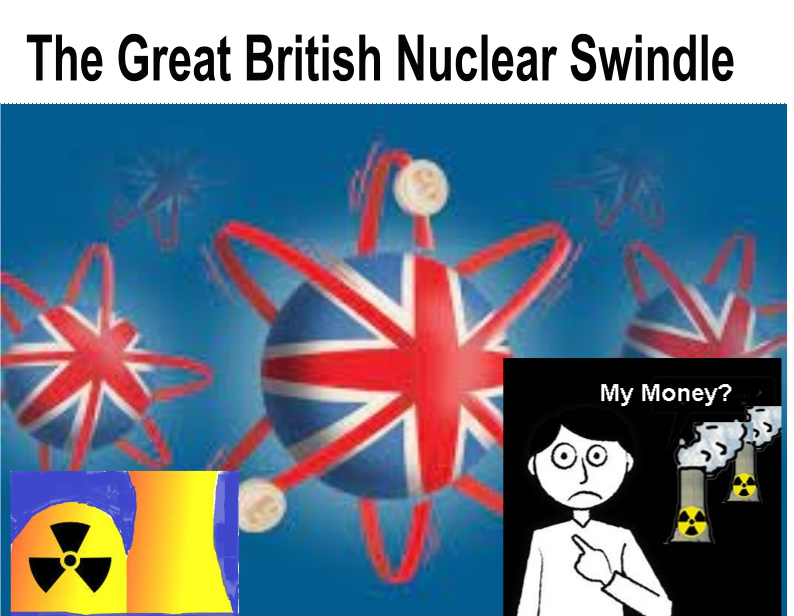
The last power reactor start-up in the UK was 29 years ago — Sizewell B in 1995.
Over the past decade, several proposed new nuclear power plants have been abandoned (Moorside, Wylfa, Oldbury) and the only project to reach the construction stage is Hinkley Point C, comprising two French-designed EPR reactors.
In the late 2000s, the estimated construction cost for one EPR reactor in the UK was £2 billion (A$3.9 billion). When construction of two EPR reactors at Hinkley Point commenced in 2018 and 2019, the cost estimate for the two reactors was £19.6 billion.
The current cost estimate for the two reactors has ballooned to £46 billion (A$89 billion) or £23 billion (A$44.5 billion) per reactor. That is 11.5 times higher than the estimate in the late 2000s. Further cost overruns are certain. This is an example of the Golden Rule of Nuclear Economics: Add a Zero to Nuclear Industry Estimates.
The UK National Audit Office estimates that taxpayer subsidies for Hinkley Point — primarily in the form of a guaranteed payment of £92.50 (A$180) per megawatt-hour (2012 prices), indexed for inflation, for 35 years — could amount to £30 billion (A$58 billion) while other credible estimates put the figure as high as £48.3 billion (A$94 billion).
Delays
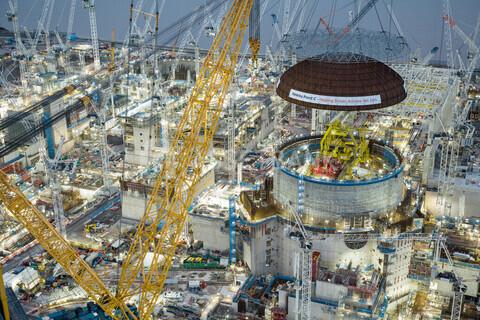
The delays associated with Hinkley Point have been as shocking as the cost overruns. In 2007, French utility EDF boasted that Britons would be using electricity from an EPR reactor at Hinkley Point to cook their Christmas turkeys in 2017. In 2008, the UK government said the reactors would be complete “well before 2020”.
But construction of the two reactors didn’t even begin until 2018 and 2019, respectively, at which time completion was expected in 2026. Now, completion is expected in 2030 or 2031.
Undoubtedly there will be further delays and if the reactors are completed, it will be more than a quarter of a century after the 2007 EDF boast that Britons would finally be using electricity from Hinkley Point to cook their Christmas turkeys.
Construction will take well over 10 years; planning and construction over 25 years. Yet in Australia, the Coalition argues that Australians could be cooking Christmas turkeys with nuclear power 10 years from now.
‘Something of a crisis’
Nuclear industry lobbyist Tim Yeo said in 2017 that the UK’s nuclear power program faced “something of a crisis”. The following year, Toshiba abandoned the planned Moorside nuclear power project near Sellafield despite generous offers of government support — a “crushing blow” according to Yeo.
Then in 2019, Hitachi abandoned the planned Wylfa reactor project in Wales after the estimated cost of the twin-reactor project had risen by 50 percent.
Hitachi abandoned the project despite an offer from the UK government to take a one-third equity stake in the project; to consider providing all of the required debt financing; and to consider providing a guarantee of a generous minimum payment per unit of electricity.
Long gone was the 2006 assertion from then UK industry secretary Alistair Darling that the private sector would have to “initiate, fund, construct and operate” nuclear power plants.
The UK Nuclear Free Local Authorities noted that Hitachi joined a growing list of companies and utilities backing out of the UK nuclear new-build program:
“Let’s not forget that Hitachi are not the first energy utility to come to the conclusion that new nuclear build in the UK is not a particularly viable prospect. The German utilities RWE Npower and E-on previously tried to develop the site before they sold it on Hitachi in order to protect their own vulnerable energy market share in the UK and Germany.
“British Gas owner Centrica pulled out of supporting Hinkley Point C, as did GDF Suez and Iberdrola at Moorside, before Toshiba almost collapsed after unwise new nuclear investments in the United States forced it to pull out of the Sellafield Moorside development just a couple of months ago.”
Sizewell C

The UK government hopes to progress the Sizewell C project in Suffolk, comprising two EPR reactors, and is once again offering very generous support including taking an equity stake in the project and using a ‘regulated asset base‘ model which foists financial risks onto taxpayers and could result in taxpayers paying billions for failed projects — as it has in the US.
If recent experience is any guide, the government will struggle to find corporations or utilities willing to invest in Sizewell regardless of generous government support.
(The same could be said for plans for small modular reactors or mid-sized reactors envisaged by Rolls-Royce — it is doubtful whether private finance can be secured despite generous taxpayer subsidies.)
Many reactors have been permanently shut down in the UK: the IAEA lists 36 such reactors. Since the Sizewell B reactor startup in 1995, there have been 24 permanent reactors shut-downs and zero startups.
Repeat: since the last reactor startup in the UK, there have been 24 shut-downs!
The capacity of the nine remaining reactors (5.9 gigawatts — GW) is less than half of the peak of 13 GW in the late 1990s. Nuclear power’s contribution to electricity supply has fallen from 22 percent in the early 2000s to 14.2 percent.
Meanwhile, the UK government reports that renewable power sources accounted for 44.5 percent of total UK generation in the third quarter of 2023, a higher share than fossil fuels and around three times more than nuclear’s share.
What to make of the conservative UK government’s goal of quadrupling nuclear capacity to 24 GW by 2050? It is deeply implausible. The facts speak for themselves. Two dozen reactor shutdowns and zero startups since 1995.
The Hinkley Point project has been extremely slow and extremely expensive. The Sizewell C project is uncertain. Other proposals — including proposals for small modular reactors — are even more uncertain and distant.
Unsurprisingly, the extraordinary cost overruns and delays associated with Hinkley Point have complicated plans to advance the proposed Sizewell C project.
In 2010, the UK government announced that Sizewell was one of the locations slated for new reactors. Fourteen years later, construction is some years away and it remains uncertain if the project will reach the construction stage. EDF and the UK government are seeking to raise a further £20 billion from new investors. All reasonable offers considered.
France
The Sizewell C project is equally complicated across the channel due to EDF’s massive debts and its plan to replace the EPR design with an EPR2 design, about which little is known except that safety will be sacrificed on the altar of economics. EDF’s debt as of early 2023 was €64.5 billion (A$107 billion) and it was fully nationalised later in 2023 due to its crushing debts.
In addition to its adventures across the channel, EDF has a “colossal maintenance and investment programme to fund” in France as the Financial Times noted in October 2021.
As in the UK, there has not been a single reactor startup in France since the last millennium. The only current reactor construction project is one EPR reactor under construction at Flamanville. The current cost estimate of €19.1 billion (A$31.6 billion) is nearly six times higher than the original estimate of €3.3 billion (A$5.5 billion).
Construction of the Flamanville reactor began in 2007 and it remains incomplete 17 years later. Planning plus construction have taken over a quarter of a century. Yet the Coalition argues that Australians could be cooking Christmas turkeys with nuclear power 10 years from now.
France’s nuclear industry was in its “worst situation ever“, a former EDF director said in 2016 — and the situation has worsened since then. Another former EDF director said in early 2024 that the French nuclear industry is “on a slow descent to hell” and he has “fierce doubts about EDF’s ability to build more reactors.”
The US

The V.C. Summer project in South Carolina (two AP1000 reactors) was abandoned in 2017 after the expenditure of around US$9 billion (A$13.6 billion). Construction began in 2013 and the project was abandoned in 2017.
The project was initially estimated to cost US$11.5 billion; when it was abandoned, the estimate was US$25 billion (A$38 billion).
Largely as a result of the V.C. Summer disaster, Westinghouse filed for bankruptcy in 2017 and its parent company Toshiba only avoided bankruptcy by selling its most profitable assets. Both companies decided that they would no longer take on the huge risks associated with reactor construction projects. A year earlier, Westinghouse said its goal was to win overseas orders for at least 45 AP1000 reactors by 2030.
Criminal investigations and prosecutions related to the V.C. Summer project are ongoing: the fiasco is known as the ‘nukegate’ scandal.
Vogtle

With the abandonment of the V.C. Summer project in South Carolina, the only remaining reactor construction project in the US was the Vogtle project in Georgia (two AP1000 reactors).
Construction of the Vogtle reactors began in 2013 and the expected completion dates of 2016 and 2017 were pushed back seven years to 2023 and 2024. In 2014, Westinghouse claimed a three-year construction schedule for AP1000 reactors but the Vogtle reactors took 10 and 11 years to complete.
The first licence application for the Vogtle project was submitted in 2006 so planning and construction took 17 years in addition to the time spent before the 2006 application.
The latest cost estimate for the Vogtle project is $34 billion (A$51 billion), more than twice the estimate when construction began (US$14–15.5 billion). The project only survived because of multi-billion-dollar taxpayer bailouts.
In 2006, Westinghouse said it could build an AP1000 reactor for as little as US$1.4 billion (A$2.1 billion) — 12 times lower than the latest Vogtle estimate of US$17 billion (A$25.5 billion) per reactor. Another example of the Golden Rule of Nuclear Economics: Add a Zero to Nuclear Industry Estimates.
Corruption scandals
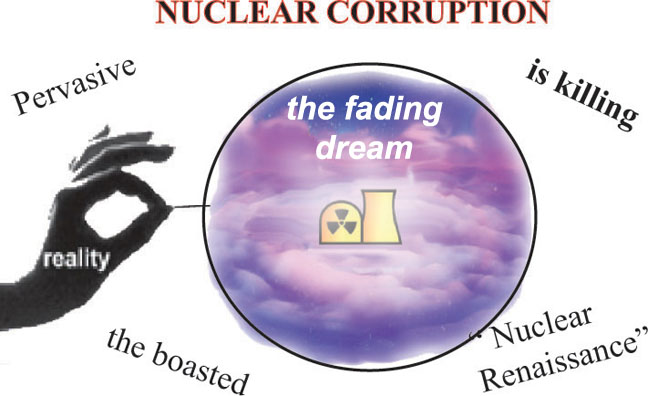
In 2005, the US Nuclear Energy Institute claimed that Westinghouse’s estimate of US$1,365 per kilowatt “has a solid analytical basis, has been peer-reviewed, and reflects a rigorous design, engineering and constructability assessment.”
In fact, the estimate was out by an order of magnitude and the Institute’s involvement in a raft of corruption scandals has been exposed. No doubt the Dutton Coalition would happily parrot whatever lies the Institute chose to feed them, and no doubt the Murdoch/Sky/AFR echo-chamber would happily amplify those lies.
During the ill-fated ‘nuclear renaissance’, the US Nuclear Regulatory Commission received applications to build 31 reactors, but only the Vogtle and V.C. Summer projects reached the construction stage and only the twin-reactor Vogtle project was completed. Two out of 31 ain’t bad. Well it is, actually.
Thirteen reactors have been permanently shut down since 2013 with many more closures in the pipeline. The US has one of the oldest reactor fleets in the world with a mean age of 42.1 years. The mean age of the 29 reactors closed worldwide from 2018‒2022 was 43.5 years.
Around 20 unprofitable, ageing reactors have been saved by nuclear bailout funding but their future is precarious. In addition to the V.C. Summer corruption scandal, nuclear bailout programs are mired in corruption scandals (see here, here, here and here and if you’re still not convinced see here, here, and here).
Dr. Jim Green is the national nuclear campaigner with Friends of the Earth Australia and a member of the Nuclear Consulting Group.
Coalition will seek a social licence for nuclear: Dutton

AFR, Phillip Coorey, 12 Mar 24
Communities will be consulted and “incentivised” to adopt nuclear power, Opposition Leader Peter Dutton says as he amplifies his case for the energy source to play a central role in Australia reducing its emissions.
Mr Dutton will also pledge to “ramp up” the domestic production of gas to help firm renewable energy, in his keynote speech to be delivered to The Australian Financial Review Business Summit on Tuesday.
He will also hint at an expansion of rooftop solar, as already flagged by Nationals leader David Littleproud, as an alternative to large-scale renewable energy projects and the thousands of kilometres of transmission infrastructure that those will require……………………….
In setting the scene for his nuclear announcement, Mr Dutton will outline three principles that will guide the policy.
“First and foremost, we want to get the highest yield of energy using the smallest amount of land,” he will say.
“We want to maximise the amount of energy we can obtain per square metre and minimise our environmental footprint.”
This will be achieved by putting reactors on or near the sites of old coal-fired power stations so they can use the existing transmission grid.
The second principle will involve seeking a “social licence” for the policy “by listening to and incentivising communities to adopt nuclear power”.
A third principle is that the Coalition will put people at the centre of our energy policy by making lower energy bills a key consideration.
Mr Dutton dared the government to lift the nuclear power moratorium and let the market decide.
‘Does not make sense’
But energy experts appearing at the Summit continued to cast doubt on the feasibility of the Coalition’s approach.
Carbon Market Institute chair Kerry Schott said she was technology neutral but nuclear “really does not make sense for Australia”.
“Nuclear by far, like daylight by far, [is] the most expensive,” she said.
“It really doesn’t make sense for Australia because we have so much renewable energy resources.”
She said firming wind and solar with hydro and “a little bit of gas” until hydrogen was commercially available was “by far the cheapest and easiest”.
She did, however, agree, that putting solar panels on every rooftop would alleviate the need for Labor’s thousands of kilometres of transmission infrastructure……………………………… https://www.afr.com/business-summit/coalition-will-seek-a-social-licence-for-nuclear-dutton-20240311-p5fbby
Dutton’s nuclear plan will require huge subsidies
AFR 12 Mar 24
So the two prongs of Peter Dutton’s energy plan are to adopt nuclear power and to ramp up production of gas? (“Coalition to seek ‘social licence’ for nuclear power,” March 11)
Well, we know which of the two prongs will actually happen, and it won’t be the nuclear one.
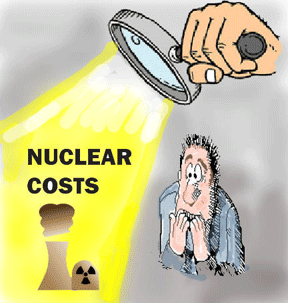
To go down the nuclear path would require massive government subsidies – not just in the construction phase, but over their entire life of the power stations.
This is what is happening in France, where nuclear supplies 70 per cent of the nation’s electricity, and in Ontario, where the figure is 59 per cent.
Otherwise, the government would have to set electricity prices at a level that would underwrite the power companies’ profitability – irrespective of whether those prices were competitive with other forms of energy.
Either way, nuclear is not viable in Australia – at least, not on economic grounds.
Ken Enderby, Concord, NSW
Coalition must consider nuclear cost
Peter Dutton’s nuclear ideas (“Coalition to seek ‘social licence’ for nuclear power,” March 11) fly in the face of evidence.
The cost to build, the huge subsidies, the intellectual capital required, the siting, the water use, the lead-up time for power generation, the cost to consumers, the decommissioning costs, the half-life of plutonium 239 – none of this will deter him. He will continue to juxtapose the idea of nuclear against the reality of renewables.
He and his party will continue to stymie, mock and disparage our transition efforts. The Coalition’s “all of the above” approach sounds open-minded but disguises the fact that “all” does not include the necessary all-out push for renewables.
Nuclear has no chance of getting us to where we need to be, either in terms of emissions or in developing our crucial renewables industries.
Fiona Colin, Malvern East, Victoria……………………. https://www.afr.com/policy/economy/dutton-s-nuclear-plan-will-require-huge-subsidies-20240311-p5fbhj
Tell him he’s dreaming’: Bowen rubbishes Coalition claim Australia could have nuclear power in a decade
Energy minister says average build time for a nuclear plant in US is 19 years and giving up on renewables would be a ‘massive economic own goal’
Josh Butler, 10 Mar 24, Guardian
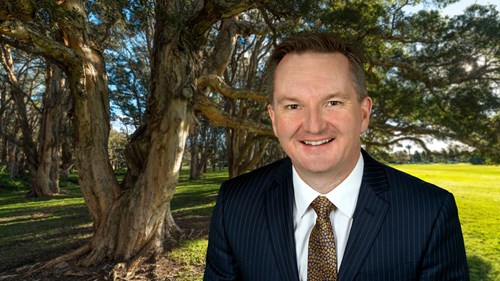
The federal energy minister, Chris Bowen, has dismissed Coalition MP Ted O’Brien’s claim that Australia could develop a nuclear power industry within a decade, stating: “Tell him he’s dreaming.”
The mocking comment on Sunday came as the government continued to pour scorn on the opposition’s speculative alternative plan to renewable energy. O’Brien said the Coalition was in the “advanced stages” of finalising its policy, which is not expected to be unveiled for several weeks.
Bowen also told ABC TV that the government was open to amending its fuel
The federal energy minister, Chris Bowen, has dismissed Coalition MP Ted O’Brien’s claim that Australia could develop a nuclear power industry within a decade, stating: “Tell him he’s dreaming.”
The mocking comment on Sunday came as the government continued to pour scorn on the opposition’s speculative alternative plan to renewable energy. O’Brien said the Coalition was in the “advanced stages” of finalising its policy, which is not expected to be unveiled for several weeks.
Bowen also told ABC TV that the government was open to amending its fuel efficiency standards for motor vehicles while again denying claims from the Coalition and some manufacturers that it would increase car prices.
The Coalition’s push for nuclear energy in Australia has been derided by the government and experts. The opposition leader, Peter Dutton, has not specified where the potential nuclear facilities would be located, nor how much they could contribute to the nation’s energy mix.
Sky News reported on Sunday that a 2020 paper from the NSW chief scientist found a nuclear power industry would require tens of thousands of trained staff and at least two decades to become operational.
Responding to the report, O’Brien – the opposition’s energy spokesman – claimed the Coalition had received different advice.
“The best experts around the world with whom we’ve been engaging are saying Australia could have nuclear up and running within a 10-year period,” O’Brien said.
O’Brien did not reveal which experts the Coalition had talked to. Guardian Australia asked his office for more information.
The shadow minister said nuclear could be part of a “balanced mix” of other power types and he criticised Labor for being “negative”.
Bowen was asked about O’Brien’s claim that nuclear could be developed in Australia within a decade.
“Tell him he’s dreaming,” Bowen said on the ABC’s Insiders program, referencing the Australian comedy movie The Castle. “I don’t know what experts he’s talking to.”
Bowen said the average build time for a nuclear plant in the US – a country he called “the nuclear leader of the world” – was 19 years.
“Ted O’Brien thinks he can do it in Australia in 10 with a standing start, no regulations, banned not only nationally but in the three most populous states,” Bowen said.
The minister rubbished arguments that Australia should scrap its ban on nuclear energy to allow private industry to investigate options, claiming that establishing a nuclear industry would require “eye-watering amounts of government taxpayer subsid[ies].”
“I’ve had no one knock on my door to say ‘I want to build a nuclear power plant in Australia’ but I had plenty of the world’s biggest renewables companies through my door,” Bowen said on Sunday.
“There’s a myth this is happening elsewhere in the world. It’s not. Australia has the best renewable resources in the world. It would be a massive economic own goal to give up utilising those resources and go down this nuclear fantasy.”
Beyond suggesting nuclear plants be built at former coal-powered facilities, the Coalition has not confirmed details of their policy – including costs, timeframes, how local opposition would be overcome and the amount of power to be generated.
Dutton could fill in some of the blanks in his budget reply speech in May. He is under pressure to announce details.
Coalition MPs have been agitating for the opposition leader to outline new policies they can spruik ahead of the federal election, which could be held this year…………. https://www.theguardian.com/australia-news/2024/mar/10/tell-him-hes-dreaming-bowen-rubbishes-coalition-claim-australia-could-have-nuclear-power-in-a-decade
Coalition’s nuclear red herring is a betrayal of the Australian people.
Coalition’s nuclear red herring is a betrayal of the Australian people
March 9, 2024 | Canberra Times
Tim Buckley, Annemarie Jonson
https://www.canberratimes.com.au/story/8547521/peter-duttons-nuclear-red-herring-is-a-coalition-betrayal-of-australians/
The sudden enthusiasm of the LNP for nuclear energy is another divisive, cynical and damaging ploy to ignite Climate Wars 2.0 and disrupt and delay Australia’s accelerating renewables transition on behalf of the fossil fuel cartel. The LNP’s climate and energy luddites burned a decade when they were in office. We can’t afford more of the same policy lunacy.
Policy confusion, disinformation and chaos around the nuclear furphy is exactly the solution if you are looking to destroy renewable energy investor confidence, deter investment, and set back our accelerating pathway to decarbonisation – the bedrock of our nation’s economic future. Investors need credible and stable policy and regulation.
The Coalition’s nuclear red herring, and its related threat to pull strategic public capital investment from utility-scale renewables, increases sovereign risk, and is a betrayal of the Australian people.
Nothing about nuclear power makes sense in Australia.
As former Chief Scientist Dr Alan Finkel has said, it would be 20 years or more before the first operation of small modular reactor (SMR) technology in Australia. We need to decarbonise our energy system and economy this critical decade to address the concurrent climate, energy and cost-of-living crises.
SMR technology is not commercial. There are no SMRs in operation outside of Russia and China. In November, the only SMR development in the US was terminated.
There are no private companies worldwide who can build and operate nuclear power plants without massive government underwriting, because they can’t get insurance.
Tokyo Electric Power Company went bankrupt overnight due to its Fukushima nuclear disaster, requiring a US$200 billion taxpayer bailout of the cleanup costs, which will still be being funded beyond 2050.
In promoting nuclear, the LNP is essentially calling for a massive multi-decade subsidy fest that would make the LNP’s Snowy 2.0 and NBN white elephants look like value for money by comparison. Where has the LNP’s staunch preference for free markets gone?
The LNP nuclear shills say they will soon announce sites for reactors. It is not clear in what universe they think they can secure social licence from impacted communities. Legal challenges and civic protest are inevitable.
How they propose to manage the financial cost of multi-centuries of waste storage and rehabilitation to mitigate risk remains a mystery. It is worth noting the unfunded £260 billion liability this decade UK taxpayers face for decommissioning its nuclear waste. Does the LNP suggest leaving this massive cost to future generations?
The economics simply don’t stack up. Firmed renewables are the cheapest form of energy. The cost of nuclear power generation is much higher than its low-cost clean energy alternatives.
But don’t take our word for it. The CSIRO and the Australian Energy Market Operator said in May 2023 that nuclear is “not an economically competitive solution in Australia”, and that we lack the “frameworks for its consideration and operation within the timeframe required.”
The 2022 World Nuclear Industry Status Report said that between 2009 and 2021, costs for solar declined from US$359 to US$36 per megawatt hour (MWh), a fall of 90 per cent, and for wind from US$135 to US$38 per MWh, a 72 per cent fall, while nuclear power costs rose from US$123 to US$167 per MWh, up 36 per cent in the same period.
Battery storage costs are falling double digits each year, and Goldman Sachs just forecast another 40 per cent decline by 2025. Massive ongoing deflation is a feature of renewables, nuclear is the opposite; massive ongoing inflation of costs, externalised onto the public (as highlighted by the World Nuclear News).
The Investor Group on Climate Change, representing investors with $30 trillion in assets, said there is no interest among investors in nuclear.
The IGCC notes nuclear has “project time blowouts of anything from seven to 15+ years and cost blowouts in the tens of billions, and lowest-cost technologies, renewables, batteries and so on, are available to deploy now”.
At last, we are seeing a huge influx of capital into Australia’s renewables transition, triggered by the enabling policy architecture of the Albanese federal government such as Energy Minister Chris Bowen’s federal Capacity Investment Scheme announced in late 2023. Our $3.6 trillion super industry has flagged this policy framework as key to crowding in private capital into renewables infrastructure.
Just last month Rio Tinto inked landmark world-scale 25-year power purchasing agreements worth billions that will underwrite the nation’s biggest yet wind and solar developments, powering the processing of its alumina and aluminium in central QLD with green energy.
The Investor Group on Climate Change, representing investors with $30 trillion in assets, said there is no interest among investors in nuclear.
The IGCC notes nuclear has “project time blowouts of anything from seven to 15+ years and cost blowouts in the tens of billions, and lowest-cost technologies, renewables, batteries and so on, are available to deploy now”.
At last, we are seeing a huge influx of capital into Australia’s renewables transition, triggered by the enabling policy architecture of the Albanese federal government such as Energy Minister Chris Bowen’s federal Capacity Investment Scheme announced in late 2023. Our $3.6 trillion super industry has flagged this policy framework as key to crowding in private capital into renewables infrastructure.
Just last month Rio Tinto inked landmark world-scale 25-year power purchasing agreements worth billions that will underwrite the nation’s biggest yet wind and solar developments, powering the processing of its alumina and aluminium in central QLD with green energy.
1 This month.
20 September –National Day of Action in Melbourne on the International Day of Peace


Help Aunty Sue Protect Her Land and Sacred Sites From Destructive Rocket Testing.
.

Australians deserve the truth
about
AUKUS – https://aukuspublicinquiry.com/


PETITION – To: Prime Minister Anthony Albanese and the Australian Labor Government

of the week – Australians for War Powers Reform (AWPR)
To see nuclear-related stories in greater depth and intensity
 Antinuclear