Killing Aid Workers: Australia’s Muddled Policy on Israel
Australian anger at the government level must therefore be severely qualified. Support roles, thereby rendering Australian companies complicit in Israeli’s military efforts, and in ancillary fashion the Australian government, continue to be an important feature. The F-35, a mainstay US-made fighter for the Israeli Air Force, is not manufactured or built in Australia, but is sustained through the supply of spare parts stored in a number of allied countries. According to the Australian Department of Defence, “more than 70 Australian companies have directly shared more than $4.13 billion in global F-35 production and sustainment contracts.”
April 5, 2024, by: Dr Binoy Kampmark, https://theaimn.com/killing-aid-workers-australias-muddled-policy-on-israel/
The Australian Prime Minister, Anthony Albanese, was distraught and testy. It seemed that, on this occasion, Israel had gone too far. Not too far in killing over 32,000 Palestinians in Gaza, a staggering percentage of them being children. Not too far in terms of using starvation as a weapon of war. Not too far in bringing attention to the International Court of Justice that its actions are potentially genocidal.
Israel had overstepped in doing something it has done previously to other nationals: kill humanitarian workers in targeted strikes. The difference for Albanese on this occasion was that one of the individuals among the seven World Central Kitchen charity workers killed during the midnight between April 1 and 2 was Australian national Lalzawmi “Zomi” Frankcom.
Frankcom and her colleagues had unloaded humanitarian food supplies from Cyprus that had been sent via a maritime route before leaving the Deir al-Balah warehouse. The convoy, despite driving in a designated “deconflicted” zone, was subsequently attacked by three missiles fired from a Hermes 450 drone. All vehicles had the WCK logo prominently displayed. WCK had been closely coordinating the movements of their personnel with the IDF.
In a press conference on April 3, Albanese described the actions as “completely unacceptable.” He noted that the Israeli government had accepted responsibility for the strikes, while Israel’s Prime Minister, Benjamin Netanyahu had conveyed his condolences to Frankcom’s family, with assurances that he would be “committed to full transparency”.
The next day, the Australian PM called the slaying of Frankcom a “catastrophic event”, reiterating Netanyahu’s promises from the previous day that he was “committed to a full and proper investigation.” Albanese also wished that these findings be made public, and that accountability be shown for Israel’s actions, including for those directly responsible. “What we know is that there have been too many innocent lives lost in Gaza.”
Australian Foreign Minister, Penny Wong, restated the need for “full accountability and transparency” and Australian cooperation with Israel “on the detail of this investigation.” She further acknowledged the deaths of over 30,000 civilians, with some “half a million Palestinians” starving.
Beyond an investigation, mounted and therefore controlled by the Israeli forces themselves, nothing much else can be hoped for. The Albanese approach has been one of copybook warnings and concerns to an ally it clearly fears affronting. What would a ground invasion of Rafah do to the civilian population? What of the continuing hardships in Gaza? Push for a humanitarian ceasefire, but what else?
Australian anger at the government level must therefore be severely qualified. Support roles, thereby rendering Australian companies complicit in Israeli’s military efforts, and in ancillary fashion the Australian government, continue to be an important feature. The F-35, a mainstay US-made fighter for the Israeli Air Force, is not manufactured or built in Australia, but is sustained through the supply of spare parts stored in a number of allied countries. According to the Australian Department of Defence, “more than 70 Australian companies have directly shared more than $4.13 billion in global F-35 production and sustainment contracts.”
The Australian government has previously stated that all export permit decisions “must assess any relevant human rights risks and Australia’s compliance with its international obligations.” The refusal of a permit would be assured in cases where an exported product “might be used to facilitate human rights abuses.” On paper, this seems solidly reasoned and consistent with international humanitarian law. But Canberra has been a glutton for the Israeli military industry, approving 322 defence exports over the past six years. In 2022, it approved 49 export permits of a military nature bound for Israel; in the first three months of 2023, the number was 23.
The drone used in the strike that killed Frankcom is the pride and joy of Elbit Systems, which boasts a far from negligible presence in Australia. In February, Elbit Systems received a A$917 million contract from the Australian Defence Department, despite previous national security concerns among Australian military personnel regarding its Battle Management System (BMS).
When confronted with the suggestion advanced by the Australian Greens that Australia end arms sales to Israel, given the presence of Australian spare parts in weaponry used by the IDF, Wong displayed her true plumage. The Australian Greens, she sneered, were “trying to make this a partisan political issue.” With weasel-minded persistence, Wong again quibbled that “we are not exporting arms to Israel” and claiming Australian complicity in Israeli actions was “detrimental to the fabric of Australian society.”
The Australian position on supplying Israel remains much like that of the United States, with one fundamental exception. The White House, the Pentagon and the US Congress, despite increasing concerns about the arrangement, continue to bankroll and supply the Israeli war machine even as issue is taken about how that machine works. That much is admitted. The Australian line on this is even weaker.
The feeble argument made by such watery types as Foreign Minister Wong focus on matters of degree and semantics. Israel is not being furnished with weapons; they are merely being furnished with weapon components.
Aside from ending arms sales, there is precedent for Australia taking the bull by the horns and charging into the mist of legal accountability regarding the killing of civilians in war. It proved an enthusiastic participant in the Joint Investigation Team (JIT), charged with combing through the events leading to the downing of the Malaysian Airlines MH17 over Ukraine in July 2014 by a Buk missile, killing all 298 on board.
Any such equivalent investigation into the IDF personnel responsible for the killing of Frankcom and her colleagues is unlikely. When the IDF talks of comprehensive reviews, we know exactly how comprehensively slanted they will be.
“No feasible pathway:” Liberal MP Matt Kean quits Coalition-based charity because of its obsession with nuclear

Giles Parkinson, Apr 4, 2024, https://reneweconomy.com.au/no-feasible-pathway-kean-quits-coalition-based-charity-because-of-its-obsession-with-nuclear/
Former NSW Liberal government energy minister Matt Kean has quit his role as ambassador of an environmental charity dominated by state and federal Liberal and National Party MPs, saying it had become obsessed with promoting nuclear power and is seeking to delay the rollout of renewables.
Kean says he is quitting the Coalition for Conservation (c4C) because of concerns about the direction of the charity, which has undergone a major shift in focus in the past year, coinciding – according to the AFR – with the growing involvement of patrol Trevor St Baker, the former coal baron and now nuclear investor and proponent.
“When the network was formed, I was an enthusiastic supporter, because I believe that it is the Coalition that should be the best custodians for our environment,” Kean wrote in a letter to the organisation’s chair, former federal Coalition minister Larry Anthony.
“It has become clear in recent times that the Coalition for conservation has increasingly focussed on nuclear power in the electricity system.
“In particular I was concerned to read an article in the Canberra times advocating nuclear power stations as an alternative to building new large scale transmission lines.
“While I recognise that one cannot rule out nuclear playing a constructive role in the Australian electricity system in the distant future, the reality is that there is no feasible pathway to play any material role in helping Australia replace our coal fired power stations in line with the climate science.”
The C4C appears to have undergone a rapid rethink on emissions reductions, dumping its previous support for renewable as the cheapest path to net zero in favour of nuclear.
It is a major major shift which has coincided – according to the AFR’s Rear Window column – with the growing involvement of one of the C4C two patrons, the billionaire Trevor St Baker, the former coal baron and now nuclear investor and proponent.
Kean is the architect of the plan to replace Australia’s biggest fleet of coal generators with wind, solar and storage, and whose work now forms the basis of the Federal Labor government’s Capacity Investment Scheme that will lead its own ambitious renewable energy targets.
His decision to quit the group highlights the growing divide between moderates in the Coalition, and the hard right, which has become obsessed with nuclear and is supported by a growing number of so-called “think tanks”, Murdoch media, and charities such as C4C.
The group’s recent activity on X and its own website have been focused entirely on nuclear, and it has joined the chorus of conservatives, including Coalition leader Peter Dutton and energy spokesman Ted O’Brien, in attacking institutions such as the CSIRO and AEMO for their GenCost reports and renewable energy roadmaps.
Kean wrote in his letter that large scale nuclear reactors have proven costly and slow to deliver, particularly in the UK with the massive delays and cost overruns at the Hinkley point C nuclear power project.
He also noted that small modular nuclear reactors promoted by the charity as a solution to Australia’s energy challenges are not currently commercial anywhere in the world, and early stage demonstration projects have been cancelled or delayed into the 2030’s.
“Even if (nuclear energy in Australia) were possible, it would be extremely expensive and far more expensive than the alternative as set out in AEMO’s integrated system plan,” he wrote.
“I not only regard advocacy for nuclear power as against the public interest on environmental, engineering and economic grounds, I also see it as an attempt to delay and defer responsible and decisive action or climate change in a way that seems to drive up power prices in NSW by delaying renewables.”
Matt Kean admonished by federal Opposition for criticising nuclear direction
NSW Shadow Health Minister Matt Kean has been admonished by Shadow Treasurer Angus Taylor after he expressed concern over the Coalition’s direction away from renewables and towards nuclear power, reports NSW Political Reporter Julia Bradley.
The comments follow former NSW treasurer and energy minister Matt Kean’s public resignation from an organisation called Coalition for Conservation, which works with the Liberal Party on issues to do with climate change.
The Shadow Health Minister for NSW says he became “increasingly concerned with the direction of the Coalition for Conservation” after he claimed the institution became “increasingly focused” on nuclear power rather than renewable energy, Ms Bradley explained.
Mr Kean posted the resignation letter to his X social media page on Friday morning, claiming there is “no feasible pathway” for nuclear energy “to play any material role in helping Australia replace our coal-fired power stations in line with climate science.”
Shadow Treasurer and former energy minister Angus Taylor responded to the story with a statement expressing his disappointment a Coalition MP could not understand “Labor’s renewable only madness will fail”.
A hard job for the Australian government to find credible spruikers for a nuclear waste dump

Nobody wants a nuclear waste dump, By The Canberra Times, April 2 2024, https://www.canberratimes.com.au/story/8576489/nuclear-waste-disposal-woes-in-australia/
One would think, given the Australian continent is second only to Antarctica in terms of low population density, it would be easier to develop a nuclear waste dump here than almost anywhere else.

COMMENT. Why on Earth would Australia want a nuclear waste dump? Just because it has space?
Unfortunately, due in large part to a series of hubristic decisions by former governments, that is not the case.
It is now more than two decades since plans for a nuclear waste facility at Woomera had to be abandoned. A subsequent proposal to site a national storage facility at Muckaty Station in the Northern Territory fell over 10 years later.
Then, after more than seven years of research and planning, the former Coalition government’s push to use farmland near Kimba in South Australia was derailed last July and August after traditional owners took their case to the Federal Court and won.
The court set the 2021 site declaration aside on the grounds that not only had the traditional owners not been consulted, they had been deliberately excluded from the consultation process.
According to Ian Lowe, emeritus professor of environment and science at Griffith University, the process had been doomed from the start by the government’s heavy-handed approach.
“The ‘decide and defend’ model where a government decides to put radioactive waste somewhere and then attempts to defend it against the community hasn’t worked anywhere,” he said.
Opposition to the proposal, which left Kimba bitterly divided, was fuelled by revelations that even though it had been billed as a “low level” nuclear waste dump, once up and running Kimba would be used to “temporarily” store intermediate-grade material until a suitable “permanent” disposal site could be found.
While millions of Australians have benefited from radioactive medical isotypes created at the former HIFAR reactor and its replacement, the Opal reactor, at Lucas Heights nobody wants the leftover waste in their backyard. And that’s perfectly understandable.
Unfortunately the temporary storage facility at Lucas Heights, which holds some of the 5000 cubic metres of waste Australia has accumulated at about 100 locations over more than six decades, is reportedly running out of space. It apparently won’t be able to accept some classes of material as early as 2027.
COMMENT. Confusion here between the “low level” medical wastes, mainly with short half-lives of radioactivity, stored at various locations across Australia, and the “higher level” long-lasting wastes resulting from the nuclear reactor itself.
Plenty of space at Lucas Heights for continued storage of these more dangerous reactor wastes.
This has put the Albanese government on the spot. As a result it has opted to go on the front foot in terms of damage control by seeking expressions of interest for a public relations team able to manage the “high outrage” national conversation about nuclear waste disposal.
The multi-million dollar question, given Kimba had been costed at $300 million, is what process will be followed in selecting the next site. Will Resources Minister Madeleine King revisit the six sites originally shortlisted almost a decade ago? Or will fresh expressions of interest from interested landowners be sought?
And, most importantly, what consultation process does the government intend to follow? Will it repeat the “decide and defend” mistakes of past governments or will it listen to the experts including Professor Lowe who urge the highest possible level of community engagement?
Given, as he has said, that under the AUKUS agreement Australia is to manage high-level waste from the future nuclear submarine fleet this is going to be a very hard sell. Australia has come a long way since the 1950s when the Menzies government, admittedly at the height of the Cold War, gave Britain carte blanche to test its nuclear weapons in the outback.
Whoever wins the “high outrage” PR tender is going to have a big job ahead of them.
Dutton’s perks for nuclear plan

April 2, 2024, The Australian, Simon Benson; Political Editor
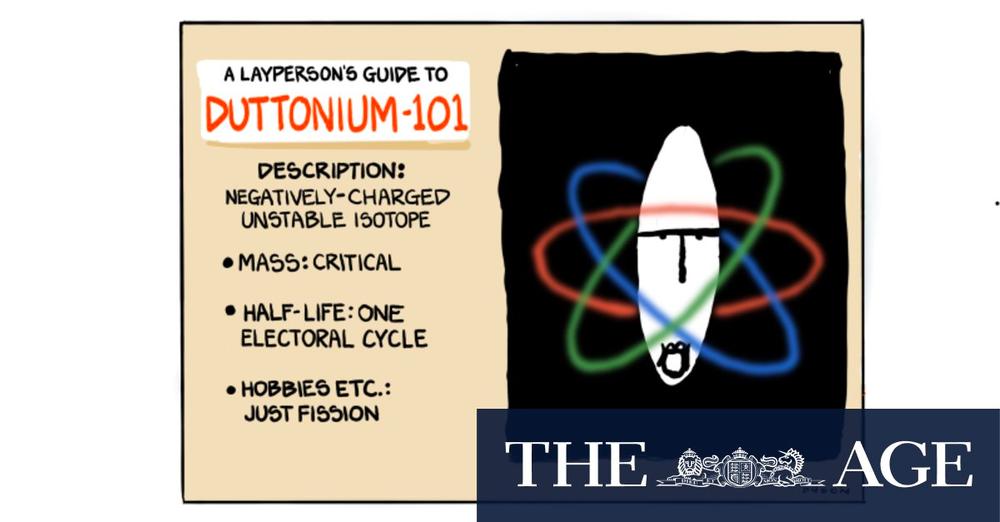
Peter Dutton is poised to release a major incentive package for coal communities to move from coal-fired power stations to nuclear energy, promising higher paying jobs and industry energy subsidies, following a US report that found the coal-to-nuclear transition pumped millions of dollars into regions that adopted them.
The Australian understands the Coalition will release the first major plank of its nuclear energy plan within weeks after identifying six or more potential sites, primarily in Queensland and NSW.
The Liberal leader will address a small business conference on Wednesday to promote the Coalition’s nuclear plan as the only proven technology that emits zero emissions while providing cheap, consistent and clean power as a source of baseload power to firm up renewables.
A report by the US Department of Energy released on Monday confirmed it would look to replace its fleet of coal-fired power plants with nuclear reactors, citing significant economic benefits to the local communities who agreed to the transition………………………………………..
Coalition climate change and energy spokesman Ted O’Brien confirmed that a Coalition package that would incentivise local coal communities would be announced before the May budget.
He said that “social licence” would be key to a future rollout of coal-to-nuclear with gas as a transition baseload energy provider.
Mr Dutton has flagged that the Coalition’s nuclear energy plan would provide incentive packages, including potential subsidised electricity prices for local industries as well as new infrastructure.
A key element of the packages would be transition arrangements for coal plant workers to upgrade to higher-paid jobs in nuclear plants………………..
Former Victoria Liberal Party President Michael Kroger says Peter Dutton has to show why “life will improve” under his government, in order to win the next election………………….
Mr Dutton will tell the Council of Small Business Australia conference that under its current approach, the government couldn’t credibly meet its 2050 net zero emissions target.
“That is why a Coalition government will ramp up domestic gas production to make energy more affordable and reliable and to help transition our economy to new energy systems,” he will say.
“And that is why we want Australia to move towards adopting the latest nuclear power technologies.
“Nuclear is the only proven technology which emits zero emissions, which can firm up renewables, and which provides cheap, consistent and clean power………………………………………….
https://www.theaustralian.com.au/nation/politics/peter-dutton-to-reveal-key-details-of-going-nuclear/news-story/87fc2f81063750adfd93a0c802d7c0e4
Coalition to release nuclear incentive package
Sky News 3 Apr 24
Peter Dutton has flagged higher paying jobs and energy subsidies for coal-fired power stations that move to nuclear energy.
Sky News Australia understands the Opposition Leader could release part of his party’s nuclear energy plan within weeks.
This comes after flagging more potential sites along the East Coast.
He is attending a small business conference in Sydney today to promote the Coalition’s nuclear plan……https://www.skynews.com.au/australia-news/politics/coalition-to-release-nuclear-incentive-package/video/fad99f67779685ace4f51b1e1ffbf58d
‘Poison portal’: US and UK could send nuclear waste to Australia under Aukus, inquiry told

Labor describes claims as ‘fear-mongering’ and says government would not accept waste from other nations.
Tory Shepherd, Tue 2 Apr 2024, https://www.theguardian.com/world/2024/apr/02/poison-portal-us-and-uk-could-send-nuclear-waste-to-australia-under-aukus-inquiry-told
Australia could become a “poison portal” for international radioactive waste under the Aukus deal, a parliamentary inquiry into nuclear safety legislation has heard.
New laws to establish a safety framework for Australia’s planned nuclear-powered submarines could also allow the US and UK to send waste here, while both of those countries are struggling to deal with their own waste, as no long-term, high-level waste facilities have been created.
The government introduced the Australian naval nuclear power safety bill in November last year. If passed, it will establish a nuclear safety watchdog, allow for naval nuclear propulsion facilities to be created, including for storing or disposing of radioactive waste from Aukus submarines. A second bill to enable the regulator to issue licenses was introduced at the same time.
Both have been referred to a Senate inquiry, which is due to report on 26 April.
Dave Sweeney, the Australian Conservation Foundation’s nuclear free campaigner, said the issue of waste disposal was “highly disturbing” and that the Aukus partners could see Australia as a “a little bit of a radioactive terra nullius”.
“Especially when it’s viewed in the context of the contested and still unresolved issue of domestic intermediate-level waste management, the clear failure of our Aukus partners to manage their own naval waste, the potential for this bill to be a poison portal to international waste and the failure of defence to effectively address existing waste streams, most noticeably PFAS,” he said.
The defence minister, Richard Marles, has previously accused the Greens of “fearmongering” when they raised similar concerns, saying the government would not accept waste from the other nations.
However, the legislation allows for the creation of facilities for “managing, storing or disposing of radioactive waste from an Aukus submarine”, and defines an Aukus submarine as either an Australian or a UK/US submarine, and “includes such a submarine that is not complete (for example, because it is being constructed or disposed of)”.
The Greens defence spokesperson, David Shoebridge, said HMS Dreadnought, one of the UK’s first nuclear submarines, had been “rusting away” since being decommissioned in 1980.
“You can go on Google Maps and look at them rusting away in real time, can’t you?” Shoebridge asked Australian Radiation Protection and Nuclear Safety Agency (Arpansa) chief regulatory officer, James Scott.
“Yes. There is no disposal pathway yet,” Scott said, adding he was “aware of the UK plans to establish a deep geological repository somewhere in the 2050s to 2060s”.
“There’s no exact date,” he said.
“The UK is pursuing a disposal pathway, and Australia will need to do the same. We are fully aware of this; we are engaging with our own radioactive waste agency, ARWA, on this, and it’s something that needs to be dealt with now, not later.”
The Dreadnought’s nuclear fuel has been removed to be stored safely. This has happened with some but not all of the submarines, but there is still no permanent disposal facility. The US also removes nuclear fuel for temporary storage.
Senior Western Australia Liberal calls for Australia to become nuclear weapons power

Brisbane Times, Hamish Hastie, March 11, 2024
A two-time WA Liberal candidate and party office bearer says Australia should have nuclear weapons.
Jim Seth made the argument at a Liberal Party state council meeting this month, saying nuclear weapons had made North Korea untouchable and suggested Australia should follow suit.
At the party’s March 2 meeting, details of which were leaked to WAtoday, Seth asked the question-and-answer panel:
“North Korea, a small country, has got nuclear fire, right? Nobody can do a mimicry [sic] on them, no neighbour can touch them, why we as first world country not nuclear react?”
Seth, who was a WA Liberals candidate for Bassendean in 2017 and for Morley in 2021 and is now the marketing committee chair and state executive member, furthered his point in a follow-up question about the Australian Navy’s capabilities to counter drone attacks…………………..
Seth claimed $90 million was being paid every day to Canberra public servants to create federal policies and suggested this money could be better spent on making Australia a nuclear power.
“We could have spent that money into making Australia a nuclear power, so nobody can come and do mimicry [sic] on us,” he said………………………….
WAtoday contacted Seth to clarify whether he was talking about nuclear energy or weapons, and he said “as a patriotic Australian” he believed Australia should have nuclear weapons.
He did not respond to follow-up requests for comment.
Australia has since 1970 been a signatory to the United Nations Nuclear Non-Proliferation Treaty, which binds the country to an agreement not to acquire nuclear weapons.
According to the Department of Foreign Trade and Affairs Australia has been one of the treaty’s strongest supporters and was a key player in ensuring the treaty was extended indefinitely in 1995.
Seth’s comments alarmed Nuclear Free WA co-convener Mia Pepper who said nuclear weapons would make Australia a target, not safer.
“Nuclear weapons have no strategic utility and would not enhance Australia’s defence or security,” she said.
“In a time of growing conflict and uncertainty, Australia should be proliferating peace and diplomacy, not fuelling nuclear tensions and threat.”………………… https://www.brisbanetimes.com.au/politics/western-australia/senior-wa-liberal-calls-for-australia-to-become-nuclear-weapons-power-20240308-p5fazr.html?ref=rss&utm_medium=rss&utm_source=rss_feed
The UK and US could send nuclear waste to Australia under our AUKUS deal
https://www.crikey.com.au/2024/04/02/misbehaving-mps-pay-aukus-nuclear-waste/
The UK and US could send nuclear waste to Australia under our AUKUS deal, the Australian Conservation Foundation’s Dave Sweeney told a parliamentary inquiry.
It’s exploring Labor’s draft Australian Naval Nuclear Power Safety Bill, as Guardian Australia reports, which proposed facilities that could store or dispose of radioactive waste from AUKUS submarines — defined as either an Australian or a UK/US one, the Defence Department’s domestic nuclear policy branch assistant director general Kim Moy confirmed.
Basically, we’d be in prime position to become a poison portal, Sweeney claimed, though Defence Minister Richard Marles has before vowed it won’t happen. In any case, one expert told the inquiry we need a plan to store the nuclear waste from the subs for as long as 100,000 years — and so far, no-one in AUKUS has quite worked it out.
‘Like a radioactive cloud’: elegance and horror combine in powerful Yhonnie Scarce exhibition
Australia’s forgotten nuclear history and its dehumanisation of Aboriginal people come together in First Nations glass artist’s fiercely intellectual work.
Guardian, by Rosamund Brennan, 2 Apr 24
Yhonnie Scarce grew up in the grim aftermath of nuclear weapons testing in South Australia in the 50s and 60s, not far from her birthplace of Woomera. From the tender age of ten, she heard stories from elders about a cataclysmic roar, the sky turning red and a poisonous black mist hovering over the desert, like an apparition.
Born in 1973, the Kothakha and Nukunu glass artist has spent much of her career researching the British government’s testing of nuclear weapons in Maralinga and Emu Field, which she says “lit a fire in my heart that hasn’t been extinguished”.
The blasts wreaked havoc on generations of Aboriginal people, as well as military personnel and non-Aboriginal civilians – sending radioactive clouds thousands of kilometres, causing burns, blindness, birth defects and premature death.
When the toxic plumes reached Ceduna, where Scarce’s family lived, radioactive slag rained down from the sky, singeing their skin. Their concerns about the burns were rebuffed by doctors, who spuriously claimed there was a measles outbreak. But today, according to Scarce, cancer is prevalent in the town.
“I call this a mass genocide,” Scarce says. “I don’t know if we’ll ever find out how many Aboriginal people died over that 10-year period. But I can imagine it’s thousands.”………………………………………………………………………………………………..
The series is revelatory of Scarce’s practice: at once fiercely intellectual, deeply felt and elegant in its materiality. As a glass-blower, Scarce quite literally breathes life into her work, animating its delicate, molten surface, giving form to invisible pain and loss.
Glass holds special significance for Scarce: crafted from silica, or sand, it emerges from the very essence of the landscape. As Australia’s only professional Indigenous glass-blower, she veered away from working with traditional forms like decorative vases or bowls, instead drawing from what she calls the “bush supermarket”: depicting yams, plums and bush bananas to convey the history of her people.
Conceived by Wardandi and Badimaya curator Clothilde Bullen, the career-spanning exhibition at AGWA also features works which examine the dehumanisation and exploitation of Aboriginal people through displacement, indentured labour and institutionalised racism. One such work is In The Dead House, which features glass bush bananas laid out on a mortuary trolley, their bodies split wide open.
……………………………………………………………………………………………… In a seemingly fated moment, when those monstrous atomic bombs exploded at Maralinga almost 70 years ago, the red desert sand melted into thousands of green shards of glass that still litter the site today. Across Scarce’s 20-year career, it’s as if she’s been slowly collecting the disaster’s shattered remains and, piece by piece, crystallising a dark, hidden chapter of Australia’s history. Like a radioactive cloud, her astonishing body of work engulfs you in its sheer power and potency.
https://www.theguardian.com/artanddesign/2024/apr/02/yhonnie-scarce-light-of-day-art-gallery-western-australia
- Yhonnie Scarce: Light of Day is showing at the Art Gallery of Western Australia until 19 May 2024
Melissa Parke: The nuclear threat Australia is ignoring
In its 2018 policy platform, Labor committed to signing and ratifying the TPNW in government, after taking account of a number of factors, including the new treaty’s interaction with the longstanding non-proliferation treaty.
It was Albanese who moved the motion, stating at the time, “Nuclear weapons are the most destructive, inhumane and indiscriminate weapons ever created. Today we have an opportunity to take a step towards their elimination.”
The motion was seconded by the now defence minister, Richard Marles, and adopted unanimously.
The Saturday Paper, 30 Mar 24
In August 1939, a month before the outbreak of World War II, Albert Einstein wrote to then United States president Franklin D. Roosevelt advising that a large mass of uranium could be used to make “extremely powerful bombs of a new type”.
Fearing Nazi Germany would be the first to develop such weaponry, he implored Roosevelt to speed up experimental work aimed at harnessing the destructive power of the atom.
It was, he later said, the “one great mistake” of his life.
Like J. Robert Oppenheimer, Einstein became increasingly alarmed at the implications of the Manhattan Project. In just a few years, the human species had acquired the means to destroy itself, along with most other living organisms on Earth.
Horrified by the high death toll from the US atomic bombings of Hiroshima and Nagasaki in 1945, which killed more than 200,000 people, mostly civilians, Einstein reflected, “The unleashed power of the atom has changed everything save our modes of thinking, and we thus drift toward unparalleled catastrophe.”
Shortly before his death in 1955, Einstein signed a manifesto with other renowned intellectuals, including the mathematician and philosopher Bertrand Russell, warning “a war with H-bombs might quite possibly put an end to the human race”.
Their growing concern stemmed, in part, from the discovery that nuclear weapons could spread destruction over a much wider area than had initially been supposed.
A year earlier, at Bikini Atoll in the Marshall Islands, America’s infamous Castle Bravo nuclear weapons test had poisoned not only the people of nearby Rongelap but also Japanese fishermen hundreds of kilometres from the blast site.
It was the largest of more than 300 US, French and British nuclear test explosions carried out in the Pacific between 1946 and 1996, with devastating consequences for local populations and the environment.
The British government also tested nuclear weapons on Australian soil in the 1950s and 1960s, poisoning the environment, dislocating and irradiating Aboriginal communities, and affecting many of the 20,000 British and Australian service personnel involved in the testing program.
The toxic legacy of these experiments – in Australia, the Pacific and other parts of the world – persists to this day. Those exposed to radiation and their descendants suffer from birth defects and cancers at much higher rates than the general population.
Still, the nuclear arms race continues apace. The dire warnings articulated so powerfully in the Russell–Einstein manifesto seven decades ago remain just as relevant today.
Our world is teetering on the brink of catastrophe, with close to 13,000 nuclear weapons in the arsenals of nine countries. The risk of their use – whether by accident or design – is as high as ever……………………………………………………………
Australia’s plan to acquire nuclear-powered submarines under AUKUS has only exacerbated tensions, eroding well-established non-proliferation norms.
Last year, more than 150 medical journals, including The Lancet and the Medical Journal of Australia, put out a joint call for urgent action to eliminate nuclear weapons. They identified the abolition of nuclear weapons as a public health priority. “Even a ‘limited’ nuclear war involving only 250 of the 13,000 nuclear weapons in the world,” the warning stated, “could kill 120 million people outright and cause global climate disruption leading to a nuclear famine, putting two billion people at risk.”……………………………………………………………………………………………………………..
This week, as I walked the halls of Parliament House to advocate for Australia’s signing of the Treaty on the Prohibition of Nuclear Weapons (TPNW), a landmark accord adopted at the United Nations in 2017 with the backing of 122 countries, I was reminded of the power that people in government have to make real and long-lasting change, and also how all too often they let opportunities slip by.
During my nine years as the Labor member for Fremantle, I saw how government action and policy change could make positive differences for people and the environment, but also how inaction could have devastating consequences.
The Albanese government has an opportunity to leave a powerful legacy and help secure the future of all life on Earth. To do so, Australia must step out from under the shadow of the nuclear umbrella and sign the Treaty for the Prohibition of Nuclear Wespons (TPNW)
The sticking point for Australia has been the doctrine of extended nuclear deterrence, a feature of our defence strategy for decades. In theory, Australia relies on US nuclear weapons to defend us against nuclear attack. Washington, however, has never made a public commitment to that effect. Furthermore, since nuclear deterrence is based on the willingness and readiness to commit the mass murder of civilians, it is morally and legally unacceptable, even by way of retaliation.
Deterrence theory also assumes complete rationality and predictability of all actors, including one’s enemies, all of the time, which is a bold assumption.
There are many things that cannot be deterred, including accidents, miscalculations, unhinged leaders, terrorist groups, cyber attacks and simple mistakes. There have been many nuclear near-misses over the decades and we have been on the brink of catastrophe more than once, most famously during the Cuban Missile Crisis in 1962.
The TPNW provides a pathway to the elimination of nuclear weapons. It is a new norm in international law that delegitimises and stigmatises the most destructive and inhumane weapons ever created. It also includes groundbreaking provisions to assist communities harmed by nuclear use and testing and to remediate contaminated environments.
Indonesia, New Zealand, Malaysia, the Philippines, Thailand and nine of the Pacific Island states have signed up. We are clearly out of step with our region.
Australia has a proud history of championing nuclear disarmament, particularly under Labor governments. The late Tom Uren, a Labor luminary and mentor to Anthony Albanese, was one of the party’s most passionate critics of nuclear weapons and war.
It was under the Whitlam government, with Uren serving as a minister, that Australia ratified the Treaty on the Non-Proliferation of Nuclear Weapons in 1973. Bob Hawke worked with Pacific neighbours to develop the South Pacific Nuclear Free Zone Treaty in 1985. Paul Keating established the Canberra Commission on the Elimination of Nuclear Weapons in 1995. Kevin Rudd established a follow-up commission in 2008.
In its 2018 policy platform, Labor committed to signing and ratifying the TPNW in government, after taking account of a number of factors, including the new treaty’s interaction with the longstanding non-proliferation treaty.
It was Albanese who moved the motion, stating at the time, “Nuclear weapons are the most destructive, inhumane and indiscriminate weapons ever created. Today we have an opportunity to take a step towards their elimination.”
The motion was seconded by the now defence minister, Richard Marles, and adopted unanimously.
Albanese argued the most effective way for Australia to build universal support for the TPNW – including, ultimately, bringing nuclear-armed states on board – would be for our country to join the treaty itself.
He also said that doing so would not jeopardise Australia’s alliance with the US, noting Australia had joined other disarmament treaties to which the US isn’t a party, including those banning anti-personnel landmines and cluster munitions.
New Zealand, the Philippines and Thailand have all ratified the TPNW, with no disruption to their ongoing non-nuclear military cooperation with the US. Indeed, the Philippines recently almost doubled the number of its military bases available to US forces and conducted joint military exercises with the US in the South China Sea.
Labor reaffirmed its commitment to signing the TPNW at its 2021 and 2023 national conferences, but the Albanese government has not yet inked the accord. It is time for the prime minister to act.
The rising, existential danger of nuclear war makes it all the more important for Australia to get on the right side of history.
We need to change our modes of thinking – to use Einstein’s phrase – and dispense with old ideas about what makes us safe and secure. We must remember that disarmament is essential for our collective survival.
In their manifesto, Einstein and Russell appealed as human beings to human beings: “Remember your humanity, and forget the rest.”
This article was first published in the print edition of The Saturday Paper on March 30, 2024 as “The nuclear threat Australia is ignoring”. https://www.thesaturdaypaper.com.au/comment/topic/2024/03/30/the-nuclear-threat-australia-ignoring#mtr
.
Liberal Coalition twisting itself into knots over nuclear policy
Liberal MP warns Dutton on nuclear energy as Labor steps up attacks
By Paul Sakkal, March 28, 2024 , https://www.smh.com.au/politics/federal/liberal-mp-warns-dutton-on-nuclear-energy-as-labor-steps-up-attacks-20240326-p5ff92.html
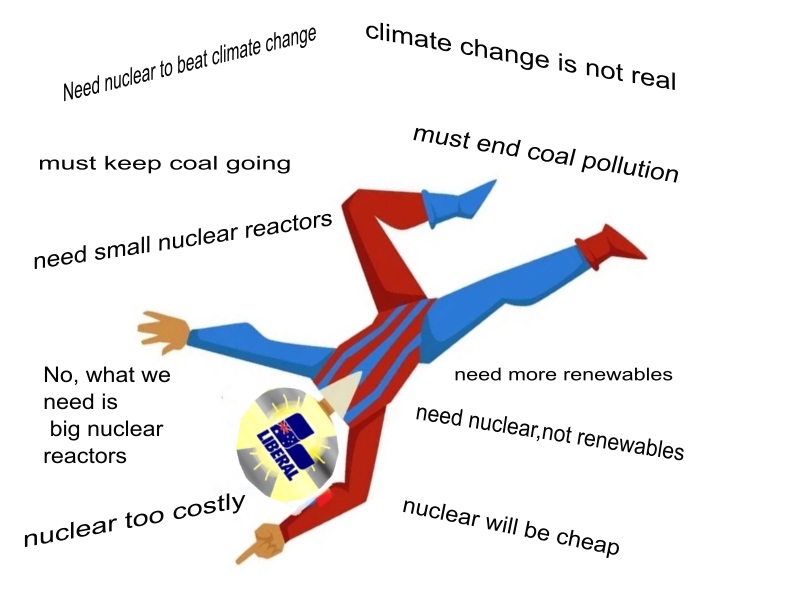
Liberal MP Bridget Archer has issued her colleagues a caution on the political risk of the party’s nuclear energy plans, which the backbencher claims have been catapulted into political debate partly to keep climate change doubters on board with the Coalition’s net zero emissions policy.
While there is widespread support within Peter Dutton’s opposition for a conversation on nuclear energy, several Coalition MPs speaking confidentially to detail private concerns said they were worried the opposition was moving too quickly and creating an easy target for Labor attacks.
As the first Liberal to ask questions about the Coalition’s approach, Archer argued fiscally conservative opposition MPs, including herself, would be uneasy with the massive government investment required to build multibillion-dollar plants.
Nuclear energy, which Archer — a leading moderate voice within the party — says she is open to, should be pursued only if coupled with a rapid surge in renewables, she said, a contrast with Dutton and other Coalition MPs, who suggest extending the life of coal until nuclear availability in 10 or 20 years.
Dutton and the shadow cabinet MP leading the nuclear push, Ted O’Brien, are expected to detail their energy plans, including about six plant sites, by the budget in May, but Archer said the initial policy should be limited to lifting Australia’s nuclear moratorium.
“I’m very agnostic about it and I don’t think we should be afraid to just have conversations. But there are a lot of things that need to line up,” she said, noting technological and economic factors that might inhibit private investment even if the decades-old moratorium was overturned.
The opposition has spoken in favour of nuclear energy since losing government in 2022, and escalated its commitment this year as it declared support for large-scale nuclear on top of new-age small modular reactors.
Its backing of the new energy source has guaranteed that climate change and energy will be a key election issue. Voters will be presented with a choice between Labor’s renewables-heavy path to a zero emissions future and one complemented by nuclear energy, amid doubts over Labor’s emissions-reduction targets and expensive energy bills.
Signalling Labor’s future election attacks, Prime Minister Anthony Albanese compared Dutton to the contentious energy source in parliament on Wednesday, saying: “One is risky, expensive, divisive and toxic; the other is a nuclear reactor. The bad news for the Liberal Party is that you can put both on a corflute, and we certainly intend to do so.”
Dutton has been open about the potential need for government investment in nuclear plants, which Labor says have cost tens of billions overseas.
Archer, a member of an influential parliamentary inquiry into nuclear energy last term, said she would be uncomfortable with a “big government” approach to energy investment, which she said might irk Liberals with a fiscally conservative bent.
O’Brien has emphasised nuclear as a zero-emissions option to smooth Australia’s bumpy transition to net zero. However, some of the strongest voices for nuclear energy are MPs such as Barnaby Joyce, who oppose renewables and have questioned scientific orthodoxy on climate change.
Earlier this month O’Brien said, “we should not be closing our coal-fired power stations prematurely” because under Labor’s plans 90 per cent of baseload energy would exit the grid by 2034.
Archer, who Dutton this week congratulated for winning the McKinnon Prize for political leadership, said nuclear energy should not be used as an excuse to prolong fossil fuel reliance.
“There is no point even having a nuclear discussion if you don’t accept a need to decarbonise, to transition away from coal and gas,” she said. “There only is a case for nuclear if there is a fairly rapid transition to large-scale renewables, otherwise why are you doing it?”
“I think part of the reason for having the discussion is to keep people in the tent on net zero.”
Allegra Spender, a teal MP who some Liberals believe should be recruited to the party in future, said nuclear “may have a role in the distant future”.
But it is too slow, too expensive and the UK Hinkley [nuclear power station] experience shows the costs are too uncertain for it to be relevant to our current energy plans,” she said.
“AGL Energy, Alinta, EnergyAustralia and Origin Energy have all dismissed nuclear.
“The community does not trust the Coalition’s commitment to climate action, and their current stance reinforces it.”
Purgatorial Torments: Assange and the UK High Court

Australian Independent Media, March 27, 2024, by: Dr Binoy Kampmark
What is it about British justice that has a certain rankness to it, notably when it comes to dealing with political charges? The record is not good, and the ongoing sadistic carnival that is the prosecution (and persecution) of Julian Assange continues to provide meat for the table.
Those supporting the WikiLeaks publisher, who faces extradition to the United States even as he remains scandalously confined and refused bail in Belmarsh Prison, had hoped for a clear decision from the UK High Court on March 26. Either they would reject leave to appeal the totality of his case, thereby setting the wheels of extradition into motion, or permit a full review, which would provide some relief. Instead, they got a recipe for purgatorial prolongation, a tormenting midway that grants the US government a possibility to make amends in seeking their quarry.
A sinking sense of repetition was evident. In December 2021, the High Court overturned the decision of the District Court Justice Vanessa Baraitser to bar extradition on the weight of certain assurances provided by the US government. Her judgment had been brutal to Assange in all respects but one: that extradition would imperil his life in the US penal system, largely due to his demonstrated suicidal ideation and inadequate facilities to cope with that risk.
With a school child’s gullibility – or a lawyer’s biting cynicism – the High Court judges accepted assurances from the Department of Justice (DOJ) that Assange would not face the crushing conditions of detention in the notorious ADX Florence facility or suffer the gagging restrictions euphemised as Special Administrative Measures. He would also receive the appropriate medical care that would alleviate his suicide risk and face the prospect of serving the balance of any sentence back in Australia. The refusal to look behind the mutability and fickle nature of such undertakings merely passed the judges by. The March 26 judgment is much in keeping with that tradition.
The grounds for Assange’s team numbered nine in total entailing two parts. Some of these should be familiar to even the most generally acquainted reader. The first part, comprising seven grounds, argues that the decision to send the case to the Home Secretary was wrong for: ignoring the bar to extradition under the UK-US Extradition Treaty for political offences, for which Assange is being sought for; that his prosecution is for political opinions; that the extradition is incompatible with article 7 of the European Convention on Human Rights (ECHR) noting that there should be no punishment without law; that the process is incompatible with article 10 of the ECHR protecting freedom of expression; that prejudice at trial would follow by reason of his non-US nationality; that the right to a fair trial, protected by article 6 of the ECHR, was not guaranteed; and that the extradition is incompatible with articles 2 and 3 of the ECHR (right to life, and prohibiting inhuman and degrading treatment).
The second part of the application challenged the UK Home Secretary’s decision to approve the extradition, which should have been barred by the treaty between the UK and US, and on the grounds that there was “inadequate specialty/death penalty protection.”
In this gaggle of imposing, even damning arguments, the High Court was only moved by three arguments, leaving much of Baraitser’s reasons untouched. Assange’s legal team had established an arguable case that sending the case to the Home Secretary was wrong as he might be prejudiced at trial by reason of his nationality. Following from that “but only as a consequence of that”, extradition would be incompatible with free speech protections under article 10 of the ECHR. An arguable case against the Home Secretary’s decision could also be made as it was barred by inadequate specialty/death penalty protection.
What had taken place was a dramatic and savage pruning of a wholesome challenge to a political persecution garishly dressed in legal drag. On the issue of whether Assange was being prosecuted for his political opinions, the Court was happy to accept the woeful finding by Baraitser that he had not. The judge was “entitled to reach that conclusion on the evidence before her, and on the unchallenged sworn evidence of the prosecutor (which refutes the applicant’s case).” While accepting the view that Assange “acted out of political conviction”, the extradition was not being made “on account of his political views.” Again, we see the judiciary avoid the facts staring at it: that the exposure of war crimes, atrocities, torture and various misdeeds of state are supposedly not political at all.
………………………………………………………………………………………….. Of enormous, distorting significance was the refusal by the High Court to accept “fresh evidence” such as the Yahoo News article from September 2021 outlining the views of intelligence officials on the possible kidnapping and even assassination of Assange.
…………….Imaginatively, if inexplicably, the judges accepted her finding that the conduct by the CIA and UC Global regarding the Ecuadorian embassy had no link with the extradition proceedings. With jaw dropping incredulity, the judges reasoned that the murderous, brutal rationale for dealing with Assange contemplated by the US intelligence services “is removed if the applicant is extradited.” In a fit of true Orwellian reasoning, Assange’s safety would be guaranteed the moment he was placed in the custody of his would-be abductors and murderers.
The High Court was also generous enough to do the homework for the US government by reiterating the position taken by their brother judges in the 2021 decision. Concerns about Assange’s mistreatment would be alleviated by granting “assurances (that the applicant is permitted to rely on the First Amendment, that the applicant is not prejudiced at trial (including sentence) by reason of his nationality, that he is afforded the same First Amendment protection as a United States citizen, and that the death penalty not be imposed).” Such a request is absurd for presuming, not only that the prosecutors can be held to their word, but that a US court would feel inclined to accept the application of the First Amendment, let alone abide by requested sentencing requirements.
The US government has been given till April 16 to file assurances addressing the three grounds, with further written submissions in response to be filed by April 30 by Assange’s team, and May 14 by the Home Secretary. Another leave of appeal will be entertained on May 20. If the DOJ does not provide any assurances, then leave to appeal will be granted. The accretions of obscenity in the Assange saga are set to continue. more https://theaimn.com/purgatorial-torments-assange-and-the-uk-high-court/
IFM Investors steers clear of nuclear projects
Jenny Wiggins, Infrastructure reporter, AFR, 28 May 24
IFM Investors, which manages some $217 billion for Australian superannuation funds, is steering clear of investments in nuclear projects due to the difficulties of managing nuclear waste.
While IFM Investors believes “energy security is fundamental,” it hasn’t invested in any nuclear projects to date, global head of infrastructure Kyle Mangini told The Australian Financial Review.…………… (Subscribers only) https://www.afr.com/companies/infrastructure/ifm-investors-steers-clear-of-nuclear-projects-20240325-p5ff1h
‘They don’t have a plan’: Chris Bowen slams Opposition push for nuclear
Climate Change and Energy Minister Chris Bowen has slammed the Opposition over its push for nuclear because they “don’t have a plan”.
“Rolling out renewables and storage over this decade is critical not just for reducing emissions … but because it’s the cheapest form of energy available,” Mr Bowen said during Question Time on Wednesday.
“It is important for jobs and job creation, and also it’s very important for reliability.
“The alternative approach that’s been proposed by those opposite is nuclear.
“Any sort of nuclear plan is irresponsible and incorrect.
“Maybe they got it right because they’ve got a thought bubble, but they certainly don’t have a plan.”
1 This month
25 October – Film –Britain’s Nuclear Bomb Scandal: Our Story – part of the Adelaide Film Festival,
Screening and Conversation
A screening of Britain’s Nuclear Bomb Scandal: Our Story (2024) followed by a talk with 2026 Bettison and James Awardee and Tradtional Owner Karina Lester in conversation with Simone Tur.
When: Sun 25 Oct, 12:00pm-Screening, 1:15pm-Talk
Where: The Mercury
Free admission, register below by clicking on BUY TICKETS and select free event tickets, at end of web page:
https://www.adelaidefilmfestival.org/program/2026/britains-nuclear-bomb-scandal-our-story
.

Australians deserve the truth
about
AUKUS – https://aukuspublicinquiry.com/

PETITION – To: Prime Minister Anthony Albanese and the Australian Labor Government

of the week – Australians for War Powers Reform (AWPR)
To see nuclear-related stories in greater depth and intensity

