Peter Dutton in standoff with state Liberal leaders over federal Coalition’s nuclear plan
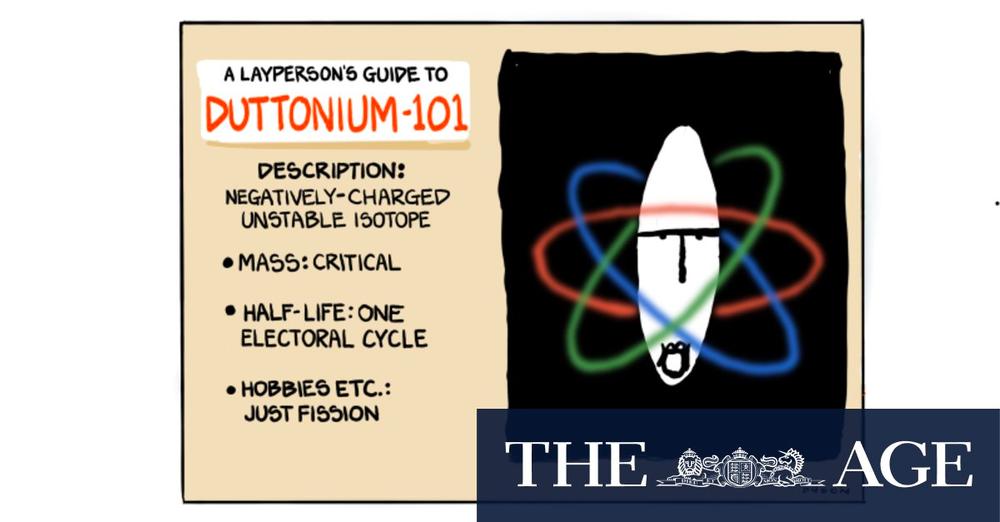
The federal opposition leader’s calls to include nuclear power in Australia’s energy mix has so far failed to win support from his state colleagues
Guardian, Tamsin Rose, Catie McLeod and Tory Shepherd, Sun 24 Mar 2024
The federal Coalition faces a battle with the states on its proposal for nuclear power stations at the sites of decommissioned coal power plants, with state premiers and opposition leaders alike largely against Peter Dutton’s proposal.
Labor governments and Coalition oppositions in Queensland, New South Wales, Victoria and South Australia are either outright opposed to the plan or have failed to endorse it.
Most of those states have their own bans on nuclear that would need to be lifted in addition to the federal ban if Dutton’s plan were to progress.
Despite this, the federal opposition leader has repeatedly called for nuclear to be considered as part of the future energy mix for Australia.
Here’s how the debate is playing out around Australia.
Queensland
It is illegal to run any forms of nuclear facilities in Queensland, including power stations and radioactive waste dumps. Any change to this would need to be passed by parliament.
David Crisafulli, the Liberal National party leader, is the bluntest in his opposition to Dutton’s plan.
When asked if he supported the federal Liberal leader and fellow Queenslander’s energy campaign earlier in the week, the opposition leader said: “No, we don’t.”
“Until both sides of Canberra agree, that will never happen because there won’t be investment,” Crisafulli said.
The state’s deputy opposition leader, Jarrod Bleijie, said debate was “many years” away and the party was focused on the cost of living in the immediate future.
“People are hurting, they need to see their electricity bills reduced now and that has to be our priority,” he told Sky News.
New South Wales
Similarly, in NSW there is a ban on uranium mining and nuclear power for electricity generation.
The state’s shadow energy minister, James Griffin, said he supported a “rational discussion about nuclear energy” but stopped short of endorsing the federal Coalition’s proposal……………………………….
The premier, Chris Minns, has dismissed any nuclear energy strategy that uses modular reactors for NSW………………………………………
Victoria
A number of nuclear-related activities, including exploration for uranium and construction or operation of a nuclear reactor, are banned in Victoria.
Like its northern counterparts, the Victorian opposition has failed to endorse the federal Coalition’s nuclear plans.
The shadow energy minister, David Davis, said “the Victorian Liberals and Nationals support a commonsense transition to renewables that ensures affordability and security of supply”.
South Australia
There are no state-level bans on nuclear power in place in South Australia and the premier, Peter Malinauskas, has repeatedly said he is open to or neutral towards the idea of nuclear power, but that the economics do not stack up.
SA is something of a nuclear state thanks to uranium mining and the prospect of building nuclear submarines, but Malinauskas does not think nuclear should be part of the power mix, not least because he has pledged that SA’s power will be fully sourced from renewables by 2027.
The energy minister, Tom Koutsantonis, said: “While we have nothing in principle against nuclear power, this current debate is nothing but a distraction because it is not economically feasible or viable for Australia.”
The opposition leader, David Speirs, said “all options should be on the table in the pursuit of an affordable, reliable and clean energy future”.
“That includes looking at new generation nuclear energy as a possible addition to our energy mix,” he said.
Coalition yet to produce costed nuclear energy policy
Last week, Dutton claimed the annual report from science agency CSIRO that had included estimates of costs for small modular reactors – which are not yet available commercially – was “discredited” because it “doesn’t take into account some of the transmission costs, the costs around subsidies for the renewables”.
CSIRO rejected Dutton’s claim that its estimates were unreliable, with its chief executive, Douglas Hilton, warning that maintaining trust “requires our political leaders to resist the temptation to disparage science”.
The most recent GenCost report estimates a theoretical small modular reactor built in 2030 would cost $382 to $636 per MWh. It says this is much more expensive than solar and wind, which it puts at between $91 and $130 per MWh even once integration costs are included.
The federal Coalition is yet to produce a costed energy policy, despite arguing for a lift to Australia’s ban on nuclear energy and suggesting it will nominate six potential sites for nuclear reactors around Australia – likely to be close to current or retiring coal-fired power stations.
With additional reporting by Benita Kolovos, Paul Karp, Graham Readfearn and Andrew Messenger https://amp.theguardian.com/australia-news/2024/mar/24/peter-dutton-liberal-leaders-nuclear-power-ban
Financiers shun nuclear, upbeat on climate investment
By Marion Rae, March 25 2024 https://www.canberratimes.com.au/story/8566564/financiers-shun-nuclear-upbeat-on-climate-investment/
Nuclear energy is last on the list of technologies that investors want exposure to, according to a survey of big institutions.
The vast majority of investors do not see nuclear power as a good investment, with less than one in 10 exploring this technology, the survey released on Monday found.
Opposition Leader Peter Dutton is spruiking nuclear reactors as an option for Australia’s future low-carbon economy although the energy source is illegal under existing laws and Labor has ruled it out.
Renewable energy is tipped to deliver the best long-term financial returns, with half the investors surveyed exploring opportunities to invest.
Investors have also become more confident about Australian climate policy under the Albanese government, according to the survey by the Investor Group on Climate Change.
“Investors have given the government a pretty good report card,” the group’s policy chief Erwin Jackson said.
But Australia will need globally competitive, targeted incentives to suit the nation’s economic strengths and values to stop “ongoing capital flight” to the United States and Europe where there are more generous tax breaks.
Clear timelines for the phase-out of fossil fuels by 2050 would also help investors manage transition risks and remain invested in the Australian economy, according to the group.
This year’s data includes 63 superannuation funds as well as other asset owners and managers, with more than $37 trillion in assets under management globally. Their beneficiaries include more than 15 million Australians.
Emerging priorities include clear timelines for phasing out coal, oil and gas and clear policies to build resilience and adapt to physical damage from climate change.
Opinions citing policy and regulatory uncertainty as a barrier to clean economy investment in Australia have changed dramatically, supported by four out of 10 investors compared with 7 out of 10 in 2021.
Renewable energy (47 per cent) was picked as the best option for long-term climate solutions, followed by nature-based schemes including biodiversity projects (34 per cent).
But investors are still in the dark on the federal government’s sector-by-sector decarbonisation plans for heavy polluters such as the energy, transport, agriculture and resources industries – and on the scope of the 2035 emissions reduction target.
“Credible and clear sector by sector decarbonisation plans to achieve a 2035 target with the highest possible level of ambition are critical for investment and it is critical to build on the steps already taken,” Mr Jackson said.
Climate Change and Energy Minister Chris Bowen has said the 2035 target will be “ambitious and achievable”, with advice to come from Australia’s recently beefed-up Climate Change Authority.
The sectoral review by the authority has an August 1 deadline, and will be released shortly afterwards.
Australian Associated Press
Sinking billions: undergunned and overpriced

Missing records, billions in over-runs, conflicts of interest, and flawed ships. How the Defence Department’s new frigates project is a boondoggle for a British weapons-maker.
MICHELLE FAHY, JUL 3, 2023, https://undueinfluence.substack.com/p/sinking-billions-undergunned-and?utm_source=post-email-title&publication_id=297295&post_id=132705738&isFreemail=true&utm_medium=email
Part one of a two-part series.
In this two-part investigation, Declassified Australia examines the flawed contracting process that led to a $46 billion naval ship-building deal that has been found to be suffering what an investigative audit described as ‘corruption vulnerabilities’.
The company at the centre of the scandal, UK arms giant BAE Systems, is revealed to have lied to Australia’s Defence Department about the planned ship’s design.
Crucial departmental records of key decision-making meetings have gone missing, while no overall assessment of whether the selected BAE design was value for money was ever made.
The Australian National Audit Office (ANAO) reported in May its findings on the multi-billion dollar contract Australia signed in December 2018 with BAE Systems to build nine Hunter-class frigates.
The ANAO found that BAE had overstated – bureaucratic language for lied – the level of development of the frigate’s design, which meant cost inflation and schedule slippage were severely under-estimated.
BAE exaggerated the maturity of its design to get around a key government objective requiring the ship to be based on an existing military-off-the-shelf design with a minimum level of change.
Defence selected the BAE Systems frigate even though the two other ships on its shortlist were considered the two most viable designs.
Business as usual
Conflicts of interest, secret consulting deals, and revolving door appointments all undermine democracy, yet this is business-as-usual at the Defence Department, the nation’s biggest procurement agency.
Former senior BAE executives have been placed at the heart of Australia’s naval procurement. They have helped write government shipbuilding policy, overseen the navy’s largest tenders, and have even been hired by the government to negotiate on its behalf with their former employer on a deal now found to be riddled with probity concerns.
Granting preferential access to certain arms industry insiders escalated under previous Liberal-National coalition governments and since 2022 has continued under the Albanese Labor government, making this a story about state capture as well, when a corporation has the power to bend governments to its will.
When combined with departmental corruption or incompetence, or both, the result is defence procurement projects that are billions of dollars over budget and running years late. As a result, the navy is facing massive capability gaps.
Continue reading this story at Declassified Australia…
Julian Assange and the Plea Nibble

Barry Pollack, one of Assange’s legal representatives, has not been given any indication that the department would, as such, accept the deal, a point he reiterated to Consortium News: “[W]e have been given no indication that the Department of Justice intends to resolve the case.”
March 23, 2024 by: Dr Binoy Kampmark https://theaimn.com/julian-assange-and-the-plea-nibble/
Be wary of what Washington offers in negotiations at the best of times. The empire gives and takes when it can; the hegemon proffers and in equal measure and withdraws offers it deems fit. This is all well known to the legal team of WikiLeaks’ founder Julian Assange, who, the Wall Street Journal “exclusively” reveals, is in ongoing negotiations with US Justice Department officials on a possible plea deal.
As things stand, the US Department of Justice is determined to get its mitts on Assange on the dubious strength of 18 charges, 17 confected from the brutal Espionage Act of 1917. Any conviction from these charges risks a 175-year jail term, effectively constituting a death sentence for the Australian publisher.
The war time statute, which was intended to curb free speech and muzzle the press for the duration of the First World War, was assailed by Wisconsin Republican Senator Robert La Follette as a rotten device that impaired “the right of the people to discuss the war in all its phases.” It was exactly in time of war that the citizen “be more alert to the preservation of his right to control his government. He must be most watchful of the encroachment of the military upon the civil power.” And that encroachment is all the more pressing, given the Act’s repurposing as a weapon against leakers and publishers of national security material. In its most obscene incarnation, it has become the US government’s political spear against a non-US national who published US classified documents outside the United States.
The plea deal idea is not new. In August last year, the Sydney Morning Herald pounced upon comments from US Ambassador to Australia Caroline Kennedy that a “resolution” to the Assange imbroglio might be on the table. “There is a way to resolve it,” the ambassador suggested at the time. Any such resolution could involve a reduction of any charges in favour of a guilty plea, subject to finalisation by the Department of Justice. Her remarks were heavily caveated: this was more a matter for the DOJ than the State Department or any other agency. “So it’s not really a diplomatic issue, but I think there absolutely could be a resolution.”
The WSJ now reports that officials from the DOJ and Assange’s legal team “have had preliminary discussions in recent months about what a plea deal could look like to end the lengthy legal drama.” These talks “remain in flux” and “could fizzle.” Redundantly, the Journal reports that any such agreement “would require approval at the highest levels of the Justice Department.”
Barry Pollack, one of Assange’s legal representatives, has not been given any indication that the department would, as such, accept the deal, a point he reiterated to Consortium News: “[W]e have been given no indication that the Department of Justice intends to resolve the case.”
One floated possibility would be a guilty plea on a charge of mishandling classified documents, which would be classed as a misdemeanour. Doing so would take some of the sting out of the indictment, which is currently thick with felonies and one conspiracy charge of computer intrusion. “Under the deal, Assange could potentially enter that plea remotely, without setting foot in the US.” Speculation from the paper follows. “The time he has spent behind bars in London would count toward any US sentence, and he would be likely to be free to leave prison shortly after any deal has concluded.”
With little basis for the claim, the report lightly declares that the failure of plea talks would not necessarily be a bad thing for Assange. He could still “be sent to the US for trial”, where “he may not stay for long, given the Australia pledge.” The pledge in question is part of a series of highly questionable assurances given to the UK government that Assange’s carceral conditions would not include detention in the supermax ADX Florence facility, the imposition of notorious Special Administrative Measures, and the provision of appropriate healthcare. Were he to receive a sentence, it would be open to him to apply and serve its balance in Australia. But all such undertakings have been given on condition that they can be broken, and transfer deals between the US and other countries have been plagued by delays, inconsistencies, and bad faith.
-ADVERTISEMENT-
The dangers and opportunities to Assange have been bundled together, a sniff of an idea rather than a formulation of a concrete deal. And deals can be broken. It is hard to imagine that Assange would not be expected to board a flight bound for the United States, even if he could make his plea remotely. Constitutional attorney Bruce Afran, in an interview with CN Live! last August, suggested that a plea, taken internationally, was “not barred by any laws. If all parties consent to it, then the court has jurisdiction.” Yes, but what then?
In any event, once on US soil, there is nothing stopping a grand volte face, that nasty legal practice of tagging on new charges that would carry even more onerous penalties. It should be never forgotten that Assange would be delivered up to a country whose authorities had contemplated, at points, abduction, illegal rendition, and assassination.
Either way, the current process is one of gradual judicial and penal assassination, conducted through prolonged proceedings that continue to assail the publisher’s health even as he stays confined to Belmarsh Prison. (Assange awaits the UK High Court’s decision on whether he will be granted leave to appeal the extradition order from the Home Office.) The concerns will be how to spare WikiLeaks founder further punishment while still forcing Washington to concede defeat in its quest to jail a publisher. That quest, unfortunately, remains an ongoing one.
Here’s why there is no nuclear option for Australia to reach net zero
Dr Alan Finkel, Guardian, 22 Mar 24
Any call to go directly from coal to nuclear is effectively a call to delay decarbonisation of our electricity system by 20 years.
The battle lines have been drawn over Australia’s energy future.
With the nation signed up to net zero emissions by 2050, the Albanese Labor government is committed to renewables. The Coalition wants nuclear.
The opposition leader, Peter Dutton, has a vision for meeting Australia’s energy needs that would include large-scale nuclear power plants and small modular reactors, a technology that is not yet proven, but which the shadow minister for energy, Ted O’Brien, says could be “up and running within a 10-year period.”
While nuclear power might experience a resurgence globally and eventually have a role in Australia, right now, no matter how much intent there might be to activate a nuclear power industry, it is difficult to envision before 2040.
The reality is there is no substitute for solar and wind power this decade and next, supported by batteries, transmission lines and peaking gas generation.
Any call to go directly from coal to nuclear is effectively a call to delay decarbonisation of our electricity system by 20 years……………………………………………………………………….
The cons
There are challenges for nuclear power in Australia, most notably timetable and cost.
Legislation. Commonwealth legislation passed by the Howard government in 1998 prohibits nuclear power. Australia is the only country in the G20 to have a legislated ban on nuclear power. This would need to be lifted before anything else could happen.
Public support. An August 2023 poll by the Resolve Political Monitor found 40% of people backed nuclear power, 33% were undecided and 27% were opposed. It is likely that no matter how small the opposition, it will be vocal.
Ramp rate. Large nuclear power generators cannot ramp up and down rapidly like batteries or peaking gas generators. This reduces their compatibility with a predominantly solar and wind powered electricity grid. It is expected, though, that small modular reactors (SMRs) will be better in this respect than large, conventional reactors.
Falling investment. The various operational, political and cost challenges faced by the nuclear industry have led to nuclear’s share of global electricity generation falling from more than 17% in 1996 to 9% in 2022.
Starting from scratch. It is unlikely that Australia would switch from being a laggard to a leader. That is, we would not proceed before we saw a licensed SMR (not a prototype) operating in the US, Canada, UK or another OECD country.
After that, we would need to beef up the regulatory system, find the first site, find and license the first operator, approve and issue construction contracts, establish a waste-management system, establish the decommissioning rules and decommissioning fund, run the environmental and safety regulatory gamut, train a workforce, respond to the inevitable protests and respond to the inevitable legal opposition all the way to the high court.
Only then could construction begin. It is difficult to imagine all this could be accomplished and provide an operational nuclear reactor in Australia before the mid 2040s.
The cost of wind versus nuclear
Coal-fired generators and nuclear power generators can dispatch electricity at full power more than 90% of the year. In practice, because demand fluctuates, the typical dispatch level from the Australian coal-fired fleet is about 60%.
For comparison, what would be the capital cost of a wind farm to dispatch 60% of the year? A simplified approach would be to ignore market economics and the variability of solar electricity in the system, and assume a 30% capacity factor for the wind energy. With these assumptions, for a windfarm to dispatch 60% of the year, we would need to install 2GW of wind turbines. The first 1GW of turbines would dispatch when the wind is blowing. The second 1GW of turbines would be used to charge a 7GW-hour (GWh) battery, to be discharged into the grid on demand.
Using figures from the CSIRO’s GenCost draft 2023-2024 report, the cost in this simplified model would be around $7bn per GW. Other, less costly, integration configurations are available. In comparison, based on the latest cost estimates for the Hinkley Point C plant under construction in the UK, the cost for nuclear power would be $27bn per GW.
The big opportunity in thinking small
In Australia, we would be looking to use SMRs because of the enormous cost and construction delays of large-scale nuclear plants. But we will want the reassurance of first seeing SMRs work safely and well in the UK, Europe, Canada, the US or another OECD country.
The trouble is, there are no SMRs operating in the UK, Europe, Canada, the US or any other OECD country. Nor are any SMRs under construction or approved in an OECD country.
There is no data to support any claims about how much SMRs will cost when deployed as operating power stations………………………………………https://www.theguardian.com/commentisfree/2024/mar/22/heres-why-there-is-no-nuclear-option-for-australia-to-reach-net-zero
Zion Lights and her lying, climate-denying mentor Michael Shellenberger

The only nuclear industry that is booming is nuclear decommissioning ‒ the World Nuclear Association anticipates US$111 billion (A$145 billion) worth of decommissioning projects to 2035. [written in 2017 – but nothing’s changed]
Zion Lights was sucked into nuclear advocacy by self-confessed liar, climate denier and MAGA lunatic Michael Shellenberger.
JIM GREEN, https://jimkgreen1.substack.com/p/zion-lights-and-her-lying-climate 21 Mar 24
The latest substack missive from British nuclear power advocate Zion Lights reflects the cognitive dissonance that all nuclear advocates must be experiencing. Mixed in with anger and nuttiness. In the UK, if the two Hinkley Point C reactors are ever completed (the only two reactors under construction in the UK), the cost will be at least A$44 billion per reactor and it will be at least 25 years between the announcement that new reactors will be built and grid-connection of the reactors. If we allow for the usual pattern of overruns and delays, the figures are likely to be A$50+ billion per reactor, and 30 years between announcement and grid-connection.
Since the last reactor startup in the UK (Sizewell B in 1995), 24 reactors have been permanently shut-down. If the Hinkley Point C reactors begin operating in the early- to mid-30s, it will be 35‒40 years between reactors startups in the UK, during which time there will have been 32 permanent reactor-shutdowns. Only Sizewell B is likely to be operating.
If not for the military connections (which Lights studiously ignores), Hinkley Point C would likely be abandoned and plans for more reactors would also be abandoned.
Lights was sucked into nuclear advocacy by self-confessed liar, climate denier and MAGA lunatic Michael Shellenberger. You can read more about Lights here, Shellenberger here, and you can read Extinction Rebellion’s important statement about both of them here. The Extinction Rebellion statement concludes: “Zion Lights, Michael Shellenberger, the Breakthrough Institute and their associated deniers and delayers are intentionally spreading doubt about the severity of the [climate] crisis and the action needed to respond to it.”
Presumably Lights did at least some research beforehand but still thought it a good idea to work for self-confessed liar and climate denier Shellenberger.
I mention Shellenberger because Lights’ latest substack post is nothing more than a cut-and-paste of lies and distortions that Shellenberger has been peddling for decades. Lights might at least have the decency to come up with her own lies and distortions.
That being the case, I won’t trawl through Lights’ post here. Instead, here is an article about Shellenberger which covers the same ground. “Nuclear power will solve global warming and feed all the world’s children.”
Is there a future for ‘pro-nuclear environmentalism’?
Jim Green, 30 Oct 2017, RenewEconomy. For a longer version of this article please click here.
Michael Shellenberger is visiting Australia this week. He has been a prominent environmentalist (of sorts) since he co-authored the 2004 essay, The Death of Environmentalism. These days, as the President of the California-based ‘Environmental Progress’ lobby group, he is stridently pro-nuclear, hostile towards renewable energy and hostile towards the environment movement.
Shellenberger is visiting to speak at the International Mining and Resources Conference in Melbourne. His visit was promoted by Graham Lloyd in The Australian in September. Shellenberger is “one of the world’s leading new-generation environmental thinkers” according to The Australian, and if the newspaper is any guide he is here to promote his message that wind and solar have failed, that they are doubling the cost of electricity, and that “all existing renewable technologies do is make the electricity system chaotic and provide greenwash for fossil fuels.”
Trawling through Environmental Progress literature, one of their recurring themes is the falsehood that “every time nuclear plants close they are replaced almost entirely by fossil fuels”. South Korea, for example, plans to reduce reliance on coal and nuclear under recently-elected President Moon Jae-in, and to boost reliance on gas and renewables. But Shellenberger and Environmental Progress ignore those plans and concoct their own scare-story in which coal and gas replace nuclear power, electricity prices soar, thousands die from increased air pollution, and greenhouse emissions increase.
Fake scientists and radiation quackery
Environmental Progress’ UK director John Lindberg is described as an “expert on radiation” on the lobby group’s website. In fact, he has no scientific qualifications. Likewise, a South Korean article falsely claims that Shellenberger is a scientist and that article is reposted, without correction, on the Environmental Progress website.
Shellenberger says that at a recent talk in Berlin: “Many Germans simply could not believe how few people died and will die from the Chernobyl accident (under 200) and that nobody died or will die from the meltdowns at Fukushima. How could it be that everything we were told is not only wrong, but often the opposite of the truth?”
There’s a simple reason that Germans didn’t believe Shellenberger’s claims about Chernobyl and Fukushima ‒ they are false.
Continue readingShadow energy minister Ted O’Brien’s nuclear energy misstep

https://www.canberratimes.com.au/story/8560035/shadow-minister-ted-obriens-nuclear-energy-misstep/ By John Hanscombe, March 20 2024
A couple of weeks ago, during a run of sunny, breezy weather, the price of electricity actually went into negative territory in NSW as wind and solar kicked in.
I discovered this on a fascinating website, OpenNEM, which tracks national energy market data, including where the power comes from – solar, wind, hydro, coal and gas – the emissions it produces, and its value at any given point. It’s become a bit addictive, regularly checking to see where most of the power has come from.
It was heartening seeing renewables – especially rooftop solar – generating so much power during the day when conditions were favourable.
Solar’s peak was especially high last Tuesday, the same day shadow energy minister Ted O’Brien appeared on the ABC’s 7.30 to spruik the Coalition’s push for nuclear energy. O’Brien made the mistake of trying to mansplain to Sarah Ferguson (is there a more patronising expression than “Let me unpack this”?) why his party thought nuclear was the way to go. It was painful to watch.
He fumbled through awkward questions about cost. Questions about the fact it takes the US, with its established nuclear energy industry, 19 years to build a reactor. Questions about the Coalition’s intentions to keep coal in the energy mix. Every attempt by Ted to “unpack it” ended up in a ditch.
This question from Ferguson on Bill Gates’s enthusiasm for nuclear, cited repeatedly by the Coalition, was when things really went bad for poor old Ted: “I asked Bill Gates, on this program, whether Australia should be involved in nuclear energy, and this was his answer: ‘Australia doesn’t need to get engaged on this. Australia should aggressively take advantage of Australia’s natural endowment to do solar and wind. That’s clear-cut and beneficial to Australia.'”
By the end of the interview, the shadow minister was a shadow of his former self.
“He ended up looking like he’d been through a woodchipper,” said a mate watching from Hobart.
News from the Australian Energy Market that electricity prices were not going to be hiked next year, and would even start to come down, will make the Coalition’s nuclear pitch even harder to sell.
Most energy experts agree the cost of setting up nuclear power in Australia will be borne by consumers, that it would likely be the mid-2040s when a reactor would finally come on line.
Peter Dutton keeps calling for a mature discussion on nuclear energy.
There’s nothing mature about dismissing the work of the CSIRO, our peak scientific body, just because its research shows renewables are cheaper than coal and nuclear.
There’s nothing mature about Ted O’Brien ignoring the advice of one of the world’s most successful business operators and nuclear energy champions, Bill Gates, who says Australia doesn’t need to go down that expensive path.
And skipping from hailing theoretical small modular reactors one week to large-scale reactors the next is all over the shop.
The whole push seems to be a Quixotic attempt at relevance, a guileless opposition tilting at windmills.
Chief scientist backs renewables, calls nuclear power ‘expensive’
Q+A / By Jason Whittaker 18 Mar 24
- In short: Chief Scientist Cathy Foley says nuclear energy is “expensive” and the energy debate must be guided by research.
- Opposition Leader Peter Dutton has criticised the CSIRO, which says renewables like solar and wind are cheaper.
- What’s next? Retired Major General Gus McLachlan says the purchase of nuclear-powered submarines is a test of leadership.
Australia’s chief scientist has backed a renewables-led path to net zero emissions over the “expensive technology” of nuclear energy.
After the federal opposition puts nuclear-fired power generation back on the national agenda, Cathy Foley told Q+A that any assessment of energy sources should be guided by evidence.
“If you look at the reports that have been done, it’s [nuclear power] an expensive technology and it’s one where it would take some time to build up the capability to do that in Australia,” Dr Foley said.
“As chief scientist, it’s not for me to actually say what the government should do.
“What we should be doing is looking at the evidence and the information that is available and making sure that we make good decisions based on all the different things we have to take into account.”
Last week, Opposition Leader Peter Dutton attacked research from the CSIRO on the higher cost of nuclear power over renewables such as solar and wind, prompting a public defence from the nation’s leading science institution.
“It’s not relied on. It’s not a genuine piece of work,” Mr Dutton said on Friday, calling the research “discredited”.
In response, CSIRO chief executive Douglas Hilton said in a statement: “I will staunchly defend our scientists and our organisation against unfounded criticism.”
Dr Foley spent 15 years at the CSIRO before becoming the nation’s chief scientist.
Asked by Q+A host Patricia Karvelas if nuclear power should be on the table, she said: “I don’t think we should be making that decision without getting the information that’s needed.”
“So at the moment the plan is to be able to get to zero emissions using renewables and batteries …
“Australia has got a fantastic situation where we have so much energy from wind and solar that we should be making the most of that.
“We have the potential to have renewables based on solar panels and wind and batteries and that is the pathway that the government has been putting forward and is on a plan to get there by getting to zero emissions.”
The power of ‘little suns’
Leading American physicist Bryan Greene said nuclear is a “wonderful energy source” — but it’s the next generation of the technology (nuclear fusion) that offers the most promise.
“Once that is on the table, everything changes,” the Columbia University professor told Q+A.
“That will be the approach that will take over, say, from 2050 or 2060 onwards.”
Current nuclear fission technology — splitting large atoms to generate energy — leaves radioactive waste and the danger of reactor meltdowns……………………more https://www.abc.net.au/news/2024-03-19/chief-scientist-cathy-foley-nuclear-expensive-backs-renewables/103602312
Dutton’s bid for nuclear power: hoax or reckless endangerment?
“In the last few months, we’ve seen a bill introduced into the Parliament by the Labor Government that legalises the acceptance of nuclear waste from the UK and US and provides the Government with the power to nominate any place in Australia as a nuclear waste site, with no requirement to consult with local communities or other interested groups.”
In the bigger picture, AUKUS depends upon a gamble that nuclear power will be the naval fuel of the future. And the even bigger gamble that submarines are not yet obsolete.
But beyond the tactics of Labor-baiting and the politics of diversion ……. lurks the original – and only – economic rationale of nuclear power – as an adjunct to a nuclear arms industry.
March 18, 2024, by: David Tyler https://theaimn.com/duttons-nuclear-dream-is-a-dead-cat-on-the-table-to-distract-us-from-his-dunkley-debacle/
It’s incredible. Such is our love-in with Peter “Junkyard” Dutton, our former Border Overlord, who used to play the bad cop dispensing rough justice–doing whatever it took to keep us safe-that today, he’s being cheered by most of the press gallery for reckless endangerment in his punt on nuclear energy.
Is it just to please his sponsor, Gina Rinehart and other richly attractive mining oligarchs who will make a few extra billion out of delaying the end of coal-fired power generation? Even if they do hasten the end of the world, they do get to star in their own perverted, planet-destroying mother of all snuff movies?
Or… brace yourself- does “Dutts” blunt truth and other fiction’s pin up boy-harbour
And what a boon for democracy. Voters choose between the pro-mining, colliery-opening, Labor Party and the pro-mining right-wing rump of a moribund Liberal Party, only in the race because of its secret agreement with the National Party, a mob of pro-mining, faux populists who pose as saviours of The Bush and its battlers, such as Riverview Old Boy, Barnaby Thomas Gerald Joyce’s Weatherboard Nine.
Or Bob Katter’s family which includes the incredibly successful arms manufacturer, son-in-law Rob Nioa.
ulterior motives?
Of course. A whiff of Emu Field, Montebello and Maralinga on the campaign trail helps with Coalition branding and product differentiation. “I’m with nuclear, stupid” would be a killer of an election slogan. Albo and Dutts could get together to whip up a referendum for the next federal democracy sausage BBQ. Besides, no-one in the nuclear power side hustle isn’t also itching to develop his or her own nuclear weapon cycle. Nuclear energy only makes sense if you are a nuclear arms manufacturer.
Nuclear is also a feint in the climate wars. Let’s talk tactics. Team Dutton can say that Labor is on the right track but has “no credible pathway” unless you have nuclear energy in the brew, firming up your mix. The Liberal Party plays the front end of the Coalition panto horse; the Nationals bring up the rear.
And just as he did after defeat in Aston, Dutton dashes into nuclear after his Dunkley debacle. Note he’s now a big reactor man, having got the email that small modular reactors are scarce as rocking-horse manure. It’s a revolutionary turn. A year or so ago, Dutts opposed, “the establishment of big nuclear facilities”. But being a conservative in Australian politics means, you don’t have to explain or apologise.
-ADVERTISEMENT-
Nor do you have to heed our scientists. “… the CSIRO has made clear, large reactors are too large for our small grids, and small reactors are still unproven commercially.”
Smear them. Say it’s a discredited study.
Sean Kelly sees Dutton’s pro-nuclear vision as a way of buying unity. Nobody on Dutton’s team thinks it’s a real policy, he claims, and it’s a long-term fantasy, so they won’t buck Dutton’s wilful stupidity. He’s sniping at CSIRO, too, which always wins friends amongst a growing anti-science brigade, a resource tapped into shamelessly by such figures as, “planter saint”, Barnaby Joyce; off his nut about the “green peril”. The former deputy PM also calls windmills, “filth” whilst renewable energy is a “swindle”.
The Coalition attack on CSIRO parallels its harassment of a now cowed ABC, on which it inflicted a barrage of criticism, funding cuts and Morrison’s captain’s pick of Ita Buttrose as chair. Cutbacks in the CSIRO have also taken their toll but their CEO, Professor Doug Hilton publicly rebukes Dutton.
“For science to be useful and for challenges to be overcome it requires the trust of the community. Maintaining trust requires scientists to act with integrity. Maintaining trust also requires our political leaders to resist the temptation to disparage science.”
Kelly might add that the Coalition is riven by at least ten factions, post-Morrison, and has rivals hatching plots of helping their leader by taking his job away from him. One of these, with some experience of edged weapons, is former SAS Patrol Commander, Captain Andrew Hastie who must have been cheered when in 2017 the AFP cleared of war crimes, an SAS soldier who cut the hands off two suspected Taliban fighters. Handy Andy was in command of some other soldiers at the scene. Hastie’s mentor is none other than party kingmaker, Big Mining Shill and fellow happy clapper, the Nationals’ John Anderson.
A spill now could avoid some bloodletting in the next federal election, a surgical strike, perhaps.
Rex Patrick sees Peter Dutton’s move as a “nasty” political wedge given that the federal Labor government has already signed us on to Morrison’s AUKUS which guarantees a small modular nuclear reactor inside a submarine moored near you if you happen to live close to HMAS Stirling Naval Base in Perth, the Osborne Naval Shipyards in Adelaide, SA or the yet to be opened mystery envelope containing only three options, Sydney Harbour, Wollongong/ Port Kembla or Newcastle.
Hint. The Royal Australian Navy berths in Sydney Harbour.
Moreover, the disposing of nuclear waste is also well in hand, notes Patrick.
“In the last few months, we’ve seen a bill introduced into the Parliament by the Labor Government that legalises the acceptance of nuclear waste from the UK and US and provides the Government with the power to nominate any place in Australia as a nuclear waste site, with no requirement to consult with local communities or other interested groups.”
In the bigger picture, AUKUS depends upon a gamble that nuclear power will be the naval fuel of the future. And the even bigger gamble that submarines are not yet obsolete.
Yet even today it’s uneconomic and fraught with a perplex of disposal and safety issues. Dutts the Kiwi Bikie Gangster Deporter, Dual Citizenship-Stripper, Dole-bludger-buster, or the African Gang vigilante; dog-whistling racism, fear and division, demonising the other, is as complex as the next bloke. But he is not a big ideas man. Fizza Turnbull has never heard Peter propose a single constructive idea.
Dutton’s mentor, John Howard was rarely troubled by big ideas either. But now, Dutton is calling for “a mature debate™” on a nuclear energy, we don’t need, can’t afford, could never rely on and can’t fuel. We’d be importing expensive fuel rods we can’t make at home for reactors which would never be built in time (without a slave labour workforce like the UAE) to replace our rapidly clapped-out coal-fired plant
Continue readingAustralia’s big electricity generators say nuclear not viable for at least a decade
AGL Energy, Alinta, EnergyAustralia and Origin Energy say they will remain focused on renewables despite Coalition support for nuclear reactors
Peter Hannam, Guardian. 19 Mar 24
Australia’s big private electricity generators have dismissed nuclear energy as a viable source of power for their customers for at least a decade.
They say they will remain focused on developing renewable sources as coal and gas plants exit the grid.
The comments – from AGL Energy, Alinta, EnergyAustralia and Origin Energy – follow an announcement by the opposition leader, Peter Dutton, that the Coalition would back both large-scale and small modular nuclear reactors (SMR) as a way to cut electricity prices and increase grid reliability.
Energy Australia, whose Hong Kong-listed owner CLP currently operates two large nuclear power stations in mainland China, said the company was “committed to Australia’s clean energy transformation, reducing emissions as quickly and affordably as possible while maintaining system reliability”…………………………………………
NSW’s chief scientist, Hugh Durrant-Whyte, dismissed the comparisons by nuclear energy advocates of places such as Ontario, Canada. That country had spent decades building a nuclear industry employing 70,000 people.
“Nobody in this country has even the faintest idea how to build a nuclear power plant,” Durrant-Whyte, a former nuclear adviser to the UK government, told NSW upper house estimates earlier this month. https://www.theguardian.com/australia-news/2024/mar/19/australias-big-electricity-generators-say-nuclear-not-viable-for-at-least-a-decade
Turnbull says Australia ‘mugged by reality’ on Aukus deal as US set to halve submarine build
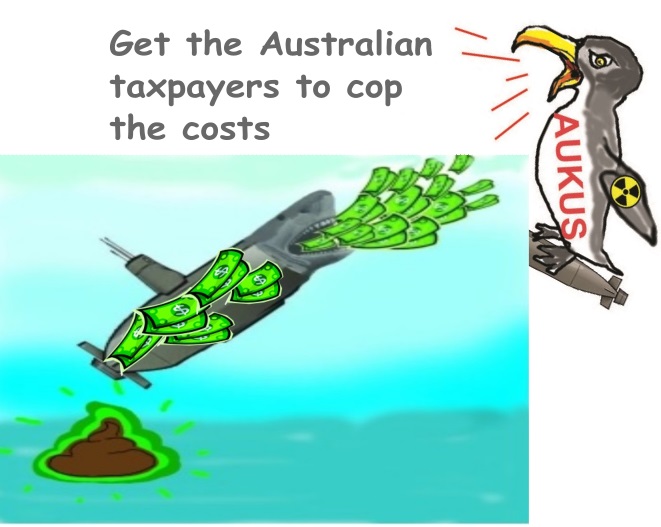
“Australian taxpayers should not be footing the bill for America’s dockyards.
We are on the hook to the tune of $3bn as soon as next year as a downpayment for subs that might never arrive and be useless on delivery,”
Former PM says the reality is the US will not make their submarine deficit worse by giving or selling submarines to Australia
Amy Remeikis, Wed 13 Mar 2024 , https://www.theguardian.com/world/2024/mar/13/turnbull-says-australia-mugged-by-reality-on-aukus-deal-as-us-set-to-halve-submarine-build
Australian taxpayers should not be footing the bill for America’s dockyards.
We are on the hook to the tune of $3bn as soon as next year as a downpayment for subs that might never arrive and be useless on delivery,”
The former prime minister Malcolm Turnbull said Australia has been “mugged by reality” over the Aukus submarine deal after the US announced it will halve the number of submarines it will build next year, throwing the Australia end of the agreement into doubt.
With the US president, Joe Biden, continuing to face a hostile Congress, the Pentagon budget draft request includes construction of just one Virginia-class nuclear submarine for 2025.
Under the Aukus agreement, production is meant to be ramped up to ensure Australia will have access to at least three Virginia-class submarines from the US in the 2030s. That is to fill a “capability gap” before nuclear-powered submarines to be built in Adelaide enter into service from the 2040s.
The prime minister, Anthony Albanese, played down the impact of the US budget announcement, insisting that “our plans are very clear”.
“We have an agreement that was reached with the United States and the UK,” Albanese told reporters in Darwin on Wednesday. “That legislation went through the US Congress last year. That was a product of a lot of hard work.”
The defence minister, Richard Marles, said earlier that the US remained committed to the deal.
“As we approach the one-year anniversary of Aukus, Australia, the United States and United Kingdom remain steadfast in our commitment to the pathway announced last March, which will see Australia acquire conventionally armed, nuclear-powered submarines,” he said.
“All three Aukus partners are working at pace to integrate our industrial bases and to realise this historic initiative between our countries.”
Greens senator David Shoebridge, who has been critical of the Aukus deal from the start, said the US budget announcement was the beginning of the end of Aukus.
“When the US passed the law to set up Aukus, they put in kill switches, one of which allowed the US to not transfer the submarines if doing so would ‘degrade the US undersea capabilities’. Budgeting for one submarine all but guarantees this,” he said on X.
4/ The failure is almost too big to wrap your head around.
We are providing billions of dollars to the US, have given up an independent foreign policy and made Australia a parking lot for US weapons. In exchange, we get nothing.
Nothing but a big target and empty pockets.— David Shoebridge (@DavidShoebridge) March 12, 2024
The US budget does include increased spending on the submarine industrial base, which was a key component of the Aukus pillar one deal, as it laid the groundwork to increase production in the coming years.
But Turnbull, an architect of the French submarine deal which was unceremoniously dumped by the Morrison government in favour of the Aukus deal, said Australia was now at the mercy of the United States for a key part of its defence strategy.
He said that the US needed to increase submarine production to meet its own needs before it was able to transfer boats to Australia, but were now only producing about half as many that were needed for the US navy and were struggling to maintain the boats they held, due to labour shortages.
“What does that mean for Australia? It means because the Morrison government, adopted by Albanese, has basically abandoned our sovereignty in terms of submarines, we are completely dependent on what happens in the United States as to whether we get them now,” he told ABC radio.
“The reality is the Americans are not going to make their submarine deficit worse than it is already by giving or selling submarines to Australia and the Aukus legislation actually sets that out quite specifically.skip past newsletter promotion
“So you know, this is really a case of us being mugged by reality. I mean, there’s a lot of Aukus cheerleaders, and anyone that has any criticism of Aukus is almost described as being unpatriotic. We’ve got to be realistic here.”
The ALP grassroots activist group, Labor Against War, want the Albanese government to freeze Aukus payments to the US so as not to “underwrite the US navy industrial shipyards”.
The national convenor of Labor Against War, Marcus Strom, said Australian taxpayers should not be footing the bill for America’s dockyards.
We are on the hook to the tune of $3bn as soon as next year as a downpayment for subs that might never arrive and be useless on delivery,” he said.
“This Labor government managed to junk Scott Morrison’s tax plan. Why would it be so stupid to continue with his war plan?”
While the Pentagon has sought to assure Australia its submarine production will be back on track by 2028, the looming threat of Donald Trump returning to the White House has raised further concerns the deal will be scuttled.
“On Aukus pillar 1 we are effectively in conflict with the needs of the US navy, and you know as well as I do the American government, when it comes to a choice between the needs of the US navy and the Australian navy, are always going to back their own,” Turnbull said.
Marles has previously denied Aukus will erode Australia’s sovereignty. In a speech to parliament last year, Marles said Australia would “always make sovereign, independent decisions on how our capabilities are employed”.
Additional reporting by Daniel Hurst
Nuclear energy debate ‘many years’ away: Qld Deputy Opposition leader
Queensland Deputy Opposition leader Jarrod Bleijie claims the nuclear energy debate is “many years” away as he focuses on lowering power prices in the immediate future.
Mr Bleijie said he is focusing on making sure energy is affordable and reliable as the Opposition pushes to bring its coal power stations back online.
“There is a lot of water to go under that bridge before that is the case and I suspect we will be at an election before our federal counterparts,” Mr Bleijie told Sky News Australia.
“I stood at the booths in Ipswich West and Inala and every second person was talking about the cost of living crisis in Queensland now.
“People are hurting, they need to see their electricity bills reduced now and that has to be our priority.”
How Biden’s budget plunged the Aukus submarines pact into doubt
Alarm in Australia as the US suddenly struggles to fortify its own fleet
Matt Oliver, INDUSTRY EDITOR, 18 March 2024
A year on from the trio’s meeting, the Aukus partnership is suddenly
looking decidedly more fragile. Inside defence circles, there are growing
doubts about America’s ability and willingness to deliver following a
shock proposal from the Biden administration that cuts to the heart of the
deal.
Amid a row at home over government budgets, the White House this
month suggested halving the number of Virginia-class submarines it builds
next year – the very same type it has promised to Australia under Aukus.
That means the US faces a shortfall itself, raising the prospect it may
refuse to sell its existing vessels and leave Canberra in the lurch.
Telegraph 18th March 2024
Peter Dutton refuses to say where his nuclear reactors will go

Peter Dutton, Bill Shorten clash on nuclear on Today show
After Australia’s peak science body called out the Opposition Leader, Peter Dutton has failed to answer one question on nuclear.
Ellen Ransley news.com.au 17 Mar 24
Peter Dutton has failed to answer a key question in a fiery clash with Bill Shorten over nuclear energy.
The Opposition Leader has this week been spruiking his plans for moving nuclear, but when asked by the NDIS Minister where the reactors would go, Mr Dutton didn’t answer.
“Are you willing to host one of your nuclear power plants in your electorate or anywhere in Queensland? Where are you going to put your reactors?” Mr Shorten posited to Mr Dutton on Nine’s Today Show on Friday morning.
Bill Shorten and Peter Dutton clashed on nuclear during a TV segment on Friday morning.
Mr Dutton did not answer the question, instead pointing Mr Shorten towards a “huge argument in the United Kingdom at the moment, where adults are able to have a conversation”.
“The Labour Party there is arguing for the Tories to have more baseload nuclear power because they know it’s zero emissions,” Mr Dutton replied.
“This government, your government, has no chance whatsoever of meeting the net zero by 2050 target. That’s the reality of it. What we’ve said is that where you’ve got a retiring asset … you can replace that coal with a zero emissions technology, the latest technology, the same technology you’ve signed up to for then nuclear submarines.”
During the segment, Mr Dutton was questioned on his stance on Australia’s national science agency CSIRO over comments he made earlier this week.
On Tuesday, Mr Dutton said it had been “well documented” that CSIRO “can’t be relied up” during a press conference where he discussed nuclear energy and a report by the agency that found nuclear energy was more expensive.
Mr Dutton said the report was “discredited”.
It prompted the agency to make a rare statement, with a letter from chief executive Doug Hilton published online on Friday morning, saying that for science to be useful, it requires the “trust” of the community.
“Maintaining trust also requires our political leaders to resist the temptation to disparage science,” he said.
“The GenCost report is updated each year … (It) is carefully produced … and updated regularly as new data comes to hand.
“The GenCost report can be trusted by all our elected representatives, irrespective of whether they are advocating for electricity generation by renewables, coal, gas, or nuclear energy.”………… https://www.news.com.au/national/politics/peter-dutton-bill-shorten-clash-on-nuclear-on-today-show/news-story/2a872c38238b358c5b3043158498775a
NUCLEAR POWER STATIONS ARE NOT APPROPRIATE FOR AUSTRALIA – AND NEVER WILL BE

Climate Council, 15 Mar 24
The prospect of nuclear power in Australia has been a topic of public debate since the 1950s. While Australia has never had a nuclear power station, we do have 33% of the world’s uranium deposits and we are the world’s third largest producer of it. Periodically, as with the changing of the seasons, various individuals appear in the media singing the virtues of nuclear energy – claiming it is the only option for clean and reliable electricity in Australia.
In fact, over one third of Australia’s electricity is already powered by renewables, and new initiatives like the Capacity Investment Scheme are set to push us towards 82% renewable energy by the end of this decade. While the move to clean energy is still not happening fast enough, it is underway and starting to speed up. We do not need distractions like nuclear to derail our progress now, so let’s set the record straight.
Why doesn’t nuclear power make sense for Australia?
1. Nuclear power stations can’t be built anywhere in Australia.
They are banned in every state, and in every territory. Such bans were introduced because of community concerns about the health and environmental risks. Many parliamentary inquiries at a federal and state level – see this Victorian Inquiry, this Federal Inquiry, and this South Australian Inquiry for instance – have been held into nuclear energy, and all have concluded that it makes no sense in Australia.
2. Nuclear power stations are expensive and take too long to build.
Australia’s independent science information agency, CSIRO, has found that solar and wind are by far the cheapest ways of producing electricity(even when factoring in storage). In contrast, the cost of building and operating nuclear in Australia remains prohibitively high.
Analysis conducted by the nuclear industry itself shows nuclear power stations take an average of 9.4 years to build – compared to 1–3 years for a major wind or solar project. Australia needs to replace its ageing coal-fired power stations as quickly as possible to rapidly reduce emissions this decade. As shown in the Australian Energy Market Operator’s Integrated System Plan, by far the cheapest and quickest way to do this is to ramp up renewable energy paired with storage like pumped hydro, and batteries.
3. Nuclear power poses significant community, environmental, health and economic risks.
Radiation from major nuclear disasters, such as Chernobyl in 1986 and Fukushima in 2011, have impacted hundreds of thousands of people and contaminated vast areas that take decades to clean up. Even when a nuclear power station operates as intended, it creates a long-term and prohibitively expensive legacy of site remediation, fuel processing and radioactive waste storage.
4. Nuclear power is not renewable, and it is not safe.
Uranium is a finite resource just like coal, oil and gas. It needs to be mined and, just like mining coal, oil and gas, this carries serious safety concerns, including contaminating the environment with radioactive dust, radon gas, water-borne toxins, and increased levels of background radiation. On the other hand, energy generated from the sun and wind releases no pollutants into the air and is overwhelmingly considered to be safe.
There you have it: nuclear power is expensive, illegal, dangerous and decades away from powering our homes and businesses. It makes no sense. On the other hand, energy from the sun and wind is cheap, abundant, safe and available now. So, let’s get on with building more renewable energy!
What is a nuclear power station?…………………………………………………
Unlike coal and gas, no greenhouse gas pollution is created in the operation of the nuclear reactor. However, all other steps involved in producing nuclear power – from mining, to construction, decommissioning and waste management – result in greenhouse gas pollution.………………………….
Case Study 1: Hinkley Nuclear Power Station, United Kingdom………………………
Case Study 2: NuScale Power, United States of America……………………………..
Meeting the climate challenge means taking bold and decisive action this decade with the technologies that are ready to go in Australia today. The significant limitations nuclear energy faces means that there is no real prospect of it playing a role in reducing Australia’s emissions.
1 This month
25 October – Film –Britain’s Nuclear Bomb Scandal: Our Story – part of the Adelaide Film Festival,
Screening and Conversation
A screening of Britain’s Nuclear Bomb Scandal: Our Story (2024) followed by a talk with 2026 Bettison and James Awardee and Tradtional Owner Karina Lester in conversation with Simone Tur.
When: Sun 25 Oct, 12:00pm-Screening, 1:15pm-Talk
Where: The Mercury
Free admission, register below by clicking on BUY TICKETS and select free event tickets, at end of web page:
https://www.adelaidefilmfestival.org/program/2026/britains-nuclear-bomb-scandal-our-story
.

Australians deserve the truth
about
AUKUS – https://aukuspublicinquiry.com/

PETITION – To: Prime Minister Anthony Albanese and the Australian Labor Government

of the week – Australians for War Powers Reform (AWPR)
To see nuclear-related stories in greater depth and intensity

