The US grip on Australia keeps tightening. Can we break free and avoid war?

By Bevan RamsdenAug 9, 2023 https://johnmenadue.com/for-independence-and-peace-the-us-grip-on-australia-must-be-broken/—
AUSMIN 2023 has further surrendered sovereignty and tightened the US military grip on Australia. The integration of the ADF with the US military, insertion of US intelligence staff in our defence intelligence organisation and the increased military presence of the US including command facilities in Australia has locked us into any war plans of the United States and made us a launching pad for their wars. The US grip on Australia must be broken to give us independence and a peaceful future.
The AUSMIN 2023 talks between the Australian Defence and Foreign Affairs ministers, Richard Marles and Penny Wong and their US counterparts Secretary of State Antony Blinken and Defence Secretary Lloyd Austin, have further tightened the US military grip on Australia.
Australia has become the US southern Indo-Pacific base from which it will launch military operations. Under the US Force Posture Agreement the US has established, or is in the process of establishing, huge fuel, munitions, spare parts, maintenance and equipment storage facilities on our continent. It has also been given unimpeded access to our airports, seaports, RAAF, RAN and Army bases for its military aircraft, warships and nuclear submarines. Sovereignty has been cravenly sacrificed on the altar of the US-Australia military alliance.
These Australian facilities are being massively upgraded largely at Australian taxpayers expense to support these US military operations.
The ADF trains extensively with, and is under the command of, the US military in war exercises such as Talisman Sabre. The ADF is now so integrated with the US military and our foreign policy so tied to that of the US that Australia will be swept into the next US war without a whimper from our political leaders and indeed with their enthusiastic support. That the next US war will be against China, Australia’s major trading partner and that such a war will have a catastrophic impact on every aspect of the Australian people’s lives and those of the people in our region and the world, with the dreadful possibility of a nuclear exchange, apparently has not registered with our leaders.
By agreeing to the outcomes of the AUSMIN 2023 talks, Richard Marles and Penny Wong have shown that they are no more than flunkeys, willing to place the interests of the US above those of the Australian people. Some might even regard them as traitors whose actions border on treason. Either way they have accepted measures which effectively increase the US grip on Australia and infringe our national sovereignty in a most fundamental way, by denying us the ability to decide if, when and against whom we go to war.
Let’s review the decisions reached at AUSMIN 2023.
AUSMIN 2023 re-affirmed a joint commitment to operationalise the Alliance including through enhanced Force Posture Cooperation across land, maritime and air domains as well as through the Combined Logistics, Sustainment and Maritime Enterprise. They declared Enhanced Space Cooperation as a new Force Posture Initiative to enable closer cooperation on this critical operational domain.
There will be a fresh expansion of the deployment of U.S. forces to Australia including amphibious troops and maritime reconnaissance planes.
American intelligence analysts will be embedded within the Defence’s spy agency in Canberra establishing a Combined Intelligence Centre- Australia within Australia’s Defence Intelligence Organisation by 2024.
In addition to upgrading RAAF Tindal and Darwin there will be expansion and “hardening” against attacks of two other RAAF bases in the north, RAAF Scherger near Weipa in Qld and RAAF Curtin near Derby in WA.
Lightning, Super Hornet fighters and C-17 cargo planes. On November 1st 2022 the ABC ‘Four Corners’ program revealed that RAAF Tindal will be upgraded to accommodate up to six nuclear-capable B52 bombers, and on August 4th 2023 it disclosed that a search of US budget filings had revealed plans to build a US Air Force Mission Planning and Operations Centre in Darwin, plans which have never been fully disclosed by the Australian Government. Through Enhanced Maritime Cooperation there will be more and longer visits of US nuclear submarines to HMAS Stirling in WA from 2023. These visits are in preparation for Submarine Rotational Force-West involving UK and US nuclear submarines being berthed and serviced under the AUKUS Agreement.
The Americans will now conduct a “regular rotation” of U.S. army watercraft as well as deploying a US Navy spy plane to conduct surveillance flights.
The US announced its intention to pre-position US Army stores and materiel at Bandiana Army base near Wodonga in Victoria as a precursor for longer term establishment of an enduring Logistics Support Area in Queensland designed to enhance interoperability and accelerate the ability to respond to alleged ‘regional crises’ which are in reality US-perceived threats to its hegemony.
The US will collaborate with Australia in the local production of multiple- launch guided missiles, planned to commence by 2025.
We are in the grip of the US military, which is ever-tightening and underpins US control of our economy. We are indebted to the historian Clinton Fernandes for his analysis showing that of Australia’s twenty largest corporations, 15 are majority US owned. This includes BHP Billiton, once called the “Big Australian” but now 73% US owned and therefore beholden to US shareholders. The four major banks, NAB, ANZ, Westpac and the CBA, once the government- owned peoples’ bank, are all majority owned by US shareholders, a form of ‘foreign influence’ that the Government doesn’t seem to have a problem with.
The huge public expenditure on “defence”, such as the $368 billion for nuclear-powered submarines, $10 billion for Hercules cargo aircraft, $10 billion for armoured vehicles, billions for runway extensions and port upgrades – the list goes on and is at the expense of addressing urgent social needs such as urgent measures to deal with climate change and address the serious crisis in public housing, health care and public education. There is no military threat to Australia. The real beneficiary is the US military-industrial complex which has its presence in Australia through Lockheed Martin, Boeing and other corporations.
If we are to have an independent and hope of a peaceful future, the US grip on our country must be broken. There can be no social or economic justice, no real solution to the ever-worsening crises in housing, public health care, public education, care of children and the aged, and no effective measures to address climate change and no peaceful future until we free ourselves from the grip of the US militarily, politically and economically.
In order to free ourselves we must unite and we can, because increasing numbers of Australians from different walks of life and political persuasions are becoming alarmed at the suicidal direction the present Australian political leadership is taking us. We are many and are powerful when we are united, while the US collaborators and those who profit from US domination are few. We need political leaders who will serve the interests of the Australian people rather than those of the US or any other foreign power. We need a new constitution, one which will respect the people who first walked this land, will forbid the presence of ALL foreign bases and foreign troops on our soil and will give emphasis to the promotion of peace and mutually beneficial relations with all countries.
Only independence can give us back our sovereignty and self-respect and the possibility of a peaceful future.
The Coalition’s likely embrace of nuclear energy is high-risk politics
The Conversation. Michelle Grattan, 10 Aug 23
Crazy brave, or just crazy? If, as seems likely, the opposition embraces nuclear power in its 2025 election policy, it will be taking a huge political gamble.
The Coalition might argue this would be the best (or only) way to ensure we achieve net zero by 2050. But “nuclear” is a trigger word in the political debate, and the reactions it triggers are mostly negative.
Opposition Leader Peter Dutton has been open since the election about nuclear energy being on the Coalition’s agenda. It’s a “no surprises” tactic – but one that has allowed the government, especially Climate Change Minister Chris Bowen, to regularly attack and ridicule the idea.
This week opposition climate change and energy spokesman Ted O’Brien was spruiking nuclear power, writing in The Australian about the US state of Wyoming’s plans for a coal-to-nuclear transition.
……………………..O’Brien, a Queensland Liberal, has been a vociferous nuclear advocate; he chaired a parliamentary inquiry under the former government that recommended work to deepen understanding of nuclear technology and a partial lifting of the present moratorium, dating from 1998, on nuclear energy.
Nationals leader David Littleproud has also been central to the push for the Coalition to back nuclear energy.
The Nationals, by their climate scepticism and their deep attachment to coal, held back the Coalition on climate policy for more than a decade. Ahead of the 2022 election they were dragged by Scott Morrison to agree to the 2050 target with a massive financial bribe (some of which they didn’t receive because of the change of government).
Now, in opposition, some of the Nationals’ rump would like the party to ditch the 2050 commitment. The nuclear option would be one means of keeping them in the tent.
The “nuclear” the Coalition is talking about doesn’t involve old-style plants, but “new and emerging technologies” including small modular reactors.
That’s one of the problems for the policy – this is an emerging technology, not a quick fix to Australia’s challenges in transiting from fossil fuels.
That is, however, nothing compared with the challenge of public opinion. Notably, the 2019 parliamentary report was titled Nuclear Energy – Not without your approval.
A 2022 Lowy poll found Australians divided on the issue of nuclear power, although opinion appeared to be softening. Some 52% supported removing the ban, which was a five-point rise from 2021; 45% opposed this – six points down on the year before.
The government would have a ready-made “not in my backyard” campaign to launch against the Coalition’s policy. …………………… https://theconversation.com/grattan-on-friday-the-coalitions-likely-embrace-of-nuclear-energy-is-high-risk-politics-211346
Marcus Strom: AUKUS is a mad, bad and dangerous war policy, Labor Against War

And that’s what Labor Against War is about. We can’t sit silently on this. We only formed only a few months ago. Already, we are working branch by branch, moving motions, winning many, losing some, making alliances with the Maritime Union, the Australian Manufacturing Workers Union, the Electrical Trades Union, the Construction Union. Unions New South Wales has a policy opposed to AUKUS.
By Marcus StromAug 10, 2023 https://johnmenadue.com/marcus-strom-aukus-is-a-mad-bad-and-dangerous-war-policy/
Anthony Albanese likes to think of himself as a Bob Hawke unifying type. But if he keeps dragging us along this war path, he will be remembered as our Tony Blair.
We hear a lot about how AUKUS is going to be about getting the balance right, rebalancing the region as China expands. And yes, China has its interests, and is building a military in the region and that is also to be concerned about. But I wonder about balance. And we’ve just been reminded again the stories from Guam and from Okinawa. There are 343 US bases in East Asia alone. Now, I don’t know how eight nuclear submarines adds to the balance in the region.
AUKUS is a policy of empire. And empire means violence. And I am amazed having worked in Canberra until recently at the blithe, consequence-free approach that our political leaders seem take to this. It’s “just the price of doing business on the world stage” is how it’s presented.
This is not what the Labor Party should be fighting for.
Alongside the obscene violence of joint war games happening in Australia at the moment, we’ve had the AUSMIN meeting between leading Australian ministers and US ministers. I read this in the press yesterday about what AUSMIN means. “Australia is now being asked to pull more of its weight in the alliance, play a bigger role in helping stabilise the regional balance of power and be integrated as a base of operations into US force projections into the region or into US war planning for a possible conflict with China in Asia.”
That’s from the very radical editorial column of the Australian Financial Review. Also from the Australian Financial Review today, “The AUSMIN talks over the weekend continue the trend since the late 1990s of tying Australia more tightly into both American grand strategy and war planning in Asia. The permanent American military presence on Australian soil is now at a scale unprecedented since the Second World War.”
They are preparing us for war.
That is why I could no longer work for this government. Up until February I was press secretary to Ed Husic, and the AUKUS policy is one of the main reasons I resigned from that position.
As I said to somebody coming in, “The secret to never being disillusioned with the Labor Party is never be illusioned with the Labor Party.” But the Labor Party, despite its many flaws, does have a tradition of opposing some unjust wars. This was pointed out by Paul Keating at a recent National Press Club speech he gave.
Labor was against the Vietnam War, eventually; Labor did stand against the second Iraq War. Although Bob Hawke did support the first Iraq war. So there’s a chequered history.
I’m going to talk about Tom Uren. Tom Uren many of you will know was a lone voice to start with against the Vietnam War in the Labor Party.
Keating pointed out that the ALP opposed Vietnam. But that’s not always how it was. Tom Uren points out in an interview he gave in 1996, that he and Jim Cairns, who went on to become treasurer, moved a motion to Labor caucus in 1965 opposing US bombing of North Vietnam. They lost that vote.
The left then of the Labor Party voted against it. But seven years later Gough Whitlam on a wave of anti-war sentiment took power and one of the first acts was to bring the remaining Australian troops home from Vietnam.
So we can fight back and we can make change. While Tom Uren started as a lone voice, on AUKUS in the Labor Party, I can say we are not alone. Already people like Paul Keating, Bob Carr, Carmen Lawrence, Doug Cameron, Peter Garrett are speaking out against the insanity of this policy.
War is a deadly business. It can’t be treated as a gambit against wedge politics from the opposition, but that is how it’s being treated.
The war in Iraq killed hundreds of thousands of people, left millions displaced, sparked regional destabilisation, engendered the ISIS calamity. A war with China would make Iraq look like a tea party; it would threaten nuclear catastrophe. This is what we’re facing with AUKUS.
It is also a threat to Australian sovereignty. AUSMIN and the military interoperability it is producing, means that there will be US soldiers enmeshed with Australian forces on a continual basis.
And this Australian government, this Labor government, is now allowing the rotation of B-52s through the Tindal base in the Northern Territory. Now, those planes carry nuclear weapons. They neither confirm nor deny. Australia’s quite relaxed at that policy. But we know that makes Australia a nuclear target.
It makes Australia not just a target and a victim, but an aggressor in the region; a host to war machines that could slaughter millions of people. We have to say, “No” to that.
I’m reminded of something Henry Kissinger said, “Being an enemy of the United States is very dangerous. Being a friend is fatal.”
Simon Crean was Labor leader when the Iraq war happened, and he bravely stood against the war drums. When Simon Crean died recently, Prime Minister Anthony Albanese said, “History has vindicated Simon’s judgment, but at the time his stance was deeply counter to the prevailing political and media climate.”
We are again looking for such courage in a Labor leader.
Instead, we have meekly inherited a Scott Morrison policy. When I speak at Labor Party meetings I say, “If we’d lost the last election, and Scott Morrison was pursuing this policy, you’d all be up in arms. You’d all be screaming about the injustice of it, the war mongering of it. Just because our guy’s doing it doesn’t mean you should shut up.”
And that’s what Labor Against War is about. We can’t sit silently on this. We only formed only a few months ago. Already, we are working branch by branch, moving motions, winning many, losing some, making alliances with the Maritime Union, the Australian Manufacturing Workers Union, the Electrical Trades Union, the Construction Union. Unions New South Wales has a policy opposed to AUKUS.
The South Coast Labor Council, which is facing having a nuclear submarine base in Port Kembla, has stood up and said, “No”.
Branch by branch anti-war activists are passing resolutions. We’ve now going into National Conference. We are hoping we can force at least a bit of a debate onto that conference. To not even discuss this would be an absolute travesty of Labor Party democracy.
We’re not expecting to win at the first hurdle, but neither did Tom Uren. This is a long campaign to win the Labor Party from being a war party to being a peace party.
Assurances count for nothing. The danger we face in a multi-decade, multibillion-dollar program is we don’t know who will be prime minister in ten years, five years. We don’t know who’s going to be in the White House at the end of next year. And yet we are going to be lumbered with a nuclear alliance with two fading Anglo powers on the other side of the world.
AUKUS is a mad, bad and dangerous war policy. And to borrow from the French, we don’t just think this, we know this. As an aside, I was absolutely gobsmacked by the chutzpah of Macron speaking in the Pacific, complaining about the ‘new imperialism’ recently.
Anthony Albanese likes to think of himself as a Bob Hawke unifying type. But if he keeps dragging us along this war path, he will be remembered as our Tony Blair.
Believe it or not, the ALP is meant to be a democratic socialist party. Read it, it’s in the rules.
It’s meant to fight for a better world. But we should no longer be satisfied for fighting for Chifley’s Light on the Hill. This is a labour of Sisyphus, a goal that we never reach. It is time to bring the light down into the shadows, to enlighten the world, to bring hope to today, not tomorrow.
Capitalism is a war system. We have to oppose capitalism to stop war.
Hope is rising. We will make a difference. Use that anger that you felt to really get active. We are rebuilding a peace movement, an anti-war movement.
I look here today; we need to double, triple our numbers. At our last Labor Against War meeting in Sydney, we had somebody there in their 80s telling us about how they fought against the Vietnam War. And there were people in the room in their school uniforms. Now that is a sign for hope that we can raise our voices fight a really bad policy.
And we have to win this because the alternative is cataclysmic.
These are extracts from a speech by Marcus Strom at a public meeting organised by IPAN at the ANU, Canberra, 1 August 2023
Nuclear waste dump plans scrapped for South Australia
By Andrew Brown August 10 2023 –
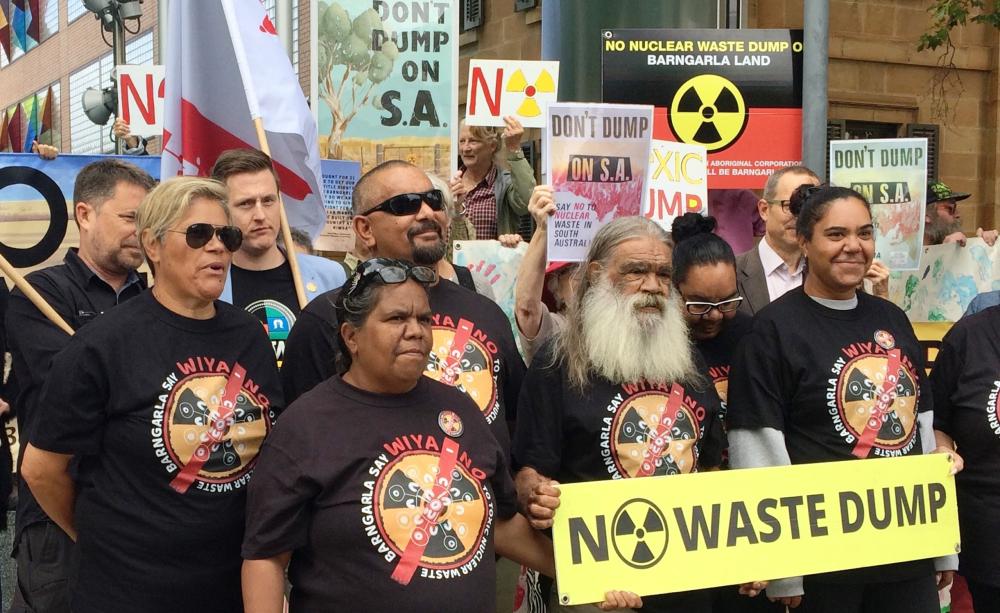
Plans for a nuclear waste dump in regional South Australia have been scrapped by the federal government following a court decision blocking its construction.
The waste facility was earmarked to be built on land at Napandee near the town of Kimba in the Eyre Peninsula by the previous coalition government in 2021.
The decision was challenged in the Federal Court by traditional owners, the Barngarla people, who said the decision was made without them being consulted.
The court ruled in July the facility could not be built.
Resources Minister Madeleine King told federal parliament the government would look for a new location for the nuclear waste storage.
“I’m deeply sorry for the uncertainty the process has created for the Kimba community, for my own department, for the Australian Radioactive Waste Agency workers and for the workers involved in the project,” she said.
“I also acknowledge the profound distress this process has caused the Barngarla people.”
Ms King said any work near Kimba had stopped after the court’s decision.
She said the government would not appeal against the court decision.
“We have to get this right. This is long lasting, multi-generational government policy for the disposal of waste that can take thousands of years to decay,” she said.
“We must consult widely and bring stakeholders including First Nations people along with us. We remain bipartisan in our approach.”…………………………………………………………….. https://www.canberratimes.com.au/story/8303272/nuclear-waste-dump-plans-scrapped-for-south-australia/
Yes in my backyard: Nationals happy to go nuclear

SMH, yMike Foley and James Massola, August 10, 2023
Nationals leader David Littleproud has declared he is open to having a nuclear power plant in his Queensland electorate, as the Coalition pushes a new plan to convert Australia’s existing fleet of coal plants to the controversial source of electricity generation.
Coalition energy spokesman Ted O’Brien said on Wednesday nuclear energy was a crucial emissions-reduction technology. He called for a national discussion about ending Australia’s moratorium, and argued that existing coal plants could be supplanted with the developing nuclear technology of small modular reactors.
Federal parliament banned nuclear power in 1998, and the moratorium has remained in place with bipartisan support.
“I would support a process to explore small-scale modular reactor technology in my electorate with appropriate consultation and education of the community if a moratorium was removed,” Littleproud said.
The Maranoa MP, whose electorate sprawls across western Queensland, was joined by two Nationals colleagues in supporting nuclear in their patch.
Michelle Landry, who represents Capricornia in Queensland, said she would support a coal-to-nuclear transition in her electorate at a “coal-fired power station that is no longer being used”.
Former leader Barnaby Joyce, whose electorate of New England in northern NSW does not have coal plants, emphatically backed developing the technology in his electorate.
O’Brien, however, would not be drawn on his position on a nuclear power plant in his Sunshine Coast electorate of Fairfax. He said a selection of nuclear locations could be addressed if the moratorium was lifted.
“If we end up with a clean energy policy that includes zero-emissions nuclear energy, a cheap NIMBY [not-in-my-backyard] campaign will inevitably come and we’ll deal with those sort of childish debates then,” O’Brien said.
O’Brien said small modular reactors would be key to a nuclear energy policy………………………
CSIRO and the Australian Energy Market Operator’s GenCost report into the cost of electricity generation based on technology type found that an energy grid running on 90 per cent renewables, including transmission lines and back-up battery or gas power, would cost between $70 to $100 a megawatt hour in 2030.
Small modular reactors would cost between $200 and $350 a megawatt hour, were that technology available by 2030.
Former chief scientist of Australia Alan Finkel, writing in the Financial Review this week, said it was unlikely small modular reactors could be deployed before 2040 in Australia, which meant “we must continue our investment in renewables”.
Climate Change and Energy Minister Chris Bowen has rejected the deployment of nuclear power and on Wednesday reiterated the Albanese government’s goal to cut power bills by supplying 82 per cent of electricity through renewable energy by 2030.
“We look forward to the costings and the locations of the nuclear power stations when [O’Brien] releases them. I’ve been a bit confused about why a party claiming to be economically rational would propose the most expensive form of energy as a way to reduce prices,” Bowen told parliament.
On Wednesday, Bowen announced energy rule changes to force companies building transmission lines to engage in earlier and more frequent “genuine” community consultation. The move is designed to reduce community opposition, which is now the main obstacle to the government’s goal to decarbonise the electricity grid.
Opposition Leader Peter Dutton has backed the coal-to-nuclear plan and Canning MP Andrew Hastie said small modular reactors should be considered as replacement for coal plants given “we already have four to five small modular reactors on order” to power Australia’s next generation of nuclear submarines.
When asked if he backed nuclear in his northern NSW electorate, Joyce said: “Not only would I be happy to have a small modular reactor in New England, but I suggested the policy to accompany it.”…………………………………….https://www.smh.com.au/politics/federal/yes-in-my-backyard-nationals-happy-to-go-nuclear-20230809-p5dv43.html
Government abandons plan to dump nuclear waste near Kimba, sparking new hunt for dump site
ABC , By political reporter Matthew Doran, 10 Aug 23
Key points:
- The planned nuclear waste site near Kimba, SA, has been formally abandoned
- The Federal Court ruled against Coalition plans to dump nuclear waste there
- The Opposition claims it is a massive setback
…………………………………………………………. In parliament, Federal Resources Minister Madeleine King said the government respected the court decision.
“The Albanese Labor government does not intend to pursue Napandee as a potential site for the facility, nor is the government pursuing the previously shortlisted Lyndhurst and Wallerberdina sites,” Ms King said.
She revealed all work on the Napandee site had ceased.
“Any activities that have already been conducted were non-permanent and will be reversed or remediated,” Ms King said.
“The site is currently being supervised to ensure it remains safe and cultural heritage is protected while we work through dispossession of the land.”
The Coalition immediately took aim at the announcement, accusing Labor of a “legacy failure” and “abandoning years of work”………………………………………………………………………………………………….
Nuclear storage site still needed
Ms King said Australia needed a nuclear storage facility, but argued it could not be at the Napandee site.
……………………………….. “The site of Australia’s only nuclear reactor at Lucas Heights can safely store waste on site for some time, but we must ensure this waste has an appropriate disposal pathway.”
She argued the government remained committed to finding a solution. https://www.abc.net.au/news/2023-08-10/kimba-nuclear-dumping-plan-abandoned/102711320
Coalition’s aim for nuclear energy criticised by the Australian government.
A radical proposal to change Australia forever has been criticised by the Australian government amid the nation’s energy crisis.
news.com.au Alex Blair 10 Aug 23
The Coalition is reportedly considering a “coal-to-nuclear transition” as part of its 2025 energy policy.
The strategy aims to secure long-term baseload power, reduce emissions, and lower electricity prices, with plans to tap into Australia’s abundant uranium reserves.
Australian regions the party believes are vulnerable to the shift from coal to renewables, including the Hunter Valley and Queensland, have reportedly been floated as potential candidates for the development of small modular reactors.
Opposition energy and climate change spokesman Ted O’Brien emphasises that local community input is crucial and that a “social license” should be obtained before any major infrastructure project is undertaken………………………………………………………………
However, Labor party representatives say the Coalition’s plan is riddled with holes. A spokesperson for Climate Change minister Chris Bowen said the Coalition had previously voiced support for a nuclear Australia but is yet to provide rock solid details to the public.
“They’re yet to come up with a plan with where the reactors can go and how much they will cost,” the spokesperson told news.com.au.
“Even if we started today, having nuclear power ready within 10 years is being generous. They’re very much against renewables, where we are backing it. Labor has implemented the $20b rewiring the nation policy, which has produced an actual change for the future.
There are credible reports that nuclear is the most expensive source of energy in the world, so they really need to show people the plan.”
The spokesperson noted the Coalition has long had a stance against Labor’s renewable energy plan, which aims to provide Australia with 82 per cent of its energy by 2030.
Last year, renewables accounted for roughly 36 per cent of Australia’s energy, with coal generation falling from 59.1 per cent in 2021 to 54.6 per cent in 2022……………………………..
Bowen said Australia needs more investments in order to reach its net-zero goals, calling for more industry figureheads to get behind the clean energy scheme.
“Sector by sector plans are important for Australia because each sector is so different,” he said.
“I’ve been struck by the level of support and engagement from Australian businesses — big and small, and from international investors.” https://www.news.com.au/national/politics/show-people-the-plan-coalition-criticised-over-calls-to-transition-australia-to-nuclear-energy/news-story/48e3f1e14e9e72275ab1d2df91992d0a
Reducing the risks of nuclear war — the role of health professionals
By – Kamran Abbasi, Parveen Ali, Virginia Barbour, Kirsten Bibbins‐Domingo, Marcel GM Olde Rikkert, Andy Haines, Ira Helfand, Richard C Horton, Bob Mash, Arun Mitra, Carlos A Monteiro, Elena N Naumova, Eric J Rubin, Tilman A Ruff, Peush Sahni, James Tumwine, Paul Yonga and Chris Zielinski
Med J Aust || doi: 10.5694/mja2.52054, 7 August 2023
In January 2023, the Science and Security Board of the Bulletin of the Atomic Scientists moved the hands of the Doomsday Clock forward to 90 s before midnight, reflecting the growing risk of nuclear war.1 In August 2022, the UN Secretary‐General António Guterres warned that the world is now in “a time of nuclear danger not seen since the height of the Cold War”.2 The danger has been underlined by growing tensions between many nuclear armed states.1,3 As editors of health and medical journals worldwide, we call on health professionals to alert the public and our leaders to this major danger to public health and the essential life support systems of the planet — and urge action to prevent it.
Current nuclear arms control and non‐proliferation efforts are inadequate to protect the world’s population against the threat of nuclear war by design, error, or miscalculation. The Treaty on the Non‐Proliferation of Nuclear Weapons (NPT) commits each of the 190 participating nations “to pursue negotiations in good faith on effective measures relating to cessation of the nuclear arms race at an early date and to nuclear disarmament, and on a treaty on general and complete disarmament under strict and effective international control”.4 …………………………………………
Any use of nuclear weapons would be catastrophic for humanity. Even a “limited” nuclear war involving only 250 of the 13 000 nuclear weapons in the world could kill 120 million people outright and cause global climate disruption leading to a nuclear famine, putting 2 billion people at risk.7,8 A large‐scale nuclear war between the USA and Russia could kill 200 million people or more in the near term, and potentially cause a global “nuclear winter” that could kill 5–6 billion people, threatening the survival of humanity.7,8. Once a nuclear weapon is detonated, escalation to all‐out nuclear war could occur rapidly. The prevention of any use of nuclear weapons is therefore an urgent public health priority and fundamental steps must also be taken to address the root cause of the problem — by abolishing nuclear weapons.
The health community has had a crucial role in efforts to reduce the risk of nuclear war and must continue to do so in the future.9 In the 1980s the efforts of health professionals, led by the International Physicians for the Prevention of Nuclear War (IPPNW), helped to end the Cold War arms race by educating policy makers and the public on both sides of the Iron Curtain about the medical consequences of nuclear war. This was recognised when the 1985 Nobel Peace Prize was awarded to the IPPNW (http://www.ippnw.org).10
In 2007, the IPPNW launched the International Campaign to Abolish Nuclear Weapons, which grew into a global civil society campaign with hundreds of partner organisations. A pathway to nuclear abolition was created with the adoption of the Treaty on the Prohibition of Nuclear Weapons in 2017, for which the International Campaign to Abolish Nuclear Weapons was awarded the 2017 Nobel Peace Prize……………………………………………………………..
We now call on health professional associations to inform their members worldwide about the threat to human survival and to join with the IPPNW to support efforts to reduce the near‐term risks of nuclear war, including three immediate steps on the part of nuclear‐armed states and their allies: first, adopt a no first use policy;12 second, take their nuclear weapons off hair‐trigger alert; and, third, urge all states involved in current conflicts to pledge publicly and unequivocally that they will not use nuclear weapons in these conflicts. We further ask them to work for a definitive end to the nuclear threat by supporting the urgent commencement of negotiations among the nuclear‐armed states for a verifiable, timebound agreement to eliminate their nuclear weapons in accordance with commitments in the NPT, opening the way for all nations to join the Treaty on the Prohibition of Nuclear Weapons…………….. more https://www.mja.com.au/journal/2023/219/5/reducing-risks-nuclear-war-role-health-professionals
Water Wars: Cooling the Data Centres

August 6, 2023, Dr Binoy Kampmar, https://theaimn.com/water-wars-cooling-the-data-centres/
Water. Data centres. The continuous, pressing need to cool the latter, which houses servers to store and process data, with the former, which is becoming ever more precious in the climate crisis. Hardly a good comingling of factors.
Like planting cotton in drought-stricken areas, decisions to place data hubs in various locations across the globe are becoming increasingly contentious from an environmental perspective, and not merely because of their carbon emitting propensities. In the United States, which houses 33% of the globe’s data centres, the problem of water usage is becoming acute.
As the Washington Post reported in April this year, residents in Mesa, Arizona were concerned that Meta’s decision to build another data centre was bound to cause more trouble than it was worth. “My first reaction was concern for our water,” claimed city council member Jenn Duff. (The state already has approximately 49 data centres.)
The move to liquid cooling from air cooling for increasingly complex IT processes has been relentless. As the authors of a piece in the ASHRAE Journal from July 2019 explain, “Air cooling has worked well for systems that deploy processors up to 150 W, but IT equipment is now being manufactured with processors well above 150 W where air cooling is no longer practical.” The use of liquid cooling was not only more efficient than air cooling regarding heat transfer, but “more energy efficient, reducing electrical energy costs significantly.” The authors, however, show little concern about the water supplies needed in such ventures.
The same cannot be said about a co-authored study on the environmental footprint of US-located data centres published two years later. During their investigations, the authors identified a telling tendency: “Our bottom-up approach reveals one-fifth of data center servers’ direct water footprint comes from moderately to highly stressed watersheds, while nearly half of servers are fully or partially powered by power plants located within water stressed reasons.” And to make things just that bit less appealing, it was also found that roughly 0.5% of total US greenhouse gas emissions could also be attributed to such centres.
Google has proven to be particularly thirsty in this regard, not to mention secretive in the amount of water it uses at its data hubs. In 2022, The Oregonian/Oregon Live reported that the company’s water use in The Dalles had almost tripled over five years. The increased usage was enabled, in no small part, because of increased access to the municipal water supply in return for an upgrade to the water supply and a transfer of certain water rights. Since establishing the first data centre in The Dalles in 2005, Google has also received tax breaks worth $260 million.
The city officials responsible for the arrangement were in no mood to answer questions posed by the inquisitive paper on Google’s water consumption. A prolonged 13-month legal battle ensued, with the city arguing that the company’s water use constituted a “trade secret”, thereby exempting them from Oregon’s disclosure rules. To have disclosed such details would have, argued Google, revealed information on how the company cooled their servers to eager competitors.
In the eventual settlement, The Dalles agreed to provide public access to 10 years of historical data on Google’s water consumption. The city also agreed to pay $53,000 to the Reporters Committee for Freedom of the Press, which had agreed to represent The Oregonian/Oregon Live. The city’s own costs had run into $106,000. But most troubling in the affair, leaving aside the lamentable conduct of public officials, was the willingness of a private company to bankroll a state entity in preventing access to public records. Tim Gleason, former dean of the University of Oregon’s School of Journalism and Communication, saw this distortion as more than just a touch troubling. “To allow a private entity to essentially fund public advocacy of keeping something out of the public domain is just contrary to the basic intent of the law.”
Instead of conceding that the whole enterprise had been a shabby affront to local residents concerned about the use of a precious communal resource, compromising both the public utility and Google, the company’s global head of infrastructure and water strategy, Ben Townsend, proved benevolent. “What we thought was really important was that we partner with the local utility and actually transfer those water rights over to the utility in a way that benefits the entire community.” That’s right, dear public, they’re doing it for you.
John Devoe, executive director of the WaterWatch advocacy group, also issued a grim warning in the face of Google’s ever increasing water use, which will burgeon further with two more data centres promised along the Columbia River. “If the data center water use doubles or triples over the next decade, it’s going to have serious effects on fish and wildlife on source water streams, and it’s potentially going to have serious effects for other water users in the area of The Dalles.”
Much of the policy making in this area is proving to be increasingly shoddy. With a global demand for ever more complex information systems, including AI, the Earth’s environment promises to be stripped further. Information hunger risks becoming a form of ecological license.
Building for War: The US Imperium’s Top End Spend

August 5, 2023, Dr Binoy Kampmark, https://theaimn.com/building-for-war-the-us-imperiums-top-end-spend/
The AUSMIN 2023 talks held between the US Secretaries of State and Defense and their Australian counterparts, confirmed the increasing, unaccountable militarisation of the Australian north and its preparation for a future conflict with Beijing. Details were skimpy, the rhetoric aspirational. But the Australian performance from Defence Minister Richard Marles, and Foreign Minister Penny Wong, was crawling, lamentable, even outrageous. State Secretary Antony Blinken and Defense Secretary Lloyd Austin III could only look on with sheer wonder at their prostrate hosts.
Money, much of it from the US military budget, is being poured into upgrading, expanding and redeveloping Royal Australian Air Force (RAAF) bases in the Northern Territory city of Darwin, and Tindal, situated 320km south-east of Darwin, the intended to “address functional deficiencies and capacity constraints in existing facilities and infrastructure.” Two new locations are also being proposed at RAAF Bases Scherger and RAAF Curtin, aided by site surveys.
The AUSMIN joint statement, while revealing nothing in terms of operational details or costs, proved heavy with talk about “the ambitious trajectory of Enhanced Force Posture Cooperation across land, maritime, and air domains, as well as Combined Logistics, Sustainment and Maintenance Enterprise (CoLSME).” Additionally, there would be “Enhanced Air Cooperation” with a rotating “US Navy Maritime Patrol and Reconnaissance Aircraft in Australia to enhance regional maritime domain awareness, with an ambition of inviting likeminded partners to participate in the future.”
Further details have come to light about the money being spent by the Pentagon on facilities in Darwin. The unromantically titled FY22 MCAF Project PAF160700 Squadron Operations Facility at the RAAF Darwin base “includes the construction (design-bid-build) of a United States Air Force squadron facility at the … (RAAF) in Darwin, Australia.” The project is deemed necessary to add space “for aircrew flight equipment, maintenance and care, mission planning, intelligence, crew briefings, crew readiness, and incidental related work.” Some of the systems are mundane but deemed important for an expanded facility, including ventilating and air conditioning, water heating, plumbing, utility energy meters and sub-meters and a building automation system (HVAC Control system).
Correspondents from the Australian Broadcasting have gone further into the squadron operations facility, consulting US budget filings and tender documents to reveal cost assessments of $26 million (A$40 million). A further parking apron at RAAF Darwin is also featured in the planning, estimated to cost somewhere in the order of $258 billion. This will further supplement plans to establish the East Arm fuel storage facility for the US Air Force located 15 kilometres from Darwin that should be able to, on completion by September this year, store 300 million litres of military jet fuel intended to support US military activity in the Northern Territory and Indo-Pacific region.
According to the tender documents, the squadron operations facility also had a broader, more strategic significance: “to support strategic operations and to run multiple 15-day training exercises during the NT dry season for deployed B-52 squadrons.” The RAAF Tindal facility’s redevelopment, slated to conclude in 2026, is also intended to accommodate six B-52 bombers. Given their nuclear capability, residents in the NT should feel a suitable degree of terror.
Michael Shoebridge, founder and director of Strategic Analysis Australia, is none too pleased by this state of affairs. He is unhappy by Canberra’s reticence on US-Australian military arrangements, and none too keen on a debate that is only being informed by US-based sources. “A public debate needs to be enabled by information and you can’t have a complete picture without knowing where the money is being spent.”
While it is hard to disagree with that tack, Shoebridge’s outfit, in line with such think tanks as the Australian Strategic Policy Institute, is not against turning Australia into a frontline fortress state ready for war. What he, and his colleagues take issue with, is the overwhelmingly dominant role the US is playing in the venture. Those in Washington, Shoebridge argues, seem to “understand the urgency we don’t seem to.” Rather than questioning Australia’s need for a larger, more threatening military capability to fight phantoms and confected foreign adversaries, he accepts the premise, wholeheartedly. Canberra, in short, should muck in more, pull its weight, and drum up Australian personnel for the killing.
Anthony Bergin, a senior fellow of Strategic Analysis Australia, teases out the idea of such mucking in, suggesting a familiar formula. He insists that, in order to improve “our national security, we should be looking at options short of conscription which wouldn’t be as hard to sell to the Australian people.” He thought the timing perfect for such a move. “There’s now a latent appetite for our political leaders to introduce measures to bolster national resilience.”
This silly reading only makes sense on the assumption that the Australian public has been softened sufficiently by such hysterical affronts to sensibility as the Red Alert campaign waged in the Fairfax Press.
Options to add padding to Australia’s military preparedness include doubling or tripling school cadets and cadet programs of the “outdoor bound” type based in the regions. But more important would be the creation of a “national militia training scheme”. Bergin is, however, displeased by the difficulty of finding “volunteers of any kind”, a strange comment given the huge, unpaid volunteer army that governs the delivery of numerous services in Australia, from charities to firefighting.
Alison Broinowski, herself formerly of the Australian diplomatic corps, safely concludes that the current moves constitute “another step in the same direction – a step that the government has been taking a series of for years; accepting whatever the United States government wants to place on Australian soil.” More’s the pity that most details are to come from Washington sources, indicating, with irrefutable finality, Canberra’s abject subordination to the US imperium and its refusal to admit that fact.
Parramatta Labor Party’s FEC unanimous anti-AUKUS motion
Antonina Gentile 4 Aug 23
The ALP’s FEC of the entire Parramatta electorate tonight voted unanimously against aukus. This makes it the second FEC in NSW, the other being Sydney. Thus noone can try to attack the campaign as an inner urban phenomenon anymore.
This will certainly give AA and the Executive something to lose some sleep over. They are confident that they will win the National Conference vote, but they have a widespread party membership in movement and these are far less pleased than they thought.
If the “aukestra” outside Conference is impressive, parliamentary delegates will now more than ever need to take note and, if lobbied by their constituencies and organisations such as those on this list, some could start finding their tongues…
Nuclear issues turn Radio-Active dial up
Georgia Curry, August 5, 2023, https://canberraweekly.com.au/nuclear-issues-turn-radio-active-dial-up/
With Hiroshima Day this Sunday, 6 August, (and Nagasaki Day on 9 August) plus the cinema release of Oppenheimer, there’s no better time to highlight Australia’s longest running show about nuclear issues – Radio Active.
Canberra’s oldest community radio station, 2XXFM 98.3, airs the program every Sunday morning and, sadly, nuclear issues are just as topical now as they were when the show started in 1976.
According to the Doomsday Clock, which was created by the Bulletin of the Atomic Scientists (founded in 1945 by Albert Einstein and University of Chicago scientists who helped develop the first atomic weapons), it is 90 seconds to midnight.
The Doomsday Clock is set every year and has become a universally recognised indicator of the world’s vulnerability to global catastrophe caused by man-made technologies.
This ticking clock feeds the longevity of Radio-Active. Canberra’s 2XXFM is one of 20 community radio stations broadcasting the show around Australia for the past 47 years.
The show is produced at Melbourne’s community radio station 3CR by producer Michaela Stubbs.
“All of the show’s presenters are activists, which is probably why the show has gone on for so long because we have quite a big movement that is multi-generational and we’re really passionate about the issues,” Michaela says. “My mum was part of the peace and nuclear disarmament movement in the ‘80s so I had an awareness of Hiroshima Day.”
Michael has a vast archive of tapes to draw from and recently aired a show about “Down Winders”, people affected by the Trinity nuclear test site in New Mexico, USA, the site of the first detonation of a nuclear weapon.
“That was such an important story,” Michaela says. “They are the voices that don’t get heard.”
There are also old cassettes of protests such as Australia’s Jabiluka blockades in the ‘70s against the Jabiluka uranium mine in the Northern Territory.
Michaela recently interviewed an Indigenous woman whose family was affected by the British Government atomic tests at Emu Field, South Australia. This occurred 70 years ago this October and her family is still seeking reparations.
“We have always had a strong focus on amplifying the voices of people who are directly impacted by nuclear development,” Michaela says.
Australia’s longest running show on nuclear issues also focuses on peace and sustainability. Radio-Active is broadcast on Canberra community radio 2XXFM 98.3 every Sunday, 7.30am-8am.
USA flexes its belligerent muscles in Western Australia, showing off its nuclear submarines

US military shows off nuclear capable submarine in Western Australia By 9News Staff Aug 4, 2023 https://www.9news.com.au/national/us-military-shows-off-nuclear-capable-submarine-in-western-australia/9b152141-2e3f-4a2a-a73f-37b7a02738cb
The United States military is flexing its nuclear fleet of submarines in Western Australia.
The arrival of the USS North Carolina is the first visit since a landmark defence deal was signed earlier this year.
Australia is buying eight of the nuclear-powered Virginia class submarines in a deal costing $368 billion.
Australia’s Ambassador to the US Kevin Rudd was on Garden Island touring the 110-metre vessel which can go three months underwater.
WA will permanently house nuclear subs from next decade.
HMAS Stirling is set for an upgrade as thousands more submariners file through Perth.
The public is not allowed to know how long the North Carolina will be docked in Perth – that information is classified even from Australia’s defence minister.
However, there have been reassurances the AUKUS deal is watertight regardless of who is in the White House.
Advisor to the US secretary of defence Abe Denmark said there has been broad bipartisan support.
Rudd described the move as an opportunity to step up the capabilities of the Royal Australian Navy and the sovereign capabilities of Australia “in a highly uncertain period strategically”.
Veterans, descendants of nuclear testing era urged to apply for British medal
Sapeer Mayron, Stuuf NZ, Aug 05 2023
When 85-year-old Gerald ‘Gerry’ Wright was 19, he saw his own skeleton through his momentarily transparent skin.
He was standing on board a Royal New Zealand Navy frigate, hands over his eyes, 130 kilometres away from the spot a nuclear bomb was tested off Kiribati, then called Christmas Island.
As the bomb, Grapple Y, went off with the force of 3 mega tonnes of TNT it caused such intense radiation that Wright and his company saw the bones in their hands – even if only for a moment.
Wright was deployed to Operation Grapple: a British mission of nine nuclear tests all told between March 1957 and September 1958. Grapple Y was the largest nuclear weapon the British ever tested.
He joined in 1958, and witnessed five of the nine hydrogen bomb tests. His job: send a balloon skyward and monitor the weather, ensuring calm skies for the nuclear tests.
Along with some 500 other New Zealanders on Operation Grapple, Wright was exposed to dangerous levels of radiation, not only during the tests but afterwards when the nuclear cloud remained overhead.
If it rained – even through the bomb’s cloud – the Navy sailors were told to shower outside on the frigate deck to save on fresh water, he said.
In 2005, The New Zealand Nuclear Test Veterans’ Association commissioned Dr Al Rowland from Massey University to study 50 Operation Grapple veterans’ chromosomes.
His study “unequivocally” proved the effects of the radiation had long term effects on the veterans and their families.
Wright counts himself lucky he doesn’t face the cancers and health problems of so many of his peers, and doesn’t waste energy being angry about the exposure. “It’s a fact of life,” he said.
“It was quite spectacular. And at the time I personally was very pleased that here I was at the cutting edge of modern technology and very glad of what was going on.
“It was only later on we found there were lots of side effects.”
Now, 65 years after his deployment he’ll finally have a medal honouring his service.
In November 2022, the government of the United Kingdom announced it would be awarding medals to anyone – or anyone’s kin – involved in the United Kingdom’s Nuclear Test Programme between 1952 and 1967.
The medal itself is the result of a hard-fought campaign by non-government organisation Labrats International (which stands for Legacy of the Atomic Bomb. Recognition for Atomic Test Survivors).
Speaking from Wales, co-founder Alan Owen said they have been campaigning since 2020 for this medal………………………………………………..
Owen said whether nuclear weapons should even be used is a separate issue – honouring the people who served their country’s orders should be non-negotiable.
“A lot of them are suffering ill health. The few thousand that are left feel that they’re the lucky ones.”
But the work doesn’t end with the medal. Labrats are working to integrate the stories of nuclear veterans and the weapons testing era into the UK’s school curriculum and public education like in museums and libraries.
They also want compensation for veterans and their families, as well as the indigenous tribes of Pacific islands, New Zealand and Australia who were displaced or wrongfully treated during the tests.
“These indigenous tribes, especially in Australia that were just treated as third class citizens, and they were affected… they’ve received nothing.
“There needs to be a big plan and push for compensation across the communities affected by UK testing, definitely.”
It’s hoped the first medals will be delivered ahead of Remembrance Sunday 2023, November 12.
To apply for a medal, visit the UK Ministry of Defence website. https://www.stuff.co.nz/national/132583004/veterans-descendants-of-nuclear-testing-era-urged-to-apply-for-british-medal
AUKUS, Australia and the drive to war
By John Minns, Aug 2, 2023 https://johnmenadue.com/aukus-australia-and-the-drive-to-war/
My fear is not that AUKUS SSNs, if they arrive, will be late, ineffective, and obsolete. My fear is that they will arrive and will be effective and even lethal. Because, if that is the case, they will play a part in the drive to a potentially devastating war with China that would be a disaster for the entire world.
This was a speech given at an anti-AUKUS protest at the ANU on 28 July 2023
Friends, I have been proud to have been part of a number of protests against the AUKUS alliance and the nuclear submarine deal that is part of it. However, to be truthful, I haven’t always completely agreed with everything that has been said at them.
I heard at one of the protests a speaker opposing the subs deal because they might never arrive, or might be delivered very late, or that, by then, they would be ineffective and obsolete. Apart from the enormous cost, my concern is not that they will be late or obsolete. My fear is that they will arrive and will be effective and even lethal. Because, if that is the case, they will play a part in the drive to a potentially devastating war with China that would be a disaster for the entire world.
In a war with China – what would victory look like? It would certainly not end, like the Second World War, with allied troops occupying Germany and Japan. Even to imagine Australian, British and US troops patrolling the streets of Shanghai is to realise what a ludicrous prospect that is. China – a vast and nuclear-armed country – is not going to be physically occupied.
Would victory mean that China’s dynamic economy would no longer stock the shelves of Kmart and the like around the world and that it would revert to a poor semi-agricultural country. Hardly – unless it is turned into a nuclear wasteland – it will clearly go on to be the largest economy in the world.
Would victory be the successful defence of Taiwan. Well, China has claimed Taiwan since 1949. But it has made no attempt to invade it. In any case, are we prepared to go to war to defend the independence of a place whose independence we don’t recognise and don’t support. It makes no sense.
Would victory mean that China is prevented from interfering in the affairs of other countries – something which every large or wealthy power does – including Australia in the Asia-Pacific. I study Latin America and, when US politicians talk about China’s interference in the domestic affairs of others, I hear, somewhere in my head, roars of bitterly ironic laughter from all over Latin America. Because the US has interfered in the affairs of every country in Latin America and the Caribbean – instigating coups, supporting military dictatorships, blockading harbours, embargoing trade and even military invasion. And it has done so for the last two hundred years – ever since President James Munro in 1823 proclaimed the doctrine that only the US had the right to interfere in the region.
Would victory mean that so-called Chinese military expansionism is halted. Well, it’s true that China has set up military bases on a number of artificial islands. But the US has around 750 foreign military bases in more than 80 countries. To my knowledge, China has one – in Djibouti. If bases and the ability to project military force is the problem, then China is not the main culprit.
Also, the US spends more on its military than the next 10 countries combined and most of them are US allies.
The chances of being killed by the US military are enormously higher than by any other country. A recent research project from Brown University in the US showed that, since 2001, about 900,000 people have been killed directly by the US military – nearly half of those were civilians. On top of that, what the project calls “the reverberating effects” of US military action – such as famine, destruction of sanitation, health care and other infrastructure has led to several times as many civilian deaths as caused directly.
Would victory in a war with China mean the successful defence of our trade routes and shipping lanes. Where do our trade routes and shipping lanes lead? Largely to China! So, would we fight China to defend our trade with China?
Another thing I’ve heard said that I disagree with is that the AUKUS deal might drag Australia into a war with China. Australia is not being dragged anywhere. The Australian government is eagerly jumping into this alliance – with eyes wide open – rather than being forced into something not of its own making.
There has never been a war conducted by our great and powerful friends that Australia has not been eager to join – whether to the Maori Wars in New Zealand, to Sudan and to South Africa in the 19th century, to the First and Second World Wars, to Korea, Malaysia, Vietnam, Afghanistan and Iraq – twice. We should not be protesting calling for Australia’s independence – it is independent – we should be calling for it to use that independence to help halt the drive to war – rather than to enthusiastically join it.
I’ve heard some on the other side of this argument repeat the old cliché – “if you want peace, prepare for war”. It sounds good – a nice juxtaposition of opposites etc. But it is logical and historical rubbish. It is essentially the argument of the National Rifle Association of America. The NRA says that to be safe, we need to have everyone armed. Security comes from allowing all to buy AR-15 assault rifles. We know how that has worked out in practice. Preparing for war to ensure peace is the same argument on an international scale.
When we look at the great periods of arms build-up, we see that they led to war rather than peace. It was the case with the arms build-up – especially the naval build-up – before World War One, with rearmament in the 1930s, with the Cold War arms economy which was accompanied by very hot and devastating wars – in Vietnam and Korea for example – which were among the most destructive on a per capita basis in modern history..
The world today contains great possibilities. We have the resources and the human ingenuity to deal with some of our real problems – like housing, poverty, health, education, climate. Some of that ingenuity is right here at the ANU. Let us set that ingenuity to the task of solving the real problems which affect our lives and our society rather than to the exacting but grisly science of blowing human bodies apart.
1 This month

of the week – Australians for War Powers Reform (AWPR)
To see nuclear-related stories in greater depth and intensity
 Antinuclear