AUKUS: Are nuclear-powered submarines a good idea for Australia?

“[So] the question for us is, is it sensible for Australia to commit itself to go to war with the US against China — a war we have no reason to believe the US can win, in order to acquire submarines that we don’t need?”
ABC RN / By Nick Baker and Taryn Priadko for Global Roaming 5 Mar 24
There were always going to be questions about a nuclear-powered submarine deal with a (stated) price tag of up to $368 billion.
But, as the dust settles on the AUKUS security pact and Australians patiently wait for the subs that come with it, some defence experts are warning that the deal could fall apart.
“I think the chance of the plan unfolding effectively is extremely low,” Hugh White, an emeritus professor of strategic studies at the Australian National University, tells ABC RN’s Global Roaming.
Professor White was a defence adviser to the Hawke government and worked as a deputy secretary for strategy and intelligence in the Department of Defence. He’s also been a big critic of AUKUS.
So could AUKUS sink? And what would that mean for Australia’s defence plans?
What is AUKUS?
On September 15, 2021, a new trilateral security partnership between Australia, the UK and the US was announced, called AUKUS (A-UK-US).
Australia was scrapping its earlier $90 billion deal with France for 12 conventional-powered submarines and instead securing nuclear-powered submarines through AUKUS.
More details were announced on March 13 last year, including around the two so-called “pillars” of AUKUS.
Pillar One, which has received the most attention, is the submarines.
The plan is for Australia to buy at least three nuclear-powered Virginia class submarines from the US in the early 2030s.
We will then build at least five of a new, nuclear-powered submarine class dubbed the SSN-AUKUS, likely in Adelaide, in the 2030s, 2040s and beyond.
Pillar Two involves the sharing of technology, in areas like quantum computing, artificial intelligence and hypersonic missiles.
Former prime minister Scott Morrison called AUKUS “the best” decision of his government, while current Prime Minister Anthony Albanese has said it would “strengthen Australia’s national security and stability in our region”.
AUKUS worries
Professor White has two main worries around AUKUS.
“We do need submarines. I think submarines are a very important part of a defensive posture for Australia … [But] I don’t think we need nuclear-powered submarines,” he says.
“They’re so much more expensive. They’re so much more difficult to make. They’re so much more difficult to operate. We’ll end up with far fewer of them in our fleet.”
He says his second concern is far bigger: “I don’t think we’re going to get [the submarines].”
He claims the plan is overly reliant on future decisions and assistance from the US and UK governments, and also full of near-insurmountable technical tasks for Australia.
“I think what’s going to happen … is within the next few years, the whole thing will just come apart in our hands. And we’ll be back to square one trying to work out how to get some more conventional [submarines].”
Allan Behm, the director of the international and security affairs program at the Australia Institute, also doubts the likelihood of the AUKUS deal going ahead as planned.
One reason, he says, is that the technologies, skills and workforce that are required from a country like Australia to build and maintain nuclear-powered subs is pushing our limits, even with the involvement of the US and UK.
“We’re going into a technological domain with which we are totally unfamiliar,” says Mr Behm, who has a 30-year career in the Australian public service and was senior advisor to then-shadow minister for foreign affairs Penny Wong.
“We’re talking about a number of submarines with nuclear propulsion systems in them. And we’ve only got one nuclear reactor in Australia, which is nothing like the very, very highly enriched uranium reactors, the pressure water reactors that exist in nuclear-powered submarines,” he says.
“I think the best parallel would be, how would Australia imagine that it would undertake, conduct and retrieve a moon launch?”
US versus China
If AUKUS goes ahead as planned, is it the best way to keep Australia safe?
It’s been framed as a massive deterrent to China, which keeps building up its military.
Mr Morrison told the ABC last year, AUKUS helps to “change the calculus for any potential aggressors in our region”.
But Professor White says there are pitfalls with this strategy too.
He claims AUKUS could pull Australia into a future US-China conflict over Taiwan, which he contends the US may not win.
“China has focused so strongly and so effectively on building precisely the kinds of forces it needs to prevent the US projecting power by sea and air into the Western Pacific,” he says.
“[So] the question for us is, is it sensible for Australia to commit itself to go to war with the US against China — a war we have no reason to believe the US can win, in order to acquire submarines that we don’t need?”
While Australia has made clear it will have full control over the nuclear-powered submarines under the deal, Professor White says the US may still expect us to support them in a future war.
Cost concerns
The estimated cost of the submarine program will be up to $368 billion over the next 30 years. It’s a figure that has attracted no shortage of criticism.
“It puts so many of our defence eggs in one super expensive basket,” Mr Behm says.
“Short of expanding our defence budget by a considerable amount … we would find ourselves with very constrained capabilities in other fields in order to meet the expenditure targets of this project.”
And, based on other defence projects, he contends there will be cost blowouts.
“Whenever [the Department of] Defence says it’s going to cost you $1, always multiply it by three. And so your $368 billion is, in effect, a lifetime cost of $1 trillion,” he says.
“And you can do a hell of a lot with $1 trillion.”
A safer Australia?
The AUKUS critics have their critics too.
Peter Dean, the director of foreign policy and defence at the University of Sydney’s US Studies Centre, says he has a “diametrically opposed” outlook to Professor White and Mr Behm………………………………………………
Scrap AUKUS, totally rethink defence?
Meanwhile, Professor White, from the anti-AUKUS camp, is advocating a totally different approach to AUKUS.
He says Australia should pivot away from the US and think about “how we can develop our national capability to defend ourselves independently against a major Asian power?”
“Traditionally, Australians have believed that as a very big continent with a relatively small population … we couldn’t possibly defend ourselves. But I don’t think that’s right.”
But he says this would need a change in priorities…………………………………………………
A missing part of the discussion
Mr Behm, also from the anti-AUKUS camp, says there’s an element sometimes missing in discussions about defence.
Diplomacy has got to be central to the way in which you think about your long-term national security,” he says.
“You get much more return on your investment in diplomacy than you ever get out of defence systems, which in the life of almost all of them you never use.”………………………………….
Mr Behm advocates for more emphasis on “how you use the intellectual and cultural resources of the nation to both protect and to promote its deep and long-term security”.
“[So] I would be prepared to argue that the pivot on which our national security rests is the foreign minister.” https://www.abc.net.au/news/2024-03-05/aukus-set-to-sink/103534664
Peter Dutton’s climate denial is morphing into a madcap nuclear fantasy. The ban should stay

And don’t think for a moment that the Coalition, if in power and with no nuclear ban standing in its way, would not propose some mad-cap scheme to lock in some unproven projects from the first nuclear salesman that turns up at their door.
And don’t think for a moment that the Coalition, if in power and with no nuclear ban standing in its way, would not propose some mad-cap scheme to lock in some unproven projects from the first nuclear salesman that turns up at their door.
Giles Parkinson, Mar 5, 2024, https://reneweconomy.com.au/peter-duttons-climate-denial-is-morphing-into-a-madcap-nuclear-fantasy-the-ban-should-stay/
The energy tropes on social media are getting so bizarre it is sometimes hard to imagine how anyone would take them seriously.
Welcome to the Trumpian world we now live in: Say something often enough and people may end up believing it. And just when you think it could not get any more weird, up pops the federal Coalition with a plan for nuclear power.
There is a lot to be said about nuclear energy, and despite its exorbitant costs some countries are still trying to build nuclear plants because it either supports their military complex, or because they feel they have no choice.
In most countries, the arguments in favour of nuclear power are usually based around the promise and determination that it can accelerate the transition towards net zero and low carbon economies.
Not in Australia: The Coalition makes their position very, very clear. They don’t buy into the renewables thing, they think it is reckless and will ruin the environment, and the economy. And they are not particularly interested in accelerating, or even meeting, net zero emission targets.
Far better, they say, to stop the renewables transition in its tracks, keep coal fired power stations open and wait for small modular reactors. Which, if they ever arrive, cannot realistically be deployed in Australia before 2040, if then.
Even the large nuclear reactors suggested on Tuesday by Coalition leader Peter Dutton – maybe he realises that SMRs are indeed a fantasy – could not be built before 2040, more likely 2045.
The push for nuclear over renewables, and keeping coal fired power stations open, is an argument you can only prosecute if you happen to believe that climate science is a load of crap, and the result of some UN-based conspiracy to deprive us all of our liberties.
Which just happens to be a core belief of key members of the Coalition, its loudest media mouthpieces, and what appears to be its main advisory body, the Gina Rinehart-funded Institute of Public Affairs.
As Michael Mazengarb reported last week, a whole cast of right-wing so-called “think tanks” are prosecuting the argument for nuclear, attacking renewables, and helping feed the social media frenzy against this and other technology solutions – battery storage, EVs, and the very concept of demand management and smart energy.
The nuclear debate is moving into the mainstream. Surveys, most with loaded questions, suggest there is majority support for nuclear and the removal of Australia’s ban of the technology. That’s questionably, but even Australia’s pre-eminent business commentator, Alan Kohler, bought into the argument this week.
Kohler argued the ban against nuclear should be removed, but won’t matter much because the market will decide, and investors will not put money into nuclear because they don’t want to bury themselves under a wall of debt and absurdly expensive production costs.
“The market will decide” is a key Coalition and nuclear booster talking point.
Kohler is wrong. And so is the Coalition. The market will not decide. The market has not decided the fate of nuclear power stations for decades – they are funded, owned and often enough bailed out by governments and state-owned entities.
And there are not that many actually being built. The Coalition’s “nuclear renaissance” is a mirage and a fiction. According to a report from the International Energy Agency this week, new solar installations across the world rose to 420 gigawatts in 2023, new wind to 117 GW, and new nuclear slumped to just 5.5 GW.
And they are not doing much for emissions either. In the five year period from 2019 to 2023, the IEA says, solar accounted for 1.1 billion tonnes of avoided annual emissions. Wind accounted for 830 million tonnes of avoided annual emissions, and already installed nuclear just 160 million tonnes.
That won’t phase a Coalition government in Australia. The nuclear ban should stay because the country’s ruling parties, and the Coalition in particular, have shown a penchant for hare-brained and vanity projects that make little or no financial or strategic sense.
Think of the Aukus deal – $368 billion for six nuclear submarines, which, as was feared, as acted as a kind of Trojan horse for the nuclear boosters. Think of Snowy 2.0, already costing $12 billion and counting for a project that won’t deliver anything like the benefits claimed, and that does not include the cost of transmission.
Snowy 2.0 is an interesting case.
Read more: Peter Dutton’s climate denial is morphing into a madcap nuclear fantasy. The ban should stayIt could be argued that Snowy 2.0 has done more damage to the Australian renewable energy transition than any other project, or policy position. And you could also argue its parent company, the government-owned Snowy Hydro, could provide the perfect vehicle for Dutton’s nuclear dreams.
The sheer scale of Snowy 2.0 has caused countless of smaller, more sensible and more distributed storage projects to be delayed or cancelled.
The Snowy Hydro rhetoric in support of the project – that battery storage is not feasible, and household batteries are a waste of money – has helped deflect the media and policy debate away from where it needed to be: consumer energy resources.
Snowy Hydro didn’t like want to change their primacy in the market with new fangled ideas. Demand management, its former CEO Paul Broad liked to say, is akin to “forced blackouts.”
Their push against CER and smart energy solutions is much reported and quoted position that has caused pain across the grid and for consumers, and helped derail plans for a sensible and fair transition. Regulators and policy makers only now realise they have been led up the garden path and are scrambling for ways to repair the situation.
And the transmission lines that have been fast-tracked to support Snowy 2.0 – the HumeLink and VNI-West, most notably – have been rushed and poorly handled, and have provided a trigger point for the anti-transmission and anti-renewable agenda that now floods the airwaves.
Snowy Hydro is still at it. During a recent media tour of the stalled and costly Snowy 2.0 tunnelling project, CEO Dennis Barnes was quoted by one of the invited journalists as saying that “no other technology” exists that can deliver more than four hours storage.
“There may be technologies in 15, 20 years, but there is no commercial technology other than pumped hydro that goes beyond four hours,” Barnes was quoted as saying by The Australian.
That would be news to global energy giants such as RWE, BP and Ark Energy (owned by Korea Zinc) who have contracted to build eight-hour batteries for the NSW government as part of their plan to fill the gap that could be created if the Eraring coal generator does close as planned in August next year.
Those eight-hour batteries will all be up and running well before Snowy 2.0.
But it’s merely a symptom of the nonsense and misinformation that must be stated by developers to justify projects that are not such as great idea.
The nuclear cartel and its supporters are no different, and have been emboldened by Trump’s triumph with fake news: Facts don’t seem to matter so much any more.
The energy world, particularly in Australia, is moving away from “baseload” to renewables and “flexible” dispatchable capacity. Rooftop solar is expected to increase four fold over the next two decades, and be accompanied by a mass switch to electrification (business and households), and electric vehicles.
The switch to EVs is significant, because it causes consumers to think on a near daily basis how and where they will charge the electric vehicles, and at what cost.
It makes them focus on their options for solar, and storage, and smart software, and whether they are getting a fair deal from the current market that is now so focused on big centralised power.
The Coalition wants to throw that transition into reverse.
Exactly how the Coalition expects to jam baseload nuclear into a grid where rooftop solar accounts for all grid demand and more during the day is not explained. Don’t expect an answer, because they haven’t thought about it yet, and when they do it will probably feature curtailment and more storage.
See Alan Pear’s comment: How can nuclear fit into a renewable grid where base load cannot compete
And don’t think for a moment that the Coalition, if in power and with no nuclear ban standing in its way, would not propose some mad-cap scheme to lock in some unproven projects from the first nuclear salesman that turns up at their door.
Private investors won’t put up the money for nuclear power plants, but the Coalition – be it the LNP in Queensland with their state-owned utilities, or the Dutton-led Coalition in Canberra with Snowy Hydro – won’t need them.
Perversely, Snowy Hydro, might provide an attractive synergy for the Coalition’s nuclear plans, and not just for their shared disregard and disdain for consumer and distributed energy resources and smart energy solutions.
EdF, the French government-owned utility that runs its nuclear power plants, is also the biggest operator of pumped hydro in the world, because much of the world’s pumped hydro was built half a century ago with the specific task of backing up nuclear energy. As the name suggests, Snowy Hydro, has lots of hydro.
(Yes, nuclear needs back up power, and a lot of it. Because of that, and because its business model is based around “baseload”, it doesn’t really help in the renewables transition. In a country like Australia with world-leading wind and solar resources, it competes against it).
And, like the French government which shields French consumers from the soaring cost of nuclear (it cost $40 billion in 2022/23 alone after half their fleet went offline), the Coalition can dip into the Commonwealth budget for funds – as they did for Aukus – for which the current crop of MPs and Senators will never be accountable.
Their denial of economic reality is total. The only small modular reactor that has got close to regulatory approval and to actually being built, was the NuScale technology in the US, which got pulled because the costs spiralled beyond what even the technology’s naysayers were predicting.
But we are told repeatedly that nuclear isn’t expensive at all. “Billionaires are demanding Australians refuse cheaper, reliable, emission-free nuclear power,” Vikki Campion, the wife of National MP and anti-renewable ring-leader Barnaby Joyce, writes in the Murdoch media. Cheaper than what, exactly? Nothing much.
The Coalition has been trying to stop the renewable energy revolution for the last two decades, and is now launching attacks against institutions such as the CSIRO and AEMO.
Maybe it’s time people paused to reflect about why that is. Exactly whose purpose are they serving, whose interests are they defending? Why was it so important for Dutton to fly to Perth last week for an hour to celebrate Rinerhart’s birthday?
The fossil fuel mafia ganged up on John Howard over the then mandatory renewable target and the proposed carbon price, and right through Tony Abbott and Scott Morrison to Dutton, it’s been the same story. Malcolm Turnbull might have been different, but his legacy is Snowy 2.0.
Labor is now in power, its climate policies still fall short of what the science demands by 2030, but it is having a real crack at meeting the 82 per cent target modelled in the market operator’s Integrated System Plan, and which is now an official target.
Even the biggest energy users – those that run the smelters and the refineries – are demanding the transition to renewables, and are acting on it.
Curiously, the renewables industry stays largely mum on the nuclear issue – relying, perhaps, on the notion that rational thought, science and economics will prevail. We don’t live in that world any more.
Nuclear is nothing more than a distraction, and a dangerous one at that. The ban should stay.
Continue readingMP says coalition ‘must’ explain plan for nuclear power near Anglesea on the Victorian Surf Coast
March 3, 2024 by Tim Lamacraft, https://www.bay939.com.au/local-news/mp-says-coalition-must-explain-nuclear-coast-plan/—
The federal member for Corangamite says the coalition needs to explain where it would build a nuclear reactor on the Surf Coast.
It follows suggestions from Liberal leader Peter Dutton the former Anglesea power station would be a suitable location for nuclear power generator.
Anglesea was in Labor MP Libby Coker’s seat of Corangamite before it moved into the electorate of Wannon for the 2022 election, held by senior Liberal MP Dan Tehan who’s now seeking to downplay nuclear talk there.
Asked last week if Anglesea could host a small modular reactor (SMR) as suggested by his leader, Mr Tehan said Alcoa’s former coal mine and power generator there was already earmarked for an eco-tourism site by the UK based Eden Project.
“Planning is already taking place, and we’re looking at the first small modular nuclear reactor occurring in 2035, obviously the community and everyone hopes that the Eden Project will be up and running by that stage,” he said.
The Eden Project is facing increasing pushback from the Surf Coast community, including from the local shire where the deputy mayor is opposed to it.
“There are a lot like me who are wary of the proposal and definitely question the need, probably very, very sceptical about their being a need for it,” Cr Mike Bodsworth said, who also represents the Anglesea ward.
When asked by Geelong Broadcasters what he thought the chances of nuclear reactor going into Anglesea were, Dan Tehan said he was “on the record as supporting the Eden Project.”
“The community strongly supports the Eden Project, like I do,” Mr Tehan said.
“As we continue to investigate sites around the country, there’ll be other sites which will tick the box more so than Anglesea, where there is already – I think – a very worthwhile proposal.”
Libby Coker remains unconvinced, and says the opposition is yet to outline much of the detail behind its push for nuclear power, including the disposal of spent fuel.
“Peter Dutton and the Coalition must tell us where on the Surf Coast they’re planning to build this nuclear reactor and put its waste,” she said.
Peter Dutton won’t back down on the Coalition’s desire to take its nuclear energy policy to the next election.
news.com.au, Eleanor Campbell, 5 Mar 24
Peter Dutton has doubled down on the Coalition’s decision to push ahead with a nuclear power policy, saying it’s the only ‘credible pathway’ to net zero.
The Opposition Leader has unveiled a draft of his energy policy to take to the next election that proposes to replace existing coal-fired power generators with a mix of small and large scale nuclear reactors to use for net-zero power sources.
He also indicated where the nuclear reactors could be located.
Mr Dutton said nuclear reactors would provide a more reliable and cheaper source of clean energy.
“The Prime Minister’s had an opportunity to put forward a plan,” the Opposition Leader said.
“He doesn’t have the guts to stand up and make the decision that our country needs made and we do need to look at the best technology, zero emissions.
“I think it’s the only credible pathway we have to our international commitment to net zero by 2050.
But his plans have been ridiculed by the Albanese government, which argues it would take “decades” to build and delay Australia’s transition to clean energy.
’Cruel hoax’: Picture has state up in arms
‘Bulldust’: Twiggy lampoons nuclear push
Why this photo sent suburb into meltdown
Peter Dutton has doubled down on the Coalition’s decision to push ahead with a nuclear power policy, saying it’s the only ‘credible pathway’ to net zero.
The Opposition Leader has unveiled a draft of his energy policy to take to the next election that proposes to replace existing coal-fired power generators with a mix of small and large scale nuclear reactors to use for net-zero power sources.
He also indicated where the nuclear reactors could be located.
“If there’s a retiring coal fired generator that’s already got an existing distribution network, the wires and poles are already there to distribute the energy across the network into homes and businesses, that’s really what we’re interested in,” Mr Dutton said
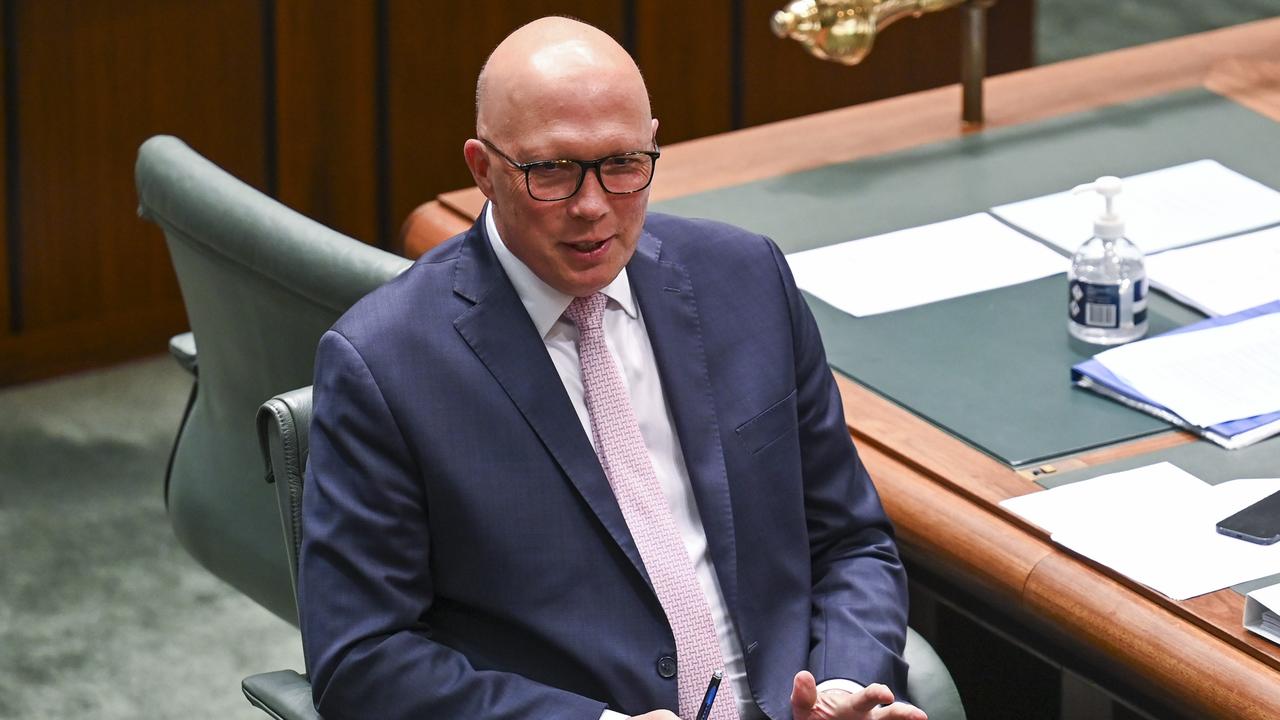
Opposition Leader Peter Dutton says nuclear power is the ‘only credible’ way to net zero. Picture: NCA NewsWire / Martin Ollman
Mr Dutton said nuclear reactors would provide a more reliable and cheaper source of clean energy.
“The Prime Minister’s had an opportunity to put forward a plan,” the Opposition Leader said.
“He doesn’t have the guts to stand up and make the decision that our country needs made and we do need to look at the best technology, zero emissions.
“I think it’s the only credible pathway we have to our international commitment to net zero by 2050.
But his plans have been ridiculed by the Albanese government, which argues it would take “decades” to build and delay Australia’s transition to clean energy.
“I look forward as well to [Mr Dutton] arguing where the financing will come for such reactors, whether taxpayers will be expected to pay for this, because we know the cheapest form of energy in Australia is renewables,” Mr Albanese said.
“Every ten years there are these proposals … what never comes is any investment, because it simply doesn’t stack up commercially.”
Treasurer Jim Chalmers blasted Mr Dutton’s “nuclear fantasy”, saying his plans to overturn laws to build nuclear module reactors would cost taxpayers hundreds of billions of dollars and set the country back in its efforts to reach net zero.
“It’s no surprise to anyone that Peter Dutton has gone for the most expensive option, the most divisive option and longest to build,” the Treasurer said on Tuesday.
“That’s because he’s more interested in cheap and divisive politics than cheap and reliable power. We see that in this more or less culture war over nuclear energy. This a nuclear fantasy.”
Mr Dutton said the technology was “unbelievable” compared with the 1950s and said rerouting the nation’s net-zero path towards nuclear would lead to greater financial relief for households.
Nuclear energy has been banned in Australia since laws were introduced in 1983.
A senate committee was told last year that if a ban on nuclear energy were to be overturned, it would take at least 10 to 15 years to have an operational nuclear power plant in Australia.
Nationals MP Bridget McKenzie said the opposition had anticipated pushback ahead of the announcement.
Independent MP Monique Ryan said the Coalition’s nuclear plan was unrealistic.
“Basically, what the Liberal National Party is doing is kicking the can down the road on the transition because they want to keep in with their friends. The big, you know, coal and gas suppliers because there is not a small functional small modular reactor in the world,” she said.
“I think it’s time that we acknowledge the fact that this is not a realistic plan.”…………………………………. more https://www.news.com.au/technology/environment/sustainability/treasurer-jim-chalmers-rips-into-opposition-leader-peter-duttons-nuclear-energy-plans/news-story/4eb130a74b64224f103e6841ed2a4283
Coalition MPs open to nuclear in their electorates
ABC News, 5 Mar 24
“…………………………………………………………………………………………. The electorates containing coal plants scheduled to close are held almost entirely by Liberal and National MPs, with the exception of Hunter MP Dan Repacholi.
Nationals MP Colin Boyce said the Callide Power Station could be a good option for a nuclear plant, if the community supported it.
“Absolutely on face value I would be supportive of looking at those options. The Callide Power Station at Biloela in central Queensland is number one on the list for closure according to the current Queensland government, so that site there, all the infrastructure that’s already there, the transmission lines, the water supplies, that would be somewhere to me that would be a reasonable outcome,” Mr Boyce said.
“I would suggest that site is a possible site for a possible nuclear small modular reactor, or something similar.
“Having said that we would have to take that to the community and gauge their thoughts on it before any decisions were made.”
He added that safety concerns held by some communities were valid, and that was why an honest conversation to address those concerns was necessary.
Nationals MP Darren Chester, who represents the seat of Gippsland where the Yallourn coal fired plant is scheduled to close, told the ABC last year he would consider a nuclear reactor in the Latrobe Valley if it made sense.
“If a potentially suitable site was identified for a nuclear power station in my electorate, it should be considered in a transparent manner with widespread consultation and an explanation of the potential costs and benefits,” Mr Chester said.
“If it was in the national interest and there were social, economic and environmental benefits, I’m sure that Gippslanders would be willing to have a constructive conversation about nuclear energy.”
Mr Chester told The Australian yesterday any government wanting to introduce nuclear would first have to reassure host communities safety concerns had been managed.
Nationals leader David Littleproud told Perth radio station 6PR yesterday he was ready to lead the way on the prospect of nuclear power in his electorate.
“I’ve got four coal fired power stations [in my electorate], I’ve made it very clear. I’m prepared to lead my community in that discussion,” he said.
“And we’ve got time, we don’t have to do all this by 2030.”
Liberal MP Rick Wilson said it would be premature to speculate on sites, but was open to the idea of a nuclear site in O’Connor.
Communities such as Collie in my electorate, which have experience hosting power stations, have high energy-IQ and their existing infrastructure and workforces could make them potential candidates to host a next-generation nuclear plant in the future,” Mr Wilson said.
He said like any major project, it would need the backing of the community.
Dan Repacholi, whose electorate contains plants scheduled for closure, has been contacted for comment. https://www.abc.net.au/news/2024-03-05/coalition-nuclear-plan-identifies-retiring-coal-likely-sites/103545440
Western Australia’s Premier Cook goes nuclear on Dutton’s ‘simplistic, ridiculous’ power plan
SMH, Hamish Hastie, March 5, 2024 —
A Coalition proposal to build nuclear power stations at the sites of retired or retiring coal stations is ridiculous and a distraction from efforts to reach net zero using renewables, West Australian Premier Roger Cook has said.
Opposition leader Peter Dutton floated the idea of building nuclear power stations on sites of retired coal stations – which could include the South West town of Collie – as a zero-emissions solution to the nation’s energy woes.
Cook blasted the Coalition proposal that federal Nationals leader David Littleproud was spruiking in WA this week as a fantasy.
“The rollout of small nuclear reactors or modular reactors in other countries has been halted because it’s not commercial, it’s not viable,” he said.
“In addition to that, Australia has no experience in nuclear power generation so we don’t have the workforce, we don’t have the know-how to be able to bring them in.
“You simply cannot plonk these things into a landscape and plug it into the grid. These simplistic sort of ideas are ridiculous.
“What we need to do is accept that climate change is a reality and move to exploit the abundance of wind and solar that we have at our disposal.
“There’s no quick fix here, you’ve got actually do the hard work and this is simply a sound grab by the Nationals to distract people from the real hard work which is being done.”……………………………………………………… https://www.smh.com.au/politics/western-australia/cook-goes-nuclear-on-dutton-s-simplistic-ridiculous-power-plan-20240305-p5fa0r.html
Talk of nuclear power plant sites ‘conjecture’, says Liberal MP amid internal division on Dutton’s policy
Rowan Ramsey says overturning ban on nuclear first is the ‘most logical thing’ to do as opposition leader prepares to nominate up to six locations
Paul Karp Chief political correspondent, Guardian, 5 Mar 24
The Liberal MP Rowan Ramsey has said any talk of where nuclear power plants would be built or waste would go is “conjecture” that cannot sensibly be tackled until after the nuclear ban is lifted.
As the opposition leader, Peter Dutton, prepares to announce an energy policy nominating up to six possible sites for nuclear plants, he faces internal divisions about the level of government support required, proposed locations and questions about storage of nuclear waste.
On Tuesday Dutton all but confirmed the Coalition will propose locating nuclear power plants on the site of retiring coal power plants, claiming that this would save having to build new transmission infrastructure for renewables.
The plan would suggest that the Labor-held seat of Hunter, independent Andrew Gee’s seat of Calare and Coalition-held Flynn, Maranoa, O’Connor and Gippsland are on the shortlist for nuclear power stations.
The Gippsland MP, Darren Chester, has argued that his community would need to receive “direct economic benefits” if it were to host power plants.
The Liberal MP for Sturt, James Stevens, has argued that community concerns must be allayed by explaining where and how waste will be stored. This opens another can of worms for the Coalition, as Australia has failed for decades to build a dump for its slowly accumulating intermediate nuclear waste.
Ramsey told Guardian Australia that Kimba, a proposed site for a waste dump in his South Australian electorate of Grey, was “never envisaged, planned or promised to hold high-level waste”……..
It is unclear how the Coalition’s nuclear policy hopes to overcome the enormous cost, long lead-in time and lack of private investment to make new power plants a reality.
Stevens said on Monday that “embracing nuclear generation for civilian electricity purposes is not something to be done on a whim” and that Australians would rightly want to know “how we will deal with some challenges, such as the custody of waste, the location of these generation plants”.
But the Liberal candidate for Cook, Simon Kennedy, who is likely to take Scott Morrison’s seat in parliament, argued on Tuesday that voters in his electorate are “used to” the idea of nuclear waste, because the Lucas Heights reactor – for production of medical and industrial isotopes – is “right outside the electorate”.
Kennedy told Sky News that Australians want “clean, cheap and reliable” power, accusing the Albanese government of being “ideological” for not considering nuclear.
Chester told Guardian Australia he has an “open mind when it comes to the public debate regarding nuclear energy in Australia”.
“It is premature to rule regions in or out as potential locations for a nuclear power station because there’s no proposal on the table,” he said.
“But as a matter of principle, you would need to be able to demonstrate to a potential host community, including Gippsland, that any safety concerns could be ameliorated and there were direct social and economic benefits to our community.”……………………………………
Jason Falinski, the former member for Mackellar and the New South Wales Liberal party president, told Sky News on Monday that “nuclear energy is not something that we are necessarily advocating for”.
“What we’re saying is that it should be part of the mix, part of the option available for Australian policymakers.”
On Tuesday the prime minister, Anthony Albanese, questioned where financing will come from and whether “taxpayers will be expected to pay” for nuclear, because “we know that nuclear is not only the most expensive form of new energy, it is also more than a decade off”.
“I noticed in today’s reports, [Dutton] seems to have backed away a little bit from talking about a technology that does not exist in small, modular reactors that he’s been speaking about,” Albanese told reporters on the sidelines of the Asean conference in Melbourne.
“He’s now speaking about large nuclear reactors. They need to be near populations and need to be near water.”
Albanese said “investment never comes” into nuclear because “it simply doesn’t stack up commercially”.
Dutton told reporters in Brisbane that nuclear is “the only credible pathway we have to our international commitments to net zero by 2050”.
Dutton would not rule out support for large-scale reactors, saying only that the Coalition wanted the “latest technology”.
“We’ve said we’re only interested in sites where you have an end-of-life coal-fired generation asset, so that means you can use the existing distribution network.”
Asked if taxpayers will have to support nuclear, Dutton did not respond but cited the Canadian province of Ontario and the United States as examples where businesses and households pay less for power with nuclear in the mix https://www.theguardian.com/australia-news/2024/mar/05/peter-dutton-liberal-coalition-nuclear-power-plant-policy-locations-waste-rowan-ramsey
Coalition’s plan to go nuclear puts five regions on the table as favoured locations for nuclear reactors
ABC News, By political reporter Jake Evans, 5 Feb 24
There are just a handful of regions in Australia shaping up as the most likely candidates for the Coalition’s proposal to install nuclear reactors in Australia, as the party eyes retiring coal stations as a way to go nuclear.
Opposition Leader Peter Dutton says he will be up front with voters about where the Coalition is looking to place potential nuclear reactors when the party announces its policy in coming weeks.
Speaking on Channel Seven this morning, Mr Dutton confirmed the party was “interested” in replacing retiring coal plants with nuclear, because the sites come ready with poles and wires to distribute power.
“If there’s a retiring coal asset, so there’s a coal fired generator that’s already got an existing distribution network, the wires and poles are already there to distribute the energy across the network into homes and businesses, that’s really what we’re interested in,” Mr Dutton said.
Doing so would leave just a narrow range of possible regions for a nuclear reactor.
The federal divisions of Gippsland in Victoria, Hunter in New South Wales, Maranoa and Flynn in Queensland and O’Connor in West Australia are the only electorates with coal plants scheduled to completely close in the next two decades.
There are also partial closures scheduled at Callide, Loy Yang and Vales Point in the NSW Central Coast, which would add Labor minister Pat Conroy’s electorate of Shortland to the list.
With its policy yet to be announced, it’s not clear what the Coalition considers as viable options.
Australia also still has a total ban on nuclear energy in place, which the Coalition would have to win the support of parliament to lift even if it won government at the next federal election.
And there are a number of safety and technical requirements for installing any nuclear reactor, such as geological stability and a readily available source of water.
The national science agency CSIRO has estimated nuclear energy from small modular reactors (SMRs), modern reactors built in a factory and then shipped to a site for installation, would also be more expensive than powering the grid through wind and solar.
The agency projected in its draft GenCost report that wind and solar would cost an average of $82 per megawatt hour by 2030, while SMR nuclear power would cost an average $282 by 2030.
Even if the nuclear ban was lifted tomorrow and a decision immediately taken to commission a nuclear reactor, CSIRO estimates the first SMR would not be in full operation before 2038, ruling it out of “any major role” in reaching net zero emissions by 2050.
Mr Dutton said nuclear reactors would provide a more reliable source of clean energy, and would avoid the need for thousands of kilometres of new transmission lines to be built.
“We need to make sure that we can firm up the renewables that are in the system. We know that of the G20 nations, Australia is the only nation that doesn’t have or hasn’t agreed to adopt nuclear power domestically,” he said.
Prime Minister Anthony Albanese said he looked forward to the Coalition announcing its nuclear policy.
“I look forward as well to [Mr Dutton] arguing where the financing will come for such reactors, whether taxpayers will be expected to pay for this, because we know the cheapest form of energy in Australia is renewables,” he said.
“Every ten years there are these proposals … what never comes is any investment, because it simply doesn’t stack up commercially…………………………………. https://www.abc.net.au/news/2024-03-05/coalition-nuclear-plan-identifies-retiring-coal-likely-sites/103545440
Silencing the Voice: the fossil-fuelled Atlas Network’s Campaign against Constitutional Recognition of Indigenous Australia
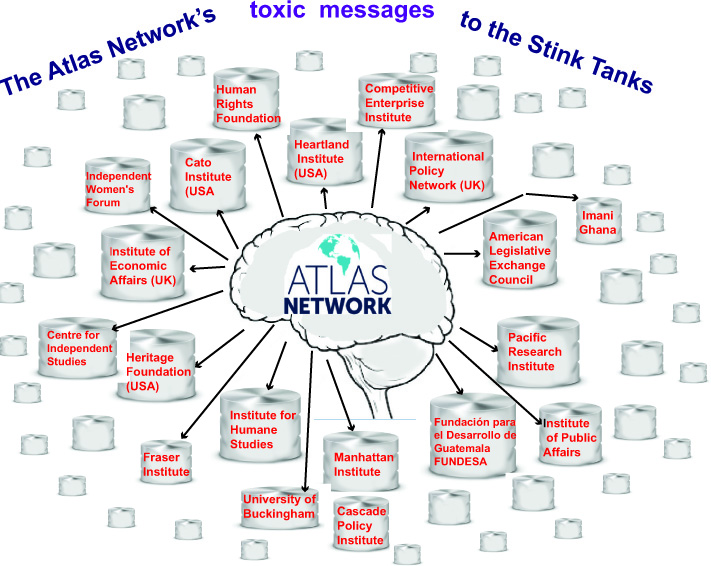
Jeremy Walker, University of Technology Sydney,Sep 30, 2023
Abstract
Australians will soon vote in a referendum to recognise Indigenous Australia in its 1901 Constitution and establish a First Nations Voice to Parliament. A year ago, polling suggested the referendum proposal of the 2017 National Constitutional Convention and its Uluru Statement from the Heart enjoyed 60% support. Since lead anti-Voice campaign organisation Advance Australia began its media offensive, the Yes vote has declined to 40%. This article argues the No campaign is being conducted on behalf of fossil-fuel corporations and their allies, whose efforts to mislead the public on life-and-death matters reach back over half a century. Coordinated across the Australian branches of the little-known Atlas Network, a global infrastructure of 500+ ‘think-tanks’ including the Centre for Independent Studies, the Institute of Public Affairs and LibertyWorks, I demonstrate that the No campaign shares the aims and methods of the longstanding Atlas disinformation campaign against climate policy. Opposition to long-overdue constitutional recognition for Indigenous Australians can be traced to fears the Voice might strengthen the capacity of Indigenous communities and Australia’s parliamentary democracy to rein in the polluting industries driving us toward climate and ecological collapse.
Article Details
Issue Vol 15 No 2 (2023)
Dutton wants a ‘mature debate’ about nuclear power. By the time we’ve had one, new plants will be too late to replace coal

If Dutton is serious about nuclear power in Australia, he needs to put forward a plan now. It must spell out a realistic timeline that includes the establishment of necessary regulation, the required funding model and the sites to be considered.
John Quiggin, Professor, School of Economics, The University of Queensland, 29 Feb 24, https://theconversation.com/dutton-wants-a-mature-debate-about-nuclear-power-by-the-time-weve-had-one-new-plants-will-be-too-late-to-replace-coal-224513
If you believe Newspoll and the Australian Financial Review, Australia wants to go nuclear – as long it’s small.
Newspoll this week suggests a majority of us are in favour of building small modular nuclear reactors. A poll of Australian Financial Review readers last year told a similar story.
These polls (and a more general question about nuclear power in a Resolve poll for Nine newspapers this week) come after a concerted effort by the Coalition to normalise talking about nuclear power – specifically, the small, modular kind that’s meant to be cheaper and safer. Unfortunately, while small reactors have been around for decades, they are generally costlier than larger reactors with a similar design. This reflects the economies of size associated with larger boilers.
The hope (and it’s still only a hope) is “modular” design will permit reactors to be built in factories in large numbers (and therefore at low cost), then shipped to the sites where they are installed.
Coalition enthusiasm for talking about small modular reactors has not been dented by the failure of the only serious proposal to build them: that of NuScale, a company that designs and markets these reactors in the United States. Faced with long delays and increases in the projected costs of the Voygr reactor, the intended buyers, a group of municipal power utilities, pulled the plug. The project had a decade of development behind it but had not even reached prototype stage.
Other proposals to build small modular reactors abound but none are likely to be constructed anywhere before the mid-2030s, if at all. Even if they work as planned (a big if), they will arrive too late to replace coal power in Australia. So Opposition Leader Peter Dutton needs to put up a detailed plan for how he would deliver nuclear power in time.
So why would Australians support nuclear?
It is worth looking at the claim that Australians support nuclear power. This was the question the Newspoll asked:
There is a proposal to build several small modular nuclear reactors around Australia to produce zero-emissions energy on the sites of existing coal-fired power stations once they are retired. Do you approve or disapprove of this proposal?
This question assumes two things. First, that small modular reactors exist. Second, that someone is proposing to build and operate them, presumably expecting they can do so at a cost low enough to compete with alternative energy sources.
Unfortunately, neither is true. Nuclear-generated power costs up to ten times as much as solar and wind energy. A more accurate phrasing of the question would be:
There is a proposal to keep coal-fired power stations operating until the development of small modular reactors which might, in the future, supply zero-emissions energy. Do you approve or disapprove of this proposal?
It seems unlikely such a proposal would gain majority support.
Building nuclear takes a long time
When we consider the timeline for existing reactor projects, the difficulties with nuclear power come into sharp focus.
As National Party Senate Leader Bridget McKenzie has pointed out, the most successful recent implementation of nuclear power has been in the United Arab Emirates. In 2008, the UAE president (and emir of Abi Dhabi), Mohamed bin Zayed Al Nahyan, announced a plan to build four nuclear reactors. Construction started in 2012. The last reactor is about to be connected to the grid, 16 years after the project was announced.
The UAE’s performance is better than that achieved recently in Western countries including the US, UK, France and Finland.
In 16 years’ time, by 2040, most of Australia’s remaining coal-fired power stations will have shut down. Suppose the Coalition gained office in 2025 on a program of advocating nuclear power and managed to pass the necessary legislation in 2026. If we could match the pace of the UAE, nuclear power stations would start coming online just in time to replace them.
If we spent three to five years discussing the issue, then matched the UAE schedule, the plants would arrive too late.
It would take longer in Australia
Would it be possible to match the UAE schedule? The UAE had no need to pass legislation: it doesn’t have a parliament like ours, let alone a Senate that can obstruct government legislation. The necessary institutions, including a regulatory commission and a publicly owned nuclear power firm, were established by decree.
There were no problems with site selection, not to mention environmental impact statements and court actions. The site at Barakah was conveniently located on an almost uninhabited stretch of desert coastline, but still close enough to the main population centres to permit a connection to transmission lines, access for workers, and so on. There’s nowhere in Australia’s eastern states (where the power is needed) that matches that description.
Finally, there are no problems with strikes or union demands: both are illegal in the UAE. Foreign workers with even less rights than Emirati citizens did almost all the construction work.
Despite all these advantages, the UAE has not gone any further with nuclear power. Instead of building more reactors after the first four, it’s investing massively in solar power and battery storage.
Time to start work is running out
The Coalition began calling for a “mature debate” on nuclear immediately after losing office.
But it’s now too late for discussion. If Australia is to replace any of our retiring coal-fired power stations with nuclear reactors, Dutton must commit to this goal before the 2025 election.
Talk about hypothetical future technologies is, at this point, nothing more than a distraction. If Dutton is serious about nuclear power in Australia, he needs to put forward a plan now. It must spell out a realistic timeline that includes the establishment of necessary regulation, the required funding model and the sites to be considered.
In summary, it’s time to put up or shut up.
Andrew Forrest attacks Coalition’s nuclear “bulldust” and betraying the bush
Rachel Williamson, Feb 26, 2024, https://reneweconomy.com.au/andrew-forrest-attacks-coalitions-nuclear-bulldust-and-betraying-the-bush/—
Mining billionaire and green energy evangelist Dr Andrew Forrest has come out swinging against the deepening support for nuclear, and the aversion to wind and solar power within the National and Liberal parties in the name of farmers.
Forrest called on the federal government to speed up the transition away from carbon-intensive industries via three “simple” policies, and called on the government-in-waiting to stop spreading misinformation about renewables.
In the last fortnight opposition leader Peter Dutton doubled down on his calls for small modular nuclear reactors to be put in small Australian towns, saying he’d put one on the former Alcoa mine and power station site in the coastal Victorian town of Anglesea, while energy spokesman Ted O’Brien would put one in the Latrobe Valley.
Nationals leader David Littleproud also wants to stop the rollout of large scale renewables in Australia because rural areas are “saturated” with them, and wants to limit the energy transition to residential rooftop solar and arrays on commercial buildings.
Forrest pooh-poohed their understanding of the economics of major projects, saying the Coalition proposals would leave Australia “destitute” because of the enormously cost of nuclear compared to wind and solar.
“I ask you who claim to represent the bush now to stop dividing us with the false hope that we can cling to fossil fuels forever,” Forrest said during a talk at the National Press Club.
” We can’t, so please stop betraying the bush. If we swallow this new lie that we should stop the rollout of green energy, and that nuclear energy will be a fairy godmother, we will be worse off again.
“These misinformed, unscientific, uneconomic plucked out of thin air, bulldust nuclear policies, [from] politicians masquerading as leaders, helps no one. Politicians who do whatever they can to discourage votes are just politicians, they are not political leaders.”
Forrest cited in particular the misinformation that Australian farmers will have to give up huge tracts of land to enable the green energy transition (a meme advanced by the Institute of Public Affairs and repeated by the likes or rival iron ore billionaire Gina Rinehart and the Coalition.
Forrest also announced a fund to help with wind and solar farm decommissioning and calling on the federal government to better regulate renewables developers to ensure they set aside money for that purpose.
It’s easy with three “simple” policies
Forrest wants to see a test for all major projects that explicitly considers climate impacts, for the country to lean into least cost, firmed renewables, and for the carbon levy proposed by Rod Sims and Ross Garnaut on fossil fuel imports and exports.
“We can circuit break the cost of living crisis, turn around unemployment and play our full part in decarbonizing at least to 6 per cent of global emissions through new green export industries,” he said.
“Australia can generate not one but many of its own Australian Aramcos with the right policy settings. We can achieve all these with three simple policies.”
An impact test would create a climate trigger for every project requiring government approval, making carbon emissions and global warming automatically part of any environmental assessment.
US president Biden has already taken some action in this vein by pausing LNG export projects pending an assessment of the impacts on climate change.
Forrest claimed that it is the US’ “forward thinking climate strategy” and not the enormous funding on offer under the inflation Reduction Act (IRA) that is why Fortescue is building a liquid green hydrogen project in Phoenix, Arizona.
The second policy recommendation, leaning into renewables, repeats calls to roll out renewables faster in order to bring down the cost of electricity for Australians, while the third demanded an end to the “free ride” of fossil fuel companies via a carbon levy.
“The multi decadal polluting companies have exploited vicious lobbying for approvals so they can crowd out green energy, so they can prevent Australians from having the choice between cheaper green energy, which would destroy their livelihoods,” Forrest said.
“Let’s be clear for the sake of the visionless, a carbon solutions levy is not a carbon tax… it would only be applied to the 100-odd fossil fuel extraction sites in Australia and to importers, who are stopping us making our own energy. The beauty of this levy is that it does not penalise everyday Australians.
“It only penalises that the perpetrators of this crisis, the fossil fuel industry… Existing gas projects will continue to operate, they’ll just have to pay the levy. They’ll just have to pay their way. That’ll be new.”
He even called out taxpayer support for miners to use imported diesel, naming his own company Fortescue as one beneficiary.
“Their lobby groups quickly hide behind the Australian farm to defend the diesel fuel rebate. But they know that the vast proportion of the money goes to big mining and fossil fuel companies, not Australia’s farmers or fishermen.
” The ridiculousness of the rich crying out for more fossil fuel subsidies while denying climate change will surely go down as one of the most perversely selfish behaviours in Australian history.”
Fossil fuel subsidies increased to a record-breaking $57.1 billion in 2023, up from the $55.3 billion forecast in the 2022 budget, according to a report by The Australia Institute last year.
The Fuel Tax Act which subsidises the consumption of diesel, has cost over $95 billion in tax foregone to the Australian economy, via the Fuel Tax Credit Scheme (FTCS), since it was legislated in 2006.
Andrew Forrest and Peter Dutton are on a collision course over Nuclear Power
National Times 26 Feb 24
Andrew ‘Twiggy’ Forrest labels Coalition push for nuclear energy ‘bulldust’ and a ‘new lie’ ( Paul Karp Chief political correspondent for The Guardian)
Mining billionaire says cost of nuclear will be four to five times that of renewables and opposition’s policy is ‘an excuse for doing nothing’
The mining billionaire Andrew “Twiggy” Forrest has labelled the Coalition’s push for nuclear energy “bulldust” and a “new lie” that would delay the clean energy transition and harm regional Australia.
The executive chair and founder of mining company Fortescue and the renewable energy investor Tattarang on Monday urged the opposition to stop advocating expensive and unfeasible alternatives to renewables.
The Coalition is yet to produce a costed energy policy, despite arguing to lift Australia’s ban on nuclear energy and recent comments from the Nationals leader, David Littleproud, that expanded rooftop solar could be rolled out instead of large-scale renewables.
The Liberals and Nationals have complained that large-scale renewables and transmission projects will ruin agricultural land, despite experts debunking the extent of this claimed impact.
Forrest told the National Press Club that “even the fossil fuel industry has taken responsibility” for global heating, and that “doing nothing” is not an option, with Australia to face tariffs from the European Union if it doesn’t reduce emissions.
Forrest told politicians who “claim to represent the bush” – a reference to the Nationals – to “stop dividing us with the false hope that we can cling to fossil fuels for ever … We can’t. So, please stop betraying the bush.”
“If we swallow this new lie that we should stop the rollout of green energy and that nuclear energy will be our fairy godmother, we will be worse off again,” he said.
Forrest said it was “hopeless” that politicians are asking Australians “to wait for new technology in 20 years’ time that may never happen”.
“It’s just an excuse for doing nothing. This is the straight admission that fossil fuels have to go, but their solutions risk leaving us destitute.”
According to energy department estimates for the Albanese government, replacing Australia’s coal power plants with nuclear would cost $387bn.
Forrest said he had “done the numbers” and nuclear will cost four to five times more than renewables, which can reduce emissions within a few years.
“A leader will remind the farming community offline that global warming is real and that all their customers are taking it very seriously,” he said.
“Instead of knocking a slow-moving, gracious wind turbine, try a nuclear power plant or a belching coal plant next door.
“The fact that we can feel climate change already despite the ocean soaking up most of out heat-generated emissions means Australia has finally run out of time.
“We get the next few years wrong and Australia’s economy and the rest of us cook. We get it right, and Australia enjoys decades of economic growth, full employment and reinvigoration of its natural environment.”
Forrest backed the proposal for a carbon solutions levy to raise $100bn, advanced by Ross Garnaut, a leading economist during the Hawke government, and Rod Sims, a former head of the competition watchdog.
Forrest also called for a green hydrogen tax credit to grow the industry, on top of the $2bn hydrogen head start fund, and a climate trigger to block approval of major projects if they contribute to global heating.
Forrest announced that Squadron, his renewable energy venture, will create an industry fund for decommissioning wind turbines so landowners can have “peace of mind” that the landscape will not be harmed if turbines are not renewed and extended.
Sarah Hanson-Young, the Greens environment spokesperson, said that “business leaders like Forrest can see that, for the sake of our environment and economy, we need to stop expanding fossil fuels”.
“Forrest backed the growing call for a climate trigger in environment law and I hope that Labor were listening.”
Earlier on Monday the shadow energy and climate change minister, Ted O’Brien, told reporters in Canberra there was “no doubt that the experts are advising us that one of the best places to locate zero-emissions nuclear reactors would be where coal plants are retired”.
O’Brien accused Labor of “steamrolling regional communities” to build renewables, but could not say what the Coalition would do if communities around existing coal power stations objected to nuclear power.
O’Brien was unable to say how much nuclear power would cost, responding that “a lot of questions that can only be answered once we release our policy”.
“We have been formulating an all-of-the-above [technologies], balanced policy for Australia’s future energy mix.”
No nuclear option for $275m green-manufacturing and innovation grants
Sam McKeith, Feb 26, 2024, https://reneweconomy.com.au/green-manufacturing-gets-275m-boost-with-launch-of-innovation-grant-scheme/
Grants from a NSW $275 million green manufacturing fund will not go towards nuclear projects as the state says the technology is not part of its plans to reach net-zero emissions.
Under the Net Zero Manufacturing Initiative program, announced on Monday, businesses can access grants for manufacture of renewable energy systems, low-carbon products and clean-technology innovation.
The program is part of the state’s legislated pledge to cut greenhouse gas emissions to 50 per cent of 2005 levels by 2030 and hit net zero by 2050.
But Climate Change Minister Penny Sharpe ruled out any grants going to projects such as the development of small modular nuclear reactors, despite a Newspoll on Monday showing two-thirds of younger Australians backed the technology.
“We’re looking at, even if you wanted to start today … a 14-year horizon to get it in the ground, which we don’t actually have,” she told reporters.
“The second point that I make is that nuclear energy is 350 per cent more expensive than renewables.”
Premier Chris Minns said the grants would bolster local manufacturing in the renewable and clean-technology industries, especially among small and medium-sized firms.
“The thing I like about this so much is that it enhances what is taking place in our research universities in the state as it currently stands,” he said.
The initiative will focus on lab-proven tech and the build of “market-ready products” ready to be scaled up and rolled out in NSW, the government says.
It comes as the state scrambles to replace ageing coal power stations with renewable energy to meet its emission targets, while also trying to keep a lid on power prices and maintain capacity.
Proponents of nuclear power are peddling hot air
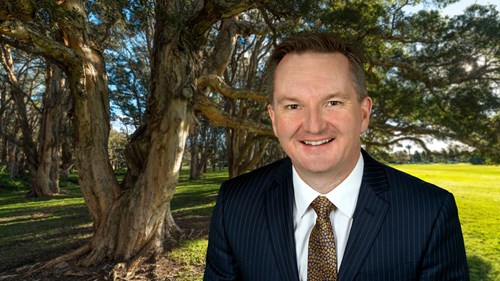
Chris Bowen, Minister for Climate Change and Energy, Australia
Chris Bowen, 24 February 2024. https://minister.dcceew.gov.au/bowen/media-releases/opinion-piece-proponents-nuclear-power-are-peddling-hot-air
Opponents of cleaner, cheaper renewables have used a particularly spectacular contortion of logic to claim the recent catastrophic storms in Victoria and the resulting power outages as evidence of the folly of acting on climate change and boosting renewables.
Predictably, nuclear energy advocates seized on the Victorian events and temporary power outage to re-energise their campaign for Australia to start a nuclear energy industry.
Let’s be clear upfront. Nuclear is not being pushed as a genuine alternative to renewables. It’s being used as a distraction and a delaying tactic.
It’s also quite the feat to assert that had it been nuclear rather than renewables, a coal-fired electricity generator in Victoria wouldn’t have shut itself down as protection against surges from storm-damaged transmission. It’s an even greater leap essentially to assert that a grid under the LNP would involve no distribution – given the vast majority of outages were caused by extreme damage to the distribution network – including from the half a million lightning strikes in eight hours.
Will nuclear powered electricity be transmitted by osmosis? By Bluetooth? By a vibe? Whether your energy comes from coal, nuclear, gas or renewables, if poles and wires are down, electricity won’t get where it needs to go.
The pro-nuclear argument is two-pronged. That the world has realised the perils of renewables and is experiencing a nuclear renaissance, and Australia is missing out.
And that nuclear is much cheaper than renewable energy, once upgrading and expanding the grid is factored in.
Both these arguments collapse faster than a tree in a lightning strike when exposed to the facts.
Global investment in renewable energy sources constitutes three quarters of all power generation investment.
Take just solar, for example. Last year, the world installed 440GW of renewable capacity. This is more than the world’s entire existing nuclear capacity built up through decades of investment. By early 2025, renewable energy will surpass coal as the planet’s largest source of energy, while coal, gas and nuclear will all shrink their market share.
Nuclear and coal combined, however, account for only 16 per cent of new global power investment. In 2005, electricity companies in the US pledged to build more than 30 reactors. Only four ever commenced construction. Two were abandoned due to massive cost and time delays.
The alleged boom in Small Modular Reactors is also a mirage. China and Russia are the only two countries to have installed them. The US has now abandoned its “flagship” commercial-scale pilot SMR (promised back in 2008), wearing 70 per cent cost blowouts without having started construction on a single reactor.
We know the Russian SMRs have extraordinarily low load factors and that nuclear waste from the SMR process is disproportionate to their output. The Chinese data is more opaque, but given SMRs generate about 300MW (compared to a coal-fired power station at 2000MW), we have no reason to believe there is anything approaching a serious contribution to China’s energy demand from their two units.
My shadow minister predicted that last year’s Dubai COP would be remembered as the “nuclear COP”. Not so much. Twenty three countries have pledged to triple nuclear energy by 2050, while 124 countries pledged to triple renewable energy investment within the next six years, before the nuclear dream even gets started.
Then there is cost. Contrary to myth, GenCost does include the cost of transmission and storage, and the CSIRO-AEMO GenCost conclusions about the chasm between nuclear and renewables costs could not be clearer.
But if you don’t want to accept eminent and independent practitioners at those organisations, then you can have a look at the Bulletin of Atomic Scientists, which estimates it will cost $US15 trillion to triple nuclear capacity. Or University College London, which recently found that “new nuclear capacity is only cost effective if ambitious cost and construction times are assumed”.
And if you don’t like University College London’s research, ask the merchant bank Lazard, which shows levelised cost of nuclear to be four times higher than utilityscale solar and wind.
Then look at how many nuclear projects are falling over because of cost and time overruns. The UK’s Hinkley C nuclear plant was promised to be “cooking Christmas turkeys by 2017”. It’s yet to warm a single drumstick, with latest costings at more than $86bn. Who in Australia does the opposition energy spokesman expect will be footing those kind of bills?
Like many things in the climate debate, the push for nuclear power has taken on a singular importance in the culture wars. It’s striking that a party that once prided itself on economic rationalism could embrace a frolic so spectacularly uneconomic. This is the triumph of culture wars over climate pragmatism in the alternative government.
The LNP has been promising to reveal the details of its long nuclear fairytales soon. It can’t come soon enough.
No plan for nuclear power in Australia will survive contact with reality. The Australian people deserve more than hot air to power their homes and businesses.
“Stop dividing us”: Andrew Forrest attacks pro-nuclear politicians

Rachel Williamson, https://reneweconomy.com.au/stop-dividing-us-andrew-forrest-attacks-pro-nuclear-politicians/
Mining billionaire and green energy evangelist Dr Andrew Forrest has come out swinging against the deepening support for nuclear, and the aversion to wind and solar power within the National and Liberal parties in the name of farmers.
Forrest called on the federal government to speed up the transition away from carbon-intensive industries via three “simple” policies, and called on the government-in-waiting to stop spreading misinformation about renewables.
In the last fortnight opposition leader Peter Dutton doubled down on his calls for small modular nuclear reactors to be put in small Australian towns, saying he’d put one on the former Alcoa mine and power station site in the coastal Victorian town of Anglesea, while energy spokesman Ted O’Brien would put one in the Latrobe Valley.
Nationals leader David Littleproud also wants to stop the rollout of large scale renewables in Australia because rural areas are “saturated” with them, and wants to limit the energy transition to residential rooftop solar and arrays on commercial buildings.
Forrest pooh-poohed their understanding of the economics of major projects, saying the Coalition proposals would leave Australia “destitute” because of the enormously cost of nuclear compared to wind and solar.
“I ask you who claim to represent the bush now to stop dividing us with the false hope that we can cling to fossil fuels forever,” Forrest said during a talk at the National Press Club.
” We can’t, so please stop betraying the bush. If we swallow this new lie that we should stop the rollout of green energy, and that nuclear energy will be a fairy godmother, we will be worse off again.
“These misinformed, unscientific, uneconomic plucked out of thin air, bulldust nuclear policies, [from] politicians masquerading as leaders, helps no one. Politicians who do whatever they can to discourage voters are just politicians, they are not political leaders.”
Forrest cited in particular the misinformation that Australian farmers will have to give up huge tracts of land to enable the green energy transition (a meme advanced by the Institute of Public Affairs and repeated by the likes or rival iron ore billionaire Gina Rinehart and the Coalition.
Forrest also announced a fund to help with wind and solar farm decommissioning and calling on the federal government to better regulate renewables developers to ensure they set aside money for that purpose.
It’s easy with three “simple” policies
Forrest wants to see a test for all major projects that explicitly considers climate impacts, for the country to lean into least cost, firmed renewables, and for the carbon levy proposed by Rod Sims and Ross Garnaut on fossil fuel imports and exports.
“We can circuit break the cost of living crisis, turn around unemployment and play our full part in decarbonizing at least to 6 per cent of global emissions through new green export industries,” he said.
“Australia can generate not one but many of its own Australian Aramcos with the right policy settings. We can achieve all these with three simple policies.
An impact test would create a climate trigger for every project requiring government approval, making carbon emissions and global warming automatically part of any environmental assessment.
US president Biden has already taken some action in this vein by pausing LNG export projects pending an assessment of the impacts on climate change.
Forrest claimed that it is the US’ “forward thinking climate strategy” and not the enormous funding on offer under the inflation Reduction Act (IRA) that is why Fortescue is building a liquid green hydrogen project in Phoenix, Arizona.
The second policy recommendation, leaning into renewables, repeats calls to roll out renewables faster in order to bring down the cost of electricity for Australians, while the third demanded an end to the “free ride” of fossil fuel companies via a carbon levy.
“The multi decadal polluting companies have exploited vicious lobbying for approvals so they can crowd out green energy, so they can prevent Australians from having the choice between cheaper green energy, which would destroy their livelihoods,” Forrest said.
“Let’s be clear for the sake of the visionless, a carbon solutions levy is not a carbon tax… it would only be applied to the 100-odd fossil fuel extraction sites in Australia and to importers, who are stopping us making our own energy. The beauty of this levy is that it does not penalise everyday Australians.
“It only penalises that the perpetrators of this crisis, the fossil fuel industry… Existing gas projects will continue to operate, they’ll just have to pay the levy. They’ll just have to pay their way. That’ll be new.”
He even called out taxpayer support for miners to use imported diesel, naming his own company Fortescue as one beneficiary.
“Their lobby groups quickly hide behind the Australian farm to defend the diesel fuel rebate. But they know that the vast proportion of the money goes to big mining and fossil fuel companies, not Australia’s farmers or fishermen.
” The ridiculousness of the rich crying out for more fossil fuel subsidies while denying climate change will surely go down as one of the most perversely selfish behaviours in Australian history.”
Fossil fuel subsidies increased to a record-breaking $57.1 billion in 2023, up from the $55.3 billion forecast in the 2022 budget, according to a report by The Australia Institute last year.
The Fuel Tax Act which subsidises the consumption of diesel, has cost over $95 billion in tax foregone to the Australian economy, via the Fuel Tax Credit Scheme (FTCS), since it was legislated in 2006.
1 This month
25 October – Film –Britain’s Nuclear Bomb Scandal: Our Story – part of the Adelaide Film Festival,
Screening and Conversation
A screening of Britain’s Nuclear Bomb Scandal: Our Story (2024) followed by a talk with 2026 Bettison and James Awardee and Tradtional Owner Karina Lester in conversation with Simone Tur.
When: Sun 25 Oct, 12:00pm-Screening, 1:15pm-Talk
Where: The Mercury
Free admission, register below by clicking on BUY TICKETS and select free event tickets, at end of web page:
https://www.adelaidefilmfestival.org/program/2026/britains-nuclear-bomb-scandal-our-story
.

Australians deserve the truth
about
AUKUS – https://aukuspublicinquiry.com/

PETITION – To: Prime Minister Anthony Albanese and the Australian Labor Government

of the week – Australians for War Powers Reform (AWPR)
To see nuclear-related stories in greater depth and intensity

