Cold turkeys: The demise of nuclear power
Jim Green, Mar 12, 2024, https://reneweconomy.com.au/cold-turkeys-the-demise-of-nuclear-power-in-australias-aukus-partner-countries/
When announcing the AUKUS agreement in 2021, then Prime Minister (and secret energy minister) Scott Morrison said: “Let me be clear: Australia is not seeking to establish … a civil nuclear capability.” He also said that “a civil nuclear energy industry is not a requirement for us to go through the submarine program.”
However, Coalition Senators argued in a report last year that Australia’s “national security” would be put at risk by retaining federal legislation banning nuclear power and that the “decision to purchase nuclear submarines makes it imperative for Australia to drop its ban on nuclear energy.”
So, let’s see how nuclear power is faring in our AUKUS partners, the UK and the US.
This is a story about conventional, large reactors. All that needs to be said about ‘small modular reactors’ in the UK and the US is that none exist and none are under construction.
This is a story about conventional, large reactors. All that needs to be said about ‘small modular reactors’ in the UK and the US is that none exist and none are under construction.
The UK
The last power reactor start-up in the UK was 29 years ago — Sizewell B in 1995.
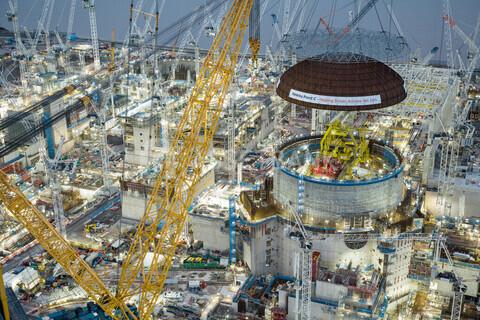
Over the past decade, several proposed new nuclear power plants have been abandoned (Moorside, Wylfa, Oldbury) and the only project to reach the construction stage is Hinkley Point C, comprising two French-designed EPR reactors.
In the late 2000s, the estimated construction cost for one EPR reactor in the UK was £2 billion (A$3.9 billion). When construction of two EPR reactors at Hinkley Point commenced in 2018 and 2019, the cost estimate for the two reactors was £19.6 billion.
The current cost estimate for the two reactors has ballooned to £46 billion (A$89 billion) or £23 billion (A$44.5 billion) per reactor. That is 11.5 times higher than the estimate in the late 2000s. Further cost overruns are certain. This is an example of the Golden Rule of Nuclear Economics: Add a Zero to Nuclear Industry Estimates.
The UK National Audit Office estimates that taxpayer subsidies for Hinkley Point — primarily in the form of a guaranteed payment of £92.50 (A$180) per megawatt-hour (2012 prices), indexed for inflation, for 35 years — could amount to £30 billion (A$58 billion) while other credible estimates put the figure as high as £48.3 billion (A$94 billion).
Delays
The delays associated with Hinkley Point have been as shocking as the cost overruns. In 2007, French utility EDF boasted that Britons would be using electricity from an EPR reactor at Hinkley Point to cook their Christmas turkeys in 2017. In 2008, the UK government said the reactors would be complete “well before 2020”.
But construction of the two reactors didn’t even begin until 2018 and 2019, respectively, at which time completion was expected in 2026. Now, completion is expected in 2030 or 2031.
Undoubtedly there will be further delays and if the reactors are completed, it will be more than a quarter of a century after the 2007 EDF boast that Britons would finally be using electricity from Hinkley Point to cook their Christmas turkeys.
Construction will take well over 10 years; planning and construction over 25 years. Yet in Australia, the Coalition argues that Australians could be cooking Christmas turkeys with nuclear power 10 years from now.
‘Something of a crisis’
Nuclear industry lobbyist Tim Yeo said in 2017 that the UK’s nuclear power program faced “something of a crisis”. The following year, Toshiba abandoned the planned Moorside nuclear power project near Sellafield despite generous offers of government support — a “crushing blow” according to Yeo.
Then in 2019, Hitachi abandoned the planned Wylfa reactor project in Wales after the estimated cost of the twin-reactor project had risen by 50 percent.
Hitachi abandoned the project despite an offer from the UK government to take a one-third equity stake in the project; to consider providing all of the required debt financing; and to consider providing a guarantee of a generous minimum payment per unit of electricity.
Long gone was the 2006 assertion from then UK industry secretary Alistair Darling that the private sector would have to “initiate, fund, construct and operate” nuclear power plants.
The UK Nuclear Free Local Authorities noted that Hitachi joined a growing list of companies and utilities backing out of the UK nuclear new-build program:
“Let’s not forget that Hitachi are not the first energy utility to come to the conclusion that new nuclear build in the UK is not a particularly viable prospect. The German utilities RWE Npower and E-on previously tried to develop the site before they sold it on Hitachi in order to protect their own vulnerable energy market share in the UK and Germany.
“British Gas owner Centrica pulled out of supporting Hinkley Point C, as did GDF Suez and Iberdrola at Moorside, before Toshiba almost collapsed after unwise new nuclear investments in the United States forced it to pull out of the Sellafield Moorside development just a couple of months ago.”
Sizewell C

The UK government hopes to progress the Sizewell C project in Suffolk, comprising two EPR reactors, and is once again offering very generous support including taking an equity stake in the project and using a ‘regulated asset base‘ model which foists financial risks onto taxpayers and could result in taxpayers paying billions for failed projects — as it has in the US.
If recent experience is any guide, the government will struggle to find corporations or utilities willing to invest in Sizewell regardless of generous government support.
(The same could be said for plans for small modular reactors or mid-sized reactors envisaged by Rolls-Royce — it is doubtful whether private finance can be secured despite generous taxpayer subsidies.)
Many reactors have been permanently shut down in the UK: the IAEA lists 36 such reactors. Since the Sizewell B reactor startup in 1995, there have been 24 permanent reactors shut-downs and zero startups.
Repeat: since the last reactor startup in the UK, there have been 24 shut-downs!
The capacity of the nine remaining reactors (5.9 gigawatts — GW) is less than half of the peak of 13 GW in the late 1990s. Nuclear power’s contribution to electricity supply has fallen from 22 percent in the early 2000s to 14.2 percent.
Meanwhile, the UK government reports that renewable power sources accounted for 44.5 percent of total UK generation in the third quarter of 2023, a higher share than fossil fuels and around three times more than nuclear’s share.
What to make of the conservative UK government’s goal of quadrupling nuclear capacity to 24 GW by 2050? It is deeply implausible. The facts speak for themselves. Two dozen reactor shutdowns and zero startups since 1995.
The Hinkley Point project has been extremely slow and extremely expensive. The Sizewell C project is uncertain. Other proposals — including proposals for small modular reactors — are even more uncertain and distant.
Unsurprisingly, the extraordinary cost overruns and delays associated with Hinkley Point have complicated plans to advance the proposed Sizewell C project.
In 2010, the UK government announced that Sizewell was one of the locations slated for new reactors. Fourteen years later, construction is some years away and it remains uncertain if the project will reach the construction stage. EDF and the UK government are seeking to raise a further £20 billion from new investors. All reasonable offers considered.
France
The Sizewell C project is equally complicated across the channel due to EDF’s massive debts and its plan to replace the EPR design with an EPR2 design, about which little is known except that safety will be sacrificed on the altar of economics. EDF’s debt as of early 2023 was €64.5 billion (A$107 billion) and it was fully nationalised later in 2023 due to its crushing debts.
In addition to its adventures across the channel, EDF has a “colossal maintenance and investment programme to fund” in France as the Financial Times noted in October 2021.
As in the UK, there has not been a single reactor startup in France since the last millennium. The only current reactor construction project is one EPR reactor under construction at Flamanville. The current cost estimate of €19.1 billion (A$31.6 billion) is nearly six times higher than the original estimate of €3.3 billion (A$5.5 billion).
Construction of the Flamanville reactor began in 2007 and it remains incomplete 17 years later. Planning plus construction have taken over a quarter of a century. Yet the Coalition argues that Australians could be cooking Christmas turkeys with nuclear power 10 years from now.
France’s nuclear industry was in its “worst situation ever“, a former EDF director said in 2016 — and the situation has worsened since then. Another former EDF director said in early 2024 that the French nuclear industry is “on a slow descent to hell” and he has “fierce doubts about EDF’s ability to build more reactors.”
The US

The V.C. Summer project in South Carolina (two AP1000 reactors) was abandoned in 2017 after the expenditure of around US$9 billion (A$13.6 billion). Construction began in 2013 and the project was abandoned in 2017.
The project was initially estimated to cost US$11.5 billion; when it was abandoned, the estimate was US$25 billion (A$38 billion).
Largely as a result of the V.C. Summer disaster, Westinghouse filed for bankruptcy in 2017 and its parent company Toshiba only avoided bankruptcy by selling its most profitable assets. Both companies decided that they would no longer take on the huge risks associated with reactor construction projects. A year earlier, Westinghouse said its goal was to win overseas orders for at least 45 AP1000 reactors by 2030.
Criminal investigations and prosecutions related to the V.C. Summer project are ongoing: the fiasco is known as the ‘nukegate’ scandal.
Vogtle

With the abandonment of the V.C. Summer project in South Carolina, the only remaining reactor construction project in the US was the Vogtle project in Georgia (two AP1000 reactors).
Construction of the Vogtle reactors began in 2013 and the expected completion dates of 2016 and 2017 were pushed back seven years to 2023 and 2024. In 2014, Westinghouse claimed a three-year construction schedule for AP1000 reactors but the Vogtle reactors took 10 and 11 years to complete.
The first licence application for the Vogtle project was submitted in 2006 so planning and construction took 17 years in addition to the time spent before the 2006 application.
The latest cost estimate for the Vogtle project is $34 billion (A$51 billion), more than twice the estimate when construction began (US$14–15.5 billion). The project only survived because of multi-billion-dollar taxpayer bailouts.
In 2006, Westinghouse said it could build an AP1000 reactor for as little as US$1.4 billion (A$2.1 billion) — 12 times lower than the latest Vogtle estimate of US$17 billion (A$25.5 billion) per reactor. Another example of the Golden Rule of Nuclear Economics: Add a Zero to Nuclear Industry Estimates.
Corruption scandals
In 2005, the US Nuclear Energy Institute claimed that Westinghouse’s estimate of US$1,365 per kilowatt “has a solid analytical basis, has been peer-reviewed, and reflects a rigorous design, engineering and constructability assessment.”
In fact, the estimate was out by an order of magnitude and the Institute’s involvement in a raft of corruption scandals has been exposed. No doubt the Dutton Coalition would happily parrot whatever lies the Institute chose to feed them, and no doubt the Murdoch/Sky/AFR echo-chamber would happily amplify those lies.
During the ill-fated ‘nuclear renaissance’, the US Nuclear Regulatory Commission received applications to build 31 reactors, but only the Vogtle and V.C. Summer projects reached the construction stage and only the twin-reactor Vogtle project was completed. Two out of 31 ain’t bad. Well it is, actually.
Thirteen reactors have been permanently shut down since 2013 with many more closures in the pipeline. The US has one of the oldest reactor fleets in the world with a mean age of 42.1 years. The mean age of the 29 reactors closed worldwide from 2018‒2022 was 43.5 years.
Around 20 unprofitable, ageing reactors have been saved by nuclear bailout funding but their future is precarious. In addition to the V.C. Summer corruption scandal, nuclear bailout programs are mired in corruption scandals (see here, here, here and here and if you’re still not convinced see here, here, and here).
Dr. Jim Green is the national nuclear campaigner with Friends of the Earth Australia and a member of the Nuclear Consulting Group.
Coalition will seek a social licence for nuclear: Dutton

AFR, Phillip Coorey, 12 Mar 24
Communities will be consulted and “incentivised” to adopt nuclear power, Opposition Leader Peter Dutton says as he amplifies his case for the energy source to play a central role in Australia reducing its emissions.
Mr Dutton will also pledge to “ramp up” the domestic production of gas to help firm renewable energy, in his keynote speech to be delivered to The Australian Financial Review Business Summit on Tuesday.
He will also hint at an expansion of rooftop solar, as already flagged by Nationals leader David Littleproud, as an alternative to large-scale renewable energy projects and the thousands of kilometres of transmission infrastructure that those will require……………………….
In setting the scene for his nuclear announcement, Mr Dutton will outline three principles that will guide the policy.
“First and foremost, we want to get the highest yield of energy using the smallest amount of land,” he will say.
“We want to maximise the amount of energy we can obtain per square metre and minimise our environmental footprint.”
This will be achieved by putting reactors on or near the sites of old coal-fired power stations so they can use the existing transmission grid.
The second principle will involve seeking a “social licence” for the policy “by listening to and incentivising communities to adopt nuclear power”.
A third principle is that the Coalition will put people at the centre of our energy policy by making lower energy bills a key consideration.
Mr Dutton dared the government to lift the nuclear power moratorium and let the market decide.
‘Does not make sense’
But energy experts appearing at the Summit continued to cast doubt on the feasibility of the Coalition’s approach.
Carbon Market Institute chair Kerry Schott said she was technology neutral but nuclear “really does not make sense for Australia”.
“Nuclear by far, like daylight by far, [is] the most expensive,” she said.
“It really doesn’t make sense for Australia because we have so much renewable energy resources.”
She said firming wind and solar with hydro and “a little bit of gas” until hydrogen was commercially available was “by far the cheapest and easiest”.
She did, however, agree, that putting solar panels on every rooftop would alleviate the need for Labor’s thousands of kilometres of transmission infrastructure……………………………… https://www.afr.com/business-summit/coalition-will-seek-a-social-licence-for-nuclear-dutton-20240311-p5fbby
Dutton’s nuclear plan will require huge subsidies
AFR 12 Mar 24
So the two prongs of Peter Dutton’s energy plan are to adopt nuclear power and to ramp up production of gas? (“Coalition to seek ‘social licence’ for nuclear power,” March 11)
Well, we know which of the two prongs will actually happen, and it won’t be the nuclear one.
To go down the nuclear path would require massive government subsidies – not just in the construction phase, but over their entire life of the power stations.
This is what is happening in France, where nuclear supplies 70 per cent of the nation’s electricity, and in Ontario, where the figure is 59 per cent.
Otherwise, the government would have to set electricity prices at a level that would underwrite the power companies’ profitability – irrespective of whether those prices were competitive with other forms of energy.
Either way, nuclear is not viable in Australia – at least, not on economic grounds.
Ken Enderby, Concord, NSW
Coalition must consider nuclear cost
Peter Dutton’s nuclear ideas (“Coalition to seek ‘social licence’ for nuclear power,” March 11) fly in the face of evidence.
The cost to build, the huge subsidies, the intellectual capital required, the siting, the water use, the lead-up time for power generation, the cost to consumers, the decommissioning costs, the half-life of plutonium 239 – none of this will deter him. He will continue to juxtapose the idea of nuclear against the reality of renewables.
He and his party will continue to stymie, mock and disparage our transition efforts. The Coalition’s “all of the above” approach sounds open-minded but disguises the fact that “all” does not include the necessary all-out push for renewables.
Nuclear has no chance of getting us to where we need to be, either in terms of emissions or in developing our crucial renewables industries.
Fiona Colin, Malvern East, Victoria……………………. https://www.afr.com/policy/economy/dutton-s-nuclear-plan-will-require-huge-subsidies-20240311-p5fbhj
Tell him he’s dreaming’: Bowen rubbishes Coalition claim Australia could have nuclear power in a decade
Energy minister says average build time for a nuclear plant in US is 19 years and giving up on renewables would be a ‘massive economic own goal’
Josh Butler, 10 Mar 24, Guardian
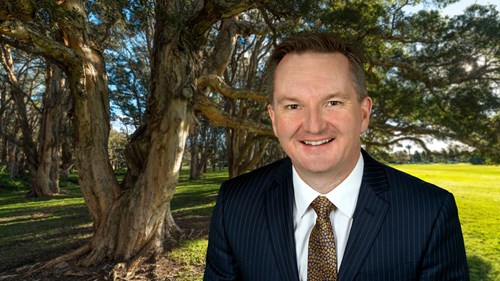
The federal energy minister, Chris Bowen, has dismissed Coalition MP Ted O’Brien’s claim that Australia could develop a nuclear power industry within a decade, stating: “Tell him he’s dreaming.”
The mocking comment on Sunday came as the government continued to pour scorn on the opposition’s speculative alternative plan to renewable energy. O’Brien said the Coalition was in the “advanced stages” of finalising its policy, which is not expected to be unveiled for several weeks.
Bowen also told ABC TV that the government was open to amending its fuel
The federal energy minister, Chris Bowen, has dismissed Coalition MP Ted O’Brien’s claim that Australia could develop a nuclear power industry within a decade, stating: “Tell him he’s dreaming.”
The mocking comment on Sunday came as the government continued to pour scorn on the opposition’s speculative alternative plan to renewable energy. O’Brien said the Coalition was in the “advanced stages” of finalising its policy, which is not expected to be unveiled for several weeks.
Bowen also told ABC TV that the government was open to amending its fuel efficiency standards for motor vehicles while again denying claims from the Coalition and some manufacturers that it would increase car prices.
The Coalition’s push for nuclear energy in Australia has been derided by the government and experts. The opposition leader, Peter Dutton, has not specified where the potential nuclear facilities would be located, nor how much they could contribute to the nation’s energy mix.
Sky News reported on Sunday that a 2020 paper from the NSW chief scientist found a nuclear power industry would require tens of thousands of trained staff and at least two decades to become operational.
Responding to the report, O’Brien – the opposition’s energy spokesman – claimed the Coalition had received different advice.
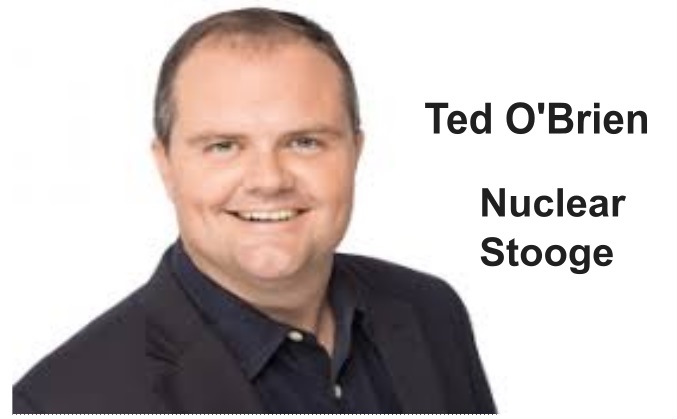
“The best experts around the world with whom we’ve been engaging are saying Australia could have nuclear up and running within a 10-year period,” O’Brien said.
O’Brien did not reveal which experts the Coalition had talked to. Guardian Australia asked his office for more information.
The shadow minister said nuclear could be part of a “balanced mix” of other power types and he criticised Labor for being “negative”.
Bowen was asked about O’Brien’s claim that nuclear could be developed in Australia within a decade.
“Tell him he’s dreaming,” Bowen said on the ABC’s Insiders program, referencing the Australian comedy movie The Castle. “I don’t know what experts he’s talking to.”
Bowen said the average build time for a nuclear plant in the US – a country he called “the nuclear leader of the world” – was 19 years.
“Ted O’Brien thinks he can do it in Australia in 10 with a standing start, no regulations, banned not only nationally but in the three most populous states,” Bowen said.
The minister rubbished arguments that Australia should scrap its ban on nuclear energy to allow private industry to investigate options, claiming that establishing a nuclear industry would require “eye-watering amounts of government taxpayer subsid[ies].”
“I’ve had no one knock on my door to say ‘I want to build a nuclear power plant in Australia’ but I had plenty of the world’s biggest renewables companies through my door,” Bowen said on Sunday.
“There’s a myth this is happening elsewhere in the world. It’s not. Australia has the best renewable resources in the world. It would be a massive economic own goal to give up utilising those resources and go down this nuclear fantasy.”
Beyond suggesting nuclear plants be built at former coal-powered facilities, the Coalition has not confirmed details of their policy – including costs, timeframes, how local opposition would be overcome and the amount of power to be generated.
Dutton could fill in some of the blanks in his budget reply speech in May. He is under pressure to announce details.
Coalition MPs have been agitating for the opposition leader to outline new policies they can spruik ahead of the federal election, which could be held this year…………. https://www.theguardian.com/australia-news/2024/mar/10/tell-him-hes-dreaming-bowen-rubbishes-coalition-claim-australia-could-have-nuclear-power-in-a-decade
Coalition’s nuclear red herring is a betrayal of the Australian people.
Coalition’s nuclear red herring is a betrayal of the Australian people
March 9, 2024 | Canberra Times
Tim Buckley, Annemarie Jonson
https://www.canberratimes.com.au/story/8547521/peter-duttons-nuclear-red-herring-is-a-coalition-betrayal-of-australians/
The sudden enthusiasm of the LNP for nuclear energy is another divisive, cynical and damaging ploy to ignite Climate Wars 2.0 and disrupt and delay Australia’s accelerating renewables transition on behalf of the fossil fuel cartel. The LNP’s climate and energy luddites burned a decade when they were in office. We can’t afford more of the same policy lunacy.
Policy confusion, disinformation and chaos around the nuclear furphy is exactly the solution if you are looking to destroy renewable energy investor confidence, deter investment, and set back our accelerating pathway to decarbonisation – the bedrock of our nation’s economic future. Investors need credible and stable policy and regulation.
The Coalition’s nuclear red herring, and its related threat to pull strategic public capital investment from utility-scale renewables, increases sovereign risk, and is a betrayal of the Australian people.
Nothing about nuclear power makes sense in Australia.
As former Chief Scientist Dr Alan Finkel has said, it would be 20 years or more before the first operation of small modular reactor (SMR) technology in Australia. We need to decarbonise our energy system and economy this critical decade to address the concurrent climate, energy and cost-of-living crises.
SMR technology is not commercial. There are no SMRs in operation outside of Russia and China. In November, the only SMR development in the US was terminated.
There are no private companies worldwide who can build and operate nuclear power plants without massive government underwriting, because they can’t get insurance.
Tokyo Electric Power Company went bankrupt overnight due to its Fukushima nuclear disaster, requiring a US$200 billion taxpayer bailout of the cleanup costs, which will still be being funded beyond 2050.
In promoting nuclear, the LNP is essentially calling for a massive multi-decade subsidy fest that would make the LNP’s Snowy 2.0 and NBN white elephants look like value for money by comparison. Where has the LNP’s staunch preference for free markets gone?
The LNP nuclear shills say they will soon announce sites for reactors. It is not clear in what universe they think they can secure social licence from impacted communities. Legal challenges and civic protest are inevitable.
How they propose to manage the financial cost of multi-centuries of waste storage and rehabilitation to mitigate risk remains a mystery. It is worth noting the unfunded £260 billion liability this decade UK taxpayers face for decommissioning its nuclear waste. Does the LNP suggest leaving this massive cost to future generations?
The economics simply don’t stack up. Firmed renewables are the cheapest form of energy. The cost of nuclear power generation is much higher than its low-cost clean energy alternatives.
But don’t take our word for it. The CSIRO and the Australian Energy Market Operator said in May 2023 that nuclear is “not an economically competitive solution in Australia”, and that we lack the “frameworks for its consideration and operation within the timeframe required.”
The 2022 World Nuclear Industry Status Report said that between 2009 and 2021, costs for solar declined from US$359 to US$36 per megawatt hour (MWh), a fall of 90 per cent, and for wind from US$135 to US$38 per MWh, a 72 per cent fall, while nuclear power costs rose from US$123 to US$167 per MWh, up 36 per cent in the same period.
Battery storage costs are falling double digits each year, and Goldman Sachs just forecast another 40 per cent decline by 2025. Massive ongoing deflation is a feature of renewables, nuclear is the opposite; massive ongoing inflation of costs, externalised onto the public (as highlighted by the World Nuclear News).
The Investor Group on Climate Change, representing investors with $30 trillion in assets, said there is no interest among investors in nuclear.
The IGCC notes nuclear has “project time blowouts of anything from seven to 15+ years and cost blowouts in the tens of billions, and lowest-cost technologies, renewables, batteries and so on, are available to deploy now”.
At last, we are seeing a huge influx of capital into Australia’s renewables transition, triggered by the enabling policy architecture of the Albanese federal government such as Energy Minister Chris Bowen’s federal Capacity Investment Scheme announced in late 2023. Our $3.6 trillion super industry has flagged this policy framework as key to crowding in private capital into renewables infrastructure.
Just last month Rio Tinto inked landmark world-scale 25-year power purchasing agreements worth billions that will underwrite the nation’s biggest yet wind and solar developments, powering the processing of its alumina and aluminium in central QLD with green energy.
The Investor Group on Climate Change, representing investors with $30 trillion in assets, said there is no interest among investors in nuclear.
The IGCC notes nuclear has “project time blowouts of anything from seven to 15+ years and cost blowouts in the tens of billions, and lowest-cost technologies, renewables, batteries and so on, are available to deploy now”.
At last, we are seeing a huge influx of capital into Australia’s renewables transition, triggered by the enabling policy architecture of the Albanese federal government such as Energy Minister Chris Bowen’s federal Capacity Investment Scheme announced in late 2023. Our $3.6 trillion super industry has flagged this policy framework as key to crowding in private capital into renewables infrastructure.
Just last month Rio Tinto inked landmark world-scale 25-year power purchasing agreements worth billions that will underwrite the nation’s biggest yet wind and solar developments, powering the processing of its alumina and aluminium in central QLD with green energy.
Peter Dutton’s nuclear implosion after Dunkley byelection loss

The Saturday Paper, 9 Mar 24 Paul Bongiorno
Anthony Albanese had a good week, thank you very much. His opponent, Peter Dutton, not so much. In fact, you could say the Dunkley byelection blew the opposition leader’s credibility out of the water and left him stranded for a reset.
Not that anyone who bothered to watch the byelection night on the news channels would get the impression from the Liberals they had fallen miserably short of stalling Albanese’s new year momentum. Nor did their performance demonstrate that their strategy was on target to recapture the outer suburban seats they need to offset the loss of 19 seats at the 2022 election………………………………………………………………………………………………………………………………………………………..
a lesson for Advance and Dutton is that winning an election is a very different challenge to disrupting a referendum……………………………………………………………………………………………….
We now have the framework for the Coalition’s “energy plan” – although whether this policy to build large-scale and yet to be commercially viable nuclear small modular reactors (SMRs) is a winner is questionable to say the least.
Albanese took time out from hosting the Association of Southeast Asian Nations (ASEAN) summit in Melbourne to say he looked forward to Dutton announcing the locations for nuclear reactors and where the financing would come from.
Dutton is in the same denial mode his colleagues showed in their reactions to the byelection loss. When he finally put up his head on Tuesday, the opposition leader ducked questions on who would pay for his nuclear “fantasy”, as Albanese calls it, and kept talking about a cheaper, firmer option. His spiel could only be viewed as unbelievable.
The GenCost report from the CSIRO and the Australian Energy Market Operator estimates by 2030 the cost of power from an SMR would be between $200 and $350 per megawatt hour, compared with between $60 and $100 per megawatt hour for wind and solar.
Treasurer Jim Chalmers said Dutton “is always on the hunt for cheap politics, not cheap electricity”.
It’s hard to see this as the winning reset the Liberals crave. https://www.thesaturdaypaper.com.au/comment/topic/2024/03/09/peter-duttons-nuclear-implosion#mtr
Coalition must come clean on how its nuclear vision would work
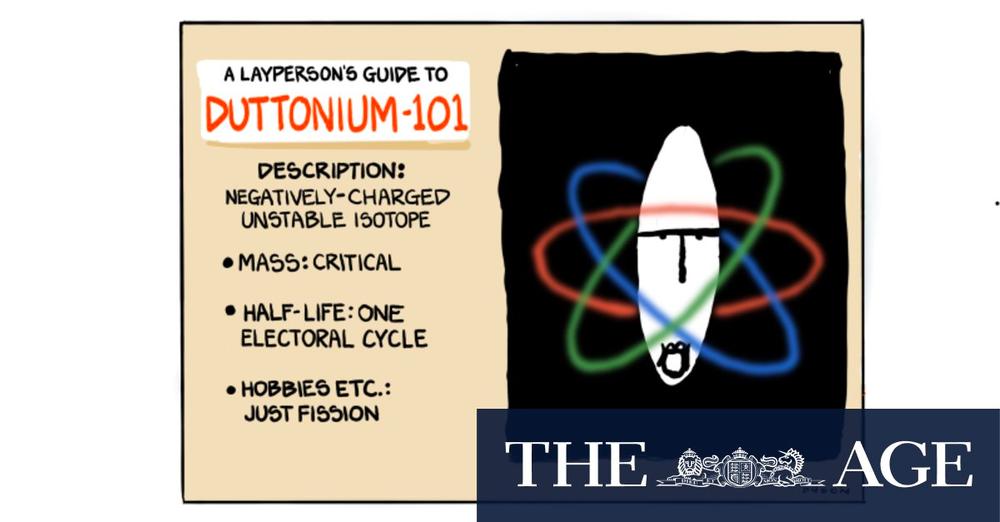
NUCLEAR QUESTIONS
Simon Holmes a Court is right, “Australia’s climate wars will not end until the Coalition chooses engineering and economics over ideology and idiocy”, (“Nuclear option scorns our natural advantage”, 7/3).
Shadow minister for climate change and energy, Ted O’Brien has said, “The world is embracing zero-emissions nuclear energy because it solves the energy trilemma of affordability, reliability and emissions reduction”.
Does the Coalition honestly believe, in the face of successive GenCost reports and overwhelming overseas experience, that nuclear would provide Australian consumers with cheaper-than-renewables electricity? What then of the huge government subsidies propping up nuclear, for instance the $4 billion for the failed US NuScale SMR experiment?
If we, as David Littleproud suggests, allowed “the marketplace to decide”, how much would Australians subsidise such ventures? How does the Coalition propose to create reliability in our energy grid with nuclear, when it would not be available until at least around 2040?
Finally, in what year does the Coalition propose reaching net zero emissions? Some in its ranks want to renege on our 2050 international commitments, so any commitment is sounding hollow.
The Coalition needs to come clean with the electorate.
Fiona Colin, Malvern East
Nuclear numbers don’t add up
Nuclear power plants take six to eight years to construct. They have an expected working life of 20 to 40 years, but decommissioning takes 20 to 30 years. The numbers just don’t stack up. However, the building and decommissioning phases would provide substantial employment opportunities.
Louise Zattelman, Box Hill
What does Dutton know that we don’t?
Peter Dutton must believe the nuclear option for the provision of power is a vote winner at the next federal election. This seems to fly in the face of public opinion, experts who claim it is not feasible, practical, proven or economical.
So what does he know that we don’t? An election is looming. It’s time for the Coalition to think of practical policies that at least give them a chance.
Bruce MacKenzie, South Kingsville
‘Mr Dutton is right’: Murdoch’s News Corp papers grant nuclear power glowing coverage

News Corp has done a climate turnaround, spruiking the Coalition’s new nuclear policy at every opportunity. But how much Kool-Aid have its reporters drunk?
DAANYAL SAEED, MAR 06, 2024, https://www.crikey.com.au/2024/03/06/news-corp-peter-dutton-nuclear-policy/
The Coalition’s solution to the climate crisis is set to be unveiled, with Peter Dutton reportedly planning to announce sites for a number of nuclear power stations, which would necessarily involve lifting Australia’s long-standing ban on nuclear power.
While the Coalition’s policy has been rubbished as “misinformed bulldust” by the likes of Andrew Forrest, a “dumb idea” by experts and “hot air” by the energy minister, the News Corp papers have been at the forefront of nuclear advocacy.
In the past month, The Australian has published a number of articles on nuclear power, with only one of its many op-eds (the aforementioned “hot air” piece by Energy Minister Chris Bowen) arguing in favour of Australia’s ban on nuclear.
Conversely, the paper has run several opinion pieces in favour of nuclear power, including two editorials advocating for its use, the most recent of which was published this morning.
The paper’s editorial on March 6 said it was “time for a properly costed plan on the nuclear option”, stating “Peter Dutton’s embrace of a nuclear option for consideration is worthwhile”.
“Dutton is right to develop a net-zero plan that includes nuclear,” the piece continued. “Refusing to lift the ban or even consider the issue … makes the federal government look out of touch with what is happening in the modern energy world.”
Crikey asked The Australian’s managing editor Darren Davidson on March 5 whether the paper had an editorial view on the merits of nuclear energy, and how it balanced any view it may have with the Coalition’s policy position, as well as any ethical obligations that may arise in its reportage. He declined to comment.
This morning’s editorial comes on the heels of one published on February 17 headlined “Nuclear option made easy by the renewables miscue”. It went on to describe nuclear power as “a logical option for emissions-free power”, a “sensible option”, but admitted it was “incendiary politics”
It rekindles the climate wars and undermines the certainty that is craved by business.”
Political editor Simon Benson has been responsible for much of this nuclear coverage, penning an op-ed on February 25 that argued the Labor government was “at risk of ending up on the wrong side of history in its fanatical opposition to nuclear power”.
Benson was also responsible for an exclusive, also published on February 25, that showed Newspoll data conducted for The Australian that showed 55% of Australian voters “supported the idea of small modular nuclear reactors as a replacement technology for coal-fired power”.
As early as February 15 Benson had insights into the Coalition’s policy, penning a piece titled “Liberals’ nuclear policy has potential to electrify”.
The Australian has also ran a number of opinion pieces over the past month in favour of the Coalition’s policy, including one by Peta Credlin headlined: “Liberal true believers stand firm against false net-zero gospel”.
However the paper also ran a piece by Sarah Ison on February 16 that highlighted one of the limits of the introduction of nuclear power in Australia. Ison interviewed Australian Industry Group climate change director Tennant Reed, who said that Australia may be waiting for more than 20 years for economically viable nuclear power.
Shock as Australian Prime Minister learns that he is not above international law

the Prime Minister would be wise to seek independent advice from one of several influential Australians who have significant expertise in the field of international humanitarian law.
By Margaret ReynoldsMar 7, 2024, https://johnmenadue.com/shocked-australian-pm-learns-he-is-not-above-international-law/
Prime Ministers are too often monopolised by people telling them what they want to hear. Most political advisers can’t see beyond the latest opinion poll and the Australian bureaucracy has become equally reluctant to offer frank and fearless advice. It appears that the Attorney General, Defence and Foreign Affairs and Trade Departments have each failed to alert the Prime Minister and his government to the risks inherent in ignoring international law when responding to the Gaza crisis.
However, many members of Australian civil society have indeed urged the Federal Government to act strongly to uphold humanitarian standards and avoid crimes against humanity They have demanded the Federal Government restore funding to the United Nations Relief and Works Agency and ban arms sales to Israel. More than 100 non-government organisations have communicated their alarm that Australia could in any way be contributing to the ongoing atrocities being inflicted on the Palestinians. Since January 27th, many Australians have anticipated a public official response to the International Court of Justice interim ruling that a case of genocide against Israel is plausible Yet this weight of urgent correspondence and advocacy has failed to alert the Prime Minister’s staff to Australia’s responsibilities as a signatory of the Genocide Convention.
Today more than 100 Australian lawyers endorsed the referral of Anthony Albanese, together with other members of his government and the Opposition leader, Peter Dutton to the International Criminal Court as Accessory to Genocide in Gaza alleging political and material support to the Israel government and military over the past five months.
The 92-page document sets down specific ways in which this allegation can be upheld.
– Freezing of funding to the United Nations Relief and Works Agency amid a humanitarian crisis
– Providing military aid and approving defence exports to Israel
– Ambiguously deploying an Australian military contingent to the region where its location and exact role have not been disclosed
– Permitting Australians to travel to Israel to join the Israeli Defence Force and take part in its attacks on Gaza.
In response, the Prime Minister has dismissed the referral to the International Criminal Court as “lacking credibility” and it is unsurprising he would go into a defensive denial mode. However, it would be a brave leader who did not now demand detailed briefings on these allegations from those departments that have failed to respond to the International Court of Justice genocide warning. Furthermore, the Prime Minister would be wise to seek independent advice from one of several influential Australians who have significant expertise in the field of international humanitarian law.
Regardless of the long-term future of this and comparable allegations against other western leaders, the Australian Government has been given the chance to review its commitment to international law. It can continue to ignore calls for transparency and Australian independence in foreign policy, or it can start to seriously examine why the allegations of complicity have been made.
There is no doubt that many nations are much more actively concerned about the charge of genocide brought against Israel by the South African government. In February more than fifty countries including Indonesia, Malaysia, Fiji, Japan, Great Britain and Ireland sent official legal delegations to the Hague to present their nations opinions to the International Court of Justice., but Australia was not represented.
In contrast, the Australian Government has avoided any detailed public response to its responsibilities as a signatory to the Genocide Convention. Indeed, it has recently twice closed down parliamentary debate that could lead to a comprehensive House of Representatives discussion. There has been no debate about how Australia may assist in future medical rehabilitation of Palestinians nor how it will contribute to the rebuilding of Gaza. While the Foreign Minister may refer to a “two state solution “ there has been no official announcement that Australia finally recognises the State of Palestine.
Furthermore, the failure of the Australian public service to maintain or prioritise current independent information about the continuing assault in Gaza amounts to negligence. In a recent meeting, United Nations Relief and Works Agency in Gaza, Director Tom White was advised “the Australian Government wanted to be sure UNRWA Gaza aid funding will go to those who need it “! This bland indeed inhuman statement clearly reflects that there is something seriously wrong with how the government is currently managing its international responsibilities.
Of course, it is embarrassing for the current Australian Government to be named as an “accessory to genocide”, but all members of parliament should not be too quick to dismiss the allegation until they have reviewed why and how such a charge could be made. The parliament hears too many simplistic speeches giving loyalty to allies who blatantly ignore international law and it’s time our representatives faced this reality.
Australia has a proud record as a founding member of the United Nations, which is responsible for developing international law. So many well-known Australian names have contributed to a great variety of United Nations achievements, yet few parliamentarians speak up for the importance of the international body. International law is being undermined by governments choosing militarism ahead of the rule of law, so it is imperative that the Australian government and parliament commit to prioritising its international responsibilities. Many Australians will be watching closely, demanding that humanitarian leadership is restored.
Margaret Reynolds is a former councillor and Federal Minister for Local Government. She chaired the Advisory Board of the Australian Centre of Excellence in Local Government at the University of Technology, Sydney 2008-2012.
She has a long history in the peace movement starting during the Vietnam War. As a Labor senator she supported the Pine Gap Women’s Peace camp and visited Greenham Common to support anti-nuclear campaigners . She represented Parliamentarians for Global Action at several human rights and peace conferences in the 1990s. After leaving parliament she taught International Relations at the University of Queensland.
Margaret is the National President of the Women’s International League for Peace and Freedom
Nuclear power: Peter Dutton changes gear in favour of big reactors not small modular ones,

Mr O’Brien told The Australian Financial Review in June 2022 that SMRs, not large-scale power plants, were the future of nuclear.
Mr Dutton is now saying modern giant power plants would be the backbone of the Coalition’s energy policy.
Phillip Coorey, https://www.afr.com/politics/federal/dutton-changes-gear-on-nuclear-plans-pm-dismissive-20240305-p5f9vg 5 Mar 24
Plans by the Coalition to build large nuclear reactors on the sites of old coal-fired power stations would be prohibitively expensive, take more than a decade to implement, and would not work in most cases because such reactors need to be near water, Prime Minister Anthony Albanese said.
Mr Albanese, who as shadow environment minister two decades ago fought plans by John Howard to consider nuclear power plants near populated coastal communities, said little had changed in terms of the political difficulties of such a proposal.
“He is now speaking about large nuclear reactors. They need to be near populations, they need to be near water,” he said of Mr Dutton.
“I look forward to him announcing the locations for nuclear reactors in Australia and for there to be an appropriate debate about that.”
Mr Dutton and his energy spokesman Ted O’Brien are proposing nuclear power be used to provide baseload power to firm renewable energy and ensure Australia can achieve new zero emissions by 20250.
Rather than build, as Labor is intending to do, 28,000 kilometres of poles and wires to transmit renewable energy from wind and solar farms, Mr Dutton is proposing building nuclear power pants on the sites of coal fired plants as they are decommissioned.
The proposal builds on the original plan, which would involve a strong focus on small modular reactors.
Mr O’Brien told The Australian Financial Review in June 2022 that SMRs, not large-scale power plants, were the future of nuclear.
“Nobody wants old Soviet technology, you wouldn’t touch it with a barge pole,” he said.
But SMR technology is still embryonic, and Mr Dutton is now saying modern giant power plants would be the backbone of the Coalition’s energy policy.
“It doesn’t resemble anything that you’ve seen in the past. It’s like comparing a motor vehicle you’re driving off the showroom floor today in 2024, compared to something in 1954,” he said.
“So, the technology is unbelievable compared to what it was 50 or 70 years ago.”
He said bipartisan support for nuclear-powered submarines under the AUKUS deal had removed any opposition to nuclear power on the basis of their needing to have a high-level nuclear waste dump.
Mr Albanese said the nuclear argument had changed little since Mr Howard had businessman and nuclear physicist Ziggy Switkowski examine the option in 2006.
“Every 10 years, there are these proposals, we’ve seen the Switkowski report come and go,” he said.
“What never comes is any investment, because it simply doesn’t stack up commercially.
“I look forward as well to him arguing where the financing will come [from] for such reactors, or whether taxpayers will be expected to pay for this.”
The Opposition argues Mr Albanese should lift the moratorium on nuclear power and let the market decide.
Mr Dutton said Mr Albanese was out of touch with public opinion which, according to opinion polls, is warming to nuclear power.
“It’s … supported by a lot of younger people because they’re well-read, and they know that it’s zero emissions, and it can firm up renewables in the system,” he said.
“The government’s got sort of a wing and a prayer at the moment where they think if we have 100 per cent renewables in the system, the costs will go down, or there can be reliability. Neither of those things will happen, in fact, the opposite.”
Australia has had many significant inquiries into nuclear power, over the past 60 years

Paul Richards, 6 Mar 24
Peter Dutton and his Coalition opposition party keep calling for a “mature” debate on nuclear power, as if no-one has ever discussed it seriously. But Australia has had many “mature” inquiries and discussions related to nuclear energy, uranium mining, and the nuclear fuel cycle over the past 60 years. Here are some notable ones:
1.] Radium Hill Royal Commission (1953):
This inquiry examined the safety and health concerns related to uranium mining at Radium Hill in South Australia. It investigated radiation exposure for workers and nearby communities and made recommendations for improved safety measures.
2.] McMahon Report (1955):
Commissioned by the Australian government, this report explored the potential for nuclear power generation in Australia. It assessed the feasibility, costs, and benefits of establishing nuclear power plants and considered the country’s uranium resources.
3.] Fox Report (1976):
The report, officially titled “Uranium Mining, Processing, and Radiation Safety”, was commissioned by the Australian government to investigate the health and safety aspects of uranium mining and processing. It examined radiation exposure risks for workers and surrounding communities and recommended regulatory measures.
4.] Joint Select Committee on the Environment (1980-1981):
This parliamentary committee inquired into the environmental and health impacts of uranium mining and processing in Australia. It examined issues such as radiation contamination, waste management, and rehabilitation of mining sites.
5.] Commonwealth Government Inquiry into Nuclear Energy (2006):
This inquiry examined the potential for Australia’s involvement in the nuclear fuel cycle, including uranium mining, nuclear power generation, and waste management. The resulting report, known as the Switkowski Report, provided analysis and recommendations on these issues.
6.] South Australian Nuclear Fuel Cycle Royal Commission (2015-2016):
This inquiry was established by the Government of South Australia to investigate the potential for the state’s further involvement in the nuclear fuel cycle, including uranium mining, enrichment, energy generation, and waste management. The final report provided a comprehensive analysis and recommendations regarding these issues.
7.] Federal Government Inquiry into Nuclear Energy (2019):
The Australian Federal Parliament’s Standing Committee on the Environment and Energy conducted an inquiry into the prerequisites for nuclear energy in Australia. It examined the economic, environmental, and safety implications of nuclear power generation and assessed public opinion and regulatory frameworks.
These inquiries reflect Australia’s ongoing evaluations and debates surrounding nuclear energy, uranium mining, and the broader nuclear fuel cycle, considering various economic, environmental, social, and political factors over the past 60 years.
Prime Minister of Australia, and Henchmen, Referred to International Criminal Court for Support of Gaza Genocide
By Birchgrove Legal, March 5, 2024, https://worldbeyondwar.org/prime-minister-of-australia-and-henchmen-referred-to-international-criminal-court-for-support-of-gaza-genocide/
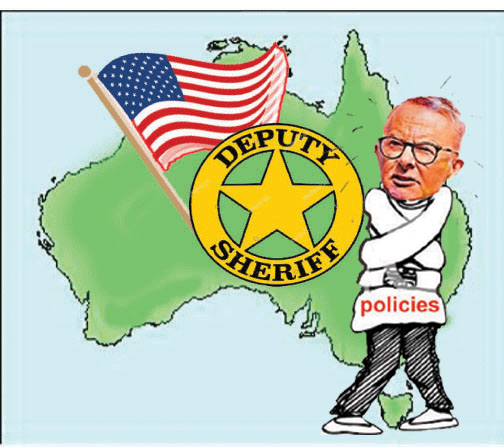
Australian Prime Minister Anthony Albanese has been referred to the International Criminal Court as an accessory to genocide in Gaza, making him the first leader of a Western [Western?] nation to be referred to the ICC under Article 15 of the Rome Statute.
A team of Australian lawyers from Birchgrove Legal, led by King’s Counsel Sheryn Omeri, have spent months documenting the alleged complicity and outlining the individual criminal responsibility of Mr Albanese in respect to the situation in Palestine.
The 92-page document, which has been endorsed by more than one hundred Australian lawyers and barristers, was yesterday submitted to the Office of ICC Prosecutor, Karim Khan KC.
The document sets out a number of actions taken by the PM and other ministers and members of parliament, including Foreign Minister Wong and the Leader of the Opposition, for the Prosecutor to consider and investigate. These include:
- Freezing $6 million in funding to the primary aid agency operating in Gaza – UNRWA – amid a humanitarian crisis based on unsubstantiated claims by Israel after the International Court of Justice had found it plausibly to be committing genocide in Gaza.
- Providing military aid and approving defence exports to Israel, which could be used by the IDF in the course of the prima facie commission of genocide and crimes against humanity.
- Ambiguously deploying an Australian military contingent to the region, where its location and exact role have not been disclosed.
- Permitting Australians, either explicitly or implicitly, to travel to Israel to join the IDF and take part in its attacks on Gaza.
- Providing unequivocal political support for Israel’s actions, as evidenced by the political statements of the PM and other members of Parliament, including the Leader of the Opposition.
Ms Omeri KC said the case was legally significant because it focused exclusively on two modes of accessorial liability.
“The Rome Statute provides four modes of individual criminal responsibility, two of which are accessorial,” Omeri said.
“In relation to accessorial liability, a person may be criminally responsible for a crime set out in the Rome Statute if, for the purpose of facilitating the commission of that crime, that person aids, abets or otherwise assists in the commission of the crime, or its attempted commission, including by providing the means for its commission.
“Secondly, if that person in any other way contributes to the commission of the crime or its attempted commission by a group, knowing that the group intends to commit the crime.”
Ms Omeri KC said the Article 15 communication had been carefully drafted by those instructing her and was now a matter for the Prosecutor to consider.
“The Office of the Prosecutor of the ICC is already pursuing an ongoing investigation into the situation in the State of Palestine, which it has been conducting since March 2021,” Omeri said.
“That includes investigating events which have occurred since 7 October 2023. This Article 15 communication will add to the evidence available to the Prosecutor in relation to that situation.
“The Article 15 communication is of a piece with recent domestic legal cases brought against Western leaders in a number of countries such as in the US, against President Biden, and most recently, in Germany, against, among other senior government ministers, Chancellor Scholz.
“These cases demonstrate a growing desire on the part of civil society and ordinary citizens of Western countries to ensure that their governments do not assist in the perpetration of international crimes, especially in circumstances where the ICJ has found a plausible case of genocide in Gaza.”
Principal solicitor at Birchgrove Legal, Moustafa Kheir, said his team had twice written to Mr Albanese, putting him on notice and seeking a response on behalf of the applicants who make up a large consortium of concerned Australian citizens, including those of Palestinian ethnicity.
Mr Kheir said communications were ignored on both occasions.
“Since October we have attempted communications with our Prime Minister as we reasonably believe that he and members of his cabinet are encouraging and supporting war crimes committed by Israel against Palestinian civilians through their political and military assistance,” Kheir said.
“The Prime Minister has ignored our concerns and given the limited avenues we have for recourse under national law, we have been left with little option but to pursue this Article 15 communication to the International Criminal Court.
“Our communication has been endorsed by King’s Counsel Greg James AM and well over 100 senior counsel and barristers, retired judges, law professors and academics from around Australia who wish to test the strength of international law to hold their own democratic leaders accountable given the barriers we face to do it nationally.
“As lawyers and barristers, it is impossible to sit back and watch sustained breaches of international law while Albanese continues to refer to the perpetrator as “a dear friend.”
A copy of the application can be viewed here: ICC-Referral-Australian-Government-Ministers-and-Opposition-Leader-04032024_BLG.pdf
Or here.
Nuclear slow and expensive, renewables fast and cheap: Bowen slaps down Coalition “fantasy”
Giles Parkinson, Mar 7, 2024, https://reneweconomy.com.au/nuclear-slow-and-expensive-renewables-fast-and-cheap-bowen-slaps-down-coalition-fantasy/—
Federal climate and energy minister Chris Bowen has again slammed the federal Coalition’s “nuclear fantasy”, describing it as a deliberate distraction and the latest “desperate effort” to keep the culture war over energy and climate alive.
“(They say) renewable energy is all too hard, we’ll just have to go nuclear,” Bowen said in comments at the Smart Energy Council conference in Sydney, adding that the technology is “utterly uneconomic.”
Bowen was asked why the government would not support a lifting of the ban against nuclear power and allow – as the Coalition and others suggest – to let the “market decide.” He pointed to the fact that it would take a decade to develop a regulatory regime, and three states also had their own bans in place.
“They say ‘lift the ban’ and the market will sort it,” Bowen said.
“Well, the market hasn’t sorted it out anywhere else in the world, there is not a market in the world where nuclear isn’t subsidised substantially by government. So this idea that we lift the ban and all these foreign investors are going to suddenly come to help Australia’s nuclear sector is just fantasy.”
Bowen said three states would also have to lift their bans, and only then could a regulatory process be put in place which he said would require at least 10 years, before deciding on location, environmental approvals and the question of subsidies.
“It would be a massive distraction,” Bowen said. “And it would send the signal somehow to the market that Australia and the Australian Government are interested in nuclear, when we’re not because it uneconomic, utterly uneconomic.
Coalition leader Peter Dutton and energy spokesman Ted O’Brien had favoured small modular reactors, and dismissed large “Soviet era” reactors, but appear to have now changed their mind and flipped back towards large scale nuclear after the only prospective SMR in the western world was cancelled because of soaring costs.
Bowen says the push to nuclear is simply an extension of the culture war over climate and energy issues.
“We know the sorts of arguments they run. It’s a desperate effort to keep the culture war alive. Renewable energy is all too hard. We’ll just have to go nuclear.”
Federal Labor has adopted a target to reach 82 per cent renewables by 2030, and most energy experts suggest all remaining coal fired power stations would be closed by around 2035.
Nuclear is seen as impossible to deliver in Australia before 2040, notwithstanding its costs, and energy experts question how an essentially “baseload” energy supply can be jammed into what will by then be a grid dominated by wind and solar, and particularly rooftop solar, which will require storage and flexible capacity.
The federal government’s Capacity Investment Scheme is likely to seek 10 GW of new wind and solar capacity in a series of auctions in 2024, and likely a similar amount in 2025, along with at least 3 GW of long durations storage in each of the next three years.
Bowen said a formal announcement is expected soon. He said the result of the first CIS auction, for 600 MW of long duration storage (defined as a minimum four hours) had elicited a very good response and the results would be announced in coming months.
Market has ‘made its decision’ about nuclear energy being too expensive
Labor MP Andrew Charlton says the market has “made its decision” about nuclear energy being too expensive.
Mr Charlton joined Sky News Australia to discuss the latest developments in nuclear energy across the world.
“We saw recently the small nuclear reactor in Idaho was cancelled because of rising costs – that was a market decision to say no to nuclear,” he said.
“Let’s remember, this small nuclear reactor in Idaho is the one that the Liberal Opposition called the future of clean energy – it’s now being cancelled, it’s being scrapped.
“The truth is that the market has made its decision about nuclear energy; it knows that nuclear energy is by far the most costly type of new energy that we could add into the grid, and that’s why it’s not part of the government’s plan.”
Top scientist explains nuclear process and risks: Sunshine Coast previously considered for facility
Sunshine Coast News, STEELE TAYLOR, 6 MARCH 2024
A leading local academic has detailed the risks posed by nuclear power, amid revelations the Sunshine Coast was, in 2007, put on a shortlist of possible sites for a facility.
Emeritus Professor Ian Lowe says there are multiple problems with nuclear energy, including high costs, lengthy builds, health threats and international tension.
Professor Lowe explained the process of nuclear energy production, and the potential for accidents.
“In a nuclear reactor, the process of fission (breaking up of unstable large atoms like uranium) releases heat energy, which is used to boil water,” he said.
“It is basically just a more complicated way of boiling water than burning coal or gas.
“The steam produced by the boiling water is used to turn a turbine and generate electricity.
“In normal operation, nuclear reactors have a good safety record but there have been a series of large-scale accidents like the Windscale fire, the Three Mile Island meltdown, the Chernobyl explosion and the destruction of the Fukushima reactor by a tsunami.
Those accidents have made people nervous about living near a nuclear power station.
“In the cases of Chernobyl and Fukushima, whole regions have been made permanently uninhabitable because the radiation levels are not safe for people to live there.
“As well as the small but non-zero risk of serious accidents, nuclear reactors produce radioactive waste that will need to be safely stored for thousands of years.
“This is a problem that is causing real headaches for all the countries that have nuclear power stations, with only one – Finland – being on the path to a solution.”
Professor Lowe says nuclear energy production has multiple requirements, and locations for power plants have been considered.
“If we were to build a nuclear power station in Australia, the need for massive amounts of cooling water would demand a coastal site,” he said.
“It would also need to be connected to the electricity grid and ideally be near a major power user like a capital city.”
The Australia Institute used a checklist of the needs to produce a shortlist of possible sites for nuclear power plants, for a research paper that was produced in late 2006 and released in early 2007.
The Sunshine Coast, where Professor Lowe has lived for the past 20 years, was among the locations named.
“In a nuclear reactor, the process of fission (breaking up of unstable large atoms like uranium) releases heat energy, which is used to boil water,” he station.
“In the cases of Chernobyl and Fukushima, whole regions have been made permanently uninhabitable because the radiation levels are not safe for people to live there.
“As well as the small but non-zero risk of serious accidents, nuclear reactors produce radioactive waste that will need to be safely stored for thousands of years.
“This is a problem that is causing real headaches for all the countries that have nuclear power stations, with only one – Finland – being on the path to a solution.”
Professor Lowe says nuclear energy production has multiple requirements, and locations for power plants have been considered.
“If we were to build a nuclear power station in Australia, the need for massive amounts of cooling water would demand a coastal site,” he said.
“It would also need to be connected to the electricity grid and ideally be near a major power user like a capital city.”
The Australia Institute used a checklist of the needs to produce a shortlist of possible sites for nuclear power plants, for a research paper that was produced in late 2006 and released in early 2007.
The Sunshine Coast, where Professor Lowe has lived for the past 20 years, was among the locations named.
“It is worth adding that the tsunami of panic among sitting members of parliament when that list was released had to be seen to be believed,” he said.
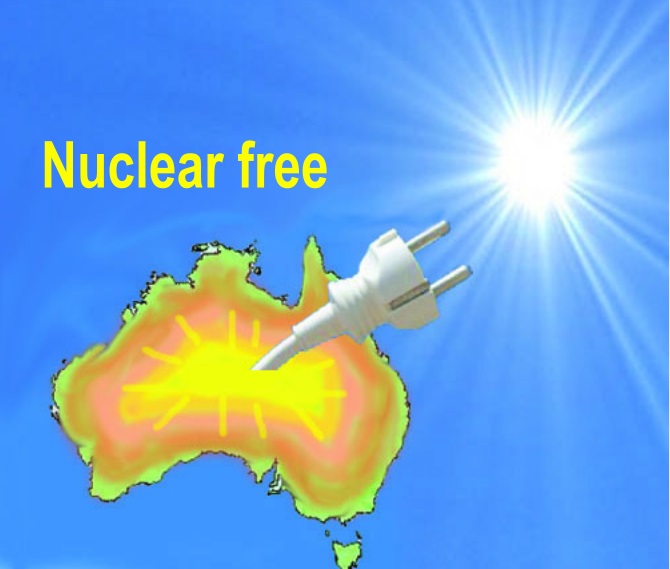
“But we do now have a local member (Fairfax MP Ted O’Brien), promoting nuclear energy with great enthusiasm.”
There is no indication that the Sunshine Coast is on a current shortlist of possible sites………..
Mr O’Brien has previously said, via ABC Radio National, that he would welcome a nuclear facility in his electorate or any other electorate, “where it is proven to be technologically feasible, has a social licence and is going to get prices down”.
But he also told Sunshine Coast News that a nuclear facility would probably be better placed somewhere other than the Coast………………..
Legalities and history
Professor Lowe says there would be legal hoops to jump through to make nuclear power production possible in the country.
“Nuclear power is not legal in Australia. To get support for its Environmental Protection and Biodiversity Conservation Act in 1999, the Howard government included clauses that specifically prohibit uranium enrichment, fuel fabrication and the building of power reactors,” he said.
“So, any proposal for nuclear power would require repealing that prohibition.
“The current government has no interest in doing that; neither did the Coalition at any point in their nine years in office.
“Since the 2007 report, no Australian government – national or state, Coalition or ALP – has shown any serious interest in nuclear power………… there is certainly enough opposition to make any politician very nervous about the chances of the community supporting it.”…………………………………………….. https://www.sunshinecoastnews.com.au/2024/03/06/academic-outlines-risks-of-nuclear-power-coast-on-shortlist/?fbclid=IwAR2I76u7tz5tjM31QVgAq3P_UBlTk8qySjV7dflzmrLmWai10-bUq65Cq9Q—
1 This month
25 October – Film –Britain’s Nuclear Bomb Scandal: Our Story – part of the Adelaide Film Festival,
Screening and Conversation
A screening of Britain’s Nuclear Bomb Scandal: Our Story (2024) followed by a talk with 2026 Bettison and James Awardee and Tradtional Owner Karina Lester in conversation with Simone Tur.
When: Sun 25 Oct, 12:00pm-Screening, 1:15pm-Talk
Where: The Mercury
Free admission, register below by clicking on BUY TICKETS and select free event tickets, at end of web page:
https://www.adelaidefilmfestival.org/program/2026/britains-nuclear-bomb-scandal-our-story
.

Australians deserve the truth
about
AUKUS – https://aukuspublicinquiry.com/

PETITION – To: Prime Minister Anthony Albanese and the Australian Labor Government

of the week – Australians for War Powers Reform (AWPR)
To see nuclear-related stories in greater depth and intensity

