Aboriginal Australians defeat nuclear dump
Dr Jim Green 26th July 2023 https://theecologist.org/2023/jul/26/aboriginal-australians-defeat-nuclear-dump
Historic win as South Australian Aboriginal traditional owners defeat nuclear dump plan.
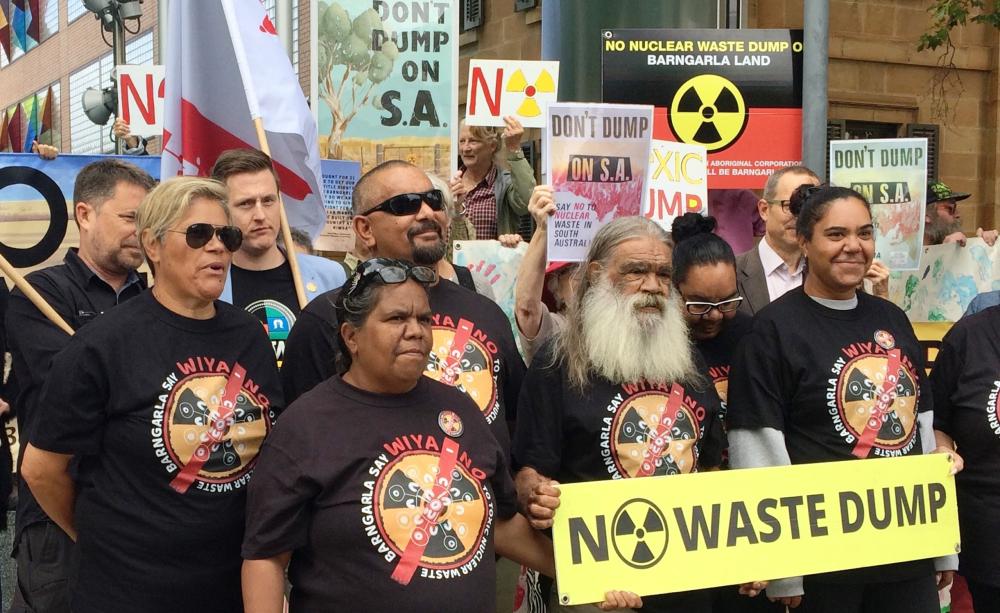
Bipartisan efforts by successive federal governments to impose a national nuclear waste dump on the land of Barngarla Aboriginal traditional owners in South Australia (SA) have been upended by a federal court decision in favour of the Barngarla people.
Australians will have their say in a referendum about whether to change their constitution to recognise the First Nations of Australia by establishing an Aboriginal and Torres Strait Islander Voice later this year.
READ: Radioactive waste and the nuclear war on Australia’s Aboriginal people
The Voice would be an independent and permanent advisory body giving advice to the Australian parliament and government on matters that affect the lives of first nations peoples.
Ignored
Sadly, the federal Labor government has at the same time continued with the plan of the previous regime to establish a national nuclear waste dump near Kimba in South Australia – despite the unanimous opposition of the Barngarla traditional owners.
This plan has now come a-cropper. The Barngarla traditional owners sought to revoke the nomination of the dump site and the federal court this month agreed, arguing that the nomination of the dump site was infected by “apprehended bias” and “pre-judgement”.
The government might yet appeal the decision. However it seems likely that the plan for a nuclear dump on Barngarla country will instead be abandoned.
Aunty Dawn Taylor, a Barngarla elder, said: “I am so happy for the women’s sites and dreaming on our country that are not in the firing line of a waste dump. I fought for all this time for my grandparents and for my future generations as well.”
Jason Bilney, chairperson of the Barngarla Determination Aboriginal Corporation, said: “The Barngarla fought for 21 years for Native Title rights over our lands, including Kimba, and we weren’t going to stop fighting for this. We have always opposed a nuclear waste dump on our country and today is a big win for our community and elders.”
The Kimba site has been targeted for a dump since 2015. In 2021, the conservative Coalition government formally nominated the Kimba dump site, and the Labor government has continued with the plan since winning the May 2022 election.
Violation
Barngarla traditional owners were excluded from a so-called ‘community ballot’ by the Coalition government. An independent and professional ballot of Barngarla traditional owners found absolutely no support for the proposed dump ‒ but it was ignored.
The federal parliament’s joint committee on human rights unanimously concluded in an April 2020 report that the government was violating the human rights of Barngarla people. Even the Coalition members of the committee endorsed the report.
But the Coalition government continued to ignore the human rights of the Barngarla people. The Coalition government also tried to pass legislation which would deny Barngarla traditional owners the right to challenge the nomination of the Kimba dump site in the courts. However the draft legislation was blocked by Labor, minor parties and independent senators.
It was expected ‒ or at least hoped ‒ that the incoming Labor government would abandon the controversial dump proposal after the May 2022 election. But Labor only went as far as pointing out that Barngarla traditional owners could challenge the dump plan in the courts.
The Barngarla Determination Aboriginal Corporation was forced to launch a legal challenge against the previous government’s nomination of the Kimba dump site – and the Labor government fought the case.
Battle
There are at least two problems with Labor’s position. Firstly, the government has vastly greater resources to contest a legal challenge. Indeed, the government has spent A$13 million (£6.8 million) fighting Barngarla traditional owners in the federal court.
Barngarla traditional owners have spent significantly less than A$500,000 – needless to say, they have many pressing demands on their limited resources. There is no other example in recent Australian history of this level of legal attack on an Aboriginal group.
Secondly, the relevant laws are stacked against the interests of traditional owners. In 2007, the conservative Coalition government passed legislation ‒ the Commonwealth Radioactive Waste Management Act ‒ allowing the imposition of a nuclear waste dump on Aboriginal land with no consultation, and no consent from traditional owners.
At the time, Labor parliamentarians described the legislation as “extreme”, “arrogant”, “draconian”, “sordid”, and “profoundly shameful”.
But when the Labor government returned to the legislation in 2012 ‒ and renamed it the National Radioactive Waste Management Act ‒ the amendments were superficial and still allowed for the imposition of a nuclear waste dump with no consultation or consent from Traditional Owners.
Immoral
Regardless of the federal court’s decision, the plan to impose a nuclear dump despite the unanimous opposition of Barngarla traditional owners is immoral. It contradicts the spirit of the Voice to Parliament currently being championed by the Labor government.
Jayne Stinson, chair of the South Australian parliament’s environment, resources and development committee, said: “In this day and age, when we’re talking about ‘voice, treaty and truth‘, we can’t just turn around and say, ‘Oh well, those are our values but in this particular instance, we’re going to ignore the voice of Aboriginal people’.
“I think that’s just preposterous and it’s inconsistent with what most South Australians would think.”
The plan to dump on Barngarla country makes a mockery of Labor’s professed support for the United Nations’ Declaration on the Rights of Indigenous Peoples, which states that “no storage or disposal of hazardous materials shall take place in the lands or territories of indigenous peoples without their free, prior and informed consent”.
There is no informed consent from Barngarla traditional owners: there is informed unanimous opposition.
‘Dreadful’
Dr Susan Close, now the Labor deputy premier of South Australia, has consistently opposed the dump. She said in 2019 that it was a “dreadful process from start to finish” that led to the nomination of the proposed Kimba dump site and that SA Labor is “utterly opposed” to the “appalling” process which led to Kimba being targeted.
Dr Close noted in a 2020 statement, titled ‘Kimba site selection process flawed, waste dump plans must be scrapped’, that SA Labor “has committed to traditional owners having a right of veto over any nuclear waste sites, yet the federal government has shown no respect to the local Aboriginal people.”
She has called for her federal Labor colleagues to abandon the Kimba dump proposal once and for all in the wake of the recent federal court decision.
In February 2008, Labor prime minister Kevin Rudd highlighted the life-story of Lorna Fejo ‒ a member of the stolen generation ‒ in the historic National Apology to Aboriginal People in Parliament House.
At the same time, the Rudd government was attempting to impose a nuclear waste dump on Fejo’s country in the Northern Territory. Lorna said: “I’m really sad. The thing is ‒ when are we going to have a fair go? Australia is supposed to be the land of the fair go. I’ve been stolen from my mother and now they’re stealing my land off me.”
Resistance
Federal Labor’s “nuclear racism” is disgraceful and it diminishes all Australians. And Labor’s nuclear racism is always supported by the conservative Coalition parties, who are still today arguing for a ‘no’ vote in the upcoming referendum on a Voice to Parliament.
But nuclear racism has always met with resistance. Remarkably, community campaigns led by Aboriginal people have stopped five nuclear dump proposals since the turn of the century.
Plans for a national nuclear waste dump in SA have been defeated in 2004, 2019 and 2023 (touch wood), a planned national nuclear dump in the Northern Territory was defeated in 2014, and a plan to turn SA into the world’s high-level nuclear waste dump was defeated in 2016.
Three of the five successful campaigns involved legal challenges that made it much more difficult for governments to override community resistance.
The federal Labor government should abandon the Kimba dump site and apologise for attempting to foist a dump on Barngarla country despite the unanimous opposition of traditional owners.
Veto
The federal Labor government should also adopt SA Labor’s policy that traditional owners should have a right of veto over any proposed nuclear dumps.
That would give traditional owners across the country some confidence that their voice will be heard as the government progresses plans to store and dispose of waste arising from nuclear-powered submarines in the coming decades.
Finally, Labor must commit to amend the shameful and racist National Radioactive Waste Management Act.
This Author
Dr Jim Green is the national nuclear campaigner with Friends of the Earth Australia.
More information:
Radioactive waste and the nuclear war on Australia’s Aboriginal people
Barngarla: Help us Have a Say on Kimba (facebook)
Friends of the Earth nuclear-free campaign
No Radioactive Waste Facility for Kimba District (facebook)
Key British Assange supporter says Wikileaks founder could cut deal to secure freedom
The Age, By Latika Bourke, July 26, 2023
London: One of federal parliament’s leading supporters of Julian Assange says the WikiLeaks founder could cut a deal with prosecutors and plead guilty to “whatever nonsense” necessary to secure his release from prison.
Labor MP Julian Hill, the member for Bruce, tried unsuccessfully to visit Assange in Belmarsh prison, where he has been held since 2019, during a private trip to Europe recently.
Prime Minister Anthony Albanese has directly lobbied US President Joe Biden for the Queenslander’s release but has so far failed to secure it, and has hinted that Assange may have to accept a plea deal.
“The reality is that Australia cannot force the United States to [release Assange], and if they refuse, then no Australian should judge Mr Assange if he chooses to just cut a deal and end this matter,” said Hill.
“His health is deteriorating and if the US refuses to do the right thing and drop the charges then no one would think less of him for crossing his fingers and toes, pleading guilty to whatever nonsense he has to and getting the hell out of there.”
Hill, a member of a cross-party group of MPs who support Assange’s release, also hit out at supporters who he sees as fixated on having Assange suffer as a martyr and continue to languish in prison as he faces extradition to the United States.
“It worries me greatly that there are some Assange supporters who would rather he be a martyr than a free man, but ultimately it’s important for everyone to respect what Julian himself chooses to do,” he said.
His wife Stella Assange has repeatedly warned his health has deteriorated badly due to his incarceration over the last four years…………………………………….
Stella Assange has not said if her husband will accept any plea deal, urging instead that the Biden administration force the US Department of Justice to drop the case, which began under the former Trump administration……………….
Hill said there was only one priority as the case continued to drag on and that was “bringing him home safely to be with his family”.
“I’m not privy to the negotiations that may be occurring but frankly the parliamentarians would back him to the hilt in cutting a deal if that’s what he chose,” he said.
“That’s a message that I wanted to convey personally and hear from him what he wants.”
The Australian High Commission in London tried to help Hill visit Assange on July 1, but the request was denied at the last minute by prison authorities.
“It was incredibly frustrating and disappointing that the Belmarsh Prison authorities failed to approve Mr Assange’s request for me to visit him,” Hill said. “The required paperwork was completed by Julian multiple times.
“However it mysteriously got lost and mislaid until the day before the scheduled visit when they said it was too short notice. It’s up to them to explain whether it’s a conspiracy or a stuff up, but it’s profoundly disappointing to the cross-parliamentary group.”
Jenny Louis, the governor of Belmarsh Prison, was contacted for comment. https://www.theage.com.au/world/europe/key-assange-supporter-says-wikileaks-founder-could-cut-deal-to-secure-freedom-20230725-p5dr7n.html
The Star-Spangled Kangaroo
CAITLIN JOHNSTONE, JUL 27, 2023 https://www.caitlinjohnst.one/p/the-star-spangled-kangaroo?utm_source=post-email-title&publication_id=82124&post_id=135485598&isFreemail=true&utm_medium=email
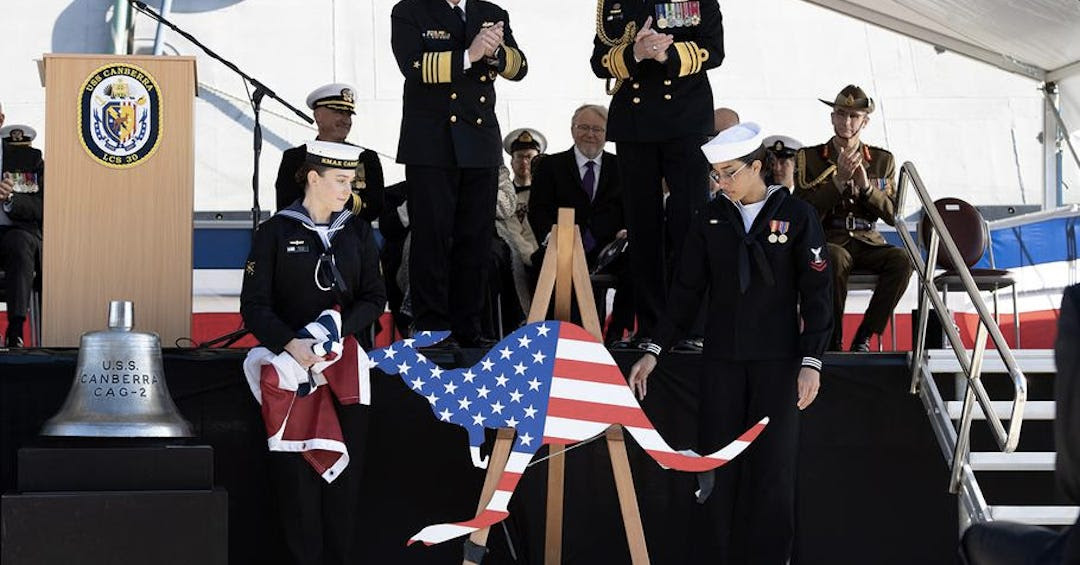
A new US warship has been ushered into service in Sydney. The ship is called the USS Canberra to honor the military union of the United States and Australia, and, if that’s still too subtle for you, it has a literal star-spangled kangaroo affixed to its side.
That’s right: the first US warship ever commissioned in a foreign port has been emblazoned with a kangaroo covered in the stars and stripes of the United States flag. An Australian officer will reportedly always be part of the staff of the ship, to further symbolize the holy matrimony between Australia and the US war machine.
“I can think of no better symbol of this shared future than the USS Canberra,” gushed US ambassador to Australia Caroline Kennedy. “Built by American workers at an Australian company in Mobile, Alabama, her crew will always include a Royal Australian Navy sailor, and from today forward, she will proudly display a star-spangled kangaroo.”
And you know what? She’s right. Not because of her giddy joy over the complete absorption of Australia into the US military apparatus of course — that’s a horrifying nightmare which is increasingly putting this nation on track toward a frontline role in Washington’s war plans against China. But she’s right that the star-spangled kangaroo and the ship which carries it is a perfect symbol for the way these two nations have become inseparably intertwined.
In fact, I’d take it a step further. I’d say the star-spangled kangaroo should be the new symbol for our entire nation.
I mean, we might as well, right? Australia is not a sovereign nation in any meaningful way; we’re functionally a US military/intelligence asset, and according to our defence minister Richard Marles our own military is being moved “beyond interoperability to interchangeability” with the US war machine so they can “operate seamlessly together, at speed.”
The US imprisons Australian journalist Julian Assange for exposing US war crimes like he’s the personal property of the Pentagon, and when the US doesn’t like our Prime Minister because he’s too keen on Australian independence or perceived as too friendly with China, they simply replace him with another one.
We even found out recently that Australians are not permitted to know if the US is bringing nuclear weapons into this country. That is a secret the US keeps from all of us, and our government respects their privacy on the matter.
So I think the star-spangled kangaroo is an entirely appropriate symbol for this country. Put it on our flag. Put it on our money. Put it on all our warships and planes, and on every military uniform. When you walk into an Australian government building, Yankarooey (or whatever stupid Aussie nickname we make up for the thing to mask our own cognitive dissonance) should be the first thing everyone sees.
Undignified? Certainly. Humiliating? Absolutely. An admission that Australia is not a real nation? Of course. But at least it would be honest. If we’re going to act like Washington’s subservient basement gimp, we may as well dress the part.
Seven deadly sins in the Defence industry

In the light of such revelations, and of the fact that nuclear-propelled submarines are really suitable only for deep sea operations, not littoral defence, Richard Marles’s obduracy in continuing to pursue Virginia-Class Attack submarines is astonishing.
It is also about whether the Australian tax payer will be ripped off in the process of acquiring them.
By Richard Broinowski Jul 27, 2023 https://johnmenadue.com/seven-deadly-sins-in-the-defence-industry/
If previous defence acquisitions are any guide, the enormous cost of nuclear-powered submarines for the Royal Australian Navy will almost certainly escalate well beyond the estimated but un-itemised initial price of $A368 billion. The record of corruption of the two US submarine builders suggests that the project will also probably suffer from mismanagement. The final bill is likely to be astronomical.
In my article ‘AUKUS exposes Australia’s incoherent defence policy’, (Pearls and Irritations 14 February 2022), I mentioned the findings of Fred Bennett, Chief of Capital Procurement in the Australian Department of Defence from 1984 to 1988. Bennett listed what he called the seven deadly sins of defence procurement projects – novelty, uncertainty, complexity, interdependence, resource limitations, creative destruction and political constraints. (Security Challenges Vol 6 No 3 Spring 2010).
Bennett claimed that all have been present to a greater or lesser degree in most acquisition projects, and none can be entirely evaded or eliminated. The record over several decades, both in Australia and Britain supports his view.
The Australian Jindalee over the horizon radar system suffered similar delays. The Lockheed Martin F-35 joint strike fighter, designed as a low-cost, lightweight high-performance stealth aircraft, is none of these things, and its project director was sacked in 2010 for cost overruns, schedule delays and a troubling performance record. The BAE Hunter class frigate program has been plagued by design changes which made the ships heavier and slower than intended.
Trying to adhere to a prime contract comprising 22,000 pages with 600 sub contracts, the Collins class submarine all but lost its way in a forest of complexity. This was exacerbated when Wormald, the lead corporation in the submarine consortium changed hands. The head of Wormald was also chair of the Australian Submarine Corporation. The ASC lost its CEO and a period of chaos followed.
But it is not just Bennett’s seven deadly sins we have to worry about with regard to the acquisition of US nuclear powered submarines. Nor is it just about confusion about their primary role, and whether they will be the best possible platform available to realise it. It is also about whether the Australian tax payer will be ripped off in the process of acquiring them.
There are precedents. ……………………………………………………………………………………………………………………………
In the light of such revelations, and of the fact that nuclear-propelled submarines are really suitable only for deep sea operations, not littoral defence, Richard Marles’s obduracy in continuing to pursue Virginia-Class Attack submarines is astonishing. Much cheaper conventional submarines with air-independent propulsion (AIP) are available from Sweden, Germany, Korea or Japan. They are quieter than nuclear submarines, have the capacity to lurk undetected for 30 days or more, are almost as fast, and are very unlikely to suffer the kind of cost blow-outs we are likely to face in nuclear-powered Virginias. We could also get them sooner.
The pro-nuclear lobby in Australia is excited by the prospect that possession of nuclear-powered submarines will lead to the capacity to develop a complete nuclear industry in Australia. This is a pipe dream. Operating experience with ANSTO’s one small Argentinian-designed research reactor at Lucas Heights does not enhance our capacity to enrich uranium, fabricate fuel rods, construct power reactors, or permanently dispose of nuclear waste. Few if any local councils would welcome construction of power reactors in their backyards. Australia still has no designated burial place for low-level medical nuclear waste. A growing number of high-level highly toxic spent fuel rods remain unprocessed at Lucas Heights. Uranium and plutonium residue from rods that have been processed overseas remain in temporary storage.
One can only hope that it is not too late to abandon the purchase of Virginia submarines in favour of much cheaper non-nuclear boats with AIP.
[problems in defence procurement, submarines, corruption, AUKUS, faulty steel plate, nuclear propulsion versus AIP]
Nuclear weapons:“Oppenheimer” won’tmake a difference, but Australia can
The Interpreter GARETH EVANS, 26 July 23
The movie missed a chance to galvanise a renewed campaign, to better protect against existential danger than rely on sheer dumb luck.
Oppenheimer is a big disappointment for those of us who hoped that this super-hyped, all-star-cast new movie might give new life to the nuclear disarmament cause, creating new awareness of nuclear risks and energising popular support for their elimination – maybe even influencing senior policymakers in the way that the 1983 telemovie The Day After was, famously, an epiphany for Ronald Reagan.
…………………………… while making clear that the Hiroshima and Nagasaki bombs were big bangs, and the Edward Teller’s anticipated H-bomb much bigger still, it is no part of the film’s mission to convey the sheer flesh and blood horror of these most indiscriminately inhumane weapons ever devised.
Oppenheimer’s moral qualms about massive civilian death tolls, and the catastrophic potential of an internationally unregulated post-war nuclear arms race, are not as clearly or forcefully explained as they could be. And the film takes it as given that the bomb-dropping (not the Soviet Union’s almost simultaneous declaration of war) was the decisive factor in Japan’s surrender – an historically flawed storyline, but one that remains critical to this day in keeping alive belief in the utility of nuclear weapons.
So, with no new help from the cinema, it’s back to the same old frustrating drawing board for nuclear risk reduction and disarmament campaigners.
The need for effective advocacy and action here has never been more compelling. Nearly 13,000 nuclear warheads are still in existence, with a combined destructive capability of close to 100,000 Hiroshima- or Nagasaki-sized bombs, and stockpiles, especially in our own Indo-Pacific region, now growing again. The taboo against their deliberate use is weakening, with Russia’s President Vladimir Putin talking up this prospect in language not heard since the height of the Cold War. Longstanding nuclear arms control agreements are now either dead (ABM, INF, Open Skies) or on life support (New START).
Moreover, the risk of use through human or system error or miscalculation is greater than ever, not least given new developments in AI and cyber-offence capability. That we have not had a nuclear weapon used for nearly 80 years is not a result of statesmanship, system integrity and infallibility, or the inherent stability of nuclear deterrence. It has been sheer dumb luck, and it is utterly wishful thinking to believe that this luck can continue in perpetuity.
…………………………..what can reasonably be hoped for, and sooner rather than later, is a serious global commitment to nuclear risk reduction.
Australia has a more useful role in this enterprise than many may imagine, with our generally strong record on arms control – including bringing to conclusion the Chemical Weapons Convention – and our nuclear credentials burnished by the ground-breaking Keating government-initiated Canberra Commission on the Elimination of Nuclear Weapons, the Howard Government’s role in getting the Comprehensive Test Ban Treaty to a vote, and the more recent Rudd government-initiated Australia-Japan International Commission on Nuclear Non-Proliferation and Disarmament.
The most commonly proposed risk-reduction measures – and central elements in the Australia–Japan commission’s proposed “minimisation” agenda – may be described as the “4 Ds”. They are Doctrine (getting universal buy-in for a No First Use (NFU) commitment), Deployment (drastically reducing the number of weapons ready for immediate use), De-alerting (taking weapons off high-alert, launch-on warning readiness) and Decreased numbers (reducing the overall global stockpile to less than 2,000 weapons).
A world with low numbers of nuclear weapons, with very few of them physically deployed, with practically none of them on high-alert launch status, and with every nuclear-armed state visibly committed to never being the first to use them, would still be very far from perfect. But one that could achieve these objectives would be a very much safer world than we live in now.
What has been most depressing about Australia’s performance in recent years, which it is very much to be hoped will now change, is that even these realistic objectives have not been actively supported. Australia’s status as a close US ally and, as such, one of the “nuclear umbrella” states, gives us a particularly significant potential role in advancing some key elements of the risk-reduction agenda just described.
The most immediately useful step we could take would be to support the growing international movement for the universal adoption of No First Use doctrine by the nuclear-armed states. ………………… At the NPT Review Conference concluded in New York in August 2022, a great deal of support was evident for such No First Use commitments as part of a larger risk reduction agenda. But the delegation of our new Labor government made no contribution to that debate. I live in hope that that position will change. https://www.lowyinstitute.org/the-interpreter/nuclear-weapons-oppenheimer-won-t-make-difference-australia-can
New Zealand’s anti-nuclear stance means it won’t play a role in Australia’s submarine plans
New Zealand’s commitment to remaining nuclear-free means it won’t play a role in Australia’s defense plans to acquire nuclear-powered submarines, the leaders from both countries said Wednesday
ABC News, By NICK PERRY Associated Press, July 26, 2023
WELLINGTON, New Zealand — New Zealand’s longstanding commitment to remaining nuclear-free means it won’t play a role in Australia‘s plans to acquire nuclear-powered submarines, the leaders from both countries said after meeting Wednesday…………………………………………………………. more https://abcnews.go.com/International/wireStory/new-zealands-anti-nuclear-stance-means-play-role-101659242
Western media as cheerleaders for war
Carried away by the logic of one-upmanship that they impose on the world of politics, the media are co-producing Western countries’ progressive entry into the war against Russia. Everything about the way they treat the conflict suggests that such a confrontation is inevitable. This battle of opinion, which began a year ago, is now being waged on three fronts at once. First, the beatification of Zelensky,
Western journalists are all but unanimous that negotiating with Russia would equal forgiving it its aggression. Nothing short of a crushing victory for Ukraine is conscionable. The risk of escalation is rarely mentioned.
Le Monde Diplomatiqe by Serge Halimi & Pierre Rimbert, Translated by George Miller March 2023
After speeches by British prime minister Rishi Sunak and Ukrainian president Volodymyr Zelensky at a joint press conference on 8 February at a military base in southwest England, it was time for questions. BBC Ukraine correspondent Natalia Goncharova greeted Zelensky with, ‘I would really like to hug you, but I’m not allowed.’ Ignoring his security service, Zelensky got down from the podium and embraced her to general applause. Then Goncharova asked Sunak, ‘You know that Ukrainian soldiers are dying every day. Don’t you think that that decision about warplanes is taking too long?’ In 2003, during the invasion of Iraq, the embedding of journalists with the US military had caused some in the profession to wince; 20 years on, in the Ukraine war, it’s become a journalism of the all-out embrace.
In France, too, the code of conduct set out by Hubert Beuve-Méry, founder of the daily Le Monde (and this publication), counselling ‘contact and distance’, has been set aside. At least when it comes to Volodymyr Zelensky: ‘In real life, he’s nice, quite cool, often funny and not at all grudging with his time,’ said Isabelle Lasserre, Le Figaro’s diplomatic correspondent and darling of the media, France Inter and news channel LCI in particular, since she adopted an uncompromising stance on Ukraine. ‘He has an incredible leadership style, a very intense charisma. He gets straight to the point, he always speaks with conviction,’ she told C politique on France 5 (12 February 2023).
Eulogies, hugs, gushing questions: the Western press’s veneration of this president in khaki fatigues suggests media in thrall to political leaders. But that impression is misleading. Since Donald Trump’s election in 2016, and particularly since Russia’s aggression in Ukraine, ‘journalism’ in the United States and also in Europe has increasingly behaved like an autonomous political force with its own ideological agenda.
Unlike traditional political parties, the media are simultaneously bringing to life and feeding rival tendencies that form two branches of the market for news: one on the hard right (Fox News, The Sun, CNews etc), the other liberal (the New York Times, the Washington Post, CNN, the Guardian, Le Monde etc). With these two audiences, both of which demand their own partisan reading of events, ‘journalism’ is careful not to alienate the faithful by ever making them doubt the bewitching story it serves up.
Media in combat mode have polarised the US around fictitious issues (‘Trump is the Kremlin’s puppet’, ‘Joe Biden’s election victory was rigged’). Since the invasion of Ukraine, they have involved the West in a war against Russia by suppressing any public debate on the risks of military escalation.
This undertaking has been aided by instincts inherited from the cold war: (much-replayed) archive footage of American schoolchildren learning how to protect themselves from a Soviet nuclear attack; a long-standing obsession with communist subversion in the US; and recurrent paranoia about the ‘enemy within’.
It was conceivable, though, that the demise of the Soviet Union and the election of a president who enjoyed strong support in the West, and was almost servile towards it — Boris Yeltsin — would call for more cordial relations between the two former protagonists in a confrontation that had become futile. The Russian people longed for this just as much as their leaders: in the early 1990s, when former Soviet citizens were asked about their favourite international partner, 74% of them picked the US (1).
To ensure US hegemony
This enthusiasm was not mutual. US politicians and media treated Russia as a defeated country, whose role was to not only bend to the rules of then-triumphant neoliberal capitalism, but also to remain strategically weak so that no hostile power could ever again threaten US hegemony. In 1992, only a few weeks after the end of the Soviet Union, the leaked draft Defense Planning Guidance (DPG), better known as the Wolfowitz Doctrine, a Pentagon document that the press published immediately, already had Russia in its sights. It stated that Washington would henceforth need to ‘refocus on precluding the emergence of any future global competitor’. The power of American ‘conviction’ would be all the more compelling because the Pentagon promised to back it up with a military capable of ‘preclud[ing] hostile competitors from challenging our critical interests’ (2). However, ‘the master of the Kremlin’ was then Boris Yeltsin, not Vladimir Putin.
But that barely mattered, because with rare exceptions — notably Saudi Arabia and Israel — the US and its media were almost equally inflexible towards and dismissive of their puppets (Yeltsin), their ‘allies’ (European states) and their enemies (China, Russia, Iran). The idea in the Wolfowitz Doctrine that the international order is ultimately guaranteed by the United States and that the US must be in a position to ‘act independently, as necessary’ when international support is ‘sluggish or inadequate’ was the consensus in the State Department, Washington think tanks and newsrooms. This imperial prism explains the unquestioning acceptance with which all American wars, including the most illegal ones, have been greeted by Fox News and the New York Times.
Journalists have gone back to basics. In the Ukraine war, Chinese, Indian, Latin American, Arab or African viewpoints don’t count?
So Russians gradually became disenchanted with the West…………and NATO’s ongoing expansion, together with the experience of privatisation, finally convinced the Russian public that the US intended, if not to ‘humiliate’ Russia, then at least to subordinate it. ……….
In the US, the construction of the Russian enemy had proceeded in parallel as disagreements and tensions between the two former superpowers grew. ………………………………………….
‘Trump, Putin’s lackey’
Much inanity flowed from this belief. And the European media picked up most of it…………………………………………………….
The US mainstream media’s war on Trump illustrated the transformation of the news business into a political force………………………………………………….
……..journalist Jeff Gerth, who spent three decades on the New York Times, recently published a rolling investigation of the media’s Russiagate coverage in the respected Columbia Journalism Review (5). This mountain of fake news, whose main purveyors were the New York Times, the Washington Post, CNN and MSNBC, asserted that, without collusion between Trump and Putin, Clinton would have been sitting in the Oval Office. Unfortunately for them, after two years of investigation, special prosecutor Robert Mueller, a darling of the Democrats, burst this bubble and disproved any collusion (6). The Washington Post even had to correct several of its scoops and take down the most grotesque fabrications from its website.
The Columbia Journalism Review’s investigation can be read like a textbook of journalistic errors: elision of information that doesn’t corroborate a reporter’s thesis, a competitive race for scoops at the expense of rigour, passing off as ‘Russian disinformation’ stories that are true but embarrassing to the Democrats, the misleading presentation of statistics, misuse of anonymous sources (a thousandfold during the Trump era) vaguely described as ‘administration officials’ or ‘intelligence officials’.
Misleading use of statistics
Even when the agencies corrected or denied the information they had published, the press, acting as an autonomous political force, went on to make doctored ‘revelations’ to keep up the pressure on the White House. ……………………………………………….
As if to confirm this damning indictment of the press, the media outlets involved greeted Gerth’s investigation with stony silence, no doubt confident that their readers would rather have their convictions reaffirmed than be disabused. The result, Gerth explained, is that a profession that is highly influential in public life faces no penalty when it goes wrong……………………………….
Russiagate had turned questions about a ‘Russian threat’ into a domestic political weapon; the media emerged from it discredited. But the war in Ukraine saved them in a sense. It enabled them to recycle their obsession, this time based on real aggression and in a more favourable political context, since both US parties agree that their country should be arming Ukraine against Russia for as long as it takes.
The cult of ‘Western values’

A similar consensus exists in Europe. The 1999 Kosovo war had already seen Germany’s Greens commit themselves wholeheartedly to NATO; even today, the most fervent support for Kyiv is found among the liberal left and environmentalist groups that were once tempted by pacifism. . For these educated sections of society, defending Ukraine is a secular religion: journalists, high priests of the cult of ‘Western values’, preach the salvation of progressive souls at last mobilised against Moscow’s imperialism. Putin’s nationalist diatribes and reactionary traditionalism encourage this militancy, as does the presence of a Democrat in the White House.
The almost total absence of dissenting voices within the ‘progressive’ universe is also partly explained by the price exacted for straying from the bellicose line that is asserted with almost imperceptible shades of difference by LCI and France 2, Médiapart and Paris Match, L’Opinion and Politis, RTL and France Inter. Any reservation expressed about the general mobilisation for Ukraine sparks controversy or scandal,………………………………………………………………
This question gives rise to others. Why do the hosts of this morning show have guests who are almost unanimously in favour of increasing military aid to Kyiv: François Hollande, Bernard Guetta, Isabelle Lasserre, Pierre Servent etc? Why is it that from 8pm on LCI, under the leadership of Darius Rochebin (an admirer of Bernard-Henri Lévy), ‘debates’ on Ukraine assemble panels of Atlanticist journalists (a rotating cast of Pierre Servent, Isabelle Lasserre and Nicolas Tenzer), former NATO researchers (Samantha de Bendern), an exiled ‘former KGB agent’ and Ukrainian activists? Why do magazine covers look like leaflets distributed in Kyiv (‘Ukraine must win’, ran the headline in L’Express on 16 February 2023)? Why do reporters make do so often with simply illustrating a story devised in newsrooms in Paris and why, finally, do editorials only add a patina of respectability to this crusading tone?
It is as if everyone had agreed there is only one possible foreign policy, the policy being pursued by Ursula von der Leyen and the US State Department, and summed up by the German foreign minister on 25 January: ‘We’re waging a war against Russia’. The absence of pluralism is all the more noticeable because any leftwing opponents stay silent or invisible (8). …………….. journalists have gone back to basics. In the Ukraine war, Chinese, Indian, Latin American, Arab or African viewpoints don’t count
Carried away by the logic of one-upmanship that they impose on the world of politics, the media are co-producing Western countries’ progressive entry into the war against Russia. Everything about the way they treat the conflict suggests that such a confrontation is inevitable. This battle of opinion, which began a year ago, is now being waged on three fronts at once. First, the beatification of Zelensky, who has become the most famous influencer on the planet, to the extent that no book fair, film festival or American football match can claim success without his blessing via video link.
……………………………………………………………..The fear of offending Kyiv sometimes borders on self-censorship: when the New York Times ran a story online initially headlined ‘Ukraine corruption scandal stokes longstanding aid concerns in US’ (27 January 2023), it was immediately amended to read: ‘US officials overseeing aid say Ukrainian leaders are tackling corruption.’
The West’s sanctions campaign
The second front is the campaign to destroy Russia economically and militarily through sanctions and stepping up arms deliveries to Ukraine in the form of artillery, missiles, tanks and fighter planes. Not content with brushing aside the debate on the dangers of such a military escalation, the media equate any idea of negotiation with giving Moscow a full pardon (shades of Munich, 1938). As for economic retaliation, they are reluctant to admit their relative failure;…………………………………………………………..
The third front, which is probably most effective because least visible, is the avoidance of any historical perspective on the conflict and unfolding events. When France Inter’s geopolitics commentator Pierre Haski, who is also the president of Reporters Without Borders, rightly accused the Russians of ‘hitting cities and infrastructure’ (14 February 2023), he failed to point out that this is precisely what NATO did during the war in Kosovo. ………………………………………
The idea that other people might compare Russian imperialism to that of the US — wars without a UN mandate in Kosovo and Iraq, Washington’s denunciation of several disarmament agreements with Moscow, embargoes and boycotts against Cuba and Iran, extra-judicial executions by drone, the persecution of Julian Assange and Chelsea Manning — is unwelcome in most newsrooms. As a result, these Western decisions are erased from memory or treated as exceptions, not part of a pattern.
………………………………………………. But the biased presentation of history does not just impoverish Westerners’ ability to judge the ongoing war. It also renders less comprehensible the reaction of other peoples who are aware of facts that their media are willing to tell them. For Arabs, Africans or Latin Americans, the assertion that Ukraine is ‘fighting for our values’ (11) can only reawaken memories of the Iraq war. At the time when the US was preparing to invade that country on a false prospectus, it received the support of eight European leaders — from the Czech Republic, Spain, Portugal, Italy, the UK, Hungary, Poland and Denmark — in the form of a joint letter published in the Wall Street Journal on 30 January 2003. It began, ‘The real bond between the United States and Europe is the values we share: democracy, individual freedom, human rights and the Rule of Law.’ The result: a country destroyed and hundreds of thousands of lives lost.
Does this mean that beyond Ukraine, other acts of aggression, massive destruction, violations of people’s right to self-determination have not aroused the same indignation, the same batteries of sanctions, the same abundance of military assistance to the besieged country? Silence in the ranks! https://mondediplo.com/2023/03/08media
US, Australia Launch Largest-Ever Joint Military Exercise
This year’s Talisman Sabre exercise involved 11 other nations and over 30,000 military personnelby Dave DeCamp Posted on https://news.antiwar.com/2023/07/23/us-australia-launch-largest-ever-joint-military-exercise/
The US and Australia on Friday launched the largest-ever iteration of their Talisman Sabre exercise as the US is increasingly focused on building alliances in the Asia Pacific against China.
The Talisman Sabre started in 2005 as a biennial exercise between the US and Australia. This year’s iteration involves participants from 11 other countries and over 30,000 military personnel.
US Navy Secretary Carlos Del Toro spoke at the opening ceremony on Friday and said the massive drills served as a warning to China. “The most important message that China can take from this exercise and anything that our allies and partners do together is that we are extremely tied by the core values that exist among our many nations together,” he said at a naval base in Sydney.
In a symbolic gesture to demonstrate the growing military ties between the US and Australia, the US on Saturday commissioned a naval vessel in Sydney, the USS Canberra, an Independence-class littoral combat ship. It marked the first time the US ever commissioned a US Navy ship was commissioned in a foreign port.
Del Toro has previously said that the US Navy envisions turning Australia into a full-service submarine hub for the US and its allies in the region under the AUKUS military pact that was signed between the US, Britain, and Australia in 2021 that will result in Canberra acquiring nuclear-powered submarines.
The US and Australia were joined in the Talisman Sabre exercises by militaries from Fiji, France, Indonesia, Japan, South Korea, New Zealand, Papua New Guinea, Tonga, Britain, Canada, and Germany. Personnel from the Philippines, Singapore, and Thailand are attending as observers.
The exercises involve live-fire drills and will conclude on August 4. A Chinese naval vessel was spotted surveilling the drills, which Australian military officials said have happened since 2017.
UPDATE – The Zaporozhiya Nuclear Plant: Zelenskiy’s Next Simulacra?
Russian and Eurasian Politics, by GORDONHAHNJuly 22, 2023
To update my original article “The Zaporozhiya Nuclear Power Plant: Zelenskiy’s Next Simulacara” it is worth noting the following points:
(1) There has been no incident, obviously, at the plant either of Russian origin, as Ukrainian president Volodomyr Zelenskiy claimed was being planned, or of Ukrainian origin, as I argued was possible and the Russians claimed was almost certain in response to the Ukrainian claims. However, there was, as I suspected, clearly another Ukrainian fake, another Zelenskiy simulacra, since there was not ‘Russian nuclear terrorist attack and since the IAEA came out and refuted the Ukrainians’ claims that the Russians had planted explosives at the Zaporozhiya plant.
Second, it appears that this particular Zelenskiy simulacra was an effort to push the failure of the Ukrainian counteroffensive out of the headlines on the eve of NATO’s Vilnius summit. It may be that, as some sources report, that European leaders intervened to prevent the Ukrainians from following through on their supposedly planned false flag.
Third, it is astonishing how the Western media and Wstern governments, which was heavy breathing in its hard work of repeating the Kiev Maidan regime’s talking point about the ‘imminent Russian nuclear terrorism, has shoved the entire episode of Zelenskiy’s ‘Russian nuclear terrorist attack’ into the bottomless ‘memory whole’ that serves this war.
This follows the same pattern of moving on quickly after the numerous controversial and false claims that have come out of Kiev both before and during the war. Regarding the latter, there s already a long list: the Kakhovskii damn attack, the Nord Stream pipeline attack, the ‘Russian massacre’ at Bucha (where is the list of names of those killed and the detailed forensics reports on how and when precisely they died?), the hero Ukrainian pilot ‘The Ghost’ who never existed, the heroic defense of Snake Island that never occurred, the bombing of the Mariupol maternity hospital, among others.
This is part of a larger Western pattern of memory-wholing………………………………………….. The point is not that the West and Ukraine always lie or that lie more than Moscow, which it seems they do, however. The point is that Zelenskiy and his government comprise a serial fake artist, the West is their microphone, and Russia has work to do to compete with its opponents in the sphere of ‘public diplomacy.’
The original article reads as follows:
It appears almost certain that Ukrainian President Volodomyr Zelenskiy and his generals, rather than Russian President Vladimir Putin and his, are considering and preparing a false flag nuclear provocation at the Zaporozhiya nuclear power plant (ZNPP) set for July 7-9 to frame NATO summit and perhaps also to provide political cover for a Polish-Baltic republic move of forces into western Ukraine. Such a nuclear event will not be on a scale even approaching the Chernobyl accident, but it will be sufficient so that it can be framed as grave ‘Russian crime against humanity’ and used by Kiev to gain certain advantages via the West,
The incident likely will occur as a result of a Ukrainian attempt to seize the Zaporozhiya NPP in response to which Russian troops will be accused of detonating explosives creating a dirty bomb effect on a small scale. Ukrainian troops will cross the dried-up Dnepr, seize the ZNPP, detonate explosives there themselves. This will allow Kiev and the West to accuse Moscow of ‘nuclear terrorism’.
The signs of an impending false flag operation have been flashing for weeks, with numerous Ukrainian commentaries to the effect that the Russians were planning a nuclear terrorist operation at the Energodar ZNPP.
. The most recent make things pretty clear. IAEA inspections have never endorsed Ukrainian claims – ongoing for over a year now – that it is Russian forces that fire on the ZNPP. Indeed, Russian forces have occupied all of Energodar and the ZNPP and have for well over a year, and IAEA has a team permanently stationed at the plant along with Russian RosAtom personnel, who now run the plant.
More recently, on June 23rd Ukrainian Main Military Intelligence Directorate chief Kyrylo Budanov reported that Russia had completed preparations for carrying out a nuclear terrorist attack at the ZPNN
(https://twitter.com/TheStudyofWar/status/1673143608315367425?s=20).
On June 29-30, Ukraine held nuclear accident civilian defense exercises in Zaporozhiya and the neighboring region of Kherson simulating the effects of an attack on the Zaporizhiya plant………………………………………………………… IAEA inspector recently refuted Zelenskiy’s claims that Russia had moved explosives into the plant in preparation for its terrorist attack, noting “found “no visible indications of mines or other explosives” at the Zaporizhiya plant (www.newsweek.com/russia-could-blow-nuclear-plant-after-handing-it-ukraine-zelensky-1810318). ………………………………………………………………., the pro-Ukrainian Institute for the Study of War concluded it is unlikely that Russia would undertake such a nuclear gambit, casting doubt on Kiev’s propaganda campaign.
It must be kept firmly in mind that Ukraine is desperate. Desperate men do desperate things. Kiev badly needs additional arms supplies from the West, and it was hoped significant gains of territory in the first month of Kiev’s counteroffensive would be sufficient to market Ukraine’s military as worthy of greater support to the July 11 NATO summit, as Zelenskiy himself has acknowledged (https://t.me/rezident_ua/18566). But such success has not materialized and could not have.
Russian forces have overpowering advantages in air, artillery, drone, heavy ground equipment (tanks, APCs) and are attritting Western supplied Abrams tanks and Bradley fighting vehicles rapidly. Ukrainian forces are now increasingly implementing their counteroffensive without air cover, tanks, and artillery, suffering massive casualties for minimal gains in territory, which are most often quickly lost again. In a recent Washington Post interview Zalyuzhniy recently berated the West for its unrealistic expectations regarding the counteroffensive, particularly in light of Western failure to supply Kiev with F-16s and sufficient numbers of tanks, APCs, artillery, and ammunition……………………………………………………………………….. more https://gordonhahn.com/2023/07/22/update-the-zaporozhiya-nuclear-plant-zelenskiys-next-simulacra/
Japan Doesn’t Want to Fight for Taiwan and Neither Do Other US Allies

if Japan fought alongside the US in a hypothetical conflict with China over Taiwan, the Japanese civilians and economy would suffer greatly. What’s more, in a conflict between two nuclear powers, China and the US, Japan may itself become a nuclear target,
22.07.2023 Ekaterina Blinova https://sputnikglobe.com/20230722/japan-doesnt-want-to-fight-for-taiwan-and-neither-do-other-us-allies-1112066099.html
Despite Japan bolstering its military capabilities under the nation’s new Defense Buildup Program, it appears to have zero appetite to engage in direct confrontation with China over Taiwan, Western media and think tanks say.
US military facilities in Okinawa, Japan, might play a central role in any Taiwan crisis, according to the Western press. Moreover, American military analysts have almost unanimously agreed that Japan is “the most likely US ally to contribute troops” in a potential US conflict with China over the island.
Back in October 2021, War on the Rocks, a US online media outlet, quoted a Japanese poll which appeared to indicate that 74% of respondents would support their government’s military engagement in the Taiwan Strait against China. The report further speculated about the possibilities of circumventing the country’s Constitution, which limits Japan’s ability to participate in conflicts.
Bold statements made by some Japanese officials also seemed to confirm Tokyo’s resolve. One of them, former Minister of Defense Yasuhide Nakayama, insisted in June 2021 that Taiwan is a “red line” and that “we have to protect Taiwan as a democratic country.” Japan and Taiwan are geographically close and any possible military actions over the island could potentially affect Japan’s Okinawa prefecture, Nakayama argued at the time.
Is China Going to Take Taiwan by Force?
The People’s Republic of China, which considers Taiwan its inalienable part, has repeatedly stated that it is going to reunite with the island peacefully, referring to years of fruitful collaboration with the former Taiwanese government formed by members of Kuomintang Party.
The Kuomintang can make a spectacular comeback during the Taiwanese general elections, scheduled for January 2024. The party’s victory could nip the fuss around Taiwan’s secessionism and potential conflict in the bud. Even US lawmakers admit it, considering the Kuomintang’s win a potential “threat” to Washington’s plans in the Asia-Pacific.
Biden Fast-Tracks Arming of Taiwan
For their part, the Biden administration and American legislators have repeatedly issued provocative statements with regard to the island, with the US president claiming time and time again that Washington is ready to “protect” Taiwan “militarily.” The US has also bolstered arms sales to the island.
In late June, Biden approved two potential arms sales totaling $440 million to Taiwan, including ammo and other military equipment. Earlier, in March, the US State Department approved a $619 million sale of hundreds of missiles to Taiwan to arm its new US-made F-16 jet fighters. Moreover, the Biden administration has started to use fast-track authority for accelerating the pace of the arming of Taiwan. The same mechanism has been used by Biden to speed-up Ukraine’s militarization.
Japanese Leadership Seems Unhappy With US Bellicosity
The unfolding situation has apparently given shivers to the Japanese leadership. The Wall Street Journal broke on Monday that the Japanese government is ready to give permission to the US to use bases in Japan in the case of conflict over Taiwan, but Tokyo’s own participation is unlikely.
Per the report, Washington invited Tokyo to consider using its Self-Defense Forces, especially the Maritime Self-Defense Force for hunting for Chinese submarines around the island of Taiwan and for other military missions.
Presently, Japan is home to about 54,000 US troops, according to the Council on Foreign Relations. It also hosts the headquarters of the US Navy’s 7th Fleet and the 31st Marine Expeditionary Unit.
Tokyo’s concerns have certain grounds. In May, Japanese scholar Kiyoshi Sugawa wrote for Responsible Statecraft, the online magazine of the Quincy Institute (a DC-based think tank), that if Japan fought alongside the US in a hypothetical conflict with China over Taiwan, the Japanese civilians and economy would suffer greatly. What’s more, in a conflict between two nuclear powers, China and the US, Japan may itself become a nuclear target, Sugawa warned.
The DC-based think also refers to the recent Japanese polls which indicate that just 11% of Japanese respondents consider it possible to fight alongside the US against China, while 27% said that their forces should not cooperate with the US military at all. The majority (56%) said that providing logistical support to the US would be more than enough in the event of the conflict.
Nobody Wants to Die for Uncle Sam
What’s more, Japan is not the only US ally unwilling to fight with China over Taiwan. The Australian government has recently signaled that it gave no promises to Washington about military participation in a potential conflict. The Philippines does not want to get dragged into the conflict, either.
When it comes to South Korea, it also lacks any enthusiasm of joining the US in a combat operation in the Taiwan Strait. Western observers draw attention to the fact that South Korean President Yoon Suk-yeol avoided meeting with then-US House Speaker Nancy Pelosi in Seoul after her controversial tour to Taiwan. The Diplomat suggested that Seoul has at least three reasons to avoid a possible war over the island. First, the China market accounts for 30% of South Korea’s total trade; second, Seoul fears that a Taiwan conflict would increase “the North Korean threat”; third, for Seoul friendly relations with Beijing is a guarantee against a conflict with Pyongyang.
Still, there is yet another US regional treaty ally, Thailand. However, according to the DC-based think tank, it’s completely impossible to force Bangkok to fight against China for the sake of Taiwan.
While muddying the waters of the Taiwan Strait, the US risks staying face-to-face with China which would mean a defeat in a possible military standoff, judging from the US’ earlier war game simulations.
Ukrainian drone attack on Moscow is ‘international terrorism’ – Russia’s Foreign Ministry
RT.com 24 July 23
Two UAVs crashed into buildings in the Russian capital, with fragments reportedly found not far from the Defense Ministry
The attempted Ukrainian drone attack on Moscow early Monday morning, which damaged several non-residential buildings, is “an act of international terrorism,” Russian Foreign Ministry spokeswoman Maria Zakharova has said.
The spokeswoman condemned the attack on Monday morning while speaking to RTVI TV. Earlier, the Russian Defense Ministry said Ukraine attempted to stage “a terrorist attack” against Moscow using two drones, which were suppressed by electronic warfare systems……………
Kiev applauded the raid, with Mikhail Fedorov, Ukraine’s minister for digital transformation, promising that “there will be more” of these incidents.
Amid the conflict with Russia, Kiev has previously tried to launch drone raids on Moscow and its suburbs. Earlier this month, the Russian Defense Ministry said that air defenses downed four drones in the southeastern districts of the capital, and another UAV was neutralized by electronic warfare systems west of Moscow…………………………… more https://www.rt.com/russia/580185-ukrainian-drone-attack-moscow-international-terrorism/—
Congressional Concerns: Stalling Nuclear Submarines for Australia

Australian Independent Media July 23, 2023, Dr Binoy Kampmark
Any security arrangement with too many variables and multiple contingencies, risks stuttering and keeling over. Critical delays might be suffered, attributable to a number of factors beyond the parties concerned. Disputes and disagreements may surface. Such an arrangement is AUKUS, where the number of cooks risk spoiling any meal they promise to cook.
The main dish here comprises the nuclear-powered submarines that are meant to make their way to Australian shores, both in terms of purchase and construction. It marks what the US, UK and Australia describe as the first pillar of the agreement. Ostensibly, they are intended for the island continent’s self-defence, declared as wholesomely and even desperately necessary in these dangerous times. Factually, they are intended as expensive toys for willing vassals, possibly operated by Australian personnel, at the beckon call of US naval and military forces, monitoring Chinese forces and any mischief they might cause.
While the agreement envisages the creation of specific AUKUS submarines using a British design, supplemented by US technology and Australian logistics, up to three Virginia Class (SSN-774) submarines are intended as an initial transfer. The decision to do so, however, ultimately resides in Congress. As delighted and willing as President Joe Biden might well be to part with such hulks, representatives in Washington are not all in accord.
Signs that not all lawmakers were keen on the arrangement were already being expressed in December 2022. In a letter to Biden authored by Democratic Senator Jack Reed and outgoing Republican Senator James Inhofe, concerns were expressed “about the state of the US submarine industrial base as well as its ability to support the desired AUKUS SSN [nuclear sub] end state.” Current conditions, the senators went on to describe, required “a sober assessment of the facts to avoid stressing the US submarine industrial base to the breaking point.”
On May 22, a Congressional Research Service report outlined some of the issues facing US politicians regarding the procurement of the Virginia (SSN-774) submarine for the Australian Navy……………………………
The report has proven prescient enough. Republicans on the Senate Armed Services Committee have realised that stalling aspects of AUKUS might prove useful, if it entails increasing military spending beyond levels set by the current debt-limit deal………………………………………
Then came another problem: almost 40% of the US attack submarines would be incapable of deployment due to maintenance delays………………………….
The terms, for Wicker, are stark. “To keep the commitment under AUKUS, and not reduce our own fleet, the US would have to produce between 2.3 and 2.5 attack submarines a year.”…………………………………………..
Such manoeuvring has caught the Democrats off guard……………………………………………..
As US lawmakers wrestle over funds and the need to increase submarine production, the Australian side of the bargain looks flimsy, weak, and dispensable. With cap waiting to be filled, Canberra’s undistinguished begging is qualified by what, exactly, will be provided. What the US president promises, Congress taketh. Wise heads might see this as a chance to disentangle, extricate, and cancel an agreement monumentally absurd, costly and filled with folly. It might even go some way to preserve peace rather than stimulate Indo-Pacific militarism. https://theaimn.com/congressional-concerns-stalling-nuclear-submarines-for-australia/
Dutton’s Nuclear Folly: Small Modular Reactors a political mirage

by Rex Patrick | Jul 23, 2023 https://michaelwest.com.au/duttons-nuclear-folly-small-modular-reactors-a-political-mirage/
As Peter Dutton talks up nuclear power, it is not surprising to see Andrew Liveris shifting his pitch from a ‘gas led recovery’ to a call for Small Modular Reactors (SMRs) to be considered for the 2032 Brisbane Olympics. Dutton is engaged in politics, Liveris in fantasy. Rex Patrick reports on the nuclear distraction.
What’s a Small Modular Reactor?
Small modular reactors (SMRs) are nuclear powered reactors with an electrical power output of less than 300 megawatts (MW).
There’s potential for these reactors to be mass produced and deployed at significantly lower costs to traditional nuclear reactors to replace coal and gas fired power plants with low carbon, base-load, synchronous power generation.
But for a sunburnt country with an abundance of space, they will never compete with solar and wind, supplemented by base-load technologies such as batteries, hydro, pumped-hydro and molten salt.
A Liveris’ Fantasy
Liveris’s 2032 suggestion was beyond belief.
Russia has packaged two low powered nuclear ice breaker reactors in a floating barge to claim a first SMR. China has a demonstration SMR in Shidaowan. Apart from that, they don’t exist.
The US is aiming to have its first SMR generating power in 2029. Its proponent, NuScale Power, has assigned a memorandum of understanding with Polish mining firm, KGHM, to deploy a plant to support its copper and silver production in Poland.
While there are over 70 SMR designs being developed across 18 countries, few are even close to being commercially mass produced.
Australia has had some involvement in SMRs through ANSTO, the operator of the Australia’s only 20 MW nuclear reactor used for nuclear medicine, research, scientific and industrial purposes.
Since late 2020 ANSTO has been participating in a three year International Atomic Energy Agency’s co-ordinated research project on the economic appraisal of SMRs. It has assembled a team of its own and other Australian experts to analyse the economics of the technology.
They have also supported a University of Queensland PhD candidate to model the deployment of SMRs across the Australian National Energy Market. The student is due to conclude his PhD work in a few month’s time.
Eight days after Minister Chris Bowen was sworn in he sought an ANSTO briefing on SMRs.
The Politics of Dutton
While ANSTO has been at work, CSIRO has also been working with the Australian Energy Market Operator to work out the Levelised Cost Of Electricity (LCOE) for each technology.
For 2030, wind and solar are sitting on or around $50/MWh while SMRs are somewhere between $150 and $300/MWh
For 2050, wind and solar are sitting on or below $50/MWh while SMRs are somewhere between $125 and $150/MWh.
Peter Dutton is not one to let facts get in the way of a political position.
Turnbull foiled, Teals fuelled
Across 2017 and 2018 Prime Minister Malcolm Turnbull was working up a National Energy Guarantee (NEG) policy to deliver energy to Australia which balanced out cost, reliability and emissions cleanliness. It was policy designed by engineers and economists.
Dutton moved to exploit deep seated division in the Liberal National Party (LNP).
He wasn’t interested in climate change. He wasn’t interested in good policy. He was interested in himself. He used NEG to challenge Turnbull’s leadership and, while he failed, he managed to kill off the policy. A second challenge saw Scott Morrison sworn is as Prime Minister and the NEG abandoned.
Dutton was the person responsible for a moment in time that created opportunity for the Teals, who went on to displace a number of LNP members in the 2022 election.
A lack of vision
Dutton promoting nuclear will appeal to the LNP base. To the informed, he won’t appeal to those concerned about cost of living and, yet again, he’s certainly not offering leadership and vision.
Yes, there is a case for a mix of wind, solar and nuclear (in place of gas and coal), but it is not a case that’s filled with vision. A better future for Australia is one that seeks to capitalise on abundant space and renewables; a mix of wind, solar, batteries, hydro, pumped-hydro, batteries, molten-salt and other technologies.
That’s what Malcolm Turnbull was trying to do with NEG and Snowy Hydro 2.0. Sadly, Snowy Hydro 2.0 is a project that’s turning out to be a good idea poorly executed.
Originally envisaged to cost $2b, new estimates have its final costs sitting at $10b. A value for money re-assessment must occur, with one alternate pumped-hydro solution being Tasmanian with a second cable being funded to clean electrons across the Bass Strait?
Fusion power
Solutions are available as we wait for fusion energy to arrive.
Fusion received international attention in late 2022 when a US based group made more energy that was put into a fusion reaction, showing proof of concept.
It’ a long way off, a source that won’t be fielded until beyond 2050, but something we should be aiming for.
Wasted opportunity
We don’t pass our planet on to our children and grandchildren; it’s actually on loan from them. It should be treated accordingly.
We should cast our mind forward to 2070, when the world has fully embraced base-load renewables and fusion.
A young man named Dutton will be asking himself ‘what exactly was my great-grandfather thinking”, as he grapples with the still controversial and unsolved problem of dealing with high level nuclear waste from AUKUS submarines and a foray into SMRs.
The answer to the young man’s question will be, “folly”.
Nevil Shute’s ‘On the Beach’ warned us of nuclear annihilation. It’s still a hot-button issue with a new play at the Sydney Theatre Company

ABC News The Conversation / By Alexander Howard, 23 Jul 23
“……………………………….. the nuclear threat is still very much at the top of our collective mind.
The Sydney Theatre Company is staging the very first stage adaptation of Shute’s novel “On the Beach”. And Oppenheimer, one of 2023’s two most-hyped films, tells the story of the man referred to as “the father of the atomic bomb”.
‘Australia’s most important novel’
Journalist Gideon Haigh calls On the Beach “arguably Australia’s most important novel — important in the sense of confronting a mass international audience with the defining issue of the age”.
British-born Shute emigrated in 1950 to Australia, where he lived outside Melbourne. As well as writing novels, he worked as an aeronautical engineer.
The title of On the Beach — which started life as a four-part story called The Last Days on Earth — ostensibly referred to a Royal Navy expression for reassignment. (Shute spent time in the Royal Naval Reserve during World War II.) However, as readers of Eliot’s poetry will know, the phrase also appears late in The Hollow Men:
In this last of meeting places
We grope together
And avoid speech
Gathered on this beach of the tumid river.
As in Eliot’s poem, the characters that cluster together in the pages of Shute’s novel, set in and around Melbourne between 1962 and 1963, tend on occasion to avoid speech…………………………
The reason why the guests at Peter’s party are so keen to avoid serious talk is both simple and depressing. They are trying very hard to forget that they are all going to be dead from radiation poisoning in a matter of months.
Shute brings the reader up to speed after the dinner party wraps up. A massive nuclear war has devastated the entire northern hemisphere, wiping out all forms of life there. And the radioactive fallout generated during the conflict is now creeping — slowly but surely — into the southern hemisphere.
Shute makes it clear there is absolutely nothing anyone can do about this. In tonally dispassionate prose, he reveals that vast swathes of Australia have already been rendered uninhabitable due to radiation poisoning. The only thing the characters who remain can do is wait.
…………………………………………………………………………… This is the way Shute’s novel of nuclear extinction ends: not with a bang but with a whimper. Released at the height of the Cold War, On the Beach struck a chord with millions of concerned readers.
………………………………………………………………………Shute’s didactic inclinations are evident towards the end of the novel. “Peter,” the character Mary asks, “why did this all this happen to us?” Even at this late stage, Mary, whose radiation-racked body is spasming uncontrollably, wants to know whether things might have panned out differently. Her husband’s reply is revealing:
“I don’t know … Some kinds of silliness you just can’t stop,” he said. “I mean, if a couple of hundred million people all decide that their national honour requires them to drop cobalt bombs upon their neighbour, well, there’s not much that you or I can do about it. The only possible hope would have been to educate them out of their silliness.”
………………………..While the science in the novel was somewhat flawed, Shute’s cautionary tale undoubtedly spoke to the collective zeitgeist.
………………………………………………..
Shute’s vision of humanity’s self-inflicted destruction is eerily resonant in our time of climate emergency. The nuclear threat remains, too, in our perilous historical moment of democratic backsliding and failing nuclear states.
It seems increasingly likely the world as we know it is coming to an end — if it hasn’t already. The question remains: will it be with a bang or a whimper?
On The Beach runs at the Sydney Theatre Company July 24 to August 12, 2023, with previews July 18–21. https://www.abc.net.au/news/2023-07-23/nevil-shute-on-the-beach-nuclear-annihilation-hot-button-issue/102621052
AUKUS’ nuclear waste dump is the secret no-one talks about. So what’ll it cost?
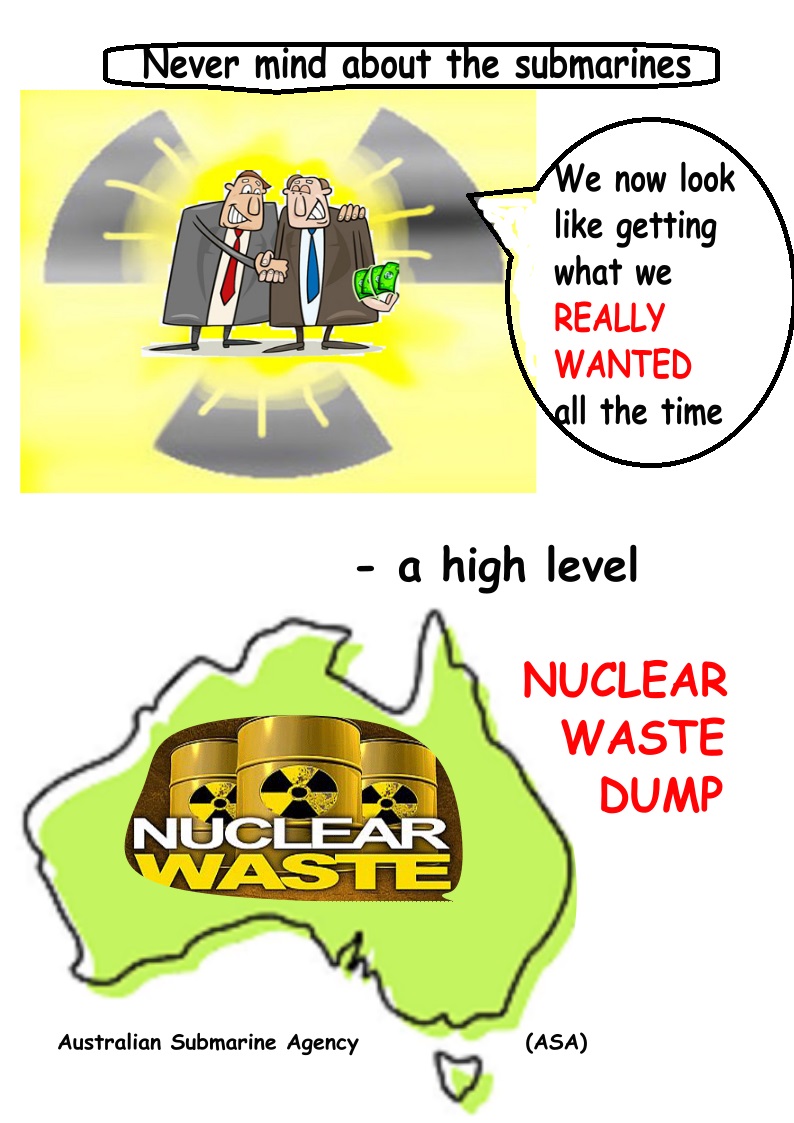
The $360 billion cost of AUKUS might be startling, but on top of that is another undiscussed figure: the cost of building storage for nuclear waste.
Crikey, DAVID HARDAKER, JUL 24, 2023
In late 2021, it came as a shock when Australia woke up to find that its government, under then-prime minister Scott Morrison, had secretly agreed to join the nuclear submarine club with old friends, the US and the UK.
The secret within that secret was that Australia would be responsible for the radioactive waste generated by its involvement in the AUKUS program. For the first time, Australia had signed up to construct a storage facility for high-grade nuclear waste, robust enough to last 1000 years.
Australia had never done it. Nor the US. Nor the UK. Was the iron-clad commitment to building a waste dump part of the deal struck by Morrison when he announced the AUKUS partnership? If so, he didn’t mention it at the time. Nor was it mentioned by US President Joe Biden, UK Prime Minister Rishi Sunak or Australian Prime Minister Anthony Albanese at the official AUKUS announcement in San Diego in March…………. (subscribers only) more https://www.crikey.com.au/2023/07/24/aukus-nuclear-waste-dump-cost-australia/
1 This month

of the week – Australians for War Powers Reform (AWPR)
To see nuclear-related stories in greater depth and intensity
 Antinuclear