Australia’s nuclear brawl spills over into Dubai climate summit
AFR, Hans van Leeuwen 10 Dec 23
Mr Holmes à Court, convener of Climate 200, told Nine journalists that tripling nuclear energy was “a pretty easy pledge to sign onto, because three times zero is zero”.
Dubai | Australia’s domestic debate over nuclear energy has spilled over into the COP28 climate summit in Dubai, as the opposition set out its stall and drew flak both from the government and Liberal Party dissenters.
Opposition climate change and energy spokesman Ted O’Brien is leading a delegation of Liberal and National parliamentarians to COP28 for a five-day visit focused heavily on promoting nuclear energy as a future part of Australia’s energy mix.
He vowed that in government the Coalition would join a 22-country partnership pledging to triple nuclear energy capacity by 2050, which was inked during COP28. And he expanded his party’s nuclear vision to include potential grid-scale reactors in NSW’s Hunter region and other ex-coalmining areas.
But Climate Change and Energy Minister Chris Bowen launched a blistering broadside against his opponents, describing the nuclear policy as “a pipe dream”. And senior Liberal figures at COP28, including former prime minister Malcolm Turnbull and former NSW treasurer Matt Kean, questioned the policy………………
The debate broke out into the open after Mr O’Brien appeared on a COP28 panel entitled “Australia’s nuclear energy potential: Joining the global journey”.
“COP28 will be known as the nuclear COP,” he said. He described the Coalition’s policy as an “all of the above” plan, involving renewables, coal, gas and nuclear………………..
On nuclear, Mr O’Brien envisioned a role not just for small modular reactors that can be used for mines, city-level power or industrial processes, but for big reactors to firm up renewable electricity’s intermittent, variable feed into the grid.
“When it comes to nuclear technologies, we are looking at all-of-the-above for generation three-plus and beyond. So that is micro reactors, that is small reactors, that is large reactors,” he said.
Mr Bowen responded that at COP28, “nuclear energy is not involved in the multilateral conversations”.
“When I meet with counterparts, even those who are nuclear countries, they say ‘if I had your renewables, your renewable potential, I wouldn’t go down the nuclear road’,” he said. “It’s a pipe dream wrapped in a fantasy accompanied by an illusion … and I don’t have time for distractions.”……………
Mr O’Brien’s former boss, Mr Turnbull, told the Financial Review he was sceptical.
“I don’t have a problem with lifting the legislative ban on nuclear generation. But unless somebody genuinely shows a strong commitment to building it, why would you set up the whole nuclear regulation infrastructure you would need?” he said.
“The test on nukes is this: who is going to finance it or build it? Where are the energy companies demanding the right to do it? They don’t exist.”
Mr Kean said he was open to small modular reactors, but the technology would not be available until almost the 2040s.
“Just as you wouldn’t base your entire transport strategy around flying cars, nor should you base your entire energy policy around technology that won’t be available for at least 15 years,” he told the Financial Review.
“We need to get on with the job of modernising our electricity system now. And that means deploying technology that we know works, and can help lower household bills – that’s renewables backed up by household storage.”……………………………………
Mr Holmes à Court, convener of Climate 200, told Nine journalists that tripling nuclear energy was “a pretty easy pledge to sign onto, because three times zero is zero”………………….. https://www.afr.com/policy/energy-and-climate/australia-s-nuclear-brawl-spills-over-into-dubai-climate-summit-20231210-p5eqbq
Inside the Coalition’s nuclear crusade at COP28

Opposition climate change and energy spokesman Ted O’Brien brought half a dozen other Liberal and National parliamentarians to COP28 in Dubai. What were they doing there?
AFR , 10 Dec 23
……………………………………Ted O’Brien has been talking about nuclear non-stop in Dubai for two days, and has several more days to go – including a whistle-stop tour of one of the United Arab Emirates’ four nuclear reactors.
Many of his meetings are with nuclear engineers, entrepreneurs and assorted experts, who are gathered in and around COP28 in force despite nuclear not having much prominence on the formal agenda………………………….
The delegation includes opposition trade spokesman Kevin Hogan, senators Perin Davey, Bridget McKenzie, Andrew Bragg and Dean Smith, and MP David Gillespie. They have met conservative politicians from the US, Britain and Scandinavia, and are engaging in a daily marathon of panel debates and networking events.

………….. the outfit behind his trip, Coalition for Conservation, held a public session on whether Australia should go nuclear, alongside a group of nuclear executives and lobbyists. O’Brien’s impassioned speech included PowerPoint pictures of his kids, and of a literal fork in the road.
O’Brien has been walking into nuclear’s embrace for most of his seven years as a federal parliamentarian. But it is now nothing short of a bear hug…………………………………….
Climate Change and Energy Minister Chris Bowen says nuclear is too expensive, and it is unnecessary. Even if it was a good baseload option for the grid, he says, it won’t arrive in time to make a difference.
Other sceptics at COP28 – teal financier Simon Holmes a Court, former prime minister Malcolm Turnbull, and former NSW Liberal treasurer Matt Kean – all make the same point.
“You won’t be able to get those [reactors] built, let alone the workforce to run then, for 20 years. But we don’t have 20 years because coal is running out in 10,” Kean says.
By 2035, the only coal-fired power plant left in NSW will be Mt Piper, he says, which runs out in 2040. “If you’re waiting for a solution that won’t be ready for 20 years, that’s just a recipe for blackouts.”
Holmes a Court makes a similar point about small modular reactors, which could be used to power factories, industrial parks, towns or remote communities.
“We could throw a trillion dollars at SMRs today, and they still wouldn’t be operating in the time that we need the energy to replace the coal power stations that have reached end of life,” he tells reporters after watching O’Brien speak.
“It’s lovely to talk about being technology-agnostic, but the nuclear technology that would be applicable to Australia simply does not exist yet.”
………………………………………. Turnbull and Bowen both can’t see any clamour from the industry, saying there is no evidence of energy companies wanting to launch the sector in Australia. Again, though, O’Brien got a gee-up from COP28.
………………………..Turnbull, meanwhile, makes a broader point that nuclear can’t be used to “firm” renewables – that is, switch on and provide back-up power when it isn’t sunny or windy – because reactors have to run constantly rather than flex to support solar or wind.
……………………………………………https://www.afr.com/policy/energy-and-climate/inside-the-coalition-s-nuclear-crusade-at-cop28-20231210-p5eqbt
Indonesia ratifies nuclear weapons ban treaty. Australia should too.
MARIANNE HANSON, https://www.lowyinstitute.org/the-interpreter/indonesia-ratifies-nuclear-weapons-ban-treaty-australia-should-too
Why does the government remain at odds with the vast majority of its neighbours?
Indonesia’s parliament last month agreed to ratify the United Nations Treaty on the Prohibition of Nuclear Weapons (TPNW). This is an important political development, and it deserves attention – across the region and in Australia. The approval of ratification was done very symbolically, just ahead of the second meeting of States Parties of the TPNW at the United Nations, held last week. The meeting at UN headquarters in New York was attended by most of the TPNW’s 69 parties, as well as by representatives from 35 non-parties, including Australia as well as NATO members Belgium, Norway and Germany.
Indonesia will soon deposit its instrument of ratification at the UN, formally becoming a state party. By ratifying the TPNW, Indonesia is making it clear that it rejects the most destructive of all weapons of mass destruction, nuclear weapons. That is good news. It’s a recognition that there are still around 12,500 nuclear weapons in existence, many of them vastly more destructive than the Hiroshima bomb, and a reminder that the world still lives under the very real – indeed growing – threat of complete annihilation.
Indonesia is a leading member of the Association of Southeast Asian Nations, a grouping which, decades ago, made its stance against nuclear weapons clear by creating the Southeast Asian Nuclear Weapon Free Zone (SEANWFZ). Nine of the ten ASEAN members have signed or ratified the TPNW (as has ASEAN observer Timor-Leste), but Indonesia’s ratification is especially important because it signals a clear commitment by one of the world’s largest states to work towards the global elimination of these inhumane weapons.
Indonesia is also a founding member of the 120 nation Non-Aligned Movement, a grouping which marshals considerable collective diplomatic clout on the international stage. For the great majority of non-aligned states, nuclear weapons are seen not just as weapons of horrific destruction, but also as instruments of continuing domination and exploitation. Many formerly colonised states are asking the large and powerful countries to listen to them and to consider their security preferences. They have a point: nuclear weapon states effectively hold the entire world to ransom.
Indonesia’s ratification should make Australians ask why its government remains at odds with the vast majority of its neighbours. Most of the South Pacific states, Southeast Asia, and New Zealand clearly oppose the threat of nuclear weapons. The TPNW makes these inhumane weapons illegal, as other treaties do for biological and chemical weapons, landmines, and cluster munitions.
Prime Minister Anthony Albanese has supported the TPNW, stating that “nuclear weapons are the most destructive, inhumane, and indiscriminate weapons ever created”, and that “the struggle for nuclear disarmament is the most important struggle for the human race”. Labor’s national policy platform, repeated in August this year, commits Australia to signing and ratifying the TPNW. But the government is yet to do so, leaving Australia now out of step with its largest neighbour and the region more broadly.
The AUKUS arrangement with the US and the UK signals a faith in the old-fashioned militarism of the Anglosphere more than the promising dynamics and peaceful potential of the region. Indonesia, Malaysia, and other states expressed concern about Australia’s plan to acquire nuclear-powered submarines. Proceeding with AUKUS makes it even more important that Australia credibly reassure the world it has no intention of acquiring nuclear weapons. Signing the TPNW would make that commitment concrete.
Clearly there has been pressure from the United States on Canberra not to sign. But fears of endangering the ANZUS alliance are overblown; Washington will be displeased when Australia signs the TPNW, but Canberra can remain an invaluable (conventional weapons) partner for the United States in the Asia-Pacific region. Signing the TPNW does not void the ANZUS alliance, nor does it mean Australia cannot proceed with AUKUS, although this pact would have to be managed carefully.
Several US allies have already signed the TPNW and even some NATO states have explored the option of joining. Australia can take a principled stand. Nuclear weapons are immoral and threaten the existence of everyone, the environment and life on Earth.
And a closer alignment by Canberra with the views of Australia’s region will be important.
Indonesia has a population of around 280 million people and is a secular democratic country with a Muslim-majority population, the largest in the world. Its economic growth is strong, with predictions that it will be among the top five world economies within a few decades. It has a growing middle-class, with an overwhelmingly young population (a quarter are aged under 14). Indonesia is a vibrant and vital part of Australia’s local geography and will become an increasingly important trading partner. All this suggests that Canberra should be paying more attention to the security wishes of its near neighbours. By signing the TPNW, Australia will be on the right side of history and be more in sync with its region.
Indonesia and other Asia-Pacific neighbours are showing the way. It’s time to work towards a common future with them, not a future blighted by the danger of nuclear annihilation.
Radiation leaked from cancer treatment room at Monash Medical Centre in Melbourne, documents reveal
ABC By Danny Tran,8 Dec 23
- In short: Monash Medical Centre discovered a cancer treatment room did not have adequate shielding to prevent radiation exposure to staff
- It self-reported to the Victorian health department, which told the hospital it had provided misleading information about the thickness of the concrete slabs separating the building’s floors
- What’s next? A doctor has raised concerns about radiation risk to hospital staff, however the health department says radiation levels are too low to be of concern
……………………………………………………………………………………………more https://www.abc.net.au/news/2023-12-08/monash-medical-centre-radiation-leak-cancer-treatment-room/103201728
Australian government funding Adelaide University to train students for a nuclear-powered defence-force

Undergraduate funding to support nuclear-powered industry
5 December 2023, https://www.australiandefence.com.au/news/news/undergraduate-funding-to-support-nuclear-powered-industry
The University of Adelaide announced on 29 November that it has received Federal Government commitment to fund the training of hundreds more domestic undergraduate students to join the future defence workforce.
Under the Federal Government’s Nuclear-Powered Submarines (NPS) program the University of Adelaide has received an allocation of $38,634,835 between 2024 and 2030 to deliver an additional 700 Commonwealth Supported Places (CSPs).
“The University of Adelaide is pleased to receive this commitment of funding from the Federal Government to help train the defence workforce of the future,” said Professor Peter Høj AC, Vice-Chancellor and President, the University of Adelaide.
“This is a massive endorsement of the University’s capability to support the Australian Government’s plans to become a nuclear-powered defence-force under the AUKUS program.
“The University will lead developments in defence-related education as well as invest in research and research infrastructure to support the training of the best and brightest minds.”
The University of Adelaide received the largest number of places allocated to any university under this announcement. The 700 additional places at the University of Adelaide will deliver more graduates from STEM disciplines.
The Commonwealth and South Australian Government will also be funding schemes that will support eligible students to take up these new opportunities. These schemes include degree apprenticeships and scholarships, announced recently as part of the South Australian Defence Industry Workforce and Skills Action Plan
Australia’s AUKUS nuclear submarines could fuel regional arms race despite assurance
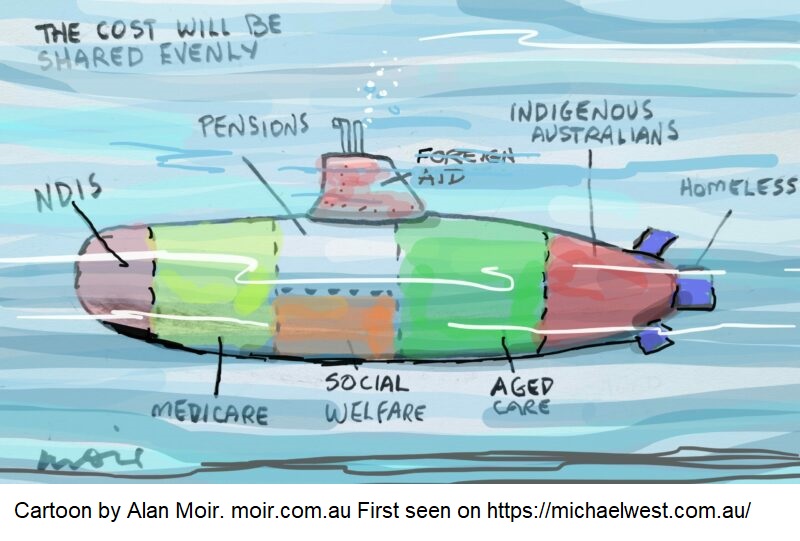
“AUKUS is designed to shore up American power in East Asia, not de-escalate tensions,”
By Su-Lin TanDec 4, 2023, https://johnmenadue.com/australias-aukus-nuclear-submarines-could-fuel-regional-arms-race-despite-assurance/
Defence Industry Minister Pat Conroy says Australia is not worsening the arms race and gives assurance about the submarines’ nuclear reactors. The deal could still spark a defence build-up in Asia-Pacific while Australia lacks the facilities to deal with nuclear waste, analysts say.
Australia may have asserted that its acquisition of nuclear-powered submarines under AUKUS is not aggravating the “arms race”, but the deal and the three-nation alliance could still fuel a defence build-up in the Asia-Pacific and heighten regional tensions, security analysts say.
At the national press club in Canberra on Tuesday, Australian Defence Industry Minister Pat Conroy reiterated the importance of the submarines to the country’s defence while debunking “myths” about the trilateral deal struck with Britain and the United States, which is largely seen as a countermeasure targeting China.
“The arms race is the greatest it’s been since 1945, and that is why I reject assertions … that Australia is somehow fuelling that arms race,” he said, adding that rising tensions in the Asia-Pacific had posed the most challenging strategic environment for Australia since World War II. “We are responding to it in a responsible and mature manner, like Australian governments should.”
Australia will own at least eight submarines over the next three decades through the A$368 billion (US$243 billion) deal. First announced in 2021 and finalised earlier this year, the controversial pact has raised concerns in the region.
Collin Koh, a senior fellow at the S. Rajaratnam School of International Studies in Singapore, said Conroy’s comment was not a surprise as countries including China and others in Asia-Pacific often couched their arms acquisitions in “defensive terms”.
Most countries would do so in the name of national security interests but it did not mean such actions ensured peace or safety, he said.
Even before AUKUS was announced in 2021, China and other regional countries had already embarked on significant military build-up since the 1990s, Koh said.
“Conroy may not be necessarily wrong to say AUKUS responds to this already ongoing condition, yet at the same time, it’s also not wrong to say that AUKUS … may not only be used by Beijing to legitimise its naval build-up, it also could be exploited as a justification for other regional countries’ military build-up programmes,” Koh said.
Australia’s acquisition of the submarines might trigger new problems as other countries could argue that they should also acquire similar capabilities, said Maria Rost Rublee, a nuclear politics expert at Monash University.
These countries are not limited to “dangerous actors”, for instance, in South Korea where the majority of its people have expressed a desire for their country to own nuclear weapons, Rublee added.
“Just having this type of technology in the hands of a country where you have strong popular support for nuclear weapons could be an issue,” she said.
In an analysis earlier this month, Ankit Panda, the Stanton Senior Fellow in the Nuclear Policy Programme at the Carnegie Endowment for International Peace, warned the accumulation of weapons such as missiles could potentially lead to unintended attacks.
“The Indo-Pacific region has entered a new missile age … each nation individually seeking deterrence while as a whole steering the region into ever more dangerous waters,” he said. “A particular risk concerns the prospects of attacks on the nuclear forces of countries like North Korea and China, by US or allied forces in ways that may not be intended.”
By the 2030s, the Indo-Pacific region would be “full of thousands of new missiles that can be expected to be used widely in the context of a major regional war”, Panda said.
Responding to Conroy’s comments, the national convenor of Labor Against War in Australia, Marcus Strom, said: “If your answer to growing regional tension is to add offensive weaponry, you create a logic towards war.
“AUKUS is designed to shore up American power in East Asia, not de-escalate tensions,” he added.
While Conroy has given assurances about the safety of sealed nuclear reactors within the submarines, analysts argued that the lack of facilities in Australia for the eventual disposal of these reactors is worrying.
“The strength of this agreement is that the reactor module comes to us sealed. It comes sealed, designed to be never opened over the life of a submarine. You don’t have to refuel it, you don’t have to insert new fuel rods … [over] the life of the submarine,” Conroy said.
But nuclear waste expert Ian Lowe said in an analysis on The Conversation website earlier this year that Australia has failed for decades to find long-term storage solutions for small quantities of low- and intermediate-level nuclear waste.
Even Australia’s allies and AUKUS partners, the US and the UK, do not have long-term solutions for nuclear waste storage, according to Lowe.
“This should be concerning. To manage the waste from our proposed nuclear submarines properly, we’ll have to develop systems and sites which do not currently exist in Australia,” Lowe said.
Australian states such as Victoria, Queensland and South Australia have said they would not accept a nuclear waste facility within their borders.
While it will be another 30 years before Australia has to worry about dumping the submarine’s nuclear reactors, it is not a long time, Rublee said.
“If they take their nuclear stewardship obligations seriously, they must immediately begin working on the long-term storage of high-level nuclear waste,” she added.
Australia backs Cop28 promise to triple renewables but not nuclear capacity pledge
More than 115 countries vow to triple renewable energy capacity by 2030 – though not China and India
Adam Morton and Katharine Murphy, Guardian, Sun 3 Dec 2023
Australia has backed a pledge at Cop28 climate summit to triple global renewable energy capacity and double the annual rate of energy efficiency improvements by 2030.
The climate change minister, Chris Bowen, said the Albanese government had joined 117 other countries in making the pledge, reiterating an agreement reached by G20 countries in September.
The renewable energy agreement was one of a series of headline declarations made as more than 100 global leaders arrived in the United Arab Emirates for the opening days of the two-week conference.
Anthony Albanese is not attending, and Bowen is not due to fly to Dubai until later this week for the event’s final week, when ministers will attempt to wrangle a consensus position on how to lift action to tackle the climate crisis in the face of rising geopolitical tensions. Australia was represented at the opening plenary by its climate change ambassador, Kristin Tilley.
Bowen said Australia had joined other major energy exporters, including the US, Canada and Norway, in supporting the renewables and energy efficiency push.
“We know that renewables are the cleanest and cheapest form of energy, and that energy efficiency can also help drive down bills and emissions,” he said in a statement. “For emissions to go down around the world, we need a big international push. Australia has the resources and the smarts to help supply the world with clean energy technologies to drive down those emissions while spurring new Australian industry.”
The renewable energy pledge was welcomed by climate campaigners and analysts. Tim Buckley, director of the independent think tank Clean Energy Finance, said it was excellent to see Australia backing the commitment. He said falling costs had made the transition to renewables “an entirely economically sensible and viable commitment”………………………………………………………………………..
Australia is the chair of the “umbrella group” of countries at the talks, which includes the US, UK, New Zealand, Canada, Ukraine, Israel and Norway. Bowen said he intended “to be quite an active chair” and that meant “bringing other countries with us” to help reach a consensus.
An initial draft Cop text released on Saturday listed included a range of expressions to be debated, including that either fossil fuels or coal should be “phased out” or “phased down”. The same applied to fossil fuel subsidies. Saudi Arabia, China and India have previously resisted calls to agree that all fossil fuels should be phased out.
Australia was also among more than 100 countries to back declarations pledging to strengthen climate action in healthcare and farming. It did not sign up to a commitment by 22 countries, including the US, Canada, Japan and Britain, to triple nuclear energy capacity by 2050.
The Albanese government is hoping to win support for Australia to host Cop31 in 2026 with Pacific countries, but it is unclear whether a decision will be made in Dubai. The UN climate process faces a more pressing decision on where next year’s annual summit will be held. It is due to be hosted in eastern Europe but Russia has blocked agreement on which country will take the reins.
Karina Lester addresses the Second Meeting of States Parties to the TPNW
Karina Lester, second-generation nuclear test survivor and ICAN Ambassador addresses the delegates at the UN Second Meeting of States Parties to the Treaty on the Prohibition of Nuclear Weapons in NYC, November 28th, 2023.
She said “People still suffer to this day. We know our lands are poisoned. We know the fallout contaminated our country and our families, our people who move through those traditional lands…
We want recognition by governments of the day of the harms and what they’ve imposed on our people and on our traditional lands… We want respect and we want to start the conversations on repair. How do we work together to fix the damages that are there?”
She called on states parties to get to work on Articles 6 & 7 and for observers to double their efforts to sign and ratify the #nuclearban. She called on Australia, in particular, to make joining the treaty a top priority.
Sovereignty Surrendered: Subordinating Australia’s Defence Industry
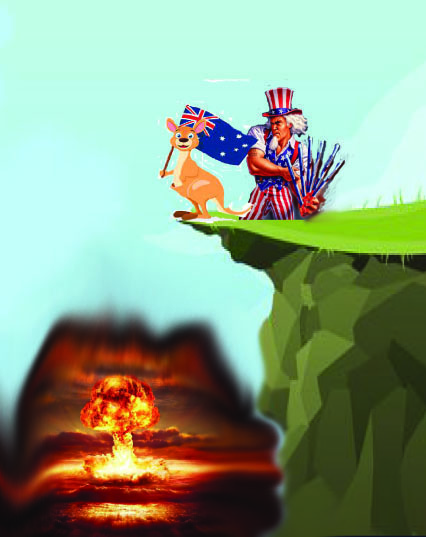
Bureaucratic red tape will be slashed – for the Australian Defence industry and the AUKUS partners.
the broader object here is unmistakably directed, less to Australian capabilities than privileged access and a relinquishing of control to the paymasters in Washington.
“Whenever it cooperates with the US Australia will surrender any sovereign capability it develops to the United States control and bureaucracy.”
November 30, 2023, Dr Binoy Kampmark, https://theaimn.com/sovereignty-surrendered-subordinating-australias-defence-industry/
One could earn a tidy sum the number of times the word “sovereignty” has been uttered or mentioned in public statements and briefings by the Australian Prime Minister, Anthony Albanese.
But such sovereignty has shown itself to be counterfeit. The net of dependency and control is being increasingly tightened around Australia, be it in terms of Washington’s access to rare commodities (nickel, cobalt, lithium), the proposed and ultimately fatuous nuclear-propelled submarine fleet, and the broader militarisation and garrisoning of the country by US military personnel and assets. (The latter includes the stationing of such nuclear-capable assets as B-52 bombers in the Northern Territory.)
The next notch on the belt of US control has been affirmed by new proposals that will effectively make technological access to the Australian defence industry by AUKUS partners (the United States and the United Kingdom) an even easier affair than it already is. But in so doing, the intention is to restrict the supply of military and dual-use good technology from Australia to other foreign entities while privileging the concerns of the US and UK. In short, control is set to be wrested from Australia.
The issue of reforming US export controls, governed by the musty provisions of the US International Trade in Arms Regulations (ITAR), was always going to be a feature of any technology transfer, notably regarding nuclear-propulsion. But even before the minting of AUKUS, Canberra and Washington had pondered the issue of industrial integration and sharing technology via such instruments as the Defense Cooperation Treaty of 2012 and Australia’s addition to the National Technology and Industrial Base in 2017.

This fundamentally failed enterprise risks being complicated further by the latest export reforms, though you would not think so, reading the guff streaming from the Australian Defence Department. A media release from Defence Minister Richard Marles tries to justify the changes by stating that “billions of dollars in investment” will be released. Bureaucratic red tape will be slashed – for the Australian Defence industry and the AUKUS partners. “Under the legislation introduced today, Australia’s existing trade controls will be expanded to regulate the supply of controlled items and provision of services in the Defence and Strategic Goods List, ensuring our cutting-edge military technologies are protected.”
Central to the reforms is the introduction of a national exemption that will cover trade of defence goods and technologies with the US and UK, thereby “establishing a license-free environment for Australian industry, research and science.” But the broader object here is unmistakably directed, less to Australian capabilities than privileged access and a relinquishing of control to the paymasters in Washington. A closer read, and it’s all got to do with those wretched white elephants of the sea: the nuclear-powered submarine.
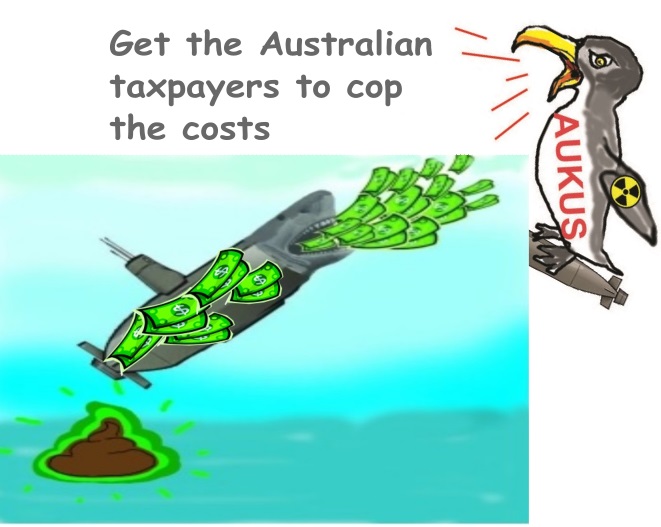
As the Minister for Defence Industry, Pat Conroy, states, “This legislation is an important step in the Albanese Government’s strategy for acquiring the state-of-the-art nuclear-powered submarines that will be key to protecting Australians and our nation’s interests.” In doing so, Conroy, Marles and company are offering Australia’s defence base to the State Department and the Pentagon.
With a mixture of hard sobriety and alarm, a number of expert voices have voiced concern regarding the implications of these new regulations. One is Bill Greenwalt, a figure much known in the field of US defence procurement, largely as a prominent drafter of its legal framework. He is unequivocal in his criticism of the US approach, and the keen willingness of Australian officials to capitulate. “After years of US State Department prodding, it appears that Australia signed up to the principles and specifics of the failed US export control system,” Greenwalt explained to the Australian Broadcasting Corporation. “Whenever it cooperates with the US it will surrender any sovereign capability it develops to the United States control and bureaucracy.”
The singular feature of these arrangements, Greenwalt continues to elaborate, is that Australia “got nothing except the hope that the US will remove process barriers that will allow the US to essentially steal and control Australian technology faster.”
In an email sent to Breaking Defense, Greenwalt was even more excoriating of the Australian effort. “It appears that the Australians adopted the US export control system lock, stock and barrel, and everything I wrote about in my USSC (US Studies Center) piece in the 8 deadly sins of ITAR section will now apply to Australian innovation. I think they just put themselves back 50 years.”
The paper in question, co-authored with Tom Corben, identifies those deadly sins that risk impairing the success of AUKUS: “an outdated mindset; universality and non-materiality; extraterritoriality; anti-discrimination; transactional process compliance; knowledge taint; non-reciprocity; and unwarranted predictability.”
When such vulgar middle-management speech is decoded, much can be put down to the fact that dealing with Washington and its military-industrial complex can be an imperilling exercise. The US imperium remains fixated, as Greenwalt and Corben write, with “an outdated superpower mindset” discouragingly inhibiting to its allies. What constitutes a “defence article” within such export controls is very much left to the discretion of the executive. The archaic application of extraterritoriality means that recipient countries of US technology must request permission from the State Department if re-exporting to another end-user is required for any designated defence article.
The failure to reform such strictures, and the insistence that Australia make its own specific adjustments, alarms Chennupati Jagadish, president of the Australian Academy of Science. The new regulations may encourage unfettered collaboration between the US and UK, “but I would require an approved permit prior to collaborating with other foreign nationals. Without it, my collaborations could see me jailed.” The bleak conclusion: “it expands Australia’s backyard to include the US and UK, but it raises the fence.” Or, more accurately, it incorporates, with a stern finality, Australia as a pliable satellite in an Anglo-American arrangement whose defence arrangements are controlled by Washington.
Independents pressure Australia on nuclear ban treaty ahead of UN meeting
November 24th, 2023
11 independent parliamentarians have issued a public call on the Prime Minister to keep Labor’s promise to sign and ratify the UN Treaty on the Prohibition of Nuclear Weapons, ahead of the treaty’s Second Meeting of States Parties on 27 November – 1 December in New York.
The letter, which is signed by Kate Chaney MP, Zoe Daniel MP, Dr. Helen Haines MP, Senator David Pocock, Dr. Monique Ryan MP, Dr. Sophie Scamps MP, Allegra Spender MP, Zali Steggall OAM MP, Senator Lidia Thorpe, Kylea Tink MP, and Andrew Wilkie MP, states that “nuclear weapons do not promote security, they undermine it. We don’t accept the everlasting presence of these weapons.” They “urge the Government to advance its signature and ratification of the Ban Treaty without delay, to bring Australia in line with our South-East Asian and Pacific island neighbours.”
In regards to the letter, Federal Member for Goldstein, Zoe Daniel MP, said: “Voters supported Labor at the election, believing in good faith that they would implement their platform.
“Signing and ratifying was Labor Party policy before the election and has been reaffirmed since.
“In the most perilous times since the height of the Cold War this treaty is needed more than ever; voters want it and so do the vulnerable nations of the Pacific whose backyards were used for nuclear testing without their permission.
“Look at what Labor does, not what it says.”
Australia will attend the Second Meeting of States Parties as an observer, with a parliamentary head of delegation, after attending the first Meeting of States Parties in June 2022. It is expected that several states, including Indonesia, will ratify the treaty during the meeting, bolstering universalisation efforts. Around 100 countries will attend, along with over 400 civil society delegates.
Gem Romuld, ICAN Australia Director, welcomed the independents’ statement and Australia’s attendance at the meeting, but said the Albanese Government must do more, in line with their policy platform to sign and ratify the treaty.
“We welcome the Australian government’s engagement with the Treaty on the Prohibition of Nuclear Weapons, but observing meetings isn’t enough. There is clearly broad support for signing on to this treaty in the Australian Parliament, as indicated by the independents’ statement to the PM.
“Labor needs to make good on their promise to join the majority of our South East Asian and Pacific neighbours and sign and ratify the TPNW. We hope that Australia’s attendance at this meeting will spur efforts towards this urgent goal.”
Romuld is joining the international ICAN delegation at the meeting, including Yankunytjatjara-Anangu woman and second-generation nuclear test survivor Karina Lester, and current ICAN Executive Director, former Labor MP Melissa Parke.
Malaysian Govt urged to halt Australian company Lynas’ thorium extraction plan

https://www.thestar.com.my/news/nation/2023/11/24/govt-urged-to-halt-lynas-thorium-extraction-plan
SEVERAL DAP lawmakers have urged the government to review Lynas Malaysia’s license and stop the plan for thorium extraction from the waste produced at the factory of the rare earth producer.Chow Yu Hui (PH-Raub) said that he remains unconvinced that Lynas Malaysia was capable of extracting thorium.
“Let us not forget that the amount of waste from the Lynas plant was as large as five hills behind its factory. Will the new thorium extraction technology and Lynas be able to manage the radioactive waste which is expected to reach 1.2 million metric tonnes?” he asked reporters at the parliament media centre yesterday.
Oct 24, Science, Technology and Innovation Minister Chang Lih Kang announced that Lynas Malaysia would be allowed to import lanthanide concentrates until its licence expires in March 2026.
He also said that the Atomic Energy Licensing Board (AELB) decided to amend Lynas Malaysia’s license conditions after the company made a proposal to the licensing board about its thorium extraction technology.
With this, Chang said radioactive waste will not be produced after extraction and cracking and leaching activities are carried out on the lanthanide concentrate.
Khoo Poay Tiong (PH-Kota Melaka) said the Science, Technology and Innovation Ministry had announced on May 10 regarding the renewal of Lynas Malaysia’s license until Dec 31.
However, Khoo said that within a period of five months, the government, via AELB, had reviewed Lynas’ licence conditions.
“This matter has raised many concerns regarding the radioactive pollution and safety of locals,” said Khoo, who also wanted to know the parties that came up with the idea of thorium extraction.“We also want clarification from the government on what the possible market for thorium is,” he said.
Tan Hong Pin (PH-Bakri) also pointed out that thorium extraction technology was still in its initial phases, even at the international level.
“To what extent can thorium be extracted, used and commercially extracted? What are the effective measures that can be taken by the government to address the issue and ensure that Lynas will adhere to all the international standards in managing radioactive waste?” asked Tan.
On Nov 16, Chang promised that AELB will closely monitor the thorium extraction process from Lynas Malaysia’s waste material.
Fine print bombshell – share information which “undermines trust in government”, face jail

by Rex Patrick | Nov 21, 2023 https://michaelwest.com.au/government-review-of-secrecy-provisions-an-assault-on-democracy/?utm_source=newsletter&utm_medium=email&utm_term=2023-11-23&utm_campaign=Michael+West+Media+Weekly+Update
The Government has released its ‘Review into Secrecy Provisions’ whose fine print contains the greatest assault on democracy and accountability in many years, writes Rex Patrick.
Secrecy is woven into the fabric of the Australian Government. There are eleven general secrecy offences in the criminal code, 295 non-disclosure duties in 102 laws that attract criminal liability, and 569 specific secrecy offences in 183 laws.
A rationalisation and a review of secrecy laws was long overdue.
But buried in this review is a bombshell. Carried out by the Attorney-General’s Department, the review report makes a key recommendation that disclosure of information that could cause a loss of trust in Government should be criminalised.
Paragraph 146 states:
“… disclosure of information that harms the effective working of Government undermines the Australian community’s trust in government and the ability of Commonwealth departments and agencies to deliver policies and programs. It is appropriate that conduct which causes or is likely to cause prejudice to the effective working of government be covered [by secrecy provisions enforceable under the criminal code]”
The national security bureaucrats’ view seems to be that secrecy is essential to ensure trust in government!
The infamous character of Sir Humphrey Appleby in the Yes Minister TV show would be so proud.
If implemented, this recommendation would raise for public servants a criminal penalty for anything embarrassing, anything that might put a question in the way of policy information or even any wrongdoing by officials to the extent that revealing such might undermine confidence in government.
Review origins
The review stemmed from a report of the Parliamentary Joint Committee on Intelligence and Security looking into the 2019 ABC and the Smethurst media raids.
The review was intended to be the first step in a process that would ensure that these laws protect and are consistent with essential public interests, including the public interest in transparency in government decision-making, parliamentary scrutiny and accountability, and effective media investigations and reporting.
The recommendation of the Review that the Government create a new sweeping secrecy offence is quite at odds with the original objectives of this exercise, and is indeed quite contrary to proper principles of transparency, scrutiny and accountability of government.
While the review recommends the repeal of some redundant and outdated secrecy offences and non-disclosure duties, this very modest wind back of secrecy will be completely submerged by the development of “a new general secrecy offence” for inclusion in the Criminal Code Act 1995.
Protecting the leaders
To be clear, public servants already have a duty not to disclose information unless they are authorised to do so, or they are required/permitted to disclose it by law.
But it’s one thing to say that public servants should operate in a ‘privacy of government’ environment, it’s completely another thing to say that everything they discuss or write about is confidential and they should go to jail if they reveal anything.
Under the current ‘privacy of government’ arrangements, we are supposed to let the government quietly get on with business overseen by Parliament, the Auditor-General, the Ombudsman, the National Anti-Corruption Commission (NACC) and law enforcement, the Freedom of Information Regime and whistleblower protection.
This all sounds good; except the Parliament is very weak on oversight, the Auditor-General and Ombudsman are underfunded, the NACC operates in complete secrecy, the FOI regime is totally broken and whistleblower protections are simply non-existent.
Secrecy overreach
But even if the accountability of government systems did work, the Secrecy Review’s recommendation is overreach. It just re-enforces a culture of secrecy inside government that is already in need of a secrecy exorcism.
The much better view is that of former Sir Anthony Mason, AC KBE GBM KC in the High Court Case of Commonwealth v John Fairfax & Sons Ltd (“Defence Papers case“) [1980], before he was Chief Justice, when he said:
“It is unacceptable in our democratic society that there should be a restraint on the publication of information relating to government when the only vice of that information is that it enables the public to discuss, review and criticize government action.
His judicial pronouncement trumps the bureaucratic authors of a review that presses a recommendation that aims to protect senior leadership and ministers from embarrassment and the exposure of incompetence using the threat of criminal punishment. But his views only last until new laws are passed.
A captured Attorney General
The next question, of course, is whether the Attorney-General and the Government will act on this recommendation and remain beholden to his national security bureaucrats?
If his past record of betraying whistleblowers and his refusal to pursue Freedom of Information reforms is any guide, there aren’t any grounds for optimism.
Proceeding down this path would deal a great blow to democratic accountability and public interest journalism.
Proceeding down this path would deal a great blow to democratic accountability and public interest journalism.
It would embed the already harmful secrecy culture that exists across a vast expanse of government activity and could also blow a hole in Australia’s already weak and failing FOI regime.
But does the Government and the Attorney General want a political fight over a move towards excessive and unjustified secrecy? We will have to see, but if they do go down this path it’s a fight they’re sure to get.
A four-decade-old Pacific treaty was meant to preserve the ‘peaceful region’. Now experts say it’s being exploited
“We regret that the Aukus agreement … is escalating geopolitical tensions in our region and undermining Pacific-led nuclear-free regionalism,” says the Pacific Elders’ Voice,
the US and the UK will increase rotations of nuclear-powered submarines to Australia,
Pacific countries rushed to join the TPNW six years ago, reflecting their longstanding concerns about nuclear testing legacies. It’s the same regional sentiment that spurred the earlier Treaty of Rarotonga.
Daniel Hurst in Rarotonga
Nearly 40 years after the Treaty of Rarotonga came into force, the region is on edge about another rise in geopolitical tension
…………………………………………………………………………….heightened concerns permeated the region in the months leading up to the crucial meeting in the Cook Islands in August 1985 where leaders endorsed a nuclear-free zone.
Hawke, the Australian prime minister at the time, hailed the negotiations as a “dramatic success” that would send “a clear and unequivocal message to the world”, with the treaty leaving major powers in no doubt about the region’s desire to preserve “the South Pacific as the peaceful region which its name implies”.
But nearly 40 years after the Treaty of Rarotonga came into force, the region is on edge about another rise in geopolitical tensions – and critics say gaps in the treaty’s coverage are now being exploited.
“The treaty was really important to a lot of people, especially for grassroots activists,” says Talei Mangioni, a Fijian-Australian board member of the International Campaign to Abolish Nuclear Weapons Australia.
But it was quite watered down. And so even though we celebrate it today, what activists were saying in the 1980s and what progressive states like Papua New Guinea, Solomon Islands and Vanuatu were saying was that it wasn’t comprehensive enough.”
Mangioni, who researches the legacy of the Nuclear Free and Independent Pacific Movement, adds: “That’s what’s left us now with things like Aukus exploiting certain loopholes that have remained in the treaty.”
A hotbed of great-power competition?
When leaders met last week in the Cook Islands for the annual meeting of the Pacific Islands Forum (Pif), the Treaty of Rarotonga was once again on everyone’s lips.
The host of the summit, prime minister Mark Brown of the Cook Islands, argued the region “should rediscover and revisit our Rarotonga treaty to ensure that it reflects the concerns of Pacific countries today, and not just what occurred back in 1985”.
The treaty – signed on the 40th anniversary of the US atomic bombing of the Japanese city of Hiroshima – reflected “the deep concern of all forum members at the continuing nuclear arms race and the risk of nuclear war”.
Also known as the South Pacific Nuclear Free Zone Treaty, it designated a vast area from the west coast of Australia to Latin America where its parties must prevent the “stationing” (critics say this was always a deliberately ambiguous word) of nuclear weapons.
“The treaty prohibits the use, testing or stationing of nuclear explosive devices in the South Pacific,” the Cook Islands News explained on 7 August 1985.
“It does not prohibit countries from transporting nuclear devices through the zone nor does it prohibit nuclear-powered or equipped ships from calling in ports within the area.”
Today the parties to this treaty are Australia, Cook Islands, Fiji, Kiribati, Nauru, New Zealand, Niue, Papua New Guinea, Samoa, Solomon Islands, Tonga, Tuvalu and Vanuatu.
Once again, many of these nations are worried about the Pacific becoming a hotbed of great-power competition and the risk of that spiralling into conflict. Aukus feeds into some of those fears.
“We regret that the Aukus agreement … is escalating geopolitical tensions in our region and undermining Pacific-led nuclear-free regionalism,” says the Pacific Elders’ Voice, a group of former leaders whose members include Anote Tong, the ex-president of Kiribati.
The legality of a treaty – and the spirit of it
Under the Aukus plan, Australia will buy at least three Virginia class nuclear-powered submarines from the US in the 2030s, before Australian-built boats enter into service from the 2040s.
In the meantime, the US and the UK will increase rotations of nuclear-powered submarines to Australia, all aimed at deterring China from unilateral action against Taiwan or destabilising activities in the increasingly contested South China Sea.
One point of sensitivity is that it will be the first time a provision of the Nuclear Non-Proliferation Treaty regime has been used to transfer naval nuclear propulsion technology from a nuclear weapons state to a non-weapons state.
The Australian government has worked assiduously behind the scenes to reassure Pacific leaders on a key point about Aukus.
“Certainly when I was talking to people about it I would explain how it was consistent with the Treaty of Rarotonga,” says the Australian minister for the Pacific, Pat Conroy.
Donald Rothwell, a professor of international law at the Australian National University, concurs. The treaty, he notes, does not deal with nuclear-propelled submarines.
“My view is that Aukus is consistent with Australia’s Treaty of Rarotonga obligations,” Rothwell says.
“Pacific states may have concerns about the potential stationing of US and UK nuclear-armed warships in Australian ports under Aukus. The stationing of such vessels, as opposed to port visits, would be contrary to the treaty.”
The Australian prime minister, Anthony Albanese, sought to allay any Aukus-related concerns when he briefed Pacific leaders during the Pif meetings last week and appears to have held off any open rebellion.
Albanese insists the treaty remains “a good document” and “all of the arrangements that we’ve put in place have been consistent with that”.
But anti-nuclear campaigners point to the planned new aircraft parking apron at the Tindal base in the Northern Territory that will be able to accommodate up to six US B-52 bombers.
The US refuses to confirm or deny whether the aircraft on rotation would be nuclear-armed, in line with longstanding policy.
“We should delineate between a legalistic interpretation of the Treaty of Rarotonga and the spirit of it,” says Marco de Jong, a Pacific historian based in Aotearoa New Zealand.
“Pacific nations are growing increasingly frustrated at Australia’s reliance on loopholes and technicalities.”
Australia: the regional outlier
The Nobel prize-winning International Campaign to Abolish Nuclear Weapons says a good way for Australia to reassure the region about its long-term intentions would be to sign the newer Treaty on the Prohibition of Nuclear Weapons (TPNW).
This is an idea Albanese previously supported enthusiastically but which appears stalled.
One potential problem is that the US has warned that the TPNW – which includes a blanket ban on helping others to use or threaten to use nuclear weapons – wouldn’t allow for close allies like Australia to enjoy the protection of the American “nuclear umbrella”.
Documents obtained by the Guardian under freedom of information laws show the Australian defence department has warned the Labor government that the TPNW is “internationally divisive” because the nuclear weapons states “are all opposed”.
But Mangioni, a member of the Youngsolwara Pacific movement of activists, counters that Pacific countries rushed to join the TPNW six years ago, reflecting their longstanding concerns about nuclear testing legacies. It’s the same regional sentiment that spurred the earlier Treaty of Rarotonga.
“I would say that Australia is indeed the outlier compared to the rest of the Pacific states,” Mangioni says.
“Australia depends on nuclear deterrence as its policy but the rest of the Pacific states are nuclear abolitionists.” https://www.theguardian.com/world/2023/nov/19/a-40-year-old-pacific-treaty-was-meant-to-maintain-the-peaceful-region-now-experts-say-its-being-exploited
A Duty to Obey: David McBride, Whistleblowing and Following Orders
Australian Independent Media November 19, 2023, Dr Binoy Kampmark
The unpardonable, outrageous trial of Australian whistleblower David McBride was a brief affair. On November 13, it did not take long for the brutal power of the Commonwealth to become evident. McBride, having disclosed material that formed the Australian public about alleged war crimes by special forces in Afghanistan, was going to be made an example of.
McBride served as a major in the British army before becoming a lawyer for the Australian Defence Force, serving two tours in Afghanistan over 2011 and 2013. During that time, he gathered material about the culture and operations of Australia’s special forces that would ultimately pique the interest of investigators and lead to the Brereton Inquiry which, in 2020, made 36 referrals to the Australian Federal Police related to alleged war crimes.
McBride was subsequently charged with five national security offences. He was also denied immunity from prosecution under the near-unworkable provisions of the Public Interest Disclosure Act 2013 (Cth).
A central contention of the Crown was that McBride had, first and foremost, a duty to follow orders as a military lawyer. Such a duty flows on from the oath sworn to the sovereign, and no public interest could trump that undertaking. “A soldier,” contended Trish McDonald in her astonishing submission, “does not serve the sovereign by promising to do whatever the soldier thinks is in the public interest, even if contrary to the laws made by parliament.”
Even a layperson’s reading of the oath would surely make a nonsense of this view, but Justice David Mossop was in little mood to suggest otherwise. “There is no aspect of duty that allows the accused to act in the public interest contrary to a lawful order.” It was a point he would be putting to the jury, effectively excluding any broader public interest considerations that might be at play in disobeying a military order.
For anybody vaguely familiar with military law since the Nuremberg trials of Nazi leaders in 1945, such orders are never absolute, nor to be obeyed without qualification. Following orders without question or demur in all cases went out – or so the 1945 trials suggested – with Nazi officialdom and the Third Reich. There are cases when a soldier is under a positive duty to disobey certain orders. But McDonald was trapped in a fusty pre-Nuremberg world, evidenced by her use of a 19th century authority on military justice that would have sat well with the German defence team: “There is nothing so dangerous to the civil establishment of the state as an undisciplined or reactionary army.”
Chief counsel representing McBride, Stephen Odgers, hoped to drag Australian military justice into the twenty-first century, reaffirming the wisdom of Nuremberg: there are times when a public duty supersedes and transcends the narrow demands of authority, notably when it comes to the commission or concealment of crimes. The oath McBride swore as a member of the ADF to serve the sovereign comprised an element to act in the public interest, even when opposed to a lawful order…………………………………………..
With the trial resuming on November 17, Mossop issued another stinging order: that the Attorney-General’s office remove classified documents in McBride’s possession that could be presented to the jury at trial. As one of the defence team, Mark Davis, told reporters, “We received the decision just this afternoon, which was in essence to remove evidence from the defence.” In doing so, “The Crown, the government, was given the authority to bundle up evidence and run out the backdoor with it.”
With such gloomy prospects, McBride requested a new indictment on lesser charges, to which he pleaded guilty. Facing sentencing in the new year, he may be eligible to serve time outside carceral conditions, though a decade long stint is also in the offing. “The result of today’s outcome,” wrote transparency advocate and former Senator Rex Patrick, “is one brave whistleblower likely behind bars and thousands of prospective whistleblowers lost from the community.”………………………………………………………………………………………………………………..more https://theaimn.com/a-duty-to-obey-david-mcbride-whistleblowing-and-following-orders/
AUKUS Submarine Revelations Compel a Rethink
16 NOV 2023, By Dr Alan J. Kuperman, https://www.internationalaffairs.org.au/australianoutlook/aukus-submarine-revelations-compel-a-rethink/?fbclid=IwAR0aqbbEXcIh3HpPpmlRKMD9gIJfXmHWKZL6hbNYuq7jT1HhiEBwLsHZ95Q
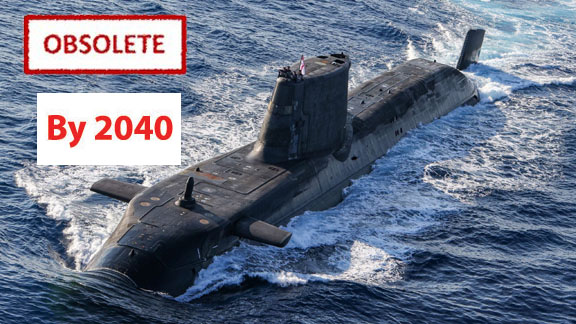
US Congressional report argues that Australia’s acquisition of nuclear submarines would actually undercut deterrence of China by depleting the US submarine fleet. With the promise of nuclear submarines becoming ever distant, it may be time to reconsider other options.
Recent surprising disclosures have revealed that nuclear-powered submarines, which Australia plans to acquire under the trilateral AUKUS partnership, cannot achieve three of the government’s main stated objectives for the program. The Australian purchase would degrade, not enhance, deterrence against China. It could provide only a miniscule and inconsistent presence at sea even after two decades. And it would undermine rather than sustain the global non-proliferation regime. Thankfully, only a tiny fraction of the program’s total estimated cost of up to AUD $368bn has been spent to date, so it is not too late for Australians to consider better ways to ensure national security.
On the first objective, Australia’s former prime minister, Scott Morrison, who negotiated the AUKUS submarine deal, claimed it was necessary to achieve a “credible deterrent” against China, and his successor Anthony Albanese soon agreed. Last month, however, the US Congressional Budget Office (CBO) belied that assertion. It reported that, because the United States would sell Australia three to five existing nuclear attack submarines (SSNs) from the US fleet before the US industrial base could expand to replace them, “the sale of SSNs to Australia would reduce the number of attack submarines available to the [US] Navy.”
The CBO then posed a crucial question: “Would China be less deterred if the United States reduced the number of its attack submarines to help Australia develop its submarine force?” The answer appeared obvious because “Australia would control its own submarines, and their participation in any particular conflict would not be guaranteed. In fact, in March 2020, the Australian defence minister stated that his country did not promise to support the United States in the event of a conflict involving Taiwan and the People’s Republic of China.” Thus, the report indicated that Australia’s acquisition of nuclear submarines would undercut deterrence of China – exactly opposite to the claims of Australia’s leaders.
Second, Morrison declared in 2021 that AUKUS’s “first major initiative” would be to provide Australia a nuclear-powered submarine fleet. This year, however, Albanese conceded that the still-under-design SSN-AUKUS would not begin delivery to Australia until the 2040s at least. In the meantime, according to RAN Vice Admiral Jonathan Mead’s Senate Estimates testimony in May, Australia expects to receive from the United States by the late 2030s two partially used nuclear submarines and one new one. That may sound like three submarines, but it is illusory. Recent reports reveal that only 63 percent of the US Navy’s submarines are operable in any year, and those that can operate spend only 39 percent of the year at sea. Thus, on average, each US attack submarine is on duty for just 25 percent of the year, or three months. This means that even if Australia received its promised three US vessels by the late 2030s, on average the RAN would be able to deploy less than one nuclear submarine at a time. Is that really the “fleet” that Aussies expect for their billions of tax dollars?
Third, Albanese promised at the 2023 AUKUS summit that “Australia’s proud record of leadership in the international nuclear non-proliferation regime will of course continue.” However, the SSN-AUKUS would violate a fundamental tenet of that regime by needlessly using weapons-grade, highly enriched uranium (HEU) fuel – sufficient for hundreds of nuclear bombs.
Since the 1970s, the non-proliferation regime has banned HEU fuel in the new reactors of countries like Australia that have pledged under the Nuclear Non-Proliferation Treaty to eschew nuclear weapons. The regime went so far as to convert 71 old reactors from HEU fuel to low-enriched uranium (LEU) fuel, to eliminate the proliferation risk. Indeed, HEU minimisation is deemed so vital for non-proliferation that it has been applied even to tiny reactors containing only one kilogram of weapons-grade uranium. Now Australia intends to eviscerate that non-proliferation norm by fuelling each SSN-AUKUS with hundreds of kilos of such bomb-grade uranium.
Fortunately, nuclear submarines do not require HEU fuel and can function perfectly well with LEU fuel, as the navies of France and China use. Despite this, Australia and its partners insist on HEU fuel for SSN-AUKUS, to enable smaller reactors without refuelling, thereby sending a message globally that HEU is required for the best submarines. As a result, we can expect other countries to declare – as Iran did immediately following the AUKUS announcement – that their navies too will use HEU, which they will enrich themselves, opening a huge back door to nuclear weapons. By contrast, LEU fuel is infinitely more proliferation resistant than HEU fuel, notwithstanding musings by uninformed AUKUS cheerleaders.
Australia’s defence minister, Richard Marles, has dismissed proliferation concerns by saying the HEU fuel would be imported in “sealed” reactors and thus inaccessible. In reality, however, Australia announced this year that it would extract the HEU fuel from all retired submarines and retain it in perpetuity, thereby savaging the non-proliferation regime even further. The supposedly “spent” fuel from each retired submarine would in fact contain an estimated 200 kilograms of still very highly enriched uranium, sufficient for a dozen or more nuclear weapons.
So, what can Australia do now? At the least, it should ask its partners to switch to LEU fuel for Australia’s SSN-AUKUS, to comport with non-proliferation norms. Fortunately, the US Congress has funded development of LEU naval fuel for the last eight years, providing a head-start to incorporate such proliferation-resistant fuel in the ongoing design of the SSN-AUKUS. If Albanese means what he says about “leadership in the international nuclear non-proliferation regime,” this step is a no-brainer.
The bigger question is whether Australia should abandon pursuit of nuclear submarines entirely. The Congressional report suggests that doing so would actually strengthen deterrence over the next few decades by not depleting the US fleet. Australia instead could reprogram the hundreds of billions earmarked for its nuclear submarines to buy defence systems that would complement rather than undermine US deterrence. That certainly sounds like a win-win.
Alan J. Kuperman is associate professor and coordinator of the Nuclear Proliferation Prevention Project at the LBJ School of Public Affairs, University of Texas at Austin.
1 This month.
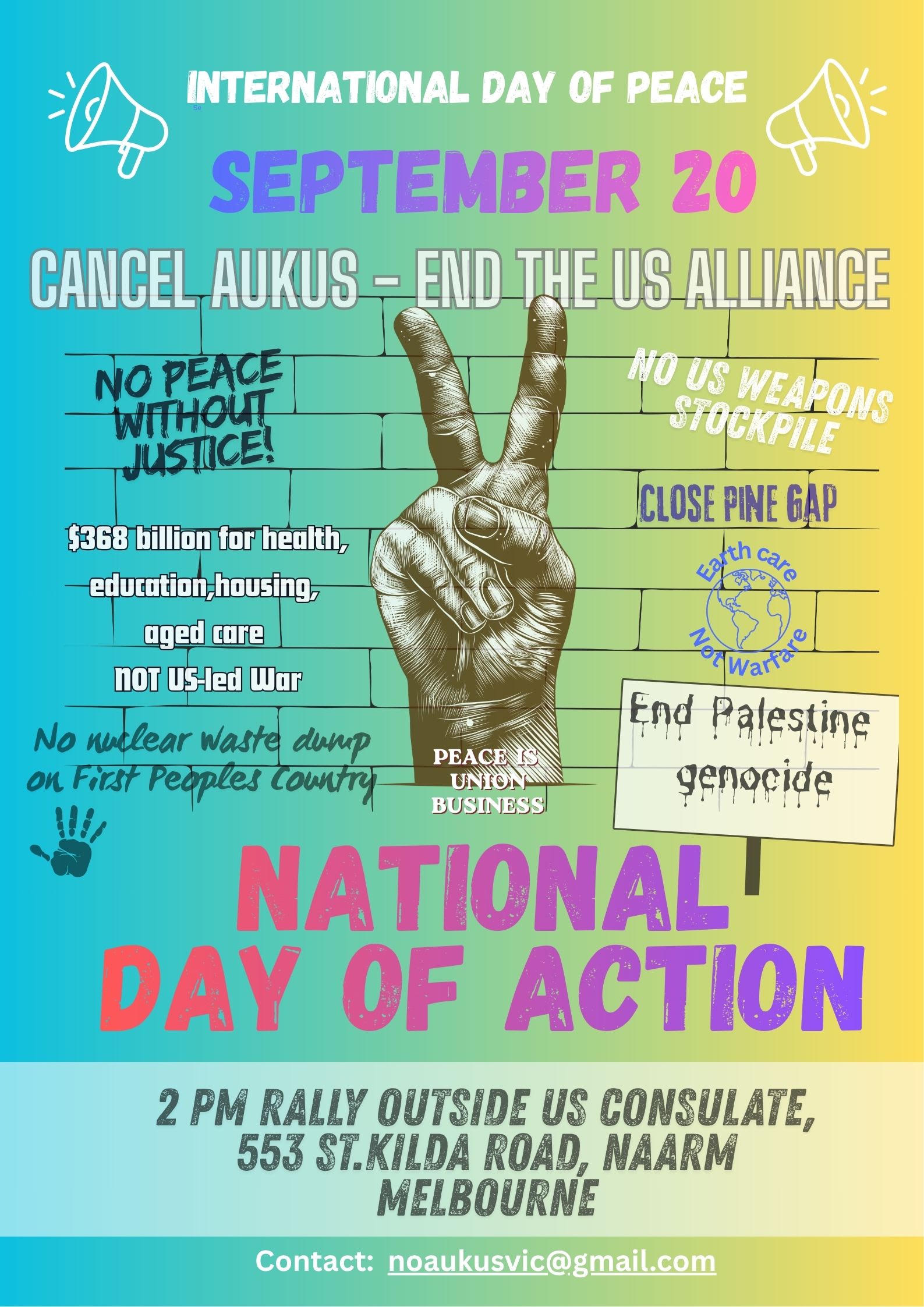
20 September –National Day of Action in Melbourne on the International Day of Peace

Help Aunty Sue Protect Her Land and Sacred Sites From Destructive Rocket Testing.
.

Australians deserve the truth
about
AUKUS – https://aukuspublicinquiry.com/


PETITION – To: Prime Minister Anthony Albanese and the Australian Labor Government

of the week – Australians for War Powers Reform (AWPR)
To see nuclear-related stories in greater depth and intensity
 Antinuclear