Malaysian Govt urged to halt Australian company Lynas’ thorium extraction plan

https://www.thestar.com.my/news/nation/2023/11/24/govt-urged-to-halt-lynas-thorium-extraction-plan
SEVERAL DAP lawmakers have urged the government to review Lynas Malaysia’s license and stop the plan for thorium extraction from the waste produced at the factory of the rare earth producer.Chow Yu Hui (PH-Raub) said that he remains unconvinced that Lynas Malaysia was capable of extracting thorium.
“Let us not forget that the amount of waste from the Lynas plant was as large as five hills behind its factory. Will the new thorium extraction technology and Lynas be able to manage the radioactive waste which is expected to reach 1.2 million metric tonnes?” he asked reporters at the parliament media centre yesterday.
Oct 24, Science, Technology and Innovation Minister Chang Lih Kang announced that Lynas Malaysia would be allowed to import lanthanide concentrates until its licence expires in March 2026.
He also said that the Atomic Energy Licensing Board (AELB) decided to amend Lynas Malaysia’s license conditions after the company made a proposal to the licensing board about its thorium extraction technology.
With this, Chang said radioactive waste will not be produced after extraction and cracking and leaching activities are carried out on the lanthanide concentrate.
Khoo Poay Tiong (PH-Kota Melaka) said the Science, Technology and Innovation Ministry had announced on May 10 regarding the renewal of Lynas Malaysia’s license until Dec 31.
However, Khoo said that within a period of five months, the government, via AELB, had reviewed Lynas’ licence conditions.
“This matter has raised many concerns regarding the radioactive pollution and safety of locals,” said Khoo, who also wanted to know the parties that came up with the idea of thorium extraction.“We also want clarification from the government on what the possible market for thorium is,” he said.
Tan Hong Pin (PH-Bakri) also pointed out that thorium extraction technology was still in its initial phases, even at the international level.
“To what extent can thorium be extracted, used and commercially extracted? What are the effective measures that can be taken by the government to address the issue and ensure that Lynas will adhere to all the international standards in managing radioactive waste?” asked Tan.
On Nov 16, Chang promised that AELB will closely monitor the thorium extraction process from Lynas Malaysia’s waste material.
Fine print bombshell – share information which “undermines trust in government”, face jail

by Rex Patrick | Nov 21, 2023 https://michaelwest.com.au/government-review-of-secrecy-provisions-an-assault-on-democracy/?utm_source=newsletter&utm_medium=email&utm_term=2023-11-23&utm_campaign=Michael+West+Media+Weekly+Update
The Government has released its ‘Review into Secrecy Provisions’ whose fine print contains the greatest assault on democracy and accountability in many years, writes Rex Patrick.
Secrecy is woven into the fabric of the Australian Government. There are eleven general secrecy offences in the criminal code, 295 non-disclosure duties in 102 laws that attract criminal liability, and 569 specific secrecy offences in 183 laws.
A rationalisation and a review of secrecy laws was long overdue.
But buried in this review is a bombshell. Carried out by the Attorney-General’s Department, the review report makes a key recommendation that disclosure of information that could cause a loss of trust in Government should be criminalised.
Paragraph 146 states:
“… disclosure of information that harms the effective working of Government undermines the Australian community’s trust in government and the ability of Commonwealth departments and agencies to deliver policies and programs. It is appropriate that conduct which causes or is likely to cause prejudice to the effective working of government be covered [by secrecy provisions enforceable under the criminal code]”
The national security bureaucrats’ view seems to be that secrecy is essential to ensure trust in government!
The infamous character of Sir Humphrey Appleby in the Yes Minister TV show would be so proud.
If implemented, this recommendation would raise for public servants a criminal penalty for anything embarrassing, anything that might put a question in the way of policy information or even any wrongdoing by officials to the extent that revealing such might undermine confidence in government.
Review origins
The review stemmed from a report of the Parliamentary Joint Committee on Intelligence and Security looking into the 2019 ABC and the Smethurst media raids.
The review was intended to be the first step in a process that would ensure that these laws protect and are consistent with essential public interests, including the public interest in transparency in government decision-making, parliamentary scrutiny and accountability, and effective media investigations and reporting.
The recommendation of the Review that the Government create a new sweeping secrecy offence is quite at odds with the original objectives of this exercise, and is indeed quite contrary to proper principles of transparency, scrutiny and accountability of government.
While the review recommends the repeal of some redundant and outdated secrecy offences and non-disclosure duties, this very modest wind back of secrecy will be completely submerged by the development of “a new general secrecy offence” for inclusion in the Criminal Code Act 1995.
Protecting the leaders
To be clear, public servants already have a duty not to disclose information unless they are authorised to do so, or they are required/permitted to disclose it by law.
But it’s one thing to say that public servants should operate in a ‘privacy of government’ environment, it’s completely another thing to say that everything they discuss or write about is confidential and they should go to jail if they reveal anything.
Under the current ‘privacy of government’ arrangements, we are supposed to let the government quietly get on with business overseen by Parliament, the Auditor-General, the Ombudsman, the National Anti-Corruption Commission (NACC) and law enforcement, the Freedom of Information Regime and whistleblower protection.
This all sounds good; except the Parliament is very weak on oversight, the Auditor-General and Ombudsman are underfunded, the NACC operates in complete secrecy, the FOI regime is totally broken and whistleblower protections are simply non-existent.
Secrecy overreach
But even if the accountability of government systems did work, the Secrecy Review’s recommendation is overreach. It just re-enforces a culture of secrecy inside government that is already in need of a secrecy exorcism.
The much better view is that of former Sir Anthony Mason, AC KBE GBM KC in the High Court Case of Commonwealth v John Fairfax & Sons Ltd (“Defence Papers case“) [1980], before he was Chief Justice, when he said:
“It is unacceptable in our democratic society that there should be a restraint on the publication of information relating to government when the only vice of that information is that it enables the public to discuss, review and criticize government action.
His judicial pronouncement trumps the bureaucratic authors of a review that presses a recommendation that aims to protect senior leadership and ministers from embarrassment and the exposure of incompetence using the threat of criminal punishment. But his views only last until new laws are passed.
A captured Attorney General
The next question, of course, is whether the Attorney-General and the Government will act on this recommendation and remain beholden to his national security bureaucrats?
If his past record of betraying whistleblowers and his refusal to pursue Freedom of Information reforms is any guide, there aren’t any grounds for optimism.
Proceeding down this path would deal a great blow to democratic accountability and public interest journalism.
Proceeding down this path would deal a great blow to democratic accountability and public interest journalism.
It would embed the already harmful secrecy culture that exists across a vast expanse of government activity and could also blow a hole in Australia’s already weak and failing FOI regime.
But does the Government and the Attorney General want a political fight over a move towards excessive and unjustified secrecy? We will have to see, but if they do go down this path it’s a fight they’re sure to get.
A four-decade-old Pacific treaty was meant to preserve the ‘peaceful region’. Now experts say it’s being exploited
“We regret that the Aukus agreement … is escalating geopolitical tensions in our region and undermining Pacific-led nuclear-free regionalism,” says the Pacific Elders’ Voice,
the US and the UK will increase rotations of nuclear-powered submarines to Australia,
Pacific countries rushed to join the TPNW six years ago, reflecting their longstanding concerns about nuclear testing legacies. It’s the same regional sentiment that spurred the earlier Treaty of Rarotonga.
Daniel Hurst in Rarotonga
Nearly 40 years after the Treaty of Rarotonga came into force, the region is on edge about another rise in geopolitical tension
…………………………………………………………………………….heightened concerns permeated the region in the months leading up to the crucial meeting in the Cook Islands in August 1985 where leaders endorsed a nuclear-free zone.
Hawke, the Australian prime minister at the time, hailed the negotiations as a “dramatic success” that would send “a clear and unequivocal message to the world”, with the treaty leaving major powers in no doubt about the region’s desire to preserve “the South Pacific as the peaceful region which its name implies”.
But nearly 40 years after the Treaty of Rarotonga came into force, the region is on edge about another rise in geopolitical tensions – and critics say gaps in the treaty’s coverage are now being exploited.
“The treaty was really important to a lot of people, especially for grassroots activists,” says Talei Mangioni, a Fijian-Australian board member of the International Campaign to Abolish Nuclear Weapons Australia.
But it was quite watered down. And so even though we celebrate it today, what activists were saying in the 1980s and what progressive states like Papua New Guinea, Solomon Islands and Vanuatu were saying was that it wasn’t comprehensive enough.”
Mangioni, who researches the legacy of the Nuclear Free and Independent Pacific Movement, adds: “That’s what’s left us now with things like Aukus exploiting certain loopholes that have remained in the treaty.”
A hotbed of great-power competition?
When leaders met last week in the Cook Islands for the annual meeting of the Pacific Islands Forum (Pif), the Treaty of Rarotonga was once again on everyone’s lips.
The host of the summit, prime minister Mark Brown of the Cook Islands, argued the region “should rediscover and revisit our Rarotonga treaty to ensure that it reflects the concerns of Pacific countries today, and not just what occurred back in 1985”.
The treaty – signed on the 40th anniversary of the US atomic bombing of the Japanese city of Hiroshima – reflected “the deep concern of all forum members at the continuing nuclear arms race and the risk of nuclear war”.
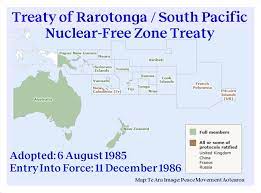
Also known as the South Pacific Nuclear Free Zone Treaty, it designated a vast area from the west coast of Australia to Latin America where its parties must prevent the “stationing” (critics say this was always a deliberately ambiguous word) of nuclear weapons.
“The treaty prohibits the use, testing or stationing of nuclear explosive devices in the South Pacific,” the Cook Islands News explained on 7 August 1985.
“It does not prohibit countries from transporting nuclear devices through the zone nor does it prohibit nuclear-powered or equipped ships from calling in ports within the area.”
Today the parties to this treaty are Australia, Cook Islands, Fiji, Kiribati, Nauru, New Zealand, Niue, Papua New Guinea, Samoa, Solomon Islands, Tonga, Tuvalu and Vanuatu.
Once again, many of these nations are worried about the Pacific becoming a hotbed of great-power competition and the risk of that spiralling into conflict. Aukus feeds into some of those fears.
“We regret that the Aukus agreement … is escalating geopolitical tensions in our region and undermining Pacific-led nuclear-free regionalism,” says the Pacific Elders’ Voice, a group of former leaders whose members include Anote Tong, the ex-president of Kiribati.
The legality of a treaty – and the spirit of it
Under the Aukus plan, Australia will buy at least three Virginia class nuclear-powered submarines from the US in the 2030s, before Australian-built boats enter into service from the 2040s.
In the meantime, the US and the UK will increase rotations of nuclear-powered submarines to Australia, all aimed at deterring China from unilateral action against Taiwan or destabilising activities in the increasingly contested South China Sea.
One point of sensitivity is that it will be the first time a provision of the Nuclear Non-Proliferation Treaty regime has been used to transfer naval nuclear propulsion technology from a nuclear weapons state to a non-weapons state.
The Australian government has worked assiduously behind the scenes to reassure Pacific leaders on a key point about Aukus.
“Certainly when I was talking to people about it I would explain how it was consistent with the Treaty of Rarotonga,” says the Australian minister for the Pacific, Pat Conroy.
Donald Rothwell, a professor of international law at the Australian National University, concurs. The treaty, he notes, does not deal with nuclear-propelled submarines.
“My view is that Aukus is consistent with Australia’s Treaty of Rarotonga obligations,” Rothwell says.
“Pacific states may have concerns about the potential stationing of US and UK nuclear-armed warships in Australian ports under Aukus. The stationing of such vessels, as opposed to port visits, would be contrary to the treaty.”
The Australian prime minister, Anthony Albanese, sought to allay any Aukus-related concerns when he briefed Pacific leaders during the Pif meetings last week and appears to have held off any open rebellion.
Albanese insists the treaty remains “a good document” and “all of the arrangements that we’ve put in place have been consistent with that”.
But anti-nuclear campaigners point to the planned new aircraft parking apron at the Tindal base in the Northern Territory that will be able to accommodate up to six US B-52 bombers.
The US refuses to confirm or deny whether the aircraft on rotation would be nuclear-armed, in line with longstanding policy.
“We should delineate between a legalistic interpretation of the Treaty of Rarotonga and the spirit of it,” says Marco de Jong, a Pacific historian based in Aotearoa New Zealand.
“Pacific nations are growing increasingly frustrated at Australia’s reliance on loopholes and technicalities.”
Australia: the regional outlier
The Nobel prize-winning International Campaign to Abolish Nuclear Weapons says a good way for Australia to reassure the region about its long-term intentions would be to sign the newer Treaty on the Prohibition of Nuclear Weapons (TPNW).
This is an idea Albanese previously supported enthusiastically but which appears stalled.
One potential problem is that the US has warned that the TPNW – which includes a blanket ban on helping others to use or threaten to use nuclear weapons – wouldn’t allow for close allies like Australia to enjoy the protection of the American “nuclear umbrella”.
Documents obtained by the Guardian under freedom of information laws show the Australian defence department has warned the Labor government that the TPNW is “internationally divisive” because the nuclear weapons states “are all opposed”.
But Mangioni, a member of the Youngsolwara Pacific movement of activists, counters that Pacific countries rushed to join the TPNW six years ago, reflecting their longstanding concerns about nuclear testing legacies. It’s the same regional sentiment that spurred the earlier Treaty of Rarotonga.
“I would say that Australia is indeed the outlier compared to the rest of the Pacific states,” Mangioni says.
“Australia depends on nuclear deterrence as its policy but the rest of the Pacific states are nuclear abolitionists.” https://www.theguardian.com/world/2023/nov/19/a-40-year-old-pacific-treaty-was-meant-to-maintain-the-peaceful-region-now-experts-say-its-being-exploited
A Duty to Obey: David McBride, Whistleblowing and Following Orders
Australian Independent Media November 19, 2023, Dr Binoy Kampmark
The unpardonable, outrageous trial of Australian whistleblower David McBride was a brief affair. On November 13, it did not take long for the brutal power of the Commonwealth to become evident. McBride, having disclosed material that formed the Australian public about alleged war crimes by special forces in Afghanistan, was going to be made an example of.
McBride served as a major in the British army before becoming a lawyer for the Australian Defence Force, serving two tours in Afghanistan over 2011 and 2013. During that time, he gathered material about the culture and operations of Australia’s special forces that would ultimately pique the interest of investigators and lead to the Brereton Inquiry which, in 2020, made 36 referrals to the Australian Federal Police related to alleged war crimes.
McBride was subsequently charged with five national security offences. He was also denied immunity from prosecution under the near-unworkable provisions of the Public Interest Disclosure Act 2013 (Cth).
A central contention of the Crown was that McBride had, first and foremost, a duty to follow orders as a military lawyer. Such a duty flows on from the oath sworn to the sovereign, and no public interest could trump that undertaking. “A soldier,” contended Trish McDonald in her astonishing submission, “does not serve the sovereign by promising to do whatever the soldier thinks is in the public interest, even if contrary to the laws made by parliament.”
Even a layperson’s reading of the oath would surely make a nonsense of this view, but Justice David Mossop was in little mood to suggest otherwise. “There is no aspect of duty that allows the accused to act in the public interest contrary to a lawful order.” It was a point he would be putting to the jury, effectively excluding any broader public interest considerations that might be at play in disobeying a military order.
For anybody vaguely familiar with military law since the Nuremberg trials of Nazi leaders in 1945, such orders are never absolute, nor to be obeyed without qualification. Following orders without question or demur in all cases went out – or so the 1945 trials suggested – with Nazi officialdom and the Third Reich. There are cases when a soldier is under a positive duty to disobey certain orders. But McDonald was trapped in a fusty pre-Nuremberg world, evidenced by her use of a 19th century authority on military justice that would have sat well with the German defence team: “There is nothing so dangerous to the civil establishment of the state as an undisciplined or reactionary army.”
Chief counsel representing McBride, Stephen Odgers, hoped to drag Australian military justice into the twenty-first century, reaffirming the wisdom of Nuremberg: there are times when a public duty supersedes and transcends the narrow demands of authority, notably when it comes to the commission or concealment of crimes. The oath McBride swore as a member of the ADF to serve the sovereign comprised an element to act in the public interest, even when opposed to a lawful order…………………………………………..
With the trial resuming on November 17, Mossop issued another stinging order: that the Attorney-General’s office remove classified documents in McBride’s possession that could be presented to the jury at trial. As one of the defence team, Mark Davis, told reporters, “We received the decision just this afternoon, which was in essence to remove evidence from the defence.” In doing so, “The Crown, the government, was given the authority to bundle up evidence and run out the backdoor with it.”
With such gloomy prospects, McBride requested a new indictment on lesser charges, to which he pleaded guilty. Facing sentencing in the new year, he may be eligible to serve time outside carceral conditions, though a decade long stint is also in the offing. “The result of today’s outcome,” wrote transparency advocate and former Senator Rex Patrick, “is one brave whistleblower likely behind bars and thousands of prospective whistleblowers lost from the community.”………………………………………………………………………………………………………………..more https://theaimn.com/a-duty-to-obey-david-mcbride-whistleblowing-and-following-orders/
AUKUS Submarine Revelations Compel a Rethink
16 NOV 2023, By Dr Alan J. Kuperman, https://www.internationalaffairs.org.au/australianoutlook/aukus-submarine-revelations-compel-a-rethink/?fbclid=IwAR0aqbbEXcIh3HpPpmlRKMD9gIJfXmHWKZL6hbNYuq7jT1HhiEBwLsHZ95Q
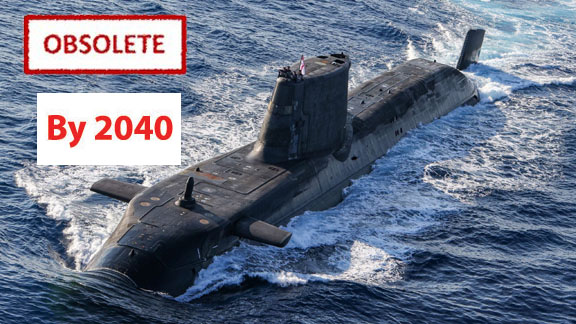
US Congressional report argues that Australia’s acquisition of nuclear submarines would actually undercut deterrence of China by depleting the US submarine fleet. With the promise of nuclear submarines becoming ever distant, it may be time to reconsider other options.
Recent surprising disclosures have revealed that nuclear-powered submarines, which Australia plans to acquire under the trilateral AUKUS partnership, cannot achieve three of the government’s main stated objectives for the program. The Australian purchase would degrade, not enhance, deterrence against China. It could provide only a miniscule and inconsistent presence at sea even after two decades. And it would undermine rather than sustain the global non-proliferation regime. Thankfully, only a tiny fraction of the program’s total estimated cost of up to AUD $368bn has been spent to date, so it is not too late for Australians to consider better ways to ensure national security.
On the first objective, Australia’s former prime minister, Scott Morrison, who negotiated the AUKUS submarine deal, claimed it was necessary to achieve a “credible deterrent” against China, and his successor Anthony Albanese soon agreed. Last month, however, the US Congressional Budget Office (CBO) belied that assertion. It reported that, because the United States would sell Australia three to five existing nuclear attack submarines (SSNs) from the US fleet before the US industrial base could expand to replace them, “the sale of SSNs to Australia would reduce the number of attack submarines available to the [US] Navy.”
The CBO then posed a crucial question: “Would China be less deterred if the United States reduced the number of its attack submarines to help Australia develop its submarine force?” The answer appeared obvious because “Australia would control its own submarines, and their participation in any particular conflict would not be guaranteed. In fact, in March 2020, the Australian defence minister stated that his country did not promise to support the United States in the event of a conflict involving Taiwan and the People’s Republic of China.” Thus, the report indicated that Australia’s acquisition of nuclear submarines would undercut deterrence of China – exactly opposite to the claims of Australia’s leaders.
Second, Morrison declared in 2021 that AUKUS’s “first major initiative” would be to provide Australia a nuclear-powered submarine fleet. This year, however, Albanese conceded that the still-under-design SSN-AUKUS would not begin delivery to Australia until the 2040s at least. In the meantime, according to RAN Vice Admiral Jonathan Mead’s Senate Estimates testimony in May, Australia expects to receive from the United States by the late 2030s two partially used nuclear submarines and one new one. That may sound like three submarines, but it is illusory. Recent reports reveal that only 63 percent of the US Navy’s submarines are operable in any year, and those that can operate spend only 39 percent of the year at sea. Thus, on average, each US attack submarine is on duty for just 25 percent of the year, or three months. This means that even if Australia received its promised three US vessels by the late 2030s, on average the RAN would be able to deploy less than one nuclear submarine at a time. Is that really the “fleet” that Aussies expect for their billions of tax dollars?
Third, Albanese promised at the 2023 AUKUS summit that “Australia’s proud record of leadership in the international nuclear non-proliferation regime will of course continue.” However, the SSN-AUKUS would violate a fundamental tenet of that regime by needlessly using weapons-grade, highly enriched uranium (HEU) fuel – sufficient for hundreds of nuclear bombs.
Since the 1970s, the non-proliferation regime has banned HEU fuel in the new reactors of countries like Australia that have pledged under the Nuclear Non-Proliferation Treaty to eschew nuclear weapons. The regime went so far as to convert 71 old reactors from HEU fuel to low-enriched uranium (LEU) fuel, to eliminate the proliferation risk. Indeed, HEU minimisation is deemed so vital for non-proliferation that it has been applied even to tiny reactors containing only one kilogram of weapons-grade uranium. Now Australia intends to eviscerate that non-proliferation norm by fuelling each SSN-AUKUS with hundreds of kilos of such bomb-grade uranium.
Fortunately, nuclear submarines do not require HEU fuel and can function perfectly well with LEU fuel, as the navies of France and China use. Despite this, Australia and its partners insist on HEU fuel for SSN-AUKUS, to enable smaller reactors without refuelling, thereby sending a message globally that HEU is required for the best submarines. As a result, we can expect other countries to declare – as Iran did immediately following the AUKUS announcement – that their navies too will use HEU, which they will enrich themselves, opening a huge back door to nuclear weapons. By contrast, LEU fuel is infinitely more proliferation resistant than HEU fuel, notwithstanding musings by uninformed AUKUS cheerleaders.
Australia’s defence minister, Richard Marles, has dismissed proliferation concerns by saying the HEU fuel would be imported in “sealed” reactors and thus inaccessible. In reality, however, Australia announced this year that it would extract the HEU fuel from all retired submarines and retain it in perpetuity, thereby savaging the non-proliferation regime even further. The supposedly “spent” fuel from each retired submarine would in fact contain an estimated 200 kilograms of still very highly enriched uranium, sufficient for a dozen or more nuclear weapons.
So, what can Australia do now? At the least, it should ask its partners to switch to LEU fuel for Australia’s SSN-AUKUS, to comport with non-proliferation norms. Fortunately, the US Congress has funded development of LEU naval fuel for the last eight years, providing a head-start to incorporate such proliferation-resistant fuel in the ongoing design of the SSN-AUKUS. If Albanese means what he says about “leadership in the international nuclear non-proliferation regime,” this step is a no-brainer.
The bigger question is whether Australia should abandon pursuit of nuclear submarines entirely. The Congressional report suggests that doing so would actually strengthen deterrence over the next few decades by not depleting the US fleet. Australia instead could reprogram the hundreds of billions earmarked for its nuclear submarines to buy defence systems that would complement rather than undermine US deterrence. That certainly sounds like a win-win.
Alan J. Kuperman is associate professor and coordinator of the Nuclear Proliferation Prevention Project at the LBJ School of Public Affairs, University of Texas at Austin.
Barngarla traditional owners win national conservation award for successful radioactive waste campaign news on radioactive waste
16 NOVEMBER 2023, https://www.acf.org.au/barngarla-rawlinson-award-win—
The Barngarla Determination Aboriginal Corporation has been awarded the 2023 Peter Rawlinson Award for a successful seven-year campaign to protect their country in South Australia from the long-term threats posed by radioactive waste.
The award, which celebrates outstanding voluntary contributions to protect the environment, was announced at the Australian Conservation Foundation’s AGM in Melbourne tonight.
“In August 2023, a David and Goliath struggle came to an end when federal Resources Minister Madeleine King announced the federal government would not advance a plan inherited from the former Coalition government to locate a national radioactive waste facility near Kimba on SA’s Eyre Peninsula,” said ACF’s nuclear free campaigner Dave Sweeney.
“The federal waste plan was deeply flawed and inconsistent with international best practice.
“The Barngarla always opposed radioactive waste on their country and repeated calls for Morrison government ministers Matt Canavan and Keith Pitt to scrap the plan were ignored.
“For seven years, against sustained pressure and propaganda, they stood firm.
“In July 2023, the Federal Court found Minister Pitt’s decision to declare the Kimba site was not valid because it was biased, rather than based on an independent and thorough process.
“Federal Labor’s subsequent decision to accept the court’s judgment was a prudent and a proper call and offers an important chance to change the government’s approach to this complex issue.
ACF thanks the Barngarla and acknowledges the sustained and successful efforts of a proud community to honour their past and protect their future. All of us are richer as a result.”
Established in 1992, the Rawlinson Award is given annually in memory of ACF Councillor Peter Rawlinson – a zoologist, lecturer in biological science and environmental campaigner.
$31m fines, 25 years jail for nuclear submarine safety breaches
“This robust and comprehensive approach to regulating Australia’s nuclear-powered submarine program recognises the Albanese government’s commitment to nuclear stewardship and upholding the highest standards for nuclear safety and security,” Mr Marles said.
Andrew Tillett https://www.afr.com/politics/federal/31m-fines-25-years-jail-for-nuclear-submarine-safety-breaches-20231115-p5ek9x
Organisations that breach nuclear safety regulations will be hit with fines of up to $31 million while individuals face up to 25 years jail under AUKUS-related laws to be introduced into parliament on Thursday.
The legislation establishes the regulatory framework overseeing the operations of Australia’s nuclear-powered submarines that will initially be acquired from the US then built in Adelaide.
The Australian Naval Nuclear Power Safety Regulator will also be responsible for facilities in Australia for submarines, including rotational visits of US and UK boats, and designated zones, including Adelaide’s shipyard and Perth’s HMAS Stirling navy base.
The regulator will sit within the Defence portfolio but will be an independent statutory agency, headed by a director-general independent of the Defence Force and not subject to the ADF chain of command or directions from Defence and the Australian Submarine Agency.
The new regulator will have monitoring and investigative powers, including the power to determine legal compliance; whether information is accurate; and the powers necessary to investigate offences.
A licensing regime will be created for nuclear activities and new offences introduced for breaches of nuclear safety duties. The most serious breaches will attract a fine for a body corporate of up to $31 million and 25 years in jail.
A limited power will also be created allowing the defence minister of the day to direct the regulator. The power will be narrow in scope and only be used when the minister was satisfied it was necessary in the interests of national security and to deal with an emergency.
The government argues the existing nuclear safety regime and regulators – the Australian Nuclear Science and Technology Organisation, the Australian Radiation Protection and Nuclear Safety Agency and Environment Department – are insufficient for the demands of overseeing nuclear-powered submarines.
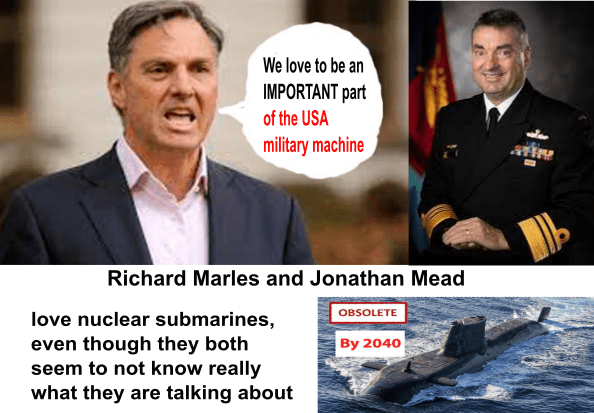
“This robust and comprehensive approach to regulating Australia’s nuclear-powered submarine program recognises the Albanese government’s commitment to nuclear stewardship and upholding the highest standards for nuclear safety and security,” Mr Marles said.
“The new regulator will have access to relevant expertise and experience, allowing it to cooperate effectively with other Australian regulators and those of our international partners.
“Today is another important step towards ensuring we employ the highest standards of nuclear safety and protection across the lifecycle of this historic capability.”
The Militarised University: Where Secrecy Goes to Thrive

Across Australia’s universities, the AUKUS military initiative between the US, UK and Australia, primarily focused on developing nuclear powered technology for a new submarine design, has titillated the managerial wonks of the tertiary education sector. In September, the Defence Department announced that 4,000 additional Commonwealth supported places (CSPs) for undergraduate students would be funded as part of its “Nuclear-Powered Submarine Student Pathways” strategy.
Then come the true villains of the peace, the arms manufacturers and companies that make the military-university-industrial complex intimate and obscene.
November 14, 2023, by: Dr Binoy Kampmark, https://theaimn.com/the-militarised-university-where-secrecy-goes-to-thrive/
For anyone wishing to bury secrets, especially of the unsavoury sort, there is one forum that stands out. Call it a higher education institution. Call it a university. Even better, capitalise it: the University. This is certainly the case in Australia, where education is less a pursuit of knowledge as the acquiring of a commodity, laid out spam for so much return. On that vast island continent, the university, dominated by a largely semi-literate and utterly unaccountable management, is a place where secrets are buried, concealed with a gleeful dedication verging on mania.
In its submission to what will hopefully become the Australian Universities Accord, the Australian Association of University Professors (AAUP) notes the following: “Unfortunately, university managements are increasingly disconnected from and unaccountable to academic values and academic communities. Students, Government and granting bodies, pay universities to deliver services according to academic values, but academics are impeded from working in accordance with academic values by interfering management. Further, the managers themselves do not work in accordance with academic values.”
Those in the defence industry have taken note. By turning such institutions of instruction into supply lines for research and development in armaments, they can be assured of secrecy conditions the envy of most intelligence agencies. Consulting, viewing, gaining access to relevant agreements, documentation and projects for reasons of public discussion is virtually impossible. These are always seen as “commercial” and “in confidence”.
Only the overly fed and watered members of the University Politburo are granted such access. Entry into the arcana of its deliberations is ceremonially tolerated via Academic Board meetings or Senatorial deliberations. Furthermore, academics throughout the university sport a reliable, moral flabbiness that will prevent them from spilling the beans and airing a troubled conscience, even in cases where leaking the documentation might be possible. Middle class, mortgage-laden status anxiety is the usual formula here, one that neuters revolutionary spirits – not that there was much to begin with.
Across Australia’s universities, the AUKUS military initiative between the US, UK and Australia, primarily focused on developing nuclear powered technology for a new submarine design, has titillated the managerial wonks of the tertiary education sector. In September, the Defence Department announced that 4,000 additional Commonwealth supported places (CSPs) for undergraduate students would be funded as part of its “Nuclear-Powered Submarine Student Pathways” strategy.
Institutes have sprung up running short courses to rake in the cash, such as the UWA Defence and Security Institute, which proudly claims to have created the “essential course for those seeking to gain a greater understanding of AUKUS Pillar 1 (nuclear powered submarines) and the impacts for Western Australia and beyond.” A course running for thirteen hours does not seem particularly hefty, but this is a field of glitz over substance.
Then come the true villains of the peace, the arms manufacturers and companies that make the military-university-industrial complex intimate and obscene. One of interest here is Israel’s Elbit Systems. For years, it has hammered out a reputation for manufacturing such lethal products as the Hermes 900 drone, which was first deployed in 2014 against targets in the Gaza Strip. It supplies the lion’s share of drones used by the Israeli Defence Forces for strikes and surveillance (the figure may be as high as 85%).
The company has managed to beef up many an activist’s resumé. Members of the Palestine Action group claim to have scored a victory in securing the permanent closure of two of Elbit’s sites in 2022, including the London head office. “The cracks in Elbit’s warehouse windows,” the organisation trumpeted in August this year, “do not simply represent cosmetic damage but also symbolise the crumbling foundations of Elbit’s relationship with the British State’s so-called defence interests.”
The corporation has also fallen out of favour with a number of investors. HSBC and the French multinational AXA Investment Managers divested from the company in 2018 and 2019 given its role in producing and commercialising cluster munitions and white phosphoros shells. In May 2022, the Australian sovereign wealth fund, Future Fund, excluded Elbit Systems Limited from its investment portfolio for much the same reasons.
Despite this blotched and blotted record, Elbit could still stealthily establish a bridgehead in the university sector down under through its creation, in 2021, of a Centre of Excellence in Human-Machine Teaming and Artificial Intelligence in Port Melbourne. Elbit Systems of Australia (ELSA) had two special clients: the state government of Victoria, which provided some funding via Invest Victoria, and RMIT University’s Centre for Industrial AI Research and Innovation. The two-year partnership with ELSA’s Centre of Excellence was intended to, according to ELSA’s then managing director and retired Major General Paul McLachlan, “research how to use drones to count the number of people in designated evacuation zones, then to co-ordinate and communicate the most efficient evacuation routes to everyone in the zone, as well as monitoring the area to ensure that everyone has been accounted for.”
Despite such seemingly noble goals, the opening ceremony in February 2021 had a distinctly heavy military accent, with senior representatives from the Royal Australian Airforce, DST (Defence Science and Technology) Group and the Capability Acquisition and Sustainment Group (CASG). No one present could deny that technology used in the context of civilian evacuations in the face of natural disaster could just as well be deployed in a military security context. As Antony Loewenstein has observed, “If you partner, as a state or a university, with a company like Elbit, you have blood on your hands because the record of Elbit in Israel-Palestine, on the US-Mexican border and elsewhere is so damned clear.”
Since the Hamas attacks on Israeli soil that took place on October 7, the ELSA-RMIT-Victorian relationship has seemingly altered. A war of horrendous carnage is being waged in the Gaza Strip. Activists claim to have scored a famous victory in securing the university’s hazy termination of any partnership with ELSA. “This is a significant victory for the Boycott, Divestment and Sanctions movement in Australia,” claims Hilmi Dabbagh of BDS Australia. “Australian universities have been put on notice that they will be targeted if they partner with any Israeli company or institution complicit in human rights abuses and attacks on Palestinians.”
Such confidence is admirably fresh, if a touch green. It is worth looking at the university statement, which is revealing in ways that have been entirely missed in the enthusiastic pronouncements of the BDS movement. The university claims to “not design, develop or manufacture weapons or munitions in the university or as part of any partnership. With regard to Elbit Systems, RMIT does not have a partnership with Elbit Systems or any of their subsidiaries, including Elbit Systems of Australia (ELSA).” Such wording avoids the language of termination, leaving the question open as to whether it ever had an arrangement to begin with, with its requisite project links. This will, as with much else, be deemed commercial, in confidence, and buried in the bowels of secrecy we have come to expect from the antipodean university sector.
Republicans and Democrats Unite to Push for Assange’s Freedom

Sixteen members of Congress signed a letter to President Biden urging him to drop the case against the WikiLeaks founder.
By Dave DeCamp / Antiwar.com https://scheerpost.com/2023/11/12/republicans-and-democrats-unite-to-push-for-assanges-freedom
Abipartisan group of 16 members of Congress has called on President Biden to drop the case against WikiLeaks founder Julian Assange, warning of the grave threats to press freedom if he is convicted.
The lawmakers made the call in a letter sent to President Biden on Wednesday. The effort was led by Reps. Thomas Massie (R-KY) and James McGovern (D-MA), who began circulating the letter to their colleagues for signatures last month.
“It is the duty of journalists to seek out sources, including documentary evidence, in order to report to the public on the activities of government,” the letter reads, according to a press release from Assange Defense.
“The United States must not pursue an unnecessary prosecution that risks criminalizing common journalistic practices and thus chilling the work of the free press. We urge you to ensure that this case be brought to a close in as timely a manner as possible,” the letter states.
The letter was also signed by Reps. Alexandria Ocasio-Cortez (D-NY), Jamaal Bowman (D-NY), Ayanna Pressley (D-MA), Greg Casar (D-TX), Ilhan Omar (D-MN), Cori Bush (D-MO), Rashida Tlaib (D-MI), Eric Burlison (R-MO), Marjorie Taylor Greene (R-GA), Paul Gosar (R-AZ), Jesús García (D-IL), Pramila Jayapal (D-WA), Matthew Rosendale (R-MT), and Sen. Rand Paul (R-KY).
The letter comes as the Biden administration has been under pressure from the Australian government to free Assange, who is an Australian citizen. In September, a delegation of Australian members of parliament from across the political spectrum visited Washington and met with US officials to lobby for Assange. Australian Prime Minister Anthony Albanese brought up the case with President Biden when he visited the White House in October.
Assange faces up to 175 years in prison if extradited to the US and convicted for exposing US war crimes. The charges stem from documents published by WikiLeaks that Assange obtained from his source, former Army Private Chelsea Manning, a standard journalistic practice. Assange has been held in London’s Belmarsh Prison since April 2019 as his legal team is fighting against US efforts to extradite him.
US reactor project fail heats up Australia’s nuclear power debate
ByMike Foley, November 10, 2023 — https://www.smh.com.au/politics/federal/us-reactor-project-fail-heats-up-australia-s-nuclear-power-debate-20231109-p5eisu.html
A nuclear energy developer championed by the Coalition has canned its most advanced project in the United States, raising questions over the viability of the technology in Australia.
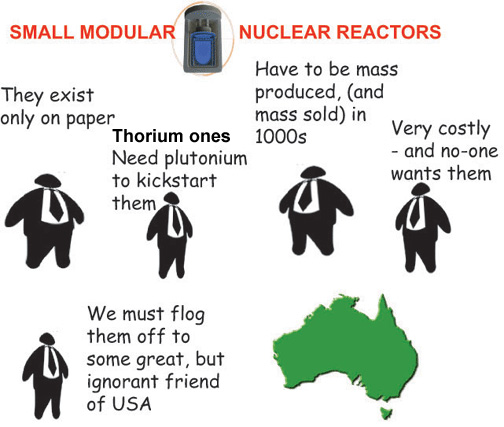
NuScale Power, which was developing small modular reactors at a US government-owned site in Idaho with plans to sell electricity to suppliers across the regional network by 2029, on Thursday said it had abandoned the project due to a lack of customer sign-ups.
The federal opposition, which wants Australia to overturn its longstanding ban on nuclear energy, claims small modular reactors – the next generation of nuclear power plants – are the only viable backup for renewable energy as the country transitions away from fossil fuels.
But Climate Change and Energy Minister Chris Bowen said NuScale’s announcement was further proof that small modular reactors were not viable for Australia.
“The opposition’s only energy policy is small modular reactors,” Bowen said. “Today, the most advanced prototype in the US has been cancelled. The [opposition’s] plan for energy security is just more hot air from Peter Dutton.”
NuScale’s small modular reactor design was the first to be approved by the US Nuclear Regulatory Commission in January. It was awarded more than $US1 billion ($1.56 billion) in government funding to support its development.
The company said in 2021 it would supply power from its small modular reactor plant for $US58 a megawatt hour. Since then, that figure has more than doubled to $US89 a megawatt hour.
Mason Baker, the chief executive of NuScale’s government-owned partner, Utah Associated Municipal Power Systems, said it was working with the company and the US Department of Energy to wind down the project.
“This decision is very disappointing given the years of pioneering hard work put into the [project],” Baker said.
Opposition Leader Peter Dutton has said small modular reactors could easily replace Australia’s coal-fired power plants.
“Australians must consider new nuclear technologies as part of the energy mix,” he said in July. “New nuclear technologies can be plugged into existing grids and work immediately.”
Opposition climate change and energy spokesman Ted O’Brien said in May that NuScale’s designs offered “exceptional flexibility” and would allow a “simple expansion” for Australia’s energy grid.
“North America has done the maths. It has mapped its course to a net-zero future, and it’s one that sensibly includes next-generation, zero-emissions nuclear energy.”
But recent Energy Department modelling found more than 70 small modular reactors, which are forecast to generate 300 megawatts each, would be needed to replace all of Australia’s coal plants at an estimated cost of $387 billion.
O’Brien said on Thursday that Bowen had applied “faulty logic” to NuScale’s announcement and if he applied the same test to renewables, they too would be considered a failure.
“Is Bowen arguing that wind power is dead because the world’s leading supplier, Siemens, is seeking a €15 billion government bailout, or the days of solar are over because plans for the world’s largest solar plant, Sun Cable, have run into trouble,” O’Brien said.
“If Australia is serious about reaching net-zero emissions by 2050 while keeping the lights on and getting prices down, we cannot afford to take any option off the table.”
Pacific Islands Forum – time to reinvigorate the Treaty of Rarotonga, the nuclear weapons-free pact ?
Pacific backs Australian climate policy: Albanese.
St George and Sutherland Shire Leader, Australian Associated Press 9 Nov 23
“…………………………………………………………………………………………………. Joining climate as one of the top issues at the gathering are nuclear concerns, with Pacific leaders showing their resolve to keep the region nuclear-free.
The Pacific is stridently nuclear-free, a legacy of the region’s painful history with testing of nuclear weapons by the United States, United Kingdom and France.
Australia’s AUKUS deal to obtain nuclear-powered submarines raises concern among many, given the sensitivity of nuclear issues.
Leaders in Kiribati, Tuvalu, Solomon Islands and Fiji have previously expressed reservations on different fronts, including the extravagant cost, which exceeds the entire annual GDP of PIF members excepting Australia and New Zealand.
PIF chair and Cook Islands Prime Minister Mark Brown has suggested the time could have come to “reinvigorate” the Treaty of Rarotonga, the nuclear weapons-free pact signed during the Cold War.
Mr Albanese was less forthcoming on whether reform was needed, declining to respond to questions on whether he supported Mr Brown’s calls.
“We support the Treaty of Rarotonga. It is a good document. It has stood the test of time, all of the arrangements that have been in place, we’ve been consistent with that, and it retains our support,” he said.
The legacy of another nuclear incident – the 2011 Fukushima power plant disaster – also hangs over the Pacific.
Japan is releasing treated wastewater from the power plant, insisting it is safe to do so, with an International Atomic Energy Agency report as proof.
Australia and New Zealand accept those guarantees, but a growing number of Pacific nations hold concerns, including Polynesian and Melanesian blocs.
At the PIF summit, Fiji Prime Minister Sitiveni Rabuka is championing another initiative: declaring the Pacific an “ocean of peace”.
That proposal, the nuclear concerns and the Suva Agreement regional unity pact are late inclusions onto the agenda of the leaders retreat. https://www.theleader.com.au/story/8417306/pacific-backs-australian-climate-policy-albanese/
First newly built nuclear-powered submarine under AUKUS likely to be sold in 2038, US admiral reveals
ABC, By defence correspondent Andrew Greene, 9 Nov 23
Australia will be sold its first new American nuclear-powered submarine in 2038, according to a senior US naval officer who has also revealed that initial sales of second-hand Virginia-class boats will likely take place in 2032 and 2035.
Key points:
- US Navy personnel have laid out when they think the first nuclear-powered submarines could be delivered to Australia
- The first newly constructed boat under the AUKUS deal is expected to be sold in 2038
- Second-hand Virginia class submarines could be sold in 2032 and 2035
During a separate media event in Sydney, the visiting commander of the US Pacific fleet also assured Australians that this country will maintain full sovereignty over the American technology when it eventually comes into service here.
Speaking in Washington, the US commander of submarine forces, Vice Admiral Bill Houston, provided a provisional timeline for transferring Virginia-class submarines to Australia under the AUKUS partnership.
According to US publication Breaking Defense, Vice Admiral Houston said planned US sales of “in-service submarines” to Australia are expected in 2032 and 2035, while the 2038 sale will be a newly constructed Block VII version of the Virginia-class.
The newly constructed Block VII submarine will not carry the Virginia Payload Module, the mid-body section equipped on certain boats in the fleet that increases its missile capacity.
Under the AUKUS agreement, the United States will sell at least three, and up to five, Virginia-class submarines in the 2030s, before the United Kingdom will then jointly construct a new SSN-AUKUS submarine fleet with Australia.
Defence Minister Richard Marles has not yet commented on the new details of the proposed “optimal pathway” for nuclear-powered submarines, but earlier this week he expressed optimism the project still enjoyed broad political support in the US.
“There is legislation which is going through the US Congress as we speak, legislation which goes to reducing the export control regime as it applies between Australia and America,” Mr Marles said on Tuesday.
“[It is] legislation which will enable the sale of the Virginias but importantly legislation which will enable the provision of the Australian contribution to the American industrial uplift,” he added.
US officials insist the annual production rate of Virginia-class submarines needs to increase from the current level of 1.2 vessels to well above 2 per year, before transfers to Australia can occur……………………………………………… https://www.abc.net.au/news/2023-11-09/aukus-submarine-sales-timelines-revealed/103083780
Small modular nuclear reactor that was hailed by Coalition as future cancelled due to rising costs

Opposition climate and energy spokesperson had pointed to SMRs as a solution to Australia’s energy needs, but experts raise questions over price tag.
Adam Morton, Guardian, 9 Nov 23
The only small modular nuclear power plant approved in the US – cited by the Australian opposition as evidence of a “burgeoning” global nuclear industry – has been cancelled due to rising costs.
NuScale Power announced on Wednesday that it had dropped plans to build a long-promised “carbon free power project” in Idaho. It blamed the decision on a lack of subscribers for the plant’s electricity.
The Coalition’s energy and climate spokesperson, Ted O’Brien, has cited NuScale’s technology as part of the opposition’s contentious argument that Australia should lift a national ban on nuclear energy and that small modular reactors (SMRs) could be an affordable replacement for its ageing coal-fired power plant
In an opinion piece in the Australian earlier this year, O’Brien said the company’s integrated reactors, starting with the Idaho plant in 2029, offered “exceptional flexibility” and were an example “of a burgeoning nuclear industry for next-generation technology” in the US.
The climate change minister, Chris Bowen, said SMRs were “the opposition’s only energy policy”.
“The most advanced prototype in the US has been cancelled. The LNP’s plan for energy security is just more hot air from Peter Dutton,” he said………………………………………………………………………………
Industry experts say SMRs are not commercially available, that nuclear energy is more expensive than alternatives and in a best-case scenario could not play a role in Australia for more than a decade, and probably not before 2040. The Australian Energy Market Operator found renewable energy could be providing 96% of the country’s electricity by that time.
The Coalition opposes Labor’s goal of reaching 82% renewable electricity by 2030. It has argued for a slower response to the climate crisis and amplified local concerns about new clean energy and electricity transmission connections.
The projected cost of the NuScale project had blown out from US$3.6bn for 720 megawatts in 2020 to US$9.3bn for 462MW last year. It failed after securing subscriptions for only 20% of the required capital from a Utah-based consortium of electricity companies.
Simon Holmes à Court, a clean energy advocate and commentator and convener of political fundraising body Climate 200, said the estimated capital cost of the Idaho project before it was cancelled was 70% higher than CSIRO projections of what nuclear power plants could cost to build in 2030.
He said this undermined arguments by the Coalition and other nuclear advocates, who had accused the CSIRO of exaggerating the likely cost of nuclear energy.
Holmes à Court said Australia needed a rapid rollout of solar, wind and energy storage. He recently toured nuclear power projects in the US.
“The simple fact is that commercial SMRs don’t exist. There are zero in operation or even contracted for construction outside Russia and China. The cancellation of one of the three leading proposals underscores the speculative nature of this far-off technology,” he said.
“More than two thirds of our coal generators will retire in the next decade due to age. By pushing a unicorn technology the Coalition is posing a threat to the cost and security of Australia’s electricity grid.” https://www.theguardian.com/australia-news/2023/nov/09/small-modular-nuclear-reactor-that-was-hailed-by-coalition-as-future-cancelled-due-to-rising-costs
—
Showboating for War: Johnson and Morrison in Israel
November 7, 2023, Dr Binoy Kampmark, https://theaimn.com/showboating-for-war-johnson-and-morrison-in-israel/
Banished Prime Ministers are an irritation. They clog the airwaves of punditry with their views about how things were and how things should be. But even there, degrees of severity and competence should be observed. The more noble sorts would pursue the goals of peace, even as they bag large wads of cash in stating the obvious. With former Australian Prime Minister Scott Morrison, and his disgraced counterpart from the UK, Boris Johnson, the cash is being forked out for war.
That Israeli authorities thought it suitable to invite these two men to bolster their war against Hamas shows a degree of deep desperation. Johnson, a serial rule breaker when it came to his own government’s pandemic regulations, was forced to resign as PM by his own Conservative party in June this year. He proved to be persistently and pathologically mendacious, a ragtag mix of contemptuousness and buffoonery.
Only Australia’s own Morrison could have possibly kept up, secretly commandeering, without knowledge of his own Cabinet, up to five different ministries in addition to his own. Despite losing the May 2022 election to Labor’s Anthony Albanese, he remains a sitting federal member, when not avidly think-tanking for anti-China causes and the US imperium.
As Gaza City is being systematically liquidated, pulverised, demolished and destroyed by Israeli firepower, these two men have decided to cheer matters on with their equivalent of pompoms and drums. The Israeli Defence Force needs all the help it can get in destroying any vestige of Palestinian political power in the small settlement, and history lessons are not what interests them. While Johnson is infinitely more informed about history than Morrison, both were united in their cheap showboating exercise.
Their Israeli hosts, assured that they would never be questioned, took the men to Kibbutz Kfar Aza, the place where 100 residents met their fate at the hands of the al-Qassam Brigade, the military wing of Hamas, on October 7. Here was a chance to compress and cleanse history, to give it that ethical clarity Morrison and Johnson always resisted as prime ministers. It was Johnson’s wish that the world would be able to see what had taken place “so people could be under no illusion about the savagery, the sadism, the lack of humanity of Hamas terrorists.”
That word, again: humanity. The humanity exorcised from any assessment of Palestinian worth, sovereignty, liberty. A humanity reserved for a certain type of privileged victimhood, one rarified in the cool atmosphere of exceptionalism known as God’s chosen people drawn from a document part fiction, part history. It follows that the retaliatory steps taken in prosecuting any response will be justified. “Of course,” Johnson emphasises, “it is right for Israel to take the necessary steps… to stop that happening again.”
On Channel 12 news, Johnson stressed the need to keep the moral compass steady and free of any regard for the Palestinians or their cause: “[S]ince that appalling massacre of October 7, you’re seeing a kind of fog descend, a moral fog, and I just want to remind people of the absolute barbarism of what took place and to make it clear that Israel has the right to defend itself.” With emphasis, he stated that, “There can be no moral equivalence between the terrorism of Hamas and the actions of the Israeli Defence Forces.”
When given the chance to talk about pursuing a ceasefire in the name of ecumenical grace, Johnson was curt. Think of those 240 hostages held by Hamas. “[W]hen you have a crime of this scale, and when there’s the possibility of it happening again, I don’t think it’s the business of the world to tell Israel to stop.” Forget international law, humanitarian restraint on the use of force, proportionate response, and conduct might just find itself within the margins of the tolerable.
Morrison, for his part, saw the trip as “an opportunity to understand firsthand what is occurring on the ground, honour those who have been lost, show support for those who have suffered and are now engaged in this terrible conflict and discuss how to move forward.” He also argued against a ceasefire, as this would only “advantage Hamas to be able to strengthen their positions and make this war go on for even longer”.
As for the matter of making sure the attacks of October 7 are never repeated, the point is all too obvious. It will keep happening again with dreary, bloody predictability. If not next year, then the next decade. Or generation. Eliminating Hamas will simply be a bloody pruning exercise verging on genocide, allowing fresh vegetation to thrive. The forest of vengeance will continue to grow; the thousands of children who survive will never forgive the IDF for what they have done and continue to do. Each dead family brings with it a family of converts for the Palestinian cause. Israel’s publicity relations wonks would be best advised to pay Johnson and Morrison and wish them on their merry way.
Targeting Gaza From US Spy Hub in Australia
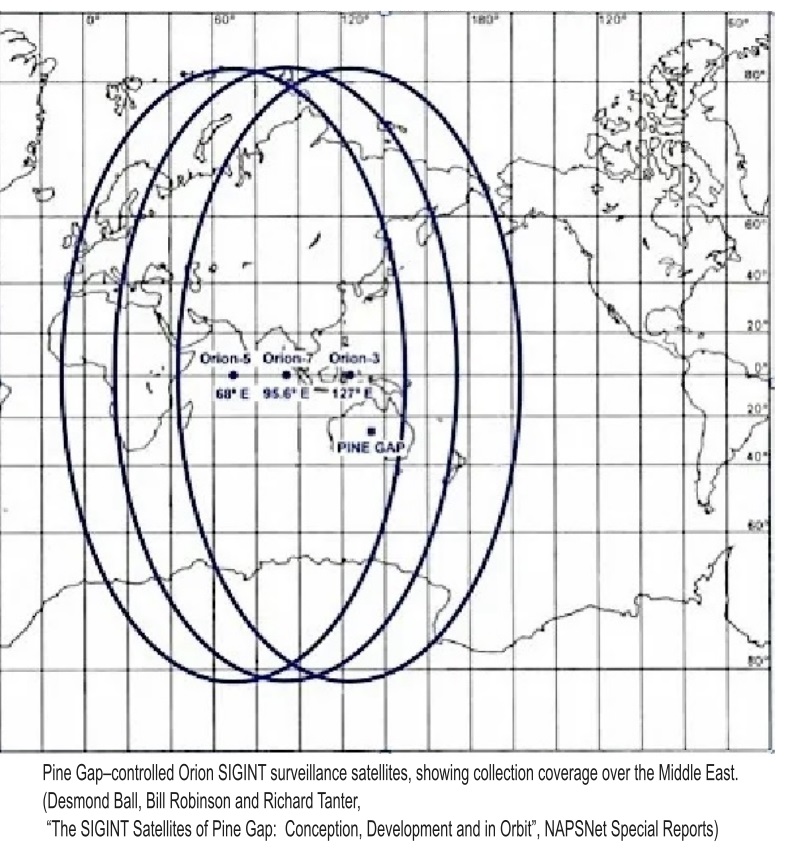
Peter Cronau reports on Canberra’s secret support for Israel’s brutal assault on Palestinians in Gaza through NSA intelligence satellites in the U.S. Pine Gap base near Alice Springs.
Peter Cronau, Declassified Australia https://consortiumnews.com/2023/11/03/targeting-gaza-from-us-spy-hub-in-australia/
The Pine Gap U.S. surveillance base located outside of Alice Springs in Australia is collecting an enormous range of communications and electronic intelligence from the brutal Gaza-Israel battlefield — and this data is being provided to the Israel Defence Forces.
Two large Orion geosynchronous signals intelligence satellites, belonging to the U.S. and operated from Pine Gap, are located 36,000 kms above the equator over the Indian Ocean. Frosxxxdxxxxxm there, they look down on the Middle East, Europe and Africa, and gather huge amounts of intelligence data to beam back to the Pine Gap base.xxxxxc
After collecting and analysing the communications and intelligence data for the U.S. National Security Agency (NSA), Pine Gap is providing it to the Israel Defence Forces, as it steps up its brutal assault on Palestinians in the Gaza enclave.
Pine Gap facility is monitoring the Gaza Strip and surrounding areas with all its resources, and gathering intelligence assessed to be useful to Israel,” a former Pine Gap employee has told Declassified Australia.
David Rosenberg worked inside Pine Gap as “team leader of weapon signals analysis” for 18 years until 2008. He is a 23-year veteran of the NSA.
“Pine Gap has satellites overhead. Every one of those assets would be on those locations, looking for anything that could help them.”
“Pine Gap facility is monitoring the Gaza Strip and surrounding areas with all its resources, and gathering intelligence assessed to be useful to Israel.”
Rosenberg says the personnel at Pine Gap are tasked with collecting signals such as “command and control” centres in Gaza, with Hamas headquarters often located near hospitals, schools and other civilian structures. “The aim would be to minimise casualties to non-combatants in achieving their objective of destroying Hamas.”
Since the Oct. 7 Hamas attack on Israel that killed over 1,400 Israelis, both military and civilian, the Israel Defence Forces has bombed hundreds of targets inside Gaza, killing far more than Hamas militants. An estimated 9,000 people so far have been killed, including most shockingly 3,600 children.
United Nations agencies have deplored the nearly four-week Israeli bombing campaign saying,
“Gaza has become a ‘graveyard’ for children with thousands now killed under Israeli bombardment, while more than a million face dire shortages of essentials and a lifetime of trauma ahead.”
Pine Gap’s Global Role
The sprawling satellite ground station outside Alice Springs, officially titled Joint Defence Facility Pine Gap (JDFPG), has been described as the United States’ second most important surveillance base globally.
About half the 800 personnel working at the Central Australian base are American, with Australian government employees making up fewer than 100 of the increasingly privatised staff.
The base is no mere passive communication collector. Personnel at the Pine Gap base provide vital detailed analysis and reporting on SIGINT (signals intelligence) and ELINT (electronic intelligence) it collects.
As well as surveillance of civilian, commercial and military communications, it provides detailed geolocation intelligence to the U.S. military that can be used to locate with precision targets in the battlefield.
This was first conclusively documented in a secret NSA document, titled “Site Profile,” leaked from the Edward Snowden archive to this writer and first published by ABC Australia in 2017:
“RAINFALL [Pine Gap’s NSA codename] detects, collects, records, processes, analyses and reports on PROFORMA signals collected from tasked target entities.”
These PROFORMA signals are the communications data of radar and weapon systems collected in near real-time — they likely would include remote launch signals for Hamas rockets, as well as any threatened missile launches from Lebanon or Iran.
“Pine Gap detects, collects, records, processes, analyses and reports on PROFORMA signals collected from tasked target entities.
This present war in Gaza is not the first time the dishes of Pine Gap have assisted Israel’s military with intelligence, including the detecting of incoming missiles, according to this previous report.
“During the [1991] Gulf War, Israeli reports praised Australia for relaying Scud missile launch warnings from the Nurrungar joint U.S.-Australian facility in South Australia, a task now assigned to Pine Gap.”
During the early stages of the 2003 U.S. invasion of Iraq, the NSA installed a data link to send early warning of any Iraqi missile launches detected directly to Israel’s Air Force headquarters at Tel Nof airbase, south of Tel Aviv.
Israel’s Access to ‘Five Eye’ Jewels
The NSA “maintains a far-reaching technical and analytic relationship with the Israeli SIGINT National Unit (ISNU),” according to documents published by The Intercept in 2014. The documents show the NSA and ISNU are “sharing information on access, intercept, targeting, language, analysis and reporting.”
“This SIGINT relationship has increasingly been the catalyst for a broader intelligence relationship between the United States and Israel.
“The Israeli side enjoys the benefits of expanded geographic access to world-class NSA cryptanalytic and SIGINT engineering expertise.”
It’s thanks to the Pine Gap base, with its satellites so strategically positioned to monitor the Middle East region, along with its targeting and analysis capability, that Israel is able to make use of these benefits.
Another leaked document, a targeting exchange agreement from the U.K.’s surveillance agency, GCHQ, reveals one of the “specific intelligence topics” shared among the NSA, GCHQ and ISNU was “Palestinians.” The document states that “due to the sensitivities” of Israeli involvement that particular program does not include direct targeting of Palestinians themselves.
The NSA considers their intelligence-sharing arrangement as being “beneficial to both NSA’s and ISNU’s mission and intelligence requirements.”
This wide intelligence sharing arrangement potentially opens up to the Israelis the “jewels” of the Five Eye global surveillance system collected by the NSA global surveillance network, including by Australia’s Pine Gap base.
Declassified Australia asked a series of questions of the Australian Defence Department about the role of the Pine Gap base in the Israel-Gaza war, and about the legal protections that may be in place to defend personnel of the base should legal charges of war crimes be laid. No response was received by deadline.
Peter Cronau is an award-winning investigative journalist, writer, and film-maker. His documentaries have appeared on ABC TV’s Four Corners and Radio National’s Background Briefing. He is an editor and cofounder of DECLASSIFIED AUSTRALIA. He is co-editor of the recent book A Secret Australia – Revealed by the WikiLeaks Exposés.
This article is from Declassified Australia.
1 This month
25 October – Film –Britain’s Nuclear Bomb Scandal: Our Story – part of the Adelaide Film Festival,
Screening and Conversation
A screening of Britain’s Nuclear Bomb Scandal: Our Story (2024) followed by a talk with 2026 Bettison and James Awardee and Tradtional Owner Karina Lester in conversation with Simone Tur.
When: Sun 25 Oct, 12:00pm-Screening, 1:15pm-Talk
Where: The Mercury
Free admission, register below by clicking on BUY TICKETS and select free event tickets, at end of web page:
https://www.adelaidefilmfestival.org/program/2026/britains-nuclear-bomb-scandal-our-story
.

Australians deserve the truth
about
AUKUS – https://aukuspublicinquiry.com/

PETITION – To: Prime Minister Anthony Albanese and the Australian Labor Government

of the week – Australians for War Powers Reform (AWPR)
To see nuclear-related stories in greater depth and intensity

