Coalition delivers the same old tired nuclear talking points at COP28

With a heavy sigh, Crikey once again delves into the most pointless ritual in Australian public policy — the nuclear energy ‘debate’.
CHARLIE LEWIS, DEC 11, 2023, https://www.crikey.com.au/2023/12/11/coalition-nuclear-energy-australia/
“Today I am happy to announce that a reelected Coalition government will, at its first COP after being returned to office, sign the nuclear pledge and return Australia to where it belongs, standing alongside its friends and allies,” opposition climate change and energy spokesman Ted O’Brien told world climate summit/increasingly dark joke at humanity’s expense COP28 on Saturday.
He pledged that a reelected Coalition government would triple nuclear energy output and overturn Australia’s nuclear energy moratorium, insisting “no nuclear, no net zero”.
And so, with a heavy sigh, Crikey once again delves into what our politics editor Bernard Keane has described as “the single most boring and ossified ritual in Australian public policy”.
A ‘sensible’ debate
It always starts with a demand for a “sensible” debate around the topic. Going back to John Howard’s years as prime minister (he called for this not once but twice) and to pick a handful of examples since: Then-foreign minister Julie Bishop in 2014, the then-assistant science minister Karen Andrews in 2015 and then-candidate Warren Mundine in 2019. Just last week, troublemaking former Labor minister Joel Fitzgibbon called on the Albanese government to end the ban on nuclear energy. This is not to mention a swathe of conservative media figures adding their voices to the choir over the years.
With dreary inevitability, Opposition Leader Peter Dutton reached for the old hymn book in his budget reply this year, arguing (all together now): “Any sensible government must consider small modular nuclear as part of the energy mix.”
Time is money and also money is money
As we’ve long reported — long, long reported — there are several barriers to nuclear power in Australia, primarily that the whole thing is incredibly expensive because Australia doesn’t have any nuclear infrastructure. As clean energy investor and man with a zeal for the teal Simon Holmes à Court, who was at O’Brien’s address, puts it, “it is a pretty easy pledge to sign because three times zero is zero”.
Nuclear power plants take a very long time to build — as Australia’s former chief scientist Alan Finkel told the Nine papers in August, it’s highly unlikely Australia could open a nuclear power plant before the early 2040s, a delay the country can ill afford if it is to dramatically reduce emissions as quickly as it needs to.
On top of this is the eye-watering price. According to research from the Department of Climate Change and Energy released in September this year, the cost of replacing coalmine sites with small nuclear reactors would be $387 billion.
Even former chair of the Australian Nuclear Science and Technology Organisation Dr Ziggy Switkowski, who undertook a review on the viability of nuclear power for the Howard government in 2007 and is a very big fan of nuclear energy, conceded in 2018 “the window for gigawatt-scale nuclear has closed”:
With requirements for baseload capacity reducing, adding nuclear capacity one gigawatt at a time is hard to justify, especially as costs are now very high (in the range of $5 billion to $10 billion), development timelines are 15+ years, and solar with battery storage are winning the race.
The tax that is not to be named
There is and always has been only one way, in the eyes of Australia’s most credible nuclear spruikers, for nuclear energy to compete with existing energy sources: impose a carbon price.
Switkowski’s 2007 review probably didn’t greatly please Howard, given it found that nuclear became viable compared with coal and gas only if there was a carbon price. Economist and Crikey contributor John Quiggin has also previously argued in favour of nuclear energy in Australia only if it is backed by a carbon price.
Labor’s new AUKUS bill declares Osborne in SA, Stirling in WA as nuclear zones.
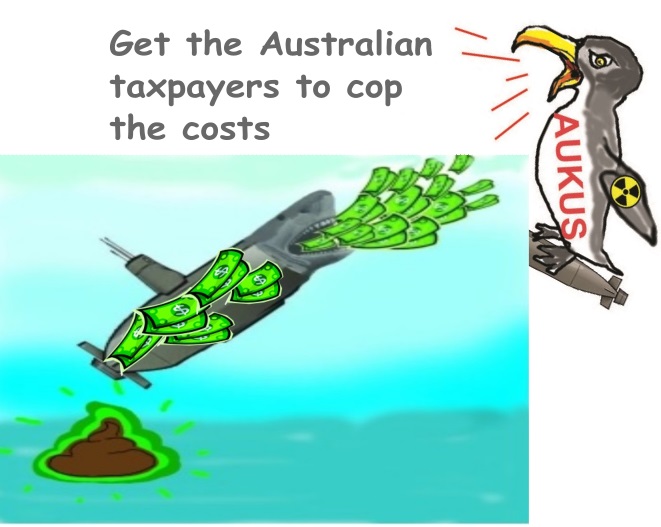
AUKUS’ claims of “nuclear stewardship” with US nuclear submarines and retaining the US origin high-level nuclear wastes are a farce.
The US has been unable to dispose of its own high-level wastes.
David Noonan, Kaurna Yerta/Adelaide, December 12, 2023, Issue 1396 https://www.greenleft.org.au/content/labors-new-aukus-bill-declares-osborne-sa-stirling-wa-nuclear-zones
Labor introduced a bill on November 16, which cites Osborne as the first designated zone for the AUKUS nuclear-powered submarines.
The Australian Naval Nuclear Power Safety (Transitional Provisions) Bill 2023 allows for naval nuclear reactors at Port Adelaide under a new “Australian Naval Nuclear Power Safety Regulator”. That entity is to report directly to Minister for Defence Richard Marles.
Nuclear submarines have never used this port.
Alarmingly, Section 132 of the bill over-rides the Australian Radiation Protection and Nuclear Safety Act 1998 and the military regulator is given powers over the civilian Nuclear Safety Agency ARPANSA.
The Medical Association for Prevention of War has sounded the alarm. “Naval nuclear reactors — like all nuclear reactors — pose potentially serious risks for people and the environment. But unlike other reactors, most information about naval reactors is kept classified, and it can be difficult to say how safe they are.

Marles told parliament he will hold the power to direct the military nuclear regulator during a “national security” emergency.
Stirling Naval Base, near Fremantle in Western Australia, is the second nuclear zone to be declared in this bill.
The South Australian and Port Adelaide communities have the right to have a say on nuclear safety and the risks in bringing naval nuclear reactors into the port.
Key public interest questions are yet to be answered.
They include: Will communities be consulted on accident response plans? What is the existing radiation emergency capability in current and proposed nuclear sub port sites? Will local health and medical services be consulted? How will communities be properly informed about the risks of naval nuclear reactors? How will safety issues be monitored and communicated? How will the public interest in safety issues be protected? When will accident scenarios for nuclear subs at base be modelled and made public? How can the public verify the quality of emergency management plans and systems? How can authorities demonstrate their capacity to respond to radiation emergencies, and other accident scenarios?
The bill has now gone to a Senate Foreign Affairs, Defence and Trade Legislation Committee inquiry, which is open for public submissions and is due to report next April.
The bill proposes to override state laws.
Section 135, “Operation of State and Territory laws”, states: “If a law of a State or Territory, or one or more provisions of such a law, is prescribed by the regulations, that law or provision does not apply in relation to a regulated activity.”
The bill provides for regulated activities in “nuclear waste management, storage and disposal” at AUKUS facilities in future nuclear zones, to be authorised under Section 135.
According to media reports in August, the Woomera rocket range is understood to be the “favoured location” for the storage and disposal of submarine nuclear waste.
If the federal government wants to locate an AUKUS nuclear waste dump in South Australia, it will have to over-ride existing law to impose this.
This AUKUS bill is a threat to the people of SA. AUKUS locks Australia into buying existing US military nuclear reactors in second-hand 10-12 year old submarines, loaded with intractable US-origin weapons grade high-level nuclear wastes.
US Vice Admiral Bill Houston has said in-service Virginia class submarines would be sold in 2032 and 2035 and a newly-produced submarine in 2038.
AUKUS’ claims of “nuclear stewardship” with US nuclear submarines and retaining the US origin high-level nuclear wastes are a farce. The US has been unable to dispose of its own high-level wastes.
Marles said in March there would be an AUKUS announcement by early 2024 on a process to manage high-level nuclear waste and to site a waste disposal facility.
The storage and disposal of nuclear wastes compromises the safety and welfare of the people of SA. That is why it is prohibited by the state’s Nuclear Waste Storage (Prohibition) Act 2000.
This law covers public interest issues, including health, safety and welfare as well as “to protect the environment in which they live by prohibiting the establishment of certain nuclear waste storage facilities in this State”.
The import, transport, storage and disposal of high-level nuclear reactor waste is prohibited in SA.
This AUKUS bill must be challenged. The SA Premier is yet to say if he will support an Indigenous right to say “No” to an AUKUS dump. South Australians have a right to decide their own future and to say “No”.
[Dave Noonan is a long-term anti-nuclear campaigner. For more information see the Medical Association for Prevention of War’s Safety Brief. Contact the Committee Secretariat on 02 6277 3535 or email fadt.sen@aph.gov.au. Upload your submission here.]
Liberal Coalition’s strategy – support fossil fuels by delaying renewables and pushing for nuclear energy

they’ve come up with the perfect strategy to ensure no climate action is taken – advocate the bypassing of renewables in favour of small nuclear modular reactors.
It’s the old strategy of “why put off until tomorrow what you can put off forever”?
Or, as Malcolm Turnbull put it at the COP28 meeting: “Nuclear’s only utility is as … a means of supporting fossil fuels by delaying and distracting the rollout of renewables”.
Energy transition needs gas not nuclear, https://www.afr.com/policy/energy-and-climate/energy-transition-needs-gas-not-nuclear-20231203-p5eola 11 Dec 23, Craig Emerson, Former Labor minister and economist
A rational decarbonising energy policy offers a middle path between the absolutists and the denialists.
A civilisation is in decline when logical thinking and evidence-based policy are angrily dismissed in favour of tribal dogma. Western civilisation is lurching in this dangerous direction. Bravery is needed from those who remain capable of rational thought.
A prime contemporary example is the energy transition. Arguing about the energy transition are the absolutists and the denialists.
The absolutists demand that Australia open no new coal mines or gas fields. They require the governments of poor countries to shut their coal-fired power stations forthwith, despite no affordable alternative source of electricity being available.
In these countries, solar and wind power can play a role in electricity generation, but not totally and immediately. Renewable generation requires firming capacity in the nights and evenings, which can be provided by gas generators.
In fact, gas peaking and standby can hasten the closure of coal-fired power stations, which is desirable for the planet. But the neocolonial absolutists demand gas be excluded from the energy mix in poor countries.
The absolutists also oppose carbon capture and storage as a matter of dogma. The same goes for carbon offsets, regardless of their integrity.
Gas is also used to produce synthetic fibres; the kind Absolutists like to wear in preference to thirsty cotton and the wool of methane-emitting sheep.
Coking coal is used to produce steel. Absolutists oppose new coking coal mines. People in poor countries are not to have access to steel products, the type that rich-country absolutists use every day.
Denialists, on the other hand, such as former prime minister Tony Abbott, speak of the global warming hoax and describe believers in climate change as members of a cult. Denialists believe that not just absolutists are involved in this conspiracy against the western way of life, but so too are the United Nations, the NASA space agency and the world’s bureaus of meteorology.
Denialists have learned not to speak so loudly of these alleged hoaxes, cults and conspiracies, operating on the assumption that most voters under the age of 40 have been brainwashed into believing climate change is real and will cast their votes accordingly.
To address this electoral quandary, they’ve come up with the perfect strategy to ensure no climate action is taken – advocate the bypassing of renewables in favour of small nuclear modular reactors.
With cost blowouts precipitating the recent collapse of a flagship US project working on a small modular reactor, the prospects of this technology supplying electricity at competitive prices are highly questionable.
In any event, former NSW treasurer Matt Kean, though favourably disposed to small nuclear modular reactors, has pointed out that none would be ready for commercial deployment before 2040.
By that time, Australia’s fleet of ageing coal-fired power stations will be clapped out.
The Peter Dutton-led opposition voted against the Albanese government’s safeguard mechanism, the latest attempt to put a price on carbon for major emitters, despite the Business Council of Australia calling it “a very good policy”.
In an effort to continue the debilitating climate wars that have been raging for more than a decade, Dutton labelled the safeguard mechanism a “carbon tax 2.0”.
With no emissions-reduction strategy, plenty of hostility towards renewables and a promise of small modular reactors from 2040 at the earliest, the denialists have only one remaining option – to use taxpayers’ money to fund the construction of new coal-fired power stations. The private sector certainly won’t risk it.
It’s the old strategy of “why put off until tomorrow what you can put off forever”?
Or, as Malcolm Turnbull put it at the COP28 meeting: “Nuclear’s only utility is as … a means of supporting fossil fuels by delaying and distracting the rollout of renewables”.
There is a middle path between the absolutists and the denialists.
A rational decarbonising energy policy would include the legislated safeguard mechanism, solar and wind energy, and – for firming capacity – the use of gas, big batteries and, where economically viable, pumped hydro.
Where gas producers can make carbon capture and storage feasible, they should be encouraged to do so. Trading in high-integrity carbon offsets should be part of the solution, especially for countries that lack viable renewable energy resources.
In various combinations, these features of a rational climate policy have been adopted by the Rudd, Gillard, Turnbull and Albanese governments. They were opposed by the Abbott government and, largely, by the Dutton-led Coalition.
Between them, absolutists and denialists would oppose most – if not all – of these sensible features.
Finding a demilitarised zone between these warring tribes is as elusive as it was when the Senate voted down a carbon price 14 years ago. Yet, it seems that most of the voting public feels the policy approach now being taken by federal and state governments lies along that narrow path.
The lesson from this story is to let warring tribes slug it out and get on with sound policy in the national interest.
Going nuclear would be a costly mistake
Graeme Lechte, The Age, 12 Dec 23
The article ″Coalition MP talks up triple nuclear option at climate summit″ (11/12) raises disturbing issues in regard to Australia’s future energy production and our pathway to net zero. A group of Coalition MPs have backed a pledge to increase nuclear energy output and overturn the current policy of no nuclear energy in Australia. If the Coalition is returned, its energy policy will flip the focus from renewables to nuclear. After all the hard work and investment to establish a secure power system based around renewables, under a Coalition government, renewables would play second fiddle to establishing an expensive nuclear industry that would take at least 10 years to come on line. Aside from the safety issues and emissions from mining uranium, this policy would see renewables sidelined and the path to net zero become a confusion of opposing strategies.
Labor’s attempts to base our energy supply around renewables would be in tatters under a future Coalition government and our path to net zero even more difficult – not to mention the huge costs associated with establishing a fledgling nuclear industry.
Ted O’Brien’s nuclear love-in at COP28 gets a brutal reality check.

Ed note. I was pretty surprised that Rafael Grossi who usually downplays all the risks of nuclear (safety, terrorism, weapons proliferation, wastes) went so far as to claim that nuclear is not even a financial risk !
Jim Green 11 December 2023, https://reneweconomy.com.au/ted-obriens-nuclear-love-in-at-cop28-gets-a-brutal-reality-check/—
The nuclear lobby has been out in force at the COP28 climate conference in Dubai. Their main initiative was a ‘declaration’ promoting a “global aspirational goal of tripling nuclear energy capacity from 2020 by 2050”, signed by 22 countries and supported by 120 companies.
The 22 countries are Bulgaria, Canada, the Czech Republic, Finland, France, Ghana, Hungary, Japan, South Korea, Moldova, Mongolia, Morocco, the Netherlands, Poland, Romania, Slovakia, Slovenia, Sweden, Ukraine, the UAE, the UK and the USA.
David Appleyard, editor of Nuclear Engineering International, did the math: “Now 2050 still sounds like a long way off, but to triple nuclear capacity in this time frame would require nuclear deployment to average 40 GW [gigawatts] a year over the next two and half decades. The cruel reality is that’s more than six times the rate that has been seen over the last decade.”
A dominant feature in the declaration — and all the nuclear lobbying surrounding COP28 — is the perceived need to find new methods of financing nuclear plants. In the words of the declaration, participants “commit to mobilize investments in nuclear power, including through innovative financing mechanisms”.
Nuclear power as a commercial venture is very nearly dead, and thus the participants “invite shareholders of the World Bank, international financial institutions, and regional development banks to encourage the inclusion of nuclear energy in their organizations’ energy lending policies”.
In a parallel initiative announced during COP28, the US plans to “jump start” the development of small modular reactor (SMR) exports despite the recent collapse of NuScale Power’s flagship project in Idaho. The US Export-Import Bank has approved a resolution to fund applications for the export of US SMR systems and components.
International Atomic Energy Agency director-general Rafael Grossi recently said — apparently without irony — that international financial institutions, development banks and private banks and investors should take a fresh look at the “winning” investment of financing new nuclear power plants.
In fact, US giant Westinghouse declared bankruptcy in 2017 following its disastrous reactor construction projects in South Carolina and Georgia; the British nuclear power industry went bankrupt years ago and was sold to the French, then the French nuclear industry went bankrupt and has been fully nationalised; South Korean utility KEPCO’s debt has climbed to A$224 billion; the Japanese nuclear industry is essentially a pile of ashes in the aftermath of the Fukushima disaster; and so on.
Ted O’Brien says a bunch of silly things
The federal Coalition’s shadow energy minister Ted O’Brien was the lead speaker at a forum on the sidelines of COP28 titled ‘Australia’s Nuclear Energy Potential: Joining the Global Journey’.
The forum also heard from representatives of the (so-called) Coalition for Conservation (which flew seven Liberal and National MPs to the summit), the World Nuclear Association, Emirates Nuclear Energy Corporation, the US Nuclear Industry Council; and an Italian SMR start-up called Newcleo.
O’Brien said that a Coalition government would sign the 22-nation declaration with its aspirational goal of tripling nuclear power capacity by 2050.
The Labor government last week joined more than 120 countries in backing a pledge to triple renewable energy and double the rate of energy efficiency by 2030 — a pledge opposed by the Coalition. O’Brien reiterated the Coalition’s opposition to the Labor government’s target of 82 per cent renewable power supply by 2030.
Speaking to The Guardian, former NSW treasurer Matt Kean said “obviously nuclear is a long way away” and Australia should back renewable energy now: “Who knows what might be available in another 20 years — we may have flying cars in 20 years — but that doesn’t mean you base your whole transport around it.”
O’Brien told the COP sideline forum that Australia’s legislation banning nuclear power is “bizarre”. That would be the legislation introduced by John Howard’s Coalition government and left untouched by the Abbott, Turnbull and Morrison Coalition governments over nearly a decade.
O’Brien said Australia’s track record on renewables is something to be “enormously proud of” without noting the Coalition’s decades-long efforts to slow the growth of renewables and to promote fossil fuel power generators.
He failed to mention that fellow Queenslander and Nationals leader David Littleproud recently said he wants a “pause” to the roll out of wind and solar and transmission links and a stop to the “reckless pursuit” of the government’s 82 percent renewables target by 2030.
O’Brien showed a photo of his children, whose existence apparently demonstrates his commitment to a low-carbon, environmentally sustainable future. In case anyone thought he was serious, he said that Australia needs more gas-fired power generation.
O’Brien said nuclear power is one of the fastest ways to decarbonise; that nuclear waste is “so miniscule”; that Australia should develop “capabilities in other areas of the nuclear fuel cycle”; that the Coalition was not interested in old nuclear but rather Generation 3+ (i.e. mostly non-existent) nuclear power; and that COP28 will be remembered as the “nuclear COP”.
World Nuclear Industry Status Report
The December 6 release of the World Nuclear Industry Status Report (WNISR) provided a welcome relief to all the nuclear nonsense at COP28, including O’Brien’s. For over 30 years, these annual reports have provided factual information that irritates the nuclear industry no end.
Continue readingAustralia’s nuclear brawl spills over into Dubai climate summit
AFR, Hans van Leeuwen 10 Dec 23
Mr Holmes à Court, convener of Climate 200, told Nine journalists that tripling nuclear energy was “a pretty easy pledge to sign onto, because three times zero is zero”.
Dubai | Australia’s domestic debate over nuclear energy has spilled over into the COP28 climate summit in Dubai, as the opposition set out its stall and drew flak both from the government and Liberal Party dissenters.
Opposition climate change and energy spokesman Ted O’Brien is leading a delegation of Liberal and National parliamentarians to COP28 for a five-day visit focused heavily on promoting nuclear energy as a future part of Australia’s energy mix.
He vowed that in government the Coalition would join a 22-country partnership pledging to triple nuclear energy capacity by 2050, which was inked during COP28. And he expanded his party’s nuclear vision to include potential grid-scale reactors in NSW’s Hunter region and other ex-coalmining areas.
But Climate Change and Energy Minister Chris Bowen launched a blistering broadside against his opponents, describing the nuclear policy as “a pipe dream”. And senior Liberal figures at COP28, including former prime minister Malcolm Turnbull and former NSW treasurer Matt Kean, questioned the policy………………
The debate broke out into the open after Mr O’Brien appeared on a COP28 panel entitled “Australia’s nuclear energy potential: Joining the global journey”.
“COP28 will be known as the nuclear COP,” he said. He described the Coalition’s policy as an “all of the above” plan, involving renewables, coal, gas and nuclear………………..
On nuclear, Mr O’Brien envisioned a role not just for small modular reactors that can be used for mines, city-level power or industrial processes, but for big reactors to firm up renewable electricity’s intermittent, variable feed into the grid.
“When it comes to nuclear technologies, we are looking at all-of-the-above for generation three-plus and beyond. So that is micro reactors, that is small reactors, that is large reactors,” he said.
Mr Bowen responded that at COP28, “nuclear energy is not involved in the multilateral conversations”.
“When I meet with counterparts, even those who are nuclear countries, they say ‘if I had your renewables, your renewable potential, I wouldn’t go down the nuclear road’,” he said. “It’s a pipe dream wrapped in a fantasy accompanied by an illusion … and I don’t have time for distractions.”……………
Mr O’Brien’s former boss, Mr Turnbull, told the Financial Review he was sceptical.
“I don’t have a problem with lifting the legislative ban on nuclear generation. But unless somebody genuinely shows a strong commitment to building it, why would you set up the whole nuclear regulation infrastructure you would need?” he said.
“The test on nukes is this: who is going to finance it or build it? Where are the energy companies demanding the right to do it? They don’t exist.”
Mr Kean said he was open to small modular reactors, but the technology would not be available until almost the 2040s.
“Just as you wouldn’t base your entire transport strategy around flying cars, nor should you base your entire energy policy around technology that won’t be available for at least 15 years,” he told the Financial Review.
“We need to get on with the job of modernising our electricity system now. And that means deploying technology that we know works, and can help lower household bills – that’s renewables backed up by household storage.”……………………………………
Mr Holmes à Court, convener of Climate 200, told Nine journalists that tripling nuclear energy was “a pretty easy pledge to sign onto, because three times zero is zero”………………….. https://www.afr.com/policy/energy-and-climate/australia-s-nuclear-brawl-spills-over-into-dubai-climate-summit-20231210-p5eqbq
Inside the Coalition’s nuclear crusade at COP28
Opposition climate change and energy spokesman Ted O’Brien brought half a dozen other Liberal and National parliamentarians to COP28 in Dubai. What were they doing there?
AFR , 10 Dec 23
……………………………………Ted O’Brien has been talking about nuclear non-stop in Dubai for two days, and has several more days to go – including a whistle-stop tour of one of the United Arab Emirates’ four nuclear reactors.
Many of his meetings are with nuclear engineers, entrepreneurs and assorted experts, who are gathered in and around COP28 in force despite nuclear not having much prominence on the formal agenda………………………….
The delegation includes opposition trade spokesman Kevin Hogan, senators Perin Davey, Bridget McKenzie, Andrew Bragg and Dean Smith, and MP David Gillespie. They have met conservative politicians from the US, Britain and Scandinavia, and are engaging in a daily marathon of panel debates and networking events.

………….. the outfit behind his trip, Coalition for Conservation, held a public session on whether Australia should go nuclear, alongside a group of nuclear executives and lobbyists. O’Brien’s impassioned speech included PowerPoint pictures of his kids, and of a literal fork in the road.
O’Brien has been walking into nuclear’s embrace for most of his seven years as a federal parliamentarian. But it is now nothing short of a bear hug…………………………………….
Climate Change and Energy Minister Chris Bowen says nuclear is too expensive, and it is unnecessary. Even if it was a good baseload option for the grid, he says, it won’t arrive in time to make a difference.
Other sceptics at COP28 – teal financier Simon Holmes a Court, former prime minister Malcolm Turnbull, and former NSW Liberal treasurer Matt Kean – all make the same point.
“You won’t be able to get those [reactors] built, let alone the workforce to run then, for 20 years. But we don’t have 20 years because coal is running out in 10,” Kean says.
By 2035, the only coal-fired power plant left in NSW will be Mt Piper, he says, which runs out in 2040. “If you’re waiting for a solution that won’t be ready for 20 years, that’s just a recipe for blackouts.”
Holmes a Court makes a similar point about small modular reactors, which could be used to power factories, industrial parks, towns or remote communities.
“We could throw a trillion dollars at SMRs today, and they still wouldn’t be operating in the time that we need the energy to replace the coal power stations that have reached end of life,” he tells reporters after watching O’Brien speak.
“It’s lovely to talk about being technology-agnostic, but the nuclear technology that would be applicable to Australia simply does not exist yet.”
………………………………………. Turnbull and Bowen both can’t see any clamour from the industry, saying there is no evidence of energy companies wanting to launch the sector in Australia. Again, though, O’Brien got a gee-up from COP28.
………………………..Turnbull, meanwhile, makes a broader point that nuclear can’t be used to “firm” renewables – that is, switch on and provide back-up power when it isn’t sunny or windy – because reactors have to run constantly rather than flex to support solar or wind.
……………………………………………https://www.afr.com/policy/energy-and-climate/inside-the-coalition-s-nuclear-crusade-at-cop28-20231210-p5eqbt
Indonesia ratifies nuclear weapons ban treaty. Australia should too.
MARIANNE HANSON, https://www.lowyinstitute.org/the-interpreter/indonesia-ratifies-nuclear-weapons-ban-treaty-australia-should-too
Why does the government remain at odds with the vast majority of its neighbours?
Indonesia’s parliament last month agreed to ratify the United Nations Treaty on the Prohibition of Nuclear Weapons (TPNW). This is an important political development, and it deserves attention – across the region and in Australia. The approval of ratification was done very symbolically, just ahead of the second meeting of States Parties of the TPNW at the United Nations, held last week. The meeting at UN headquarters in New York was attended by most of the TPNW’s 69 parties, as well as by representatives from 35 non-parties, including Australia as well as NATO members Belgium, Norway and Germany.
Indonesia will soon deposit its instrument of ratification at the UN, formally becoming a state party. By ratifying the TPNW, Indonesia is making it clear that it rejects the most destructive of all weapons of mass destruction, nuclear weapons. That is good news. It’s a recognition that there are still around 12,500 nuclear weapons in existence, many of them vastly more destructive than the Hiroshima bomb, and a reminder that the world still lives under the very real – indeed growing – threat of complete annihilation.
Indonesia is a leading member of the Association of Southeast Asian Nations, a grouping which, decades ago, made its stance against nuclear weapons clear by creating the Southeast Asian Nuclear Weapon Free Zone (SEANWFZ). Nine of the ten ASEAN members have signed or ratified the TPNW (as has ASEAN observer Timor-Leste), but Indonesia’s ratification is especially important because it signals a clear commitment by one of the world’s largest states to work towards the global elimination of these inhumane weapons.
Indonesia is also a founding member of the 120 nation Non-Aligned Movement, a grouping which marshals considerable collective diplomatic clout on the international stage. For the great majority of non-aligned states, nuclear weapons are seen not just as weapons of horrific destruction, but also as instruments of continuing domination and exploitation. Many formerly colonised states are asking the large and powerful countries to listen to them and to consider their security preferences. They have a point: nuclear weapon states effectively hold the entire world to ransom.
Indonesia’s ratification should make Australians ask why its government remains at odds with the vast majority of its neighbours. Most of the South Pacific states, Southeast Asia, and New Zealand clearly oppose the threat of nuclear weapons. The TPNW makes these inhumane weapons illegal, as other treaties do for biological and chemical weapons, landmines, and cluster munitions.
Prime Minister Anthony Albanese has supported the TPNW, stating that “nuclear weapons are the most destructive, inhumane, and indiscriminate weapons ever created”, and that “the struggle for nuclear disarmament is the most important struggle for the human race”. Labor’s national policy platform, repeated in August this year, commits Australia to signing and ratifying the TPNW. But the government is yet to do so, leaving Australia now out of step with its largest neighbour and the region more broadly.
The AUKUS arrangement with the US and the UK signals a faith in the old-fashioned militarism of the Anglosphere more than the promising dynamics and peaceful potential of the region. Indonesia, Malaysia, and other states expressed concern about Australia’s plan to acquire nuclear-powered submarines. Proceeding with AUKUS makes it even more important that Australia credibly reassure the world it has no intention of acquiring nuclear weapons. Signing the TPNW would make that commitment concrete.
Clearly there has been pressure from the United States on Canberra not to sign. But fears of endangering the ANZUS alliance are overblown; Washington will be displeased when Australia signs the TPNW, but Canberra can remain an invaluable (conventional weapons) partner for the United States in the Asia-Pacific region. Signing the TPNW does not void the ANZUS alliance, nor does it mean Australia cannot proceed with AUKUS, although this pact would have to be managed carefully.
Several US allies have already signed the TPNW and even some NATO states have explored the option of joining. Australia can take a principled stand. Nuclear weapons are immoral and threaten the existence of everyone, the environment and life on Earth.
And a closer alignment by Canberra with the views of Australia’s region will be important.
Indonesia has a population of around 280 million people and is a secular democratic country with a Muslim-majority population, the largest in the world. Its economic growth is strong, with predictions that it will be among the top five world economies within a few decades. It has a growing middle-class, with an overwhelmingly young population (a quarter are aged under 14). Indonesia is a vibrant and vital part of Australia’s local geography and will become an increasingly important trading partner. All this suggests that Canberra should be paying more attention to the security wishes of its near neighbours. By signing the TPNW, Australia will be on the right side of history and be more in sync with its region.
Indonesia and other Asia-Pacific neighbours are showing the way. It’s time to work towards a common future with them, not a future blighted by the danger of nuclear annihilation.
Radiation leaked from cancer treatment room at Monash Medical Centre in Melbourne, documents reveal
ABC By Danny Tran,8 Dec 23
- In short: Monash Medical Centre discovered a cancer treatment room did not have adequate shielding to prevent radiation exposure to staff
- It self-reported to the Victorian health department, which told the hospital it had provided misleading information about the thickness of the concrete slabs separating the building’s floors
- What’s next? A doctor has raised concerns about radiation risk to hospital staff, however the health department says radiation levels are too low to be of concern
……………………………………………………………………………………………more https://www.abc.net.au/news/2023-12-08/monash-medical-centre-radiation-leak-cancer-treatment-room/103201728
Australian government funding Adelaide University to train students for a nuclear-powered defence-force
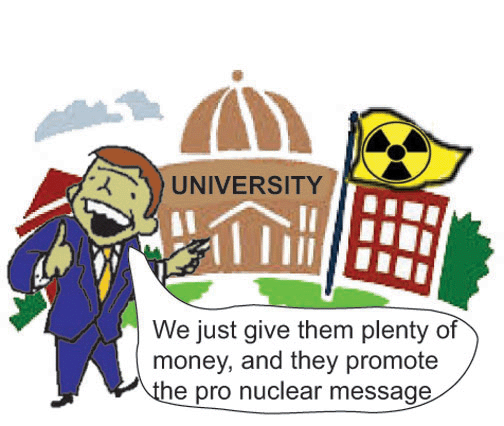
Undergraduate funding to support nuclear-powered industry
5 December 2023, https://www.australiandefence.com.au/news/news/undergraduate-funding-to-support-nuclear-powered-industry
The University of Adelaide announced on 29 November that it has received Federal Government commitment to fund the training of hundreds more domestic undergraduate students to join the future defence workforce.
Under the Federal Government’s Nuclear-Powered Submarines (NPS) program the University of Adelaide has received an allocation of $38,634,835 between 2024 and 2030 to deliver an additional 700 Commonwealth Supported Places (CSPs).
“The University of Adelaide is pleased to receive this commitment of funding from the Federal Government to help train the defence workforce of the future,” said Professor Peter Høj AC, Vice-Chancellor and President, the University of Adelaide.
“This is a massive endorsement of the University’s capability to support the Australian Government’s plans to become a nuclear-powered defence-force under the AUKUS program.
“The University will lead developments in defence-related education as well as invest in research and research infrastructure to support the training of the best and brightest minds.”
The University of Adelaide received the largest number of places allocated to any university under this announcement. The 700 additional places at the University of Adelaide will deliver more graduates from STEM disciplines.
The Commonwealth and South Australian Government will also be funding schemes that will support eligible students to take up these new opportunities. These schemes include degree apprenticeships and scholarships, announced recently as part of the South Australian Defence Industry Workforce and Skills Action Plan
Australia’s AUKUS nuclear submarines could fuel regional arms race despite assurance
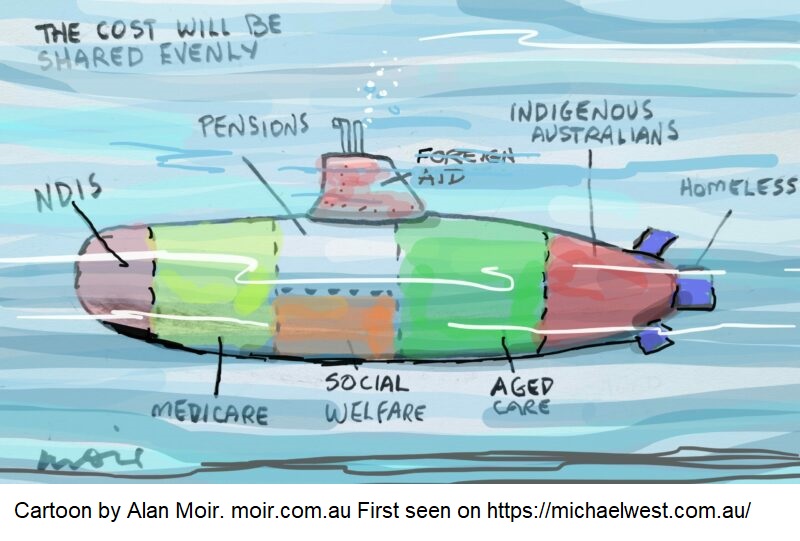
“AUKUS is designed to shore up American power in East Asia, not de-escalate tensions,”
By Su-Lin TanDec 4, 2023, https://johnmenadue.com/australias-aukus-nuclear-submarines-could-fuel-regional-arms-race-despite-assurance/
Defence Industry Minister Pat Conroy says Australia is not worsening the arms race and gives assurance about the submarines’ nuclear reactors. The deal could still spark a defence build-up in Asia-Pacific while Australia lacks the facilities to deal with nuclear waste, analysts say.
Australia may have asserted that its acquisition of nuclear-powered submarines under AUKUS is not aggravating the “arms race”, but the deal and the three-nation alliance could still fuel a defence build-up in the Asia-Pacific and heighten regional tensions, security analysts say.
At the national press club in Canberra on Tuesday, Australian Defence Industry Minister Pat Conroy reiterated the importance of the submarines to the country’s defence while debunking “myths” about the trilateral deal struck with Britain and the United States, which is largely seen as a countermeasure targeting China.
“The arms race is the greatest it’s been since 1945, and that is why I reject assertions … that Australia is somehow fuelling that arms race,” he said, adding that rising tensions in the Asia-Pacific had posed the most challenging strategic environment for Australia since World War II. “We are responding to it in a responsible and mature manner, like Australian governments should.”
Australia will own at least eight submarines over the next three decades through the A$368 billion (US$243 billion) deal. First announced in 2021 and finalised earlier this year, the controversial pact has raised concerns in the region.
Collin Koh, a senior fellow at the S. Rajaratnam School of International Studies in Singapore, said Conroy’s comment was not a surprise as countries including China and others in Asia-Pacific often couched their arms acquisitions in “defensive terms”.
Most countries would do so in the name of national security interests but it did not mean such actions ensured peace or safety, he said.
Even before AUKUS was announced in 2021, China and other regional countries had already embarked on significant military build-up since the 1990s, Koh said.
“Conroy may not be necessarily wrong to say AUKUS responds to this already ongoing condition, yet at the same time, it’s also not wrong to say that AUKUS … may not only be used by Beijing to legitimise its naval build-up, it also could be exploited as a justification for other regional countries’ military build-up programmes,” Koh said.
Australia’s acquisition of the submarines might trigger new problems as other countries could argue that they should also acquire similar capabilities, said Maria Rost Rublee, a nuclear politics expert at Monash University.
These countries are not limited to “dangerous actors”, for instance, in South Korea where the majority of its people have expressed a desire for their country to own nuclear weapons, Rublee added.
“Just having this type of technology in the hands of a country where you have strong popular support for nuclear weapons could be an issue,” she said.
In an analysis earlier this month, Ankit Panda, the Stanton Senior Fellow in the Nuclear Policy Programme at the Carnegie Endowment for International Peace, warned the accumulation of weapons such as missiles could potentially lead to unintended attacks.
“The Indo-Pacific region has entered a new missile age … each nation individually seeking deterrence while as a whole steering the region into ever more dangerous waters,” he said. “A particular risk concerns the prospects of attacks on the nuclear forces of countries like North Korea and China, by US or allied forces in ways that may not be intended.”
By the 2030s, the Indo-Pacific region would be “full of thousands of new missiles that can be expected to be used widely in the context of a major regional war”, Panda said.
Responding to Conroy’s comments, the national convenor of Labor Against War in Australia, Marcus Strom, said: “If your answer to growing regional tension is to add offensive weaponry, you create a logic towards war.
“AUKUS is designed to shore up American power in East Asia, not de-escalate tensions,” he added.
While Conroy has given assurances about the safety of sealed nuclear reactors within the submarines, analysts argued that the lack of facilities in Australia for the eventual disposal of these reactors is worrying.
“The strength of this agreement is that the reactor module comes to us sealed. It comes sealed, designed to be never opened over the life of a submarine. You don’t have to refuel it, you don’t have to insert new fuel rods … [over] the life of the submarine,” Conroy said.
But nuclear waste expert Ian Lowe said in an analysis on The Conversation website earlier this year that Australia has failed for decades to find long-term storage solutions for small quantities of low- and intermediate-level nuclear waste.
Even Australia’s allies and AUKUS partners, the US and the UK, do not have long-term solutions for nuclear waste storage, according to Lowe.
“This should be concerning. To manage the waste from our proposed nuclear submarines properly, we’ll have to develop systems and sites which do not currently exist in Australia,” Lowe said.
Australian states such as Victoria, Queensland and South Australia have said they would not accept a nuclear waste facility within their borders.
While it will be another 30 years before Australia has to worry about dumping the submarine’s nuclear reactors, it is not a long time, Rublee said.
“If they take their nuclear stewardship obligations seriously, they must immediately begin working on the long-term storage of high-level nuclear waste,” she added.
Australia backs Cop28 promise to triple renewables but not nuclear capacity pledge
More than 115 countries vow to triple renewable energy capacity by 2030 – though not China and India
Adam Morton and Katharine Murphy, Guardian, Sun 3 Dec 2023
Australia has backed a pledge at Cop28 climate summit to triple global renewable energy capacity and double the annual rate of energy efficiency improvements by 2030.
The climate change minister, Chris Bowen, said the Albanese government had joined 117 other countries in making the pledge, reiterating an agreement reached by G20 countries in September.
The renewable energy agreement was one of a series of headline declarations made as more than 100 global leaders arrived in the United Arab Emirates for the opening days of the two-week conference.
Anthony Albanese is not attending, and Bowen is not due to fly to Dubai until later this week for the event’s final week, when ministers will attempt to wrangle a consensus position on how to lift action to tackle the climate crisis in the face of rising geopolitical tensions. Australia was represented at the opening plenary by its climate change ambassador, Kristin Tilley.
Bowen said Australia had joined other major energy exporters, including the US, Canada and Norway, in supporting the renewables and energy efficiency push.
“We know that renewables are the cleanest and cheapest form of energy, and that energy efficiency can also help drive down bills and emissions,” he said in a statement. “For emissions to go down around the world, we need a big international push. Australia has the resources and the smarts to help supply the world with clean energy technologies to drive down those emissions while spurring new Australian industry.”
The renewable energy pledge was welcomed by climate campaigners and analysts. Tim Buckley, director of the independent think tank Clean Energy Finance, said it was excellent to see Australia backing the commitment. He said falling costs had made the transition to renewables “an entirely economically sensible and viable commitment”………………………………………………………………………..
Australia is the chair of the “umbrella group” of countries at the talks, which includes the US, UK, New Zealand, Canada, Ukraine, Israel and Norway. Bowen said he intended “to be quite an active chair” and that meant “bringing other countries with us” to help reach a consensus.
An initial draft Cop text released on Saturday listed included a range of expressions to be debated, including that either fossil fuels or coal should be “phased out” or “phased down”. The same applied to fossil fuel subsidies. Saudi Arabia, China and India have previously resisted calls to agree that all fossil fuels should be phased out.
Australia was also among more than 100 countries to back declarations pledging to strengthen climate action in healthcare and farming. It did not sign up to a commitment by 22 countries, including the US, Canada, Japan and Britain, to triple nuclear energy capacity by 2050.
The Albanese government is hoping to win support for Australia to host Cop31 in 2026 with Pacific countries, but it is unclear whether a decision will be made in Dubai. The UN climate process faces a more pressing decision on where next year’s annual summit will be held. It is due to be hosted in eastern Europe but Russia has blocked agreement on which country will take the reins.
Karina Lester addresses the Second Meeting of States Parties to the TPNW
Karina Lester, second-generation nuclear test survivor and ICAN Ambassador addresses the delegates at the UN Second Meeting of States Parties to the Treaty on the Prohibition of Nuclear Weapons in NYC, November 28th, 2023.
She said “People still suffer to this day. We know our lands are poisoned. We know the fallout contaminated our country and our families, our people who move through those traditional lands…
We want recognition by governments of the day of the harms and what they’ve imposed on our people and on our traditional lands… We want respect and we want to start the conversations on repair. How do we work together to fix the damages that are there?”
She called on states parties to get to work on Articles 6 & 7 and for observers to double their efforts to sign and ratify the #nuclearban. She called on Australia, in particular, to make joining the treaty a top priority.
Sovereignty Surrendered: Subordinating Australia’s Defence Industry

Bureaucratic red tape will be slashed – for the Australian Defence industry and the AUKUS partners.
the broader object here is unmistakably directed, less to Australian capabilities than privileged access and a relinquishing of control to the paymasters in Washington.
“Whenever it cooperates with the US Australia will surrender any sovereign capability it develops to the United States control and bureaucracy.”
November 30, 2023, Dr Binoy Kampmark, https://theaimn.com/sovereignty-surrendered-subordinating-australias-defence-industry/
One could earn a tidy sum the number of times the word “sovereignty” has been uttered or mentioned in public statements and briefings by the Australian Prime Minister, Anthony Albanese.
But such sovereignty has shown itself to be counterfeit. The net of dependency and control is being increasingly tightened around Australia, be it in terms of Washington’s access to rare commodities (nickel, cobalt, lithium), the proposed and ultimately fatuous nuclear-propelled submarine fleet, and the broader militarisation and garrisoning of the country by US military personnel and assets. (The latter includes the stationing of such nuclear-capable assets as B-52 bombers in the Northern Territory.)
The next notch on the belt of US control has been affirmed by new proposals that will effectively make technological access to the Australian defence industry by AUKUS partners (the United States and the United Kingdom) an even easier affair than it already is. But in so doing, the intention is to restrict the supply of military and dual-use good technology from Australia to other foreign entities while privileging the concerns of the US and UK. In short, control is set to be wrested from Australia.
The issue of reforming US export controls, governed by the musty provisions of the US International Trade in Arms Regulations (ITAR), was always going to be a feature of any technology transfer, notably regarding nuclear-propulsion. But even before the minting of AUKUS, Canberra and Washington had pondered the issue of industrial integration and sharing technology via such instruments as the Defense Cooperation Treaty of 2012 and Australia’s addition to the National Technology and Industrial Base in 2017.
This fundamentally failed enterprise risks being complicated further by the latest export reforms, though you would not think so, reading the guff streaming from the Australian Defence Department. A media release from Defence Minister Richard Marles tries to justify the changes by stating that “billions of dollars in investment” will be released. Bureaucratic red tape will be slashed – for the Australian Defence industry and the AUKUS partners. “Under the legislation introduced today, Australia’s existing trade controls will be expanded to regulate the supply of controlled items and provision of services in the Defence and Strategic Goods List, ensuring our cutting-edge military technologies are protected.”
Central to the reforms is the introduction of a national exemption that will cover trade of defence goods and technologies with the US and UK, thereby “establishing a license-free environment for Australian industry, research and science.” But the broader object here is unmistakably directed, less to Australian capabilities than privileged access and a relinquishing of control to the paymasters in Washington. A closer read, and it’s all got to do with those wretched white elephants of the sea: the nuclear-powered submarine.
As the Minister for Defence Industry, Pat Conroy, states, “This legislation is an important step in the Albanese Government’s strategy for acquiring the state-of-the-art nuclear-powered submarines that will be key to protecting Australians and our nation’s interests.” In doing so, Conroy, Marles and company are offering Australia’s defence base to the State Department and the Pentagon.
With a mixture of hard sobriety and alarm, a number of expert voices have voiced concern regarding the implications of these new regulations. One is Bill Greenwalt, a figure much known in the field of US defence procurement, largely as a prominent drafter of its legal framework. He is unequivocal in his criticism of the US approach, and the keen willingness of Australian officials to capitulate. “After years of US State Department prodding, it appears that Australia signed up to the principles and specifics of the failed US export control system,” Greenwalt explained to the Australian Broadcasting Corporation. “Whenever it cooperates with the US it will surrender any sovereign capability it develops to the United States control and bureaucracy.”
The singular feature of these arrangements, Greenwalt continues to elaborate, is that Australia “got nothing except the hope that the US will remove process barriers that will allow the US to essentially steal and control Australian technology faster.”
In an email sent to Breaking Defense, Greenwalt was even more excoriating of the Australian effort. “It appears that the Australians adopted the US export control system lock, stock and barrel, and everything I wrote about in my USSC (US Studies Center) piece in the 8 deadly sins of ITAR section will now apply to Australian innovation. I think they just put themselves back 50 years.”
The paper in question, co-authored with Tom Corben, identifies those deadly sins that risk impairing the success of AUKUS: “an outdated mindset; universality and non-materiality; extraterritoriality; anti-discrimination; transactional process compliance; knowledge taint; non-reciprocity; and unwarranted predictability.”
When such vulgar middle-management speech is decoded, much can be put down to the fact that dealing with Washington and its military-industrial complex can be an imperilling exercise. The US imperium remains fixated, as Greenwalt and Corben write, with “an outdated superpower mindset” discouragingly inhibiting to its allies. What constitutes a “defence article” within such export controls is very much left to the discretion of the executive. The archaic application of extraterritoriality means that recipient countries of US technology must request permission from the State Department if re-exporting to another end-user is required for any designated defence article.
The failure to reform such strictures, and the insistence that Australia make its own specific adjustments, alarms Chennupati Jagadish, president of the Australian Academy of Science. The new regulations may encourage unfettered collaboration between the US and UK, “but I would require an approved permit prior to collaborating with other foreign nationals. Without it, my collaborations could see me jailed.” The bleak conclusion: “it expands Australia’s backyard to include the US and UK, but it raises the fence.” Or, more accurately, it incorporates, with a stern finality, Australia as a pliable satellite in an Anglo-American arrangement whose defence arrangements are controlled by Washington.
Independents pressure Australia on nuclear ban treaty ahead of UN meeting
November 24th, 2023
11 independent parliamentarians have issued a public call on the Prime Minister to keep Labor’s promise to sign and ratify the UN Treaty on the Prohibition of Nuclear Weapons, ahead of the treaty’s Second Meeting of States Parties on 27 November – 1 December in New York.
The letter, which is signed by Kate Chaney MP, Zoe Daniel MP, Dr. Helen Haines MP, Senator David Pocock, Dr. Monique Ryan MP, Dr. Sophie Scamps MP, Allegra Spender MP, Zali Steggall OAM MP, Senator Lidia Thorpe, Kylea Tink MP, and Andrew Wilkie MP, states that “nuclear weapons do not promote security, they undermine it. We don’t accept the everlasting presence of these weapons.” They “urge the Government to advance its signature and ratification of the Ban Treaty without delay, to bring Australia in line with our South-East Asian and Pacific island neighbours.”
In regards to the letter, Federal Member for Goldstein, Zoe Daniel MP, said: “Voters supported Labor at the election, believing in good faith that they would implement their platform.
“Signing and ratifying was Labor Party policy before the election and has been reaffirmed since.
“In the most perilous times since the height of the Cold War this treaty is needed more than ever; voters want it and so do the vulnerable nations of the Pacific whose backyards were used for nuclear testing without their permission.
“Look at what Labor does, not what it says.”
Australia will attend the Second Meeting of States Parties as an observer, with a parliamentary head of delegation, after attending the first Meeting of States Parties in June 2022. It is expected that several states, including Indonesia, will ratify the treaty during the meeting, bolstering universalisation efforts. Around 100 countries will attend, along with over 400 civil society delegates.
Gem Romuld, ICAN Australia Director, welcomed the independents’ statement and Australia’s attendance at the meeting, but said the Albanese Government must do more, in line with their policy platform to sign and ratify the treaty.
“We welcome the Australian government’s engagement with the Treaty on the Prohibition of Nuclear Weapons, but observing meetings isn’t enough. There is clearly broad support for signing on to this treaty in the Australian Parliament, as indicated by the independents’ statement to the PM.
“Labor needs to make good on their promise to join the majority of our South East Asian and Pacific neighbours and sign and ratify the TPNW. We hope that Australia’s attendance at this meeting will spur efforts towards this urgent goal.”
Romuld is joining the international ICAN delegation at the meeting, including Yankunytjatjara-Anangu woman and second-generation nuclear test survivor Karina Lester, and current ICAN Executive Director, former Labor MP Melissa Parke.
1 This month
25 October – Film –Britain’s Nuclear Bomb Scandal: Our Story – part of the Adelaide Film Festival,
Screening and Conversation
A screening of Britain’s Nuclear Bomb Scandal: Our Story (2024) followed by a talk with 2026 Bettison and James Awardee and Tradtional Owner Karina Lester in conversation with Simone Tur.
When: Sun 25 Oct, 12:00pm-Screening, 1:15pm-Talk
Where: The Mercury
Free admission, register below by clicking on BUY TICKETS and select free event tickets, at end of web page:
https://www.adelaidefilmfestival.org/program/2026/britains-nuclear-bomb-scandal-our-story
.

Australians deserve the truth
about
AUKUS – https://aukuspublicinquiry.com/

PETITION – To: Prime Minister Anthony Albanese and the Australian Labor Government

of the week – Australians for War Powers Reform (AWPR)
To see nuclear-related stories in greater depth and intensity

