Nobel Peace Prize Win and the work of Australian indigenous activist Karina Lester
 Indigenous anti-nuclear activist tells of her personal work with Nobel Prize-winning ICAN http://www.abc.net.au/news/2017-10-07/ican-and-a-personal-battle-against-nuclear-weapons/9026846 By Karen Percy For Karina Lester 2017 has been a mixed bag — the loss of her beloved father, but a big win as part of the Nobel Peace Prize-winning International Campaign to Abolish Nuclear Weapons (ICAN).
Ms Lester’s anti-nuclear stance is a very personal one.
Her father was Yami Lester, an Aboriginal elder who was blinded by nuclear fallout when he was a child.
Mr Lester died just two weeks after the United Nations agreed to the Treaty on the Prohibition of Nuclear Weapons thanks to ICAN’s work, which was last night named by the Norwegian Nobel Committee as the Peace Prize winner for 2017.
He was 75 and had spent a lifetime raising awareness of the dangers of nuclear weapons, having been blinded during British weapons testing in Maralinga in South Australia in the 1950s.
“I think he’d be really pleased and very proud to know but also grateful that ICAN was able to provide that platform for us and that his story was so powerful,” Ms Lester said.
On July 7 the United Nations adopted the treaty. Mr Lester died on July 21.
Ms Lester has become as passionate about the anti-nuclear movement as her father. “It’s not a happy story, it’s quite a sad and tragic story, but ICAN has certainly been a wonderful platform for us Anangu and Aboriginal people of Australia to really talk up strongly about what happened to us back in those days,” she said.
When she was younger, she did not know what had caused her father’s blindness.
“It wasn’t until later in life that I realised it was such a sad story … with the doings of the British Government and our Australian Government as well … allowing for tests to happen in South Australia in the 1950s and 60s.
“[And] that they were responsible for taking my father’s sight.
“There were a lot of people affected by this, not only Aboriginal people, there were non-Aboriginal people, ex-servicemen and women who were exposed to this as well.”
As a representative of Indigenous voices within ICAN’s 400-strong organisations around the world, she has told her father’s story to audiences around the Asia-Pacific region, including the Japanese city of Hiroshima, which was struck by an American nuclear bomb in 1945.
A later attack on the Japanese city of Nagasaki prompted an end to World War II.
Ms Lester has also exchanged stories with the people of the Marshall Islands and Tahiti affected by nuclear testing by French authorities from the 1960s until the 1990s.
“Many tests have taken place or nuclear issues have occurred in Indigenous countries around the world, so it’s a global issue for sure,” said Ms Lester, a Western Desert Pitjantjatjara Yankunytjatjara woman.
Her grandparents were part of efforts to prevent the establishment of a nuclear waste facility in SA.
She took her daughters to Hiroshima in November 2015 where Yami Lester’s experience was well understood.
“It’s important for us to continue on sharing that story for the next generation to know the story and [then] the next generation to know the story,” she said.
The historic treaty pushed by ICAN needs 50 nations to sign on before it will be activated.
Australia has yet to join the treaty.
Death of famed and much-loved Aboriginal activist Yami Lester
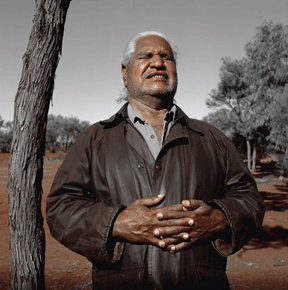 Yankunytjatjara elder and Maralinga nuclear test survivor Yami Lester OAM passes away, aged 75 http://www.adelaidenow.com.au/news/south-australia/yankunytjatjara-elder-and-maralinga-nuclear-test-survivor-yami-lester-oam-passes-away-aged-75/news-story/ccfc3f82c75a643c3e49f22c8a215dbf, MATT GARRICK, Sunday Mail (SA), July 22, 2017 YANKUNYTJATJARA elder Yami Lester OAM, an Outback hero who opened the nation’s eyes to the human cost of nuclear tests committed on Australian soil, has died aged 75 in Alice Springs.
Tributes flow, on the death of highly respected Aboriginal elder Yami Lester
 Yami Lester: tributes follow death of Aboriginal elder and Maralinga activist https://www.theguardian.com/australia-news/2017/jul/23/yami-lester-tributes-follow-death-of-aboriginal-elder-and-maralinga-activist
Lester, who was blinded by British atomic tests in South Australia in the 1950s, campaigned to get recognition for the 1,800 Indigenous Australians affected, Guardian, 23 July 17 Tributes have poured in for Aboriginal elder and activist Yami Lester, who died at the age of 75.
Lester, who died in Alice Springs on Friday night, lived a life of “great hardship and challenge” after being blinded as a young adolescent by the Maralinga atomic tests in the 1950s, which he called the “black mist”.
He worked as a stockman before losing his sight.
He may be farewelled at a state funeral if his family accepts the offer from the Northern Territory government.“Mr Lester was a key Aboriginal leader who embraced the challenge of bridging two worlds,” NT chief minister Michael Gunner said on Saturday.
“He never let his blindness hold him back, he was sharp as a tack in negotiating at the highest levels of business and government.
“His life was a life of great hardship and challenge, met with great courage and foresight, and he achieved great change.”
He joined the Aboriginal Advancement League in Adelaide, fighting to gain recognition for the British atomic tests in South Australia, and an acknowledgement for the 1,800 Aboriginal people affected.
His work lead to the McClelland royal commission in 1984-85 which resulted in group compensation for the Maralinga Tjarutja people and long-term clean-up operations to restore the land.
Lester, who had an Order of Australia, was also central to the work of the Pitjantjatjara Council that led to the grant of freehold title to traditional owners in South Australia.
South Australia’s Aboriginal affairs minister, Kyam Maher, said Lester had inspired many and left behind a strong legacy.
Lester was also the inspiration for the 1987 Paul Kelly song Maralinga.“My thoughts are with his family, who carry on his work of activism, standing up for the rights and views of Anangu and preserving culture and language,” he said in a statement.
The South Australian government is consulting with his family on a memorial to recognise his contribution to the state.
Karina Lester: the Anangu story, and the Aboriginal fight against nuclear waste dumping
Karina Lester: Aboriginal people do not want a nuclear waste dump in South Australia http://www.adelaidenow.com.au/news/opinion/karina-lester-aboriginal-people-do-not-want-a-nuclear-waste-dump-in-south-australia/news-story/b180d3850f4285c208a334957ef5d6f0 Karina Lester, The Advertiser June 28, 2017 IT was a huge honour to travel to New York for United Nations negotiations on a historic treaty to ban nuclear weapons — a long journey from Walatina in the Anangu Pitjantjatjara Yankunytjatjara Lands in far north west South Australia.
Our Anangu story is not a happy one but it was a privilege to speak up at the UN — for my family and my own people and for indigenous peoples around the world who have suffered the effects of nuclear testing since the dawn of this nuclear age. I felt a great responsibility to acknowledge the many indigenous people who had lost lives and land, and suffered other harm and sickness, including my father Yami Lester.
Dad was blinded by the British nuclear testing at Emu Field in 1953 and has never laid eyes on his Country since, nor ever on his son and two daughters, his 12 grandchildren and two great grandchildren. I shared our family’s story and urged the 130 nations gathered there to produce a strong treaty that will not only ban these destructive weapons but formally recognise the disproportionate impact of nuclear weapon activities on indigenous peoples.
Yet, in the back of my mind in New York, amid all that history making and all that hope, was the knowledge that this fight is not even close to being over at home, that we never seem to be able to draw to a close this dangerous industry in South Australia.
Pitjantjatjara, Yankunytjatjara, Kokatha, Adnyamathanha and other Aboriginal people of South Australia have been fighting this nuclear problem now for decades, since my father heard a British official falsely claiming that Anangu had been consulted on the tests which sent the ‘black mist’ which poisoned our people and land.
Dad’s campaigning helped pave the way for the Royal Commission into British Nuclear Tests in Australia in 1985. But it didn’t take long for this injustice to be forgotten, for our traditional lands to once more to be seen as empty wastelands and for this struggle to become intergenerational.
In 1998 the Howard Government announced its plan to build a national radioactive waste dump in the SA Outback. This time it was the Kupa Piti Kungka Tjuta, senior Aboriginal woman from Coober Pedy — among them my Kami (nana) Eileen Kampakuta Brown — who had to step up for the fight with their “Irati Wanti — the poison, leave it” campaign. It took a huge toll on those old women but they had learnt of the danger from their experience of Maralinga and Emu Field.
Then two years ago came the threat again, with the Royal Commission into the expansion of the nuclear fuel cycle in South Australia and the proposal to ship, store and bury up to one-third of the world’s high-level long-lived radioactive waste. Where? Not in Adelaide, of course.
But as my Kami said, this radioactive risk is not just a problem for our mob, it’s a problem for all South Australians, and the proposal was resoundingly rejected.
Meanwhile, the Federal Government has been looking at Adnyamathanha country in the Flinders Ranges for a national low and intermediate-level nuclear dump. Facing strong Aboriginal resistance, it is also proposing a site on the Eyre Peninsula. Aboriginal people are not the only opponents of nuclear waste, but we have borne the brunt of this industry and have intimate knowledge of its costs.
My father lost his eyesight because of nuclear weapons testing, but he has never lost his vision of a cleaner and safer future free of nuclear threats from weapons and waste. It’s time this country and this state shared that vision.
Karina Lester is a Yankunytjatjara Anangu woman, who works with the University of Adelaide’s Mobile Language Team as the Aboriginal Co-Manager and Language Worker. She is a member of the Natural Resources Management Council
For Australian climate scientists, climate change is becoming a personal and serious concern
research shows that if there isn’t a reduction in CO2 emissions, there will be up to 50 extra really hot days a year in northern Australia by the end of the century.
Professor David Griggs, who recently retired as director of the Sustainable Development Institute at Monash University, said Australia is in denial about climate change.
“Australians will have to adapt or die,” he said.
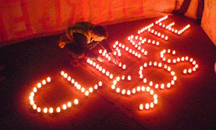 Climate scientists reveal their fears for the future http://www.abc.net.au/news/2017-06-27/climate-scientists-speak-of-their-worst-fears/8631368, Lateline By Kerry Brewster, Cradling her newborn baby girl, heatwave expert Sarah Perkins Kirkpatrick admits to feeling torn between the joy of motherhood and anxiety over her first-born child’s future.
“I always wanted a big family and I’m thrilled. But my happiness is altered by what I know is coming with climate change,” she said.
“I don’t like to scare people but the future’s not looking very good.
“Having a baby makes it personal. Will this child suffer heatstroke just walking to school?”
Dr Perkins Kirkpatrick is one of several climate scientists who Lateline spoke to, seeking a range of opinions from experts at some of the top climate change research units within major universities in Australia. Continue reading
Farmers want the Australian government to embrace solar energy
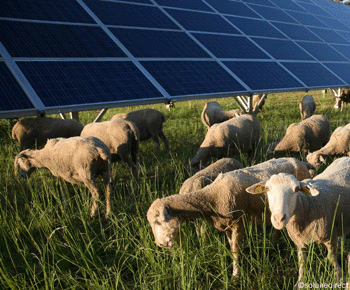
Farmers urge government to embrace solar for the future http://www.examiner.com.au/story/4625721/farmers-urge-government-to-embrace-solar-for-the-future/?cs=97 30 Apr 2017, A year ago, my family acquired solar panels in a very unusual way. Our farm is located in Quirindi, northern NSW, in the heart of Australia’s food bowl.
We’ve never before experienced a run of 40-degree days like we had last summer. Being farmers we are at the mercy of the seasons, and in recent years we have experienced extremes in our weather – extended hot summer periods and increasingly variable rainfall. It’s hard on our cows, it dries out the soil, stresses pastures and impacts the number of animals we can stock on the farm.
A few years back a concerned group of Christians called Common Grace crowdfunded enough money to buy solar panels for the then Prime Minister, Tony Abbott. It was an attempt to raise awareness of the value and importance of sustainable energy.
But when this gift was rejected, Common Grace turned to the front lines of climate change in Australia and offered the panels to farmers, like me. My parents taught me the value of caring for the land, and so, I appreciate the clean energy from solar which allows me to use appliances during the day knowing I am having minimal impact on the environment.
My family spends less on electricity now and with the price of solar storage falling, we’ve got plans to go completely off the grid.
It’s frustrating that our government is failing to transition Australia to sustainable energy when we are out in the paddock already trying to adapt to the impacts of worsening droughts and heatwaves.
We must tackle climate change so we can pass on healthy farmlands to our children, and so farmers can continue to produce food and clothes for generations to come.
Being given the opportunity to go solar has been great. I just wish our government will now give it a go. Kirrily Blomfield was 2014 NSW farmer of the year.
One Aboriginal family – devastated by Maralinga nuclear bomb testing
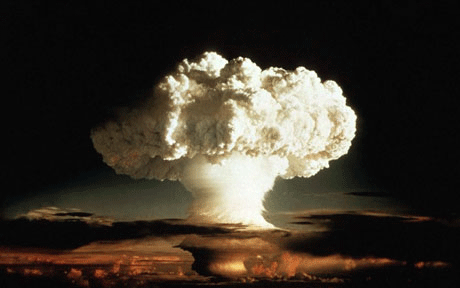 Chapter 16: A toxic legacy : British nuclear weapons testing in Australia Published in: Wayward governance : illegality and its control in the public sector / P N Grabosky Canberra : Australian Institute of Criminology, 1989 ISBN 0 642 14605 5(Australian studies in law, crime and justice series); pp. 235-253 “…….The security measures taken to restrict access to the testing site were not without flaws. One morning in May 1957, four Aboriginal people, the Milpuddie family, were found by range authorities near the crater formed by the ‘Buffalo 2’ explosion the previous October. ‘Me man, woman, two children and two dogs had set out on foot from the Everard Ranges in the northwest of South Australia, and were unaware that the Aboriginal inhabitants of the Maralinga area had been removed. When authorities discovered them, the family was immediately taken to a decontamination centre at the site, and were required to shower. After this experience, which must have been frightening enough, the family was driven to Yalata.
As one of the site personnel described the experience:
It was a shocking trip down as they had never ridden in a vehicle before and vomited everywhere (Australia 1985, p. 320).
On instructions from the Secretary of the Commonwealth Department of Supply, the dogs were shot. ‘ne woman was pregnant at the time the family was taken into custody; subsequently, her baby was born dead. Australian authorities went to great lengths to keep the incident secret, but they appear to have been less concerned with the family’s subsequent health. Commenting upon the fact that no-one appears to have taken the time to explain the experience to which the hapless Aborigines were subjected, a team of anthropologists was to comment:
[T]he three remaining members of the family have been subjected to a high degree of stress and unhappiness about the events of twenty-eight years ago (Australia 1985, p. 323)…….http://aic.gov.au/publications/previous%20series/lcj/1-20/wayward/ch16.html
1 This month

of the week – Australians for War Powers Reform (AWPR)
To see nuclear-related stories in greater depth and intensity
 Antinuclear