Aukusing for War: The Real Target Is China
Dr Binoy Kampmark, April 7 2024 https://theaimn.com/aukusing-for-war-the-real-target-is-china/
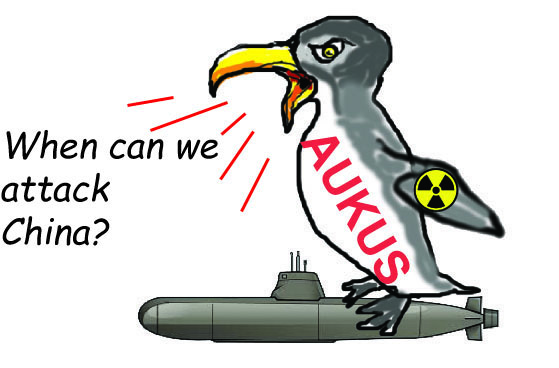
A remarkably perverse reality is in the offing regarding AUKUS. In terms of submarines, it will lag, possibly even sink, leaving the US and, to a lesser extent the UK, operating their fleets as Australians foot the bill and provide the refreshment
Not only is Australia effectively promising to finance and service that particular capacity, it will also do so in the service of a potentially catastrophic conflict which will see its automatic commitment. A truly high price to pay for an abdication of sovereignty for the fiction of regional stability.
The occasional burst of candour from US diplomats provides a striking, air clearing difference to their Australian and British counterparts. Official statements about the AUKUS security pact between Washington, London and Canberra, rarely mention the target in so many words, except on the gossiping fringes. Commentators and think tankers are essentially given free rein to speculate, masticating over such streaky and light terms as “new strategic environment”, “great power competition”, “rules-based order”.
On the occasion of his April 3 visit to Washington’s Center for a New American Security (CNAS), US Deputy Secretary of State Kurt Campbell was refreshingly frank. His presence as an emissary of US power in the Pacific has been notable since the AUKUS announcement in September 2021.
In March last year, Campbell, as Deputy Assistant to the US President and Coordinator for the Indo-Pacific National Security Council, was unfurling the US flag before various Pacific states, adamant that US policy was being reoriented from one of neglect to one of greater attentiveness. The Solomon Islands, given its newly minted security pact with Beijing, was of special concern. “We realise that we have to overcome in certain areas some amounts of distrust and uncertainty about follow through,” he explained to reporters in Wellington, New Zealand. “We’re seeking to gain that trust and confidence as we go forward.”
In Honiara, Campbell conceded that the US had not done “enough before” and had to be “big enough to admit that we need to do more, and we need to do better.” This entailed, in no small part, cornering the Solomon Islands Premier Manasseh Sogavare into affirming that Beijing would not be permitted to establish a military facility capable of supporting “power projection capabilities.”
In his discussion with the CNAS Chief Executive Officer, Richard Fontaine, Campbell did the usual runup, doffing the cap to the stock principles. Banal generalities were discussed, for instance, as to whether the US should be the sole show in projecting power or seek support from like-minded sorts. “I would argue that as the United States and other nations confront a challenging security environment, that the best way to maintain peace and security is to work constructively and deeply with allies and partners.” A less than stealthy rebuke was reserved for those who think “that the best that the United States can do is to act alone and to husband its resources and think about unilateral, individual steps it might take.”
The latter view has always been scorned by those calling themselves multilateralists, a cloaking term for waging war arm-in-arm with satellite states and vassals while ascribing to it peace keeping purposes in the name of stability. Campbell is unsurprising in arguing “that working closely with other nations, not just diplomatically, but in defensive avenues [emphasis added], has the consequence of strengthening peace and stability more generally.” The virtue with the unilateralists is the possibility that war should be resorted to sparingly. If one is taking up arms alone, a sense of caution can moderate the bloodlust.
Campbell revealingly envisages “a number of areas of conflict and in a number of scenarios that countries acting together” in the Indo-Pacific, including Japan, Australia, South Korea and India. “I think that balance, the additional capacity will help strengthen deterrence more general [sic].” The candid admission on the role played by the AUKUS submarines follows, with the boats having “the potential to have submarines from a number of countries operating in close coordination that could deliver conventional ordinance from long distances. Those have enormous implications in a variety of scenarios, including in cross-strait circumstances.” And so, we have the prospect of submarines associated with the AUKUS compact being engaged in a potential war with China over Taiwan.
When asked on what to do about the slow production rate of submarines on the part of the US Navy necessary to keep AUKUS afloat, Campbell acknowledged the constraints – the Covid pandemic, supply chain issues, the number of submarines in dry dock requiring or requiring servicing. But like Don Quixote taking the reins of Rosinante to charge the windmills, he is undeterred in his optimism, insisting that “the urgent security demands in Europe and the Indo-Pacific require much more rapid ability to deliver both ordinance and other capabilities.”
To do so, the military industrial complex needs to be broadened (good news for the defence industry, terrible for the peacemakers). “I think probably there is going to be a need over time for a larger number of vendors, both in the United States in Australia and Great Britain, involved in both AUKUS and other endeavours.”
There was also little by way of peace talk in Campbell’s confidence about the April 11 trilateral Washington summit between the US, Japan and the Philippines, following a bilateral summit to be held between President Joe Biden and Japan’s Prime Minister Fumio Kishida. When terms such as “modernize” and “update” are bandied about in the context of an alliance, notably with an eye towards a rival power’s ambitions, the warring instincts must surely be stirred. In the language of true encirclement, Campbell envisages a cooperative framework that will “help link the Indo-Pacific more effectively to Europe” while underscoring “our commitment to the region as a whole.”
A remarkably perverse reality is in the offing regarding AUKUS. In terms of submarines, it will lag, possibly even sink, leaving the US and, to a lesser extent the UK, operating their fleets as Australians foot the bill and provide the refreshments. Campbell may well mention Australia and the UK in the context of nuclear-powered submarines, but it remains clear where his focus is: the US program “which I would regard as the jewel in the crown of our defense industrial capacity.” Not only is Australia effectively promising to finance and service that particular capacity, it will also do so in the service of a potentially catastrophic conflict which will see its automatic commitment. A truly high price to pay for an abdication of sovereignty for the fiction of regional stability.
Killing Aid Workers: Australia’s Muddled Policy on Israel
Australian anger at the government level must therefore be severely qualified. Support roles, thereby rendering Australian companies complicit in Israeli’s military efforts, and in ancillary fashion the Australian government, continue to be an important feature. The F-35, a mainstay US-made fighter for the Israeli Air Force, is not manufactured or built in Australia, but is sustained through the supply of spare parts stored in a number of allied countries. According to the Australian Department of Defence, “more than 70 Australian companies have directly shared more than $4.13 billion in global F-35 production and sustainment contracts.”
April 5, 2024, by: Dr Binoy Kampmark, https://theaimn.com/killing-aid-workers-australias-muddled-policy-on-israel/
The Australian Prime Minister, Anthony Albanese, was distraught and testy. It seemed that, on this occasion, Israel had gone too far. Not too far in killing over 32,000 Palestinians in Gaza, a staggering percentage of them being children. Not too far in terms of using starvation as a weapon of war. Not too far in bringing attention to the International Court of Justice that its actions are potentially genocidal.
Israel had overstepped in doing something it has done previously to other nationals: kill humanitarian workers in targeted strikes. The difference for Albanese on this occasion was that one of the individuals among the seven World Central Kitchen charity workers killed during the midnight between April 1 and 2 was Australian national Lalzawmi “Zomi” Frankcom.
Frankcom and her colleagues had unloaded humanitarian food supplies from Cyprus that had been sent via a maritime route before leaving the Deir al-Balah warehouse. The convoy, despite driving in a designated “deconflicted” zone, was subsequently attacked by three missiles fired from a Hermes 450 drone. All vehicles had the WCK logo prominently displayed. WCK had been closely coordinating the movements of their personnel with the IDF.
In a press conference on April 3, Albanese described the actions as “completely unacceptable.” He noted that the Israeli government had accepted responsibility for the strikes, while Israel’s Prime Minister, Benjamin Netanyahu had conveyed his condolences to Frankcom’s family, with assurances that he would be “committed to full transparency”.
The next day, the Australian PM called the slaying of Frankcom a “catastrophic event”, reiterating Netanyahu’s promises from the previous day that he was “committed to a full and proper investigation.” Albanese also wished that these findings be made public, and that accountability be shown for Israel’s actions, including for those directly responsible. “What we know is that there have been too many innocent lives lost in Gaza.”
Australian Foreign Minister, Penny Wong, restated the need for “full accountability and transparency” and Australian cooperation with Israel “on the detail of this investigation.” She further acknowledged the deaths of over 30,000 civilians, with some “half a million Palestinians” starving.
Beyond an investigation, mounted and therefore controlled by the Israeli forces themselves, nothing much else can be hoped for. The Albanese approach has been one of copybook warnings and concerns to an ally it clearly fears affronting. What would a ground invasion of Rafah do to the civilian population? What of the continuing hardships in Gaza? Push for a humanitarian ceasefire, but what else?
Australian anger at the government level must therefore be severely qualified. Support roles, thereby rendering Australian companies complicit in Israeli’s military efforts, and in ancillary fashion the Australian government, continue to be an important feature. The F-35, a mainstay US-made fighter for the Israeli Air Force, is not manufactured or built in Australia, but is sustained through the supply of spare parts stored in a number of allied countries. According to the Australian Department of Defence, “more than 70 Australian companies have directly shared more than $4.13 billion in global F-35 production and sustainment contracts.”
The Australian government has previously stated that all export permit decisions “must assess any relevant human rights risks and Australia’s compliance with its international obligations.” The refusal of a permit would be assured in cases where an exported product “might be used to facilitate human rights abuses.” On paper, this seems solidly reasoned and consistent with international humanitarian law. But Canberra has been a glutton for the Israeli military industry, approving 322 defence exports over the past six years. In 2022, it approved 49 export permits of a military nature bound for Israel; in the first three months of 2023, the number was 23.
The drone used in the strike that killed Frankcom is the pride and joy of Elbit Systems, which boasts a far from negligible presence in Australia. In February, Elbit Systems received a A$917 million contract from the Australian Defence Department, despite previous national security concerns among Australian military personnel regarding its Battle Management System (BMS).
When confronted with the suggestion advanced by the Australian Greens that Australia end arms sales to Israel, given the presence of Australian spare parts in weaponry used by the IDF, Wong displayed her true plumage. The Australian Greens, she sneered, were “trying to make this a partisan political issue.” With weasel-minded persistence, Wong again quibbled that “we are not exporting arms to Israel” and claiming Australian complicity in Israeli actions was “detrimental to the fabric of Australian society.”
The Australian position on supplying Israel remains much like that of the United States, with one fundamental exception. The White House, the Pentagon and the US Congress, despite increasing concerns about the arrangement, continue to bankroll and supply the Israeli war machine even as issue is taken about how that machine works. That much is admitted. The Australian line on this is even weaker.
The feeble argument made by such watery types as Foreign Minister Wong focus on matters of degree and semantics. Israel is not being furnished with weapons; they are merely being furnished with weapon components.
Aside from ending arms sales, there is precedent for Australia taking the bull by the horns and charging into the mist of legal accountability regarding the killing of civilians in war. It proved an enthusiastic participant in the Joint Investigation Team (JIT), charged with combing through the events leading to the downing of the Malaysian Airlines MH17 over Ukraine in July 2014 by a Buk missile, killing all 298 on board.
Any such equivalent investigation into the IDF personnel responsible for the killing of Frankcom and her colleagues is unlikely. When the IDF talks of comprehensive reviews, we know exactly how comprehensively slanted they will be.
‘Poison portal’: US and UK could send nuclear waste to Australia under Aukus, inquiry told
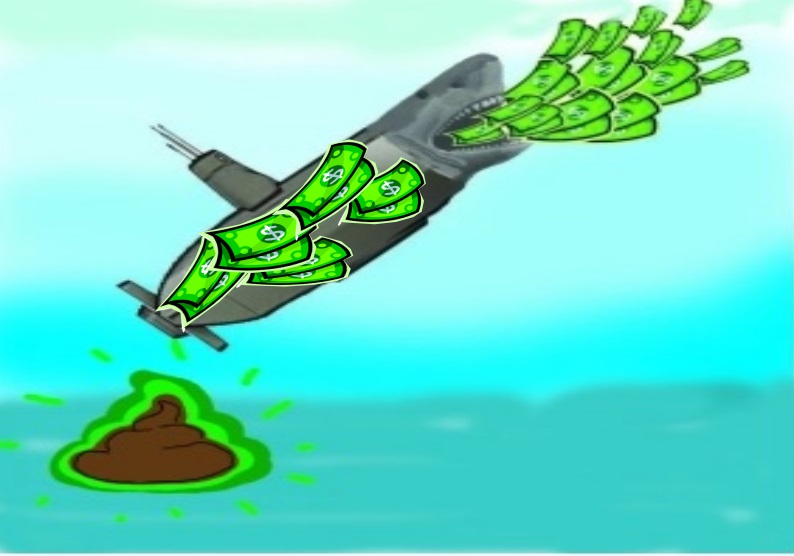
Labor describes claims as ‘fear-mongering’ and says government would not accept waste from other nations.
Tory Shepherd, Tue 2 Apr 2024, https://www.theguardian.com/world/2024/apr/02/poison-portal-us-and-uk-could-send-nuclear-waste-to-australia-under-aukus-inquiry-told
Australia could become a “poison portal” for international radioactive waste under the Aukus deal, a parliamentary inquiry into nuclear safety legislation has heard.
New laws to establish a safety framework for Australia’s planned nuclear-powered submarines could also allow the US and UK to send waste here, while both of those countries are struggling to deal with their own waste, as no long-term, high-level waste facilities have been created.
The government introduced the Australian naval nuclear power safety bill in November last year. If passed, it will establish a nuclear safety watchdog, allow for naval nuclear propulsion facilities to be created, including for storing or disposing of radioactive waste from Aukus submarines. A second bill to enable the regulator to issue licenses was introduced at the same time.
Both have been referred to a Senate inquiry, which is due to report on 26 April.
Dave Sweeney, the Australian Conservation Foundation’s nuclear free campaigner, said the issue of waste disposal was “highly disturbing” and that the Aukus partners could see Australia as a “a little bit of a radioactive terra nullius”.
“Especially when it’s viewed in the context of the contested and still unresolved issue of domestic intermediate-level waste management, the clear failure of our Aukus partners to manage their own naval waste, the potential for this bill to be a poison portal to international waste and the failure of defence to effectively address existing waste streams, most noticeably PFAS,” he said.
The defence minister, Richard Marles, has previously accused the Greens of “fearmongering” when they raised similar concerns, saying the government would not accept waste from the other nations.
However, the legislation allows for the creation of facilities for “managing, storing or disposing of radioactive waste from an Aukus submarine”, and defines an Aukus submarine as either an Australian or a UK/US submarine, and “includes such a submarine that is not complete (for example, because it is being constructed or disposed of)”.
The Greens defence spokesperson, David Shoebridge, said HMS Dreadnought, one of the UK’s first nuclear submarines, had been “rusting away” since being decommissioned in 1980.
“You can go on Google Maps and look at them rusting away in real time, can’t you?” Shoebridge asked Australian Radiation Protection and Nuclear Safety Agency (Arpansa) chief regulatory officer, James Scott.
“Yes. There is no disposal pathway yet,” Scott said, adding he was “aware of the UK plans to establish a deep geological repository somewhere in the 2050s to 2060s”.
“There’s no exact date,” he said.
“The UK is pursuing a disposal pathway, and Australia will need to do the same. We are fully aware of this; we are engaging with our own radioactive waste agency, ARWA, on this, and it’s something that needs to be dealt with now, not later.”
The Dreadnought’s nuclear fuel has been removed to be stored safely. This has happened with some but not all of the submarines, but there is still no permanent disposal facility. The US also removes nuclear fuel for temporary storage.
Melissa Parke: The nuclear threat Australia is ignoring
In its 2018 policy platform, Labor committed to signing and ratifying the TPNW in government, after taking account of a number of factors, including the new treaty’s interaction with the longstanding non-proliferation treaty.
It was Albanese who moved the motion, stating at the time, “Nuclear weapons are the most destructive, inhumane and indiscriminate weapons ever created. Today we have an opportunity to take a step towards their elimination.”
The motion was seconded by the now defence minister, Richard Marles, and adopted unanimously.
The Saturday Paper, 30 Mar 24
In August 1939, a month before the outbreak of World War II, Albert Einstein wrote to then United States president Franklin D. Roosevelt advising that a large mass of uranium could be used to make “extremely powerful bombs of a new type”.
Fearing Nazi Germany would be the first to develop such weaponry, he implored Roosevelt to speed up experimental work aimed at harnessing the destructive power of the atom.
It was, he later said, the “one great mistake” of his life.
Like J. Robert Oppenheimer, Einstein became increasingly alarmed at the implications of the Manhattan Project. In just a few years, the human species had acquired the means to destroy itself, along with most other living organisms on Earth.
Horrified by the high death toll from the US atomic bombings of Hiroshima and Nagasaki in 1945, which killed more than 200,000 people, mostly civilians, Einstein reflected, “The unleashed power of the atom has changed everything save our modes of thinking, and we thus drift toward unparalleled catastrophe.”
Shortly before his death in 1955, Einstein signed a manifesto with other renowned intellectuals, including the mathematician and philosopher Bertrand Russell, warning “a war with H-bombs might quite possibly put an end to the human race”.
Their growing concern stemmed, in part, from the discovery that nuclear weapons could spread destruction over a much wider area than had initially been supposed.
A year earlier, at Bikini Atoll in the Marshall Islands, America’s infamous Castle Bravo nuclear weapons test had poisoned not only the people of nearby Rongelap but also Japanese fishermen hundreds of kilometres from the blast site.
It was the largest of more than 300 US, French and British nuclear test explosions carried out in the Pacific between 1946 and 1996, with devastating consequences for local populations and the environment.
The British government also tested nuclear weapons on Australian soil in the 1950s and 1960s, poisoning the environment, dislocating and irradiating Aboriginal communities, and affecting many of the 20,000 British and Australian service personnel involved in the testing program.
The toxic legacy of these experiments – in Australia, the Pacific and other parts of the world – persists to this day. Those exposed to radiation and their descendants suffer from birth defects and cancers at much higher rates than the general population.
Still, the nuclear arms race continues apace. The dire warnings articulated so powerfully in the Russell–Einstein manifesto seven decades ago remain just as relevant today.
Our world is teetering on the brink of catastrophe, with close to 13,000 nuclear weapons in the arsenals of nine countries. The risk of their use – whether by accident or design – is as high as ever……………………………………………………………
Australia’s plan to acquire nuclear-powered submarines under AUKUS has only exacerbated tensions, eroding well-established non-proliferation norms.
Last year, more than 150 medical journals, including The Lancet and the Medical Journal of Australia, put out a joint call for urgent action to eliminate nuclear weapons. They identified the abolition of nuclear weapons as a public health priority. “Even a ‘limited’ nuclear war involving only 250 of the 13,000 nuclear weapons in the world,” the warning stated, “could kill 120 million people outright and cause global climate disruption leading to a nuclear famine, putting two billion people at risk.”……………………………………………………………………………………………………………..
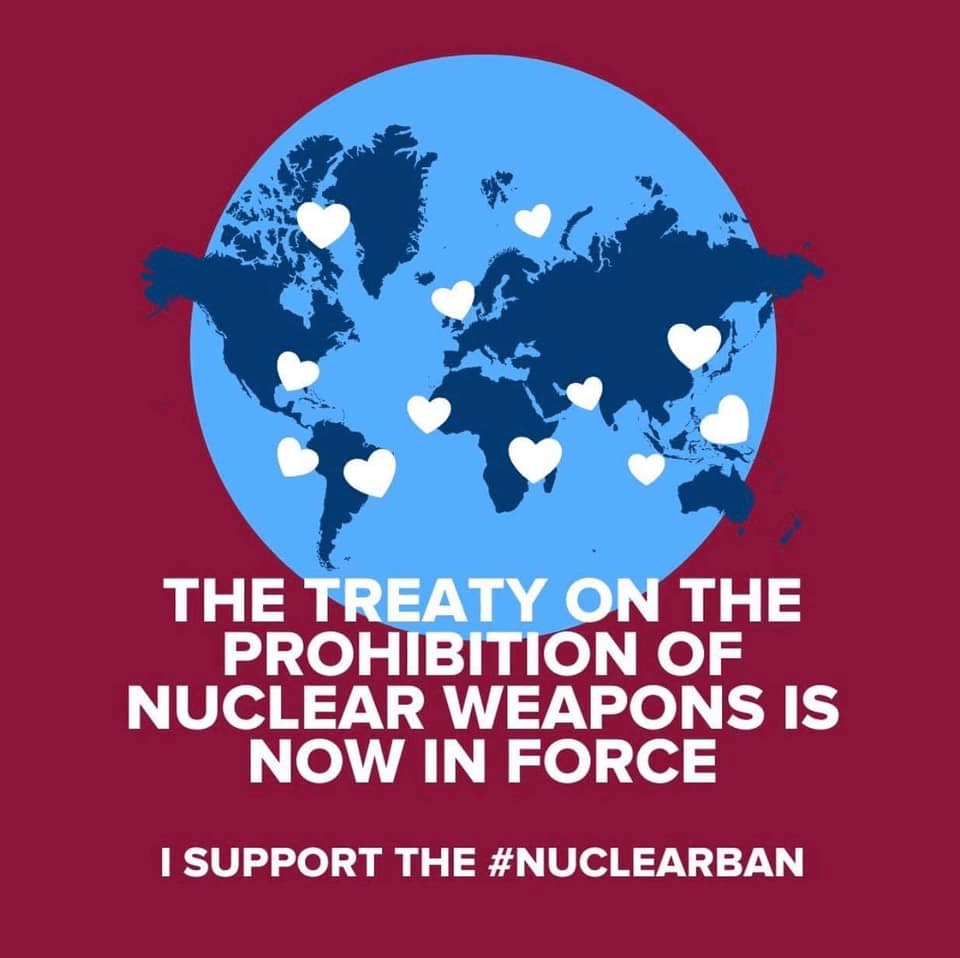
This week, as I walked the halls of Parliament House to advocate for Australia’s signing of the Treaty on the Prohibition of Nuclear Weapons (TPNW), a landmark accord adopted at the United Nations in 2017 with the backing of 122 countries, I was reminded of the power that people in government have to make real and long-lasting change, and also how all too often they let opportunities slip by.
During my nine years as the Labor member for Fremantle, I saw how government action and policy change could make positive differences for people and the environment, but also how inaction could have devastating consequences.
The Albanese government has an opportunity to leave a powerful legacy and help secure the future of all life on Earth. To do so, Australia must step out from under the shadow of the nuclear umbrella and sign the Treaty for the Prohibition of Nuclear Wespons (TPNW)
The sticking point for Australia has been the doctrine of extended nuclear deterrence, a feature of our defence strategy for decades. In theory, Australia relies on US nuclear weapons to defend us against nuclear attack. Washington, however, has never made a public commitment to that effect. Furthermore, since nuclear deterrence is based on the willingness and readiness to commit the mass murder of civilians, it is morally and legally unacceptable, even by way of retaliation.
Deterrence theory also assumes complete rationality and predictability of all actors, including one’s enemies, all of the time, which is a bold assumption.
There are many things that cannot be deterred, including accidents, miscalculations, unhinged leaders, terrorist groups, cyber attacks and simple mistakes. There have been many nuclear near-misses over the decades and we have been on the brink of catastrophe more than once, most famously during the Cuban Missile Crisis in 1962.
The TPNW provides a pathway to the elimination of nuclear weapons. It is a new norm in international law that delegitimises and stigmatises the most destructive and inhumane weapons ever created. It also includes groundbreaking provisions to assist communities harmed by nuclear use and testing and to remediate contaminated environments.
Indonesia, New Zealand, Malaysia, the Philippines, Thailand and nine of the Pacific Island states have signed up. We are clearly out of step with our region.
Australia has a proud history of championing nuclear disarmament, particularly under Labor governments. The late Tom Uren, a Labor luminary and mentor to Anthony Albanese, was one of the party’s most passionate critics of nuclear weapons and war.
It was under the Whitlam government, with Uren serving as a minister, that Australia ratified the Treaty on the Non-Proliferation of Nuclear Weapons in 1973. Bob Hawke worked with Pacific neighbours to develop the South Pacific Nuclear Free Zone Treaty in 1985. Paul Keating established the Canberra Commission on the Elimination of Nuclear Weapons in 1995. Kevin Rudd established a follow-up commission in 2008.
In its 2018 policy platform, Labor committed to signing and ratifying the TPNW in government, after taking account of a number of factors, including the new treaty’s interaction with the longstanding non-proliferation treaty.
It was Albanese who moved the motion, stating at the time, “Nuclear weapons are the most destructive, inhumane and indiscriminate weapons ever created. Today we have an opportunity to take a step towards their elimination.”
The motion was seconded by the now defence minister, Richard Marles, and adopted unanimously.
Albanese argued the most effective way for Australia to build universal support for the TPNW – including, ultimately, bringing nuclear-armed states on board – would be for our country to join the treaty itself.
He also said that doing so would not jeopardise Australia’s alliance with the US, noting Australia had joined other disarmament treaties to which the US isn’t a party, including those banning anti-personnel landmines and cluster munitions.
New Zealand, the Philippines and Thailand have all ratified the TPNW, with no disruption to their ongoing non-nuclear military cooperation with the US. Indeed, the Philippines recently almost doubled the number of its military bases available to US forces and conducted joint military exercises with the US in the South China Sea.
Labor reaffirmed its commitment to signing the TPNW at its 2021 and 2023 national conferences, but the Albanese government has not yet inked the accord. It is time for the prime minister to act.
The rising, existential danger of nuclear war makes it all the more important for Australia to get on the right side of history.
We need to change our modes of thinking – to use Einstein’s phrase – and dispense with old ideas about what makes us safe and secure. We must remember that disarmament is essential for our collective survival.
In their manifesto, Einstein and Russell appealed as human beings to human beings: “Remember your humanity, and forget the rest.”
This article was first published in the print edition of The Saturday Paper on March 30, 2024 as “The nuclear threat Australia is ignoring”. https://www.thesaturdaypaper.com.au/comment/topic/2024/03/30/the-nuclear-threat-australia-ignoring#mtr
.
Australia’s move on nuclear submarines raises concern
Editor : Li Yan, https://www.ecns.cn/news/military/2024-03-28/detail-ihcyyfhe2567871.shtml
Despite growing concerns over costs, capabilities, and risks to national interests, Australia has committed to collaborating with the United States and the United Kingdom to advance the AUKUS nuclear-powered submarines, a move experts predicted would escalate domestic opposition and heighten regional tensions.
Australia has pledged $3 billion to support British industry in constructing nuclear-powered submarines, ensuring the timely delivery of its new fleet, as announced by both countries last Friday.
Grant Shapps, British defense secretary, emphasized the ongoing importance of AUKUS while drawing attention to the so-called “China threat” in his remarks.
However, the trilateral agreement has faced domestic criticism and protests from the outset. On March 18, local unions and environmental groups in Australia urged the government to abandon plans for a base while holding a protest outside the parliament house, the latest demonstration in a series, some of which drew as many as 5,000 protesters.
The establishment of the base is a key component of AUKUS, Australia’s largest defense initiative since World War II. In total, the submarine project could cost up to $240 billion over the next 30 years.
“We don’t want to be part of someone else’s belligerent nuclear plans,” said Arthur Rorris, head of the South Coast Labor Council, comprising unions representing 50,000 workers in the area.
They fear the base could choke an infant clean energy sector by taking up scarce land and ushering in security curbs, as well as the permanent presence of U.S. warships. Faced with strong opposition, the government said it hadn’t decided on Port Kembla, a favorable location for the base, as local media had reported.
Chen Hong, director of the Australian Studies Centre at East China Normal University in Shanghai, said the protests against AUKUS signify a growing awareness among Australians of the detrimental consequences of the military pact on national interests and regional stability.
“By taking part in the U.S.-led trilateral military pact, Australia hopes to get nuclear submarine technologies and more security promises from the United States and the United Kingdom. However, this move will drag the country and its people into a potential war as the Australian government keeps supporting U.S. hegemony and surrenders its land for U.S. warships,” Chen said.
AUKUS, established in 2021, aims to bolster Australia’s military capabilities by providing it with nuclear-powered submarines.
Fueling tensions
“Through AUKUS, the U.S. and its Western allies are trying to weaponize Australia and force the country to join its ‘anti-China’ bloc. Plus, the U.S. has kept pushing forward its ‘Indo-Pacific’ strategy, which also involves Australia, fueling tensions in the whole region,” he said.
Daryl Guppy, an international financial technical analyst and former national board member of the Australia China Business Council in Melbourne, said that some Australian politicians have moved closely with the U.S. on the assumption that U.S. and Australian interests are largely the same, which has undermined Australia’s sovereign independence.
Apart from the political turbulence, Chen also said the nuclear submarine pact will raise concerns over nuclear proliferation and cause environmental influences that will damage the health of local communities.
“Australia has long championed nuclear-weapon-free zones and was a founding member of the South Pacific Nuclear Free Zone Treaty. However, Australia’s attempt to acquire nuclear submarines will undermine its nuclear-free promise,” Chen said.
As Chinese Foreign Minister Wang Yi visited Australia recently, experts are expecting that the two countries can collaborate to improve the bilateral relationship.
“China and Australia can work together to find more common grounds and build a more stable, mature and fruitful comprehensive strategic partnership, which will benefit the peoples of the two countries,” Chen said.
The AUKUS Cash Cow: Robbing the Australian Taxpayer
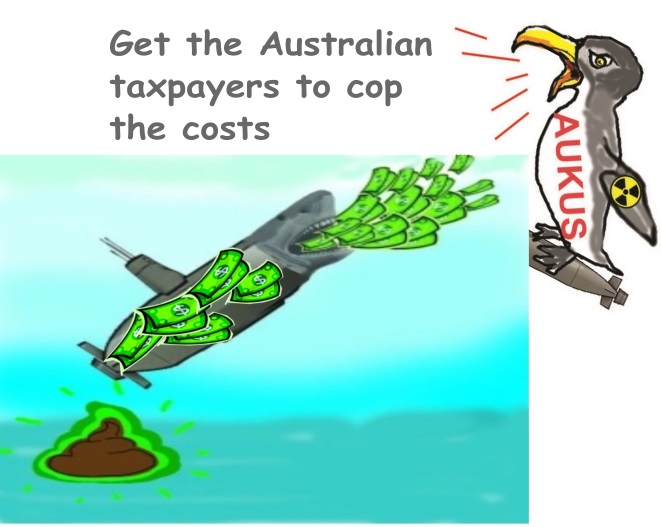
The eye-opener in the AUKMIN chatter is the promise from Canberra to send A$4.6 billion (£2.4 billion) to speed up lethargic construction at the Rolls-Royce nuclear reactor production line. There are already questions that the reactor cores, being built at Derby, will be delayed for the UK’s own Dreadnought nuclear submarine.
The eye-opener in the AUKMIN chatter is the promise from Canberra to send A$4.6 billion (£2.4 billion) to speed up lethargic construction at the Rolls-Royce nuclear reactor production line.
March 26, 2024, by: Dr Binoy Kampmark, https://theaimn.com/the-aukus-cash-cow-robbing-the-australian-taxpayer/
Two British ministers, the UK Foreign Secretary David Cameron and Defence Secretary Grant Shapps, paid a recent visit to Australia recently as part of the AUKMIN (Australia-United Kingdom Ministerial Consultations) talks. It showed, yet again, that Australia’s government loves being mugged. Stomped on. Mowed over. Beaten.
It was mugged, from the outset, in its unconditional surrender to the US military industrial complex with the AUKUS security agreement. It was mugged in throwing money (that of the Australian taxpayer) at the US submarine industry, which is lagging in its production schedule for both the Virginia-class boats and new designs such as the Columbia class. British shipyards were hardly going to miss out on this generous distribution of Australian money, largesse ill-deserved for a flagging production line.
A joint statement on the March 22 meeting, conducted with Defence Minister Richard Marles and Foreign Minister Penny Wong, was packed with trite observations and lazy reflections about the nature of the “international order”. Ministers “agreed the contemporary [UK-Australian] relationship is responding in an agile and coordinated way to global challenges.” When it comes to matters of submarine finance and construction, agility is that last word that comes to mind.
Boxes were ticked with managerial, inconsequential rigour. Russia, condemned for its “full-scale, illegal and immoral invasion of Ukraine.” Encouragement offered for Australia in training Ukrainian personnel through Operation Kudu and joining the Drone Capability Coalition. Exaggerated “concern at the catastrophic humanitarian crisis in Gaza.” Praise for the United Nations Convention on the Law of the Sea (UNCLOS) and “respect of navigation.”
The relevant pointers were to be found later in the statement. The UK has been hoping for a greater engagement in the Indo-Pacific (those damn French take all the plaudits from the European power perspective), and the AUKUS bridge has been one excuse for doing so. Accordingly, this signalled a “commitment to a comprehensive and modern defence relationship, underlined by the signing of the updated Agreement between the Government of Australia and the Government of the United Kingdom of Great Britain and Northern Ireland for Defence and Security Cooperation.”
When politicians need to justify opening the public wallet, such tired terms as “unprecedented”, “threat” and “changing” are used. These are the words of foreign minister Wong: “Australia and the United Kingdom are building on our longstanding strategic partnership to address our challenging and rapidly changing world.” Marles preferred the words “an increasingly complex strategic environment.” Shapps followed a similar line of thinking. “Nuclear-powered submarines are not cheap, but we live in a much more dangerous world, where we are seeing a much more assertive region [with] China, a much more dangerous world all around with what is happening in the Middle East and Europe.” Hardly a basis for the submarines, but the fetish is strong and gripping.
With dread, critics of AUKUS would have noted yet another round of promised disgorging. Britain’s submarine industry is even more lagging than that of the United States, and bringing Britannia aboard the subsidy truck is yet another signal that the AUKUS submarines, when and if they ever get off the design page and groan off the shipyards, are guaranteed well deserved obsolescence or glorious unworkability.
A separate statement released by all the partners of the AUKUS agreement glories in the SSN-AUKUS submarine, intended as a joint effort between BAE Systems and the Australian Submarine Corporation (ASC). (BAE Systems, it should be remembered, is behind the troubled Hunter-class frigate program, one plagued by difficulties in unproven capabilities.)
An already challenging series of ingredients is further complicated by the US role as well. “SSN-AUKUS is being trilaterally developed, based on the United Kingdom’s next designs and incorporation technology from all three nations, including cutting edge United States submarine technologies.” This fabled fiction “will be equipped for intelligence, surveillance, undersea warfare and strike missions, and will provide maximum interoperability among AUKUS partners.” The ink on this is clear: the Royal Australian Navy will, as with any of the promised second-hand Virginia-class boats, be a subordinate partner.
In this, a false sense of submarine construction is being conveyed through what is termed the “Optimal Pathway”, ostensibly to “create a stronger, more resilient trilateral submarine industrial base, supporting submarine production and maintenance in all three countries.” In actual fact, the Australian leg of this entire effort is considerably greater in supporting the two partners, be it in terms of upgrading HMAS Stirling in Western Australia to permit UK and US SSNs to dock as part of Submarine Rotational Force West from 2027, and infrastructure upgrades in South Australia. It all has the appearance of garrisoning by foreign powers, a reality all the more startling given various upgrades to land and aerial platforms for the United States in the Northern Territory.
The eye-opener in the AUKMIN chatter is the promise from Canberra to send A$4.6 billion (£2.4 billion) to speed up lethargic construction at the Rolls-Royce nuclear reactor production line. There are already questions that the reactor cores, being built at Derby, will be delayed for the UK’s own Dreadnought nuclear submarine. The amount, it was stated by the Australian government, was deemed “an appropriate and proportionate contribution to expand production and accommodate Australia’s requirements.” Hardly.
Ultimately, this absurd spectacle entails a windfall of cash, ill-deserved funding to two powers with little promise of returns and no guarantees of speedier boat construction. The shipyards of both the UK and the United States can take much joy from this, as can those keen to further proliferate nuclear platforms, leaving the Australian voter with that terrible feeling of being, well, mugged.
UN Security Council ceasefire resolution a turning point in Gaza war
March 26, 2024, by: The AIM Network, m https://theaimn.com/un-security-council-ceasefire-resolution-a-turning-point-in-gaza-war/
Australian Council for International Development Media Release
Australia’s peak body for international humanitarian organisations welcomes the United Nations Security Council’s resolution calling for an immediate ceasefire in Gaza and release of all hostages as a crucial turning point in the war.
Australian Council for International Development (ACFID) CEO Marc Purcell said it marked a significant breakthrough despite the United States’ decision to abstain from voting.
“This passage of this binding resolution, following four failed attempts since the start of the war, shows global leaders are no longer willing to accept the deaths of tens of thousands of civilians, many of them children, as collateral,” he said.
“The US’ decision to abstain is disappointing, particularly since it put forward its own failed proposal for a ceasefire just days ago. It is essential the US use its influence and relationship with Israel to obtain a permanent ceasefire.
“We are hopeful the passage of this resolution overnight marks a crucial turning point in the war that has killed nearly 32,000 civilians through bombing, starvation and dehydration.
“It is vital that both the state of Israel and militant groups immediately lay down arms to allow for the passage of humanitarian assistance, which is still being blocked from entry into Gaza, and the release of all hostages.”
ACFID is urging the Australian government to commit additional and ongoing funding for the humanitarian response in Gaza and the West bank, including for Australian non-government organisations providing lifesaving assistance.
Huge UK £286bn nuclear submarine deal with US at risk for one reason warns ex Navy chief

The construction of modern nuclear submarines requires more expertise than it took to land a man on the Moon, says the former chief of the Royal Navy.
EXPRESS UK, By CIARAN MCGRATH, Senior News Reporter, Sat, Mar 16, 2024
The first will see the US and UK share technology with Australia in order to develop a new class of nuclear-powered submarines, the SNN-AUKUS, while the second pillar will focus on cyber capabilities, artificial intelligence, quantum technologies, and additional undersea capabilities.
However, speaking earlier this month, Hugh White, an emeritus professor of strategic studies at the Australian National University, voiced his doubts about the long-term viability of AUKUS, citing estimated costs of up to £286 billion between now and the 2050s.
Prof White told ABC RN’s Global Roaming: “I think the chance of the plan unfolding effectively is extremely low.”
Meanwhile, in an analysis published last week, Allan Behm, director of Australia’s International and Security Affairs Program, wrote: “The 2021 AUKUS announcement came with the promise of a sovereign Australian fleet of nuclear-powered submarines.
“Nearly 18 months on, however, it remains unclear if these submarines will ever be delivered – or if Australia actually needs them.”………………
He explained: “Pillar Two is very useful, and there’s a discussion about whether Japan be allowed to get involved, should Canada be involved, etc, that’s great.
“But with Pillar One, there are a number of complications. So, yes, there’s a cost which is huge, and the Australians seem to be committed to it.
“But there are now a number of voices in Australia saying, can we really do this, as one would expect
“The other thing is the Americans themselves, who are going to be selling four Virginia class submarines to the Australians as a stop-gap.
“They are short of nuclear attack submarines and so there are people in America who are saying, ‘well, how are we sure we want to do this because we can’t build enough quickly enough to fill up the gap when we get rid of the ones we’re giving to Australia’.”
The Royal Navy currently operates six fleet submarines (SSNs), of the Trafalgar and Astute classes, with two more Astute-class boats currently under construction, and four ballistic missile submarines (SSBN), of the Vanguard class, equipped with nuclear weapons. All are nuclear powered.
However, Lord West emphasised that such vessels did not simply “come off the conveyor belt”.
He explained: “The Astute class submarines are more complex than the technical work to land a man on the moon. That is how incredibly complex the technology is. https://www.express.co.uk/news/world/1877871/aukus-deal-australia-royal-navy-astute-class
AUKUS anniversary brings a sinking feeling.

The Age, By Matthew Knott, March 13, 2024 —
As anniversaries go, this one has turned out to be quite a downer.
A year since Anthony Albanese, Joe Biden and Rishi Sunak stood at a naval base in San Diego to unveil Australia’s plan to acquire a fleet of nuclear-powered submarines, critics of the AUKUS pact are cock-a-hoop and its backers are on the defensive.
It’s a turnaround from December, when AUKUS’s champions were celebrating the fact that the notoriously dysfunctional and divided United States Congress had passed legislation authorising the sale of three Virginia-class submarines to Australia.
“This is a very significant accomplishment for all the parties involved,” declared US Congressman Joe Courtney, co-chair of the Congressional Friends of Australia Caucus.
“A lot of people have been holding their breath to see whether Congress takes this seriously.”
Yet in the lead-up to the one-year milestone, prominent commentators have been promoting a sense of gloom around the submarine plan.
“Dead in the water: the AUKUS delusion,” screams the bright yellow cover of the current edition of the Australian Foreign Affairs journal.
In the lead essay, defence expert and longtime AUKUS sceptic Hugh White argues the submarine plan will “almost certainly fail”, effectively reading AUKUS’s last rites before the pact has even reached teething age.
After laying out multiple ways in which the submarine plan could fall apart, White predicts the crunch is “perhaps most likely to come in Washington, where a number of hurdles could prove fatal to America’s willingness to sell us Virginia-class subs”.
Esteemed Financial Times foreign affairs columnist Gideon Rachman ventilated these anxieties to an international audience in February in a piece titled, “The squawkus about AUKUS is getting louder”.
Then came the Tuesday release of the Biden administration’s 2025 defence budget request, revealing it was only seeking funding for one Virginia-class submarine to built in the coming year. That is down from the two previously expected and well below the production rate of 2.33 subs a year the US says is necessary to sell any submarines to Australia.
As it tries to compete with China for supremacy in the Indo-Pacific, the US Navy is currently 17 attack submarines below its target of 66 – raising obvious questions about whether it will agree to hand over three boats to Australia beginning in 2032.
The legislation passed by Congress last year requires the president of the day to certify that the transfer of the submarines “will not degrade the United States undersea capabilities” and would be contingent on the US “making sufficient submarine production and maintenance investments” to meet its own needs.
The US navy is struggling to cope with supply chain blockages and worker shortages, so much so that the defence sector bought prime-time advertisements during the Oscars telecast to convince welders, forklift drivers, plumbers and marine biologists to help make AUKUS a reality.
Far from elated, AUKUS’s biggest champion in the US Congress is now furious. Describing the budget request as a “hard rudder turn”, Courtney said the decision to produce just one Virginia-class boat in a year “makes little or no sense” and would have a profound impact on both the US and Australian navies.
Former prime minister Malcolm Turnbull, who has long argued Australia would be better off under the deal he struck with France to acquire conventional diesel submarines, leapt onto ABC radio to say he told us so.
“This is really a case of us being mugged by reality,” Turnbull said.
“We are bobbing along as a cork in the maelstrom of American politics…Unless the Americans are able to dramatically change the pace at which they’re producing submarines, and there’s no reason to believe they will be able to do so, we will not ever get the submarines that were promised.”
The Australian and US governments have tried to push back on the doubters, with Defence Minister Richard Marles insisting the three nations “remain steadfast in our commitment to the pathway announced last March”.
The US Navy argues it is pouring $11 billion into the US industrial base over five years, with a plan to produce two Virginia-class submarines by 2028 and the 2.33 required to meet its AUKUS commitments soon after that.
……………………………………………………….. depends on how optimistic you feel about the American political system and the strength of the US-Australia alliance. Meanwhile, we have to contend with the possibility of Donald Trump’s return to the White House and no one knows what he would do about AUKUS…………………………….
From the moment it was announced a year ago, it has been clear the submarine plan was courageous in the Yes, Minister sense of the word: a hugely ambitious and risky endeavour that could come unstuck in several ways. While it is vastly premature to declare AUKUS dead, immense challenges remain.
Ultimately, only the delivery of the promised submarines will silence the doubters – not soothing words from Washington and Canberra. https://www.theage.com.au/politics/federal/aukus-anniversary-brings-a-sinking-feeling-20240313-p5fc0y.html
Pentagon sparks fresh AUKUS doubts on anniversary of Australia’s nuclear-powered submarine plans
ABC, By defence correspondent Andrew Greene, 13 Mar24
- In short: Defence Minister Richard Marles says AUKUS partners are working to help Australia acquire nuclear-powered submarines despite changes to procurement plans in the US.
- The US Navy says it will order just one fast-attack nuclear submarine in 2025, rather than two.
- What’s next? As part of the AUKUS deal, Australia will provide more than $4.5 billion to bolster America’s submarine industrial base
………………………………………Already the US is struggling to ramp up its submarine production rate to an annual target of 2.33 so it can replace retiring boats in its own fleet and begin transfers of second-hand stock to Australia in the early 2030s.
At present, the US is only achieving around 1.2 to 1.3 boats each year due to labour shortages and supply chain delays following the COVID-19 pandemic, with the Navy not expected to consistently hit a two-per-year target until 2029.
Former prime minister Malcolm Turnbull told the ABC Australia’s future defence had become completely dependent on the United States.
…………………………………….. This week marks one year since Prime Minister Anthony Albanese joined British counterpart Rishi Sunak and US president Joe Biden at a San Diego Naval Base to outline the AUKUS “optimal pathway” for Australia to acquire nuclear-powered submarines.
Greens senator David Shoebridge described the latest US defence budget request as a failure for the AUKUS partnership that was “almost too big to wrap your head around” and predicted Australia would end up with “nothing”.
“When the US passed the law to set up AUKUS they put in kill switches, one of which allowed the US to not transfer the submarines if doing so would ‘degrade the US undersea capabilities’. Budgeting for one submarine all but guarantees this,” he warned
………………………….Budget changes under new proposal
As part of the AUKUS deal, Australia will provide more than $4.5 billion to bolster America’s submarine industrial base, while the US aims to contribute a similar amount contingent on congressional negotiations over defence spending that are complicated by the Ukrainian war.
However, this week’s Pentagon budget proposal requests Congress to appropriate a further $US4 billion for the US submarine industrial base in 2025, and $US11.1 billion over five years, for a “historic” investment to expand production.https://www.abc.net.au/news/2024-03-13/us-defence-announcement-raises-questions-on-aukus-anniversary/103578408
Issues Changing the Nation: Never Ending AUKUS Submarine Policy Sagas

March 14, 2024 : The AIM Network, By Denis Bright
The issue of AUKUS has resurfaced from the murky depths of undersea politics. ABC News graphics remind readers of the latest additional payment to fast track the AUKUS deal with its proposed cost of at least $US368 billion.
Public policy interest in the AUKUS submarine saga is now being propelled by doubts about US construction deadlines for the high technology nuclear-powered submarines. The US Navy confirmed that it will halve the number of nuclear-powered submarines on offer in its 2025 budget. Second-hand LA Class submarines will not be available for sharing with Australia as they will be needed in the USA. Even the construction schedule for AUKUS-class submarines in Adelaide is now in doubt (ABC News 13 March 2024).
For readers who are new to this issue, I might restate some background to the AUKUS deals. The commercial military industrial complexes do not advertise their hidden details. Making a request to Gemini-Google Bard provided this summary for verification by readers:
- US Virginia-class submarines: Australia will acquire at least three (and potentially up to five) Virginia-class nuclear-powered attack submarines from the US. The first of these might be in early 2030s. The leading corporations from the US military industrial complexes are General Dynamics and Huntington Ingalls Industries (Newport News Shipbuilding). Numerous supportive technology companies engage in preparations for these developments including involvement from Boeing.
- AUKUS-class submarines: Provided through US and British commercial providers of a new class of nuclear-powered attack submarines during the 2040s. The British firms particularly embedded in the AUKUS Programme are:
: BAE Systems will play a critical role in the construction of the AUKUS submarines.
: Babcock International will be involved in construction and maintenance.
: Rolls-Royce will be involved in design and delivery of the nuclear reactors.
- Temporary Rotational Deployment UK Astute-class and US Virginia-class submarines are planned on a rotational basis to HMAS Stirling in Western Australia.
The US Studies Centre in Sydney (9 February 2024) offered commentary by its Director Professor Peter Dean and research associate Alice Nason:
AUKUS has become a case study in generational politics. Public opinion polling reveals only 33 per cent of Gen Z and millennial voters believe it’s a good idea for Australia to have nuclear-powered submarines, compared with 66 per cent of voters aged sixty-five and over.
Still, on some things, all generations agree: a plurality of Australian voters feel nuclear-powered submarines are not worth the cost to Australian taxpayers. Only 21 per cent of voters believe the submarines warrant their $368bn price tag.
These apprehensions, especially among young people, should alarm our policymakers. The people who are expected to staff Australia’s new submarine enterprise as of now don’t support it. This is only the tip of the iceberg for Australia’s workforce challenge.
Australia will build up a sizeable military industrial complex over the next half-century if the AUKUS deals proceed as planned. Lobbying in support of AUKUS has attracted retired political leaders from both sides of politics who are committed to the goal of a more militarized Australia (Anton Nilsson Crikey.com 23 January 2024).
From the far-off United States, Anna Massoglia and Dan Auble from the Open Secrets site were able provide details of lobbying by major corporations in during 2023 just in support of AUKUS. Boeing, Lockheed Martin and General Dynamics topped the lobbying spending with a combined expenditure of over $US80 million.
David Hardaker of Crikey.com exposed the roles of conservative lobbyists in support of the efforts of the military corporates (31 May 2023). This is an exercise in investigative journalism at its best:
A Crikey investigation into the power of conservative political lobbyists CT Group has revealed that two US companies represented by CT are set to be among the biggest winners of the “forever” AUKUS defence deal hatched by former prime minister Scott Morrison.
One of the companies, General Dynamics, is the lead contractor for constructing the US navy’s fleet of nuclear-powered submarines. The other company, Centrus Energy, is the leading provider of nuclear fuel for US national security purposes and for naval reactors.
CT’s US entity, CTF Global LLC, has acted as a lobbyist for General Dynamics and Centrus Energy since it set up shop in Washington in 2018, taking on the client list of long-term lobbyist Larry Grossman who was seeking to extend the global reach of his firm.
The evolution of the CIT Group as defence lobbyists came as it reached the peak of its political influence in Australia at the end of 2018 with its then-Australian CEO Yaron Finkelstein joining Morrison’s staff as principal private secretary.
In parallel with Australia, the CT Group also enjoyed the closest of relationships with then-UK prime minister Boris Johnson. David Canzini, a former CT executive, was part of Johnson’s team as a deputy chief of staff.
Readers can follow the investigative trails offered through Crikey.com:
Explore the Series
In this era of cost-of-living politics, no one on either side of politics seems to worry about the irregular additional costs of the AUKUS deals. There was an unexpected allocation of $A835 million to France was imposed on the Labor Government for breach of contract from the cancellation of Malcolm Turnbull’s submarine deal.
- Crosby Textor: the pollsters that took over the Liberal Party and became a global power.
- Mere coincidence? Crosby Textor is the common link in Morrison’s AUKUS deal.
- Scott Morrison issues blanket denial on nuclear submarine questions.
- Spooks and spies: Crosby Textor moves into shadowy territory.
- Crosby Textor group’s influence on the Liberals has been pervasive. Is it time to cut the link?
- Crosby Textor’s influence on prime ministers helped it dominate the Anglosphere.
The Register of Lobbyists and the Foreign Influence Transparency Scheme (the Scheme) from the Attorney-General’s Department do not provide easy access to the specific roles played by lobbyists for firms associated with military industrial complexes. Just knowing which lobbyists have an association with a company like the CT Group is of little practical purpose in investigative journalism. This is a sample register extract for the CT Group which was mentioned in the Crikey.com articles.The LinkedIn site offers more clues by showing which ex-politicians or former military personnel and policy advisers with links to Australian and global military industrial companies through both lobbying activities or the convening of forum events or other corporate links. There is nothing sinister about the openness of the opportunities offered through LinkedIn which opens a new world of connections for further investigation by journalists.
Here are just three examples. Arthur Sinodinos, Joel Fitzgibbon, Lynton Crosby
…….. Critical discussion might be painful to political elites. Armed conflicts in a nuclear age are even worse. Let’s pause for some reflection before more jingoism gets Australia into real trouble through over-commitment to global corporate military industrial complexes and the expansion of a stronger home-grown variant in Australia. https://theaimn.com/issues-changing-the-nation-never-ending-aukus-submarine-policy-sagas/
Shock as Australian Prime Minister learns that he is not above international law
the Prime Minister would be wise to seek independent advice from one of several influential Australians who have significant expertise in the field of international humanitarian law.
By Margaret ReynoldsMar 7, 2024, https://johnmenadue.com/shocked-australian-pm-learns-he-is-not-above-international-law/
Prime Ministers are too often monopolised by people telling them what they want to hear. Most political advisers can’t see beyond the latest opinion poll and the Australian bureaucracy has become equally reluctant to offer frank and fearless advice. It appears that the Attorney General, Defence and Foreign Affairs and Trade Departments have each failed to alert the Prime Minister and his government to the risks inherent in ignoring international law when responding to the Gaza crisis.
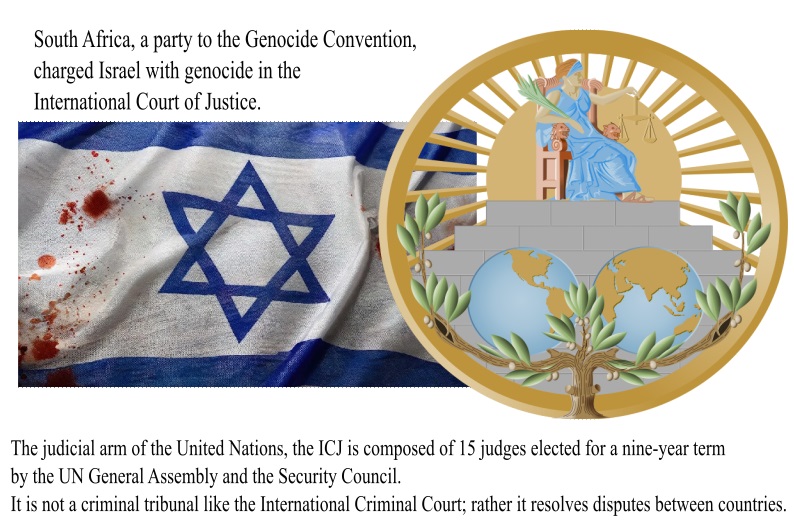
However, many members of Australian civil society have indeed urged the Federal Government to act strongly to uphold humanitarian standards and avoid crimes against humanity They have demanded the Federal Government restore funding to the United Nations Relief and Works Agency and ban arms sales to Israel. More than 100 non-government organisations have communicated their alarm that Australia could in any way be contributing to the ongoing atrocities being inflicted on the Palestinians. Since January 27th, many Australians have anticipated a public official response to the International Court of Justice interim ruling that a case of genocide against Israel is plausible Yet this weight of urgent correspondence and advocacy has failed to alert the Prime Minister’s staff to Australia’s responsibilities as a signatory of the Genocide Convention.
Today more than 100 Australian lawyers endorsed the referral of Anthony Albanese, together with other members of his government and the Opposition leader, Peter Dutton to the International Criminal Court as Accessory to Genocide in Gaza alleging political and material support to the Israel government and military over the past five months.
The 92-page document sets down specific ways in which this allegation can be upheld.
– Freezing of funding to the United Nations Relief and Works Agency amid a humanitarian crisis
– Providing military aid and approving defence exports to Israel
– Ambiguously deploying an Australian military contingent to the region where its location and exact role have not been disclosed
– Permitting Australians to travel to Israel to join the Israeli Defence Force and take part in its attacks on Gaza.
In response, the Prime Minister has dismissed the referral to the International Criminal Court as “lacking credibility” and it is unsurprising he would go into a defensive denial mode. However, it would be a brave leader who did not now demand detailed briefings on these allegations from those departments that have failed to respond to the International Court of Justice genocide warning. Furthermore, the Prime Minister would be wise to seek independent advice from one of several influential Australians who have significant expertise in the field of international humanitarian law.
Regardless of the long-term future of this and comparable allegations against other western leaders, the Australian Government has been given the chance to review its commitment to international law. It can continue to ignore calls for transparency and Australian independence in foreign policy, or it can start to seriously examine why the allegations of complicity have been made.
There is no doubt that many nations are much more actively concerned about the charge of genocide brought against Israel by the South African government. In February more than fifty countries including Indonesia, Malaysia, Fiji, Japan, Great Britain and Ireland sent official legal delegations to the Hague to present their nations opinions to the International Court of Justice., but Australia was not represented.
In contrast, the Australian Government has avoided any detailed public response to its responsibilities as a signatory to the Genocide Convention. Indeed, it has recently twice closed down parliamentary debate that could lead to a comprehensive House of Representatives discussion. There has been no debate about how Australia may assist in future medical rehabilitation of Palestinians nor how it will contribute to the rebuilding of Gaza. While the Foreign Minister may refer to a “two state solution “ there has been no official announcement that Australia finally recognises the State of Palestine.
Furthermore, the failure of the Australian public service to maintain or prioritise current independent information about the continuing assault in Gaza amounts to negligence. In a recent meeting, United Nations Relief and Works Agency in Gaza, Director Tom White was advised “the Australian Government wanted to be sure UNRWA Gaza aid funding will go to those who need it “! This bland indeed inhuman statement clearly reflects that there is something seriously wrong with how the government is currently managing its international responsibilities.
Of course, it is embarrassing for the current Australian Government to be named as an “accessory to genocide”, but all members of parliament should not be too quick to dismiss the allegation until they have reviewed why and how such a charge could be made. The parliament hears too many simplistic speeches giving loyalty to allies who blatantly ignore international law and it’s time our representatives faced this reality.
Australia has a proud record as a founding member of the United Nations, which is responsible for developing international law. So many well-known Australian names have contributed to a great variety of United Nations achievements, yet few parliamentarians speak up for the importance of the international body. International law is being undermined by governments choosing militarism ahead of the rule of law, so it is imperative that the Australian government and parliament commit to prioritising its international responsibilities. Many Australians will be watching closely, demanding that humanitarian leadership is restored.
Margaret Reynolds is a former councillor and Federal Minister for Local Government. She chaired the Advisory Board of the Australian Centre of Excellence in Local Government at the University of Technology, Sydney 2008-2012.
She has a long history in the peace movement starting during the Vietnam War. As a Labor senator she supported the Pine Gap Women’s Peace camp and visited Greenham Common to support anti-nuclear campaigners . She represented Parliamentarians for Global Action at several human rights and peace conferences in the 1990s. After leaving parliament she taught International Relations at the University of Queensland.
Margaret is the National President of the Women’s International League for Peace and Freedom
Prime Minister of Australia, and Henchmen, Referred to International Criminal Court for Support of Gaza Genocide
By Birchgrove Legal, March 5, 2024, https://worldbeyondwar.org/prime-minister-of-australia-and-henchmen-referred-to-international-criminal-court-for-support-of-gaza-genocide/
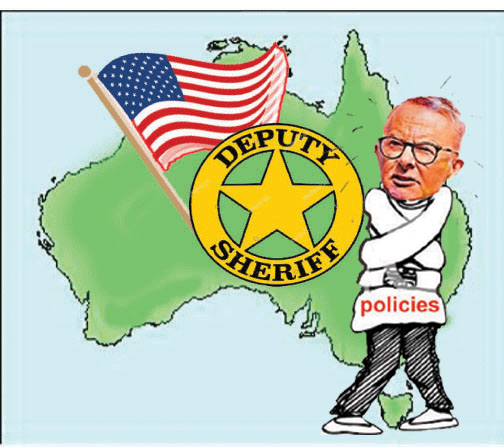
Australian Prime Minister Anthony Albanese has been referred to the International Criminal Court as an accessory to genocide in Gaza, making him the first leader of a Western [Western?] nation to be referred to the ICC under Article 15 of the Rome Statute.
A team of Australian lawyers from Birchgrove Legal, led by King’s Counsel Sheryn Omeri, have spent months documenting the alleged complicity and outlining the individual criminal responsibility of Mr Albanese in respect to the situation in Palestine.
The 92-page document, which has been endorsed by more than one hundred Australian lawyers and barristers, was yesterday submitted to the Office of ICC Prosecutor, Karim Khan KC.
The document sets out a number of actions taken by the PM and other ministers and members of parliament, including Foreign Minister Wong and the Leader of the Opposition, for the Prosecutor to consider and investigate. These include:
- Freezing $6 million in funding to the primary aid agency operating in Gaza – UNRWA – amid a humanitarian crisis based on unsubstantiated claims by Israel after the International Court of Justice had found it plausibly to be committing genocide in Gaza.
- Providing military aid and approving defence exports to Israel, which could be used by the IDF in the course of the prima facie commission of genocide and crimes against humanity.
- Ambiguously deploying an Australian military contingent to the region, where its location and exact role have not been disclosed.
- Permitting Australians, either explicitly or implicitly, to travel to Israel to join the IDF and take part in its attacks on Gaza.
- Providing unequivocal political support for Israel’s actions, as evidenced by the political statements of the PM and other members of Parliament, including the Leader of the Opposition.
Ms Omeri KC said the case was legally significant because it focused exclusively on two modes of accessorial liability.
“The Rome Statute provides four modes of individual criminal responsibility, two of which are accessorial,” Omeri said.
“In relation to accessorial liability, a person may be criminally responsible for a crime set out in the Rome Statute if, for the purpose of facilitating the commission of that crime, that person aids, abets or otherwise assists in the commission of the crime, or its attempted commission, including by providing the means for its commission.
“Secondly, if that person in any other way contributes to the commission of the crime or its attempted commission by a group, knowing that the group intends to commit the crime.”
Ms Omeri KC said the Article 15 communication had been carefully drafted by those instructing her and was now a matter for the Prosecutor to consider.
“The Office of the Prosecutor of the ICC is already pursuing an ongoing investigation into the situation in the State of Palestine, which it has been conducting since March 2021,” Omeri said.
“That includes investigating events which have occurred since 7 October 2023. This Article 15 communication will add to the evidence available to the Prosecutor in relation to that situation.
“The Article 15 communication is of a piece with recent domestic legal cases brought against Western leaders in a number of countries such as in the US, against President Biden, and most recently, in Germany, against, among other senior government ministers, Chancellor Scholz.
“These cases demonstrate a growing desire on the part of civil society and ordinary citizens of Western countries to ensure that their governments do not assist in the perpetration of international crimes, especially in circumstances where the ICJ has found a plausible case of genocide in Gaza.”
Principal solicitor at Birchgrove Legal, Moustafa Kheir, said his team had twice written to Mr Albanese, putting him on notice and seeking a response on behalf of the applicants who make up a large consortium of concerned Australian citizens, including those of Palestinian ethnicity.
Mr Kheir said communications were ignored on both occasions.
“Since October we have attempted communications with our Prime Minister as we reasonably believe that he and members of his cabinet are encouraging and supporting war crimes committed by Israel against Palestinian civilians through their political and military assistance,” Kheir said.
“The Prime Minister has ignored our concerns and given the limited avenues we have for recourse under national law, we have been left with little option but to pursue this Article 15 communication to the International Criminal Court.
“Our communication has been endorsed by King’s Counsel Greg James AM and well over 100 senior counsel and barristers, retired judges, law professors and academics from around Australia who wish to test the strength of international law to hold their own democratic leaders accountable given the barriers we face to do it nationally.
“As lawyers and barristers, it is impossible to sit back and watch sustained breaches of international law while Albanese continues to refer to the perpetrator as “a dear friend.”
A copy of the application can be viewed here: ICC-Referral-Australian-Government-Ministers-and-Opposition-Leader-04032024_BLG.pdf
Or here.
What comes after Rafah
By David Donovan | 22 February 2024, https://independentaustralia.net/life/life-display/what-comes-after-rafah,18353
What will happen after Israeli forces raze Rafah? Founder and director Dave Donovan discusses the ongoing genocide in Gaza and its likely aftershocks.
THIS IS a very important Independent Australia editorial because the world is at a crucial stepping point, a junction, a crisis, where whichever path is chosen will dictate the next 30, or maybe 50, years for global peace.
The crisis is Gaza. The choices are clear. A messy, indeterminate peace or a walk through the tombstones. On from which this world will be – for at least some, and maybe the rest of us – irrevocably altered. A world in which murder and death reign.
Currently, as these words are written, Israel stands on the brink of launching an offensive into the last desperate holdout of the Palestinian people: Rafah.
Israeli nationalists – let’s not dignify their objectives with their favoured demonym, Zionists – weaponise the extremely loaded term, anti-Semitism, to accuse any who object to their expansionary doctrine and indisputable war crimes.
And let us be clear: opposing war crimes is not anti-Semitism. It is not even anti-Zionist or anti-Israel. It is pro-humanity. Our position has been plain and consistent, ever since we began publication. We have indeed held all parties to account in this sphere. We are anti-violence and anti-war.
It is undeniable that not all Jewish people or Zionists are comfortable with the actions of the Israeli Armed Forces in this conflict; nor do all Palestinians endorse Hamas or its actions.
Racism and bigotry are evil but using past wrongs – admittedly horrifying, brutal and evil genocidal wrongs – does not excuse an ongoing mass slaughter, a genocide we have witnessed unfolding night after night on our TV screens, including images of burned and dismembered people, even most distressingly, of babies and small children. No past sin, no sense of self-righteousness, not even the horrific and evil October 7 actions by Hamas, no matter how callous and disgusting, can excuse wholesale slaughter.
But we are on the verge of exactly that.
Let’s make no bones about it, Israel is a rogue state. Netanyahu, Israel’s Far-Right Prime Minister, has repeatedly refused to recognise international law – most recently via the International Court of Justice, which has declared Israel’s current onslaught in Gaza an ongoing genocide – and plans to raze Rafah until the last Hamas fighter is killed.
No one is safe — not refugees, not journalists, not medical professionals, not aid workers.
And so the last of the Palestinians in Gaza will die, even the smallest children, just in case there is a Hamas fighter left among them.
That Australians may be okay with this ethnic cleansing beggars belief. Yet, at best we are complacent onlookers and sadly, more accurately, we are compliant cronies.
And what happens next?
WHAT SHOULD HAPPEN NEXT
The United States should intervene to halt the Israeli Defence Force’s invasion of Rafah. The U.S., the closest ally of Israel, is the only power that could turn it back from its murderous, genocidal intent.
WHAT WILL LIKELY HAPPEN NEXT
After Israel crushes Rafah and sends what remains of the Palestinian people fleeing to refugee camps, perhaps in Egypt, then Israel will, under the guise of eradicating the remaining Hamas terrorists, continue its grand campaign into the Middle East.
Probably first in Lebanon, which it has already begun bombing but wherever territory can be acquired. Then a massive international Islamic force will be mobilised to take on Israel. The U.S. and its allies, including Australia, will step in. World War III.
Total victory in Gaza might be the spark that ignites a global war which has been looming for decades. Russia appears to be spoiling for a war. Global outrage over Israel’s actions is such that the forces which are inclined to oppose America, including Russia and China, will likely use this confrontation to finally mobilise against Israel and the United States.
And if such a war were to occur, which seems likely given any pyrrhic Israeli victory, it would finally end the Zionist dream. One thing is quite certain, irrespective of how such a catastrophic conflagration might end, Israel would be no more.
Israel may win this “battle” against the Palestinians, but it will lose the war. That is what beckons.
Sadly for Australia, when our imperial masters dictate, we will be active participants.
And it would mean that we would once again be needlessly spilling the blood of our children over the “holy land”, as we have done over and over again in numerous conflicts for more than a century.
This is not just a crucial editorial, this is a wake-up call.
Julian Assange judge previously acted for MI6
The judge set to rule on the Assange extradition case was previously paid to represent the interests of MI6 and the Ministry of Defence – whose activities WikiLeaks has exposed.
MARK CURTIS AND JOHN MCEVOY, 19 FEBRUARY 2024
One of the two High Court judges who will rule on Julian Assange’s bid to stop his extradition to the US represented the UK’s Secret Intelligence Service (MI6) and the Ministry of Defence, Declassified has found.
Justice Jeremy Johnson has also been a specially vetted barrister, cleared by the UK authorities to access top secret information.
Johnson will sit with Dame Victoria Sharp, his senior judge, to decide the fate of the WikiLeaks co-founder. If extradited, Assange faces a maximum sentence of 175 years.
His persecution by the US authorities has been at the behest of Washington’s intelligence and security services, with whom the UK has deep relations.
His persecution by the US authorities has been at the behest of Washington’s intelligence and security services, with whom the UK has deep relations.
Assange’s journalistic career has been marked by exposing the dirty secrets of the US and UK national security establishments. He now faces a judge who has acted for, and received security clearance from, some of those same state agencies.
As with previous judges who have ruled on Assange’s case, this raises concerns about institutional conflicts of interest.
Exactly how much Johnson has been paid for his work for government departments is not clear. Records show he was paid twice by the Government Legal Department for his services in 2018. The sum was over £55,000.
Briefed by MI6
Justice Johnson became a deputy High Court judge in 2016 and a full judge in 2019. His biography states he has been “often acting in cases involving the police and government departments”.
As a barrister, in 2007 he represented MI6 as an observer during the inquests into the deaths of Princess Diana and Dodi Al Fayed.
Johnson worked alongside Robin Tam QC, previously described by legal directories as a barrister who “does an enormous amount of often sensitive work” for the UK government…………………………………………………….
Defending the ministry
Johnson has also represented the UK Ministry of Defence (MoD) on at least two occasions.
In 2013, he acted for the department during the high-profile Al-Sweady inquiry, which looked into allegations that “British soldiers torture and unlawfully killed Iraqi prisoners” in 2004.
The MoD’s lawyers said the Iraqi allegations were a “product of lies” and that those making the claims “were guilty of a criminal conspiracy”.
Johnson argued there was “compelling and extensive and independent forensic evidence” to refute the case. The five-year inquiry, which cost around £25m, exonerated the British troops.
Johnson also acted for the MoD in 2011, in an appeal case against Shaun Wood, a Royal Air Force (RAF) serviceman. ………………………….
‘Highest security clearance’
Johnson was appointed by the Attorney General to be a “special advocate” in around 2007, Declassified understands. These are specially vetted barristers who act for the purpose of hearing secret evidence in a closed court.
Special advocates “must undergo and obtain Developed Vetting (the highest level of HM Government security clearance) prior to their appointment”, government guidance states.
Developed Vetting is required for individuals having “frequent and uncontrolled access to TOP SECRET assets or require any access to TOP SECRET codeword material”. ………………………………………………………………………………………………………………………….. https://www.declassifieduk.org/julian-assange-judge-previously-acted-for-mi6/
1 This month

of the week – Australians for War Powers Reform (AWPR)
To see nuclear-related stories in greater depth and intensity
 Antinuclear